
Live: Hurricane Irma Hits Center Of Cuba Hard

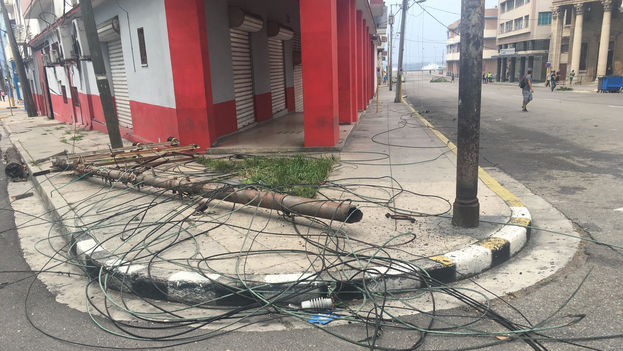
In Havana, Hurricane Irma has begun to cause the first damage with falling electric poles and broken tree branches. (14ymedio)

14ymedio bigger14ymedio, Havana, 8 September 2017 — Hurricane Irma advanced through the archipelago north of the province of Camagüey early this morning, where it touched land in Cayo Romano on Friday night with winds up to 160 miles per hour.

Irma is the first category 5 hurricane whose eye has touched Cuban territory since 1932. On Saturday morning, its maximum sustained winds fell and it became a category three hurricane on the Saffir Simpson scale. Its expanse affected the entire national territory.
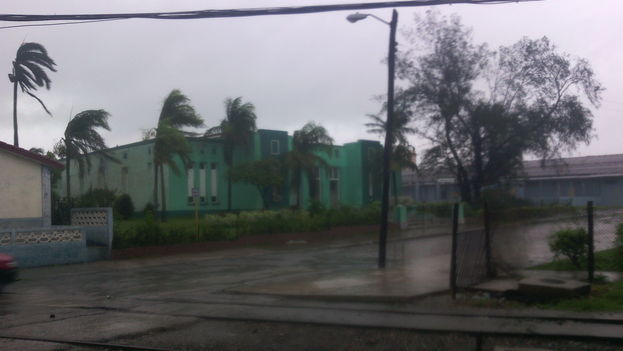
In some regions of Camagüey winds have exceeded 60 mph. (14ymedio)

In the municipalities of Esmeralda and Chambas the rains and the winds have been felt strongly since the dawn of this Saturday and according to reports of the local radio the 13 evacuation centers with the territory of Camagüey are crowded. continue reading

The president of the Government in Camagüey, Isabel González Cárdenas, informed the official media that in the town of Esmeralda there are “severe damages to roofs and facades of state institutions and private houses, fallen trees, breaks in the electrical service, and partial and total building collapses.”

Residents take advantage of a pause in the rains to evaluate the damages in the city of Camagüey. (14ymedio)

As it passes through the province of Camagüey, Irma is causing damage in almost all municipalities.

The slum area popularly called La Fabela in the Bobes neighborhood west of Camagüey was flooded as the waters of the San Pedro River overflowed, but many residents refused to be evacuated for fear of being prevented from returning to their homes.

“There was no way to prepare for this,” said Liset Ávila, 28, who lost all her belongings when the river began to flood. “The wind was terrifying, but what did the most damage was the water, I’ve lost everything,” she laments.

A few yards away, Rafael Suárez does not regret having stayed despite the fact that he can barely move through the water. “I did not evacuate because these houses are illegal and it was very likely that we would not be allowed to return,” he told this newspaper. “Now we only have to wait for the water to go down and start rebuilding what was left.”

For Irma Cáceres what happened is as unfortunate as it is unprecedented. “I’ve never seen such a disaster,” she says, and heading down the street in search of her house of which she can barely see the roof.
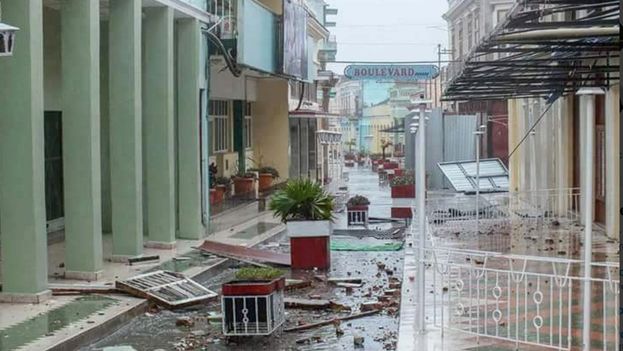
The boulevard of the city of Santa Clara has suffered major damage from the passage of Hurricane Irma. (Guillermo Fariñas / Twitter)

René Fernández Quiroga, a resident of Santa Cruz del Sur, told this newspaper that “tropical storm winds are being felt, there are many fallen trees, telephone cables have fallen and some homes have lost their roofs in the Jacinto González neighborhood.”

During the morning Punta Alegre, sustained winds exceeding 90 mph and there are serious coastal floods, larger than any of the local people remember.

Magalys Cabrera, a resident of that municipality, commented to the 14ymedio via telephone that she has not dared to leave her house but can hear from indoors “the roar of collapsing roofs.”

In the early hours of Saturday, Cabrera peered into her yard and noted with alarm that “all the fruit trees are on the ground,” a situation repeated among the nearest homes.

In Florida municipality, damage reaches the South Coast, where at least 300 inhabitants of this well-known beach have had to be moved to higher areas due to the intense penetrations of the sea that began in the earliest hours of the morning.

Sea penetrations and strong winds have destroyed part of the hotel infrastructure in the area, as well as private homes.

Yulián Arencibia, a specialist at the local meteorological station, said that in the last hours there had been gusts of 85 mph and sustained winds of around 50 mph. Rain gauges recorded over than five inches in just six hours.

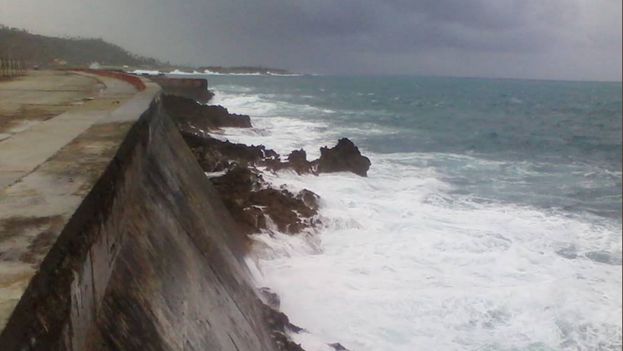
According to the meteorology institute, Irma will continue to move slowly (at about 9 mph) to the west and later will turn towards the west-northwest. Hurricane-force winds may be felt as far as Matanzas, while Havana will have coastal flooding on the Malecon due to the penetration of the sea.

Caibarién, Villa Clara, also has suffered greatly as a result of the persistent rains and the winds that have increased since dawn. The sea penetrated about a third of a mile inland and there are reported gusts of 132 mph and sustained winds of 100 mph.
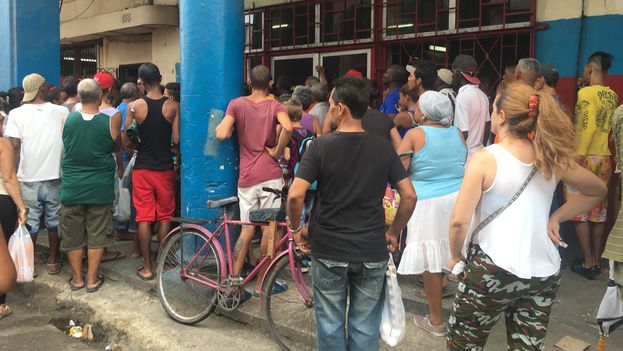
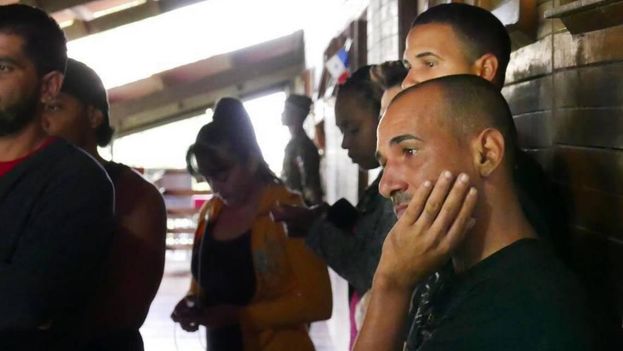
In the Cuban capital people line up in desperation at markets and bakeries in search of provisions. (14ymedio)

The city has lost much of its electrical and telephone lines, which have fallen before the storm, and numerous houses have collapsed. To this alarming scenario is added coastal flooding in the low-lying areas.

In the city of Gibara in Holguin, strong wind gusts have affected dozens of homes and state facilities, according to official sources and the local hospital lost its doors due to flooding.

On the north coast of Ciego de Avila, there have been 16 to 23 foot waves and strong penetrations of the sea.

The greatest damages so far are in the northern keys, where the tourist resorts of Cayo Coco and Cayo Guillermo are located. More than 30,000 tourists staying in the area have been evacuated and the winds have knocked down most of the hotel structures.

The most powerful cyclone ever recorded in the Atlantic has led to the evacuation of more one million people in Cuba so far.

Given this situation, Civil Defense declared the Alarm Phase for the provinces of Mayabeque, Havana and Artemisa, the Alert Phase for Pinar del Río, and the Information Phase for the Special Municipality of the Isla de la Juventud; the remainder of the country has been declared in the Alarm phase.

The municipality of Candelaria in Mayabeque dawned cloudy this Saturday and desperation seized the inhabitants before the advance of the hurricane. In state markets there are long lines to buy eggs and ham, the only products available.

There are no cookies or milk, and bread normally sold unrationed has been temporarily rationed to avoid hoarding. The agricultural markets this morning were offering only sweet potatoes and bananas, while in the state cafes there were only cigars and rum.

Havanans get ready 

The waves have increased on Havana’s Malecon and almost no one is seen walking on the streets, nor is there any traffic. Authorities estimate that about 10,000 people from the height of the Tunnel on Linea Street up to 23rd, plus from the Malecon to Linea Street will be flooded out. Of these 10,000 people, it is estimated that some 7,000 will be placed in the 19 shelters that have been established in the Plaza de la Revolución municipality. The other 3,000 people who reside in this area will move to the homes of family and friends.
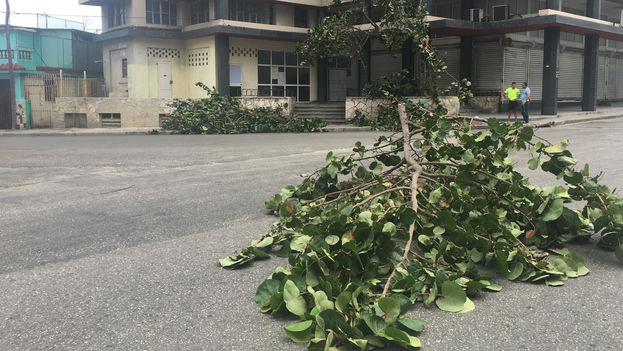
The first branches of trees that are falling in the Cuban capital under the winds of Hurricane Irma. (14ymedio)
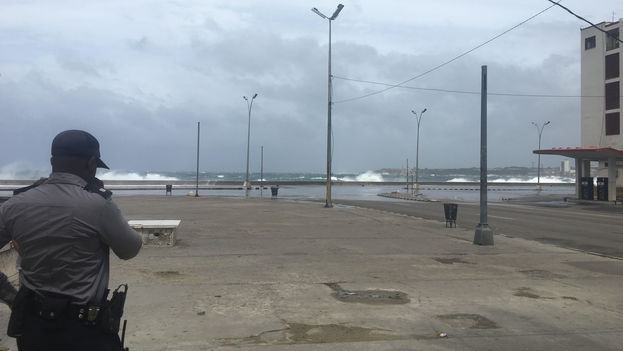
The police blocked access to Havana’s Malecón where the waves are many feet high. (14ymedio)


Cubans Ask Cachita To “Take Pity” On The Island

Thousands of parishioners participated this Friday in the procession for the Virgin of Charity of Cobre, Patroness of Cuba. (14ymedio)

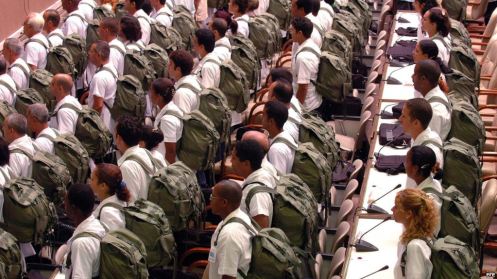
14ymedio bigger14ymedio, Zunilda Mata, Havana, 9 September 2017 — While the winds were pummeling the eastern and central parts of the island, thousands of faithful devotees gathered this Friday in Havana to participate in the procession for the Virgin of the Charity of Cobre, Cuba’s Patron Saint, which is celebrated every 8th September. To the traditional requests for prosperity and health, this year an added request was that Hurricane Irma not cause serious damage to the country.

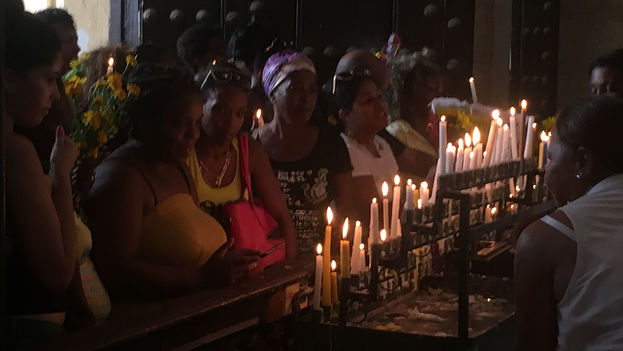
The diocesan sanctuary of Our Lady of Charity, located in the municipality of Central Havana, received thousands of parishioners with flowers and candles. Some also wore yellow clothing in allusion to Ochún, the orisha of santería with which the Virgin of Charity of Cobre is syncretized. continue reading

The image of Cachita, as the island’s patroness is popularly known, left the church shortly after six o’clock in the evening on a procession through several nearby streets. Along the way, there was no lack of devotional displays with petals of flowers thrown from the balconies and songs.

“I came to ask for Cuba and Miami,” Estervina, 82, who had gone to the procession accompanied by three grandchildren, told 14ymedio. “My two children live in Florida and I’m begging Cachita to take pity and dissolve the hurricane.” In her hands, the old woman carried a bouquet of sunflowers.

Others chose to light candles inside the church, although these days the informal market has been depleted of such products due to the high demand sparked by preparations to protect against the most powerful hurricane ever recorded in the Atlantic.

Finding candles for the Virgin of the Charity of Cobre has been especially difficult this year due to the high demand for candles to prepare for Hurricane Irma. (14ymedio)

“Better times will come and I’ll bring you more candles, but this year I only had this one,” says Jorge Luis, a fervent devotee of Cachita. The man prayed inside the church and in his entreaties included “finally having a home of his own and taking a trip abroad.”

From the province of Holguín, Jorge Luis was worried this Friday by the situation of his family in the city of Gibara. “Irma is nearly there and I have come so that the Virgin may help my people to move forward without serious damage, that they do not have physical injuries and that their house is not damaged,” he says.

The archbishop of Havana, Juan de la Caridad García, was also part of the procession with priests and nuns of various congregations, and later he officiated the mass in the temple of Calle Salud y Manrique. During the pilgrimage invocations were made to the importance of family and reconciliation among Cubans.

The procession was heavily guarded by uniformed police officers and plainclothes agents, but no incidents occurred.

This year it was not possible to carry out the traditional procession in Santiago de Cuba, from the Basilica del Cobre, due to the deterioration of the weather conditions.

Cuban Students Rebel Against the Uniformity of the Classrooms

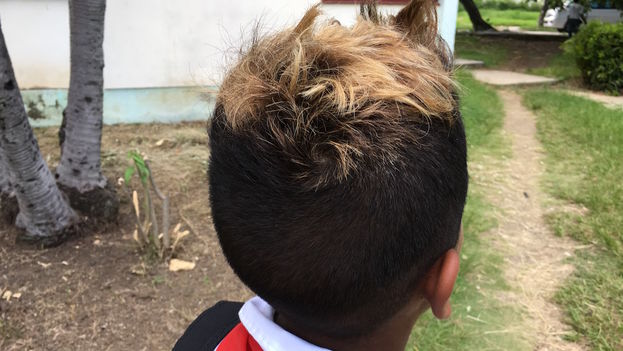
Students are asked to “eliminate” their dyed hair if they want to enter the classroom. (14ymedio)

14ymedio bigger14ymedio, Luz Escobar, Havana, 8 September 2017 – The return to class, for thousands of children and young people, means a return to the discipline of school after two months of vacation. This September, school directors have focused their crusade against fingernails and hair painted bright colors, and students are forced to get haircuts or remove the enamel to conform to the regulations.

In July and August, far from the classrooms, many teenagers chose the strident tones of summer fashion. Red, green, blue and purple have been a trend in hair and phosphorescent colors are favored for fingernails, a rainbow that the schools are not willing to accept.

“I do not want to see anyone here with phosphorescent nails or hair dyed in colors,” warned a fifth-grade teacher on Monday, at the entrance of her classroom in a school in the Plaza de Revolución municipality. The scene has been repeated in schools all over the island, which stick to regulations to limit the creativity of students. continue reading

Julio Mojena, the father of twins residing in the Havana neighborhood of Cerro, considers the restrictions arbitrary since there is no written rule that specifically states them. His sons dyed their hair in August and now, he laments, “they can’t go to class until they get haircuts… In my time it was the length of the hair and the earrings, now it’s the color. What will it be tomorrow?” he asks.

“Each school can make adjustments to school regulations” depending “on the characteristics of their community,” a Ministry of Education official, who prefers to remain anonymous, told 14ymedio by phone.

Although there is no specific regulation on hair color, nails or any other detail, the official maintains that “in the schools uniformity is demanded” in the physical aspect of the student body and that this detail is supported by the general regulations.

The official acknowledges that there was a time when the length of males’ hair was strictly regulated, but that now they may “wear their mane to the collar.” Formerly males’ hair could be no more than just over an inch long.

In the eighties the crusade against hair length and the maintenance of aesthetic uniformity among students even jumped to the pages of the official newspapers. However, the José Martí Pioneer Organization (for elementary schools) and the Federation of Middle School Students did not mediate in favor of those they represent and the students did not win that symbolic battle for differentiation.

Nevertheless, controls have softened over the years, especially since the economic crisis forced families to substitute parts of the school uniform for home-made ones or to buy their children’s school shoes in the hard currency markets as a result of a breakdown in the supply of manufactured products in the ration market.

Now it is common to see students in the regulated garments modified with pleats, raised hems or adjusted sleeves.

Nor do girls and young women escape the restrictions. “In this classroom you come to study and those nails decorated with figures or painted with phosphorescent colors distract the attention of other students,” a Spanish teacher tells his students at Baragua Protest Junior High School in Central Havana.

So far this year, at least ten girls from the school say they have had problems with the manicure they were wearing when the school year began. In contrast, the pressure for them is less in terms of hair; if they dye their hair blond or red it is ignored, although other tones, such as violet, blue or green may not be.

“Reality evolves faster than school regulations,” explains Zulema Vázquez, a sociologist with two school age children. “The teaching authorities have a mentality from the last century and are not prepared to deal with the new situations that are taking place,” she says.

The specialist considers that any attempt at uniformity in terms of physical appearance eventually causes children and adolescents to find more sophisticated ways to differentiate themselves. “It can be the length of the skirt, a piercing, adjustments made to a blouse, the color or the length of the hair, but in one way or another, they will find a way to break the monotony,” argues Vázquez.

María Molina, mother of a teenager in Cienfuegos, told 14ymedio that her 14-year-old son was unable to start the school year at José Gregorio Technological Institute where he is training to be a “teacher of agriculture,” because his teacher and the school’s principal did not allow him to attend with his dyed hair.

According to Molina, the teacher and the director warned that “if you don’t cut your hair or dye it black” he would not be admitted. The mother tried to negotiate an intermediate solution and proposed that the young man cut his hair a little every week until the dyed part disappears, but her alternative was not accepted.

“As a mother I feel frustrated, I called the provincial and municipal education department and everyone repeats that we have to respect the school regulations,” she concludes with irritation.

“This Town Can’t Stand Another Hurricane”

At 11:30 p.m. on Thursday, coastal flooding began in Baracoa. (Venceremos / @ PrensaGtmo)

14ymedio bigger14ymedio, Havana, 8 September 2017 — In El Girasol, a town on the outskirts of the Cuban city of Guantánamo, residents look up at the sky with fear. Most of the houses in the area “can’t stand another hurricane,” warns Yoanni Beltrán, owner of a house with cardboard walls and a light roof that, as of Thursday, has already begun to suffer from the rains associated with Hurricane Irma.

At midnight, the storm was 125 miles northeast of Punta de Maisí on the eastern end of the island and workers at La Rusa hotel felt they were experiencing a déjà vu from Hurricane Matthew, which last October tore the roof off that emblematic lodging. continue reading

“We are here, but we are not offering services because right now it’s about preserving the place to avoid its getting damaged again,” a local employee told this newspaper by phone. Hours after that call, staff were also evacuated in the face of deteriorating weather conditions.

The situation during the afternoon was very different. Juannier Rodríguez Matos, a resident of the city, told 14ymedio that people seemed “too trusting” because the eye of the storm will not pass through the area. “The most worried are those who have spent almost a year living in shelters because they lost everything with Matthew, and now the solution to their problem may be delayed,” said the young man.

At 11:30 p.m. on Thursday night, coastal flooding began in Baracoa and the roofs of several houses collapsed under the force of the winds. Most of the residents in the lower parts of the municipality and within 45 miles of the coast have left their homes to go to shelters, caves, military refuges or the homes of other family members.

In other Guantanamo towns the evacuation continues at a more leisurely pace. “A group of neighbors had the initiative for us to shelter in a kindergarten,” Yoanni Beltran told this newspaper. “A lieutenant colonel of the Civil Defense said that we had to leave and wait for the order to arrive so we can do it.”

Although weather conditions in El Girasol have not deteriorated to the point of building collapses or falling trees, residents fear that the situation will worsen and they will be trapped amid the winds and rain.

The dangers associated with Irma have not loosened police controls or lessened repression. Maykel González, a contributor to the Diario de Cuba site attempted to interview evacuees in Isabela de Sagua; he and his colleague Carlos Alejandro Rodríguez were arrested for reporting.

The police forced the two reporters to erase their interviews and also forced them to undress for a meticulous body search, a situation similar to that experienced by the Periodismo de Barrio (Neighborhood Journalism) team when it tried to cover the damage left by Matthew last October.

In Santiago de Cuba, where the effects of the hurricane had not yet been felt as of midnight Thursday, more than 75,000 people had been evacuated, and in the province of Camagüey 130 shelters are available for those living in areas of greatest danger.

Nora Gonzalez, a resident of Santa Lucia beach in Camagüey, summarized her fears in a more than eloquent way, for this newspaper. “Today you are someone who boasts of prosperity and in a few hours a hurricane passes and you are no longer anyone. The worst thing is that you do not have the strength to start from the beginning.”

Cuba’s Most Pressing Problems / Eduardo Martinez

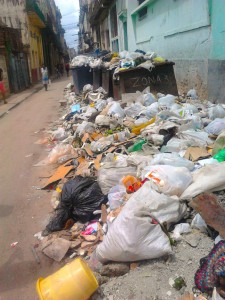
Trash overflowing and collecting around the available dumpsters at Aquila and Estrella Streets in Havana. Photo by Orlando Freire Santana

Primavera Digital, Eduardo Martínez Rodríguez El Cerro, Havana, 5 September 2017 — We list here the most pressing problems faced by average Cubans:

1-A greatly reduced ration book of subsidized foods. High prices in the markets. Very little on offer in the stores. Relatively cheap goods of horrendous quality. In an island surrounded by water there is no fish. Fishing is not permitted.

2-Total sustained inflation of 1000%. Constant reduction of the average Cuban’s buying power. continue reading

3-Almost total absence of locally produced or imported cosmetics and perfumes. Scarce, poor and expensive supply of clothing and shoes. Shortages of detergents, toilet paper, soaps, etc.

4-Terrible public transportation in a constant state of decay. Very expensive taxis. Private alternative drivers greatly harassed by police and inspectors who stringently enforce technical and aesthetic standards for which they provide no support.

5-Extremely high and burdensome taxes imposed on all private businesses, absence of incentives, no wholesale market, absence of low tariffs, barriers to importing, excessive and corrupt bureaucracy, great number of regulations and prohibitions that obstruct free enterprise, etc.

6-Abysmal state of the never-finished National Highway and of urban and rural roads throughout the country, where no work to reverse this situation can be seen. Advanced and irrecoverable (in terms of planning and current economic possibilities) deterioration of the housing stock and all urban infrastructure. Railway lines that are technologically backward, save those that have to do with access to the Port of Mariel.

7-Obsolete airports. New and more severe customs restrictions on the entry of merchandise and products when in fact the opposite should be the case, if the objective is to incentivize minimal but effective commerce. Impossibility of importation by private individuals or entities.

8-Dual monetary system*. When the Cuban Convertible Peso (CUC) is eliminated it will leave only the Cuban Peso (CUP) along with the exorbitantly high current prices. A median monthly salary consists of little more than 300 CUP monthly, while the cost of living for that same period is 2500 CUP.

9-High unemployment, not officially recognized.

10-The presence on the streets of a high number of uniformed police officers, members of State Security, and of inspectors who obstruct private enterprise and public life.

11-Exceedingly high emigration, especially of young and highly qualified professionals. Very low birth rate and very rapid aging of the population.

12-High housing deficit. Scarce and very expensive construction materials. Properties being bought-up by foreigners hiding behind national residents, incentivized by (for them) low real estate prices compared with those in their own countries.

13-Highly censored news media that don’t report on many matters of national and international interest. Scant possibility of accessing the Internet. Dreadful radio and television programming. Culture that is mediated and restricted by a Ministry that inhibits and prohibits more than it encourages, supports or represents.

14-Bad education with non-systematic improvisation of evaluative measures (such as oral exams for the 12th grade). Low expectations of students, indifference and apathy on their part for a future devoid of interest.

15-Bad medical and health services throughout the Island in light of the acute shortage of professionals for so many residents. Chronic absence of primary and secondary medications. An abusive black market in health care and products. The appalling state of public hospitals. Full waiting rooms but an extreme dearth of personnel given the exporting of the healthcare labor force to work in foreign countries in exchange for hard currency paid directly to the government.

16-Very little possibility of accessing recreation centers.

17-Violence, aggressiveness and widespread coarseness in the streets. High social indiscipline as a consequence of the sharp and sustained economic crisis in the country. The appearance of uncollected trash heaps around insufficient or very deteriorated garbage cans–founts of stink, mosquitoes and disease–on the corners of not very privileged or centrally located neighborhoods. The appearance of legions of dumpster divers (barehanded garbage pickers, usually old or chronically displaced persons) in search of recyclable aluminum cans, empty soda bottles that can be sold to private entrepreneurs, remains of edible food, anything that can be sold to unsuspecting buyers, etc. These ladies and gentlemen care little about order and hygiene, and they contribute to the nation’s urban disaster.

18-The ruling class is not interested in any type of aid from the North Americans, for they fear that–as will happen anyway, as is in fact already happening–their power will quickly slip through their fingers, and in six months time this country will become another Puerto Rico.

eduardo57@nauta.cu

Translator’s Notes:

*Cuba has two currencies: Cuban pesos (CUP), worth about 4 cents US, and Cuban Convertible pesos (CUC), each worth 25 Cuban pesos, or about one dollar US. It has been a longstanding, but as yet unfulfilled, promise of the government to move to a single currency.

Translated By:  Alicia Barraqué Ellison

Cuba Awaits Irma, One of the Most Powerful Hurricanes in its History, With Empty Markets

14ymedio bigger14ymedio, Marcelo Hernandez/Mario Penton, Havana-Miami, 6 September 2017 — After devastating Antigua and Barbuda, Hurricane Irma continues to approach Cuba with sustained winds of more than 180 miles/hour. The islander’s residents are anxious buy food, candles and materials to reinforce doors or windows but the chronic shortages of the last weeks are aggravated by the increase in demand.

In Baracoa, one of the cities that is most afraid of the approach of a new hurricane because it has not yet recovered from the previous one, people took to the streets this morning in search of food that does not need refrigeration and that can withstand the scourge of humidity, but found very little to buy. continue reading

“There are no cookies nor milk powder, nor are they selling candles and the bakeries have had very long lines since dawn,” Humberto López, a resident of the town whose home lost its roof during Hurricane Matthew, lamented on the phone, adding that he did not want “that monster come here.”

The Cuban economy has suffered since the beginning of the economic crisis in Venezuela. This year Raúl Castro’s government announced a cut of US $1.5 billion in imports in the first half of the year, with a direct effect on the retail market.

Despite an increase in remittances and tourism, the Cuban economy depends to a large extent on contracts signed with Caracas, which supplies some 60,000 barrels of oil a day in exchange for thousands of Cuban specialists camped out in its territory.

Cuban authorities have declared a hurricane alert for the center and east of the country, the step that precedes the hurricane alarm, just as the winds begin to beat the island. So far this century, Cuba has faced about 15 hurricanes with losses of more than 26 billion dollars, according to official figures.

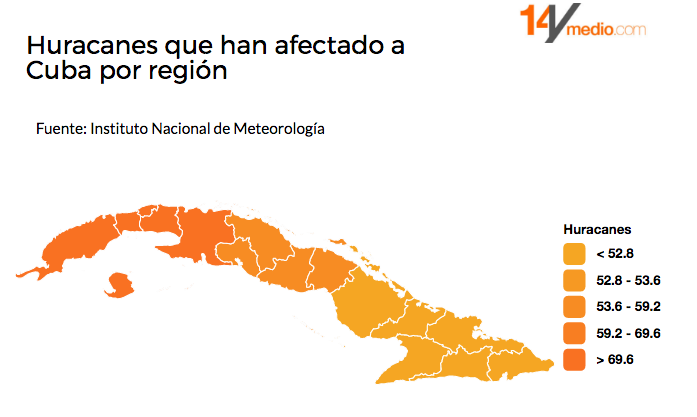
Hurricanes that have hit Cuba by region. Source: National Meteorological Institute.

In the market at 3rd and 7th streets, in the west of the Cuban capital, the number of customers has not yet increased significantly, but in the the stores refrigerators this Wednesday there are only chicken pieces, hotdogs and a few packets of ground meat. The most cautious are, for the most part, owners of private businesses who don’t want to run out of supplies.

“There is no toilet paper, there are only small bottles of water and milk there is nothing for days,” laments Yusnier, a young entrepreneur who helps his mother rent three rooms to tourists. “We have to guarantee the foreigners breakfast every day and this hurricane puts everything at risk.”

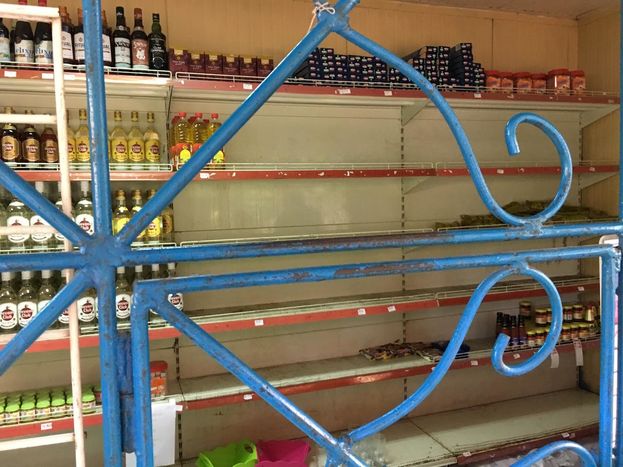
These were the shelves of Nuevo Milenio market in La Timba this Wednesday. Without milk, tomato sauce or tuna, dozens of Havanans came to the store to stock up on provisions. (14ymedio)

If Irma were to hit the island as a category 5 storm on the Saffir Simpson scale, it would enter the record books as one of the most powerful hurricanes ever to hit the largest of the Antilles; since records have been kept, starting in 1791, only three hurricanes of this intensity have reached the Cuban coast.

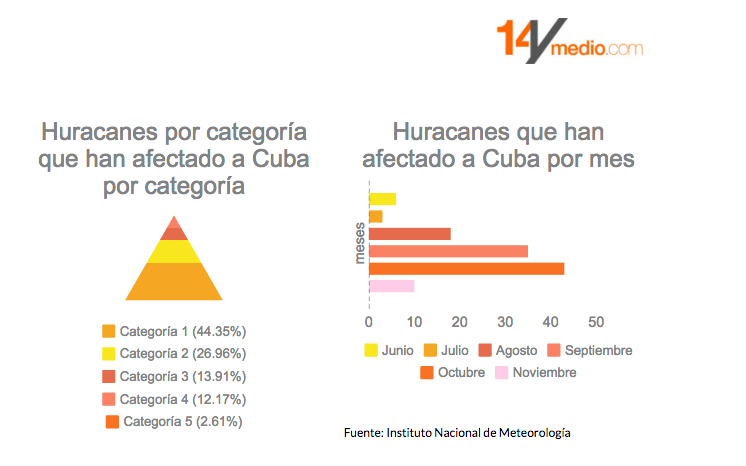
According to data from the Institute of Meteorology, 115 hurricanes have hit Cuba since 1791. Of these, 14 hurricanes had an intensity in the winds between 130-156 mph, corresponding to category 4 an the scale and about 16 reached category 3 (111-129 mph).

In the main agricultural markets of the capital, people’s anxiousness to store food is already apparent. A pound of black beans, which costs the official salary of a working day in places such as San Rafael Street or 19th and B in Vedado, were selling like hot cakes as of yesterday afternoon. “It’s something that does not spoil and that can withstand rain and wind,” said a customer this morning in front of a display of chickpeas.

Left: Hurricanes that have hit Cuba by category. Right: Months in which hurricanes have hit Cuba.

On a tour of hotels near the coast of Havana it is not yet possible to see the warning signs. “The city has not yet been formally put on alert so we do not have the authority to allocate resources to cover the windows or take other protective actions,” an employee of the Deauville hotel, who preferred to remain anonymous, told this newspaper.

The cays located in the north of the island, one of the main tourist centers of the country, are among the most affected. At a time of increases in tourism, Irma could force the authorities to carry out mass evacuations of travelers from the areas in greatest danger and move them to other tourist centers, in a country with a hotel capacity, as of the end of 2015, of only 63,000 rooms.

The authorities have warned that the main dangers associated with Hurricane Irma are wind, rain and sea penetrations. In 2008 the penetration of the sea in Baracoa, the first city founded in Cuba, completely destroyed its malecón and the first row of houses of that city. That image was replayed with the scourge of Hurricane Matthew and could be repeated with the approaching passage of Irma.

Under Raúl Castro, Cuban Education Has Lost Teachers And Budget

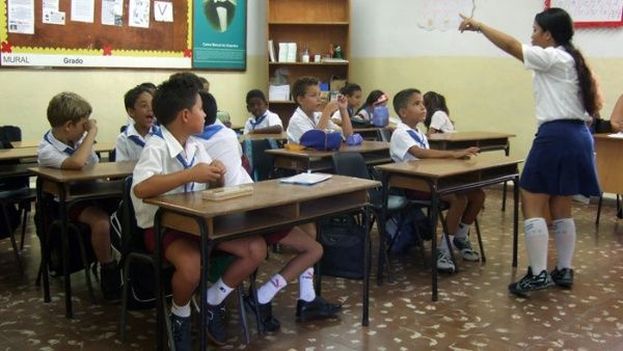
The country needs 16,000 more teachers to cover the deficit in all areas of education. (Telesur)

14ymedio bigger14ymedio, Mario Penton, Miami, 31 August 2017 — The red and white uniform has been washed and ironed for two days; next to it, a blue neckerchief. Eddy Alberto is eight years old and is starting the second grade at the Héroes de Yaguajay elementary school in the province of Sancti Spiritus. When he grows up, he wants to be a teacher and he has been asking his mother about the beginning of school for a week.

“On Monday, the tragedy begins again,” says Yanelis, Eddy Alberto’s mother, by telephone. “Last year they were three months without a teacher and according to what a teacher’s aid told me, this year they don’t have anyone either. They are going to put the librarian in charge of teaching them,” she adds with annoyance.

On September 4, more than 1,750,000 students will begin the new school year in Cuba. There will be 10,698 educational institutions opening, but some problems, such as teachers for all classrooms, continue to drag on from year to year. continue reading

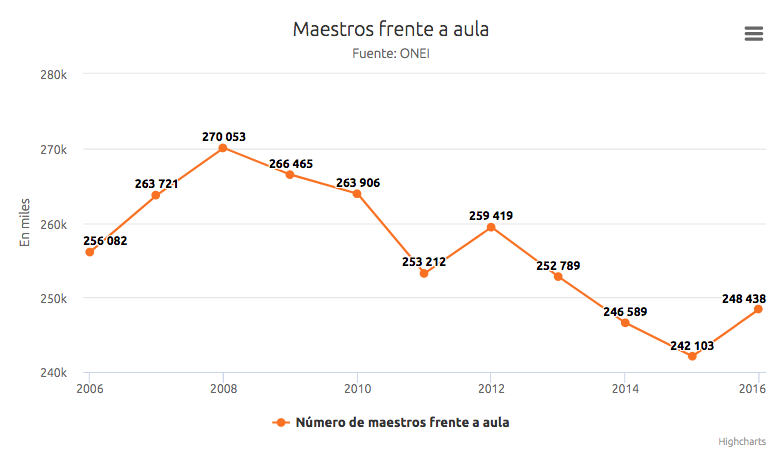
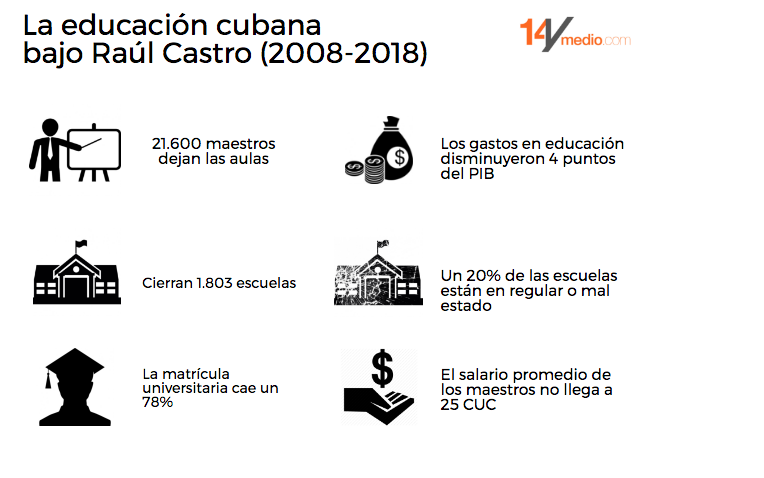
According to official data from the National Office of Statistics and Information (ONEI), in 2016-2017 there were 248,438 classroom teachers, some 21,600 fewer than in 2008 when Raul Castro became president.

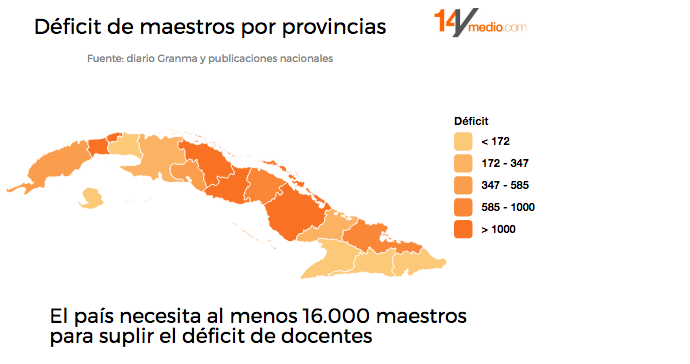
The country needs 16,000 more teachers to cover the deficit in all areas of education. In addition, between 10,000 and 13,000 teachers are on staff but out of the classroom for personal problems or maternity leave, as recently acknowledged by the Minister of Education, Ena Elsa Velázquez, in an interview with the magazine Bohemia.

Deficit of teachers in Cuba, by province: The country needs at least 16,ooo more teachers. (14ymedio)

To remedy the exodus of teachers, the minister proposes several options: the hiring of teachers, the reinstatement of retirees, and the use of university students as teachers at other levels. Velázquez also said that her Ministry has created “a system of moral encouragement” for teachers. Some provinces, such as Guantánamo and Santiago de Cuba, will send teachers to others where the need is urgent, such as Matanzas and Havana.

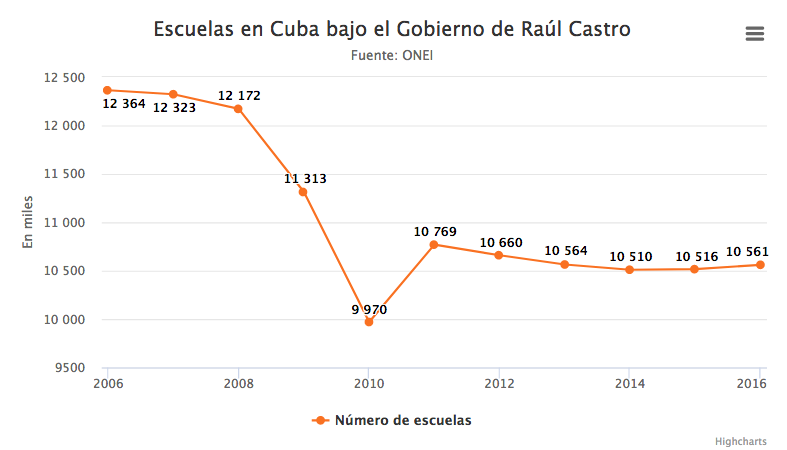
Since taking office, first as interim president (2006) and then as president elected by the National Assembly (2008), Raul Castro substantially reduced the budget of the Ministry of Education. Expenditure on Education fell by 5 percentage points as a share of Gross Domestic Product, from 14% in 2008 to 9% in 2017, as it appears in the Budget Law approved last January by the National Assembly. During this period, 1,803 schools were also closed, according to official figures.

Number of schools in Cuba under Raul Castro’s government. Source: Cuban National Office of Statistics and Information  (ONEI)

“The problem is that nobody wants to be a teacher because they pay them very little and they exploit them a lot,” says Yanelys.

Last year the Ministry of Education provided a salary increase of about 200 Cuban pesos for teachers with a greater teaching load. Even so, the average salary of an education professional is around 533 Cuban pesos, a little more than 20 dollars a month.

The reduction of resources has had a direct impact on the quality of the education system. According to the minister, more than 20% of school facilities are in a state between regular and bad.

The lack of encouragement to study education has been recognized by the same authorities, who saw with astonishment that only 58 undergraduates opted for three of the university teaching courses of the more than twenty that were offered in the province of Cienfuegos.

Numbers of classroom teachers in Cuba. Source Cuban National Office of Statistics and Information  (ONEI)

“For a long time, coverage and quality, as well as accessibility to the educational system, made Cuba one of the most lauded countries in Latin America,” explains the Cuban academic Armando Chaguaceda from Mexico.

However, he believes that many professionals have been lost “because there is not an adequate attention to the teacher.”

“They spent much more money on the training program for ‘emerging teachers’ than on simply recognizing the value of the work of thousands of self-sacrificing teachers,” he explains.

At the beginning of the 21st century, then-President Fidel Castro created the Teaching Schools for Emerging Teachers and Integral Teachers, which in just a few months prepared primary and secondary school teachers to make up for the exodus of professionals. After nearly a decade and thousands of graduates, the teacher deficit continues.

Education under Raul Castro; 21,600 teachers leave the classrooms; 1,803 schools closed; 78% fewer university students; education expenditures drop by 4% of GDP; 20% of schools are in regular or bad condition; average teacher salaries don’t exceed 25 CUC monthly (roughly $25 USD)

The director of the Center for Coexistence Studies, Dagoberto Valdés, acknowledges that the country is facing a major challenge: “The civility and ethical and civic education of children leaving schools is shameful. It is something that marks the culture of our people,” he says.

Convivencia, a think tank in the province of Pinar del Río, prepared last year, as part of its Thoughts for the Future of Cuba, a report with concrete proposals on education.

“There is a serious demographic problem in the country that is already reflected in educational enrollment. There are fewer and fewer people who enter the education system and graduate,” laments Valdés.

The number of graduates with university degrees has fallen as sharply as enrollment, which has fallen more than 78% in the last decade.

“We believe that a true educational project is needed that integrates both the school and the family and civil society, without ideological shading, but based on the cultural heritage of the nation, from [Father Félix] Varela to [José] Martí,” he dreams.

Cuba’s Public Phones Persist in the Smartphone Era

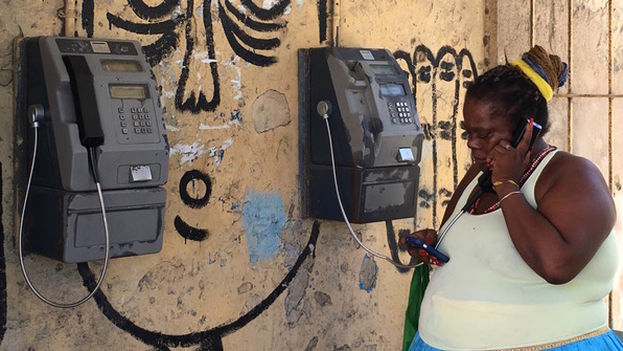
Using a mobile phone as a pager or to receive messages while making the calls from a public device is a solution that many customers chose to avoid the high prices of Cuba’s state phone company’s cellular service. (14ymedio)

14ymedio bigger14ymedio, Luz Escobar, Havana, 5 September 2017 — The young touchscreen generation looks at them with curiosity and the new rich keep their distance, but there are Cubans for whom public telephones continue to be an important way of communicating in the face of the high prices of the mobile service.

Making local calls from public phones is much easier on citizens’ pockets than using a cellphone. On the public phones, callers only have to pay 0.3 Cuban pesos (CUP) per minute during the day and 0.2 CUP per night (1.0 CUP = 4¢ US). For longer distance calls, such as between Havana and Santiago de Cuba, the price is set at 1.0 CUP during the day, 0.5 CUP at night, and after eleven PM it only costs 0.1, meaning a ten minute call can be made for the equivalent of just 4¢ USD. continue reading

In countries like France or England public telephones are on the verge of extinction, given the advance of cellular networks. In Spain, despite being a very deficient service and with an 84% decrease in available phones in the last 15 years (from 55,000 to 18,000 nationwide), the service is still required by law and the company with the concession was forced to renew its contract in 2017, when a public tender received no takers. As in Spain, the Cuban government is committed to maintaining, through the Telecommunications Company of Cuba (Etecsa), a service that is used by lower income citizens.

At the end of last year, the country operated 59,818 public phones, including 8,588 coin operated phones. For this year, the state communications monopoly plans to install 500 new public phones, of which 45 are intended especially for people with disabilities.

At the end of 2015, the country had only 1,333,034 fixed lines – in a country with over 11 million people – of which 996,063 served the residential sector, according to data from the Statistical Yearbook published by the National Office of Statistics and Information (ONEI). The installation of phone lines in homes has grown very slowly in recent years and between 2010 and 2015 just over 185,000 lines were added throughout the country.

Along with the poor quality of bread and the transportation problems, the problems with public phone service dominate the criticisms most heard on the streets and raised in the local People’s Power Accountability Meetings, where people can sound off to their elected officials. Deterioration, vandalism and the scarcity of phones in heavily populated areas are the subject of complaints.

Raquel Stone, a commercial specialist for ETECSA’s Public Telephone Services Division, told the official media that every year the company must repair thousands of public phones rendered unusable due to vandalism. The most common damage is having the handset pulled out.

Repairing the equipment represents an expense of 1,000 Cuban convertible pesos (CUC, 1 CUC = roughly 1 USD) for each coin-operated device, and between 330 and 400 CUC for each device that operates only with prepaid cards.

“The publics,” as they are popularly called, are in high demand not only among those who cannot afford a cell phone, but also among those who carry a cellphone so they can be reached, but make most outgoing calls from the devices located in the streets.

At the end of 2015, the country had only 1,333,034 fixed lines, of which 996,063 provide services to the residential sector, according to the Statistical Yearbook published by the National Office of Statistics and Information (ONEI).

“If I call you and hang up on the second ring, it means I’m going to see you, but if I call you and let it ring, I can’t go,” a teenage girl shouts from the sidewalk to her friend who had just gotten on the bus. “But don’t pick up because I have almost nothing left on my cell,” she adds. The 0.35 CUC it costs for each minute of a cellphone call represents approximately half the daily salary of a professional.

In spite of these rates, in July of this year the number of active cellphone lines in the country reached 4,313,000. The growth experienced since Cubans were first authorized to contract for the service, in 2008, still places Cuba at the tail end of Latin American countries.

Only 35.5% of the Cuban population has access to cellular service, in contrast to nations such as Panama, where usage surpasses the number of inhabitants and is at the top of the region, with a 172% penetration rate for cellphone service. In Guatemala the rate is 115% and in Puerto Rico 88%.

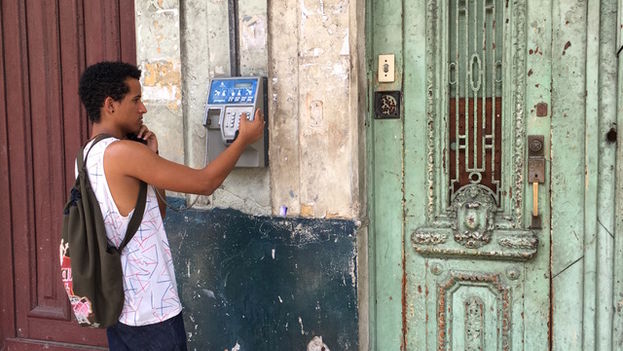
Aníbal Lorenzo, a 32-year-old pedicab driver who has been living in Havana for two months, is one of millions of Cubans who can not even dream of a cell phone. To maintain communication with his family in Guantánamo, he purchased a prepaid card that he uses on the public network. The worker laments that coin-operated phones almost never work.

“I have searched all the phones that are on Amistad Street,” he says while testing several unsuccessful phones. A few feet away, a young woman picks up a headset and hears the ringing tone, but before she starts to talk, she takes out a handkerchief from her purse and cleans the area near her mouth. “They are always dirty and stink,” she complains.

The telecommunications company has installed some public telephones in funeral homes, hospitals and pharmacies. The caller must dial 1-69-69 and charge the amount to the recipient of the call. The option is little known yet, but it can get one out of a bind.

“They stole my purse on the bus and a man told me that in a nearby Emergency Room there was a telephone that had that service,” says Rosaura, a young architect who before that incident not “touched a public phone for more than five years.” Now, she recognizes that in certain situations you have to go back to the old fashioned way.

In the last decade, attempts have been made internationally to offer new uses from public phone booths. In Spain for example, in addition to accepting payment by credit card, some have enabled the possibility of sending emails and SMS to mobile phones. Despite this, it has not been possible to avoid a fall off of 84% in this service in just 15 years.

In France phone booths have become public libraries in some localities, while in London the legendary red wooden cubicles are leased to small business owners who have turned them into small businesses, such as craft shops or tiny florists.

In the imposing building on the corner of Águila and Dragones streets, the ETECSA headquarters is located in a property that belonged to the American company AT&T more than five decades ago, when it was nationalized. In one of its rooms, a museum preserves several models of the first public telephones that were installed in the Island.

“All this is active thanks to a group of retirees who maintain the equipment,” says María del Carmen, one of the local workers. “In telecommunications schools, only new technology is taught now,” and these pensioners are “the only ones who have mastered these devices.”

A few yards from María del Carmen, a young woman receives a call on her cell phone while waiting to pay her telephone bill. She responds hurriedly and with short phrases. “Hang on, I’ll call you from an public phone,” she says as she looks around at the nearest devices.

The New Electoral Guardians

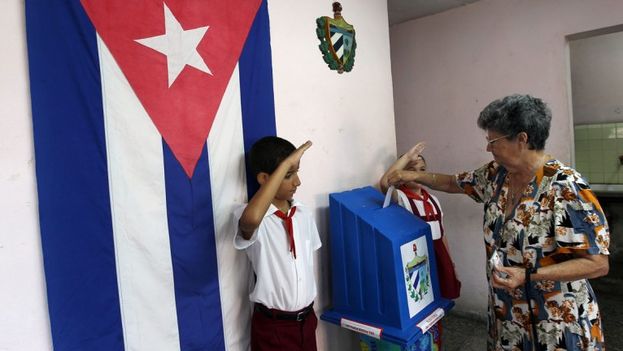
A woman participating in the municipal elections in Cuba is saluted by two schoolchildren as she deposits her ballot. (EFE)

14ymedio bigger14ymedio, Reinaldo Escobar, Havana, 4 September 2017 — The Cuban elections have several publicized trademarks, among them the presence of children dressed in the school uniform to guard the polls. These Pioneers* confirm with a salute when the voter deposits their vote, in contrast to the armed soldiers who in the Republican past prevented the theft of the ballot boxes.

For four decades, the presence of these Pioneers has become a favored image of photographers and a symbolic gesture, in its double meaning of a signature act or uselessness. It is clear that no one is going to manipulate the ballots since all the legitimized candidates represent the interests of the only permitted party. continue reading

This September 4 is the first step in a process that will end on February 24, 2018, when Cuban citizens will find out who has been designated to fill the seats of the Council of State, particularly its president. This Monday the process starts as a “pilot experience” in a single constituency of each of the country’s 168 municipalities. Voting will take place in the other constituencies during the month of September.

The Government is concerned that these candidate nominating assemblies will allow an unwelcome candidate to make it through. Not only do they fear an opponent who belongs to an anti-government organization, but in a secluded district someone might appear who has the reputation of not applauding with sufficient enthusiasm.

To prevent such a thing from happening, the allegorical appeal of the Pioneers as guardians of the ballot boxes is of little use. With plenty of time in advance, a harsh-demeanored seguroso—State Security agent—will have visited anyone who intends to run independently.

It will not be necessary to show the ‘instruments’ to the nonconforming, it will be enough to warn of the fatal consequences that such daring might bring. Someone will remind them that they have a grandparent admitted to the hospital, a child who hopes to be a college student some day, a brother who is applying for a license to be self-employed, or a pig that fattens in their yard without permission.

If the threats do not take effect and the disobedient show up to be proposed in the nomination assembly, the work will be finished by the militants of the zone’s Party nucleus, who will have been schooled in the darkest corners of the biographies of the intrepid candidates.

Without modesty or shame they will point out some baseness such as “if he has been unfaithful to his partner, how can he be expected to be loyal to his constituents”; or mention that he buys on the black market or never shows up to perform voluntary work. Finally, the duly warned participants will be asked by a public show of hands whether the discredited aspirant will be nominated as a candidate.

On this occasion a new resource will come into play. The youth brigades of the 9th Congress of the Committees for the Defense of the Revolution (CDR) have programmed their agenda of activities precisely during the time period in which the nominating assemblies are held.

The initiative, which aims to carry out volunteer work and tour historical sites in tribute to the great CDR event, counts among its efforts “to support the assemblies where the people propose their candidates,” and everyone knows what this means. As Red Guards they will be watching over the purity of the proposed from the very genesis of the process.

The ballots will only bear the names of the most obedient and when the time comes to deposit them in the polls, the innocent Pioneers will have nothing to worry about.

Translator’s note: Cuban children are initiated into the Communist Party’s Pioneer movement in early elementary school and continue until adolescence, when they are expected to join the Young Communist League. The Pioneer’s motto, shouted by the children at school assemblies, is “Pioneers for communism: We will be like Che!”

“To Set Men Against Men is an Appalling Task”

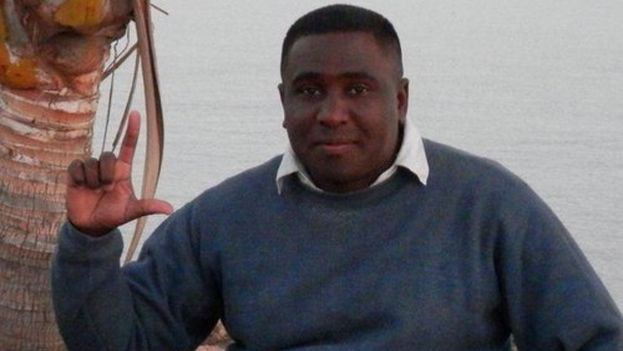
Iván Hernández Carrillo. (Twitter / @ivanlibre)

14ymedio bigger14ymedio, Rosa Maria Paya, Miami, 4 September 2017 — In the early hours of September 1st they did it again. It happened just as it did 14 years ago when, in March of 2003, the Cuban regime arrested dozens of Varela Project activists and independent journalists. This time the assault lasted 10 hours.

Listening to the narration of the vexations perpetrated by the political police at the home of the former prisoner of conscience Iván Hernández Carrillo was like reliving the horror unleashed in 2003, when the repression tried to abort Cuban Spring, as my father, Oswaldo Payá, called the historical conjuncture where the dictatorship felt more exposed and cornered than ever. continue reading

Over two days, the repressors of the Ministry of Interior broke into the houses of most of the leaders of the Varela Project, most of whom were dear friends of our family. The triggering cause was that this legal initiative was getting the support not only of civil society, but also of a large part of the citizenry, which was sufficient reason to imprison 75 peaceful opponents throughout the island. On that occasion the searches seemed to go on forever, as they do today, and were and are brutally humiliating.

Iván Hernández was beaten at the doorway of his home where he lives with his family, in the municipality of Colón, Matanzas province. It was before dawn, when the family was still asleep. He asked for some time to get dressed before opening the door and it was then that they broke down the door and opened it by force.

The police entered with two German shepherd dogs. With great violence they pushed him against the wall while twisting his neck.

They immediately put handcuffs on him with his hands behind his back and did the same to his mother, Asunción Carrillo, a lady of 65 years. Then the two were pushed into the patrol cars, and arbitrarily detained until the evening.

Then the search began, followed by the robbery. About 50 people, including police, special troops and State Security agents, minutely searched every space in the house, including the garbage bins. They took everything they found in their path: both the cell and landline phones, fans, computer, old fax machine, a tablet, the clock, the television, all the family’s work and personal papers, the scarce office supplies, pencils, pens, staplers. Like neighborhood shoplifters, even some of clothes and shoes were stolen.

They also took away all the books, about 2000 volumes collected for years and years, which made up the family’s independent library and private collection. All were books that they made available to the community as loans, completely free of charge.

In this way, the entire collection of José Martí’s Complete Works was stolen, which State Security’s G-2 officials probably have not read nor will read, ignorant of even the phrases of reproof that the man we Cubans call ‘the Apostle’ dedicated to Marxism, as a doctrine of hatred: “To set men against men is an appalling task,” José Martí wrote, on the occasion of Marx’s death.

But, just like 14 years ago, the main message of this police attack is not aimed at the courage of the opponents attacked, but rather, it aims to discourage their families, neighbors, friends, and other Cubans, wherever they live. The message is terror in its pure state: that was the source and will be the legacy of the so-called Cuban Revolution. The goal is the paralysis of our people. The reason is the fears of a regime that knows itself to be vulnerable.

In truth, this cruelty exposes how weak the elite corporate-military perceives itself to be, though by now it certainly has all the power in Cuba and has hijacked our national sovereignty; but it didn’t know, does not know and will never be able to deal with differences, which is why it only attempts to annihilate them.

But the task of exterminating differences is humanly impossible, the socioeconomic system in Cuba failed decades ago and the dynasty has nothing to offer. That is why it represses without question, but that is also why it must disappear as a regime. We are much closer to freedom today than it seems to them with their atrocities. Because Cubans, like all other human beings, want to be the owners of our own lives (lives in truth, not in faked loyalty), to be able realize our most creative ideas, and to take advantage of the opportunities that we ourselves are capable of creating.

For this noble cause, Iván Hernández works with many others, promoting the Cuban people’s right to decide through the citizen campaign Cuba Decides, to which all are invited. The democratization of a country that does not deserve to be left out of the assembly of contemporary societies is a cause that cannot fail. It is the cause through which, sooner rather than later, the Cuban nation will rise.

Judge and Press

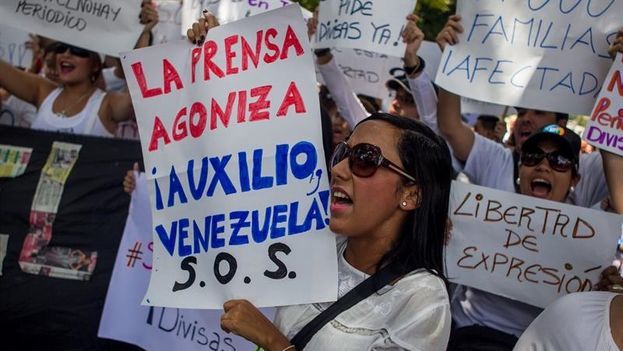
Archive image of a protest by journalists in Caracas. (EFE)

14ymedio bigger14ymedio, Yoani Sanchez, Havana, 3 September 2017 — The man approaches a dilapidated Havana kiosk and buys the latest copy of the newspaper Granma, the official organ of the only party allowed. The situation, extreme like almost everything that happens in Cuba, is only a small part of the tensions that journalism is experiencing in Latin America, the most lethal region on the planet for the press.

The continent, where several of the patricians who promoted independence also exercised the profession of journalism, has become a hostile place for reporters, a minefield for the media. Now, every written word can send its author to court or even to death.

In many of our countries, families would prefer their children to become civil servants or gang members, rather that become cannon fodder for a newspaper. “You’re going to end up underground,” the mother of a Salvadoran reporter has repeated for years when she finds him searching for data or gathering the pieces of an investigation. continue reading

In the absence of solid institutions, the press has unduly been awarded the role of prosecutor, ombudsman and comptroller. With all the risks that this entails.

That role transcends the boundaries of the profession and has created excessive expectations among readers. Before it was the redeemers or the caudillos who came to save a nation, now many expect these hybrid beings – a mixture of kamikaze and journalist – to be willing to sacrifice themselves for them.

The darkest scenarios these information specialists find on their path are where impunity or populism reigns. They are the targets of insults or bullets in countries where democracies fail and insecurity reigns. There is no clearer sign that a system has been shipwrecked by authoritarianism or has become a failed state than the way it treats the press.

Where institutions are collapsing, the dangers faced by reporters are greater. A system that cannot protect its citizens, will start by failing to support those who report or those who put in writing the generalized defenselessness.

Nicolás Maduro’s Venezuela, Raúl Castro’s Cuba, or the Nicaragua of the late Daniel Ortega are some of the geographical points where reporting reality means exposing yourself to reprisals from power. But the list of territories adverse to investigative journalism includes many more nations in the region. In Mexico criminal groups see journalism as a more deadly enemy than military operations.

Poorly paid, even more poorly valued and with working days that know no limits, a good share of Latin American journalists feel that the dreams that led them to take on a profession were more of a mirage than a reality. They have reached this conclusion not only because of the lack of professional and material support, but especially because of coercion.

The defensive response to repression and punishment has been – in many cases – to avoid the street, to choose to do desktop journalism or to rely on the great evils that the recently deceased teacher Miguel Ángel Bastenier described as “declarationitis, officialdom, hyperpoliticization, and international omission.”

The uncritical reproduction of official declarations in the insipid environment of a press conference is complemented by genuflections to the ruling party, because it is from “up there” that the press credentials are distributed for the next event, privileges are administered and jobs in the public media are filled.

The excess of politics is also expressed with those series of stories about the internal workings of government palaces instead of addressing human stories. A press that survives off the party entrails and the fights between its figures has taken possession of the media scene.

“The prideful villager” that José Martí spoke about discovers the warm water in the midst of the ocean of needs that defines Latin America. Turning one’s back on the other has become a form of protection and reproducing in the newspaper headlines what happens on a diplomatic scale among the nations of this continent: so close and so separate.

However, the strongest effect brought about by repression is withdrawal, locking oneself in the glass bubble of a newsroom and writing from a distance. Screen and keyboard reporters swarm everywhere. Flesh-and-blood stories are missing while analyses abound.

The editors know that each headline can become a declaration of war in these places and, in most media, the red lines are added not by the publisher but are marked by threats or expediencies.

The journalist and Spanish professor Bernardo Díaz Nosty describes in his book Dead Journalism the string of obstacles faced by the reporters of our continent. Dictatorships on the one hand, impunity on the other, and narco-power, which manages large regions – as if they were countries in question –make up most of those risks.

At the top of this scale of terror are disappearance and death, although “before the assassination, there usually comes the harassment of the journalist and his relatives, physical assault, stigmatization, extortion,” says Díaz Nosty.

“All this leads to the breakdown of professional independence, the renunciation of the practice of journalism, and exile, if not to capitulation and surrender to the conditions established by the enemy,” he points out in his book.

Writing about organized crime, drug trafficking, money laundering or political corruption can be a death sentence in these places. The lack of a state response to actions against information professionals increases the feeling of lack of protection.

Worse yet, many governments in the region have chosen to kill journalism. To achieve that murder – without leaving too much evidence – they develop an extensive network of threats, legal punishments and controls. Not to mention, of course, the perks.

Buying the loyalty of a journalistic pen is one of the aspirations of any power or political group. To narrate through the arts of a loyal informant and to be able to count on the submissive undertones of the press populate the fantasies of partisan propaganda departments.

Together with the court jester, the sycophant of the moment and the spokesmen who repeat slogans, populists reassure themselves that they have their own press. A tame byproduct, headlines molded to avoid any discomfort, and reporters who settle for attending bland press conferences where the most important remains hidden and the inconsequential fills the teletypes.

The vast majority of Latin American governments dream of training the media, managing them as ventriloquists, and making them jump through the hoops of their desires. For them, a journalist is just an amplifier, through which they manage the audience and impose their ideas.

_____________

Editorial Note: This article has been published previously by the Spanish newspaper El País in its edition of Saturday 3 of September.

How Does the Cuban Survive? / Eduardo Martínez

Primavera Digital, Eduardo Martínez Rodríguez, Havana, 31 July 2017 — In the 1960s and even the 70s, the legitimacy of the system–despite its continuous economic fiascos and failure to achieve an adequate and genuinely Cuban social system–was acceptable for the hopeful lower classes, while the middle and upper classes were fleeing to Miami.

Fifty-eight years after the triumph of the Revolution and still under the same regime, we ask ourselves the same questions, and many more besides.

The so-called Special Period began in 1990, a crisis from which, more than a quarter-century later, we have been unable to emerge. But the government obstinately insists on committing the same errors that produced the misfortunes of today. continue reading

This system appears equitable in theory, but in practice (the evaluative test of truth) it has proven to be dysfunctional.

The government attempts to improve and change the system, but in practice, nothing improves and nothing changes.

Of what use has been the enormous propaganda expounded around the Economic Guidelines and the last two Congresses of the Communist Party?  What changes have effectively improved the very precarious living standard of the Cuban people?

A foreigner might ask, “What is this man saying? What ‘very precarious living standard,’ when in fact they have government-guaranteed basic subsistence, free education, unbeatable social security, and enviable health care comparable to the best in the world?” He might think that I am a “mercenary on the imperialist payroll.” But whoever thinks this way does himself little favor. We shall speak of these matters…

The changes the government has made–to allow for a certain degree of self-employment in minute private businesses–improve the living standard of a few very determined entrepreneurs who, come hell or high water, are trying to earn incomes that will provide them a decent existence.

But these individuals are few and far between, and they have a difficult time of it, given the great number of erratic and disorganized regulations, the stress of inspectors and functionaries constantly hanging around demanding the expected and the unexpected, the high cost and difficulty of obtaining inputs, and the draconian taxes that must be paid to agencies that provide no type of security, facilities or guarantees for the work they supposedly regulate. And there is no wholesale market to lower prices and provide some assurance of supplies, preventing start-up merchants from snatching up all available materials needed by individuals.

Up until a few years ago, everything was guaranteed. You would work for the State until the age of 60, then retire with a little pension that would support you until death. Today, nothing is guaranteed. Nothing.

Of what use have been those vaunted “Guidelines”? We Cubans continue to live in poverty, on the lowest human scale.

The current situation of average Cubans–more than 90% of the population–is dire, literally unsustainable. The government knows this but does nothing to improve this situation, even though there exist the means and resources to do so, the methods and a trained labor force desirous of working for a suitable salary.

A redistribution of profits is needed, a clear and transparent accounting system, so that the citizens may know where every cent that we produce is invested: it is our right…

Readers will forgive the digression that follows, because regarding this subject, I find myself obligated to put forth concrete examples that could hurt the feelings of many.

One of my neighbors in Havana’s El Cerro neighborhood is an engineer who is now quite advanced in years. His wife was a professor. Both have been retired now for decades, with pensions of 200 Cuban pesos* (CUP) per month each. They have no children or other relatives. They were once faithful and honest functionaries, and members of the Cuban Communist Party (PCC).

The minimum cost of living is at about 2500 CUP (approx. 100 Cuban convertible pesos, CUC*) per month. With that sum one can acquire basic foodstuffs and medicines. Forget clothes and shoes, household appliances, home repairs, etc.

Both of these elderly people have to decide between what they will eat or what medicines they will buy when needed. In the not too distant future they will die and will not be counted in the national statistics as dead from starvation or lack of adequate medical care.

Last month, by way of the ration book, they bought the assigned amount of chicken, five eggs, and a half-pound of “soy ham” per person. This couple cannot acquire anything in CUC. Where is the protein in their diet? The fruits and vegetables they need?

In their prime, this aged couple were active members of this society and faithful followers of the PCC. Today, they do not officially exist. They will soon leave this earth and nobody will have done anything for them. They live in isolation, confined to their apartment during their last days.

This is how the majority of the aged survive. Many were faithful followers of Fidel who, at some point, renounced their emigrating relatives, took part in repudiation rallies and hurled eggs at those who were leaving, always applauded at the Plaza of the Revolution–even when their monthly ration of rice and sugar was reduced by a pound under the standard quota—and who trooped along in the Marches of the Combatant People, etc.

This permanent economic crisis and the astronomical inflation that the government maintains by force directly harms the elderly. There has been much official talk about helping them, taking care of them, but nothing has been done of any great scale. Old folks’ homes are extremely scarce. To enter one, you have to give up your pension to the State and, to get his or her attention, you have to give up your house to a functionary who decides if you will be admitted.

Lack of adequate medical care? How can that be?

My brother, generally healthy and very active, took ill a few days ago. He went to the doctor’s office on the second morning of a severe malaise, but on that day they were only seeing pregnant women. He was not seen. On the third day he returned to the office and the general practitioner, without so much as examining him, let alone taking his blood pressure or listening to his heart, among other basic check-ups, prescribed him analgesics. On the fourth day, still suffering the same complaints, but worsening, my brother visited the polyclinic and the doctor on duty was about to prescribe him something, without performing any examinations, blood work, urinalysis, etc. Nothing. My brother fled before the doctor could get a word out. He turned to a well-known cardiologist, who within in a nearby hospital discovered that he is a diabetic, and placed him under treatment.

Doctors find themselves constantly besieged everywhere by relatives, friends and acquaintances in search of at least basic medical attention, and this increases their workload tremendously, because desperate people are knocking on the doors of their homes at all hours.

It takes me a half hour to walk to the hospital where my wife works as a gynecologist. For her–who of course does not own a car–it takes two hours. She has to constantly stop to give street consultations to the persons who are impelled to seek her out because of the deficiencies of the health care system. She, with infinite patience, gives them her time and does the best she can.

Today, overburdened Cuban doctors are forced to economize, to employ a personal evaluative scale by observation before utilizing expendable or electronic resources that might be costly to the State. This is per training by the Ministry of Public Health. Where do they put the more than $8-billion earned by our foreign medical missions?

In the pharmacies, no antacids, anti-fungals, anti-allergens, potent analgesics, antibiotics, etc. can be found. There is practically nothing there except for medicinal syrups concocted from traditional herbal recipes. Even aspirin is scarce. Notwithstanding, many powerful medicines, some of Cuban manufacture, are sold on the black market at exorbitant prices.

In the poorly provisioned hospitals, to gain admittance is quite difficult, albeit free. For a surgical operation one needs a miracle or a friend.

When a patient is admitted, he or she must bring bedclothes, food, fans, drinking water, etc., and–in light of the devastating shortage of nurses–someone must remain with the patient to ensure the timely administration of treatment and medications. Upon release from the hospital, if the patient does not slip 10 CUC to the ambulance drivers, there is a wait of three days for the ambulance service from the hospital, or else one must rely on expensive private taxis.

Have we spoken of the enormous waiting lists for operations? The sick must wait weeks, months, years, and then die because the operating rooms are never available due to advanced deterioration, or lack of bedding, anesthesiologists, water or surgical sutures.

Is this the celebrated medical service?

Everything I refer to here is demonstrable. One only needs to visit a hospital as a patient.

But the rulers always have some luxury tour planned out for the gullible or those who want to believe.

Today in our society can be seen sharp differences between a rarefied group of enriched government bureaucrats (along with a few successful miscreants) and the overwhelming majority of the people.

There are excellent neighborhoods such as Nuevo Vedado, Miramar, Siboney, Atabey, and some other area along the periphery of Havana such as Fontanar, etc., where these personages somehow finagle (there is always something murky about these transactions) grand mansions, practically all built in the 1950s, as this is the only architectural era on which one can rely for elegance and style.

There is a law on the books, of which little is said, which imposes space limitations on permits for new construction. That law refers to modest dwellings of just a few square meters per inhabitant.

Near my house, a functionary who drives an enormous Mercedes has built a residence of nearly 1000 sq. ft., utilizing a private work force. With the blocks and cement they have used just on the surrounding wall, a modest apartment house could be built.

No argument here against big mansions. The problem is when its occupants sharply preach all that about “do as I say, not as I do.”

At this time, the government appears to be in a profound financial crisis. It hardly exports anything, tourism has not increased as predicted, and the price of petroleum is still low (thanks to Venezuela). All that’s left are the scarce products of our pharmaceutical manufacturing, biotechnology and the export of human capital to the detriment of our already precarious internal services.

There are shortages of supplies to the CUC stores, and delayed and even more scarce stocks of regular and subsidized foodstuffs.

What will low-income people, the aged, eat when there are no more provisions to be had through the ration book?

There are markets for fresh agricultural products and pork and lamb, but their prices continue to rise unabated. For example, at the peak of the harvest season, a pound of tomatoes or onions costs 10 to 15 Cuban pesos, which is more than a worker makes in one day, and let’s not even speak of pork, which costs 35 Cuban pesos per pound.

If the government is trying to gain access to the bank credits of major world markets to salvage at least one part of the socialist economy, it will find itself forced to cut back on all types of services to the population, and even if not, they will continue to deteriorate. And we are well past the times of Marches of the Combatant peoples, of military slogans and harangues.

Still, this government has nine lives. In the 1960s, the Soviets bailed it out. Later, Hugo Chávez came on the scene to rescue it. Today, as Chavismo is mired in problems, the help will come from whom we least expected it.

Will the regime accept the political and social cost of a massive infusion of North American investments? Hopefully it will, because I’m dying to eat a double Big Mac and wash it down with a liter of Coca-Cola on the corner of Malecon and 23rd.

Really, the Castros have never cared about the people’s calamitous situation. What they care about is the State, their State, the one they hope will survive them, so that they will not find themselves as defendants in a Cuban version of the Nuremberg Trials.

eduardo57@nauta.cu

Translator’s Notes:

*Cuba has two currencies: Cuban pesos, worth about 4 cents US, and Cuban Convertible pesos, each worth 25 Cuban pesos, or about one dollar US. It has been a longstanding, but as yet unfulfilled, promise of the government to move to a single currency.

Translated By:  Alicia Barraqué Ellison


Somos+ Stands In Solidarity With The Victims Of The Terrorist Attack In Barcelona / Somos+

Somos+, 18 August, 2017 — The political group Somos+ offers condolences and solidarity to the city of Barcelona, in the wake of the recent terrorist attack which left 13 dead and over a hundred wounded, according to official sources.

We grieve the loss of human life caused by this condemnable act. Our thoughts are with the families and friends of the victims. We wish for a quick return to calm for the city and that those responsible are brought to justice

We repeat our condemnation of these kinds of attacks that threaten humane principles. We are part of a community that dreams of an end to this wave of terror and hatred, in the construction of a fraternal, caring society.

Translated by Alice Edwards

Cuba Planning to Send Medical Brigade to the U.S. to Aid Victims of Hurricane Harvey / Juan Juan Almeida

Cuban medical workers gathered prior to heading out to provide services abroad.

Juan Juan Almeida, 1 September 2017 — The Cuban government is making plans to send a team of medical specialists to the the state of Texas as soon as possible to offer aid to flood victims of Hurricane Harvey.

The government sent an urgent order to the Ministry of Public Health (MINSAP), which was later announced to the provincial branches in a videoconference headed by Dr. Marcia Cobas, a deputy in the National Assembly and Deputy Minister of Health for Medical Aid, International Relations and Information, as reported to Martí Noticias by sources close to the organization.

During the video conference, all provincial medical aid agencies were informed that the possible transport of a significant number of eligible Cuban aid workers to the Havana Convention Center, located on Vía Monumental and Cerrera Cojímar, for intensive training in preparation for personal interviews in September is under consideration. continue reading

A brief synopsis of the video conference was later distributed by email to MINSAP directors.

This is not the first time that Cuba has offered medical aid to the United States. In August 2005 the Cuban government created the Henry Reeve International Contingent of Medical Specialists for Disasters and Epidemics to aid populations in Louisiana, Mississippi and Alabama affected by Hurricane Katrina.

In this instance, MINSAP plans to enlist eight-hundred aid workers from different medical fields capable of responding immediately to the demands of the affected population.

MINSAP has already prepared a list of 1,000 potential team members which includes specialists from twelve provinces and the special municipality of Isla de la Juventud. The provinces with the highest number of pre-selected physicians are Santiago de Cuba (230), Havana (160), Holguín (160) and Granma (110).

According to the report obtained by Martí Noticias, the professionals chosen are required to bring the following documents to the interview:

Medical diplomas as well as diplomas for specialized fields in which they hope to work.

  •  Curriculum vitae in English, with an emphasis on medical skills.
  •  Photocopy of national ID card.
  •  Photocopy of professional card.
  •  A photo in any format

“Attached is the transport plan, organized by categories and provinces. We must take all measures necessary to fulfill this task, which is of highest priority,” concludes the document, which was circulated by email and signed by Ovidio L. Alba Betancourt, head of SMC (Medical Services of Cuba), a branch of Central Unit for Medical Cooperation (UCCM).

Earlier this year, Cuban doctors travelled to Chicago to participate in an aid program in that city for at-risk communities with limited resources as part of a collaboration that will last for close to a year. Cuban doctors will focus their attention on maternal and infant care as well as the detection and prevention of cancer.

From August 14 to 17, specialists from the American Association for the Advancement of Science, in collaboration with the Cuban Academy of Sciences, participated in a binational symposium in Havana to discuss approaches to vector controls for Aedes aegypti mosquito, which can transmit diseases such as dengue, chikungunya and Zika.

Cubans Stranded In Panama Are Wary of the Deportation Initiated By the Government

Some twenty migrants organized a press conference outside the Gualaca camp in Chiriquí province to complain that they have been victims of a “deception”. (El Nuevo Herald)

14ymedio bigger14ymedio, Mario Penton, Miami, 29 August 2017 — This Monday the process began to repatriate 75 undocumented migrants who were stranded in Panama after the United States ended the wet foot/dry foot policy that allowed Cubans who touched American soil to stay. The Cubans stranded in Panama accepted that government’s proposal to return to their own country, in exchange for financial support and a visa to legally return to Panama, but some say they feel “betrayed” because the first deportees were not given an appointment at the consulate.

“We feel betrayed by Panama because they sent the first two emigrants to Cuba and did not give them an appointment at the consulate in Havana,” one of the Cubans, who has asked to remain anonymous for fear of reprisals, said via telephone. continue reading

This Monday a Cuban couple was repatriated to the island and according to the Panamanian Deputy Minister of Security, Jonathan Del Rosario, they received economic aid so that they can start over as self-employed. Regarding the consulate appointment, the couple says that they were only given telephone numbers for the Panama consulate in Havana and not a date as the deputy minister had said.

“I am a man of my word, and everything we have promised is going to be fulfilled,” Del Rosario told 14ymedio from Panama City.

According to the vice minister, the pre-appointment is a record that shows that the migrants have fulfilled the promise to return to Cuba. “The list of those who return will be transmitted to the consulate through the Foreign Ministry,” he explained.

“We have to have patience and confidence because everything we have promised has been fulfilled over time,” he added.

The first Cuban returnees were the ones who had spent the most time outside the country. According to the families of both migrants, who live in Havana, the trip was in line with what was planned and they are now “reuniting with family.”

“I have been very clear, very honest and very frank, I do not see why the migrants are suspicious,” said the deputy minister, who added that “those who misbehave or become rebellious will move from the Gualaca shelter to Migration for their deportation.” He lamented that the repatriation process could be at risk because of the despair of some islanders.

So far, no other migrants have been sent back to Cuba because it is the Panamanian administration that pays for the tickets and economic support, something for which it is still organizing the budget. “It’s a complex process that requires time,” Del Rosario explained.

Meanwhile, a dozen Cubans organized a press conference outside the Gualaca camp in Chiriquí province on Tuesday to complain that they have been victims of a “deception.”

“Not all Cubans think in the same way, there are some of us who are ungrateful and don’t value what this country is doing for us, but we are not everyone,” says a second migrant who asks for anonymity for fear of the protest leaders.

“We are desperate, that is true. The months pass and we are still here thinking that we will have to return to Cuba and start from scratch,” he adds.


Note: Our apologies that these videos are not subtitled in English

The Cubans fear having to face the difficult task of getting an appointment at the Panama embassy in Havana. Some applicants have waited more than six months to be seen by the consulate due to the thousands of calls received every Thursday to process visas to that country. Faced with increasing demand, Panama’s Director of Immigration, Javier Carrillo, told 14ymedio that the number of visas would increase from the current 500 to about 1,000.

At the end of June, the Panamanian government proposed to the 124 Cubans who were in the Gualaca camp that they voluntarily return to their country in exchange for $1,650 and a multiple entry visa to Panama.

A little more than half of the undocumented immigrants accepted this proposal because of the impossibility of legalizing their status in the country or entering the United States where, as of January 12, with the end of the wet foot/dry foot policy, Cubans lost the privilege of being granted automatic refuges status if they reached American soil.