
‘Che’ Guevara Welcomes Passengers At Miami Airport For A Few Hours

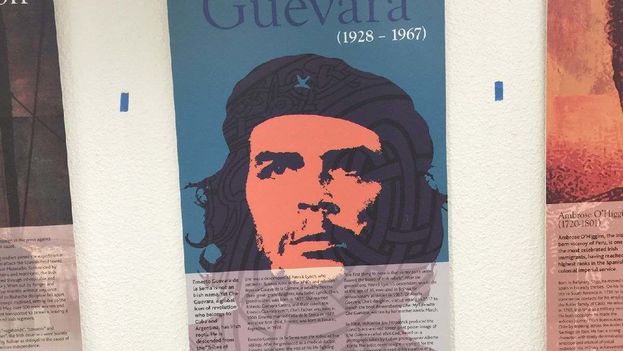
A poster with the image of the Argentine guerrilla was exhibited for some hours by mistake in one of the main terminals of the Miami airport. (Courtesy)

14ymedio bigger14ymedio, Mario Penton, Miami, 1 September 2017 — Miami Dade County Mayor Carlos A. Giménez, whose family had to go into exile after the Cuban Revolution in 1959,  never thought that his image would be linked to that of Ernesto Che Guevara, one of the “bearded ones” who established communism in his homeland.

The image of Guevara welcomed passengers at Miami International Airport for a few hours on Thursday night and continuing into Friday morning, just a few yards from another image showing Giménez as part of the exhibition The Irish in Latin America, sponsored by the Irish embassy in the United States to highlight the contributions of immigrants from that country to the history and culture of Latin American.

“Che Guevara wanted to make people ‘an effective, violent, selective and cold killing machine’, as he put it. Far from being considered a hero, they should measure him by the same yardstick as Osama Bin Laden” continue reading

“The picture of Che is no longer there, they took it away,” said an airport employee who asked to remain anonymous.

“I saw it last night and I did not agree. They should have put another photo of a celebrated person from Cuba, but not Che who was a murderer. It’s fine that the communists in Cuban or Venezuela display it there, but not here,” said the employee of Cuban origin.

Greg Chin, communications director for the airport told 14ymedio that in one of the preliminary versions of the art exhibition organizers presented the poster with the image of Argentine guerrilla, but that the authorities of the terminal made it clear they would not display it out of respect for the community.

“It was taken down early in the morning. It wasn’t on display at the airport for even 12 hours,” he explained.

The image of Giménez remains at the beginning of the exhibition ,which contains a total of 27 posters with personalities of Irish descent that marked Latin American history. The legend under his image extols his Irish ancestry and credits the ties he has created between the two communities.

The mayor’s office said he “deeply regrets” the incident and they were unaware of the images that would be displayed at the airport.

“In an essay about the exhibition they included the image of Che Guevara and the staff of the air terminal themselves expressed their rejection of this figure and what it represents in Miami,” said Stephanie Severino, a spokeswoman for the mayor’s office.

The exhibition is divided by the main countries where the Irish emigrated to. Five of the images are dedicated to Cubans and highlight historical figures such as José Martí, Father Felix Varela, Ricardo O’Farrill and Alejandro O’Reilly.

Ernesto Guevara, born in Argentina, participated in the struggle against Batista and then joined the revolutionary government with Fidel Castro; the Irish exhibition presented him as a physician committed to social justice.

Fragment of the original exhibition of “The Irish presence in Latin America”. (Courtesy)

“After graduating as a doctor, Ernesto spent the rest of his life fighting against poverty and injustice in Latin America,” declared the exhibit, classifying him as “one of the most celebrated revolutionaries of the twentieth century.”

The image of Che that was displayed last night at the airport’s E terminal was created in 1968 by Irish artist Jim Fitzpatrick. It is a poster in white and red with the image of Che Guevara under the name VIVA CHE, and is inspired by the famous photograph taken by Alberto Korda.

The Irish ancestry of Guevara comes to him through his paternal grandmother, Ana Isabel Lynch, born in Argentina. The family’s Irish roots from Patrick Lynch, who established himself in Buenos Aires in 1740, married to a wealthy heiress.

The Irish embassy in the United States told this newspaper that the panel with the image of Che was not supposed to be included . “It was removed as soon as we discovered the error this morning. We fully understand the sensitivity and deeply regret the error,” said communications director Carol Jordan.

María Werlau, director of the NGO Cuba Archive, dedicated to collecting information on Cuban historical memory, believes that the image of Che Guevara is one of the “most successful” advertising campaigns in history.

Werlau is the author of a book entitled The Forgotten Victims of ‘Che’ Guevara which details the shootings directed by the Argentine guerrilla after summary trials in Havana’s La Cabaña fortress.

Che’s biographies are voluminous but almost never thoroughly investigate his crimes. Guevara was one of the forerunners of the infamous UMAP in Cuba [forced labor camps for dissidents, priests and homosexuals]. He wrote against the Indians and against the blacks. In his own writings he recognized that he liked to kill,” she explained.

For Werlau, placing the image of Che next to patriots like Martí and Varela is the “product of the ignorance.” According to the expert, the Cuban exile has not been able to raise awareness of the need to dismantle the propaganda of the Government of Havana.

Che Guevara wanted to make people ‘an effective, violent, selective and cold killing machine’, as he put it. Far from being considered a hero, they should measure him by the same yardstick as Osama Bin Laden,” she added.
Cuban Universities Need Autonomy / Iván García

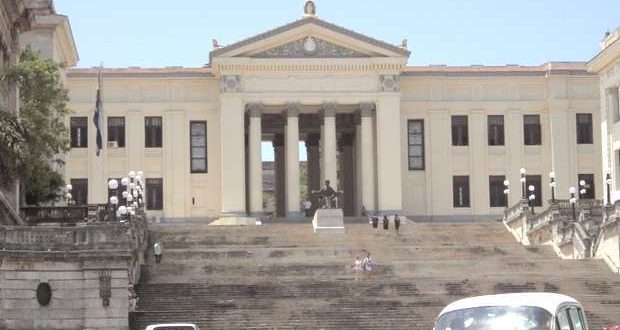
University of Havana. It was established 5 January 1728 by Dominican friars. It is the oldest higher education institution in Cuba, and one of the first in America. Taken from Cubanet.

Iván García, 30 August 2017 — Since his wife died two years ago, Manuel hasn’t been eating properly. At night, he sits in front of an obsolete cathode ray tube television, and usually watches the news or the baseball while he drinks some fourth-rate rum bought from a convenience store.

His big old house with high ceilings needs rather more than just a lick of paint. In the living room, the worn-out furniture is long overdue for replacement. Books, periodicals and magazines overflow four shelves on the wall. In a corridor there are various cardboard boxes full of textbooks and bibliographies about electronics and computing.

He says he’s 65, but looks ten years older. His sparse beard needs a barber to do something with it, and his greasy hair urgently needs a wash with anti-dandruff shampoo.  He has been unhappy since God took his wife away. continue reading

His uncared-for appearance makes him look like a tramp or an incurable alcoholic. But Manuel is a professor of electronics. He has a masters and a doctorate and has written a couple of specialised books, “which probably not many people have read”, Manuel says with a frank smile.

His miserable basic monthly salary of  740 Cuban pesos, equivalent to 30 dollars, doesn’t go very far. “I also get 80 pesos a month for my masters, 150 for the doctorate and 100 pesos extra for over 20 years’ service as a teacher. A thousand and seventy pesos in total, which is 43 Cuban convertible pesos at the present rate of exchange (roughly 43 USD). It’s enough to eat once a day, pay the electricity, water, gas and the phone. If I have anything left over, I buy books”.

With the same honesty he confesses, “They don’t pay me not even one convertible peso bonus. In this age of knowledge, with out-of date laboratories and shortages in the basic materials for study, university professors continue imparting knowledge to future generations out of vocational dedication more than anything.”

Manuel could offer private classes and get extra money. “Many of us do it, but I don’t. Because it’s prohibited and it’s unethical. A teacher giving an exam should not charge for passing his students. It’s a type of concealed fraud which they do in Cuba.  Those classes benefit students with well-to-do parents. The most studious and capable are the ones who should graduate. University is for the best of them. In technical courses like telecommunications, those who don’t have ability quit their studies in the first or second year because the classes are difficult”.

In his opinion, “Cuban universities have lost their quality, but their faculty staff continue to be the best qualified in the national education system. It isn’t like that in primary or secondary schools where, with certain exceptions, teachers now are not very good. That becomes evident later; when students get to university, they have all sorts of weaknesses, some of them basic, like they don’t know how to spell”.

David, a student of industrial engineering, thinks “there are good, middling and bad teachers, just as in any area of work. But, when compared to pre-university, secondary and primary, the university professor has preserved his standing. The government should allocate a bigger budget to equipping the universities. It’s unforgivable that courses like computing or electronics have second generation computers and that the connection time to the internet is limited like the bread in your ration book.”

Diana, a philosophy graduate, has pleasant memories of her teachers. “They were very professional and very knowledgeable about the subjects they were teaching. But when they entered the classroom some of them made you sad, with their old clothes, and their worn-out shoes with broken soles”.

José Manuel,  a working professor, believes “that higher education has lost a lot of its quality. What is happening is that in comparison with the dreadful state of teaching in the other educational levels, the universities see themselves as being on a different dimension. Thirty years ago, the University of Havana, the one in Santa Clara, and the old CUJAE, which is now the José Antonio Echevarría Tech., were among the best higher education institutions in Latin America. Now we are hardly in the top 250”.

Martí News talked to some university professors about the deterioration in the quality of higher education and what could be done to improve it. Rody, an algebra professor, got straight to the point:

“The reduction is due to the poor salaries. Every time there is a meeting with officials with the Ministry of Higher Education, they ask for more commitment and blah blah blah, but never a word about a pay increase or motivation for teaching staff. Apart from putting salaries up, they could incentivise the best professors by offering them personal grooming products and food as well as houses and cars. The government should provide subsidised holidays for outstanding teachers with accommodation in tourist resorts. They do it for the military, why can’t they do it for all teachers, not just those in university?”

Sara, a history teacher, thinks that “Cuban universities need autonomy, and not to be controlled by the government. Let educators have their correct place in society. We have to get away from this inverted pyramid in Cuba. Manual trades are important and necessary, but, everywhere in the world, people with university qualifications earn more than unskilled workers”.

Talking about autonomy, in 2012, the professor and academic Dimas Castellanos published an article in Diario de Cuba in which he ended up emphasising: “With the loss of its autonomy, the Cuban university ceased to be a strong point of civil society. In order for it to be that, the changes taking place in the economy have to be accompanied by changes in liberties and rights, among which university autonomy is an unavoidable necessity if it is to be relevant.

Carlos, an ex-professor of sociology, emphasises: “Because of miserable salaries and low social status, a lot of university professors are chasing scholarships and collaborations with overseas universities. And, if successful, definitely more than a few of them are deciding to emigrate. The Cuban academic world is poverty-stricken. The most talented professors, if they have their own opinions, and are not crushed by the system, may pay for it by being expelled from the centre, isolated and disparaged. There are more than enough examples. That was the case with the dissident Félix Bonne Carcassés, who died at the beginning of the year, a university professor with an excellent academic career. Or the recent case of the economist Omar Everleny Pérez, thrown out by the government from his job as an investigator”.

It’s not unusual in the island to find university professors driving taxis or renting their houses out to tourists and in that way adding a bit to their meagre finances. Others trawl the internet searching for scholarships or academic events outside the country to participate in. “Whichever doctorate, or simply taking part in a special panel outside the country, helps you earn a few dollars or euros which, when you get back, you can use to repair your house and buy food for your family”, explains an academic who spends half the year travelling to countries in different continents.

One possible way to update yourself, widen your knowledge and exchange experiences, especially following the re-establishment of relations between Cuba and the United States, would be if Cuban university professors could get internships or establish themselves as speakers at American universities.

It would be like winning first prize in the lottery.

Translated by GH

Angola Rejects Service of Cuban Medical Collaborators / Juan Juan Almeida

Juan Juan Almeida, 15 August 2017 — In an unprecedented decision that could have diplomatic repurcussions, the Angolan government rejected the 189 Cuban collaborators prepapred to travel to join the Cuban medical mission in that African country.

The unexpected decision was communicated to Havana through an email sent from Luanda by the ANTEX company, and received in Havana in the office of Roberto Morales, Cuban Minister of Public Health, on 31 July.

ANTEX is a Cuban military company, registered with the Cuban Chamber of Commerce which has signed important agreements to provide services and development of joint venture companies with the Angolan government. continue reading

On 24 February, with several ministers and representatives from both nations, Cuba and Angola celebrated the thirteenth session of the Intergovernmental Commission, which confirmed the need to establish and/or expand their bilateral and cooperation commitments in some sectors, such as planning and finance, education, construction, transportation, culture, energy, water, agriculture, geology and mining, fishing, urban planning, industry, communications, health and the biopharmaceutical industry.

The reasons why Angola is rejecting these Cuban aid workers are lost among various versions from sources that have preferred to remain anonymous. Among the problems mentioned are the payments for the services of the Cuban professionals, among other possible reasons.

The relationship between Angola and Cuba began in 1960, and was sweetened in 1961 when then-Cuban President Osvaldo Dorticós met with MPLA (People’s Movement for the Liberation of Angola) representation at the first conference of the Non-Aligned Movement in Belgrade and offered to provide, with charitable spirit, the Cuban experience.

The link began to take shape on June 25, 1975 in Maputo, when the late Angolan President Agostino Neto met with Armando Acosta, who presided over the Cuban delegation to the festivities for the independence of Mozambique. It was at that moment that Neto asked Acosta for urgent help  to train thePeople’s Armed Forces of the Liberation of Angola.

But it was not until 15 November 1975, when the first Cuban ambassador to Luanda, Oscar Oramas, signed the establishment of diplomatic relations between the two countries with then-Angolan Foreign Minister José Eduardo dos Santos. From then until now, there had never been an incident that could tarnish bilateral relations.

The Cuban medical mission began in Angola at the same time as the Cuban troops arrived. During the conflict more than 450,000 Cubans passed through Angolan territory, among them doctors, teachers, engineers and soldiers.

Miguel Diaz-Canel, Vice-President on Paper / Juan Juan Almeida

Juan Juan Almeida, 30 August 2017 — He was born on April 20, 1960. Miguel Mario Díaz-Canel Bermúdez, a former university professor and first vice-president of the Council of State and Council of Ministers of the Republic of Cuba, is an “architect” of limited inventiveness and little ingenuity, a simple leader fashioned by political necessity.

A video made last February has in recent days gone viral. In it, this gentleman leader can be seen at a Communist Party conference giving the most strident Stalinist-style harangue. But aside from the way some are interpreting this deplorable action, it is worth noting that such behavior is typical for Cuban leaders, defending power they do not have.

Skilled, with good eyesight and an even better sense of smell, the first vice-president of the Caribbean’s largest nation squanders his bravado on what he describes as “an avalanche of subversive proposals and projects.” Among those he mentions are the compendium of digital content informally distributed on the island and known by everyone as The Weekly Packet, certain privately owned businesses that recall the 1950’s, and the digital magazine OnCuba, which he promises to close. continue reading

This deplorable proceeding will go down in history, and certainly not as a glorious moment. This reminds me of the catchy chorus from a song by the Spanish singer-songwriter Joaquín Sabina, which goes: “For lies, those of reality. You promise everything, but give nothing…”

I understand that clever people take advantage of the ignorance of others, that scholars have opinions, and that talk show guests talk. But the video was made in February. It is now September, OnCuba is still in operation and the Weekly Packet’s programming is still being distributed. In a dictatorial nation such as this, calling Díaz-Canel a vice-president is as dubious as calling Kim Jong-un’s barber a hair stylist.

Too bad for Díaz-Canel. For someone who can be as imposing as a Spanish galleon at full sail, he comes off as a marionette, someone who seems to forget that in Cuba it is the Party that, for the moment, holds power.

The second-secretary of the Cuban Communist Party, Dr. José Ramón Machado Ventura, made it clear to him when he decided not to grant Cuban legal status to the Che Guevara Foundation due to simple personal problems with his family. To date, the late guerilla leader’s former home remains nothing more than a legal studies center. The same thing happened to a foundation established by the famous Cuban singer Pablo Milanés, which he also shut down under the pretext that it was encouraging tendencies more suited to a capitalist lifestyle.

One has to remain hopeful and look at the facts before coming to any conclusions about the future of Cuba. It does not necessarily matter whose head wears the crown but rather who holds the scepter and sits on the throne.

What is clear is that, with barely five months to go before that fateful day in February 2018, there is still no real successor to the current leadership.

Edison Lanza and the Lack of Press Freedom in Cuba / Somos+, Karla Pérez González

Edison Lanza

Somos+, Karla Pérez González, 28 August 2017 — Edison Lanza, Special Rapporteur for the Freedom of Expression of the Inter-American Commission on Human Rights (CIDH), shares his vision on what is happening in Cuba regarding the violation of a series of elementary rights, already surpassed by the majority of systems that govern the continent.

The Uruguayan, who has held the reins of this department of the CIDH since 2014, regrets the Cuban case, where according to him, at the moment “the modality of repression has changed, but it is still a state that violates the international standards of freedom of expression”. continue reading

“In the last 20 years the rapporteur has been consistently pointed out that, first of all, there is no pluralistic system of political parties in Cuba, there is no system that allows pluralism of opinions and diversity of ideas. Then there is a legal framework restricting freedom of expression, starting from the Constitution that subordinates this right – which is individual – to the interests of the Party and the Revolution. There are an immense series of criminal figures that suppress critical voices. The history of the last 30 years in Cuba has led to situations of exile, or imprisonment for political dissent that forms organizations that are not allowed by the regime. Simply to propose from the Academy a series of transformations in the economy and in the Cuban political system, some were cataloged of subversives and of attempting against the security of the State, and they underwent severe and long penalties of prison”, said the journalist.

Regarding the island of the last five-year period, he explained that “there are sentences of journalists, activists, human rights defenders and journalists are simply being held outside official structures, which can last for 24 or 48 hours. They are then released, or subjected to criminal proceedings that generate a strong inhibitory effect, or destruction of material, subtraction of equipment to prevent independent journalists from performing their work. ”

Internet was the last topic of the interview. It is known the complicated panorama that crosses the common Cuban to “connect”. When in the world this communicative tool is a necessity today, the criollos still have to see it -not because they want to, but because they have no other choice- as a luxury, a petty-bourgeois pleasure.

“Obviously the lack of internet access that today is the platform to disseminate information par excellence and in general Cubans have restrictions to access the Internet, to disseminate. Surveillance also on those who exercise freedom of expression. A journalist who lives guarded, who tries to know his source of information, his contacts by email, etc., is a journalist who is not free. All this scenario makes Cuba a country not free to do journalism.

The Rapporteur has also integrated, led and founded several non-governmental organizations in defense of the right to freedom of expression. He did postgraduate studies on freedom of expression and criminal law at the University of the Republic, and holds a doctorate related to the processes of regulation of audiovisual media in the region at the Faculty of Social Sciences of the University of Buenos Aires.

Edison Lanza is co-founder of the Center for Archives and Access to Public Information in Uruguay. Moreover, this also included the Committee on Freedom of Expression and Access to Information of the Regional Alliance for Free Expression and Information and the IFEX-ALC Alliance for the Defense of Freedom of Expression. He has also offered consultancies to different countries for the development of law projects related to access to public information, freedom of expression and communication media systems, among others.

Translated by: J. Rausenberger (From Somos+ English site)

Cuba Prepares to Ship Masses of Health Workers to Venezuela / Juan Juan Almeida

Juan Juan Almeida, 29 August 2017 — The crisis in Venezuela has generated the mobilization of a greater number of Cuban “collaborators” in the healthcare sector than ever recorded in history, some of them committed to participate in the military exercises called by president Nicolas Maduro.

While president Nicolas Maduro stirs up the internal forces with military skirmishes against the threats of the United States and blocks the signals of two emblematic television stations, Venezuela is receiving with particular discretion an unprecendented number of Cuban health workers, which includes both doctors and other professionals in this sector, according to reports obtained by Martí Noticias.

Starting at 7 in the morning on 17 August and continuing until today, the Central Unit of Medical Cooperation (UCCM), in Havana, has managed to accelerate the travel of an army of white coats, ready to perform their labors in Venezuela. continue reading

Currently, there are some 28,000 health professionals in Venezuela, but the number could be quickly augmented in the coming days.

In less than 15 days they have processed more than 2,000 Cuban health workers, among them nurses, intensive care and medical emergency physicians that come from the health system of the Cuban Revolutionary Armed Forces (FAR). An act that, for some, seems to be the underside of humanitarian aid.

The collaborators come from all provinces of the country, although the processing center is in Havana.

“Whether from the FAR or not, the Cuban health workers that the UCCM has sent to Venezuela are not a political party and do not occupy leadership positions in any of the spheres of Venezuelan sociopolitical life,” according to a source in the Cuban medical sector.

The informant said they all go as doctors, nurses or health-related people, “willing to provide excellent medical care and care for patients with the same respect and love they learned in school.”

“Guns kill, medicine opens a path that has no going back,” the source added.

However, it is striking that according to a document distributed from 21 August, doctors from the FAR were cited, as a matter of obligation, and as subordinates, to form part of the Bolivarian Sovereignty military exercise that began in Macarao, on 26 August.

In a context like that of Venezuela today, no one can camouflage themselves under a profession that holds an important space in the life of Venezuela.

“In the UCCM we have the responsibility to guarantee the fulfillment of the commitments made by the Cuban government in the field of international medical collaboration. For this reason, the fact that Cuban doctors, processed by UCCM, are part of this or any other military exercise, constitutes a flagrant violation of the peace and medical cooperation agreement — to strengthen the historic bond of friendship between both peoples, and to work In order to promote and promote the economic and social progress of the two countries with the integration of Latin America and the Caribbean — which was signed on 30 October 2000 in Caracas by Cuban Commander in Chief Fidel Castro and Venezuelan President Hugo Rafael Chávez Frías,” the informant said.