Mario Lleonart, 29 September 2017 — The regime is already starting to unleash its blind fury over the U.S. government’s decision in response to the dictatorship’s inescapable and treacherous complicity in the attack on its diplomats.
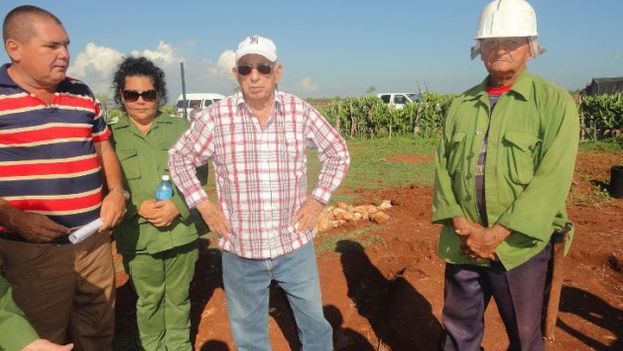
Iván Hernández Carrillo was visited this morning by a bailiff of the Municipal Tribunal of Colón, who delivered an official summons to an legal hearing on Tuesday 17 October.
The summons does not reveal the charge behind the proceedings, so Iván went to the tribunal offices, where they told him that he would be tried for nonpayment of a fine — an obvious excuse. continue reading
Iván is one of the dissidents who bear the special designation of having been among the former political prisoners of conscience, the Group of 75 during Cuba’s Black Spring of 2003, who still remains in Cuba. This makes him a symbol that the regime wants to utilize in what is likely the start of a predictable wave of repression, with a goal to fill its holding pens with hostages. This is a longstanding practice of a system that abducts its own citizens so as to provoke ransom negotiations.
It is clear that the regime was already exploring these options that it always has up its sinister sleeve. On Friday, 1 September, following a search of his residence, they had communicated to Iván that he would be charged with the crime of inciting delinquency.
For more information, contact:
Iván Hernández Carrillo at phone number: 52599366
Or via email at: ivanlibre2011@gmail.com
Juan Juan Almeida, 26 September 2017 — Developing Information and Communications Technologies as a strategic sector is an old premise for the Cuban government, but the migration of professionals to the non-state sector is the main enemy for the computerization and national cybersecurity program.
“Let’s say that structurally we can have control of the data that circulates in the different cellphone networks, cybercafes, wifi sites and the more than a million users who have access to the Internet through Nauta accounts [from ETECSA, the state telecommunications company]. We also work together with a group of attorneys to structure a legal and regulatory framework for navigation, that contains decrees and complementary rules according to the cybernecessity,” says a graduate of Jose Antonio Echeverria Technology Univeristy (CUJAE), speaking to Marti Noticias.
In 2015, the First Vice-President of Cuba’s Council of State and of Ministers, Miguel Díaz-Canel, announced the creation of the Council for Computerization and Cybersecurity, which would be subordinate to the country’s top management and fulfill the mission of coordinating and controlling policies and comprehensive strategies associated with the world of technologies, and that would put cybersecurity ahead of computerization. continue reading
Several institutions remain associated with this Council, whose mission is to safeguard integrity, independence and technological sovereignty; as well as to strengthen the presence and impact of the Cuban system in the social networks: The Computer Network Security Office (OSRI) is directly subordinated to the Ministry of Informatics and Communications.
The Computer Network Security Office (OSRI) is directly subordinated to the Ministry of Informatics and Communications.
“I am terrified of this group because they are very well equipped and like hunting dogs they can inspect and find even what you have erased.” says the source, one of those potentially chosen to be part of the Cuban delegations that will participate in the 19th World Youth and Students Festival, in the Russian city of Sochi.
DATYS is another group of programmers that belongs to the Ministry of the Intertior (MININT), and is responsible for manufacturing and selling software. This is the group that makes biometric programs for fingerprint recognition, it was this group that implemented the identification system in Venezuela, Bolivia, Nicaragua, Ecuador, among other countries.
SOFTEL is another small, strategic, vanguard community that offers advanced IT solutions, explains the interviewee. It has its headquarters within the University of Computer Science (UCI) and now is working on GalenLab, a software for the implementation of digital medical records.
The source referred to two systems created by SOFTEL: Galen Lab “Blood Bank,” to create blood banks and donor registries; and Galen Lab “Diagnostic Methods,” engaged with the process inside a laboratory that allows access to the exams of each patient of the Cuban medical system and of any of the medical missions of Cuba abroad.
SERTFOD is another group of young people dedicated to cybersecurity. It belongs to the Revolutionary Armed Forces (FAR) and since last July was authorized to provide services outside the FAR. Now it is in charge of repairing computer media, in addition to installing alarms and surveillance cameras in several civilian companies, and even in foreign companies. This group is in charge of managing the technology and methods that operate in a condition of secrecy or compartmentalization.
“The organization exists and is up and running; the problem is that our leaders belong to an age group that refuses to be a part of the digital age and that has sidelines the more than 25,000 professional experts in this area,” adds the source.
With low wages, poor working conditions, zero professional achievement, and the inability to negotiate patents and intellectual property, it is understandable that these specialists, skilled personnel with well-kept secrets, emigrate.
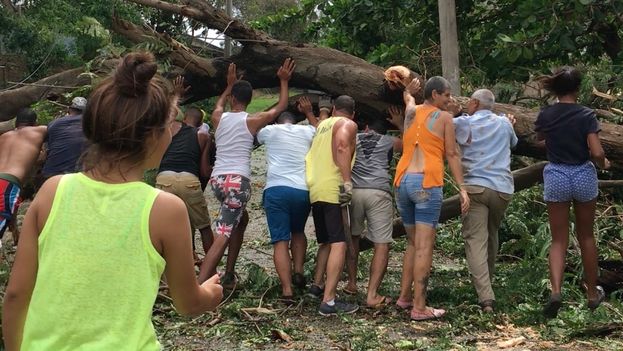
Residents of the La Timba neighborhood in Havana collaborate to lift a tree trunk toppled by Hurricane Irma. (14ymedio)
14ymedio, Zunilda Mata, Havana, 27 September 2017 – Three families are now bathing in Bernardina’s shower. “Everyone brings their own soap but the water is for everyone,” says the 86-year-old woman at her house on Calle Campanario in Havana. After Hurricane Irma the retiree opened her doors to her most affected neighbors, a gesture that is repeated throughout the country.
The official press has been full of headlines about international donations and the state’s work to accelerate the recovery, but the most important aid is being offered by citizens themselves. From the first minute, neighbors, family members and activists turned their energies to helping the most damaged communities.
Since the first winds began to blow and some municipalities on the north coast were almost completely evacuated, civil and spontaneous relief meant the difference between life and death for thousands of people. More than 77% of those sheltered took refuge in the homes of relatives or acquaintances, according to official data. continue reading
The close neighborly relations that characterize most Cuban neighborhoods are even more intense in small settlements and were very effective in protecting private property and avoiding a greater number of deaths.
“They talk about the great hell of small towns, but here what saved us is that we all know each other well and we are like a family,” says Yania, who lives in the historic center of Caibarién and whose home was badly damaged by the winds.
“We went to the house next door and all that’s left of ours is only part of a room,” laments the young woman. Now, she is waiting for international donations and the aid promised by the government to subsidize 50% of the materials needed for the reconstruction of housing, but at least she already has assistance she can count on: “The neighbors will help us to raise the walls.”
In the East, the outlawed Cuban Patriotic Union (UNPACU) is looking for strategies to prevent its aid initiatives from being boycotted. “We suffered a lot of persecution when we wanted to help the victims of Hurricane Matthew in Baracoa,” remembers the leader of the organization, José Daniel Ferrer.
Now, with the passage of Irma, “we are looking for mechanisms, with the utmost discretion, to see how to channel our help to these people,” says the former political prisoner. “Steps have been taken, such as sending money to affected activists to buy batteries, potable water and other things.”
On Tuesday, the official media opened several bank accounts directed to residents on the island for “solidarity contributions to help victims of Irma.” Enabling this type of aid came ten days after the International Financial Bank did something similar to “channel donations” from abroad.
The rapidity in requesting cooperation from other nations and the delay in accepting local donations has generated displeasure among many. The state-run newspaper Granma recognizes this situation by suggesting between the lines that the opening of bank accounts was done after Cuban citizens “manifested their solidarity interest in making monetary contributions.”
The Catholic Church has also tried to channel these desires to help coming from regions where the inhabitants were not seriously affected. In the first 72 hours after the hurricane, Caritas Cuba set up an emergency network to provide relief to the most affected and disadvantaged people. To achieve this, countless volunteers, parishioners and residents have worked in those parts of the country.
In the Havana office of the organization it’s a hectic time. The phones don’t stop ringing with calls from people who have lost everything or almost everything. Julian Rigao tries to deal with all these requests and explains that in every neighborhood in the capital there is a chapel where people can “leave donations.” Then the parish priests and religious congregations “will send them to the Archbishopric.”
In Catholic parishes a survey has been distributed to uncover the most critical cases. Since Monday, September 18, some churches, such as the Sacred Heart on Linea Street, are preparing breakfasts and dinners to help the most unprotected people in their community, according to a report.
Protestants are also collecting donations. In the Upper Room Baptist temple on centrally located Carlos III street, help is received “until three-thirty in the afternoon,” says Svan, who works in the temple. “It may come in a bag, in a cardboard box or however they’ve packed it.”
Little by little, people are also coming to donate mainly clothing, footwear and household goods. On the other hand, the state’s mass organizations, such as the Committees for the Defense of the Revolution and the Federation of Cuban Women, have not put out any appeals to raise donations.
“In my house we have prepared several bags with women’s and baby clothes”, says Lilian Bosque, a resident of Colon Street in the Plaza of the Revolution district. Now, she hopes to “put them together with what other neighbors have gathered and take them to the Santa Rosa de Lima chapel near here.”
Bosque is aware that “this is not going to solve the problem, but at least it will alleviate the situation of families who have been left with nothing,” and she points out that it is a silent gesture without the intention of receiving any recognition. “No one wants to earn a diploma with this or have it appear in Granma, it is the help that any human being in these situations needs.”
Young Kurds line up to vote in the referendum. (@aminahekmet)
14ymedio, Yoani Sanchez, Havana, 29 September 2017 — In a country like Cuba, where regional conflicts don’t surpass the resounding insults during a ball game, secessionism sounds like a distant subject. However, the ruling party has not hesitated for more than half a century to support annexation or separatism efforts in other nations based on ideological convenience.
Right now, the national press is addressing two referendums: those of Kurdistan and Catalonia. Both processes, so different and distant, constitute an excellent opportunity to measure the political whims of the Cuban Government and its double standards in this area.
In both cases, the news coverage has been so contradictory that even the most indifferent viewers have noticed that in the local news the Catalans are called independentistas and the Kurds separatistas. Some “have every right to be a nation,” but the others “put at risk the stability of a convulsive zone.” continue reading
The same interests that salute the Catalonian government, raise their hands against the proposal of Kurdish leader Masoud Barzani. In the morning, the radio commentators clamor for Barcelona to disconnect itself from the Kingdom of Spain, but in the afternoon they support the words of the Turkish Government that consider the Kurdish plebiscite “null and void” and lacking a “legal basis.”
Behind this obvious contradiction in public discourse are the political pacts of the day, the complicities between regimes and, at worst, the objective to contribute to damaging the democratic governments of the world.
The enthusiastic official support for the Catalan referendum is not supported because of the connotations that this will have for the lives of millions of people, but by the blow that it means for the Spanish State. The Cuban Government is more concerned that Spanish Prime Minister Mariano Rajoy and the Popular Party suffer a defeat in their own home than it is in the fate of the independentistas.
In addition to visits by senior officials and the anticipated visit of Spain’s King Felipe VI to the island early next year, Raul Castro’s government does not condone the Moncloa Palace’s criticism of human rights violations in Cuba. In addition, Spain belongs to the North Atlantic Treaty Organization (NATO) and strongly criticizes Nicolas Maduro, two of many profound differences.
The press controlled by Cuba’s Department of Revolutionary Orientation (DOR) also needs the Catalan conflict to show that democratic countries are shaken by instability, a way of emphasizing that only with the Revolution will the unity of the Cuban nation be maintained and that only socialism will prevent the dismemberment of the national territory.
However, in the case of the Kurdish plebiscite, Havana does not hide its suspicions of the process, which has origins more in political opportunism than in realpolitik.
When the High Electoral Commission of Iraqi Kurdistan announced on Wednesday that more than 92% of voters said ‘yes’ to independence, there were not many smiles on the island’s newscasts. The reason is not only that Iraq is opposed to the victory of the secessionists. So, also, are Iran, Syria and Turkey, all three of which are, to a greater or lesser extent, allies of President Raul Castro.
While the Turkish administration fears that Kurdish independence will infect Kurds living in its territory, Iran accuses Israel of supporting this week’s referendum and Syrian officials say it is the “result of US policies aimed at fragmenting the countries of the region,” despite the fact that the United States has declared itself against a plebiscite that has found international support only in Tel Aviv.
Aligned with its partners, with whom it shares positions and forms blocks in the United Nations to evade responsibilities or to avoid sanctions, Havana’s Plaza of the Revolution has preferred to distance itself from the “Yes” victory among the Kurds. These separatistas are not well regarded by Granma, Cuba’s official newspaper.
It matters little to the Cuban government whether or not, in both referendums, people vote for a legitimate demand that has roots in the history of a region. What is most worrisome is deciphering who is affected by secessionism. In its symbolic and simplified way of thinking, the Plaza of the Revolution believes that independence is a prize deserved only by its comrades.
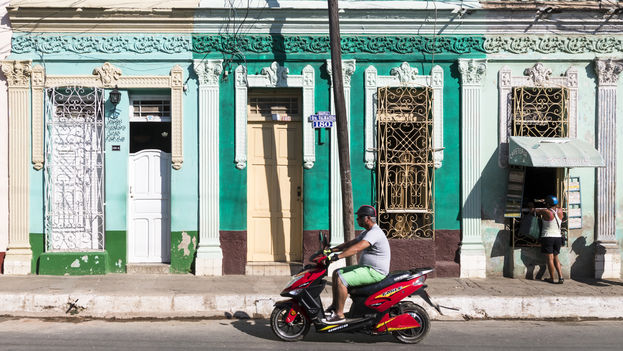
In the city of Trinidad electric motorbikes can be rented by tourists who spend entertaining hours riding them around the city.
14ymedio, Marcelo Hernandez, Havana, 28 September 2017 — Electric motorbikes, known as motorinas, continue to gain space on Cuban streets as an alternative to congested public transportation and the high prices of private taxis. This light vehicle has also become an ally for the home delivery food business, owners of homes for rents and illegal traders.
In the tourist city of Trinidad local entrepreneurs have added to the rental of rooms the rent of motorinas by the hour so that their customers can tour the colonial style streets. In Havana, pizza delivery companies deliver their orders on these vehicles whose price ranges from 1,900 to 2,500 CUC, depending on quality.
During the days of Hurricane Irma, these electric motorbikes were essential to evacuate everything from people to appliances. Given their small size and the ability to squeeze through almost any path – no matter how narrow – they were a great help in getting supplies from one place to another. The main problem was associated with their weak point, they run on electricity and the storm-induced blackout lasted for several days, during which motorbike owners could not charge the batteries.
“There was silence because you couldn’t hear a television of a motorina,” says Calixto, who lives in the center of Caibarién, describing those days. When the electricity returned, the motorinas once again continues their frantic action in the cities.
”Nauta Hogar” (Nauta Home) will be marketed throughout the Island starting Friday, but prices are still very high. (Cubadebate)
14ymedio, Havana, 28 September 2017 — Cuba’s state telecommunications company ETECSA will expand its Nauta Hogar (Nauta Home) service beginning Friday, 29 September, and extend it “gradually through December to all the country’s provinces,” more than six months after the conclusion of the first tests of free home internet access.
Amarelys Rodríguez Sánchez, Director of the Havana Network Operations Division, explained to the official press that the service will begin in the provincial capitals of Pinar del Río, Las Tunas, Holguin, Granma, Guantanamo and some of the surrounding districts, where there are technical conditions in place to support it.
“Anyone who has a fixed home phone line will be a potential customer and will be contacted by telephone to arrange the appointment, if they are interested, to sign the service contract,” she explained. continue reading
The offer consists of an allowance of 30 hours per month for a price of 15 Cuban convertible pesos (CUC, roughly $15 USD), for the basic navigation speed and paid in advance. The customer must also pay an additional monthly fee depending on the speed requested in the contract.
To contract with Nauta Hogar the subscriber must have digitized telephone service and the conditions that support the configuration of the contracted speed, and in addition must acquira an ADSL modem from ETECSA at a price of 19 CUC.
The subscriber must also have a computer. The user will access the network through a Nauta account to which the 30 hours of navigation will be charged; the hours do not carry over and can only be used within each month.
The contracted navigation time is loaded when the service is enabled and, subsequently, on the first day of each month. If the contracted hours are exhausted, the account can be recharged through the prepaid vouchers that are already commonly used to connect to wifi services at public hotspots.
Rodríguez Sánchez, head of the Nauta Hogar project, clarified that if the customer contracts for a speed of 256 Kbps upload (.024 Kbps download) they will get the first month free and receive a 15 CUC bonus. Users who contract higher speeds will enjoy the same advantage and only have to pay the difference depending on the selected speed.
The price for the 512 Kbps package will continue to be 30 CUC, while the price for 1,024 Kbps will be 50 CUC and the price for a speed of 2,048 Kbps will be 70 CUC, prohibitive amounts for most Cubans, the majority of whom – those employed by the state – earn an average total monthly wage less then the 30 CUC price of the cheapest service.
Once the contract has been entered into, the service will be activated within 72 hours and the customers themselves must install the modem on their phone lines, for which they will be given a quick installation guide.
Last January, the state monopoly chose 2,000 users in the district of Catedral and Plaza Vieja in Havana for a pilot test of home web connectivity that ended on February 28. In the capital there are currently 600 active Nauta Hogar accounts.
The service will also be extended to other municipalities in Havana to the extent that each area has the technical conditions to support it. “The initial plan is for 38,000 connections,” said Domínguez.
A 2016 report by the US organization Freedom House regarding internet service on the island says that the penetration of the web in the country is between 5% and 31%. Meanwhile, dozens of web pages are blocked because of their content.
Another recent study published by Amnesty International reports that only 25% of the population can connect to the Internet and only 5% of households have access to the network. For years, a home connection was granted only to some professionals, doctors, journalists, intellectuals or academics with proven ideological fidelity to the ruling party.
Vice President José Ramón Machado Ventura (plaid shirt) tours agricultural areas in the province of Cienfuegos. (Cinco de septiembre)
14ymedio, Caridad Cruz, Cienfuegos/Miami, 28 September 2017 — A strong smell of urine permeates the Russian-style apartment while Margot cooks a couple of pork steaks. “They are boar [the male pig], that’s why the smell,” she explains. Getting food in Cienfuegos, a city that was only affected by the edges of Hurricane Irma, has become an odyssey, according to its residents.
“There’s a man who sells pork from a pushcart and we buy it. What are we going to do if every time we want to buy something in the market, the lines are gigantic?” says Margot as she tries to remove the bad smell from the meat with some basil and a little ‘complete seasoning’ that she scrapes out of a nearly empty jar.
“They deceived me, I spent my monthly pension on ten pounds of stinking meat that there is no choice but to eat it,” she laments. continue reading
The authorities of Cienfuegos have imposed a severe rationing after Hurrican Irma. Eggs, vegetables and meat are regulated and you can only buy a certain amount per person “to avoid speculation.”
“The unrationed eggs have all been taken to Villa Clara because there they don’t even have a pot to piss in,” says the clerk at a point of sale in Calzada de Dolores, one of the main arteries of the city.
The alternative to chicken eggs are duck and quail eggs, which are sold in the Ministry of Internal Commerce stores, but it’s enough to check the stores to confirm that in many of them there are no eggs of any kind.
“There are no eggs in the whole city. It’s because of the hurricane,” another shop assistant explains.
In order to buy fruits or vegetables, the situation is similar. In the markets where the prices are controlled by the state, people line up from early in the morning, while in the uncontrolled markets and from the pushcarts, prices are skyrocketing.
“The state is to blame for this situation,” says Margot. “Television announces that all the countries are sending aid, but they use it only for Havana, which is where people throw themselves into the streets [to protest],” she explains.
Although the official media did not make reference to the protest of 13 September in Havana sparked by the absence of electricity and water, the videos of the demonstration have gone viral through the ‘weekly packet’.
“As long as people remain silent, things are going to stay the same, but nobody wants to be cannon fodder,” he laments.
Although the damages in the province were minimal, compared to the north of Villa Clara, Ciego de Avila and Camagüey, the city was without electricity for more than 96 hours due to failures in the local thermo-electrical plant.
In the midst of this situation, Cuban Vice President Jose Ramon Machado Ventura, 86, along with the Communist Party’s staff in the territory, toured some of the province’s agricultural sites where, according to the local press, he got “the commitment” of the farmers to “produce more food.”
In the Hard Currency Collection Stores (TRD) – as the state chain of outlets is officially called – the availability of meat, poultry and cans of fish has been reduced in recent weeks. “Before the cyclone, there was almost nothing,” said Magalis, a customer at the La Casa Mimbre store. “What they have left is at exorbitant prices, which no worker can buy.”
Cuba reduced imports by more than 1.5 billion dollars in the first half of the year, which in the opinion of economists has had a direct effect on the worsening of shortages in state stores.
“They recently opened a market here near (La Casa Mimbre), but between the lines, the little assortment and the high prices it’s not worth going,” she says.
“There is an Italian cheese that I suppose is the worst of what’s available in the world’s markets, but here a single kilogram costs 20.05 CUC (roughly $20 US), more than an entire month’s salary,” she protests.
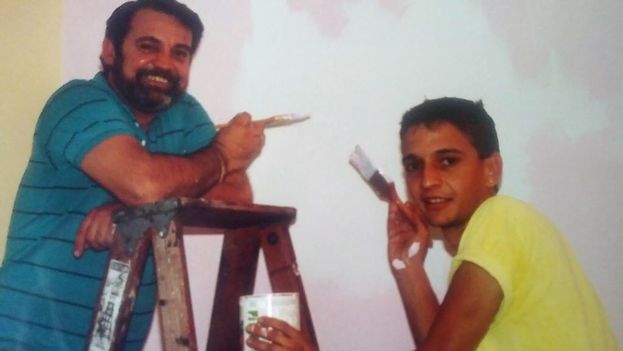
Carlos Iván González painting next to its father just after arriving from Cuba with the Mariel Boatlift. (Courtesy)
14ymedio, Mario Penton, Miami, 22 September 2017 — Carlos Iván González arrived in Florida in 1980, during the Mariel Boatlift exodus, barely 14 years old. Now, at age 50 and after establishing a family in the United States, deportation is hanging over his head. In 2012, he was sentenced by a state judge to five years in prison for growing and selling marijuana, trafficking in cannabis and possession of narcotic drug, and as soon as he got out he was confined to a detention center in Wakulla, where he has already spent more than 200 days waiting for Cuban authorities to approve his return to the island.
González’s laziness toward obtaining US citizenship has led to his dangerous situation. The commission of the crime led to the loss of his ‘Green Card’ (permanent residence permit) and his family fears that he will join the list of 2,746 Marielitos that the Cuban government agreed to receive in 1984 as a result of an agreement between Fidel Castro and Ronald Reagan.
During that exodus, more than 125,000 people escaped from the island on a maritime bridge authorized by Fidel Castro; among these were some criminals to whom the United States refused to grant asylum. With the pact between the presidents, the members of a list drawn up by the US must return to Cuba, but the returns have come slowly, in groups of between 90 and 100 each year, according to journalist Alfonso Chardy. continue reading
As a result, some of the deportables have disappeared, died or their health prevents them from traveling. Aside from those Marielitos agreed to 33 years ago, Havana refused to receive its citizens residing in the US with a deportation order until the signing of an agreement with the Obama administration in January of last year. At that time it was agreed to fill that quota with criminals with deportation orders who entered during the Mariel Boatlift, people like Carlos Ivan Gonzalez.
“Alone, without family, without friends or money. This is how my son would have to return if Emigration sends him to Cuba,” says Sarah Gonzalez. Carlos Ivan’s mother, 71, resides in Cape Coral (South Florida) and now laments her son having been too lazy to get naturalized.
Gonzalez held a hunger strike last week in Wakulla, along with ten other Cubans in the same situation, but they had to abandon it because they were ill without achieving their goal of being released, according to his mother.
“I know that my son is not innocent, but he has already paid society for his crime with five years in jail. Now they are now talking about eliminating the US embassy in Havana. The politicians continue with their conflict, while my son wastes his life in a cell,” she complains.
Sarah Gonzalez argues that a detention center official told her that Cuba had rejected the repatriation proposal from the US authorities but her son may have been included in the quota of “substitute” Marielitos.
“There is something going on with those who came through Mariel, and Washington is pressuring Cuba to accept them, even after Cuba has refused,” adds Sarah Gonzalez.
Meanwhile, Carlos Iván, a mechanic by profession, father of a firefighter and grandfather of a girl he has not yet met, is constantly guarded by the Immigration and Customs Enforcement (ICE).
An ICE official told 14ymedio that the average time of a person in custody with a deportation order is between 30 and 35 days. However, when there is serious evidence that the subject can be deported, that period can be extended.
Usually, in the cases of Cubans in this situation, an alternative to detention is sought, since the island’s government decision whether to receive the immigrant can take years.
Among the solutions ICE provides to maintain control over the individual are electronic monitoring and supervision orders, which allow the person to lead a normal life provided that they meet from time to time in agency’s offices and give an account of their situation.
“When lawyers appeal the judge’s decision or request extensions of certain legal proceedings, when this happens and the judge does not allow bail, the subject must remain in custody, which lengthens the process,” the official adds.
Gonzalez’s family says he does not have enough money to bring the case to court, and the official lawyers do not deal with immigration issues. However, there are various institutions such as the Catholic Church and human rights groups that offer free or low-cost services to immigrants.
“We are a couple of elderly diabetics and over 70. We have to send money to him to communicate with us and to eat better, because prisons are bad everywhere,” adds Gonzalez’s mother.
The family has tried to get help through Senator Marco Rubio’s office and the governor of Florida, but claims to have gotten “nothing.”
“When I called the media they hang up on me because they say it has to be interesting. Does it have to be interesting for a man to die on a hunger strike or to deprive him of his freedom to be on the news?” she asks indignantly.
Roberto Santana Capdesuñer, independent candidate from Holguín. (Courtesy)
14ymedio, Reinaldo Escobar, Havana, 26 September 2017 — Located between two bays, the Holguin municipality of Antilla is among the smallest of Cuba. In District 3, young Roberto Miguel Santana Capdesuñer aspired to be a delegate at the Nominating Candidates Assembly, but a mixture of chance and likely bad intention prevented it.
Santana, 27, has been collaborating for two years with the platform #Otro18 (Another 2018) and has become coordinator of the initiative in the provinces of Granma and Holguín. In order to make a living, he obtained a license as a food seller, but the inspectors pursued him with the fines until they made his “life impossible.”
He then got a job at a state-run restaurant where he kept the accounts. However, they soon dismissed him on the grounds that he was not reliable because he was not revolutionary. Fed up with feeling segregated for not sharing the ideology of power, he decided to throw himself into activism. continue reading
Santana talks about the situation of his town with the same pain that he would recount his personal sufferings. “Our main problems are housing, food and lack of medications. In our pharmacy there is a list of 120 drugs which are missing,” he says.
The port of Antilla, which previously gave life to the place, is no longer operating and there is only one tobacco factory and a corn mill.
Like most Cubans linked to the political opposition, Santana has been the subject of police citations, arbitrary arrests, searches of the house where he lives, confiscation of his belongings, interrogations and, above all, a systematic campaign to discredit him.
Along with the risks, his attitude has also placed him in a leadership position among his neighbors. “Many people come to tell me their problems because they see in me an alternative, something different and that fills me with satisfaction,” he tells this newspaper. “There are more people who put their trust in me than those who see me as an enemy.”
In the current electoral process, the Nominating Assembly of his area was scheduled for September 7, but was suspended without fixing a new date due to Hurricane Irma. After a few days, the nomination process began again throughout the municipality, with the exception of District 3 where the activist resides.
Santana recalls that on Monday, September 18, he was advised that they could see his daughter at the pediatric hospital in Holguín. That same night he went there with his little four-year-old Lauren, and she was immediately admitted, he says.
The haste to hospitalize her came as a surprise to Santana, who on other occasions found that “there is a long wait for that.” At seven o’clock the next day he received an urgent call to inform him that the people in charge of calling the meeting were telling the voters that the Assembly would be held in an hour.
Trapped in the provincial capital, two hours from his village, the aspiring delegate saw his candidacy dissolve. The neighbors who were in a position to propose him thought that his absence was a sign that he had given up standing for election. The work he had done for more than two years and waiting for that moment came to nothing.
He later learned that no citation to come to the meeting was delivered to his mother-in-law’s house where he lives with his wife. “At that time there was no transport between Holguín and Antilla and even if I had had a car of my own it would have taken two hours to get there,” Santana laments.
Of the 200 voters in the district only 70 participated in the Assembly, according to what several residents told 14ymedio. An irregularity that contradicts the electoral rules, which require that “the massive presence of the voters of the area be verified beforehand,” before the meeting begins.
“They took advantage of the fact that I was facing a family problem to call the meeting just one hour ahead of time,” claims the activist. In his mind, the idea that State Security was behind such haste took shape. “It was unethical, a real trick,” he said.
Contingency and arbitrariness conspired against Santana that night to prevent his being chosen as a different delegate. “Not like others who want to serve as puppets to the government, sheltered behind the wall of the Communist Party, but as a counterpart in favor of the people of the neighborhood,” comments the frustrated candidate.
For the moment and under the current Electoral Law, the young activist will have to wait at least two and a half more years to try again.
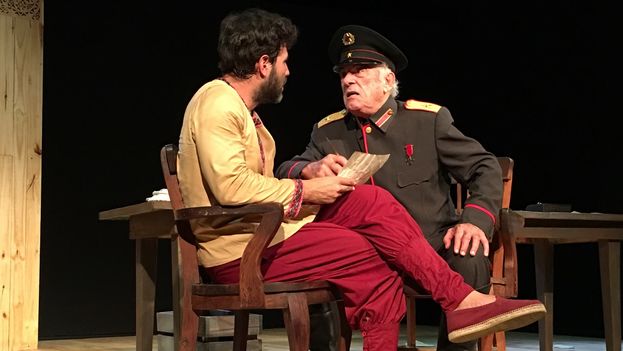
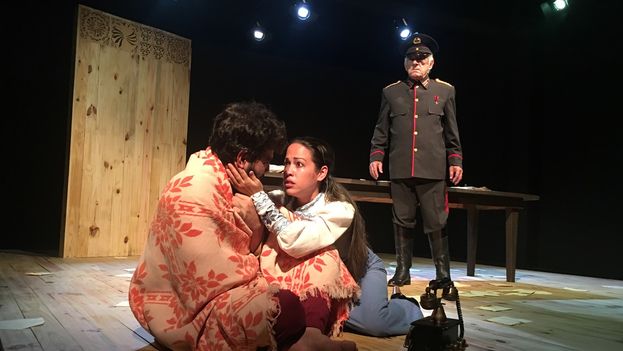
’Love Letters to Stalin’, by Juan Mayorga, is being performed at the Argos Theater in Havana. (14ymedio)
14ymedio, Reinaldo Escobar, Havana, 25 September 2017 — When leaving the Argos Theater after the performance of Love Letters to Stalin, a good part of the audience needs to shake their heads. Like someone waking from a nightmare, there will be those who, for long minutes, fear that the monsters from the dream might appear around the next corner.
The play, with the original text by Spaniard Juan Mayorga, brings to the stage the drama experienced by the writer Mikhail Bulgakov (born Kiev, 1891) given his tense relationship with the Soviet Government. The author of novels such as The White Guard became known on the Island thanks to his book The Master and Margarita (1926), which could only be published 26 years after his death.
The piece, directed by Abel González Melo, tackles the thorny issue of the interaction between intellectuals and power, a bond that is stretched thin when rulers exercise strict censorship and the freedom of the artist is mired in the marshes of politics. continue reading
Although complacent art, which sings praises to tyrants, rarely survives the fall of dictatorships, the script suggests that the irreverent pay a high personal and editorial cost to transcend the sterilizing whims of power. In the words of the protagonist in LoveLetters to Stalin: “An artist who is silent is not a real artist … How can I write songs to a country that for me is like a prison?”
In the small theater on Ayestaran Street the audience watches the scenes in which Bulgakov writes letters to the Soviet dictator Joseph Stalin (1879-1953) denouncing that performances of the play The Purple Island have been prohibited. The writer also complains that the play The Days of the Turbins was barred and that Zoe’s Apartment was removed from the listings.
“I do not have the courage to live in a country where I can neither represent nor publish my works. I am writing to you so that you will return to me my freedom as a writer or expel me from the Soviet Union with my wife,” he cries in his letter.
According to Bulgakov’s biographers, Stalin responded to this letter in 1930 with a telephone call. In the scene in which the sound of the ringing phone is heard, the actor Alberto Corona – who represents the writer – jumps for joy and embraces his wife, played by Liliana Lam. Full of glee he shouts: “Comrade Stalin has called me!”
Desperation leads Bulgakov to the delirium of imagining, standing in his living room, the unmistakable figure of the dictator, who is given life by the actor Pancho Garcia, winner of the 2012 National Theater Award. (14ymedio)
However, the communication remains unfinished due to technical problems at the moment when Stalin was about to schedule a personal encounter with the artist. From that moment, the novelist and playwright does nothing more than write new missives and stay home waiting for the phone to ring again. “All I have written is a child’s play if I compare it with a letter to Stalin,” he says.
Desperation leads Bulgakov to the delirium of imagining that he sees, standing in the middle of his living room, the unmistakable figure of the dictator, brought to life by the actor Pancho Garcia, winner of the 2012 National Theater Award.
The specter of Stalin that dialogues with the writer is not only that iron man who orders the death of his fellow combatants, but also the magnanimous chief who feels “surrounded by the incompetent” and who wishes to sit down and converse with an uncomfortable intellectual to hear his views about the future of the country.
A Stalin who, at the same time, shows his darker side. A rogue who “has almost driven our friend Zamiatin crazy, and has succeeded in getting Maiakosvki to commit suicide,” says Bulgakov. The innocent idealization of that Stalin also represents the writer’s last hope of becoming accepted without having to give up himself.
The need to prove that he is not on the side of enemies, his love of the country where his writing is nourished, and growing unease because his work is pushed aside, weave the fall of the Russian writer. A descent into the abyss of ostracism, from which only a pact with the censor could save him.
“I suspect that in Cuba in 2017, some of his phrases and situations will be heard and observed as they have not been anywhere else,” said the author, Juan Mayorga. Comparisons between that USSR and a Cuba where, for years, critical authors were penalized with an exclusion from the catalogs of published books, a ban on travel and the execution of their reputations.
The staging of Love Letters to Stalin in a theater in Havana reopens the debate on the consequences of decades of censorship and control over cultural production and over the island’s intellectuals. From Fidel Castro’s Words to the Intellectuals, to the arrest of graffiti artist Danilo Maldonado, all the stories of exclusion or submission of an artist parade in the minds of the spectators.
Thus, Bulgakov becomes at times Virgilio Piñera, Heberto Padilla and Maria Elena Cruz Varela. For moments he also longed to be closer to the authorities and enjoy the status of a novelist pampered by institutions, in the style of Manuel Cofiño, Miguel Barnet or Abel Prieto. Only to finally discover in his own experience that authoritarians do not seek writers but propagandists; they prefer slogans over literature.
When the powerful hurricane Irma touched land, there were about 50,000 tourists on the island, according to calculations by the Ministry of Tourism. (14ymedio)
14ymedio, Luz Escobar and Zunilda Mata, Havana/Varadero, 21 September 2017 — “This is what’s left of the gardens of the Blue Lagoon,” says an employee while looking at a cellphone photo of fallen palm trees and tangled vegetation. The bus in which he is traveling is responsible for distributing staff to the hotels in Varadero, Cuba’s main resort, which is trying to recover after Hurricane Irma.
The Hicacos peninsula, where the famous beach is located, is wrapped up in a recovery effort operating at different speeds. A land of contrasts, alternating luxurious resorts, mansions and fragile private houses with gabled roofs, the main tourist center of the Island is binding up its wounds on the eve of the high season. continue reading
On Tuesday, the streets were clear of the logs and debris left by the storm, but inside the hotels the damages range from light to serious. However, Varadero again has that air of a “tourist nation” – one with no flag or local flavor – that can be found anywhere on the planet where there is sun and sand.
“This beach feeds a lot of people,” Rigoberto told 14ymedio; he is an artisan by profession licensed to sell seed and pearl necklaces in the town’s most important artisan fair. “On the days we couldn’t sell, people were crazy because they lost a lot of money,” he says.
On a small table Rigoberto sets out ceramic ashtrays, carved wooden images of sensual women, and tiny clay turtles. “The worst has been for the homeowners who have suffered damages but who don’t have the resources available to the hotel managers and the state,” he says.
After days of anguish, an urgency to close the wounds has overtaken the residents and the resort employees. “We’ll all be ruined if the tourists decide to go to Cancun,” Rigoberto explains. The Mexican beach is Cuba’s main rival at a time when the Greater and Lesser Antilles have been battered by several hurricanes.
Three young men speaking Russian pass near Rigoberto wearing wrist-bands confirming their “all-inclusive” status at the resort. “Those are the first who have returned,” says the artisan. “They don’t care that much that the hotels aren’t a hundred percent ready, because what they are looking for is sun,” he opines.
Irma hit Cuba just before the high season, in a year when the authorities expected to reach the longed-for figure of five million tourists. When the powerful hurricane hit land, there were about 50,000 travelers in the entire island according to the calculations of the Ministry of Tourism.
After the weather disaster the official information has talked of devastation to describe the situation in the keys area. But at the same time a recovery in record time seems destined to appease the fears of travelers.
Wednesday’s primetime news warned of “an international campaign against Cuban tourism” that “is attempting to magnify the damages.” Tourism Minister, Manuel Marrero assured that “there is no hotel that has suffered structural problems.”
However, complaints about substandard services are being felt and reported at hotel reception desks and in internet travelers’ forums. At the Royalton Hotel Hicacos about 40 guests are trying to make their vacation holiday not end in nightmare, but the conditions are not the best.
Joseph and his wife did not want to cancel the reservation they made six months ago to visit Varadero and “get a rest from so much work,” they tell this newspaper. Coming from Germany, they followed the course of the hurricane, fearing that the agency would postpone the trip or send them to another part of Cuba.
“We were scared to arrive but outside of some broken glassware in the hotel we found no major damage to the infrastructure,” says the German, although he acknowledges that the food is not good because he came looking for local flavors and even the butter is imported.
“The employees are very nervous and the hot water service still isn’t working very well.” Among the problems most lamented by the guests is that “there is no peppermint for the mojitos” and “there are few fruits at breakfast despite being in the tropics.”
For Andrés, a Colombian who spent his honeymoon in Cuba during and after Irma’s passage, the most difficult thing to deal with was what he calls “the fall in quality.” Staying at the Varadero Meliá hotel he lamented that the menu was bad. “Although they say they have two buffet restaurants, it’s not true,” he complains, and notes that the water sports services are not yet working again.
“We had to pay for the extra nights we stayed at the hotel because our flight was canceled and they didn’t give us any rebates even though the pools aren’t open and they didn’t change the sheets for more than three days,” he protests. Now, he hopes to make a claim to demand a refund of some of the money he spent.
At the moment, the management of the hotel has sent him a message stating its “total willingness to favor you with the best conditions if you return to the Varadero Meliá.”
Some hotels in the area are still closed, such as the Meliá chain’s Varadero Paradisus, which suffered severe damages. An employee of the Cubatur agency explained via telephone to this newspaper that the area known as Family Concierge was “devastated” and there were also damages to the main building and to the restaurant that was built near the beach.
Some hotels in the area are still closed like the Meliá chain’s Varadero Paradisus, which suffered severe damages. (Courtesy)
A spokesman for the Mallorcan chain, which owns a total of 27 hotels on the island, 11 of them in the keys, told the Spanish media that their accommodations in the famous resort have suffered minor damages and are re-establishing their services. In addition, he specified that the closure of the Varadero Paradisus is because of improvements being made before the high season arrives.
The head of the sales department of the Sol Palmeras hotel proudly said that on Wednesday about 200 tourists were staying at their facility. “Given how the area was left, we have recovered quickly,” he emphasized.
Dana, an employee of the exclusive Royalton Hicacos, acknowledges that conditions are still not optimal. The main damages are in “the buffet service restaurant and beach gazebo, still closed,” after Irma.
Despite this, private and government-controlled hotel authorities have not decreed any special reduction in room costs, according to a Cubanacan travel agency specialist.
Only during the hurricane itself “tourists who came here and booked directly at the hotel reception received a 40% discount,” says Dana. This rebate was offered only to clients who arrived at the accommodation relocated from the keys of the north of the Island, who were compensated for the fact that their new accommodation had no electricity.
To avoid distress, many are choosing another destination within the island where the hurricane did less damage. The largest beneficiaries are the town of Viñales, the María la Gorda beach, also in the west, and the city of Trinidad in the south.
“There is a lot of demand for the hotels in the historical center of Havana as well,” says an employee who offers tour packages in the Cubatur office in the Habana Libre Hotel. “What is totally closed is accommodation in the northern keys,” she explains to a Cuban client.
National tourism has been increasing since 2008, when Raúl Castro’s government allowed Cubans living on the island to go to the country’s hotels, from which they had been banned for decade. In 2014, about 1.2 million nationals stayed in these facilities and spent 147.3 million Cuban convertible pesos (roughly the same in US dollars), according to official data.
The trend has continued to increase and “most of the packages sold here are intended for Cubans,” says the Cubatur employee. She notes, however, that “right now international tourism is being prioritized, for those who made reservations weeks ago.”
Rebeca Monzó, who lives in Havana’s Nuevo Vedado neighborhood and rents a room through Airbnb, has not suffered serious damage to her business. So far she has not had reservation cancellations and is waiting for a new customer who is arriving this week.
During the hurricane she hosted two Spaniards “who fled from the province of Sancti Spíritus” when the first winds began to blow. Her guests “experienced the hurricane from another perspective,” says Monzó.
“They helped us to store water, lined up to buy bread and experienced their days in Havana as a great adventure.” The hostess acknowledges that they survived “thanks to the pasta we had because in those days there was nothing to eat.” Her home was five days without water and electricity.
Shortages are one of the most negative side effects left by the hurricane.
In Varadero, the extensive informal market network that nourishes a good part of the area’s private businesses is also trying to recover. “In this area it was very easy to buy shrimp and lobster,” says Rigoberto, while taking some canvases painted with coconut motifs and reddish sunsets out of boxes.
“The hurricane has been a serious blow to the seafood vendors because apart from cutting off several access roads and leaving a lot of people without refrigeration, there is now more police control in the area,” he says.
The sale of these raw products is forbidden to private individuals and is strictly punished by the authorities, as is the black market in cheese and milk, also prominent in the area.
At the corners of the main street, parallel to the beach, are uniformed police officers and some state brigades cleaning the area. “Until all this goes away we have to stay quiet,” recommends the artisan. “Irma has stirred everything up and it will take time until the waters find their level,” says a Spaniard.
Even if Castro were to leave for Esmeralda, Punta Alegre, or Corralillo today, he could not escape the doubt that his visit was more fruit of the pressures than of his own desires. (EFE)
14ymedio, Generation Y, Yoani Sanchez, Havana, 25 September 2017 — Most active politicians like to have their photos taken while greeting children, talking to factory workers, or visiting a disaster area. These images, seen on countless occasions, do not translate into better government performance, or even real concern, but at least they are consistent with a formal and public ritual.
More than two weeks ago, Hurricane Irma devastated countless towns in central Cuba, affected communities near the north coast and left the coastal areas of the city of Havana under water. Since then, Raúl Castro has not been to any of the affected sites and has not been seen near the houses that lost their roofs, the sidewalks filled with the furniture drying in the sun or the places sheltering some who have no homes to return to. continue reading
In the first days of his absence, speculations focused on the octogenarian’s health and a possible indisposition making him unable to travel to the most affected areas. However, Castro had enough physical energy to go and receive Nicolás Maduro at the airport. He has chosen to take a photo with the Venezuelan president rather than with the population battered by the meteoric winds.
The feelings left by this distancing are contradictory. His most ardent supporters speculate that he does not want to add expenses to the national budget with a visit more symbolic than effective. Others say he is letting younger officials take his place before the cameras so that they can gain visibility before 24 February of next year, when he will step down from the presidency of the country.
His critics, however, speak of the weariness that has gripped the General after a sequence of defeats, among them not being able to end the island’s dual currency system, or to reduce corruption, or to offer Cuban workers dignified wages that can become their primary source of economic support, or to attract foreign investment. Exhaustion has taken over the leader of the Communist Party a few months before he leaves power.
Now it is too late for the photo next to the victims. Even if Castro were to leave for Esmeralda, Punta Alegre, or Corralillo today, he could not escape the doubt that his visit was more the fruit of pressures than of his own desires. A snapshot next to an old woman whose house is nothing more than the foundation would seem to be a resounding act of gimmicky populism, but the lack of that image makes him look as distant and indifferent.
If he goes where Irma left a trail of pain he loses; if he stays in his palace he also loses.
An art installation on the Malecon during the 12th Havana Biennial (14ymedio)
14ymedio, Havana, 25 September 2019 – The Promotion Division of Cuba’s National Council of the Arts and the Wifredo Lam Center for Contemporary Art announced that the 13th Havana Biennial, scheduled to be held next year, will be postponed until 2019.
A press release on the Council’s website it explains that due “the extremely serious damages caused by Hurricane Irma on the country’s system of cultural institutions,” they have “rescheduled several events” planned for the country.
The announcement does not give an exact date for the more important visual arts event in the country, although it says that “detailed information” is forthcoming.
The last edition of the Biennial was held between May and June of 2015, under the theme “Between The Idea And The Experience,” focused on a search for an artistic perspective beyond the museums and galleries.
Participating in the last Biennial were more than 120 guest artists, individuals and collectives who took advantage of their own spaces to install their works. The exhibition also included group projects conceived as an “artistic quarry” because they offered space for recently graduated young artists.
Over its 30 years, the Biennial has passed through different moments, some marked by artistic effervescence and others by apathy, affected by the economic crisis and the censorship of uncomfortable artists.
In its most recent edition the artist Tania Bruguera, who did not have an official invitation, presented a session of more than 100 hours of consecutive reading, analysis and discussion of Hannah Arendt’s “The Origins of Totalitarianism,” at the independent International Institute of Artivism, which took the name of the famous German philosopher.
Two officials from State Security visited Bruguera to dissuade her from continuing her artistic action and blocking several activists from being able to access the site where she performed the reading.
Photo: By Yariel Valdés González in Caibarié, a fishing village to the north of Villa Clara province, which suffered greatly in the path of Irma. Taken by Periodismo de Barrio
Ivan Garcia, 22 September 2017 — In that bit of Havana between Calle Línea and Avenida del Malecón, people are still taking out mattresses, clothes, furniture, and other things damaged by the sea which was driven inland by the powerful Hurricane Irma two weeks ago, and leaving them to air in the sun.
In any park, house in multiple occupation, or corner in Vedado, with a network of buildings and grand old houses with designs ranging from Art Deco and Neo-Classical to reinforced concrete, built before Fidel Castro changed architecture into the clunky and the vulgar, their residents tell stories with typical Cuban exaggeration. continue reading
“I am telling you that when the water got into the garage in my building, the cars were floating. It felt as if someone was tapping on the wall of my room, and it was the cars, which were drifting about like crazy spinning tops,” I am assured by Ignacio a 76-year-old pensioner, standing in a queue to get a portion of yellow rice with hot dogs for 5 pesos (20 cents USD).
In various kiosks improvised by the state to help people affected by Irma’s blast, they sell packets of crackers for 25 pesos, tins of sardines for 28 pesos and guava sticks for 17.
“People with money don’t buy that food, because here we now have electric light and gas in the street. This kind of “grub” is for the poorest people, who, both before and after the hurricane, lived without a cent to their name. The government doesn’t begin to understand that families who have no money, and there are lots of them, cannot buy stuff, even if they sell it cheap. They should give this food away without charge. It’s not our fault we are poor,” says Luis Manuel, a man with calloused hands who collects empty drink and beer cans and then sells them as a raw material.
Not everyone living in El Vedado is upper crust, earning lots of money and being sent dollars from family on the other side of the Straits of Florida. Just like Miramar and other middle class districts in Havana before 1959, El Vedado has been marginalised, many houses are in danger of collapsing, and lots of elegant residences have been transformed into slum tenements with hundreds of families living in dodgy conditions.
The patio of the big old house where the poet Dulce María Loynaz lived, in 14th Street between Línea and Calzada, has been converted into a plot with innumerable pigstys made of wood and panels thrown up in a hurry.
Round and about the US embassy, where the hurricane mercilessly attacked the building, there are clusters of residential areas and basements of buildings converted into apartments which have been flooded up to the ceiling by sea water.
Magda, a single mother with three children, who sells cleaning products, clothing and memory cards on the side, brought to Havana in suitcases by “mules,” believes she is dogged by misfortune.
“I don’t know why, but destiny is treating me cruelly. I fight to take care of my kids, I am an honest person, I don’t rob or blame anybody. I have bad luck, like I was born under a bad sign. I have spent fifty years trying to live the way God wants and trying to get out of being poor. And there’s no way. And now the government comes down from the clouds with the news that it’s going to sell building materials at half price. They’re either fools or they’re playing the fool. Can’t they understand that people aren’t living badly because they’re masochists? It’s because the money we have coming in isn’t enough to live any better. For people like me, with the roof falling down around our heads, the only way to repair your house is if the state covers all the cost,” says an angry Magda.
Up and down the country there is a frank discussion concerning what kind of strategy there should be about building materials needed to deal with natural disasters. Some think there should be affordable insurance policies, others that designers and civil engineers should come up with houses which are more hurricane-resistant.
“It’s a viscious circle. Every year the government sells you panels and poor quality building materials, and the following year, when a new hurricane comes along, the wind destroys your roof or your house again. What do they make corrugated iron roofs for? You don’t need to be a genius to see that hurricanes always affect the poorest people. None of the houses in Siboney or Miramar, where the elegant people live, suffered any upheavals from Irma,” says Eulogio, who lives on a plot in El Vedado.
Two weeks after the Irma bombshell destroyed thousands of houses, schools, hotels, crops, poultry farms and state institutions in its path, the people living in the areas most affected are at breaking point.
A fisherman living in Isabela de Sagua, 331 kms east of the capital, who is passing through Havana, says “Hurricane Irma practically wiped my village off the map. 90% of the houses were partly damaged or completely destroyed. It will be years before we can recover from it. If Hurricane María had gone through Cuba, we would have needed Jesus to come here after it and pray for us.”
Fifty-eight years after Hurricane Fidel Castro established communism in the island, burying freedom of the press, opposition parties, and converting democracy into empty words, hurricanes are the enemy to be defeated. They affect Cuba, the Caribbean and the United States; the number one enemy of the Castro brothers. Each time they are stronger and more destructive. Human ingenuity, which was able to put a man on the moon, create the internet and eradicate fatal diseases, hasn’t found an effective way to reduce their damage.
As long as the olive-green autocracy goes on distributing panels and materials which are only good for repairing minor damage, and while they go on building fewer than eight thousand solid houses a year, the fury of the hurricanes will carry on devastating the towns in their path. And, as always, the people most affected will be the poor.
Castros celebrate while Hurricane Irma batters Cuba
Juan Juan Almeida, 13 September 2017 — On Friday, September 8, the day the faithful celebrate the feast day of the Virgin of Charity of El Cobre, Hurricane Irma — a powerful category 5 storm — slammed into eastern Cuba with full force.
An onslaught of huge waves, heavy rains and hurricane-force winds caused damage that is hard to calculate and will be even harder to repair. The official press reported the loss of at least ten lives.
In response, General Raúl Castro wrote and published an article in Granma, the official mouthpiece of the Communist Party, entitled “A Call to Our Combative People.” In a sublime display of hypocrisy, this very fanciful piece ended with the declaration — and I quote — “Let us take up the recovery following the example of Cuba’s Commander-in-Chief, Fidel Castro.” continue reading
Clearly, solidarity is a universal moral principle that we should all practice. But not because of a sterile lecture which — in the case of this harangue by the country’s ruler — amounts to nothing more than an attempt to play upon people’s hopes.
The youngest of the Castros — a man of hooded eyes and meager talent who is also in the line of succession to the presidency of the Council of Ministers and Council of State — expressed his sympathy for the thousands of Cubans who have lost everything. These people are no doubt unaware that on the same day, September 8, as Baracoa and the entire eastern portion of the island were experiencing the destructive effects of winds that exceeded 200 kilometers per hour and caused damage to the electrical grid, homes and agriculture, the Castro family — or at least the most high-profile members of this clan — had marked the day by celebrating together at Saint Francis of Assisi Basilica and Monastery in Old Havana.
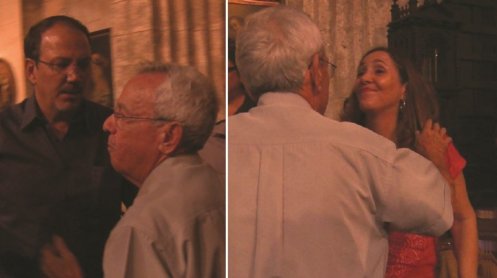
While the residents of Gibara were experiencing the desperate anguish of terrifying floods and the frustrations of being without electricity, the Castro dynasty’s hereditary princes — Alejandro, Nilsa and Mariela Castro Espín ( Raúl’s kids); Antonio, Alexis, Alex and Angel Castro Soto del Valle as well as Fidel Castro Díaz-Balart (Fidel’s sons) — were enjoying refreshing, well-made mojitos and the enchanting delights of caviar, squid and salmon with raspberry jam on thin layers of crustless bread in a charming Baroque edifice in Old Havana. The occasion was the debut and launch of a pair of books entitled “Fidel Castro and the United States” and “Raúl Castro and Our America.”
The cousins, children of the two powerful Castros, greeted each other affectionately but sat apart, at once together but separate.
It was like a sexless marriage in which, owing to certain commitments, the parties still share a bed. They allowed themselves to celebrate their good fortune dispassionately and without resentment while, at that exact moment, the unfortunate were fleeing from Irma’s impact.
In truth, I don’t know what Raúl was thinking. I believe he was probably thinking what a blessing it was to be handed by divine fiat the mantle of Commander-in-Chief.
Dr. Eusebio Leal, Havana’s official historian, presided over the event. The man in charge of compiling the data for this masterpiece, which is already being touted as the next best seller, was the astute and temperamental Colonel Abel Enrique González Santamaría who, in addition to having a doctorate in political science, is also senior adviser to the Defense and National Security Commission. He wore a light olive guayabera to the event, a color that might be described as a dull Sierra Maestra green.*
It is only natural that we should dress in subdued tones in these difficult days when people are seeing a lifetime’s worth of work taken away in seconds by the force of a hurricane.
*Translator’s note: a reference to the color of the military fatigues worn by Castro and his revolutionaries when they were operating in the mountains.