My Friend Marquito Will Repatriate to Cuba / Cubanet, Luis Cino Alvarez

repatriado

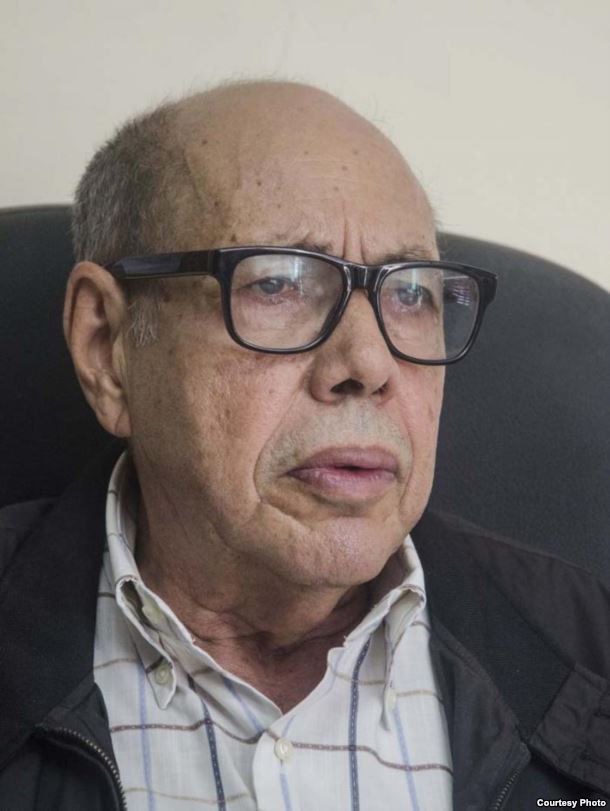
cubanet square logoCubanet, Luis Cino Alvarez, Havana, 31 October 2016 — My friend Marquito who has lived in Miami for fifteen years, has decided, as soon as he retires, to return to Cuba to live.

When he told me his plans, on the next to last day of my stay in Miami, after several whiskies and beers as we sat on the patio of a mutual friend in Miami Springs, I couldn’t believe what I was hearing. I thought it was a joke. Or pure drunkenness. But no. The man is serious. He has it all worked out. And is even trying to convince some of his friends to imitate him.

He said his American Dream isn’t going like he dreamed: that he is always financially burdened, that he can’t make it with the costs and the taxes, that he worked too much in jobs he didn’t like and that were below his professional abilities, which kills nostalgia, and he doesn’t want to end up in an asylum… continue reading

He explains that in Cuba, with the new circumstances created by the restoration of relations with the United States, he will get much more out of the 700-odd dollars he’ll receive from his pension when he retires at 65 (he’s almost 60). He calculates that in Havana, at his mother’s house in El Vedado, he will be able to live much better that he does today in Miami, where that money will barely pay the rent for the studio, a bedroom with a bathroom and kitchen, where he has lived in Hialeah since his divorce.

In vain I tried to convince him that this is nonsense, that “something,” which for me continues to be “this,” has not changed as much as he thinks, that I can’t imagine that after so many years he could readapt and resign himself to living without freedom after having known it.

He says, “It doesn’t matter, with money you can slip by, you’re indifferent. And when I’m really bored, when I need to oxygenate myself, now I can come and go, get a ticket and spend a few days vacation in Miami…”

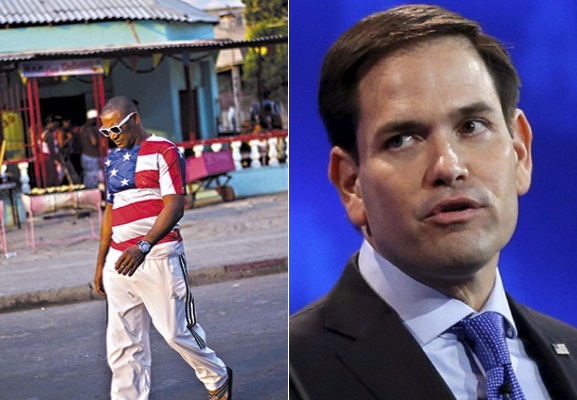
He says he has met several Cubans who have returned to the country and haven’t repented it. When I tell him it’s really fucked to give the dictatorship arguments to say that most of those who leave Cuba go for economic reasons and not political ones, and that I am beginning to understand Cuban-American politicians I disagree with, like Senator Marco Rubio and the representative Carlos Curbelo, when they complain that some Cubans are blatantly abusing the laws of the United States, and especially the pockets of the American taxpayers, Marquito interrupts me and tells me not to get all heavy with the “freaking politics” and he asks me if I wouldn’t be happy if we got together “there,” like we used to, and talk and listen to music from the ‘70s. Now that he has reassembled his vinyl collection he’s bring it to Cuba and we’ll listen to it with much better quality that when we used to listen on those horrible Russian turntables.

I can already imagine the bitter and endless litany of lamentations and complaints about “this” that Marquito would repeat in these meetings of castaways. The same ones as fifteen years ago, before he left. When he thought he was being suffocated and that the world as we knew it, would crush him. Has he already forgotten that time?

Marquito joked and in the face of my dismay sang, closer to Charlie Garcia Carlos Gardel, the one about “return, with a withered face …” and “feeling that is a breath of life …” And then he got philosophical, and said: “It’s like closing a circle. Completing a cycle. That’s what it’s about…”

I still do not believe he was serious. I prefer to think it was a joke.

About the Author: Luis Cino Alvarez (b. Havana, 1956).

Cuba’s Cienfuegos Refinery Reduced Production By Half Due to Cuts In Venezuelan Oil / 14ymedio, Mario Penton and Nora Gamez Torres

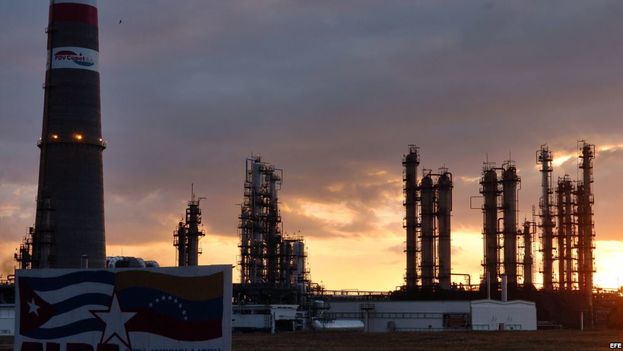
The Camilo Cienfuegos refinery in Cuba. (EFE)

14ymedio bigger14ymedio, Mario Penton and Nora Gamez Torres, Miami, 31 October 2016 – Cuba’s Cienfuegos refinery, operated by Cuvenpetrol SA, a Cuban/Venezuelan joint venture, has been forced to cut production by half due to cuts in shipments of crude oil from Venezuela, according to comments made on Monday by an official of the Cuban Communist Party (PCC).

Plans to build a neighboring petrochemical complex with Venezuela’s participation are also on hold, said Lidia Esther Brunet, first secretary of the Cienfuegos Provincial PCC.

The official admitted that the Camilo Cienfuegos refinery, a plant from the Soviet era, will not meet its targets this year “as it had done since its reactivation in 2007” and will process about 9.43 million barrels of oil, just 53% of the plant’s planned production. Brunet attributed the causes to “contract issues, Venezuela and other questions,” as she explained to the Chinese news agency Xinhua. continue reading

“Right now it is not processing Venezuelan crude. Shipments decreased substantially since last year,” said a specialist at the refinery who requested anonymity.

This month marks 16 years since the signing of the cooperation agreement between Venezuela and Cuba under which oil is exchanged for Cuban doctors and other services.

A worker at the refinery said the plant is refining crude oil from Algeria. “The situation is unstable, we start again Sunday, but sometimes it stops and restarts. We are all very afraid that in the end we will be lout of work. It would be a tremendous blow,” he said. The plant has a payroll of 780 workers, according to official data from 2010.

“The managers are saying that the joint venture could be closed due to the economic situation of Venezuela, and Cuba would wait for another country to assume their 49% of the shares. The big problem is that the refinery has never been profitable, because there were a number of needed investments that were never made,” said the refinery specialist, adding that “there has not been a reduction in the workforce yet, but it has already been announced. ”

In July of this year,Luis Morillo,general manager in Cuba for the Venezuelan state oil company PDVSZ, announced that the refinery would partially shut down for 120 days in various periods of the year “for maintenance.”

“The statements confirm what was already announced. Cienfuegos is not operating, but not because of technical problems, but because Venezuela does not have enough crude oil to send to refineries in Cuba. It is not about Cienfuegos, but about Venezuela,” said Jorge Piñón, acting director of the Center for International Energy and Environmental Policy at the University of Texas at Austin.

The expert, who monitors the movement of tankers in the Caribbean, said that in the last three or four months “there has been almost no traffic to Cienfuegos.”

The refinery’s expansion plans included increasing oil processing capacity to 150,000 barrels per day, the construction of a plant for olefin and aromatics, expanded storage capacity, and reactivating the pipeline between Matanzas and Cienfuegos.

According to Piñón the impact of the decrease in oil supply from Venezuela has not been even greater because the country continues to import oil from other sources, which comes in primarily to the port of Matanzas.

On Monday, Foreign Trade Minister Rodrigo Malmierca, admitted that the Cuban economy, severely hit by the crisis in Venezuela, would not grow even the 1% expected.

Starting in the second half of this year, the government announced cuts in fuel and electricity consumption, mainly in state enterprises. Under this plan, the central government assigns each company a monthly allocation of kilowatts of electricity. If the company exhausts its quota before the end of the month, their supply is cut off and workers go home “on vacation.”

The authorities have also cut public lighting and the distribution of fuel to companies, a part of which was diverted to the black market for private transport, the prices of which have risen as a result of this decision.

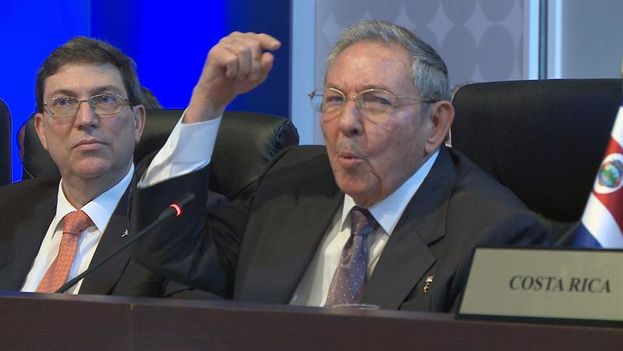
During a televised speech in July, President Raul Castro confirmed the decline in oil shipments from Venezuela. According to Reuters, citing internal PDVSA data, Venezuela supplies fell 40% in the first half of 2016. Jorge Piñón, the expert from the University of Texas, estimated that the reduction is 25% since the beginning of this year. The government has no recent statistics on the total refinement and extraction of domestic oil.

Robbed, Arrested And Beaten By Cuban State Security / 14ymedio, Juannier Matos Rodriguez

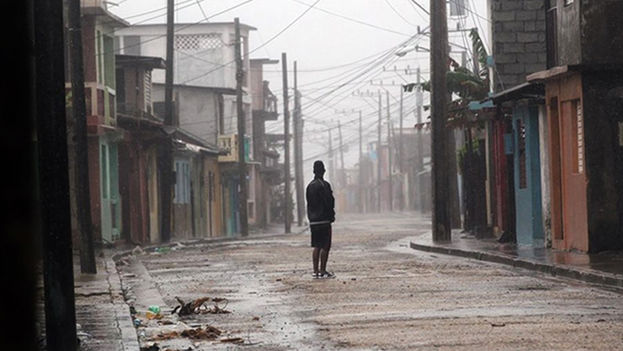
A man stands in the street in the city of Baracoa, in Guantanamo. (EFE)

14ymedio bigger14ymedio, Juannier Rodriguez Matos, Baracoa, 30 October 2016 — On Wednesday, October 12 at 5:40 pm, when I was on my way to the phone company in downtown Baracoa, the voice of Capitan Alfredo Oliveros ruined my afternoon, “Juannier, let’s go to your house for a moment, we want to talk with you […], we’re going to do a search,” he told me in an arrogant tone of voice.

A patrol car came up the road and the driver and a soldier from the Special Troops got out, handcuffed my hands behind me, and made me get in the back of the car. He got in with me and looked at me so long and fixedly I had to say to him, “Compadre, don’t look at me any more.” He responded, “You wouldn’t want me to pick you up and beat you.” continue reading

They took me back to my house and waiting there was Dieser Castro Pelegin (formerly a deputy of the Ministry of the Interior, MINIT, in Baracoa, now I don’t know what he does), the State Security agent Eliner Leyva, an official from the Cuban Revolutionary Police with the ID number 25513, the investigator Diorvys Odelin Lamoth, a van with some six or eight soldiers from the Special Troops, the informers from the Vigilance Committee, Diosmarys Infante Palmero (president of the Federation of Cuban Women) and Meydi Duran Navarro (agent from MINIT’s Special Protective Services Company), along with Alfredo Oliveros.

They showed me a search warrant signed by Elier Lopez Carcases, currently a MINIT deputy in Baracoa. They did not tell me the reason for the search.

They took my computer, a phone, a hard drive, two USB memories, several books and magazines, among other things.

Those hands took my books and threw them in a dirty sack, and with some copies they mockingly said: “This is burning my hands.” They took books that did not even mention Cuba, it was enough that the title would include the words freedom, rights, ethics, civic, transition, journalism and democracy, any of those words that are always repeated in international settings by the experiment called Revolution that is Cuba.

The officers claimed they were subversive books, but they were mine and they had no right to steal them from me. I don’t go to some communist’s house and say, “Hey, that book 100 Hours with Fidel is useless. Give it to me, I’m going to toss it out, it’s 100 hours of lies.”

What hurt me most was that the flash drives and the computer had years of research for my degree in Biology, my diploma work, a recent several months long research project collecting information on a population of polymita brocheri (land snails) in Punta Maisi on which I will publish new results, hours of work in the hot sun in Maisí, dozens of gigabytes of literature on the subject and specialty, as well as personal information.

I begged them to let me keep the items about biology, which is professional work, about those beautiful snails that are a threatened species, that was done for Cuba, I didn’t even know what to say, but as if it was nothing, they didn’t understand they were taking a part of my life.

They took two Cuban flags, one of which I flew from my roof as a gesture of solidarity with the neighbors who lost everything and in appreciation for my brothers all over the island who prayed for us during Hurricane Matthew, which I’m convinced made God protect every human life; and one of which was on the wall at the head of my bed, which made me dream every night about a more just and fraternal country with room for everyone.

Then I was again handcuffed with my hands behind my back and without saying anything they took me to a cell in the Baracoa police station. There I refused to eat and continued to do so the next day, when they took me out again, handcuffed, to a jail in La Maya, in Santiago de Cuba, passing through Imías, San Antonio del Sur and Guantanamo.

The next day in the morning, a MINIT major went to the jail, apparently the second in command in the La Maya unit, and I told him, “Officer, you are violating my right to a phone call.” He responded, “Yes, and we will continue to violate it.”

I told the officer who was guarding the cells I was feeling sick and would he please take me to a doctor. I heard a senior officer reply: “The one from Baracoa, he’s a disgrace, he’s a counterrevolutionary, let him die, it’s not your problem, it’s CI’s (Counterintelligence) problem.” I was in that filthy cell without eating until Saturday morning, when a police official came and put me out on the street.

I arrived in Baracoa the next morning. I went to the MINIT delegation and they told me they weren’t going to return anything, that everything had to be reviewed in Guantanamo and then they would give me an answer.

Juannier Rodriguez Matos

In Cuba ‘Raulismo’ Follows The Fine Print Of ‘Fidelismo’ / 14ymedio

The state model promoted by Raul Castro is incapable of sowing the crops needed to feed the population. (EFE / Señal Instucional)

14ymedio bigger14ymedio, Havana, 27 October 2016 – In recent weeks several alarming news reports about the Cuban economy have filled the front pages of newspapers. The attitude of the government in monopolizing the aid for the victims of Hurricane Matthew and its cutting off of new licenses for private restaurants have raised fears that the country is heading down the path of “counter-reform,” accompanied by an aggressive political rhetoric.

The first signs of this backtracking were felt in the “Guidelines for Economic and Social Policy of the Party and the Revolution,” updated during the 7th Communist Party Congress last April. These guidelines not only refuse to accept “the concentration of property” in non-state forms of productions, but added that the concentration of wealth would also not be tolerated.

For those who were waiting for the Party Congress to lead to greater flexibilities for national entrepreneurs, this strengthening of the most orthodox line increased their frustration.

“Raul Castro’s government seems more willing to lose the income from taxes on entrepreneurs than to allow entrepreneurs to exist with positive results,” laments an economist at the University of Havana who asked to remain anonymous. “Although the foreign media has exaggerated the similarities between the reforms undertaken on the island and the Chinese and Vietnamese style models, in practice, Cuban officialdom strives every day to do the exact opposite.” continue reading

The national press is full of calls to use the maximum “reserves of productive efficiency” that supposedly exist on the island, but this is just an empty phrase if they don’t start opening the Cuban economy instead of closing it.

After officially ascending to power in 2008, Raul Castro initiated a process of changes in the economy that he called “structural” and necessary for the country. Among those that had the greatest impact on daily life was the push for the private sector, which had been corralled with excessive controls, rules and high taxes during the presidency of Fidel Castro.

The leasing of state land under the terms of usufruct generated hope for advances toward greater flexibility in production and trade in agricultural products. The creation of urban cooperatives also helped to fuel the illusions of an economic recovery and an improvement that would be felt on Cuba’s dinner tables and in Cuban pockets.

There were also the relaxations to allow Cubans to buy and sell homes and cars, to travel outside the country and to be able to have cellphones, which achieved greater political impacts, lauded in the headlines of the international press as it highlighted “the Raul reforms.”

Eight years after the beginning of that impulse for renewal, officialdom is determined to divert attention from the main problems facing the country. In the streets there is a palpable sense that the country is returning to the early years of this century, with an imposed economic arbitrariness.

The former Minister of the Armed Forces, now president, has not met his commitment to push transformations “without haste, but without pause,” a much-repeated phrase that has become a touchstone of his supposed intentions. In recent years, instead of advancing, the flexibility measures have stalled and only 21% of the Guidelines have been met, according to the authorities themselves.

Recently, the private sector in the dining industry has begun to suffer new pressures. The announcement of a freeze in the issuance of new licenses to open private restaurants has been read as an unmistakable sign of a slowing, and even a backtracking, in the reforms.

Instead of concentrating its facilities to create a wholesale market, the state has chosen to dedicate all its efforts so that entrepreneurs cannot acquire the products and raw materials needed for their businesses in the informal market. Monitoring and control absorbs more resources and energy, in this case, than enabling and empowering.

Something similar has happened with private transportation, which, since the beginning of the year, has been under intense scrutiny by the authorities, with the government canceling of licenses in an attempt to regulate rates already established by supply and demand. Price caps have affected the population and doubled the time passengers spend in travel.

When logic suggested that the authorities should turn their efforts to providing carriers gasoline and oil at wholesale prices, they inverted the logic with inspectors demanding receipts from the drivers of shared-taxi services to prove they bought their fuel at state outlets. This, at a time when it is an open secret that private transport is only profitable if fuel is supplied through the informal market.

The ever louder beating of the drums by the most recalcitrant targets the accumulation of wealth, but without announcing the definition of what is acceptable and what is not. A practice of confusion and permanent anxiety that was very effective for Fidel Castro in keeping the country on tenterhooks for five decades.

The question many are asking is why doesn’t the government turn its energy to working with private businesses to make the state sector more efficient. Why not decentralize this mammoth network that produces more costs than benefits?

The little progress that has been made in this direction is felt in the country’s development. According to official estimates, in 2016 economic growth will be less than 1%, a figure dominated by the state sector that employs three-quarters of the labor force.

The state model driven by Raul Castro has chosen, in recent months, to spend huge resources on political mobilizations, but is incapable of sowing the crops needed to feed the population.

What country does he intend to bequeath to his successor?

Those who applauded his reforms look out over a Cuba today that is turning to the past, and a government that redoubles its rhetoric against independent journalists, bloggers and academic critics. A nation that continues to put the brake on its productive forces and looks grudgingly on entrepreneurship and prosperity.

Does Economic Development Lead To Democracy? / 14ymedio, Jose Azel

The political sociologist Seymour Martin Lipset. (Wikicommons)

14ymedio bigger14ymedio, Jose Azel, Miami, 27 October 2016 – For decades the statement that “the more wealthy a nation is, the greater the chances that it supports democracy” has been a conventional view and a centerpiece of United States foreign policy. This quote is from a seminal work from 1959, “Some Social Requisites of Democracy: Economic Development and Political Legitimacy” by the political sociologist Seymour Martin Lipset.

Lipset was the first to raise, on empirical grounds, a correlation between development and democracy. His thesis continues to guide US foreign policy and is often cited in discussions of how to promote transitions to democracy. continue reading

In what is known as the Lipset hypothesis, the professor theorized that economic development supports the consolidation of democracy, expanding levels of literacy, information and access to the media, expanding the middle class, activating independent civic organizations, emphasizing legitimacy and other sociopolitical values. Sadly, he is one of the most cited authors read.

Lipset noted that the correlation between politics and democracy is a wide list of factors that change social conditions, enabling the reception of a democratic culture. These elements, among them industrialization, urbanization, wealth and education, are the conditions, not the causes, of democracy. As suggested by the title of the article, the relation between economic development and political democracy is correlative, not causal.

US foreign policy errs when it ignores the contingent nature of history and relegates the complex social and structural conditions that lead to democracy to a simplistic economic variable. The error is multiplied when correlation is confused with causality. As Lipset shows, economic prosperity is often accompanied by personal freedoms, but that does not mean that economic growth causes political reforms.

The fact that the two events are frequently observed together does not meant that one causes the other: that the rooster crows every morning does not mean that the rooster makes the sun rise. In logic, the principle that correlation does not imply causality is known as the cum ergo propter hoc fallacy, which in Latin means “with this, therefore because of this.”

The most important political implications of the Lipset hypothesis have become one of the most researched topics in the social sciences. Recent studies don’t support the affirmation that economic development brings democracy. The most that can be obtained from empirical evidence is that development facilitates the permanence of this form of government, but does not make it more likely.

However, the US foreign policy will continues to depend on the false causality of the “development first, democracy later,” approach.

Atypical cases flow in both directions with wealthy autocracies like Saudi Arabia and poor democracies like Costa Rica. In the case of totalitarian regimes, it is clear that economic development does not lead to political reforms, as is shown in China and Vietnam. In totalitarian societies the elites have a lot to lose and choose oppression.

In the case of authoritarian regimes, the experience is mixed. The divergent cases of South Korea and Singapore illustrate the limitations of the claims that development furthers democracy. South Korea seems to exemplify circumstances where the increase in wealth contributed to the later democratic consolidation. Singapore, for its part, turns the thesis on its head, because the country remains authoritarian and has become more repressive with the increase in prosperity.

Our understanding of the relationship between the type of regime and economic development remains, at best, probabilistic. But we have learned that in previous communist societies it wasn’t the economy that generated the pro-democracy movements. In those countries, the essential struggle between the population and the elites was about human rights and civil liberties.

Therefore, to promote democracy US foreign policy should be updated and better informed, to understand how citizens adopt democratic values and push for democratic reforms.

____________________

Editor’s Note: José Azel is a senior researcher at the Institute for Cuban and Cuban American Studies at the University of Miami and author of Mañana in Cuba.

Camilo Cienfuegos, Nowhere to be Found / 14ymedio

Each October 28 the commemoration of Camilo Cienfuegos has become a tradition in primary schools across Cuba. (14ymedio)

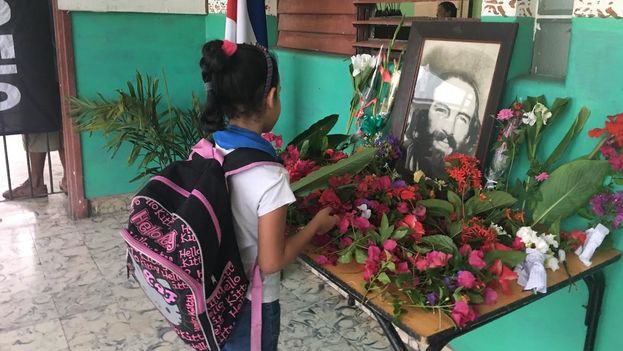
14ymedio bigger14ymedio, Havana, 28 October 2016 – Every October 28 the action is repeated, already converted into a tradition in the elementary schools throughout the country. Children bring flowers to their classrooms and from there leave to through them into the sea as a reminder of Commander Camilo Cienfuegos, who disappeared in 1959 in strange circumstances. Over time, the historical details have become blurred, the official version of events has become highly schematic, while students made comparisons or ask uncomfortable questions.

This morning, at a school in Havana, a preschool teacher tried to explain to her five-year-old students that “the Gentleman of the Vanguard” was lost at sea and they never found “anything at all” of him, not a single trace. The response of one of the little children disconcerted the energetic teacher, “Yes, teacher, I was at the beach once with my cousin and he lost a toy in the water that never came back… we looked everywhere and we never never found it.”

For new generations of Cubans, Camilo is that gentleman of the big hat and diaphanous laughter… of whom there is “nothing, nothing” left.

The Blockade Again… Fidel’s War Against Windmills / 14ymedio, Pedro Campos

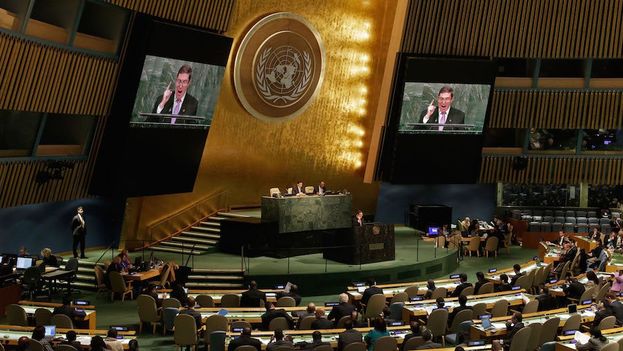
Foreign Minister Bruno Rodriguez defends the UN General Assembly resolution against the embargo to which, in 2016, no country voted no. (@Minrex)

14ymedio bigger14ymedio, Pedro Campos, Havana, 28 October 2016 – Launching an advertising campaign, deploying a costly diplomatic action charged to the Cuban people against a “blockade” that doesn’t have a single opponent in the United Nations, because even the United States government abstained, is at the very least to make yourself a laughingstock to the world.

This happens when politics is not structured based on rational thought, nor even on your own interests, but on the remains of pride, madness and fear.

We discover, one more time, that this campaign is directed against the Cuban people whom it tries to continue to disinform and shut up with nonsense seeking justifications for suicidally clinging to obsolete methods and ideas, superseded by history, even at the cost of international credibility. continue reading

The world doesn’t care about fidelismo, about the Castro regime. It is demonstrably tired of it. The regime’s goal is to maintain power within. An absolute power that makes room for any nonsense, so corrupt is it, so addicted and brutish.

The US government’s intelligent abstention in the periodic vote in the UN General Assembly on the American embargo on Cuba, left the Cuban government, as we say colloquially, with the rifle on its shoulder ready to swing at a ball that hasn’t been pitched, or falling under the cannon fire of a ghost ship on the high seas.

Now how are they going to keep blaming Obama and his government for the permanence of some strings of the blockade (as the Cuban government likes to calls it), or the embargo (as it is, in fact).

The overwhelming media and mobilizing campaign against the “blockade” reached its zenith on the eave of the UN vote on the repeated Castro regime proposal stating the “need to put an end to the economic, commercial and financial blockade imposed by the United States of America against Cuba.”

Cuba’s press organs spent several days trying to demonstrate that the blockade-embargo is the cause of all our ills. For weeks, the repudiation rallies have been unending in work and study centers, led by the likes of television talking-head Randy Alonso, against a policy that never diminished one iota the well-being of the political elite and which, instead, has served to justify its disasters, repressions and phobias toward democracy.

People, meanwhile, play at the Soviet era game in Russia: “They pretend to pay us and we pretend to work.” Which translated in this context would mean something like “they try to deceive us and we let them think we believe them so they’ll leave us alone.”

If anything has demonstrated once again how useful fidelismo is in maintaining what is left of the embargo, it is precisely this beardless social mobilization to entertain people and the rigged domestic measures to counter the “imperialist penetration,” which at any particular moment they identify with the policies approved by the last congress of the Cuban Communist Party (PCC) regarding self-employment, cooperatives and foreign investments.

The policy of rapprochement with the United States, developed in the last years of the Obama administration, which has been taking steps since the last Bush administration, has reached the reestablishment of relations, the signing of several presidential orders modifying nearly everything that is not codified by Congress, and even the visit of the US president to Cuba, whose people did not hide their joy at possibly the most momentous visit by a head of state in the last half century.

The US president has been very clear: he wants to live the blockade, but it doesn’t depend on him. He is doing everything he can to dismantle it from the office of the president. It’s clear that he would like a democratic government in Havana with whom the US would have better relations, but he does not intend to meddle in Cuban affairs. He said this in Cuba: this is a matter for Cubans.

But it doesn’t matter, the campaign against the blockade will continue. Fidelismo cannot live without enemies, and even though the adversary vows, promises and acts constructively, he must continue to be blamed for all wrongs and his “fifth column” must be repressed. If not, on whom is going to fall the historic blame for the disaster? Because history “must absolve” it*.

Fidel’s war against the windmills will continue.

*Translator’s note: A phrase taken from Fidel Castro’s defense in court (according to a version later published by he himself) for the 1953 attack on the Moncada Barracks, which is considered the start of the Revolution that ultimately triumphed in 1959: “Condemn me, it does not matter. History will absolve me.”

From Today Your Life Will Be “Very Difficult,” State Security Tells Dagoberto Valdes / 14ymedio

Dagoberto Valdes was summoned on Thursday at one in the afternoon to the headquarters of the State Security Pinar del Rio. (@mariojose_cuba)

14ymedio bigger14ymedio, Havana, 28 October 2016 — The director of the Center for Coexistence Studies (CEC), Dagoberto Valdes, summoned to a meeting with State Security on Thursday, received “an official warning” which anticipates “the possibility of committing crimes against State Security as defined in the Penal Code.”

Valdes, who remained at the police headquarters on the San Juan road for two hours and fifteen minutes, explained to 14ymedio that the officials threatened him that “as of today” his life “would be very difficult” if one day “he was to incur one of these crimes.” The police mentioned as possible violations of the law the receipt of money from the United States for his activities, or the lack of a contribution to the treasury. The director of Coexistence affirmed that he had “received not even one cent from the United States government.” continue reading

Despite these warnings, Valdes affirmed that everything happened “in a serious and respectful climate” and that “there was no physical abuse” at any time.

“I came to this place [the headquarters of the State Security] on time and within minutes of the hour I was received by Lieutenant Colonel Osvaldo Labrador, head of the unit, and Major Joaquin” said Valdes in a statement received by this newspaper.

According to the director of Coexistence, on entering the unit he was led to “an interrogation room where the entire conversation was filmed.” In it, he said Lt. Col. Labrador told him that for “all these years” he had remained “at the razor’s edge between being a layman of the Church and being a counterrevolutionary.”

Accordingly, Valdes added by telephone, they advanced that if he “engages in counterrevolution” he would be “treated” accordingly, but not if he continues with “his profile as a Catholic layman and cares for the social objective of Coexistence” and he mentioned “2003, when the 75.”

At the end of the declaration, Valdes was taken to the “technical” room where they took his “finger and palm prints, an odor print of his pelvis and photos from the front and side,” and later took him to the infirmary. Despite telling Major Joaquin that he felt “in very good health,” they insisted on taking his blood pressure, which was stable.

Dagoberto Valdes is thankful “with all his heart, for the immense solidarity received from friends and brothers of many countries and institutions, as well as for the prayers of pastors and brothers of different faiths.”

The Coexistence Studies Center focuses on training for citizenship and civil society in Cuba. Among its activities is the publication of the magazine Convivencia (Coexistence), the discussion of proposals for the future of the island and the exchange ideas about our current situation.

Last September the members of Coexistence denounced that at least nine of them had been subjected to police interrogation. The activists were forced to suspend the My Neighborhood One Community program due to pressure from State Security, which included operations around several of their homes, arrests and the cutting of the cell phone service of event organizers.

Based in the province of Pinar del Rio, the independent entity is conceived as a think tank to “think about the national home we desire, to contribute to the reconstruction of the human person and the fabric of civil society.”


“It Is Not Because You Write In ‘OnCuba’, It Is What You Write,” University Professor Told / 14ymedio, Mario Penton

Juan Antonio Fernández Estrada, a professor at the Faculty of Law of the University of Havana. (Cubaposible)

14ymedio bigger14ymedio, Mario Penton, Miami, 26 October 2016 — “It’s not because you write in OnCuba, it is what you write,” were the words used by the authorities of the Faculty of Law of the University of Havana to tell Juan Antonio Fernández Estrada that he could not continue to be a university professor. This measure “put the lid on the jar” and provoked a reaction from the teacher, who says he will not stay silent about this new outrage.

“I do not want to make a media show of this. I am submitting demands through the relevant channels and waiting for the responses to a situation that I consider unjust,” Fernandez told 14ymedio by phone, after an email he shared with friends explaining his situation went viral on the national servers. He further clarified that had never asked anyone to share or make public that communication which was meant to be private. continue reading

As of March 2012, the professor has contributed articles to the American magazine OnCuba, a publication with correspondents in Cuba that is widely disseminated through informal networks on the island.

The magazine is permitted by the Government and is a refuge for journalists and academics who see their contributions as a way to increase their meager income working in the state sector. Fernandez has published twenty columns ranging from opinions, history, politics and other topics of interest to Cubans.

“They informed me that my contract as a guest lecturer at the Faculty of Law could not be continued because I had been asked to resign from the Center for the Study of Public Administration (CEAP), and having done so, I had resigned from all of the University of Havana. I told them that other teachers had continued on as guest lecturers after having resigned as professors, but they explained to me that my resignation from CEAP had been for personal problems, the University considered it was because of my writings for OnCuba, and especially for an article about President Obama’s visit to Cuba,” reads an email that Fernandez sent to his friends.

The article referenced said, “I don’t want to know anything about the Industriales (baseball team) or Obama,” published at the beginning of April of this year, after the visit of the US president to Cuba. In this opinion column, Fernandez lambasted “the cries that warn us of Obama’s deception” and, putting his finger on the wound, wrote, “We, the people, we are not the one approaching the United States, nor like sovereigns did we talk in secret for more than a year with that government, nor did we invite President Obama to Cuba, nor did we invite him to speak live on national television.”

Given the impossibility of being hired, the professor told them that teaching was his only work, but the officials, undaunted, spit out that “you should have thought of that before writing those things.”

“I am telling you this because my silence is over this time,” said Fernandez in his email. “The University has not respected my silence all these years. I didn’t complain in 2008, I didn’t complain in 2012, but this time they can’t eliminate me without my speaking and responding.

The pressures of the Cuban authorities so that journalists and academics don’t collaborate with the private press and the emerging digital platforms has intensified over the last year. Presenters on radio and television were told in a circular transmitted verbally that they were prohibited from cooperating with these other media. According to a witness to some of the meetings, they were reminded “within the Revolution, everything, but outside of the Revolution, nothing,” which motivated everything from letters of protests to continued desertions to the independent press.

“The confusion of some has been to think that all my problems at the University of Havana have been because of errors,” concluded Fernandez, “because of naiveté, but it’s not like that, my problems have been for telling the truth, for being dignified and honest, for defending socialism and criticizing the opportunists and the shameless. These are my crimes and I will continue committing them.”

Kidnapped by Human Traffickers / 14ymedio, Georlys Olazabal Drake

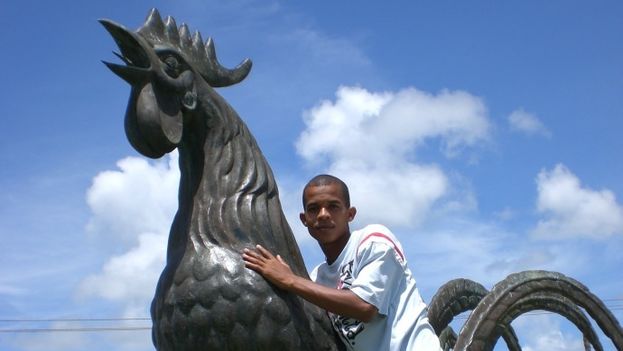
Georlys at the emblematic Rooster of Morón in Ciego de Ávila. (14ymedio)

14ymedio bigger14ymedio, Georlys Olazabal Drake, Florida, Camagüey Province, 19 October 2016 — At 29, like many of the young people here, Georlys Olazabal Drake fled the lack of opportunities in Cuba for undertake the risky journey to the United States. A member of the opposition movement Somos+ (We Are More), Olazabal Drake, who studied computer science, signed up for an illegal exit that would end up with his being kidnapped in Mexico by human traffickers.

Now he shares his story with the 14ymedio’s readers, with a notable number of details that reveal the framework of extortion, complicity and violence that surrounds many of these journeys to follow a dream.

This story started last July 23, when my cousin’s wife told me there was a boat leaving to take people to Mexico, some of them from Florida, the name of our town in Camaguey. She said the trip would cost between 2,000 and 3,000 dollars a person, but along the way – when I could no longer turn back – I discovered the real cost was 10,000 dollars.

The journey came like a hope, because everything was going badly for me at that time. I had had problems with the inspectors and the police had taken away my business license. I also had problems in my personal life.

Previously I wanted to leave the country and several of my family members had abandoned the island. Although I’m not in agreement with the system of government, the reasons that led me to leave had nothing to do with my political ideas, but with personal circumstances. I was a way to escape: I was presented with an opportunity and without thinking about it I undertook the journey. continue reading

I left in a rented car from Fontanar headed to the bridge of the PRIMER ANILLO of Havana, where a group of people had already gathered to be picked up. From there we were taken to the city of Pinar del Rio in a private truck being used to transport passengers.

During this leg of the journey I still felt sure about what I was doing. I believed it was the solution. On arriving in Pinar del Rio a gentleman picked us up outside the bus station and took us to his house. Then, in another truck, we took the highway to a town called Las Marinas. They collected us in these carts that they call spiders and took us to a farm.

We were 32 people, 20 from Pinar del Rio, 6 from Santiago de Cuba, and the other 6 from my town of Florida. There were no children, just 29 men and 3 women. Among them were 2 young men who had deserted from the border guards, taking their uniforms, their guns and leaving their jeep abandoned.

Once there, there was already no way to turn back. The only chance to abort the trip was if the border guard troops found out about it and interfered, or if the boat was intercepted at sea. They made it very clear that if we tried to leave or if we didn’t want to go, they would put an end to our lives.

There was no way to communicate with anyone, because we had to give up our cellphones. We could only go with a change of clothes, a package of cookies, a bottle of water and the money we had. We weren’t even allowed matches.

I wanted to call my wife but I knew they wouldn’t forgive me if I did so. However, I consoled myself thinking that I was making the journey for the two of us and if it worked out, I would find a way to get her out, to leave all the problems we were going through and to start again.

At the farm they didn’t give us any food. Many things were going through my head. I felt insecure, but the only thing left to me was to go forward and ask God for things to turn out well. The people got that far, although we didn’t know each other, were pretty communicative. We tried to help each other.

We slept one night at that farm, where there were several animals like cows and horses, but fortunately no mosquitoes, only some MORO crabs who were all around us because we were near the beach. Some farmers watched us at night with their faces covered, so they couldn’t be identified in case the border guards raided the placed.

During the night the time the boat would leave was changed several times, until some demanded to know the truth. After some pressure they told us it would leave at 7:30 in the morning. Then they gave us more warnings and brought us a jug of water

Around seven in the morning the farmers returned to tell us to get ready, the boat was about to some. When we approached the rock along the shore we could see in the distance what looked like a dove in the water. At that point I don’t know what I felt, I just remember telling myself, “Yes, this is what I should do.”

We were content. However, until that moment I also hoped that the boat wouldn’t arrive. I felt a desire not to make that journey, to put it all behind me and to return to the people I loved. At the moment you leave Cuba, that is when you value it.

Around 7:20 in the morning on July 24 the boat arrives. When we were far from shore I put my hands to my head and said, “My God, what have I done?” But I could no longer throw myself in the sea. The boatman pulled out a pistol and let off two shots in to the air to let us know we were under his control.

The crew was made up of two people: a boatman and his helper, both Cubans. The helper was called “El Menor” and was originally from a town in Pinar del Rio called El Cayuco, while the boatman was called “El Yuma” and was from Güines. Both of them live in Mexico and can’t enter Cuba legally, because they are wanted to drug trafficking, human trafficking and murder.

The boatman bragged about having killed his previous helper, a Honduran who was a boat mechanic.

The two men took security measures, like making us throw away our shoes so no one could escape when we landed. One of them told us that from the same place we had left from, they had made more than 30 trips last summer.

They bragged about coming and going from the island as if it was their house. According to them, in Cuba there are no teams to pursue fast boats. They leave Mexico like a fishing charter, and at night stay 60 miles out and advance slowly as if it was a fishing boat. When the sun rises, they rush in at full speed, pick up, and leave in the same way.

At around 30 miles they made a call to Mexico, to the boss of the business, and told him only: “We’re coming.” The boatman boasted that five boats belonging to the same business owner to look for people in Cuba, but only he had been able to pick up.

The trip was long because they were forced to enter Mexico at night. We arrived at Cancun, near the hotel area, after nine at night. We landed on a dock where we had to pay 100 dollars each to enter.

We were waiting for two small buses and boarded them, 16 people each. They took us to an abandoned warehouse, a sort of old rented building with all the security for this type of business. There two groups of us joined up with more than 50 people who had arrived on previous trips.

On arriving in Mexico we had to get the money to pay them. They took care of the paperwork for each migrant to fly north and present themselves at the US border. The entire trip cost 10,000 dollars, but I had no money to pay. At that point I began my odyssey.

The abandoned warehouse had two floors. Upstairs there were four bedrooms and a large living room where the TV was. One of the rooms was for the guides, who are responsible for finding people in Cuba who want to leave the country. The guides are more comfortable, with mattresses and food, and the trip is free. They are also used to control discipline. The other rooms are like cells.

The bosses were Cuban. They call the main one El Millo and he never shows his face in the business. Later it was Julian, El Negro, who is from Matanza and “attends to” the migrants and helps them do things like call their families. He functions as an intermediary. In addition, there are people everywhere who collect money.

A man named Rey, from Vertientes in Camaguey, is known as El Pinto and looks after the house. He is also responsible for the tortures.

They collected all our clothes from us, our identity cards, passports, and money to prevent any change of escape. They left us with shorts and a t-shirt, which is the “uniform” of the people help in that place.

The next day, at seven in the morning, we had a piece of bread and a glass of water for breakfast. Then they started the calls with our families, most of whom were unaware of our exit plans. They only allowed us to speak for a few seconds to they would know it was true that they had us.

If the family said they didn’t have any money, they warned them they would put their relative in a tank of acid and nothing would ever be heard of them or they would put them back in a boat and take them 30 miles out and throw them to the crocodiles.

I wasn’t tortured but others didn’t enjoy the same luck. They just punished me for not having any money and took me to a room where they only took me out for a bath once a week. We couldn’t watch TV or talk to anyone, and we had to be quiet and sleep on the floor.

I saw how they beat up several people, among them a young man that almost killed. Another who didn’t have any money, they broke two of his fingers with an ax.

If someone fell ill and they didn’t see any chance to get any money from them, they’d take them away and they never came back. We didn’t know what happened with them, if they kept them prisoner or killed them. Sometimes they would split someone’s nose and send photos to the family to scare them and threaten them.

Those who didn’t have any money didn’t receive any food. I spent 38 days with just water but no food. Sixty-nine of us lived like this, because in my group there were only 14 with money who were able to go to the United States.

It was better not to be very communicative, because they could think you were up to something, or going to flee or something else. Some, to get in good with the bosses, brought them information, so I preferred not to speak.

I stayed in a corner, quiet, sitting there, and when I was tired I slept to avoid reprisals of they became violent.

I wasn’t afraid but I worried about what my mom was able to do and thought a lot about my grandfather. On the other hand, they were convinced I was going to get out of there but couldn’t imagine how or when.

On the 35th and 36th day they started saying they were going to toss people 30 miles out or take us to the migrant centers of Chetunal and Tabasco. They took a photo of me and said to be ready at seven at night.

They put me in the taxi and called the federal police, with whom they do business. They sent the photo and the taxi information and later I just had to get in the police car. I was with the federal police for 48 hours, with the right to an attorney and they gave me a book that explained my rights and duties.

They gave us food and treated us well. The police were corrupt and also offered us the chance to continue the journey in exchange for money.

From there, they took us to the migrant center in Chetumal, where I was for 17 days, waiting for everyone. When I got there, there were 29 Cubans and on the day I left 17 more came. It was amazing to see how Cubans who don’t demand their rights on the island, do so there. They were protests about the cleanliness, water, food.

I knew they were going to deport me, but I still had the chance of refuge or political asylum. I thought about this last option, but gave up because I missed everything in Cuba. Despite all the problems I’d left behind, my country was better.

On 22 September they took me in a can to the Cancun airport and the next day, around seven in the morning, I left to fly to Havana.

They took all of us to the migrant center at Valle Grande prison, where they analyzed us, took statements and checked for criminal histories. The treatment was good, respectful and they didn’t ask us about anything. After a period of quarantine they sent me to the police station in my town and from there, home.

I’m happy to be in Cuba, with my family, my friends, and to have the chance to continue my political activism. Although sometimes I thought the solution was to emigrate to the United States, I don’t think I will try to leave again. I just want to establish myself here and have a family.

Although it’s hard to live with the problems we have in Cuba, the situations that face us when we try to exit illegally are harder. I urge everyone to fight for change in Cuba, since leaving the country is also leaving everything you love.
Cuba’s Pro-Government Intellectuals Denounce US “Cultural War” / EFE, 14ymedio

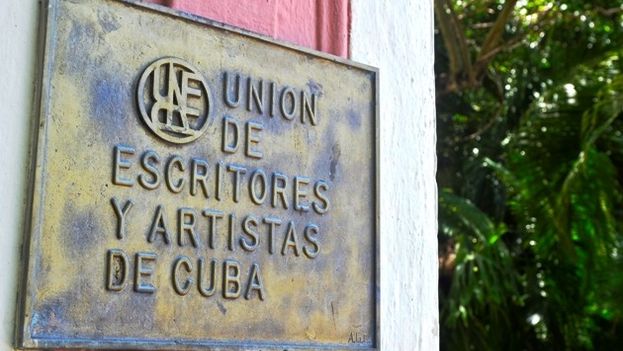
UNEAC says the US is trying to "undermine" unity, "cast doubt" and demobilize. (UNEAC)
UNEAC says the US is trying to “undermine” unity, “cast doubt” and demobilize. (UNEAC)

14ymedio biggerEFE/via 14ymedio, Havana, 20 October 2016 — The National Union of Writers and Artists of Cuba (UNEAC) and the Hermanos Saiz Association on Thursday blamed the United States for being behind a “war of culture and symbols” against Cuba and warned that “any naiveté in this sense could be very expensive for the sovereignty and independence” of the country.

“It is obvious that the war of culture and symbols that we confront is based on an explicit laid out in the statements of the leaders of the US themselves and in documents of that country’s armed forced,” says a message from these groups collected in the official press to mark the Day of Cuban Culture. continue reading

The two associations, that include the intellectuals of the island’s officialdom, say that they are trying to “undermine” unite, and “sow doubts” and demobilize.

“Although those who attack us have failed to break the commitment of the vanguard of Cuba’s artists and intellectuals with the Revolution, they do not pause in their attempts,” affirms the letter, published by the newspaper Juventud Rebelde .

The letter stresses that “history itself has been charged with demonstrating that it is not possible to imagine the survival of a socialist revolution if it is not accompanied by a profound cultural transformation that reaches the level of common sense.”

It also quotes former President Fidel Castro, who defined culture as the “shield and sword of the nation” and the current ruler, his brother Raul Castro, who recently warned that the field of Cuban culture is “doubly” threatened by ” subversive projects” and” the global wave of colonization.”

Intellectuals also refer to the economic embargo the United Stats has maintained for five decades against the island and whose “attacks” has been “suffered directly” by Cuban culture.

On October 20 Cuba celebrates National Culture Day in commemoration of the first singing of the country’s anthem, in the city of Bayamo.

Assassins, Accomplices, and Victims (II) / Ángel Santiesteban

Abel Prieto, Cuban Minister of Culture, Eduardo Galeano and Roberto Fernández Retamar, President of Casa de las Américas. AIN FOTO/Omara García Mederos

Ángel Santiesteban, 2 September 2016 — After writing what will now be considered the first part of this post, and publishing it under this same title, I was arrested by State Security; however it was not the writing, and much less the visibility that it would attain in my blog, that was the real cause for the arrest. My captors, in the height of contempt, tried to make me believe that I was a trickster, a vulgar swindler. In a flash I became, again, a dangerous offender. I confess that I even got to imagine myself in the shoes of some famous swindlers whom I met in movies, but this was not at all a game, and the cell was not a movie set.

I have dug around a great deal in their procedures up to now, and I know their falsehoods, which was why I urged them to let me know the details of my mischief. What was the cause? What would they do now to present me as a swindler? continue reading

First would be to convince me of that strange condition of con artist that even I did not recognize in myself. Time and again, fraud would be cited in their arguments, with no trace of it when the facts were compiled. Diffusion, accusation…so that the crook I was would contradict himself and ultimately see the error of his ways. Which ways?

They themselves would offer me very few details. Everything had occurred a year ago, and on the Isle of Pines–that island south of the larger one which, arbitrarily and without popular consultation, the government decided to rename the Isle of Youth. While I was shut away in a dungeon, my “interlocutors” mentioned a fraud which they were not able to explain very well, only to later refer to a packet of leaflets which, supposedly, I had given to the photographer and human rights activist Claudio Fuentes, who was also detained.

Try as the hired gun might to convince me of the “misdeed” and that I had no option other than to recognize my “crime,” I could not help but burst out laughing. The allegation was so ridiculous that I could have dignified it with many guffaws such as the one it provoked at the start, but these spurious accusations have no intention other than to ruin the lives of we Cubans who think differently, and laughter is a good thing.

I had not other option than to let them know that I was well aware of those strategies, that I was sure that they were trying to make me believe that Claudio had denounced me, and how that was a well-worn tactic–even in the movies and police novels. “I do not think the same as you. I am not a coward, nor am I your ’comrade.’ I am not a lackey.” That’s just what I said to them.

Then they laughed, but their laughter was not that of a victor, it was the nervous laughter of someone who’s about to lose. I confess that I felt frustrated; I have always dreamed of taking on an intelligent adversary, an enemy convinced of the rightness of his actions. This would be much better, but this time again it was useless to pine for such a thing, and the worst was that those gendarmes had not the slightest idea what the words “liberty” and “democracy” mean.

I was so annoyed that I started to speak of my childhood, of those days when I believed that Cuban State Security was one of the best in the world, even mentioning out loud the titles of a few novels: “Here the Sands are Whiter,” and “If I Die Tomorrow,” and “In Silence It Has Had to Be.” I mentioned the mark that those works had left on a bunch of proud adolescents who, still, believed that what which those fictional officials were defending actually existed in reality–and that we even believed, naively, that on this Island was a concerted effort to create a lasting prosperity.

The bad part, I assured them, was when I knew the whole truth, when I understood that those agents were only after ensuring the perpetual rule of the Brothers Castro. I mentioned the moment in which I crossed the line, that line that placed me, irreversibly, on the opposite side. I spoke of my discontent with a totalitarian regime, and about how I discovered the true essences of those killers in the service of the Castros: people capable of abusing women, of planting false evidence for the prosecution (after brutalizing them) of those who fight for change in Cuba. They would laugh, nervously…and with no segues they arrived at a new argument, undoubtedly the most important one, the one that caused them to shut me away.

What had truly annoyed them was a post that I had published regarding Roberto Fernández Retamar, in which I called him an assassin. According to them, I had not considered the fact that Roberto was my colleague. “I don’t have colleagues who are assassins,” I told them, and they replied that my attack had not achieved any importance, that it had already been forgotten, and that Fernández’ true comrades had made a tribute to him immediately. Then why, I asked, were they holding me there? Why were they mentioning that post? For sure, they were contradicting themselves–but I was already used to that, and once again I smiled, sardonically.

I thought of a version of Silvio Rodríguez whom I had seen on TV making tributes, in song, to Fernández, which made me suspect that it all could be a reply to my post. My detention had nothing to do with the leaflets nor with any fraud– that seizure was orchestrated after I accused Roberto Fernández Retamar of having signed a death sentence against three youths who only wanted to get out of an extremist country where they no longer wanted to live.

I had already received some news about the comments that had been incited by that post, and I also knew of the vexation that it had provoked in some writers, who judged it excessive that I should call Fernández an assassin. Again it was I who was the monster, I who committed savageries, I the irreverent and cruel barbarian–while Fernández was presented as the venerable elder, the respectable and virtuous man, the honest citizen, even after having signed a death warrant.

My detractors, the same who became his defenders while forgetting that the poet was one of the signatories of that judgment that would send three youths to the execution wall, denigrated me again, but never mentioned that the “revolutionary” poet lent a veneer of legitimacy to the death of those three young men, whose only sin was to have tried to leave a country that was tormenting them, to separate from an Island and from the dictators that have been ruling it for more than 50 years. Is that a crime?

Those who were annoyed by the post are the same who repeat the charge against me that the official discourse prepared some years ago. Those who claim that I was unjust toward Roberto Fernández Retamar did not defend my innocence when I went to jail. They saw me be taken away, they knew I was shut away in a cell, and they were silent. They never had doubts, they never confronted a power that decided to accuse of me of physically mistreating the woman who was then my companion. Those who again judge me and cast me aside are also guilty of my imprisonment.

Those who today are annoyed because I accused the president of the Casa de las Américas, did not lift a finger to request, at least, a thorough investigation of my case. They believed in the “dignity” of that woman, and today turn a deaf ear to the statements by my son. They, whom my post angered so, are the same who remain silent when “State Security” beat the Ladies in White, a “State Security” that beats women who are demonstrating peacefully. What kind of security is this? Of what State? This shows their double standard and hypocrisy. Those who signed the accusation against me today are irritated by my “attack” on the poor poet Fernández, following the orders of Abel Prieto, who at the same time was following those of the highest hierarchy of a dictatorial government.

My attackers defend only their permanence in that official union that is the UNEAC. They who seek to tarnish me want to preserve their membership in the official delegations sent to any event taking place outside the Island. They who raise their voices to attack me defend the shoes and sustenance of their children. They who attacked my liberty because, supposedly, I was beating the mother of my son, said not a word after the thrashing that State Security delivered to the actress Ana Luisa Rubio.

That woman who found herself so vulnerable, so trampled, had no choice but to leave Cuba–and what else could she do, if the UNEAC did not offer her any support nor did it organize a demonstration to confront that power that decided to batter her. No woman was to be found confronting the janissaries that bashed Rubio. In those days there was no book going around collecting the signatures of indignant UNEAC members, if any there were. Nobody went out on the street–apparently, they were amusing themselves by protecting the crumbs they get from the powers that be for their services to the “fatherland.”

 Translated by: Alicia Barraqué Ellison and others

The Ex-President of the National Bank of Cuba Has Been Arrested / Juan Juan Almeida

Juan Juan Almeida, 26 October 2016 — Under the alleged charge of influence peddling, Héctor Rodríguez Llompart, an ex-Cuban diplomat and the ex-President of the National Bank, was arrested.

“No one knows the motives,” said a source close to the Llompart family. “I think after the Ochoa case, the people running this country lost all the elements of inhibition in human conduct.” continue reading

Retired and 82-years-old, on August 8, 2016, there appeared in Granma an article that was later reproduced for the digital portal, Cudadebate. It was entitled “Viva Fidel,” in allegory to the 90th birthday of the ex-Cuban leader. However, in spite of his advanced age, his copious history and the laudatory writing about Fidel, Llompart was arrested at home, in the Casino Deportivo neighborhood, together with his wife, Patricia Arango.

Llompart, ex-Vice Chancellor, ex-President of the State Committee for Economic Collaboration (CECE), ex-Vice President of the National Commission on Economic and Scientific-Technical Cooperation and ex-President of the National Bank of Cuba, is known for depenalizing the dollar in 1993, and for the implementation of the Cuban Convertible Peso as the second official currency in 1994. Both measures had a significant impact on the economy and on living conditions for Cubans.

According to sources consulted, Patricia Arango, Rodríguez Llompart’s wife, after being freed and subjected to a search of her home, has been confined to her house.

Héctor Rodríguez Llopart is a native of Havana and did not join the Rebel Army during the conflict in the Sierra Maestra. He passed through the Cuban Chancellery, where he was Vice Minister, Minister-President of the CECE, and then the President of the National Bank of Cuba for 10 years.

Translated by Regina Anavy

Nominated for Reporters Without Borders Prize / Iván García, Tania Quintera

Ivan Garcia (L.), Tania Quintera (C.) and Raul Rivero (R.) Summer 2000

Tania Quintero and Iván García, Lucerne and Havana, 25 October 2016 — To all our friends:

Thank you for the congratulatory emails to Ivan and me (Tania Quintera) for having been nominated by Reporters Without Borders for their Press Freedom Prize in the category of Citizen Journalists.

Thanks also for the notices published in Diario de CubaDiario Las Américas and Martí Noticias.

Let me dwell on the photo from Martí Noticias, the only one where Raul Rivero, Ivan and I all appear together. In the caption they say they we are in the press room of the Cuba Press agency, but as Raul Rivero used to say, Cuba Press was an “abstraction”: it never had a headquarters or a press room. continue reading

Most of the time, the thirty some journalists of Cuba Press, climbed the three flights of stairs to the apartment of Raul and his wife Blanca Reyes, at 466 Penalver between Oquenda and Francos streets in Central Havana, and from its phone, a black apparatus with the number 79-5578, located on the hall table, we dictated our articles to people in Miami or Madrid and they posted them on the internet.  We’re talking about the years 1995-1998.

We had no internet and few Havana homes had cordless phones, which now are common. Then, we didn’t even dream of cellphones, texting, Twitter, Whatsapp, Facebook… If I remember rightly, it was in 199 when 2 or 3 of us from Cuba Press, among them Ivan and I, got some money and went to the Carlos III Mall and bought fax machines, and through them sent our work, a “luxury” in the midst of so much insecurity.

The photo from Marti Noticias, posted here, was taken in the summer of 2000 for a report on Cuban independent journalism, prepared by the Swiss journalists Ruedi Leuthold and Beat Bieri.

Raul in his only denim shirt, Ivan with his Sunday t-shirt, and me with my “coming and going” dress (in 2000 the island of the Castro’s was still living in “a special period in a time of peace”), we were ar Ricardo Gonzales Alfonso’s house, in 88th Street between 9th and 7th, in Miramar.

Three years later, on April 4, 2003, Ricardo and Raul would be tried together in the People’s Court of Diez de Octubre, and sentenced to 20 years in prison. For health reasons, Raul was released in late 2004 and April 1, 2005 came to Madrid as a political refugee.

Ricardo remained in prison until July 2010, when the negotiations between the Catholic Church, the Ladies in White, the Spanish government and Raul Castro, the political prisoners of the Group of 75 were freed and he was exiled to Spain. Ricardo continues to live in Spain, and in Cuba, it is worth remembering, was a correspondent for Reporters Without Borders.

Along with the two of us, Reporters Without Borders is also recognizing the hundreds of journalists, independent, alternative and unofficial today who in Cuba do or try to do journalism by and for Cubans.

But honestly, to be fair, that award should be given to those who are faring worse than we are: our colleagues Lu Li Yuyu Tingyu arrested in China; Ali Al-Mearay, arrested in Bahrain; Negad Roya Saberi, an Iranian-Britin sentenced to five years in prison in Tehran; the Brazilian of Japanese origin Leonardo Sakamoto; or the site SOS Média, of Burundi.


The Old Age of Elpidio Valdés / 14ymedio, Yoani Sanchez

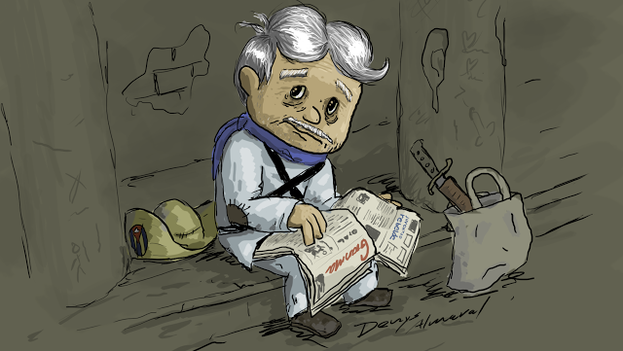
The image of the artist Denys Almaral gives an unexpected turn to the iconography created by Juan Padrón.

14ymedio bigger14ymedio, Yoani Sanchez, Havana, 24 October 2016 — Several generations of Cubans have grown up watching cartoons based on the adventures of Elpidio Valdés. A Mambí – Cuban freedom fighter – friendly and popular, the character has starred in many popular sayings and some jokes repeated ad nauseam. Willing to annihilate the Spaniards with a slash of his machete, nationalist to the core and vindicator of the version of history clung to by the official discourse, this insurrectionist tried to represent Cuban identity in his picaresque rebelliousness.

The image created by the artist Denys Almaral gives an unexpected twist to the iconography created by Juan Padron. Aged, forced to sell newspapers to survive and marked by economic hardship, this Elpido Valdes of this little vignette belies the heroic tints in which he appeared in numerous shorts and feature films dedicated to the witty independence fighter. continue reading

Instead of the country for which he fought, the rogue spends his last years in a Cuba where those who live better are those who have hard currency, where the dreams of equity are a thing of the past, and where the generation that helped to build the system is a “hindrance” to the government’s desire for a monopoly.

The island is full of Elpidio Valdéses asking for alms, standing in long lines to buy the only bread they have the right to each day and dreaming of the project of this nation that led them to the countryside to shake off the yoke of a foreign power. Now, they are not subjects of the metropolis, but of the Castro regime.

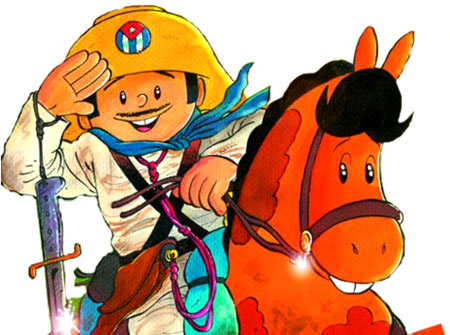
Elpidio Valdes -- the Jaun Padron version "in his youth"
Elpidio Valdes — the Juan Padron version “in his youth” Source: kreweofmambi.com