Cuban Musicians Are Freeing Themselves / 14ymedio, Lilianne Ruiz

JouMP’s alternative recording studio, “Espacio Latino Records.” (14y medio)

14ymedio, Lilianne Ruiz, Havana, 12 January 2016 – In an apartment located in a dingy, rundown concrete building of Havana’s Plaza district, dozens of musicians have made the dream of recording their songs come true. Here we find one of those “home studios” that are becoming essential for the Cuban music scene, and especially for the online market.

A couple of years ago, nineteen year-old Claudia Pérez chose a new more “intriguing” name befitting a “grand diva,” Nina. However, her vocal and performance talents will not get her very far without the backing of a musical expert and an independent producer.

JouMP, a music producer and editor, owns the studio where Nina recorded her first singles. It is composed of a single room with wood paneling, pompously advertising itself as “Espacio Latino Records.” JouMP spends hours in his studio, insulated from street noise, mixing musical effects and composing songs. continue reading

“The only thing I need to do is find the right musical thread, and then the right instrument that defines the piece’s esthetic,” remarked JouMP. He added, “Right from the start I know how to identify songs that are sure to be hits.” This is why he is so respected, and why so many entrust him with recording their albums, songs, or creating background melodies for them.

JouMP has been involved in the world of independent creativity for more than a decade, and considers himself “a sound artisan.” His most prized possession is an external hard drive storing more than four thousand musical pieces encompassing several genres, all created by him.

Stored together with his compositions are sound editing programs such as Fruity Loops, Wavelab, and Logic Pro, as well as dozens of recording tools. The majority of these programs are pirated versions, purchased on the black market.

The apple of JouMP’s eyes is his digital console, which along with his monitors, his computer with a powerful soundcard, and his microphones, gives the studio a professional look. This equipment was also acquired outside of official State channels, purchased second-hand, or from those travelling abroad who are asked to bring it back to Cuba with them.

The lack of copyright laws and official authorization give a clandestine feeling to these ventures. Still, this does not discourage those who jump at the opportunity of turning their bedrooms into “sound factories.” For the most part, the reggaetón played in shared taxis and on teenagers’ earphones are recorded in these types of alternative studios. The most common way of promoting this music on the Cuban market is by way of the “weekly packet.”

JouMP bragged about creating an arrangement for rapper Wilder 01 by mixing cha-cha with an electric guitar, thus giving it a “crunch” sound. He called the piece “Estar contigo” (“Being With You”), and offered it to EGREM. This State-run music label hailed the song’s originality, and recognized that it did contain “some traces of Cuban music.” Nonetheless, it was “too foreign.”

Those times when membership in a (government-run/official/State) organization was a prerequisite for recording an album are now in the past. “Privately owned studios give you more freedom,” commented Dj Xon, an eighteen year-old who performs at parties, and who also dreams of compiling all his work and uploading it to iTunes.

Until now, the only option available for the majority of Cuban musicians who wanted to post their music online was Bis Musica, a label owned by the State-owned corporation Artex. Bis Musica is in charge of uploading music to platforms such as Spotify, iTunes, and Amazon. It often also acts as an agent, retaining up to fifty percent of a song’s royalties.

Some artists manage to upload their songs onto the Internet thanks to a friend or relative abroad who also helps them secure their royalties. Despite the difficulty of accessing the Internet or collecting royalties in Cuba, iTunes offers a wide variety of music produced by Cubans living on the island.

In their short years, JouMP, Nina, and Wilder 01 have witnessed a giant technological and social leap forward. They have seen the industry go from old vinyl records, whose production was under total State control, to the new wave of independent studios where songs are not even burned to CD’s anymore, but instead are being produced for online streaming.

“They’ll be able to hear me anywhere in the world, because I’ll be up there,” commented Nina. While singing in that narrow studio with wood paneling, she daydreams about “the cloud,” and the enormous potential her voice could have online.

Translated by José Badué
National Identity As A Pretext / 14ymedio, Regina Coyula

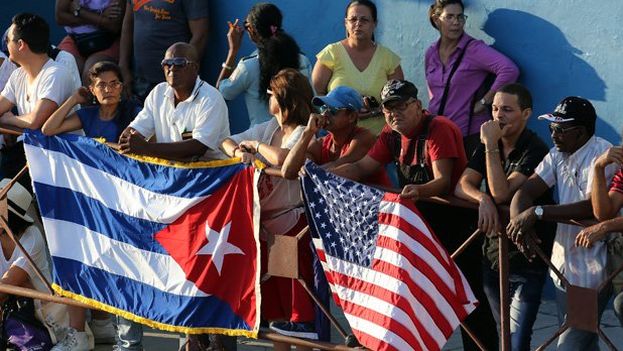
Flags of the United States and Cuba in the streets of Havana. (14ymedio)

14ymedio bigger14ymedio, Regina Coyula, Havana, 30 January 2016 — The view that the change in United States policy toward Cuba carries the danger of a loss of independence and of the values of national identity makes me smile wryly. Contrary to those who are worried, I would say that we Cubans are immune to the loss of identity, an idea that has some losing sleep.

It did not happen during the Republic, when we had mediated governments, nor did it happen when the Soviet influence was such that it “created” traditions, things that almost no one remembers now, like laying a bride’s flowers at the bust of a martyr, or substituting “Hurrah!” for “Viva!” among others I won’t even try to list. Instead, traditional festivities around Christmas, New Years and Easter were cancelled, along with others I also won’t try to list. continue reading

We have become accustomed to hearing military terms used to define the bilateral Cuba-United States relationship: cultural penetration, ideological battle, domination, hegemony. The national life throughout all these years revolved around the conflict with “the lurking enemy to the north.”

From the White House, nearly a dozen presidents eased and tightened the measures against its provocative neighbor. Conditions have changed with the passing of time and, with the disappearance of the socialist camp, other priorities left our country as an ember of the Cold War.

For the Government “governed” by a small group of octogenarians who come from the struggle against Batista in the Sierra Maestra, the situation has barely changed. They came to power very young, dynamited its structures, encouraged the bourgeoisie and with them the “lively classes” (the civil society of that time) to leave the country, and created their own way of doing things.

Because of this they never renounced the language of the barricade, nor have they stopped talking about the Cuban Revolution as a seminal and living event, when at least institutionally one can fix its end in 1976. Although the institutional character of the de facto Government of 1959 formally established a certain “informality” – with military uniforms giving way to civilian dress – the indisputable leadership of Fidel Castro sidestepped that inconvenience and he ruled as he saw fit.

Over the years, the anti-imperialist discourse has lost traction among the people, because as they have seen, the “empire” is not as fierce as it has been painted: half the family lives there, sends remittances, pays for our visits, or comes back loaded with gifts for everyone. Right now, the United States Government eases and eases and the Cuban Government interprets it as a well-deserved victory, not a quid pro quo, and still nobody understands what the crisis in farm products has to do with the “blockade.”

In the media and in academic texts (under State control), the consumer society and its values (or lack of them) have been anathematized; this has not kept cultural patterns from being a Frankenstein with the worst of each system. The taste for trash music, trash movies, trash literature and trash fashion is not only not avoided, but marks the canon of the popularly accepted. In a cruel paradox, culture has been what is most accessible to citizens in their spare time.

I don’t know how patriotism is measured. Flags haven’t been sold for many years, much less in Cuban pesos. The Cuban flag flies – though not always – on public buildings and in an ever declining number of neighborhoods and homes for the anniversary of the Revolution or the assault on the Moncada Barracks. It is also seen on the outfits made by the multinational company Adidas for our athletes, which many who are not athletes also wear, among them foreigners who assume solidarity, strolling through Havana with a beret, Che T-shirt and shoulder adorned with our national emblem.

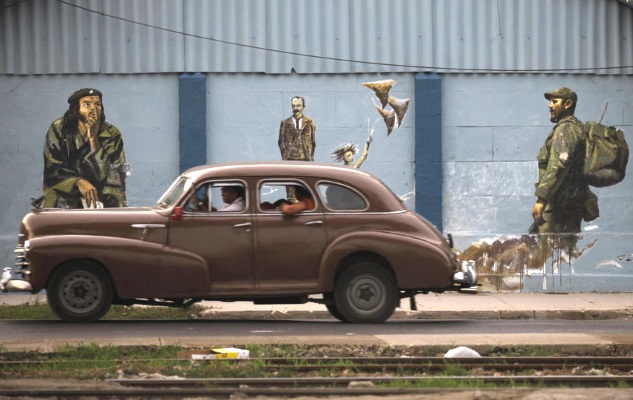
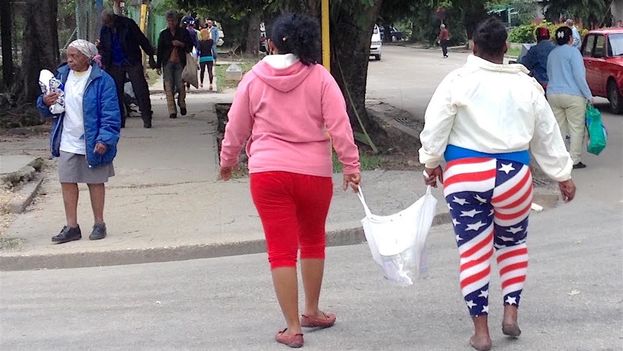
In contrast with this quasi-institutional display, I see American flags in the old American cars that function as shared taxis, in the cartoonish bubble car taxis, in the pedicabs, and on caps, T-shirts, scarfs, and even in lycra versions that have flooded the streets with cellulite-filled stars and bars. La Yuma (the USA) and los Yumas (its inhabitants) are now the paradigm of a society that doesn’t substitute McDonald’s for roast pork and is considered anti-imperialist at heart. Weird, but true.

You don’t have to be an economist or a sociologist to see the exhaustion in individual perspectives, let alone the collective. If decades ago seeing one’s children emigrate was a tragedy, today it has become a hope. The State has no solution for the discrepancy between wages and prices, for the burden of transport and housing, and has now abandoned the role of father protector with which Fidel Castro felt so comfortable. Today, everyone must address the solution to their own needs, that for not being morally correct resolves the situation of two generations brought up under the idea of the State as the cradle-to-grave provider of everything.

The true and unconfessed fear of the champions of national identity is not a fear of the cultural influence that existed long before 17 December 2014, and which will not change the essence of Cubans, but of the free flow of information that lets any citizen peer into a looking glass that gives access to complete and contrasting information.

A Hero To Justify The Cuban Failure / Cubanet, Luis Cino Alvarez

What in abundance are those who distort and manipulate the ideology of José Martí (Reuters)
What we have in abundance are those who distort and manipulate the ideology of José Martí (Reuters)

We continue on without wanting to admit that if our “wine is sour,” even if “the wine is our own,” it is no more than that: sour wine.*

Cubanet, Luis Cino Álvarez, Havana, 28 January 2016 — Today marks the 163rd anniversary of the birth of our national hero, José Martí. It is the time to repeat by rote the two or three of his sayings that all of us Cubans learned since grade school. It is but a short time before we again commemorate his death on May 19. Those two remembrances comprise most of the veneration of Martí that was instilled in us from childhood. What a shame! continue reading

We have the myth, but the counsels and teachings of Martí have served us precious little. Rather, from the era of independence [from Spain] up to today, we have systematically devoted ourselves to incurring everything against which he warned us. We have done as the Israelites in the Old Testament, who continually disobeyed Jehovah and were punished for it. Although we are not even remotely like the Hebrews, our people, too, have received their due punishment. And what awaits us, still…

Whatever became of all that which was quoted so often but has never come to pass, of the republic and the nation “for all, and for the good of all”?

We Cubans have exploited, with no compunction, the legend of Martí. Few peoples enjoy the privilege of having a poet as their national hero. But poets and their worldviews are not easy to comprehend. We never understood Martí well, and we have idealized and inflated him into the politician that he was not and never wanted to be.

Upon preparing for the War of Independence, Martí fulfilled his principal historic role. There was little else by then that he could do. His death at Dos Ríos, on 19 May 1895, confronting a Spanish patrol, was almost a suicide mission. It provided him the out that that he could not find before such great obstinacy and lack of understanding among the principle leaders of the Mambíses.

But the official story, that which was taught before [the 1959 Revolution], and which is badly taught today, refuses to acknowledge the conflicts that existed among the leaders of the independence movement…

Would Martí, after independence had been won, been able to work with those who were intending to lead the Republic as if it were a military camp**, and instill in them his civic and democratic vision?

Very few Cubans have read Martí deeply. What we have an abundance of are those who distort and manipulate his ideology. Thus, they have created a multi-purpose Martí, useful and convenient for all.

The greatest plagiarist, Fidel Castro, made of Martí the intellectual author of the attack on the Moncada barracks, his guide for the construction of a socialist society, and mentor to his pathological confrontation with the United States. To justify his single-party dictatorship, Fidel cited the case of the Cuban Revolutionary Party, overlooking the fact that it was created solely to organize the War of Independence, and not to perpetuate the rule of any political caudillo.

The legend of Martí contributed to the construction of a meta-history, a teleology of the nation’s destiny, which has done us more harm than good. Rather than redeem us, it bequeathed to us, among other things, a bad conscience and the fate of national misfortune.

Writing from exile, Martí idealized a Cuba in which he lived barely 20 years of his life. But the Cuba he invented surely would have been much better than the real one, if we Cubans had been able to make it come true—if not exactly as Martí envisioned it, at least close to it. But we were not able. And we continue not being able.

They beat us over the head so much with the pure heroes and the bronze statues that they ended up boring us. As a result of this boredom, today many Cubans, especially the young, associate Martí with the Castro regime’s harangue, and they reject him outright.

We Cubans should be ashamed of all the ignorance of and distortion of Martí. But it is easier to feel sorry for ourselves. So we continue to quote his sayings—even if they are out of context, or we do not understand them well, or we interpret them according to our whim and convenience—to justify our failure as a nation.

Thus attached to Martí, we continue not wanting to admit that if the wine is sour, for all that it is our wine, is no more than that: sour wine. Or even worse: vinegar. Which stings so much in our wounds…

luicino2012@gmail.com

Translator’s Notes:

*A reference to a quotation of Jose Martí well-known to Cubans, “Nuestro vino es agrio, pero es nuestro vino” – Our wine may be sour, but it is our own wine.

** A reference to another oft-remembered phrase from José Martí (though not one commonly invoked by Fidel or Raul Castro): “Un pueblo no se funda, General, como se manda un campamento” — A people is not founded, General, the way one commands a military camp. Martí wrote this in a 20 October 1884 letter to General Maximo Gomez, in which he resigned from the revolutionary movement.

About the Author

Luis Cino Álvarez (Havana, 1956) has worked as a professor of English, in construction, and in agriculture. He entered independent journalism in 1998. Between 2002 and Spring 2003, Cino was a member of the reporting team at De Cuba magazine. He is assistant director of the online magazine, Primavera Digital [Digital Spring], and is a regular contributor to CubaNet since 2003. A resident of Arroyo Naranjo, Cino dreams of being able to make a living from writing fiction. He is passionate about good books, the sea, jazz and blues.

Translated by: Alicia Barraqué Ellison

If We Are Talking About Terrorists / Mario Lleonart

Photo: with friends Roberto Pisano and Leonardo Delgado

Mario Lleonart, 29 January 2016 — A few days ago (January 15th and 16th) I took part in a gathering in Miami of the Coordinating Liaison Committee of the Cuban National Meeting, of which I am a member, along with eight others. On the 18th, on Martin Luther King Day in Saint Petersburg, Florida, I paid tribute to King, joining in the parade in his honour distributing copies of the Universal Declaration of Human Rights. On the 19th I visited locations in Sarasota and Manatti, Florida, which had been pounded by tornados early in the morning of the 17th. continue reading

While I was doing this, the political police made appointments with or visited people who know me in Cuba, who take part in forums of the Instituto Patmos, parishioners, collaborators, friends, neighbours and family members, to warn them that it was dangerous to have anything to do with me, inviting them to cooperate with their secret services, and to turn them against me. After I returned to Cuba some of them dared to tell me about these contacts, pressures, harassment and threats. One of the reasons put forward by the Cuban Gestapo, without any support, was that I had met terrorists in the USA.

In the afternoon of the 20th, I visited Leonardo Delgado, a one-time political prisoner, in his house in Tampa. He has been battling lung cancer for five years. With him was Roberto Pisano, one of his prison companions. His stories about the ancient Cuban prison are shocking.

That morning I had received some mail from Cuba, testifying to the arguments put forward against me by the State Security. Listening to Pisano and Delgado’s stories made me think how ridiculous it was that someone in Cuba would say that I had met terrorists in the US, since it was in fact the opposite.

I replied to the mail saying that if, by any chance I had had a meeting, without knowing it, with terrorists in the USA, it would have been if I had unknowingly met an undercover agent, one of the hundreds illegally infiltrated into the US by the Cuban political police. Like those involved in the shooting down of the four Brothers to the Rescue pilots, or those who specialise in assassinating without leaving any traces.

Translated by GH

Audit Detects Millions Missing In Havana / 14ymedio

Comptroller General of the Republic of Cuba, on 23rd Street in Vedado, Havana. (14ymedio)

14ymedio bigger14ymedio, 28 January 2016 – The results of the “national internal control check” undertaken by the Office of the Comptroller General of the Republic between January and September 2015 in Havana has set off alarms. In 366 audits conducted on 63 entities, it was found that more than 267 million pesos had gone missing (a combined figure for Cuban Pesos and Cuban Convertible Pesos), according to the government newspaper Granma, reporting on Thursday.

This is the tenth internal control check of this kind and the findings of the inspection were announced Wednesday at the Ministry of Energy and Mines, through statements by Miriam Marban, head comptroller for the Cuban capital. continue reading

The official stressed the need for greater “preparation, responsibility, demand and organization in management” to avoid losses of this magnitude, and she also stated that there had been no progress in the control of resources as had been expected.

Corruption and diversion of resources was on the agenda of the 2015 parliamentary sessions, where Comptroller General Gladys Bejerano Portela, emphasized that the greatest effects were concentrated in inventories, contracts, billing, fuel, the leasing and use of land, and standards of consumption and waste.

During the meeting this Wednesday, the issues of preparing institutions for the aging population was analyzed, and current mistakes in the supervision of the old age homes that were audited were detailed. In surveys, respondent complaints focused on the hygienic and structural conditions of these institutions.

The awarding of subsidies for the purchase of building materials was also a target of criticism. The Comptroller General revealed a lack of monitoring of the progress of the subsequent work undertaken, along with obstacles and delays in delivering the aid, as was the case in Central Havana, in which only 5% of the total beneficiaries of subsidies had actually received building materials.

The secretary of the Communist Party in the capital, Mercedes Lopez Acea, said the plan “has to prioritize those most in need.” Lopez, who is also a member of the Politburo, said managers have “an obligation” to control “the proper use of available resources.”

Machado Ventura: “The sugar harvest is very bad” in Cuba / 14ymedio

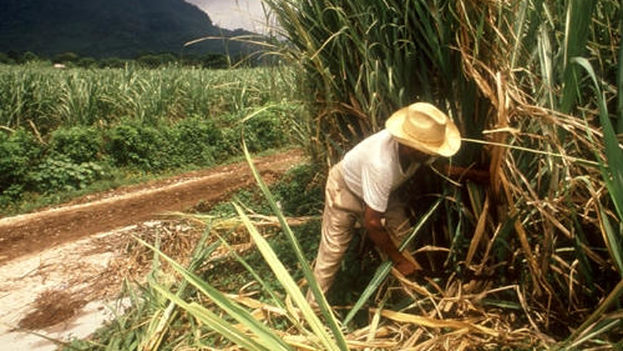
Cutting cane in Cuba. (Cuban Connection)

14ymedio bigger14ymedio 29 January 2016 — At least 43 of the 50 sugar mills taking part in the current sugar harvest are experiencing delays due to adverse weather conditions. This situation led Jose Ramon Machado Ventura, Second Secretary of the Cuban Communist Party Central Committee, to announce on television on Friday that “the sugar harvest is very bad.”

The official argued that first the country suffered “a severe drought that affected the estimates,” and in the current period of cane cutting, “the dampness and rain” have limited the process and paralyzed the milling in dozens of sugar mills. continue reading

“Although it can be cut, the industrial yield is low because the cane isn’t concentrated, it doesn’t have enough sugar,” said Machado Ventura, who is also vice president of the Council of State. The yield from the cane “is below what is normal for this time. Therefore, we have some affect on the harvest,” he emphasized.

The main problems with the harvest are concentrated in the western part of the country, according to the midday newscast. At least five sugar mills have had to stop their machines and another five have been unable to start the harvest because of the high levels of dampness in the fields.

“They are going to make the effort; if the weather improves they will be able to do it. They are not giving up, they can do it, they mustn’t start too soon, but we have to recognize that we are experiencing a harvest with many problems.”

Directors of the state sugar company Azcuba, which has a monopoly on sugar production on the island, had warned since November that the 2015-2016 harvest would be “special” due to the weather problems affecting the country. “We will be bringing in less cane than expected,” affirmed company specialist Dionis Perez Perez at that time.

The results of the 2014-2015 harvest have not been made fully public and the group only said that an increase of 18% over the previous harvest was achieved, although “the plan was some 4% lower than expected.” The experts put the figure at around 1.6 million metric tons of sugar (about 1.76 U.S. tons).

The Cuban Railroad Died / 14ymedio, Yoani Sanchez

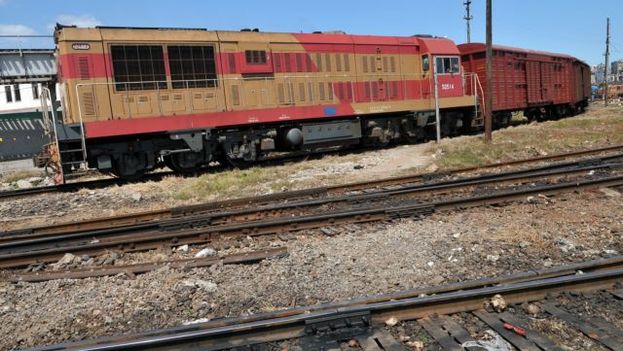
Railroad in Cuba. (EFE)

14ymedio bigger14ymedio, Yoani Sanchez, Generation Y, 29 January 2016 – My father is a train engineer. It has been decades since he drove a train, long years in which he hasn’t sounded the whistle of a locomotive while passing through a village with children running alongside the line. However, this still agile retiree originally from Matanzas still marks the 29th of January on the calendar and says “it is my day.” The day still smells of iron braking on iron, and has the rush of the platform, where some leave and others say goodbye. continue reading

The date honors the guild established in 1975, during the finishing of the first stretch of the central line. At the celebration Fidel Castro operated a Soviet locomotive, a moment that is still a source of amusement among elderly train engineers. “Everything was ready and he didn’t even get the credit of making that mass move,” says an old conductor in his eighties. The event, more about politics than railroads, was enough to let the imposed anniversary go.

The 19th of November should be the date for those who carry the iron serpent circulating in our blood. The day the first rail link in Cuba was completed, between Havana and Bejucal, in 1837, should get all the credit to earn itself a celebration that goes beyond the fanfare of the politicians and the headlines of the official press. In those nearly 17 miles (27.3 kilometers) of the initial line, a lineage began that refuses to die.

Now, when I stand in front of the lines at La Coubre terminal in Havana and observe the disaster that is rail transport in Cuba today, I ask myself if the era of the “sons of the railroad” will come to an end. Old cars, unsafe, accidents, delays, long lines to buy a ticket, luggage thefts, the stench of the toilets… and an iron fence that isolates the platform and those going aboard from those who are saying goodbye.

The Cuban railroad died. There is not much to celebrate on this day.

Cuban Police Detain Two UNPACU Activists UNPACU After Raiding Their Homes / 14ymedio

Carlos Oliva Rivery from UNPACU (Twitter)

14ymedio, Havana, 29 January 2016 — The houses of Alexeis Martínez and Carlos Oliva Rivery, both members of the Patriotic Union of Cuba (UNPACU), were raided by police this morning, according to the opposition organization. The two houses, located in the Mariana de la Torre neighborhood in Santiago de Cuba, were searched just after six o’clock in the morning by uniformed personnel and the two activists were taken to the second unit of the PNR (People’s Revolutionary Police) in Santiago de Cuba.

Some witnesses commented to 14ymedio that participating in the operation were Special Troops of the Ministry of Interior along with the police. The 20 uniformed personnel presented a search warrant, but failed to summon two witnesses from the Committee for the Defense of the Revolution to be present during the search, as required by regulations, and instead took advantage of two “unknown passersby” to play that role.

Alexeis Martínez
Alexeis Martínez from UNPACU (Twitter)

According Alianne Pérez, the wife of Alexeis Martínez, at the conclusion of what she considered “an assault,” a computer, several disks and documents, two mobile phones, all the food in the house and two paintings hanging on the wall were seized.

In Oliva’s house, the dining room serves the organization’s members from other places who pass through the city to take courses, as well as other activists who work full time for UNPACU.

Between last 22 November and today, the organization has already reported 15 raids.

Residents Of Cuba’s ‘Oil-houses’ Will Be Relocated / 14ymedio

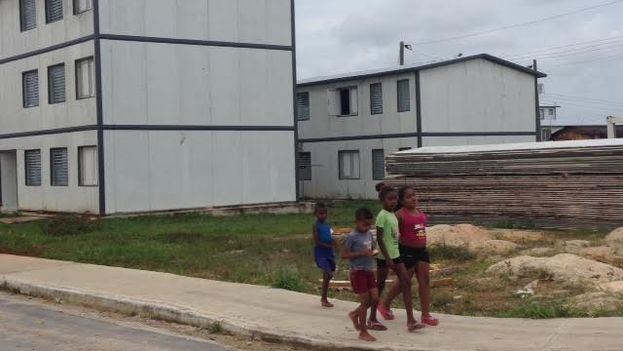
The neighborhood El Molino in Havana’s Cotorro district, made up of 19 so-called “petrocasas’ (oil-houses). (14ymedio)

14ymedio bigger14ymedio, 28 January 2016 — On Tuesday, the residents of El Molino neighborhood in Havana’s Cotorro district, were summoned in two groups to the municipal People’s Power to be informed that within a period of no more than 18 months they will be relocated into other housing, due to the calamitous state of the “petrocasas” (oil-houses) they were given less than a year ago.

A report titled “The Oil-houses are Falling Apart,” published by 14ymedio last week, revealed the deterioration and lack of finishes seen in the buildings and the infrastructure of this Havana settlement. The residents’ discontent had led to a situation that is “ready to explode,” confessed a resident of the area. continue reading

According to the testimonies of several local residents who participated in the meeting on Tuesday, the president of the Municipal Assembly, Teresa Beltran Santana, let them know that their complaints had reached those “very high up” and that according to studies, “the buildings had barely a year of life left in them.”

Zoraida Dopico, the mother of two children who lives in El Molino, is surprised by the solution they’ve been promised and adds, “Everyone knows that this was all constructed in a big rush and that it wouldn’t survive the first hurricane. When we complained that we were in danger, many said we were exaggerating,” says the woman.

Dopico confirms the long list of complaints and letters sent to official institutions. “We went to see Esteban Lazo, President of Parliament, and wrote letters to all levels … The problem even came out on the Internet!” said the lady, referring to the report published in this newspaper.

Carlos, whose testimony was collected in 14ymedio’s first report, recalls that shortly after the buildings were inaugurated, staff from the government TV program “Cuba Dice” (Cuba Says) came by. However, “they only told them about buildings with Chinese technology, which are concrete,” the elderly man remembers. The petrocasas are made from polyvinyl chloride panels.

With a certain sarcasm, the man predicted “surely at some moment they will show up here and they always find someone who seems content to have a microphone shoved in their face.”

Some were more cautious from the start and didn’t let their dreams run away with them in the petrocasas settlement, as is the case with a retired construction worker who commented, “It was clear to me, they didn’t even change the addresses on our ID Cards. Now with the move I’m not going to have to go to the end of the line because according to the paperwork I was never here,” he smiled.

For some, like Zoraida Dopico, the problem does not end with the transfer of the residents to another location. “The worst thing is that nobody cares who’s going to pay for all this. These components were brought from Spain, they paid salaries and spent millions doing it all so badly,” said the neighbor.

When asked if the government will find homes for so many people in less than a year and a half, she replied: “They do not want to see people here explode and if this problem isn’t solved quickly, what is going to develop here is going to be a revolution.”

Cuba faces a profound housing crisis with a deficit of more than 600,000 homes, and also a lack of maintenance of the buildings that are in a precarious state. According to official data, of 3.7 million properties in the country, almost 40 percent are in poor condition. However, only 27,000 homes were built in 2015.

Protest To Demand Food In Havana / 14ymedio


14ymedio biggerThe raid against street-cart vendors selling fruits and vegetables launched in Havana last week by the government is causing unease among large sectors of the population. Most affected by the restrictions are those who find in this commercial alternative a chance to buy food in their own neighborhoods and streets, far from agricultural markets.

For the elderly, people with disabilities or families with small children, the ability to buy fruits and vegetables “on their doorstep” has been very popular in recent years, despite high prices. In a clear strategy of “cutting off their nose to spite their face,” the authorities have decided to combat high food prices through maximum restrictions on intermediaries and street vendors.

The scene of a group of people protesting when police demand to see his papers and confiscate the merchandise from a street-cart vendor, as shown in this video that has come into our hands, says a lot about the unpopular measures of control the government has adopted against private vendors; and it also highlights the shortages of food products Cuban society is suffering today.

In the images posted on YouTube under the pseudonym SomosdeCuba (We are Cuban), the police harass street vendors selling fresh food. People start to gather and shout: “Abusers,” and then in a chorus yell “Food! Food! Food!” Finally the vendors start giving away their products rather than let the police confiscate them.

Price Controls Extended Across Havana / 14ymedio

 Youth Labor Army market on Tulipan Street in Havana. (14ymedio)
Youth Labor Army market on Tulipan Street in Havana. (14ymedio)

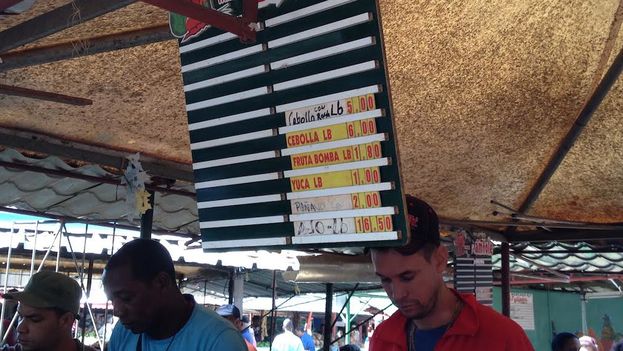
14ymedio bigger14ymedio, 25 January 2016 — What began as a novelty in mid-January has become common in the Cuban capital. The network of agricultural markets with controlled prices now extends to 66 markets and the authorities plan to extend the measure to the 105 people’s council markets in the city, as confirmed by the official press.

The second secretary of the Communist Party, Jose Ramon Machado Ventura, said after a meeting held on Saturday in Mayabeque, that fixing prices is being evaluated, “setting a maximum” on the price of numerous products, based on the cost of production and the total supply of the goods. continue reading

However, Machado Ventura acknowledged at the meeting that to finally solve the problem more and higher quality goods need to be produced, and he railed against the “illegal intermediaries” on whom the State is placing the blame for the sharp increase in prices since the middle of last year.

In Havana, the so-called State Agricultural Markets (MAE) were added to those covered by price controls; these markets had been under non-state forms of management but have now reverted to their former status. At these sites the government will maintain price controls on products such as bananas, taro, tomatoes, onions, potatoes, garlic, cabbage, squash, peppers, papaya, pineapple, okra, eggplant, chard and beans.

The implementation of the measure carries with it major restrictions on private transport that cater to the non-state markets, as well as and on street vendors who, with their wheeled carts, sell fruits and vegetables. These vendors have faced heavy police raids in recent weeks, leading them to abandon the streets of Havana where they had already become a part of the everyday landscape.

After the early enthusiasm over price controls in a limited number of markets such as the Youth Labor Army (EJT) located on Tulipan Street in the Nuevo Vedado neighborhood, customers are beginning to voice their complaints about the decline in quality of the products and the lack of stable supplies.

“Yesterday I came and bought cheap taro, but today I came and there is nothing but sweet potatoes,” complained a buyer at this Sunday’s busy market. This weekend the pallets displayed green tomatoes, squash and bananas. “But they are not ripe, you have to buy them green and wait for them to ripen in the house,” the customer protested.

Some neighbors looked thankfully on the lower prices. “I am retired and can not be paying 25 Cuban pesos for a pound of tomatoes,” says a buyer near the EJT market. “Many people are profiting from people’s needs,” added the retiree, who sees it as a good thing, because “they’ll see for themselves where the shoe pinches, and how are they going to steal now.”

The authorities have stated that only an efficient use of the land could cut prices on a permanent basis. In a recent interview with Eddy Soca Baldoquín, director general of the National Control Center of Land and Tractors, he stated that the amount of agricultural land in Cuba amounts to 15.4 million acres. State management is in charge of 30.5% of the land; cooperatives, 34.3%; and the rest is in the hands of small farmers.

Since Decree-Law No. 259 on the leasing of idle land in usufruct was approved in 2009, some 279,021 people have received land throughout the country and they currently remain in possession of about 3.5 million acres. But the measure has not had the expected impact on productivity and the prices of goods.

In a recent inspection in the province of Pinar del Rio chaired by Machado Ventura, 3,531 land leases were terminated: at least 1,126 for breach of contract; 766 for the abandonment of the land for more than six months; 703 for not using the land for the purpose for which it was granted; while the rest of the cancellations were due to deaths or voluntary abdications.

The Full Meal / 14ymedio, Reinaldo Escobar

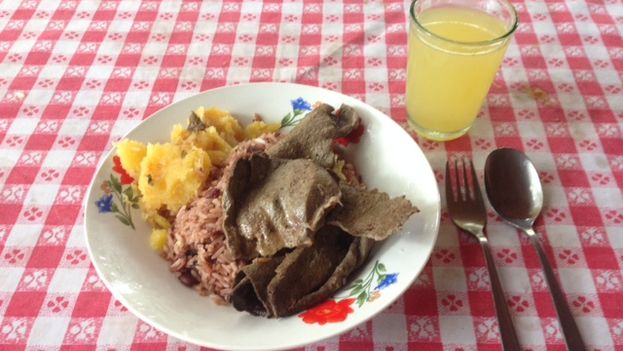
The “full meal” at the Ranchón restaurant in the Youth Labor Army market in Havana. (14ymedio)

14ymedio bigger14ymedio, Reinaldo Escobar, Havana, 29 January 2016 – “Give me the full meal,” a man tells the waiter who has stopped for a second at the table with the menu. No need to specify the menu item, the amounts or how you want it. The phrase “full meal” says it all: a plate with rice, some meat, a little vegetable and perhaps a salad. Service is fast, there are no details or sauces to choose from, just a little bit of everything before the infinite appetite of the diner.

The practice of eating away from home spread through many societies, where the family table was no longer featured when it came time to eat. The requirements of work and the speed of modern life have made people in many parts of the world choose to eat breakfast, lunch and dinner out. continue reading

In Cuba, those who go out to eat “on the street” know that they will need more money than they earn in a day’s work. There is no need to call out extreme examples of private or state restaurants where the average price for one person varies between 10 and 15 Cuban convertible pesos (about $11 to $17 U.S.), a figure that can double if the most expensive items on the menu are requested.

Among the most affordable options is food that is digested without even sitting down, which can be “bread with something” or a pizza costing ten Cuban pesos (about 40¢ US) that comes wrapped in paper and dripping with cheese. There are also the little cartons in Havana’s Chinatown where for 25 or 35 Cuban pesos you can “calm the dog,” meaning the stomach.

Other sites have managed to position themselves in a zone between the private and the state, like certain private restaurants attached to the agricultural markets. El Ranchón at the Youth Labor Army (EJT) market on Tulipan Street is a restaurant that enjoys a certain permissiveness and whose owner, as discussed in the neighborhood, is a member of the armed forces.

In places like this, of which there are very few in the city, they serve a plate with rice and beans, salad, mashed sweet potato and pork liver steak for 20 Cuban pesos. With the same sides, other options for the main course include roast pork, lamb fricassee or fried chicken, but the price never exceeds 40 Cuban pesos, even if fruit juice is included. There are no flowers or candles on the table and you have to cut the meat with a spoon, because there are no knives, but it’s good.

On the periphery of Ranchón are two government ministries, three banks, a high school and three military units, in addition to the thousands of customers who visit the busy market daily. A very old man with an enormous appetite asks for the leftovers every day. He hides so they don’t see him. He must be over 80 and he says that in his youth he could get “a full meal” for 25 centavos anywhere, “with beef: shredded, steak, or ground.”

Now that workplace cafeterias have almost disappeared, many people bring their full meal in a plastic bag and others who have chosen to eat just one meal a day, that they eagerly devour when they get home.

US-Cuba Relations: A Passing Idyll? / 14ymedio, Andres Oppenheimer

First meeting between Raul Castro and Barack Obama at the funeral of Nelson Mandela in South Africa
First meeting between Raul Castro and Barack Obama at the funeral of Nelson Mandela in South Africa.

14ymedio, Andres Oppenheimer, 28 January 2016 – There is a lot of excitement on all sides about president Barack Obama’s approach to Cuba, but allow me a word of caution: it is likely that the current idyll between Washington and Havana will cool somewhat after the November elections in the United States, regardless of who wins.

The reason is very simple: it takes two to tango (or cha-cha, in this case) and Cuba is doing little from its side to accompany the easing of U.S. trade relations against the island.

In addition, the next United States president will see the trade opening to Cuba as a legacy of Obama, and will likely not spend much political capital to continue unilaterally expanding a policy that will go down in history as the work of a previous president. continue reading

When Obama first announced the opening to Cuba on 17 December 2014, he said, rightfully, that the previous policy of the United States had failed, and that United States trade would help to create a new class of entrepreneurs and an independent civil society in Cuba.

But more than a year later, even the State Department officials who negotiatied the agreement are frustrated with Cuba.

Earlier this month, the official Cuban weekly Workers reported that the number of self-employed workers in Cuba has fallen to 496,000, from 504,000 six months ago, according to Cubaencuentro’s 12 January webpage.

The blog Letters From Cuba, by the Uruguayan journalist Fernando Ravsberg, said on 17 December that “internally, the paralysis is great.” He added that “during 2015 not one more cooperative was legalized, no new forms of self-employment were opened up, the wholesale markets were conspicuous by their absence and the long demanded unification of the currencies is still on the shelf.”

Politically, the military dictatorship in Cuba continues to ban political parties, freedom of assembly, and independent media.

During the past year, the number of arrests of peaceful dissidents rose to a record of 1,447 in November, according to the Cuban Commission on Human Rights and National Reconciliation.

Yoani Sánchez, the brave Cuban journalist publishes her digital daily 14ymedio from abroad because the regime does not allow her to publish it from Cuba, even online, wrote on January 6 that “Television, radio and newspapers are maintained under strict monopoly of the Communist Party.”

And she added, “Access to the microphone is granted only to those who agree with the government and applaud the actions of its leaders. They never interview someone with a difference of opinion.”

Despite all this, Obama announced a few days ago a third round of unilateral measures to ease the embargo on the island. The new measures will allow more American visitors to travel to Cuba and increase the number of authorized exports to the island.

The normalization of relations between the United States and Cuba has turned the island into a global object of curiosity. Tourism to Cuba increased to 3.5 million in 2015, up 17.4% over the previous year, according to official Cuban figures.

Cuban art, cuisine and music have become fashionable, and are the subject of countless newspaper articles. In contrast, few journalists report on the political prisoners or investigate the more than 3,130 killings attributed to the Castro regime since 1959, according to the records compiled by the research group CubaArchive.org.

My opinion: As I have said in earlier columns, the previous United States policy of isolating Cuba did not work and Obama’s new measures deserve a chance. However, so far they have not worked.

At this point, the normalization of relations has only helped Obama to cement his legacy as the president who resumed relations with Cuba, as Nixon did with China. So Obama pressed the accelerator with new measures of additional openings a few days ago, and will continue to do so.

But I do not think the next president of the United States – even if it is Hillary Clinton – will invest much political capital in cementing Obama’s legacy, unless Cuba gives concrete signs of an economic or political opening. The ball is in the Cuban court, and this idyll can cool off after November.

14ymedio Editorial Note: This analysis has been previously published in El Nuevo Herald. It is reproduced with the permission of the author.

The “Tight-fitting” Flag / 14ymedio

The stars and stripes, best when it is “snug” according to some. (14ymedio)

14ymedio bigger14ymedio, Havana, 27 January 2016 — After Cubans saw the handshake between Raul Castro and Barack Obama at last year’s Summit of the Americas in Panama, the number of American flags in the streets of the island soared exponentially. They are found inside taxis, on the caps that protect against the relentless tropical sun and adorning innumerable items of clothing.

There is some challenge in wearing this stars-and-stripes logo on the body. A gesture of defiance that officialdom just does not like.

Articles in the national press that acidly criticize the growing presence of Uncle Sam’s flag in Cuba have only served to fuel the desire to wear it. As if many would like to make up for those decades when showing the slightest sympathy for the country to the north meant being thrown out of work, kicked out of college or suffering even worse reprisals.

Nice and tight, in contact with the skin, today many Cubans wear it their own way to separate themselves from and contradict the government discourse.

A Decade Of Work On Press Freedom For Cuba / 14ymedio, Reinaldo Escobar

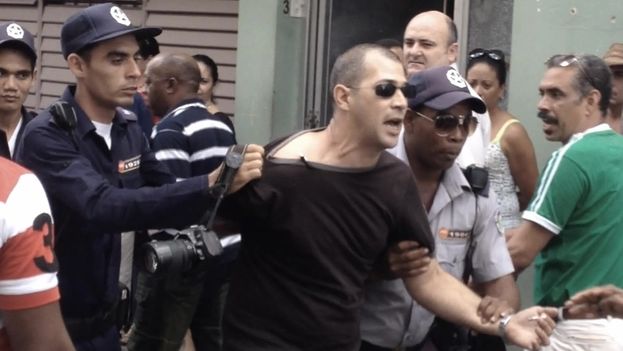
The official journalist Leandro Perez was arrested in Cuba while photographing an arrest. (Indomar Gomez / 14ymedio)

14ymedio bigger14ymedio, Reinaldo Escobar, Havana, 28 January 2016 — Journalism is a high-risk profession. Death threats and imprisonment are just around the corner for thousands of journalists throughout the world. In Cuba, as an illustrious writer said, in the last five decades “they haven’t killed journalists because they have killed journalism.” One organization defends the rights of the profession and tries to raise its voice for those who have been silenced at the microphones and in the national presses.

Ten years ago, a group of independent journalists founded the Association for Freedom of the Press (APLP) with the initial purpose of protecting the work of reporters and also to act as an independent news agency. Looking back, its members are taking stock of what it has accomplished and looking at the long road that lies ahead. continue reading

Jose Antonio Fornaris, APLP president, told 14ymedio that at present the organization is focused on “learning of and denouncing the problems of Cuban journalists in the exercise of their profession.” The most common difficulties range from arrests, the confiscation of working tools, and the little access to sources.

Freedom House, based in Washington, reported last year that Cuba remains, both regionally and globally, one of the countries with the greatest restrictions on the press. The organization denounced the fact that many Cuban journalists continue to be imprisoned and that official censorship is “widespread.” The island ranks last in Latin America with regards to press freedom.

The Cuban Constitution states that “citizens have freedom of speech and of the press in accordance with the objectives of socialist society,” but the editorial line of the national media is governed by the Department of Revolutionary Orientation (DOR), an arm of the Central Committee of the Communist Party of Cuba.

Many professionals, both in the independent sphere as well as those closest to the ruling party, have pushed in recent years for a press law. This legislation would regulate the activities of journalists and, in particular, force institutions to provide information of national interest in a public and transparent way.

Without this legal basis, the work of a reporter in Cuba will continue to move between self-censorship and danger, as APLP finds every day, when working to ensure that “in each province there are observers who are aware of the problems faced by information professionals.” Undoubtedly, these activists for press freedom have a great deal of work to do to collect every violation against the profession.

It is not enough, therefore, that a group of reporters, such as the APLP, are willing to raise their voices for others. “The ideal is for someone who has been harmed to approach us and report their case,” says Fornaris, a first step in order to then get “the corresponding verifications,” and “to provide assistance to the victim,” he adds.

Last October, during the 71st General Assembly of the Inter American Press Association (IAPA), a devastating report on Cuba was presented in which it is stated that human rights and freedom of the press are violated “absolutely and systematically” with the State “monopolizing” the media.

The small team that makes up this NGO tries to optimize its time. Miriam Herrera is responsible for the committee that attends to the journalists, while Migiuel Saludes, located in the United States, serves as the representative abroad; each one of the seven members of the board is responsible for an area of the NGO’s work.

In the APLP “we don’t have lifetime tenure,” says Fornaris. He says it with a pained smile in a country where there have not been democratic elections for seven decades. It is very important for the organization to break with this fatal flaw, and “this year we are renewing the mandates.” The president sees it clearly, “It would be unacceptable for us to call for democracy in Cuba and to have a dynasty in our ranks.”

His hope of a new morning of greater freedoms does not blind him to the present. “As long as the press doesn’t point the finger at who is responsible for its faults, nothing happens,” Fornaris concludes with determination. He does not believe that “under the rules of this system monopolized by a single party can one expect substantial change.”

However, what is not in doubt is that “the press must be free, otherwise it can’t be called the press.”