Month: October 2012
What the Revolution Might Leave Us / Ivan Garcia
 If one were asked what should be saved of the Castro brother’s communist revolution, the number of responses would be enormous. Followers of Fidel Castro — those who hang his portrait on the walls of their homes and swear he is the greatest statesman of the twentieth century — would come up with an endless list of accomplishments that should be carried on into the future.
Those who are convinced that Castro is the worst political scourge ever to afflict any country would smile quizzically and answer in a single word: nothing.
There would also be nuanced responses. Serious academics and a less passionate segment of the Cuban population, both on and outside the island, would emphasize that any future plans for the nation should include retaining universal and free health care and eduction, but little else.
Intellectuals and political scientists from the modern left argue that, before evaluating any social achievements of the Castro regime, it is essential that national sovereignty be maintained and that, in a future looming just ahead of us, we should not fall under the sphere of influence of any of the world’s power centers.
They argue for a politically independent Cuba, one with good relations with the United States but without being an unconditional ally. And for being able to accuse Washington in an international forum of any given outrage or to condemn it for some arbitrary action in one of its many wars to promote democracy.
If they could be transported in a time machine, armchair democrats would place Cuba at the level of Barbados or Trinidad and Tobago, minus the headlines in the international press on human rights violations and with a better economy and social services.
In debates Cubans committed to their country envision in their minds a spectacular future. Being optimistic is a positive thing. It is interesting that, in occasional discussions in which the admirers of the revolution participate, authoritarianism, multi-party government, the creation of independent trade unions and respect for free speech are openly acknowledged.
Public health and education are not the only unquestionable successes. Certainly teaching carries with it a strong ideological message, but all citizens living in Cuba have the possibility of learning to read and going on to higher education.
Other points in its favor are the access to culture and sports. There will always be asterisks, however. It is not possible for a nation to have a hard-currency economy and expect to be in the top spots at the Olympics.
Schools devoted to sports and arts education for children and adolescents with talent should be retained. Gymnastics and sports centers should also be brought back as a source of entertainment and a healthy option for the mind and body.
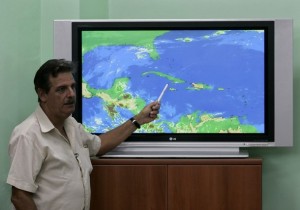
The civil defense system should not be touched either. It has worked. Since the devastations of tropical storm Flora in 1963, which cost the lives of two thousand people and caused enormous property damage, the loss of human life from hurricanes and other natural disasters has been minimal.
Broadly speaking, these are, in my opinion, the principle victories that could emerge from the Cuban revolution. Of course, there are many more things that need to change.
Addressing pressing social issues, unresolved political rights and structural changes are an enormous challenge for any future democratic administration in Cuba. But that is another story.
Photo: Dr. José Rubiera, the most recognizable face from the Institute of Meteorology and the man whose forecasts facilitate preparations by Civil Defense and the public for the arrival of thunderstorms, cyclones and cold fronts.
October 7 2012
Out of the Game / Lilianne Ruiz

This Monday, my daughter and I went to her school at 9:15 in the morning. The neckerchief ceremony had already ended.
The teacher did not ask me why we were late this Monday, but she didn’t want to know why my daughter had not come on Friday. I waited until the children had moved away: “This Thursday the political police kidnapped my friends and my boyfriend to block them from going to the court where the trial against Angel Carromero was being held, the only witness to the death of Oswaldo Payá. That day the political police knocked out Yoani Sanchez’s tooth with a blow.
In all countries, especially in Latin America, in which any type of dictatorship has been suffered, it has been also possible to prove that one of the worst social effects, for being the most generalized, is the moral degradation into which people fall. For this reason, when a person becomes aware of herself and decides to practice a life in truth she automatically becomes a dissident, especially in those countries governed by a state dictatorship that also has a discourse about justice – “all justice” as the Chancellor says – and about peace and friendship. The hypnotic power of great ideas.
When I ask myself if perhaps the women of the political police who beat Yoani are, in fact, human beings, the one who falls into a dangerous form of discrimination about what is human and what is not is me.
On returning from school I ran into the wife of good old Orestis in charge of surveillance for the Committee for the Defense of the Revolution (CDR), who asked me why I hadn’t taken my daughter to the ceremony. She knows the answer, but this time I opened my mouth to say: “She will put on the neckerchief so as not to create an adaptive conflict among her little friends, but she did not go and she will not go to any political activity because, among other reasons, behind all of this, of this adoration for the ’work’ of the leader and all those symbols that don’t mean ’the fatherland,’ are the guys who ordered the repression against my boyfriend and my friends.
This lady is one of those cases of addiction to the regime and even CDR activism and and she hopes to get a visa to travel to the United States based on being claimed as family by her stepdaughter. When Anita expressed her complicity with the politics of the government you can’t help but make note of her being in waiting for a visa to live in the United States and depending on family remittances to defend the dictatorship, only that, the one who is paying, stupid thing, is the stepdaughter in exile in the country repudiated by the politics of an extremely unjust, abusive, kidnapping government that she still defends.
It’s a mouthful; much worse, because in this violent paradox many have lost their lives.
She started screaming, really screaming, that “you can’t hold me to those words.” And then her daughter came out, who is the mastodon to bet on in a contest for people who are ugly within, and instigated by her mother, she began to hit me until I fell to the ground. I regret not having responded to the blows because I am not afraid. I was reminded of all the times that I avoided coming to blows in school simply because I don’t know how to fight by punching.
I told them I would call the police for their assault and so I did. The cops on patrol heard my whole story and I even presented myself as an opponent, doubting that the opponents that I admire would concede my taking such a title, that to me honors me. They then changed their tone, they spoke to me more sharply but they did not refuse my right to go to the station to make a complaint for assault. I told them to give me a few minutes to take my daughter to the home of the only neighbor who is my friend.
When I came down the stairs and out the door of the building, I saw Isabel, the MINIT Lieutenant Colonel, who has made a type of campaign among some of the neighbors not to speak to me, talking with one of the police and I clearly heard her tell him, “Let her make the complaint, we will go and be waiting for her there.”
I thought about saying something but continued walking with the cop and when we got to the car he told me, “Come tomorrow and make the complaint, but I’m not going to take you.” I said, “I am not afraid. If it’s about what she said I have to make a complaint because I don’t respond to their beatings because of cowardice but because it’s not my language and the police are there to stop mobs of people like her who physically assault others. That is a crime anywhere.”
We both argued for some minutes. I telling him that I was not afraid of “Security” if they really were waiting for me, and he said that if I wanted to I could go, but I had to do it on my own two feet. The police station is quite far from my house. The other patrolman came and told him, “Take her to make the complaint.” And that policeman still intrigues me, as if he was wanted to avoid my being ambushed, he never stopped saying, “You’re not going in this car.”
October 9 2012
National Anniversary / Rosa Maria Rodriguez Torrado

One of the crude reasons traditionally wielded by the totalitarians in power in Cuba and their spokespeople to society to prevent Cubans from navigating the Internet, was that they could not offer this service to everyone because of the American embargo, which prevented our connecting to one of their submarine fiber optic cables that pass near our coastline. This forced us to “plug in” to the net by way of satellite which is more expensive and slower. But now?
I remember it was in early February 2011 when the cable from Venezuela arrived in Cuba, that would increase by 3000 times the connectivity capabilities in our country. Since then, Chavez twice said the cable was ready and created the effective and multiplied possibility that all Cubans could surf the net; and he also with this maneuver put the ball in the transgressive Cuban court.
Now the authorities cook up pretexts and talk about “regulating access” in order – as is sadly common – to again tarnish the rights of Cubans. They also argue that we must avoid the hackers, the password thieves, terrorist sites, satanic cults, pornographers, etc. It all comes down to a simple formula that identifies their acts towards Cuban society: that they have the dark right to violate our rights with impunity.
I want to think that now there exists the real capacity for all of Cuban society to have the ability to access the Internet – not only a minority group of family members and privileged – that they will not delay one more minute in recognizing this right and allowing us to exercise it. That there will not be a single Cuban tired of having his rights trampled who will put his life at risk with a hunger strike to demand the possible, just and necessary access that already exists in the mega-web.
This coming February 2013 it will be two years since the coming of the fiber-optic electronic rope to our country. Are they waiting for this date to celebrate its birthday? I hope by then – I am a dreamer – we are all interconnected and we go online to schedule for ourselves a virtual fiesta in which we all join together in the great national chorus and sing “Happy Birthday” to the cable.
 October 5 2012
The Triumph of the Mediocre / Regina Coyula

What we are most worried about is the vulgarity of Cuban music. Caricature of Garrincha taken from the Internet
By email, this second and efficient manner that we Cubans have a receiving information, I have received a brief text that is attributed to various authors, but that jumps into the ring anonymously.
The triumph of the mediocre is the title and it refers to the situation in Spain. Removing some paragraph or some local reference it fits us perfectly. I will be returning to an old critique, but I don’t get too excited by what I see all around me. The bad taste and the vulgarity are not only in the lyrics of danceable music: the patterns of dress, the design (or the absence of it) that proliferates in the environment, social behavior, the deterioration of services, the bad functioning of education and health, the one time workhorses of the battle, the grayness of politics and politicians; the list where everyone who fills it, has something to do with the fact that mediocrity wins.
I don’t have the cure. There are no magic potions. But in our case, the enclosure in which we live and the exodus that has divided us must be taken into account. A Pyrrhic victory.
The Triumph of the Mediocre
Perhaps the time has come to accept that our crisis goes beyond the economy, beyond this or that politician, the greed of the bankers or the risk premium. To assume that our problems will not be changed by one party or another, by another battery of emergency measures, or a general strike. To recognize that the principal problem of Spain is not Greece, the euro, nor Mrs. Merkel. To admit, to try to correct, that we have become a mediocre country.
No country comes to such a condition overnight. Nor in three or four years. It is the result of the chain that starts in school and ends at the establishment. We have created a culture in which the mediocre are the most popular students in high school, the first to be elected to office, those who have the most to say in the media and the ones we vote for in elections without caring what they do. Because they are us. We are so accustomed to our mediocrity that we have ended up accepting it is a natural state of things. Its exceptions, almost always reduced to sports, serve us to deny the evidence.
Mediocre is a country where its inhabitants spend on average 134 minutes a day in front of the television that shows principally garbage. Mediocre is a country that in every democracy has not had a president that speaks English or had the least knowledge about international politics. Mediocre is the only country in the world that, in its rancid sectarianism, has managed to divide even the associations of victims of terrorism. Mediocre is a country that doesn’t have a single university among the 150 best in the world and forces its best researchers into exile to survive.
Mediocre is a country with a quarter of its population unemployed yet it finds the greatest motives for outrage when the puppets of a neighboring country make jokes about its athletes. Mediocre is a country where the brilliance of another provokes suspicion, creativity is marginalized — if not stolen with impunity — and independence is punished. The country that has made mediocrity the great national aspiration, pursued without complexes by its thousands of young people who look to occupy the next place in the Big Brother contest, by politicians who insult without coming up with an idea, by bosses who surround themselves with the mediocre to hide their own mediocrity and by students who ridicule a classmate for his hard work.
Mediocre is a country that has fostered the celebration of the triumph of the mediocre, cornered excellence until it is left with only two options: to leave the country or to allow oneself to be swallowed up in the gray sea of mediocrity.
October 5 2012
Until October 11 DOUBLE RECHARGE with Ezetop.com… THANKS! / Orlando Luis Pardo Lazo
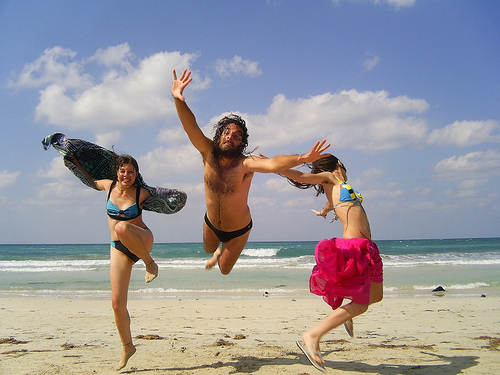
You can help me by recharging my mobile phone. Log onto www.ezetop.com. My mobile number is +53-53340187
THANK YOU! GRACIAS! THANK YOU! and THANKS!
October 9 2012
—-
Site manager’s note: For those of you who regularly help the bloggers by recharging their cell phones… first… THANK YOU… it’s an incredibly wonderful way to help the bloggers directly. Second… these two-for-one offers come along from time to time, and so what better time to do it — your money goes twice as far. And third, the phone numbers for the bloggers are listed in the Page on the menu bar, above: “Direct Help To Bloggers”
If you have any problems with recharges, please email TranslatingCuba — at — gmail.com and we’ll see if we can solve your problems.
Ballots and Balloons / Regina Coyula
 Our television was well into playing its role as Hugo Chavez’s political sergeant dedicating so much space to the Venezuelan election as if it was its own. No television-broadcast-informed Cuban could physically identify Capriles, let alone give an opinion about his program. He was only mentioned as the “far right candidate” and his “neoliberal agenda.” The continuity of Chavismo is vital to the continuity of Castroismo. I write this post at 4 pm on Sunday afternoon, while anticipating that there will be reelection by a small margin; my doubts are nevertheless with the president’s ability to survive until his new term, which raises the bigger question about the continuity of the so called XXI Century Socialism, which like North Korean’s Juche idea, no one really knows what it’s all about.
After the war of polls that preceded today’s election in the neighbor country, I do not pretend to establish a state of opinion with my impressions of two hours ago, born just behind a diverse group of young men that were exchanging white T-shirts for those of Barcelona, and heading towards a small hotel nearby where, for 2 CUC, they would watch the classic Spanish soccer league on a big-screen TV, in an air-conditioned room.
Excitement — and at times, animosity — defined these fans, to whom I asked, in a moment of courage, if they knew something about the elections in Venezuela.
A martian. That is what I must have looked like to them, at my age and with my dark glasses. Not one responded using words. The most they granted me was a shoulder shrug. Some will be happy with juvenile political apathy, not me. The great majority, going with the flow, will go and vote in our next elections, voiding their ballot or complacently casting it, but not one of them will be able to articulate a solution to a problem in their job, school or neighborhood. They belong to a society in which everything was thought about and decided way before their birth; in those young men, the initiative chip is defective.
I walked to the top of a street where one begins to descend a steep street that I plan not to retake on my return. From the top, I saw the fans wearing the colors of their favorite football club gather in front of the small hotel’s sidewalk. I do not want pay 2 CUC for something that is not food or soap, so I bought bread at the bakery and returned home to not miss the game, since I too have my little heart.
Translated by: Eduardo Alemán
October 8 2012
New Forms of Power Outages / Fernando Damaso
 For several weeks now, The Electric Company has been replacing old wooden electricity poles, the majority of which date to the time of the Republic, and which have been in use for more than fifty years. Since they were not regularly replaced over the years, it is now being done on a massive scale, with the resulting inconveniences and impact on the population.
I don’t know how it is done elsewhere, but in Havana, specifically Nuevo Vedado, the method being employed leaves much to be desired. Days and sometimes weeks before, a hole is dug several centimeters around the pole, leaving it exposed next to the extracted earth. This poses a potential danger for passersby, especially at night, when street lighting is scarce. Also, during rainy days like these, the hole often fills with water and the extracted soil around it washes away, making the sidewalk, which generally has deteriorated due to lack of maintenance, unpassable.
To change a pole, a crew of four to six men take ten hours, from eight in the morning until six in the evening, a period of time in which the electricity is shut off in the affected area. If two to three brigades work in the area simultaneously, they can change two to three posts a day. This happens at least once a week. We therefore have a planned power outage of ten hours duration weekly. Due to the large number of poles to be replaced and the “high productivity,” the outages are guaranteed to go on for the rest of this year and even into into the next.
I am not opposed to the poles being replaced, although I would have preferred an underground system — one less susceptible to being battered by hurricanes — but we cannot “squeeze blood from a stone,” especially in moments of crisis. What bothers me is that, while each post is being replaced, only two men are really working. The rest are looking on, waiting their turns while sitting on the curb, accompanied by a bottle of rum. It is possible that this constitutes a new form of “socialist labor” in connection with “the updating” of “the model,” but by all lights it seems quite unproductive. This is not an anomaly. I have seen it on numerous occasions, which leads me to believe it is established practice.
In summary, the method used to replace electrical poles guarantees there will be outages, but without having to declare them as such by disguising them as “maintenance projects.” We enjoy other outages of the same duration, these disguised as “tree pruning projects.” Without a doubt the Electric Company deserves recognition for its originality in creating new forms of outages.
October 7 2012
Three Elections, One Country Update: After the First Election / Yoani Sanchez
 What does the voice of Henrique Capriles sound like? A neighbor asked me a few days ago. I didn’t know whether to tell him it was high-pitched or deep, soft or forceful, because the Cuban media is careful not to air it. Instead, we only have the opportunity to hear the agitated shouts of Hugo Chavez, the verbal attacks he throws at his young opponent. So this morning we saw the leader, who has been in power for 13 years, celebrating his new electoral triumph. It’s clear than a new six-year term for him is a guarantee of survival for the government in Havana.
Raul Castro’s government had too much invested in the Venezuelan elections on October 7. He could have lost the irreplaceable support of his most devoted ally. The Venezuelan subsidy has allowed the General President to implement, slowing and in a lukewarm way, changes that constrict the economic sphere. But this type of dependency, once established, ends up becoming a chronic situation. Neither through offering farmers the ability to lease land in usufruct, nor the expansion of licenses for self-employment, has Cuban managed to take its first steps towards material autonomy nor economic sovereignty. More than a circumstance, the need for external subsidy is the core of the Castro regime, the direct result of its inability to successfully manage the national economy. We can’t forget the voluminous support sent from the Kremlin… now replaced by the Miraflores Palace in Caracas. Once again a blank check has been signed over to the Plaza of the Revolution, for six more years.
Fifty-four percent of Venezuelans have ratified Hugo Chavez as leader of their country, and Raul’s regime has some breathing room. But the great polarization in Simon Bolivar’s fatherland will make it more difficult to publicly sustain the maintenance of Cuba. Havana’s government I looking ahead to complicated months. The election in Venezuela has been the first in a cycle of three elections that will influence, to a greater or lesser extent, our national life. The presidential election in the United States follows immediately in the list of electoral processes that lie ahead. Mitt Romney has promised a heavy hand with the Cuban authorities, but Barack Obama could also be very corrosive to the Cuban system if he deepens his policy of family, academic and cultural approaches.
The first five-year term of Raul Castro will end in February 2013. Few are betting that he’s thinking of retiring to make way for a younger figure. These elections, the third that await us in the coming months, are also the last in importance and in generating expectations. The process of nominating People’s Power delegates and installing them in the National Assembly has already begun, and this body will approve the nominations to the Council of State. If the Venezuelan results have decided whether we are granted billions in subsidies, and our relationship with our powerful neighbor to the north is in play in those elections, the Cuban elections smell strongly of a play whose script is already written. We don’t even need surveys or voter polls. There is no possibility of surprises.
9 October 2012
Chain Hunger Strike Begins in Havana In Support Of Jorge Vazquez Chaviano’s Release / Wendy Iriepa and Ignacio Estrada

By: Ignacio Estrada Cepero, Independent Journalist. [Note from Translating Cuba: The strike discussed here was successful and is now over… our apologies for not translating this article sooner.]
Havana, Cuba: In a press conference the leading dissident Lic. Marta Beatriz Roque Cabello explained her decision to begin a hunger strike on last Monday, September 10th.
According to the economist, this hunger strike’s main objective is to obtain Jorge Vázquez Chaviano’s immediate release from prison. Chaviano is serving a sentence in the high-security prison La Alambrada located at 9 km from the town of Manacas, municipality of Santo Domingo, in the Villa Clara province.
During the conference, Roque Cabello presented evidence, in the form of several filed case documents reviewed by the organization “Network of Community Communicators,” a group she presides over, that Vázquez Chaviano was supposed to be freed last Sunday, September 9.
During her appearance, the well-known dissident also addressed other issues, particularly with respect to the ongoing actions against Human Rights (HR) activists and Cuba’s internal opposition groups carried out by the State Security, actions that violate the socialist state’s laws. Roque Cabello gave several examples such as police raids, surveillance, the retention of identity cards, arbitrary detentions, as well as other violations like the forced entries into Human Rights activists’ homes, planned arson, and the demolition of homes as some of the most recent cases.
Marta Beatriz, who is 67 and has diabetes, expressed that she will not accept any kind of medical assistance offered by the government during the hunger strike, tube feeding and resuscitation included. During the protest, a group of women will stay with her at home and provide live information about her health.
A group of 11 people from all around the country, among them opposition leader and ex political prisoner Jorge Luis García Pérez (Antúnez) has joined Beatriz Roque in the hunger strike.
Among the strikers, the most worrisome health conditions are those of Idania Yánez Contreras of “Coalición Central Opositora”, who moved to Havana to support Roque Cabello, and dissidents Alberto Reyes Morales and Luis Enrique Santo Caballero, both with one kidney, who remain on strike at the home of Damaris Moya in the city of Santa Clara, Cuba.
Below are the names of the people currently on hunger strike.
Marta Beatriz Roque Cabello (Havana)
Jorge Luis García Pérez (Antúnez) (Placetas, Villa Clara)
Alberto Reyes Morales (Santa Clara)
Yosmel Martínez Corcho (Santa Clara)
Luis Enrique Santo Caballero (Santa Clara)
Jorge Vázquez Chaviano (“Alambrada” Prison, Manacas, Villa Clara)
Yerandy Martínez Rodríguez (“La Pendiente” Prison, Santa Clara)
Orlando Almenares Reyes (“Canaleta Prison”, Ciego de Ávila)
Luis Enrique Pons Sánchez (“Canaleta Prison”, Ciego de Ávila)
Roverley Villalobo Torres (“Canaleta Prison”, Ciego de Ávila)
Israel Robert Isaac (“Canaleta Prison”, Ciego de Ávila)
Yuniel Álvarez García (“Canaleta Prison”, Ciego de Ávila)
Translated by Eduardo Alemán
September 12 2012
Empty Tables / Wendy Iriepa and Ignacio Estrada
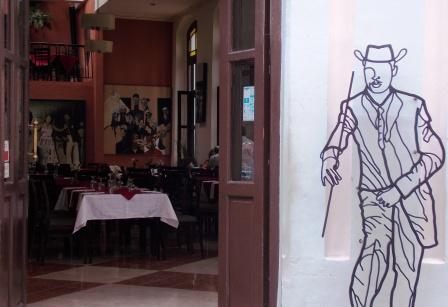
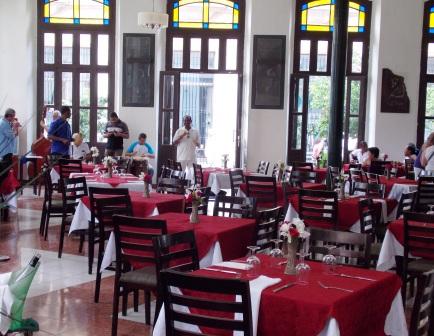
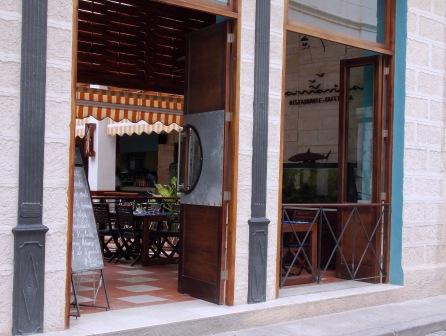
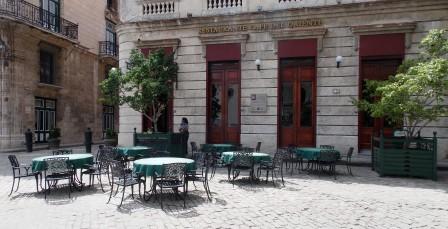
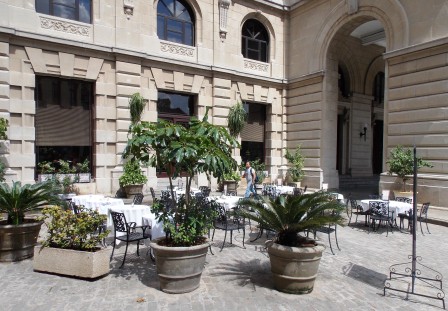 The decline in tourism in Havana is inescapable in these bleak images.
While the official media speculates about the growth in tourism to the largest of the Antilles, the reality in Havana is very distant to that in past years when innumerable foreign delegations visited.
Commenting by word of mouth, traders and restaurant staff repeat it to their friends. One of these restaurant staff attracted my attention and obliged me by offering a tour this past Sunday of some of the places most frequented by foreign visitors.
The tour started in the central area of near the Capitol, and later continued walking along Obispo, the Plaza de San Francisco, the old Plaza de Armes, and then the Cathedral. I finished the grueling walk in Chinatown, witnessing in reality the decadence or the little tourism that exists in the Cuban capital, to which we can add the number of vacant stores.
There is a sculpture on permanent display in Havana in the patio of the old St. Francis of Assisi Convent called The Silent Table, a work of an unknown artist, but on seeing these images one might suggest that they create a new work called: The Empty Table.
October 1 2012
Havana Remains the Trash Capital / Wendy Iriepa and Ignacio Estrada
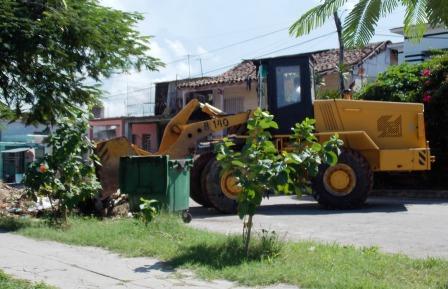
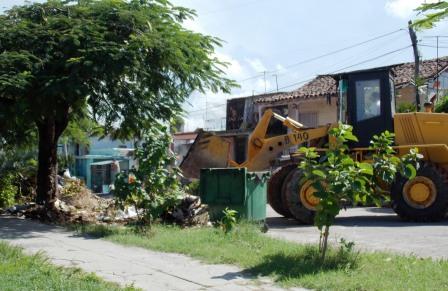 The constant appearance of micro trash dumps on Havana’s streets is one of the reasons the Aedes Aegypti mosquito — carrier of dengue fever — cannot be eradicated.
Despite the fickle efforts of the Ministry of Public Health and the authorities of the Municipalities in the capital of the country. The eradication of micro trash dumps and the proliferation of the Aedes Aegypti mosquito are from completion. So the increase in detected cases of Dengue Fever is something still unexplained in the official media.
The micro trash dumps are created as a result of lack collection of solid waste and contaminates. To which you can add the irregular hours of collection and in many cases the lack of vehicles for treating and transporting the trash.
Recently, the authorities have been forced to deal with these micro trash dumps by joining forces with other official entities.
A neighbor of the place where I took these photos, on learning where they would be published, whispered to me, “Brother, Havana is no longer ’The Capital of All Cubans.’ Now it’s ’The Capital of Trash.’”
October 1 2012
Cuban Mime Imitates the Caballero de Paris / Wendy Iriepa and Ignacio Estrada
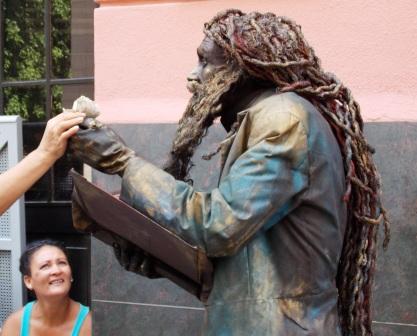
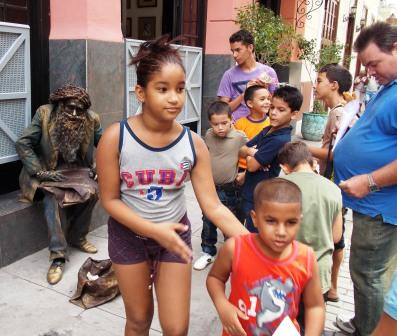
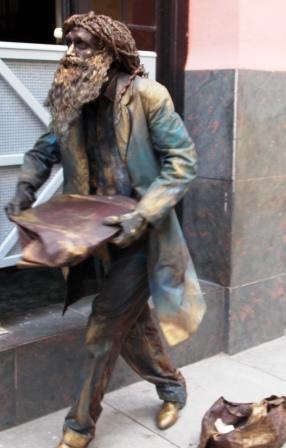
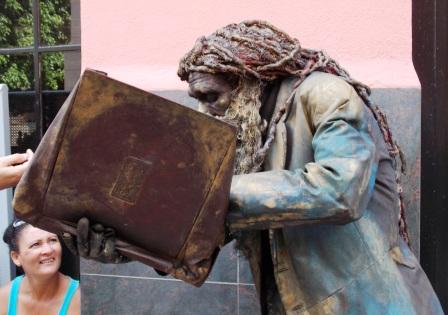 In past articles I have addressed the art of mimes in Havana, with great respect. Today I bow to them again and applaud those who develop with such professionalism in our streets.
The mimes recreate personalities from the Wild West, from musical spectaculars, artists, musicians and even composers. Now of all those I’ve seen before I’ve been most impressed by the way the character has been recreated on our streets today of the well-known Caballero de Paris.
It seems as if the man sculpted in bronze has come alive and walks among us. Kids, teenagers, young and old, everyone stops to look at him and listen to his stories, taken from different places and chivalrous adventures. I saw him give flowers made from cut up magazines and dried plant leaves. I can assure that it feels like being with the such a prodigious man who enchants Havana today, with one of the most beautiful stories.
I murmured while standing there looking at him and taking these photos that today I share with each one of you. Welcome back to the streets that have always been yours, great Caballero de Paris — our own Knight of Paris.
October 1 2012
The Good Prisoner / Reinaldo Escobar

We’re already used to perceiving the interrogation tactic of “good cop, bad cop,” so it’s only natural that those of us who are usually on the other side of the questioning think of duplicating the method.
On October 4 at around 5:30 in the afternoon an impressive police operation stopped us at the entrance to the city of Bayamo to prevent us from attending the trial of Angel Carromero. Yoani Sanchez, Agustin Lopez and I had crossed the 500 miles that separated us from Havana in a Moskovich make car. We suspected they wouldn’t let us enter the courtroom, but we didn’t think we merited the deployment of forces with which they intercepted us.
Yoani and Agustin have already told their stories. Yoani chose to clam up like an oyster, neither responding to questions nor taking food or water. She was the bad prisoner, impenetrable. I chose instead to respond, to drink fluids and, although I wasn’t on a hunger strike, I refused food (white rice and a chicken leg) simply because I had no appetite.
An investigating officer who introduced himself as Captain Céspedes (What a coincidence, a Céspedes in Bayamo!) let me know that I was under investigation for the presumed crime of “defamation of the heroes and martyrs of the Revolution,” which I later learned is really called “Defamation of institutions and organizations and of heroes and martyrs,” as defined in Article 204 of the Penal code.
I will not relate here all the dialog verbatim, just my impressions. The most notable was that, according to what my interrogator hinted at, his opinions about us were not based on information provided as evidence, nor on the reports of experts, but by what he had learned through “enemy propaganda” that had been divulged in the official Cuban media. Full of good faith as I am, I suppose that this officer, a serious, respectful and meticulous man, could not reveal the real results of the investigations because if he had we could not have been processed.
Another interesting detail is that when I was explaining the reason for our presence in Bayamo I told the investigator that the newspaper Granma (which never lies?) had published that the trial would be oral and public, so we had the right as citizens to attend. Cespedes responded that this did not include counterrevolutionaries. I couldn’t resist the temptation and argued that when Cuban decriminalizes political dissent it would not be possible to stop a citizen from attending a trial previously announced as oral and public.
With the firmness that is used to state one’s deepest convictions, my interlocutor warned me as follows: “We will never permit the counterrevolution to do what it wants.” In my role as the good prisoner I clarified that luckily it would not be them who would be governing the country and that the day this decision happened he would have to obey the order, as befits a soldier.
Then he let me sleep on a single bed with a foam mattress in a room with air conditioning and at noon on the 5th we returned to the capital in a minibus that traveled escorted by police cars sounding their sirens from Bayamo all the way to Guanabacoa.
Arriving in front of the building where we live, Yoani, the bad prisoner, shot out like greased lightning and went up the elevator. Once in the lobby, after returning to me my confiscated belonging, I said goodbye to the other officer who came to the front of the caravan. “I’m sorry I cannot thank you,” I said, “we would have preferred to return another way and you have hindered us.”
The Moskovich made another journey, but that is related by Dekaisone.
8 October 2012
The Johnson Drugstore is Open Again / Wendy Iriepa and Ignacio Estrada
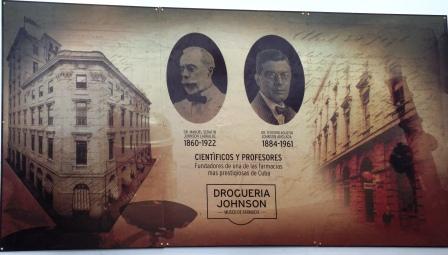
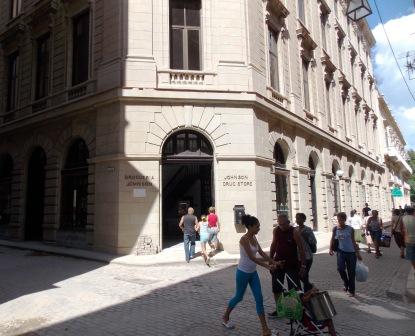
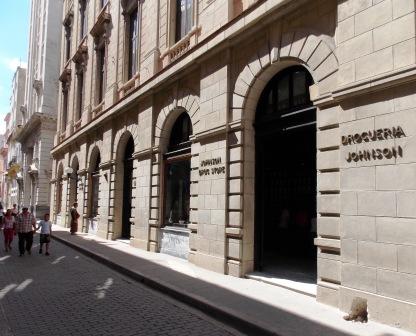
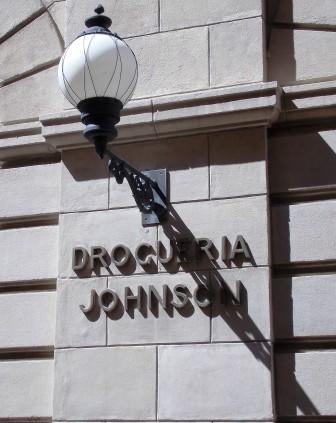
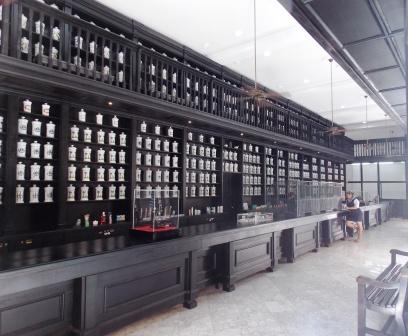 The re-opening of the Johnson Drugstore is a fact, for a several weeks now.
For those who walk down the central Obispo Street in Old Havana it’s a wonder to find such an important place rejuvenated after several years The architecture is the same as in yesteryear according to connoisseurs of this urban area. But others establish credibility by referring to the fact that it was a true drugstore before the coming to power in 1959 of the one who annoys everyone.
The truth is, the knobs on display according to one of the staff are the same as used before, with the only difference that now they are solely decorative. But it’s not the only difference, the drugstore is not the site of the Cuban Pharmacology Museum and now the products sold in the place are only available in hard currency, CUCs, a money whose value is 25 times that of the official peso.
Now the reopening of what was the most prestigious pharmacy of its era only causes a lot of talk among Cubans and is a constant witness to the institutionalized apartheid of the Caribbean island.
October 1 2012