Dissident Sonia Garro Detained in Havana / Iván García

According to Mercedes Fresneda Castillo, fighter for Afrocuban rights and member of the Ladies in White support group, the community activist and dissident Sonia Garro Alfonso, 35, was detained by the police on Thursday, July 14 at 7 PM.

“I was with her until 6 PM. Hours later, a neighbor telephoned me and told me the police had taken Garro away to an unknown location, along with her husband, Ramón Alejandro Muñoz, also a dissident. Then I asked around and found out that Sonia is under arrest in the 7th police station in the Havana neighborhood of La Lisa,” said Fresneda.

Previously, Garro had been advised by the intelligence services that they were not going to allow her to carry out the public protests that, along with six other women, she frequently carries out in various Havana locations and plazas.

This past May her husband, Ramón Alejandro Muñoz, played a leading part in a famous incident when he chained himself, machete in hand, on the roof of his house while demanding freedom for Sonia, who was under arrest at the time. This indignant Cuban still keeps up his rebellious attitude: he goes out in public with one arm in chains.

Garro has been particularly active in the past few months, but without neglecting her community project to help the poor children of her neighborhood, no matter what the political beliefs of their parents may be.

These women’s street protests are considered a serious threat by the State Security forces. They have been threatened with arrest and trial, particularly Sonia. In the month of June she complained that the number of the case they have opened against her is 2801/2011.

Sonia Garro as well as Mercedes Fresneda and other women have been reminded by the authorities of what Fidel Castro said in his day, and which has been firmly reiterated by his brother: that in Cuba the street belongs to the revolutionaries.

Photo: Laritza Diversent. Sona Garro with some of the children from the independent cultural center that operates in her home, on Avenida 47 No. 11638, between 116 and 118, Los Quemados, Marianao.

Share on Facebook

Translated by S. Solá

July 17 2011

Cuba, a State in Liquidation Sale / Iván García

Cuba’s fate will be decided in 10 years. Or less. By that time Fidel Castro, will be 95 years old. If he is still alive then, a nurse will try to feed him with puree or apple compote with a spoon.

His brother Raul, around the same, will turn 90 years old and I don’t think he will have the strength to blow the birthday cake candles. If God’s grace lets them live, they will be two boring grandpas. A piece of Cuban history prostrated in wheelchairs.

In 2021, probably before, those who rule the nation’s destinies would have been adjusting the itinerary on their political sextant. If the ship still being captained by the olive-green entrepreneurs, Cuba will be a mix of a virtual communism and state capitalism enthroned in the principal economic sectors.

Maybe by that time Cuban intelligence will have designed an obedient and nice opposition. And, not to be outdone, they will hold elections every five years. There will be two or three political parties with pompous names that will preach the same, but using different formats.

Of course, the military magnates will have the complete control of the economy and the political life. They will let  private enterprise and will encourage and reward it with lower taxes. And the powerful Cuban-Americans, will be compensated for the expropriated properties during the first years of the revolution.

If by then, the commercial firms such as Bacardi, Fanjul and other millionaires of Cuban origin would prefer to invest and leave aside “those absurd ideas like democracy and human rights,” the doors to doing business in Cuba will be open.

Those annoying political activists and independent journalists who step out of the script will have to  be careful. When a honeymoon with the Florida’s wealthy fellows exists, the embargo will be a relic, and from time to time the United States president will spend his vacation in Varadero, it won’t be necessary to set up political circuses against the dissidents.

The trouble makers will end in a grave. They will be buried three meters under, with a shot in the neck. Like in Mexico or Colombia. Nobody will want to know who killed them.

Cuba is a State in liquidation sale. The subsidies are already being dismantled and the creole mandarins now talk about profits and loss. To work, damn it! It has been said in all assemblies.

On the economy side everything is figured out. The preservation of the planned economy is to appease Fidel Castro, who hates the free market. But there are areas, such as real estate, crude oil extraction or tourism advocating  for mixed enterprises.

Many generals-turned-businessmen, dressed in white guayaberas, will give the welcome speeches at some golf tournaments. The black caddies will return to carry the golf clubs and the cash registers will be ringing with so many stunning greenbacks.

The Mariel seaport will be a goldmine. It will make Miami look small. In the Chinese factories the people will work for two dollars a day. And they will be satisfied. In a State enterprise they would only receive fifty cents of a dollar.

So this, more or less, will be Cuba’s outlook after ten years.

To put in place or not a two-headed system, combining the worst of the capitalism along with the totalitarian society’s repressive brutality, will be left in the hands of a dissidence that must mature and gain political conscience.  Otherwise, they will be blatantly bought with hard currency, in order to get a slice and keep their mouths shut.

The future looks ugly. I may be missing details. But not too many.

Share on Facebook

Translated by: Adrian Rodriguez

July 15 2011

I am guilty of… / Intramuros

By Sironay Gonzalez Rodriguez

How good I feel when knowing that I am doing the right thing, even when the majority contradicts me or avoids any comment so as not to be implicated. I like to be on the opposite side, I feel good being apart from the mass.

My biggest commitment is with the truth. With it I walk with my head up and I am not afraid, because the fear is for those who are attached to dogmas and live in the obligation of being servile although they don’t understand a thing. I give myself to a noble cause, justice, and for it I will be fighting with all the known peaceful means while God gives me strength.

I believe in the power of the small, in the capacity that people still have (although they don’t notice it) to love.

Sironay Gonzalez Rodriguez
San Cristobal, Artemisa. 1976

Translated by Adrian Rodriguez

June 30 2011

ISLAND STASIOLOGY / Orlando Luis Pardo Lazo

Of Militants and Queers

Orlando Luis Pardo Lazo

…s they have tried to call it. They weren’t “five gray years.” Much less a “black decade.” The ‘70s were the splendor, the Cuban Revolution’s era of luxury. The ‘70s are and will be the crystal clear incarnation of the world totalitarian utopia, the twentieth century ideal. In those years every concept was an absolute, including the atrocious poverty of an island where, although no one died of hunger, food and civilized objects disappeared as if by magic (or were treasured in expectation of a luminous future of great tree-lined avenues where there wouldn’t be enough room for any of their proprietors). “Burn the ships,” was our poetic slogan. Aside from that, precisely in 1971 I was born. So please, no more faggoty metaphors of opaque colors. Because the ‘70s here were also a party, unspeakable, unrepeatable, and radiant.

In comparison with these times of decadent corruption and ideological stupidity, I imagine that as a true era. Where sincerity could be neatly murderous. Where everything overflowed the banks of the Revolution, from literature to money. Where Fidel was a Faith with no expiration date and paradise could be felt. I envy my parents’ impoverished existence, with their checked shirts and dresses and corduroy sweaters (they bought my cradle on the black market). Rarely in their history have the Cuban people been so close to a poetic and policed incarnation as they were in the ‘70s. We are that, nothing more. José Lezama Lima knew it. So he remained quiet. Not from fear (at that point he lived more in bitterness than in panic), but as a messiah, as a mastermind.

And The Fat Man from Trocadero [Lezama Lima] discovered himself living counterculturally his own fabrication. Never again would there be in Cuba any frustration of political essence (nor aesthetic nor of any other kind of essence). Nor would there be reserves of any royalty. Everything was an invisible evaporation (reality swept by the olive-green logo of a libertarian Oppiano*). The baroque reached its end out of excess gravity in the island of micro-brigades. Every dramatic conflict was superfluous and had to be resolved through the established channels. Every desire was cauterized by the playful discourse of the leader (in the 70s Fidel mourned martyrs the same way he made jokes from his dais/court). Jose Lezama Lima shut up, also a liar. He forgot to say, face to face with a homophobic state that yes, he was a fag (and that Paradise, in fact, had no place within historic materialism; in many senses this tome is the Anti-Bible and a Contra-Utopia).

Whoever ignores the truth of his own body, could easily sell himself to the enemies of the homeland given the case of an invasion (and no one laugh, damn it: the invasion is still imminent to this day). That is why State Security brands him as a diversionist** in a pdf, for not having the will to throw himself in front of the Revolution’s crazy cart. For his elusive elan. For being town gossip (they proved it to him with recordings so that he wouldn’t claim innocence in the middle of the desert). For being such a loving Cuban and for hoarding so many dirty little family secrets every time he would propose sex to a pupil, maybe even to a pupil infiltrated by the G2: hence that they would scan his unpublished manuscripts before the scanner (and in this our current National Literature Awards are the primary suspects of such leak, our lezama-gate or maybe wiki-lima).

What better temple than the Mecca of Cuban culture to make love to the political police. The National Library was the spot by excellence, clitoral axis between the marble testicles of the MINFAR-MININT and the turgid phallus of Revolution Square. The den of so many notable bookworms had to be the marked site. There, the mummy Lezama Lima stopped being a contemporary writer, while still alive. He deserved it. Silence gives consent. Communism was an aspirin the size of the sun, said, back then, the pamphlet’s newest poets, and it didn’t make sense to hide our emphysemas in an imaginary hole in Centro Habana (the militia marched in front of Trocadero 162, low, and the Master of Origins complained that they did not let him enjoy his nap, while letters from abroad reached him already open: precisely to him, who had attempted the Mail Reform of Cuba during the ephemeral euphoria of 1959).

Why hasn’t anyone spoken of this brochure before? Had his colleagues forgotten? Aren’t there any survivors of the 70’s who worked at the National Library? No. There we have the fundamental problem of cuban-sophy. There are no survivors, there are rather accomplices of our little horror of a scam. Jails, exiles, microphones, suicides. Only the Security organs have a memory (although they are forbidden to narrate). Our people were born literally and literary-ly yesterday. I come to my desperation as a writer through this point: I cannot express my joy of knowing ourselves so free in terms of nation. Without teachers or martyrs. Without any more tradition than the reiterative treason. Alone, spelling out the imprisoned prose of a little brochure of the DSE (Department of State Security) where all of our future literature fits, all of Orwell’s Orbit with rum and neighborhood laughter, plus the indispensable brothel penises in exchange for a couple of bucks. We are that, nothing more. The militia won, the hetero dogma (not the heterodoxy). José Lezama Lima found out too late. That’s why he remained quiet. Not because he was a fag (by that time he was already more virginized than insulted), but for mercy towards himself: any word would be used against him.

I cannot place an end period without declaring that, in full faculty of my mental possessions, I find agreeable to declare that from being so loquacious I have become a little crazy. So that I don’t know which reminiscences or resonances forced me to type and publish this post immediately. Perhaps I have only pretended to get ahead of the officials who tend to the CASE OLPL. Perhaps it is only the shame of having being right (or of having lost my mind as a result of the dissimilar despotisms since 1971 and until today). Perhaps it is on…

Translator’s notes:
*Oppiano Licario is the title of one of José Lezama Lima’s books.
**Ideological Diversionism: Anti-revolutionary propaganda in the form of newspapers, radio, music, movies, etc. Cuban government claims this was the weapon of the enemy and of anti-revolutionaries on the island.

Translated by: Claudia D.

June 11 2011

Perverse Capital / Miriam Celaya

(Article originally published in the Diario de Cuba on July 8, 2011)

The recently published interview granted by Cuban-American businessman Carlos Saladrigas to Orlando Márquez, editor of the magazine Palabra Nueva of the Cuban archbishopric, has provoked numerous reactions on both sides–Cuba and Florida–although, of course, the official Island media have not even mentioned the matter. As expected, when the topic is about proposals of reconciliation and of Cuban expatriates’ capital investments, dynamite-charged intensification is expected, ready to blow up bridges or to place obstacles, though conciliatory opinions trying to find a middle ground do emerge, a peaceful balance between offers and opinions of the debating parties, though, as is often the case, these mediations are usually too restrained when they occur from within Cuba, since they  remain frozen at the midpoint between the problem and their possible solutions.

The work I am using here as reference, in addition to the mentioned interview of Mr. Saladrigas–whose proposals I consider very attractive–are Vicente Escobal’s article (“Mr. Saladrigas, Don’t Count Me In”) recently published by Cubanet: the debate between Jesús Arboleya Cervera and Ramón de la Cruz Ochoa published in Espacio Laical Digital Supplement No. 137/July 2011, and González Mederos Leinier’s  article (“Saladrigas Arboleya and the Debate on the Future of Cuba”), published in Digital Supplement No. 138/July Digital 2011 of the same venue.  All texts consulted are just a sample of how complex and necessary the topic of the Cuban reality, the reconciliation, and the role of the different social actors on the future of the nation are, as well as the schism created by the tremors that have encouraged the Island’s government for over 50 years.

Vicente P. Escobal, in his personal interpretation of the proposal, criticizes Saladrigas for the project of reconciliation between Cubans (he refers to “Cuba and its Diaspora: the Challenge of Facilitating a Reunion” published in the “Espacio Laical” Digital Supplement of the Archdiocesan Laity Council of the Archdiocese of Havana), for considering it as an apology to the Cuban government, and he concludes that “If our aspirations are to “perfect” communism, to hand the executioners of the Cuban people a statement of “forgive and forget” and to betray the memory of our beloved martyrs, then, Mr. Saladrigas, don’t count me in”.

For his part, Jesus Arboleya, a political analyst associated with the Cuban Ministry of the Interior and the official academic sector, attacks Saladriga’s proposal due to his not being completely convinced of “his appreciation about the virtues of the market”; not only because they don’t harmonize with the socialist aspiration and vocation that he–by virtue of certain capricious and unknown statistics–considers generalized in the Cuban people, but because “the world is upside down and it’s the market’s fault, socialist ideas have never before been more alive in Latin America, and State intervention has even been necessary in the US in order to resolve the wrongs brought about by neoliberalism.

As for Leinier González, we will need to thank the conciliatory spirit that animates him–something that’s always timely when it comes to resolving tensions–and some notes about the objective reality of Cuba today, though at times his focus may be somewhat dreamy and not entirely in tune with Cuban conditions, and though he might have felt obligated to throw the occasional soft dart against the dissidence, when–referring to the work of Arboleya–he states: “I dare say that an intellectual effort has not existed from the Cuban  opposition party (neither inside or outside Cuba) that has managed to equal, in quality and reach, the narrative defended by Jesús Arboleya”. As if Cuban intellectuals who oppose the government in Cuba were able to make use of the same editorial possibilities as that man, or if the many academic émigrés did not have their work solidly published outside Cuba.  Naïveté, fear, ignorance or opportunism are impulses that, on more than one occasion, have clouded the best of intentions of the forums, and it is for that reason that I prefer to attribute this minor cluelessness of Leinier González instead of the rush that guided him at the time he partook in a debate so very important as to stop at trifles of this nature.

However, my intention now is not to analyze the ever-challenging issue of dialogue among Cubans, nor the obvious advantages or disadvantages of alleged Cuban-American businessmen’s investments in Cuba, but to insist on jumping the sharp contradictions of the official budget, including the brilliant arguments of the outstanding analyst Jesús Arboleya. And this is because when the market relations are so demonized that they would ultimately defeat a nonexistent socialism in Cuba, the defenders of the system are forgetting to make some proposal to inform us how prosperity and development may be achieved outside the market.  At the same time, the selective amnesia of thinkers like this individual omits the existence of a strong middle class in Cuba, represented by sectors effectively linked to foreign capital and strongly correlated to the power strata.  The same memory illness does not allow the analyst to include in the category of “dangerous” foreign capital business investment from Spanish, French and Brazilian investors, and even from the Chinese government,  among others, operating since long ago in our territory, from which only the Cuban government draws profits, its narrow circle entrenched in solid interests and its foreign partners. Is this not about the demonic “concentration of capital”? Isn’t the combination of capital and absolute power the worst the worst monster created by the so-called “socialism”?

The Cuban-American dollars are, without a doubt, the “perverse capital”, though in reality they constitute one of the largest sources of foreign capital income on the Island and the financial support to tens of thousands of Cuban families. Cuban-American dollars and not “socialism” have achieved the survival and even the economic welfare of their relations in Cuba.  Mr. Arboleya and the top leadership which he serves are well aware that Carlos Saladrigas’s proposals not only contribute to legitimate a source of prosperity essentially Cuban that would turn into a dangerous beginning of autonomy for many individuals in the country, but that it will eventually foster the growth of independent cells in civil society. Florida’s Cuban entrepreneurs’ capital and not just market capital would result in, at the end of so much detouring, the vehicle for that huge “perversion” known as Freedom.

Translated by Norma Whiting

Testimony: The Failed Attempts to Make Me an Agent – I / Angel Santiesteban

Photo: Reuters

Knowing how to say no when the opportunity presents itself, no matter the surprise, the gain, or the subsequent costs of the negative, is what differentiates us from prostitutes.

My rejection of the regime came to me from an early age, I knew it was the wrong road and that with the Communist System the Cuban people would never enjoy the full and dignified life they deserve after a half century of the Republic.

How can I forget the calls in the University made to Amir Valle when in the middle of classes they interrupted the professors to take them out of the classroom and threaten them for what they said or failed to say. Or the beating given to the writer Jorge Luis Arzola in Jatibonico for attending the Literary Workshop and then, in the middle of the night, they took dragged him out of his cell and beat him again. Arzola had so many differences and grudges with the system that made them irreconcilable.

In 1994 I was a little-known writer; I was arrested and taken to the cells of State Security headquarters at Villa Marista, suspected of throwing Molotov cocktails in different places in the city. Three days and nights of interrogation made me faint. It was a dream that produced blackouts, moments of unconsciousness interrupted by shouts, threats, and shoving that I couldn’t even repulse or offer them some offense and remember that I had rights, that I was alive. Within a week I felt that death would be a pleasure.

Then, all of a sudden, they offered to let me “cooperate”: I only had to tell them who had thrown the Molotov Cocktails, “just that,” they told me. I don’t remember if I shrugged my shoulders, shook my head, or simply, in my catatonic state, they assumed my positive response. At midnight I was put out on the streets, the houses were spinning and the lights tormented me, people were looking at me like I was a drunk, but that’s to the excitement of being able to see my family, I made it home.

Several days later a plain-clothed official was walking through my neighborhood looking for me to learn some data I could give him, but he didn’t manage to find me. I had hidden in the suburb of Güinera. I hid there two months. And they waited. To their way of thinking I had failed them. They understood they wouldn’t manage to get me to give in, nor to make me understand that I would be “protected” at their side, so they moved on to Plan B.

They used every variation on me that, in the end being human, at times I asked myself if I should have collaborated; but I immediately rejected such stupidity. I never would. I knew my mother would rise from the dead to vomit in disgust. My sister would change her name. And my friends and detractors would refuse to greet me, because there is nothing more despicable than a traitor.

July 15 2011

Pedro Pablo Oliva and Henry Constantin: Two Examples of the Blockade on the World of the Cuban Culture / IntraMuros, Dagoberto Valdes

By Dagoberto Valdes and the Editorial Board

In editorial No. 14 of Convivencia Magazine (www.convivenciacuba.es) of March-April 2010, we said that:

“In the last year there has been a visible increase of the natural diversity of expressions of men and women in Cuba. This plurality has been manifested, mainly, in the cultural world. This world has been always a very multicolored one. And in the last fifty years, it has been treated more with subtle censorship and exclusions than with more direct methods. Thus, the cultural and educational world was expressing itself, more and more, in a peaceful way, critical, punctual and persevering. Instead of more room for debates; instead of opening the existing paths to the diversity of opinion and action, the answer has been the growth of violent repression, direct, without a mask nor subtleties as before.”

The last two milestones with this sad reality have been: The closing down of Pedro Pablo Oliva’s studio in Pinar del Rio last May 14, 2011 and the “cancellation” of the enrollment and grades earned over two years, by the blogger from Camagüey Henry Constatin, who is also a member of the editorial boards of the magazines Voces and Convivencia and who participates in the preparation of the serial Citizens’ Reasons, an audiovisual space for independent debates that address different aspects of our national life. Both decisions damage noticeably the spirituality and creativeness of the Cuban nation. So we expressed in the afore-mentioned editorial only a year ago.

“Those who blockade the cultural world, those who gag the arts, those who uglify beauty and turn off the lights of letters and the truthfulness of dreams for freedom, for justice and for love in Cuba, are crossing a very dangerous red line: Not only are they repressing the artists’ creativity, and the honesty of the intellectuals, or the sincerity of the communicators, but also they are repressing the nation’s soul. Those who repress the soul of the people in order to try, unsuccessfully, to smother the motions of the human spirit, are inflicting the greatest of anthropological damage on their citizens, fatally wounding the spiritual stability of the nation and executing it by means of the irreparable slope of violence, which nobody wants.”

On the now closed door of Pedro Pablo Oliva’s house, the greatest living artist of Pinar del Rio, there’s a phrase that speaks clearly of his great soul: “strictly prohibited to stop dreaming”. So responds this Cuban who loves so much his motherland, who gave so much for it and who did so much good, discreetly, to Pinar and to Cuba. All artists, intellectuals, cultural or civic animators, know that Pedro Pablo, his home and his help, has been always in favor of the realization of the best dreams of each one of us. His moderation, his humble life and his desire for a universal inclusion of everything good, right and beautiful, mark his attachment to the homeland and his indelible contribution to the culture. Reading the exhortation to don’t stop dreaming, I couldn’t avoid recalling the end of the number 14 editorial of Convivencia which is another way to say the same thing and to dream of a better future for Cuba and its culture.

“This world is upside down. And one day will be straightened. And the artists will create and express in free public spaces, respectfully and participative. And the bloggers will write and launch to the world their blogs without gags or blockades on the internet. And the musicians and composers will say, with their free musical notes and free lyrics, what their souls want for the good of all. And the writers and artisans will let fly in the air letters and shapes as free as they are responsible. And the educators and students, methodologists and directors of education, will not fear students expressing themselves, or gathering freely without the surveillance of their custodians with teacher faces. And every one, men or women, will contribute, express or intervene in the public spaces, in the cultural environments without the horrible nightmare of being labeled as a worm or a mercenary.

This world will come, nobody doubts it, and then Cuba will stand up and will close the door on the gag. And the threatening arms of brother against brother will be lowered. And the offenses between lifetime neighbors will end, and fear and the threats from our phones and squares will end. And families divided by all these will be reunited. And, then, it won’t be a day for revenge, or for hate, or rancor. Cuba, every Cuban man or woman, will brick up the door to violence and repudiation. And we will open between all of us, with the beauty of the arts and the letters, with the truthfulness of the ethical and civic education and with the kindliness of the peaceful coexistence, the ample door, diverse and fraternal of the National Home that it is and it will be forever this Cuba that still navigates in hope.”

Pedro Pablo and Henry, you know you can count on the solidarity, the affection and respect of many people in Cuba and overseas. Even the silence of fear speaks by itself. It’s only a matter of not sinking in hopelessness. It is only another big blackout. Let there be light.

Translated by: Adrian Rodriguez

May 26 2011

Noble as a Farmer, Wise as a Priest / Juan Juan Almeida

JJ.- Hector, whether some like it or not, your name is relevant when we speak of the internal opposition in Cuba. How do you see Hector Palacios?

HP.- Well, first I want to introduce myself because you already know me, but many readers do not. I am a farmer who was born in the Escambray. I am also one of the revolutionaries who since 1980, exactly during the Mariel crisis, stopped being on the side of this thing they call Revolution. Because of that I spent time in prison; I have been a prisoner of conscience three times. And between short and long detentions, I have been detained dozens and dozens of times that add up total many years. Solely and exclusively for the crime of thinking or suggesting, many times, that things have to be different.

In 1989, I was the founder of the first liberal movement of this last period in Cuba.

JJ. What kind of “Liberal”?

The type of liberal that the leaders of this country’s independence were.

I currently lead “The Liberal Unity” of the Republic of Cuba and…

JJ.-Yes, but I prefer not to get into party politics yet. Héctor, as you said a moment ago, your life began in the countryside. There is even, at least in my view, a strong rural influence in your way of speaking, of looking at things, of saying and expressing your ideas. Tell me about these beginnings, your childhood, family environment, friends.

HP.- Look, I was born in a pretty inhospitable area in the middle of the Escambray…

JJ.-What is its name?

H.-Pico Blanco. That is where my family settled, and then people came who rose up against the dictator Fulgencio Batista, the people of the Revolutionary Directorate, the Second Front of the Escambray, Che when he came from Oriente… That is, I lived in the middle of that place. But we lived peacefully, in bateyes (outbuildings), each family with a group of houses built around the head patriarch’s house.

JJ.- And what was life like in that environment?

HP.- There were teachers and priests who baptized you. I was baptized. At that time there were not the number of schools that were built later. At that time, I mean in nineteen fifty-something, where I was born there were only three schools. And it is true that in those schools all the grades were taught together, but when you finished a grade, you really finished it.

There was a lot more discipline. And, besides, you had to work in addition to going to school. That was the farming custom and that is why, among other reasons, that there was food in Cuba. Because people worked.

If you go there today, you will see that where we produced hundreds of hundred-pound sacks of coffee, thousands of tons of sugar, I don’t know how much cheese, milk, etc., today they don’t produce anything. The Escambray is without its people.

I grew up like that. The farming environment is supportive, solid, religious, and has very sincere principles. At home you couldn’t tell a lie, you ate on time.

My family wasn’t rich. My father was a mule driver and he worked from sun to sun with his team of mules.

JJ.- Was your family strict?

HP.-Some were stricter than others. I think that is a problem with farming customs. But in general they were all strict. In my home there was a lot of discipline at meal time, with personal hygiene, study time… I remember that I learned the multiplication tables at my grandmother’s house. I had to do it in a few weeks because on my left was the book but on my right was the ruler. Yes, there was strictness, there certainly was, but we lived with a lot of affection and love. It was something else.

Then it all fell apart and, just as my family was destroyed–and it was a big family–all the rest of the families of Cuba were destroyed, and those of the countryside and the nation.

And I want to confess something to you that I have never told anybody but I have thought a lot about this campaign of Raúl Castro’s that–according to him–proposes to give land to farmers for their use as if land could be given for its use. Look, you have to give land or not give it. He knows very well that it is harder to create a farmer than a doctor. At 24 years of age, a doctor is a doctor, but a 50-year-old farmer is still not a farmer.

I don’t know how Raúl Castro is going to solve the problem of a countryside without farmers. In Cuba, 80% of the people used to live in the countryside; and it was the countryside, it had a tradition of over two hundred years. So I don’t see how it is possible to solve the problem of the countryside as it is being done now.

It might be possible to solve the administrative/bureaucratic obstacles, but you need generations for the farmer to learn again how to look at the sky, because that true man, who smells it when it is going to rain, who doesn’t go to the hospital because he has a sick ox, a hurt animal or because his cow is going to give birth; that man is very difficult to make in days like these when farmers only get sunburns, lots of insecurity and pretty bad pay for their work.

JJ.- By the way, Héctor, there is a myth or a reality, I don’t know, that says that country boys have their first sexual experiences with animals. Did you have that experience along with others?

HP.- I’ll tell you. In the country there was not the “sexual spirit” that there is today. That is, you did each thing in its time. The farmer, generally, got married very young when he was just carrying his first or second girlfriend on the back of his horse. That was the custom. Not like now, when there is a very strong sexual appetite because there is nothing like what there used to be.

I really don’t remember that that was my life or that of other farmers. I don’t mean it wasn’t done, or that it isn’t still done; but you really started your family very young.

JJ.- Let’s talk about your youth. There is no doubt that the Revolution, more than a dream, was a radical process that many fell in love with. How did you see that process? Why and to what degree did you get involved?

HP.- Look, son, I didn’t go out to look for revolution; the Revolution came looking for me. I lived in the Escambray and nothing there interested me. The first town I visited was in the area of Güinía de Miranda, just at the time El Che took Güinía, about twenty kilometers from Manicaragua. That’s why I tell you that the Revolution came looking for us. And it came with an important program that they read to us, “History Will Absolve Me”, that spoke of reestablishing the constitutional order lost in 1952 after the coup; of giving land to the farmers; of paying fair salaries; of having several political parties; of not having leaders who would deceive the people; and of the need to construct roads, highways, etc…

JJ.-You fell in love, like others, with the “Moncada Program.”

HP.-Yes, I fell in love with the Moncada Program.

We really were not needy; we had our own revolution, our own land, we ate well… And not only our family, but dozens of families that lived together there and didn’t have many problems. But the best thing we had then was, in that area, no darned politicians or communists.

Later yes, later it filled up with that.

I joined the Revolution, rose up very young, only thirteen years old. I fought passionately for that Revolution until the 1980’s. Yes, I fought passionately for the Revolution until the ’80’s and I was deceived by it. Not now; now I fight for myself, for that Revolution I founded in my head.

JJ.-But today the story is different. I understand that “The Revolution” didn’t change; its leaders changed.

HP.-The Revolution changed, it is still to be made. Incredibly, now we are much worse off than under Batista. Now the land doesn’t belong to the farmers, as it did before; the store doesn’t belong to the storekeeper, as it used to, etc., etc.

Batista was a tyrant who did not monopolize property. I think that the most difficult period, as far as citizens’ problems go, began in the ’80’s.

JJ.- And what was your metamorphosis like? How did you become part of the opposition after having believed so passionately in the Revolution?

HP.- I have been surprised to hear many people say, “Suddenly, I changed.”

That’s a lie, nobody changes that quickly; it’s a process.

JJ.- Well sure, that’s why I said “metamorphosis”.

HP.- In the sugarcane harvest of ’70 I felt deceived, one could smell the lies. And with “The ten million are going” campaign the country was ruined. No factory worked or anything.

JJ.- Yes, many Cubans felt deceived; but not all of them became dissidents.

HP.- Because that isn’t easy, son. When a political process hooks you, it isn’t easy to unhook yourself. You have to have experience. I had the luck of having experience because in the middle of all this I made myself into a psychologist, a sociologist, learned to read and write… And it isn’t that I didn’t know how to read and write; I know how. But I learned well, as I learned how to relate to people. I left the Escambray and learned about the other world.

For me the final blow began in ’79 when they let the famous “counterrevolutionaries” who lived in Miami enter Cuba. It was a campaign of Fidel’s, “The Country Has Grown”, in which it was understood that the problems between Miami and Havana had been resolved. Then I, who had family outside with whom I couldn’t correspond, had to deal with those families who put their JEANS in front of me. I asked myself a thousand times, why?

It was like the one who had been showered with rotten eggs when he left had come back to give you a box of eggs. Something like that.

That was my first shock, and I didn’t pay attention to them and so got warnings.

The following year came “El Mariel” and how was I to imagine that this country was prepared to even kill or run over and beat people… “El Mariel” was the decisive point for many people. But don’t forget that the people of this country were terrified. Because this Revolution sowed terror. People were indiscriminately executed by firing squad, etc.

JJ.- With no trial?

HP.- Well, there were summary trials with no serious appeals allowed. Then terror began to be sowed. And the worst thing is, the worst thing that can happen to a human being is to be terrified because no one can think or reason if he is terrified.

It happened to me; I also lived terrified. The first time the State Security came to visit me, I almost died. Because I thought that was how…well, how it is: true power. But it is a malevolent power that I didn’t know existed. The top leaders knew this, the ones who had created the problem. We intermediate-level soldiers did not know about this.

When I saw that in the street was when I definitely broke with this totalitarian, unscrupulous dictatorship.

JJ.- And doesn’t it seem to you that, speaking of that very fear, is what is happening now?

HP.- No, I am talking about terror, and what there is now is fear. People think with fear. There is an enormous difference between fear and terror. As I said, people cannot think when they are terrorized; with fear, they can. That is why what they call Revolution has reached a critical stage, because the terror is passing.

JJ.- Now then, you are a definite member of the opposition.

HP.- Yes, sure.

JJ… and there is a theory that the members of the opposition are people who marginalize themselves, who isolate themselves from society… How much truth is there is this? Where does this theory come from? Do you hide, stay away from movie theaters, or…?

HP.- Those are theories invented by totalitarian parties and governments. Don’t forget that the easiest thing for a totalitarian party or government (with all the power in the world) to do is to denigrate others.

And one way to denigrate a human being is to marginalize him or accuse him of not having contact with reality, or with the people, or with his family, etc.

There is no more balanced person than a dissident. Because he thinks about tomorrow, about his family, he thinks about remaking what has been taken from us, thinks about not having again the bad things we had or that we have today. And, even more, we think about not killing, about love and, of course, about others’ rights.

JJ.- Do you have friends who are active in the Communist Party?

Of course; some are good people. It is just that they are terrorized like the senior government appointees are terrified because they know they are being watched. I told you a while ago, in a private conversation, that I have a brother who is a high official in the army, whom I haven’t seen for 20 years. He lives there at Matanza, has two or three cars; for him it is easy to come but he is still living in a state of terror. The poor guy doesn’t visit our mother either. They could take away his stripes and even certain benefits.

Look, right now, after the transfer of power–because here there have been no elections and Raúl has not been elected President but rather there has been a transfer within the monarchy (because here there is a type of monarchy), 25 senior leaders have been replaced. Who would have thought that Carlos Lage could have been replaced, or Felipe Pérez Roque?

Translated by S.Solá

2 June 2011

Breaking the Blockade / Rebeca Monzo

Rebellious Hash (recipe)

Ingredients:

1 roll of Our Delight minced turkey, 16 ounces, from Wichita, USA

1 box of 1-1/2 ounces of Sierra Harvest Raisins, USA

One large onion from the expensive farmers market because in the cheap one they almost never have it.

2 cloves of garlic.

1 green pepper.

2 Tablespoons of sunflower oil from the foreign currency stores.

1 teaspoon salt.

2 tablespoons, tomato puree.

1 Cup chopped vegetables.

4 finely chopped cilantro leaves.

Process:

Heat the pan and add the finely chopped onion, don’t brown it, cook until just transparent, add finely chopped garlic (don’t crush as you will lose the juice). Finally add the pepper.

Now add the contents of the mixed turkey roll to the pan, stir to coat with the seasonings and add salt and white pepper (if you have it), to taste.

Let it simmer on low for about 20 minutes. Stir occasionally and cover to keep it from drying out.

Serves four people if accompanied by white rice and fried plantains.

Serve with a salad of avocado or whatever is available that day at the farmer’s market.

Bon appetit! Buen provecho!

July 13 2011

Racism a la Cuban(a)* / Iván García

When it comes time for sex, black Cuban women don’t feel discriminated against. Rather used. Roxana, 36, an architect, endures with Asian patience the sexual harassment from her white bosses, the gross come-ons, and the outright proposals to go to bed for 20 dollars.

What I have to put up with is incredible. From one boss who undresses me with his eyes and tries to blackmail me with a promotion or a trip abroad in exchange for sleeping with him, to the drunks on the street who offer me money,” says Roxana, while waiting for the bus going her way back home.

Racism in Cuba has several faces. And variations. More or less subtle. Even the forms are more explicit. But when it comes time to “play the tune” (fuck), skin color disappears as if by magic.

Especially if you are a woman. In a quick survey of 14 white men, ten said they wanted to sleep with black and mestizo women, “and if they are hookers, the better.” To the other four, mulatto women, “light skinned mulatto females without bad hair (kinky),” make them horny.

The story changes when it comes to marriage. Of the 14, only 2 would marry a black woman, and maybe 6 with a mulatto female if she were spectacular. “But I prefer to marry a white woman,” says one of those asked.

According to sociologist Edna Ramirez, racism on the island is an authentic Pandora’s box. “Cuban laws sanction discrimination by skin color, but in any society you can not legislate the mind and behavior of people. Always in Cuba there have been borders delimiting black and white. With the coming to power of Fidel Castro, the racial phenomenon apparently decreased due to the participation of blacks and mestizos in the social process that had just begun. Despite being a mestizo nation, where we have always coexisted without serious problems, for 20 years now there have been signs of racism toward blacks. On the part of whites and even mestizos, with higher standards of living or senior positions in companies and government institutions.”

You can see it from a bird’s eye view. Those who live the worst are blacks. Visit the filthy rooming houses of the slums or the huts reinforced with cardboard and aluminum that flourish in several Havana suburbs and you will see that almost all the tenants have dark skin

Of those swelling the island’s prisons, around 90% are black. The most violent and bloody crimes are usually committed by blacks. Youth gangs devoted to robbing occupied houses or assaulting people on the street, to steal their hard currency, an iPhone or a Messi T-shirt, generally are made up of blacks and mulattoes.

At the time of migration there are also differences. Sociologist Ramirez is conducting a comparative study of Cubans living abroad. “And, with few exceptions, blacks earn less and thus send less money to relatives in Cuba. It is an issue with an historical, educational and even political background.”
The government and cultural institutions accept that there is racial discrimination. Among the thorny issues in the history of Cuba in the twentieth century is the armed uprising of the Partido Independiente de Color in several cities in May 1912. 3,000 blacks were lynched, or died fighting. Among those who met the order to appease the rioters with fire and blood was Colonel Francisco José Martí, son of José Martí, the national hero. A hundred years after the events, it’s still an incorrect historiographical approach or it is preferably ignored.
Then, blacks and mulattoes rebelled to demand equality and also to be part of government and institutions. A century later, most key positions are still occupied by whites. To reverse the situation, the Sixth Congress of the Communist Party gave a coat of dark paint to the central committee. According to a Party member, there are guidelines to attract more blacks.
Even the census conducted on the island does not show the exact number of blacks and mestizos. “When it comes time to check the box for race, many mestizos declared themselves white in the census. It was optional, “says Daniel who worked on the development of the last Population and Housing Census in 2002.

The Census showed that 65% of Cubans are white, 24.9% mestizo and 10.1% blacks. But when you walk through the streets, will notice that the number of black Cubans and mulattoes are significantly higher than the official data.

Not even the dissidence is saved from racist attitudes. Sonia Garro, opponent since 2007, and who performs an outstanding community work with poor children in the neighborhood of Marianao where she lives and often along with other women go to the streets of Havana to protest, suffers it firsthand.
The night of her graduation as a nursing technician had to endure the humiliation of being separated from a group photo by a leader at the time to pick her diploma. “Don’t be upset, is that those of race don’t look good in the pictures,” he said. “Such was the shame I felt I didn’t even want to collect my diploma. I cried uncontrollably, “recalls Garro. Now, being a high caliber opponent, she still has to swallow bitter pills because of her colored skin.
“The officers of State Security themselves who utter racial slurs do not understand that a black woman can be a dissident. Even worst, is that there are groups within the dissidence where they ignore you and don’t pay any attention to your projects or actions, because of pure racism, says Sonia.

The race issue in Cuba is a real time bomb. The state looks the other way and attempts to minimize the issue. Meanwhile, white guys still crave black and mulatto women to lay with them in bed.

* Translator’s note: In Spanish the letter A after a noun indicates feminine, therefore cubana is a Cuban female.

Share on Facebook

July 10 2011

My Reasons for the Bridge / Yoani Sánchez

With regards to the new amendment presented in the U.S. Congress to restrict travel and remittances to Cuba.

We lived in a dark time in 1992 and this daughter of a train engineer with no train had decided to drop out of high school. I got up early and told my mother. Hands on my head, screaming through the house, the dog barking in shock. “I’m not going any more Mom, I’m not going,” I concluded categorically and went back to bed. My only shoes, inherited from a friend when they already had huge holes in the soles, had fallen apart. I had learned to walk with them touching the floor in a way so that the rips didn’t show, but I could do little to hide them when we had Military Training class. There I had to lie face down, crawling along the terrain, imagining that I was under enemy fire. Then the shells were falling all around me, not those of imperialism but rather of jokes, the cruel chants of those who had better shoes.

For several days my parents gave me all sorts of arguments. How can you throw away your high grades, the sacrifice of studying, all for this “little detail”! they repeated… but at 16 I was ready to forego a diploma rather than suffer the ridicule. The decision was made. My mother ran to the house of a neighbor. She spent the night dialing the number of some of my father’s aunts who lived on the other shore, demonized in the official press. Some weeks later the package arrived. Along with soup cubes and some ointment to treat the pains of rheumatism, was a pair of brand new white sneakers. I returned to my 11th grade classroom the next day.

It’s true that financial help coming from outside has led many Cubans to construct an apathetic and apolitical bubble, but it has also enabled them to survive and grow. Without that help, once sent to me from Florida, my life would have been totally different. I would not have finished high school, probably I would have sailed — on a wooden door — during the rafter crisis, or I would have sunk into conformity with no horizons. But I managed, with this support, to go on. To end up at the university still wearing those shoes of salvation.

Right now, thousands of teenagers, the self-employed, seniors, students and babies depend on the uninterrupted growth in the flow between the families in exile and those on the island. In many Cuban homes the personal ability of thousands of individuals to overcome depends on maintaining this bridge, and their future as citizens rests in the arms of solidarity extended from outside.

July 13,2011

Who Benefits From the Cuban Embargo? / Iván García

What I always admired about the United State policies is their pragmatism. It has an unmistakable capacity to dump in the trash can the strategies that don’t work. And to overcome the errors.

But regarding the Cuban embargo, the Americans show a notable stupidity. Let’s see it from its supporters’ angle. Its advocates think that if the United States lifts it, Castro and his olive green entrepreneurs, will be lining up their pockets with dollars.

They will keep on governing for decades. So the democrats and the human rights activists on the island will continue to be harassed or beaten by the mobs egged by the political police. With the embargo, they say, the United States tries to asphyxiate the regime, promote people’s discontent and provoke the angry Cubans to start a protest on the Havana waterfront.

But neither one thing nor the other happened. In 52 years, the common people didn’t throw themselves on the streets. Or maybe. On August 5, 1994, not to change the status quo, but to make Castro open the gate and to throw themselves into the sea heading to Florida using any floating object.

Of course, the embargo is pure gold for Castro’s propaganda. According to the official media, the Cuban economy is walking with crutches because of the “blockade’s” effects. I don’t think so.

The reality is that the system adopted by the brothers from Biran doesn’t work. All the ill conceived authoritarian ideas, where several essential human rights are suppressed, didn’t take off coherently in any nation.

Only under the boots and the tackling of the secret services is the system maintained. Actually, the commercial embargo affects common citizens. Sufferers of cancer or AIDS cannot afford the latest generation medicine patented in the United States. A regular Cuban can not make bank transactions with United States based branches.

Cuban Americans and foreign tourists can not use American credit cards. The trite excuse used by the embargo supporters, that if it didn’t exist the Castros would be a kind of rich guys, falls by itself.

Long ago, the Castros became the McDucks. I don’t think that the embargo’s toughening will turn them into panhandlers. The embargo is an authentic mirrors game. Its defenders didn’t achieve nothing. The authoritarianism and the lack of freedom continues. 

Of course, the ones who blame the embargo for all the misfortunes that have been happening are also lying. Cuba’s bad situation is the fault of the government. And if you decide to visit Havana, with hard currency, you can buy Coca-Cola, Dell computers and Motorola mobile phones.

Ninety-five percent of State computers use Windows programs. The buses running on the Cuban streets have General Motors components. The foreign currency pharmacies sell American antibiotics and Johnson and Johnson syrups.

The embargo is a real sieve. It has more holes than a Swiss cheese. Add the fact that the United States is one of the Cuba’s main food providers .

Through donations to the island, previous generation medicines and antibiotics come to the island. More than a billion dollars annually are received through remittances. And another billion dollars in equipment, electric appliances and shoddy textiles, sent by Cubans living overseas.

What embargo are we talking about then? A policy or a rule is efficient if it works. But the Cuban embargo has not been working. In addition, it is not politically profitable.

Every year, a majority of countries vote against it in the UN, and for the record, many of the countries condemning the embargo are also critics of the island dictatorship. When the president of the United States decides to abolish the embargo, he will put the Havana regime against the wall.

Because the Cuban economy will still be a disaster. The people won’t live better. Nor will the pantries will be replenished with food. But there will be no excuses or emotional fuel to harangue the masses. The people governing will be naked to the world’s public eye. And therefore will be forced to change.

Who benefits from the Cuban embargo? Fidel and Raul Castro. No one else.

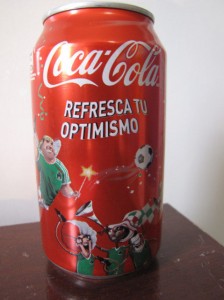
Photo : In his blog the HoboTraveler, the journalist Andy Graham wrote that on Saturday December 6, 2009 he went with two Norwegians to the Jazz Café of the Gallery Paseo, a mall located at Paseo and Malecon, Vedado. Once in the interior, after paying 10 convertible pesos to enter, he asked for a Coca-Cola and they brought a 355 ml can of Coke which he decided to photograph, surprised that in Cuba they were selling the soft drink — a symbol of the USA. In his blog he also posted the picture of the back of the can, where you can see it is a Mexican coke (Tania Quintero)

Share on Facebook

 Translated by Adrian Rodriguez

July 12 2011

The Country Carousel / Rosa María Rodríguez Torrado

With its rustic figures of wood with a vertical tube going through it that no longer makes it go up and down, the little horses of Mónaco, en La Víbora, are the rusty gallop of boredom, the wheel of poverty in turns of hopelessness. With faces unexpressive of emotion, we purchased the rides for our toddlers on the plain slowness and monotony, to cross the doors of imagination in machines re-molded by abandonment and unrepaired from laziness.

That’s how we also find the adults, caught in the green map of prohibitions, with footprints of hammers of litanies and patched dreams of absence and silence. This unremarkable merry-go-round forces its tedious motor, whose arrhythmia of pistons can hardly turn the rusted structure.

Translated by: BW

July 11 2011