The Country Carousel

With its rustic figures of wood with a vertical tube going through it that no longer makes it go up and down, the little horses of Mónaco, en La Víbora, are the rusty gallop of boredom, the wheel of poverty in turns of hopelessness.  With faces unexpressive of emotion, we purchased the rides for our toddlers on the plain slowness and monotony, to cross the doors of imagination in machines re-molded by abandonment and unrepaired from laziness.

That’s how we also find the adults, caught in the green map of prohibitions, with footprints of hammers of litanies and patched dreams of absence and silence.  This unremarkable merry-go-round forces its tedious motor, whose arrhythmia of pistons can hardly turn the rusted structure.

Translated by: BW

July 11 2011

… as I was saying… / Regina Coyula

For the doubters, they lost their bets. I continue blogging, continue tweeting, even though I almost never tweet, because to say something in 140 characters I have to wait to connect to the Internet, then I post and it’s more clear.

Let me tell you. On my return and after successful combat against sewage, like Martina the Cockroach, with the money earned by my husband, I gave myself the task of fixing the house. My little hut is very nice and welcoming, but it hasn’t been painted in more than ten years, the dining set has suffered the impoverishment of losing a chair, entirely the responsibility of Raul Rivero before the Black Spring of 2003. The remaining chairs are cyclically coming unglued with no remedy, and end up losing their backs. Then I had to make them cushions to avoid the pinches from the loose wood, and finally they are tied together with electric cord so as not to fall to pieces. Once on the blog I spoke of a bad run of breaks, but these daily miseries I kept hidden, so that they would not be misinterpreted by someone.

My idea was to buy a dining set to replace the old one already detailed, but the prices give me chills, and they are almost always of chipboard, so I took advantage of the farmers market that was selling these rather rustic stools and I bought them, and the table I thought I’d give four legs in place of the central support that looks like a carousel. The carpenter to do this doesn’t appear, the carpenters are the elite of the manual laborers, taking their due in CUCs, like high fashion designers, what they do is create, not repair.

In the kitchen I have my new best friend. I enjoy the rare privilege of being the last one in my neighborhood to have a decent washing machine. I also gave myself the task of buying two sacks of cement and something called “stone dust,” which replaces sand and gravel. I bought the cement at 6.40 CUC a bag in a hardware store to avoid problems. But for the stone dust I visited a place in the city that seems like another planet called “The Screw,” where they built the first reservoir in the city, now defunct. I should have done a post about that trip but I was busy.

I have a handyman friend and I contracted with him to build a wall and to take down another, small ones, no fear, with the intent of giving my son a room with some privacy; also to move the built-ins in the kitchen and to paint. And I have not been contemplative: I’ve sawed, hammered, screwed and unscrewed, collected, washed down, rearranged, in short, I’ve worked like crazy and still am not finished.

But for one whose house was so tacked together, to see it now is satisfying.

In these two months, the first in Spain and then working on the house, I’m sure I’ve lost many readers. It doesn’t matter. I will start again. Don’t be confused by the domestic tone of this post: My bifocals haven’t stopped looking around very carefully. So I return to where we were. I also missed it.

July 11 2011

Pillar of Salt / Ernesto Morales Licea

True to my iconoclastic anti-traditionalist spirit, I deliberately ignored a date: the first year of this blog. It happened last Saturday. On July 9, 2010, I inaugurated this space with Prologue to The Little Brother, which was more an avalanche than a prologue: it was the first handful of snow I launched to roll, convinced that in its trajectory it would get fat, increase in volume and scope without my having to know limits or consequences.

I, the despair of my loved ones for my apathy before the formalities, with my disinterest in anything that smacks of tradition, of a date marker, could not even celebrate the first year of existence of The Little Brother. I don’t like to celebrate the past: it feels to me like the fate of those who turned their heads to see what happened with Sodom and Gomorrah behind them.

However, I also had a reason to look away when this July 9th recalled that a year ago I hung the first post: I never would have wanted this blog to be born.

This blog was not of spontaneity: it was born of necessity. This blog is not a hobby chosen by someone who doesn’t like philately or collecting old tickets. This blog was the desperate scream from someone whose throat would have exploded if he hadn’t found a safety valve. It was, yes, the catalyst for an intellectual adrenaline that would end up destabilizing me, affecting me, turn me against myself, if I didn’t find spaces to be.

And so I began to write The Little Brother. A name, I thought, for a page, as a concept, not to refer to me, but following the usage of any creation that took the unforeseen road: for dozens of people, known and unknown, work colleagues, distant friends, I lost my Ernesto Morales and was re-baptized as The Little Brother.

Perhaps what I remember most about those first day when I knew that I had just given birth to “something” on the Internet, was the riotous in which the effort grabbed me: freneticly, like a revelation that didn’t feel the keys under my fingers, and the need to publish something new every two days to try to overcome the boredom of twenty-five years, and too much accumulated frustration. To overcome, also, the impossibility of finding where to post my writings in a country that suddenly felt hostile to me.

When I lost my job for insubordination in the national press, I lost not only an empty livelihood of 12 dollars a month: I began to lose, also, the artistic-intellectual spectrum to which I belonged during my first 18 years of life.

Henceforth, to invite Ernesto Morales to readings of narrative, of timeless stories, of pure fiction: to invite an ousted apprentice writer and journalist who would read his texts in public — even though he hadn’t received some award! — became a dangerous undertaking for my friends of the guild, who had to fight like lions faithful to the friendship, to not expel me from their circles.

The ubiquitous State Security agents, diligent, never ceased to demand explanations, provoke analyses, every time my name appeared in some local gathering.

The extreme: “Godless Pilgrims,” my volume of stories that won a national context whose prize included the publication of the book, was suspiciously withdrawn from the publishing plan once my condition as a “disaffected” came to hand in another Scarlet Letter: I was leaving the country.

The rest, the other rest, the long time readers of this blog know: intimidation, blackmail, indecent proposals of my Visa in exchange for my silence, stunning photo-montages to create an image of me as a pimp and sexual corrupter.

After the exile, the horrendous exile that is always an exercise in humility: an exile that deflates you, that ignores your schooling and makes you start from zero. With a forces and hard humility.

And meanwhile, this blog. An article ever three, four, or six days. A return to the keyboard that is like a consecration of an inner freedom, untouchable:my posts here carry the sinful halo of irreverence, which admits no censors nor limits. The Little Brother losing followers, gaining others, holding onto a handful of faithful readers with their hopes of always finding something new, giving form to the almost two thousand daily hits on this blog.

The day I send everything flying, and dedicate myself solely to doing what I really want with my years: to live, and to write literature — a touch of journalism wouldn’t be bad, but just that a touch — this blog will be lying in wait for me and will continue to catch me. Even when I’m freed of my journalist’s skin, known to be temporary, and when my irremediable writer self finds the modern patron disposed to put his fortune into my career: “devote yourself solely to writing and don’t worry about a thing.” (Now, my sarcastic ingenuous smile.)

The day I send everything flying. I will not be able to do without this blog. I have the bizarre certainty that I am too much it, it is too much me. The Little Brother, like William Wilson in the story by Poe, has not only erased my name and supplanted my identity: I think it has, dangerously, been turned into my essence and life philosophy, altering everything around me.

In the end, I’m obliged, at this moment, to look back, to look at its first year of life, when I have always know I shouldn’t. It wouldn’t surprise me if right now I was turned into a statue of salt.

July 11 2011

Cuban State Responsible for Scarcity of Agricultural, Meat Products / Iván García

Serafín, 69, never had toys. For his 8th birthday the gifts from his father were a pick and hoe. He woke him at 5 AM and they went to work in a row of onions. He told him, “If you want your children and grandchildren to have toys, you will have to get it out of the earth. Mother earth will give you your present and your future. There is no other option.” And that is how it has been for over five decades.
A descendant of immigrants from the Canary Islands, strong as a ceiba tree and with the blood pressure of a young man of 20, Serafïn is the owner of a small farm in the province of Sancti Spiritus, 300 kilometers east of Havana.

To get to his farm one must walk a long way and then cross the Zaza community dam, which looks like an inland sea, go along a dusty road where the invasive marabou weed and greenery stretch as far as the horizon and, after crossing a puddle somewhat dried up by the drought, reach a small village of poor people who eat little and poorly but who drink a lot of rum. Just behind the little village is Serafïn’s farm.

In its good days it had dozens of fruit trees and 120 cows. Fertile land that produced hundreds of hundred-pound sacks of onions, rice, greens and vegetables.

Old Serafïn and his children and grandchildren still live on the land. But the agricultural policies of the government do not inspire them to work. “Look, Acopio (a state-owned company) pays only two pesos and 80 centavos for a kilo of onions. And the people at the market buy them at 10 pesos a pound. In 2008, after President Raúl Castro began to pay three pesos a liter in order to stimulate milk production, I delivered almost a thousand liters a day. Things were not going bad for me. But in November of last year they raised the cost of a kilowatt from 0.75 to 1.30 an hour. And from the 2,500 pesos (100 dollars) I used to pay a month for electricity I now pay almost 10,000 pesos (400 dollars), which raises my cost of milk and agricultural production,” the farmer says while smoking a hand-rolled cigar.

According to Serafín, the government gives them supplies at non-subsidized prices. “They sell us a gallon of gas for 6 dollars. And the seeds and work tools are very expensive. Due to the drought, my family has had to make investments and buy pumps to extract water from wells and reservoirs, which makes our use of electricity skyrocket. If you add to this the fact that 80% of our production is sold to the government at laughable prices, you can understand why there is so much empty land full of blight and marabou weed.”

Serafín says that for a while he preferred to sell the cows to the government instead of using them for milk production. “The last straw,” says Augusto, Serafín’s youngest son, “is that at times we have to steal our own crops”. And when the inspector comes they claim that the crops were stolen (robbery has become a daily occurrence in the Cuban countryside), in order to have a little extra food for selling in the farmers markets where the law of supply and demand is in effect.

“The government forces you to lie and fix the figures. I think that not even the old feudal owners demanded they be given such a high percentage of products. In countries that are agricultural powerhouses like the United States, the government subsidizes the farmers. This is logical, since you don’t fool around with agriculture when you have to feed 300 million people, in addition to exporting food for 2 billion more all over the planet,” comments Serafín, a guajiro who likes to read and keep himself informed.

For him, if the regime really wants to fill family tables with vegetables, fruit and pork and for people to have coffee with milk for breakfast, it should create a law under which the State is not sold more than 15 or 20% of production.

“Laws that give you a guarantee. No regulations or orientations, that are exchanged for others according to its convenience. I do not know any small landholder that is not upset with the government. That is why when people travel around the island they see kilometers and kilometers of land that is not being cultivated. Nobody wants to work the land. There is very little stimulus,” says Serafín.

Before 1959, he remembers, Cuba had more than enough fruits and vegetables and even exported them. “But for that to happen, the government must change its abusive methods. The main responsibility for the scarcity of agricultural and cattle products is the Cuban government,” he states. That simple.

Share on Facebook

Translated by S. Solá

June 25 2011

XY, Axis of Coordinates or Chromosomes of Survival / Rosa María Rodríguez Torrado

A little while ago I left my house and a neighbor in my sector (whom I shall call ‘X’) signaled me to come to the sidewalk in front. The attitude of her corporeal whisper intrigued me. I crossed the street to go meet her, looking all around, because her conspiratorial gestures put me on alert. There were only a few kids playing football in the street, and on the corner, a mysterious man with short hair was walking in small circles. Nevertheless I calmly approached her and her expression changed to one of admiration when I reached her: “Mi’ja, you didn’t tell me you have a blog!” ‘X’ only knows how to send and receive mail on “the appliance” which for her is the computer, as her youngest child (Y) showed her how before emigrating. So she regularly goes to an internet cafe to exchange messages with her offspring. In ‘Y’s’ most recent email, she commented that she’d found my journal via Google, that she subscribed to it and reads my works. She also sent X the link so she could visit me.

After a few minutes of talking, in which her flattery rose up into my face, I humbly thanked her and told her I’d write about this. She reacted with fear and the insistence of someone verbally begging on her knees and made me promise her I would not do it. She would not even agree to the option of changing the names, as she is in the phase of “behaving better than ever” to avoid problems and be able to reunite with her family in the United States.

During our farewell I turned my face and saw that coming towards us was the man on the corner who I was suspicious of, with a woman who appeared to be his wife and who carried a large purse. As they passed close to us, she told him–looking back secretively–that she was late because she had to walk about to avoid the police, and she feared they would confiscate the merchandise. ‘X’ and I looked at each other–with the indifference that tedious and repeated stories awaken–opened our eyes and with a sarcastic and silent smile we said goodbye that day.

I’ve come across her two or three times more, and after assuring herself that no one is observing her, she greets me with affection and she gives me the thumbs-up sign, the “V” of victory, or the “L” of liberty. I saw her again last night and she had an expression of repugnance. She greeted me coldly–like some revolutionary CDR* spy who knows my dissident activities–went toward the group that was gathering a few meters from us, where the CDR president’s house is and in front of which they were going to celebrate the National Assembly of the People’s Power.

The repressive agencies of the regime have implanted over decades, in regard to political matters, an osteomiedosis–a “fear in the bones”–that has penetrated deep into Cuban sociogenetics, generating frustration and forcing habitual pretense as a survival strategy. Regardless of everything I am an optimist, so I am sure that those problems that now seem hopeless will not be permanent in our society.

*Translator’s note: CDR stands for Committee for the Defense of the Revolution. These neighborhood-by-neighborhood and even block-by-block watchdog groups are one of the key mechanisms through which the state controls every individual.

Translated by Julietta Appleton

June 15 2011

Family and Migration / Dimas Castellanos

(Published in Laborem, voice of the Movement of Christian Workers/Cuba. Year 9, No. 36, October-December 2010)

There is a close relationship between the family and migration. The family is a group constituted by blood ties or marriage that, besides preceding other forms of social relationships, due to its functions constitutes the very marrow of society.  It is the school of love, of education and participation in people’s lives, while it gives its members company and security.  Migration, which is as ancient as the family, is a form of reaccommodation in order to survive when material and/or social conditions in the place of residence become insufficient to guarantee the conservation and development of life.

With the exception of the nomadic tribes that moved around with all their members, contemporary migration separates one part of its members, often a married couple.  It is a phenomenon that, becoming universal as globalization develops, affects the traditional functions of the family.  In the particular case of Cuba, the economic crisis, the lack of proportion between income and the cost of living and the prohibition on leaving and returning to the country, among other factors, generate individual as well as mass migration, as the Cuban family immersed in the struggle to satisfy its most elemental needs, when separated, loses a good part of the reasons that held it together.  This has occurred both before and after the embargo, before and after the Adjustment Law and before and after the “Battle of Ideas” and so it will continue.

Migration, with no possibility of returning, besides affecting the family–especially the youngest, who are the principal beneficiaries of its instruction, education and love–also affects the nation, since the flight of professionals is decapitalizing and aging our society.  Perhaps that is why John Paul II, in his homily to the family, told us, “Cuba, take care of your families so that you keep your heart healthy.”

Translated by S. Solá

January 17 2011

A Nightmare in Las Tunas / Laritza Diversent

On June 21st the offices of the National Institute of Housing in Las Tunas issued an ultimatum to evict from their home the daughter and grandchildren of the deceased Gustavo Valeriano Sanchez Urquiza, a fighter who participated in the guerrilla warfare fought by the Rebel Army in the oriental zone.

The Provincial Directory of Housing of Las Tunas received from the Prosecutor, and from the Department of Criminal Investigation and Operations of the Interior Ministry, instructions to confiscate the property occupied by Deysi Graciela Sanchez Rivero and illegally leased by her daughter to a foreigner.

According to the resolution decreeing the forfeit of the right to the property, and illegal occupants to the actual dwellers, “The property was rented on an hourly basis, in an illegal way, a room and a bathroom, to the foreigner Andrea Ghiotto, so that he could have sexual intercourse with females.”

The sentence No. 92/2011 of Las Tunas court claims that Andrea Ghiotto, of Italian nationality, organized a local soccer team in the years 2006 and 2007, with the consent of the Sports authorities. He even organized international matches and made substantial donations of supplies, because he is a man with a lot of money.

Andrea, famous all over the province, is considered the king of fiscal fraud in Italy. Accused of corruption in his country, he obtained his freedom thanks to a confession implicating public officials and more than a hundred businessmen.

In March of 2010, Ghiotto made his last trip to The Tunas territory. At that time he was arrested and deported from the island, after he admitted to having sexual intercourse with more than thirty girls in private homes.

Generally, the Cuban authorities prosecute citizens who rent rooms to aliens without authorization, for the crime of procuring and human trafficking, and in an independent administrative process, order the confiscation of the property, according to the decree-law 232/03 of the State Council.

That legal disposition says that “the confiscation could be ordained against the owners, including those hosting a third party who commits the crime,” whenever the occasion or the circumstances make evident or lead one to rationally suppose that they have knowledge or connection to the acts.

For more than four years, she has lived with her mother, Theresa Esther Rivero Vargas, an 89-year-old elder, diabetic, with breast cancer and a hip fracture, who also collaborated with the rebel guerrillas.

According to the authorities, the owner knew of these activities because she had solicited authorization to rent a room and it was denied, the house being situated without 75 yards of school. The fact, once appreciated as an attempt to comply with the law, turned out to be an aggravation in the case.

Deysi Graciela, daughter of the Revolutionary fighter Sanchez Urquiza, appealed the verdict of the Provincial Directory of Housing of Las Tunas before the President of the National Institute of Housing, who reaffirmed the confiscation. As the last option and facing the impossibility of asking for justice before the courts, she requested the mediation of the President of the Province Government, but he admitted he did not have the power to resolve her case.

“It is a nightmare”, said tearful Deysi Graciela, who is still appealing to the authorities to defend her rights over the property. “This can not be what my father fought for and was prepared to sacrifice his life for. Thanks be to God he is not longer with us, because he would have died of disappointment.”

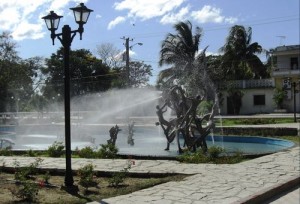
Photo: Eyanex, Panoramio. Las Tunas, Fountain of the Antilles.

Share on Facebook

Translated by: Adrian Rodriguez

July 7 2011

Time to Drink Coffee? / Luis Felipe Rojas

Photo: Luis Felipe Rojas

On this Sunday morning, I savor a good cup of coffee given to me by good friends who have offered me a safe place to stay while my wife informs me that police officials are looking for me back in San German. I will share some opinions with you all about how the history of coffee has changed in my country.

As a child I was raised by my Grandmother Maria, who would send me off to school, along with my other cousins,after a good cup of coffee and a piece of buttered bread, cheese, or some sort of meat that may have been left over from the previous night.

Now, the Cuban government has once again promoted coffee mixed with “substitutes” as the only way of drinking the dark liquid which is so popular amongst Cuban families. During these days I can’t help but remember the beginnings of the 1980’s when coffee was sold in grains in Cuba. Every fifteen days a truck would distribute some rationed ounces of this coffee which people would take home, toast it, and grind it. But that is history, a past which will not return for now to the island.

Drinking pure coffee over here these days is just as dangerous as killing a cow to eat its meat. Traveling from one town to another with grains of coffee in your backpack constitutes taking part in “illegal business”. If an inspector or a police officer catches you, the fine for “illegality” given to you can never be absolved. I know people who get headaches if they don’t at least drink one small cup of coffee per day. I have even met people who toast plantains as a substitute for coffee.

For those who didn’t know, in Holguin there was a coffee toaster in the center of the city, near the provincial Pediatric Hospital. The smoke which would spread throughout the surroundings was overwhelming, it was a toxic and bothersome residue whenever the white beans were being toasted, which happened often.

As far as I have understood, the International Coffee Organization recently stated that coffee which has been mixed more than 5% should not be considered coffee. This is pretty alarming for us if we take into consideration the little chart which is stamped on the envelope of rationed coffee which says that is has been mixed 50%.

On Cuban television, as well as in provincial newspapers, the same defenders of the same misdemeanors as always have come out. In the “Ahora” newspaper of Holguin someone explained how to prepare coffee in the coffee machine, as if it was the same thing as trying to figure out how to set up a computer or how to move around in a space shuttle. The article made allusions to a few weeks ago when various of these coffee packs exploded. An official from a provincial company in Havana even went on to say that before such a measure was taken, the coffee has been mixed even more than 50%, forgetting to cite that this information was never announced to the people.

According to the misinformation services, just as much as the TV or the written media, we Cubans should agree on each measure taken without protesting. And, a very interesting fact according these same services- each action that is taken is in favor of the people.

We mustn’t be surprised if tomorrow they announce that rice will be sold mixed with some other sort of substitute.

Translated by Raul G.

10 July 2011

Social Criticism Widespread in Cuban Films / Dimas Castellanos

The 32nd Festival of New Latin American Cinema, which ended in Havana last December 2, showed that the seventh art is on the upswing in Latin America and that Cuba is no exception.

Among the over 500 participants, the Cuban films–independently of their themes, of their directors’ degree of success, and of the quality of the actors and scripts–for the first time all critically reflected the social reality of the country. This is proof that culture, even if it is subjected to being a prisoner of ideology, as is our case, by its nature and functions transcends even such a negative imposition. A short review, limited to the four fiction-category feature films that participated in the competition, is evidence of this.

Casa Vieja (Old House), by Lester Hamlet, based on the theatrical work of the same name by Abelardo Estorino, uses the narrative of an individual case, the return to the heart of the family of a Cuban after 14 years of living abroad, to reveal the negative effect the Cuban political system has had on the economic and moral penury in which society finds itself trapped.

According to its director, “it is a film that speaks about who we are and how I see Cubans’ life from the point of view of the affective compact”. With that vision, with heavy emotional weight, he delves into one of Cuba’s many current problems. The film, which had received the Grand Prize for the Best Feature Film Fiction Book at the VIII Pobre Humberto Solás International Film Festival, this time won the popularity prize, the Cybervote Prize of the Latin American and Caribbean Film and Audiovisual Portal of the New Latin American Film Foundation and the Jury Mention for Fiction.

Larga Distance (Long Distance), by Esteban Insausti, gives us the story of four friends who, because of the deep crisis produced by the disappearance of real socialism in Eastern Europe, could not keep their oath to never leave each other. Ana, one of the four, on reaching the age of 35 and no longer having friends to celebrate her birthday with, throws an imaginary party, evoking memories of old friends.

From a sociological point of view, it is a critique of the impact of emigration on Cubans’ lives, due to the inability of the Cuban system to provide opportunities inside the country. The life of her parents shows the persistence of problems through generations and the complete failure of the project to create a New Man in Cuba. In the end, social malfunctions resulting from the system have triumphed over resistance in return for the impoverishment and moral ruin of a considerable number of the sectors of society.

Boleto al paraíso (Ticket to Paradise), by Eduardo Chijona, was inspired by accounts of real events that happened in 1993, collected in the book Confesiones a un médico (Confessions to a Doctor) by Jorge Pérez Avila. The film tells the story of several adolescents who, as a result of their families’ material and spiritual poverty, link their destinies to run away from home in search of a non-existent paradise and end up getting infected with the AIDS virus and “enjoying” life in a sanatorium–a simultaneous pact of love and death.

Afinidades (Affinities) by Jorge Perugorría and Vladimir Cruz, with script by Cruz, goes into a facet of the administrative corruption of civil servants relating to the management of mixed (public/private) businesses, which is nothing less than the expression of the general decline of Cuban society since a salary stopped being the principal source of income; in it this sector is bureaucratic and invested with powers that allow it to enjoy privileges denied to the average Cuban, thanks to the almost absolute government institution of “property of all the people” under the control of a few. A benefit that leads to sentimental transgression and aggression against dignity, the deliberate manipulation of one’s fellow man. Although the film deals with a problem of contemporary life, in Cuba it is inseparable from the Cuban structural problem, caused primarily by contradictions inside the country.

Martí, el Ojo del canario (Martí, Eye of the Canary) from prize-winning director and scriptwriter Fernando Pérez, is a film inspired by the infancy and adolescence of the Apostle, the result of the search to answer the question, “How, in full Colonial times, was it possible for such a brilliant and high-minded figure as José Martí to have been created?” In my opinion, it is the best film of the festival, a combination of the sensibility, ethics, love and quest that define its director.

It is precisely Fernando Pérez who, with his concept of cinema as a way of seeing, interpreting and forming reality, has shown the potential for critical cinematography to promote critical thought among Cubans; a practical demonstration of intellectuals’ responsibility as aesthetes of change, critics of our deficiencies and sources of connection between our traditions and universal knowledge. The principal message, among the many this film offers, is an appeal to rescue our dignity.

The film has already won the Colón de Plata Prize for Best Director and Best Photography at the Huelva Film Festival. It just won the Coral Prize for Direction and the Artistic Direction Prise for Erick Grass and the Best Poster to Giselle Monzón. In addition the Alba Cultural Latin America First Copy Grand Prize (Ex Aequo); the Film, Radio and Television Prize of the Association of Cuban Artists and Writers; Prize of the Cuban Association of Cinematographic Press; El Megano Prize of the National Federation of Film Clubs; 2009 Caminos Prize of the Martin Luther King Memorial Center; Roque Dalton Radio Prize from Radio Habana Cuba; Cined Prize from Educational Cinematography; Vigía Prize from the Matanzas branch site; and UNICEF Prize.

Social criticism, which has been present in the history of Cuban fimmaking for several decades, has evolved from isolated appearances to becoming a general critical current, which doubtless has much to do with the critical conscience that is steadily gaining strength in our society and which is even beginning to be reflected in the most recent, but still weak, signs of changes in the circles of power.

Translated by S. Solá

(Published in www.diariodecuba.com on December 27, 2010)

January 3 2011

SMALL TALK / Orlando Luis Pardo Lazo

REFLECTIONS, WAVES, INTERFACES

Orlando Luis Pardo Lazo

Like at the border, in vintage films. The guard asks us for our documents as is routine and we follow the rules, but something doesn’t work. Everything confuses us, even the language. And we know it in advance. Instinct or intuition. We drown at the last minute. We leave the game. We drag the bottom. Inflexible, inexorably.

Friday mornings are like that. The damp humidity of the wood of the old house riddles our bones. It seems we are floating, but in reality it’s asphyxiating. The lump of water in the throat. The stabbing pain in the lungs. We are water. We are drowning. Even here.

Everyone, sooner or later, if we pay attention, we come to that soft limit, of velvety insomnia. That pearl of glazed madness that settles in the base of our brain shifting our center of gravity, making the mind more dense than our own body, submerging the fragile line of flotation between sanity and insanity. It happened to me. Not now. Many marvelous dawns ago, of damp Fridays like today.

To you too, I know. Floods surround you. But don’t lose heart. Kick, what a pedestrian word. Gasp. Play the float, like in movies of drownings, until the rope consumes you. Consumes you. Then we will see. Then we will live. Then we will placentally (from placenta) survive death in the dense limbo of the sea of oblivion. You don’t understand me. I don’t either.

Boneless octopi, anemic anemones. Dream dreams of water and the smell of water. It’s rain. Sweet water of nonexistent rivers in Havana. Cold water of strangers who touch through a liquid wall. Dream desires also of water. Everything oozes, flows at a voracity we never gave credence would happen to us in the flesh.

Enough. The night advances more agile than its images. If the sun rises now, I die. I don’t know if I miss you or the underwater world that never emerged in us. Floating is so ephemeral, such a fallacious film. I swallow in dreams. I choke, what an atrocious word. The water definitely knows you. Smells you. Hurts like you, the impossible you. Of the unrepeatable cosmogonic visions from childhood. Which swept me. I’m sorry. I never managed to be mad.

July 9 2011

Liberated Women / Rebeca Monzo

Young woman selling peanuts.

Circulating in the media these days is a United Nations report on Latin American women. In it concerns are expressed about domestic violence, equality with regards to work opportunities, and the liberation of the gender.

To my way of thinking, little has been achieved in this regard in my country since the forties, when Cuban women had an active and important participation in our society: philosophers, teachers, doctors in teaching, medical and writers marked the forefront of a gender that increasingly occupied a more prominent place in society of those times.

In real life, the Cuban woman today, is far from having been liberated: all the intentions have not come to pass, they are, as we would say, a dead letter. On the contrary, women’s obligations and difficulties have increased. A strong economy is one of the principle pillars on which true liberation rests.

The lack of paying jobs along, where people can live decently, without having to undertake extracurricular tasks to augment a bit their squalid salaries, the lack of conditions in the home and in the social sphere that ease domestic chores (which currently waste a great deal of time), plus all the difficulties of travel, buying food and other necessities, means that the Cuban woman carries on her shoulders almost the entire weight of the home: she is in charge of making the family meals, taking and picking up the children from their schools or daycare, overseeing their homework, caring for elderly relatives living with the family, caring for her husband, in-laws and other relatives.

She does not have time to look after herself, her health, she has to depend on the ration book to obtain monthly feminine supplies, and she faces menopause lacking vitamins, creams and medications to help her through this difficult stage.

The best jobs continue to be the almost exclusive patrimony of men. This, not to mention that in our country precisely because of the above, the vast majority of marriages fail, which lamentably puts us in the top position with regards to statistics of divorce. The majority of our women are divorced or separated, facing all the work of the home alone. These frustrations and accumulated stresses carry within them a contained violence, that for any casual reason can serve as a detonator for domestic violence, where one can be the victim or victimizer.

We can’t speak of women’s liberation until society is structured and run in such a way that the conditions actually exist to be able to count on the necessary facilities needed to meet obligations outside of work, without it causing a deterioration in the personal or in the family.

July 9 2011

Choking it Down / Rosa María Rodríguez Torrado

When I say metaphorically to my friends that my mouth is dry, they think that probably I have diabetes – because of my weight gain since I quit smoking – or a thirst to drink the vital liquid. They don’t understand that fifty-two years of the same party (the only one legally approved) ruling Cuba is a huge amount of time. “Maybe the ones who will come after will be worst”, they tell me, resigned, and convinced that a small group of people has dominion over our country.

For a long time we’ve worked to “quench the thirst” for democratic values, national and personal freedom, the respect for all the civil and political rights and democratization in general, but we are stuck because of the lack of such attributes in the power elite and the lack of a democratic culture among Cubans. However, we had been and continue to advocate for these values of benefit to our motherland and nation. So far, I will have to continue “choking it down,” while we fill the glass with that fundamental matter for Cuba’s democratic health.

Translated by: Adrian Rodriguez

July 8 2011

Choking it Down

When I say metaphorically to my friends that my mouth is dry, they think that probably I have diabetes – because of my weight gain since I quit smoking – or a thirst to drink the vital liquid. They don’t understand that fifty-two years of the same party (the only one legally approved) ruling Cuba is a huge amount of time. “Maybe the ones who will come after will be worst”, they tell me, resigned, and convinced that a small group of people has dominion over our country.

For a long time we’ve worked to “quench the thirst” for democratic values, national and personal freedom, the respect for all the civil and political rights and democratization in general, but we are stuck because of the lack of such attributes in the power elite and the lack of a democratic culture among Cubans. However, we had been and continue to advocate for these values of benefit to our motherland and nation. So far, I will have to continue “choking it down,” while we fill the glass with that fundamental matter for Cuba’s democratic health.

 Translated by: Adrian Rodriguez

July 8 2011

The Anti-Bread / Rosa María Rodríguez Torrado

It should be done with wheat flour, but is often reinvented with sweet potato starch, is supposed to have grease, but it’s missing in the recipe, and salt, but because it causes the modified dough to collapse nobody uses it: the result is the anti-bread — one a day — which is the quota assigned to Cubans by the imposed rationing card.

With its ugly appearance of a Middle Ages crust of bread, in “the middle” of the stench and unhealthiness, the bread is one of the areas where the government timeservers show their contempt towards the people. It is the pandemonium of the underestimation and disrespect of cuban society. If you try to eat it the day after, most probably you will have two obnoxious experiences. The first one is that for sure you will have to pinch your nose or hold your breath to ignore its acrid smell, and second, you may chip a tooth in the process. The acridity is because it is made with bad quality yeast and because it has too much water added to ensure the proper weight just in case an inspector “shows up”, he won’t be able to verify the ingredients adulteration — in which case ‘the dough’ to silence him would rise; the hardness, because the lack of grease in it. In addition you have to bring your own bag to buy your bread, the employee snatches the pen from behind his ear to write in your rationing card the one and only bun that you are entitled to buy for that day. He takes your money, shakes hands with all the people who greets him, swipes the sweat from his forehead and then, he serves your bread using his bare hands (without using tongs or gloves) and without washing them.

A few years ago the State made an important investment in modern bakery technologies acquired overseas. In that chain of bakeries the bread is more expensive — ten Cuban pesos a pound — and in the beginnings the quality was noticeably better; but now days it is almost as bad as that for sale in the bodegas but the price didn’t drop as the quality did.

On many occasions and because of consumer complaints, the TV news did on-site interviews with the managers of such bakeries, they had been questioned about the production failures and urged to make public statements promising the solution to these and other problems. But the media news involvement has not been effective and the result is the same: the anti-bread.

The core of the problem is systemic and happens because the lack of control, the low salaries and the dearth of civic awareness provoked by the “grab whatever you can” way of life brought by the deceptive concept of the social property, because it is very well known that the Cubans are not allowed to own any kind of real estate. The local small leadership is struggling to survive when there’s no choice: either survive taking the “bread” home to sustain their families, joining the generalized corruption and unlawful activities, or live a poorish life in the legality of a virtual Cuba outlined by the only party and its unsuccessful government model.

Those who like to invent trash, or to reform what is already invented and works well, have to be reminded of that old Cuban saying: “It’s better to copy from something good than to create something bad”. We, the Cubans of the generations after 1959, could never be accused of being copycats.

Translated by: Adrian Rodriguez

July 8 2011