REV IN PEACE… / Orlando Luis Pardo Lazo

FOR WHOM THE IBERIA TOLLS…?

Orlando Luis Pardo Lazo

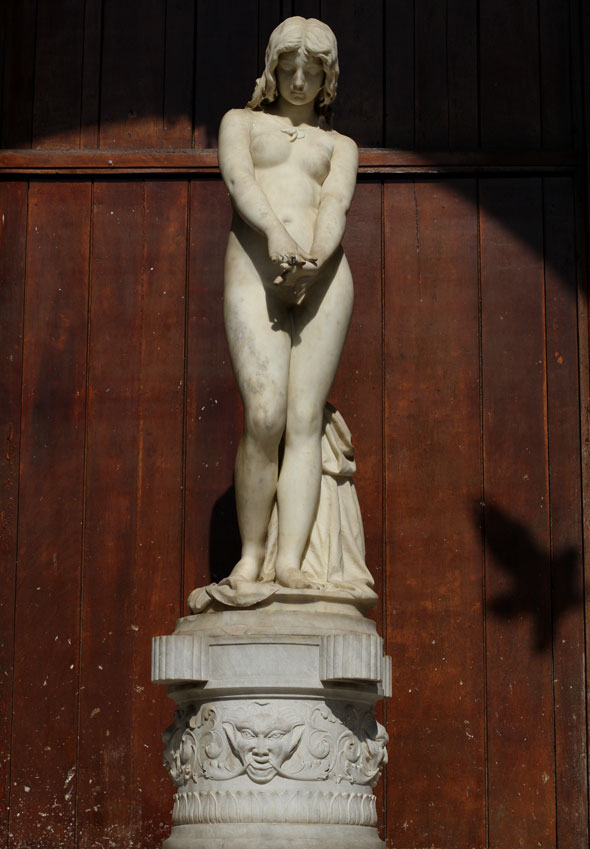
History repeats itself. Once as comedy and another time as a black hole, abyss of pre-capitalist post-modernity that is inhabited in Cuba. Its name isn’t even known. Barely Adonis, a word that maybe even he ignored in his ancestral echoes of splendid or ruinous marble.

His body doesn’t count either. His history even less. The pain in the Island has been for a long time diluted among masks and make up, plastic arts of the very political death of this country. From an imaginary death, to a gradual dropper and without social blame. From a weightless death, at a height of ten thousand feet and then as a fetish of the free European press. Corpse in a flying object identified with an Iberia logotype, news or necro cloud that will never rain over Cuba. Statistics apart from the State, that looks the other way and applauds in peace. Biographies without orthography that Cuba will not cry over. To the contrary. At times it ignores them and at times it pokes fun at them. Our humanity as a planetary race ended at some point of the last century and millennium, in the splinters of some corner with no name of that thing cynics call “Cubanity”.

Adonis suffered in accelerated time the torment of Cubans throughout the time and strait of decades. His hunger strike was also an oxygen strike, cryotorture, compressing a minimum of liberty, extreme socialypsism, grotesque wink at Google Earth, scandal suppressed by the local security organs. My name is not as divine as his, but the absurdity surrounding Adonis moved me. His illusion against the law of probability. His terrible performance. His days cut short of the world. His being nobody, because now, suddenly, even his family, if he has one and they already know, left him lying in a capitalist morgue of Spain (ipso facto citizenship by rigor mortis).

What to think. What to utter. Please, a minute of blogger silence for the dead who still have to die. Silent holocaust. Criminal captions. Deafening noise. Jonah of the New Man in the competitive belly of Iberia. Cubansummatum est…!

Translated by: Claudia D.

July 15 2011

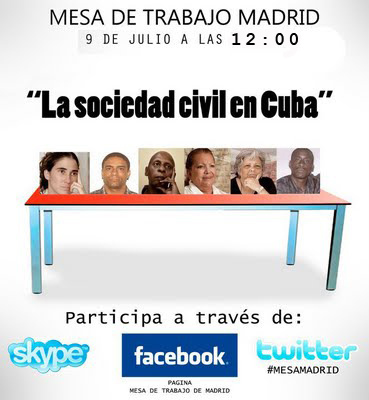
Work Table of Madrid Now…! / Orlando Luis Pardo Lazo

Work Table of Madrid now….!,originally uploaded by orlandoluispardolazo.

Saturday July 9th, the second Work Table will be celebrated in Madrid.

On the topic The Emerging Civil Society, we will have a participatory debate with Miguel Angel Garcia, president of the ONGD CENINFEC (Center of Information and Documentation of Cuban Studies), which will contribute interesting facts about the topic. Participate along with us and give us your opinion.

Translated by: Claudia D.

July 9 2011

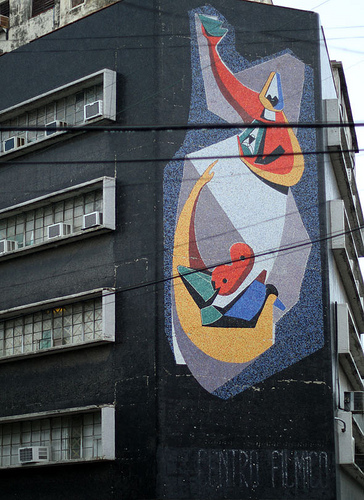
Where is this Havana Wonder…? / Orlando Luis Pardo Lazo

Where is this Havana Wonder…?, originally uploaded by orlandoluispardolazo.

POST REVOLUTION MONDAYS asks in what part of our Havana who art in mud we can find, still today, this wonder of an image. Who made it? When? Why?

If you answer me in a comment, there’s a prize. I will give you my blog! I will send you a printed photo from BORING HOME UTOPICS, any one you choose. I’ll dedicate a post to you! Whatever you want…

Don’t leave me in apparent ignorance.

Write me a comment here about this architectural jewel, please…!

NOW.

Translated by: CDA

July 7 2011

“Heavyweight” Words / Fernando Dámaso

Painting: R. Fabelo

Autocrats throughout history have always liked to use, in trying to express their ideas, big words, lofty, bulky, heavyweight. So common ones have been: irreversible, unchangeable, untouchable, forever, eternal, unshakable, indestructible, solid, impenetrable, unyielding, and so on. They don’t look for them in dictionaries, but they fall like rain, part of their vision of society. So they use them without any sense of proportion and sometimes to the point of ridicule.

In times not so long ago, the Hitler’s Third Reich claimed a life of a thousand years and socialism, not to be outdone, declared itself irreversible, saying it would liquidate capitalism and establish communism forever. One as much an outrage as the other, the mentioned words were the common denominator of propaganda campaigns, slogans and even the core interventions of its leaders and followers, each one trying to be stronger, to leave no doubts about the only possible reality, backed by the illustrious history and intelligence of its thinkers.

As words, unless accompanied by events that validate them, do no work, but the larger, bulkier and heavier they are, the framework collapses under them and they shatter, denying what for years they have tried to implant with a chisel in the minds of citizens, into order to disarm them with hopes of change.

Today, reality is otherwise. To try to use them again demonstrates, first, an absolute lack of originality and, what’s more, does not take into account that technological development has arrived, in one way or another, to the majority of humans, and that information, a direct result of the same, is impossible to lock up in tight ideologies, despite all the efforts and resources to devote to it. An informed citizen is very difficult to manipulate and deceive.

It would be healthier for those who cling to these obsolete formulas to try to keep their flock docile, to put their feet on the ground and captured its vibrations, which are manifested today in almost everyone. To hear and feel them is wise; to be deaf is not intelligent.

July 16 2011

Testimony: The Failed Attempts to Make Me an Agent – III / Angel Santiesteban

Photo: Reuters

It terrified me to know that I could return to the cells for another sixty days, or maybe more. But it caused me more terror to imagine myself “cooperating” with those I didn’t believe, with those who I considered were abusing my country, to know myself complicit disgusts me. I also knew that to be a writer in the system in which I had to leave, to be recognized and have the right to publish, I had to infallibly offer an image of support to the Government or, at least, to pass unnoticed, a “fellow traveler,” apolitical or anarchist. But my literature critical of the system betrayed me in every publication.

A few days from having returned from sixty days imprisonment, I received a visit at home from a man who identified himself as a State Security “agent.” He could see on my face that he wasn’t welcome. He said he would take only a few minutes, because a senior officer was waiting to talk to me.

Outside was a Lada car that took me to an apartment in the Vibora neighborhood. After greeting the owners they told me to continue to the last room. I waited for a uniformed colonel. He asked me several questions that I answered mostly in monosyllables. It was evident that I didn’t like him or that I took those minutes as a waste of time. They gave me pencil and paper and asked me to write a report in the third person. When he understood my hesitation he told me to write about anything because that was why I was a writer. I don’t even remember what nonsense I wrote.

We didn’t even say goodbye, he just nodded and withdrew his presence. I returned home worried, the Colonel’s face said something I couldn’t decipher. What I was sure of was that it would be fatal for me.

Days later, the same official came to house, stopped me in the street, and asked me to accompany him to see if I recognized some guys who were motorcyclists like me and were, perhaps, those who had thrown the Molotov-cocktail. They took me to a tenement and asked me to enter the last room. I refused, saying that I wasn’t a cop and had no vocation to be one. We exchanged various insults and at this point several people came out whom the official insisted I identify. I said I didn’t know them. Two days later they knocked on my door, when I opened it there was a man pointing a gun at me. The gun was within reach of my hand and I felt defenseless.

The sound seemed alien, just the shock of the black, then the smell of gunpowder. I thought I was unharmed but then I felt something sticky running down my leg. I looked and raised my arm and I could see the hold. The bullet penetrated the muscles of my arm, passed through it and went through my ribs to my chest. A patrol car “happened” to be nearby and took me to the nearest hospital.

Two days later, the official, Germán, appeared and relocated me to the Hermonos Amejeiras Hospital and put me in a room with a security camera. The doctors decided to leave the bullet inside me because removing it would have required breaking the sternum and caused major trauma.
When I left I went to recover at the house of a friend, who told me that the same Germán had suggested to him to get me out of his house, and he had responded that friends don’t abandon each other.

That was the direct farewell of their attempt to make me into an Agent of State Security. Against their will I was winning literary prizes, especially those they didn’t reach in time to block the vote, as in 1992 when they threatened the writer Abilio Estevez. Since then I have been a thorn in their side that has denied them the pleasure of eating souls.

When the international jury of the Casa de las Americas Prize in 2006, decided to award it to me for my book “Blessed Are Those Who Mourn,” they were annoyed. One of them approached me at the La Cabaña Book Fair and told me the award had made me into a sacred cow. That from that moment I was more dangerous.

I think he was right. Anyway, I reminded him that the system was executing even its sacred Generals, so how much could one “cow” more or less matter.

25 July 2011

Years with a “Tagline” / Fernando Dámaso

The French Revolution, among its many changes, tried renaming the months and, during its short existence, appeared Rainy, Floral, Windy, Thermidor etc. Luckily for the French, after a whirlwind of severed heads came the calm, and months returned to their traditional names.

The Cuban Revolution could not be left behind and although it didn’t dare with the months, it attached labels to the years, adding a tagline. So 1959 was “The Year of the Liberation” and then followed that of Agriculture, Literacy, Industrialization, Planning and so on. It was a historic accommodation, just like the execution wall replaced the guillotine.

Each new year of the revolutionary calendar has received its tagline, some of them very far-fetched, like that for this year: The Anniversaries of the Decisive Battles of the Revolution. This adding taglines, though it has been a free burden for everyone, has particularly harmed typists and computer operators, who have been forced to load them on to all of their writings after the year’s number.

The interesting thing is, with rare exceptions, the taglines never come to pass, since their objective was centered on the efforts to solve the problem demarcated by their name, during the year in question. We continue, after more than fifty years of taglines, without agriculture, without industrialization, without productivity, without efficiency, without austerity, and so on.

Perhaps, because of that, in the updating of the model that is being carried out, the years can now simply get a consecutive tagline: Year 52 of the Revolution, Year 53 of the Revolution, etc. At least it doesn’t promise anything and, what’s more, needs no explanation for the failure of its objectives. It is more pragmatic.

Perhaps because of that, in the updated model that is being carried out now only have one postscript years consecutively: 52 years of the Revolution, 53 years of the Revolution, and so on. At least not undertake and also do not need explanations of the failure of its objectives. It is more pragmatic.

July 23 2011

In Its Rightful Place / Fernando Dámaso

The word “opponent,” according to dictionaries, means: He is who opposed to another, who is in disagreement, the dissenting. It’s simply one word like any other in general use. In Cuba, during the Republic it was an accepted and respected word: the government of the day had opponents and these, when they constituted the government, also had opponents in their turn. It was a healthy practice: forcing the leaders to submit themselves to a continual valuation of their acts and to be held accountable for them.

Grau, Prío and Batista had opponents: the majority of historical leaders were opponents of these presidents and their governments. There were stages when the opponents employed peaceful methods, and others in which they used violent methods. Within the opposition there were differences, as is natural in any human group. To be in opposition was not a stigma, but rather simply that one did not conform, was not in agreement with what was happening and proposed other solutions. Opponents, in their respective times, also included Villena, Mella, Torriente Brau, Guiteras, Roa, Chibás, Marinello, José Antonio, Frank País and many others. The list would be endless.

On the establishment of a new regime, the opponents were declared persona non grata and, the same word, excised from the national political lexicon. It was established that the people and the government were the same and, therefore, anyone not in agreement with the government was not with the people. In its place classifying nous and adjectives were introduced, including the current “dissident.” This responded to a logic of power: the opponents, who almost always start as a minority, at a determined moment become the majority, and finally, the government. This, which was and is normal in any democratic country, couldn’t happen here. The dissident, however, being a black sheep, someone who leaves the fold, will always be in the minority without access to power. In general one speaks of the government and opposition, and almost never of the government and dissidence, as different options.

For a government to BE GOOD and, what’s more, efficient and just, a GOOD OPPOSITION is necessary. It’s not healthy for a government to look only in its own mirror, as this is not a counterpart of anything or anyone. When this happens, it is what happens with us: we walk on the edge of the abyss and, in many cases, we find ourselves at the bottom of it.

A serious and responsible opposition, active, open to public opinion (we once again put the word in its proper place), will always be positive for a nation and for all its citizens, whatever they think and whatever policies they defend. Without confrontation there is no development. It is a law of dialectics that has been conveniently forgotten for many years. Dialog is not only an exchange of opinions, it is also confrontation, listening and discussing respectfully, in order to find better solutions to different problems. Our reality has demanded this for a long time.

June 13 2011

Your Nostalgia / Ernesto Morales Licea

You discover it by chance. Looking, without much encouragement, through some photos, let’s say: images of a past that you know will never return. (It is one of the hallmarks of the past: it never returns.) You look at the photos with pleasure, sometimes strangely, because in the past your hair was longer, or you had a mustache, or you weighed some thirty pounds less than you do today; you look at a piece of time frozen in the scene, innocent of the next turn of the page, of the next image that will appear before you, everything will change.

And suddenly you discover: the sting of nostalgia.

It’s not an aggressive impact. It almost never is. Nostalgia is a like a whisper, not a strident discomfort. It is activated in some unthinkable way: in the photos you were looking at familiar faces no longer living, places you will return to, pieces of your personal history, and all was well. But suddenly an object, laughter stopped in time, a pose in front of the camera, the dog you had at home, the color of some wall; suddenly a click triggered an unpredictable mechanism, and everything broke with the noise of a crack or a scar. So with nothing more. The affective memory, they say. Like madeleines for Proust’s character. Memories that are not remembered: that are felt. They do not pass through the brain, they pass, perhaps, through the heart.

Nostalgia has been a powerful ally of all tyrants of all times: the worst punishment, more ferocious even than death, has always been exile. When the satraps wanted to crush the souls of their enemies, they do not execute them: they exile them. They knew that in the distance a hangman called nostalgia would not rest: a kind of slow death, calmly, a death that kills unnoticed. The philosopher Attalus, Miguel de Unamuno, Felix Varela, Alexander Solzhenitsyn, José María Heredia, Demosthenes, Ciro Alegría, José Martí, they knew it well.

In his demonic mind, Stalin know that before mowing down Trotsky’s life he would increase the pain: expel him, to wander through the wide and foreign world, before putting an end to him. Nostalgia exploded in the pained heart of Guillermo Cabrera Infante, and made him a withdrawn Londoner he never recognized in the mirror.

Nostalgia is for many worse than death. The longing for yours and for what belongs to you, for that social and individual consciousness that shaped you as your years passed, that tacit and boiling pain is, for some, an impossible weight. It is not in vain that the death penalty exists in the state of law, but not in exile.

Would it be worth it to rebuild the past in the present you live, as an antidote to nostalgia? Let’s say: as everything is a question of money, let’s put money in this game of dreams. You win the lottery. Someone calls you on the phone, tells you that from now on you will have a 100 million dollars. And you apply it… let’s see… you set aside half to recreate your past. You cold not build the house where you were born with its odor and its dead neighbors, with its narrow streets and its dogs and noises; nor could you drag with you the environment of its history. But you could surround yourself with those you desire. In reality affective memory feels privileged for the living, for people, not for wood or concrete.

With your 50 million you can bring with you, to the new site-country-reality where you live, almost everything that really interests you: your family, the friends you most think of, the girlfriends you had, even with their new boyfriends if it pleases you. You can give them houses and food, close, very close to you. And then you discover that if the effort was to reconstruct your happiness, you’ve miserably wasted half your fortune. You discover that everything has changed, your friends aren’t the same, that the symbolism was left behind, that your life, your day-to-day, the routines you missed and that you now detest, existed while you existed in the past. And that time knows no mercy, and everything is buried in the dust forever.

No one knows, no one suspects it, but nostalgia obscures the years of our lives. You hide the present where you should be living among a tangle of memories and sadness. You convert yourself into a specter you never thought yourself to be. The specter that closes its eyes, reproduces your neighborhood, your children, your stinking streets, between dreaming and dozing, and stores memories, manages them, to live by and for them. And some will henceforth be specters without peace: dying destroyed by nostalgia, by longing, for parents they didn’t see die and could not bury, for the cruel destiny of beginning a new life at the midpoint of their existence.

I think of this on this day I turn 27. Not bad. I like my 27. I like the investment I’ve made with my 27. But I think of this today because my mother can’t give me a sublime kiss, and will spend a day in agony, tormented by my distance. I think of this because my friends, who think of me and owe me the iron love of someone who knew how to earn it, they will miss my sarcastic face before their effusive congratulations (I’m not too much of a cultivator of dates and traditions: for some my unpardonable defect). I think of this, above all, because I am not resigned to accepting in silence the shitty laughter of those who employ the nostalgia of Cubans as their most effective weapon, most coercive, most deceitful.

In that Universal History of Infamy, written by a semi-blind Argentine genius, must be included the testimony of ours, of mine. The testimony now mine. The sordid history of an entire people lacerated by the nostalgia of those who stayed and those who are gone, which is basically nostalgia for their own identity split in two. The story of how hundreds, thousands, millions of beings were condemned to eternal nostalgia in the name of a hellish ideology.

Your tragedy is worse than you imagine, though you turn your face and refuse to look at it. Though you submerge yourself in the morning paper, and in the recently cut grass, in your remade life. You do not miss anyone from your past. Your nostalgia is really a nostalgia for yourself, and against that, what can you do?

July 25 2011

GET ON IT, DAMN IT…! / Orlando Luis Pardo Lazo

TO MORE BLOCKADE, MORE SOCIALISM

Orlando Luis Pardo Lazo

Let yumas [Americans] do and undo in Yuma [America] as they democratically please. It would be too much already if from Cuba, we Cubans pretended to dictate norms in American politics. It is their Congress, their Committee, their Foreign Affairs, their House of Representatives or of Repression, their Obama, their Cuban-American exile. Their baggage.

If the heavy, or pedantic tanks wish to go back to April of 1961, or to October of 1962, let them go back. It is their sovereign right to legislate or counter legislate. Their paycheck. Cuba is only one more section, not the center of the world to them. Almost a curiosity. Fire to the pot until the bottom burns. Better that way.

Never was Cuban society more real-socialist than when the Island’s isolation was absolute (and not only on the part of the US, but also of half of Latin America). Since 1898, without yumas this was a land of barbarity. No worst beating than that of your own.

In the seventies, when a tourist was a rara avis, almost always a G2 spy, there wasn’t any oxygen for anyone and the nation simply went the way of North Korea. Come Mao or high water. Wars in all of Africa. Guerillas in all of our hemisphere. Thousands of prisoners, then thousands and thousands of emigrants. Ah, we were so free. Our hands were so free to dictate within all of our Archipelago CUBAG. The imperialist eagle was only a still shot of what awaited us outside of Cuba, according to ICAIC news by Santiago Alvarez. Never did people think so little and so badly within Cuba as they did then. Literature died. Television aroused disgust. There were no minorities (nor queers). The iron curtain fell, and when it seemed that Carter and Billy Joel were going to raise it a bit, Fidel Castro moved heaven and earth to make sure a decade more of Republican conserva-tatorship followed in the White House.

It is my opinion that, due to a lack of imagination and an excess of politicalogic technicalities, history must repeat itself now. Why rehearse an innovation? Why play XXI century? Who said the future is around the corner? Who thought of not following the retrovolucionary beat of the government in Havana? No improvisations. More of the same. Pressure will make the grandfathers of utopia fall. This time it will work. I promise.

Fewer yumas in Cuba (State Security expels them for that reason and not for ideological ones), fewer tourists, less pleasure of finding each other face to face, fewer digital gadgets, fewer orgasms in English (oh my oh my), less white skin pink cheek, fewer college magazines, less chewing gum, fewer interviews, fewer invitation letters, fewer visas, less Interests in the Section, fewer green cards at the excess of white cards, anyway…Fewer years two thousand, more of last century and millennium. Less capital, more socialipsism. Put just a little more pressure on the mixed arabesque guy, darn it, and you’ll see how by the end of the year half of Cuba will await him with a part-time job in a Hialeah factory.

Idiots. I’m sorry.

They are little foreign Fidels.

Does it take so much to admit that the Revolution was nothing, and that, however, that nothing won? Why should we have to pay with hunger and sickness? Why don’t thousands and thousands throw themselves in another Freedom Fleet and you’ll see how we give each other a great hug of transition, millions and millions in the very wall of malecón. Why should we continue with another beat of cutting here and dialogue there? It is a reduction to absurdity, but absurdity is our daily bread as a nation here and there: Couldn’t we pretend for a year that Cuba is the most democratic nation in the planet, and treat it as such, maybe in a year it really will be?

Oh, please. Let’s admit it. What we want is to kill and to have us killed. There are no luddites. There is no delirium. When our democracy gets here it will be emaciated. Anti-American. The only things this country does not tolerate right at this moment are thinkers as terrible and dumb as Orlando Luis (I already said it myself to save them the commentary).

Yesterday’s dead are a permanent fatum in favor of the Revolution: executions occurred at first not to take power violently, but rather to never let go of it without the same quantity of senseless blood.

Work hard. You’re winning. The massacre will be more than a media one. Its first victim guarantees it.

Translated by: Claudia D.

July 22 2011

Gilipolladas* of Etiquette / Rosa María Rodríguez Torrado

The realities imposed on us during the time of the “Special Period”*[2] and the foreign investments, brought with them new forms of expression that involved part of the Cuban society. Those nationals linked to the tourism, to the diplomatic community and those working with foreigners and their currency or the exchange market, integrated into their language words such as “sir, madam, or miss” to address someone — As if the “comrades”*[3] of so many years, men or women, had emigrated — and other Anglicisms such as “llámame para atrás” (call me back) or verbal crutches such as “tú sabes” (you know); and the spanish ones, “¿vale?” to agree or assent to something, the “gilipollas” (idiot) in substitution of the ultra-Cuban “comemierda“*[4] (shiteater). I didn’t find an etymological dictionary to check whether or not the origin of this word is Cuban, but it is an image that reflects how much identified we are in our slang with such vulgarism. Also, due to the presence of Spanish businessmen and tourists in recent years, and our interaction with them, we acquired additional words of erotic content, that I prefer to avoid here.

The foreigners, who travel to Cuba as tourists, are seeking for “chicas“*[5] and “chicos” *[5]; not muchachas*[5] or muchachos*[5], young people, women and men to get involved with. People around the world have their own jargons and language traits and their customs which define them as a nation, even if we share the same language. The inclusion of foreign expressions and practices in a sector of our society is not a local phenomenon that has political overtones, as two friends argued recently, they are due to globalization, which is connecting us worldwide in various spheres of life; the internet, which allows us to interact in real time with many places of the world and to the opening to foreign tourism in our country after nearly three decades of staying stuck in snow crystals incubators “for better handling,” as the wolf of Little Red Riding Hood would say.

Therefore, it doesn’t worry me too much that our language is nuanced with foreign words. I can listen a youth calling another “brother”, assenting with a “that’s ok”, or leaving with a “see you…”, that does not wake me up from my dreams; what really concerns me is the frantic emigration with which we Cubans have been naturalized as world citizens. That’s more important and significant that the locutions of our vernacular spanish. Let’s leave those misgivings to more conservative specialists.

I disapprove of false behavior, such as those who, in their environment, uncork their repressions and unleash their own churlishness in their element and in others, laminate in plastic their attitudes and with this label places, as if they ignore that we should behave in an educated way, regardless of where we are.

That’s how we, a large portion of the Cubans living in our country, are going these days: the Penelopes weave their dreams — with imported yarn — while waiting for the democracy ship; the believers in religions of African origin don’t offer drums to their African pantheon ‘orishas’*[6], now they revere them using violins*[7] more often than before; and the majority still waits in frustration because “a malicious man” seized our rights and our freedom. With the permanent production chain of poverty that most Cubans inherited, they leave us also with the sad reality of the everyday ordinary fellow citizen who, to offset the economic hardships, is adorning his language with foreign gems to experience at least how the vocabulary is “being enriched.”

*Translator’s notes:
(1)- Gilipolladas is a Spain’s bad word meaning foolishness , idiocies, therefore a gilipollas is an idiot , a fool and can be use as an asshole etc…
(2)-The special period was the name given by the Cuban government to the economic situation after the fall of the USSR and the eastern Europe socialist governments.
(3)- Comrade was the usual way to address another person in Cuba since 1959.
(4)- Comemierda is a Cuba’s bad word for fool, idiot, asshole, etc.. although literally means shit eater.
(5)- chicos, chicas, muchachos and muchachas all have the same meaning: young men and women, but in Cuba muchachas and muchachos are used.
(6) An Orisha is a spirit or deity that reflects one of the manifestations of Olodumare (God) in the Yoruba spiritual or religious system.
(7) violins are played to revere Oshun, who has been syncretized with Our Lady of Charity , Cuba’s patroness.

Translated by: Adrian Rodriguez

July 20 2011