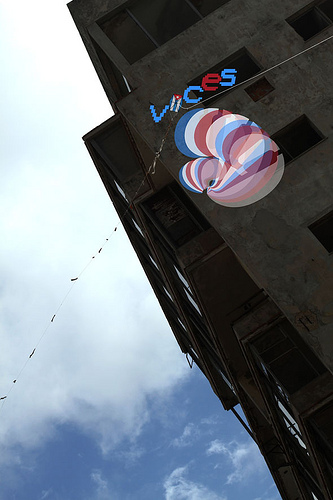
VOICES 9 FOR FRIDAY 29TH…!!! / Orlando Luis Pardo Lazo

VOCES 9 PA´L VIERNES 29…!!!, originally uploaded by orlandoluispardolazo.

VOICES, THE FREE-LANCE MAGAZINE REACHES ITS 1ST YEAR ANNIVERSARY…!!!

vocescuba.files.wordpress.com/2011/04/voces8.pdf

vocescuba.files.wordpress.com/2011/04/voces71.pdf

vocescuba.files.wordpress.com/2011/04/voces6-pdf1.pdf

vocescuba.files.wordpress.com/2011/02/voces5-pdf.pdf

vocescuba.files.wordpress.com/2011/02/voces4.pdf

vocescuba.files.wordpress.com/2010/11/voces3.pdf

vocescuba.files.wordpress.com/2010/11/voces2.pdf

vocescuba.files.wordpress.com/2010/11/voces1.pdf

Translated by Claudia D.

July 23 2011

Gilipolladas* of Etiquette

The realities imposed on us during the time of the “Special Period”*[2] and the foreign investments, brought with them new forms of expression that involved part of the Cuban society. Those nationals linked to the tourism, to the diplomatic community and those working with foreigners and their currency or the exchange market, integrated into their language words such as “sir, madam, or miss” to address someone — As if the “comrades”*[3] of so many years, men or women, had emigrated — and other Anglicisms such as “llámame para atrás” (call me back) or verbal crutches such as “tú sabes” (you know); and the spanish ones, “¿vale?” to agree or assent to something, the “gilipollas” (idiot) in substitution of the ultra-Cuban “comemierda“*[4] (shiteater). I didn’t find an etymological dictionary to check whether or not the origin of this word is Cuban, but it is an image that reflects how much identified we are in our slang with such vulgarism. Also, due to the presence of Spanish businessmen and tourists in recent years, and our interaction with them, we acquired additional words of erotic content, that I prefer to avoid here.

The foreigners, who travel to Cuba as tourists, are seeking for “chicas“*[5] and “chicos” *[5]; not muchachas*[5] or muchachos*[5], young people, women and men to get involved with. People around the world have their own jargons and language traits and their customs which define them as a nation, even if we share the same language. The inclusion of foreign expressions and practices in a sector of our society is not a local phenomenon that has political overtones, as two friends argued recently, they are due to globalization, which is connecting us worldwide in various spheres of life; the internet, which allows us to interact in real time with many places of the world and to the opening to foreign tourism in our country after nearly three decades of staying stuck in snow crystals incubators “for better handling,” as the wolf of Little Red Riding Hood would say.

Therefore, it doesn’t worry me too much that our language is nuanced with foreign words. I can listen a youth calling another “brother”,  assenting with a “that’s ok”, or leaving with a “see you…”, that does not wake me up from my dreams; what really concerns me is the frantic emigration with which we Cubans have been naturalized as world citizens. That’s more important and significant that the locutions of our vernacular spanish. Let’s leave those misgivings to more conservative specialists.

I disapprove of false behavior, such as those who, in their environment, uncork their repressions and unleash their own churlishness in their element and in others, laminate in plastic their attitudes and with this label places, as if they ignore that we should behave in an educated way, regardless of where we are.

That’s how we, a large portion of the Cubans living in our country, are going these days: the Penelopes weave their dreams — with imported yarn — while waiting for the democracy ship; the believers in religions of African origin don’t  offer drums to their African pantheon ‘orishas’*[6], now they revere them using violins*[7] more often than before; and the majority still waits in frustration because “a malicious man” seized our rights and our freedom. With the permanent production chain of poverty that most Cubans inherited, they leave us also with the sad reality of the everyday ordinary fellow citizen who, to offset the economic hardships, is adorning his language with foreign gems to experience at least how the vocabulary is “being enriched.”

*Translator’s notes:
(1)- Gilipolladas is a Spain’s bad word  meaning foolishness , idiocies, therefore a gilipollas is an idiot , a fool and can be use as an asshole etc…
(2)-The special period was the name given by the Cuban government to the economic situation after the fall of the USSR and the eastern Europe socialist governments.
(3)- Comrade was the usual way to address another person in Cuba since 1959.
(4)- Comemierda is a Cuba’s bad word for fool, idiot, asshole, etc.. although literally means shit eater.
(5)- chicos, chicas, muchachos and muchachas all have the same meaning: young men and women, but in Cuba muchachas and muchachos are used.
(6) An Orisha is a spirit or deity that reflects one of the manifestations of Olodumare (God) in the Yoruba spiritual or religious system.
(7) violins are played to revere Oshun, who has been syncretized with Our Lady of Charity , Cuba’s patroness.

Translated by: Adrian Rodriguez

July 20 2011

A Botched Robbery / Rebeca Monzo

A friend from Spain sent me a package in the mail, on July 6th, containing medicines, two cell phones, one for myself and the other one for another person, with their corresponding chargers, three flash drives, and some office supplies.

The package arrived in less than fifteen days. When I was notified of its arrival, I went to pick it up to the Ministry of Communications facilities. At the moment that the package was handed to me, the employee noticed that outside of the box protected by a transparent plastic from the TransVal Company, was a loose cell phone battery. After we opened it up to look at its content, we saw that the two cell phones declared on the original invoice were missing. Only the batteries were left (botched robbery) whose models corresponded to the different brands, and the empty box of one of them.

The box arrived with an expected note saying: Unfortunately your shipment arrived at our services with damages to its packaging.

I immediately went to make my claim to the Technical Department of the Postal Zone Six for Services to the Population. There, they also charged me $25.00 pesos. I don’t know if that was because of my mismanagement or what.

It is assumed that the mail is inviolable, and especially when the contents have been declared to the pertinent authorities. How is it possible that accidentally all packages, including mail, even a simple magazine from a foreign university, get here damaged, and come along with the obviously expected note?

Right there, an employee, very kindly, informed me that if I wanted to, I could go to Calle 100 and Boyeros, where all the packages arrive before they are processed by the Ministry of Communications, but the problem was that they did not serve the public there. This seemed a joke to me, but the woman told me this very seriously.

I decided to write a letter, to explain this story with every detail, and send it to the Juventud Rebelde (Rebel Youth) Newspaper, which has a section called Acknowledgment of Receipt, where they use to receive and publish this type of complaint. What turns out to be ridiculous and deplorable is the botch of the robbery.

Translated by: Nina

July 23 2011

Synopsis of a Report Detailing the first Semester of 2011 in 5 Cuban Provinces / Luis Felipe Rojas

Photo by Jose W. Camejo

*This report was born here, where the accredited Cuban agencies never visit and where the orders of the General (‘the streets belonging to the revolutionaries‘) are upheld through beatings, detainments, and prison bars. With the political and economic crisis plaguing the country, the Cuban government has implemented new measures which go directly against the lives of Cubans. This situation has given rise to massive discontent against the government’s politics. However, the current context has been planned by the governmental authorities who have held a tight grip on the half a century long political model.

The solution of the militants has been the increased repression within society in order to avoid the accumulation of open criticism which would endanger the stability of the country. This is why the government has applied a heightened level of repression against independent civil society, and as consequence there are more detainments of multiple dissidents, beatings of protestors in the streets, acts of mob repudiation, threats against the relatives of dissidents, restrictions of movement for activists within the national territory, deportations, harassment of activists, and forced house arrests in order to impede public civic activities in the streets.

The outcome of this abusive system has brought the death of another dissident, this time in a public park during the month of May. His name was Juan Wilfredo Soto Garcia. This death was even mentioned through the very own words of General Raul Castro when he came out on television and authorized the repression against those who do not agree with socialism.

It is not dismissible, and we warn, with time, that there will be other possible victims of Castro’s system. The mob repudiation attacks continues as a practice of the government implemented in order to try and frighten the human rights activists and the opposition. These actions constitute a highly dangerous factor, for it endangers the lives of civilians and defenseless people, among them children, women, and the elderly.

These photos are the most recent proof. It occurred on Sunday, July 17th. Various women went to the sanctuary of El Cobre to attend mass. Upon concluding mass, the women carried out a silent march through the streets with their gladiolus in hand. Such an act scared the regime so much that beatings were indiscriminately carried out against the women. This time they were not detained and taken to a police unit because they had to be taken to the hospital first.

Photos taken by Jose W. Camejo

———–

*Translator’s note: The ‘report’ Luis Felipe mentions is the mid-annual report of human rights abuses and repression which have occurred in Cuba for 2011, and which has been published on the blog of the Eastern Democratic Alliance, “El Palenque“. In the report, one can notice the increase of violence and attacks against the Cuban people during 2011.

Translated by Raul G.

20 July 2011

With the Weight of Life / Luis Felipe Rojas

In this case, it has to do with one of the gravest problems of humanity. The art of transporting a bit of precious liquid home faces a path just as winding as the search for El Dorado. In a small provincial village like San German, the lack of water and poor diets and access to food is the greatest challenge.

I made this documentary a few years before the local aqueduct was constructed. The old men who fetched the water at that time still do so today.

People are supposed to receive water from the pipes but due to electrical deficiencies, an infinite amount of leakages, and horrible planning among the schedules of those who put the water, it seems like wagons (used to fetch the water) will never stop existing in this region.

Monguito, Rafael, Mauro and other water-carriers assured us at the time that with the new aqueduct it would all be better. Geronimo, the diligent one, confessed to me that even if his profession became extinct, he knew that it would benefit the entire town.

I was really moved by these men who gave up so much time to put up with the state inspectors, functionaries, and police officers who constantly demanded one paper or another from them to make sure that the horses they were riding were theirs, that they were paying the taxes attached to traveling, and other state regulations. Even with that said, they persisted beyond the interests of a few bucks a month.

I filmed this documentary with the same precariousness I filmed previous ones. And now it has been confirmed that the scarcity of water is also mixed with other bureaucratic inefficiencies which we all know are traits of the state functionaries.

Translated by Raul G.

14 July 2011

Cuba: Notes About Unity, Leadership One-Party System / Miriam Celaya

(Article originally published in the digital magazine Convivencia, Issue No. 21)

In just five years, Cubans have been witnessing an extremely aggravating process in the socioeconomic and political crisis, steeped in what constitutes an exceedingly complex national and international juncture. Though just a few years ago it would have been possible to alleviate the hardship and mitigate potential conflicts by the reasonable application of some economic measures, with strategies to achieve positive outcomes in the medium term, the current situation requires a much deeper intervention than the few reforms enacted from the halls of power and consecrated during the celebration — similarly late — of the Sixth Congress of the only legal party. Those reforms, in addition, fall shy and insufficient of the effects of said economy.

The Cuban structural crisis today encompasses as much of our economy — in a true bankrupt state — as society as a whole and politics, this last category including both the policies of the government — demonstrably unable to meet current demands or to propose a viable model — such as the opposition’s alternative proposals, given the lack of coordination by the latter; of comprehensive and inclusive coherent programs, able to move decisively a sufficient number of stakeholders. It is fair to say at this point that the opposition action sprung from the early 90’s of the last century had the responsibility (and credit) to break the myth of “unanimity” politics in Cuba and forced the government to admit the existence of dissident sectors. Their modest gains are not negligible in terms of totalitarianism, in an extremely hostile frame against an opponent that, even in the absence of arguments, owns all the media and repressive instruments needed to prevent the strengthening of demonstrations by the internal dissent.

The problem of unity

One of the most recurring themes about the limitations that have threatened the progress of the opposition in Cuba in the last ten years focuses on what many have called a “lack of unity”, meaning the inability of opposition parties to create common projects with sufficient convoking power to denote a political wager of any importance against the government. The government, meanwhile, points to “the absence of social roots” of the movements and opposition parties as a clear sign of popular support for the revolution, as if the existence of a totalitarian regime — with all its concentration of power and its implications — and not, by itself, as a solid obstacle to building bridges of communication between Cuban with alternatives proposals to the system.

The Island’s reality, however, after the experience of a half century of failures by a demonstrably ineffective system, and after many years of the existence of opposition groups, which, though they have offered an example of civic resistance and have survived in adverse conditions, have not been established as an option to be taken into account by the government or society, has come to a climax that imposes challenges to all Cubans equally. Change today is not an option but an imperative that contains within itself the key to the survival of the nation and not just the permanence of a system, or the success of a party or ideological proposals or policies of any trend.

At the current juncture, the analysis of various factors specific to an eventual process of change for Cuba is absolutely necessary. Without intending to be “the solution” to our circumstances, this analysis could contribute in building a consensus that might lead to the inclusion of interests of all social sectors and not just a portion thereof; i.e., the thrust of the action is to develop through the unification of Cubans around proposals essentially civic, without ideological or purely political overtones, taking into account that ideologies constitute breakpoints of the basic consensus, essential for offering the government a solid social alternative.

It is obvious that a reality as complex and critical as that of Cuba forces us to part from a from an appreciation point as objective as possible, ignoring both the sectarian passions and troublesome exclusions that, sooner or later, tend to cause strife and extreme radicalism of unpredictable consequences. The “Cuban problem”, if we might call it that, is systemic, multiple-component and cumulative, due to causes of various kinds, and although the roots of our current ills are secured in the essence of a totalitarian regime, that regime alone could not constitute the only element responsible for the cause of the general crisis now choking us. Unlike enjoying the “benefits” in a country divided and distributed as booty among the small but powerful ruling caste, the responsibility for the current situation is ours to a certain extent, and we should all answer the call to reverse it.

Then there is the lack of properly organized social forces, even within the ranks of the opposition. Successive attempts at “unity” from various opposition parties have resulted in resounding failures, proving that comprehensive and effective alliances cannot be achieved based on ideology. Cases of pacts or collective projects have had a fleeting and precarious existence to collapsing in the end without achieving consistency. It is axiomatic that Cuban society is not ready to assume the challenge of choosing ideology, but may instead join in the general interest of building a democracy with the limited space of freedom we have, that might, gradually and naturally, lead to the emergence of political parties and other associations. Only after this initial metamorphosis from slaves to citizens will Cubans be ready to devote ourselves to politics by defining our ideological preferences.

It is appropriate in this regard to remember how much individual and social responsibility corresponds to the people, to attain a stable and lasting political equilibrium, economic welfare and a climate of social peace, such issues as, at the moment, neither the government is able to guarantee us — with the final crisis provoked by the failure of the system — nor by the opposition parties, with the with the wear and tear of two decades of damaged existence, the insufficiency of alliances or agreements, and the numerous and sustained emigration of many of its members due to political persecution and other causes.

The problem of leadership

Complications of the general collapse of the system, in turn, require systemic and also complex solutions. Our historical tradition of leader worship — whose tendency to leave important decisions in the hands of a leader maintains a dogged persistence to date — has planted in the collective mind the idea of the exaltation of figures above the relevance and quality of thought and even the law. This is one of the features that has made possible not only unhealthy political egotism, extreme voluntarism and a whole saga of violence, coups and other violations of constitutional order, but also the existence and the actual survival of a dictatorship that has lasted for more than half a century against the grain of the advances of regional democracies in the whole of the XXI century.

The Cuban experience should have made us understand, at least, than when there are no corresponding civic parties in a society, the leader becomes dictator. However, amid the overall worst general crisis of the last century, those called to “unite” around new ideological or group leaders, in what appears to be a sort of political tribalism where individuals — like attachments to a regional sports team — seem to group motivated by the personal devotion that the “leader” awakens in them and not by a clear awareness of the programs and interests that they represent and the commitments they are undertaking. Moreover, the members of parties (including the official PCC) that dominate the theoretical and philosophical ideologies that support them are in the minority. Faith in the leader seems to be enough support at the time of taking sides and cheering decisions, often without consultation or without subscribing documents.

The government’s ideological entrenchment is also repeated in the essential features of leaders of not a few opposition groups, each one of whom, at times, has believed himself to be able to offer the best solution, the philosopher’s stone or the most appropriate and sufficient Midas touch to overcome the national crisis, thus establishing the impossibility of alliances and consensus, even among groups of same or similar trends.

Another danger amid opposition alternatives with respect to leadership is the marked propensity for the establishment of “permanent positions”, so much so that some groups or parties are identified more by the figure who heads it than by the proposals they offer. Generally, they a referred to as “whose” group rather than as “which” group, suggesting a lack of maturity and of political consolidation, in addition to reflecting a lack of democratic practices within them.

What has been discussed here does not aim to deny the importance of the emergence of leaders, quite the contrary. Leaders with social recognition, prestige, with a high sense of ethics, public service-minded and innovative ideas are always key players in mobilizing goodwill. Any process of social transformation has brought the presence of leaders who have often had decisive influence on events. History is full of examples. The agglutinating capacity of the leaders, then, could be an essential component for promoting a transition in Cuba, as long as they combine the necessary set of virtues necessary to overcome the vices of the current society and, in turn, be able to put national civic interests above pettiness and personal ambitions; leaders, after all, who give preference to the rights and the development of this essential component of democracy which in Cuba is a true rarity: the people.

The problem of the single party

What would be ideal, in the Cuban case, would be the growth of opinion leaders that would help prepare for tomorrow’s citizens today, a task that must renounce the temptations of immediacy and improvisation — specific characteristics of the Cuban identity — and cannot concentrate in the hands of a leader with messianic tendencies in the narrow machinations of a party. Without neglecting or excluding any element in the dissidence spectrum that has developed its work up to the present, from political parties to independent civic groups and alternative journalism in all its forms, citizenship education is a previous, unavoidable step if we wish to succeed in a process of change and democratic transition. This does not suggest proposing a “wait” involving delaying the process, but to simultaneously shape the people with positive actions to encourage the expansion of independent civic spaces and social interest in alternative programs, whether or not they are policy proposals. Assuming democracy in a broader sense, the concept of “citizen” is not only its essential foundation, but greatly exceeds the narrow ideological framework.

It is known that a political party, whether the official one or any in opposition, cannot represent, by itself, the wide diversity of interests and nuances of society as a whole. Ergo, any political party which is deemed elected representative of Cubans or synthesis of the national democracy is guilty of committing a flagrant violation of civil and political rights of those who, in principal, he meant to represent.

In fact, in the face of a process of change, the presumption of ownership by any party would be so crazy as the fraudulent and unreasonable assumption that the communist party is the ideal heir and follower of the ideals of Martí or follower of the unifying task of the Cuban Revolutionary Party, a lie with which the government seeks to justify the absurd one-party rule. The ideological scam has been so magnified and repeated that almost all Cubans ignore that the party founded by the Apostle to organize and conduct the final War of Independence was not based on or contain in its objectives any ideological element beyond the separatist aspirations of its leaders, much less did it assume the intention to become a “single party” for Cubans once independence was achieved.

The recent Sixth Congress of the Communist Party did not offer solutions expected by the most optimistic, however, it clearly demonstrated the government’s interest in retaining power at all cost and at whatever price the nation will have to pay. This government has nothing to offer towards our future, except to pay off its non-ending debt of frustrations contracted against Cubans. Its time has finally come and gone; it is the people’s hour. The real challenge in today’s Cuba, then, is to forge strategic connections based not on purely political or ideological programs, leaders or figures, but on general interests capable of mobilizing the opinions and actions of broad social sectors. Common sense dictates that the solution to our problems today is not about replacing one leader or one party with another, but in finding a broad, common, inclusive, and comprehensive consensus without ideology, and complete, capable of gradually overcoming the acute and irreversible systemic crisis. To do this, we must foster partnerships based on essential civic principles, with a deep ethical commitment and public service as their essential premises. This is a truly daunting task in a society so divided and morally bankrupt, but the surest way for an effective transition and permanent social peace.

Translated by: Norma Whiting

July 18 2011
Official Communication of the Rotilla Festival in Response to the Government Hijacking / Orlando Luis Pardo Lazo

Havana, Cuba. July 20th, 2011

*Official Statement of the Directive Council of the Rotilla Festival
* Purpose: Denunciation of the Hijacking of Rotilla Festival

Rotilla Festival, founded in the year 1998, is the only event of its kind in Cuba.

It is brought together every year in the month of august, and during three consecutive days it promotes and exposes the great majority of the demonstrations of the Cuban artistic vanguard.

It is of a non-lucrative character, completely free and open to the public.
Originally it began as a movement promoting electronic music exclusively, since 2008 it incorporated in its artistic program musical bands of the most varied formats, but always under the principle of promoting the alternative within the arts.

In the same way, since its beginnings the festival has been administered INDEPENDENTLY by its founders, and practically without any collaboration of the Cuban authorities (state-government). That has been our policy and our position, we wanted to grow by ourselves, develop ourselves and generate an authentic movement aimed especially at the youth with their true expectations and demands very much in mind.

In our last edition (2010), already because of the artistic proposals, because of the national and international press coverage, because of its long trajectory and the renown it has acquired world-wide, the festival obtained a record attendance of 20,000 persons, thus placing itself as the longest running and most attended youth event in the island. The great quantity of film material gathered in all this time legitimizes this claim.

Today, in 2011, Rotilla Festival faces its greatest disgrace.

The Cuban Government, personified by vice-president Esteban Lazo, together with the Ministry of Culture, personified by vice minister Fernando Rojas, try to hijack the event from the hands of its organizers and founders, and produce it from government institutions, seizing and plagiarizing our name, our scheduled days and our convocation, distorting the very concept of the event, bringing to the “festival” bands that modify the format that we ourselves, the festival’s legitimate owners, had established. At the same time, the institutions questioned have offered the participating artists of this “event” monetary remuneration, in that way deteriorating the social relationship established historically (on a non lucrative basis) among the original organizers and the artists, thus securing the performance of the latter.

Traditionally there existed a dialogue with the authorities, where they pressured us so that a certain group did not perform, and in exchange they would cooperate to allow the festival to happen. Thus, was established a modus vivendi, of coexistence. It has never being easy informing an artist that he cannot perform because the Ministry of Culture rejects him; but that is the traditional folklore that we live in Cuba regarding art; everyone knows it. However, this time…the so-called institutions have gone too far.

They have informed us informally, by way of Noel Soca, government official who heads the Commission of Recreation and Culture in the new province of Mayabeque, that we no longer had any involvement in the subject, that the festival would be run by the Ministry of Culture and the Institute of Music on the designated days, as young people would attend anyway.

The board of directors of Festival Rotilla headed to the Ministry of Culture, knowing that a meeting was being carried out with the purpose and name “Rotilla”, in the offices of Fernando Rojas, vice minister of Culture. From this meeting we were politely expelled; we had not been invited.

Censorship (already traditional), is one thing, and something very different is the theft, plagiarism, and hijacking of a work that has reached such high levels of attention at even international levels, and that can count on the congratulations of thousands of young Cuban people who have attended for years.

The organizing team of Rotilla Festival wants to clearly and categorically assert, that in this year 2011, the Rotilla Festival is cancelled, due to the ethical violence that has been manifested by the highest authorities of Cuban culture.

We, organizers and authors of the Rotilla Festival, and I myself, its director and founder, DENOUNCE the theft, plagiarism, and hijacking that this attitude represents for all the young people of this earth that we today represent. We denounce the excessive and stubborn censorship that is being exerted against any cultural activity that DOES NOT originate in the so-called institutions. We denounce the harassment to which we are constantly being subjected. We denounce the surveillance and the subtle or direct threats to which we are subject daily.

“A country is not governed as one governs the barracks” Said Jose Marti to the general Maximo Gomez on the occasion of the small war. We believe a country should foster pluralist thought, its society should be the owner and true sovereign of its nation, and above all, owner of the good work constructed with the effort of many years and with its very own sweat.

The theft of one’s own work, conceived as a life project, is the most immoral and deplorable act that the government of a nation could be involved in. It violates all the principles of revolutionary ethics, whose concept is written in each corner of every neighborhood across the whole country.

We warn our leaders that this type of behavior attacks even the base of the social contract that is in place in Cuban society. They attack the principle of respect that a populace (nation) must have for their government. We believe this even contradicts some of the same points that have just been released by the Sixth Congress of the Communist Party of Cuba, ignoring some of the principles that were set forth; leaving the children of Cuba wandering aimlessly without hope or direction.

To reconstruct the nation, it is evidently necessary that we all participate. And that participation can only be generated with the confidence and the respect between the government and its people. Such acts will plant in us, today’s youth, the distrust to build and create in our own land, because there is no guarantee that either our creations nor our investments in time, human resources, and material resources will be respected.

We made it clear to our institutional counterpart that we will initiate the corresponding legal proceedings against them, because this act not only violates all known ethical and moral concepts, but also a set of laws on copyright and ownership of intellectual property that, we expect, are still in force in the Cuban nation.

It is time that each of us demand the rights that correspond to us as citizens, and that these rights mark our relationship with institutions. It is time to bring order to the folly (stupidity) and arbitrariness.

We want to do our exercise in our land, invest and earn doing what we do, our personal businesses, our parties, and our festival. That right, which we demand, but do not have, is just and necessary.

The Rotilla Festival team invites anyone who identifies with or adheres to our cause to disseminate this speech by any means at their disposal. This way we can build, today, the solidarity of tomorrow.

We hope that this news is received with the same respect that we intended to print it. It is our intention to discuss reform, to grow and succeed, to build a nation for all where everyone has their own space to grow as confident and capable individuals.

Let there be no doubt that we will continue demanding the right to carry out our festival in the coming years, it is our legitimate right.

MATRAKA PRODUCTIONS – ROTILLA FESTIVAL

Translated by Roots of Hope

Bad Handwriting in La Joven Cuba (11) / Regina Coyula

For Tatu, for The deaths I never had.

I deferred my comments to my return. Your article contains inaccuracies; you can’t attribute your obvious indignation to a list appearing on a website (which you don’t cite, such that I can give my own opinion). To begin with the dead that you never had, you never had 20,000 dead under the Batista dictatorship, this figure given by Miguel Ángel Quevedo, director of Bohemia, who took advantage of the suspension of press censorship to throw out a number in order to galvanize public opinion. The funny thing is that after the insurrectionary triumph, the number kept being repeated, at least to the point when I heard it in the 80s, it was still, if not official, informally so.

When you refer to the enemies of Cuba or anti-Cuban sites, you should say the enemies of the Cuban government or antigovernment sites, Cuba is much more than a political term.

The executions of the first months of 1959, of course, have to be viewed critically. Cuba had abolished the death penalty in 1940, and although the Revolution is the source of law, the trials were conducted in a very questionable manner. I can remember the trial of the Batista pilots, absolved with respect to their responsibility in the bombing of civilian objectives, and how Fidel Castro did not agree with the decision of this court and again indicted the pilots, which led to their being convicted into the suicide of Comandante Rebelde Félix Pena, who served as president of the court at the first trial. I have a friend whose father was executed in Santiago de Cuba in that era and the proof of innocence that he tried present was not considered.

The support of the people for the executions was by simple acclamation, enraged as they were by the discourse of an orator who knew what the masses wanted. Deciding the life and death of a human being requires more than applause. World public opinion, enthralled until that moment with the new heroes, reacted against the executions.

Everything would be much easier if there was access to the official information regarding the executions, complete names, reasons etc. It should be declassified because these papers are more than 50 years old, but no. It requires a letter with an accredited signature explaining the purposes of such research.

And I disagree with the statement you make at the end of the post. The majority of young Cubans know their history very badly and are not to blame. Have you seen the thickness of the history textbooks?

Greetings to all participants. Until next week.

July 21 2011

Migrations / Fernando Dámaso

Migration, the movement of people from one place to another for economic, social or political reasons, as well as the periodic traveling of some animals in search of food and for other needs, is as old as the emergence of life on earth. These motions have always occurred. In some countries the population is practically formed by immigrants and their descendents. The cases abound and are well known. No one, in principle, is against it.

However, when talking about migration, it must be undertaken legally, meeting the requirements established by the country or countries that are going to receive the immigrant. People allow those they please to enter their homes, and establish rules of conduct. It should happen the same way with countries. The immigrant should understand, accept and respect this.

You may wonder: where does this free lecture comes from? The reason is very simple: in my country, which by the way doesn’t welcome immigrants, the authorities have become advocates for those who emigrate to other countries, demanding for them, whether they are legal or illegal, fair treatment and respect for all the inherent rights of human beings.

To speak of the noose in the hanged man’s house has always been considered in bad taste. This is what bothers me about this attitude of solidarity. Considering that it is not adding fuel to the fire, or in a malicious way, to help towards the solution of the emigration problem which, it’s important to say, will always exist. In the first place, the responsibility belongs to the countries whose citizens, for one reason or other are forced to emigrate (Cuba stands out in this). If favorable economic, social and political conditions are created, there will be fewer people emigrating. Cuba was never a country of emigrants, quite the contrary, it has been one of immigrants. Here, Spaniards, Chinese, Japanese, African, Lebanese, Americans, Syrians, Hebrews, French, Haitians, Latin Americans, and even Russians and other nationalities settled and founded families and created wealth. It must have happened for a reason! Today, Cuba is a country of emigrants: there are Cubans in all the corners of the world. It happens for a reason!

The country that receives emigrants and, therefore, has immigrants, has every right to establish how many laws and regulations it deems appropriate to achieve peaceful coexistence and national security. It is assumed that somebody, in an illegal way, will try to stay in order to benefit from the national laws. Here–the source of rants in defense of legal or illegal immigrants in other countries–discriminatory measures are applied, and citizens are not allowed to reside in a locality or province, or to relocate elsewhere, without proper government permits. Moreover, they cannot even temporarily visit their families without such permission. This, not to mention family members living abroad (be they children, siblings, parents etc.) who, when they stay in their family’s house when they come to visit, must have authorization from The Office of Immigration and Foreign Affairs, paying 45 CUC (hard currency) ahead of time for each visit (regardless of whether it is for babies or elderly). A complicit silence is maintained over these national aberrations. As it more or less says in the hit song: I have a telescope to see far away. Perhaps I need another to see up close!

Translated by: Adrian Rodriguez

July 19 2011

Meurice’s Roar / Yoani Sánchez

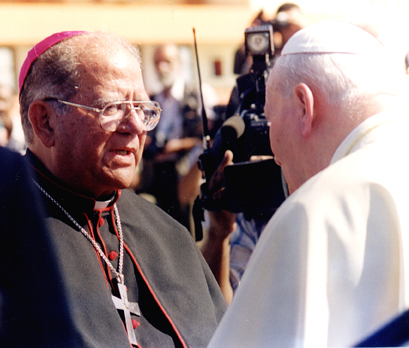
Image taken from "La Voz católica"

In memoriam for Pedro Meurice Estiú
Archbishop Emeritus of Santiago de Cuba

They called Archbishop Pedro Meurice Estiu “the lion of the East” for his more-than-proven bravery in the face of the arbitrary and authoritarian. That January 24, 1998, in Antonia Maceo Plaza in Santiago de Cuba, his face is serious, deep in thought. Pope John Paul II has just finished his homily and the Archbishop of Santiago de Cuba was to address his flock and the Shepherd who had come to visit it. Before taking the podium, Meurice spoke with the priest Jose Conrado Rodriguez Alegre and told him, “This lion is old with a shaggy mane, but it will roar.” He took the microphone and kept his word.

Facing the surprised Santiagans gathered there, and those who were watching the live on television, Meurice’s address seems to interpret our thoughts, to spring from our own mouths. “Holy Father… I present to you a growing number of Cubans who have confused the country with a party, the nation with a historical process we have lived through in recent decades, culture with an ideology.” And on this side of the screen, many of us did not stop applauding, crying, jumping, looking at the shocked and annoyed face of Raul Castro at the foot of the dais. No one had told the Minister of the Armed Forces–in public and before so many witnesses–truths of this nature. Some escaped in fear from that immense square, but others? The boldest? They were chanting the word, “Freedom.”

“This is a people that has the richness of joy, and a material poverty that saddens and overwhelms it, barely letting it see beyond immediate subsistence,” the lion continued to roar. And in our lethargic civic consciousness something began to stir. Meurice had returned to his years of greatest vitality and the swords that emerged from the ground of that Plaza flew in the face of a rebelliousness lost in some corner of history. For a few brief moments we were free. The homily ended, the severe gesture of our current president presaged scoldings for the old lion, but the crook of John Paul II would protect him.

Today, Pedro Meurice has left us, with his nobility of the feline guardian of the litter, leaving us with the responsibility to present ourselves to the world. How are we going to describe ourselves now? Who will be belive that 13 years later we haven’t been able to “demystify the false messiahs”? How will we explain the fear that has led to paralysis, to continuing to wait for others who will roar for us?

Testimony: The Failed Attempts to Make Me an Agent – II / Angel Santiesteban

Photo: Reuters

After two months of hiding in the neighborhood of Güinera, I reappeared in my neighborhood. Everything seemed calm. The good thing was that I had taken advantage of the time to read and create. And I thought I could resume my life.

When I least expected it, they raided my house and arrested me once again. As soon as I arrived at their headquarters, they assured me that I would now spend there as punishment the same length of time that I hadn’t shown them my face. And that is exactly what happened. They kept me in those cells of intense disciplinary rigor for the 60 days that I had remained hidden. There, also, I undertook a process of creation which was my salvation.

In that prison I wrote a story in my memory. I would say one phrase out loud, and then add another word and began to repeat it from the beginning, and so, continually, hundreds of words beginning to be a long story that, in fact, I published. I just remember my cell mates looking at me with fear, as if I was a crazy man who might hurt them. There was one moment when one of them knelt to beg me to shut up, they were tormented, I wasn’t letting them think or sleep. I think they also learned the story.

On the 56th day a certain Germán came to see me, he was one of the state security agents I had always seen at literary events, especially at the activities of the Casa de las Americas. He was accompanied by two others, and when they took me to the office they were seated on the sofa. I had barely entered and looked at them, when my pants fell down, keeping in mind that I wasn’t wearing underwear, and they looked offended. The Germán guy told me that he wasn’t going to get into it with me and assured me that, despite everything, he was a young revolutionary.

I really had to hold myself back, in light of my physical weakness, from my desire to come to blows with them, feeling an immense need to give rein to my anger. Germán assured me that he would work it out soon, but not to forget to “cooperate” with the officials.

At the end of 60 days I had become so thin that when I went to see my mother-in-law, who had known me for ten years, she couldn’t recognize me. When I talked I started to cry, and the feeling came over me of being in the state of calamity.

I had barely entered the apartment when, without even drinking a glass of cold water, I sat in front of the computer and began to write the text I had memorized. In those days of imprisonment my greatest fear was that I would forget the story.

Then I saved it, and on seeing it printed I felt like the sun had come out for the first time since my arrest; I believe I smiled because I understood that I had played a trick on them. If they thought they could keep me from writing, from creating, they had not managed to do so.

And of course, even more than before, I was reluctant to cooperate.

July 20 2011

Heroes Without Weapons / Dimas Castellanos

Dr. Tomás Romay Chacón

In Cuba, with its pregnant history of violent acts, we pay exaggerated attention to episodes of war in detriment to other ways of making history, such as science–forger of knowledge and of culture–that contributes so much to the formation of nationality the nation and the country over centuries. On May 19 of this year we will arrive at the 150th anniversary of the founding of the Royal Academy of medical, physical, and natural sciences of Havana, whose birth was conditioned by the development reached by the productive forces and by the sustained and joint effort of Cubans, who from different political and ideological positions, united their forces for the development of Cuba. In recognition of these heroes, almost anonymous, I am going to mention nine of them.

Tomás Romay Chacón (1764-1849). Physician, cofounder of Newsprint of Havana and of the Economic Society of Friends of the Country, made innumerable contributions to science and culture, but it was in medicine where he made his greatest contributions; in 1794 he presented to the Ordinary Meeting of the Patriotic Society of the Friends of the Country–the first scientific meeting of Cuban doctors–-his dissertation on the malignant fever commonly called black ball met, and discovered it introduced vaccination against smallpox, introduced the studies of anatomy on the cadaver, those of the clinic in the rooms of the hospital and took students to the sources of the sick and to the morgue to practice autopsies. He was one of those who petitioned King Fernando VII about the necessity of creating a science academy on the island. for his activities in preventing disease and promoting the advancement of medicine he is considered “the first great Cuban hygienist” and the initiator of the scientific movement in Cuba. Romay was a man of his time in class, of the established political system, defender of the established political system, admirer of the Spanish monarchy, and intransigent enemy of revolutionary liberalism; irrefutable proof that one can be a force in science, culture and nationality independent of political or ideological affiliation.

José Estévez Cantal (1771-1841). Chemist and botanist. Student of Tomás Romay was probably the first Cuban who received a scientific education in Europe and the first botanist of some importance. Between them they worked on a catalog of plants, begun by Baltasar Boldo, considered as the first floor of Cuba. He was the first Cuban chemist who distinguished himself in the search for varieties of sugarcane and who applied this science to a new branch of therapy: medical hydrology. Thanks to his analysis of the waters of San Diego–the most famous of our mineral medicinal springs–he was able to take advantage of their healing properties. Through Estévez botany, chemistry, and mineralogy were introduced on the island reinvigorating the already advanced movement of cultural and scientific reform.

Esteban Pichardo Tapia (1799-1879). Lawyer and geographer, born in Santo Domingo. Considered “the most prominent geographer of Cuba.” His geographic and cartographic work was the basis for the contour map drawn to scale, made ​​in 1908 by the American Army of Occupation. His main geographical work was the Route Map of the Roads of Cuba. In 1829 he presented the Compendium of Geography of the Island of Cuba for use in colleges and high schools. He also dabbled in literature with a volume of poems and the Dictionary of Cuban Voices, published in 1836.

Felipe Poey Aloy (1799-1891). Researcher and Professor in Natural Sciences. In France, where he met Jorge Cuvier, he published his first entomological studies. In 1838, he presented a project to establish in Havana a cabinet of natural history, which later became part of the University of Havana. He studied The sugarcane borer and avocado pests, bringing wide knowledge of the basics of biology. He is considered “the initiator of the scientific era in the natural history of Cuba” and was one of the 30 founding members of the Royal Academy of Medical Sciences, Physical and Natural Sciences.

Nicolás Gutiérrez José Hernández (1800-1890). Surgeon, founder of the Havana Medical Journal, Cuba’s first magazine devoted exclusively to medicine. He introduced in Cuba chloroform is a surgical anesthetic. On the death of Tomás Romay, Nicolás became the principal figure in the Havana medical community. He was one of the leading personalities in the struggle to found the Royal Academy of Medical, Physical and Natural Sciences in Havana, where he held the presidency to which he was reelected until his death.

Francisco Frias Jacott, Count of Pozos Dulces (1809-1877).
Agronomist, science writer and agrarian reformer. Author of the Agricultural Development Program, aimed at laying the foundations for a national identity agro-technology and agro-science to achieve social and economic equilibrium. An ardent supporter of small farms, small industry and the work of the peasant family. He was the first speaker at the Royal Academy of Medical Sciences, Physical and Natural Sciences of Havana, on the theory of Darwin, and was a defender of the Institute for Chemical Research, founded in 1848, and in 1861 he was a promoter of the Cuban Agricultural Institute. In 1868 he was honored for his work: “Report on the livestock industry on the island of Cuba” and “The scientific basis on which rests the view that the destruction of the animal kingdom, involves that of the plant and vice versa.”

Francisco Fernández de Lara Albee (1816-1887). Engineer. Between the repair of the Convent of San Agustín in Havana, his first work, through the construction of the Isabel II aqueduct, he is found prominently in all the material construction of that era. His great work with the use of the waters of the Vento Springs, for which he investigated the entire relationship between the quality and the transfer of the liquid to the Palatino reservoirs. Through this he demonstrated the negative influence of sunlight on the deposited waters; modify the geology of the terrain to adapt it to protect the canal; and ran it under the Almendares River. A project that was not repeated until the middle of the 20th century, when the tunnel under Havana Bay was constructed. For this work he was awarded, first in Philadelphia and later in Paris, with the gold medal, while the Royal development board called him “the most famous of Cuban engineers.”

Aguirre Andrés Poey (1825-1919).
Meteorologist. Precursor in Cuba of research in this field, considered the “true creator of scientific meteorology in Cuba.” In 1848 he prepared an atlas with 28 lithographed maps for primary schools, the first of its kind printed in Cuba. In 1850 he established an observatory at his home where he undertook atmospheric research. In 1855 he produced a catalog of hurricanes entitled “Chronological Table comprising 400 hurricanes and cyclones that have occurred in the West Indies and the North Atlantic from 1493 to 1855;” a work considered essential in this matter.

Alvaro Reinoso y Valdés (1829-1888).
Chemist, physiologist, agronomist and industrial technologist. He replaced José Luis Casaseca at the head of the Chemical Research Institute of Havana, which became the Agricultural Station. In 1862, when Cuba ranked first in the world in sugar production, it stood last in agricultural productivity. To the solution of this contradiction Reynoso devoted all his efforts. In his masterpiece, “An Essay on the cultivation of sugar cane,” published in 1862, he developed a comprehensive system of agro-technical measures to ensure the intensive cultivation of sugar cane, for which he fully analyzed all operations related to the cultivation and harvesting of the grass. Reinoso is considered “Father of the Cuban Scientific Agriculture.” Despite all the time that has passed, Cuba today has not exceeded the sugar crops of a century ago.

Along with these nine heroes of Cuban science it is necessary to recognize the contributions of foreign scientists, including Alejandro Humboldt de Hollwede (1769-1859), José Luís Casaseca Silván (1800-1869) y Ramón de la Sagra Periz (1798-1871). The first, in many respects, knew Cuba better than Cuban themselves, the latter is considered the “father of Cuban chemistry” and the third, the leading Professor of Natural History, who created and directed the Botanical Garden and the Havana Institute of Agriculture.

The review of these famous scientists makes a mockery of the absurd attempt to link homeland and nation with socialism and revolution.

Published in Diario de Cuba (www.ddcuba.com) Friday, May 27, 2011