The press reports that at a meeting of the Council of Ministers they took some steps to ease aspects of self-employment. Among them: increasing from twenty-five to fifty the number of chairs allowed in paladares(private restaurants); reducing for a time the fee paid to rent a house from two hundred to one hundred and fifty pesos (both in hard currency and national currency); increasing from twenty to forty percent the expenses that can be deducted in transport using animal power; considering a three to six month tax free extension for the repair of homes or motor vehicles for rentals, and others of similar content.
Although these measures are far from what is really necessary, they alleviate some burdens imposed on self-employment and permit its development while stimulating those who perform it. They show some concern for its achievement and are signs that, despite the inertia that still exists, they are facing the realities, correcting the previous regulations, something that never happened before.
However, it is noteworthy that it is the Council of Ministers who has to decide. If we analyze each measure, we note that they are simple adjustments of something already approved in its general form, for different levels of power. Nothing of particular importance. They couldn’t deal with those issues of little importance to the respective ministries and State institutions, without burdening the Council of Ministers? Is there no more quick and direct way to untie knots?
For many years, perhaps too many, the heads of ministries and State institutions have lacked the real power of decision, being simply executor of a supreme will that determined and decided everything. In addition, their main role was to serve as scapegoats for failure. This created and consolidated the disastrous centralization they are trying to remove today. Would not it be convenient to begin to implement it, giving them responsibilities that are inherent in their positions? The thousands of adjustments and adaptations required must be left to the individual responsible and not just the Council of Ministers. It would be an impossible task for them, as they should occupy themselves dealing with issues far more momentous.
I mention these small steps and vote because they continue to take, because ultimately should result in a slight improvement in the situation of citizens, although they are not the total solution to our many problems. But we should take what we can get, which doesn’t mean that we shouldn’t aspire to get everything.
Among the authorities and officials serving in the national mass media, the verb “to recover” is the most used in these times of guidelines and updating the economic model. It is practically applied to all areas and activities of the nation, whether of a material or spiritual nature: everything should be “recovered.”
First things first: when something has to be recovered, it means that at some point it existed and then at another point, for some reason, it disappeared. Something that never existed can’t be recovered. So, when one speaks of recovering the sugar production, the coffee crop, grains, rice, minerals, and so on, or mining, the railroad, the fishing fleet, the merchant marine, et cetera, it is assumed that it existed and disappeared. This corresponds to material matters.
The same happens with the spiritual. When considering the recovery of social and labor discipline, good manners, formal education, morality, civility, correct language, etc., is also accepted that it existed and disappeared.
If we simplify the problem, which is quite complex, we can conclude that all these issues, as in any other country, were established and consolidated over time, from colonial times through the Republic and into the early years of the sixties until we come to socialism, when there was a massive collapse. Today, if we listen to the authorities, everything has to be recovered. It is a true work of giants, that pretty much everything created in the colonial era and in 56 years of the Republic does not exist.
It remains a mystery: no one speaks of the causes of this disaster. One could think that it was due to cyclones, but there have always been cyclones, drought, but there have always been droughts, heavy rains, but there have always been heavy rains. Perhaps the blockade (in reality, the embargo) is responsible, but for more than thirty years, the former USSR and the rest of the extinct socialist countries subsidized us with billions in financial aid, in addition to technologies, specialists and goods. Afterward the support was taken on by the Bolivarian Venezuela up until today. It is possible that we Cubans are an incapable people, but during the colonial period and the Republic we proved capable, becoming an example for Latin America and other countries. In short: there don’t seem to be any causes. Could it be that the model doesn’t work? Draw your own conclusions.
In a few days, the much postponed Sixth Party Congress will be held, with its original innovation: it will only address the economic issue. It is true that this is one of the most tricky, but there are other outstanding issues, which will be deferred and held over time. Putting a straitjacket on the Congress is not healthy. Moreover, in practice, what they are going to analyze (the guidelines) have already been examined and there is very little new that they are going to bring. This gives a quite formal character to it, like the completion of something that shouldn’t be further postponed.
Economic problems are not of interest only to party members and their delegates to the congress, nor only to the economic experts of the party and government. If you try to cook the possible solutions with the same recipes and chefs who have done so for the past five conferences without actual results, there very little that can be expected to come of it.
If the will exists to confront and resolve the accumulated economic problems, there must be real participation of all parties, and a hearing of and taking into account the views and possible solutions of different specialists, both of party and government as well as those outside. This is a problem that affects us all, and all of us, without political or ideological exclusion, must participate. In practice this has not happened. The entrenchment of the impregnable fortress had proved its failure.
To solve economic problems is to move through major changes in the current model. Including the authorization of small and medium private enterprises and cooperatives; authorizing the investment of capital, first of all of Cubans, both inside and out of the country, and of foreign capital in agriculture, the substitution of land ownership for land in usufruct, with amortization in fair conditions and regulations that do not allow hoarding. These would be real actions, from which one would expect short-term results.
To ensure these changes will require relevant legislation, clearly establishing the rights and duties of each, as well as their implementation, and an intelligent tax system to serve as a stimulator and regulator of production and services, not a plastic bag to prevent breathing and stifle investment and enterprise. It is not advisable to continue shooting in the dark and trying to supplant the laws of economics with political and ideological voluntarism.
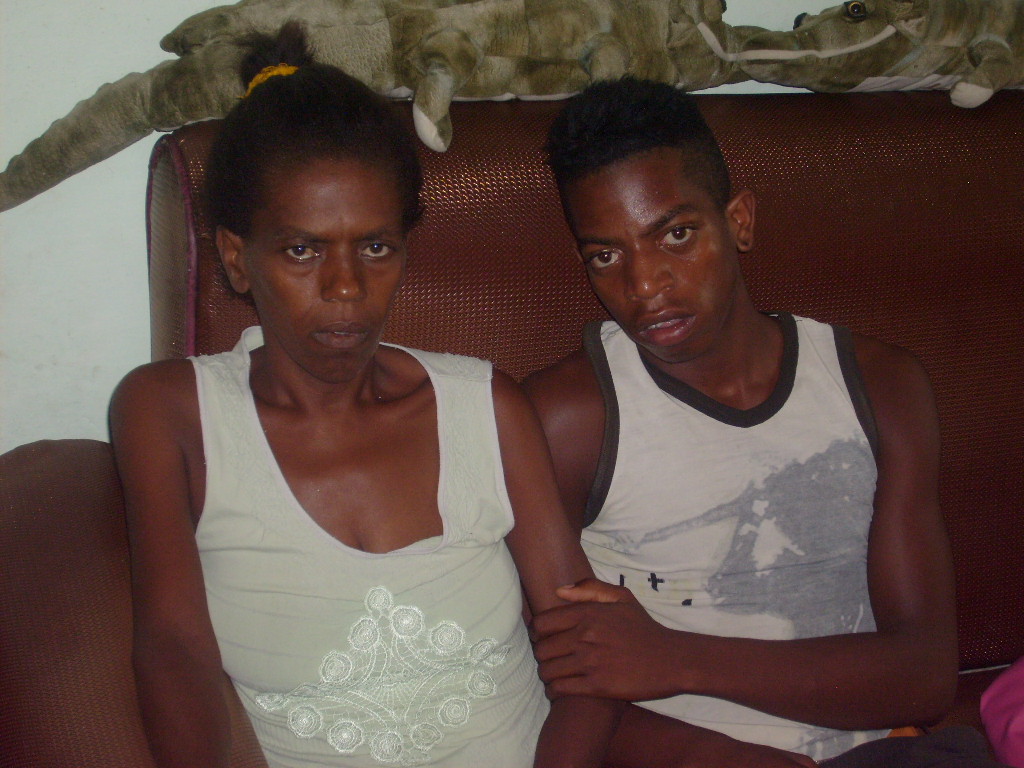
Raiza Medina claims justice for the death of her son Ángel Izquierdo Medina, a black teenager of 14, who died this last July 15, after having been shot by a retired police official.
According to Ismael Suarez Herc, 17, eyewitness of the events and he victim’s cousin, who was climbing a mamoncillo tree when Amado Interian, alias “el Pinto,” an ex-police official, fired his 45 caliber revolver. He reached for his left buttock. The teenager was still breathing when he fell. Minutes later he died.
The news affected the capital town of Mantilla, Arroyo Naranjo. Hundreds of people gathered outside the clinic in the town where the teenager’s body was first taken, and in chorus shouted “murderer.” Forensic medicine certified the cause of death as acute anemia.
At the wake, in the Mauline funeral home, over 400 people attended. The funeral was held in the afternoon the next day, at the Colon cemetery. State Security troops, in civilian clothes, were in the farewell to Izquierdo Medina. Although protests were reported, no arrests were made.
The farm where the incident occurred is located in Las Lajas, Mantilla, a neighborhood on the edge of the Arroyo Naranjo municipality, in Havana. It has a predominantly black, low income population with a high dangerousness index. Suarez Herce affirms that they crossed through there to take a dip in the Abelardo dam, in Calvario.
Interian, was head of the police sector in various localities of Arroyo Naranjo, the poorest and most violent municipality in Havana. Neighbors and relatives of the victim described him as an angry man with a short fuse.
They say he killed two people and caused several injuries with his weapon. An unofficial source told Raiza, Medina Izquierdo’s mother, that a man, approximately 60, said he acted in self defense.
As of now his whereabouts are unknown. Witnesses said he was detained by police. However, some in the area say he ran away and others that he hung himself. The authorities have given no details.
Relatives and neighbors of the victim suspect the police are looking for excuses not to prosecute him, and they are demanding justice for the death of Angel Izquierdo Medina, that it not go unpunished.
I decided not to write about the celebration of the event for the 26th of July. Last year’s post would be perfect to narrate the essence of what happened yesterday in Ciego de Avila. These celebrations and the supposed competition of the provinces to be the site of them, have been converted into mere formalities. Formalities full of hollow figures, because if simply search your memory you can remember the speech for the occasion, a long list of achievements of all the provinces, as all at some time have been the site of event of yesterday, some provinces several times; figures that, if true, should have brought a better economic outlook in the country, and we know the sorry state in which the Cuban economy finds itself.
It’s not a bad idea to abandon the paraphernalia that surrounds the country each year with the celebration of the 26th of July, and honor the martyrs by dedicating to social works the enormous resources that are devoted to the event (transportation and accommodation for the Moncada combatants, printed T-shirts, hats or caps, food and snacks, mobilization of personal), in short, the always secret funds that swell the enormous and seemingly bottomless debt, that yet hangs over us all.
Among the activities planned for this coming April 16, there is a parade, an activity increasingly remote in recent years, on the official calendar. Military parades usually are held for one reason: to make a show of force. This could this be directed inward or outward and sometimes in both directions. The time devoted to preparation (one month, with practices in the Plaza), confirms the importance accorded to it.
If its reason corresponds to the first variant, it would be good to remember when it comes time for the truth, that the majority of the military are with the people, of whom they are a part. To remember the armies of the countries of Eastern Europe, led by the former USSR, with thousands of generals, commissioners and political and party organizations, joined their citizens during the changes. Closer in time, the armies in Tunisia and Egypt were also on the side of those who demanded changes.
If their reason corresponds to the second variant, to think that old recycled weapons can impress the alleged eternal enemy, is as absurd as to foresee a war, which has been fifty-two years waiting on the sidelines. And very few still really believe in the story of “Here comes the wolf”! Besides, everyone knows that when the wolf decides to go somewhere, it is very difficult to stop it. The events of recent years prove it.
If its reason is the third alternative, then an act is just more propaganda directed at unconditional friends, to continue sleeping on the same side, as they have been doing for years, hose security forces who have been specially invited for years and who, later, make profound statements of solidarity. It is simply offering a circus when bread is scarce.
The tragic fact is that, when making continuous calls to saving, austerity, the optimal use of time and work, work, work, considerable human and material resources are squandered which could well be used for more useful and necessary tasks. It would be healthy if strength was demonstrated through respect for all views, including differences, and creating a climate of social peace, where all Cubans could take place as citizens without having to emigrate, bringing their talents and efforts to bear for the good of the nation.
Cyclically, like the seasons, the Cuban Adjustment Act appears in the national media, always to criticize it, to call it a murderous law and to demand its repeal. It is considered, although it us a U.S. law, that it intrudes on the problems of Cuba and, therefore, has an interfering character. Everything that touches the government of the island, even with the petal of a rose, is of this character. It is a legendary defense, used for too many years.
As much as they talk against it, its maintenance or repeal is vested solely in the United States government. Their legislative, judicial and executive have the final word. The rest are just media campaigns, to distract attention from more complex and important problems. Its existence, no matter what anyone says, has benefited many thousands of compatriots who have remade their lives and their families in a land of freedom, where they now live and no longer sacrifice their years, hoping for a glorious future never comes and is increasingly more distant.
Let’s consider the issue from another angle. If the Cuban authorities want to solve the problem on their hands they have the solution: simply have to restore to citizens the rights they had under the Constitution of 1940, and that were taken from them in 1959. Among them, for those who don’t know or have forgotten, the right to exit and enter the country freely and without any permit, as well as respect and protection for their property, without the ability to seize it, in addition to the exercise of all other citizen rights. If these rights are restored, the Cuban Adjustment Act would lose its raison d’etre and, naturally and without complications, would cease to apply as unnecessary. As you see, it is a decision that is entirely in the hands of those who demand its repeal. It seems absurd but it is reality.
Sometimes, at the height of the manipulation, they go so far as to say that rushed law should also apply to immigrants from other countries. Which is it, is it a killer or not? The answer is not difficult, it does not apply because these immigrants have not lost their rights as citizens in their respective countries and can freely come and go and live where they please, without losing any of their property.
It is symptomatic that a regime that has always been extremely conservative about the reception of immigrants in its own territory (the Haitian brothers are returned as soon as they hit the east coast of the country), is so worried about the situation of immigrants other countries. It smells of political expediency and is a token of eternal confrontation with the empire.
The procedure was simple. Very simple. You looked for a piece of cardboard and painted it with a phrase against the Government. You hung it around your neck and went out into the street. Like in the reality shows where a naked man comes out into the light of day starkers, and his challenge is to reach a determined goal without law enforcement stopping him. Well, here you wouldn’t last two blocks with a sign around your neck.
You could also opt to choose a city wall and appear before it with a can of paint in hand, and decorate it with one of those phrases against Fidel Castro and his brother Raul, the Communist Party, the system, or something along those lines. You could be sure: in this way, before you’d finished the last word, you’d hear two or three dry brakes screeching, and then the cold metal of the handcuffs on your wrists.
Now, painting signs on walls you would run a risk: that your phrase would never be finished. As you wouldn’t know at what point in the expression you would be arrested, you’d hope that the police would be delayed a few moments (not likely) and then finish your work and the sign would have a reactionary sense. Otherwise, you might fail. Why? Because a sign that just said “Dow” is not classified as a subversive activity, but rather as disorderly contact: no one gave you permission to paint a wall. It has the same connotation as breaking a window or peeing in a public place. Just that. Perhaps if you had no prior criminal incidents, they would fine you, or, in the worst case, put you on house arrest. The Social Environment Department would send you a letter announcing to you, on their part, a further fine of one thousand pesos for your act: you had marred the adornment of the city. And then you’d be left with the ugliness of two fines to pay, and you wouldn’t be a prisoner. Much less have the category of a political prisoner, which was what you needed.
An example: Aristides Bazán. Professional historian. When he exhausted his legal tricks, always unsuccessful, to teach at other universities in the world, he understood something: they would never let him out for being good. The professor was a potential emigrant, and this could not be allowed. Then, he knew what he had to do.
He armed himself with a rectangular acrylic, six feet long by some ten wide. With a black marker he wrote on it a beautiful and vast idea of the immortal José Martí, Apostle of Independence and the first modernist of poetry. He had read the martyr in a letter to his close friend Fermín Valdés Domínguez, and since then had said surreptitiously repeated it to some of his students. He wrote exactly:
“The socialist idea has two dangers, like so many others: that of foreign, confused and incomplete interpretations, and that of the arrogance and hidden rage of the ambitious, who, in order to rise in the world, begin by feigning it, to have shoulders to climb on, frenetic defenders of the helpless…”
Aristides Bazán did not have the soul of a pilgrim to exhibit his reactionary sign in the street, nor a Mexican muralist to decorate public spaces, so he opted to hang this thought in the door of his house and to have his things ready.
He is still waiting, today, for his arrest. The laws of the country changed without his acquiring a passport as a prisoner of conscience. It’s true that in the short time he exhibited the banner on the facade of his house, three plainclothes officers and then three more in uniform, took notes, shot photos, and quietly discussed some things quietly. Apparently they took the evidence to their laboratories. But Professor Aristides never managed to be taken prisoner. After a long time, he confessed that perhaps he was not very clear in his positions. He should have chosen something more transparent. If you want to achieve something quickly, it should not be very difficult for the enemy.
But there’s more. Nor should it leave room for manipulation of information. A poster should have enough personality to deliver a single, unchanging idea. Otherwise, the enterprise could not be successful.
Another example: January 1, 2000 a drunk with a desire to try his fortune in other lands woke with desires for freedom. Without rinsing his mouth, belching alcohol, he appeared with a blue-green crayon in front of City Hall. There, he chose the wall of a House of Culture for his ideological brush. He wrote, with great double letters: Freedom. And sat down under to await the agents. The previous day he had advised a nephew who lived in the North: Get ready, soon we will be celebrating together. When he woke up, in a stinking cell at the Municipal Police Station, the damage was already repaired. A local artist had taken advantage of the space, instead of being allowed to repaint the facade of the House of Culture. In its place he had written: Freedom Was Born Without a Master, signed: Silvio Rodriguez, and a handful of white doves with Cuban flags in their beaks finished off the mural.
The poor fellow spent three months on a farm, and then was back on the street.
So, where were we. The concept of a sign. No one knows why, but one of the cardinal sins of the system has always been a sign on a wall. These rulers have felt a real weakness for them. From the time when they risked their lived to decorate a wall with red paint with the inscription: “Down with Machado.” It may seem exaggerated, but it’s the truth. There were those who threw firecrackers at the houses of the henchmen, those who went on strike…and those who wrote signs. I never have understood how it could bother me it a sign appeared somewhere with “Down with” my name. If they did it on my own facade I might cuss them out, but if it’s some other, I don’t care.
But here he was upset, and how. He would never escape. For serial killers and perpetrators of crimes against humanity, there was the possibility of evading the investigations. But for sign painters, not one. Those who did it with a true subversive vocation, were imprisoned. Those who did it to leave the country, the same. The method was infallible. The Human Rights organizations automatically inscribed your name among the prisoners of conscience. It was a matter of surviving behind the bars. Once out, you presented yourself at some conflicting embassy as a persecuted politico, and then after a couple of months of confirmations, they awarded you a visa. Even your family was included in the pack.
The process gained many followers and became a business. Whoever had a white wall on his property could make some money. But they had to contract with a night watchman to watch the area at night, and a guard to do the same during the day. To write on the wall, you had to pay. Obviously, the more central it was, the more it cost. After collecting his pesos, the owner retired the watchdogs and set a specific time. After the police took the guy, the owner of the wall repainted it a perfect white. Erased it, like a blackboard. Waiting for the next cave artist.
Those who decided to hang their sign, just in case, also crossed the palm of the president of the block’s Committee for the Defense of the Revolution, to call the police and tell them who was the author of the work, and even a couple dominoes players, who acted as witnesses. They thanked him, too. Wished him luck on his future journey.
But there is not good that lasts a hundred years. At some point the breach was sealed. A coming together of Justice reform and the Penal Code, and the sign painters lost their bargain. Worse: they begin to take it into account in their judgments. Ignorance of the law is no excuse. Henceforth, the courts sanctioned them with the most twisted and brilliant euphemisms (apart from the handy Disturbance of Public Order, they came up with Mistreatment of Social Property, Citizen Dangerousness, Civil Disobedience, and many more…), but the name “Political” was never used again.
At that time, we had just learned of another possibility about to be extinguished. You had to go, flashlight and map in hand, to the tunnels of the resistance. Too many of us were continuing behind the bars of smoke and water, and an excellent escape tunnel had to be dynamited.
———————————————————————
* This text belongs to literary fiction, not journalism. It is part of a separate volume of stories (most of them far from any Cuban context) entitled The Renegade, although this is Chapter 3 of a kind of macro-story that links everything at the end. A book I have not finished (but almost), halfway between a novel and short stories.
The use of a disqualifying language against political opponents has been a fairly widespread practice, though in general certain limits of public responsibility and established decency are respected. There are also laws that penalize defamation, due to which, whomever raises a question about a person must support it with evidence and proof. So it works, at least, in most democratic countries.
During the years of the Batista dictatorship, those who did not agree with his politics were classified as opponents. Except in times when censorship was established, they had the means to express their opinions. They were not detained or imprisoned, and also participated actively in the national debate. Those opponents who opted for violence as a form of struggle, planting bombs and firecrackers and carrying out attacks and sabotage, were labeled as subversives or communists. The word terrorist was not yet fashionable. If caught, they were repressed by bloody or judicial methods. In the latter case, they had available to them defense counsel and fair trials. There are many examples.
Beginning in 1959, those who did not accept the new regime or disagreed with some of its postulates, were labeled counterrevolutionaries. Tossed into this sack were both those who acted peacefully as well those who opted for violence. Soon he put his hand in the dictionary and began to apply, festively, every kind of dis-qualifier: worms, stateless, traitors, mercenaries, lumpen, slag, employees of the empire, and so on. This method continues to today and has increased. Applied for years, with no possibility to respond, (all media and controls belong to the state), citizens have been so manipulated that they react by inertia, without the use of reason, forgetting in many cases that it even exists.
Denigrating and discrediting those who think differently and, moreover, those who dare to express it, only shows weakness, no matter how much the statements multiply in strength. The problems of Cuba must be revolved by Cubans (all Cubans, both inside and out of the country) but for that, we can not be expected to maintain the historical monologue, where only those who govern us think they possess the absolute truth. The continuous failures have shown the opposite. It requires honest and respectful dialogue.
However, dialogue requires there be a willingness in the parties interested in it. to maintain the sectarian and exclusionary position of the past five decades, claiming that those who think for themselves are taking orders from the empire is not serious. The reality is otherwise: every day citizens are increasingly questioning their plight and raising the need for real changes in the interest of the nation, not of an ideology or a party. Coping with them peacefully, with the participation of all, as recommended by José Martí, is intelligent.
Latin America, historically, has moved like a raft floating in the ocean: forward or backward depending on the ebb and flow of the tide. In the early twentieth century it was carried away by the rising nationalism, believing that isolating itself from the world and closing in on itself, it would be able to better solve its problems. That failing, it opted for strong and autocratic governments: the dictatorships with messianic leaders. Each country exalted a dictator, some for decades, establishing a right of inheritance.
Then, that too failing and tired of patriarchs, it was the turn of the guerrillas, and an epidemic of beards and olive green uniforms covered the continent and the pages of newspapers and magazines. Guerrilla commanders organized in all countries, and commanders and others appeared, by one method or another, aspiring to the violent seizure of power.
Failing en masse, many annihilated, those that survived decided to try legality, converting themselves into political parties or totally immersing themselves in the drug trade. Then came the time of democratic presidents and neoliberalism and the Chicago School, at which the governments of Latin American map with some stability and periods of civic peace.
Then populist current burst on the scene, which has tried to spread like bird flu, but populism has no future, gripped in his own verbiage and contradictions, unable to really solve the economic problems of nations where it has been tried. What will the new wave be which will move the ailing American raft? We do not know. But it would not be wrong to say that until they decide to find land and settle in it, devoting their crew to serious and responsible work, the only proven long-lasting wealth creator, and leave off being carried by the movement of the waves, they will not find the progress or happiness.
It was very early, the circles under the speaker’s eyes could be seen like two dark wounds, and the sun was not yet too punishing in Maximo Gomez Plaza. On soft seats, a small group witnessed live the 26th of July event in Ciego de Avila province. Meanwhile, the rest of those in the Plaza sat on plastic chairs or were simply left standing. From this side of the screen, we few viewers awake at that hour made an effort not to go back to sleep. The event was so boring and so predictable in its structure that at times it seemed like a rebroadcast from the previous year. Not even a spontaneous breeze moved the hair of the attendees. Even the fly on the face of the orator that took a fancy to the camera, looked unreal.
But the greatest monotony came with the words of Jose Ramon Machado Ventura. An hour after having heard them, it was difficult to remember what had been said by this grayest of all vice presidents, the most dogmatic of the orthodox. During the scheduled pauses in the speech someone shouted a slogan which was then repeated by the crowd. The applause heard was also conveniently administered, without unauthorized outbreaks, with no fits and starts. Enormous credentials hung from the necks of those who enjoyed the chairs, giving the lie, with such an excess of paper and plastic, to the calls from the podium for efficiency and putting an end to the bureaucracy.
In a moment that must have been the end, though it could just as well have been a break in the script, Raul Castro left without having directed a single word to the crowd. He rose from his chair and walked away, followed closely by a loyal bodyguard who has more of a role on TV than some ministers. The Plaza quickly began to empty out, as the speaker tried to close with certain slogans that once moved passions. “And this is all that’s left?” I thought, with sorrow for others. With this exhausted choreography they thought to move passions? I turned off the TV in the middle of a phrase and went back to sleep. Outside the sun was warming the balconies, drying up the puddles, revealing the cracks.
Translator’s note: The 26th of July was the date of the failed 1953 attack by Fidel Castro and others on the Moncada Barracks in Santiago de Cuba, and was taken as the name of his movement. It is celebrated annually in Cuba.
The Latin American left, old, new or newest, in its love-hate relationship with the northern neighbor, has always railed against it, making it totally responsible for all our political, economic and social ills. Added to this has been the contribution, over the years, of many of our intellectuals and artists who, enjoying most comfortable economic positions, have tried to establish a kind of political patronage over the masses, trying to cleanse, with them, their bourgeois stigma, which they deny but enjoy. It’s not worth recording their names, because the list is endless.
Acknowledging our shortcomings is something extremely difficult for Latin Americans. We’ve always like the role of victims and it has paid us good dividends. Immensely rich lands have provided us with wealth or well-being and all for the fault of others: first it was the Spanish and Portuguese who destroyed the magnificent and idyllic aboriginal civilizations, which respected the human being, did not go to war and lived in peace and harmony, resting on the banks of rivers and lakes, singing and dancing in honor of the gods, who were so good and so undemanding that they showered them with offerings of tropical fruits. Then there were the British, Dutch, French, etc. who also came to exploit and take over our natural resources that we, wisely, didn’t exploit, reserving them for future generations. In the end came the Americans, getting rid of all the designated governments and doing what they pleased, and so on.
This story, well told, is very comfortable for our leftists and allowed them to disregard the reality and the real causes of our situation: our own incapacity. Other countries with fewer natural resources, with adverse geographical and climatic conditions, with submissions and wars, have been able to struggle, overcome obstacles and develop without exploiting anyone: Switzerland, Finland, Sweden, Thailand, Malaysia, to name a few. Why has Canada developed while Mexico hasn’t, both having borders with the United States? Is it that the United States has been magnanimous with Canada and stingy with Mexico? Or is that Canadians, instead of wasting time in fratricidal strife, have dedicated themselves to work hard and develop their country? The answer is obvious, despite the silliness of our left. If we review the history of Latin American nations we find only a string of wars and warlords in a violent and interminable struggle to seize power and benefit from cliques outside the people’s interests, although they often disguise themselves as such.
The people meekly followed these mythical characters and have relied on an endless carnival, which has plunged us into the most appalling underdevelopment, without real hope of leaving it. All leaders have used the same scheme: from liberator to dictator.
Until our people stop whining, blaming everything on their neighbor (whom they envy) and decide to work hard, to settle the caudillism and establish a truly democratic system, where what matters is the management of government and results, not personal sympathies for one or another figure, until we establish and strengthen the institutions that can prevent someone from seizing power and operating at will, until democracy really works and not the current freaks, we cannot solve any of our problems.
Meanwhile, our leftists, supported by the festive leftists of the developed countries, continue to entertain themselves organizing protest marches against everything, burning effigies of Uncle Sam and the incumbent president as well as flags, to the rhythm of a Brazilian samba, a Colombian cumbia, a Venezuelan joropo or a Cuban conga, with large portraits of Bolivar, Che and other convenient figures. It’s easy and convenient to shift onto the shoulders of others our own historical incapacity and indolence, to be able to continue lying against the trunk of a coconut tree napping, while responsible nations and workers cross in front of us and leave us behind.
One of the accusations most used by the authorities to disqualify and discredit their political opponents, or simply citizens who think differently, is to label them “employees of the empire.” The accusation has its media effect and many honest people accept it as the absolute truth and even repeat it against some of their neighbors, acquaintances and even family members, without questioning its supposed veracity. From so much repetition over so many years, it has become obvious: Those who do not think like the establishment must be paid by someone for it.
I am not going to sanctify a priori all the disaffected, nor put their hands to the fire, defending their moral and civic purity, but as in every social or political group, in the vineyard of the Lord there is everything (even infiltrated agents). Life has shown it every day, and every day proved it. There must be, above all, realists!
Let’s get to the heart of the matter: those who serve the regime in various jobs. In this country, like everything else, all the communication media belong to the State and, therefore, those who work in them are, whether they accept it or not, employees of the regime. In this category are the journalists, broadcasters, program hosts, commentators, director, producers, technicians, consultants, etc., both in radio and in television, as well as in the so-called flat press. This means that, if they don’t follow the orders of their boss, they can run into problems and even become “available” (a synonym for “unemployed”) and lose, in addition to their salaries, some of the incentives provided for good behavior (hard currency, vacations at the beach, gas for their cars, foreign travel, etc.). This is well-known fact. Something similar happens in the privileged study centers (for example at the University of Computer Sciences), where if the professors and students don’t carry out the assigned computer tasks, they risk being thrown out.
A few wise words: Who, then, are the real employees? It is a shame to listen to the employees of the regime repeat insults and diatribes against other Cubans who, unlike them, are, in fact, employed by no one, as if they weren’t following their own conscience.
A lie has such short legs that the truth always catches up. At some point, sooner rather than later, our deluded people will discover for themselves the manipulation they’ve been the subjected to over many years, and demand an accounting from those responsible. They should think about it!
Everyone has his longed for neighborhood, that marked him forever and set the paths to his existence. Mantilla is mine. It’s center was the Route 4 Station, facing the church, and alongside the Youth Campus, the school whose director was Nilo, and one of its teachers was Delia Padura, my first grade teacher. Next door was the place that sometimes offered boxing and other events.
The Station, which was made of wood at first, was rebuilt and modernized, entirely of masonry, with workshops, cleaning and greasing shots, a snack bar and huge mercury light fixtures, replacing the dim incandescent bulbs, converting the place and its surroundings day and night. Modern General Motors buses, painted green and yellow, replaced the old ones of wood and metal painted orange and brown.
Before coming to the Station, on Mantilla Avenue, at the entrance to the La Lira neighborhood, was the Clinic and then, on Giral street, there was a refreshment kiosk with cigarettes and sweets where, on one side, in two panels, they showed the daily programs for the Palma and Ensueno movie theaters. Further on, there was the El Lucero highway, the house of the statues, facing the pharmacy, where there had always been, in huge bins, white and pink sugar candy to give to the customers. Next door was the ground where, years later, was the Chic cinema which offered on Spanish films from Cifesa for adults. The mail was in a wooden house with counters and shelves, where you collected your correspondence and packages. A little further on the Chinese stand, selling all kinds of chips, fresh fruit, and delicious ice creams made of sorbets. Next to it, an old grocery store where you could find everything.
In This environment, marked by shops and the family homes of our neighbors, the years of my childhood went by. Every memory, indelibly engraved, returns often, transporting me to this unique and unrepeatable time. The friendly faces appear, many already gone, the moments of joy and sorry and the daily events, not less important for being simple.
Mantilla, with its paved avenue and trees on both sides, that came from the intersection of La Palma and extended to the town of El Calvaria, is the place that always made me feel proud, where urban and rural fused, with houses of wood and masonry, an aqueduct and electric light, and spacious patios with fruit trees and pets, where I first heard the radio, learned to read and write, and watched television. Distant in time, totally transformed, unknown, always present.