An Essential Document / Fernando Dámaso

To return repeatedly to the past is not healthy because it presupposes nostalgia and idealizes something that like it or not, is blurred in the collective and individual memory in accordance with the passing of the years. But to forget it …. of course, is an equally bad idea. The present anguish and distress that it is our turn to live, is such that often we turn our gaze backwards, trying to see where we went wrong and at what point we should have acted differently from what we did instead. The present, without a doubt, has its firmest footing in the past

Today the majority, nearing the end of the current historical moment, try to imagine how to embark upon the immediate future. And it is there that I think we must carry out a return to the past, something that to many could seem unnatural (and counter-intuitive) to the point of being excessively conservative.

I’ll explain. I believe that in order to return to the path from which we strayed on March 10, 1952, and now well known, from which we strayed from on the first of January 1959, we have to re-establish, from the outset, the Constitution of 1940 as a foundational document, singular and prevailing, from which going forward, we would carry out the changes that would be determined by our political, economic, and social needs. Overall, the point of meeting between the lost Republic and the Republic to be established must be this document. With it, we would achieve something of real importance; the historical continuity of the Cuban nation. The current totalitarian regime, and the regimes of Batista and Machado as well, constitute negative phenomena, dark stains, in the republican advent begun on the 20th of May, 1902

The point at which this meeting takes place, more than a point of departure, would constitute a concrete base from which to begin the innumerable and difficult tasks that we must face, among them the task of building a strong democratic state. I know that 71 years have passed since the day when this exemplary document was approved (it was signed on the first of July, 1940 and formally acknowledged on the fifth of July) and so much has changed in Cuba and the world. However, the Constitution of 1940, in whose creation the entire national and political spectrum participated, without exception, and which in its time was considered among the most advanced in the world, has not lost its relevance in many of its articles nor has it been surpassed by the version created in the socialist phase, a faceless copy of the Stalinist Soviet constitution with amendments of a deeply opportunistic character, added in the last few years in order to support the needs of the current regime.

A return to the Constitution of 1940, although it could seem to be a return to the past, is simply to retake the path at the point at which it was left 59 years earlier, and from that point, to reconstruct and consolidate the Republic under new conditions found today.

Translated by James Delacroix

July 1 2011

Work and Migration / Dimas Castellanos

(Published in Laborem. The Voice of the Christian Workers’ Movement / Cuba. Vol. 9, No. 36, July-September, 2010)

Work and migration are closely linked. If the former radiates the riches that sustain the material and spiritual life of man, the second serves to rearrange things when work is incapable of guaranteeing the preservation and development of life. With respect to the church, there are a number of documents that are required reading, among which the following encyclicals stand out.

The Rerum Novarum (1891) of Pope Leon XIII contains valuable reflections on the redistribution of the product of social work by means of a salary. The Pacem en Terris (1963) of Pope John XXIII proposes that the church must share man’s historical adventure. The Populorum Progressio (1967) of Paul VI approaches poverty from the point of view of justice and recognizes that the church must help overcome these problems. The Laborem Exercens (1981) of John Paul II says that the justice of a socio-economic system and its just functioning deserve to be valued according to the way in which human work is remunerated, that fair remuneration is the key problem of social ethics and that a fair salary is that which permits one to start and honorably support a family and ensure its future. From these proposals one can deduce that a salary is an important indicator of social justice, and that it shows if the economy is or is not in the service of man. The four encyclicals mentioned demonstrate the preferred option in favor of the poor as a basic element.

In Cuba, the lack of connection between income and the cost of living made a salary no longer the principal source of income, with terrible consequences for the economy, for spiritual life and for social relations in general. Contrary to this, official statistics gave out one of the lowest unemployment rates in the universe, while thousands of Cubans of employment age escaped from the country in search of better living conditions. This happened even when it had not been recognized that there were over a million excess workers.

Without human migration our makeup as a people cannot be explained. From the first inhabitants who arrive from the arc of the Antilles to the first half of the XX century, our country has been characterized by immigration. That trend took a 180 degree turn in the second half of the century. Our emigration, in contrast to the massive exoduses in other parts of the world, is a sustained and growing process that began in 1959, continued with Operation Peter Pan, with the departures through the ports of Camarioca, Mariel and the Guantanamo Naval Base and has continued in different forms that go from navigating an inner tube to abandoning a foreign mission, a phenomenon sharpened by the lack of any right to freely enter and leave the country.

The duration of this phenomenon, the sociological diversity of the emigrants and the damage to the nation are sufficient reasons to understand that the fundamental cause of this situation lies in the inability of the current model to satisfy the needs of the population. For this reason, the individual must be made the end and not the means, implying that salaries and property must be restructured, and civil rights implemented as well.

Repeating the words of Jose Marti: May all who want the nation to prosper help to establish things in the country so that every man may work in an active job that contributes to his personal independence.

Spanish post
January 20 2011

Revolico.com, a Cuban virtual store / Iván García

The creators of Revolico define it as “a small and functional team of programmers who one day felt the urge of a more simple way, organized and efficient to advertise and review what other people were already advertising”.

It was born in 2007 and nobody knows for sure who manages a web in which you can find almost everything. It runs at full throttle, without government permission. Around two million advertisements have been seen on a monthly basis.

Dalia, an engineer, was repairing her home and in the black market couldn’t find aluminum windows. “I went to the site and found there Revolico offers that pleased me. In addition to the windows , I bought ceramic tiles for the bathroom floor”.

Rigoberto, a musician, before wasting a whole afternoon digging in the foreign currency businesses, prefers to check first Revolico’s ads. “Rarely can I find what I look for in the State stores. Through Revolico, I have been able to buy my musical instruments.”

Among the usual visitors to this retail web site, you can find people who are looking for the latest cell phone models, computers and their parts and equipment. It has become a benchmark for the acquisition of goods for sale at a lower price than those in the foreign currency market.

Although the prices are not cheap. This virtual store is governed by offer and demand. At this time of the year, you can find an air conditioner of a ton of capacity for 470 dollars.

If you wait until summertime most probably you will end up paying around 600 dollars for the same model. People speculate that may be an online business with the government approval, but the constant blockades to the site deny this rumor.

In the island, there’s a doubt over who is behind Revolico. Richard, a guy with an iPod always hanging from his neck, is one of the programmers that keep the on-line retailer running.

“Our server is overseas. The rest is easy. The internet surfers offer their goods and for a reasonable fee we posted on our site. The portal had a tremendous growth, it already has cars and real estate. We are bothering the regime because we are out of their monopoly and control”, points Richard.

A government official said that the Cuban State use to block the page because ignores the source of a lot of these products.” We have proof that some of the goods for sale are presumably stolen goods from the State warehouses”, he indicated.

It is difficult to verify the source. But the web site managers made very clear that it is forbidden to post advertisements about jobs and exploitation of minors or any link with sex and money; drugs and narcotics; prostitution and pimping; terrorism; any kind of weapons as well as religious or political propaganda.

In spite of these prohibitions, Richard doesn’t believe that the Cuban government will legalize such a transactions, even imposing taxes on them. In a country where the internet connection is not bigger than 4 % of the population, the Revolico.com effectiveness is a real remarkable event.
Cuba is the illegalities Mecca. Because of all the absurd barriers, people manage to go around them. Either trafficking shoddy merchandise and money using “mules” from Florida. Or creating virtual sites like Revolico.com.

The elderly, used to the long lines and the long walks under the burning heat of the sun, are not persuaded of this a little bit exotic way of buying. They prefer to see and touch the merchandise.

For the young people, knowledgeable in the ample possibilities of the internet, it is an effective way to get the goods that the State don’t offer. Like Saul, proud of his Toyota Yaris thanks to Revolico.com.

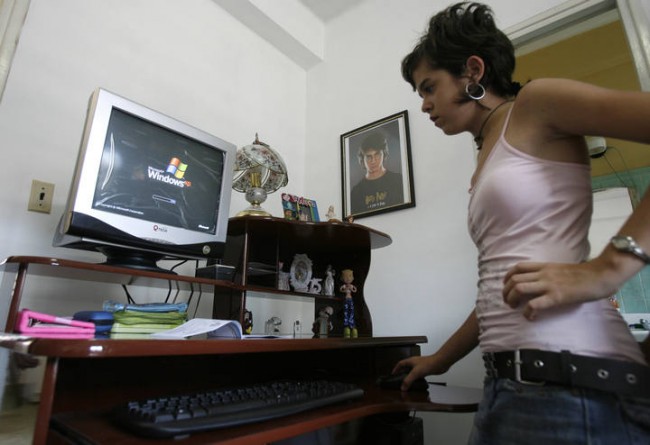
Photo : Reuters. Young woman from Havana, Cuba, turns on her PC to buy in Revolico.

Translated by Adrian Rodriguez

July 6 2011

Cuba, Another Parade / Iván García

In 52 years of Revolution, Cubans have become used to attending parades and events. Not always spontaneously. The members of rapid response brigades — paramilitary shock troops — are called to hold repudiation rallies and verbal lynchings against opponents, in particular against the Ladies in White.

Two weeks after the military parade in the Plaza de la Revolución on 16 April, Havaneros were called into mobilization again. This time at 7:30 in the morning, for International Workers’ Day, which has been observed for more than a century throughout the world, Cuba included.

Before 1959, the parades were combative and proper symbols of the anniversary were hung, or perhaps workers’ and unions’ demands. Now, since only one central workers’ union exists and other unions have been converted into administrative appendices and nuclei of the Communist Party — the only one permitted — the celebration of May Day has a clear and defined political tone.

It might be enough to read the official convocation: “The workers’ parade will be the expression of the unity of all the people and of its will to contribute to develop the implementation of the Cuban economic model through the strategies in accordance with the 6th Party Congress, and to establish the compromise of supporting and actively participating conscientiously in the transformation that this process demands to guarantee the continuity of socialism and the preservation of our independence and our national sovereignty”.

The cost of living has risen ferociously in the country, but those who parade in Havana and the rest of the provinces won’t be able to complain. Neither will they be able to shout or raise signs demanding raises in their salaries or claiming a series of measures in favor of self-employment. No. Among other political signs, some will certainly demand the liberation of the five Cuban spies condemned to long US prison sentences, and that Washington end its commercial embargo, in effect since 1962.

Despite the closeness to the World Press Freedom Day, on 3 May, to think that on the First of May it should occur to someone on the island to demand free traffic of information or internet for everyone.

In Cuba, one can march. Always and when one keeps to the time and date called by the government, the Party, or the Ministry of the Interior. Under this heading private initiatives are forbidden*.

Photo: Iván Castro, Flickr

(*) Recently, the police detained Darsi Ferrer, his wife and three more dissidents, who, outside the Coppelia Ice Cream shop, on the corner of L and 23 in Havana, were stopped while carrying signs demanding they be granted permits to travel overseas.

Share on Facebook

Translated by: JT

May 1 2011

The Health of Hugo Chávez Disturbs Many in Cuba / Iván García

When some days ago the Venezuelan chancellor Nicolás Maduro read a plain official note, announcing that President Hugo Chávez Frías, aged 54, would be undergoing surgery in the lower abdomen, few in Cuba paid attention.

Maduro’s message was issued in Havana, during a bilateral meeting as part of the strategic alliance signed by Cuba and Venezuela — members of the ALBA, a mercantile, financial and political alliance in which Bolivia, Ecuador, and Nicaragua participate.

The information about Chávez’s surgery has been manipulated with tweezers by the State media, almost as if it were a State secret; a matter of national security.

Lacking a free and transparent press, the rumors ran from one extreme to the other. All were fables and whispers. Politicians and local impresarios must be pulling their hair with the bad news about the colonel from Barinas. To the average Cuban his health doesn’t matter too much. What worries them are the consequences that a fatal end would bring.

When Benito, age 49, factory worker, learned that Chávez would be operated on, he gave it no importance. “By his age and because he seemed like a healthy man. But it seems that the man is fucked. I know because of the news I heard on Radio Martí and from people who illegally watch television from Miami by the ‘antenna’ (satellite connection). If he disappears from the ‘air’ (he dies), he’d bring us a million internal problems, from oil right down to the money that resolves the thousands of Cuban co-ops in Venezuela”, he expressed, alarmed.

From there come the shots of the common citizens. It is calculated that more than 30,000 Cubans lend their services in Venezuela, like doctors, sports trainers, engineers, coaches, and military men. In practice, this collaboration has turned into an ‘industry’ that permits the government to invest petrodollars – a deal that fattens the national GDP. And on the good health of Chávez depends all those thousands of Cubans in Venezuela continuing to bring home dollars and merchandise.

For every doctor who works in Venezuela, his family in Cuba receives around 60 dollars monthly. A pittance. But with that monthly payment, four people can eat hot meals once a day. And when the doctor returns after two years of service, they load him or her up with garbage for their families and to nourish the little clothing stalls staffed by the self-employed throughout the country.

Besides, the ‘internationalists’, as those who cooperate are called, can choose their houses. A true privilege: in 75% of the housing in Cuba three different generations reside under the same roof and 63% of the housing is in fair or poor shape.

For all these advantages, for simple Cubans the death of the strong man from Caracas would strip even more from the worthless national economy. They aren’t walking far from the truth. In the last 52 years, Cuba has lived on its belly, maintained by other nations and brushing half the world’s teeth. Doubtlessly, a change of government in Venezuela would be a catastrophe with dramatic overtones.

Raúl Castro knows it, too. The loquacious Venezuelan President won his power by votes. And those same elections could send him back to Barinas. Because of this, Castro II intends to make his slow and methodical reforms, which would permit him to tone down the consequences in case of something unforeseen in Venezuela.

The governors of Cuba aren’t waiting for the cart to get in the way. Precisely now, when the olive green impresarios tried to make the economy move on its own, with new investments and elevated consumption of petroleum. It would be to return to the most critical stage of the “special period”. Like getting in the time machine, but going backwards.

That the horse should sink halfway through the puddle wasn’t in the contingency plans of the meticulous wise men of the regime, dedicated to plan variances and political strategies. But if changes occur in Venezuela, Cuba would be left adrift.

To the Havaneros, who generally aren’t used to being interested in political events, the news coming from the south has them sitting up and paying attention. Ernesto, aged 54, a shaman, doesn’t even want to think about it. “Two of my sons are working in Venezuela, and I have eleven ‘adoptees’ (from santería) there. The future of my children depends on the dollars they can bring home”, he says. And adds: “No religious brother has been able to confirm what’s been said, that Chávez was coming to Cuba to make himself a saint (‘un Ifá’)”.

The first rumors were reassuring about health problems. Chávez should make himself a saint. “I hope that’s the motive. If it were true that he has a terminal cancer, then we won’t see blacks”, says Oscar, age 35, a party militant.

More drastic is René, age 69, palero (practitioner of the Palo or Rules of the Congo). “I always knew that Fidel was going to pull Chávez through his disgrace. Castro has very strong protectors. And those he usually holds up, or who die first, or fall into disgrace”.

For now, Fidel Castro has company in the hospital.

Photo: AP. Chávez’s supporters in Caracas.

Share on Facebook

Translated by: JT

June 27 2011

Reform without Freedom / Dimas Castellanos

The difficulty in understating what is happening in Cuba in the area of social change relates to the peculiarities of the current economic reforms. While the Guidelines approved by the VI Communist Party Congress have begun to be implemented, the government remains stuck in other areas, without which it is impossible to get results. This contradiction, which applies to the whole group of Guidelines, shows up particularly in the area of international relations.

Due to the systemic nature of social phenomena, any manifestation of the multiple contradictions contained in the approved Guidelines will be sufficient to lead to failure unless the rules of the game are first changed. I will refer to only two of them: 1- the need for financing and 2- the interest of the workers.

The first, because of the level of deterioration, obsolescence and destruction of the means of production in productive sectors, from agriculture and fishing to industry, requires an amount of investment that the Cuban state by itself cannot manage.

Without discounting the ideological solidarity of the Venezuelan government with Cuba, the great world-level financial centers demand democratic changes in Cuba as a prerequisite for the needed financial support. Among these are the European Union and the United States.

This shows the need for relaunching an internal human rights and civil liberties policy aimed at improving conditions for Cubans and, at the same time, changing Cuba’s image in this respect. This is what was achieved, partially, by the freeing of the political prisoners and the approval of the Guidelines. In addition to the insufficiency of these two measures, the decision to keep strict control over all dissident activities inside the country has led to a spiral of repression whose result conflicts with the need for external financing.

In the end, just before the suspension of the European Union’s Commom Position and the Carter visit to Havana as an indication of the beginning of a conversation with the neighbor to the North, the repressive internal policies have once again removed the possibility of external financing. As a result, Europe maintains its common position and the United States applauds the changes but considers them insufficient.

The other means of financing, insufficient due to the greatness of the needs but still considerable, is the possibility of allowing Cubans to participate as business owners in the changes that are taking place, so that part of the remittances from abroad are converted into capital. But this requires a substantial change in the totalitarian mentality of Father State, who insists that Cubans, inside or outside the country, only participate in what he decides and in the way he deems best.

The government wants domestic calm for the changes, but the decision to implement changes having been made at such a late date makes this impossible. So the alternatives are to permit a certain freedom of opinion, which the country needs for these very changes to occur, or to continue repression of everyone who thinks differently.

What is going to happen? I don’t think anyone can predict this without a high margin of error, but reflecting on some issues might help. In the first place, the inertia has been broken and the government cannot or has few possibilities of going back due to the level of social disagreement and the changes that are taking place outside the control of the state in international relations as well as internally.

All roads lead through the gradual implementation of human rights but, for this, interest in retaining the model that brought about the current state must be put in the background, to be judged by history, which will either praise it or denounce it depending on the option taken.

Translated by S.Solá

June 17 2011

Cuba: the Illogic of the Single Party / Dimas Castellanos

monumento-en-el-parque-central

(Published Friday May 27, 2011 on the site: http:www.vocescubanas.com)

The common characteristics that identify the human race also have important differences that cannot be ignored. The social character–the most defining and essential peculiarity of man–manifests itself in the diversity of associations that he creates for collaboration, promotion and the defense of his interests; reality that has its reflection in the philosophical concept of unity in difference.

As the etymology of the word indicates, political parties are associations not of all of society but of a part of it; as a consequence, any intent to convert a part into a Representative of the whole, with the diversity of interests and concepts that characterize it, constitutes a violation of the right to equality before the law and political freedom. For this reason every political party self-declared to be a sole force or superior force of society, in order to impose its will has had to violate the most elemental civil and political rights of the citizens: an act against the social nature of the human race, against dignity and consequently against social progress, which has let to the global failure of single parties throughout history.

In 1878, in Cuba there were created the Partido Union Constitucional/Constitutional Union Party and the Partido Liberal/Liberal Party, one of which represented the feelings of the Spanish and the other that of the Cubans. At the end of the XIX century, the Partido Autonomista/Autonomous Party was founded; it had a reform tendency and coexisted with the Partido Revolucionario Cubano (PRC)/Cuban Revolutionary Party (PRC), which supported independence. In 1899, Diego Vicente Tejera created the Partido Socialista Cubano/Cuban Socialist Party because the interests of the workers were not represented in the liberal and conservative parties at that time. In 1925, the Partido Comunista/Communist Party was founded by a group of Cubans who believed in that ideology. In 1947, Eduardo Chibas Founded the Partido Ortodoxo/Orthodox Party because the Partido Autentico/Authentic Party he belonged to did not satisfy part of its members. Fidel Castro, who came out of the Partido Ortodoxo, after the assault on the Moncada Barracks founded the Movimiento 26 de Julio/26th of July Movement, since his insurrectionist ideas did not fit the existing associations. Each leader or social group, depending on its interests, founded one single party; none proposed the absurd idea of founding several at the same time, which makes it ridiculous to justify the current single party state under the pretext that Marti organized a single party.

The Partido Comunista de Cuba/Communist Party of Cuba, self-proclaimed “superior guiding force of society and of the state”, after offering undeniable proof of its inability, such as the violation of the time limits in its own statutes for holding congresses every five years; of not respecting agreements made in previous congresses; of lacking personnel to rotate leadership roles; when it has been obliged to initiate reforms that violate declared principles, proposes to maintain the single party rule that is one of the causes of the failure seen.

Three recent facts demonstrate that the declared intention to change everything that must be changed does not include the single party system. In the Address to the VI Congress of the Communist Party on April 16, it was proposed that the National Conference to be held in January of 2012 have among its objectives to accomplish “for today and always” the content of Article 5 of the Constitution of the Republic, which sets out the single party system. The following day the President of the National Assembly of Popular Power said “it must be taken into account that this Party is really the political organization of the Cuban nation, the legitimate heir of the Party of Marti.” But even more eloquent was the article entitled “The Idea of a Single Party is the Legacy of Jose Marti”, published on April 8 in the newspaper Granma. Since this article proposes to attribute the authorship of the single party system to the most brilliant Cuban politician of all time, I will consider the direct quotations from Marti to demonstrate the absurdity of the arguments put forward in the article.

The first quote is taken from a letter written by Marti to General Maximo Gomez in July of 1882: To whom does Cuba turn at the defining moment, now near, in which it loses all its new hope at the end of the war, the promises of Spain, and the Liberals’ policy have made it hold? It turns to all those who have found a solution outside Spain. But if this does not work, eloquent, proud, moderate, profound, a revolutionary party that inspires, by the cohesion and modesty of its men, and the sense of its projects, enough confidence to quiet the longings of the country–to whom should it turn but to the men of the annexationist party that rose up at that time? How to keep all the fans of a comfortable freedom from following them, since they think that with that solution they at the same time save their fortune and their conscience? That is the serious risk. That is why it is time for us to stand up.1

Here, as we can see, Marti proposes the need for not the party but for a party, to attract those who would follow another party, which implies the existence of others. He does not propose to substitute or eliminate but to compete. Contrary to the article in Granma, he recognizes that “at a time when political struggle is expressed increasingly between political parties that are perfectly structured and organized a party is needed that would inspire confidence due to its qualities: cohesion in its ranks, the modesty of its members, the sense of its proposals.”

The second quotation was taken from the letter to Jose Dolores Poyo of November 1887: “At some other time our war could have been a heroic outburst or an explosion of sentiment; but having learned from twenty years of fatigue (…) the Cuban war is no longer a simple military campaign in which blind bravery followed a famous leader, but rather a very complicated political problem, easy to solve if we take into account its various parts and adjust our revolutionary conduct to it, but formidable if we pretend to create a solution without paying attention to its realities, or challenging them. (…) And what is most fearful about the revolution for the very ones who want it is the confusing and personal character with which it has been presented up to now; it is the lack of a revolutionary system, with clearly objective ends, that removes from the country the fears that the revolution inspires today and replaces them with a deserved confidence in the greatness and vision that the ideals of the war will carry with it in the cordiality of those that promote it, in the stated purpose of making war for a free and dignified peace, and not for the benefit of those who only see war as a way of achieving their own power or fortune.”2

Here no commentaries are necessary. Marti clearly refers to the need for an organization, in this case a party, in order not to repeat the errors of the past. But at no time does he speak of a sole party.

The third, dated April 30, 1892, says: “Unity of thought, which in no way means servitude of opinion, is without doubt indispensable to the success of every political program, (…) To open the thinking of the Cuban Revolutionary Party to disorderly thought would be as terrible as reducing the thought of a people composed of different factions, just as is humanity, to an impossible unanimity. If by its thoughts, and by its actions based on them, the campaign of the Cuban Revolutionary Party is to be efficient and most glorious, it is most necessary that, whatever the differences of fervor or social aspiration may be, there not be seen any contradiction or inflammatory reserve or vile partialities or regretted generosity in the thinking of the Revolutionary Party. Its thought must be seen in its deeds. Man writes himself with works. Man only believes in works. If we inspire faith today, it is because we do all that we say. If our new, strong power is in our unexpected union, we would voluntarily relinquish our power if we removed its unity from our thought.”3

In this quotation Marti emphasizes the need for unity of thought within the PRC as a condition for success, but he clarifies that this would be as dangerous as reducing its thought to an impossible unanimity. And he adds something that would be good to remember: Thoughts must be seen in deeds. many must write with his works. Many only believes in deeds. The idea of the unitary party seems to have only been in the mind of the author or authors of the article, since in the quotations used that idea is obviously lacking.

According to the article, once the Spanish power was eliminated and the American military occupation imposed, Estrada Palma considered the mission of the PRC to be finished and proceeded to dissolve the party, with which he mutilated an important part of the ideas of Marti, which foresaw using the Party not only in the war against Spain but also in the founding of a republic “with all and for the good of all”. In this conclusion the article confuses the ends with the means, since Marti’s proposal was to generate the Republic out of the war.

In the resolutions of the PRC nothing appears relating to its work after the victory, while its bases clearly define that the PRC is formed “to achieve with the common efforts of all men of good will the absolute independence of the Island of Cuba and to promote and help that of Puerto Rico”; and it is not proposed to perpetuate in the Cuban Republic “the authoritarian spirit and the bureaucratic makeup of the colony but rather to found in the frank and cordial exercise of man’s legitimate capabilities a new nation and sincere democracy capable of overcoming, through the order of real work and the equilibrium of social forces, the dangers of a sudden freedom in a society composed for slavery”; and that “it is not the objective to take to Cuba a victorious group that considers the Island as its prey and dominion but rather to prepare, with as many efficient means as freedom from the foreigner permits, war that must be made for the decorum and well-being of all Cubans, and to deliver a free country to the entire country.”4

Marti established a genetic relationship between War and Republic, in which the latter had to incubate from within the former. He project the founding of the Republic, which in his ideas was form and final destination, as opposed to the war and the party, conceived as intermediate links to arrive at it [the Republic]. For this reason, in the speech “With all and for the good of all” he said: “…let us close the path to the republic that is not prepared by worthy means of man’s decorum, for the good and the prosperity of all Cubans”5; and on December 5, 1891 he wrote to Jose Dolores Poyo: “It is my dream that every Cuban be an entirely free political man…”6

Let us examine other essential Marti ideas about the PRC.

1-While in New York in January of 1880, Marti presented a critical study of the errors of the Ten Years’ War in which he included the various factors that explained the failure and consequently pointed out its causes, among them the lack of unity among the revolutionaries, in which he deduces the need for an organization to forge it.

2- In June of 1882, in a letter to Maximo Gomez, he outlined the objectives of the PRC as follows: “…I only aspire that, forming a visible cohesive body all those selfless strong men appear united by the same serious and judicious desire to give Cuba true and lasting freedom, capable of repressing their impatience as long as there is no way to remedy the evils in Cuba with a probable victory in a rapid, unanimous and grand war…”7. Faithful to those principles, Marti separated from the Gomez-Maceo Plan in 1884 and wrote to the Generalissimo: “…But there is something that is above all the personal regard which you inspire in me, and even beyond all apparent reason: and it is my determination to not give an inch, through blind love for an idea for which my life is dedicated, to bringing to my country a regime of personal despotism that would be more shameful and terrible than the political despotism it suffers from now…”8.

3-In December, 1887 he notified Maximo Gomez that the country was stumbling toward war and that it lacked “a plan that unites it and a political program that calms it.”9. Precisely for this reason he founds the PRC, as an organizing, creating and controlling institution with a conscience focused on taking the place of spontaneity and immediate action.

4-In the Resolutions of November 1891, he stated that: “The revolutionary organization must not forget the practical needs derived from the constitution and history of the country, or work directly for the current or future predominance of any class, but by its grouping, according to democratic methods, of all the living forces of the country, for the brotherhood and common action of the Cubans living abroad, for the respect and assistance of the republics of the world, and for the creation of a just and open republic…raised with all and for the good of all”10.

5-On February 17, 1892, in Our Ideas, he said: “And it is not appropriate to ask if the war is attractive or not, since no faithful soul can be attracted to it, but to organize the war so that with it comes republican peace, and after it the upheavals that have had to be suffered will not again be justifiable or necessary…”11.

6-On April 10 of the same year, in the founding act of the PRC, he reiterated that the party be created: “so that in the achievement of the independence of today go the germs of the definitive independence of tomorrow” April 12, 1893 he said: “Greatness is that of the Revolutionary Party: that to found a republic, it has begun with the republic. its strength is that: that in the work of all, the right of all. It is an idea that must be brought to Cuba: not a person”13. It appears that the content of these two quotations led the author of the article published in Granma to think they referred to a supposed task of the PRC after the victory.

7-In the Manifesto of Montecristi signed jointly with Maximo Gomez on March 25, 1895, he stated that war is not “the unhealthy triumph of one Cuban party over another, or even the humiliation of one mistaken group of Cubans but the solemn demonstration of the will of a country that is fed up as proven in the previous war to launch itself lightly into a conflict that must end only with a victory or in the tomb”14.

The common point in the quotations taken from the Granma article, and in those I add, is that the founding of the PRC was conceived as an organizing, controlling and consciousness-raising institution in order to take the place of spontaneity and immediate action, encourage unity among the combatants, replace caudillism, personalism, and direct the war as a tactical necessity part of a larger strategy, as an intermediate link in order to give birth to the Nation and construct the Republic with all and for the good of all. Its functions were laid out so that from its center would arise the seeds of a definitive independence, not to represent a social class or the revolutionaries but all Cubans, not for elective gain, not to dominate and prohibit the existence of different parties after the victory, not to cancel out popular participation, not to declare that the street and the university belong to the revolutionaries, not the jail those who think differently. Realities that demonstrate Marti’s democratic and humanistic ideas are not only far from but contradictory to the practice of a single party system.

The unnatural character of the makeup of Cuba’s single party system is such that for its establishment they had to eliminate all the other political parties and the variety of existing associations, from which process emerged a “perfect” model of a totalitarian regime and, with it, stagnation and failure.

Even accepting the absurd thesis that Marti foresaw after the victory using the Party in the founding of the Republic, one would have to also accept the contrary thesis that, due to his deeply democratic philosophy, he would do it in competition with the existing parties, not by declaring on his own that his would be the only party. Neither did any of the delegates to the constitutional assemblies of Jimaguayú (1895) and de la Yaya (1897)–among which there were followers of Marti’s ideas such as Fermín Valdés Domínguez and Enrique Loynaz del Castillo–propose to include any article of that type, which demonstrates the absence of such an intent. Another resounding proof is the difference of interests and of social composition of the revolutionary groups in Florida, New York and inside Cuba, a diversity that Marti called on for the war but which after the victory manifested itself naturally in the variety of classifications and purposes.

For all of these reasons, the purpose of defining the role of the Communist Party as the organized vanguard of the nation in the coming National Conference should be corrected, for the good of all Cubans and in respect for Jose Marti. And in its place political differences should be legalized and the right to free association instituted, so that in the presence of other parties, the Communist Party might demonstrate or not its capacity to call itself vanguard, but above all, so that Cubans become citizens and play the active role that belongs to them in the destiny of the nation.

1 MARTI, JOSE. Selected Works in three volumes. Havana, Editorial de Ciencias Sociales, 2000. Volume I, p. 326.

2 Marti, Jose. Complete Works. Havana, Editoria de Ciencias Sociales, 1991. Volume I, pp 211-212

3 Marti, Jose. Complete Works. Havana, Editorial de Ciencias Sociales, 1991. Volume I, p. 424

4 MARTI, JOSE, Selected Works in three volumes. Volume III, pp.26-27

5 MARTI, JOSE. Selected Works in three volumes. Volume III, pp.9-10

6 MARTI, JOSE. Selected Works in three volumes. Volume III, pp 24-25

7MARTI, JOSE. Selected Works in three volumes. V I, P.325

8 MARTi, JOSE. Selected Works in three volumes. V I, p.459

9 MARTI, JOSE. Selected Works in three volumes. V II, p.211

10 MARTI, JOSE. Resolutions taken by Cuban emigrants in Tampa and Key West in November 1891. Selected Works in three volumes. V III, p.23

11 MARTI, JOSE. Selected Works in three volumes. V III, p.65

12 MARTI, JOSE. Selected Works in three volumes. V III, p.99

13MARTI, JOSE. Selected Works in three volumes. V III, p.192

14MARTI JOSE. Selected Works in three volumes. V III, p.511

Translated by S. Solá

June 3 2011
RIDING MISTER ROJAS / Orlando Luis Pardo Lazo

RIDING MISTER ROJAS, originally uploaded by Orlando Luis Pardo Lazo

In art, like in politics, the speeches of epigones, now free of the original guilt of the Messiah, start attempting a liberal rereading of the revolutionary scripture and end up being pure fascism. The Cuban intellectual Fernando Rojas, beyond his high governmental charge (every now and then the rumor that he will replace Abel Prieto circulates with horror in the Cuban literary camp), has no reason to be the exception.

Half a century after an adjustment in incidental accounts, Rojas relaunches Fidel Castro’s Words to the Intellectuals from 1961, to the future. He does not want to let the archeologists be the ones who exhume the fossil violence of the document. To interpret is to sanitize. And Rojas bets on ideologizing what was such a concrete act: to put the gun over a desk at the Biblioteca Nacional, the National Library.

It’s about, of course, an attempted coup against Cuban culture. A process of terminal “red”-ization. And hopefully that maneuver will be successful, beyond his scientific demagogy and his republican cadence of Stalinist party in power. Because the full health of any culture is only attained under the obscene boot of a despot. Because without censure there is no moral resistance that might yield limited creativity (cue the developing world’s yawns for our aesthetic exile). Because the future depends on equal parts victim and torturer, where right now Fernando Rojas incarnates that second role (leading role and not at all supporting) with historic chivalry.

So then, the next decade promises to be both gray and luminous in Rojas’s perspective. There will be debates of an anti-dogmatic style about the big mistakes of the Revolution’s past. The bureaucracy will be bureaucratically memorialized for the one-thousandth nine-hundredth fifty-ninth time. There will be rescue rectifications, even for the non-revolutionary writers who don’t get to be incorrigibly reactionary (I myself might be saved on a little plank there). The rage of Cabrera Infante and Reinaldo Arenas will be bleached, like the iniquitous irony of Virgilio Piñera and the atrocious cunning of Lezama were, in their moment, bleached as well. The barbarism of Lydia Cabrera will be folklorized and the stridencies of Celia Cruz will be obligatory. In the meantime, the market will continue being a medieval tool in the mummified hands of the State: the illusion always immersed inside the institution. It’s the theory of the ripe carrot versus the tyranny of an olive green whip.

Applause, close ovation: that’s how the Cuban press transcribed the translation of Fidel Castro’s calligraphers. And Fernando Rojas should’ve finished off like that Granma’s grammar in his last speech. He should not have felt pity for that coda that no one in Cuba, except me, will concede him. In fact, applause and closed ovation is the least that the monolithic ideal that betrays him from paragraph to paragraph deserves, the ones that suppurate an anti-intellectual disdain that would be better articulated, in terms of author, in one of those novels about the loneliness of a dictator previously sadistic and now senile.

Fernando Rojas magnanimously pardons his new captive children’s lives (little happy men that are panic-stricken by him or flirt with him, but definitely children lost in the forest, that sooner or later, will be corrected by the political Peter Pans who care for them). There is no way to avoid his good intentions when brandishing a paved paper like it’s the sole Law. Our Rojaspierre in the ministry knows that the illiteracy of the Cuban audience is in direct proportion to their high educational level. Everyone wants to create, ergo it will then be very easy to make them believe first. And later we will agree on heroes and tombs, as well as grants and voyages, but always complicitly between companions, because out there and in here citizens are sharpening their knives, that never-as-useful than today unscrupulous and insatiable counterrevolution.

Nonetheless, in spite of the enlightened effort of Rojas, clucking out of context “inside the Revolution, everything; against the Revolution, nothing,” forwarding the phrase without reading the rest of that primitive speech, exaggerating its character of cultural apartheid and nullifying the semantic subtleties of socialism, maybe it has been the luck of a minimal vengeance, inconsistently transgenerational, almost an anonymous tweet that doesn’t remember what user it came out of, a discontinued vanishing line before the megalomaniac monologue of decades and decades of the Maximum Leader in his tribunal grandstand. It seems that each one has the bad date he deserves.

Translated by: Joanne Gomez

July 6 2011

growwwing old.cu / Orlando Luis Pardo Lazo

20TH CENTURY OLD MAN

Orlando Luis Pardo Lazo

I suddenly aged today.

I lived my normal life, at the margin of everything, now without understanding anything too much, but without worrying about it. I looked at death with indifference. At pleasure with a touch of horror. At society like a tolerable evil. At lies like metaphors. At my mother as if she still was my mother. I suspect I was at peace today.

Then I suddenly aged.

On the TV, Fidel and Chavez incarnated the scrawny image of defeat. Not political defeat, of course. In that arena, both tend towards immortality now. Instead in biological defeat. The swan song of the body. Holding on to the Cuban newspapers, that say so little, luckily. Snatching tasteless headlines. Fixing the date of the day before cameras without microphones (the audio was awful, maybe on purpose) so that the whole world would judge them as living zombies.

I looked at my hands. Since high school I had not felt that panic. The visible veins, the porous skin. I thought of my age. I turn 40 in December. In a little while I’ll probably look worse than Fidel. In a lot less time, something like Chavez’s mysterious pelvic abscess could happen to me (except I would have terrible free medical attention in my own country). In no time, there will be no reverse for my aging. In fact, I already feel very old. Ancestral. Archaic. It’s enough, please.

It seems it was essential to liberate that hyper-edited video for the always pressing international public opinion. It seemed pathetic to me. I had never seen Fidel like that (maybe it had been decades since I paid him any attention). I remembered the elderly of my family, all too long-lived. Their mandibles and cheekbones and gesticulations were now those of a Fidel guided more or less by Chavez’s infantile incontinence.

I stretched my hand. I wanted to touch the man before it was too late. It’s called piety. Too late could very well be too late for me. My eyes teared up. There is no beauty in the ruins of a human being. There is never justice in that much decadence. It would be monstrous if we didn’t die, but any prattling cadaver is a startling monstrosity. I say it only for my grandparents, it is understood. I say it only for myself.

When the little video ended, I felt I could not regroup in front of the TV. My joints burned. My cheeks much more. I was hungry. I wanted to go out and buy stuff. Stuff to accompany me to the end of the world. But I didn’t dare. I fancied Planet Cuba as a spectral place, a hologram in past perfect, a fragile fractal whose disciplinary order was to the point of exploding.

My little bones jingled. I felt an insufferable pity for myself. Cuban television was digging the grave where its sensible citizens let themselves fall. I would’ve done it today, almost without noticing. I don’t want to look like that, please. I don’t ever want to see anyone like that.

Translated by: Joanne Gómez

June 30 2011

The Poet / Rebeca Monzo

(This story is fiction, based on reality)

My friend was finishing transferring to his flash memory, the last poems that, like all, had left his heart exhausted. Each time that he put the last period on one, he said that it was like having given birth. It is clear that this hadn’t happened out of his own experience, this sublime pain, but being the older son, he was the witness of the birth, one by one, of his fifteen siblings, and he could appreciate in the sweaty face of his mother, how painful it was.

Meanwhile, in the other bedroom, his wife hastily put in the suitcase everything that she understood was strictly necessary. After returning, because she knew return was inevitable, they would come loaded with gifts, books, and glory, things that weigh a lot and that would make the overweight fees very costly.

Whatever the case, his slovenly appearance urgently needed fixing, a product of none other than the extreme necessity brought by the passing years, leaving for the last moment the fixing of his teeth. They paid dearly and in the black market economy so that it would be done well. He knew that upon arriving at the town where his books wold be launched he would be obliged to smile and say some words of thanks.

The outbound trip was good, because really he didn’t bring more than the clothes he was wearing and a change for his arrival. His wife, friend, confidant, lover and editor, did the same, so that the luggage would be very light.

After a very tiring plane trip, they took the train. In Groñolo, the destination of both, a massive reception awaited them, with a band, regional dances, and streamers. Meanwhile, from the sky, an airship let mountains of confetti fall from the sky. It looked like it was snowing in the middle of summer.

Suddenly, the music stopped and the multitude of people began to chant his name and clap. He went up to the improvised podium, with his blue suit that the mayor had sent him as a gift and started his speech. As he was getting excited with his own words, he started to notice his tongue getting a little slipped-up: he felt that something was moving inside of his mouth. Relying on the serenity and grandeur that had always characterized him, he continued his address. Then those closest to the platform stopped paying attention to his words, to stoop to pick up those little white and shiny grains, that at first they believed were falling from the sky. When, suddenly, one of those who were present, raised up his arm into the air to show everyone his discovery: “It’s a tooth,” he exclaimed enthusiastically, “A tooth from our great poet!” Everyone crouched down to eagerly look for one, to take it as a souvenir. The poet, growing even bolder and without losing his composure, said, “I haven’t only come to offer the most passionate verses, projecting from my mind and heart, I also left you a little bit of myself: those teeth that you will take today as a souvenir, and that with great pleasure I will autograph, because even though acrylic, they are part of myself since what I paid was so very expensive.

The crowd, in the face of such words, acclaimed deliriously that great man that came from a small island far away, not only to deliver brilliant poems to them, but also his shiny teeth, no less, as proof of his love and friendship.

Translated by: BW

June 27 2011

4th of July / Rebeca Monzo

Today we celebrate the 235 year anniversary of the Declaration of Independence of the United States of America, a country of immigrants and grand opportunities, so defamed by some and so dreamed about by many. I, particularly, have some critics, who say that I am pro-American, they don’t offend me. It is true that I greatly admire that country. But, I was born, I grew up, and I educated myself feeling proud to be Cuban. That is contrary to others, who defame it, and they say they feel hate and resentment against it, but don’t miss the opportunity to shop in its famous stores, take their kids to Disneyland every time they can and dream that someday one of them will get a degree from one of its universities.

In any case, humbly from this, I join my space together to the happiness of the celebration.

Translated by: BW

July 4 2011

Official and Alternative Twitterers Launch a Truce / Iván García

Like two boxers who stare each other in the eye, before beginning their attack, came TwittHab, the first encounter between official and alternative ‘twitterers’. If the proposition was to fraternize and build bridges, this first exploratory round between virtual gladiators who’ve made blogs, Facebook and Twitter a tool for spreading their ideas, was below expectations.

The cause wasn’t the attendance at the debate of heavyweights. The star blogger of the alternatives, Yoani Sánchez, was mute. Also absent were Claudia Cadelo, Reinaldo Escobar, Dimas Castellanos, and Miriam Celaya — bloggers of an indubitable level.

For the band of those supporting Fidel Castro’s brand of socialism neither the excellent bloggers Sandra Álvarez, nor Elaine Díaz, nor the ghost-like Yohandry Fontana appeared. But it wasn’t bad. It is always welcome to build bridges.

And of course, the dialog, the presentations and the interchange of e-mails between cybernauts who sometimes trade acidic disqualifications on the net are preferable to physical violence practiced by the piece by certain groups loyal to the regime.

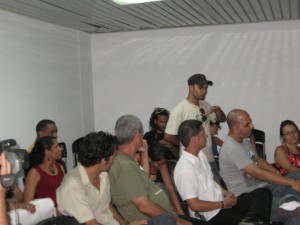
Four in the afternoon of Friday 1 July passed in an aseptic cubicle in the Cuba Pavillion, in La Rampa, in the heart of Havana, a chat was started between ‘twitterers’ accepted by the government and the others, those who want profound changes in the matter of political and economic freedoms.

The pro-government ones played with a 5:1 advantage. Of the more than thirty attendees, there were only six independent bloggers and ‘twitterers’. Leunam Rodriguez, a young twenty-something who seven months ago opened a Twitter account, played moderator. The exchange started cold, with scorched looks and the logical suspicion between persons who reside in a nation where debate of opposite opinions is a rare bird.

Of course, respect got priority, although there were threats of uprisings. One of them happened when the blogger Henry Constantín, after noting gratitude for the diplomatic and polite climate, said “Some days ago, when I was expelled from the Instituto Superior de Arte (ISA) for political motives, I was beaten and received threats from State Security, now in this room I see that I can state my opinions without receiving a sudden volley of blows”.

The response of the official bloggers and twitterers was that in this encounter there would be no blows. Leunam defended the right of each one to freely express his views, as much on the net as in any other way. He declared himself a part of the revolutionary project and paraphrasing the troubadour Silvio Rodriguez, noted that “revolution is evolution”.

And so, when an alternative blogger identified as Agustín López gave a speech with clear political bias, the journalist, blogger and editor of the magazine The Middle Way, Enrique Ubieta, jumped like a spring.

“Please, we are here to fraternize, not to make political allegations”, said Ubieta. A difficult result in a meeting between individuals with different ways of thinking, politics doesn’t rise to the fore.

It is precisely the political arguments that make citizens different. If they had talked about sports, stamp collecting, fashion, or cinema, perhaps everyone would have ended up drinking some beers in a bar.

But if they share political differences, Cuban bloggers from one or another group, we’ll have more things that unite us than divide us. We all suffer chaotic public transport, the poor state of the streets and housing, and how expensive it is to bring food home to the family table, among other material difficulties.

Talking is always healthy. To reason and respect the discrepancies of others. Softening jealousies will cost enough. Something is more than nothing. And at least in this first encounter, ‘twitterers’ of both groups could look face to face and even exchange greetings.

It would have been better if there had been some principle players in this virtual “battle of ideas”. We missed Elaine and Sandra, Yoani and Claudia. And those present remained without knowing who, in reality, is Yohandry Fontana — he will keep being an ethereal guy, a question mark.

Perhaps these debates with uncovered faces will be a test balloon on the part of the government of Raúl Castro. Or they might not be. We’ll give him the benefit of the doubt.

Photo: Iván is the mulatto whom we see in the last row, on the left.

Share on Facebook

Translated by: JT

July 3 2011

PS 2 / Rosa María Rodríguez Torrado

Image taken from http://www.joystickdivision.com/2009/12/15_games_defined_playstation.php
The group I was speaking with got involved in a baseball discussion about whether it was a sport, pastime, or both, the game of balls and strikes; in the poor defense the national teams have shown throughout the series and the bad state of the terrain. The reasons are many and we really don’t need the “accommodating and advisory” quality of the sports commentators, who show their faces on Cuban television so that the fans, knowing the multiple reasons that could be affecting our athletes, can toss their uncensored opinions around like an expert roundtable.

So as not to be missing the usual things, the masculine voices began to rise in tone and impeded me taking my mental aqualung to abstract myself from the passionate racket that seemed unnecessary to me. But in spite of the raised voices, I managed to submerge myself “in apnea” in my thoughts and I made a parallel with the popular Play Station video game I’d seen the daughter of a friend playing a few days before. I asked myself how much it would advance in a few more years and if they would continue counting the new consoles in the saga the Sony brand is making. Evidently, competitiveness will prevent no. 52 of the new game from coming out with the same name and technological development will make them better all the time. What I don’t want is for them to prevent the possibility of piracy, to be able to play with burned CDs and to even introduce our own version of MVP-Cuban Government Leagues (forever). In particular, I can’t imagine some old folks running the bases time and again in an endless game. I beg on the healthy, clean, and authentic competition where quality and whoever does the best in the 9 standard innings prevails. After the 27th out, it is not legitimate nor ethical to make use of ruses to avoid the sign that says “Game over.”

May 18 2011

Professional Protesters / Fernando Dámaso

The public meetings and marches of protest, so common nowadays, are almost as old as the humanity itself. In different forms, and for different reasons, we can find them in all eras of world history. Some because of their transcendence, have prevailed in our memories, and others less important, have been erased by the time. However, both have played a roll in the making of history, facilitating changes and adjustments, mostly for the benefit of the mankind. Those who had been participating consciously in them, and those who still participate today, defending their rights and good causes, deserve a lot of respect and are not the subject of these lines.

Since the end of the past century and the first years of the current one, they had been changing and growing, sometimes out of proportion. Today protesting has become commonplace, practically everything is protested, turning it into a national sport as well as an international one. There is a great variety of protests: against the politicians in office, against economists, against credit organizations, in support of different social groups, against the greenhouse effect, against fossil fuels, against hunger, in favor of the whales, polar bears, kangaroos, etcetera. Sometimes they are organized against certain books, pictures, paintings, sculptures and so forth.

In this process of spreading mass protests, avery peculiar character has emerged: the professional of the protest (the protester). In reality, he is not concerned with the reason of the protest and has nothing in common with it. His participation is just motivated by snobbishness and his attention seeking behavior. As a general rule he has a comfortable economic situation or a patron (individual or social), who conveniently helps him. In his wardrobe, to make sure he won’t clash with the nature of each protest, he has all kind of outfits: from t-shirts with musical or third world icons, like Che and Lennon, to olive-green caps showing humongous red stars at Mao Zedong style, not counting boots, jeans, jackets, parkas, etcetera, all of them of famous brand names, preferably the most popular ones.

Another important aspect is their freedom of movement: He or she is ready to participate (interested or disinterested) in any part of their own country or the world, as long as in that place the right to protest is conveniently respected. You will never find them in those places where protest (by your own decision) is strictly forbidden, and by doing it you pay with your life or a jail term. This character shows up either in a big city or a tiny country town in the middle of nowhere, any place where there’s someone or something to protest against. They meet and move massively by land, air or sea, using buses, trains or ships and even planes. They come like the plagues and proceed to settle down and establish chaos and anarchy, making more difficult the existence of the locals, with their multiple signs and banners in the wind, their burning of flags and their speeches and harangues learned well by repeating them restlessly.

Years ago, many of these characters, planned their social international meetings in their agendas: for the spring, an exhibition of Van Gogh paintings in Amsterdam; for the summer an out doors concert in Saint Mark’s square; ; for the fall , in Paris Opera house and in the winter, in the Rockefeller Center in New York City. Now everything had changed: in the spring they meet for a march in defense of the whales in Sidney, Australia; in the summer in London against the International Monetary Fund; in the fall in Buenos Aires in support of the native South American Indians and in the winter in Moscow against the greenhouse effect.

These activities, of a marked folkloric significance, are made with a big deployment of the news media, due to the importance of protesting, but also and much more important, is to be in the newspapers, magazines, the TV and also on the internet. This builds the curriculum for a future events participation. Obtaining a protester profile, guarantees your position in the select group of professional protesters, including to be invited to different events, most of them all expenses paid. The professional protester, born in the last century, without a doubt, because of his dedication and tenacity, has a place in society and has created a new occupation for the XXI century.

Translated by: Adrian Rodriguez

June 22 2011

PS 2

Image taken from http://www.joystickdivision.com/2009/12/15_games_defined_playstation.php
The group I was speaking with got involved in a baseball discussion about whether it was a sport, pastime, or both, the game of balls and strikes; in the poor defense the national teams have shown throughout the series and the bad state of the terrain. The reasons are many and we really don’t need the “accommodating and advisory” quality of the sports commentators, who show their faces on Cuban television so that the fans, knowing the multiple reasons that could be affecting our athletes, can toss their uncensored opinions around like an expert roundtable.

So as not to be missing the usual things, the masculine voices began to rise in tone and impeded me taking my mental aqualung to abstract myself from the passionate racket that seemed unnecessary to me. But in spite of the raised voices, I managed to submerge myself “in apnea” in my thoughts and I made a parallel with the popular Play Station video game I’d seen the daughter of a friend playing a few days before. I asked myself how much it would advance in a few more years and if they would continue counting the new consoles in the saga the Sony brand is making. Evidently, competitiveness will prevent no. 52 of the new game  from coming out with the same name and technological development will make them better all the time. What I don’t want is for them to prevent the possibility of piracy, to be able to play with burned CDs and to even introduce our own version of MVP-Cuban Government Leagues (forever). In particular, I can’t imagine some old folks running the bases time and again in an endless game. I beg on the healthy, clean, and authentic competition where quality and whoever does the best in the 9 standard innings prevails. After the 27th out, it is not legitimate nor ethical to make use of ruses to avoid the sign that says “Game over.”

May 18 2011