The shipment includes 700 food kits and 700 hygiene modules, as part of the $100 million package announced by Washington
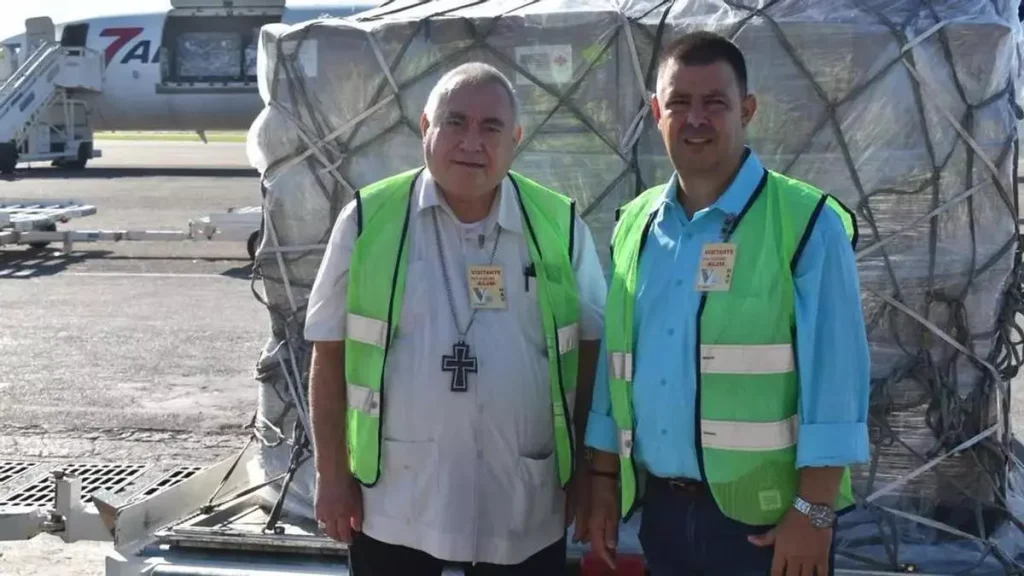
 EFE/14ymedio, Madrid, October 9, 2026 / A shipment of humanitarian aid sent by the United States arrived this Thursday at José Martí International Airport in Havana, bound for vulnerable families in the Diocese of Pinar del Río. Caritas Cuba reported that the shipment includes 700 food kits and another 700 hygiene modules.
The diocesan bishop, Juan de Dios Hernández Ruiz, and the director of Caritas Pinar del Río, Abel Castillo López, received the cargo at the air terminal together with volunteers and airport staff. Distribution will take place in the parish of Candelaria and in the community of Quiebra Hacha, which belongs to the parish of Mariel. Although they are part of the Pinar del Río diocese, both communities are in the province of Artemisa.
Caritas volunteers identified the beneficiary families in advance and coordinated the receipt and delivery of the donation. The organization says the distribution will be guided “by transparency, equity and social justice.”
The aid will prioritize elderly people living alone; pregnant or breastfeeding women with identified risks; children under five years of age in vulnerable situations; and people with disabilities or who are bedridden and unable to care for themselves.
We are fully aware that we cannot reach everyone, and that is a reality that pains us. Resources are limited and priority is given to those who need it most
In a statement, Hernández Ruiz acknowledged the limits of the shipment: “As a Church, we are fully aware that we cannot reach everyone, and that is a reality that pains us. Resources are limited and priority is given to those who need it most.”
The shipment is part of the $100 million humanitarian aid package announced by Washington in May. Of that amount, $60 million would be channeled through the Catholic Church, with the collaboration of Caritas Cuba and Catholic Relief Services; the other $40 million would be handled by other organizations.
The first 18-ton shipment arrived in Havana last July. In September, the US Embassy announced that the aid would also reach Pinar del Río and four other provinces: Camagüey, Ciego de Ávila, Cienfuegos and Matanzas. Days earlier, Caritas had received in Santa Clara another shipment of 700 food and hygiene modules, intended for communities in Villa Clara.
So far in October, the Dioceses of Camagüey province and the parish of Gaspar in Ciego de Ávila, also in the central region, have received shipments as well.
The US State Department announced in May that the $100 million in aid would be “direct humanitarian assistance to the Cuban people, which would be distributed in coordination with the Catholic Church and other independent and trustworthy humanitarian organizations.”
The arrival of the donations comes at a time of heightened verbal confrontation between Havana and Washington, considered the greatest tension in decades in their contentious relations.
The aid arrives in the midst of a deep economic crisis that the island has been suffering for six years, aggravated by the pandemic, failed national policies and US sanctions. The crisis is reflected in shortages of food, fuel and medicine, galloping inflation, prolonged blackouts and growing dollarization.
Since January, Washington has added a policy of “maximum pressure,” which includes an oil blockade and, since May, secondary measures against vital sectors of the Cuban regime’s economy, which have worsened the economic and energy crisis.
Translated by GH.
______________________
COLLABORATE WITH OUR WORK: The 14ymedio team is committed to practicing serious journalism that reflects Cuba’s reality in all its depth. Thank you for joining us on this long journey. We invite you to continue supporting us by becoming a member of 14ymedio now. Together we can continue transforming journalism in Cuba.