The arrival of two American warships in Guantánamo capped off a particularly fertile month for rumors
 14ymedio, Havana, September 7, 2026 – August ended in Cuba the way it began: with blackouts, uncertainty, and a collection of rumors that spread through the streets, social media, and instant messaging services. That universe of speculation had a bit of everything: changes at the top of the presidency, the disappearance of the Cuban peso, the resignation of Miguel Díaz-Canel, internet restrictions, and, to close out the month, an imminent US invasion.
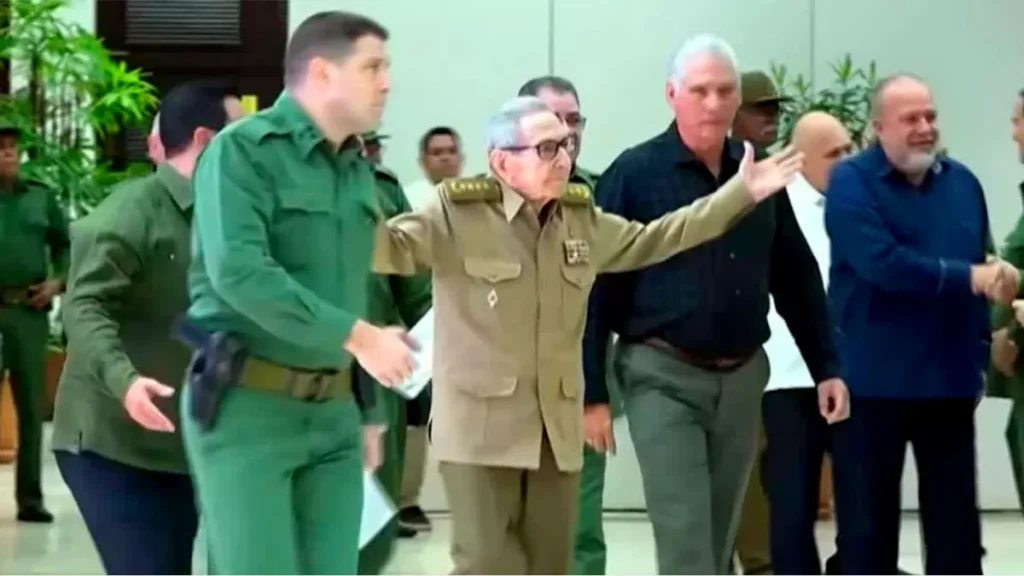
The most persistent rumor once again starred Raúl Castro. Messages and posts claimed that the 95-year-old general was gravely ill after suffering a stroke, and some declared him outright dead. The story grew until it jumped from social media into some news outlets.
This is not the first time Fidel Castro’s younger brother has been buried ahead of schedule. With the general’s obituary “frozen” for years in numerous newsrooms, every piece of news about his health triggers a mix of anxiety, expectation, and speculation about the day after. In Cuba, where leaders’ medical bulletins tend to be state secrets, official silence also provides magnificent fertilizer for the imagination.
This is not the first time Fidel Castro’s younger brother has been buried ahead of schedule. With the general’s obituary “frozen” for years in numerous newsrooms
Another WhatsApp chain resolved the succession question more expeditiously. Inés María Chapman, the deputy prime minister, was supposedly “the Cuban Delcy Rodríguez,” on the verge of becoming “CUBA’S NEW PRESIDENT,” no less than with Washington’s backing. The sustained use of capital letters, indispensable in the diplomacy of hoax chain messages, stood in for any source, document, or statement that might have backed up such a political turnaround.
A supposed Central Bank statement also circulated, announcing the “definitive elimination” of the Cuban peso as legal tender and the full dollarization of the economy. However, the national currency remains officially alive – even if its purchasing power looks more dead by the day.
Miguel Díaz-Canel was made to resign once again. A fake letter, circulated under the usual “Breaking News” label, opened with a solemn “Compatriots” and presented an unexpectedly self-critical president, willing to admit that he had underestimated the economic crisis, reacted too late to food and medicine shortages, and failed to keep his promises. Perhaps the element that most quickly gave away the hoax was precisely so much contrition in one place.
The state telecom monopoly Etecsa didn’t escape the rumor mill either. Another fake statement, carefully drafted in bureaucratic style, announced that starting September 1st Cubans would only be able to use mobile data for four hours a day, between ten at night and two in the morning. Given recent experience with rate hikes, restrictions, and connection troubles, many people didn’t even need much convincing to believe it. When reality has spent years training the public for the worst, rumor-mongers have much of their work already done for them.
But August saved its action movie for the very end. On the 31st, two US military ships, the USS Billings and the USS Minneapolis-Saint Paul, arrived at the Guantánamo Naval Base. The presence of both vessels is documented by the US Navy itself; the Billings arrived as part of a scheduled deployment, and the Minneapolis-Saint Paul had left Mayport, Florida, on August 27th to begin its own.
The two vessels were enough to dust off rumors of an American military intervention, further fueled by regional tensions
For some, however, it took only a few forwarded messages to leap from that to invasion. The two vessels were enough to dust off rumors of an American military intervention, further fueled by regional tensions. For certain influencers, the ships were definitive proof that “something big” was about to happen.
None of it happened. But the rumors thrived because each one touched a real anxiety: who will control the country after Raúl, how much further the national currency can deteriorate, how far the restrictions will go, and how a crisis that seems bottomless will end. In today’s Cuba, a rumor doesn’t need to be true. It’s enough for it to look too much like something that could happen.
Translated by GH.
______________________
COLLABORATE WITH OUR WORK: The 14ymedio team is committed to practicing serious journalism that reflects Cuba’s reality in all its depth. Thank you for joining us on this long journey. We invite you to continue supporting us by becoming a member of 14ymedio now. Together we can continue transforming journalism in Cuba.