The tank fitted into the truck’s cargo compartment illustrates the precariousness of a city battered by blackouts and breakdowns.
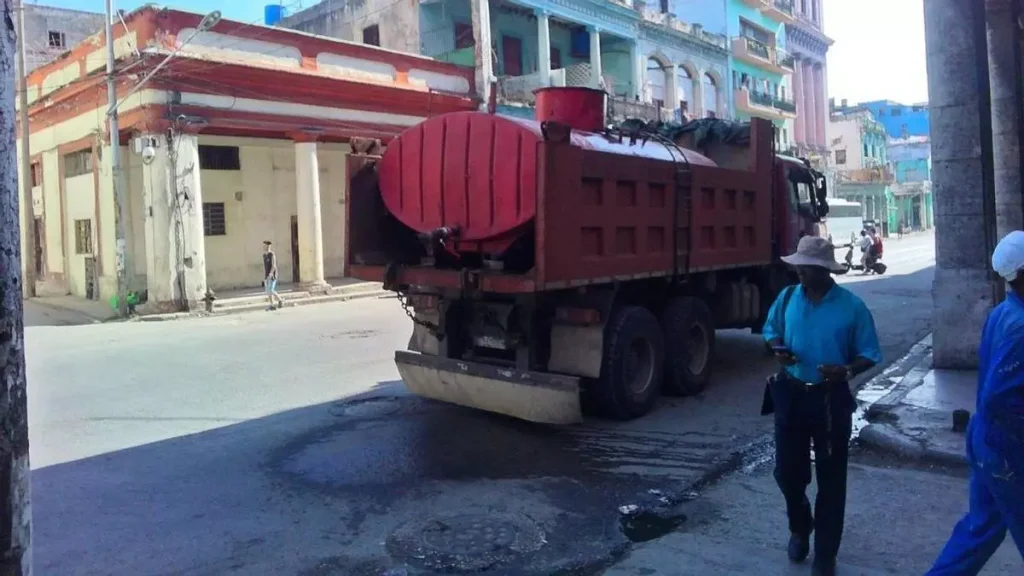
 14ymedio, Juan Diego Rodríguez, Havana, September 5, 2026 – At first glance, it looks like an old cargo truck stopped alongside the curb. But a look at the back reveals the contraption. A cylindrical tank has been installed inside the vehicle’s cargo bed, and at one end an outlet allows the water to be discharged. The result is an improvised water tanker, one of those emergency solutions that in Havana eventually become part of the landscape as if they had always been there.
The vehicle, seen by 14ymedio on Reina Street in Centro Habana, retains virtually intact the structure of an old Soviet-made Kamaz. The tank has been fitted inside the compartment originally intended to transport cargo, far removed from the configuration of a truck specifically built to carry liquids. The adaptation is rudimentary, but apparently it does the job.
The scene would be little more than a mechanical curiosity if it did not appear amid the severe supply crisis affecting the capital. In recent months, dozens of neighborhoods have suffered prolonged interruptions caused by breaks in water mains, equipment being out of service, leaks, and above all, blackouts that leave pumping systems without electricity.
This summer, several Havana residents have reported prices of between 40,000 and 60,000 pesos for a water tanker
Recent breakdowns in systems such as Cuenca Sur and Oeste have affected densely populated municipalities, including Centro Habana, Cerro, Plaza de la Revolución, Diez de Octubre, Playa, and Boyeros. Aguas de La Habana reports almost daily on new interruptions caused by lack of electricity, breakdowns, and repair work. The problem of obtaining electricity thus adds another increasingly basic problem: turning on the tap and having water come out.
When the network stops working, water tankers go from being an auxiliary service to becoming a lifeline. But even for that, resources are not plentiful. Vehicles in good condition, with spare parts and fuel, are also scarce, and the Government itself has acknowledged difficulties in meeting distribution schedules using tanker trucks.
The shortage has also created a lucrative informal market. This summer, several Havana residents have reported prices of between 40,000 and 60,000 pesos for a water tanker, with some cases reaching as high as 80,000, depending on the neighborhood and the buyer’s urgency. Just a few years ago, in 2021, getting a water tanker on the black market cost between 400 and 600 pesos.
A resident of Luyanó tells this newspaper that the supply crisis has fueled a growing informal business around water. “In areas where water never comes in, they have to buy it for 2,500 pesos per tank, a 20-liter bottle for 300 pesos, or spend 100 pesos for a frozen water cucumber [Mexican beverage made from cucumber, water, lime juice and sugar],” she explains.
One service plugs another’s hole and, meanwhile, the precariousness keeps going around in circles
The lack of water also drives residents into the streets. Protests by residents tired of going days without service have been recorded in several parts of Havana, some involving mothers with their children. At the end of August, Sady Campanioni, a Havana mother who had spent days reporting that no water was reaching her block and had publicly demanded a fairer distribution, was arrested. Her arrest showed the extent to which a supply crisis can lead to punitive actions by the authorities, when demanding a basic service ends up provoking surveillance, threats, or arrests.
The Kamaz truck on Reina Street sums up this chain of shortages. Faced with a lack of specialized equipment, a tank is installed on an old truck, extending a little further the useful life of a machine that arrived on the Island decades ago.
The same logic is repeated inside people’s homes. In houses, any bucket, bottle, cooking pot, or tank serves to store water when it finally appears. On the street, any truck that can still start may end up being converted into a water tanker, even as garbage piles up on street corners because there are not enough vehicles to collect it. One service plugs another’s hole and, meanwhile, the precariousness keeps going around in circles.
Translated by Regina Anavy
______________________
COLLABORATE WITH OUR WORK: The 14ymedio team is committed to practicing serious journalism that reflects Cuba’s reality in all its depth. Thank you for joining us on this long journey. We invite you to continue supporting us by becoming a member of 14ymedio now. Together we can continue transforming journalism in Cuba.