- Residents report power cuts lasting more than 20 hours, while some housing developments with swimming pools never experience blackouts.
- The assault on a truck loaded with cooking oil reflects the worsening social tensions in Cuba.
 14ymedio, Havana, September 5, 2026 – Despite the fines imposed on demonstrators, the police repression, and neighborhood surveillance, pot-banging demonstrations – cacerolazos – continue in different parts of the Island. These protests against daily blackouts that last more than 20 hours, problems with water supplies, and living conditions in general are now more organized.
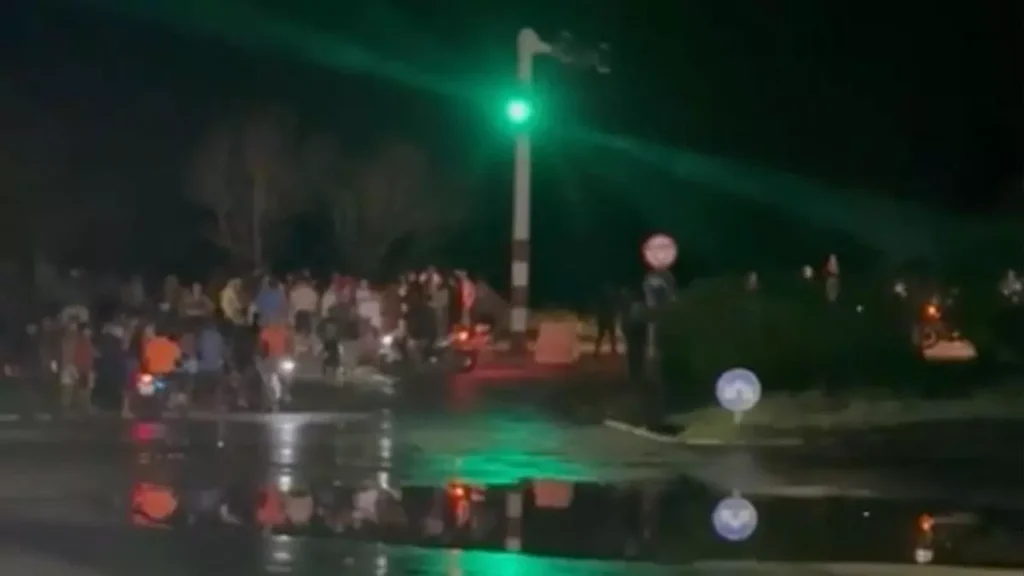
This Saturday, in the community of Fontanar, in the Boyeros municipality of Havana, dozens of residents took to the streets banging pots and blocked Rancho Boyeros Avenue while chanting, “We want electricity!”
Videos circulated on social media show the residents’ determination as they stand in front of vehicles, preventing them from passing along the blocked road, while police patrol cars arrived to contain the demonstration. It was the second consecutive day that the same neighborhood had taken to the streets to protest the blackouts.
“More than 10 police patrol cars came. They beat a couple of people, took away two or three, and put an end to the action,” one of the participants told 14ymedio. “We are already thinking of doing it again, but more organized, so that more people will come.”
“More than 10 police patrol cars came. They beat a couple of people, took away two or three, and put an end to the action”
“They’ve been cutting our electricity for more than 24 hours for several days, and we have no water,” the resident added. “Meanwhile, there is electricity all around us, such as in the rental houses with swimming pools in the Río Cristal and Abel Santamaría housing developments. They never cut their power because they say they pay for it.”
According to witness accounts gathered by Martí Noticias, those detained were “a woman and a young man,” although their identities could not be confirmed. The same sources said that five patrol cars arrived at the scene, along with the so-called Black Berets and Red Berets, the feared special forces of the Ministry of the Interior and the Armed Forces, which specialize in suppressing disturbances and were recently sanctioned by the U.S. Government.
Cacerolazos have become an increasingly common response to the alarming energy crisis affecting the Island. In June, Cubalex recorded 253 protests in Cuba, the highest monthly figure since it began tracking such events in 2022.
With the summer heat, as Cuba faces its worst economic crisis since 1959, the fuel shortage has also worsened the healthcare situation and basic services. The country has recorded new outbreaks of mosquito-borne diseases and, amid the collapse of the healthcare system, deaths have been reported that could have been prevented under other circumstances.
“This city is like a madman’s house, which he keeps filling with garbage, excrement and junk”
Water supply problems, affecting more than half a million Havana residents, according to figures acknowledged by the authorities themselves, combined with the garbage collection crisis caused by the lack of fuel, have made the city a difficult place to get around. “There is a horrible stench in the streets; there is sewage water everywhere, garbage, the smell of excrement,” says a resident of Luyanó. “This city is like a madman’s house, which he keeps filling with garbage, excrement and junk.”
These problems are compounded by inflation and the steadily rising cost of basic products such as cooking oil, eggs, and powdered milk. The severity of the situation was exposed this Friday in the capital’s La Lisa municipality, where dozens of people stormed a truck loaded with cooking oil, in an incident that spread on social media.
According to information published by journalist Gilberto Dorrego, the vehicle was guarded by police officers, but residents rushed the truck to take bottles of oil. The video circulated shows a crowd of people trying to climb onto the truck and distribute the merchandise among themselves. Many children and mothers can be seen in the crowd, running to grab a bottle.
A liter of sunflower oil has reached prices of as much as 5,000 or even 6,000 pesos on the Island’s informal market, approximately the equivalent of $10 at the street exchange rate, nearly two monthly minimum wages in Cuba.
Translated by Regina Anavy
______________________
COLLABORATE WITH OUR WORK: The 14ymedio team is committed to practicing serious journalism that reflects Cuba’s reality in all its depth. Thank you for joining us on this long journey. We invite you to continue supporting us by becoming a member of 14ymedio now. Together we can continue transforming journalism in Cuba.