EcoFlow, solar panels and solar-powered generators replace the old revolutionary epic in blackout-ridden Cuba
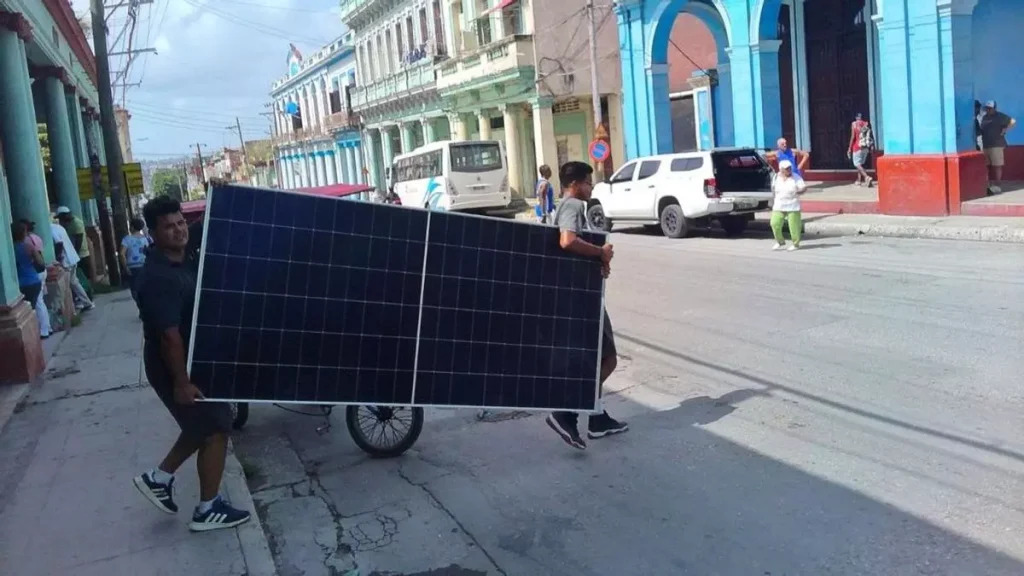
 14ymedio, José A. Adrián Torres, Málaga, September 6, 2026 / Perhaps one of the few things that isn’t scarce in Cuba is the sun. It rises every day without the Electric Union announcing its synchronization with the National Electric System (SEN), it doesn’t need fuel oil, it doesn’t wait for a spare part, and so far no breakdown has taken it offline. Nor does it depend on a friendly oil tanker docking or a Political Bureau meeting concluding. On the Island of Blackouts, the sun is the only energy provider that still doesn’t require foreign currency for its supply.
The Revolution and its leaders took almost seven decades to see the sun as a lifeline, even though it had always been right in front of their Fidel-style caps. Now the government is presenting photovoltaic energy as the path to energy sovereignty and claims that the more than 50 installed solar parks, with over 1,000 megawatts peak capacity, provide around 38% of the energy consumed during the day during peak sunlight hours. This is positive news, of course. At this point, arguing with the sun would be absurd, even for a system that has been arguing with the real economy for years.
The sun works for free, but storing its energy comes at a price: Cuba lacks sufficient battery banks and a stable grid capable of integrating them. The first storage systems serve primarily to regulate frequency, not to shift the midday to the nighttime peak. When the sun sets, the aging thermoelectric plants return, along with out-of-service units, high-sulfur Cuban crude, a shortage of spare parts, and generators without fuel. Demand hovers around 3,000 megawatts, and the deficits have left more than half the country simultaneously in darkness. The national electricity system—SEN to its ‘friends’—has suffered so many collapses that the word “national” is beginning to sound like the most optimistic part of its name.
The embargo did not age the thermoelectric plants, it did not deplete on its own the reserves of spare parts, nor did it impose decades of insufficient investment and misguided priorities.
The oil embargo imposed by Washington has aggravated the shortages to an extreme; to omit this would be to deceive. But the embargo did not age the thermoelectric plants, nor did it single-handedly deplete the reserves of spare parts, nor did it impose decades of insufficient investment and misguided priorities. External pressure explains much of the acceleration of the crisis; it does not absolve 67 years of energy policy. This is a renewed Special Period, without a name: perhaps the authorities avoid calling it that because a temporary emergency that lasts for decades is beginning to resemble the system itself too closely.
In homes, physics has imposed a less solemn solution: a panel, a battery, and the meticulous management of every watt. This is how EcoFlow has ascended to the pantheon of Cuban household icons. EcoFlow is a Chinese brand of portable power stations, founded in 2017, but in Cuba, its name is beginning to function as a common noun, just as other brands have ended up naming entire products. It doesn’t matter much whether the specific device is EcoFlow, Bluetti, Jackery, or any other technological relative: in everyday speech, the hero is usually called EcoFlow.
The small models allow you to keep some lights on, charge cell phones, power the router, or run a fan. Those of a larger capacity can sustain a television for a time, a refrigerator, and other household appliances for a while, provided the family learns a new set of rules: how many watts each appliance consumes, what gets plugged in first, and which member of the household has to go without. In Cuba, even emergency electricity has had to be rationed, although this time the ration book is mental.
Compared to gasoline or diesel generators, these electric plants have clear advantages. They don’t emit smoke, they don’t deafen the building, and they don’t force you to go out in search of fuel that might cost more than what you’re trying to save inside the cold. However, nor are they complete miracles. If the blackout lasts twenty, thirty, or forty hours, the battery will eventually run out. And if there’s no solar panel, the EcoFlow becomes just another silent box waiting, sitting on the sofa with the rest of the family, for the power to come back on.
Anyone with a daughter in Hialeah, a brother in Madrid, a business that charges in foreign currency, or access to privileged circles can manage to get a few hours of normality.
The real miracle begins earlier: acquiring them. The equipment costs anywhere from several hundred to several thousand dollars, depending on its power output, additional batteries, and accompanying solar panels. There are no reliable public statistics indicating how many have entered Cuba; perhaps because someone fears discovering they arrive in greater numbers than the tourists. Customs regulates their importation but doesn’t publish a census by brand. What is visible, however, is the market that has sprung up around them: shops, shipping agencies, and relatives in Miami who no longer send just medicine, food, or clothing, but small, packaged power plants.
Many years ago, when asked how a Cuban managed to survive scarcity and an impossible salary, the answer was: “With FE,” [faith] Family Exterior. It was the only faith that worked verifiable miracles. The new energy liturgy hasn’t abolished it; it has perfected it. Those who have a daughter in Hialeah, a brother in Madrid, a business that charges in foreign currency, or access to privileged circles can achieve a few hours of normality. Those who have none of that continue to rely on candles, cardboard used as fans, and the benevolence of the alumbrón [a Cuban word meaning the time when the power comes on].
The Revolution promised to abolish social classes and has instead created a socio-electrical hierarchy. At the top are the Castro regime’s inner circle, with the heads of GAESA and their families as their “vanguard” courtiers, along with hotels, certain institutions, businesses with cash reserves, and those receiving substantial remittances. Below them are those with a modest battery who calculate whether to use a fan or a refrigerator that night. At the bottom are the majority, who recognize others’ comfort by the hum of an air conditioner when the entire neighborhood is silent. Inequality is no longer measured solely by what one eats, what one wears, or the car one drives, but by the number of hours of electricity each person can afford.
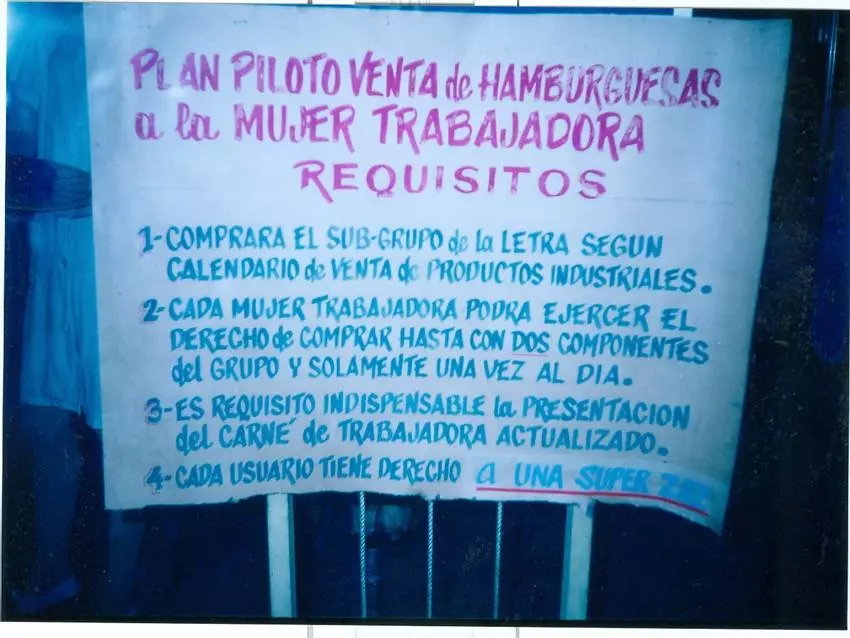
The State, unable to guarantee the supply of electricity, retains its full capacity to manage the process. Its specialty: processing its own incompetence. At some of the new “community solar charging stations,” charging points powered by photovoltaic panels, the user must provide their name, ID card number, the model of the device, the type of outlet needed, and the connection time; then they pay and receive a tag to retrieve it. The sun is free, but its use still requires guardianship, registration, and authorization. Nature provided the energy; socialism provided the paperwork. This very socialist procedure for managing scarcity—it is said that “socialism distributes wealth until it runs out,” since it doesn’t know how to create it—reminding me of the scheduled sale of Super ZAZ hamburgers—which the people, in their mockery, also called McCastro—in the nineties: the product changes, but not the bureaucratic ordeal to obtain it. A famous tango said that “twenty years is nothing”; The revolutionary management style has been going on for well over thirty years without changing its score and it already sounds like a broken record.
It is no surprise, then, that EcoFlow has displaced traditional heroes. It doesn’t wear olive green, it has no school biography, it doesn’t give speeches, and it doesn’t demand slogans. It arrives brand new, manufactured by the Chinese capitalism that Havana embraces when it finances solar parks, but whose economic results it avoids comparing with those of the Revolution. Nor does it promise a bright future: it offers, with a modesty uncharacteristic of propaganda, four hours of fan time, a charged cell phone, and the possibility that food won’t go to waste.
This practical heroism coincides with the discrediting of heroes of bronze and marble. On August 24, 14ymedio reported that a bust of José Martí had been found decapitated and smashed in Valle Grande, in La Lisa, during the early morning hours of a blackout that had already lasted more than twenty hours. Another monument to Martí was defaced with yellow paint in Guanabacoa, and days earlier, a statue of Antonio Maceo had been toppled from its pedestal in Las Tunas.
It’s not that Martí has become outdated; it’s that the State has tried to pass off as Martí-inspired everything that contradicts his republicanism, his defense of individual dignity, and his idea of a homeland “with everyone and for the good of everyone.”
Destroying heritage is not liberating a country, and no one should attribute to unknown perpetrators an intention that has not yet been proven. But neither can the symbolism be ignored. The regime hijacked Martí, Maceo, and the heroes of independence, permanently enshrining them on the revolutionary platform and turning them into notaries of every failure since 1959. By repeatedly placing them behind every slogan, it ended up making them the target of every attack. It’s not that Martí has become outdated; it’s that the State has tried to pass off as Martí’s ideals anything that contradicts his republicanism, his defense of individual dignity, and his vision of a homeland “with all and for the good of all.”
This explains the replacement. The bust no longer protects, speeches don’t cool the room, and slogans don’t preserve milk. The EcoFlow, on the other hand, delivers. It doesn’t ask about the owner’s background, question their ideological deviations , or demand attendance at the Plaza. It only requires charging, care, and not exceeding the power limit. In a society weary of historical promises, the efficiency of a plug acquires moral dignity.
Even Cuba’s renowned capacity for “invention” has reached its limits. Ingenuity can resurrect a fan, adapt a Soviet part to an old Chevrolet, transform one object into another, and extend the life of something that elsewhere would have been thrown away for years. But it doesn’t generate 2,000 megawatts, refine oil, or rebuild an electrical grid. “Creative resistance” serves as a motto while the government turns other people’s patience into a renewable resource. Resisting without a future ceases to be a virtue and becomes a way of managing exhaustion and frustration.
Even the banter—the kind of jokes and humor typical of Cádiz, spoken in Cuban slang —is unleashed. Cuban humor has survived dictators, shortages, hurricanes, and special periods, but it needs sleep, food, and some hope that tomorrow won’t be a darker repetition of today. When you spend entire nights swatting mosquitoes, fanning a child, and making sure the last bit of food doesn’t spoil, the banter and the jokes stop being a relief and start sounding like another patriotic duty: besides suffering, you have to do it with grace and “revolutionary spirit.”
Dictatorships can survive for a long time at seemingly terminal levels of misery because deterioration does not, in itself, create a political alternative.
That’s why it’s best to avoid easy or simplistic explanations for the country’s apparent paralysis. Not all silence equates to acquiescence, nor is every neighbor who observes a pot-banging protest from their window a coward. Repression has made collective protest seem like an individual risk: those who take to the streets can lose their jobs, be beaten, or end up in prison, while others calculate whether they will be enough to protect them. Fear doesn’t demonstrate allegiance to the regime; it demonstrates that the regime has been far more adept at distributing it than food and electricity.
Understanding that fear, however, doesn’t mean we have to turn it into a perpetual excuse. Dictatorships can survive for a long time in seemingly terminal levels of misery because deterioration doesn’t, on its own, generate a political alternative. Electricity can collapse on its own; power, unfortunately, almost never does. As long as a few bang their pots and pans and many wait to see if the protest succeeds before joining in, the government will continue to rely on its main strategic reserve: the isolation of each Cuban and the futile habit of letting someone else take the first step.
No democratic transition will be viable without an internal struggle capable of transforming scattered discontent into organization, civil disobedience, coordinated protests, and a recognizable alternative for the country. There will be risks and probably casualties, because dictatorships rarely relinquish power without first resorting to violence. Martyrs are not recruited from a catalog, nor is their number decreed from the safety of abroad: they appear, tragically, when power represses a society that has decided to stop waiting. Exile and the international community can protect, amplify, and sustain this struggle; they cannot replace it.
The other temptation is to once again outsource salvation. Before, Soviet oil was awaited, then Venezuelan oil; now some hope that the United States, Donald Trump, Marco Rubio, and the exile community will act as a geopolitical EcoFlow capable of connecting Cuba with democracy. A military intervention is not a parcel delivery: it brings death, legitimacy problems, the risk of a power vacuum, and a likely stampede toward Florida. The recent migrant influx into the Spanish city of Ceuta—hardly spontaneous—has served as a reminder of how easily a border and a reception system can be overwhelmed in a matter of hours. Washington is also doing these calculations, and, faced with an island of more than nine million inhabitants, it’s doing them on a grand scale.
Democracy will not arrive new and pristine, free of tariffs and paid for by a relative from Miami.
External pressure can weaken the regime, protect the opposition, and facilitate a transition; it cannot create from the outside the civil society that will have to sustain it. Nor is there a “Marshall Plan” that can function on institutions that are destroyed, without rules, riddled with corruption, lacking trust, and without internal actors capable of managing aid. Democracy will not arrive brand new and pristine, free of tariffs, and paid for by a relative in Miami.
A visa for the United States or Europe remains the primary object of desire in Cuba—a Cuban friend sums it up this way: “The first thing a Cuban wants is to be a foreigner”—and the EcoFlow has become the second. One promises to solve the problem; the other, to suspend it for a few hours. Both reveal the same tragedy: individual solutions arrive from abroad while the collective solution remains postponed. Cuba cannot live indefinitely between escape routes and electric batteries. The Revolution has ensured that normality on the island is no longer a given: batteries, like many other things, are purchased separately.
The sun will continue to rise, indifferent to the Communist Party, the embargo, and the reports from the Electric Union. Solar panels can and should be used: the fact that the government uses them for propaganda doesn’t make solar energy a bad idea. But a home battery doesn’t replace an energy policy, just as a remittance doesn’t replace an economy and an American invasion doesn’t replace an organized citizenry.
Perhaps change will begin when the country stops waiting to see who recharges it and decides how to produce, distribute, and control its own electricity, in every sense of the word. Until then, Martí will remain trapped on the pedestal the regime imposed on him, EcoFlow will occupy the domestic altar, and millions of Cubans will await the next alumbrón*. The sun rises every morning, punctual and without asking permission from the Central Committee. Of all Cuba’s new heroes, he is the only one who still works for himself, but he can do little more for a country where the “Queen of the Night” rules most of the time.
________
*alumbrón – An ironic term for when the electricity is ON
**Sign Translation
Title: Pilot Plan Sale of Hamburgers to the Working Woman – Requirements
1 – Check the sub-group of the print according to the sales calendar of industrial products.
2 – Every working woman can exercise the right to purchase up to two components of the group and only once a day.
3 – It is an indispensable requirement to present the current work ID
4 – Every user has the right to one super-ZAZ
______________________
COLLABORATE WITH OUR WORK: The 14ymedio team is committed to practicing serious journalism that reflects Cuba’s reality in all its depth. Thank you for joining us on this long journey. We invite you to continue supporting us by becoming a member of 14ymedio now. Together we can continue transforming journalism in Cuba.