The man in charge of the security of Cuba’s leadership appears alongside the former head of state.
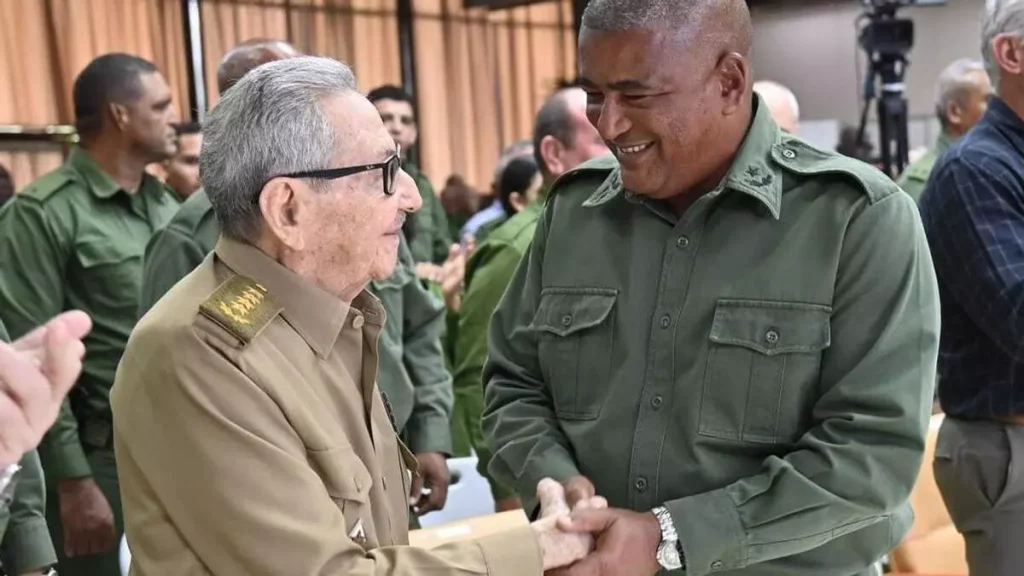
 14ymedio, Havana, September 6, 2026 – Emir Mesa Corona has spent nearly three decades appearing just a few meters from power in Cuba, but until now his name has meant little outside the circles of the Ministry of the Interior. He has no known official biography, his place and date of birth are unknown, and it is not even clear when he attained the rank of general. However, this weekend he partially emerged from the shadows. Holding the rank of brigadier general, he was presented as head of the Directorate of Personal Security, one of the most opaque and sensitive organs of the Cuban apparatus.
Raúl Castro’s reappearance at the ceremony also carried added significance. In the preceding days, rumors had circulated about his death and an alleged serious deterioration in his health, after Diario de las Américas reported that the 95-year-old general had supposedly suffered a stroke and was being kept alive with life-support equipment. The information, attributed to unidentified sources, quickly spread through media outlets and social networks, while the Cuban Government remained silent. His presence at the event, applauded and surrounded precisely by the men responsible for protecting him, ultimately disproved at least the reports of his death. As if Personal Security had had to save the younger Castro not only from attacks and threats, but this time also from rumors about his own death.
It was Mesa Corona who presented the army general with a recognition for his status, alongside Fidel, as “founding chief” of Personal Security during Saturday’s ceremony marking the 65th anniversary of that structure. He also delivered the central remarks at a ceremony attended by Miguel Díaz-Canel and much of the country’s political and military leadership.
The appearance also makes it possible to put a face and a name to a military officer whose career can be traced through documents at least as far back as 1998
His speech offered a glimpse into the nature of an organization that goes far beyond placing bodyguards around the leaders. Mesa Corona spoke of coordination with the Armed Forces, Military Counterintelligence, and other structures of the Ministry of the Interior. He also stressed the need to anticipate threats and openly raised the question of what would happen in the event of an attempt to “kidnap or assassinate” any of the country’s top leaders.
The appearance also makes it possible to put a face and a name to a military officer whose career can be traced through documents at least as far back as 1998. In February of that year, the newspaper Granma identified him as a captain and “head of the Military House Unit” when he took part in the presentation of the credentials of Bolivia’s then-ambassador. The Military House is precisely part of the apparatus associated with the care and protection of the top leadership.
Fifteen years later, he had made a considerable leap. During the Bastión 2013 military exercise, Raúl Castro visited the Command Post of the Organization for Security and Internal Order. There, then-Colonel Emir Mesa Corona, introduced as the “second head of the Directorate of the Ministry of the Interior,” briefed the ruler on the progress of the operations.
That information suggests that Mesa Corona joined the Ministry of the Interior no later than the early 1990s
In February 2018, he still held the rank of colonel. That year, the Council of State awarded him the Eliseo Reyes Medal, Second Class, along with other senior officers, including Ramón Romero Curbelo, now one of the most influential figures within Cuba’s intelligence apparatus. The decree justified the award on the basis of a career spanning more than 25 to more than 30 years within the Ministry of the Interior and the fulfillment of “important missions and tasks” related to state security and internal order.
That information suggests that Mesa Corona joined the Ministry of the Interior no later than the early 1990s, although there is no public information specifying the date.
By May 2023, he was already a general, and his position was much less ambiguous. An official publication of Vietnam’s Ministry of Public Security included him in a Cuban delegation headed by Interior Minister Lázaro Alberto Álvarez Casas and identified him as the head or commander of the organization responsible for protecting senior leaders.
The delegation also included the Interior Ministry’s head of logistics, the head of International Relations and the director of Cimeq, the hospital traditionally reserved for the ruling elite. The trip establishes that Mesa Corona had held a position equivalent to head of Personal Security at least since 2023, although the resolution by which he was appointed has not been made public.
It is possible that Raúl’s grandson headed the structure for a period, that he was later replaced by Mesa Corona, or that his actual responsibility was always his grandfather’s direct security detail rather than command of the entire apparatus
A year later, he reappeared at a security meeting held in Managua with Nikolai Patrushev, then secretary of Russia’s Security Council and one of the most powerful men in Moscow’s security apparatus. Interior Minister Álvarez Casas was accompanied by Brigadier Generals Mesa Corona and Ramón Romero Curbelo. The meeting also brought together senior officials from Nicaragua, Venezuela, and Bolivia.
His current position, however, raises a question. Several media outlets assumed that the person who had taken over the Directorate General of Personal Security in 2016 was Raúl Guillermo Rodríguez Castro, El Cangrejo, Raúl Castro’s grandson and bodyguard. The initial information came from Juan Juan Almeida and said that Rodríguez Castro had replaced General Humberto Francis Pardo.
Francis Pardo is well documented as the former head of the organization. Granma still identified him as head of Personal Security in 2013, and when he died in 2021, Díaz-Canel himself recalled that he had led that “troop of loyal men” for 30 of his 56 years in the Ministry of the Interior.
The exact role of El Cangrejo is now less clear. This year he has again been described as responsible for his grandfather’s personal security and has acquired unprecedented political visibility, but he is not known to formally hold any position in the Government, the Party, or the Armed Forces. The official identification of Mesa Corona as head of the Directorate of Personal Security therefore requires qualifying the version that for a decade attributed that position to Rodríguez Castro. It is possible that Raúl’s grandson headed the structure for a period, that he was later replaced by Mesa Corona, or that his actual responsibility was always his grandfather’s direct security detail rather than command of the entire apparatus.
In an organization designed to keep safe those who rule Cuba’s destiny, discretion is part of the job
Mesa Corona also does not appear to limit himself to physically protecting Díaz-Canel and the Castros. In his speech on Saturday, he paid special tribute to the 32 Cuban soldiers killed in Venezuela and called for their example to guide the daily work of Personal Security. The presence of relatives of those who died at the ceremony reinforces the evidence of the link between that Directorate and the Cuban apparatus deployed around Venezuela’s leadership.
Much remains unknown. There is no known date of birth, academic résumé, family information or public record of his assignments. Nor is it known exactly when he was promoted to brigadier general or when he assumed the position he holds today.
The scarcity of information is not accidental. In an organization designed to keep safe those who rule Cuba’s destiny, discretion is part of the job. Mesa Corona has spent nearly 30 years rising through that world without becoming a public figure. Now, as the regime once again speaks openly of assassination attempts, kidnappings, and external enemies, the man responsible for watching the backs of the leadership has stepped out, at least for a few minutes, into the spotlight.
Translated by Regina Anavy
______________________
COLLABORATE WITH OUR WORK: The 14ymedio team is committed to practicing serious journalism that reflects Cuba’s reality in all its depth. Thank you for joining us on this long journey. We invite you to continue supporting us by becoming a member of 14ymedio now. Together we can continue transforming journalism in Cuba.