“A Granel was only the first of many,” says a knowledgeable source who requested anonymity. “The fuel is coming in through pipelines.”
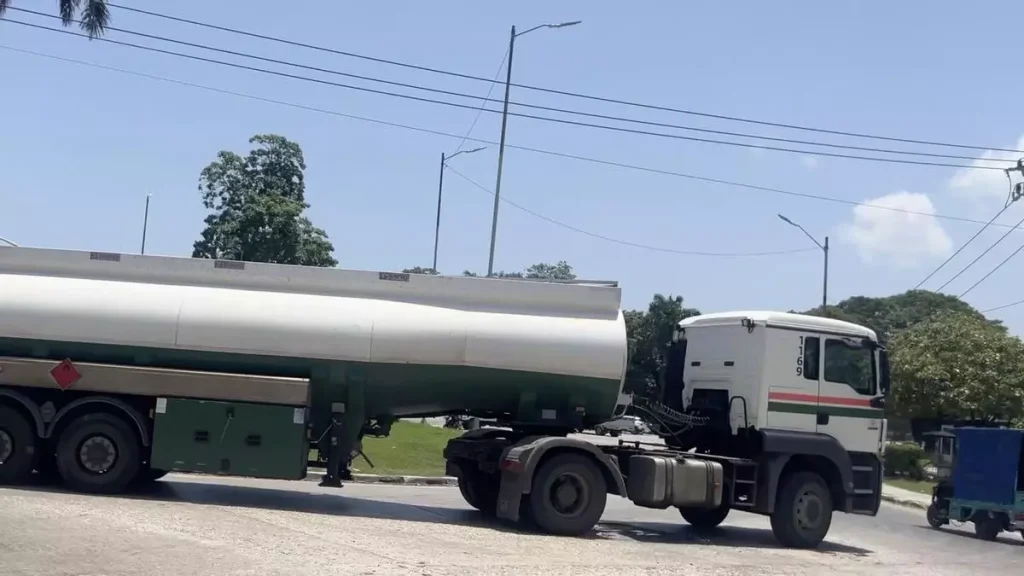
 14ymedio, Darío Hernández, Havana, July 23, 2026 – It is no longer just small private businesses connected to the oil or transportation sectors, or those that specifically need gasoline to operate. The importating of fuel from the U.S., authorized for the private sector since last February, has spread to all kinds of businesses.
This can be seen at several gas stations in Havana. One example is the service station known as the Shell Roundabout in Guanabacoa, which was closed to the public five months ago to serve only yellow taxis and began selling imported gasoline last May. There, 14ymedio confirmed that gasoline is being sold for $5 dollars per liter*.
“They lease the gas stations, issue invoices, and sell gasoline by the liter in dollars,” summarizes a customer at that station, where, as this newspaper previously reported, fuel is supplied not only to private businesses but also to state-owned companies, in direct violation of the authorization granted by the U.S. Office of Foreign Assets Control (OFAC).
This Monday, in a report published by the Sancti Spíritus provincial newspaper Escambray, José Lorenzo García, the provincial transportation delegate, stated that the ministry had “circulated” a document regarding the possibility of bus companies purchasing fuel from small private businesses, but that there was still no regulation in place to govern the practice.
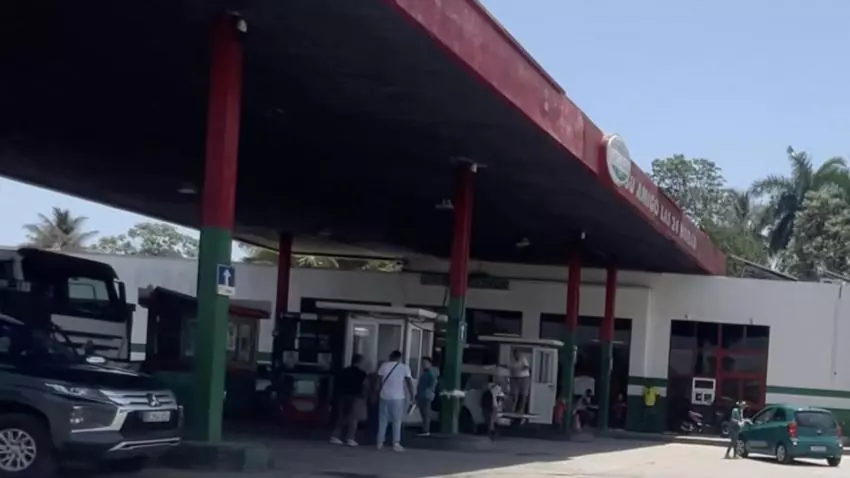
In practice, this newspaper has confirmed that, in Havana, these State-owned vehicles are already fueling up at the same gas stations that serve private businesses. Among them is the station on Avenida del Puerto, where fuel is sold to national buses, whose terminal is located right next door, while the station at Vía Blanca and Fábrica serves trucks and water tankers. In addition, many state-owned Lada cars can be seen at the Vía Blanca station near the Luyanó bridge.
An entire black-market buying and selling network has also emerged that goes far beyond specialized businesses. “Right now anyone on the street has gasoline and will sell it to you at outrageous prices,” says a Havana driver. “Food businesses, people in the dollar-selling business—anyone will sell you a liter of gasoline for 3,500 pesos.”
One example is a small company dedicated to selling beer. “Right now, all they are promoting is gasoline, nothing else,” says one customer. In a WhatsApp message, they explain the requirements and, while revealing other service stations operating like the Shell Roundabout, warn: “You have to keep in mind that a waiting list is made, and you will be notified when they are ready to enable fueling at Tropicana [a gas station in the Playa municipality] and Acapulco [in Nuevo Vedado].”
Advertisements are also multiplying on social media. “Imported premium gasoline, minimum purchase 20 liters, $4.30 per liter,” reads one ad from Jaimanitas, in Playa. The same seller offers a price of $4.25 per liter for purchases of 40 liters or more, $4.20 for 100 liters or more, and $4.15 for purchases of 200 liters or more.
Beyond the fact that the business activities of these companies have nothing to do with fuel, the issue is that they are using the State distribution network, thereby also violating U.S. regulations. This is the case of A Granel, documented by 14ymedio, which sells diesel for $2.50 per liter from an industrial warehouse located at the end of Avenida del Puerto, owned by the Cuban Lubricants Company (Cubalub), which belongs to the State-owned Cupet.
“A Granel was only the first of many,” says a knowledgeable source who requested anonymity. “The fuel is coming in through pipelines”
Whatever the case, it is privately imported fuel that is keeping the country minimally running since the U.S. imposed an oil blockade
Whatever the case, it is privately imported fuel that is keeping the country minimally running since the U.S. imposed an oil blockade on the Cuban regime following its intervention in Venezuela earlier this year. Since January 9, the date when the last Mexican tanker, the Ocean Mariner, arrived on the island, only one vessel has docked: the Anatoly Kolodkin, which arrived on March 30 carrying Russian crude oil.
The official price of gasoline increased on July 10: gasoline rose from $2 to $2.50 per liter, while diesel increased from $1.80 to $2 per liter. In any case, fuel available for public sale through the Ticket app has reached extremely low levels.
In Havana it has been unavailable since May 28. Only a few gas stations outside the capital remain open, almost exclusively in Sancti Spíritus, where the number of operating service stations has also been reduced since July 8. Matanzas and Villa Clara, which had been dispensing fuel almost daily at several stations, have not done so since June 4.
There have been three exceptions to this situation: this Tuesday, when a gas station opened in Camagüey; on June 16, when another station opened in Artemisa; and on June 30, when fuel was dispensed at a service station in Havana (Santa María del Rosario).
*Equivalent to almost $19 a gallon
Translated by Regina Anavy
______________________
COLLABORATE WITH OUR WORK: The 14ymedio team is committed to practicing serious journalism that reflects Cuba’s reality in all its depth. Thank you for joining us on this long journey. We invite you to continue supporting us by becoming a member of 14ymedio now. Together we can continue transforming journalism in Cuba.