


A New Phrase From My Daughter… / Luz Escobar

Cuba-United States: Focusing on Transparency / Ivan Garcia
 There are not always good arguments for trampling on the jurisdiction of a foreign nation. The Cold War mentality is still latent in the behavior of certain U.S. institutions.
If a government believes in democracy and political freedom, it shouldn’t go around hiding its peaceful efforts to support the democrats in autocratic countries like Cuba.
The performance of USAID in the case of the contractor Alan Gross, jailed for clandestinely introducing satellite internet connections, or of Zunzuneao, the so-called Cuban Twitter, have been burdened by a lack of transparency and professionalism. continue reading
Freedom of expression, information and access to the internet are inalienable rights of any citizen. If the government of a country denies them, it is not a punishable crime to allow another person to inform them in some way.
Authoritarian and vertical societies like Cuba possess a bunch of rules that allow them to manage the flow of information at will. This control allows them to govern without hiccups, manipulating adverse opinions or hiding them.
The White House can implement policies that contribute to Cubans having diverse sources of information. But with transparency. And not designing strategies that could be interpreted as interference.
It is positive that the United States Interest Section in Havana operates two free internet rooms, where anyone can go, dissidents or otherwise.
Washington’s policy toward Cuba is generally public and transparent. On the internet it is not difficult to find help or money awarded to opposition groups on the island. A good way to bury this obsessive mania for espionage and mystery.
It must be a goal of the United States that the Radio Martí programming is becoming more enjoyable, analytical and professional. Since the 1960s, the Cuban regime used Radio Havana Cuba as an instrument to sell its doctrines to foreign countries.
With the petrodollars of the late Hugo Chavez, Telesur was created, television dedicated to openly spreading and supporting the most rancid of the Latin American left. That’s their right.
But each person should also be respected, according to his opinions, able to freely access the TV channel he desires, listen to the radio station he prefers, and read his favorite newspapers and digital sites.
For the olive-green autocracy, the 21st century is an ideological struggle. And it has orchestrated a campaign called “the battle of ideas.” But on the national scene, opinions that diverge from the official line are not accepted.
Cable antennas are illegal. Internet costs a price unattainable for most ordinary people. Foreign newspapers and books critical of the status quo are censored.
All that’s left is to listen to shortwave. Or sit in the bar of a hotel, spend four dollars to drink a mojito and watch Spanish CNN. The censorship even goes beyond politics.
Although it’s fair to recognize that Raul Castro has allowed Cubans to see NBA and MLB games, foreign games in which players from the island participate are still banned.
It’s the same in the literary, intellectual and musical fields. The singing Willy Chirino, the composer Jorge Luis Piloto, the poet Raul Rivero, the columnist Carlos Albert Montaner, or the writer Zoe Valdez, are prohibited from visiting their homeland for being convinced anti-Castroites.
The Castro brothers suffer from a rare mania: they consider themselves the legitimate owners of the nation. And know how to sell themselves as victims. And mor than a few times, U.S. and European institutions, with their Cold War mentality, give them ammunition.
Iván García
Photo: Flags of Cuba, United States, United Kingdom and the European Union, among others, waving on the balcony of the Hotel Saratoga, where in April 2013 Beyoncé and her husband , rapper Jay -Z stayed. The pretext for the couple to spend three days in Havana was celebrating their fifth wedding anniversary. It was speculated that behind the visit could be Barack Obama, friend of the artists. True or not, the journey was questioned in Cuba and in the United States. Taken from Cubanet .
29 April 2014
The Biggest / Fernando Damaso
 I read in the official press: the biggest workers’ parade in the world. How wonderful! Congratulations! But I ask myself: how does this help Cubans on a day-to-day basis? Does it resolve any of their many problems? Maybe it would be better, although without trying to be the biggest or highest, to improve the GDP (Gross Domestic Product), and production, productivity and quality of what little we make, increase our present salaries and miserable pensions, sort out the shortage of houses, and carry out maintenance on the ones that do exist, perfect our health care and education systems, repair our streets and avenues, ensure the regular supply of water and the proper working of the drainage network, and lots of things besides. continue reading
It appears that triumphalism is an evil we are stuck with, and it keeps popping up, in spite of all the discussion about poverty and how to deal with it.
The extinct Soviet Union kept organising the biggest workers’ parades, every May 1st in the historic Red Square in Moscow. Did it solve anything? Did it prevent socialism collapsing and disappearing? And what remains of that now? The only thing it achieved was that their leaders, lined up on the stand above Lenin’s Mausoleum, believe that the workers, totally united, supported them unconditionally and were happy with everything they did. Are we going to make the same mistake here?
May 1st is just a day in which, in democratic societies, the workers insist on improvements and concessions from the current government, and, in non-democratic societies the government uses the workers for political propaganda.
Translated by GH
2 May 2014
On Different Sides / Fernando Damaso

Photo by Rebeca
For some time the official discourse in Cuba has gone one way and the lives of Cubans have gone another. The agreements and guidelines are a part of the first, constantly referred to by the authorities as if they were part of some holy book of binding obligations, and the struggle for survival is now part of the second.
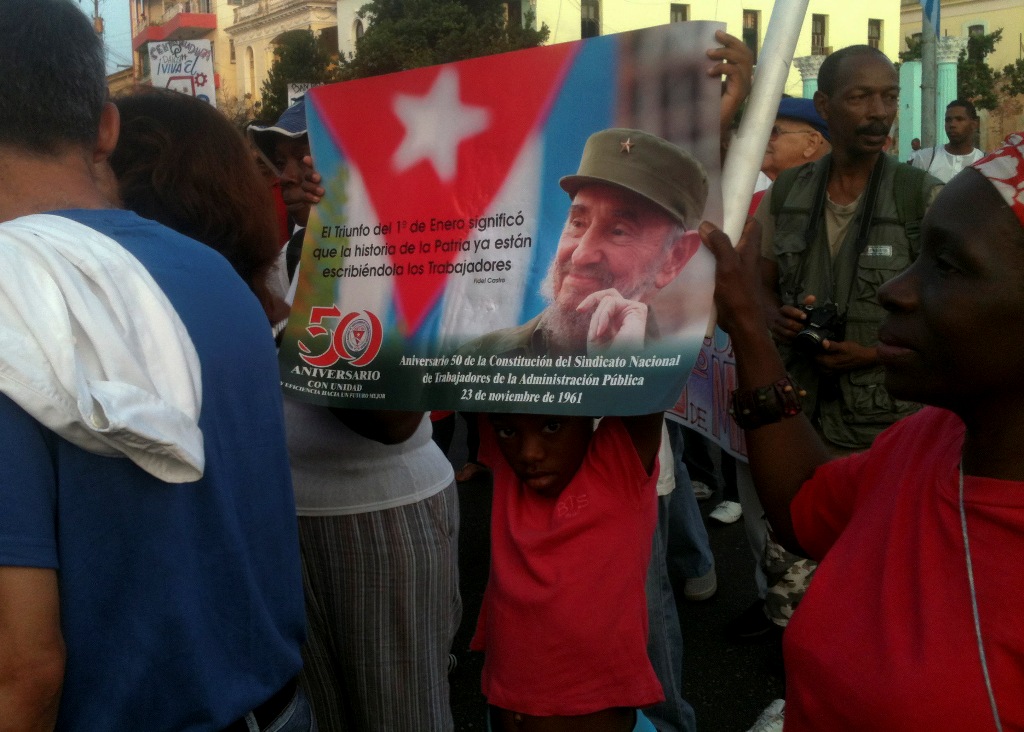
On May 1st the combative people will make the earth tremble with their massive parades. It’s already known how many will participate in each municipality and province and the thousands from each union in the capital. It’s a pity that these figures of binding obligations– 35,000 in Construction, 40,000 in Education, Science and Sports, 80,000 in Industry, etc.–don’t match, with exactitude, the production of sugar, milk, meat, food, vegetables and other products. continue reading
Without any doubt, it is easier to organize the circus than to ensure the bread.
On the banners held high no demands to the government will appear, despite the disastrous economic situation and the pitiful salaries and pensions. The “union leaders” will ensure this and many, the dreamers, will believe we are living in the best of worlds and enjoy the best of governments. Perhaps the authorities also believe it, as they are accustomed to the enjoyment of absolute power for more than 56 years.
However, we all know how they work and how participation in these mass mobilizations is ensured. We don’t forget that they also existed in the former socialist countries, led by the former Soviet Union and how, at a democratic stroke, they disappeared.
The reality, palpable every day on the street, in the workplaces and schools and homes, reflects the complete opposite. The unbelievers are increasingly more, and it is not only the young people who speak, whose objective is to study so as to take off at the first opportunity or to participate in some mission abroad, to get some cash and improve their economic situation and that of their families or just to leave; but also adults and the elderly, convinced that they were shortchanged of their lives, demanding from them present sacrifices and hardships with the promise of a better future, which dissipated between slogans and speeches, rallies and mass parades.
28 April 2014
After the Parade / Luz Escobar

I Am Not Afraid / Angel Santiesteban

Even though more than half a decade has transpired since that confession: “I know that I am afraid, very afraid,” that the great writer Virgilio Piñera — one of the greatest artists born in the archipelago — pronounced in the National Library, in the same place and at the same time that Fidel Castro prattled his “Words to Intellectuals,” I could never stop imagining the inner mockery that the young comandante must have hidden on hearing the sentence; and then, the abundant and grotesque laughter of the rest of the bearded men. . . and the times that they would have repeated “fucking fag,” without any of them imagining — unhappy souls — that the poet would outlive them in dignity and would come to form part of the history of the country as one of its great men, thanks to his literary legacy, while Fidel Castro and the rest of his unworthy “revolutionary” team just leave us an immense wake of blood and pain. continue reading

Virgilio Piñera
The bravest and most honest among those present at that meeting was Piñera, who with his declarations got ahead of what would fall over the country, in particular over the cultural sector. Thanks to those premonitory words, worthy of an enlightened one, today we know the cost of what has been ignored by the rest of the intellectuals.
Maybe — if in that moment they had united — then they would have been respected, so preventing all the suffering that Virgilio, Reinaldo Arenas and Heberto Padilla suffered so much; possibly also they would have avoided all that abusive theater that surrounded us during the fatal period of the 1970’s decade, when because of their critical, human work, because of their ideology and their sexuality, they were persecuted, marginalized, expelled from their jobs and study centers and brought to bleed their original sin of being artists.
Fidel Castro always knew that he had to watch them closely and keep them under his boot, given that in spite the fact that he was dealing with “the soft sector of society,” they were dangerous, harmful to his ideals about keeping himself in power.
Now, since my incarceration due to the opening of my blog “The Children Nobody Wanted,” I can attest, paraphrasing the brilliant Virgilio, that “I am not afraid, not at all,” and paraphrasing the dictator, “Within art, everything; against art, nothing.”

Angel Santiesteban-Prats
Lawton prison settlement. April 2014.
Translated by mlk.
5 May 2014
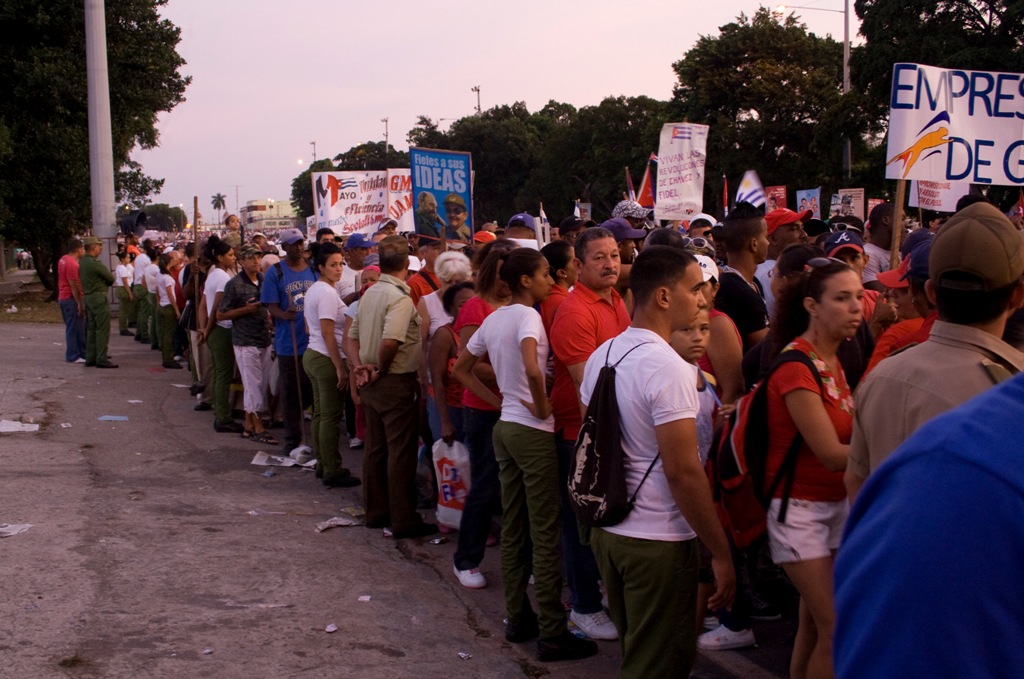
May Day Parade – 3 / Luz Escobar
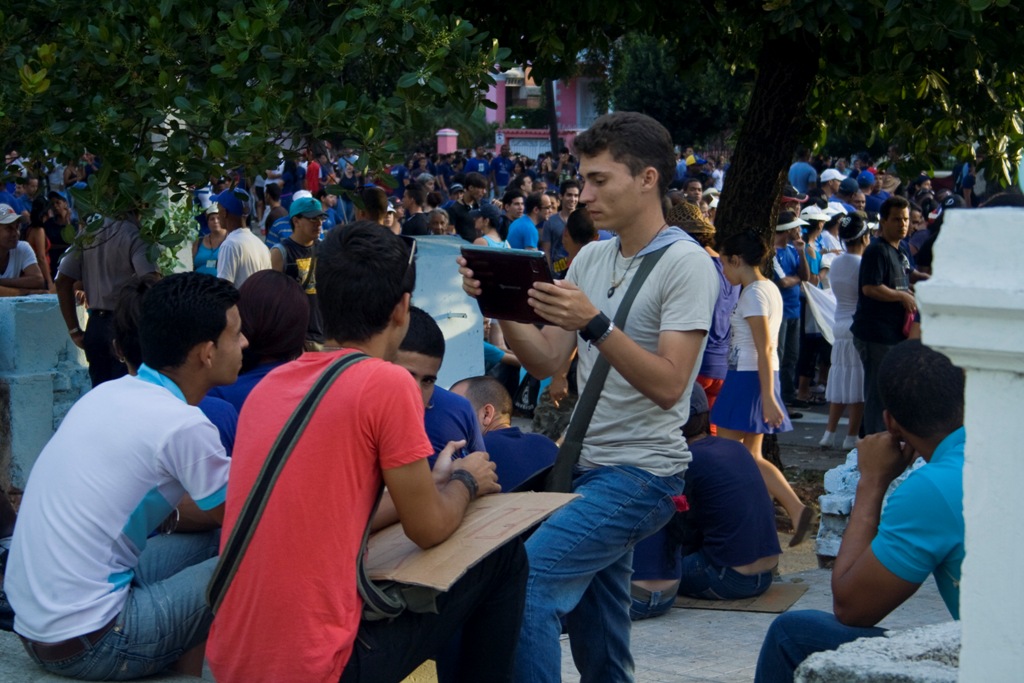
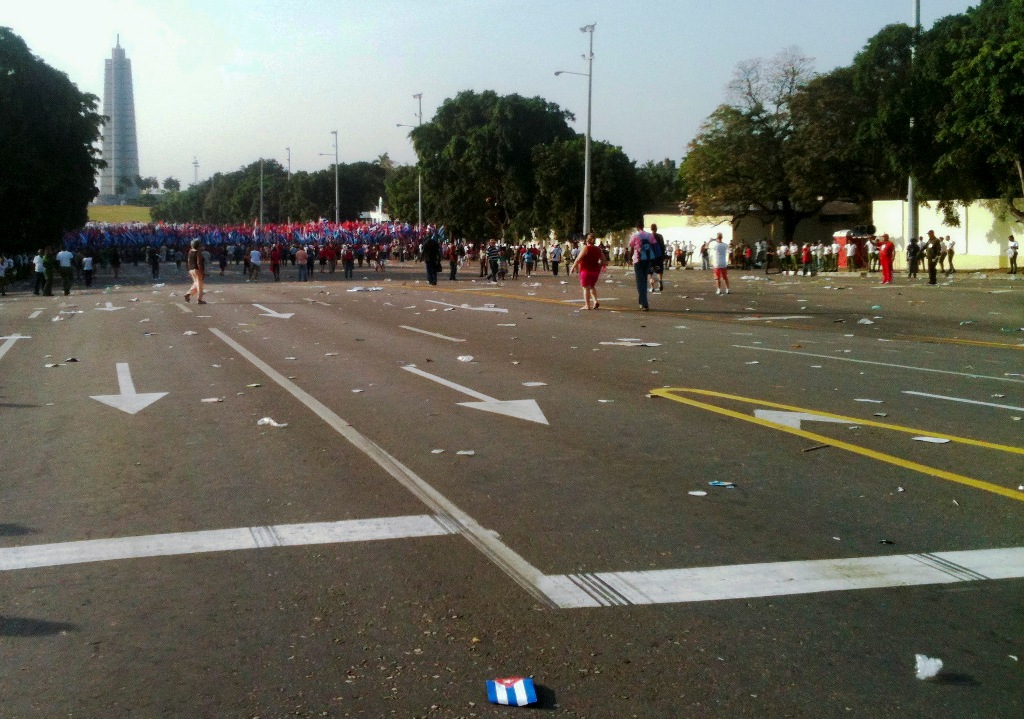
May Day Parade – 2 / Luz Escobar
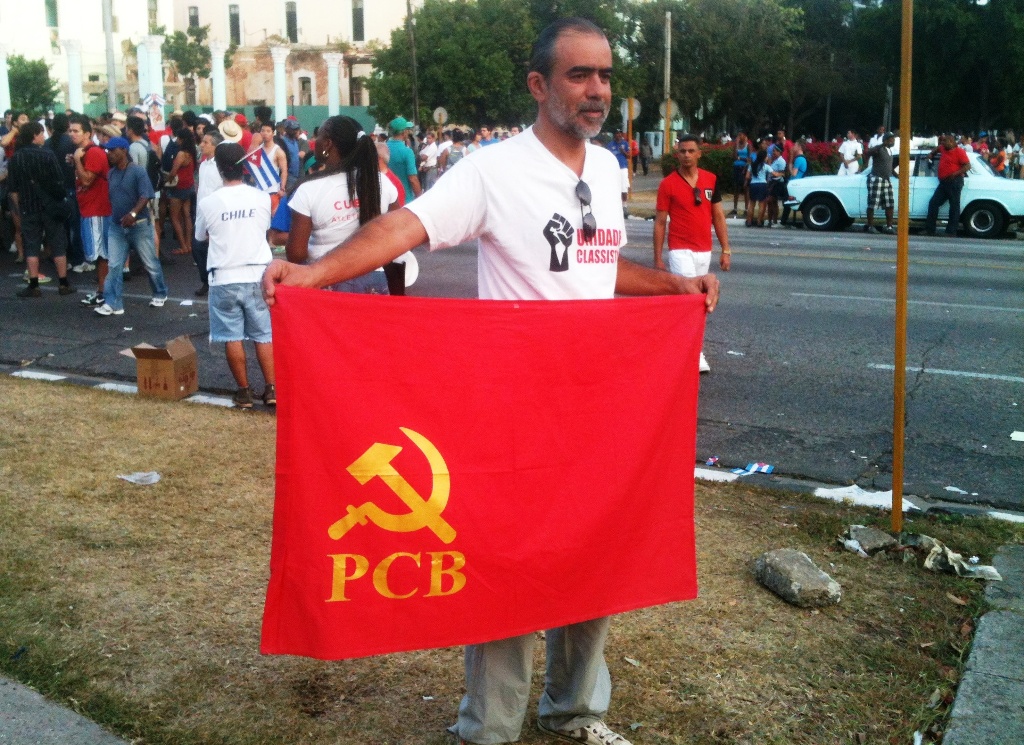
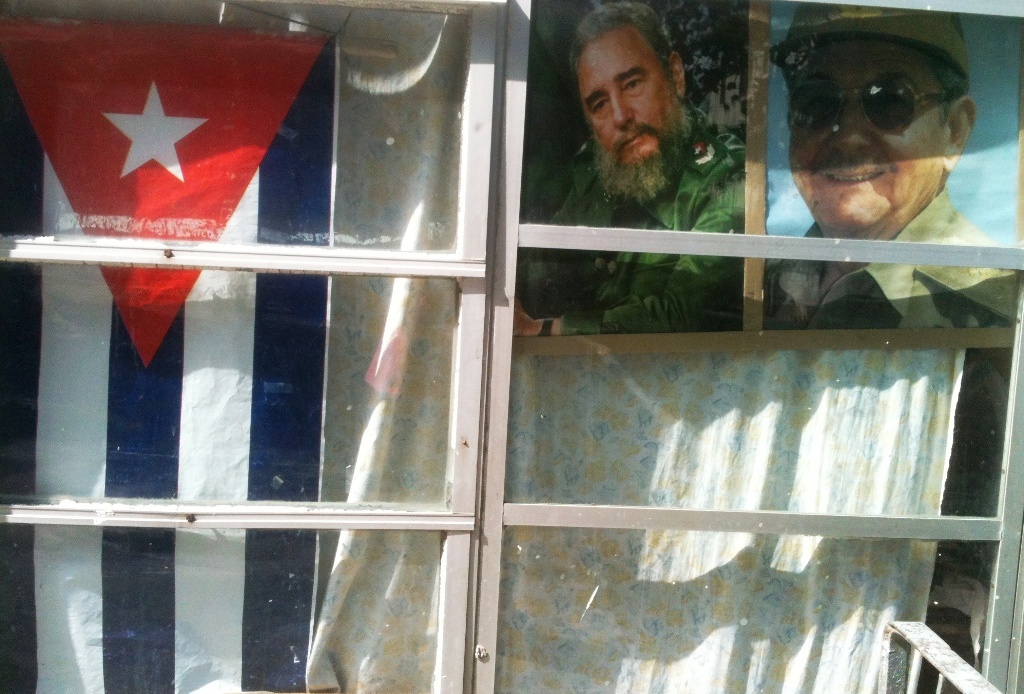
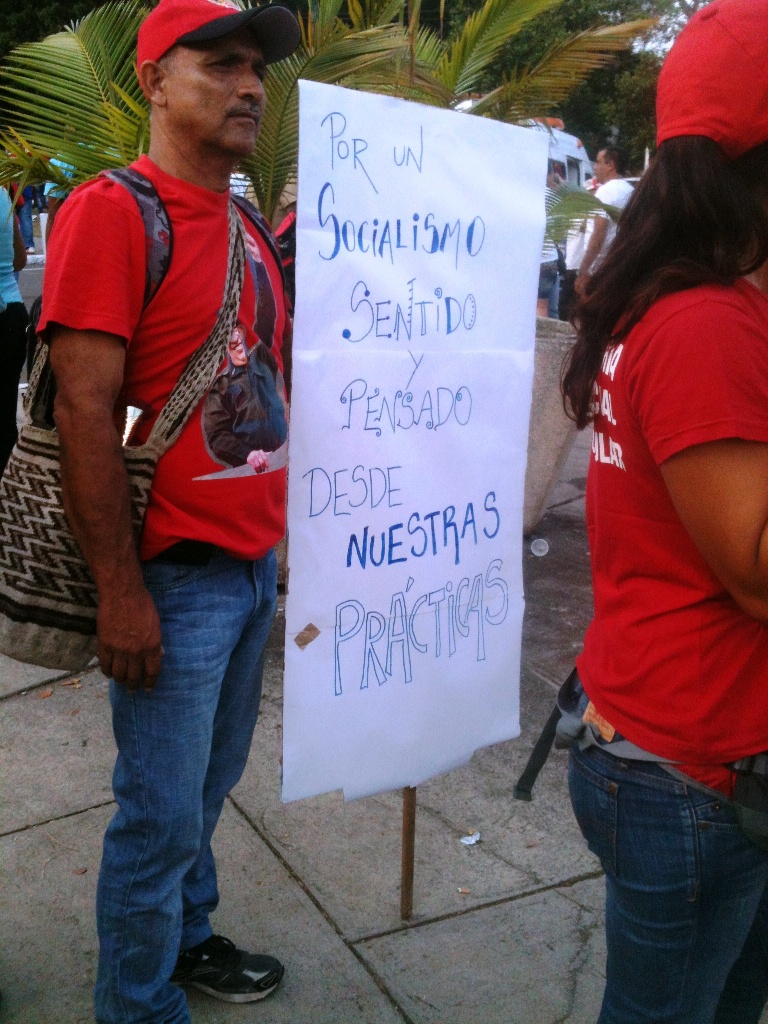
For a sensible and thoughtful Socialism from our practices
May Day Parade – 1 / Luz Escobar
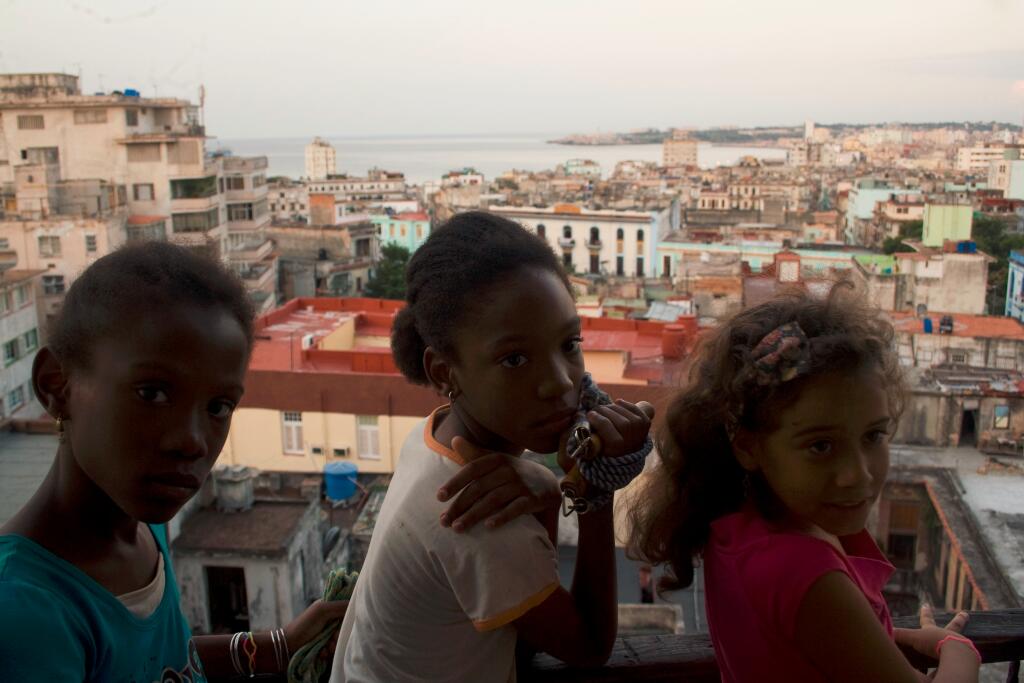
Girls / Luz Escobar
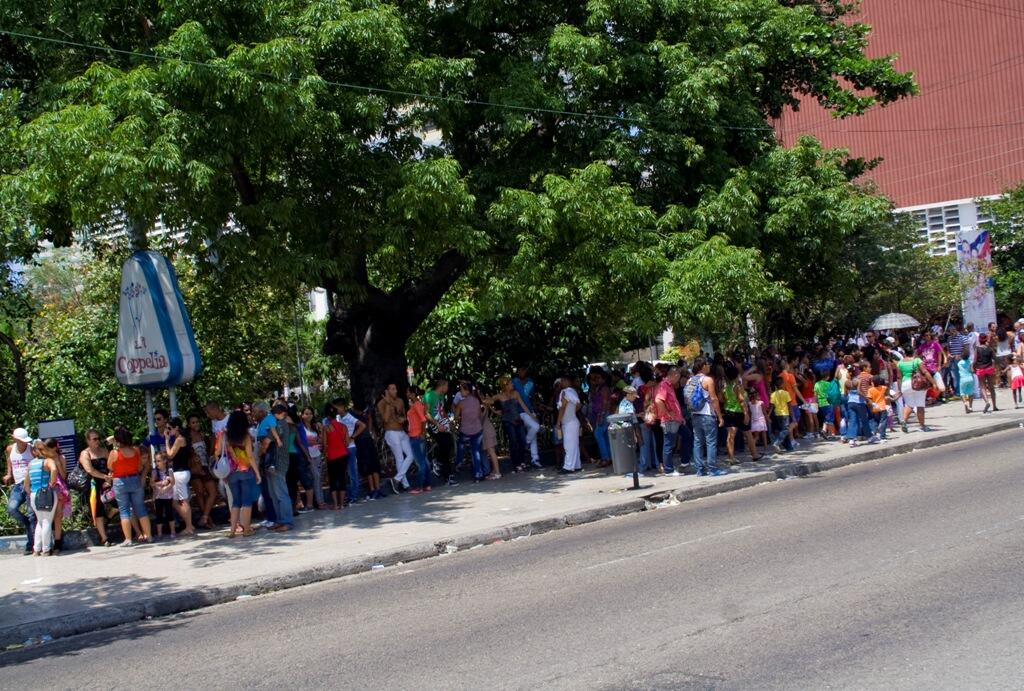
The Mother of All Lines… / Luz Escobar
An Untimely Journey / Fernando Damaso

Archive photo
An untimely and hasty journey by the Russian Foreign Minister through several Latin American countries last week was surprising. Rather than a normal official trip to cement relations overseas, it seemed like a bunt play in search of allies. After its expansionist actions in Ukrainian territory, with the annexation of Crimea and the intention to appropriate Russian-speaking territories using the violent actions of their followers in the regions close to their own borders, Russia needs political support at any cost, both from its former partners as well as its friends.
With the tense situation created in Europe, where the Foreign Minister had been the principal spokesperson for his president, and a key figure in defense of his nationalistic and nostalgic-imperialist desires, the timing chosen to review economic and commercial accords in effect until 2020 is disingenuous; and equally so to talk about the state of bilateral relations which, according to his own statement, are not strategic associations, but ones of brotherhood and solidarity. continue reading
In addition, he appears now with a repetitive criticism of the American blockade, an offer to invest in the Mariel Special Economic Zone, and a conversion of a tenth of Cuba’s debt to Russia into an economic investment on the Island, an unlikely carrot, more akin to an operation to buy political support.
Missing, before and during the conversations, were the now classic: laying a wreath at the José Martí statue in the Plaza of the Revolution, visiting the Mariel Special Economic Zone, attending an event at La Colmenita, and meeting with the families of the spies. Nor was he interested in enjoying the “largest workers’ march in the world.” He had other priorities.
The reality is most countries act in a similar way, when they need others to endorse certain political acts, but at least they do it with diplomacy and not in such a crude and clumsy way.
The right thing to do would be to resolve the Ukraine crisis peacefully, through mutual respect and serious dialog between the parties, but for him it’s not permissible to try to break up the country, supporting its Balkanization, with the supposedly “noble objective” of protecting the Russian-speaking population or any other nationality.
Before, according to the official propaganda, Ukraine was a sister to Russia and also to Cuba. Now it’s been converted into an enemy of both. How is this possible? It seems that this sisterhood has always been a simple fraud, like the many we’ve had but no longer do: it responded only to short-term political interests, without any other real sentiment.
We hope that this rushed visit of the Foreign Minister doesn’t presage a new Sovietization of our country, now updated as Russification, because having Russian speakers in a country seems to present the danger of a territorial appropriation.
5 May 2014
Blacks and Mixed-Race Still Marginalized in Cuba / Ivan Garcia

Every summer since 2009, in line with the economic openings of General Castro, Gerald, the owner of a photography business, has rented a room in a hotel in Varadero for 5 nights.
Gerald, a white man married to a mixed-race woman, authoritatively calls attention to the small number of black or mixed-race Cuban tourists. “There are very few. I stay in four and five-star hotels and the blacks that I’ve seen are either employees, or partners of foreigners.” continue reading
“Last year I went to the hotel Memorie, which has a thousand rooms, and they had only 8 black or mixed-race guests, and half of them were the spouses or companions of foreigners,” said Orestes, a tall, well-dressed black man who manages a hard-currency cafeteria in Havana, and knows first-hand the disguised racism of the privileged economic sectors.
“For every black or mixed-race person who manages an important place there are 50 whites. In hotels or strategic positions in the economy, the managers are white. There the blacks are helpers, kitchen assistants, chamber maids, pool cleaners, or grass cutters. In the meetings of managers from over 400 Havana hard-currency cafes, nightclubs, and restaurants you see only about twenty in attendance who are darker skinned or black,” said Orestes.
Twice a week, Yamila and Melisa, a pair of lesbian prostitutes, come to a restaurant called Las Piedras, in Vedado, hunting for foreign tourists or Cubans with extra cash. “I can assure you that 70% of young prostitutes are mixed-race or black,” says Jamila.
Carlos, a sociologist, believes that racism in Cuba may not be the problem it is in the U.S. or Europe. “But there are strong prejudices and the social pyramid is designed so that very few blacks can succeed. Differences have remained since 1886 when slavery was abolished. Blacks are less fortunate. They live in the worst houses, receive fewer dollars or euros in remittances, and can’t vacation in first-rate tourist facilities. They remain marginalized. And that results in a large number of prostitutes and criminals in the prisons.”
Eleven years ago, in a speech to police officers and the Interior Ministry, Fidel Castro revealed that 80% of the prisoners in Cuba are blacks and mixed-race.
Joel, a black man who has spent 12 of his 34 years behind bars, believes that that reality has not changed. “In all prisons in Cuba—there are more than 200 prisons on the island according to human rights activists—the number of blacks far exceeds that of whites. Even the offenses are different. While most whites are in prison for killing cows, scams, financial crime or corruption, blacks tend to commit more violent crimes, such as fighting with knives, arson, theft, pickpocketing, assault, home invasion robbery, rape, and murder” says Joel, for whom prison is a second home.
A police investigator acknowledges that the usual pattern used by the police during operations is based on racial factors. “Young black men are more likely to be arrested. This modus operandi has not changed,” he says.
In 2013, Roberto Zurbano, the former director of the Publishing House of the Americas, was dismissed for acknowledging, in an interview with the New York Times, the significant differences between whites and blacks in Cuba.
According to the Census of Population and Housing completed in 2012, in one decade, based on the previous census of 2002, the mixed-race population in Cuba grew from 24.9 percent to 26.6 percent. The white population decreased from 65 percent to 64.1 percent, and blacks decreased from 10.1 percent to 9.3 percent.
The worst news for black and mixed-race Cubans is that there are no independent legal institutions that protect them in the face of government neglect.
Among the dissidents there is an anti-racist organization, CIR (Citizens for Racial Integration Committee) led by Juan Antonio Madrazo, which from an intellectual perspective studies and tries to give solutions to the current racial divides.
But the regime does not recognize them. Quite the contrary. It has accused black historian Manuel Cuesta Morúa, a CIR adviser, of promoting disorders “affecting international peace and security.” His freedom of movement is restricted by the state. He cannot travel abroad, and every Tuesday he has to report in at a police station.
Blacks and mixed-race members of the peaceful opposition often receive degrading treatment and racist abuse from counterintelligence officers.
Right now, Sonia Garro Alfonso and Ramón Alejandro Muñoz, a dissident black couple, sleep in damp dungeons. They have spent two years waiting for trial.
Iván García
Translated by Tomás A.
3 April 2014
There’s Nothing to Celebrate / Miriam Celaya
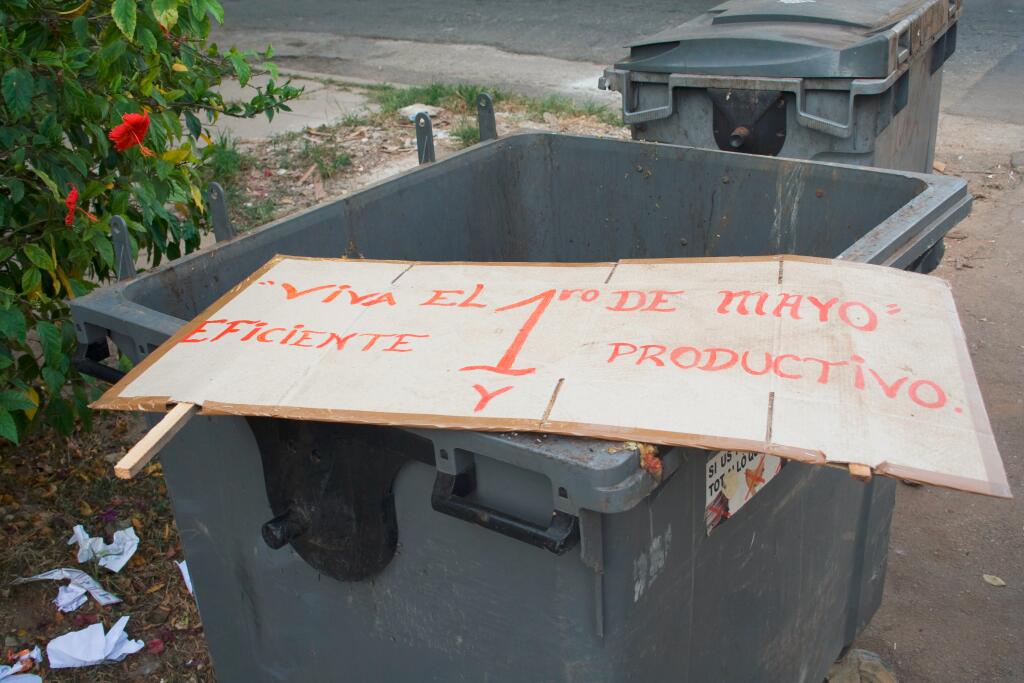
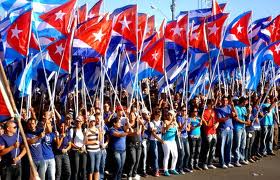 MAY DAY – Even Karl Marx would be surprised at the only parade of slave workers
HAVANA, Cuba – All the official media is in a raging fanfare summoning to “the united people’s great mobilization which will take place in squares and avenues” this May 1st. Cymbals and trumpets are pleased with the wild benefits achieved by the Cuban working class.
Among the expected events collateral to “the party” was a lackluster celebration that took place on the 144th anniversary of Lenin’s birth on the hill bearing his name in the Havana municipality of Regla, while during the week, acts have taken place throughout, awarding certificates to union leaders. This year, there will be a “superior parade”, because during the closing ceremony of the XX Congress of the Cuban Workers Syndicate (CTC), the General-President called for an “earth-shaking” event. continue reading
And it really is amazing to see how much weight this land can sustain! The Cuban reality is increasingly incoherent. Only in Cuba is it possible to celebrate a trade union congress without any unions or syndicates, or to reward leaders of an organization whose most important contributions in recent times have been to announce and support–as if it were a preview–the government’s plan for the layoffs of 25% of the country’s labor force; to approve, undauntedly and without blushing, the Labor Code proposed by the supreme exploiter of the work force this past December 20th, unpublished as of yet, and to convene a parade of workers to support the same political system that strips them of such basic rights as the free participation in economic reforms that are being forged at the offices of the olive green caste, that is, on the back of those same workers.
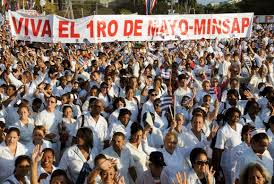 But Mr. Luis Manuel Castañedo, secretary general of the CTC, made an announcement this week in the capital that “this year’s march will be combative, massive, disciplined and compact, to uphold socialism, unity about the historical direction of the revolution, implementation of Guidelines and the support for the liberation of the antiterrorist Heroes, who remain unjustly imprisoned in the US.”
Thus, all mixed like in a Cuban stew, he rattled off his handful of stale and empty phrases, absolutely devoid of the least meaning for most of the people marching in the parade, and probably for himself.
Thus, for the short time it will take around the Plaza Cívica, Cuban marchers will postpone all illegal activities, such as robbing the State, smuggling, dealing in stolen goods, administrative corruption, etc., in order to march as obediently as frauds before the “crispy rice” monument, just before the statue of that foremost Cuban, who was never unionized and who, in addition, rejected socialism for considering it “future slavery”. One cannot conceive greater absurdity and hypocrisy.
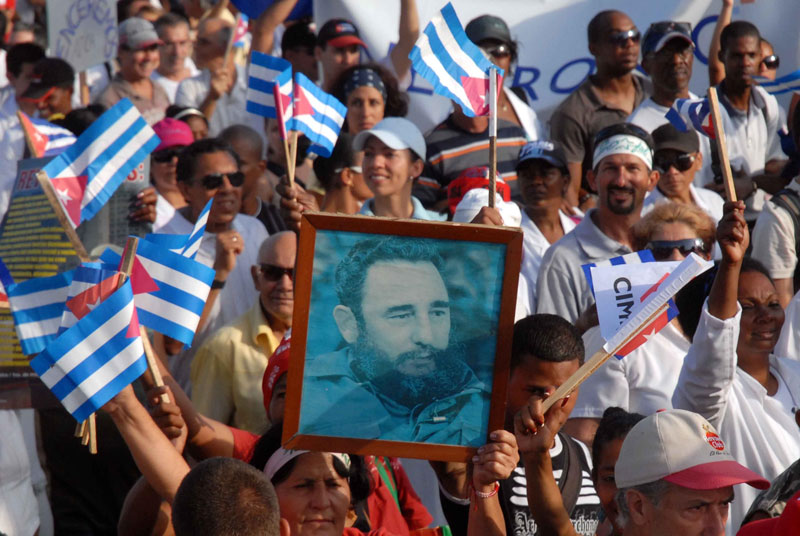 Just in case, and taking into account that the layoffs, “desertions” and constant emigration have decimated the ranks of the ever heroic Cuban workers , the CTC will make sure that the CDR (Committee for the Defense of the Revolution), the FMC (Federation of Cuban Women), the Combatants Association, students and the UJC (Young Communist Union) will be in attendance. We need to fill in, whenever possible, the obvious blanks that have been appearing of late among the ranks of the faithful in the processions.
When the tumultuous pantomime finally ends next Thursday, nobody will know for sure what the working class might really be celebrating, so many industry and job shutdowns, the tax increases, the insufficiency of wages, the breaches of the sugar harvest and agricultural plans, market price increases, the denial of the right of free contract or any other of many similar achievements that have come hand-in-hand from the Guidelines, the apex of the late-Castro fruit. Whatever. This is about a matter of pure form and not content, not necessarily of being, but of pretending. Not standing out.
If it were not so sad it would be laughable. Chances are that even Karl Marx himself would be surprised if he could witness the parade of workers held in slavery. And, on the record, all without the need for lashes or overseers. Some rascals, those who are always joking around, say that the General President has a hidden card to ensure attendance: whoever completes the parade’s circuit will be stimulated with a glass of milk. Now they tell us!
Translated by Norma Whiting
1 May 2014