The daughter of a Mexican mother and German father, Frida Kahlo was born in Coyoacán, Mexico on July 7, 1910.
She attended the Escuela Normal de Maestros and graduated from the Escuela Nacional Preparatoria. She dreamed of becoming a doctor until a terrible accident destroyed her body, forcing her to lay in bed for many months and receive painful treatments, causing her to stop studying medicine.
In the midst of her dramatic convalescence, her iron will and attachment to life led her to become extensively self-taught in the arts and the mysteries of painting. She became an artist and took advantage of her knowledge to teach classes at the Escuela de Artes Plásticas in spite of her physical limitations.
Her first exhibitions demonstrated her talent, which she continued to develop and which culminated in a magnificent work, turning her into one of the most famous painters of her type worldwide.
She impressed upon her work all the pain, feeling, and sensitivity that characterized her life. The memory of Frida is inextricably linked to the great muralist Diego Rivera, who was her husband, lover, confidant, and greatest critic and admirer. In spite of a tempestuous marital relationship, art united them until the end of her life, on July 13, 1954.
This month, Mexico pays homage to those who hold a seat of honor in the plastic arts of the 20th century. I am also joining in this commemoration since Frida was a source of inspiration and presence in my patchwork art.
Frida Kahlo narrated her life through painted images. The painting of this great artist is like no one else’s. As Diego Rivera, her husband, pointed out one day, she “is the only example of the history of art, of someone who tore open her breast and heart to tell the biological truth of what she feels in them.”
Most of her work is unknown; it is held in private collections and by friends. The value of it grows each day.
14YMEDIO, Fernando Damáso,Havana, 21 July 2014 — It is no secret that the editorial policy of a newspaper responds to the interests of its owners. In countries where freedom of the press exists and is respected, newspapers abound, reflecting many different interests. In countries where freedom of the press is clearly absent, one, two or three newspapers are sufficient, more than enough to cover the form, because they all say the same thing and defend the same principles.
The case of Cuba is a good “bad example”; Granma, Juventud Rebelde (Rebel Youth), and Trabajadores (Workers), each in its area of influence, serve a single objective: to defend at all cost the established political economic system.
In Republican-era Cuba, with a population half as large as today, there were 14 national newspapers: Diario de la Marina, El Mundo, Información, El País, Excelsior, Prensa Libre, Mañana, Alerta, El Crisol, Ataja, Tiempo en Cuba, La Calle, Diario Nacional and Noticias de Hoy. There were also two newspapers in English and three in Chinese, as well as newspapers in each one of the six provinces.
continue reading
Some came out in the morning and others in the afternoon. Some included comic strips and were printed in color with photographs, and some had weekend supplements. In their Sunday additions the newspapers multiplied the number of pages and had a great number of advertisements. They sold for five cents during the week and 10 cents on Sunday.
This variety of daily papers covered the entire Cuban social spectrum, from the most conservative positions represented by Diario de la Marina, to the most radical represented by Noticias de Hoy, the newspaper of the communist. Between one or another there appeared the whole gamut of political, economic and social concepts. Some prioritized political news, and others events. All of them dedicated space to culture and sports, where qualified journalists had regular columns.
In their Sunday editions Diario de la Marina, El Mundo and Información devoted ample space to literature, visual arts, theater, music, film, science, among other topics, with articles written by prestigious intellectuals who were not forced to toe the editorial line.
Leafing through old copies, articles appear from important personalities and journalists such as Enrique José Varona, Juan Gualberto Gómez, Rubén Martínez Villena, Raúl Roa, Carlos Márquez Sterling, Sergio Carbó, Jorge Mañach, Anita Arroyo, Emilio Roig de Leuchsenring, Gastón Baquero, Felipe Pazos, Mirta Aguirre, Eladio Secades, Edith García Buchaca, Alejo Carpentier, Agustín Tamargo, Enrique de la Osa and many others who make up the endless list and demonstrate the multiplicity of views.
Every citizen could freely choose the one most corresponding to their own, without dogmatic impositions of any kind.
There were dailies that exploited sensationalism and yellow journalism to sell their copies quickly, and those that offered more serious news in a measured way, which were most of them. Newspapers were hawked on the streets by vendors, using as promotional hook the main news on the front page, always leaving up in the air a question that forced you to buy it, if you wanted to know everything.
Some famous hooks, often repeated, were: See how they caught him! He struck her and fled! He stole and jumped from the second floor! Get the scandal! Here is all the evidence! The cyclone is coming tomorrow! and others.
The main points of sale were the bus stops, where they were offered to the passengers through the windows in quick sales transactions. In addition, there was home delivery by subscription or, more leisurely, by distributors that roamed the neighborhoods. They were characterized by punctuality, thus ensuring that the papers arrived daily before breakfast or before dinner, depending on whether it was a morning or evening edition.
After 1959, the Republican-era press had a sad ending, first with the invention by the government of “tag lines”—short texts, supposedly written by “revolutionary” workers, were added at the ends of articles and reports to reject the opinions expressed—and finally, with the intervention and closure of the newspapers.
The Republican-era Cuban press was dismissed during the last half century by the spokespeople of the ruling party, forgetting that it provided an important service in the defense of citizens’ interests and in critiquing the different governments in every era, a source of pride and an example to imitate in these times, where free opinions are only possible in the few independent newspapers that exist against all odds, persecuted and suppressed by the authorities, and whose circulation is hindered.
A friend sent me photos of a demonstration in the streets of Vienna in support of the Palestinians. I also received—from all over the world—images with signs of solidarity or rejection of one or the other of the parties implicated in the conflict in Gaza. Many take sides and demonstrate it, be it a tweet, a way of dressing, a shout or a public protest. In Cuba, however, only the official press and institutions may speak in headlines and statements. In the 14 days of the latest bloody confrontation between Israel and Hamas, no spontaneous demonstration on the subject has taken place in our public spaces.
Freedom can be simulated, replaced by false statistics of well-being and justice, but someone always puts it to the test. That public protests on national and international issues don’t happen in our territory is evidence of the lack of rights and social autonomy we endure. It is this same gagging of public speech that prevents organizations like those of the LGBT community from protesting the arrival on the island of Vladimir Putin, considered one of the most homophobic presidents on the planet today. It is also a bad sign that today, during the arrival of Xi Jinping, no one is seen outside the airport demanding the release of Chinese dissidents or asking for greater environmental protections in that country.
I repeat, freedom can be simulated, but its lack is obvious in a minute, its immense absence. So among my friends—one of whom has prepared his keffiyeh, while the other has a Star of David tattooed on his arm—cannot march through the streets of Havana showing their preferences or outrage. No one is allowed, of their own initiative, to denounce the deaths, the blood, the pain. Thus, we will not see pictures from Havana with the streets filled with people outraged by the events in Gaza.
The case of the Malaysian plane downed over Ukraine is lamentable and condemnable because it involves innocent people–now called collateral victims–divorced from the conflict. Surely appropriate investigations will be undertaken to identify those responsible for this barbaric act. However, it is striking how, in the first moments of this tragedy, certain characters, who appear to have a crystal ball, have come forward to hand out accusations without any evidence, their preferred target being the Ukraine authorities, exempting the Russians and pro-Russian separatist from any responsibility.
The problems of the Ukrainians with the Russians, exacerbated now with the separation of Kiev from Moscow, are long-standing and existed in the Soviet era, only then they were brutally repressed to maintain the former Soviet Union at all cost, and to present it as a joining of united brothers. This is well-known and the evidence for it is overwhelming.
The aspirations of the Russian president to restore his lost Empire are also well-known. The annexation of Crimea, in reality of Tatar origin, is a good example. Thus, there is a geopolitical confrontation between Russia and Ukraine: the Ukrainians are trying to maintain the integrity of their country, and the Russians are trying to dismember it, taking advantage of the ethnic Russian population who colonized areas of this country, a method also used with other republics during the Soviet era. Examples: Estonia Lithuania and Latvia.
The question to ask is, who benefits from the downing of the plane? The Ukrainian authorities did not benefit; confirming their responsibility would put them on the spot in the public eye. Does it serve the Russians and the pro-Russian separatists in their campaign against the government of Kiev? The answer is in the wind.
With much of the world caught up in the unharmonious rivalry of football’s World Cup, which ended last Sunday in Brazil, few people were paying attention to the conclusion of the funereal G77+China summit.
It was attended by a couple of serious figures, a group of spermatzoon zombies and a broad spectrum of political antiques who, given their actions, did not seem to be living in an era in which theoretical debates, respect for inequality and discord dominate.
This event — a theatrical fantasy based on an esoteric work of fiction — ended on June 15 in the city of Santa Cruz, Bolivia. It was yet another portrayal of lunacy, one in which uncreative delegates gave insipid speeches full of florid mumbo-jumbo. continue reading
They amounted to monologues that sounded good but convinced no one. Ban Ki Moon, the UN Secretary General himself, spoke of human rights before a cynical troupe of representatives from countries – Zimbabwe, Syria, Equatorial Guinea, Cuba and Venezuela – accused of violating them. And the there was China, which arrived at the summit without bothering to conceal its true intentions: commercial expansion and strategic positioning in the Americas.
I suggest that analysts start paying attention to this particular issue and stop ignoring Asia’s current imperial-minded superpower, which has invested more than one-hundred million dollars in the region over the last eight years.
There were pleasant but disturbing words from the gruff, obstinate and colorful Evo Morales, president of the summit and of Bolivia — the poorest and most backward country in the South America — whose speeches were sprinkled with his customary and dangerously foolhardy statements. Instead of requesting more support for his nation, he proposed the elimination of the UN Security Council as a means of creating a “new world order.”
A dictatorial government must appear above reproach and project an exemplary image, at least according to books that try to explain how power and social harmony in totalitarian systems are achieved principally through fear. But it can intimidate the lackluster, incoherent, arrogant and rigid.
General Raul Castro, with marked but unconvincing overacting and macho bravado, eschewed the customary meddling policies of Cuba’s revolutionary government. Projecting instead a posture of economic prowess and crocodile charisma, he publicly and shamelessly denounced what he called “illegal, covert and subversive actions, used to destabilize countries.” The Cuban president added, “At the present time state sovereignty is being transgressed and principles of international law are being blatantly violated.”
Has the General/President been drinking again or does he think that saying one thing while doing another is not lying but rather just a way to maintain a tradition that has been passed down?
In short, the sea.* I don’t know if it was luck or misfortune but, because attention was focused on goals, news of a summit attended by presidents, heads-of-state and over 100 representatives from various countries was not reported until the end of some newscasts. It is evidence that we live at a crucial time marked by a complete leadership vacuum. Worrisome.
*Translator’s note: “en fin, el mar.” Final line of a stanza from the well-known poem “Tengo” (“I Have”) by 20th century Cuban poet Nicolas Guillen.
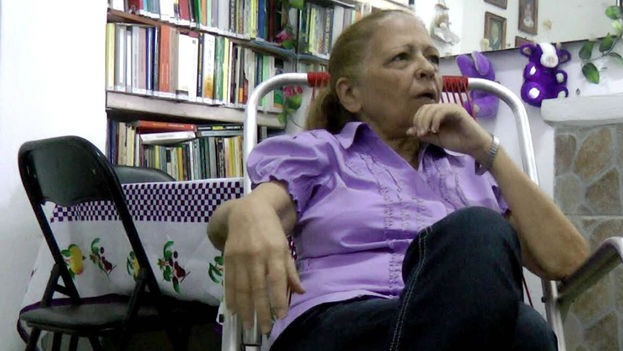
Martha Beatriz Roque, the new president of the Hispano-Cuban Foundation. (14ymedio)
14YMEDIO, Havana, 18 July 2013 — The Cuban economist Martha Beatriz Roque has just been named president of the Hispano-Cuban Foundation (FHC). The institution has tried to “promote the presence and relevance of the FHC in the island.” 14ymedio was able to speak with the prominent dissident to get her impressions about the new appointment and her immediate plans.
QUESTION: How do you feel to have been chosen for this position?
ANSWER: It is a tremendous responsibility, because when the board members of the FHC decided to choose me for this position they based it on some expectations that I must now meet. A challenge of this nature, one always takes it as a challenge, with a bit of fear too, because I know it will not be easy.
Q. What are the first steps that you will take starting now?
A. First I must organize the Cuban side. The patronage in Madrid is very well defined, but here there are some steps that need to be taken in that regard. The first is to legalize the situation at the Embassy of Spain in Cuba and then there will be many other steps and concrete actions. But contrary to how Raul Castro thinks things must be done in Cuba, when he advised doing everything slowly and gradually, we will try to make our plans a reality as quickly and swiftly as possible.
Q. Do you intend to try to legally register this entity in the Register of Associations of Cuba?
A. In Spain this foundation is legalized, it is based in Madrid and is well known in the European Union. Legalize it in Cuba? …? I don’t know if it makes much sense even to try.
Q. Will you continue as usual with his work as head of the Community Communicators Network and the Institute of Independent Economists?
A. Yes, of course, one has nothing to do with the others. All tasks that come starting now with this new responsibility will be in addition to what we do every day. I hope I have the time and energy.
Adolfo Suarez, Spanish lawyer Catholic politician, finally extends his hand in a physical goodbye. From now on we will resort to memory, photos and audiovisuals to see him greet us with his amiable gesture of unwavering gallantry in the fight for democracy in his country. History records him as the architect of the Spanish transition. For me, he is the foundation and the pillar itself of the magnificent bringing in of democracy and the entire process of political development that happened after the death of Francisco Franco.
As a public man and a decent statesman he worked for the reconciliation of Spaniards, to eradicate the vestiges of dictatorship in Spain, and to help lift his country, not to bring it to its knees it as dictators and their partisans in uniform usually do.
The warm smile of this kind man – a leader without rancor who didn’t hide behind the knife of vengeance, but offered the embrace of reconciliation – earned him the love and respect of the entire world. He starred in the development of a democratic monarchy and gave lessons in respect for the institutions and laws which with the transfer of power have been maintained from 1976 until today.
We Cubans, who suffer from 55 years of a dictatorship that defeated another one of seven years to remain in power and ruin Cuba, value the moral stature of politicians who serve their countries and their societies, rather than those who use a pedestal, as José Martí said, to rise above them.
I remember during my childhood how the Cuban dictator criticized the caudillo of El Ferrol for his years in power and, with the passing of time, he himself broke the record for the most years in power in Cuba.
Democratic societies are mourning today for the eternal loss of this citizen and politician who showed the world that intentions are demonstrated with acts not with words. May this illustrious son of Spain, an exemplary example of a democracy, rest in peace.
Rosa Lopez, Havana, 17 July 2014, 14ymedio — Many Cubans opt for the informal market instead the high prices of the products in hard currency stores. Who among us has not bought cheese, ketchup or milk in illegal trading networks? However, when we acquire something in secret and do not know the seller, the chances of being scammed or buying spoiled merchandise multiply. The greatest danger, however, is to buy a product that damages our health, hence it is important to be careful with certain foods.
Every Cuban adult has some experience to tell about a fish sold as red snapper and it was actually tench, Claria or barracuda. With the fish slickly packaged and displayed furtively, the trader assures us that it is ” good, white with few bones.” Later, in the pan or dish, frustrated, we discovered the deception.
Some customers claim to have a good contact to buy seafood that so far has not failed them. Lucky them! By contrast, the vast majority is supplied by an illegal and unstable market whose providers change frequently. The fish markets under state management offer little variety and high prices, not to mention the long lines that sometimes form in front of their doors.
It is easy to think that living on an island we can have our tables filled with seafood, oysters, sardines and other sea delicacies. Nothing is further from reality. In Cuba it it easier to find turkey hash “made in USA”, than a good marlin steak or grouper head soup.
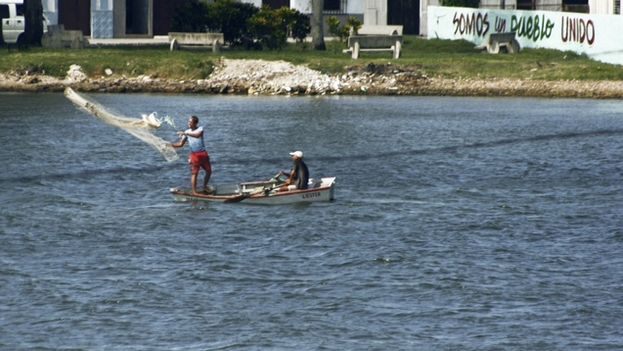
The restrictions imposed on both private fishing and the sale of fish push us to the black market when looking for a good product. The species may have been caught in oxidation ponds belonging to factories or industries, and could introduce chemicals into our bodies that bring negative short and medium term effects.
On the island there are many reservoirs and coastal areas that contaminated by discharges from industries and settlements. Fish that live in those stretched should not be used for human consumption. An example is Havana Bay, whose waters are polluted by oil, sewage and other waste discharges.
Another threat is ciguatera, a food poisoning that is endemic in the tropics caused by eating infected fish. The fish afflicted with this disease cannot be identified by smell, taste or color.
If a stranger knocks at your door offering a tempting fish filet or steak, be careful. It may not be what they say, or in the worst case, it could damage your health.
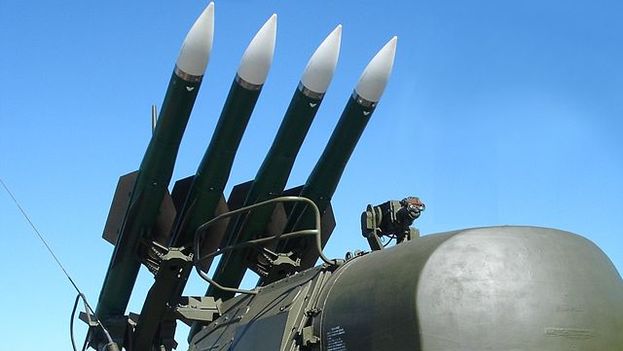
Buk missile battery, similar to what might have shot down the plane of Malaysia Airlines
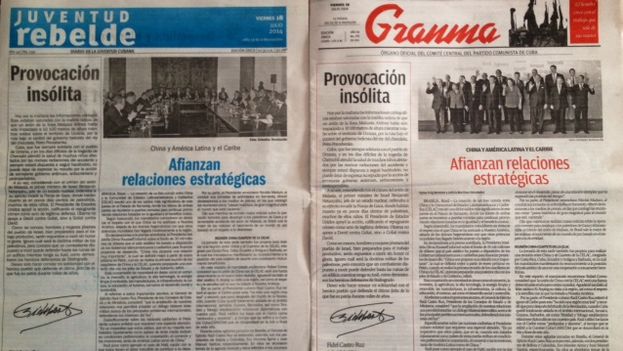
14ymedio, 18 July 2014 — Former Cuban president Fidel Castro published one of his “Reflections” today in Juventude Rebelde (Rebel Youth) in which he bluntly accuses the government of Ukraine of the crash of the Malaysian Airlines plane that caused the deaths of 298 passengers in the air space over Donetsk.
Without providing any evidence or reasons for the suspicion, Castro ended the first paragraph suggesting that the plane “had been hit at 30,000 feet flying over Ukrainian territory on a path under the control of the war mongering government of the king of chocolate, Petro Poroshenko.”
Continuing, the leader of the Revolution recalled the friendship between Cuba and Ukraine and the island’s support after the Chernobyl disaster (in the north of the country, then belonging to the Soviet Union), but argues that he cannot fail to condemn “the action of such an anti-Russian, anti-Ukraine and pro-imperialist government.”
As of today it has been a week since the last public appearance of Fidel Castro, when he met with Russian President Vladimir Putin. The relationship between Russia and Cuba, which has historically been excellent, has become even closer in recent weeks.
Earlier this month, the Russian Federation ratified the cancellation of 90% of the enormous debt of the government of Havana the former USSR, some $30 billion dollars. During his visit to the island, Putin demonstrated that both parties are working on a program of economic, commercial, scientific and technical development until 2020 and their “business advisors” remain active.
Russia also counts on its ally in the diplomatic arena. In the United Nations the Cuban government votes with the Federation.
The grass, the cows, and the man; in the food chain every species expects a greater predator. International politics works in the same way. The government of Venezuela, for example, manipulates world, regional and even local opinion, publicizing the work it does in the Barrio Adentro, Milagro, Sonrisa, Negra Hipólita, José Gregorio Hernández, Moncada missions, etc, etc, etc.
Seeming to clean the castle but in reality they market popular health as if it were a pedestal, in order to save the King and to entertain the country. Using their own sick people to bring the country to its knees, to divide it into tribes that confront each other, to denigrate the spirit and to darken the pride of millions of Venezuelans.
It is a tragedy for many is fortunate for a few. There is nothing of altruism, much less of kindness; it is simply a crime that, given the necessity, becomes socially acceptable but continues to be exactly like any criminal.
continue reading
There are, therefore, many who confuse a beach with a battlefield, trash with news, who on seeing themselves observers of the real world, limit their vision and mimic whatever parrots are to blame for this crisis called Nicholas Maduro.
Big mistake. The politicians know perfectly well the basics and the repetitiveness of the human race; most people allow themselves to be led, need to be led, and hope that their loyalty will be well compensated.
The former member of the Socialist League, the former bus driver of Caracas the former Foreign Minister, the former executive Vice president, autocrat par excellence and current president of Venezuela, is simply a chess piece who has great responsibility; here Havana is the predator with amazing acuity, and driven by its usual strategy, of domination and management, it invests resources in sending doctors and medicine to control the area and to feed groups of opinion. Julius Caesar, military leader, politician and former Roman dictator said, “A people should not be invaded without any reason.”
I still can not accept that so many analysts in their work of analysis overlook the detail that “El Chino” has nothing to do with China, and the invasion of stethoscopes and white coats is pure business; delivering to the highest bidder the great bear of the Russian steppe.
General Raul Castro, A man more occupied in accumulating power then in defending ideologies, avidly pro-Russian, zigzagging, calculating, and in favor of the Cold War, is trying to organize a possible ending serving the area to a Moscow that is awakening from a lethargy and misses no opportunity to throw itself threateningly into the backyard of the United States with the idea of recapturing its feudal Caribbean paradise and using it as a naval base in the expansion of ALBA, CARICOM, CELAC, OEA and MERCOSUR, all governed by the left and, coincidently, the geographic space that could favor the Kremlin and its ambitions to match the pulse of the New World Order. Something that contradicts the Monroe doctrine; hence much to my regret, “America is no longer for Americans.”
For several days now I have not published a post, despite my desires to do so and the nagging thought that it wasn’t getting done.
It is true that the World Cup robbed part of my attention, but that was not what impeded my writing. Rather, it was all the tasks that were piling up in relation to an upcoming exhibition of my works. Preparing for this event takes a lot of effort and dedication, as does the negotiating required to obtain adequate materials.
Even so, with all due respect, I would be remiss if I didn’t comment on the recent visit of Dr. Margaret Chan, General Director of the World Health Organization, and the statements she delivered in the University of Havana’s Grand Hall, during the unsuitably named magisterial conference. Dr. Chan expressed that, thanks to the Cuban government, our people do not eat junk food. She also praised the work of our public health.
I really do not comprehend how these people, who occupy such relevant posts in the United Nations (UN), take at face value the reports provided by totalitarian regimes, without taking the trouble to check the facts through other means and compare other data.
Most of us know that these people are hosted in our country by high-level officials, and that they are taken over and over to the same places, which obviously are set up for such purposes, e.g.: a certain floor of Almejeiras Hospital, the Biotechnology department, and the La Castellana special school for differentiated teaching, among others. In addition, the visitors are customarily taken down 5th Avenue in Miramar, and they never stop at locations that aren’t set up for these political purposes.
How is it possible that the supreme body that oversees all of these organizations — the UN — has yet to take the trouble to look into these matters more deeply?
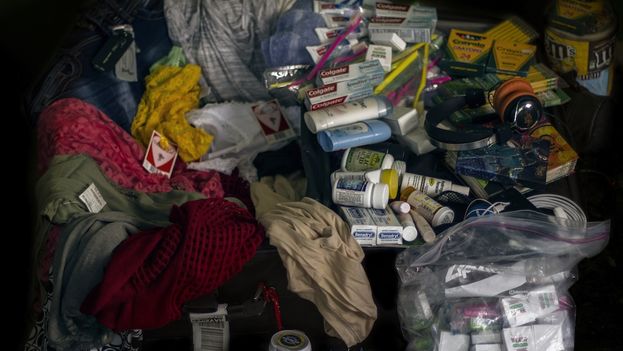
The inside of a traveler’s suitcase arriving from Miami (14ymedio)
Customs restricts imports even more
Reinaldo Escobar, Havana, 14ymedio | 14 July 2014 — On the occasion of the latest customs regulations that further limit the products that travelers can bring to the island, a group of officials from the General Customs of the Republic of Cuba (AGR) held a press conference to respond to some concerns of the population. Among the pearls exposed there, it’s worth nothing an argument put forward by Idalmis Rosales Milanes, deputy chief of the AGR, where she tried to equate these actions with what happens outside of Cuba. “All countries,” she said, “regulate non-commercial imports to their territory.”
And it’s true. What this official didn’t say is that in all countries there are other regulations for commercial imports to non-state entities. If this weren’t the case, I would have to believe two things: that in the rest of the world all the stores are state-owned, or that the goods for sale in them are produced entirely in the country in which they are located. It gives the impression that this precision is for idiots, because it’s so irrational it’s embarrassing to have to clarify it.
The absurdity is normal only if the entire environment is also absurd. Whoever developed and approved these resolutions was personally persuaded that commerce is a crime unless it is performed by the only state monopoly that they themselves control.
Instead of developing a list detailing how many razors, pairs of shoes or fake nails can be carried in your suitcase, it would be much more useful to allow the importation and sale of whatever merchandise (non-lethal) is produced in the world, and to promote its free trade by private individuals who would be those who would assume the risk of being left with them in their shops if they weren’t able to sell them.
The law should allow the owner of a restaurant to import, in his condition as a private businessperson, the wine, pasta and cheese consumed by his customers. The seamstress should also have the right to bring fabric and dyes from other countries with which she designs her clothes, and the small trader must be able to count on the possibility of bringing the instant glue, the sponges for cleaning, and the hair dye, from other latitudes to the island. All this, backed and supported by commercial permits and import licenses… in the hand of the non-state sector.
That theses commercial imports are on a list of prohibited products, that there is a limit of the number of admissible pieces, that a diversified tax is imposed according to the article… all this would be almost comprehensible and, especially, debatable. What I can’t make heads nor tails of is this “dog in the manger” conduct, which neither eats nor allows others to eat, and in this case neither imports nor allow to be imported; neither trades, nor allows others to trade.
IGNACIO VARONA, 14ymedio, Havana, Cuba | 13 July 2014 — The Cuban government’s support for the Soviet tank invasion of Czechoslovakia, the failure of the 10 Million Ton Sugar Harvest, the case of Heberto Padilla, the repudiation rallies of 1980, and Cuba’s Black Spring are chief among the breaking points for many who at one time backed the Cuban Revolution. A political process that at its beginnings more than a half century ago enjoyed strong approval inside and outside the island has become increasingly characterized by deception. This persistent flux from believing to not believing has made critics out of former sympathizers, and antagonists out of those who once gave ovations.
Inside Cuba, one instance of major fracture in the support for the revolution was the execution of General Arnaldo Ochoa. This event took place on July 13, 1989, exactly 25 years ago. Along with him were executed three high-level officials of the Ministry of Armed Forces (MINFAR) and the Ministry of the Interior (MININT). A military court found them guilty of — and condemned them to death for — the crimes of drug trafficking and high treason. continue reading
Never will it be known the true extent of the disillusionment caused by this event in many communist militants as well as the rest of the population. The disappointment amongst the people that emanated from the so-called “Case Number 1” of 1989 fed the decision of many individuals to take the step toward dissension. Numerous dissidents cite this judicial process and its extreme sentences as the moment when they broke with the party line.
The 1990s could not be understood without the precedent of a televised trial that riveted millions of Cubans to the small screen, as if to the most impelling soap opera. After long days of hearing allegations and accusations, a bond was established between the TV audience and the figure of Ochoa that nobody could have foreseen. This “connection” consisted of a combination of respect and pity, to which was added the silent hope that the sentences requested by the prosecutors would not actually be applied in their full severity.
“I sat in front of the television set believing in the system, and when I arose I no longer believed in anything”, said María López, who at that time belonged to the Young Communists League (UJC). A few months after “El Indio” (“The Indian”) — as Ochoa was popularly called by some — Maria turned in her UJC membership card. “I could not tolerate such cruelty, besides which it always seemed to me that what came out in that trial was not the full truth,” she concluded. Like her, an unpublicized number of other militants distanced themselves from the organization, severing their ties or assuming a less aggressive stance.
The “Balseros” (Rafters) Crisis that would occur five years later was comprised of individuals who, besides suffering the miseries of the Special Period, had lived through the trial. Part of the disillusionment that would manifest in fragile vessels crossing the Florida Straits emanated from that event. Although hunger and the lack of prospects where the primary goads toward the exodus, for many of those who launched themselves to the sea, the death of of Arnaldo Ochoa had contributed to severing their emotional ties to the system.
“It was the moment in which totalitarianism removed its mask”, noted Ezequiel Méndez, who is now based in Los Angeles, USA. On that July 13, Ezequiel had guard duty in the unit where he was serving his compulsory military service. He remembers seeing the “long faces of the officers, which gave us to understand that something was going on”. Within the army, the execution of these four military men was especially disturbing, but fear and silence were the major expressions of this emotion. “In the mess hall, when the TV set was turned on for the broadcast of the trial, nobody said a word…everyone was very, very quiet”, recalls Ezequiel about those days.
A quarter century after the effect of those executions, the disappointment has not diminished. Rather, other disappointments have been added to it. The government was never able to recapture lost sympathy, and the days are over when military feats produced heroes.