Fidel Died / Orlando Luis Pardo Lazo

Cuban democracy has taken so long that now it seems we Cubans can wait for a little longer. President Obama, with his historical Cuban speech, is indeed recognizing the future rights of a leftist dictatorship that in turn never recognized the rights of Cuban citizens.

Yet, his Cuban counterpart, General Raul Castro, dressed in military uniform instead of his much more accustomed expensive suits, delivered a simultaneous speech so solemn that he sounded like in a funeral. It was obvious that this was his fraternal farewell to Fidel Castro, who cannot be part anymore of the Cuban equation in the new era opened today. I dare say that Fidel Castro has died and that the apocalyptic announcement may take place in the 56th anniversary of the Cuban Revolution, on January 1st.

Next, we’ll see in Cuba the masquerade of new investments and markets and local licenses for business and more access to internet and even an electoral reform, but private property will remain a myth and no fundamental freedoms are conceivable for Cubans while only one Communist Party keeps monopolizing all political life, with the State Security from the Ministry of the Interior as the real source of governance of a model based on secrecy and, of course, impunity to repression. continue reading

After decades of fostering terrorism, the Caribbean dictatorship is paving the path to a dynastic “dictatorcracy”, with second and third generation Castros perpetuated in position to lead this process without ever worrying about consulting the popular will. Thus, the Cuban self-transition from totalitarianism to State capitalism is under way with a new geopolitical ally: the United States of America. As such, Cuban democrats must re-schedule their expectations to live in a normal Cuba. This is the main consequence of the “normalization” of relations between the gerontocracy of the Revolution Square and a White House pushed both by the corporations and by the pro-Castro bias of the free press.

As for the Cuban exiles, thank you very much for what you’ve done for this great nation, yes, but your President Obama has just mentioned that effective Cubans are only the 11 million still under Castro’s rule on the Island. So, our world-wide free diaspora will remain excluded of their own nationality, at most invited to collaborate by sending their billions of dollars every year in remittances. What’s more, the Cuban Adjustment Act from 1966 is likely to be ineffective soon, so that the Cuban immigration will lose its special status in USA and the first deportations of illegal Cuban newcomers are conceivable to stop the stampede.

Last but not least, Cuban “civil society”, as Obama stated, seems no more interested in political opposition to the government and ultimately, in peacefully struggling to legally attain power. Reduced to the field of dissidence, their pro-democracy actions are limited to a digital catharsis that is perfectly tolerable for the new status quo of post-Castroism.

So, welcome to the real thing. Cuban democracy, like heaven, can wait. Like hell.

(Original in English)

17 December 2014
Of Rafters and Slave Hunters / 14ymedio, Luzbely Escobar

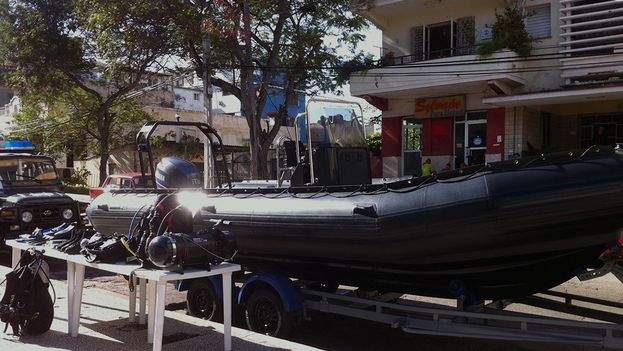
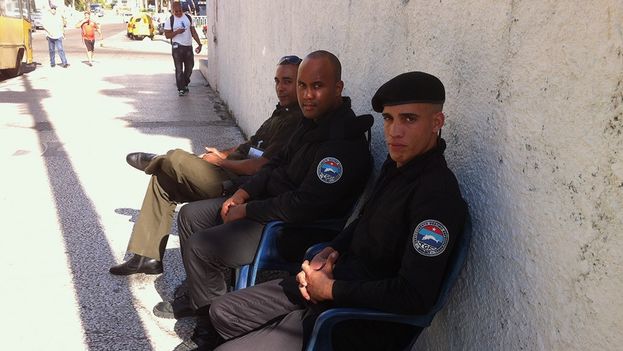
Special border guard group.  (Luzbely Escobar)
Special border guard group. (Luzbely Escobar)

Gerardo and Agustin were stuck for two days with water up to their knees, among the trunks and roots on the coast. They had chosen a point west of Havana that they nicknamed the terminal for its frequent illegal exits, but the trip was thwarted. “They detected us, I don’t know how, because it was in the middle of the night and you couldn’t even see your hands,” they relate, still somewhere between surprised and upset. The capture of the two seems to be due to a new device, half truck, half scanner, that goes in search of rafters.

Last Friday a rare entourage was exhibited a few meters from the central Havana corner of L and 23. Two military jeeps, an overhauled vehicle and a motorboat were shown to the stupefied students who formed a circle of interest just outside the Cuba Pavilion. The teens fluttered around the objects, and an officer explained the modern work tools for “protecting the Cuban coasts from illegal entry and exit.”

The purpose was to familiarize the students with every detail of the work in the Ministry of the Interior’s Border Guards in order to attract potential soldiers. The device that they described with greatest pride was a truck that once belonged to the Trasval chain messenger service and that they themselves have fitted with GPS and motion and heat sensing cameras. Its mission? Finding amid the underbrush, darkness and waves those who have decided to escape from the Cuban paradise. continue reading

The curriculum of each of the members includes not only detailed knowledge about the functioning of the new technology but also proficiency in techniques of self-defense and neutralization of the “enemy.” The students seem to listen to the explanation with the playfulness of being halfway between the hiders and the seekers, between the coastal police and the fleeing rafters.

Barely a couple of years separate Gerardo and Agustin from those youngsters in the interested circle. Maybe they once crossed an intersection or shared a jitney or waited for the green light together at a stoplight. Nevertheless, if those students were to decide to become part of the Border Guard Troops, on a night as dark as hell some would be shivering amid the mangroves and others would push the buttons of a device designed to hunt emigrants. “We have to hold them and guard them until the people from Villa Marista come to look for them,” says one of the officers to motivate even more those who listen to him under the December sun of a Havana afternoon.

A girl asks about firearms, and a man wearing a beret pulled tight to his ears tells her that they must not go out armed on these missions due to “incidents that have occurred where fatal shootings have happened.” But continuing, he explains that they plan to place on the truck “an arsenal for confronting possible entry of speedboats with armed people or explosives.”

From the outside, the singular truck looks like a featureless gray box, but passing through its side door one finds a bathroom and a space that can be transformed into a bedroom or meeting room. The table used for discussing upcoming plans and operations folds up and is stored. The benches are opened and converted into two bunks, one on each side, where up to four people can sleep. The climate control permits them to endure the hot nights without opening the door which would cause them to suffer the persistent coastal mosquitoes.

Border guard boat.  (Luzbely Escobar)
Border guard boat. (Luzbely Escobar)

They carry a coffee maker, a rice cooker and a so-called “Queen” cooker (a Chinese-made pressure cooker) for cooking outside the truck. In order to make it all work, they carry an electric generator “so that the current is not a problem,” they assure with a certain vanity. The boast about resources does not stop there. They relate that they have “a campaign table in tow to set up the outdoor kitchen and a tent with a 40-person capacity.” This last is for the detainees, in case the people of Villa Marista take too long and they have to sleep at the capture site.

“This is a combat truck because it was born in combat,” one of the pompous drivers is heard to exclaim. “It is a unique prototype in the country and is called a mobile command post,” he stresses. “The boss,” he says while he points his index finger up, “says that he is going to make one more advance, but well, this takes financing, this takes resources.”

The news is worst for those who evade because this team acts as if they were really slave hunters with an obsession. “This is a fixed rotation. We go out for 20 days to the coast, and we have no relief. Those are 20 days without seeing the family,” they say, explaining the conditions in which they work.

In order to attract the girls to the circle of interest, an officer with ten years of experience clarifies that “in communications there are many women who do not have to go to the coast.” They laugh and blush, then he returns to the charge saying that “all the communications offices are climate controlled, there are many women who do this work.”

Nevertheless, after looking a while at the device the teens begin to speak of going on vacation with it to the beach, with its bunks and electricity. In the end one of them laughingly says thanks for the “classified information,” and heads down the street to the sea. In the air remains doubt about the next encounter between those adolescents and the officers: Will it be to petition for entrance into the elite group or to beg them not to tighten the handcuffs?

Translated by MLK

Being in “The Packet” / Wendy Guerra

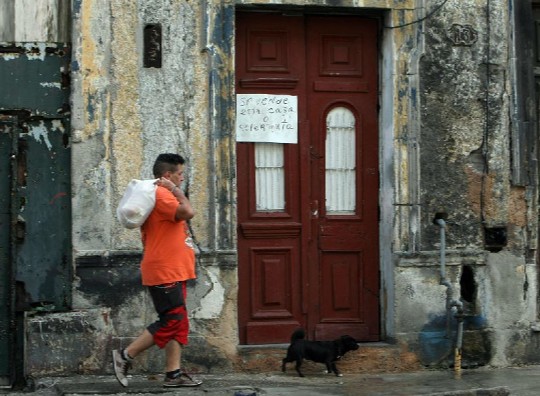
A man with a pack over his shoulder walks down a Havana street.
A man with a pack over his shoulder walks along a Havana street. (EFE)

Wendy Guerra, Habáname, 15 December 2014 — About three years ago, a young man – tall, blond and ungainly – would haul an enormous sack full of DVDs of pirated movies, music videos, TV shows and series. Today, this same young man – now more poised and better dressed – walks the streets of Miramar with a small memory stick in his pocket, dispensing information to any of the households that can pay 15, 5 or, most commonly, 10 CUCs [Cuban convertible pesos] per week to download the latest broadcast content from international channels. For those who are unable to pay this fee, for those who lack the necessary resources, there are the memory devices that we record and distribute. This happens week after week in every Havana neighborhood.

“The Packet.” This is what we locals call the mountain of information that, on a weekly basis, the anticipated visitor sells and distributes to relieve the Cuban people’s dearth of options for visual references and news sources. continue reading

Updates of www.revolico.com or www.porlalivre.com – sites so useful for buying and selling home electronics, food, medicine, clothing and items of all kinds for the island’s resistance, advertisements for paladares (restaurants) and animal clinics, rentals of privately-owned vehicles and beauty shops – all of these form part of the so-called “packet” in addition to premieres of audiovisual productions.

What’s curious about all of this is that many Cuban producers pay 15 CUCs for their productions to be added to the local packet, the domestic one that arrives weekly at your door. This is how the great collage of images and words grows, not just with content from HBO or Channel 41, Univisión or Televisa, but also those productions which have been rejected by the ICAIC or which, because of contractual issues with co-producers, cannot immediately be seen in Cuban living rooms.

Dealer: “Please, I need to include in this week’s packet that movie by Padura*, and yours, too. If you get it for me, I’ll leave you a free month’s worth of programming. Everybody is asking for these movies and they’re driving me crazy. Do you have them already? Are they good?”

Producer: “Sure, here they are.”

This is how the popular information “combo” is sustained on a national scale.

The thing is, “being in the packet” is an honor for those writers, artists, producers and actors who must wait for the approval of institutions such as ICAIC. Meanwhile, this delay tyrannically closes the possibility for excellent films such as “Return to Ithaca”* being available to the public – that is, we who think that we still control what we can view and comment-on. Poor us!

The packet is our access to the sea. To be in the packet is the best way to insert ourselves in the real life of thousands upon thousands of Cubans who want to know what is happening in their own environment.

“They” can control the movie houses because they own them, and these venues are subject to their arbitrary sense of vigilance. But in the privacy of our homes, in the personal space inside our heads, in the packet made a la carte and to order according to our needs, nobody can meddle.

Change happens, everything changes, and institutions start losing their meaning.

The packet: Free and domestic, kaleidoscopic informer, where we all wish to enter, as spectators or creators.

* Translator’s Note: This film, with a screenplay by noted Cuban writer Leonardo Padura, was censured by the Cuban government.

Translated by: Alicia Barraqué Ellison

The Challenges of Young People / Regina Coyula

When vast disagreements exist, dialogue and respectful discussion especially generate questions for the present and future. We were accustomed to the language of the barricade, where anything that didn’t align with the Holy Trinity (motherland, revolution and socialism) was as heretic as in the times of the Inquisition. There were enormous ideological fires that any newcomer or forgetful person should never doubt; he/she must only pay close attention to the embers and sparks that still rise.

The issue becomes complicated with the rise of a trendy lack of social discipline. The youth, whose responsibility to govern will come in a historically short period of time, is educated with videoclasses with no educational supervision and “emerging teachers” who barely have the advantage of three to four years more instruction than those they are teaching. With this deficiency in instruction, whatever one doesn’t learn at home, becomes increasingly difficult to learn at school. continue reading

It infuriates me to hear people say, “In my time…”, although I had professors who imposed their experiences, demeanor and ethics as soon as they entered the classroom. In addition to instruction, I received an education in school that reinforced the influence of my family on my development. Now, those who may not have good models at home, model their behavior to the beat of popular artists and telenovelas (soap operas), because those behaviors are neither learned in a manual nor from a class on television. Under the illusions of so much patriotism, the youth get just as excited about the anthem of Real Madrid as they do with that of Bayamo.

It will be complicated to discuss the course of this country in context when the youngest members of this nation are (at last) in charge of government. They learned that all you had to do to lead and tame people was to raise your voice and a finger along with a group of ideas-turned-slogans (or are they slogans disguised as ideas?). With those few elements, they said, one could corral the people. I don’t have any contempt for them; I was also once naive and easily convinced.

No one ever taught them how to express themselves in a simple and original way. Pay close attention, if you don’t believe me, to the way youth of any age and background mumble heavy diction, one cliché after another, whenever they speak in public. I noticed this months ago in the Ebola doctors, fifteen days ago in the athletes of the Juegos Centroamericanos [Central American Games], last week in the students of CUAJE or yesterday in the innovators and reasoners.

I can’t allow myself, however, to be a pessimist. With a lot of shame, I borrowed from José Martí. The shame doesn’t come from his greatness, but from the poor who have been bustled about from here to there. Despite the shame, I take what I borrowed as an ethical guide. That’s why I have faith in the improvement of humanity, in future life and the utility of virtue, and in you. I want to say that I believe in the youth who unknowingly prepare for their moment.

Translated by: Gloribel Rivas

5 December 2014

Has D-Day Arrived? / 14ymedio, Yoani Sanchez

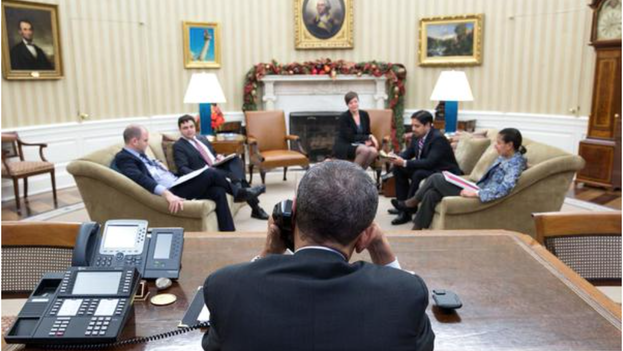
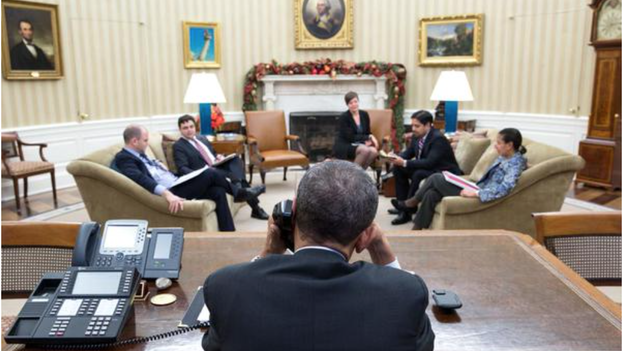
Telephone conversation between Barack Obama and Raul Castro. (White House)

14ymedio, Yoani Sanchez, Havana, 17 December 2014 — Today has been one of those days we imagine a thousand ways, but never as it finally happened. You prepare for a date on which you can celebrate the end, hug your friends who return home, wave a flag in the middle of the street, but D-Day is late. Instead, events arrive in fragments, an advance here, a loss there. With no cries of “Long live free Cuba,” nor uncorked bottles. Life obscures from us this turning point that we would mark forever on our calendars.

The announcement by the governments of Cuba and the United States of the reestablishments of diplomatic relations surprises us in the midst of signs that pointed in the opposite direction, and also of exhausted hopes. Raúl Castro just postponed the third round of talks with the European Union, scheduled for next month, and this December 10 repression fell heavily on activists, as it does every International Human Rights Day.

The first surprise was that, in the midst of the official bluster, of a certain turn of the ideological screw expressed in calls to redouble our guard against the enemy, the Plaza of the Revolution and the White House had been in talks for 18 months. Clear evidence that all this discourse of intransigence was just for show. While they made the island’s citizens believe that even to cross the threshold of the United States Interest Section in Havana turned them into traitors to the homeland, the leaders in their olive-green were working out agreements with Uncle Sam. The deceits of politics! continue reading

On the other hand, both Obama’s statements, as well as Castro’s, had a hint of capitulation. The US president announced a long list of moderating measures to bring the two nations closer, before the coveted and greatly demanded steps of democratization and political opening in our country would be achieved. The dilemma of what should have come first, a gesture from Havana or flexibility from Washington, has just been answered. However, the fig leaf of the American embargo remains, so that no one can say the resignation as been complete.

Raul Castro, for his part, limited himself to announcing the new gestures from Obama and referring to the exchange of Alan Gross and other prisoners of interest of the American government. However, in his address before the national television cameras, he gave no evidence of any agreement or compromise from the Cuban side, aside from the reestablishment of diplomatic relations. The agenda on the far side of the Florida Straits we know in detail, but the internal one remains, as it so often does, hidden and secret.

Still, despite the absence of public commitments on the part of Cuba, today was a political defeat. Under the leadership of Fidel Castro we would have never even reached an outline of an agreement of this nature. Because the Cuban system is supported by – as one of its main pillars – the existence of a permanent rival. David can’t live without Goliath and the ideological apparatus has depended too long on this dispute.

Do I listen to speeches or buy fish?

In the central market of Carlos III, customers were surprised midday that the big TVs were not broadcasting football or videoclips, but a speech by Raúl Castro and later one by Obama through the Telesur network. The first allocution caused a certain astonishment, but the second was accompanied by kisses launched toward the face of the US president, particularly when he mentioned relaxations in the sending of remittances to Cuba and the delicate topic of telecommunications. Now and again the cry of “I LOVE…” (in English!) could be heard from around the corner.

It is important to also say that the news had fierce competition, like the arrival of fish to the rationed market, after years of disappearance. However, by mid-afternoon almost everyone was aware and the shared feelings were of joy, relief, hope.

This, however, is just the beginning. Lacking is a public timeline by which commits the Cuban government to a series of gestures in support of democratization and respect for differences. We must take advantage of the synergy of both announcements to extract a public promise, which must include, at a minimum, four consensus points that civil society has been developing in recent months.

The release of all political prisoners and prisoners of conscience; the end of political repression; the ratification of the United Nations covenants on Civil, Political, Economic, Social and Cultural Rights, and the consequent adjustment of domestic laws; and the recognition of Cuban civil society within and outside the island. Extracting these commitments would begin the dismantling of totalitarianism.

As long as steps of this magnitude are not taken, many of us will continue to think that the day we have longed for is not close. So, we will keep the flags tucked away, keep the corks in the bottles, and continue to press for the final coming of D-Day.

Everything is Sold-Out / 14ymedio, Eliecer Avila

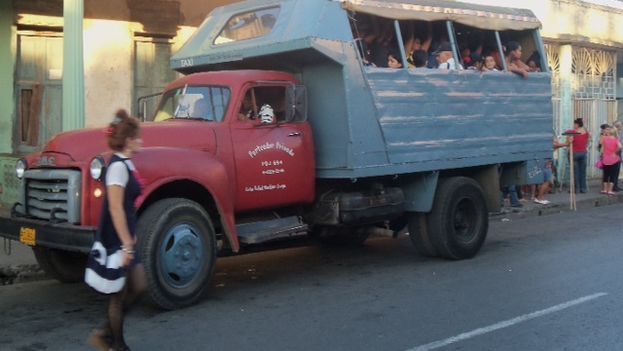
 Collective Transportation. (14ymedio)
Collective Transportation. (14ymedio)

14ymedio, Eliecer Avila, 16 December 2014 — The end-of-year all over the world presents a challenge for many enterprises and businesses, especially for those in the transportation sector. Nobody wants to miss the opportunity to considerably increase the profits to be made from an extraordinary rise in demand for services. To this end, strategies are plotted and necessary adjustments are made well in advance. It is also true that at this time there is a surge in ticket prices. What would be strange is if, assuming you have the resources to travel, you were unable to find any means to get to your destination by land, sea or air.

That is, unless you live in Cuba. This is an island whose land and total population are comparable to or exceeded by some large cities of the world.

Over here, starting in the first few days of December, you can already hear in any office that sells tickets to travelers the famous phrase, “No, Son, no, for those dates, everything is sold-out
It is also common to find someone who laughs and says, ironically, “But who in their right mind thinks they can wait till early December to start shopping for tickets? That’s something you start doing at least three months in advance!” continue reading

The problem is that if you don’t find an option to travel by plane, train or bus, then you have to take a “suck it up and endure the consequences.” This means that you have to go outside Havana to get on some ancient American truck that’s more than 50 years old (that’s been jerry-rigged for such long hauls), and deal with a unlicensed driver and zero guarantees for passengers’ safety.

Even so, the price to board these hulking masses of steel exceeds 200 pesos. Thousands of people of all ages, including babes in arms, travel to and from the eastern end of the country seated on long iron benches, holding on by the tippy-tips of their fingers, and tossed from their spot every time the vehicle brakes or makes some sudden move to get ahead, or to avoid colliding with cars that are travelling in the opposite direction at hundreds of miles per hour, where there are no paved roads.

Rain, cold, hunger, darkness, the need to answer calls of nature (which, when you can do it, you might do it on the grass): these are among the benefits of this type of travel that can last, depending on the destination province, between 12 and 20 hours – if there are no breakdowns.

These people are the ones you later see on the news, reported injured or deceased in the accidents that take place daily on these routes. Of course, those reports don’t dig at the root of the problem, but rather lay all blame on the drivers of these contraptions.

A serious reflection on this subject – or on any other aspect of the daily life of Cubans – brings us to the inevitable conclusion that without a new political system, we will never climb out of this underdevelopment, which is perilously covered-up by our own selves.

I pray once again, at this end-of-year, that the backwardness, ignorance and above all the irresponsibility of the State does not cause the loss of life for so many Cubans on our roads. Unfortunately, the statistics are stacked against me.
Translated by: Alicia Barraqué Ellison

Reactions from Cuba to the Obama-Castro agreements / 14ymedio

14ymedio, Havana, 17 December 2014 – A source from the US State Department has told 14ymedio that now begins the most difficult work, that there will be a lot of criticism, but also that many are feeling optimistic with this Wednesday’s achievement since the announcement of the resumption of diplomatic relations between Cuba and the United States. “We also have to keep in mind that President Barack Obama has announced this series of measures, but Congress can still place obstacles in the way of putting many of them into practice,” the source clarified.

Dagoberto Valdés, director of the magazine Convivencia (Coexistence), said, “It makes me happy to know that diplomatic relations are being reestablished between Cuba and the United States. I consider this as a first step towards normalization and coexistence between the two countries, I salute the release of the political prisoners, and believe that this reestablishment of ties will contribute to focusing attention on the fundamental problem of the Cuban people, which is relations between the Government and citizens. I hope that the dialog that has been established with another country can quickly be realized between a government and its own citizens.” Valdés also highlighted the words of president Raúl Castro about the need to learn to coexist among differences: “This is a breakthrough for coexistence.” continue reading

Eliécer Ávila also considers the policy shift announced by Obama to be positive. “The changes are already here and are a reality, it is the job of civil society to adapt and strengthen its strategy to continue to struggle for human rights in this new scenario, which I hope will end up being favorable to those who dream of a prosperous and free Cuba. Those who want to look back and not look forward are wasting their time,” he pointed out.

The economist Marta Beatriz Roque, however, says it is too early to have an opinion. “We have to wait to see how events unfold. Right now we are trying to find out the names of the political prisoners the government is going to release and under what conditions; then we can offer an opinion.”

José Daniel Ferrer, executive secretary of the Patriotic Union of Cuba (UNPACU), argues that it can be positive if Barack Obama’s administration has decided to take steps to normalize relations with the Havana regime, “If and only if they don’t forget the commitment they’ve made many times and in public with Cuban civil society with regards to respect for human rights in our country.” He added, “The solution to our problems is in the non-violent struggle of Cubans seeking their rights and freedoms, everything else is secondary.”

Ferrer believes that the American government has made a gesture of goodwill, but, “Now we have to see if the Cuban regime reciprocates and demonstrates its goodwill in practice. I strikes me that while the secret talks were being held, the Cuban government postponed conversations with the European Union at exactly the point when they were going to talk about human rights.”

On the streets of Havana, people expressed great happiness and everyone relates what happened with this Wednesday’s date, the day dedicated to St. Lazarus, a very powerful saint among Cubans. Projected on the TV screens at the Carlos II Market, located in the center of the Cuban capital, were the speeches of both leaders. In the audience, many threw kisses to Obama and hugged each other.

Cuba and the United States will reestablish diplomatic relations / 14ymedio

Telephone conversation between Barack Obama and Raul Castro. (Source: The White House)

14medio, Washington, 17 December 2014 (With information from agencies) — Cuba and the United States will reestablish bilateral relations. The announcement was made this Wednesday after it became known that the American prisoner Alan Gross had been released in response to a humanitarian request from Washington. In exchange, Barack Obama’s administration released the three Cuban spies from the group called “The Five,” who were still serving sentences in the United States, according to the Twitter account of René González, one of the group who had been released in 2011, after completing his sentence.

Gross, 65, “has already left Cuba on a plane bound for the United States,” said a White House source. “He was released on humanitarian grounds by the Cuban government, following a request from the United States,” the source added, after serving five years of a 15 year sentence for “threats against the security of the State.” continue reading

The White House denied that US president Barack Obama would visit Cuban during the two years remaining in his term of office.

Obama made a statement from the White House in which he announced the immediate resumption of relations with Cuba, as well as the outlines of a new policy. “Neither the American, nor Cuban people are well served by a rigid policy that is rooted in events that took place before most of us were born.”

Cuban president Raúl Castro also offered a speech in which he stated that, in a telephone conversation with Obama, they had “agreed to the reestablishment of diplomatic relations. This doesn’t mean that the main issue has been resolved: the economic blockade.”

The New York Times reported that Havana and Washington undertook secret negotiations in Canada over the last 18 months, encouraged by Pope Francisco. The dialog culminated in a meeting at the Vatican. Pope Francisco announced he was “deeply pleased” by the historic decision.

Venezuelan president Nicolas Maduro, speaking from the Mercosur Summit now being held in Buenos Aires, also welcomed the reestablishment of relations, calling it a “historic rectification.”

The situation of Alan Gross – arrested in 2009 for distributing satellite telecommunications equipment while serving as a subcontractor to the United States Agency for International Development (USAID), and sentenced in 2011 – was seen as the main obstacle to a normalization of relations between the United States and Cuba.

Washington had refused to consider the possibility of a prisoner exchange with Cuba. Gross repeatedly criticized the lack of an effort on the part of the US government for his release, and this year undertook a week-long hunger strike to pressure the White House.

Obama: “We are making these changes because it is the right thing to do” / 14ymedio

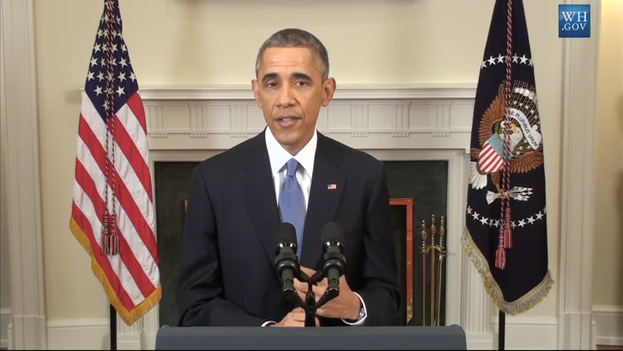
Obama during his speech

14ymedio, Havana, 17 December 2014 – US President Barack Obama announced in a speech from the White House this Wednesday that Cuba and the United States would resume diplomatic relations after the break that occurred in 1961.

“Neither the American, nor Cuban people are well served by a rigid policy that is rooted in events that took place before most of us were born.” Obama said. “We are making these changes because it is the right thing to do.”

The president said that the current classification of Cuba as a state sponsor of terrorism will also be reviewed.

The US Secretary of State will initiate conversations with Cuba “immediately” and it is expected that in the coming months the United States will open an embassy in Cuba. The first step in this process will be to address the issue of immigration between the two countries at a meeting scheduled for this coming January in Havana. continue reading

United States actions in Cuba, Obama said, will focus on improving conditions with regards to human rights and the implementation of democratic reforms in Cuba, as well as other issues of mutual interest, such as immigration, counter-narcotics, environmental protection, and human trafficking.

The White House also announced changes with regards to travel, such as favoring the expansion of general permits for travel to Cuba for all authorized travelers, or the ability to use American credit and debit cards on the island, and easing the policy on remittances. With regards to the latter the allowable amount will be increased from $500 per quarter to $2000, and will no longer require a license specific to the expediter.

Also authorized is the expansion of sales and commercial exports of certain goods and services from the United States (for example, some construction materials or agricultural machinery), as well as allowing travelers returning from the island to import a maximum of $400 in goods, of which no more than $100 may consist of a combination of tobacco and alcohol products.

Obama said that the United States will offer its support to increase Cubans’ access to communications, both through the commercial export of certain goods and the authorization for service providers to implement the mechanisms necessary to provide commercial telephone and Internet services.

“This April, we are prepared to have Cuba join the other nations of the hemisphere at the Summit of the Americas, but we will insist that civil society join us so that citizens, not just leaders, are shaping our future.” The US president will be present at the meeting in Panama at which topics such as human rights and democracy will be discussed.

Alan Gross, the hook that ended up being swallowed / 14ymedio, Yoani Sanchez

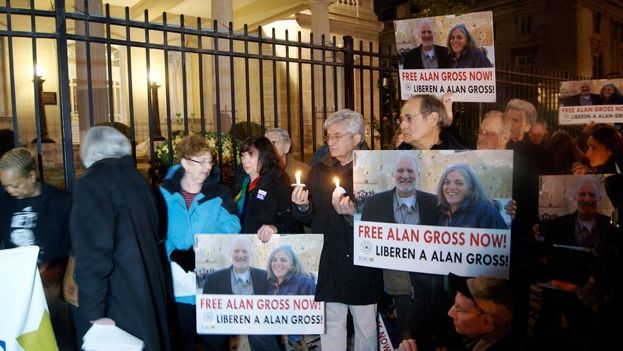
Demonstrations demanding the release of Alan Gross

14ymedio, Yoani Sanchez, Havana, 17 December 2014 – With the pessimism that has now become chronic in our society, many Cubans thought that Alan Gross would only leave Cuba, “in a box,” in an image allusive of a fatal outcome. The stubbornness shown by the Cuban government in its relations with the United States didn’t presage a short-term solution for the contractor. This Wednesday, however, he has been exchanged for three Cuban spies imprisoned in the United States, bringing to a close a long and complicated political chapter for both parties.

Gross was only useful alive and his health was rapidly deteriorating. And Raul Castro knew this very well. Hence, in recent months he raised the decibels around the proposed exchange for the agent Antonio Guerrero and the officials Ramón Labañino and Gerardo Hernández, all serving long sentences in the prisons of our neighbor to the north. To the extent that the 65-year-old contractor grew thin and lost his vision, official campaigns grew increasingly insistent about the exchange. When Gross threatened to kill himself, the alarms if the island’s government went off and the negotiating schedule accelerated. continue reading

Barack Obama, for his part, made clear that any change in policy toward Havana would come up against the insurmountable obstacle of an American imprisoned for “threats against the security of the State.” Even the New York Times had suggested an exchange in one of its editorials on Cuba, and the publication of that text in such a prestigious newspaper was read as a preview of what would happen. As in every political game, we see only one part, while in the intricacies of power the threads of the agreement made public just today were being woven.

For those of us who know the mechanism of pressure used by the Plaza of the Revolution toward its opponents, the capture of Gross itself was a move aimed at recovering the Interior Ministry’s agents. The contractor wasn’t arrested for what he did, but rather for what they could do with him. It was a simple hook and he was aware of this from the beginning. His crime was not in having brought satellite equipment to connect the Cuban Jewish community to the Internet, but rather in carrying in his pocket a passport that immediately converted him into a medium of exchange on the board of tense bilateral relations between Washington and Havana.

If we review the five years of captivity endured by Gross, we see a well-designed information script that the Cuban government used to put pressure on the Obama administration. Each image that came to light publicly, each visitor allowed to see him, was authorized with the sole condition of reinforcing the exchange proposal. In this way, the Castro regime has managed to get its way. It has managed to exchange a peaceful man, embarked on the humanitarian adventure of providing connectivity to a group of Cubans, for intelligence agents that caused significant damage and sorrow with their actions.

In the game of politics, totalitarian regimes manage to win over democracies because the former control the public opinion inside their countries, determine all legal results to suit their purposes, and can continue to waste their nation’s resources trying to free the moles they sent to their adversary’s camp. Democracies, however, end up conceding because they must answer to their own people, they must live with an incisive press that criticizes them for making or not making certain decisions, and because they are forced to do everything possible bring their dead and alive back home.

The Castro regime has won, although the positive result is that Alan Gross has emerged alive from a prison that promised to turn into his grave. Now, we can expect long weeks of cheering and slogans in which the Cuban government will proclaim itself a victor in its latest battle. But, there is no space in the national pantheon for so many still-breathing heroes, and little by little, the recently returned agents will lose importance and visibility. The myth created for them from a distance will begin to fade.

With the main obstacle for the re-establishment of diplomatic relations eliminated, the only unknown is the next step. Is the Cuban government planning another move to return to a position of force vis-a-vis the US government? Or are all the cards on the table this time, before the weary eyes of a population that anticipates that the Castro regime will also win the next move.

Translated by Mary Jo Porter and Ernesto Suarez

The Story Behind the History / Regina Coyula

I share, here, a curious fact related to yesterday’s anniversary of Maceo’s death. Almost everyone believes that Panchito Gomez Toro fell fighting alongside him. Panchito was out of commission from having been wounded in an earlier battle. On learning of the death of his admired mentor, he abandoned the body of the Lieutenant General in the battlefield after all those who were with him were wounded. Panchito decided to go and recover the body, helped by Maximo Zertucha, Maceo’s doctor, who was at his side at the moment the fatal bullet destroyed his face and he was able to confirm the death in barely two minutes.

Between Panchito and Zertucha they tried to put the body on a horse and this is when Panchito received an enemy bullet. Badly wounded, he wrote a goodbye note to his family, where he explained that he preferred to commit suicide rather than fall prisoner. The texts on this point are confused, which is explained because suicide has never been looked on kindly by Christian morality, but even so, it seems Panchito didn’t kill himself; rather a party of Spanish guerrillas, having not the least idea of who the dead man was, approached and killed Panchito with a machete to later strip the corpses of their valuables.

As is well-known, the bodies were recovered the following day by Colonel Aranguren and interred in secret to avoid the Spaniards despoiling the corpses.

For a long time, the weight of the accusation of having murdered Maceo and Panchito as part of a plot fell on Zertucha, including taking the doctor to a council of war to give an account of the events of 7 December in San Pedro; he was exonerated but for his whole life (which he lived with decency and patriotism in his native Melena del Sur) he had to carry the weight of that accusation that took flight, magnified in the foreign press and among the exile right from the start.

I wrote about this curious and little-known passage motivated by hearing on the TV news yesterday talk of the “murder” of Maceo and Gomez Toro, from a journalist named Raiko Escalante. I don’t know what sources he relied on for his work, but it seems superficial and harmful to me to have such a slight knowledge of the history we have suffered.

8 December 2014

The Wall of Tears / Reinaldo Escobar

The wall of tears at the Jose Marti International Airport. (14ymedio)

14ymedio, Reinaldo Escobar, 16 December 2014 – In the days when Havana has as its only airport what we know today as Terminal 1, there was a wide unroofed terrace from which we said goodbye to family and friends. Many times, forever.

When Terminal 3 opened, it was no longer possible to see, from land, the so often filmed scene of the instant when people climb the airplane steps, but one chance was left. On the second floor there was a glass covered deck from which it was possible to look out, to see our loved ones pass after having gone through immigration and the security checkpoint. Connoisseurs of this detail took the opportunity to throw a kiss or make some meaningful gesture. This site was given the name “the wall of tears.”

One fine day they remodeled the building, hanging a false ceiling, relocating the shops and cafes, and replacing the transparent windows with opaque glass, or perhaps they merely painted it. No one offered an explanation They say that the order to block visibility came from a retired general who, at that time, directed airport operations.
Why? You go figure. We can speculate that the former military man, infected with chronic secrecy, wanted to avoid “any information leaking” at the final minute, or simply showed a lack of human feelings.

Now the wall remains blank. In some places you can see where someone tried to scrape the white paint off the glass, but every scrape has been quickly repaired. When Havana, someday, has an airport worthy of it, there will be magnificent tunnels leading to the doors of every airplane, but by that time travel will not be as dramatic, nor as difficult.

The Privilege of Living in Cuba / 14ymedio, Cederistin Dominguez

14ymedio, CEDERISTIN DOMINGUEZ, 10 December 2014 — The independent press that usually criticizes the Cuban government using human rights as a pretext should come out into the street today, December 10. Our children, especially those in primary school, will be playing, jumping and doing pirouettes in all Havana’s main plazas. Representatives from the United Nations, the foreign press and especially the national press will enjoy a great time there, watching the carnival of happiness and color that the children will give them spontaneously and voluntarily.

How do I know? Well, because I have lived in Cuba my whole life, and I know our children, and they are very prone to playing on the tenth of December… Why this day? Well, I don’t know, the truth is that now that you ask me it is a little strange. . . It’s cold, it rains and it is a school day.

What I do know is that it coincidentally matches the world day of human rights and at least our children will not be bored in cages learning mathematics, physics or Spanish. After all, we are barbarians in all that. continue reading

But while I do not “cover the sun with a finger,” I also criticize what is badly done. For example, a very pretty activity that they should do more often with the children is acts of repudiation. The last time my boy told me that an old lady almost died while they were dragging her son and that they crushed a pile of people. Those things are very important so that children learn to behave and don’t turn out later to be like those vulgar youth who are rather critical of Raul.

Over there, those strange countries have even prohibited parties and governments from using children for politics. And they call that democracy? Here there is democracy and how. Check it out, even the newborns and fetuses, although they are unaware of their own existences, are already defending the revolution on the national news.

That is what our enemies will not pardon us for. The traitors are determined only to see the little specks in the eye, no different from the whole world’s, and from that they make a huge problem. So what if those children, when they grow up, will not be able to elect their own government, so what if they earn a laughable salary, so what if half of them by age 25 will no longer be here (having gone into exile), so what if they are expelled from their universities or their jobs if they think differently, they will not be able to associate or meet or access the internet, yadda yadda. The same old song as always… The good thing is that the people are aware that all that is false.

Look, why don’t they talk about the beauty of the choreography that the children are doing? Much more open and improvised than that of the Chinese or North Korean children. Here each child throws a ball, jumps or laughs when he feels like it… That is a the painful truth, but of course, that is not what they see… What interests them is all that bunch of nonsense that the neighbors from the north and the Europeans have put in their heads. That’s why we suspended the meeting that we had planned for these days with those evil freaks.

Okay, I am going to grab my raincoat and go out for a walk because today for sure they will sell sweet cookies in the street, and I have to take advantage…

Translated by MLK

Are You One of Those Human Rights People? / 14ymedio, Reinaldo Escobar

14ymedio, Reinaldo Escobar, Havana, 9 December 2014 — Victims of political illiteracy — as so aptly described by Dagoberto Valdés — many people do not know the difference between being a member of an opposition party, a civil society activist, an independent journalist or a protester in their own right. All are usually accommodated under a single definition: “Those human rights people.”

I’m not going to give a history here — which needs to be written – of the Cuban movement in defense of human rights. In the last thirty years, several have specialized in researching, noting and reporting on violations committed in the country of those rights enshrined in the United Nations Universal Declaration of Human Rights issued on 10 December 1948. continue reading

Such has been the hostility of the Cuban authorities to these claims, that in more than one act of repudiation voices have been heard to vociferously scream the infamous slogan, “Down with Human Rights!” This demonization has reached such an extreme that for many years the mere allusion that you have a right to something has been seen as suspicious.

Who are those who dare to approach, to jump the barriers of fear? Strangers who knock on the door, telephone calls from prison, old friends who reappear. Anyone who has seen their rights violated and has dared to go through their own Via Cruces of legal appeals, including the useless visit to the Council of State’s Office of Attention to the Population, or the call to the prosecutor’s new phone numbers when there is no other recourse, then he or she seeks out one of those “human rights people.”

The moral force of this dreaded spectrum, typecast as mercenaries in the pay of the empire, has been growing. I know of cases that are invoked as a threat, ”If you don’t resolve this problem I’m going to go to those human rights people, and see what you are going to do about it!” says the lady who built an bedroom extension on her house that they now want to make her demolish; or the worker in the process of retiring who claims a few years of service are missing from his file; or those convicted without proof, fined for no reason, the self-employed worker whose license they are going to revoke, someone who suffers a confiscation, a search; in short, all those being run over.

It is not enough to explain that others dedicate themselves to this issue, including journalists, independent librarians, or the creators of a political platform. In the end they don’t understand and they say to you, “I know you are one of those human rights people,” and there is no way to convince them that they should approach another specialist on this issue. We end up hearing the case and helping the injured.

How would you react? Would you, perhaps, tell me that you aren’t one of those human rights people either?

Cuba: From Beacon to Firefly, But the Clock Is Ticking / Juan Juan Almeida

Back when I had hair and could comb it, someone from a certain group of commentators coined a popular phrase: If Moscow were Hollywood, the world would be communist and Cuba would be its Humphrey Bogart.

This did not make sense to me but years later I came to understand that the Cuban Revolution was not an isolated phenomenon that morphed into a “trending topic” by virtue its own talent. It was part of a process that arose in the midst of the Cold War.

Without trying to get into a detailed analysis of historical precedents because I don’t want to be tiresome and because I assume we are already familiar with them, let’s just say it evolved into an obedient patriotic-nationalistic movement. continue reading

More than elsewhere in the communist bloc, it became a biography (often exaggerated) of men and women who knew how to exploit popular enthusiasm and personal charisma to monopolize the attention, power, media, sources of information, economic strength and entire institutional framework of the country, causing damage far beyond the financial.

But Bogart died, conditions changed and leaders grew old. They lost their sex appeal and their charm because, among other things, the Internet came along and made ninety miles seem a lot shorter.

Such was the fate of the Caribbean’s dominant player. The beacon of Latin America became a firefly. And no matter how much effort is stubbornly spent promoting it, the Cuban government realizes it cannot revolutionize the revolution.

A recently published study — one to whose statistics I give little credibility — claims that one in ten Cubans live in poverty in spite of being employed. This is interesting because, whether the number of poor Cubans is correct or not, I believe that this level of poverty is a result of past policies that were designed by the government to indoctrinate the public, emphasize the importance of egalitarianism and counter bourgeois habits. But they had a boomerang effect that brought the crisis back to the regime’s doorstep.

I therefore find it hard to understand why, in combating the government, some armchair observers cling to old theories and focus the discussion on widespread victimization, laying the blame on fear and poverty, while ignoring the visible examples of the island’s young entrepreneurs who, though not in open opposition, turn their backs on the state and manage to escape its middling egalitarianism.

Information is a right that downplays the truth once it becomes a commodity. When reporting on Cuba, many press outlets focus on only one aspect of reality while ignoring those elements that may not appeal to certain segments of the audience. Our country is much more than that. It is no longer a society in which its citizens mindlessly repeat the same thing.

Clearly, there are still people like that but it is undeniable that the island’s watches have begun ticking. The evidence is in the ongoing, in-depth debate that, without any organized political effort whatsoever, is starting to be heard in bread lines, bodegas, at bus stops and in homes.

The topic revolves around how to pressure the government to do a second evaluation of the travel and housing restrictions on Cubans living overseas, allowing them to return to the island without having to file applications or to meet selection criteria.

Housewives, workers, the unemployed, farmers, soldiers and even party members are all participating in this spontaneous initiative without having to be convened because they all have suffered and do suffer from family separation… O.K., and because the money doesn’t hurt either.

That’s how it is in Hollywood. Don’t forget that it was Humphrey Bogart in The Maltese Falcon who said, “We didn’t exactly believe your story… We believed your 200 dollars. I mean, you paid us more than if you had been telling us the truth, and enough more to make it all right.”

26 November 2014