The Cuban opposition calls for “strengthening unity in diversity” / 14ymedio

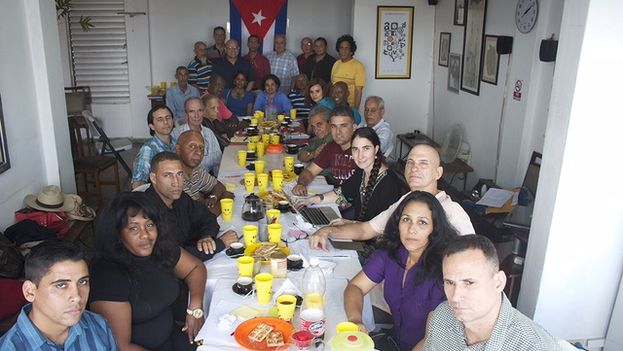
Civil Society Open Space, meeting in Cuba (14ymedio)

14ymedio, Havana, 23 December 2014 – Cuban Civil Society Open Forum, a new organization in Cuba which has come to be a forum of debate for the opposition, met this Monday in Havana to review its own development as well as its common position, faced with the new scenario that has opened with the reestablishment of relations with the United States.

The group, in the form of a final statement, made a call “to strengthen the unity in diversity achieved so far, whatever our opinions may be on this issue, and to maintain equanimity and respect.”

The meeting, with the participation of thirty activists of different points of view, focuses on developing an ethical approach to running the activities of Cuban Civil Society Open Forum. This framework, developed starting from the proposals collected in a previous draft, will be set out in a documents whose final version will be voted on at the next meeting, scheduled for the end of February 2015, according to a statement released by the group. continue reading

Another of the important points of the meeting was the future creation of a mediation group, which will work to solve conflicts internal to civil society.

With regards to the announcement of the reestablishment of relations between Cuba and the United States coming out of secret negotiations, Cuban Civil Society Open Forum expressed its pleasure in “the dozens of compatriots who will be released from prison and also the release of Alan Gross.” In addition, they noted that the agreement between Raul Castro and Obama puts an end “to the pretext and official narrative of a besieged people,” which will allow, according to the participants, focus “on democratic change in Cuba.”

Guillermo Fariñas criticized, in his speech, the “secrecy of the negotiations, which were held behind the backs not only of civil society but also the ruling party, parliament and the bulk of the institutions.” For his part, José Daniel Ferrer said that, “most important is the faith and hope that from now on we must convey to the people.” The activist also stressed the “importance of building new scenarios for democracy.”

Manuel Cuesta Morua agreed that the restoration of relations with the US represents “the end of the ‘epic’ stage and the beginning of the political stage for civil society.” Elizardo Sanchez confirmed that even the Cuban Commission for Human Rights and National Reconciliation “does not know the list of prisoners to be released, which represents about half of those imprisoned for political reasons in Cuba.”

Cuban Civil Society Open Forum meets to discuss issues of Cuban society. Last February, the group signed, for the first time, four points of consensus that summarize the demands of Cuban civil society; these were reviewed at the meeting on Monday and ratified unanimously in what was one of the first steps of opposition unity on the island.

Who is more opposed to the suspension of the embargo? / Diario de Cuba, Dariela Aquique Luna

  • The first obstacle will not come from the United States Congress, but rather from the Cuban government itself.

Diario de Cuba, Dariela Aquique Luna, Havana, 22 December 2014 – Once again it is obvious that the supposed “culture” of the Cuban people can be summarized in terms of basic literacy and median levels of schooling. Except for a high number of intellectuals and professionals, the ability to process information and analyze it coherently is a gift that has not been granted to the majority of that population, who were not taught to think for themselves; whose knowledge of the world and of their own country for more than 50 years has been limited to official pronouncements translated into preconceived rhetoric.

Having only scarce Internet access, an ignorance of how new technologies are used, and a perspective shaped solely by state-run media, my compatriots are unaware even of how things work. Therefore it is not unusual to overhear very naïve conversations with one or more participants claiming that, following the announcements by Obama, happiness and prosperity have arrived in Cuba. This is because for too long, many Cubans have believed that all the evils afflicting this country are due exclusively to the United States embargo. continue reading

Were the economic, commercial and financial sanctions against the Island definitively suspended, the Cuban government would have the first problem, for there would no longer be a scapegoat for the deficiencies and errors in the state-run economy, and their resulting effects on the country’s social life. Cuba would have to enter the arena of the real economic relations that govern the world today and not those that have been invented at their convenience to conceal structural deformations, which have created a lasting dependence on other economies that have proverbially supported the productive system of the country terms of capital and technology. That would be the first challenge.

On the other hand, the changes expected by that nascent, small-business class in Cuba would generate panic in the sectors of power. This is because, as the Marxists say, “the economic base defines the superstructure.” It is exactly for this reason that the Castro government, from its first moments, focused on planning the state sectors of industry, banking and services, centralizing the administration of material and human resources, all in the name of “economic sovereignty,” but really only to disguise its paranoia about threats to its political power.

Another quite interesting point is the matter of allowing free access to the “network of networks.” This would be like carrying out a second literacy campaign in Cuba. We Cubans would have to start from scratch in such subjects as civics, law, commerce, urban planning, ad infinitum. In other words, as the Communists know very well, change in the economy would entail a change in society. What former US President Jimmy Carter said — “Going to Cuba, doing business and investing there will bring democracy to Cuba” — is something that the Castros and their henchmen do not want to hear.

Obama, Carter, former Secretary of State Hillary Clinton, and many personalities and sectors, opine that normalizing relations with Cuba will help the US more effectively promote political change on the Island. But what the US president does not account for is the resistance to these efforts that the Cuban government and its supporters will mount.

Mr. Barack Obama is naïve to think that a change in strategy will bring democracy to Cuba. Cubans who think that an end to the embargo will make all things well are naïve. We will continue to hear canned phrases such as “foreign interference,” and “we will not permit anyone to tell us what we have to do,” and all the rest of the half-century-old chatter.

The Cuban-American right should not be so worried about the announcements and gestures coming from Obama. Who is most opposed to the suspension of the embargo? The first obstacle to ceasing the embargo will not come from the US Congress, but rather from the Cuban government itself – behind the scenes, of course, and not without extracting corresponding advantage from the matter.

Translated by: Alicia Barraqué Ellison

Fidel’s Shocking Silence / Cubanet, Miriam Celaya

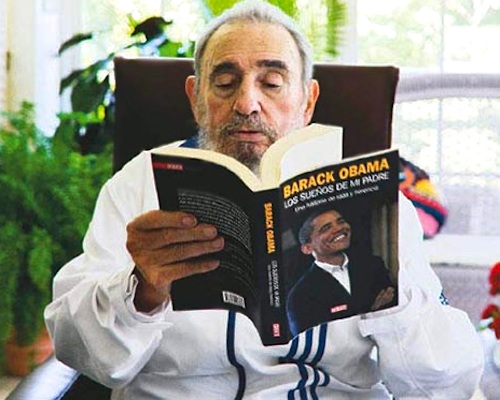
fidel-castro-barack-obamaCubanet, Miriam Celaya, Havana, 18 December 2014 — After the brief speech by General-President, Raúl Castro, about the release of Alan Gross and of “a Cuban-born citizen” at the service of the CIA, and of other prisoners who received “prison benefits, including the release of individuals the US government was interested in,” a speech which also included the announcement of the re-establishment of diplomatic relations between the two countries, everyday life in the capital continued its course, just as if we were not witnessing a moment of historical significance that puts an end to 50 years of uninterrupted disagreement between our two countries.

With agreements reached after months of negotiations, the regional political landscape changes dramatically, while such a controversial decision should, in principle have a greater effect inside Cuba, since Cuba’s excuses have run out about “the enemy” that besieges us, blockades us, and hampers our social and economic advancement. continue reading

Of course, it would be naïve to assume that the regime will make essential changes or allow an opening in political or human rights matters, particularly those relating to freedom of expression and association, just to name the some of the more “dangerous” elements for the survival of the regime. It’s the same quasi 56-year-old dictatorship of totalitarian power, and it is likely the regime will make use of any trickery to evade changes that endanger its authority in Cuba. However, that does not mean that the do-nothing strategy on the part of the US foreign policy towards Cuba was a good formula.

The strategy launched today by the White House, though risky, placed the Cuban leadership against the wall, especially in the face of the international community that, to date, has passively tolerated the ongoing violations of human rights in Cuba, and has even praised the Castro satrapy for its achievements in health and education through the continuation of a belligerent policy towards the most powerful country on earth and the supposed need for the regime to defend itself from it. With the ending of the stagnation and the re-establishing of relations, now we will have to see in what direction the actors move and the resulting changes that the new stage will produce.

We know the weakness of the nascent Cuban civil society, of its legal orphanhood and of the absence of supporting autonomous institutions, so that, on the road towards the achievement of democracy, the support and goodwill of civilized countries and of global agencies cannot be absent, under penalty of sentencing to their doom the efforts, sacrifices and aspirations of several generations of democratic Cubans. The US President seems to be aware of it, since he expressed his commitment to those hopes in his speech.

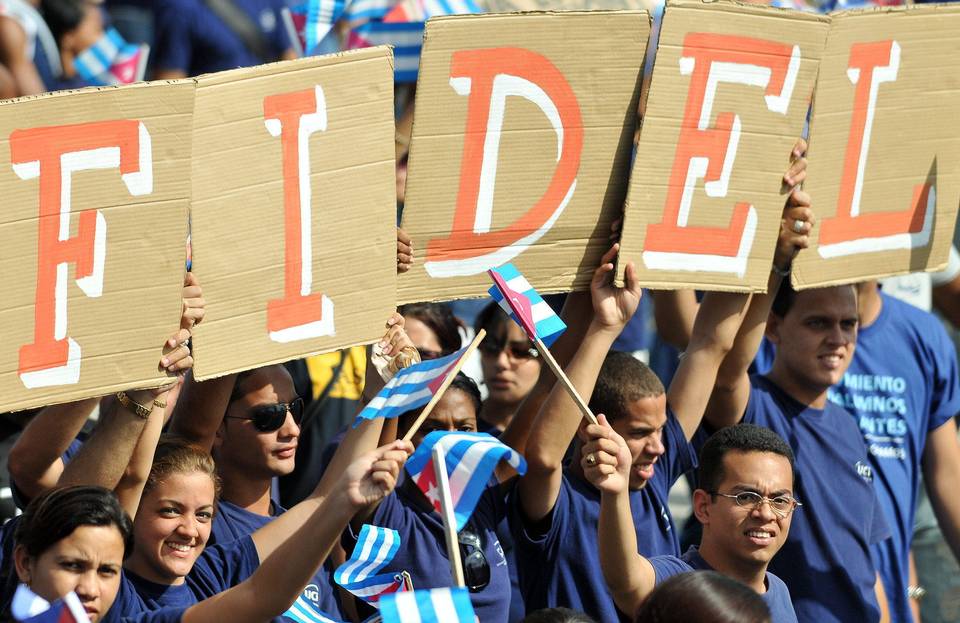
May Day march in Havana

An Indifferent Cuba

The news came as a surprise to Cubans. However, contrary to what might be expected from so many years of the “struggle for the return of the Five,” and after the substantial resources invested in international campaigns to achieve their release, there or was no apotheosis of people taking to the streets, no calls for a gathering to welcome them home, no live TV broadcasting the arrival of the much awaited “heroes.”

Havana continued its normal routine, altered only by the unexpected delivery of a pound of fish (mackerel) per consumer, an event that overwhelmed people’s expectations, at least in Centro Habana, and the corresponding lines began to form in front of the state-owned butcher shops.

Meanwhile, a group of students were mobilized at the University to do some cheering and shouting; though it still unclear whether the real reason for their joy was the release of the spies or the sudden opportunity to leave the classroom earlier than usual.

Only the primetime evening news ran a brief story, carefully prepared and intended to stir the popular sentimentality, showing the reunion of the released spies and their families, and the words of ringleader, Gerardo, expressing to the General-President his availability to follow his orders. “For whatever purpose,” stated the unrepentant servant. It did not occur to the little soldier to think that, in an environment of good relations that should begin to flow between the two countries, a new espionage adventure would not look good.

The truth is that, in contrast to Alan Gross’s obvious physical deterioration, the Cuban spies looked fat and pompous, as if, instead of having stayed in harsh prison conditions that the official media had blasted, they had returned from a picnic or a long vacation.

May Day march in Havana

The topography of absence

Perhaps the most significant finding on the day of a journey inside Cuba is Fidel Castro’s shocking silence

His absence from the media had already been sufficiently notorious during and after the celebration of the ALBA summit, ten years after the creation of that pipe dream for him and his pupil, Hugo Chávez. But his silence, in the presence of two events so linked to his existence as the end of a story of conflict on which the revolutionary legend was cemented and the arrival on the Island of the central characters of his last “battle,” is highly eloquent.

It is very significant that the return of the three spies has been so rash. This may be the happiest event year for the reflective chief, yet not a single apocryphal note with a copy of his well-known signature at the bottom of the page has appeared. Everything indicates that, either the highest druid has definitively plunged into a deep vegetative state, or he has already left this “valley of tears.” If that should be the case, don’t count on mine.

Translated by Norma Whiting

Shameful Distortions / Rebeca Monzo

The big news for all Cubans, without a doubt, has been the reestablishment of relations between Cuba and the United States, which has been a dream for three generations on our captive island, although there are opponents among some fellow countrymen both here and abroad. The other story — the one about the release of the three spies from the Wasp Network who, for refusing to the collaborate with American authorities, became by the grace of the Cuban government “anti-terrorist heroes” even though they had acknowledged their role as spies in courts of law — raises a secondary issue, which is the high economic cost for our country in the form of lawyers, propaganda and family visits.

Of course, the vast majority of Cubans without access to the internet or any other means of information other than Cuban television or Venezuela’s TeleSur (more of the same) has dutifully accepted as true what government propaganda has them led to believe, since the priorities of this long-suffering people are food and day-to-day survival. Others who rely on official media accept it out of fear of being challenged politically. continue reading

If (like me) you wander the streets of Havana, you will hear various expressions of playful joy that reveal the average person’s true feelings. Comments, especially those of young people (who do not have an official microphone under their noses), reflect dreams of a better future: We will soon have the internet, ferry service will return, McDonald’s will be everywhere, we will now be able to go to the “yuma”* without endangering our lives and those of others.

However, some old, recalcitrant members of the Committees for the Defense of the Revolutions (CDR) only talk about the release of the three spies, portraying it as a Cuban triumph over the United States, unaware that it was merely an exchange of three spies for fifty-three political prisoners of interest to the US. Of these details they are ignorant.

This reflects the focus by government-run television (the only kind) which, apparently on orders from above, focused on the return of Gerardo, Ramón and Antonio, who incidentally appeared healthy, well-fed and in superb physical condition, quite at odds with the terrible stories about mistreatment, sweatshops and other falsehoods officially promulgated during their internment.

It also stands in contrast to Alan Gross, who upon his release was anemic, having suffered loss of vision and some teeth. It was a picture worth a thousand words. By continually lying to the Cuban people and unscrupulously manipulating information, the mass media makes it clear that our country does not enjoy freedom of the press.

Now as never before, civil society and the various opposition groups must prioritize this important event, setting aside our personal differences to jointly maintain pressure on the regime so that everyone might find a place in this new, emerging era and that our voices may finally be heard. It is worth remembering that whenever negotiations of any kind take place, one should carry two suitcases: one to give and one to receive.

 *Translator’s note: Slang term for the United States.

22 December 2014

Cuba, Waiting for the “Yumas*” / Ivan Garcia

Photo source: Cubanet

Dreaming does not cost anything. Lisván, a self-employed taxi driver who spends twelve hours a day behind the wheel of an old American car from the 1940s surrounded by the piercing smell of gasoline and cigar smoke, is in theory one of those people counting on the government and anti-embargo American businessmen to finally improve the perilous diplomatic relations between Cuba and the United States.

Right now, under a tropical midday sun, the young man is analyzing how small businesspeople and private-sector workers might benefit from the new measures President Obama has outlined and a possible lifting of the economic and trade embargo.

Lisván believes that if the government authorized automobile imports and provided access to credit from US banks, he could replace his outdated, run-down car and partner with other drivers to create a freight and taxi service made up of gleaming General Motors vehicles. continue reading

“Just imagine. We would have a fleet of cars and trucks. If the government allowed it, private-sector workers would raise the quality and service of urban transport and freight. Of course, they would have to do away with unfair taxes. For a society to flourish, tax rates should be as low as possible. I think right now the government is on the right track,” he says with an optimism that is contagious.

Others are not so optimistic. Abel, a half-blind old man who is the custodian of a nausea-inducing public bathroom, smiles when asked what he hopes will result from the new political agreement with the United States.

“Nothing. You’d have to be a real asshole to believe these guys (from the regime). How can you believe people who have always demonized capitalism? If they have agreed to this change, it’s because they are desperate. It doesn’t matter if it’s socialism, capitalism or feudalism; an old man who takes care of a bathroom is just that. I don’t believe any ‘yuma’ would do his business in this filth.”

The news flash that sparked the diplomatic turnaround between the two countries has been well-received by almost all Cubans. Some with expectations bordering on science fiction.

“You’d be very naive to believe that overnight streets would be repaired, buildings would be painted, markets would offer cheap food, wages and purchasing power would skyrocket, and people would be as happy as partridges,” says Osniel, the owner of a cafe in a neighborhood west of Havana. “It’s not the American blockade that is to blame for everything going downhill; it’s the system. And as far as I can tell, the ones who created this disaster are still in power. The upside of having good relations with the Americans is that the government’s mismanagement of the economy and its failure to generate wealth will be obvious.”

The military regime has worked the story to its advantage. In the official media, front page headlines trumpet the return of the three spies imprisoned in the United States.

At the moment Cuba is talking about nothing but the future.

President Obama — mistaken or not in granting excessive concessions to a government that still does not respect freedom of expression or political liberties, that has conned half the world with its lukewarm, half-baked economic reforms, that refuses to allow Cubans to participate in the larger economy — presented a well-organized and coherent plan of what he is proposing. In contrast, General Raul Castro appeared before television cameras in an outmoded military uniform without any proposals for a people burdened with shortages, with its cities in ruins and with few prospects.

The opening of an embassy and the reestablishment of diplomatic relations with the former enemy is not enough. At least that is what Julia, the owner of a small hotel business, believes.

“Raul should have provided more details,” she says. “Are they now going to do away with those ridiculous customs duties that hinder private business. He didn’t say anything about that or a lot of other things. After the excitement over the release of the ‘five heroes’ (three spies) dies down, life will go on and people who own businesses will want to see their taxes reduced.”

The military regime should be pleased with itself. Apparently, it got the better deal in negotiations. As usual, all it had to offer in exchange was prisoners.

It is a strategy adopted by Fidel Castro: to always keep the jail cells filled with prisoners to be used as bargaining chips. The owners of private restaurants and cafes, people who rent out rooms and others have their doubts about a bonanza of gringo tourists on the island.

“The competition for tourists in the Caribbean is fierce but some money will stick,” says Armando, a clandestine tobacco salesman. “It’s common knowledge that American tourists are the biggest spenders but it’s yet to be seen if they will visit a country that has lost its charms. Maybe they will come out of curiosity to see an old bastion of communism ninety miles from their shores,” says Armando, black market seller of cigars.

Olivia, a sales representative for a five-star hotel in Havana, thinks the new measures will have a positive impact on the nation’s economy. “In 2012 there were 58,000 hotel rooms and 25,000 more were being projected,” she notes. “That won’t be enough to house an influx of American tourists which calculations indicate could soon top two million visitors.”

In a Council of Ministers meeting, Marino Murillo, the island’s portly economic czar, predicted that the country’s GDP would grow 4%.

To Reinier, an economist, such statistics seem ludicrous. “I now realize that the projected GDP was calculated based on diplomatic relations with the United States being restored in 2015,” he notes. “Even so, I have my doubts there will be a huge influx of tourists or that we will see multi-million dollar US investments. There is more to tourism than hotels. There is also additional hotel and roadway infrastructure, and those areas are off-limits. As far as significant investments in strategic sectors go, if there is no independent judiciary, Yankee capital will not come to Cuba.”

There is a common thread among those Cubans interviewed: The pretext of an imperialist enemy is now gone. If things go as expected and the embargo is lifted, only the regime’s “blockade” on private business, family imports and freedom of expression will remain in place.

The most optimistic believe Raul Castro’s moment has finally arrived, that he will implement changes that will lead us towards democracy. Others believe it is more likely that pigs will fly.

Iván García

*Translator’s note: “Yuma” is a term similar to “gringo” but with more friendly connotations.

Sunday Respite for the Ladies in White / 14ymedio

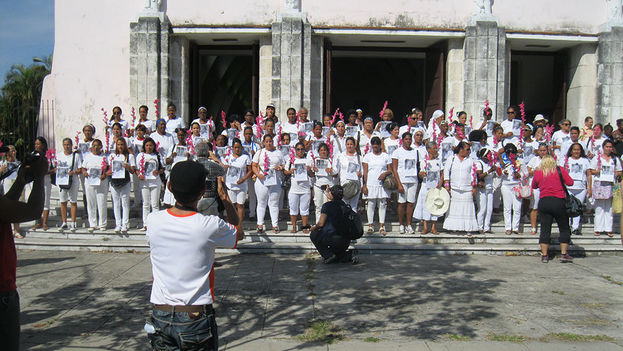
Ladies in White opposite the church of Santa Rita in Havana. (Agustin Lopez Canino)

14ymedio, 22 December 2014 – The Ladies in White marched for the freedom of political prisoners as they left mass this Sunday, an activity held every week and one which had special significance on this occasion because it was the first time since the announcement of reestablishment of relations with the United States. In Havana and Pinar del Río, where there are usually arrests and acts of repudiation against these peaceful activists, there were no repressive activities.

In Santiago de Cuba, however, the Citizens for Democracy suffered the usual repression, according to the Commission for Human Rights and National Reconciliation. Of the 36 women who were preparing to go to mass, only half managed to arrive there, while the remaining 18 were detained and abandoned in sites far from their homes.* The organization came into being after a rift with the Ladies in White over differences.

No other province had reported, as of last night, more cases of arrests or ill-treatment. The meeting this Sunday put to the test, for many, the political will of the Cuban government to behave in way coherent with the negotiations held with the United States government. The relative calm of the day has been interpreted by many opponents, however, as a maneuver by the regime to deceive public opinion and the international press. continue reading

At the end of the mass at Santa Rita Church in Havana, some 60 women marched through the pedestrian crossing on Fifth Avenue and then gathered in a park where some activists expressed their disagreement with the resumption of diplomatic relations between the United States and Cuba, which some classified as a betrayal of the Cuban people.

Among the speakers who expressed that view were Ángel Moya, former prisoner of the Cause of the 75 of the 2003 Black Spring, and Antonio González Rodríguez, who both rejected the results of the talks because they only lead to sustaining and recycling in power the current leaders and their family members.

*Translator’s note: It is a common practice of State Security Agents to detain dissidents and, rather than processing them at a police station, to simply drive them far out into the countryside and put them out of the vehicle, with no way to get home.

Cuba and the United States: Regret the past or build the future? / 14ymedio, Jorge Calaforra

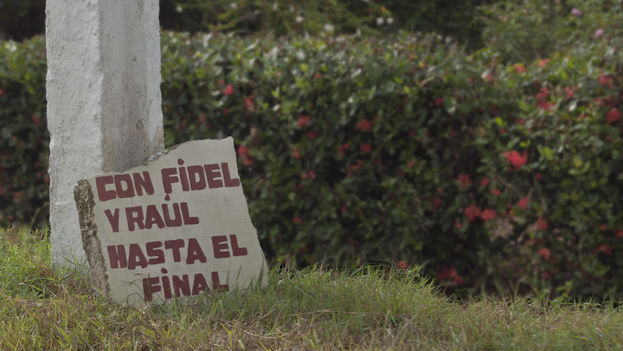
”With Fidel and Raul Until the End” (14ymedio)

14ymedio, Jorge Calaforra, Warsaw, 20 December 2014 – On 17 December 2014 at 12:01 Washington DC time, the President of the United States, Barack Obama, announced the United States’ new policy toward Cuba. It should be recalled that the president of the United States of America makes his decisions taking into account all the interests of that country, not just in the short term but also in the medium- and long-term.

Fidel Castro, with the objective of remaining in power as long as his health allowed, began the absolute destruction in 1959 of all existing institutions in Cuba, all individual freedoms, and at the same time generated a conflict with the United States and brought about the rupture of diplomatic relations and the introduction of the embargo. Previous attempts by the United States to reinitiate diplomatic relations were boycotted and Cuban policies eventually led to the bankruptcy of Cuba and Venezuela.
continue reading

The embargo, initially designed to bring about the collapse of the dictatorship, ended up being just as a medium of exchange during American elections. The lack of information, tools and the impossibility of achieving one’s dreams, led almost all the human capital Cuba possesses to leave the country or to be ready to leave it at the first opportunity that presents itself.

Therefore it is unlikely that a shift toward democracy in Cuba would have occurred with the previous strategy, without a radical change in the strategy of the United States towards Cuba.

The release of Alan Gross, kidnapped after a failed attempt to exchange the five spies for the 75 prisoners of the Black Spring, the release of a Cuban spy very important to the intelligent services of the United States, the release of 53 political prisoners in Cuba, as well as the release of the three spies remaining imprisoned in the United States, were fundamental and nonnegotiable issues for both governments.

For the creators of this strategy there was no better time than today to begin implementing it. The resumption of relations tries to avoid a possible collapse of the country, an uncontrolled situation of domestic violence within Cuba, and a sudden and massive emigration to the United States. President Raul Castro knows that improving the economy is not working and will not work and that the entry of American capital will increase the legitimacy of his heirs, as well as offering the Cuban people what the majority of them really want at this time; more food at a better price and the ability to be closer to their families, between the island and exile.

The resistance of the Cuban people to the update of the socialist economic system, which has not brought them benefits, is demonstrated by an emigration that is accelerating from year-to-year. Raul Castro prefers to sharpen the demographic problems and provide incentives for people to use their talents to improve their lives through independent work. Obama’s plan will try to reverse this flow, that is already exhausting the Florida’s capacity for the absorption of new labor and social support.

The Cuban effort to destroy the Venezuelan economy, by recommending to them that they take the same measures that Cuba took in the 1960s, is finally bearing fruit, and the fall of oil prices, from $107.89 a barrel on average in June 2014 to $55.91 this Wednesday, has led both parties who made the decision this week not to postpone it any longer.

The American decision to reestablish diplomatic relations with Havana and to begin the process that will lead to the end of the embargo in force since 1960 has little to do with Cubans.

It is a geopolitical strategy to try to position themselves as the culturally dominant matrix that absorbs a culturally different circle, the Latin American. To do this, the United States uses its best asset: force and its admirable economic wealth. Force and wealth that it has produced and maintained since it was formed as a nation, because they were able to come together as confederated states and live together with their differences. And to always point to great common objective: prosperity to guarantee opportunities for all Americans.

We Latin Americans, however, despite belonging to the same cultural circle, have not been able to stay united. Since the wars of independence and the division of the continent into twenty republics, we have spent almost two centuries in permanent conflict and cyclical poverty. If we were to identify ourselves as belonging to the same cultural circle, we could develop a strong Latin American industry, the only possible source of a true democracy.

A scenario with members of the current Cuban opposition in power is not an option desired by either of the two governments, and the strategy desired by the Republicans in the United States, to strengthen the embargo and unconditionally support the opposition in overthrowing the Cuban government, can be discarded after its disastrous application in Iraq.

The Cuban government can greatly help to implement the new American strategy in Latin America, and Cuba can benefit hugely if the decisions taken by its Council of State benefit not just its members’ own families, friends and children of friends, but if they begin to make decisions to the benefit of the 13.6 million Cubans. More than two million Cubans live in the United States, which according to the 2010 census had more than 250,000 firms doing more than 51 billion dollars in business, and the talent, creativity and skills of the Cuban labor force will be another cornerstone in this strategy, with an enormous benefit for Cuba and Cubans.

From the point of view of the United States, the forces left to Raul Castro in his remaining two years in power* is an advantage to ensure stability in the country and to take advantage of his influence in the region to build the foundations of a new structure in its relations with Latin America.

The lack of details, and the traditional style of Raul Castro’s speech, broadcast simultaneously with Obama’s on 17 December at noon, should not cause much concern. Fidel Castro has ended his active political life and President Raul Castro’s is coming to an end. On the morning of 9 November 1989, the leaders of the Communist Party of the German Democratic Republic confirmed the support of the German people for the construction of socialism; while that same night the same people joyously celebrated the fall of the Berlin Wall.

From the point of view of the art of negotiation, this decision is fine as it allows Raul Castro to construct an exit strategy, and so avoid the failure that would lead to an extremely dangerous situation for the whole region: a rise in populism financed by Russia or China. This would aggravate Latin America’s problems such as drugs and corruption, bringing as a consequence greater instability in the region and an increase in migration to the United States. In other words, more costs and fewer businesses.

We Cubans must once again build a prosperous and democratic country. But for it to be democratic, we must first and fundamentally modernize its economy, There are no human rights without prosperity. And we must not relegate this responsibility to the government of another country.

Both Raúl Castro and Barack Obama have opened new opportunities, and we will have as much democracy in Cuba as we as a civil society are able to build.

We have had one of the most inhuman governments of all time. The groups close to the current halls of power are not going to disappear, nor will they want to renounce their benefits and Mafia methods, nor their secret tribunals.

But not everyone now participating in the system belongs to these groups. Cuba will be prosperous if we are capable of building institutions for the benefit of all, if we include those with constructive attitudes, creating a state of law, forcing the government to respect human rights, and if we destroy the mafias and the corruption and prevent decisions from being taken without transparency. From within Cuba, and from civil society, organized and with clear objectives.

If we as Cubans know how to take advantage of American money and know-how, we can not only rebuild our country but support a better future for all of Latin America.

If the phrases uttered in speeches (in that of Raul regarding respect for the United Nations, and in that of Obama with regards to human rights) are a reflection of some agreement in the negotiations, then the preconditions exist to improve the conditions of individual freedoms on the island. But we will have rights only to the extent that we are effective in fighting for them, and if we are capable of defending them.

We can devote the entire 24 hours in a day to regretting the past, or to building our future. It we lose ten pesos, somehow it comes back to us. Ten minutes that is lost, is lost irretrievably.

Jorge Calaforra
www.foresightcuba.com

*Translator’s note: Raul Castro has stated that he will step down from the presidency in 2018.
December 10 in the Cuban Key of Castro / Orlando Luis Pardo Lazo

Click here for link to Diario de Cuba

Requiem for the 10th of December

When democracy comes to Cuba tomorrow in 56 years — it will come in spite of the international left — when the men and women of my country regain the life in truth that the dictatorship reduced to the filthy game of socialism, when the Castro regime is finally an era in the past and its perpetrators have been condemned to never again enthrone Communism on the Island (which will include not only the division of powers under the rule of law, but the prohibition of anti-democratic parties), then December 10 will be a date of sad remembering for my contemporaries.

This day, for generations and generations, will also be the day of the supreme impunity of the Council of State: an exercise in the color of silence that applauds or assassinates without consequences, that fights Ebola in Africa while incubating the virus of violence at home, that creates scenarios in favor or against according to the convenience of its dismal theater.

On this day the Castro regime’s hatred of Cubans will not be forgotten, nor will our historic humiliation under the love of our masters: a day that opens the heart to the necessary reconciliation still will not be easy.

Tenths of December hurt, far beyond the double funeral that is coming, with no one and for the good of no one. Tenths of December know nothing of the notion of forgetting: there is no victim that is not waiting for his victimizer if, at some time, we are to live in truth. The Cuban fight against the Castro regime is the fight of memory against memory.

10 December 2014

OPEN LETTER TO PRESIDENT BARACK OBAMA from Rosa Maria Paya Acevedo

See below for translation

OPEN LETTER TO PRESIDENT BARACK OBAMA

from Rosa Maria Paya Acevedo
Rosa María Payá Acevedo is a member of the Cuban Christian Liberation Movement.

Mr. Barack Obama
President of the United States of America

I am writing to you because I assume that goodwill inspired your decision to change U.S. policy toward my country.

I appeal to this goodwill, notwithstanding your decision to review Cuba’s place on the list of countries that sponsor terrorism despite the Cuban government’s attempt, just a year ago, to smuggle tons of weapons in a North Korean ship through the Panama Canal. And despite Cuban state security provoking the 2012 car crash that took the life of my father,Oswaldo Payá, one of Cuba’s best-known dissidents who represented the alternative to the regime, and his young associate Harold Cepero. And even though the Cuban government refuses to allow an investigation and has not given even a copy of the autopsy report to my family.

The Cuban regime has decided it needs to change its image, so it will relax its grip in some areas while it remains in power. It has discovered that it can allow more Cubans to enter and leave the country and that some people can create a timbiriche (a very small business), but the Cuban government still decides who can travel and who can open a small business. Mr. President, your laws are not what is preventing the free market and access to information in Cuba; it is the Cuban government’s legislation and its constant censorship.

We agree, Mr. President, that you cannot “keep doing the same thing for over five decades and expect different results.”

But there is nothing new in treating as “normal” the illegitimate government in Havana, which has never been elected by its citizens and has been practicing state murder with impunity. That strategy already has been done by all the other governments without positive consequences for democracy in my country.

What would be new would be a real commitment to the Cuban people, with concrete actions supporting citizens’ demands. We don’t need interventionist tactics but rather backing for solutions that we Cubans have created ourselves.

For 55 years, the only free, legal and popular demand from Cubans has been a call for a referendum on self-government, the Varela Project. We want changes in the law that will guarantee freedom of expression and association, the release of political prisoners, the right to own private enterprises, and free and plural elections.

You asked in your historic speech : How can we uphold that commitment, the commitment to freedom?

I take you at your word, Mr. President. The answer to you and to all the world’s democratic governments is: Support the implementation of a plebiscite for free and pluralistic elections in Cuba; and support citizen participation in the democratic process, the only thing that will guarantee the end of totalitarianism in Cuba.

My father used to say, “Dialogues between the elites are not the space of the people.” The totalitarianism of the 21st century — which interferes in the internal affairs of many countries in the region and promotes undemocratic practices in countries such as Venezuela — will sit at the table next to the hemisphere’s democracies. I hope censorship doesn’t come to that table as well and that we Cubans, whom you so far have excluded from this process, can have a place in future negotiations.

We expect your administration, the Vatican and Canada to support our demands with the same intensity and goodwill with which you supported this process of rapprochement with the Cuban government. Human rights are the foundation of democracy, and we expect you to support the right of Cubans to decide their future.

We ask you to support an independent investigation into the attack that caused the deaths of Oswaldo Payá and Harold Cepero.

We do not want symbolic solidarity. We do not want to participate only in the parallel forum to the next Summit of the Americas. The chair that will be occupied by the Cuban government is not the chair of the people, because the Cuban government does not represent Cuba’s citizens. That’s why we need to be present at the main summit, so that the demands of Cuban citizens are heard and empowered by the regional democracies.

Mr. President, dare now, after quoting our José Martí, to put into practice the honesty that a free Cuba deserves, “with all and for the good of all.”

God bless our countries.

Merry Christmas to you and your family,

Rosa María Payá Acevedo

================

Posted in the blog of Orlando Luis Pardo Laz0
19 December 2014

Translation of posters:

First poster: The hand is making an “L” for Libertad: Freedom

Second poster:

For life, for truth, for the future.

Rosa MaríaPayá and her family are at risk for demanding of the Cuban State an independent investigation to clarify the circumstances of the violent deaths of Oswaldo Payá and Harold Cepera. We will not abandon this Cuban family now, in the face of the lies of a fifty-year government accustomed to working in secrecy and with total impunity.

A government without a future detests that its citizens have a future.

“No, we have no illusions that it will be easy” / 14ymedio, Yoani Sanchez

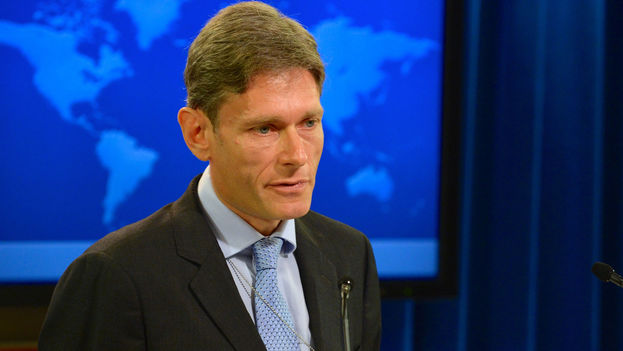
Tom Malinowski (Photo Flickr)

14ymedio, Yoani Sanchez, Havana 20 December 2014 — Since December 17, Cuba has not been the same. Discussions, questions and expectations have multiplied among us since the announcement from Barack Obama and Raul Castro about the reestablishment of relations between the United States and Cuba. We citizens have a lot of questions about the process and its influence on the future of our country.

Tom Malinowski, United States Assistant Secretary of State for Democracy, Human Rights and Labor has responded to some of these questions for 14ymedio. Today we present his answers to our readers.

Sanchez: The US has announced several measures to ease its policy towards Cuba. During the negotiations has the Cuban government shown a list of measures it is willing to implement?

Malinowski: It is important to note that the measures announced by President Obama were not things he has asked of Cuban government. They have been steps we would like to take to empower the Cuban people. continue reading

The objective is to strengthen the possibility that the people themselves can change the public policies of the Cuban government through greater access to resources and information, as well as to improve the quality of life for Cuban citizens who have lived with unnecessary social, economic and political restrictions imposed by the government.

The Cuban government has indicated that it will release 53 political prisoners, an important first step for us, and it will also allow its people greater access to the internet. We have no illusions that it will be easy, but we feel that now we have an opportunity and we will be pushing hard.

Q: Do you think President Obama or Secretary of State John Kerry will visit Cuba in the coming months? Would it not be against the embargo?

R: President Obama has said that from now on senior US government officials will visit Cuba. Roberta Jacobson, Assistant Secretary of State for the Americas, will be responsible for the delegation that will travel to Havana in January 2015 for the round of negotiations about migration between the United States and Cuba. Secretary of State John Kerry has also said that he hopes to be the first Secretary of State in 60 years to visit Cuba.

With regards to the embargo, US law prohibits certain transactions with agencies of the Cuban government. President Obama announced several modifications to the rules to facilitate the flow of resources and information to the Cuban people. In any case, visits of high officials will be part of the new diplomatic relationship between our countries.

Q: Has legalization and an opening for a free and independent press in Cuba been among the topics discussed by the two governments?

A: Yes. A key focus of our policy will be to support civil society so that every Cuban can have the right to freedom of expression, association, assembly and the press. We will insist on these reforms in our meetings with the Cuban government working together with other countries in Latin American and Europe.

We will continue to implement programs financed by the United States Congress to support fundamental freedoms, including freedom of the press and the free flow of information. The changes announced by President Obama eliminate one of the pretexts used by the Cuban government to persecute citizens who work to guarantee that the people have more freedoms. Now the focus of attention will not be on US policy toward Cuba, but on the policies of the Cuban government itself.

Q: Is there a schedule with already defined timelines to put into effect the measures announced on 17 December? And if so, when will it be made public?

A: President Obama wants to streamline the process so that the vision he presented in his speech is implemented as soon as possible The Secretary of State and all the members of president’s cabinet understand the urgency that exists to take advantage of the opportunities presented by the new measures. The changes in our regulations to increase travel and trade will happen very quickly; the normalization of relations will depend on the Cuban government and also that of the United States. This issue will be discussed by the Undersecretary of State Roberta Jacobson in January.

American Agency Will Operate Direct Flights Between New York and Havana

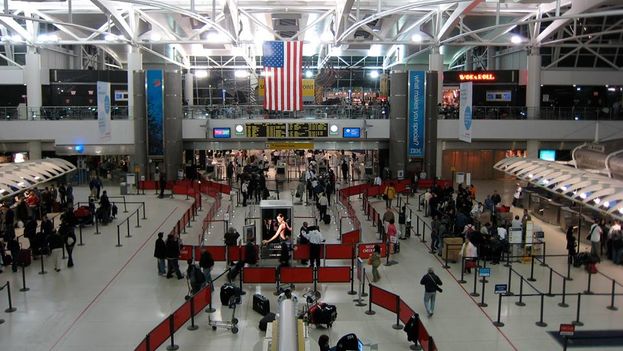
JF Kennedy Airport in New York. (Facebook page: Cuba Travel Services)

Translating Cuba note: This translation got “lost” (due to the site manager’s Thanksgiving travel apparently), and is being belatedly posted now. Our apologies.

14YMEDIO, Havana, 21 November 2014 – The American agency Cuba Travel Services announced last Thursday that it will operate a direct flight between New York’s J.F. Kennedy Airport and Havana. It is envisioned that the trips will occur daily in the afternoon, although company workers have not been able to confirm either the departure days or the frequency of the flights.

Cuba Travel Services has not provided information about the date the service will begin, but it has announced that the price for a round trip ticket on the inaugural flight will start at 849 dollars.

The company organizes travel to popular destinations like Cienfuegos, Camaguey, Santa Clara, Holguin and Santiago de Cuba, with flights operated by Sun Country Airlines. continue reading

The Turbo News site explained this afternoon that “in the spirit of the recent New York Times editorial published October 11, 2014, entitled ‘Time to End the Cuban Embargo,’ the agency Cuba Travel Services chose to provide an important cultural and social link between the two cities.”

The agency maintains that the expansion of its offering will permit travelers who leave from New York to save as compared with the current options on the market, avoiding the delays of connections and the cost of additional fares for stops in Miami, Fort Lauderdale or Tampa.

The company, which organizes daily flights between the US and Cuba, asked for permission to operate flights also from Newark Liberty International Airport, but that request was rejected.

The US government suspended direct air links with the Island at the beginning of the 1970’s and resumed them in 1999 with a flight between New York and Havana. After a slight opening by President Bill Clinton, Barack Obama also opted to soften restrictions on travel by Cuban Americans visiting the Island; now they can travel every year instead of every three and stay as long as they like.

In 2012 the Cuban government suspended landing rights on the Island for two airlines from Miami, Airline Brokers and C&T Charters, explaining the reason for the decision “as over capacity of seats and other operational themes,” although the travel agency operators revealed suspected payment defaults with Cuban authorities. Airline Brokers operated weekly flights to Havana and Cienfuegos from Miami and Fort Lauderdale, while C&T Charters traveled to Havana and Camaguey from Miami, New York and Chicago.

Translated by MLK

The beginning of the end of the Castro regime / 14ymedio, Jose Gabriel Barrenechea

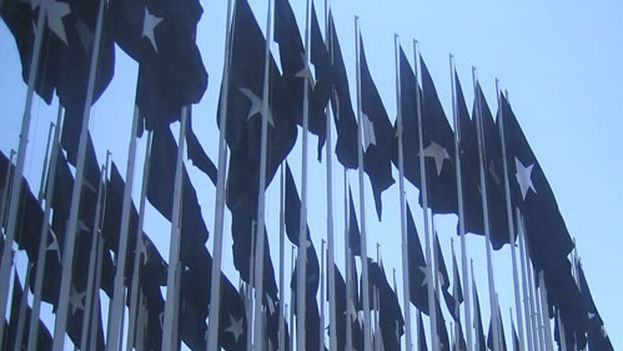
Anti-imperialist black flags in front of the United States Interest Sections in Havana

14ymedio, JOSÉ GABRIEL BARRENECHEA, Havana, 20 December 2014 – We Cubans continue to be as impressionable as ever. Thus, on the island, the masses seem to see the release of the three spies who were still in US prisons, and nothing else. Many opponents and exiles, for their part, only seem to see this bias among the great majority within Cuba. As a consequence, they immediately assume that Obama’s decision will only serve to strengthen the Castro regime.

What will remain three months from this melodrama that Cuban media officials have emphasized as focused on the three spies? Nothing, because among other things it has unfortunately revealed that los muchachones – the “big boys” – who some thought could become a part of the elite to replace the historic leaders, have no expressiveness, no people skills. They lack charisma to the point that the colorless Miguel Diaz-Canel – First Vice President of the Council of State – gives the impression of being a total politician along with the rest of them. continue reading

On the other hand, we must not overestimate the reaction of the masses. There was no more than an apathetic joy after the General President’s speech. Not even a spontaneous conga line, nor demonstrations like those of prior years when American monopolies were nationalized.

Only a few isolated acts whose protagonists have never made into to the core of public officials, members of the Party or the Communist Youth, or the usual snitches who we know flood the spaces where people tend to congregate.

Personally, at that moment I was in Santa Clara’s Vidal Park. I noted the disinterest, and the only concern on the faces of some young people appeared when they heard me predict that the Cuban Adjustment Act wasn’t long for this world.

Within three months, if in fact diplomatic relations are reestablished with the United States, there will be a functioning embassy, and most of all, every presidential measure from Obama to facilitate the flow of people, finances, goods and information. The Castro regime is one of confrontation, of segregated sterility. They only have three options: change the world, isolate themselves from it, or inexorably disappear. Their end will be:

1 – The hundreds of thousands of American tourists who can’t handle the hotels operated by the warlords and who, unlike the Canadians or Europeans, don’t mince words and don’t accept any restrictions on their basic freedoms to go where they want and meet with anyone they want.

2 – The money will rain down, and not to the dissidents but to the most effective sector of democratization: the thousands of small and minuscule businesses that will spring up left and right and that, ultimately, can’t help but clash with the “Raul stuff.”

3 – The unstoppable jet of information that will stream toward the opposition to an element much less suspicious of other spurious interests, and at the same time more educated and flexible, ideal for the times to come when, what we need will not heroes of the resistance but politicians.

4 – The almost certain abandonment of the Cuban Adjustment Act, which will deprive the regime of a convenient escape valve to lower the internal pressure at the difficult moment of the transfer of power from Raul to the colorless man he chose to replace him.

5 – The moral strengthening of the Church for having played a key role in this process, in the person of Pope Francis, who hopefully will not delay in visiting Cuba. An institution that has been upright against the dictatorship, even though some who never have been don’t find it convenient to admit it.

Although almost nobody wants to, or can, see it, in the midst of the current turmoil, the long night of the Castro regime is coming to an end. That is why Fidel Castro, to whom the details do not lie and indeed, he sees the essential, has remained, or they have made him remain, silent.

As in April of 1898, or in March of 1958*, the Americans have returned to do their part. Something that, unfortunately, they have almost never done, engaged in village style and prepotent foreign policies.

Perhaps thanks to this gesture, our two peoples, separated by barely 90 miles, are finally beginning to behave no longer like adolescent brothers, full of jealousy and small family resentments. And I speak now of a time beyond the Castro regime in retreat, when Cuba can join as one in the battles that loom over our –western – civilization.

*Translator’s note: In March 1958 the United States stopped shipping arms to Batista’s government, after Batista refused to end his suspension of constitutional guarantees and censorship of the press.

“Things are not going to change overnight” / 14ymedio, Victor Ariel Gonzalez

University of Havana (14ymedio)

14ymedio, Victor Ariel Gonzalez, Havana, 20 December 2014 — “Now when they lift the blockade …” a student says jokingly to his friends sitting in Mella Park at the University of Havana. His sentence ends mentioning some a problem that has been solved, supposedly, by the foreseeable end to the US embargo on Cuba. The group laughs and continues talking about the next party of the Law School or the salary a computer engineer earns at a company like Google.

Sitting on a bench to the side and eavesdropping on the conversation doesn’t feel quite right, but it is, perhaps, the only way to capture accurately what the University feels about the latest news. Actually, few agreed to answer questions for this report, and one group of young people apologized with, “They’ve already been asking us a lot of questions today, the foreign press has been around all day.” On presenting myself as a reporter, one of them got up to leave. So it’s impossible to get a face or a statement, even though two or three loners are disposed – always in confidence and hurriedly – to offer their particular vision. continue reading

Alberto, sitting on the side of the grand staircase waiting for his classes to begin, is one. “We have to see if everything is not just words, but I’d give it a greater than 50 percent chance that things are going to go well.” He is still wary, however, both of the changes to come and of my identify, so he doesn’t even want to say what department he’s in.

A recently graduated professor is less concise. “Everyone’s talking now about the approaches [between the governments].” And this seems to be true, because near us three or four students are talking about it. She confesses, “I believe that the reestablishment of relations is more important than the return of the prisoners. At the end of the day, it’s what was expected. And of course it has much more influence on what will happen from now on.” She is also more positive than pessimistic about the future.

Beyond University Hill, toward one end of the city, is the José Antonio Echeverría Polytechnic Institute (CUJAE), the university for engineers. Its students were less timid about offering their opinions for this report, and in general were much more excited about the important statements of Wednesday.

The first response of three of them, Telecommunications Engineering students, about what to expect from the Cuba-US rapprochement, touched on the improvement in connectivity. “Imagine, in our career,” they commented. “We hope that very soon we have more opportunities to access the Internet and that there will be more advances in this. Even the professors have talked about everything it [the announcement] could mean. It’s going to be good.”

In the faculty of Civil Engineering, a young professor at the Hydraulic Research Center (CIH) says he also has faith. “When I got the news via SMS, before the announcement midday on Wednesday, I did not want to believe it. And Obama’s speech… it didn’t match the summaries on Telesur and I heard it again that night. I thought the translation was bad, but it’s true. It’s wonderful.”

Referring to the perspectives of his specialty in this new environment, he notes that, “The rapprochement could facilitate our use of the CIH equipment, which is in a pretty bad state. Right now, for example, we can’t test with the wave simulator.” However, the interviewee said that “things are not going to change overnight.”

A little more than two days ago the nation suffered a political shakeup, and Friday was the last day of classes for the year for many university students, who start their Christmas vacations next week. The year 2015 is a great unknown for some; but unlike other times the answer, whatever it is, seems to be really close. In a few words: the university students don’t know what to expect, but they are filled with expectations.

From Discontent to Joy in Twenty-four Hours / Cubanet, Miriam Leiva

reconciliacionCubanet, Miriam Leiva, HAVANA, 18 December 2014 — President Barack Obama announced a new direction in US policy toward Cuba, on December 17. The Cuban population has expressed great joy at the news, both within the archipelago and abroad. It is a brave and historic decision, because it provides the opportunity to finally eradicate the existing environment of confrontation of almost 55 years and initiate fruitful relations to benefit of the Cuban people. The measures taken by the US president have been greeted with enthusiasm and hope by millions, although other Cubans remain cautious, because they commonly face harsh living conditions and repression.

President Raul Castro announced he was open to extensive negotiations with the United States, on all subjects, in a televised appearance coincident with that of President Barack Obama. The reasons to promote the rapprochement with Washington may be very extensive, including the deepening of the Cuban economic crisis, the need for foreign investment for recapitalization and development, social discontent over the socio-economic deprivation, loss of public confidence, and the need to improve Cuban’s international image. To achieve freedom and democracy, civil society will have to traverse the long and difficult path imposed by a totalitarian regime that seeks to prolong itself through its heirs. continue reading

The exchange of Alan Gross, imprisoned in Cuba in 2009, for 3 prisoners sentenced as spies in the United States, was a necessary condition for the US government to be able to initiate the process of normalization of relations and to achieve results with new measures directed toward the Cuban people. In addition, the island government agreed to release an American citizen after some 20 years, and 53 other political prisoners. The tradition of the American government is to not abandon any of its citizens, and to provide for their exchange or rescue with military action.

The efforts of lawmakers from both parties, the diplomacy, and members from all sectors of American society have had an important role in these developments. Pope Francis has once again demonstrated his wisdom, aided by nuncios accredited in Havana, and the Cuban Catholic Church, headed by Cardinal Ortega and the Conference of Cuban Catholic Bishops who have continued to accompany the nation and the people with their traditional patriotic and religious vocation.

The measures announced include initiation of talks to restore diplomatic relations; regulatory reform to empower the Cuban people with more efficiency; favoring the expansion of general permits for travel to Cuba and increases in the amount of remittances; expanded authorizations for commercial sales and exports of certain goods and services from the US; authorization for persons living in the United States to import additional goods to Cuba; facilitating financial transactions between the two countries; initiating new efforts to increase access to communications in Cuba and people’s ability to communicate freely; updating the application of sanctions on Cuba in third countries; establishment of negotiations with the governments of Cuba and Mexico to discuss the unresolved maritime boundary in the Gulf of Mexico; beginning of the process of reviewing Cuba’s as a state sponsor of terrorism; discussion of the participation of Cuba in the Summit of the Americas in April 2015; a firm commitment to democracy, human rights and civil society, including strong support for improving human rights conditions and democratic reforms in Cuba (a summary of an extensive Fact Sheet issued by the Office of the White House Press Secretary).