14ymedio, Clive Rudd Fernandez, 22 January 2015 — In July of last year, when I talked to some of the victims of the “Marzo de 13” Tugboat massacre in the Bay of Havana, I found a list of horrifying statistics.
Two of them would make any halfway decent human being shudder: the bodies recovered from the sea as a result of the sinking of the boat were never returned to the families, and there was never an independent investigation into the massacre in which 41 Cubans lost their lives. Ten of them were minors.
What was so shocking about these events was not just the impunity of those who perpetrated the atrocity on Cuban soil, but that what happened on 13 July 1994 is a pattern that has been repeated almost since the Revolutionary government took power in 1959.
The violent deaths, on 22 July 2012, of Oswaldo Payá, winner of the European Parliament’s Sakharov Prize for Freedom of Thought, and Harold Cepero, young leader of the Christian Liberation Movement, followed the same path of an absence of justice and the utter helplessness of the affected families. Although in this case the bodies were handed over to the families, neither Payá nor Harold were given an autopsy or an independent investigation.
With the policy changes of the Obama administration and the Havana dictatorship, some voices have begun to ask for independent investigations of the violent deaths, especially where it is known that the authorities had some participation.
Some voices think that these “problems” have the potential to point the accusing finger at the face of the government in Havana and that “this is not the opportune moment to talk about accusations, but rather about the issues that bring both nations closer,” like an independent blogger on the Island told me.
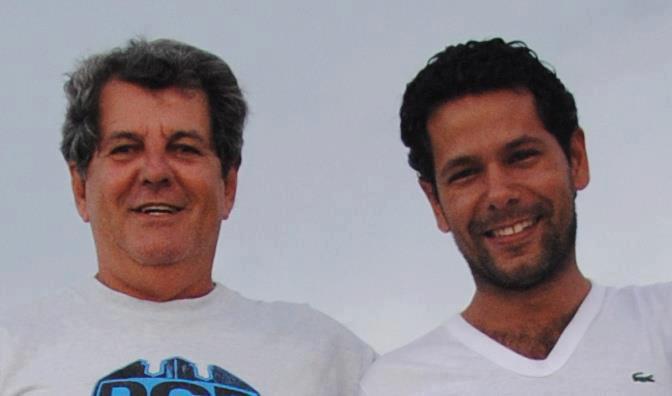
Oswaldo Payá and Harold Cepero
The international media ignores the issue to the same extent. The saddest thing isn’t that they don’t emphasize these presumed assassinations, but rather that the majority of us, Cubans inside and outside the country, don’t consider it one of the most important issues to address.
An independent investigation into the deaths of Osvaldo Payá and Harold Cepero protects all of us Cubans.
The alleged “accidents” and “careless doctors” who allegedly caused the deaths of Laura Pollán, Oswaldo Payá, Harold Cepero and many other Cubans are today the extrajudicial execution that hang like the Sword of Damocles over the heads of all Cubans living on the Island.
Those who dare to dissent and openly criticise the Government have felt the danger much more closely. Many of them have received death threats from members of State Security, who act with total impunity, as they well know that there will be no legal consequences for them.
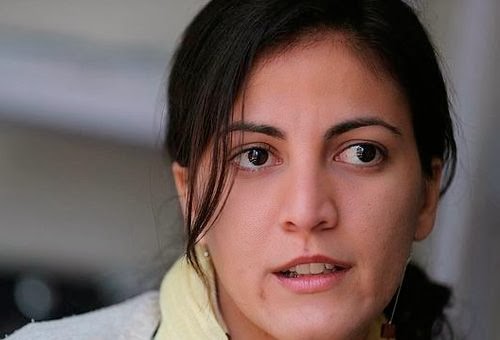
Rosa María Payá
Last night I heard that Rosa María Payá met Robert Jacobson on a plane, when the daughter of the Cuban dissident was returning from a short trip to Washington, where she had the privilege of being the guest of Senator Marco Rubio at the State of the Union.
The Assistant Secretary of State for Western Hemisphere Affairs was on her way to Havana to meet with officials from the Cuban Government in one of the meetings between the two nations at the highest level since the Jimmy Carter administration.
In this short encounter, Rosa María Payá asked whether the investigation into the death of her father would be on the negotiating table. The answer, as politically correct as it was evasive, was, “This is always a point that we raise”.
Maybe I’m wrong, but judging by the response, the issue of the unexplained deaths of opponents like Oswaldo Payá and Laura Pollán will remain unaddressed and, with them, the fear every Cuban has of being murdered at any moment, without consequences for the executioners, nor for those who give the orders.
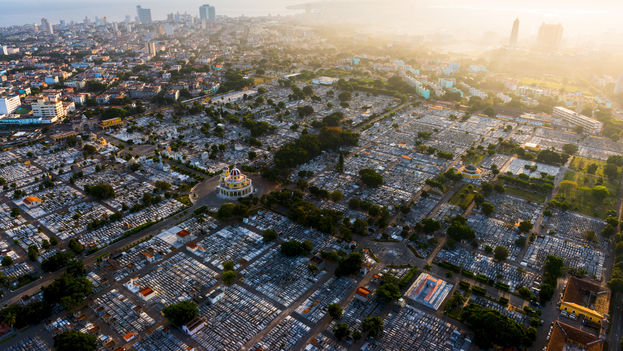
A World Heritage site, the Colón (Columbus) Cemetery in Havana has more than 500 mausoleums, chapels and family vaults. (Photo: Marius Jovaisa)
The photographer’s work was the pretext that Havana used to suspend negotiations with the European Union
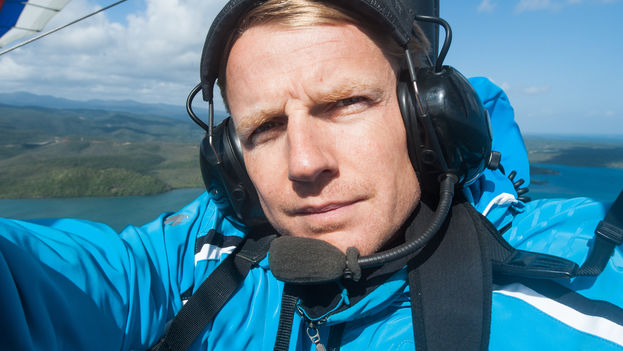
14ymedio, Ernesto Hernandez, Miami, 23 January 2015 — Marius Jovaiša is a Lithuanian photographer, 41, who has spent much of the last five years taking photos of Cuba from a perspective never before seen: from above. He started the project in 2010 thinking that, being a foreign artist far removed from politics, it would be quite easy to get permission to take aerial photos. However he quickly realized that he would have to navigate against an extremely slow bureaucracy, invest a great deal of resources, be patient, and understand that the freedom to do things is very limited on the island.
Unseen Cuba, a collection of more than 300 ariel photos of the island, taken from an ultralight 300 feet above the surface of the earth, was published in 2014. The exhibition of the images in Washington and Brussels caused problems with the Cuban authorities, who came to use his work as a pretext to suspend their dialogue with the European Union last November.
Question: Why did you decide to write a book about Cuba?
Answer: After the publication of my book of ariel photos of Lithuania, I realized that I was doing something that I enjoy, that appealed to the public, and that could also be a profitable project. With this new project I could combine my passion for photography with the adrenaline that one feels when flying in an apparatus that is open as an ultralight. It was like I was flying in a chair and, at the same, time taking incredible photos. continue reading
First I did Unseen Belize to see if the model would work in a foreign country and then I thought about Cuba, because there had not been a work of this kind in the country, and also because the island and Lithuania share a piece of history through the Soviet influence. Cuba was like a secret country and it would be a great challenge for me to develop the project. I love challenges.
Q. Do you expect to hold an exhibition in Havana next?
A. I would love that. There were already two exhibitions last year, one in the Lithuanian embassy in Washington and another with the support of the European Union in Brussels. Both caused problems with the Cuban authorities. Unfortunately, my work found itself in the middle of a political problem. Last May, our ambassador in Washington invited to the exhibition several Cuban-American members of Congress, who made very strong political statements, and the Cuban diplomatic mission reported what happened to Havana
The person responsible for Latin America at the European Union is Lithuanian and she invited me to show my work. Cuba and the European Union had begun their rounds of talks, and she thought the show would be an opportunity to educate the diplomatic community about the culture of the country.
Someone in the embassy in Brussels realized that it was the same exhibition that had created so much conflict in Washington and asked that it be canceled, but the European union refused. The Cubans boycotted the exposition, as did other Latin American ambassadors, and at the same time they suspended the talks. Many said that my exhibition was just an excuse for the cancellation and not the main reason, but that is what happened.
Q. What do Cuban authorities think of your book?
A. I sent it to them last November. I hadalready reported by telephone that on page 77 there is a picture of a lighthouse with what appears to be a soldier patrolling, from above. Although you cannot see the soldier very well, in Cuba there are regulations that prohibit photographing the military.
I was also told that there is a picture of my children with some Cuban children that they did not much appreciate. They said: “We do not want to show our children to the world in this way, they appear to be poor little savages. I am still waiting for a global response, but if there is nothing that would harm my artistic work, I am willing to publish the book in Spanish for sale in Cuba.
Q. Who were the first people you met with in Havana?
A. I met primarily with Ministry of Culture and the Ministry of Foreign Affairs. One of the entry points for me was the Antonio Núñez Foundation for Nature and Humanity. Its director, Liliana Nunez Velis, fell in love with my project and took me, literally, by the hand to the Ministry of Culture. She wrote a letter of recommendation on behalf of the Foundation saying that my project presented an opportunity to promote Cuban culture in other countries through its geography and landscape.
Then, in my meetings with the Department of International Relations within the Ministry of Culture, I worked with the department director, Pedro Monzón Barata. I was always talking with officials from each ministry separately, but I realized that each of them was coordinating everything with the military. The Government also designated me as a trading company of the Ministry of Culture to coordinate the initiative, Paradiso. Through them, money was sent from Lithuania to Cuba to develop the project.
Q. At any point do you think that it would be better to abandon the project?
A: I thought of quitting many times because the bureaucracy did not do its work and delayed decisions, it was exhausting. Something would be agreed on in the meetings, and afterwards it wouldn’t happen. On my first visit to Havana I managed to open doors and even to fly, and I committed myself totally to the project and believe that it would be possible possible to do it. On this first trip I received many compliments, everyone told me, “Relax don’t worry.”
I come from a country that belongs to the Soviet Union, I knew some things would be achieved through under the table negotiations, sidestepping the rules a little bit. I knew I would find some way to navigate through the labyrinth of regulations. Then when I felt like giving up the project, I thought about the flight that I managed on my first trip. Perhaps if I hadn’t taken this flight I would have lost interest in the project.
Q. Do the Cuban authorities feel threatened by your book?
A. I don’t think so, not at all. The problem is they expected it to be done much more slowly, and that the captions on the photos would be written by the Cuban historian and geographer assigned to the project. But they weren’t doing the work and I went ahead.
Q. In April 2014, you received a visit from the Interior Ministry. The authorities claimed that they were not aware of the project and had received complaints that “a foreign spy” was taking aerial photos of Cuba. What did they ask you in the interrogation?
A. It wasn’t an interrogation as such. They asked me several questions about the work I was doing. I do not think it was an order from above. It was rather the local police who were trying to show their spirit of initiative and were doing their job.
Q. Why initially could you not take pictures of the cities?
A. I thought it was for security reasons, but they never explained it to me. I always hoped they would let me take photos of cities, though perhaps I would have to do it in a military plane and not in my ultralight, but that was not the case. I was very surprised when they let me do it, because in other places it is not allowed.
Q. How much did the project cost?
A. The whole process – travel, events, presentations, production of the book, et cetera – has cost close to $1 million. I still haven’t finished the process, there’s a lot to be done in terms of promotion and sales, so the costs continue to rise
Q. What impressed you about Cuba?
A. When I started to visit places outside Havana – Trinidad, Santiago and so on – I realized how big and long Cuba is. The roads were very narrow and the transportation very limited. I realized it would be a complicated job.
Marius Jovaisa in in his ultralight (Marius Jovaisa)
I had a lot of contact with Cuban artists. Before the project I organized a series of seminars and presentations about my work and my experience with photography. The island’s photographers are very talented, expressing in their work, in a way, the same pain and the same sensitivity that existed in Lithuania in Communist times.
The Cuban people are strong. Their feel love for their homeland. It is very difficult to live in Cuba without access to simple things, without a free market, unable to express their creativity. It reminded me a lot of Soviet times in Lithuania.
I also met many Cubans outside the island, dreaming of the day when they could return. I stayed in B&Bs in private homes, I visited with Cubans who welcomed me like a member of their families. My kids played with their Cuban friends. Cubans are a very welcoming, they give you a unique friendship. They don’t see you as a commercial object. I was always asked about my family and not about my professional life. They improvise a lot, they have an incredible creativity.
Q. What do you want to accomplish with your book?
A. One effect that this book will have is to awaken a certain national pride in Cubans. It’s like saying: this is yours, this is your country, it was created before any revolution and political system, and it will also survive long into the future. No regime, whatever it might be, can take it from you.
These pictures evoke a sense of belonging to a single Cuba for Cubans living both inside and outside the island. I know it will be very difficult for my book to be in the homes of every Cuban on the island, but my hope is that Cuban-Americans can buy the book and share with their families inside Cuba.
For those who are not Cuban, I hope my book will serve to show the beauty of the country. Cuba is a place that is recognized throughout the entire world and I hope that this book will allow many people to see Cuba from a new perspective.
‘Unseen Cuba’ presented in Miami on Friday, January 23, 7:30 pm, at Books & Books, 265 Aragon Ave., Coral Gables. (305) 448-9599
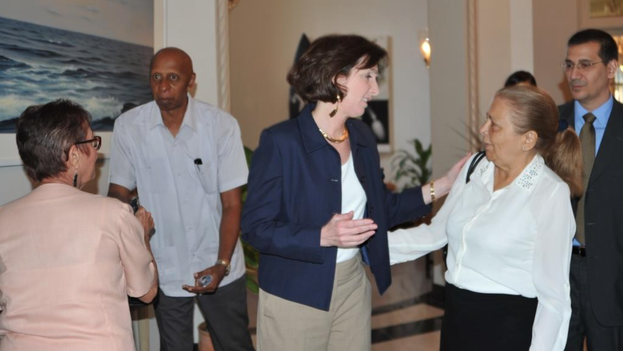
L to R: Miriam Leiva (back to camera), Roberta Jacobson, Guillermo Fariñas, Marta Beatriz Roque, Antonio Rodiles
14ymedio/EFE, Havana, 23 January 2015 – Friday morning the US Assistant Secretary of State for Western Hemisphere Affairs, Roberta Jacobson, met with a broad representation of Cuban activists. The meeting had the character of a working breakfast and the main objective was to hear from dissidents and opponents with regards to the negotiations for the reestablishment of relations between the United States and Cuba.
The meeting was held at the residence of the Chief of Mission of the US Interests Section and, on the Cuban side, attended by members of various civil society groups such as the Patriotic Union of Cuba (UNPACU), the Cuban Commission for Human Rights and National Reconciliation (CCDHRN), and the opposition group Estado de Sats (State of Sats).
José Daniel Ferrer, UNPACU leader, said, “The meeting was very fraternal, frank and positive.” According to the activist, the American side was very receptive and “reaffirmed their interest in maintaining a commitment to the demand to respect human rights, the current point of greatest concern among Cuban civil society.” The majority of those present, according to Ferrer, “focused on detailing their concerns about the future of Cuba,” and also on the concern “that the decision about the future of Cuba must rest with the Cuban people.” continue reading
Some activist expressed their concerns that the government of the United States had already made too many concessions in the process of negotiations, while the Cuban government had only released 53 prisoners.
Elizardo Sanchez, president of the Cuba Commission on Human Rights and National Reconciliation, said that “the meeting was marked by cordiality and human closeness. With this invitation and with the reception to be held tonight, the US delegation wanted to give a clear message of appreciation to the peaceful efforts of civil society.”
One of those absent from the meeting was the leader of the Ladies in White, Berta Soler, who explained to EFE today that she decided not to participate because she considered that the guest list was not balanced. Soler, who has expressed her opposition to US diplomatic approach towards Cuba and to the measures easing the embargo announced last week in Washington, expressed her dissatisfaction, saying “the selection” did not take into account “the diversity” of positions and opinions that exist in the internal dissent on this issue.
In a press conference after the meeting, Jacobson said the purpose of the change of policy toward Havana is to promote a “greater openness” in Cuba, with more rights and freedoms and “to empower the Cuban people.” According to the US diplomat, the issue of human rights and democracy is “crucial” for the United States, although she recognized that there remain “profound differences” with the Cuban government on this question.
Several activists have called a press conference at the headquarters of the CCDHRN to summarize the meeting and present their views on the process of restoring relations between the two countries. The conference will be held at 1:00 PM, at 3014 21st Street between 30th and 34th streets, in the Playa neighborhood.
14ymedio, FERNANDO DAMASO, Havana, 22 January 2015 — Among so many crises that affect us, little is said about that related to institutions. In the Republican era, there existed institutions that, without being perfect, worked. If it had not been so, the country would not have developed in the way that it did. When the new regime was put in place in 1959, instead of being perfected, most of the existing institutions were liquidated or their spheres of influence were reduced for the purpose of initiating other new ones on bare ground. Even the family, considered a principal and primary institution, did not escape, being dismembered and atomized to respond to political and ideological interests.
An institution can be many things. There exist formal and informal institutions and, in both cases, they are always social constructions. They must be efficient, that is to say, capable of functioning well, having legitimacy, being able to adapt to changes in the environment and anticipate changes besides demonstrating stability. These components must act together if they want to get results. In the Cuban case, stability has turned into a kind of brake that impedes the necessary changes, giving rise to ossified institutions. The majority of institutions established in the last fifty years suffer this infirmity, mainly the economic, legal and political ones. continue reading
The companies nationalized or seized – financial, production, trade and others – that had functioned independently in accord with the policies of their owners, were subordinated to already existing institutions or ones created for that purpose that had never performed these functions of management and administration, instituting a rigid vertical system that totally eliminated their independence and chances of reacting to changing situations; everything was decided centrally, and they were reduced to mere implementers of orders. Economic institutions not only have been incapable of developing the country but have destroyed what was achieved during the preceding years thanks to the talent and effort of several generations of Cubans.
Legal power stopped being independent and, like the legislative, was subordinated to the executive, represented by a single authority. Judicial institutions respond only to the interests of the State, to the detriment of the citizens without there existing true rule of law.
In the provincial and municipal governments changes were introduced, stripping them of their names and functions, also creating a vertical system that left them financially destitute for having to deliver most of their income to the central authority which later would dole out resources for their needs. These changes reduced the chance of solving local problems, since they no longer had the resources that their own commercial and productive activities previously generated.
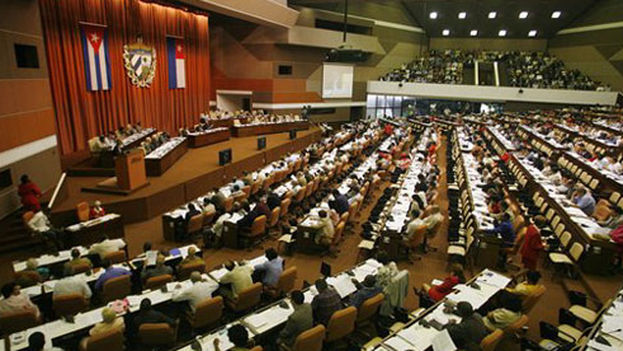
In the case of political institutions, the example of the National Assembly of Popular Power is depressing. Being the only constituent entity existing in Cuba, which also is the only legislative body and which retains the important authority to declare the unconstitutionality of laws, decrees, ordinances and other regulations, it has never exercised this authority in its 38 years of existence as the supreme agency of the State. Can anyone believe that everything legislated by the State has been just and correct?
Other negative aspects of its functioning are that almost all the votes in its legislative history have been unanimous and that the deputies have not exercised their right to present legislative proposals as individual members of the Assembly. As if that were not enough, the legal decrees of the State Council and the decrees by the Council of Ministers triple the laws by the National Assembly.
The main problem that affects all Cuban institutions – whether political, economic, legal, cultural, educational, military, medical, athletic or others – is their unconditional submission to a sole political-ideological approach, putting these interests ahead of those that relate to their reason for existing. The only exceptions perhaps are some religious institutions.
Until now the topic of institutions has been treated superficially, more with regards to their form than their content. Life demonstrates that some institutions must disappear, others must be changed, some new ones should be created and a few others can continue functioning. If this does not happen, the economic changes implemented so far and others that should come, as much economic as political and social, will lack the effectiveness, legitimacy, adaptability and stability necessary for producing beneficial results for all Cubans. It is not logical to hope that all this will be achieved with the existing historical leaders, but they could, at least, start.
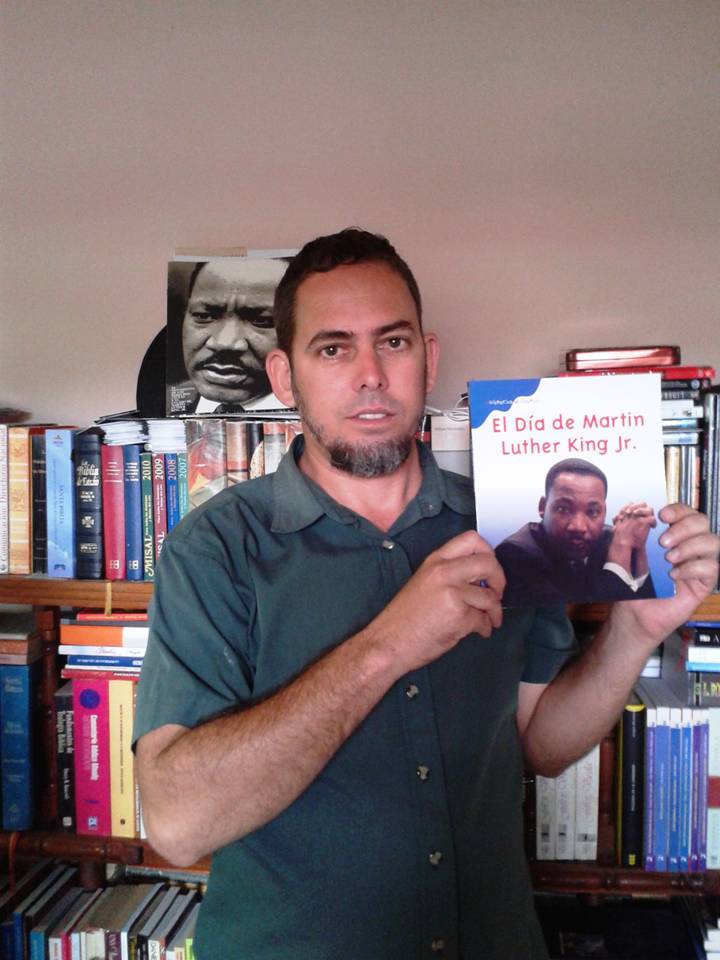
Although today [15 January] is a holiday only in the USA, I also in my own way celebrate it in Cuba. Why not join in the celebration of the birth of the Baptist pastor and fighter for civil rights, Martin Luther King Jr.? His life is inspirational for many of us, including me, who every day seek freedom and equality for human beings, all creatures of God.
His existence is one of my answers to those who in Cuba who question why I combine theology with social activism. I have not invented anything new. It is the most natural thing to combine ideas and actions, and this was what happened in the life of the Reverend King. His sermons, his philosophy, his methodology, his strategy of nonviolent struggle, his life and his martyrdom are an example to follow in any dark corner of the world, and also in the illuminated places, to prevent anyone ever to darken them.
The last time that I mentioned his name to those who are responsible for repressing me in Cuba was on October 26, when I arrived from Poland, two agents from State security awaited me at the airport for questioning about my statements in the land of Lech Walesa and my subsequent activities and position in Cuba.
According to them my pastoral ministry should be confined to the four walls of a church to which they would gladly cloister me. My answer was that in addition to the unsurpassed example of Jesus Christ, I admired and tried to imitate, except for the distances, transcendental beings such as the Lutheran pastor Dietrich Bonhoeffer, the Catholic priest Jerzy Popieluszco and the Baptist pastor Martin Luther King Jr.
To which one of them, with the obvious threat that the same thing could happen to me, he riposted: What a coincidence, that all of them are martyrs!
Hopefully just like in August 1963, when he achieved that historic March on Washington for Jobs and Freedom, in Cuba soon we will be able to realize something similar of our own in Havana, which, as the successful artist Tania Bruguera demonstrated in the recent events on December 30, so far remains forbidden to the people.
In the midst of our Cuban reality of continual violations civil rights, the Reverend Martin Luther King, Jr. is one of our luminaries.
The reestablishment of diplomatic relations between the governments of Cuba and the United States has been well received by the majority of Cubans both within and outside the island. Although it represents only the first step in solving the dispute between the two governments, it provides the basis for achieving a normal coexistence between close neighbors, both geographically and historically.
During the process of resolving this dispute, it is hoped that steps will also be taken to resolve another dispute: that between Cubans and their government
As expected, there are those who do not agree with this first step, who reject it and will do everything possible to make it fail. These people are found within the governments of both countries, as well as among the internal and external opposition. Some have lived too long under this dispute, and it is too difficult for them to give up what has become a way of life.
I am referring to government figures, who have made careers for themselves taking advantage of the dispute, enjoying the perks, experiencing neither shortages, scarcities, nor the “Special Period,” and also some opponents who, although it has cost them a great deal of work, have benefited from it, through media attention, economic assistance, and the occasional trip abroad.
This is also happened with some Cuban-American politicians, Both Democrats and Republicans. It is a well-known reality and cannot be ignored.
Those of us who are committed to change and have as our main objective the well-being of Cuba and all Cubans, without any kinds of differences or exclusions, I call on to fight to overcome the obstacles that undoubtedly will appear, and to advance this process.
It is noteworthy that, in recent days, in the press and in the Government-supported blogosphere, there have appeared some articles which, instead of promoting understanding and good relations, try to fan the flames of discord, recalling difficult times in recent history, where the only culprit, with or without evidence, continues to be the American government, while Cuba continues to play the role of innocent victim: they appear to be stuck in the story of Little Red Riding Hood and the Big Bad Wolf
If we really want to have good relations with our neighbor, and so the language of the barricade and of the ignorant, used for so many years, should begin to vary: respect, to be effective, must be mutual.
For the five-year period 2011-2016, the Cuban authorities planned for a 5.1% growth in the economy. It was later reduced to 4.4%. However the average growth has been 2.7%, with this year, 2014, being the worst with a growth of only 1.3%. This has displaced 2009, when growth was 1.4%, as the year with the worst numbers since the beginning of the so-called updating of the economic model.
We now have more than 20 years of sustained economic stagnation, which demonstrates that despite all the efforts undertaken so far to overcome it, the model does not work. It has brought a great deterioration in social services, which can clearly be felt among citizens, regardless of the official propaganda that tries to convince them of the contrary.
There has been a demonstrated inability to recover the industrial indices and agricultural production, and in addition all of the infrastructure has suffered considerable deterioration. Real salaries today represent 35% of the level of 1989. All of this taken together has affected the government’s credibility.
Despite systematic declarations to the contrary, it is necessary to increase the speed of reforms and to reduce the number of experiments that are undertaken prior to transformations. The time lost worsens the economic situation of the citizens.
14ymedio, Elicer Avila, 13 January 2015 – Cuban civil society is often questioned, as are opposition groups, due to their apparent inability to join the masses and pressure the government for necessary changes.
All of these questions are not without some truth, and a doubt comes to mind that I would like to share. I am referring to the fact that the two million Cubans (between emigrants and descendents) who live outside the country have not found an effective way to participate in the politics of the nation.
In theory, this group of Cubans has everything that the internal opposition lacks in order to have a major influence: full access to communications and information, freedom of movement, the right of association and assembly, and, above all, it has an economic power that could compete with that of the government itself.
On the other hand, the remittances that the Cuban migration sends to the country every year constitute one of the top three sources of the gross domestic product. If we accept the maxim that “He who holds the purse strings holds the power,” then it would correspond that those living abroad should have a wide representation in the parliament for being the most efficient and productive workers in the system, as well as for being the largest union. Thus, we could at least say, “He who brings, participates.” But this is not the case.
Quite the contrary, the measures usually taken by the government tend to directly affect the interest of the emigrants, and at times don’t help their families. The new customs regulations, the cost of the paperwork to enter the country, and the treatment that often borders on disrespect, are some examples of this.
To make matters worse, the new Foreign Investment Law* also excludes them, depriving them of the opportunity to contribute with their investments and their talent to the development of the country. And it is a tremendous shame. I know that outside the country there is human capital of incalculable professional value, with experience in every kind of business and, above all with immense desires to see their native land move towards progress.
How is our emigration organized to defend its natural rights in this new scenario? Will it support in a major way a civil society and a responsible opposition that has a more inclusive vision of the nation? For me, this remains an unknown.
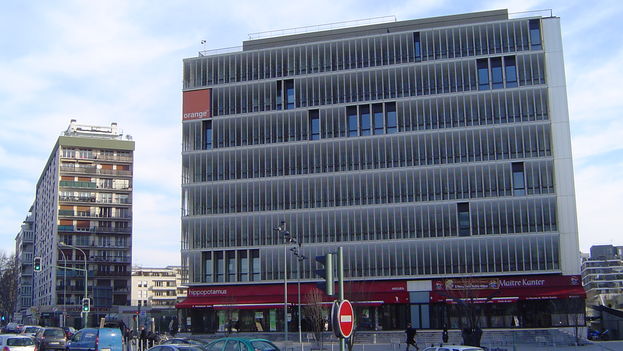
Headquarters of the French company Orange in Paris
14ymedio, 21 January 2015 — Last July the French telecommunications company Orange, chaired by Stéphane Richard, signed a confidential agreement with the Cuban state telecommunications company ETECSA to develop communications in Cuba, according to the French weekly L’Express.
According to the information this newspaper had access to, the contract stipulated that Orange would offer its services, products, and rates (telephones and equipment) to Cuba’s only local operator, and share its knowledge. The French company also committed to create an institute in Cuba dedicated to training in technologies and services for Latin America and the Caribbean.
L’Express explains that the new measures announced by Barack Obama and the easing of the embargo put the agreement with the French Telephone Company at risk. The weekly notes that Cuba continues to be a backward country with regards to access to the Internet and services are offered at prices prohibitive for the population, which makes it an El Dorado for those who want to develop this industry on the island.
Thus, L’Express comments, the agreement signed with Orange adds to the interest shown by the United States in the technological advancement of Cuba, initiated last June by Google, whose executives visited the island to promote free Internet.
Diario de Cuba, Dariela Aquique Moon | Havana | 21 Jan 2015 – Of course it wasn’t shown on Cuba television’s state channel, but Telesur did broadcast live and in full the State of the Union speech delivered yesterday evening by President Barack Obama. His spontaneity, his affable but convincing tone, his way of exhorting but not prescribing, and each of the issues addressed in his speech; it all makes me think this man is perhaps now one of the most progressive politicians in the world, though I wouldn’t want to be absolutist.
In the final of his two terms, when he has only two years left in the White House, Obama doesn’t want to leave the arena without having accomplished his proposals. And as he said himself, at this point in the game, his proposals go far beyond promises to gain followers in an electoral campaign, it is about doing what he believes is right and best for his country.
Listening to a speech like this and seeing the natural reactions of the audience, that some stand and applaud, get excited and express it; or some simply disagree, don’t clap and remain seated; seeing and hearing a speech like this, where there is no obligation of unanimity, no set slogans shouted, I see the face of democracy a little bit closer continue reading
, something I do not know because having been born in Cuba, and being only eleven when the bearded-ones entered Havana, I’ve lived here on this island that I don’t want to leave my whole life.
I confess I was excited when the American president asked Congress to suspend the Cuban embargo. When he talked about the reforms necessary in favor of immigrants who make up an important part of the economy and of US society. When he referred, without trappings and stock phrases, to respect for diversity. Beyond being male or female, black or white, gay or straight, Democrat or Republican.
Since I was a child, I’ve become accustomed to hearing only two types of allocutions: the bombastic, pamphleteering and extensive harangues of the Comandante; and for some years now, the brief, always read, and dull proclamations of the General. But both have something in common, the marked intention of convincing people that there is nothing more fair than socialism (their socialism). These fanatical outbursts that always try to show the dark side of any political practice would be somewhat compromised if all Cubans could hear Obama’s speech in its entirely, where he demonstrates that is possible to fight for social equality (or at least to try to), regardless of whether one is capitalist or socialist.
The American leader has demonstrated his excellent skills as an orator; this annual State of the Union will perhaps be considered along with Abraham Lincoln’s Gettysburg Address and Martin Luther King’s I Have a Dream speech, as one of the best in American history.
Perhaps readers will think I have an excess of enthusiasm for a speech, And perhaps they are right, but I am not used to proclamations like this. This was a positive and hopeful speech in a context where everything appears to be starting to change once and for all. I’ve always heard political tirades to the point of paroxysms. And hearing Obama, I who want a different Cuba, I have a dream.*
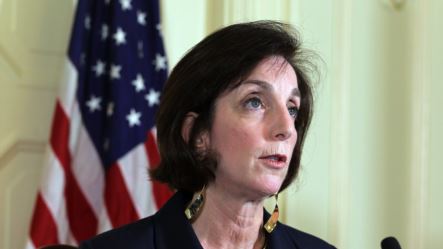
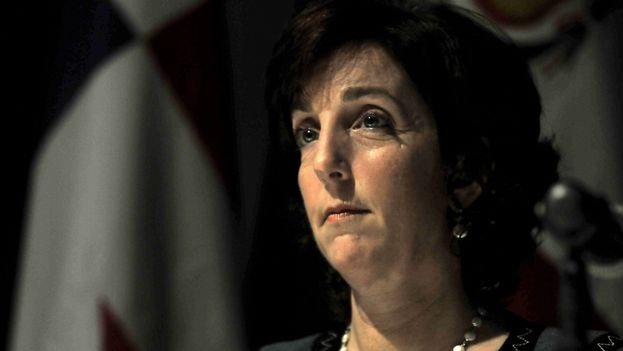
Roberta Jacobson, Assistant Secretary, Western Hemisphere Affairs, US Department of State
14ymedio, Victor Ariel Gonzalez, Havana, 21 January 2015 – The opinions broadcast on Cuban Television spaces such as the National News or the Telesur channel show points in common, although there are also contradictions, with regards to the Havana visit of the Assistant Secretary for Western Hemisphere Affairs from the US Department of State, Roberta Jackson. There are “great expectations,” says the journalist Cristina Escobar; while the analyst Esteban Morales says, “We don’t have many illusions.”
However, everyone recognizes that the negotiations on Thursday will mark a “historic” event, because they will address the reestablishment of diplomatic relations between the two countries. In short, the Interest Sections in Washington and Havana will be transformed into embassies.
On Tuesday’s National News it was reported that at the high-level meeting Havana “will discuss the banking situation of the Cuban Interest Section in the American capital, which has gone a year without offering normal services because no bank wants to offer them services due to the regulations of the blockade.” continue reading
It was also announced that, “There will be no lack (…) of issues like the fight against narcotrafficking, human trafficking, oil spills, search and rescue, counterterrorism, and confronting epidemics.” According to the official commentary, this information was provided by “a source from the Ministry of Foreign Affairs” on the Island.
Cuba is also anxious to be removed from the United States’ list of states that support international terrorism. That decision depends on President Obama.
Within the current political détente, the official media highlighted the current embargo. “Is the blockade over? Absolutely not,” concluded journalist Cristina Escobar in an analysis before Jacobson’s arrival. The journalist added that “the blockad will end the day that financial transactions between the United States and Cuba are not regulated by Congress,” which will be “a long and complex road.” Coincidentally, a few hours later, during his most important speech of the year, the US president asked Congress to end the Cuban embargo.
As was expected, one of the most fortified trenches on the Cuban side has been nationalist ideology. The regime will talk about human rights, democracy and individual freedoms – “the most difficult issues,” according to Esteban Morales on Telesur – with emphasis on “no interference” from outside and “sovereignty.” Morales argued that the US should not “demand that we follow a direction ordered [by them], in terms of organizing our democratic system and our individual liberties,” and there should also be a willingness to “throw on the table the problems of democracy, human rights and individual freedoms that exist in the US.”
The Cuban analyst does not think our northern neighbor “has renounced a political strategy to regain control of Cuba,” but now our country would have “the possibility of developing a much more positive activity” thanks to the existence of the embassies. Thus, “there will be a much more organized dynamic.”
Another concern of the ruling party is that the final lifting of the embargo might be postponed beyond the Obama administration, because the question would “depend a lot on whether we have a future administration that will stick to this idea.”
While the emphasis of the high-level meeting is diplomatic rapprochement, one agenda item that will be discussed on Thursday that does not go unnoticed is that this Wednesday will be the 28th meeting between the two governments on migration issues. Havana will take the opportunity to discuss the Cuban Adjustment Act, the “wet foot dry foot” policy, and “an interpretation of the document that could change.”
The Cuban side is most likely to oppose a resolution that benefits all those on the Island who emigrate to the United States, a legal phenomenon that creates certain contradictions in this country with regards to migration reform. Paradoxically, those Cubans who are capable of establishing themselves in the United States – thanks largely to the Cuban Adjustment Act – constitute one of the principle sources of income to the regime’s economy.
Turning to the meetings on diplomatic relations, the previous scenario had to be reconfigured in record time. In little over a month, the United States announced the rapprochement with our country, started to implement the legal measures relating to it, and its president asked a Congress dominated by the opposition party to end the half-century embargo. The speed of events is excessive for those who do not usually deal with politics in a timely fashion: the Cuban leaders.
Beyond the expectations and mistrust generated among the Island’s authorities by Roberta Jacobson’s visit, there is a notable sense of consternation. Basically, what the regime is hoping for is that things will proceed slowly, so that they will not have to deal with the consequences of an excessive enthusiasm.
Warning: The regime in Havana has prepared a new legal trap for Ángel.
As is already public knowledge, Ángel Santiesteban has been held in a military border patrol base in Jaimanitas since August 13. He was placed there after several days of detention in the Acosta Police Station, following his surrender after having taken 5 of the 15 pass days that he had accumulated since his incarceration in the Lawton prison.
The night before taking his days, on 20 July, Ángel used his blog to denounce the great rumors circulating about his imminent transfer to the border patrol base for purposes of isolating him. This was after his son had declared, on Miami’s TV Marti on July 15, that as a child he had been manipulated by his mother and State Security to force him to lie and hurt his father. continue reading
After turning himself in and having been held for days in police station cells with no nourishment, he was taken to a location such as he denounced in that post. He is kept there in isolation, where his rights to visits and calls are ignored. He has no physical space so vitally needed so that he can keep himself healthy. To demand his right, Ángel declared a hunger strike for a period of days. We learned of this because Lilianne Ruíz, of 14yMedio newspaper, was able to interview him from outside the detention facility.
We barely have news of him, because he wants to say very little by telephone, and his jailers do not allow him to send letters or post on his blog. Every time he manages to get one out, it becomes a major feat and it takes very long to reach us. This is such that just this past weekend, I received a letter from October and another from the 15th of November.
Of course, he tells me nothing in them about the incidents and motives that caused him to go on the hunger strike in recent days. But he does tell me that although the request for an appeal (made on the 4th of July of 2013) of his case was accepted, nothing has been done to move it forward. This is more grave than it appears.
As all of you have read in the press these days, the Cuban government–in a clear move to “look good” for its negotiations with the US before the imminent collapse of the aid that it receives from president Nicolás Maduro of Venezuela–has let go about 20 political prisoners. That is, the government has not freed them–they have let them go into house arrest to await their pending trials. The most well-known case is that of Sonia Garro, who with her husband and another peaceful activist, had been held for 31 months without trial.
Ángel’s case is equally notorious because not only did his son declare what truly happened–thus dismantling the judicial farce that was invented to lock up and silence Ángel–but in addition, he already served a third of his sentence (in April he will have served half)–and he should have been released pending his new trial. At the least, they should give him a conditional release in April. However this is something they will not do–given the recent releases from which they excluded Ángel, they made abundantly clear their eagerness to keep him locked up as punishment for his oppositional stance.
Having consulted with legal experts, we have learned that it is possible that the regime is preparing a new legal trap for Ángel. Conditional release is given to persons who have already served part of their sentence, but who do not have anything pending in relation to their trial.
In Ángel’s case, having requested an appeal, they could remove his right to a conditional release, claiming that it is necessary to wait until the opinion is rendered regarding the appeal.
In addition, we have learned through various sources that in the artistic and intellectual sphere in Cuba it is widely remarked that high-level functionaries of the regime who are politically and culturally connected have privately said that Ángel “will be made to serve his full sentence to that he will be well-punished.”
Bearing in mind what Ángel himself told 14Ymedio (that the prison guards, responding to his demands, had told him to hold his horses because he had already done a lot of damage to the Revolution and that if he had accepted the offer of exile made at that time he would not find himself in prison now)–and also the political prisoner releases of this week (that sought to improve the government’s terrible image due to its repression and detentions of dissidents on December 10, International Human Rights Day)–this report, plus the analysis by the legal expert, takes on a maximum significance.
Ángel’s helplessness is absolute, now that his son also is in danger for having defied the government by telling the truth–and also because Ángel is unable to post his updates on what is happening with his.
The post below is what Ángel sent me in his last letter. When he wrote it, he had no idea that Sonia Garro would be released. He still doesn’t know it. If he did, he would be overjoyed that she is able is to celebrate the holidays with her daughter, and he would have said so.
The children of Ángel will have another Christmas without their father. Ángel will have another Christmas alone and isolated.
The Castro clan will have another Christmas illegitimately usurping power and enjoying the privileges it robbed from the people.
The dictator brothers will have another Christmas violating with impunity the rights of all Cubans.
The Editor
If it were up to them, they would shoot me.
by Angel Santiesteban
In this border patrol military base where they now have me shut away and isolated, I am behind bars that reach to the roof of the patio, and I am guarded 24hrs/day, but not even that or anything else will be enough to make me back down from my goal to live in a free country, something that I do not know, even at my 48 years of age.
Regardless, it appears that they are learning that there is no way to make me change my opinion. I believe in God, and the time in prison has not been for naught, it has a purpose and God willing I am close to knowing what that is, not just for me but for my country and my family.
This is a struggle that has no room for half-measures but, unfortunately, many Cubans prefer to forget about those of us who are imprisoned, so as to not incur problems for themselves with the government.
Contrary to what many believe, the fighting spirit grows in jail because there will never be a better place to know the injustices a dictatorship commits within them such as the threats, the abuses and tramplings such as they wreaked upon me in La Lima prison and later in Prison #1580, where they would tie my feet and hands to make me ingest something foul which, I suppose, or they supposed, was nourishment.
At that point my strength increased and kept me going. With the smell of battle, blood flows with more force like a wild and untamable horse that rides through the veins.
Then they are the ones who fear, they turn away from our gaze, they avoid confronting us because the truth spoken in our face is more effective than their blows. They are the cowards because they believe that this is the most effective method to dampen our demands–without further justification, according to their logic, because they imagine that were they in our position, they would give up.
And this is their great deceit, the question they cannot answer, when they see our strength grow. When one has right on their side, a great part of the battle is already won.
Now, with more justification and strength for the battle because I have known more closely the injustice of the tyranny and the constant love and support that provide the confidence needed to remain in combat, I know why they don’t want Sonia Garro or me to be free, because we were too ’impudent’–perhaps that is the right word, to not use a vulgar term.
We faced down the political police–I on that 8th of November of 2014, when they beat me and it was seen on that video that fortunately went viral around the world and later the open letter that I addressed to Raúl Castro demanding the release of Antonio Rodiles. Sonia and I are intolerable for the government–especially so with she being of the Ladies in White and I an intellectual, we do not fit the mold that is extremely acceptable to them. They know that we do not fear them.
I don’t know how the government officials are not ashamed (but this would be asking the impossible) to still repeat the list of grave accusations that they laid on me, and then later they kept the two least serious ones, while the ’flaming witness’ for the prosecution and the accuser assured them that all were false.
Raul Castro ties the blindfold on a man about to be executed during the Revolution
I continue to wait in vain for the appeal that my attorney requested. If it were up to them, they would shoot me, but because they can’t, because times are different, then they have no other recourse but to keep me imprisoned.
On the other hand, they are gaining time, they are buying it so that Raúl Castro can serve out his term and somebody new can come in–some other Castro, surely, because the Castros will not relinquish power. I believe that they will not want to risk their position even with a puppet government that they control from behind the scenes.
While they ’take their time,’ here remain shut away those of us like Sonia and me, who have no fear, and who they have not succeeded in bringing to our knees.
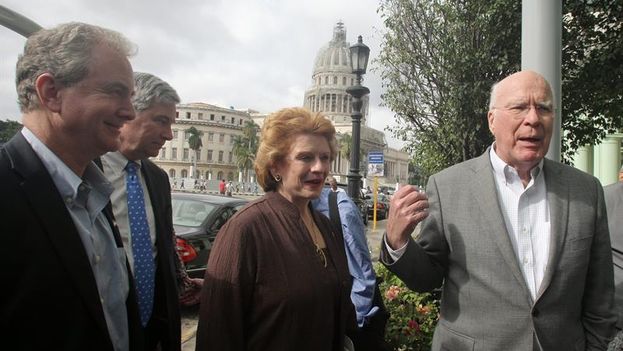
Patrick Leahy, Debbie Stabenow, Chris Van Hollen and Sheldon Whitehouse entering their hotel in Havana. (EFE / Ernesto Mastrascusa)
14ymedio, Havana, 19 January 2015 — On Sunday afternoon a dozen activists and representatives of Cuban civil society met with the American congressional delegation visiting Cuba. Chaired by Senator Patrick Leahy, the group was able hear diverse opinions in response to the announcement of the reestablishment of relations between the two countries.
A member of the delegation confirmed that the Cuban authorities were aware of the meeting with the activists and had made known to the American side their displeasure with the meeting.
In a relaxed atmosphere, several of those present expressed the conviction that “this opens a new era” and demanded greater transparency in negotiations, according to what they themselves reported after the meeting. Elizardo Sanchez, president of the Cuban Commission for Human Rights and National Reconciliation, gave lawmakers a list with the names of 24 prisoners who, on humanitarian grounds, should be included in an upcoming release process. continue reading
The leader of the movement Somos + (There are more of us), Eliecer Avila, said on leaving that he told the visitors that “Throughout this time there has been talk about the agenda of the US government or the agenda of the Cuban government, but the most important thing to consider is the agenda of the Cuban people.” According to the activist, “Before December 17 people said ‘no one can fix this,’ now the expression most heard in the street is ‘let’s see what happens’ and the great challenge for the civic forces is to get people asking, ‘What can we do to change things?’”
Manuel Cuesta Morua said that he had shared with Leahy and the rest of the group that, “This is a historical event and it is very difficult to have a perspective on something so close.” Nevertheless, he reaffirmed that “A new era is opening for Cuba.”
Several participants in the meeting noted the expectations that the December 17 announcement had awakened in the Cuban people. José Daniel Ferrer, leader of the Patriotic Union of Cuba, expressed the appreciation of the activists of his movement who had been released from prison as a result of the negotiations between the two governments.
Berta Soler, for her part, reaffirmed the position of the Ladies in White against the negotiations and questioned whether the Cuban people would benefit directly from relations between the two countries. The activist cited the continuation of the repression and police harassment against the women who belong to this human rights movement. Her position was echoed by Antonio Rodiles, director of the opposition group Estado de Sats (State of Sats).
Yoani Sánchez, director of 14ymedio, emphasized that “The Cuban government is not willing to negotiate with its own people and yet has chosen to negotiate with the American government.” Hence, “Given the absence of the people’s voice at the negotiating table, it’s important to pressure the authorities to allow freedom of expression and of the press, as this will be the way we disseminate our demands and programs.”
Others present at the meeting confirmed the positive nature of the new scenario and the need for the Cuban civic movement to exploit the advantages it offers, and to be the people who to determine their own future.