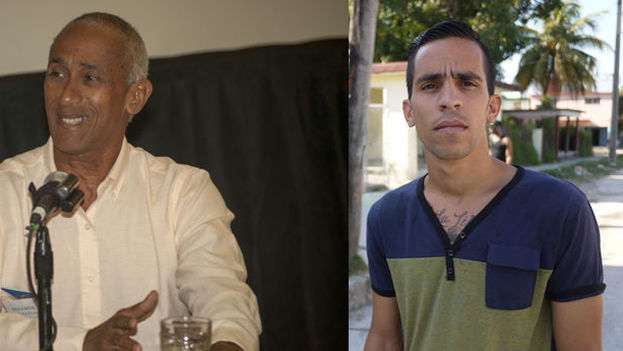
Laritza Diversent (3rd from R) and Manual Cuesta Morua (2nd from R) in meeting with Barack Obama
EFE, 10 April 2015 – The president of the United States, Barack Obama, met today in Panama with members of the Cuban opposition and civil society leaders from other countries before his anticipated meeting this Saturday with with Cuban president Raul Castro.
After giving a speech at the Forum of Civil Society, Obama attended a round table, closed to the press, with activist and civic leaders from several countries, among them the Cuban opposition members Manuel Cuesta Morúa and Laritza Diversent, according to information provided by the White House.
Also participating in the meeting were the presidents of Costa Rica, Luis Guillermo Solís, and Uruguay, Tabaré Vázquez.
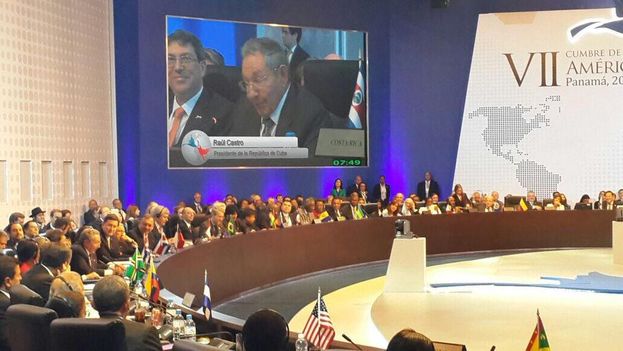
Raul Castro during his speech at the Summit of the Americas
EFE / 14ymedio, 11 April 2015 — The first speech from the president of Cuba, Raul Castro, at the Summit of the Americas, received a standing ovation in the room where the meeting is being held and grabbed the attention of hundreds of journalists in the press room installed in the Atlapa Convention Center.
“It was time for me to speak here” on behalf of Cuba, said the Cuban leader, who on Friday joined the US President Barack Obama, in a historic moment when they shook hands at the opening of the Seventh Summit of the Americas.
The announcement of Castro’s speech of the host country’s president, Juan Carlos Varela, immediately after the words of the president of the United States, provoked a loud and long applause from the heads of state and official delegations. continue reading
In the newsroom, reporters crowded in front of the giant screen to follow closely the discourse of the Cuban leader, who provoked laughter throughout his audience when he confessed that he would make “a great effort” to limit his historic speech to the eight minutes established by protocol.
“And as the six summits that excluded [Cuba] should count, six times eight is 48,” the president of Cuba joked.
During his oration, Raul Castro exempted the United States president, Barack Obama, from responsibility for the policy developed against the Caribbean island by the “ten presidents” preceding him.
The Cuban president called Obama “honest” and expressly apologized for getting emotional “in defense of the Revolution.”
However, the speech was peppered with historic allusions and complaints about the actions of the United States toward the island. He also referred to the Internet because “it works for the best […] and it works for the worst.” The issue of new technologies has played a major leading role in several of the speeches at this Summit of the Americas.
Raul Castro also expressed today his “resolute and real support for the sister republic of Venezuela and the legitimate government of Nicolas Maduro.”
“Venezuela is not and cannot be a threat to the national security of a superpower like the United States, and it is positive that the US president Barack Obama has recognized that,” added Castro during his speech to the Seventh Summit of the Americas that is unfolding in Panama.
Statement from Rosa María Payá at the Summit of the Americas
Panama, 10 April 2015
Good day.
I would like to thank everyone for their willingness to dialog. We came willing to dialog. We wanted to listen to our Cuban brothers and sisters, who we know are in the same condition as ourselves.
I want to ask forgiveness from everyone in the name of the Cuban people for what just happened in the conference hall. Despite what you saw, we Cubans are a generous and caring people. Even those people who were there were also deprived of their rights. They also cannot decide. And probably did not decide to be there. These are the aberrations that occur when you live in a dictatorship.
My father, who was killed in an attack from the Cuban government just over two years ago, said that rights have no political color. Nor do dictatorships have a political color. And we are here today wanting to promote solutions to a problem that is no longer only Cuban, nor only Venezuelan. It is a regional problem, like that we just had here. Because we have all been affected by an intolerance that we do not share. continue reading
There are two points I would like to put forward.
The first is affecting us in several countries in the region: it is the issue of impunity. We see young people disappearing in Mexico. We see prosecutors who die the day before they present their evidence. We see children murdered on the streets of Caracas. My best friend and my father were murdered in an attack two and a half years ago, and we don’t even have an autopsy report. We know it is also an issue in Nicaragua and in Guatemala. I would like to settle our point in favor of stopping the impunity and calling attention to the political leadership of Latin America to stop this impunity and take impartial measures.
My second point perhaps could be understood as very particular, because it has to do with Cuba. But from Cuba there has been a marked interference (as there has been from other countries, such as the United States, but I am Cuban) and we have to stop the interference that in some places in Latin America, particularly in Venezuela, the Cuba government is engaging in right now.
My point is in favor of the right of Cubans to decide. Cubans have not decided in free and plural elections for more than 60 years. We are asking for support for the right of Cubans to decide in a plebiscite.
In two days time, a general will arrive here to converse with the presidents of Latin America: a person who has never been chosen by the people. We also want to hear him, but we want the people to be listened to. So we ask for your support for a plebiscite in Cuba and that Cubans be asked if they want free and plural elections, if they want the recognition of political parties, if they want access to the media. If they want this process in impartial conditions.
To support the right to decide of Cubans is also to support the right to decide, the right to development and democracy for the entire region.
A group of members of the official Cuban delegation will hold a protest at the entrance of the Civil Society Forum. (EFE / Alejandro Bolívar)
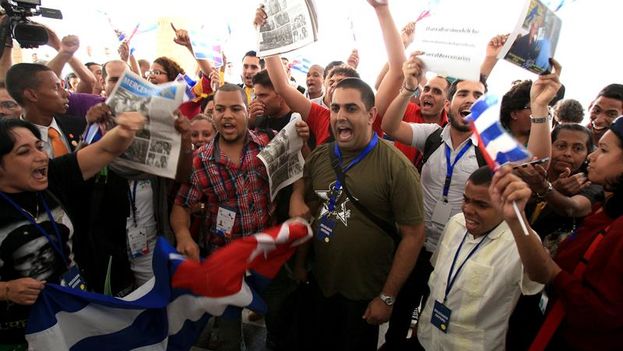
14ymedio, Miriam Celaya, Panama, 9 April 2015 – Just as expected, April 8th was D-day for Castro’s troops in Panama, with the Forum of Civil Society in the framework of the Summit of the Americas. The physical and verbal aggression and the “revolutionary violence” unleashed in all its public display of barbarism before the astonished eyes of those who were involuntary witnesses of the shameful act, demonstrate how long the arm of the dictatorship of the Island is, and how disrespectful they are willing to be at international democratic venues.
It would have been naive to expect any other conduct, after preludes that foretold the climax. The Castro clan was initially flattered in its infinite vanity, after half a century of being expelled from the OAS, to have been one of the first invitees to the Americas’ Summit, only to have to swallow the bitter pill, soon after, of tolerating the independent civil society’s presence at the regional event. These are appropriate games of democracy, but a humiliation that the Antillean olive green caste was not willing to accept.
Now we were able to prove that it was not by happenstance that several activists of the Cuban independent civil society were harassed on our arrival at the Tocumen airport, some detained a relatively long time and interrogated, as if we were terrorists or criminals, by authorities that report directly to the Panamanian government. “We do not want disturbances or provocations at the Summit,” was the warning we received before allowing us to continue, and following that, a polite phrase that was almost cynical: “Welcome to Panama.” No doubt this is a peculiar sense of the hospitality and the official image this country is offering these occasional visitors. continue reading
It was no coincidence that several activists of the Cuban independent civil society were harassed upon our arrival at Tocumen airport
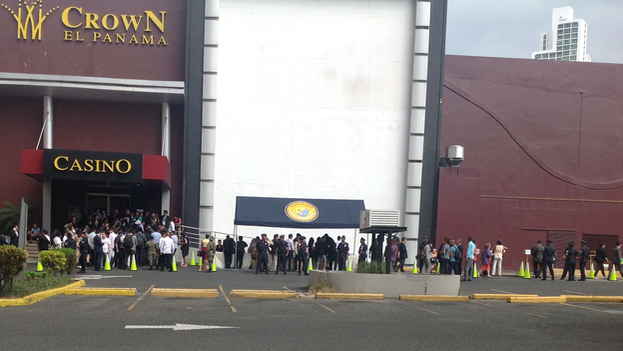
Later, there was an official apology issued by the Panamanian Foreign Ministry, but it was also learned that the Cuban regime’s troops of the “civil society” were not ill-treated or warned on their arrival. Perhaps that was why they immediately began to distribute, through the hotels hosting delegates from dozens of countries, printed leaflets containing the photographs and full names of various members of the Cuban dissidence, under the heading of “mercenaries.” A great number of the tabloids were placed on tables in the lobby of the hotel El Panama, where credentials were being processed, while other activists handed them out in the streets around the headquarters, where activities of the Summit would take place.
Thus, encouraged by the permission – the complicity, I should say – of the hosts and organizers of the Summit, the revolutionary low-lives who were further protected by the dozens of accreditations that were granted to them, felt free to create violent disturbances right in the meeting room, rudely attacking the scarce representatives of several independent organizations on the Island that had barely achieved accreditation from the Civil Society Forum on behalf of dozens of contenders who were denied the opportunity to participate.
Some public places were also the scenes of Castro mobs, sabotaging the democratic and civilized spirit that should have been expected from this hemispheric event.
It was a poor choice on the part of these guests to the democratic festivity, Messrs. hosts, and if such is the model of civility that we want to imitate in the region, a very bad effect. But worse are the results for the regime in Havana, whose objective was always to boycott the Summit and blow up the spaces for dialogue, but in attempting to demonstrate the supposed low aspect of its opposition, it ended up demonstrating its own, additionally granting its opponents the chance to show their moral superiority. Now the democrats in the region may be wondering about the stateless group who have sustained decades of peaceful struggle against the enormous machine of violence that has been brought to bear against them from the seat of power.
Worse yet are the results for the Havana regime, whose original purpose was always to boycott the Summit and blow up the spaces for dialogue
A great number of the delegates offered their solidarity to the Cuban civil society and commented to us about their bewilderment. “If this is the way it is in the midst of this forum and at a democratic venue, what must they be able to get away in Cuba,” commented a group of young people from several Latin American nations.
A somber sixty-something man shook his head disapprovingly: “This is not right … It is not proper … We cannot allow it,” he said, referring to the performance of Castro followers and supporters.
Our spontaneous embraces in the hotel lobby, to demonstrate support for each other among members of the independent civil society made a better impression than all the shouting and screaming of slogans of the crazed members of the regime. The aggression had only succeeded in uniting us beyond any differences.
It was also made clear that a dictatorship that has sustained itself on confrontation and belligerence, inside and outside its own geographical territory, would not be able to overcome the challenge posed by the open debate and arguments of its opponents. Weeks ago the General-President had already announced that “the true Cuban civil society would come to the Summit to defeat the stateless mercenaries at the service of the Empire,” thus demonstrating their absolute lack of political willingness to respect the diversity of ideas and alternative projects of the very Cubans on the Island.
Well then, General, your serfs – those same strident individuals who carry out your acts of repudiation, whose passports were confiscated as soon as they crossed the border into Panama in order to avoid inopportune desertions – withdrew from the Summit as soon as they fulfilled their wretched role. It did not matter that the Cuban State spent its people’s ever-scarce resources to finance documents, travel, accommodations, food, and a huge amount of printed pamphlets. Nothing will prevent the end of its empire of corruption and fear.
I can imagine how its “victorious” delegation will be welcomed when it returns to the ridiculed homeland. I can almost imagine the team leader, submissively bowing his prop epaulettes: “Mission accomplished, General.” And just the thought of such a degrading image overwhelms me with two conflicting feelings: compassion and contempt.
The site of the closing of the Summit’s Civil Society Forum (14ymedio)
14ymedio, Havana, 10 April 2015 — In a “statement” published on the government website Cubadebate, the Cuban government’s “civil society delegation” announced today that it will not participate in the Friday afternoon meeting between the Civil Society Forum and the heads of state participating in the Summit of the Americas in Panama.
“We have taken this decision after collectively reflecting on the scenario that has been designed in the Civil Society Forum to force us to share with mercenaries paid from abroad for the purpose of subverting the political and social system of the country,” they explained in their statement.
US President Barack Obama will participate in this meeting, along with the presidents of Uruguay, Tabaré Vázquez, and Costa Rica, Luis Guillermo Solis. In addition, Obama is expected to talk with various leaders of civil society, although the White House has not detailed with whom. continue reading
The Cuban delegation adds that it has decided to retire after “mercenaries [received] the official invitation to enter the plenary this afternoon. Out of respect for the host President and other leaders, including President Obama, the delegation of the Authentic Cuban civil society has chosen not to participate in the referenced meeting.”
STATEMENT OF THE CUBAN GOVERNMENT’S DELEGATION TO THE FORUM OF CIVIL SOCIETY AND SOCIAL ACTORS OF THE VII SUMMIT OF THE AMERICAS
Our delegation has decided not to participate in the dialogue of civil society and social actors with governments scheduled for this afternoon.
We have taken this decision after collectively reflecting on the scenario that has been designed in the Civil Society Forum to force us to share with mercenaries paid from abroad for the purpose of subverting the political and social system of the country.
Particularly offensive has been the presence of individuals linked to terrorist as vile as Luis Posada Carriles and Felix Rodriguez Mendigutía. Since our arrival in Panama, we have repeatedly denounced, with documented evidence, the true identity of these alleged representatives of the Cuban people. We reject the press manipulation of our consistent performance and its intentional omission of the evidence we have presented.
The mercenaries have received the official invitation to enter the plenary this afternoon. Out of respect for the host President and other leaders, including President Obama, the delegation of authentic Cuban civil society has chosen not to participate in the referenced meeting.
We also want to express our rejection of any document that may arise without having been the result of the discussions that took place yesterday at the Citizen Participation and Democratic Governance Tables in the Crystal and Bella Vista Rooms.
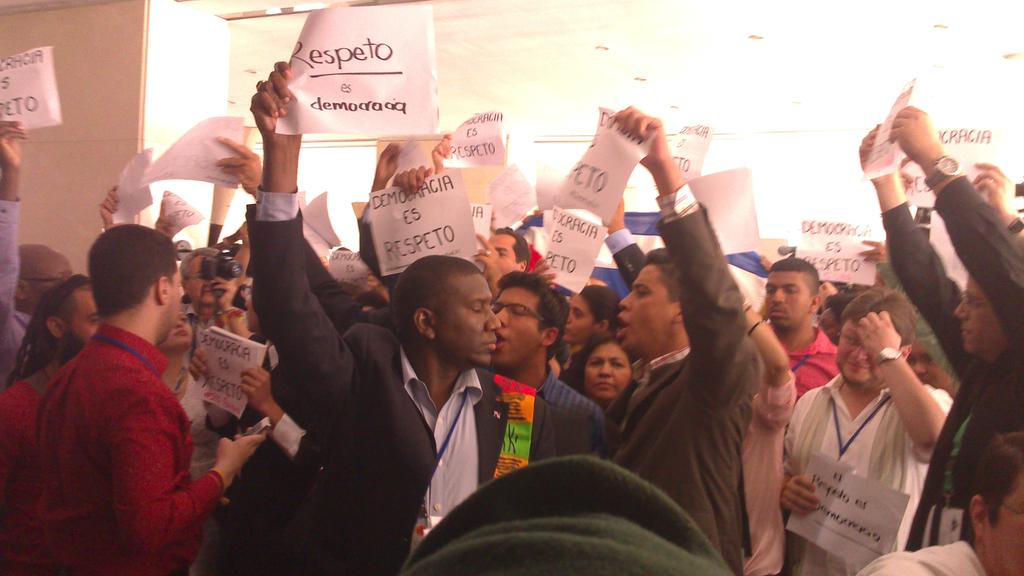
14ymedio, Panama, 10 April 2015 — On Friday morning, several Cuban activists found themselves trapped, unable to leave the Panama Hotel, due to the presence of a large number of supporters of the Havana Government, who with shouts, shoves and slogans prevented them from leaving the site and attending their meeting.
The events occurred during the morning, when the conclusions of the Civil Society Forum should have been being drafted, but whose implementation has been put at risk by the continuous interruptions.
Several Cuban activists took refuge in the hotel’s Salon Topacio, in the face of the threats and attacks by protesters.
Among the insults shouted by the protesters were “Get out, down with the worms,” “CELAC* yes, OAS no,” “Murderers” and “Mercenaries.”
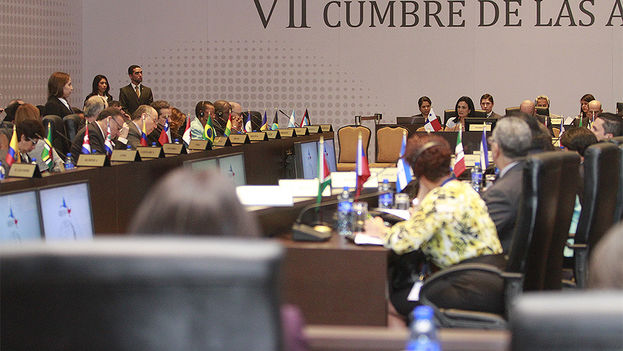
Meeting of Foreign Ministers of the Americas during the Summit. (Summit of the Americas)
14ymedio, Regina Coyula, Havana, 10 April 2105 – A clever strategy on the part of the Cuban government, with regards to the participation of the official civil society at the meeting associated with the Summit of the Americas, has been to present a delegation full of projects and good results from which they can look down on the newcomers from alternative civil society.
Cuban Television’s coverage – where the word ‘coverage’ is more akin to ‘cover up’ – identifies the official delegation, however, with objectives anchored in the era of the Cold War. They arrived in Panama with a fierce spirit and clear directions to not recognize independent civil society and to silence as much as possible its participation in the forum.
I don’t know if, after so much reading of the newspaper Granma, my granmar is so sharp that where others read patriotic indignation, I see lack of arguments; where they see maneuvers against Cuba, I interpret an intention to boycott the event. continue reading
Once more I had to hear how shamelessly the representatives of the most rancid ruling party dominate the nation, and believe they have the right to deprive it of those who don’t think like them, but rather have free will; and they also deprive me as I don’t feel represented by any of their institutions.
A special mention of the incident at the statue of José Martí. We Cubans should definitely make our devotion to Martí a private matter and not a political wildcard, a moratorium should be established on the public use of Martí so as to be able to put him in his proper place. But aside from the buffeting this giant of a Cuban has been subjected to, I feel ashamed for others. A friend country hosts an event with global resonance and “our true civil society” choses every way possible to express their outrage through violence and rabble-rousing.
Statements by some of the delegates of this civil society make it clear that they prefer dialogue with the “enemy of the North that despises us,” over that with their next door neighbors in Cuba
Statements by some of the delegates of this civil society make it clear that they prefer dialog with “the enemy from the North that despises us,” over that with their next door neighbors in Cuba, with whom they may have profound differences with whom they share a territory and an identity card.
I do not know how international public opinion will treat these painful events, but within our dis-informed country the result has been a success. To my neighbor Tomás, Cubans not included in the official delegation are nothing more than terrorists and mercenaries. Both repeat a lie until it becomes a truth for the purposes of propaganda, and great has been the use of both adjectives in the last three days. Nor do I believe that this escalation of insults will be the prelude to a kind of cultural revolution of the young Talibans, as a friend fearfully expressed to me. The Government doesn’t need experiments with more surprises than certainties.
On writing these notes I don’t have the least idea how things are going indoors, but the image of the official Cuban delegation – and this is an impression formed exclusively by watching television – is one that even the most moderate international observers could confirm, with this presence in Panama of Cubans of a different nature, the lack of democracy in our country.
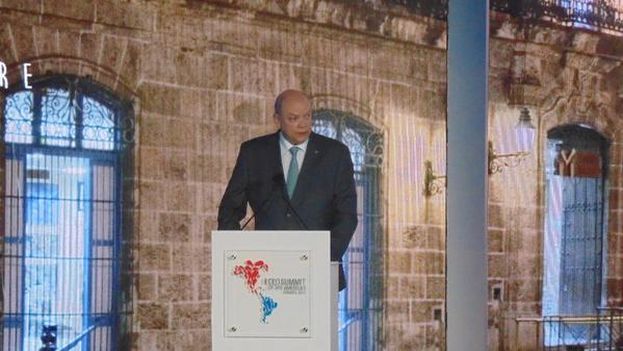
Rodrigo Malmierca, Cuba’s Minister of Foreign Trade, speaks at a Business Forum at the Americas Summit. (Twitter)
Reinado Escobar, Panama, 10 April, 2015 — Intransigence against tolerance, ideological deafness against a willingness to talk, radicalism against moderation, slogans against arguments, and many other pairs of conflicting definition could serve to headline a commentary on what is happening in Panama during the Seventh Summit of the Americas.
The pro-government Civil Society delegations from Cuba and Venezuela have systematically dedicated themselves to boycotting the parallel forums, because for them it is more important to discredit their political adversaries who favor a consensus that could conclude in a message from the civil society of the American people to their respective government. They have opted to beat, insult and denigrate their own compatriots, rather than sit down to civilized debate with them. continue reading
In a business atmosphere, however, Cuban officials have not been shy about conversing animatedly with representatives of the continent’s exploiting class. Radicalism only fits in the message being sent to the spectators, where photos of Che Guevera, little Cuban flags and wanton gestures are flying. At the other tables, among cocktails and smiles, the area’s capitalists are invited to come and invest in the Island.
Anyone might think that it is inconvenient to show both faces on the same stage, but no, the logic is different. The Government is telling prospective investors, “This is how we treat strikers, those who protest against you.”
The lesson for civil society in the countries that retain some residue of democracy is clear. The day when, in their nations, the politics supported by the Cuban government triumph, they will have to learn to conduct themselves like transmission belts, as Lenin defined the role of labor unions in socialism, otherwise they will have to get used to being treated like mercenaries, cockroaches, worms and whatever other vermin those who bet on totalitarianism choose to call them.
Rodrigo Malmierca, Cuba’s Minister of Foreign Trade, speaks at a Business Forum at the Americas Summit. (Twitter)
14ymedio, Panama, 10 April 2015 – This Thursday Cuba offered itself as a safe destination for foreign investment and invited the business leaders of America, meeting in Panama, to visit the island “to make progress toward establishing mutually beneficial businesses.”
Rodrigo Malmierca, Cuban Minister of Foreign Trade and Investment also said, in statements to reporters, that “the policy of the [US] blockade goes against not only Cuba and the Cuban people, but also the will of businesspeople in the United States.”
In a speech to businesspeople participating in the CEO Summit of the Americas, Malmierca spoke of “great expectations” produced by last December’s announcement, the beginning of a process of normalization of relations between Washington and Havana. continue reading
“The measures adopted [by the US] on Cuba in January, which modify certain aspects of the embargo, although limited, are a step in the right direction. But it must not be forgotten that (…) the blockade remains in force,” he said.
He stressed that “in recent months” Cuba has “received important delegations of [US] businesspeople and politicians, who have confirmed their interest in developing businesses with Cuban entities.”
“We are witnessing a new phase of the inclusion of Cuba on the international economic stage”
In Cuba “We do not limit nor discriminate against US companies, so that opportunities” for business and investment offered by the Island in sectors such as food, renewable energy, oil exploration, pharmaceuticals and biotechnology “are also open (to the USA),” he added.
“Today we can say that we are witnessing a new phase of the inclusion of Cuba on the international economic stage, which introduces opportunities for trade and investment,” Malmierca told the business leaders
The Cuban minister said that in this “new phase” the government of Raul Castro extended its “vision of the role of foreign investment, recognizing it as an active and essential element for the growth of certain sectors and economic activities.”
The Cuban government estimates that it needs about “2,500 billion annually in foreign investment to stimulate a growth that will lead to developing prosperity and sustainability” of the “socialist” project, he said.
Malmierca pointed out that Cuba, in addition to the “guarantees and incentives” established in a new law, “makes available” to foreign capital attractions such as scientific potential, the availability of a skilled workforce with expertise in high technology, and a privileged geographic location, among other assets.
The government needs “about 2.5 billion annually in investment to stimulate growth to sustain the socialist project”
“The Cuban market, although it is not a large economy, has an important weight in the Caribbean (…), which together with other aspects (…) translates into new opportunities to expand trade with Cuba and its role in intraregional trade,” he said.
He added that Cuba has outlined a program of long-term development that leads the country’s efforts for the building of a socialist society to bring further benefits to all Cubans.
“We are convinced that the countries of the region will accompany Cuba in these efforts,” he said.
The Second CEO Summit of the Americas is one of four official forums previous to the Seventh Summit of the Americas at which, on Friday and Saturday, the 35 countries of the continent will meet for the first time.
One of the most anticipated moments of the continental meeting is the greeting between the American president Barack Obama and the Cuban president Raul Castro.
The business event has generated a document with recommendations that will be presented to heads of state and government attendees of the hemispheric summit.
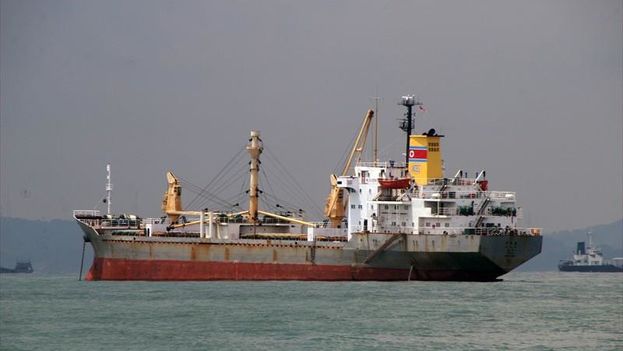
The North Korean ship Mu Du Bong. (John Wrightson / Marinetraffic)
14ymedio, Havana, 9 April 2015 — The North Korean ship Mu Du Bong and its crew are being detained in the port of Tuxpan, Mexico, as confirmed Wednesday by the Mexican Mission to the United Nations. The whip coming from Cuba ran aground on a reef, causing serious environmental damage to a protected natural area. According to the UN, the company owning the vessel is included on a list of sanctioned companies.
North Korea has accused Mexico of illegally retaining the vessel with 50 people on board and announced that it will take the necessary steps to release the vessel.
The ship was traveling with a crew of 33 North Korean nationals, according to data provided by the Mexican government. The workers are in good physical, moral and psychological condition, according to the Mexican embassy, with complete freedom of movement and will be repatriated in cooperation with the Embassy of North Korea. The vessel, however, will remain in Mexico while the investigation continues.
The video shows Cubans affiliated with the Castro regime screaming “GET OUT!” and “Down with the worms!” and “Murderer!” and singing Cuba’s National Anthem at Cubans not affiliated with the Castro regime, in the Hotel Panama during the Americas Summit
Published on 10 April 2015 on Yoani Sanchez’s Twitter account
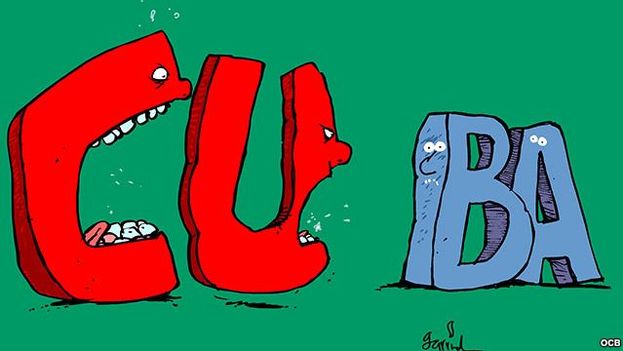
The official delegation assaults opponents in Panama. (Garrincha)
(EFE) Panama, 9 April 2015 — The president of Panama, Juan Carlos Varela, Thursday called for “respect” among opposition groups and Cuban officials who staged violent incidents yesterday that ended with the temporary detention of about twenty people.
“We are a country that welcomes everyone and we ask everyone to show respect. Last night those detained were released with a warning that, if the incidents are repeated, sanctions will be applied,” Varela told journalists before the inauguration of the Rectors of America Forum, parallel to the Seventh Summit of the Americas.
The president said that what happened outside the Cuban embassy in Panama, “Was very unfortunate and unacceptable,” and pointed out that also striking were “The sectors of Cuban [government] staff and their lack of tolerance and their provocation,” which ended with a confrontation of punches and kicks. continue reading
Although no individuals were identified, the violent encounter occurred between staff and people linked to the Cuban government, and exiled Cubans invited to the Civil Society Forum, which opened yesterday delayed by the incidents, another of which also took place at the meeting site in a hotel far from the Embassy.
Varela acknowledged that among Cubans, “There are deep wounds”
Varela acknowledged that among Cubans, “There are deep wounds” and stressed that the Panama forums are “an opportunity for approach” but that the incidents resulted in “security being strengthened in all forums,” as a result of which he directed, “a warning to everyone because the country will offer guarantees to all the leaders attending the summit.”
The Secretary of Communication for Panama, Manuel Dominguez, specified that “If a new incident occurs, the police will use force” to stop it and reiterated that they would only allow demonstrations within the framework of the law, which has provisions for expulsion or deportation from the country for the use of violence.
The Seventh Summit of the Americas will meet on Friday and Saturday, April 10-11, with all the countries of the Americas for the first time since 1956 — with the incorporation of Cuba — to discuss “Prosperity with Equity: The Challenge of Cooperation in the Americas.”
This April 8th groups associated with the Cuban regime tried to sabotage the programmed activities of the Seventh Summit of the Americas. They asserted that they could not share the space with other Cubans who, according to them, were terrorists and mercenaries. These old worn out arguments hide all the intolerance and contempt that totalitarianism has sown toward any Cuban who desires a free country. Then the usual shouts and insults appeared. A few hours later the news circulated that a group of opponents, from the island and the exile, were beating crowds of Castro supporters in a public park.
The Cuban regime has constructed a false civil society designed to control and repress, even with violence, the legitimate aspirations of the exercise of freedom of association. The fact that Mr. Abel Prieto, personal advisor to the dictator Raul Castro, was the chief of the delegation, of the supposed official groups of civil society, speaks for itself. continue reading
From the Forum for Rights and Freedoms we proudly recognize all Cuban artists, intellectuals, activists and politicians who have attended this great event to bring a message of freedom and rights. For the opponents who suffer verbal and physical and aggressions, we offer all our solidarity and support.
We appreciate the opportunity provided by the Panamanian government so that Cuban civil society can participate in this event and we hope that it establishes a precedent. The genuine civil society must play its rightful role in our nation.
The region is now facing a complex dilemma. We cannot accept the authoritarians as legitimate actors, the challenge is to firmly promote democracy and basic rights. In Cuba, we accept the challenge.
Guillermo Fariñas, coordinator of the “Juan Soto García Guilfredo” United Anti-totalitarian Forum (FANTU), winner of the 2010 European Parliament “Andrei Sakharov” Prize
“If the Cuban government aspires to be included among the democracies it must accept and respect the opposition.” Interview with Guillermo Farinas.
Cubanet.org, Jose Luis Leon Perez, Santa Clara, 7 April 2015 — Before leaving for Panama for the Civil Society Forum, Guillermo Farinas, Coordinator of the United Anti-totalitarian Forum (FANTU), who holds a critical view of the negotiations between Cuba and the United States, agreed to an interview with Cubanet.
What is your opinion about the Seventh Summit of the Americas, about the presidents of Cuba and the United States sitting for the first time at the same table?
Dialog is better than war. Personally, I think that Barack Obama erred by not taking into account Cuban civil society, the internal, non-violent opposition, when he took that step. But we must not concentrate on criticizing Obama, but the Raul Castro regime, his character and that of the top leaders, our true adversaries. continue reading
When Raul Castro returns from the Summit, will there be more tolerance toward the opponents?
The Cuban government wants the United States to buy Cuba with the dictatorship included. So far, the US administration says that it will invest in Cuba without dictatorship. I believe that depends on what happens in Venezuela. Fidel Castro and his brother have shown themselves to be opportunists. They are searching for another lifesaver, and they see it in the United States. But President Castro needs to understand that in order to be able to advance in this world he must comply with the Universal Declaration of Human Rights.
What do you hope for from the Summit for Cuba and Latin America?
That they engage in dialog and understand the different political trends and be able to come to agreements and forget historical strife, to strengthen Latin America as a zone of peace. With respect to Cuba, not just the government is represented at this Summit. There the world will be able to appreciate the presence of the opposition by Cuban civil society. It will be shown that in Cuba there is not that unanimity that the Cuban government has peddled for 56 years.
In your recent letter to Raul Castro, you sought to include in the new Electoral Law the Transparent Ballot Box project. What is your objective?
The Cuban government aspires to insert itself into the world but without fulfilling democracy, and with democracy there is no exceptionality: either there is democracy or there is not. That’s why we must fight. It is necessary, in order to avoid spilling blood, to take into account the different opinions. I raised it in my letter to Raul, as president of all Cubans, and not just the Cubans who follow his political ideals.
If the Cuban government aspires to join democracies, it must accept and respect the opposition that exists in any democratic country.
How did the Transparent Ballot Box project come about?
We agreed on it at a meeting of the United Anti-totalitarian Forum. Now we are raising awareness about other political projects in order to form part of the Steering Committee.
“Transparent Ballot Box” proposes that all political trends that exist in Cuba be represented and permitted to participate in the next general elections that are going to take place in the year 2018. Also that all public offices, including the President of the State Council and Ministers, be by direct vote. And that all citizens born in Cuba, although they may reside abroad, have the right to vote and to participate in the elections
We also think that all candidates for eligible public offices must have the material resources to be able to bring the messages of their respective plans in equality of conditions. And it is important there be international observers to supervise the election processes. These points that we ask to be included in the new Electoral Law are based on Article 88, subsection G of the Constitution of the Republic of Cuba.
Do the members of the Steering Committee represent all the opposition political trends?
This committee is not finished. On return from the Summit we will continue this labor. I can tell you about this committee that there are people from all over the country. We have not been able to speak with some but we are sure that they are going to accept this plan.
Members of the United Anti-totalitarian Forum
Do you plan to involve all citizens?
The most important thing is not that the opposition signs; we must add all the citizens who are discontented, hopeless, angered by the deceptions that they have suffered through for more than 56 years of Revolution, so that in a civilized way they ask the government to change. When ten thousand citizens or more present an initiative, their opinions have to be taken into account.
Do you think the government will permit you to gather the necessary signatures?
I think they are going to try to discredit Transparent Ballot Box, they will try to add false signatures, they will use blackmail in order to prevent people joining the project, they will try to create unfavorable states of mind, they will cultivate discouragement.
Against all that there are countermeasures. We must do something so that they regard us as people, as the non-violent opposition, as civil society independent of the government. We have to seek power in the number of signatures, which is the most important thing. When that happens, the governments of Cuba as well as the rest of the world cannot be indifferent.
According to 14ymedio, opponents like Hildebrand Chaviano, of Plaza of the Revolution and Yuniel Lopez O’Farrill of Orange Creek, could become pioneers of a nascent opposition within the government. What is your assessment?
Hildebrando Chaviano and Yuniel Lopez OFarrill
In 1996, in the Santiago de Las Vegas township, the residents voted for an opponent who put himself forward, and the government committed him to a psychiatric hospital for three months. That they now permit several opponents to be nominated is a step forward. But it is too little, too late. They are doing it now because they want a democracy to appear where there is none, because there exists no law of association and parties, and without that, there will be no democracy.
Do you want to add anything for the readers of Cubanet?
I am sure that during the Summit, some members of independent civil society and the opposition will be the subject of attacks on the part of the intolerant followers of the government of Raul and Fidel Castro. We are prepared to refute the provocations with non-violent methods. In Panama it will be seen who the terrorists are, who imposes violence.
About the author
José Luis León Pérez
He graduated as a doctor and Comprehensive General Professor in the “Felix Varela” Higher Education Institute of Villa Clara in 2007. He worked in several ESBUs (Basic Urban Secondary Schools) in Santa Clara. He served as a Methodological Consultant and teacher in the “Lazaro Cardenas del Rio” Computer Science Polytechnic Institute located in the same city. He holds a Masters of Science in Education. He serves as a citizen-journalist and independent blogger. He is also a proofreader for the weekly El Cartero Nacan and Nacan magazine, both alternative independent publications. He was born in Santa Clara, Villa Clara, where he currently resides.
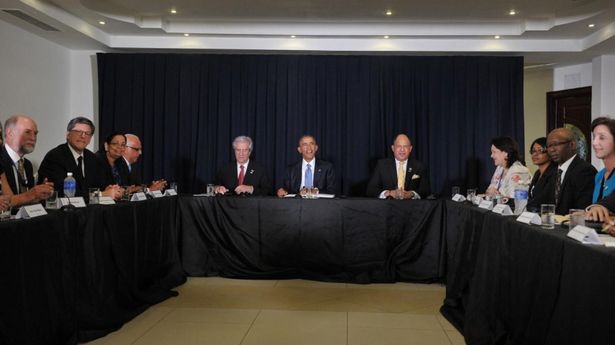
 EFE, 10 April 2015 – The president of the United States, Barack Obama, met today in Panama with members of the Cuban opposition and civil society leaders from other countries before his anticipated meeting this Saturday with with Cuban president Raul Castro.