When retirees collect their monthly pension, the services of the Popular Savings Bank of San José de las Lajas collapse.

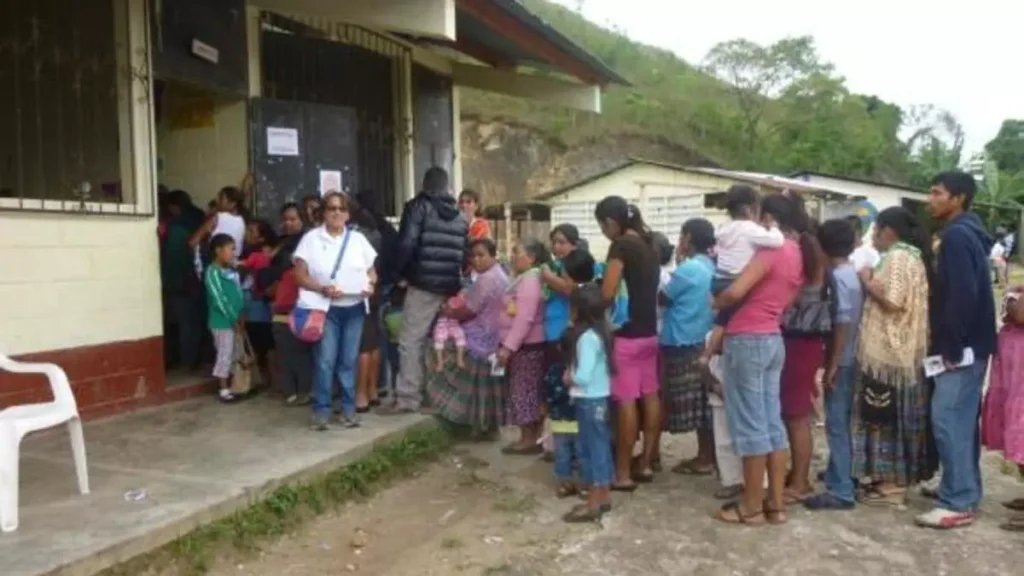
 14ymedio, Mayabeque, Julio César Contreras, March 29, 2026 – At seven in the morning there is already activity in front of the Popular Savings Bank of San José de las Lajas. The line begins to form long before the doors open, and as the minutes pass, it turns into a compact row of tired bodies, canes leaning against the wall, and eyes fixed on the entrance. Some retirees sit on the metal chairs in the entryway; others remain standing, holding their checkbooks as if they were a lifeline amid uncertainty.
The days set for paying pensions to retirees turn into a true ordeal for people who go to the bank in search of other services. Service no longer depends only on there being electricity but on there being employees available to handle the different operations. At any moment the power can go out and paralyze everything: the computers shut down, the fans stop turning, and a murmur of discontent runs through the line like a hot wind.
“The first problem is that it’s the same line for all procedures and, as expected, pensioners are the majority. I have no choice but to come back later,” comments Mayra, who practically has no cash left and therefore urgently needs to make a withdrawal. The woman looks at the door anxiously, aware that time is running against her and that, if she cannot withdraw money, she will have to postpone basic purchases such as bread or medicine. continue reading
Receiving her salary on a card keeps her enslaved to the bank, because on the street no one is accepting payment by transfer
According to the worker from the Commerce Company, receiving her salary on a card keeps her enslaved to the banking institution, because on the street no one is accepting payment by transfer. “Here at the bank the most I can withdraw is 1,000 pesos a day, but not even that small amount is guaranteed. Today, for example, all the money is earmarked for paying out the pensions. That means that until that is finished, the rest of us customers will have to look for other solutions, such as buying things through Transfermóvil at 10 or 20% above their original price,” the woman says.
At a glance, impatience is evident among those who ask who is last, peek toward the door, or leave frustrated at being unable to complete a transaction. An elderly man with a red cap and denim jacket moves forward with short steps toward the entrance, while a woman with white hair rests in a chair and fans herself with a folded sheet. No one wants to lose their place, because everyone knows that the money may run out before noon.
“There are only two tellers working, so they are forbidden from making deposits. All banking activity is concentrated in a single operation, as if they were just learning how to work now,” complains Mario, who urgently needs to deposit 20,000 pesos on his daughter’s card. “It’s true that the elderly deserve priority. However, concentrating the work in a single area goes against all logic,” he emphasizes.
For the accounting professor, his most difficult days of the month are precisely when the bank is paying out pensions. “I have to regularly send money to my daughter, who is studying in Havana. Sometimes when I leave here I have to take a pill because my blood pressure has shot up,” says Mario, after having a brief argument with an employee over the inefficiency of the banking institution.
It is incredible how time is wasted on a procedure that could be resolved with a bit of interest on the part of the bank. Anything in this country costs a lot of effort
Although it has nothing to do with the payment of pensions, Yesenia has been leaning against a column in the entryway for an hour and a half, waiting for her turn to go in. “I am in the process of applying for a loan to finish my house. In the line there is no one for that kind of thing, but they informed me that today only one commercial officer came to work and he is currently busy with other tasks. I don’t understand anything,” says the employee of a private cafeteria who can dedicate herself to these procedures twice a week. “It is incredible how time is wasted on a procedure that could be resolved with a little interest on the part of the bank. Anything one wants to do in this country costs a lot of effort,” she insists.
The atmosphere grows more tense as the morning goes on. Some retirees check their watches with concern. There are those who leave resigned, promising to return the next day, even though that means starting over from scratch.
Pressed by the time, Yasenia feels she is losing the morning without achieving her goal. The discomfort is shared by some people in the line who, sitting on a doorstep or with their hands resting against the wall, channel their frustration by talking. “The bank closes at 12:00 noon, even when there are still customers out here. It doesn’t matter who is left without collecting their money or who has to spend a month just to get a form filled out. I know the bank employees want to leave early to deal with their personal matters, but then, who takes care of ours?” the young woman asks.
In San José de las Lajas, collecting a pension is no longer a monthly procedure but a daily battle. For many retirees, the money they are waiting for is not just income, but the difference between eating or not, between buying medicine or staying home enduring the pain. That is why they return to the bank again and again, wake up before dawn, and endure hours of waiting amid uncertainty, hoping that this time there will be enough cash.
Translated by Regina Anavy
______________________
COLLABORATE WITH OUR WORK: The 14ymedio team is committed to practicing serious journalism that reflects Cuba’s reality in all its depth. Thank you for joining us on this long journey. We invite you to continue supporting us by becoming a member of 14ymedio now. Together we can continue transforming journalism in Cuba.