The Cuban State Uses Gender-Based Violence as a Tool of Repression, Amnesty International Reports

Testimonies show that authorities use, among other biases, “the maternal role to try to get women to abandon activism.”


Yenisey Taboada Ortiz, mother of political prisoner Duannis León Taboada, a political prisoner from 11 July, is one of the people interviewed for the AI report. / Facebook

14ymedio bigger14ymedio/EFE,  Madrid, 26 November 2025 — On Wednesday, the human rights organisation Amnesty International (AI) denounced the violence perpetrated by the Cuban regime against women activists, journalists and human rights defenders through gender-based abuse and authoritarian practices.

“It’s not traditional repression,” said Johana Cilano Peláez, AI’s regional researcher for the Caribbean and author of the report They Want Us To Be Silent, but we continue to resist: authoritarian practices and state violence against women in Cuba, are documented in the 40-page report,” she told the EFE news agency.

The activists also receive threats of “denial of food, medicine, visits, telephone calls and harsher sentences for their detained children” if they continue their work, explains the researcher.

Many mothers and wives of people imprisoned for political actions have been forced to strip naked in order to be allowed to visit them.

Amnesty also denounces “the subordination of the judicial system to political power,” the lack of mechanisms for reporting and redress, and the absence of a comprehensive law against gender-based violence as “factors that perpetuate impunity.”

Cilano Peláez emphasises that repression does not affect all women equally, given that institutional violence intersects with gender, race and socioeconomic status. continue reading

“Black women suffered more severe treatment, and physical violence occurred earlier than in the case of white women. We also saw that activists from poorer neighbourhoods or those further away from the capital were more vulnerable,” she points out.

For the report, AI interviewed 52 people, 34 of whom were female victims, specifically analysing the cases of five of them. Yenisey Taboada, Luz Escobar, Carolina Barrero, María Matienzo, Camila Lobón and Alina Bárbara López were interviewed and revealed that the pattern of state violence is neither incidental nor isolated, but rather “structural and sustained”.

Furthermore, black women, single mothers and women of diverse sexual orientations face aggravated forms of violence, which requires an urgent intersectional response, warns AI.

Amnesty International points out that these situations occur in an environment of restrictions on the exercise and defence of human rights, where the subordination of the judicial system to political power, the lack of mechanisms for reporting and redress, and the absence of comprehensive legislation against gender-based violence perpetuate impunity.

“The international community cannot continue to remain silent in the face of the differentiated repression suffered by women in Cuba,” stressed Ana Piquer, Amnesty International’s regional director for the Americas. “Women defenders in Cuba are punished not only for speaking out, but also for being mothers, journalists and social leaders. The state uses gender-based violence as a tool of repression: it seeks to break their dignity, their family environment and their collective strength,” she added.

The organisation stresses that the lack of guarantees, the lack of judicial independence and the absence of political freedoms stifle any potential legislation that, on paper, appears beneficial for the protection of women.

The document includes a section analysing Cuban legislation, which was praised yesterday by the official press as a benchmark and model for the protection and integration of women in public life. AI considers, however, that there is a recurring lack of statistical data – specifically on deaths due to gender-based violence, whose announced updated register has been reserved for internal consumption – and an absence of regulations demanded by feminist associations.

What’s more, the organisation emphasises that the lack of guarantees, the lack of judicial independence and the absence of political freedoms stifle any potential legislation that, on paper, appears beneficial for the protection of women.

The report concludes with a specific section calling on the Cuban authorities to end gender-based harassment of women activists. “It is time for States, especially inter-American organisations and the European Union, to demand concrete protection measures. State repression against women activists and defenders in Cuba constitutes a form of institutional gender-based violence that must be made visible and publicly condemned.”

AI calls for specific protection measures for women human rights defenders and sustained monitoring by the international community.

“What we saw is that repression against women is systemic and differentiated. The state exploits motherhood and punishes those who have less visibility or resources more harshly. That is why sustained international action is needed,” concludes Cilano Peláez.

Translated by GH

____________

COLLABORATE WITH OUR WORK: The 14ymedio team is committed to practicing serious journalism that reflects Cuba’s reality in all its depth. Thank you for joining us on this long journey. We invite you to continue supporting us by becoming a member of 14ymedio now. Together we can continue transforming journalism in Cuba.

The Cuban Regime Defends Itself Against Accusations of Links With Drug Trafficking

Cuban regime hastens to deny the statements of ‘El Pollo’ Carvajal on the role of Havana in the creation of the Cartel de Los Soles in order to flood the US with cocaine

Havana avoids, as a general rule, giving public explanations about internal security, but this time it responded immediately. / Facebook / Minint

14ymedio bigger14ymedio, Havana, December 4, 2025 — The Cuban government, aware of its current vulnerability, is reacting with unusual speed. Hours after the letter of Hugo “El Pollo” Carvajal — former head of Venezuelan intelligence — was published, in which he accuses the Chavista regime and Cuba of having designed a drug trafficking strategy against the US, Havana convened a press conference to clarify that “Cuba is not a producer of drugs or a drug transit country.”

Officials from the Ministry of the Interior and the Ministry of Justice met on Thursday at the International Press Center. They offered an image of control, but the timing of the appearance exposed the political urgency. Carvajal’s letter, addressed to Donald Trump, details two decades of narco-terrorist operations, cooperation with guerrillas, electoral manipulation and a close relationship with the Cuban intelligence services. In one of his most forceful statements, the former Venezuelan general claims that “this plan was suggested by the Cuban regime to Chávez in the mid-2000s,” referring to the use of drugs as a geopolitical weapon.

The presence of Justice Minister Oscar Silvera Martínez, First Colonel Ibey Carballo, and Colonel Juan Carlos Poey underscored the exceptional nature of the press conference. Havana generally avoids giving public explanations about internal security, but this time the complex domestic crisis, as well as the U.S. military deployment in the Caribbean, are accelerating the actions of the oldest dictatorship in the Western Hemisphere.

Poey, head of the Interior’s anti-drug agency, described the US military presence in the area as “a serious threat to Cuba’s security and sovereignty,” and he added an argument that tried to turn the tables: “The synthetic drugs circulating today in Cuba come mostly from the United States.” continue reading

Carvajal says that Cuban intelligence showed him “their networks inside US naval bases and thousands of spies sent to the US over decades”

To soften the tone, Carballo, second-in-command of the Border Guard Troops, emphasized cooperation with Washington: “We exchanged real-time information with the US Coast Guard. We gave them position, heading and characteristics of the drug boats.”

Carvajal’s letter, addressed to Trump from an American jail, is not limited to describing crimes. It situates Cuba directly as a key actor in the construction of the so-called Cartel de los Soles, affirms that Cuba provided strategic advice, and states that Cuban intelligence showed him “its networks inside US naval bases and thousands of spies sent to the US over decades.”

It also states that criminal groups such as the Tren de Aragua were formed “on the orders of Chávez and then Maduro, with coordinated support from the Ministry of the Interior and security forces,” and that some of these operatives were sent abroad. Although Cuba is not mentioned as a participant in these gangs, it does appear as an adviser and ally of the structure that created them.

The publication of the text coincides with an increase in US military pressure in the Caribbean. Washington has directly linked Venezuelan president Nicolás Maduro with drug trafficking and offered a valuable reward for his capture. US military presence near Venezuela has been considerably strengthened, with deadly attacks on drug traffickers’ boats, threats to extend them on land and the imposition of a total closure of Venezuelan airspace. In this context, any reference to Cuba’s role acquires additional weight.

At the conference, the Minister of the Interior reported that more than two tons of drugs have been “secured” in Cuba so far this year, although without detailing the routes, networks or those responsible. Authorities acknowledge an increase in consumption, especially among young people, but do not publish complete statistics. The internal response remains focused on speedy trials, long sentences and exemplary punishments.

Carvajal mentions the use of armed groups such as FARC, ELN and Hezbollah in Lebanon in coordinated operations with Caracas and Havana, as well as the export of manipulable electoral technology to other countries through the company Smartmatic

Silvera insisted that the Cuban position is “preventive” and allows the island “to not be a producer or transit country.” However, he did not explain why the Government had now decided to make a public statement on the subject, nor did he directly mention Carvajal’s allegations.

The speed with which the conference was organized, the presence of high-ranking officials and the emphasis on cooperation with the US suggest that the Government’s priority was not to inform the Cuban public, but to respond to the international impact of the testimony of the former head of Chavista intelligence.

Carvajal not only points to Havana as an advisor of the cartel run by the Venezuelan leadership, but also claims that diplomats and North American officials have collaborated with Caracas and that Russia set up a listening post on the Venezuelan island of La Orchila with the knowledge of Cuba. These allegations extend the case far beyond drug trafficking and place Cuba within a network of operations that, if confirmed, would have military, diplomatic and national security implications for Washington.

The document also mentions the use of armed groups such as the FARC, the ELN and Hezbollah in Lebanon, in coordinated operations with Caracas and Havana, as well as the export of manipulable electoral technology to other countries — including the US — through the company Smartmatic. Although the official conference avoided addressing any of these points, the coincidence with the accusations underlines the gravity of the moment.

The accusation that Cuba is directly related to an organization officially classified as terrorist places the regime in a very delicate position, just when tension is growing in the Caribbean and when Havana depends on any economic relief, financial or migratory to try and get out of the worst economic crisis since 1959.

Translated by Regina Anavy

____________

COLLABORATE WITH OUR WORK: The 14ymedio team is committed to practicing serious journalism that reflects Cuba’s reality in all its depth. Thank you for joining us on this long journey. We invite you to continue supporting us by becoming a member of 14ymedio now. Together we can continue transforming journalism in Cuba.

In Guantánamo, Cuba, Good Eyesight Has Become a Luxury Due to Shortages at State-Run Opticians

This has led to the private market taking the place of official provision.

The few state-owned opticians that remain open are just urban decoration rather than a real service. / Screenshot

14ymedio bigger14ymedio, Guantánamo, 30 November 2025 — In Guantánamo, the word “optician” is now pronounced with a hint of irony or nostalgia. It is as if people were talking about a service that existed in the past—imperfect rather than efficient, but at least it existed—and that today survives only as a sign on a shopfront. In the city centre streets, where the sun mercilessly bounces off the pavements, more and more people walk around squinting, holding their phones inches from their noses or wearing glasses patched up with adhesive tape.

The lack of lenses and frames in state-run opticians affects the quality of life of those who have been waiting for years to get better glasses, or contact lenses or buy prescription glasses that allow them to walk down the street without straining their eyes in the glare.

In front of one of the closed opticians, a woman in her sixties holds a pair of broken frames and says with resignation: “I come whenever I can to see if they’ve got anything, but nothing,” she tells 14ymedio. “Sometimes they don’t have frames, and most of the time they don’t have the prescription I need, as I’m short-sighted.”

A man in a work uniform says he has been trying to replace his glasses for months: “They tell me to come back in two or three weeks to see if any supplies have arrived, but they’ve been saying that since last August.” The scene, repeated in various parts of the city, shows closed shops, empty continue reading

display windows and employees who can only offer apologies.

No lenses, no frames, no screws, no hinges

“There are two in this area where only the guards are there because they have been without materials for so long that even the other employees no longer go to work. One of those premises has even been turned into an apartment,” complains the customer who needs glasses “to read and see up close”. His solution for the moment: to use his wife’s glasses, which, although they aren’t the same prescription, at least “prevent him from cutting his finger with a knife”.

In Guantánamo, the few state-owned opticians that remain open are more urban decoration rather than a real service. The furniture is there, and so are the cases and mirrors, but they don’t have the essentials: there are no lenses, no frames, no screws, no hinges. A woman points to the door of a shop that was once a landmark in the city: “This place has been closed for a long time. They took away the equipment. They tell people to go to another municipality, but there aren’t any there either.”

This has led to the private market taking the place of the official network. Just join any buying and selling group in the area to see an almost endless selection of modern frames, striking colours, children’s designs and lenses “for close-up vision” or “for reading”.

This abundance contrasts with the state’s poverty, but it comes at an exorbitant price: a simple pair of +1.75 glasses costs more than 900 pesos in Guantánamo. If they are of better quality or have a higher magnification, they can cost up to 1,800 or 2,000 pesos. The national average wage is around 6,500 pesos per month, so a worker has to spend between 15% and 30% of their income just to see clearly what is in front of them.

“I perform magic,” says one of these private technicians with a laugh, “but not miracles.”

My work is sewing, how can I do it without glasses?” asks a woman who proudly shows off a pair brought to her by her niece from Jamaica. Others agree: “Everyone depends on those who travel,” “if you don’t have family abroad, you’re lost,” “seeing well is a luxury now.”

For those who can’t afford a new pair, they can go to repairers: artisans of detail, guardians of an almost ritualistic skill. Few remain in Guantánamo, mostly older men who work at tiny tables, surrounded by magnifying glasses, recycled screws and worn tools. They can straighten an arm, put a piece of wire where the hinge broke, or tighten whatever is loose. But making glasses from scratch requires machinery that only the state has. “I do magic,” says one of these private technicians with a laugh, “but not miracles.”

The crisis has consequences that are not always visible. Not being able to use glasses affects productivity, learning and safety. A retired teacher explains that many older adults stop reading or doing other activities because they do not have glasses, and that this “closes them off”. Others mention frequent headaches, stumbling when walking, and difficulty performing basic tasks. In a city where many people work in manual labour, the inability to focus properly becomes an economic barrier.

Meanwhile, on the streets of Guantánamo, people can be seen squinting, enlarging the letters on their mobile phones as much as possible, or wearing frames patched up with adhesive tape. For those who cannot afford the high prices of glasses on the informal market, the city is becoming a blurry landscape.

Translated by GH

____________

COLLABORATE WITH OUR WORK: The 14ymedio team is committed to practicing serious journalism that reflects Cuba’s reality in all its depth. Thank you for joining us on this long journey. We invite you to continue supporting us by becoming a member of 14ymedio now. Together we can continue transforming journalism in Cuba.
Cuba Punishes Its Basketball Player and Argentina Humiliates the Island Team With a 105–49 Score

The national team needs to beat Uruguay and Panama to advance to the qualifier for Qatar 2027

Cuba had a poor 26 percent in field shots against Argentina. / Facebook/351 deportes

14ymedio bigger14ymedio, Havana, December 2, 2025 — Argentina swept the Cuban national basketball team from the court with an overwhelming 105-49 score at the Obras de Buenos Aires stadium, in what was their second qualifying match to advance to the World Cup in Qatar 2027. Faced with the abysmal difference of 56 points, the official media Jit acknowledged that “a pragmatic analysis of what happened is urgently needed.”

With the argument of a Cuban basketball team “reduced to alarming levels” by injuries and absences, the same media tried to minimize the fall, mentioning the foul by injury of basketball player Reynaldo Garcia, in addition to the losses of Anthony Rodríguez and Pedro Bombino.

For its part, the Argentine newspaper La Nación said that the Cuban team arrived in Buenos Aires with nine players. At the “last moment” the Cuban Basketball Federation “called Joan Gutiérrez, who days before had played with Gimnasia de La Plata in an Argentine League match against Villa Mitre.”

The controversial absence in the team led by Osmel Planas was that of Karel Guzman. According to Jit, the athlete “did not arrive at the headquarters due to errors in the coordination of his trip.” However, the reality is that “they did not give him the official passport to board the flight” to Argentina, and he was stranded in Havana. continue reading

Karel Guzmán, according to Jit, “did not arrive at the headquarters due to errors in the coordination of his trip” to Argentina

The regime punished the athlete for denouncing the bad practices and poor management of the Cuban federations. “The effort that we make in coming to play for the national team, although it is something we want, is not very valued by the federation. We always come with the best attitude, but there are times when we get there and there are extra things not related to basketball that affect us,” said Guzmán.

The basketball player was barred by the Cuban Federation of Basketball from traveling despite having an official passport, a confirmed flight ticket and his return flight already paid for, according to sports specialist Henry Morales.

At the end of the match against Argentina, Marlon Díaz, who is Cuban, confirmed to the Argentine media that Guzmán “was not given his passport.” When questioned about the reason, he replied: “These are things that happen, and we don’t know exactly why.” Planas, the coach, only would comment that the basketball player “could not travel for document reasons.”

Sobre el aspecto deportivo, Cuba presentó un deficiente 26 por ciento en tiros de campo. Lo sobresaliente fue, según medios oficialistas, la actuación de Ibrahim Echevarría, quien consiguió un doble-doble de 12 puntos y 13 rebotes.

On the sporting aspect, Cuba presented a poor 26 percent in field shots. According to official media, the performance of Ibrahim Echevarría was outstanding, with a double-double of 12 points and 13 rebounds.

Cuba has matches ahead against Uruguay and Panama, which it must win in order to continue to advance to the World Basketball Championship of Qatar 2027.

Translated by Regina Anavy

____________

COLLABORATE WITH OUR WORK: The 14ymedio team is committed to practicing serious journalism that reflects Cuba’s reality in all its depth. Thank you for joining us on this long journey. We invite you to continue supporting us by becoming a member of 14ymedio now. Together we can continue transforming journalism in Cuba.

Ecuador Detects Two Cases of Chikungunya in Visitors From Cuba

Ecuador’s Ministry of Public Health has activated a protocol to monitor all persons entering the country from the island.

PúblicaHealth authorities in Ecuador inspect homes near those of the patient with chikungunya in Portoviejo. / Ministry of Public Health

14ymedio bigger14ymedio, Havana, 23 November 2025 (delayed translation) — Ecuador’s Ministry of Public Health (MSP) “activated protocols for the containment and prevention” of chikungunya after confirming two cases in travellers from Cuba who entered the country last Thursday. “Both patients were notified immediately” and their progress is being “actively monitored and recorded,” the agency said.

The MSP stressed that in response to the outbreak of the virus – which is the main disease affecting the island with a cumulative total of 31,513 cases, of which 61 are in serious condition and 20 are in critical condition – alerts have been activated and “people coming from the island” who enter Ecuador are being registered and monitored.

One of the confirmed cases was reported by the National Reference Centre for Exanthematic, Gastroenteric and Vector-Borne Viruses of the National Institute of Public Health Research (Inspi). A second patient is a woman who lives in a private residential complex in Portoviejo and who, according to Freddy Macías, head of the Vector Control Brigade in Zone 4, “entered Ecuador already infected”.

Macías recalled that a week before the cases were confirmed, an epidemiological cordon was activated in the Portoviejo region. Once the patient with chikungunya was identified and located, the specialist explained to local media outlet La Veci, health authorities carried out a second cordon consisting of “inspecting homes and searching for breeding sites” of mosquitoes that transmit the disease. A third stage will be carried out during the week. “The controls seek to cut off any possibility of local transmission around the patient,” he added. continue reading

Epidemiological authorities are searching for breeding sites of mosquitoes that transmit chikungunya. / Ministry of Public Health

The cases triggered an alert in Ecuador, where the virus had been under control since 2023, when a visitor with chikungunya was recorded. Epidemiological surveillance figures reveal that the main concern is dengue, with 15,814 patients as of last October, 61,404 in 2024, 27,906 (2023), 16,402 (2022), 20,689 (2021) and 16,741 (2020).

As part of measures to eradicate dengue, Zika and chikungunya, Ecuador encourages the formation of mingas (community brigades) that collect tyres and waste that can serve as mosquito breeding grounds, thereby reducing the risk of these diseases spreading.

For its part, Inspi trains community health teams to identify vulnerable areas and implement preventive measures.

At the end of September, the US Embassy in Havana issued a health alert for anyone wishing to travel to Cuba due to the outbreak of Chikungunya. The risk was classified as Level 2, requiring “additional precautions” to be taken.

The diplomatic headquarters recalled that this virus is transmitted by mosquitoes and that symptoms, mainly fever and joint pain, appear between three and seven days after the bite. In addition, the Mexican Ministry of Foreign Affairs also recently issued a travel alert to the island due to the “worsening health situation resulting from the spread of arboviruses.

Translated by GH

____________

COLLABORATE WITH OUR WORK: The 14ymedio team is committed to practicing serious journalism that reflects Cuba’s reality in all its depth. Thank you for joining us on this long journey. We invite you to continue supporting us by becoming a member of 14ymedio now. Together we can continue transforming journalism in Cuba.
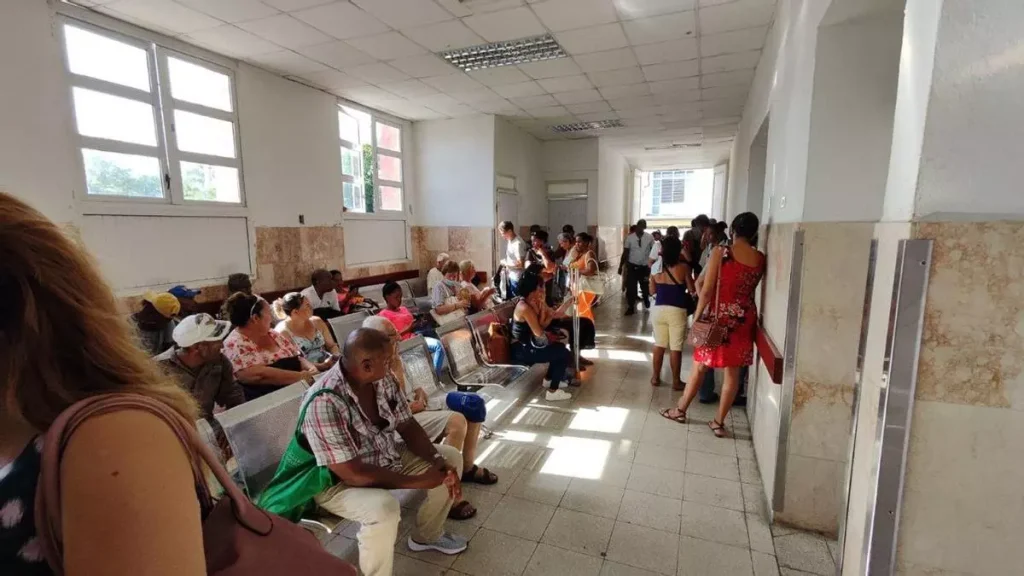
The Increase in Chikungunya Cases Is Creating a “Dangerous” Situation, Cuban Authorities Admit

Infections have risen by 23.2% in a week and the number of patients in intensive care, including many minors, has grown from 96 to 156.

Cases have increased by more than 23% this week, although there is optimism for December. / Archive/ 14ymedio

14ymedio bigger14ymedio, Madrid, 25 November 2025 (delayed translation) — Data on the arbovirus epidemic that Cuba has been experiencing in recent months is alarming health authorities, who on Monday warned of a 23.2% increase in chikungunya infections compared to the previous week. Carilda Peña García, Deputy Minister of Public Health, said that at the end of last week, 7,700 new cases of this disease had been recorded and, although she did not provide specific figures for dengue, she also confirmed an increase in the incidence rate.

In total, the country has recorded 39,760 people with “non-specific fever syndrome”, 15.8% less than the previous week. The official was optimistic about the future, stating that “historically, November is the most complex month for arboviruses, with dengue fever being hyperendemic.” This data led her to believe that there would be an improvement in the first or second week of December, also in the case of chikungunya, which is transmitted by the same mosquito.

At the moment, with 156 patients in intensive care – 96 more than the previous week – there is little cause for celebration. The Deputy Minister acknowledged that the situation “is considered dangerous” because there are many serious and critical cases. Of the latter, 34 (out of a total of 35) are under the age of 18. As for the seriously ill, the figure rises to 121, 96 of whom are minors.

There are 35 critical cases, 34 of whom are under 18 years of age. As for serious cases, the figure rises to 121, 96 of whom are minors.

Peña García explained that he is aware that there is underreporting because many people do not go to medical centres. However, he added that all suspected cases are counted, even if they have not been diagnosed in laboratories, which is common in epidemic situations. On Monday, of the 7,700 cases, 137 were confirmed by PCR, a test reserved for identifying and characterising serious cases or the onset of outbreaks. continue reading

As for dengue fever, transmission is widespread, with cases still present in 14 provinces – Sancti Spíritus, Villa Clara, Havana, Guantánamo, Ciego de Ávila and Santiago de Cuba leading the way – and the incidence rate has risen to 22.6%. The figures have not yet been updated in the World Health Organisation (WHO) documentation, so people do not know how many infections there are. At the end of last week, three deaths and 9,602 infections had been reported, which is a high rate of 87.79 per 100,000.

Although Peña García insisted on the importance of seeing a doctor, especially for vulnerable population groups, many cases are not counted officially. “All of us who don’t go to the doctor and heal ourselves at home are not included in this figure. Conduct a block-by-block survey to see how many of us there are,” said a Cubadebate reader in response to the news. Another user asked the authorities to be more specific about the cases of deaths circulating on social media.

“Could you clarify whether there have been any deaths from this cause and, if so, how many? There are all sorts of rumours circulating about hospitals and funeral homes being full, the virus spreading for several weeks, and not a single death? Something doesn’t make sense, and I do not believe that any deaths are a crime or the fault of the Ministry of Health, as is the case anywhere else on the planet in similar situations. Thank you. We await your response,” he asked. The only deaths known to date directly associated with dengue fever are three, announced in October. Since then, rumours have been spreading like wildfire.

The authorities claim that the procedure has not been widespread because there are “limitations on fuel and insecticides, but priority was given to areas with the most active transmission.”

The deputy minister explained that the Aedes aegypti infestation is considered high, with 8,545 outbreaks. The municipalities with the worst indicators are Camagüey, Pinar del Río, Sancti Spíritus and Havana. In the latter, as in Santiago de Cuba and Granma, fumigation targets are being met, another fact that is highly questioned on social media, where hundreds of voices claim that no action is being taken. The authorities admit that the procedure has not been followed everywhere because there are “limitations on fuel and insecticides, but priority was given to areas with the most active transmission in order to reduce the vector population and break the chain of transmission”.

The situation has prompted the Dominican Republic to take action. On Monday, it announced the intensification of epidemiological surveillance and vector control measures throughout the country, “as part of the ongoing prevention and response strategy to the chikungunya outbreak reported in Cuba and other Caribbean countries”.

The country’s Ministry of Health said there will be intensive fumigation campaigns, scrap metal removal and community education, as well as active screening for fever and surveillance at airports, ports and border crossings. The minister asked citizens for their cooperation, especially in keeping yards clean and removing water tanks that encourage mosquito breeding.

Translated by GH

____________

COLLABORATE WITH OUR WORK: The 14ymedio team is committed to practicing serious journalism that reflects Cuba’s reality in all its depth. Thank you for joining us on this long journey. We invite you to continue supporting us by becoming a member of 14ymedio now. Together we can continue transforming journalism in Cuba.

The Wife of 11 July Prisoner Yosvany Rosell García Warns of His Critical Condition Due to His Hunger and Thirst Strike

The US Embassy condemns “the abuse and mistreatment suffered by political prisoners in Cuban regime prisons.”

Yosvany García Caso and his wife, Mailín Rodríguez Sánchez. / Facebook

14ymedio bigger14ymedio, Madrid, 17 November 2025 — Yosvany Rosell García Caso, who has been on hunger strike for 26 days in the Cuba Sí prison in El Yayal (Holguín), has declared that he will also stop drinking liquids. His wife, Mailin Rodríguez Sánchez, told 14ymedio about this after finding out on Monday.

The situation of the political prisoner, sentenced to 15 years in prison for participating in the peaceful demonstrations on 11 July 2021, “is becoming more critical every day,” says his wife, who says she feels desperate. “They are already transporting him in a wheelchair because he cannot stand,” but despite this, she complains, “he has not been transferred to a hospital.” García Caso suffers from several conditions, including heart disease, hypertension and chronic gastritis.

The daily life of Rodríguez Sánchez and his three children is now even more complicated because they have all contracted chikungunya, one of the arboviruses spreading across the island in epidemic form. “We all have the virus and are recovering. This is terrible,” he says. “Here on my block, we are all laid up.”

“They are already transporting him in a wheelchair because he cannot stand”

Various international bodies have spoken out in favour of the political prisoner in recent weeks. On Monday, the US Embassy in Havana did so via its social media accounts, condemning “the abuse and mistreatment suffered by political prisoners in the Cuban regime’s jails”. It is alarming, says the diplomatic headquarters in X, “that 11 July prisoners such as Yosvany Rosell García are on hunger strike to protest against the constant abuses. We join their demand for the release of all political prisoners”.

García Caso announced in a handwritten letter that he would go on hunger strike from 23 October and demanded to be transferred continue reading

to a punishment cell as a “new form of protest” against the “continued imprisonment of all political prisoners”. In his letter, the activist expressed his “unequivocal support for maximum pressure from the United States Government on the narco-terrorist Cuban Government”.

He concluded with a postscript: “What you do only for yourself vanishes when you die; what we do for others is our divine legacy.”

Handwritten letter from prison signed by political prisoner Yosvany García Caso. Courtesy

Several organizations have also spoken out about the prisoner, including the Cuban Observatory for Human Rights, which on Friday issued an alert “regarding the grave risk to his life with each passing minute,” demanding “adequate medical attention and his immediate release.” Cubalex, for its part, noted that hunger strikes are “an extreme measure resorted to by people deprived of their liberty when they are denied effective avenues to report abuses or assert their rights.”

García Caso himself had already staged numerous similar protests to denounce his conviction, which he considers unjust and the result of an arbitrary trial. These hunger strikes—six up to September 11, 2022—are, according to the Justice 11J list of prisoners, what caused the gastritis he suffers from.

Arrested at his home on July 10 for a pot-banging protest, according to the same NGO, García Caso was arrested again for his participation in the July 11 events. Almost a month later, he was transferred to the Holguín Provincial Penitentiary. With alleged prior drug trafficking charges, he was accused of assault, public disorder, spreading epidemics, and incitement to commit crimes, and was initially sentenced to 20 years in prison, and later, on appeal, to 15 years.

Translated by GH

The Cuban Spy Who Gave the Information To Shoot Down the Planes of Brothers to the Rescue Dies of a Virus

Juan Pablo Roque González infiltrated the organization in Miami and returned to Cuba just before the attack

Juan Pablo Roque, during an interview given to América TeVé in 2012. / Capture

14ymedio bigger14ymedio, Madrid, November 28, 2025 — Juan Pablo Roque González, alias “Germán,” one of the Cuban spies involved in the shoot-down of Brothers to the Rescue planes in 1996, has died in Havana at the age of 70. This was confirmed this Friday from Miami by his ex-wife, Ana Margarita Martínez, who stated that his death occurred on November 25.

In an interview with Mario Vallejola, a Cuban journalist living in the US, the woman explained that he died from “a virus, one of those that is going around Cuba now.” He had undergone a heart operation and was in “delicate” condition.

“In an ironic turn of events, his death occurred on the same date that Fidel Castro died, the same dictator he served,” said Martínez, who has always maintained that Roque hid his true job from her during the marriage. She referred to this again in a social media post: “Although our marriage was later annulled in court, the consequences of his deception were profound and personal. He never faced earthly justice for his actions.”

Martínez states that, before the death of her ex-husband, she felt “obliged to address a chapter that left a deep mark on my life and in our Cuban-American community.” Roque González — recalls his ex-wife — was a member of the so-called Wasp Network, “and his betrayal caused immense damage,” not only to her and her family, “but also to the brave volunteers of Brothers to the Rescue and all those who have fought tirelessly for freedom, truth and human dignity.” continue reading

The woman explained that “he died from a virus, one of those going around Cuba now.” He had undergone a heart operation and was in “delicate” condition.

In her post she mentions the four victims of that attack — Mario de la Peña, Carlos Costa, Pablo Morales and Armando Alejandre Jr. — volunteers from the Brothers to the Rescue organization, which helped exiled Cubans and promoted freedom on the island. On February 24 almost 30 years ago, they flew in three small planes to track the rafters in the Florida Straits.

Only one returned to the Opa Locka airfield in north Miami. The other two were pulverized by missiles fired from two MiG fighters of the Cuban Air Force. Havana — then with Fidel Castro still in full power — claimed that the aircraft violated the airspace of the country, but both the US and the exile community maintained that the attack took place over international waters.

Roque González himself, a lieutenant colonel of the Cuban Revolutionary Armed Forces, served as a pilot for Brothers to the Rescue, which he infiltrated after simulating his desertion from the island in 1992, swimming to the US naval base at Guantánamo. He returned to Cuba one day before the attack and never faced justice.

His story was different from that of the five Cuban spies convicted in 2001 by the US for conspiracy to commit murder and espionage, as well as being unregistered agents of a foreign government. Arrested in 1998 in Florida while carrying out intelligence work for Cuba, the regime deployed an intense and costly propaganda campaign for their release, elevating them to the status of heroes.

The figure of Roque González gained prominence five years ago, when Netflix aired the controversial film “The WASP Network,” where he was played by actor Wagner Moura

One of them, René González, was released in 2011, and three years later, Fernando González completed his sentence, after which both returned to Cuba. In December 2014, as part of the thaw initiated by President Barack Obama, with Raúl Castro succeeding his brother Fidel in the Plaza de la Revolución, the three who remained serving sentences in the US — Ramón Labañino, Antonio Guerrero and Gerardo Hernández Nordelo — were released and deported to Cuba. In return, the Cuban government handed over Alan Gross, a contractor imprisoned on the Island for trying to deliver satellite connection devices to the Jewish community.

The figure of Roque González gained prominence five years ago, when Netflix aired the controversial film “The WASP Network,” where he was played by actor Wagner Moura. Ana Margarita Martínez, who was played by Ana de Armas, filed a lawsuit against Netflix, claiming that the film distorted reality. It was not the only lawsuit over the film: José Basulto, founder of Brothers to the Rescue, also sued for presenting him as a terrorist, although he finally settled with Netflix.

The attack on the planes took place at a time when the US administration was considering lifting the embargo on the island. In response to the shoot-down, the opposite happened: then-President Bill Clinton signed the Helms-Burton Act and intensified the economic sanctions against Cuba.

Translated by Regina Anavy

____________

COLLABORATE WITH OUR WORK: The 14ymedio team is committed to practicing serious journalism that reflects Cuba’s reality in all its depth. Thank you for joining us on this long journey. We invite you to continue supporting us by becoming a member of 14ymedio now. Together we can continue transforming journalism in Cuba.

Two People Die in Santiago De Cuba After Exposure To Fake “Alum Bleach”

The chemical is used to purify domestic drinking water.

The poor quality of piped water has got worse / Aguas Santiago Water and Sewerage Company

14ymedio bigger14ymedio, Santiago de Cuba, 25 November 2025 — The official journalist Cuscó Tarradell, in a Facebook post quoting the Municipal Assembly’s Communications Department, warned that two people had died in Santiago de Cuba after being exposed to a highly toxic substance sold as “alum bleach”.

According to information released by Tarradell, the two victims were university workers. Meanwhile, those allegedly responsible for marketing the counterfeit product stole a batch of industrial bleach from the Mar Verde warehouses and relabelled it to pass it off as “alum bleach”. The compound circulating on the informal market is a highly dangerous industrial chemical, even if ingested in small quantities.

The compound that is circulating is a highly dangerous industrial chemical.

Authentic alum is a mineral salt that has traditionally been used to help purify water. When added to liquid, it allows dirt and suspended particles to clump together and sink to the bottom, making it easier to filter and improving clarity. The product has been used for decades in basic domestic and community water purification processes, always in small quantities and under controlled conditions.

Authentic alum is a mineral salt that has traditionally been used to help purify water. / Facebook

When reporting the information Tarradell also called for local authorities and the Santiago Water Company, to address the poor quality of the water being distributed, which forces many Santiago residents to seek substances on their own to clarify it. This need, he warned, leaves the population exposed to scams and dangerous compounds such as counterfeit “alum bleach”.

The poor quality of the water supplied through the pipes has worsened following Hurricane Melissa’s passage through the eastern part of the country. Residents in the city of Santiago de Cuba complain that the water supplied to them is earthy in colour, contains suspended particles and often has a bad smell.

Following the incident involving the fake “alum bleach”, the authorities advise against consuming chemicals purchased on the street, even if they are presented as known substances, and to always check the origin and labelling of any compound intended for water treatment or domestic use.

The deaths of two people as a result of exposure to this chemical have not been reported by the official press. The local newspaper Sierra Maestra, both on its website and on its Facebook page, has not reported on the deaths or on the investigation against those accused of marketing the product.

Translated by GH

____________

COLLABORATE WITH OUR WORK: The 14ymedio team is committed to practicing serious journalism that reflects Cuba’s reality in all its depth. Thank you for joining us on this long journey. We invite you to continue supporting us by becoming a member of 14ymedio now. Together we can continue transforming journalism in Cuba.

Fifty Artists Raise Awareness of the Fight Against Gender-Based Violence in a Collective Exhibition in Cuba

The exhibition is organised in the context of the International Day for the Elimination of Violence against Women.

The collective exhibition respects the project’s vision of combining established artists with newcomers. / EFE

14ymedio biggerEFE (via 14ymedio), Havana, 27 November 2025 — A total of 63 artists from Cuba and countries such as Argentina, Spain and Mexico highlight the fight against gender violence from multiple perspectives in the collective exhibition ‘También fui otra: MásCaras’ [I was also another: MásCaras], which opened on Wednesday in Havana.

The exhibition, organised in the context of the International Day for the Elimination of Violence against Women, “aims to pay tribute to women who, historically, had to use pseudonyms to publish their works,” Diana Pedraza, who shares the curatorship with art critic Alay Fuentes, explained to EFE.

Pedraza, who is also exhibiting a photograph, added that “the tribute is from a contemporary perspective, through photographs, paintings and performances”.

The exhibition “aims to pay tribute to women who, historically, had to use pseudonyms to publish their works”.

It’s about the masks they had to wear in order to transcend,” added the young artist.

I was also someone else: MásCaras’, promoted by the cultural arts enterprise Women’s Society, will remain on display for a month at the National Office of Industrial Design in Havana.

The collective exhibition respects the project’s vision of combining established artists such as Cuba’s Zaida del Río (National Prize for Plastic Arts 2023) with other newcomers such as photographers Vida Winter and Claudia Raymat.

In the case of the former, she arrives at the exhibition with the piece ‘Impermanencias del ser’ (Impermanence of Being), with a message: “Don’t be afraid to show ourselves as we are: women.”

Claudia Raymat, meanwhile, defends in her work ‘To be or not to be’ “the sensuality of women, their sweetness, but also their strength”.

Translated by GH

____________

COLLABORATE WITH OUR WORK: The 14ymedio team is committed to practicing serious journalism that reflects Cuba’s reality in all its depth. Thank you for joining us on this long journey. We invite you to continue supporting us by becoming a member of 14ymedio now. Together we can continue transforming journalism in Cuba.

‘Chikungunya’, the Word of the Year in Cuba

Everywhere you hear: “So-and-so was knocked down by a fever” or “So-and-so hasn’t been able to move her legs for a week”

The number of wakes held at funeral homes in Havana has increased in recent weeks. / 14ymedio

14ymedio bigger14ymedio, Yoani Sánchez, 26 November 2025 — Just a few months ago, “chikungunya” was an unpronounceable word for most Cubans. It sounded like a distant term, one of those exotic diseases that appear on international news reports. But today, that strange term dominates conversations in the  lines, on social media posts, and, worst of all, in the concerns of millions of people on the island. It has become, without question, the word of the year in Cuba.

Everywhere you hear: “So-and-so got knocked out by the fever,” “So-and-so hasn’t been able to move her legs for a week,” “The children in the building have swollen joints,” or “The neighbor can only manage to swallow gelatin.” The illness is no longer a statistic but a face, a voice, a weakness. It has the smell of homemade insecticide that families use to try to defend themselves and the sound of the insistent buzzing of mosquitoes that come in through the windows.

According to recent data, more than 50,000 Cubans were hospitalized last week with arboviral diseases, including dengue and oropouche. The extent of the problem can no longer be concealed. In provinces like Villa Clara, Camagüey, and Holguín, hospitals are at capacity, and in many municipalities, family doctors quietly admit that “this is out of control.” But while chikungunya spreads, the authorities have opted for caution. First, they downplayed the presence of the virus, then limited themselves to vague references to “local transmission.” Between one ambiguous statement and another even more confusing one, the country became increasingly filled with fever, rashes, and aching knees. continue reading

In many cities, garbage collection has ceased to be a daily task and has become a sporadic event.

The deteriorating epidemiological situation surprises no one. It is accompanied, like an inseparable shadow, by the collapse of basic services. In numerous cities, garbage collection has gone from a daily task to a sporadic occurrence. Mountains of waste rot in the sun. Adding to this visible decay are the power outages, which force people to open doors and windows to cope with the nighttime heat, precisely when the Aedes aegypti mosquito is having its feast.

Then there’s the water: it either arrives dirty, or only once a week, or with such low pressure that it forces people to store it in every container they can find. In this precarious ecosystem, breeding grounds multiply, while the old vector control program—that army of fumigators and inspectors—disappeared for years. The sound of fumigation wasn’t heard until just a few days ago, when the health crisis forced the reactivation of a tiny fraction of that massive campaign.

The streets know more than official bulletins. They know about the elderly man who spent ten days with a fever, unable to be admitted because there were “no beds” available. They know about the mother who, faced with the lack of state-provided insecticide, paid a private company 1,200 pesos for fumigation—a quarter of her monthly salary. They know about the young man who, despite his physical strength, shudders in pain, as if each bone had been replaced by a piece of rusted metal. And they know about the accounts that spread out from overflowing funeral homes, always faster than the official press, always more honest than any part of the Ministry of Public Health.

That is why, when someone says “chikungunya,” no one asks what it means anymore. It means a country that can barely move and is at the mercy of the mosquito. A word that was unspeakable yesterday has become commonplace today. A word that, unfortunately, sums up better than any other 2025 in Cuba .

____________

COLLABORATE WITH OUR WORK: The 14ymedio team is committed to practicing serious journalism that reflects Cuba’s reality in all its depth. Thank you for joining us on this long journey. We invite you to continue supporting us by becoming a member of 14ymedio now. Together we can continue transforming journalism in Cuba.

The Lethality of the Epidemic Is “Incompatible” With Chikungunya, Say Cuban Doctors

The symptoms that affect the entire country do not correspond to an arbovirus but to a respiratory disease similar to Covid

Everything indicates a person-to-person contagion. Not by a vector.  So what are we talking about?” / RL Hevia

14ymedio bigger14ymedio, Havana, November 30, 2025 — Cuba is experiencing a wave of febrile diseases which, according to the Ministry of Public Health, are mainly due to an outbreak of chikungunya. However, on social networks the official diagnosis is discussed with growing mistrust, while reports of severe clinical episodes, unexpected deaths and symptoms that, according to many doctors and patients, do not fit with the usual description of arboviruses proliferate.

The publications of Dr. Reinaldo Verona Bonce, from Ciego de Ávila, who has worked for decades in tropical medicine, have catalyzed a conversation that, in a few hours, spread throughout the island. In an extensive analysis published on Facebook, the author states that “the lethality present in our country is incompatible with historical records” of chikungunya, and the current transmission patterns “deny the epidemiology of the arboviruses.”

A particularly worrisome point in the debate is the unusual severity of symptoms in children, which several doctors consider to be incompatible with a typical chikungunya outbreak. “My son was in therapy with bronchopneumonia and shortness of breath. What does a mosquito have to do with this clinical picture? I also saw babies with the same,” warned Karina Silveira after her son’s hospitalization. For Dr. Verona Bonce, the occurrence of critical cases in newborns and adolescents “is unprecedented in Caribbean arboviruses.”

The doctor says that, while the medical literature describes chikungunya as a generally benign virus — with a mortality rate of only 0.1% — in Ciego de Ávila, “daily mortality has increased from an average of 12 to 14 people to 34 in 24 hours.” At the same time, he denounces the absence of conclusive diagnostic tests: “Without PCR (polymerase chain reaction) tests to detect the cause, there is no possible diagnosis,” he insists.

The doctor particularly questions the speed at which the disease has spread. “Female mosquitos cannot make an entire country sick in weeks. Whole families become infected in unison, and you get sick if you visit a patient. One vector does not explain this,” he wrote, referring to continue reading

the Aedes aegypti mosquito.

“The spread, contagion and severity are more consistent with a respiratory virus than with an arbovirus”

The recurrence of symptoms in people who had already suffered chikungunya is another point that worries doctors and citizens. The medical literature indicates that this virus usually generates lasting immunity, with relapses considered exceptional. However, several users describe the opposite. “I am seeing that people who already were in remission now present again with the virus when they should have immunity. This leaves many questions,” wrote Neyda Nocedo, a Cuban who worked in Venezuela during previous outbreaks.

Other health professionals have begun to express similar doubts. Marisabel Delgado Quintero, a doctor at the Antonio Luaces Iraola General Hospital, comments: “The spread, contagion and severity coincide more with a respiratory virus than with an arbovirus. No mask has been recommended, nor distancing; nor was the initial outbreak contained in Matanzas.” In her opinion, the scenario greatly resembles the first months of the Covid-19 pandemic.

Hypotheses about a possible respiratory pathogen –or the simultaneous circulation of several viruses — are not new, but they have gained strength due to lack of official information. Dr. Verona Bonce himself points out that there is no feedback between the Pedro Kouri Institute of Tropical Medicine and the provinces, and that the results of dengue tests are neither confirmed nor explained.

Among the most controversial theories is the one posted on social media by Ulises Camacho, who asked people “not to be scandalized” by his approach: “It is necessary to review the long-term effects of all the Covid vaccines that were applied hastily in Cuba.” In his view, the fact that the current epidemic appears to be concentrated exclusively on the island –with no similar outbreaks elsewhere in the Caribbean or Latin America — would indicate that “there must be a very specific factor causing this only here.” His words sparked an intense discussion. While some users appreciated that “someone mentioned the issue,” others recalled that there is no scientific evidence linking vaccines to the current outbreak, and they warned of the risk of turning uncertainty into unfounded suspicions.

Beyond the scientific debate, hundreds of users have shared their personal experiences. Many describe prolonged symptoms, relapses, severe joint inflammation, generalized rash and, in some cases, difficulty breathing or severe pneumonia.

Daniela, a young woman from Havana, recounts: “I had a fever of 39 [102.2 F], swollen lymph nodes, a bulge in my groin, pain in my wrists and heels, a rash from my face to my feet. I had no respiratory symptoms. A friend of my mom’s got the same and died three days later from ‘pneumonia’.”

The variety of symptoms fuels a sense of uncertainty. No one knows exactly what is circulating, and the health system, already hit by shortages and lack of staff, is not offering answers. Many patients claim that they were sent home without diagnostic tests and without a clear clinical diagnosis.

Concern increases in communities where several deaths were reported within a few days. In Holguín, Leyza Beatriz Lorenzo, laments the death of two girls: “No one says anything; there are neither alerts nor a quarantine. That’s what they should be doing now.”

“They gave the virus a name, but I don’t think anyone knows what it is”

Another report comes from Mayabeque. Herminia Santana, a funeral home worker, describes a continuous flow of burials: “We haven’t had any relief for more than a week. Even with Covid, we didn’t see this.” Reporters from 14ymedio have been able to corroborate this by visiting cemeteries and funeral homes, where they have noted a much larger influx than usual.

In Ciego de Ávila, a doctor comments anonymously that hospitals “are full of children and adults with fulminant pneumonia and arrhythmias,” and the current protocols “do not respond to the picture we are seeing.”

These experiences do not confirm a real increase in mortality, since the government does not publish transparent statistics, but they do reveal a social perception of the crisis. The lack of transparency of the Ministry of Health has created a vacuum that is filled with speculation. Dr. Verona Bonce himself warns that his hypotheses do not seek to generate political alarm but to call for medical logic: “The idiots come out saying that this is the fault of imperialism. It’s science, reasoning. If three months ago there had been a quarantine in Matanzas, this would have been prevented.”

What is clear is that the disease affects a huge percentage of the population. In Los Palos, Mayabeque, Rosita Betancourt describes a bleak picture: “Here, 90% of us have the virus. I have been in unbearable pain since October 12. I went to the doctor, and without a test they told me it was the virus.”

The general frustration is summed up in the comment of Maguy Díaz, who has been sick for 12 days: “They gave a name to the virus, but I think nobody knows what it is.”

While the government maintains a uniform message — “it’s chikungunya”– the citizen debate shows an epidemic that behaves like nothing Cuba has seen before, in a country with a weakened health system and public confidence at historic lows. Dr. Verona Bonce closes one of his messages with a phrase that is now repeated throughout the island: “Everything speaks in favor of a person-to-person contagion. Not by a vector. So what are we talking about?”

Translated by Regina Anavy

____________

COLLABORATE WITH OUR WORK: The 14ymedio team is committed to practicing serious journalism that reflects Cuba’s reality in all its depth. Thank you for joining us on this long journey. We invite you to continue supporting us by becoming a member of 14ymedio now. Together we can continue transforming journalism in Cuba.

The Egg Breaks Another Record in Sancti Spíritus, Cuba

In a shop in Kilo 12, a carton now costs 3,400 pesos, putting it even further out of reach for many households.

Eggs for sale in a private shop in Sancti Spíritus. / 14ymedio

14ymedio bigger14ymedio, Mercedes García, Sancti Spíritus, November 27, 2025 — For months, in Sancti Spíritus, they said – with a mixture of resignation and hope – that the price of eggs “could not go any higher”. When a carton of 30 eggs climbed to 3,000 pesos, many Sancti Spíritus residents claimed that the product had reached its ceiling. “It won’t go any higher,” they repeated in farmers’ markets, improvised queues and WhatsApp groups. But this week, in a small private shop in the Kilo 12 neighbourhood, a handwritten sign shattered that illusion of a limit being reached: 3,400 pesos.

The scene in front of the shop seems routine, but something in the atmosphere suggests that it is not. Three people wait in line—a young woman in flip-flops, a woman in very short shorts, and a heavyset man carrying a bag slung across his back—none of them speaking. The stillness has a visible weight. Even the black and white cat prowling near the peeling wall moves with a certain caution, as if it understands that an invisible barrier has been crossed in that corner.

The rough granite counter holds several cartons of 30 eggs each. Each one is an expensive promise, a small privilege for those who can still afford it. In a country where the average monthly wage is less than 6,500 pesos, buying one of these cartons means spending more than half of one’s monthly income. A luxury for some, an urgent necessity for others.

Workers leaving their homes complain loudly, pensioners stop to stare incredulously at the sign, and motorcyclists drive slowly past.

>The seller, safely inside the shop, spends the day repeating the same phrase to those who approach: “Yes, they’re now 3,400.” In the neighbourhood, news of the new price spreads quickly: workers leaving their homes complain loudly, pensioners stop to stare incredulously at the sign, and motorcyclists drive by slowly, as if weighing up whether it is worth stopping. Some even clean their glasses for fear that dust has distorted the price.

In Cuba, eggs have always been a barometer of the crisis. Their price rose with inflation, with the lack of feed for poultry, with the decline in domestic production and with speculation by those who fill the gaps left by the state. But this jump of 400 pesos in a few weeks has another flavour: that of absolute vulnerability. “My pension is 3,000 pesos, which isn’t even enough for a carton,” says a man watching the scene from a safe distance.

In the city, residents make complex calculations, given that many shops only sell whole cartons, not individual eggs. “Do you want to buy half?” one neighbour shouts to another on the opposite pavement. Inflation forces people to resort to increasingly distressing arithmetic.

Translated by GH
____________

COLLABORATE WITH OUR WORK: The 14ymedio team is committed to practicing serious journalism that reflects Cuba’s reality in all its depth. Thank you for joining us on this long journey. We invite you to continue supporting us by becoming a member of 14ymedio now. Together we can continue transforming journalism in Cuba.

506 years of Havana, Between Suffering and Contrasts / 14ymedio

Havana turns 506 today. Founded on 16 November 1519, the city celebrates a birthday that does not hide its age: there are cities that age gracefully, and then there is Havana, marked by the wrinkles of neglect and the harm from continuing abandonment. / 14ymedio
1/12 The rains expose the cracks in an exhausted infrastructure. Streets that flood in minutes and entire neighbourhoods trapped under water are a reminder that urban drainage has been crying out for help for decades / 14ymedio
2/12 Getting around the city has become an odyssey. Fuel shortages and the collapse of public transport have emptied even the most well-known places. The iconic Calle 23, with its Coppelia ice cream parlour, is now quiet rather than than bustling. / 14ymedio
3/12 Long and frequent power cuts have shaped daily life in Havana. On the horizon, the column of smoke from the Turkish tankers anchored in the bay has become a permanent feature of the landscape, casting a shadow over the city. / 14ymedio
4/12 Since the protests of 11 July 2021, Havana has been under tighter surveillance. Arbitrary arrests and increased patrols are a reminder that the country’s largest city has also become subject to increased control. / 14ymedio
5/12 Begging is growing at an alarming rate. Tired faces, broken bodies and outstretched hands seeking coins reveal the depth of the economic and social deterioration in the capital. / 14ymedio
6/12 The decline in tourism shows very clearly. Streets that were once bustling now look dull, with businesses looking forward to a high season that will never come and a city that misses the sound of multiple languages. / 14ymedio
7/12 The dollar has reshaped Havana. In the last year, shops and markets that only accept foreign currency have proliferated, erecting an invisible wall between those who can buy and those who can only watch from the outside. 14ymedio
8/12 The lack of cash and the banking collapse are causing long lines at ATMs every day. People wait for hours to get money that often doesn’t appear. 14ymedio
9/12 Nothing, however, reflects the decay quite like the mountains of accumulated garbage. Entire street corners transformed into makeshift dumps speak volumes about a garbage collection service that ceased functioning long ago. 14ymedio
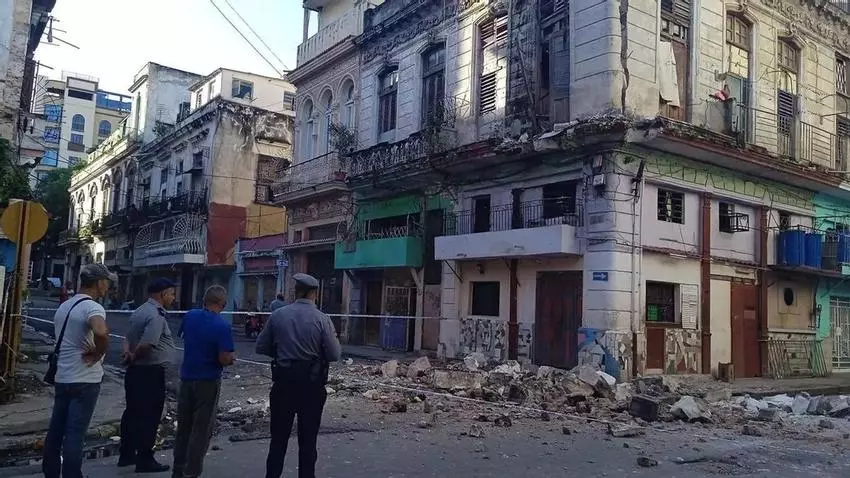
10/12 Building collapses are now part of everyday urban life. Every week, a building gives way, a balcony falls, a family is displaced. The city ages through a combination of gravity and neglect. 14ymedio
11/12 Housing insecurity is an open wound. Despite the mass exodus, thousands of families continue to live amidst leaky roofs, shoring up structures, and the constant fear that their roofs will give way. 14ymedio
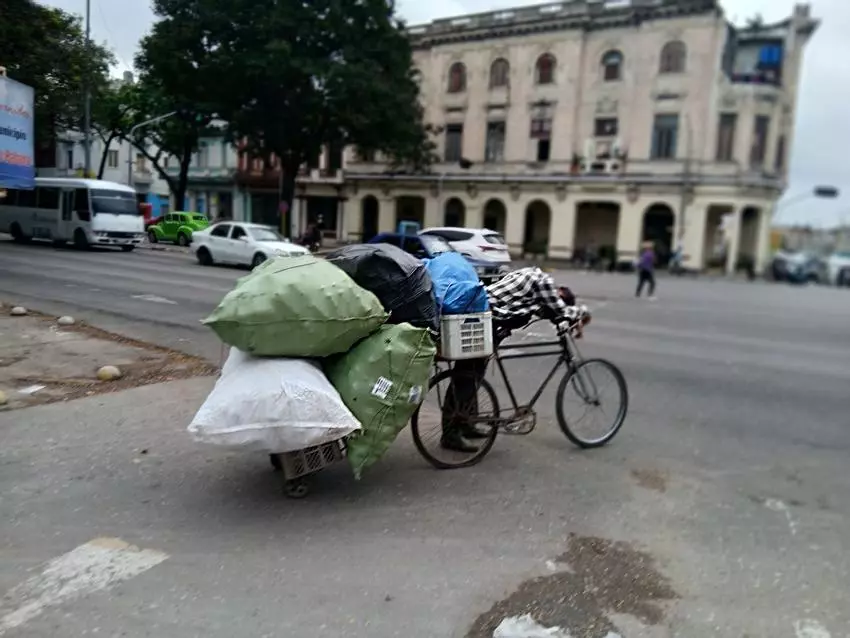
12/12 Havana is also this exhausted man, stopped on his bicycle. We don’t know if it’s work fatigue or the virus—the one that stiffens muscles and routines—that immobilizes him. But his posture perfectly encapsulates a city that reaches its 506th year exhausted, yet still clinging to the hope of moving forward. 14ymedio

14ymedio, 17 November 2025

Translator: GH

____________

COLLABORATE WITH OUR WORK: The 14ymedio team is committed to practicing serious journalism that reflects Cuba’s reality in all its depth. Thank you for joining us on this long journey. We invite you to continue supporting us by becoming a member of 14ymedio now. Together we can continue transforming journalism in Cuba.

With the Swine Fever in Spain, Cubans Could Run Out of Pork by the End of the Year

The disease detected in Catalonia has forced the suspension of exports to 40 countries

The price of pork will rise as the Christmas festivities approach. / 14ymedio

14ymedio bigger14ymedio, Havana, November 29, 2025 — The outbreak of African swine fever in groups of Catalan boars has forced the Spanish government to suspend 120 health certificates for the export of various pork products to 40 countries, including Cuba. The ban covers meat and pork products, sausages, hams, pig fat, offal, genetic material, semen, breeding pigs, feed materials, piglets for fattening, intestines and pig embryos.

African swine fever is a highly contagious viral disease affecting only domestic and feral pigs. It is not transmitted to humans but causes hemorrhagic fever and high mortality in infected animals. Because of its easy spread and devastating impact on farms, countries impose strict trade restrictions whenever an outbreak occurs.

Spain has not had a case of swine fever since 1994. The current outbreak causes it to lose its African swine fever (ASF)-free status from the World Organization for Animal Health, and, therefore, its products can no longer carry this certificate.

Spain has not had a case of swine fever since 1994

However, not all countries react in the same way to an ASF outbreak. Some large importers, such as China, which is the largest purchaser of Spanish pork, accept regionalization, which means that they will only restrict imports from the affected area, in this case Catalonia, allowing the rest of the Spanish territory to continue exporting normally. This is not the case in Cuba, which does not apply this principle and imposes a total ban on pork products as soon as an outbreak of the disease is detected anywhere in Spain.

The situation hits the pockets, already punished, of Cuban families. / 14ymedio

The unexpected outbreak is a severe blow to Spanish pig producers and also for Cuba, which depends almost entirely on imports to meet its meat demand due to the collapse continue reading

of its own industry, which is at historical lows. Spain is, since 2023, the main supplier of pork to the island, followed by the United States and Brazil. We will have to see how these health measures affect Cuban tables, at least for those who can afford it this year. The temporary loss of this key supplier coincides with a Cuban market already under pressure from shortages, rising food prices and persistent weakness in domestic production.

A pound of boneless pork exceeded 1,000 pesos this November

In most of the country’s agricultural markets, a pound of boneless pork exceeded 1,000 pesos this November, and, as is usually the case, its price will rise as the festivities approach. The suspension of purchases from Spain will make the traditional end-of-year dish even more unaffordable.

So far, there is no official pronouncement by the Cuban health authorities on whether or not the entry of pork products from Spain through travelers or personalized shipments will be maintained. This is a common technique to introduce food into the country, which since 2021 is maintained with a tariff exemption for “non-commercial” import of medicines and food. The situation is aggravated by the proximity of the Christmas dates, when demand for pork meat, sausages and ham grows. This extraordinary situation may hit the pockets of Cuban families hard at end of this year.

Translated by Regina Anavy

____________

COLLABORATE WITH OUR WORK: The 14ymedio team is committed to practicing serious journalism that reflects Cuba’s reality in all its depth. Thank you for joining us on this long journey. We invite you to continue supporting us by becoming a member of 14ymedio now. Together we can continue transforming journalism in Cuba.