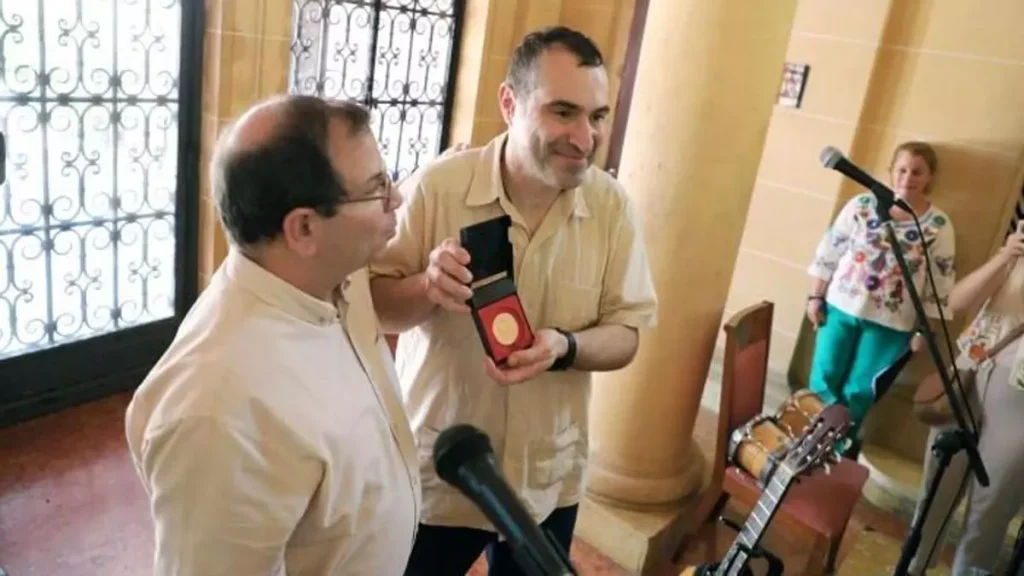
Henry Constantín has been invited to receive the award in Sweden, but he will not be able to travel because Cuban authorities are keeping him under ‘regulation’.
Part of the ‘La Hora de Cuba’ team, headed by Henry Constantín [far right] / Facebook14ymedio, Havana, April 29, 2026 / The magazine La Hora de Cuba [Cuba’s Hour] was awarded the Civil Rights Defender Award 2026 by the Swedish organization Civil Rights Defenders (CRD) on Wednesday. The award recognizes the publication, directed by Henry Constantin, for its “exceptional resilience and courage in defending freedom of expression, free and independent journalism, and democracy.” The Georgian platform Netgazeti was also among the recipients of the award .
As CRD highlights in its press release, La Hora de Cuba “operates in one of the most closed media environments in the world.” It notes that on the island, “independent journalism is, in practice, criminalized,” yet the platform works “immersed in the reality it reports.” Similarly, the organization continues, “they document arbitrary arrests, political trials, and how repression permeates daily life—stories that state media do not tell.”
On its website, the NGO highlights the work the media outlet has carried out for more than a decade, in which “hundreds of people have contributed, from journalists, artists and photographers. Many have been forced to stop collaborating after being arrested, interrogated or receiving threats against their families. Others have left the country, but some remain.”
“Many have been forced to stop cooperating after being arrested, interrogated, or receiving threats against their families.”
Henry Constantín, who has suffered several arrests for his work leading La Hora de Cuba – just two in 2026 – has stated that his media outlet has received many “awards” before this one: “More than 40 arrests, hundreds of police summonses and interrogations, thousands of threats, several defamation campaigns, a few bans on leaving Cuba for years, continuous surveillance, vandalism against my house, physical violence and police accusations.
The communicator asserted that “these are the rewards that the Cuban regime has given us for sharing the truth for almost 14 years, the same number of years that a diverse team of people has accumulated with whom I have been able to build and maintain this media outlet in the extremely harsh conditions of rural Cuba.”
Regarding the Swedish award, he said the team is deeply grateful, as it “strengthens us to continue sharing freedom and information from deep within the country, from Camagüey and every city where our team operates. Thanks to the dozens of Cubans who have worked with La Hora de Cuba over the years , thanks to the thousands of people who read us daily, and thanks to my family, always by my side.”
He also said that, “for La Hora de Cuba, this award means increased visibility and also greater responsibility. People as far away as Sweden, who work with activists and journalists in difficult situations around the world, believe that we at La Hora de Cuba deserve it. That means we must take our work even more seriously.” continue reading
“I don’t plan to leave Cuba. I’m going to continue working here, doing journalism for the freedom of Cuba.”
The award ceremony is scheduled for May 18 in Stockholm, Sweden. Although Constantín—who received the 2021 Press Freedom Award from the Inter-American Press Association (IAPA)—has been invited to attend, he will be unable to travel because Cuban authorities have kept him under travel restrictions since 2019, prohibiting him from leaving the country unless he emigrates, an option he rejects. He reaffirmed this stance after his latest arrest: “I don’t plan to leave Cuba. I’m going to continue working here, doing journalism for freedom in Cuba.”
For Iris Mariño, deputy director of La Hora de Cuba and who was under house arrest for participating in the Island-wide 11 July 2021 protests, the award “signifies that fear cannot be an obstacle in your life. Living under a dictatorship and having been subjected by the repressive apparatus to various acts of psychological, verbal, and even physical violence has not been the defining factor in my daily life. Every repressive action I have experienced, every obstacle, has made me desire freedom and democracy for Cuba even more and work towards achieving it.”
Regarding the Georgian media outlet Netgatzeti, CRD points out that one of its founders, Mzia Amaglobeli, has been in prison since last year for practicing journalism in a country that has been warned to be on the verge of a dictatorship, following the Georgian Dream party’s rise to power in 2012.
Mzia Amaglobeli has been in prison since last year for practicing journalism in a country that has been warned is on the verge of a dictatorship.
The award, a benchmark in Europe in the area of human rights, has been given since 2013 to those who defend civil rights in restrictive environments.
La Hora de Cuba is the first media outlet in the Americas to receive the recognition and the second organization to obtain it on the continent, after the Venezuelan NGO Foro Penal, dedicated to the registration of detentions for political reasons and free legal defense, won it in 2023.
Previous recipients of this award include Belarusian activist Ales Bialiatsky, [see also] who received it in 2014, eight years before being awarded the Nobel Peace Prize in 2022. At the time, he was imprisoned awaiting trial for “smuggling and financing actions that violated public order.” The human rights defender was sentenced to 10 years in prison but was pardoned last December, along with 122 other political prisoners, by Belarusian President Alexander Lukashenko.
COLLABORATE WITH OUR WORK: The 14ymedio team is committed to practicing serious journalism that reflects Cuba’s reality in all its depth. Thank you for joining us on this long journey. We invite you to continue supporting us by becoming a member of 14ymedio now. Together we can continue transforming journalism in Cuba.
The property was confiscated as part of the execution of the sentence handed down against the former deputy prime minister, who was sentenced to life imprisonment.
Laura Gil, the daughter, and Gina González wife of former minister Alejandro Gil Fernández / Facebook
The family of Alejandro Gil Fernández, Cuba’s former Minister of Economy, sentenced to life imprisonment for espionage, was evicted this Wednesday from their home in the upscale Havana neighborhood of Miramar. The two-story house, located on 24th Street between 1st and 3rd Streets in the Playa municipality, was occupied by the former Deputy Prime Minister’s wife, Gina González García; their daughter, Laura Gil González; his son-in-law, Álvaro Iglesias; and his young granddaughter, Laura and Álvaro’s daughter.
The property was seized as part of the execution of the accessory sanctions imposed in the sentence against the former deputy prime minister, including the confiscation of assets, as his sister, former broadcaster María Victoria (Vicky) Gil, confirmed to 14ymedio from Spain.
The operation began early, “around seven in the morning,” according to neighborhood sources cited by CubaNet, which documented the event with photographs. At least two trucks were parked in front of the property to load the family’s belongings, destined for their new home, Johnson 160, in La Víbora, Vicky Gil also confirmed.
“Laura is happy, despite all the difficulties, because she says that they never felt the house in Miramar was truly theirs.”
This is the Gil Fernández family home, which the former radio announcer herself had given to her niece when she moved to Spain. “The house has been closed up for two or three years, and it’s full of dust. The child has a terrible cold,” Gil told this newspaper, “but Laura is happy, despite all the difficulties, because she says that they never felt the house in Miramar was truly theirs, and that at least they’ve recovered the property, which they said they weren’t going to get back.”
Regarding this, she explains that during the trial, held in complete secrecy last November – in two separate sessions – “they said that I had made a fictitious donation to my niece, and that therefore the family home was part of the confiscated assets.” The Miramar property, the former radio announcer continues, was given to her brother when he was Minister of Economy and Planning, and in its place, “as a form of exchange with the State,” they handed over the family home, which was returned to them this Wednesday. continue reading
“It was legally proven that it was a legal act, a donation from aunt to niece,” which, she asserts, was made before a notary public in the municipality of Plaza de la Revolución, “with all the required legality.” This, she concludes, “they have been forced to acknowledge.”
Vicky Gil describes the property, inherited from her parents – Esperanza Fernández Castells and Miguel Ángel Gil Castilla – as “a nice apartment” built in 1958, which has been handed over to them “completely painted, doors, windows, ceilings, walls, in perfect condition.” The former radio announcer continues, “It has 80 square meters, a balcony overlooking the street with views of Parque de la Sola, two large bedrooms with built-in wardrobes, a shared bathroom, a very spacious living and dining room, a kitchen, a service patio, and a guest bathroom. It has no adjoining apartments.”
Vicky Gil describes the property as “a good apartment,” which has also been delivered “completely painted, doors, windows, ceilings, walls, in perfect condition.”
They were, certainly, a well-to-do family. Her father was a mining engineer and her mother a prestigious architect, who was part of, for example, the group of professionals involved in the design and construction of the emblematic Havana Bay Tunnel, built between 1957 and 1958. At the time of Fernández Castells’ death, Vicky Gil was living with her, and her brother relinquished his rights to the apartment, which is why it passed into the hands of the former radio announcer.
Agents deployed in the surrounding area prevented residents from recording or taking photographs, according to testimonies gathered by CubaNet. One account indicates that a woman who left her home with her cell phone was intercepted by a man who demanded to see the device’s gallery to verify that she had not recorded any images of the eviction.
The confiscation of Gil’s assets had already been confirmed by the Supreme People’s Court (SPC), although it did not publicly specify which properties would be seized. On December 8, 2025, the SPC issued the sentences against the former minister and imposed additional penalties, including asset confiscation, a ban on holding positions involving the administration of public funds, and the deprivation of public rights. At the end of January, the court upheld the convictions by rejecting the appeals filed by the defense. From that moment, the additional penalties could begin to be enforced.
Gil was initially sentenced to life imprisonment for espionage, acts detrimental to economic activity or contracting, bribery, theft and damage to documents or objects in official custody, violation of official seals, and breach of regulations protecting classified documents. In a second trial, he received a 20-year prison sentence for bribery as a means to commit falsification of public documents, influence peddling, and tax evasion. The combination of charges makes this one of the most serious cases against a high-ranking Cuban official in decades.
Before his rise to the Ministry of Economy, Gil had built a career within the state-run financial and insurance sector. British business records list him as a director, a position he has since resigned from, of three companies in the United Kingdom: Anglo-Caribbean Insurance Agents Limited, ACIA (UK) Limited, and Seaclaim Limited. This documentation proves his corporate positions between 2004 and 2010, although it does not, on its own, establish personal ownership or direct employment. The companies appear to be linked to the insurance and reinsurance sector in London, an industry associated with Cuban financial operations abroad.
______________________
COLLABORATE WITH OUR WORK: The 14ymedio team is committed to practicing serious journalism that reflects Cuba’s reality in all its depth. Thank you for joining us on this long journey. We invite you to continue supporting us by becoming a member of 14ymedio now. Together we can continue transforming journalism in Cuba.
The sister of the martial arts champion kidnapped by Cuban State Security denies the alleged complaints from neighbors
Mixed martial arts champion Javier Ernesto Martín Gutiérrez, known as ‘Spiderman’. / Facebook
14ymedio, Madrid, April 28, 2026 — “They call you crazy for shouting the truth to the world, for not being afraid.” Yuny, sister of mixed martial arts champion Javier Ernesto Martín Gutiérrez, known as ‘Spiderman’, has spoken out against the official justification for the violent arrest of her brother on April 24, after eight days of solitary protest from his home in Marianao (Havana).
The young woman completely rejects the version of events disseminated by the website Razones de Cuba to discredit him, namely, that the athlete is being held at Villa Marista, the State Security’s paralegal operations center, “for an evaluation to determine if he suffers from any disorder and to be able to help him.” The same publication revealed the harassment Spiderman‘s family received during the days of protest, but described it as a gesture of support: “Municipal officials approached the mother before the media spectacle, concerned about her son’s abnormal behavior.”
Furthermore, the wrestler’s neighbors were portrayed as victims “overwhelmed” by the athlete’s protests. “Meanwhile, in Marianao, neighbors sleep peacefully without shouting. In Villa Marista, a man receives a clinical evaluation, not torture,” concluded Razones de Cuba.
“All of Javier’s neighbors know him and know what he’s like, and I’d even venture to say that the neighbors are super proud of him.”
“That talk about the neighbors is a lie,” asserts Yuny Martín. His brother, for starters, she explains, lives in a place with few neighbors, on 31st Avenue across from the El Lido bus terminal, “across from an old Rápido [a cafeteria], one of the many that used to be in Cuba, and downstairs there’s just a bakery.” On the contrary, she affirms, “all of Javier’s neighbors know him and what he’s like, and I’d even venture to say that the neighbors are incredibly proud of him.” continue reading
Martín Gutiérrez, she continues, “has always been a very loved and respected young man, because he won everyone’s affection from a young age, so I seriously doubt everything that State Security wrote.” The woman is aware of how the system works. “They’re going to try to minimize Javier’s image as much as possible.”
The young man, she says, “what affected him most in this whole situation is precisely seeing that he has so many friends and loved ones and that everyone has his back.” The “disorder” argument, she argues, is easier to make “with someone who isn’t normally like that, shouting, having those kinds of outbursts, because it wasn’t common for him to do those things.”
“What affected him most in this whole situation is precisely seeing that he has so many friends and so many loved ones and that everyone has his back.”
Nobody imagined, she concedes, that Javier would be capable of protesting in that way, but everyone has to understand that “everyone gets tired”: “It was as I explained in a video: everything in life has a limit and what the Cuban is going through has never been seen.”
Before his arrest, the activist spent days shouting “Freedom!” from the solitude of his balcony, with no company but his cell phone and a mostly digital audience. “The communist system is dead! Did you see State Security? It’s you! Look at yourselves! Nobody’s coming!” he shouted toward the street, while challenging the police: “Come and get me! Shoot me with whatever you want!”
What the family did expect, starting with Javier himself, were the consequences of such a demonstration: “We knew from the moment Javier went viral on social media what was going to happen, especially because of who he is, because he’s an MMA [mixed martial arts] fighter, because he’s a national champion.” Yuny says, “My only role as his sister, because it’s my responsibility, because it’s my pain, was to help him. And to tell him a thousand times that I was incredibly proud of him for what he was doing.” However, she admits that in the last few days she asked him to stop the protest: “You have to stop, because in the end you see that you’re alone, nobody joins you, what we didn’t want was for it to get to this point.”
Yuny now asks that people continue to talk about her brother: “We can’t give up, because Javier is alive thanks to social media, and I’m not going to get tired of helping him. I’m going to go as far as I have to.”
______________________
COLLABORATE WITH OUR WORK: The 14ymedio team is committed to practicing serious journalism that reflects Cuba’s reality in all its depth. Thank you for joining us on this long journey. We invite you to continue supporting us by becoming a member of 14ymedio now. Together we can continue transforming journalism in Cuba.
Electric tricycle drivers in San José de las Lajas face long waiting times, few passengers, and rising costs that threaten their daily sustenance.
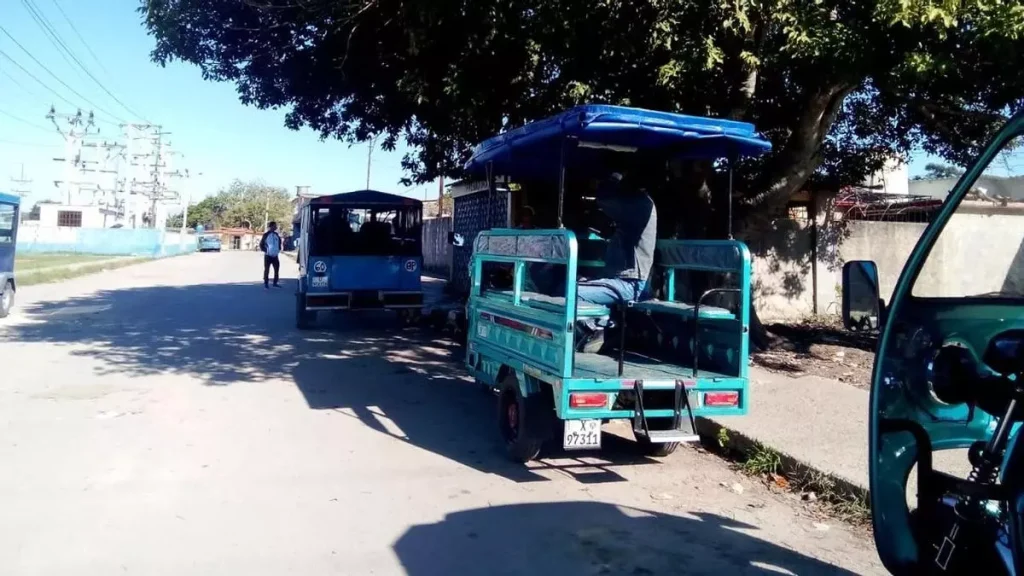
Tricycles at their starting point at the old train station in San José de las Lajas. / 14ymedio
14ymedio, Julio César Contreras, San José de las Lajas (Mayabeque), April 29, 2026 / The taxi stand at the old train station in San José de las Lajas wakes up before the rest of the city. At that early hour, when the sun is just beginning to warm the asphalt and the first bicycles listlessly cross the avenue, several electric tricycles are already lined up as if waiting for the order to leave. Under the green, blue, or red tarpaulins, the drivers converse in hushed tones, drink coffee from small plastic cups, and anxiously watch the road, waiting for the first customer of the day to appear.
“Most people have no idea how much time and money it takes to earn four pesos on these three-wheeled critters,” says Alexander, a tricycle driver who arrives early every day at the taxi stand without a fixed route. His vehicle, painted a bright blue and with a freshly charged battery, sits alongside others like it, forming an irregular line, like a small, makeshift parking lot.
Alexander explains that he always tries to arrive before 6:00 a.m. so the line of drivers isn’t too long and he has enough time to make a few trips before noon, when passenger numbers drop considerably. At that early hour, there’s still some activity: workers heading to their jobs, students with backpacks, and elderly people walking slowly to the pharmacy or clinic. But after nine or ten, the scene changes, and the taxi stand falls into a kind of lethargy. continue reading
“Although there are very few cars on the road, people can’t afford the luxury of spending 300 or 400 pesos either.”
His daily route can take him anywhere from Cotorro to Catalina de Güines, or even as far as Madruga, if he can find enough customers willing to pay the fare. Sometimes, these longer trips are the only way to make ends meet, because within the city itself, the rides are short and customers haggle over every peso. “Even though you see very few cars on the road, people can’t afford to spend 300 or 400 pesos to go from the farmers market to the Pastorita neighborhood,” he says. “We can’t ask for less than that either, because then it doesn’t add up. It’s a vicious cycle where everyone, in some way, loses out.”
The everyday scene around the terminal confirms his words. By mid-morning, several tricycles are parked in the shade of a leafy tree while their drivers seek refuge from the sun. Some check their battery cables, others discuss the price of spare parts. A young man gets out of his vehicle, stretches his legs, and observes the almost empty road with resignation.
The tricycles parked at the taxi stand confirm, indeed, that passengers are scarce. The line of vehicles seems frozen in a prolonged wait that can last for hours. “Giving rides is getting worse and worse, because the number of tricycles keeps increasing and the number of passengers is decreasing day by day,” says Ismael, sitting under the tarp of his motorcycle, shielding himself from the blazing sun. “It doesn’t matter if it’s Wednesday or Sunday anymore, the taxi stand is empty, and you have to be a magician to have a few bills in your pocket at the end of the day, because they disappear like water.”
The daily wage I’m earning is barely enough to buy the essentials for the house.”
The driver explains that he is seriously considering giving up passenger transport and dedicating himself to hauling goods for a local small business. He says his current earnings barely cover basic expenses. “What I make each day is barely enough to buy the essentials for the house,” he says. “If the tricycle happens to break down, I don’t have the money to fix it right now.”
This uncertainty is echoed by many drivers who see how the business, which seemed promising just a few years ago, has become increasingly unstable. The proliferation of electric tricycles has saturated the market, while passengers’ purchasing power continues to decline. The result is fierce competition for every customer that appears on the street corner.
On the other side of the coin are those who approach the tricycles, sweating, trying to negotiate a price that will give them some breathing room. At the side of the road, a man stops in front of one of the vehicles to ask how much the ride to his neighborhood costs. The answer elicits a gesture of displeasure and a brief exchange before the customer decides to continue on foot.
“I don’t understand why electric tricycles are as expensive as those that run on gasoline or diesel,” says Mario, a self-employed worker who makes the daily commute from his home in Tapaste to San José de las Lajas. He explains that he has to use this mode of transportation two or three times a week out of necessity, and the cost, which started at 200 pesos, has been rising rapidly, reaching 800 or 1,000 pesos at certain times and days. “There’s no stopping this,” he complains.
“I don’t understand why electric tricycles cost as much as those that run on gasoline or oil.”
For Mario, the solution to the problem doesn’t necessarily lie in stabilizing fuel prices or increasing the presence of state inspectors who control the prices of fares. In his view, the key is to restore a public transportation system that offers real alternatives to citizens. “As long as transportation is in crisis, anyone with three or four wheels will think they have the right to charge whatever they want,” he emphasizes.
Meanwhile, daily life in San José de las Lajas remains marked by waiting. The electric tricycles sit lined up at the taxi stand as if they were part of the urban landscape, silent witnesses to an economy that barely moves. Under the relentless midday sun, the drivers gaze at the horizon with patience and resignation, hoping that the next passenger will appear at any moment and allow them to set off again.
______________________
COLLABORATE WITH OUR WORK: The 14ymedio team is committed to practicing serious journalism that reflects Cuba’s reality in all its depth. Thank you for joining us on this long journey. We invite you to continue supporting us by becoming a member of 14ymedio now. Together we can continue transforming journalism in Cuba.
The study omits the responsibility of the regime, which has drained the health sector of capital to invest in the construction of hotels for tourists.
Infant mortality on the island rose from 4 per 1,000 live births in 2018 to 9.9 in 2025 / ‘Cubadebate’
A report by the Center for Economic and Policy Research (CEPR), based in the United States, published this Monday, asserts that the tightening of US sanctions against Cuba since 2017 “was probably the cause” of the dramatic increase in infant mortality on the Island, which went from 4 per 1,000 live births in 2018, to 9.9 in 2025 , an increase of 148%.
The study, which from its title echoes the regime’s mantra in the face of any problem the country faces (US Sanctions and the Sharp Rise in Infant Mortality in Cuba), quotes Alexander Main, director of International Policy at CEPR and co-author of the report, who asserts that “Trump’s maximum pressure policy on Cuba has caused the death of many babies and, although we do not yet have data for the last few months, it is very likely that more babies are now dying, even at a higher rate than last year, as a consequence of the current US fuel embargo against Cuba.”
The research center, considered left-leaning, supported by economists such as Joseph Stiglitz and Robert Solow, and largely funded by donations, asserts that if the mortality rate on the island had remained at its 2018 level, “approximately 1,800 fewer babies would have died between 2019 and 2025.” The CEPR compares Cuba’s figures with those of countries like Argentina, Brazil, Colombia, Mexico, and Jamaica, which, with the exception of Brazil, experienced declines or leveling off in their rates.
However, without emphasizing it, the report –replicated by Cubadebate on its front page this Tuesday– ends up attributing a good part of the impoverishment of Cuba’s health system to the pandemic –and not to the US embargo– noting that “the growth of the gross domestic product (GDP) per capita was -10.7% in 2020, one of the worst in the region .” continue reading
It ends up attributing much of the impoverishment of Cuba’s health system to the pandemic, and not to the US embargo.
“Unlike most other countries in the region and around the world, Cuba did subsequently experience a sizable post-COVID rebound during the years that immediately followed. Average annual GDP per capita growth from 2020 to 2024 was just 0.4 percent, as compared with the regional average of 3.2 percent. During this period, the quality of health care and access to health care services in Cuba sharply deteriorated amid widespread shortages of medicines and medical supplies and amid the departure of many health professionals,” the report states.
At no point do the authors point out that the Government continues to send thousands of doctors on international missions and that the sale of these services has served in the last decade to finance the construction of luxury hotels for a tourism sector in full decline, rather than dedicating those funds to improving the quality of health care.
For the preparation of the report, CEPR staff visited health centers in Cuba in the spring of 2024 “and observed firsthand some of the mounting challenges that the health care sector was experiencing. There were shortages of basic, critical medical supplies, such as syringes, inhalers, and even saline solution.”
“We met a young doctor who lamented being the only graduate from his class that was still practicing medicine in Cuba, and he attributed this to the shrinking wages for doctors.” Newly graduated doctors, can earn 5,060 pesos, insufficient for the most basic necessities, considering that a carton of 30 eggs can cost up to 3,000 pesos.
It attributed the problem “to the decrease in doctors’ salaries”
“At the National Oncological Institute we learned that medical staff were having great difficulty obtaining basic laboratory chemicals and were unable to access spare parts for radiotherapy equipment; as a result, they were unable to treat many cancer patients in a timely manner. The institute once had a total of 60 medical physicists (who were specialized in cancer treatment) and now had only 16. They previously had 16 anaesthesiologists and now had only five,” the center elaborated.
The report briefly reviews the chikungunya and dengue epidemic that struck Cuba last year, claiming the lives of mostly minors. “The severity of these outbreaks is likely a product of the sanctions,” the text states, omitting, first, the government’s dismissive attitude toward the initial reports flooding social media, including deaths, from mid-year onward, and its silence regarding the magnitude of the problem, which was only seriously addressed at the end of last year, almost four months after the outbreak began.
Nor does it mention that these arboviral diseases, which normally have a relatively low mortality rate, became a greater threat due to the country’s deteriorating hygiene, sanitation, and food conditions. The combination of epidemic outbreaks, a lack of medical resources, insufficient medicines, and the nutritional vulnerability of many children created a scenario that authorities now recognize as a public health emergency.
Another point not addressed by the CEPR is the consequences of government decisions, as the problems plaguing the healthcare system are not solely a result of the “blockade” or the pandemic. Dr. Ernesto René, who worked for 34 years in the Maternal and Child Health Program (PAMI) in Ciego de Ávila, warned as early as 2021 that experienced professionals were being lost “due to policies and decisions made by provincial directors that were completely misguided and lacked both scientific basis and experience.” He added that staff were not being cared for, and that “the lack of motivation has led to job abandonment, which has resulted in mortality rates unacceptable in the country for this century, leading to secondary problems such as depression among the families of those who lose a baby or their mother.”
The problems facing the health system have not only been a consequence of the “blockade” or the pandemic
The research center, in one of the report’s conclusions, points out that the current US fuel embargo, which has prevented almost all fuel shipments from reaching Cuba, “has further worsened an already critical situation.”
A country’s infant mortality rate is considered a key indicator of a population’s overall health and access to quality healthcare. Therefore, the country’s figures are disheartening, given that a decade ago, Cuba’s rate was among the lowest in the Western Hemisphere, even lower than that of the United States, at 4.3, compared to a regional average of 15.6 and a US rate of 5.8.
______________________
COLLABORATE WITH OUR WORK: The 14ymedio team is committed to practicing serious journalism that reflects Cuba’s reality in all its depth. Thank you for joining us on this long journey. We invite you to continue supporting us by becoming a member of 14ymedio now. Together we can continue transforming journalism in Cuba.
The activist launches a new Cuban Orthodox Liberal Party from her exile in Madrid
Known for her social media posts denouncing the crisis on the island, Amelia Calzadilla is committed to developing a national proposal for a post-dictatorship scenario. / 14ymedio/Courtesy
14ymedio, Luz Escobar, Madrid, April 28, 2026 / From exile in Spain, Cuban activist Amelia Calzadilla has taken a step that marks a turning point in her career: the launch of her own political project, the Cuban Orthodox Liberal Party. Known for her social media posts denouncing the crisis on the island, she is now committed to developing a national proposal for a post-dictatorship scenario.
Calzadilla herself positions this step as the result of a personal evolution marked by conflict with the establishment. In a recent social media post (with over 17,000 reactions and 2,000 comments), she writes that in 2022 she didn’t consider herself an opposition member or activist, but rather a mother dissatisfied with the state of the country. She also shared this perspective in an interview with 14ymedio, shortly after arriving in Spain, over two years ago.
However, she maintains that the harassment, threats, and smear campaigns against her ultimately pushed her toward political activism. This process, she affirms, has now culminated in the creation of this party, which she defines as a center-right liberal proposal, with an emphasis on José Martí’s ideals, justice, dignity, and the free market, although she says she will reveal the details of its platform and the people who have joined it on May 19th.
“Anyone who wants to join needs to know that we are starting from scratch and that we will have to figure out how to make it viable through our own efforts.”
She asserts that she hasn’t sought funding for the project from anyone. “There isn’t a single peso, literally,” she confesses. “Anyone who wants to join needs to know that we’re starting from scratch and that we’ll have to figure out how to make it viable through our own efforts.”
14ymedio: Why create a new political party instead of merging into an existing one? And why do it now?
Calzadilla: This wasn’t a decision against other projects, but rather a personal and political necessity. Although several initiatives exist within the opposition, they are often not visible enough, or their proposals don’t reach the population clearly. In Cuba, leaders are better known than political programs, and this leaves a significant void.
Creating a political party is, in essence, about organizing ideas for the country and putting them on the table. It doesn’t guarantee governing, but it does allow citizens to have real options to choose from in a democratic future. It also responds to the need to break with the idea that only an elite can engage in politics. Every citizen should be able to build and defend a political project. continue reading
The timing is also a factor. I sense that the system is in a phase of exhaustion and that it is necessary to prepare for the “day after.” It is not enough to confront the regime; we have to think about how the country will be rebuilt when that change occurs.
14ymedio. Your party’s name includes the term “orthodox,” which refers to Cuban political history. What does it mean in your case?
Calzadilla. The term has no connection to the Orthodox Party of the 1940s or to any specific historical figures. It is used in its original sense: returning to the basics, in this case to the principles of classical liberalism. The intention is to make it clear that this is a project centered on ideas such as individual liberty, not on past ideological currents or leftist movements. If there were any name overlap with other organizations, changing it would not be a problem. It is not a question of prominence, but of consistency.
It is a project designed for a democratic Cuba, not for the immediate transition.
14ymedio. What are the fundamental principles of your political proposal?
Calzadilla. It’s a project designed for a democratic Cuba, not for the immediate transition. It’s based on the idea of limiting the role of the State and promoting the free market, private property, and individual initiative.
It also acknowledges that the country is going through a profound crisis, so any transformation will require a complex period of reconstruction. Even so, the goal is to prevent the perpetuation of citizen dependence on the state, because that limits their freedom, even when it comes to voting.
Ultimately, it’s about striving for a society where people can thrive without economic or political constraints, and where decisions are made with genuine freedom. The program’s main points will be presented on May 19th so that anyone interested in joining can do so.
14ymedio. Which sectors of the population is your party trying to reach?
Calzadilla. It is not aimed at any specific group. The idea is for it to be a project for all Cubans, both on and off the island. The defense of individual liberty and economic development should benefit all of society, regardless of differences. It is true that many people initially gravitate toward it out of personal affinity, something common in politics, but the intention is that support be based on the content of the project, not on the person promoting it. The goal is to move from denunciation to concrete solutions.
The existence of multiple projects should not be seen as a problem, but as a natural expression of plurality.
14ymedio. How does your initiative stand in relation to other opposition actors and projects such as the Council for Democratic Transition, which you collaborate with?
Calzadilla. The existence of multiple projects should not be seen as a problem, but as a natural expression of pluralism. In a democracy, different proposals can coexist and even collaborate on common goals.
In my case, I may agree with other actors on issues such as the defense of human rights or the release of political prisoners, but that doesn’t mean all projects have to be integrated or fully compatible. This party isn’t designed for the transition, but for a later scenario.
Ultimately, it will be the citizens who decide which project represents them. The important thing is that real options exist and that the idea that Cuba’s future depends on a single structure or leadership is abandoned.
14ymedio. Does it not seem naive to start a political party without money?
Calzadilla. Yes, you’re absolutely right. But you know what happens? If I don’t believe in this, nobody else will, and what usually happens is that you start certain projects without any funding, and then the funding gradually appears. I can’t speak to current or potential members of the party without having presented them with a funding proposal. Because that’s surreal: people don’t trust you or give you money just like that; sensible people listen to your proposals, they either identify with them or they don’t, and if they do, then they make their respective contributions.
On the other hand, I have the duality and advantage of my communication skills. I want to expand my communication channels so that the money generated will allow me to have more resources available to use for the party as well, as a form of self-financing. It’s not some crazy idea of someone saying, “Well, let’s think about this and see what happens,” knowing full well that everything requires resources. Now, I’m fortunate that there are well-intentioned people around me who are willing, for the moment, not to earn money from this party and still wanting to contribute to it. That alone speaks to the need we Cubans have to participate.
______________________
COLLABORATE WITH OUR WORK: The 14ymedio team is committed to practicing serious journalism that reflects Cuba’s reality in all its depth. Thank you for joining us on this long journey. We invite you to continue supporting us by becoming a member of 14ymedio now. Together we can continue transforming journalism in Cuba.
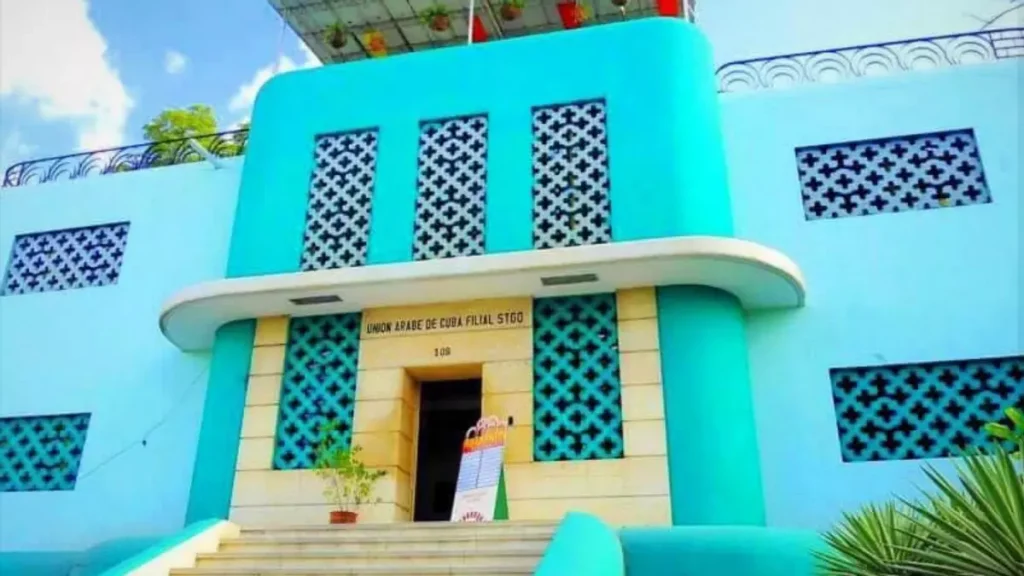
The ‘New York Times’ interviews a descendant of a family of industrialists from Santiago, Cuba, who lost a railroad, a sawmill, a shipyard, a cement factory and a farm, valued at nearly $900 million
Former Babún estate, now home to an Arab civic association in Santiago de Cuba. / Facebook
14ymedio, Madrid, 28 April 2026 / Along with political prisoners and internet access via Starlink, the US government maintains a specific demand in its talks with the Cuban regime: compensation for confiscated properties. The amount totals nearly $9 billion, calculated from an original estimated value of $1.9 billion plus 6% annual interest. The bill is impossible to pay, although Havana has responded: If Washington compensates with the $181 billion it estimates the damage caused by the embargo to be, there will be no problem.
The gap between the two positions is long-standing, and this isn’t the first time an attempt has been made to resolve it, but there has never been an agreement, and as time goes on, the difficulty only widens. Teo A. Babún, Jr., knows this well. He is the heir to a family of industrialists who left the island after the triumph of the Revolution. His grandmother managed a large house in Santiago de Cuba, where eight children and twenty-one grandchildren lived, before she left everything behind.
And that is a lot: a railroad, a sawmill, a shipyard, a cement factory, and the farm. Her assets represent 10% of the amount certified by the State Department in its overall claim, valued at $874.2 million in 2018. “We have to find a solution that protects the current occupants if it’s a home and doesn’t displace anyone. And at the same time, justice must be served,” Babún Jr. acknowledges in a report published Tuesday in The New York Times about this long-standing issue.
Raúl Castro himself came to live on the estate, which is now the Arab House, headquarters of an association with a restaurant included.
Raúl Castro himself lived on the property, which is now the Casa Árabe, headquarters of an association with a restaurant included. Ironically, the Babún family was of Lebanese origin. “If someone owns something and then takes it away without any compensation or recourse, it’s simply not fair. My family just wants justice,” he adds.
At 78, he has finally completed a project he began long ago to create a registry to help the State Department pursue claims. He stopped when he had processed 8,000 cases, which were a drop in the ocean. Of the 6,000 cases certified by Washington, ten involve giants, including five sugar companies. The claimants include such well-known names as Exxon, Coca-Cola, and continue reading
Colgate-Palmolive.
The NYT takes a look back at some of the times a possible solution has been addressed, starting with the one in the 1960s. “Cuba did not have the cash to pay and, instead, offered long-term government bonds, which the United States considered neither a prompt nor an adequate solution,” says William LeoGrande, a professor at American University and author of a book on the history of negotiations between the United States and Cuba.
In the 1990s, several experts put forward different proposals, including the creation of public-private funds to rebuild Cuba’s electrical grid and the use of some of the profits to compensate former owners, according to Jason Poblete, an attorney representing both American and Cuban owners. This type of arrangement worked in countries like Vietnam and Germany, where assets frozen in the U.S. were used to pay claims. This was not the case in the USSR or China, where owners recovered very little.
During the era of the thaw in relations, the Obama administration also attempted to find a solution to the issue, but it failed due to the regime’s disconnect from the reality of the problem. “The Cuban government didn’t seem to understand. They would ask me, ‘Richard, why are you making such a big deal about something that happened 50 or 60 years ago?’” says Richard Feinberg, a researcher at Florida International University who was in Havana to conduct a study on property claims. “This shows how little the Cuban government understood about economics and capitalism. They didn’t understand private property,” he adds.
“This shows how little the Cuban government understood about economics and capitalism. They didn’t understand private property.”
The NYT spoke with other affected individuals, including Lisandro Pérez, a Cuba expert at John Jay College of Criminal Justice in New York and author of a memoir about his family’s home in Cuba. Pérez laments that some Cubans who remained did receive some form of compensation for their losses, which was not the case for him.
Nicolás J. Gutiérrez, a Cuban-American lawyer in Miami, recounts estimated losses of $50 million in 1960. His properties included two sugar mills, 15 cattle ranches, a rice mill, a coffee plantation, a bank, an insurance company, and a wholesale food distribution company.
Now, as a member of the National Association of Cuban Landowners in Exile, he is working on the lawsuit against Expedia for operating hotels built on confiscated land. Although he has never been to Cuba, he believes that if things change, his family will try again to revive the island’s economy.
“We’ve waited a long time for this moment and for the right conditions to arise,” says Enrique Carrillo, heir to the owners of the Santa Cruz rum distillery. “My father worked tirelessly for many years to build the company, and I don’t intend to give up. My family doesn’t intend to abandon its history.”
Meanwhile, a NYT correspondent in Havana visited El Vedado, where Nicolás J. Gutiérrez’s family owned a building. There, neighbors—like the experts themselves—reject the idea of the properties being returned. One of them, Jorge González Amores, is emphatic: “If they left the country, that means they weren’t interested in the building.”
______________________
COLLABORATE WITH OUR WORK: The 14ymedio team is committed to practicing serious journalism that reflects Cuba’s reality in all its depth. Thank you for joining us on this long journey. We invite you to continue supporting us by becoming a member of 14ymedio now. Together we can continue transforming journalism in Cuba.
For asylum seekers, approval rates have fallen by 99%. / EFE
14ymedio “I can’t go back to Cuba because it’s uninhabitable: there’s no electricity, it’s impossible to find food, and, most importantly, I’m the one supporting my brothers and sisters,” Rosa, an economist in Cuba and a cook in Miami, told the Miami Herald. “However, I can’t get ahead in this country either.” Her case puts a face to a study published this Monday by the Florida newspaper, which confirms the massive drop in green card approvals for Cubans in the US.
Since December 2024, the decline is 99.8%, according to data from the Cato Institute, which emphasizes that the Trump Administration has practically “ended green card concessions for Cubans.” In October 2024, permanent legal residency was approved for 10,000 people from the island, compared to just a few dozen per month at the end of last year.
Simultaneously, Immigration and Customs Enforcement (ICE) arrests increased from less than 200 per month at the end of 2024 to about 1,000 per month in the same period of 2025. According to these data, the growth in arrests is 463%.
In January 2026, ICE detained 1,008 Cubans and approved residency for 15 of the 7,086 applicants who filed their applications.
The most extreme contrast occurred precisely in the last month covered by the study: January 2026. That month, ICE detained 1,008 Cubans and approved residency for 15 of the 7,086 applicants who filed their applications. Four were rejected, and the remaining thousands ended up in the vast backlog of Cubans who, like Rosa, are still awaiting a decision that could end very badly for them. continue reading
“A necessary factor for mass deportation is taking away people’s right to stay. And the legal immigration system is the path for people to remain in the United States, which is why they’ve targeted it,” David Bier, director of immigration studies at the Cato Institute, told the Miami Herald . “Once you don’t have legal status and there’s no way for you to stay, you either get deported or you self-deport,” notes the report’s author, who emphasizes that the Trump Administration’s policies attempt to persuade migrants to leave.
The Miami Herald article points out that, although Cubans are among Trump’s most ardent foreign supporters, some of his policies are unpopular. A poll published by the newspaper —conducted by Bendixen & Amandi International and The Tarrance Group—revealed that 79% of Cubans residing in Florida would support a military intervention on the island, while 67% support Trump’s administration.
However, they showed strong rejection (68%) of deportations of undocumented immigrants without criminal records and strongly support (81%) facilitating migration.
The Miami Herald cites Rosa’s case as an example. She arrived from Matanzas in 2023 thanks to one of the Joe Biden Administration’s immigration programs and, after a year in Homestead, with her son’s endorsement, submitted her application to take advantage of the Cuban Adjustment Act.
“I’ve submitted my paperwork, but everything has stalled. This uncertainty is agonizing,” she told the media outlet.
“I’ve submitted my paperwork, but everything has stalled. This uncertainty is agonizing,” she told the media outlet.
The Cato report has detected declines in green card approvals for applicants from all countries, not just Cuba. Overall, the reduction is in half. Furthermore, there has also been a 20% decrease in residency permits granted through family reunification. Even worse is the situation for asylum seekers, whose rates have fallen by 99%.
The delays – also linked to staff cuts, according to Cato – expose hundreds of thousands of people to arrests and possible deportations, as well as constant fear for both them and their employers, who face penalties if they hire undocumented immigrants.
______________________
COLLABORATE WITH OUR WORK: The 14ymedio team is committed to practicing serious journalism that reflects Cuba’s reality in all its depth. Thank you for joining us on this long journey. We invite you to continue supporting us by becoming a member of 14ymedio now. Together we can continue transforming journalism in Cuba.
Some 96% consider political change “extremely urgent” and 82% point to the lack of freedoms as the country’s main problem.
The magnitude of the survey results leaves no doubt about the state of opinion among the Cuban population. / 14ymedio
14ymedio, Havana, April 27, 2026 — The online survey promoted by the independent media outlet El Toque —supported by more than 20 independent media outlets and coordinated by journalists and social scientists—to gauge opinions on the country’s political and social situation has exceeded initial expectations. In less than three days, it has already accumulated more than 29,200 responses, well above the 10,000 projected by the closing date of May 1.
Of the total, 59% of the participants are located within Cuba – 17,240 at this time, according to the anonymous geolocation detection of the digital platform – despite the difficulties of connection and the state control of internet access.
The results released this Monday—which can be viewed live at this link —reveal overwhelming rejection of the current political model in Cuba. 96% of those surveyed consider political change on the island “extremely urgent.” 94% are “very dissatisfied” with the system of government, and 90% describe Cuban state policies as “completely inauthentic.”
Only 4.7% of those surveyed mentioned the US embargo as one of the country’s central problems.
When asked about “Cuba’s main problems today,” the numbers are striking: 82.4% identify limitations on civil and political rights as the country’s primary problem, even surpassing the economic crisis, cited by 52.9%. Government inefficiency and inaction also rank highly at 75.2%, while 47.7% denounce institutional corruption. In contrast, the US embargo appears far behind: only 4.7% mention it as a central problem, a stark contrast to the official narrative of the Cuban state.
The perception of a disconnect between power and the citizenry is widespread. Ninety-five percent of those surveyed claim to have no influence on government decisions. Regarding trust in the main political figures of the State, on a scale of 1 to 5 ranging from “no trust” to “full trust,” the average score is extremely low: 1.1. When asked to identify leaders with “favorable performance,” the most frequent response is “none” and “nobody.” continue reading
When imagining a transition, the rejection of current structures is almost absolute: 99% would eliminate the Communist Party, 98% the business system of the Armed Forces, and the same percentage would dismantle the State Security apparatus and state control of the media.
Some 99% would eliminate the Communist Party, 98% the business system of the Armed Forces, 98% would dismantle the State Security apparatus and state control of the media
Some 76.8% believe the country should transition to a liberal democracy with a market economy, while only 0.1% support the socialist system as it stands. Even including those who believe socialism should be reformed, support for that model does not exceed 1.4%.
As a means to resolve the internal political conflict, 60.4% of Cubans on the island support the overthrow of the government “by any means necessary,” including armed struggle. Of all those surveyed in the diaspora, 70.4% voted for this option.
Some 21.3% of all respondents prefer a negotiated transition, and only 10.1% trust peaceful mobilization as the main tool.
Regarding the role of the US and international influence in achieving political change in Cuba, 47.1% support maintaining the US embargo as a pressure tool – 44% within Cuba, 51% from the diaspora – while another 24.4% advocate for its gradual elimination.
Of Cubans on the island 60.4% support the overthrow of the government “by any means necessary,” including armed struggle.
More than a quarter of those surveyed (27.5%) support direct US military intervention. When this figure is broken down by Cubans abroad and Cubans on the island, the numbers are similar: 26.7% of all respondents within Cuba and 28.7% of Cubans in the diaspora vote in favor.
There is also consensus on what to preserve from the current system during a transition, with 73% prioritizing universal healthcare and education. An additional 68%—an identical figure among Cubans both on and off the island—vote in favor of preserving national sovereignty and independence from foreign powers.
Although the organizers themselves warn that the survey is not probabilistic and is conditioned by unequal access to the internet, the volume of responses and the strength of the figures make it a significant indicator of citizen discontent.
Some 68% – the same figure among Cubans outside and inside the Island – vote in favor of preserving national sovereignty and independence from foreign powers
The state-run media outlet Razones de Cuba has reacted with a smear campaign , attempting to discredit the survey by contrasting it with the pro-government mobilization “My Signature for the Fatherland,” promoted by President Miguel Díaz-Canel, an initiative that has already been denounced for the coercion it exerts on citizens to seek support.
Cuban researcher and journalist Hilda Landrove noted in a post on social media that, despite the limitations of any survey in a restrictive environment like Cuba, and even applying high correction margins, the magnitude of the survey results leaves no doubt about the state of opinion of the Cuban population inside and outside the country.
Amelia Calzadilla, director of Citizenship and Freedom Training and one of the promoters of the survey, told Martí Noticias that the response patterns themselves demonstrate a demand for greater citizen participation in political life.
The level of dissatisfaction with government management is above 95%.
For Calzadilla, the fact that the lack of civil and political liberties appears as the country’s main problem, according to those surveyed, reflects the population’s desire to “participate in order to fix” (the situation). The activist interprets the volume of responses as a symptom of accumulating social discontent and a willingness to express opinions directly when relatively safe channels are opened.
“If you review the survey, you’ll see that the level of dissatisfaction with the government’s management is above 95% of the participants. It’s producing very strong numbers,” the activist states.
COLLABORATE WITH OUR WORK: The 14ymedio team is committed to practicing serious journalism that reflects Cuba’s reality in all its depth. Thank you for joining us on this long journey. We invite you to continue supporting us by becoming a member of 14ymedio now. Together we can continue transforming journalism in Cuba.
Testimonies gathered by ’14ymedio’ in several Havana neighborhoods demonstrate the low turnout at the tables where people could sign spontaneously
At a table collecting “signatures for the Homeland” in the Parque de Línea y L, in El Vedado, there is zero turnout / 14ymedio
14ymedio, Havana, 26 April 2026 — The Observatory of Academic Freedom (OLA) denounced a “coercive pattern” in the island’s academic spaces to participate in the “process” called “My signature for the Fatherland,” initiated a week ago by President Miguel Díaz-Canel himself, with which the regime intends to counteract the pressures of the United States for a change in Cuba.
In a statement, the OLA reported that, “in Cuba, it is an institutionalized practice for political organizations to condition the permanence, evaluation and job stability of students and teaching staff in exchange for their participation in propaganda activities, in a flagrant distortion of the academic space.”
The NGO compiled a list of academic institutions where this modus operandi was replicated. It noted that at the Hermanos Saíz Montes de Oca University of Pinar del Río, a call was issued on April 19th for participants to “participate in an act of repudiation of the economic, commercial, and financial blockade imposed by the United States, and in favor of peace.” According to the Observatory, students and professors were instructed that, upon completion of the activity, each participant should “sign a form.”
According to the Observatory, students and teachers were instructed that, upon completion of the activity, each participant should “sign a form”
This event was repeated in other higher education institutions. In Havana, the Enrique José Varona University of Pedagogical Sciences published a post on its official Facebook page declaring that “Varona signs. On the 65th anniversary of the victory at Girón, we sign! In the centennial year of Fidel, we sign!” continue reading
Another similar case was reported at the Bauta Municipal University Center, which stated that its employees “demonstrated their loyalty to the nation.” On social media, it added that the signatures not only accompany a process, but also “show that universities are bastions of ideas, defense, and national dignity,” because “defending the nation also means teaching, serving, and signing when required.”
Other institutions, such as the Carlos Rafael Rodríguez school in Cienfuegos and the Oscar Lucero Moya school in Holguín, also joined the campaign, stating that their students and faculty participated in “support for the Revolutionary Government.”
During the closing of the V Patria Colloquium – an official world meeting of communicators in Havana, dedicated to the centenary of Fidel Castro’s birth – the head of the Ideological Department of the Central Committee of the Communist Party, Yuniasky Crespo, called for the collection of signatures in support of the Cuban Government.
The OLA emphasized that the Ministry of Higher Education and universities across the country have “echoed the campaign”
The OLA emphasized that the Ministry of Higher Education and universities across the country have “echoed the campaign.” It also stated that, although the ministry claims this is a “Cuban civil society initiative,” it was conceived within the PCC and launched at a political event.
“To understand why universities are required to participate in the collection of signatures, it is important to remember that their autonomy was abolished in 1962, with the Higher Education Reform Law, despite being an internationally recognized principle that allows higher education institutions to serve as spaces for critical thinking, free from external or internal ideological interference,” the OLA recalls.
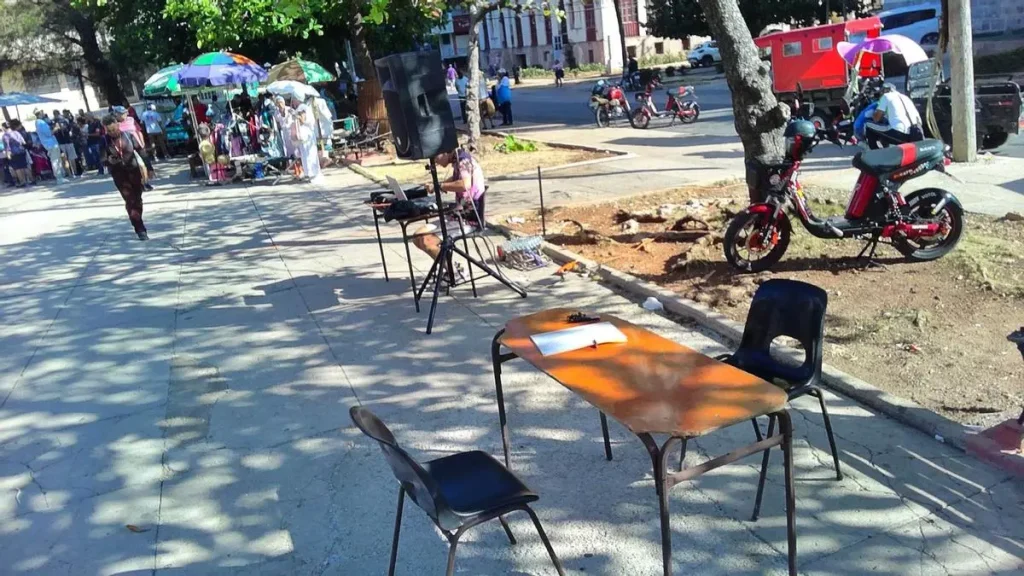
The requirement to sign can be explained by the fact that, in many cities, there is little to no participation at the registration booths set up by the authorities. 14ymedio has gathered testimonies in several Havana neighborhoods that demonstrate the almost nonexistent turnout at the locations where people could sign more spontaneously.
State workers have also reported being coerced into signing , having received the order from the start of the campaign. “They didn’t set up signing points at workplaces, but rather at the library, the cultural center, and other locations. Now, companies are telling them they have to go there to sign,” an employee from the province of Sancti Spíritus, who preferred to remain anonymous, told 14ymedio last Monday.
“They set up points at the library, the cultural center, and other places; companies are already telling them they have to go there to sign up.”
Likewise, the Committees for the Defense of the Revolution (CDR) have mobilized to go house to house. “They came to my mother’s door, and she, being very old, signed. Who knows what they told her? I already told my husband not to even think about opening the door,” recounted a resident of Ciego de Ávila.
The woman compared it to what happened in 2002, following the Varela Project launched by Oswaldo Payá, when then-President Fidel Castro ordered the CDRs to force citizens to sign a “counter-project” that ended up crystallizing in the Constitution “the irrevocable and inviolable character of socialism,” which popular humor dubbed “constitutional mummification.”
The campaign comes at a time of crisis and criticism of the Díaz-Canel government, which is seeking to legitimize its continued rule. The fuel shortage has affected key sectors such as transportation, electricity generation, and water supply.
______________________
COLLABORATE WITH OUR WORK: The 14ymedio team is committed to practicing serious journalism that reflects Cuba’s reality in all its depth. Thank you for joining us on this long journey. We invite you to continue supporting us by becoming a member of 14ymedio now. Together we can continue transforming journalism in Cuba.
MIGUEL COYULA / “Looks like AI” was the comment from an American friend, a Democrat, on sending me a photo of young Cubans with red MCGA caps (Make Cuba Great Again). Certainly when I saw the image, I instinctively felt a profound sense of unease.
At first, I thought the caps were a collage, then that they had been made in Miami. Then I considered the possibility that the Cuban regime had created them with AI to discredit the internal opposition. If the caps were real, would any small or medium-sized enterprise (SME) have risked making them in Cuba, or would they have been sent from abroad? But in reality, the image contained a much more disturbing artificiality, the extrapolation of which almost bordered on cognitive dissonance. After almost 70 years under the most recent and enduring dictatorship, young Cubans were alluding to a symbol that had become dogma for another authoritarian and fascist-like government. Absolute devotion to ideologies leads to a creed, a religion. The heralds of communism and capitalism preach political dogmas that some embrace fanatically, while for others, the definitions of left and right are exchanged at will, in an increasingly ephemeral way and subject to economic interests.
To mention just a few examples, Donald Trump (at one time a member of the Democratic Party) is now a convicted Republican president, has supported the genocide in Gaza, is responsible for releasing his followers who stormed the Capitol of his country, killing police officer Brian Sicknick. Two more recent deaths are those of citizens Renee Good and Alex Petrie, whose uniformed assassins have yet to be brought to justice. ICE, Trump’s personal army, has propagated xenophobia and repression, deporting more than three million immigrants, including Cubans. His desire for global economic domination, disguised as a “liberator” was already evident in Venezuela and Iran, and it appears that Cuba and Greenland are next.
Trump’s anti-intellectual posture has led some academics to declare him an idiot. His favorite author, Ayn Rand, erected a monument to egotism. I always found it revealing when Roark, the protagonist of The Fountainhead, declares, “No one has a right to a minute of my time,” before dynamiting a housing complex intended for low-income residents. It seemed also to served as inspiration for Elon Musk when he recently said that empathy is a weakness, as if the heroic entrepreneurs of Atlas Shrugged were revealing their true colors.
Roark’s case is interesting because his compulsive determination to preserve his individuality initially resonates with any young person unwilling to follow dogmas. His arrogance could have portrayed him as full of contradictions, a tragic antihero. But the dramatic premise collapses due to Rand’s insistence on turning him into a heroic figure, to the point of becoming inhuman, a kind of ventriloquist of Objectivism, complete with a happy ending. Personally, I’ve never been interested in heroic narratives; I don’t believe in them in art, much less in politics. I’m much more interested in Nietzsche, for his interest in the contradictions of the individual, and not claiming to have the final answer regarding a social model. Perhaps that is why, unlike Marx, his ideas didn’t generate a massive political movement, or in Rand’s case, why her Objectivism has taken root among the neoliberal elites.
Trump isn’t an idiot, but he certainly knows how to talk to idiots. While Fidel Castro sold humanist ideals, Trump promised neoliberal materialism with economic prosperity for all. Both are aligned with seemingly opposing ideologies, yet equally abstract in their physical manifestation. The sociopathic traits of both point to rampant megalomania. One at the helm of a small island, the other leading an empire through executive orders.
Fidel Castro also had expansionist ambitions, in Algeria, Congo, Ethiopia, Angola… He was criticized by many who today call for a military intervention in Cuba by a foreign power. Perhaps underdevelopment, as Edmundo Desnoes wrote, is the inability to connect things and accumulate experiences. It may also be that many have no problem whatsoever with annexationism.
Latin America has historically been the United States’ backyard. Simultaneously, the failure of the Cuban revolution is now more evident in the cultural and political illiteracy of the majority of influencers. The immediacy of the Cuba they present generally appears as an isolated phenomenon, divorced from global complexities and subject to binary reductionism. One of the MCGA guys says that the mayor of New York is a communist, which suggests that his only source of information is Fox News. And in an even more absurd contradiction, they claim not to idolize any politician. Cuba and its problems are, for them, the center of the universe, the worst place in the world, the only one worth talking about and saving. The reality is that Cuba has never been “Great.” There was a republic, yes, led by former liberators from the War of Independence, most of whom became thieves or dictators.
MCGA, MAGA’s new affiliate in Cuba, seems to ignore this. Its Fuera de la caja, Outside the Box, movement derives from an alien ideology and language, unintentionally confining itself to another box due to its own lack of authenticity and of new ideas, something one would naturally expect from a young person.
The reasons these young people invoke Trump’s slogan could be many: naiveté, ignorance, opportunism, cynicism, or simply something far more disturbing… emptiness. The Cuban people are so fed up with the current dictatorship, their senses so dulled, that if Hitler were to rise from the dead and promise to “liberate Cuba,” some might even wear swastikas. That, too, is the new man. Beings incapable of feeling and thinking as citizens of the world, who embrace the nearest invasive globalization as a symbol of freedom in the face of the material and political suffocation of the Cuban regime. They ignore that the violation of sovereignty means a green light for the expansive techno-feudalism of other empires: Russia over Ukraine, China over Taiwan. But the political sense of this Cuban seems to be governed by the programmed range of a traffic light. There is no long-term vision in their thinking. Fortunately, there are other young people on the island who also oppose the regime from a completely different perspective. Unfortunately, they are the minority in a sea of slogans, taken from what could be an Ayn Rand libertarian manual, corrupted by Javier Milei.
I’ve heard automated justifications from various people, such as, “I don’t care. What I want is for the dictatorship to end and for the political prisoners to be freed.” Perhaps if you’re an activist or a politician, that’s the ideal stance: “Unite instead of divide.” But by prioritizing a top-down goal, you’re eliminating the critical thinking necessary to prevent history from repeating itself.
The Cuban government has ineptly announced sanctions, prohibiting pro-Trump demonstrations in Cuba, as if unaware that its unpopularity will provoke a backlash from many. From a conspiratorial perspective, such ineptitude might appear to be a transitional strategy in the face of another kidnapping, stampede, or negotiated surrender.
That said, raiding a home, arresting a person, intimidating them, professionally destroying them, or inducing them into exile simply for expressing a political opinion is unacceptable.
We have endured almost seven decades of similar abuses by a system that still preaches a facade of social justice, blaming the embargo as the sole cause of all its inefficiency, internal corruption, and systematic violation of citizens’ rights.
My great-grandfather was a delegate to the constituent assembly in 1939. During the drafting of the Constitution, despite being an atheist, he proposed the initial invocation of God in consideration of the beliefs of the majority of the population. I am not my great-grandfather. I am not a politician. I am simply a citizen who distances himself from another imminent creed, in the same way that I have distanced myself from the Cuban regime. I believe in the freedom of expression of the young MCGA members, as well as in my own. We share the desire for the end of this regime, but I want to make it clear that they do not represent me. They are not the cause but rather the consequence of the failure of the left, championed by the Cuban regime for its global marketing. The reason for this text is to put an end, in this era of imminent change, to the attempts to align me with Trumpism (the only US president, at least recently, to have a political movement named after him) through private messages, petitions, and invitations to forums. But this also is not nationalism. I’ve always considered myself an iconoclast. I reject anything that smacks of uniform, be it Che Guevara berets or MAGA caps. Perhaps these three stills from my film Blue Heart (2021) best illustrate my point.
The recently concluded Málaga Film Festival was the scene of controversies. Actor Jorge Perugorría, a resident of Cuba, spoke about how the Trump administration’s new measures were suffocating the island. He was criticized by filmmaker Ian Padrón, who lives in the United States, for not mentioning the Cuban government’s responsibility as the true culprit. Both have a point, but neither side tells the whole story. Certainly, the dysfunction of the Cuban regime is undeniable. But the recent measures implemented by the Trump administration have also profoundly affected the daily lives of Cubans. The restriction on oil imports has led to greater fuel shortages, hindering public transportation and driving up the prices of private transport. Electricity is even more intermittent, affecting food refrigeration and water supplies. The prices of food and medicine have increased. The humanitarian crisis already existed, but it is impossible to deny that it is now more severe, and that it is the people, not the rulers, who suffer the most in their daily lives.
Trump’s strategy seems like manipulating animals in a coliseum, starving them so they devour the gladiators. On the same topic, filmmaker Pavel Giroud, who lives in Spain, commented in Málaga that “the enemy of my enemy is my friend,” arguing that during World War II no one questioned Europe’s alliance with the United States. This raises an interesting point, because these days one can’t speak of an alliance with the country, but rather with Trump personally. This president usurps the three branches of government established in the nation’s constitutional principles, dictating, or rather, firing off executive orders without consultation. But his followers exclaim, “He’s not a dictator!” Another colleague in Madrid privately remarked, “Transitions are always a mess.” These are all comments divorced from the physical reality of the island.
Cuba produces 40% of its national crude oil. Faced with this suffocation, it is the people who continue to suffer under this blockade, not the elite leaders, nor the police or the army. They will always be given priority in repressing an increasingly weakened population. Meanwhile, the Cuban regime, which had already lost considerable credibility, is now being revived for the reactionary left as a victim of imperialism in the form of humanitarian aid that never questions the island’s rulers, perpetuating a David-versus-Goliath struggle that further weakens the already diminished internal opposition.
Finally, there’s the human question. Every day I see vulnerable people driven to despair by the escalating crisis, but all of this seems to be considered mere collateral damage. I have lived abroad, and it is true that time, distance, and social media with its algorithms distort and polarize reality.
Facebook is a necessary evil, but its use must be limited. Lynn Cruz recently blocked Humberto Castro, a Cuban painter and fervent supporter of Donald Trump’s policies. We have also deleted or blocked followers or collaborators of the Cuban regime. Our work is barely exhibited in Cuba or Miami, but fortunately, we haven’t needed either of those powers to make our way in the rest of the world. Until very recently, I didn’t truly understand that making a living doing what we love without compromising artistic integrity could be an enviable freedom. Since Castro was a painter, one would think that perhaps art would unite them, but curiously, their only interaction—reactive interaction—is about politics. So, if there is nothing in common, what’s the point of virtual friendship? Some people complain when we delete them, but it’s nothing personal. With our terrible internet connection, receiving a notification to load a page can be torture, especially when you end up facing a repeated message.
I almost always use Facebook sporadically, just to share news about my films, festivals, awards, reviews, etc. When I shared the first version of this text, a user on the site named Jacobo Londres tagged me on his page while sharing my text, saying, “Bah, same old soft crap. Coyula wants Cuba freed, but doesn’t want it to be Trump.” Since he wasn’t my friend, his eloquence made me think he was just another troll, and I simply blocked him to avoid further notifications. Later, Lynn told me that Londres was a virtual alter ego of Javier Marimón, a writer with whom I had exchanged a couple of emails more than two decades ago regarding a possible film adaptation of one of his texts. When I replied that I was busy adapting Memorias del desarrollo (Memories of Development), he responded, “They say it’s utter crap.” I never heard from him again until now, 20 years later. Just before finishing this piece, I had just shared the video that Cinema Tropical had asked me to make to announce Crónicas del absurdo as the best Latin American documentary of the year at the annual awards ceremony held at Lincoln Center. In that video, I criticized the Cuban regime and Trump’s techno-feudalist policies; perhaps that’s where the unease began. In any case, the fact was revealing: In all these years of posting cultural news, Marimón’s only reaction, now living in London, was prompted by this, a political opinion piece, which seems to highlight his true motives.
To a certain extent, I can understand why many Cuban emigrants applaud Trump, but in doing so, they declare themselves indifferent to the physical reality of their compatriots, friends, and family on the island. An island where most never dared to dissent while living under the iron grip of its institutions. And this Castro-Trumpist limbo of reconcentration (to quote Lynn Cruz) could extend indefinitely, just as the conflict in Iran has, projecting itself as a process of attrition similar to Vietnam. While the US economy begins to collapse, many continue to applaud the world’s policeman, the conqueror of the universe, with his brand-new Department of War, the same person to whom María Corina Machado gifted her Nobel Peace Prize.
In this case, the burden falls on the Cuban people, not their leaders. Everyone hopes for Cuba’s liberation, unaware that they will most likely witness only a change of facade, the removal of the repressive figure who issued the order to attack the population on July 11th, but, as in Venezuela, replaced by another Delcy Rodríguez who will sign off on economic submission to Trump. Those who expect a president who bypasses Congress and the Senate to be interested in bringing democracy to Cuba are deluded. This demonstrates that true freedom is of interest to very few. The sad truth is that the promise of economic improvements is enough for a silent majority to tolerate yet another dictatorship. Mike Hammer, the US mission chief in Havana, was recently cheered at the Church of Our Lady of Charity in Regla, announcing the spread of the gospel as another weighty dogma on the political chessboard of the imminent new-archaic-society heir to all Latin American corruptions, quoting the cynical protagonist of my novel The Vertical Island: “An ideal of progress that we would live after the change that many called democratic.”
As a filmmaker, I make movies controlling every detail of their staging. But unfortunately, being able to appreciate them in a theater, the format for which they are designed, is something I’ve only been able to do outside the island. After years of censorship, change would benefit me. Even as a source of inspiration, I’d finally have new politicians to rail against. But I’m thinking about more than just myself. I wish that in the midst of this situation, an independent, internal political voice would emerge, someone who doesn’t follow in the footsteps of Castro or the volatile Trump. The social democracy of many Nordic countries, while not perfect, I consider to be the most humane model currently available. The ideal model hasn’t been created yet, nor can I, or intend to, imagine it. I think the best governments are those that are unobtrusive. Good administrators don’t have to worry about being strident. I know that’s probably another utopia: We are Cubans.
Miguel Coyula (1977) is a Cuban filmmaker and writer. He has created his work without institutional support, employing a multidisciplinary approach. His notable films include Red Cockroaches (2003), Memories of Development (2010), and Blue Heart (2021). His work is banned in Cuba. The magazine Cineaste describes him as “…someone whose innovative and challenging way of understanding cinema is not here to appease or flatter. It is here to sting.”
With most international flights suspended due to the US energy embargo, the island received only 35,561 visitors last month.
A small group of Russian tourists in Havana on February 13, just as the cancellation of flights from that country was announced. / 14ymedio
14ymedio, Madrid, April 27, 2026 – In the first quarter of the year, Cuba has lost almost half the number of tourists it attracted during the same period in 2015, a year that was very negative for the sector that has received the most budgetary resources in recent decades. So far in 2026, 298,057 international travelers have arrived on the island, compared to 573,363 last year, a drop of 48%.
While the figure is negative on its own, the situation becomes even more dire when analyzing just the month of March. Only 35,561 visitors arrived in Cuba, a dramatic figure, given that in the same month of 2020 —with half the world under lockdown due to the coronavirus pandemic—189,431 foreigners arrived on the island. Only in 2021 , when Cuba imposed strict measures due to the worsening COVID-19 situation nationwide, was the figure even worse, with the arrival of 12,542 international travelers.
March has traditionally been an excellent month for the tourism sector, so much so that in 2018 it was the best month of the year, with 510,760 visitors. The record figure, 530,615, was reached in 2017, although that year it fell short of December, when 551,371 visitors were recorded—the highest figure ever for one month in Cuba. Although the situation in this sector has not recovered since the pandemic, both 2023 and 2024 saw significantly more than 250,000 foreign visitors, and March was again the best month in both years.
Before the pandemic, March tourism figures were extraordinary for Cuba. / Onei
All these figures highlight the blow that Donald Trump’s decision to veto fuel shipments to Cuba represents for the island. This measure, adopted on continue reading
January 29, led airport authorities to issue a NOTAM informing that all international terminals lacked jet fuel from February 10 to March 11. The alert has had to be extended for the same reason.
In February, when the news broke, airlines announced suspensions, cancellations, and evacuations, in that order, of tourists in Cuba. Some companies that had initially intended to maintain their flights ended up backing out in less than 48 hours, and all Canadian and Russian airlines focused solely on repatriating passengers. Canadian airlines evacuated more than 10,000 people from the island on various return flights out of the 24,559 who were in Cuba throughout February. Meanwhile, Russian airlines—the second largest source of tourists to Cuba— evacuated 4,300 out of a total of 7,314 that month.
Others, like the Spanish airlines, starting with Iberia, decided to maintain their routes and refuel in the Dominican Republic, but this option has also proven unsustainable. The Madrid-based airline announced on April 13 that it would reduce frequencies in May and suspend all flights to Cuba in June, something that in its 60-year history had only occurred during the company’s severe financial difficulties (2012) and during the pandemic.
March was thus the first month in which Cuba felt the full impact of the flight suspensions. Canadian tourists continue to lead the list thanks to their cumulative numbers, although if we do the math, only 511 Canadians traveled to the island this March, 99.48% fewer than in the same month last year (98,663). In the first quarter, the number has fallen by 54.2%. Russians, the island’s second most important market, only totaled 249 travelers last month.
The largest number of arrivals in March came specifically from Cubans living abroad. There were 11,231 exiles who returned to the island last month.
The largest number of arrivals in March came specifically from Cubans living abroad. There were 11,231 exiles who returned to the island last month, and although this quarter’s decline is 42.8% compared to the same period last year, it is by far the only market that has withstood the economic downturn. Paradoxically, Americans are also a significant presence, with 5,243 tourists: ten times more than Canadians.
Some of the other nationalities that have contributed include Spain, with a paltry 1,429 travelers—a welcome boost in this situation—and China, with 1,102. Argentina, which had been gaining travelers after an intense promotional campaign, also saw a significant increase. Now, in this impossible context, the number of travelers is no higher than last year, but it still represents a considerable sum given the situation in Russia and Canada: 1,622 travelers.
In this challenging environment, the regime is trying to maintain a positive image and is stirring up excitement for FitCuba international trade fair next week. The fair for the sector is traditionally held in Havana, but this year it will take place virtually, beginning on the 7th and 8th, from 9:00 am to 7:00 pm, and concluding with a special event on the 9th from Varadero, with free admission for the public.
According to the exultant official press, the event is “aimed at exceeding all expectations” and “hundreds of tour operators and travel agencies from around the world have confirmed their presence, including those who have never participated before.”
Registered participants can visit digital booths and watch presentations or compete in gastronomy and cocktails. However, judging by the figures, the most challenging aspect seems to be “gathering real-life experiences from customers who enjoy the destination during those days.”
______________________
COLLABORATE WITH OUR WORK: The 14ymedio team is committed to practicing serious journalism that reflects Cuba’s reality in all its depth. Thank you for joining us on this long journey. We invite you to continue supporting us by becoming a member of 14ymedio now. Together we can continue transforming journalism in Cuba.
“Nobody knows for certain where truth ends and where invention begins”
In Montevideo, in the late 1980s, one such story was making the rounds. / Imagen creada con inteligencia artificial
14ymedio, Milton Chanes, Berlin, 26 April 2026 — Every city holds stories that never appear on maps. Tales that survive the passage of time, whispered and retold, each version slightly altered—as if every storyteller adds something new or erases a detail. No one knows exactly where truth ends and invention begins. But that has never been the point.
In Montevideo, in the late 1980s, one such story was making the rounds.
Sundays had their own ritual. The sound of the newspaper hitting the door, the smell of fresh ink, the coffee just brewed. And among all its sections, there was one many people read almost out of habit—sometimes out of necessity, sometimes just out of curiosity: El Gallito Luis, the classified ads section of El País.
Everything could be found there.
From improbable job offers to forgotten objects, from strange services to ads that seemed written more on impulse than logic. It was, in a way, an intimate portrait of the city. People searching, selling, exchanging—trying to solve something.
That morning, Isabel flipped through the supplement without much attention. She turned the pages quickly, pausing only briefly on the occasional curious ad, until one—small and almost lost among the others—made her stop.
It wasn’t the car that caught her attention. She didn’t even know what a 500 SEL was. But she knew that something about that price, tied to that brand, was impossible.
She read it again. More slowly this time, as if the meaning might change upon repetition.
One dollar.
It didn’t even look like a typical typo. No missing zeros. No strange symbols. It was simply… one.
The ad didn’t stand out. It wasn’t bold, nor did it take up more space than the others. And yet, it carried something unsettling. Something that didn’t fit.
Isabel lifted her gaze from the paper, her brow slightly furrowed, as if trying to solve a silent riddle.
—Alberto… —she said, without taking her eyes off the ad—. Did you see this?
—See what?
—The Mercedes ad.
—Yes, I saw it. But that car isn’t worth one dollar —Alberto replied, trying to sound reasonable—. There must be a mistake.
Isabel looked at him calmly.
—I’m going to call the number.
—What for? It’s obviously an error. No one would sell a Mercedes-Benz for a dollar. Even wrecked, the parts alone would be worth more.
—It’s not wrecked. It says it’s in perfect condition —Isabel said, already dialing the number on the cordless phone.
Her husband shook his head in disbelief. When she got something into her head… continue reading
He had been planning nothing more than a quiet Sunday
—Good morning, ma’am.
—Good morning —a woman’s voice answered on the other end.
—I saw your ad in El Gallito Luis and was wondering if the car is still available.
Alberto lowered the newspaper slightly, trying to catch the conversation.
—Honestly, no one had called yet. I thought the ad hadn’t been published.
—Oh, it has. Don’t worry.
—Are you interested?
Alberto turned his head. Those phones carried sound in a way that left little to the imagination.
—Yes, we are. We could come see it. My husband will come with me.
Alberto pointed at himself, silently mouthing: Me? What do I have to do with this?
He had been planning nothing more than a quiet Sunday.
—Of course —the woman said—. But it has to be today.
—That’s fine. Would now work?
—Perfect.
—Give me your address and we’ll head over.
Alberto stared, incredulous at this spontaneous trip.
—Thank you, I’ve got it. We live almost an hour away. Is that alright?
—No problem. I’ll be waiting. Bring your IDs.
“Bring that lucky dollar bill you keep in your wallet. Maybe today it finally pays off.”
The line went dead.
Isabel took a deep breath. She had the feeling she was about to buy a Mercedes-Benz. She didn’t care what it looked like. It was a Mercedes. And for one dollar.
Alberto went back to his newspaper, still shaking his head.
—Come on, what are you doing? Get dressed, we’re going.
—You’re actually going to buy a Mercedes?
—We’re going to see it. Grab your ID. She asked us to bring documents.
—And the money?
—Bring that lucky dollar you keep in your wallet. Maybe today it finally pays off.
Still unconvinced, Alberto figured at least it would be a Sunday outing… and they set off toward Carrasco.
“She hadn’t imagined it would be something this beautiful.”
One hour later.
—There’s the house. What a house.
—We’re wasting our time. There’s no way it costs one dollar.
A woman came out to greet them.
—Good morning.
—Good morning, ma’am. We spoke on the phone. My name is Isabel, and this is my husband, Alberto.
—Nice to meet you. Please, come in —she said, gesturing for them to enter the front garden.
—So, you have a Mercedes-Benz for sale?
—Yes, it’s here in the garage. Come with me.
Alberto and Isabel exchanged a glance and followed her. She took her time opening the gate. There it was—the car, covered by a heavy, dark tarp.
—Could you help me? —she said, looking at Alberto.
—Yes, of course. Excuse me…
As they pulled the cover away, there it was: the stunning 1983 Mercedes-Benz 500 SEL.
Alberto couldn’t help but exclaim:
—Incredible! It’s an impressive car.
Isabel smiled, delighted. She hadn’t imagined it would be something this beautiful.
The woman ran her hand slowly across the hood, almost involuntarily.
—It was my husband’s favorite car. He took care of it like it was another child.
Alberto looked at her.
—Was?
—He passed away two weeks ago —she said, with a calmness that seemed rehearsed from repeating it so often—. A heart attack. It was very quick.
Isabel felt the garage shrink slightly.
—I’m very sorry, ma’am.
The woman nodded briefly, like someone accepting a condolence she had already heard too many times.
—Thank you. Thirty-four years of marriage.
A brief silence followed. Then the woman composed herself and looked at them with a polite smile.
—So, are you interested in the car?
—Of course —Isabel said.
—But this car isn’t worth one dollar —Alberto said, looking at the woman with a mix of confusion and caution—. There must be a mistake.
The woman shook her head gently.
—There’s no mistake. For me, that’s what it’s worth. One dollar.
Alberto let out a small, uncomfortable laugh.
—Ma’am… I’d gladly buy it, but I feel like I’d be taking advantage of you.
She held his gaze, firm.
—You’re not taking advantage of me. I’ve decided on that price. And besides… it’s important that the sale happens today. Tomorrow will be too late.
Isabel, who had been quietly observing until then, stepped forward.
—Why would tomorrow be too late?
The woman hesitated for a moment.
—It’s something between my husband and me. Let’s just say… if we wait until tomorrow, everything would be different.
That hint of mystery was enough to hook Isabel.
—Can you explain?
—Yes —she replied—. But first, you have to buy the car.
—For one dollar? —Alberto asked, incredulous.
—For one dollar.
“Everything seemed right. Too right.”
Without adding anything else, the woman opened the car door and took out a folder from the seat.
—Here you are —she said, handing it to them—. It’s a document prepared by my notary. All the vehicle details are there. The only thing missing is the buyer’s name.
Isabel took the folder and began reading carefully. It was a typical draft of a purchase agreement: vehicle identification, terms, method of payment… everything in order.
—But this isn’t a final document —she said.
—No, not yet —the woman replied—. You fill in your details, sign it, and then we’ll go to the notary. He’s a family friend. He can finalize the deed today.
Alberto frowned.
—And we won’t run into any problems?
—None at all —she said with complete certainty—. The sale will be entirely legal.
Isabel looked at the document again. The buyer’s line was blank.
She glanced at Alberto. He hesitated for a second… then finally nodded.
Isabel wrote her name and ID number. Alberto did the same. Both signed.
Alberto took the dollar out of his pocket and handed it to the woman.
She shook her head.
—No. You don’t need to pay me. You’ll give the payment to the notary.
She paused briefly.
—If that’s alright with you, I’ll gather my things, call him, and we can go right away. He lives very close.
—Yes… of course —Isabel replied.
The couple looked at each other, still in disbelief. Everything seemed in order. Too much in order.
But the doubt was still there.
“I could fight it. But I decided to respect his final wishes.”
Isabel couldn’t hold back.
—Excuse me… now that we’ve signed the document… could you tell us why you’re selling it at that price?
The woman looked at her in silence for a few seconds. Then she spoke.
—Of course.
She took a deep breath.
—My husband had a mistress.
The air seemed to stop.
—We found out on Thursday… during the reading of the will.
Alberto blinked, surprised.
—The will?
—Yes. He left me this house… and another smaller one in Piriápolis. To my children, he left money and other properties.
She paused, barely noticeable.
—The car, however, he left to her.
Isabel frowned.
—Then… shouldn’t it be hers?
The woman gave a faint, bitter smile.
—In fact, yes. But my husband —she added—, who wasn’t exactly brilliant… wrote that I was to sell the car and give her the money.
Alberto and Isabel exchanged a glance.
—I could challenge it —the woman continued—. I could fight it. But I decided to respect his final wishes.
She looked at them steadily.
—And one dollar… is exactly what she’s going to receive.
The silence stretched on.
No one said a word.
The woman closed the folder gently.
—Let’s go —she said—. The notary is waiting for us.
By Milton Chanes
______________________
COLLABORATE WITH OUR WORK: The 14ymedio team is committed to practicing serious journalism that reflects Cuba’s reality in all its depth. Thank you for joining us on this long journey. We invite you to continue supporting us by becoming a member of 14ymedio now. Together we can continue transforming journalism in Cuba.
Cubalex warns that her physical and psychological integrity remains at risk despite the end of the protest
Góngora, sentenced to 14 years in prison, resorted to this extreme measure after nearly five years of repression since her incarceration. / Facebook
14ymedio, Havanam 24 Aril 2026 — Political prisoner Lizandra Góngora Espinosa, arrested for the Island-wide protests of 11 July 2021 [’11J’], ended her hunger and thirst strike on Friday. She had begun the strike on April 22nd at Los Colonos prison on the Isle of Youth, according to the Cuban legal organization Cubalex. The protest, which lasted 48 hours, was a response to the prison conditions, the lack of medical attention, and the prolonged isolation from her family.
Góngora, sentenced to 14 years in prison for her participation in the 11 July 2021 protests in Güira de Melena, resorted to this extreme measure after nearly five years of repression since her imprisonment. The hunger strike also constituted a direct response to statements by Cuban leader Miguel Díaz-Canel, who has denied the existence of political prisoners in the country.
The inmate herself announced the start of the protest to her family via a phone call from prison. Her decision generated immediate concern among human rights organizations due to the condition of her health. Góngora suffers from sickle cell anemia, a genetic disease that requires rigorous medical monitoring. Furthermore, during her incarceration, she has been diagnosed with a uterine fibroid that causes inflammation, intense pain, and bleeding. continue reading
The distance, coupled with the economic crisis and transportation limitations in Cuba, means that her family can barely visit her.
Prison authorities have systematically denied her a gynecological evaluation and the surgery she urgently needs. The lack of adequate facilities and medical staff has been the recurring argument used to justify the absence of treatment. Given this situation, her husband must use the few visits he is allowed to bring her basic painkillers to help her manage the pain. “Her physical and psychological well-being remains at risk,” the organization warned.
One of the main reasons for the complaint is her transfer in 2023 to Los Colonos prison, located on the Isle of Youth, far from her family in Artemisa. This measure has been punitive and has exacerbated her vulnerability. The distance, combined with the economic crisis and transportation limitations in Cuba, means that her family can only visit her every three or four months.
As a result, Góngora has not seen her children for more than four months, a situation that has severely damaged the family bond. The organization emphasizes that this type of separation contradicts international standards such as the Nelson Mandela Rules and the Bangkok Rules, which establish the need to place prisoners in facilities close to their homes, especially in the case of women with children.
The organization also warned about the risks faced by those who adopt these types of measures within the Cuban prison system.
The activist was sanctioned for the crimes of sabotage, public disorder, and sedition, charges that, according to Cubalex, do not correspond to her actions during the demonstrations and are intended to punish her for exercising her rights. Since her imprisonment, the organization has denounced a systematic violation of her fundamental rights, including harassment, reprisals, and precarious living conditions within the prison system.
The organization also warned about the risk faced by those who adopt this type of measure in the Cuban prison system, where strikes are often considered “indiscipline” and can lead to additional sanctions, including isolation.
Cubalex insisted that the Cuban state must guarantee adequate medical care, allow regular contact with her family, and cease all forms of reprisal. “Although she has ended her hunger strike, the underlying causes remain,” the organization reiterated.
______________________
COLLABORATE WITH OUR WORK: The 14ymedio team is committed to practicing serious journalism that reflects Cuba’s reality in all its depth. Thank you for joining us on this long journey. We invite you to continue supporting us by becoming a member of 14ymedio now. Together we can continue transforming journalism in Cuba.
A second convoy made up of activists from Italy, Switzerland, Mexico and the USA is received in Havana with a welcoming ceremony
Michele Curto, organizer of the May Day convoy, during the welcoming ceremony in Havana. / Granma
14ymedio, Havana, April 25, 2026 — Cuba’s state press continues to enthusiastically celebrate the arrival of meager international donations as gestures of “solidarity” in the face of the crisis gripping the island. These handouts of so-called “international support” are hailed as if they could compensate for a deficit that the model has been grappling with for over half a century: the inability to generate genuine economic autonomy.
On April 22, Cuba received a second European convoy of “solidarity aid,” 28 days after the Nuestra América convoy, which was received with so much propaganda surrounding it that it leads one to wonder if more resources were allocated to its promotion than to effective aid for the Cuban population.
This second convoy, called Primero de Mayo [May Day] and organized by the Agency for Cultural and Economic Exchange with Cuba, led by the Italian activist and businessman Michele Curto – also president of the joint venture BioCubaCafé SA – was received with a welcoming ceremony at the headquarters of the Cuban Institute of Friendship with the Peoples (Icap) in Havana.
“You give Cubans a grain of sand and they give you back the beach,” said Michele Curto himself at the event when he was presented, continue reading
in gratitude, with the commemorative seal of the 65th Anniversary of ICAP.
The handouts of so-called “international aid” are celebrated as if they could make up for a deficit that the model has been grappling with for over half a century.
Fernando González Llort, president of ICAP, acknowledged that the donation’s “symbolic value is of paramount importance.” At the same ceremony, Deputy Minister of Public Health Julio Guerra Izquierdo said, regarding last month’s shipment: “Although it doesn’t cover all of Cuba’s healthcare needs, it’s an immense relief.”
According to the EFE news agency, the new convoy—comprised of activists from Italy, Switzerland, Mexico, and the United States—brought to Cuba “donations of food, medical supplies, and educational materials.” The news report published in the official state newspaper Granma provides no details about the specific contents of the aid, other than the phrase “50 boxes of supplies for the Public Health system, among other things.”
This Saturday, Cubadebatealso reported that Russia delivered to the Cuban government a humanitarian shipment prepared by the government of St. Petersburg “consisting of a batch of medicines destined for hospitals and clinics on the island.”
Official ceremony for the handover of medical supplies donated by the Government of St. Petersburg at the Russian Embassy in Cuba. / Cubadebate
The article omits specifying what types of medications were included, their quantity, or how they will be distributed within Cuba’s dilapidated healthcare system, but it does show images of the few cardboard boxes containing the donation. The article emphasizes the political and symbolic gesture of the modest aid provided by St. Petersburg.
The handover ceremony was held at the Russian Embassy in Cuba. Ambassador Viktor Koronelli, personally presenting the donation to Cuban Minister of Public Health José Ángel Portal Miranda, emphasized that “this is not simply an act of humanitarian aid, but a clear demonstration of the deep and historic bonds of friendship that unite our peoples.”
Koronelli also insisted that the current health crisis in Cuba is “a consequence of the economic, commercial and financial blockade imposed by the US” and reiterated Russia’s opposition “to any form” of external pressure on Cuba.
Yesterday, Friday, the media also celebrated China’s donation to Cuban sports “as part of the close ties of friendship between the People’s Republic of China and the Republic of Cuba.” Another official ceremony was held at the Higher School for the Training of High-Performance Athletes (Esfaar) to receive the donation.
The accumulation of these “gestures of solidarity” normalizes the dependence on external donations that do not even truly alleviate the essential sectors of the Island
“It is a gesture that goes beyond the sports equipment and items we received today: it is a manifestation of solidarity and trust between two sister nations,” said Gisleydi Sosa, director of international relations at the National Institute of Sports (Inder), at the ceremony.
Once again, the specific details of the shipment take a back seat to the narrative of international cooperation: “Cuba is not alone.”
The Cuban regime is a constant recipient of international aid, where each shipment is publicly applauded as a significant relief, and yet the population continues to suffer the same shortages.
Decades ago, the official media triumphantly celebrated the “overfulfillment” of meager national production plans, but now what is celebrated is the receipt of handouts. The accumulation of these “gestures of solidarity” normalizes dependence on external donations that don’t even truly alleviate the needs of the island’s essential sectors.
If previously the propaganda celebrated production goals, today it celebrates the arrival of foreign aid
After more than half a century of centralization, the Cuban economy has functioned solely on external subsidies, unable to finance its imports with its own exports. Thus, from its inception, it depended on massive Soviet subsidies—which between 1960 and 1990 reached tens of billions of dollars—and in the 21st century, it has been sustained by Venezuelan oil.
The collapse of each of these “sponsors” – the USSR in 1991; Venezuela since January 3rd – has led to profound crises that end up being paid for by the Cuban population, forced into “resistance” and “resilience” by vertical order of the State, showing that the problem is not “cyclical” but structural.
Current donations from Russia, China, and sectors of the international left do not represent a solution. They are limited-scope stopgap measures that do not correct the structural dysfunction of the Cuban economy or the lack of genuine productive autonomy. While propaganda previously celebrated production goals, today it celebrates the arrival of foreign aid.
______________________
COLLABORATE WITH OUR WORK: The 14ymedio team is committed to practicing serious journalism that reflects Cuba’s reality in all its depth. Thank you for joining us on this long journey. We invite you to continue supporting us by becoming a member of 14ymedio now. Together we can continue transforming journalism in Cuba.
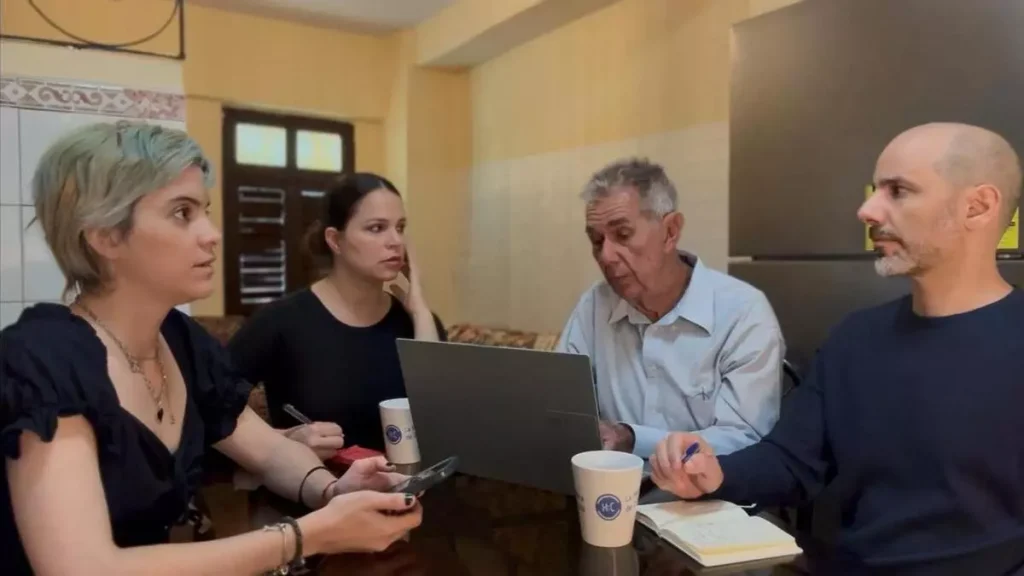
 14ymedio, Havana, April 29, 2026 / The magazine La Hora de Cuba [Cuba’s Hour] was awarded the Civil Rights Defender Award 2026 by the Swedish organization Civil Rights Defenders (CRD) on Wednesday. The award recognizes the publication, directed by Henry Constantin, for its “exceptional resilience and courage in defending freedom of expression, free and independent journalism, and democracy.” The Georgian platform Netgazeti was also among the recipients of the award .