Among its objectives are supporting asylum seekers and the desire to “influence the diplomatic agenda”
Cuba a Pulso aims to have a physical space that will allow it to bring together these and other organizations. / 14ymedio
14ymedio, Madrid, December 13, 2025 — A group of Cuban organizations in Spain held a meeting in Madrid this Friday, entitled “Cuba a Pulso” (Cuba at Full Speed), with the aim of working together towards greater coordination. The exiles seek to strengthen their shared physical space and bolster their political influence in Europe, according to a press release sent to the 14ymedio newsroom.
The meeting, which was supported by the Czech organization People in Need, included representatives from Alas Tensas and its Gender Observatory, Árbol Invertido, Museo V, Mesa de Diálogo de la Juventud Cubana, Disidencias en Movimiento, Democracia Cristiana, Otra Ola, ClickCuba, Forma Foco, CubaxCuba, 5 Minutos, Ciudadanía y Libertad, Red Femenina and El Toque, convened from Casa Palanca.
“The event stems from the hope and need to be together to be stronger,” the statement says, defining the meeting as “a first step” to build “a possible path to strengthen ourselves as exiles in Madrid and, who knows, in the rest of Europe.”
The event was born from the hope and the need to be together to be stronger
Cuba a Pulso aims to establish a physical space that can bring together these and other organizations, serving as a venue for meetings, consultations, and community activities. While the organizers acknowledge that having a headquarters “may not be immediately achievable,” they believe that moving toward this goal would be “a tangible first step” in consolidating their collaborative work.
Political influence in Spain was another key topic of discussion. According to the report, a strong network of Cubans in Madrid and Europe “can influence the diplomatic agenda,” as well as open spaces for dialogue with Spanish and European institutions to promote rights and opportunities for Cubans both continue reading
on and off the island.
The document also underscores the need to support Cuban asylum seekers, whose numbers are growing in Spain. Among the proposals discussed is the creation of a structured reception pathway, which would include guidance on asylum and documentation, job and housing searches, access to basic services, and support throughout the adaptation process.
The participants emphasized the idea of ”unity without uniformity.” / 14ymedio
The participants emphasized the idea of ”unity without uniformity,” stressing that the goal is not to impose a single vision, but to articulate differences under shared values such as dignity, solidarity, and support for those who remain on the island. “Unity does not mean suppressing opinions,” the statement reads, “but rather recognizing what unites us.”
The meeting concluded with a commitment to continue the talks and translate them into concrete actions. “This meeting is not just talk; it was born from the desire to translate the conversations into action,” the statement affirms, describing the gathering as “the seed of a shared path” for the Cuban exile community in Madrid and Europe.
____________
COLLABORATE WITH OUR WORK: The 14ymedio team is committed to practicing serious journalism that reflects Cuba’s reality in all its depth. Thank you for joining us on this long journey. We invite you to continue supporting us by becoming a member of 14ymedio now. Together we can continue transforming journalism in Cuba.
At Raúl Castro’s request, it was decided to postpone the ninth Congress, hoping to “unite forces” and create “better conditions”.
Díaz-Canel listed problems that the system itself generates and perpetuates. / Cubadebate
14ymedio, Havana, December 14, 2025 — The 11th Plenary Session of the Central Committee of the Communist Party of Cuba concluded on Saturday, leaving behind many slogans, lengthy ideological discussions and an almost total absence of real self-criticism. Miguel Díaz-Canel, first secretary of the PCC and president of the Republic, repeated to the party elite the same recipe that the ruling party has been distributing for decades: unity, resistance, discipline and ideological battle.
All this in a country facing its worst economic deterioration since the 1990s, a health collapse in the midst of a viral epidemic and a civic disengagement of the people that neither the Party nor the Government has managed to reverse.
At the meeting, it was agreed to postpone the organisation’s 9th Congress, originally scheduled for April 2026. The proposal was presented by Raúl Castro and announced by Díaz-Canel in a letter read to the members of the Central Committee. In the letter, Raúl Castro acknowledged the importance of respecting the usual congress schedule – every five years – but considered that, given the current “circumstances of force majeure”, it was more appropriate to devote the next year to addressing economic and social problems and to concentrate resources and efforts on “national recovery”. The decision was approved, as always, unanimously, with the official justification that it would allow for “cohesion of forces” and create “better conditions” for a more fruitful congress in the future.
The president began his speech by announcing the need to “change everything that needs to be changed,” although he immediately returned to placing the nonagenarian Raúl Castro as his ideological compass. “If we want to move things forward, the first thing we have to achieve is to make the Party’s grassroots organisation strong in every place,” he said, in a message that shifts the focus to rank-and-file members and avoids attributing structural failures to the political leadership.
The plenary session devoted much of its time to reviewing compliance with the agreements of the 8th Congress of the PCC, held in 2021, and the accountability of the Political Bureau. According to Díaz-Canel, none of these debates would make sense without a profound change in the internal functioning of the single party. “We cannot allow bureaucracy, formalism and inertia to continue to be obstacles,” he reiterated, as if it were a newly discovered diagnosis and not a historical burden spanning six decades of continue reading
economic and political centralisation.
In the absence of concrete solutions to the economic crisis, the official discourse reinforced the ground where the PCC feels most comfortable: symbolic confrontation. The president insisted on the need to “intensify the ideological, cultural and communicational battle,” repeating the formula of “Cuba’s truth” in the face of “manipulation” and “media warfare.” According to him, each day of the system’s survival constitutes “a victory” against the “most powerful enemy,” even though the most pressing problems—blackouts, inflation, shortages, epidemics—have essentially domestic roots.
Those who were hoping for concrete explanations, verifiable data, or some light on the opacity surrounding the Gil case had to settle for adjectives.
Díaz-Canel dedicated five lengthy and rhetorical paragraphs to Alejandro Gil, recently sentenced to life imprisonment for espionage and other crimes. The president—who was close to the former Minister of Economy and even showered him with hugs and congratulations after his dismissal—stated: “Those who profit from needs and shortcomings appear, those who obstruct progress, those who delay advancement, and those capable of selling out the nation that once elevated them to the highest offices.”
To support that assessment, he used several quotes from Fidel Castro about those who embody “selfishness, ambition, disloyalty, betrayal, or cowardice,” and about the revealing nature of every revolution, where “the altars collapse” and “the great traitors” are exposed.
Díaz-Canel maintained that there were no more accurate words to describe Gil’s “actions” and called his case a “disgraceful” one from which the country must learn lessons. He reiterated that the Revolution maintains “zero tolerance” for behaviors like those attributed to the former minister and asserted that episodes of this kind necessitate strengthening ethical and political oversight in all institutions. However, those who were hoping for concrete explanations, verifiable data, or some clarity on the opacity surrounding the case had to settle for adjectives.
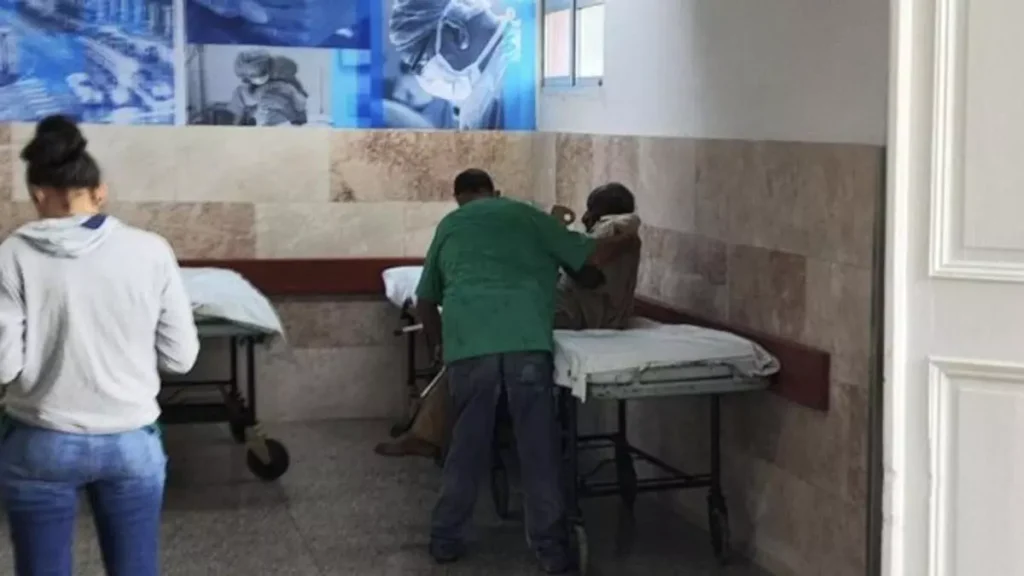
References to the “US blockade” were constant. Díaz-Canel spoke of “enormous pressure” and media intoxication capable of distorting internal perception. But even when citing the health crisis caused by dengue and chikungunya, he again placed the blame on minor organisational issues, such as a lack of personnel to fumigate, monitoring problems and control deficiencies. Not a word was said about the obvious collapse of the hospital system and the mass exodus of health professionals.
Not a word was said about the obvious collapse of the hospital system and the mass exodus of health professionals.
The president called for acting “without improvisation,” promoting “collective leadership,” encouraging criticism and self-criticism, and “confronting corruption more decisively,” even though the country’s political structure continues to lack independent mechanisms for control, transparency, or citizen oversight. In what has become a customary exercise in PCC interventions, Díaz-Canel listed problems that the system itself generates and perpetuates, but without admitting the political origin of these dysfunctions.
The plenary session also addressed the country’s economic situation, which, according to Prime Minister Manuel Marrero Cruz, is marked by a “war economy” scenario. The government’s programme to “correct distortions and revive the economy” includes 106 objectives, 342 actions and 264 indicators, a design that contrasts with the chronic lack of tangible results. The official narrative insists on the need to “prioritise tasks”, “integrate actors” and “mobilise reserves”, but the balance sheet presented confirms that the country is operating with fuel shortages, prolonged blackouts, low production levels and severe foreign exchange restrictions.
The Minister of Energy and Mines, Vicente de la O Levy, admitted that the last few weeks have been “extremely difficult,” marked by loss of generation and the inability to guarantee electrical stability. Not even the new photovoltaic solar parks, hailed as a strategic advance, compensate for the obsolete technology and lack of fuel that continue to cause blackouts of up to 18 hours in several provinces.
The message, identical to the one officialdom has repeated for decades, shifts attention from administrative failure to ideological loyalty.
Another critical issue addressed was the epidemiological crisis. Health Minister José Ángel Portal Miranda acknowledged that Cuba faces an “extraordinary” challenge, with dengue and chikungunya epidemics aggravated by a lack of supplies, fumigation equipment, laboratory reagents and basic medicines. He added that many areas have serious problems with disease-carrying mosquitoes, sanitation and water supply, a structural deterioration that the government has been unable to reverse for years. The official response, once again, insisted on “popular participation” as a solution in the absence of institutional resources.
Amid this panorama, the PCC once again placed “unity” as the cornerstone of the political project. Díaz-Canel stated that unity “is forged through participation” and that it is the guarantee that Cuba will remain “free, independent and sovereign.” The message, identical to the one the ruling party has repeated for decades, shifts attention from administrative failure to ideological loyalty. Participation, however, is limited to consultation mechanisms with no real decision-making power.
The plenary session closed with the confirmation of what had already been anticipated, namely that there will be no structural changes that alter the PCC’s political monopoly or the centralised planning that keeps the economy paralysed. Everything is focused on “correcting distortions” without touching the root of those distortions: the model itself. There is no political openness, no real economic liberalisation, no full business autonomy, and no respect for civil rights. The Party once again proclaims itself the absolute arbiter of the country’s future and the guardian of a unity that is demanded but not built on plurality.
The lack of commentary in official publications is striking, a sign of popular disinterest in this type of meeting. The system insists that the country’s problems will be solved “through our own efforts.” Cubans, who have been hearing the same thing for decades, already know the lyrics to that song, and they are fed up.
Translated by GH
____________
COLLABORATE WITH OUR WORK: The 14ymedio team is committed to practicing serious journalism that reflects Cuba’s reality in all its depth. Thank you for joining us on this long journey. We invite you to continue supporting us by becoming a member of 14ymedio now. Together we can continue transforming journalism in Cuba.
Luis Robles, “the young man with the placard,” recounts the mistreatment he suffered in prison and the persecution against his family, even after serving his five-year sentence.
Luis Robles Elizastigui, upon his arrival at Adolfo Suárez Madrid Airport on October 13 / 14ymedio
Before becoming a political prisoner, Luis Robles was “just another young Cuban struggling to get ahead.” In December 2020, his life changed when he decided to stand on San Rafael Boulevard in Central Havana with a sign demanding an end to repression and the release of rapper Denis Solís, a gesture that landed him in prison. Five years later, in exile in Spain, he recounts for the first time the details of his imprisonment, the physical and psychological torture he suffered and witnessed, and the complete lack of guarantees within the Cuban prison system, in a lengthy interview published by the Cuba X Cuba platform.
Robles begins by explaining the motivations behind his peaceful protest. “When you become a father, you start to think a little differently, to look for better options to provide for your child.” That’s why he decided to go out with a sign. “I wanted to do something to show that I disagreed with the situation, with the repression, the persecution. I thought I would do it in the best way possible so they wouldn’t have grounds to charge me, a peaceful way, without disturbing the peace.” He never imagined everything that would come next.
Robles recounts that he was first held at the Combinado del Este prison, in pretrial detention with common criminals, in “cells with 20 people, in a space of three by four meters, locked up there all day in that small space.” They could only go out to the yard “once or twice a week, for an hour.”
“I wanted to do something to show that I disagreed with the situation, with the repression, the persecution, in a peaceful way, without disturbing the peace.”
He was then transferred to the large cells of the same prison, “spaces for 45 people, it was bunk beds, bunk beds, bunk beds.” There, common criminals awaiting trial lived alongside political prisoners, he recounts. Many who knew his story approached him and “were proud to know that I was the young man who had left” with the sign, he says.
With the guards, it was a different story. “The treatment you receive in prison is dictated by State Security; they treat you as State Security orders.” In his case, the treatment included constant surveillance. “They treated me quite roughly, searching continue reading
me at any time of day or night.” Although everything he possessed was authorized, “they did it to mess with me,” he adds. “I was documenting the abuses I began to witness in prison, the torture they inflicted on the inmates, the way they punished and instilled fear in the other prisoners, and they started harassing me for that.”
Among those tortures, he recalls “several prisoners who suffered brutal beatings” and “others who, as punishment, were kept handcuffed in front of the bars overnight.” Robles was among those who received the most punishment: “Sometimes they would find me to punish me for no reason. They would chain my hands and feet with special handcuffs they call Shakiras there, which are used more for dangerous prisoners, and they would keep me like that for three or four hours.” On occasion, they would leave him “handcuffed and facing the wall,” and once “from six in the morning until two in the afternoon.” He explains that “it was to hurt me, to torture me, and I discovered that those orders came directly from State Security.”
Part of the pressure stemmed from attempts to turn him into an informant. “The aim was to break you, to get you to submit, to use you as a snitch inside the prison.”
Without me having done anything, they chained my hands and feet with special handcuffs, and kept me like that for 3 or 4 hours, sometimes more, to torture me.
The prison authorities themselves encouraged violence by common criminals against political prisoners. On several occasions, he felt threatened or in danger, especially when he was transferred to a different cellblock, but the other prisoners would warn him: “They’d tell me, ‘Hey, be careful, they sent you here to do this to you.’” But publicly denouncing it offered him some protection. “I told my mom everything that happened to me, and we reported it on social media.” The other prisoners were offered “more food, more phone access… those are the perks in prison,” he says.
The material conditions were also part of the punishment. The food, he says, was “horrible, rotten, with a foul smell that made you want to vomit.” The hamburgers “were green, from lack of refrigeration.”
The medical care was “terrible, terrible, terrible… many times I wasn’t given any medical attention.” They only attended to him “when my mother went and complained… that day they wanted to see me.” The rest was neglect: “they told me there was no medicine, that I should wait there.”
From prison, Robles also witnessed firsthand the wave of repression following the protests of 11 July 2021: “I saw people come in with broken arms, people with gunshot wounds, an elderly man whose arms were broken, a friend whose jaw was dislocated from a beating.” Minors arrived: “17, 18-year-old boys… children, minors who shouldn’t have been in an adult prison.” Many had been arrested for “standing in their doorways” or “filming.”
The food was awful, it was rotten, with a bad smell that made you want to vomit.
Robles was one of those released last January, along with hundreds of other prisoners, as part of an agreement with the Joe Biden administration. He had not yet finished serving his sentence, so he remained under house arrest until last June. But then he discovered that his freedom was a sham: “I was forbidden from expressing any political opinions or speaking about what I experienced in prison.” He was warned that everything would be fine “as long as you don’t talk… you can’t talk about what you experienced in prison… otherwise, you’ll go back to jail,” he says. Throughout his time in Cuba, he endured visits and calls from State Security.
“They came to check on me, to find out how I was thinking.” “They even came into my room, even when I was sleeping, two or three times a month. They came in like they owned the house. Unbearable,” she says.
When the sanction ended, they made it clear to him that any movement he made, even within the country, had to be reported. “I didn’t remain calm: I remained intimidated and silenced until the very last day.”
The repression also reached his family. His brother was imprisoned: “A policeman assaulted him, and now my brother is the one they put in jail, a year there without trial.” For State Security, “my brother was a hostage, he is a hostage,” who remains imprisoned in Cuba, now for attempting to leave the country illegally. They kept telling him: “Remember you have a brother imprisoned there.” His mother, Yindra Elizastigui, who also participates in the interview, suffered pressure and veiled threats.
The feeling of social isolation ultimately drove him to exile. “I felt alone; on my block, the one watching me was my neighbor. Even if I had finished my sentence, I would always have been a prisoner.”
He arrived in Madrid on October 13, 2025, but acknowledges that the aftereffects persist, “that pressure of feeling that an enemy can appear anywhere, the mind is active all the time.”
Even so, Robles believes that “resentment does more harm to the one who carries it than to the one who receives it.” “What I want is for there to be justice in my country. For that criminal, dictatorial, and repressive government to be gone. But I don’t carry resentment,” he affirms.
He sees national reconciliation as difficult but not impossible. The system “first and foremost divided us,” and to rebuild the country, “Cubans have to learn to value themselves as human beings. When we regain the awareness of what it means to be master of oneself, then there will be reconciliation,” he states.
He sends a direct message to young people: “I wouldn’t want any young person to go through what I went through, to waste that time locked up watching their life and health deteriorate. But I do urge people to fight for what they deserve. Let’s start a change of mentality.”
And he concludes with a phrase that he says he will continue to repeat until it is fulfilled: “Freedom for Cuba, freedom for all political prisoners, and freedom for all innocent people.”
____________
COLLABORATE WITH OUR WORK: The 14ymedio team is committed to practicing serious journalism that reflects Cuba’s reality in all its depth. Thank you for joining us on this long journey. We invite you to continue supporting us by becoming a member of 14ymedio now. Together we can continue transforming journalism in Cuba.
Cuban police arrest 24 people and confiscate homes, vehicles and 11 million pesos
The police operation against el químico / Canal Caribe
14ymedio, Havana, December 13, 2025 –The Cuban authorities insist on accusing external forces of being behind the spread of drugs on the island. This time, they found the pretext in a police operation announced on Friday against an alleged network dedicated to producing and distributing el químico – the chemical – the synthetic cannabinoid that has become the drug of greatest impact among young Cubans.
According to official media, the criminal network is directed from Florida and employs residents on the island as distributors, a scheme that coincides with the recent official strategy of attributing the increase in consumption to “external influences.”
Arnaldo Ramos, section chief of the Specialized Criminal Investigation Unit of the Ministry of the Interior, stated on State television that the drugs, described as a cream-like mixture, entered Cuba through “illegal air parcel shipments” camouflaged in yogurt containers, gelatin, food supplements and medications. The official insisted that Havana has “accordingly” informed Washington about individuals in the US who allegedly try to promote trafficking on the island, although “there has been no response to these cases.”
According to official media, the alleged drug trafficking network is directed from Florida
The explanation exists in a context where the Government itself has had to recognize, for the first time in years, that consumption of synthetic drugs has diversified and expanded, particularly among adolescents and people in their twenties. The most recent reports speak of a growing market for variants of el químico made with imported substances and processed clandestinely in private homes, a phenomenon that authorities had kept silent about until continue reading
very recently.
In the operation publicized this week, the head of the Anti-Drug Unit, Yoan Saporta, reported the arrest of 24 people charged with offenses related to drug trafficking. In addition to the drugs, authorities seized syringes, gloves, trays, masks and acetone, the latter considered one of the basic inputs for producing el químico. Houses, vehicles and 11 million pesos were also confiscated, a sum equivalent to $91,600 at the official exchange rate but barely more than $25,000 on the informal market.
The operation is presented as part of the “zero tolerance policy” reiterated by senior government officials in early December, when they denied that Cuba is a producing or transit country for narcotics. The official speech coincides with the reinforced US military deployment in the Caribbean to combat drug trafficking, which Havana links to geopolitical pressures on allied governments, especially that of Nicolás Maduro in Venezuela.
As part of this hardline policy, the courts have multiplied the “show trials,” a practice that the official media has frequently publicized over the past year. In one of the most recent cases, a young man was sentenced to 15 years in prison for possession and sale of small quantities of illicit substances, a punishment that is contrary to international standards and reveals the punitive hardening supported by the new Penal Code, which establishes sentences ranging from 4 to 30 years, life imprisonment and even the death penalty.
Although authorities have belatedly acknowledged the rise in drug use, they do not hesitate to crack down on independent journalists who investigate cases outside official channels. The Ministry of the Interior insists on presenting each operation as a decisive blow against drug trafficking, while the expansion of synthetic drugs exposes a reality that is less controlled than official discourse admits.
Translated by Regina Anavy
____________
COLLABORATE WITH OUR WORK: The 14ymedio team is committed to practicing serious journalism that reflects Cuba’s reality in all its depth. Thank you for joining us on this long journey. We invite you to continue supporting us by becoming a member of 14ymedio now. Together we can continue transforming journalism in Cuba.
The consulting firm Auge has published a report that compiles the opinions of 175 executives from private companies with up to 100 employees
Seventy-six per cent of the businesspeople surveyed say they feel optimistic about 2026, while 60 per cent predict that the national economy will be much worse./ 14ymedio
14ymedio, Havana, 13 December 2025 — The recently released First Business Climate Study for Cuban MSMEs*, conducted by the consulting firm Auge, reveals a contrast that sums up the current situation of the private sector on the island. The results of the study were presented on Friday during El Break, a meeting held at Nodo Habana.
According to the study, 76% of the business owners surveyed say they feel optimistic or very optimistic about 2026, while 60% predict that the national economy will be somewhat or much worse next year. The apparent contradiction, described in the report itself as a “marked divergence”, shows the disconnect between the individual performance of small firms and the perception of the economic environment in which they are forced to operate.
The study, the first of its kind to be conducted independently in Cuba, gathers the opinions of 175 executives from private companies with up to 100 employees, most of which have been in operation for more than three years. Auge warns that the selection of interviewees was not random and that the results should be taken as a qualitative approximation rather than a statistical generalisation of the country’s business universe. Even so, the consultancy firm highlights continue reading
that this initial map offers a valuable perspective on the experiences and concerns of a representative segment of the current MSME fabric.
One of the most striking elements of the analysis is the coexistence of marked optimism about their own performance with a deep mistrust of the country’s future. For the authors, this tension starkly highlights the lack of security in the regulatory and economic environment and explains why, despite the drive of the private sector, investment remains timid and innovation is geared more towards resistance than qualitative leaps. Although most respondents expect to increase their sales and profits in 2026, they are more cautious when it comes to forecasting increases in investment or staffing levels, a sign of the insecurity caused by regulatory volatility and macroeconomic unpredictability.
The consultancy recommends improving legal predictability, enabling transparent mechanisms for access to foreign currency, institutionalising dialogue between private actors and the government, and adopting firm measures to contain inflation.
Among the most optimistic companies are those engaged in information and communications technology, wholesale and retail trade, industrial and agricultural production, and food and accommodation businesses. These are sectors that, despite operating in adverse conditions, maintain a certain dynamism and adaptability.
However, current obstacles continue to erode their room for manoeuvre. This year, the most frequently cited problems were inflation (mentioned by 60 per cent), poor state infrastructure (43.4 per cent) and difficulty accessing foreign currency (38.9 per cent). Concerns for 2026 are growing in intensity, with 68% fearing greater economic instability, 56.6% anticipating new regulations that will further complicate private activity, and 48% expecting an additional increase in costs due to inflation.
The report sees this set of concerns as a map of systemic bottlenecks that are exacerbated by unstable conditions marked by rising tariffs, prolonged blackouts, persistent inflation, and the absence of a formal and stable mechanism for MSMEs to access foreign currency. Entrepreneurs were explicit in identifying what they consider to be the three priority areas for the authorities: ensuring regulatory stability, opening up real and autonomous access to foreign currency, and formally recognising the private sector’s contribution to the national economy. Without tangible progress in these areas, Auge argues, the country will remain trapped in a dynamic of low investment, low productivity and innovation reduced to survival strategies.
MSMEs have become one of the few actors with the capacity to adapt and generate a certain economic dynamism.
Based on the study’s conclusions, the consultancy recommends improving legal predictability, enabling transparent mechanisms for access to foreign currency, institutionalising dialogue between private actors and the government, and adopting firm measures to contain inflation. In Auge’s opinion, any attempt to boost the Cuban economy necessarily involves offering a more stable and less arbitrary framework for the activity of non-state enterprises.
Between 2020 and 2024, the country’s GDP has contracted by 11%, and no growth is expected in the current financial year. Although no official forecast has been released for 2026, there are no signs of a change in the trend. Failed domestic economic policies and the difficulties faced by the regime’s main allies have exacerbated structural problems that are reflected in food, fuel and medicine shortages, daily power cuts, rampant inflation, fiscal deficits, the deterioration of state services, bank decapitalisation, growing dollarisation and unabated mass migration.
In this turbulent landscape, MSMEs have become one of the few actors capable of adapting and generating some economic dynamism. But their optimism contrasts with the increasingly widespread certainty that the country is sliding into sustained decline.
*Translator’s note: Literally, “Micro, Small, Medium Enterprises.” The expectation is that it is also privately managed, but in Cuba this may include owners/managers who are connected to the government.
Translated by GH
____________
COLLABORATE WITH OUR WORK: The 14ymedio team is committed to practicing serious journalism that reflects Cuba’s reality in all its depth. Thank you for joining us on this long journey. We invite you to continue supporting us by becoming a member of 14ymedio now. Together we can continue transforming journalism in Cuba.
“Regla is one of the cleanest municipalities,” boasts a municipal employee, broom and dustpan in hand.
The wages are uncompetitive with any informal alternative, the physical strain is enormous, and the lack of resources is humiliating. / 14ymedio
14ymedio, Dario Hernandez, Havana, December 12, 2025 – On the streets of Havana, the filth no longer surprises anyone. What is truly shocking is looking closely at those who, despite everything, continue sweeping. This newspaper approached two street sweepers who, with broom and dustpan in hand, are keeping afloat—as best they can—a public service in ruins. Both are vulnerable men, physically worn down, for whom garbage has become a destiny, not a choice.
One of them, a worker from Regla, explains that he’s been in the job for “a little over a year,” working six days a week. His job consists of “keeping his area clean,” as he describes it. In practice, it’s a daily and unequal struggle against the accumulation of waste, the shortage of trucks, and institutional apathy. Despite everything, he maintains a certain pride in his town: “Regla is one of the cleanest municipalities,” he states. But his statement immediately crumbles: “People don’t want to work in the garbage.”
According to authorities, the worst-performing municipalities in Havana are Marianao, Centro Habana, and Plaza de la Revolución. Prime Minister Manuel Marrero Cruz recently complained that garbage trucks weren’t making enough trips to the rubbish dumps and threatened to inspect them “truck by truck.” The head of government also “expressed interest,” according to the official newspaper Granma, in the salaries of “frontline workers,” some 900 street sweepers, but no raise was agreed upon at the meeting, although there were calls for greater demands.
The basic wage is 2,500 pesos, but it can go up “if you do extra jobs.” /14ymedio
The street sweeper in Regla bluntly details his salary to 14ymedio. The base pay is 2,500 pesos, but it can go up “if you do extra jobs.” However, he had hip surgery and can barely walk, even with the support of his broom. “I earn 4,000 a month (about nine dollars at the informal exchange rate),” he says, shrugging his shoulders. “You know how Cubans are; they make do with continue reading
very little. It’s not that it’s enough, it’s not enough for anything.”
According to reports, some workers received between 7,000 and 10,000 pesos in the last payment, amounts that—given the country’s rampant inflation—don’t cover basic needs. Truck drivers earn slightly more, but collection vehicles are even scarcer than the personnel.
A second street sweeper, this time from Guanabacoa, is deaf and mute and uses signs and gestures to communicate. He has been sweeping for twelve years because “he has no other choice.” When asked about his salary, he makes a face of disgust and lowers his thumb, an unmistakable sign that the pay is meager. His face, weathered by the sun and exhaustion, speaks volumes.
Both cases involve people with physical or social difficulties, trapped in jobs no one else wants. “And who are the ones who work in the garbage? People like me, who are getting on in years,” acknowledges the street sweeper from Regla. His testimony paints a picture of the country’s decline, with aging, sick workers, lacking job alternatives, and employed by an essential service that is falling apart.
In Regla, the worker explains, residents have to bring their waste “in a box or a sack” due to the lack of containers and trucks. In other areas of eastern Havana, small illegal dumpsites are growing at an accelerated rate.
The bureaucracy, gathered in pristine offices, says that Havana “is not giving up on comprehensive solutions to improve its services and cleanliness.” / 14ymedio
In stark contrast to this reality, the bureaucracy, gathered in pristine offices, claims that Havana “is not giving up on comprehensive solutions to improve its services and cleanliness.” This phrase, repeated periodically, comes with promises of repairs, reorganization, “gradual” implementations, and “intersectoral” strategies.
The data shows extremely poor results. Of an identified need for 126 rolling garbage containers the industry planned for 32 with “available resources,” and only 31 have been completed. As for the street sweeper carts , there is a plan to manufacture 1,000 units, but to date only 40 have been produced.
The gap between rhetoric and reality widens even further given the epidemiological risk posed by garbage accumulation. These reports acknowledge, between the lines, that the problem is not temporary but chronic. The deterioration of sanitation services in Havana is not solely due to a lack of equipment or funding. There is a decisive human factor at play, as no one wants to do the work. The wages are uncompetitive with any informal alternative, the physical strain is immense, and the lack of resources is humiliating. “There’s a shortage of personnel,” the street sweeper in Regla repeats, as he walks slowly and with difficulty, leaning on his work tool.
____________
COLLABORATE WITH OUR WORK: The 14ymedio team is committed to practicing serious journalism that reflects Cuba’s reality in all its depth. Thank you for joining us on this long journey. We invite you to continue supporting us by becoming a member of 14ymedio now. Together we can continue transforming journalism in Cuba.
The collapse of tourism in the last five years has led the Government to reduce its investments in that sector, which until now was a priority.
Canada—traditionally the main source market for tourists to Cuba—has also drastically reduced its presence on the island this year. / September 5
14ymedio, Havana, December 12, 2025 – The Spanish Ministry of Foreign Affairs issued a health alert this Friday stating that “Cuba is currently experiencing a serious epidemic, with simultaneous outbreaks of various mosquito-borne viral diseases.” Consequently, it recommends against traveling to the island if one is not vaccinated against chikungunya, dengue, and hepatitis A.
This warning comes at the worst possible time for the Cuban government, in the middle of the peak tourist season and at the end of a catastrophic year in which the number of international travelers will not even reach half of the four million registered in 2016.
The new guidelines from Madrid were released this Wednesday, after it was confirmed that the situation in Cuba has deteriorated significantly. The accumulation of garbage and the increasing number of hours without electricity—two factors that directly impact hygiene—explain the updated alert, according to sources consulted by Confidencial Digital.
According to the most recent data from the National Office of Statistics and Information (ONEI), between January and September 2025, 36,788 Spanish tourists traveled to Cuba, representing a 27.1% drop compared to the same period in 2024. Canada—traditionally the main source market for Cuba—has also drastically reduced its presence on the island this year. In the first continue reading
seven months of 2025, the number of Canadian tourists who traveled to Cuba totaled 478,388, a figure lower than the 622,204 registered in the same period of 2024.
The regime turned the tourism industry into its economic totem and its riskiest bet
The health emergency that is now keeping tourists away is a direct result of the neglect of basic services. And that neglect, in turn, stems from an investment policy that for years prioritized tourism over agriculture, energy, health, and infrastructure.
Over the past decade, the regime has turned the tourism industry into its economic totem and its riskiest gamble. The result in 2025 is empty luxury hotels in cities where water can take weeks to arrive, beach destinations with more rooms than food in the markets, and a healthcare system lacking staff, resources, and supplies.
Official investment figures up to 2024 confirm this. While agriculture received a mere 3% of the total and public health a meager 1.9%, hotels and restaurants absorbed 10.8%, and the so-called “business services, real estate and rental activities” – a category that includes a significant portion of hotel spending – accounted for a hefty 26.6%. In other words, more than a third of national investment was earmarked for building or renovating tourism infrastructure.
The paradox is that, just now that Spain is recommending vaccination before visiting the island and even bringing a complete first-aid kit because hospitals lack medicines, the Cuban government seems to have discovered – late, very late – that perhaps it should invest more in basic services.
Cuban authorities may prevent tourists from leaving the country if there are any outstanding medical bills.
Data from January to October 2025 show a shift. Funding for tourism falls to 5.2%, and the real estate and business sector drops to 17.1%, while the provision of essential services for the general population—electricity, gas, and water—jumps from 12.6% to 36.7%, becoming the main recipient of investment. Transportation—key to moving goods and people in a semi-paralyzed country—also grows, from 8.5% to 10.7%.
But the inevitable question is: will this change be enough at this point? Because the figures also reveal what the government continues to fail to prioritize. In 2025, investments in agriculture—the foundation of food security—represent a mere 2.1% of the total, compared to 2024. Education falls to 0.4%, science and innovation also to 0.4%, and public health to 1.3%, percentages that are barely enough to keep buildings standing, much less to modernize or supply them.
The Spanish government also warns travelers that, although Cuban healthcare personnel are generally competent, “medical facilities suffer from a severe lack of supplies” and fall far short of Spanish standards. Furthermore, it emphasizes that foreigners are required to pay for any medical treatment immediately and that Cuban authorities may prevent them from leaving the country if any medical bills remain unpaid. The alert also stresses the need to bring bottled water due to the risk of Hepatitis A.
Today, with several countries—including the United States, Russia, and Mexico—advising travelers to think twice before visiting Cuba, the regime is trying to correct its course. But investments are like economic cycles; their effects take years to materialize. What went unfunded in 2015 or 2018 is now exploding in the form of blackouts, epidemics, and shortages. And what begins to be funded in 2025 may come too late to prevent the island from continuing to lose—among many other things—one of its main sources of foreign currency.
____________
COLLABORATE WITH OUR WORK: The 14ymedio team is committed to practicing serious journalism that reflects Cuba’s reality in all its depth. Thank you for joining us on this long journey. We invite you to continue supporting us by becoming a member of 14ymedio now. Together we can continue transforming journalism in Cuba.
Yields have stalled between two and 2.5 tons per hectare, whereas in the past they reached up to five and the Vietnamese achieve up to seven in the rest of the Island
Vietnam has signed several agreements with Cuba to invest in rice cultivation. / Granma
14ymedio, Madrid, December 12, 2025 –- “We’ve gone practically four years without having that technological package,” Odisnel Traba Ferrales, agricultural director of the Fernando Echenique Agroindustrial Company, told the official press. The manager refers to the kit the State used to distribute to producers—containing imported fertilizers, herbicides, and pesticides—crucial for some crops, in this case rice, which is also considered a “very technical” crop.
The province of Granma, once among the elite of rice-producing regions, plans to plant 41,000 hectares of the country’s total 200,000, but the data is hardly encouraging. The manager himself admits, between the lines, that the estimate is far from realistic. “The total planting commitment in the province (30,000 hectares from the Fernando Echenique company and 11,000 from the José Manuel Capote Sosa company) is quite a tough goal in the current context,” he emphasizes.
No surprise there: the yield of these lands is far below what was achieved in the past and barely reaches two to 2.5 tons per hectare, compared with the five obtained previously. The figure looks ridiculous when compared with the success Vietnamese producers are achieving both in Pinar del Río—where the company Agri VMA, which has land in usufruct, exceeds 7.2 tons per hectare—and elsewhere on the Island.
No surprise: the yield of these lands is far below what was achieved in the past and barely reaches two to 2.5 tons per hectare, compared with the five obtained previously.
But even more striking are the results from Vietnam’s cooperation as a State actor. Within this program, yields are even higher, according to recent data published by the Cuban Institute for Seed Plant Research, which found yields of up to 9.14 tons per hectare in the winter season (7 in spring) for continue reading
one of the varieties they work with, Viva76. In Cuba there are four varieties, three belonging to the Mekong Delta Rice Institute (MEKO), with results that have impressed even the Asian country itself.
Another variety, Viba17, yields 8.28 tons per hectare in winter and 7.13 in spring, while Viba51 reaches 7.18 in winter and 5.5 in spring. “In the context of Cuba’s efforts to overcome food security challenges due to harsh climate, saline soil, and prolonged drought, the acceptance and testing of Vietnamese rice varieties is considered a strategic step,” Vietnamese media highlighted this week.
The three varieties—grown in Matanzas, Cienfuegos, and Mayabeque—stand out for their productivity and disease resistance, with yields between 20% and 30% higher than the local variety, triple on average. Among their advantages is very fast growth, which reduces costs: about 100 or 110 days of growth compared with 120 or 125 for Cuban rice, according to the Vietnamese institute.
“This is clear proof of the effectiveness of the Rice Cooperation Project in particular, and agricultural projects in Cuba in general,” said one of the engineers who was in the country supporting the program. Although the expert praised the “hospitality” of Cubans, there have been no shortage of Vietnamese reports complaining about local work methods, which have led to program cancellations in the past.
This, along with the shortage of technology, has brought production in Granma province to a bare minimum, heavily affected as well by the flooding caused by Hurricane Melissa when the Cauto River overflowed—the planting areas are concentrated in its basin: Río Cauto, with 23,121 hectares, and Yara, with 11,602.
A report from the official State newspaper Granma, which on Friday offers the first part of what is expected to be a broader piece, includes the experience of one of the workers, who describes the difficulties of managing water. “The first two months are key; you have to be here from sunup to sundown. Today you plant the rice and tomorrow, without fail, you have to drain the field, ‘pachanguearlo,’ so that puddles don’t form. That means removing all the water because the seed is pregerminated and, if it stays submerged, it drowns.”
His account is interrupted by a colleague who highlights another problem: “There are enough weeds to fill a cart. When I barely opened it, the rush of water almost swept me away,” he says—what Granma describes as “hydraulic sabotage.” The newspaper attributes serious issues to the “water war” in the area: farmers who block the canals—“in their desperation,” it excuses—to get a few minutes of irrigation, which ultimately deprives another farmer.
The newspaper attributes serious issues to the “water war” in the area: farmers blocking the canals—“in their desperation,” it excuses—to get a few minutes of irrigation that, in the end, they take from someone else.
“Before, when a seed field was planted, anyone who stole water was prosecuted; today nothing happens,” laments one interviewee. “Just last night, the producer of the field had to leave a man on guard at this gate because people open it to take the water. That fight is old in these fields. You have to stay alert because there’s always someone ready to take advantage of someone else’s water,” he says.
The report contains another devastating line: despite the harshness of the work, “after the sugar mill shut down, there is nothing else to do but plant rice.” One interviewee claims he earned half a million pesos by flooding three caballerías* two months ago, but it isn’t easy. “The mud, the mosquitoes, the sun, the thirst… it’s brutal,” he says.
The lack of fuel also complicates rice transport—the crop “gets diverted” when it cannot be moved— not to mention Gelma, the wholesale supplier of inputs, where “there is not a single product,” forcing people to resort to mipymes [small private enterprises]. The need to pay in cash—without the bank providing it—and the high prices in pesos because of the devaluation of the national currency complete the picture.
“The success of this campaign will not depend solely on the sweat poured into the furrows, but on the ability to untie those old knots that choke productive potential,” Granma concludes. The second chapter, however, remains to be read.
*caballería is a land measure equalling 194.2 acres
Translated by Regina Anavy
____________
COLLABORATE WITH OUR WORK: The 14ymedio team is committed to practicing serious journalism that reflects Cuba’s reality in all its depth. Thank you for joining us on this long journey. We invite you to continue supporting us by becoming a member of 14ymedio now. Together we can continue transforming journalism in Cuba.
Yinet Labañino Acosta was murdered on Monday, 8 December, in her own home.
“Violence leaves marks, ignoring them leaves femicides.” New murder brings the number of cases of gender-based violence in Cuba to 42. / YoSíTeCreo en Cuba
14ymedio, Havana, 12 December 2025 — A new femicide was added on Thursday to the wave of gender-based murders in recent weeks, bringing the total to 42 in 2025, according to the independent count carried out by 14ymedio, in the absence of official information. On this occasion, according to confirmation from the feminist platforms Yo Sí Te Creo en Cuba and the Alas Tensas Gender Observatory, the victim is a 40-year-old teacher, Yinet Labañino Acosta, who was murdered on Monday, 8 December, in her own home, located in the town of Cabacú, municipality of Baracoa, in the province of Guantánamo.
According to both organisations, the alleged perpetrator not only took Labañino’s life, but also that of her husband, in an incident they classify as “gender-based murder of a man”, motivated by “issues related to machismo and misogyny”. The crime leaves two minor daughters orphaned of both their mother and father.
This is the third gender-based murder confirmed in the country so far this month. On 5 December, teenager Heidi García Orozco was stabbed to death by her boyfriend at her home in Jovellanos, Matanzas.
This was followed on 7 December by the death of Elianne Reyes Gómez, 26, mother of a young girl, who was murdered by her partner in her own home in Madruga, Mayabeque. continue reading
Yinet Labañino’s is the third gender-based murder confirmed in the country so far this month.
The previous weeks were also marked by violence. On 30 November, 46-year-old Rosa Idania Ferrer Pérez was murdered by her partner in the province of Cienfuegos. At the end of that same month, Niyu del Carmen López Morales was admitted to a hospital in Havana after being assaulted by her ex-partner.
Cuba is currently among the countries with the highest rates of femicide in Latin America, according to studies, with 1.4 murders per 100,000 women.
The seriousness of the situation has led organisations and activists to insist on the need for a comprehensive law on gender-based violence, as well as shelters for women at risk, effective protection protocols and transparency from the state regarding its statistics. They have also called for a state of emergency to be declared due to gender-based violence in Cuba.
For the time being, according to specialists, the effective implementation of the Victims’ Care Act could offer clearer tools for the protection, support and redress of those facing situations of serious violence on the island, although feminicide is not classified as a crime in the Cuban Penal Code.
Organisations and activists insist on the need for a comprehensive law on gender-based violence
An office to advise victims of gender-based violence was recently opened in Havana, created by the National Organisation of Collective Law Firms with the support of the Canadian Embassy and the United Nations Population Fund.
A national registration and monitoring system was also approved and an official prevention campaign was announced. However, activists and relatives of victims consider these measures to be insufficient in the face of the sustained increase in cases.
Translated by GH
____________
COLLABORATE WITH OUR WORK: The 14ymedio team is committed to practicing serious journalism that reflects Cuba’s reality in all its depth. Thank you for joining us on this long journey. We invite you to continue supporting us by becoming a member of 14ymedio now. Together we can continue transforming journalism in Cuba.
Trump threatens Colombia, and Petro responds: “My government has seized 2,700 tons of cocaine so far. (…) It’s the largest seizure in the history of the world.”
Screenshot from the video released by the White House of the tanker seizure. / WH
14ymedio/EFE, Washington/Caracas/Bogotá, December 11, 2025 — The United States increased pressure on Venezuela on Wednesday by intercepting and seizing an oil tanker off the coast of the South American country, as part of the naval and military deployment that Washington has maintained in the Caribbean since last August. The ship, according to the British news agency Reuters, had already unloaded 200,000 barrels of oil destined for Cuba.
The tanker, named Skipper and sailing under a false Guyanese flag, departed the Venezuelan oil port of José between December 4 and 5, after loading approximately 1.8 million barrels of Merey heavy crude. According to satellite data and information from the state oil company PDVSA, 200,000 barrels were transferred near Curaçao to the Neptuno 6 — flying the Panamanian flag — whose final destination was Cuba.
The data clarifies the confusion generated by reports from Washington that pointed to Havana as an intermediary or recipient of the crude oil. A source toldThe Washington Post that the ship was headed to Cuba, although the newspaper made it clear that the information could not be confirmed. Axios also suggested the possibility that the oil was going to the island, though it based this on the usual cooperation, without providing more concrete details. CNN, meanwhile, argued that the tanker was headed to Cuba but with its final destination being Asia, “after being negotiated through Cuban vendors.” The news outlet attributed the information to a U.S. official.
The announcement was made by Trump himself: “We just seized an oil tanker off the coast of Venezuela, a big, very big oil tanker, the biggest ever seized, actually continue reading
,” declared US President Donald Trump at the start of a roundtable discussion with business leaders at the White House.
According to The New York Times, the Skipper was seized by order of a US judge for its previous links to the smuggling of Iranian oil, sanctioned by Washington, although on this occasion it was transporting Venezuelan crude.
The Venezuelan government described the confiscation of the oil tanker as a “blatant robbery” and warned that it would appeal to international bodies to denounce this “serious international crime.”
Speaking during a session of the People’s Assembly for Sovereignty and Peace, Executive Vice President Delcy Rodríguez stated that the Nobel Peace Prize awarded to Machado is a “prize stained with blood.”
For his part, Venezuelan President Nicolás Maduro expressed his gratitude for the marches that took place in Oslo against the award given to the former congresswoman.
Maduro, in a speech to hundreds of supporters, demanded on Wednesday the “cessation of illegal and brutal interventionism,” as Trump warned his Colombian counterpart, Gustavo Petro, that he would be “next,” alluding to the pressure his government is exerting on Venezuela.
“From Venezuela we demand an end to regime change policies, coups d’état, and invasions around the world.”
“From Venezuela we demand, enough of regime change policies, coups d’état and invasions in the world,” said the Chavista leader at the close of a peasant march through the streets of Caracas, on the occasion of the 166th anniversary of the Battle of Santa Inés.
The president asserted that times of unity with Colombia are coming to carry out the “true Bolivarian revolution” and indicated that “sooner rather than later” Gran Colombia, a state formed by both South American nations between 1819 and 1831, must be refounded for the “emancipation of all South America.”
Trump, who has maintained a military deployment in the Caribbean since last August, under the pretext of combating drug trafficking and which Caracas calls a “threat,” warned Petro that he will be “next” and ruled out speaking soon with the Colombian president, who has criticized him on several occasions for his actions against Venezuela.
“He has been quite hostile toward the United States,” Trump responded when asked about his Colombian counterpart, whom he warned saying “he’s going to have big problems if he doesn’t realize” that Colombia is “producing a lot of drugs.”
Petro, for his part, responded to the American in a televised message. “Trump is very misinformed about Colombia. It’s a shame, because he dismisses the country that knows the most about cocaine trafficking. It seems his interlocutors are completely deceiving him,” Petro said, reading from a text he said he would publish in X during a televised Cabinet meeting.
Petro highlighted that during his administration, which began on August 7, 2022, there have been “1,446 ground battles against the mafias” and “13 bombings trying to locate their leaders, many of these battles with shared military intelligence.”
“That’s 2,700 tons of cocaine seized by my government so far. The 2025 seizures are almost over, and we still have months left in 2026, so we’re going to approach 4,000 tons,” said the Colombian president, who stated that this is “the largest seizure in the history of the world.”
He also stated that he has never been “hostile to the United States that fights for freedom and democracy,” but that he does not accept “impositions, and even less so those based on the misinformation of people who take advice from Colombian politicians allied with the mafias or from former military personnel who are responsible for major actions of destruction against human rights and businesses.”
In September, Trump removed Colombia from the list of countries that cooperate in the fight against drugs and subsequently sanctioned Petro, whom he accused of being a “leader in drug trafficking.”
With today’s message, the US president puts Colombia in the crosshairs of Operation Southern Spear, which he ordered under the pretext of combating drug trafficking in Latin America.
Since September, the U.S. Armed Forces have destroyed more than 20 vessels allegedly carrying drugs in the Caribbean and the Pacific, near Venezuela and Colombia, killing more than 80 crew members.
In this regard, Petro, who is a critic of that operation, stated that “it is not true that missiles on speedboats are being used to fight narco-terrorists.”
____________
COLLABORATE WITH OUR WORK: The 14ymedio team is committed to practicing serious journalism that reflects Cuba’s reality in all its depth. Thank you for joining us on this long journey. We invite you to continue supporting us by becoming a member of 14ymedio now. Together we can continue transforming journalism in Cuba.
Elianne Reyes was murdered by her partner at her home in Mayabeque
Cuba is among the countries with the highest rates of femicide in the region. / 14ymedio
14ymedio, December 11, 2025 — Elianne Reyes Gómez, 26, mother of a the young daughter, was murdered on 7 December in Madruga, Mayabeque, by her partner. The crime took place inside her own home. The news, which initially circulated among neighbours and local media, was confirmed on Wednesday by the platforms Yo Sí Te Creo en Cuba and the Gender Observatory of Alas Tensas magazine.
According to the independent count by 14ymedio – maintained in the absence of reliable official data – this would be the 41st femicide of the year, following the murder on 5 December of a teenager in Jovellanos, Matanzas.
In the same context, there was a recent attempt to murder Niyu del Carmen López Morales, who was hospitalised in Havana after being beaten and attacked with acid by her ex-partner. The attack took place in a building in the La Virgen del Camino area, where neighbours heard her screams and called the police, who managed continue reading
to rescue her. The victim confirmed that she suffered serious injuries and that the attacker remains in custody.
The cases recorded in recent weeks have caused concern.
The cases reported in recent weeks have caused concern in various communities, where family members and residents point to the lack of resources and effective means of care to respond to risky situations and prevent further episodes of violence.
Comparative studies on gender violence place Cuba among the countries with the highest rates of femicide in the region, with a ratio of 1.4 murders per 100,000 women, a level higher than that of other countries with greater public visibility on this issue, such as Mexico, Argentina, Ecuador, and Chile. This is despite the fact that in the Cuban case, the available figures do not come from official statistics, but from independent records kept by organisations that do not have access to all the information handled confidentially by the authorities.
Studies place Cuba among the countries with the highest rates of femicide
The persistence of these incidents once again highlights the need to effectively implement the Victims’ Care Act, a legal framework that, according to experts and organisations, could provide clearer tools for the protection, support and redress of those facing situations of serious violence in the country.
The recent opening in Havana of an office specialising in assisting victims of gender-based violence, created by the National Organisation of Collective Law Firms with the support of the Canadian Embassy and the United Nations Population Fund, is part of this same scenario.
Translated by GH
____________
COLLABORATE WITH OUR WORK: The 14ymedio team is committed to practicing serious journalism that reflects Cuba’s reality in all its depth. Thank you for joining us on this long journey. We invite you to continue supporting us by becoming a member of 14ymedio now. Together we can continue transforming journalism in Cuba.
At the La Milagrosa church in Santos Suárez, José Ramírez provided food to a group of senior citizens and other social services.
Interior of the Church of La Milagrosa, in the Havana neighborhood of Santos Suárez. / Caritas Cuba
14ymedio, Havana, December 11, 2025 / The Cuban government has expelled Mexican priest José Ramírez, a member of the Congregation of the Mission, for ringing the bells of the Parish of Our Lady of the Miraculous Medal –- known as La Milagrosa –- in the Havana neighborhood of Santos Suárez, during a pot-banging protest against the incessant blackouts on December 9.
Church sources confirmed to Martí Noticias that the Government decided not to renew the priest’s temporary stay permit and urged him to leave the Island this Thursday.
Activist Adelth Bonne, a neighbor of the church, denounced in a Facebook video that this situation has caused alarm and shock in the neighborhood, where the parish priest led one of the most active social projects in the capital.
According to Bonne’s testimony, several people confirmed that police officers went to the church after the pot-banging protest. Some internal sources told parishioners that it was all a “misunderstanding,” but the order to leave suggests continue reading
it was a direct punishment for the bell incident.
Church of Our Lady of the Miraculous Medal, in Santos Suárez, Havana. / Facebook/The Church in Cuba
The expulsion has generated concern among hundreds of residents who depend daily on the social services provided by La Milagrosa. The church maintains a senior citizens’ group that offers breakfast, lunch, and dinner; makes home visits to bedridden individuals; distributes school supplies; and runs a free school for children with Down syndrome, which operates using its own resources. Many of these programs were coordinated by the parish priest, who is now forced to leave the island.
“It would be one of the greatest injustices of the year,” said Bonne, who has documented the church’s impact on neighborhood life for decades. “If they close or limit that work, many elderly people will have no way to survive.”
The incident involving the priest took place amidst a wave of demonstrations that erupted Monday night and into Tuesday morning — among the largest in recent months — in Havana and other provinces affected by power outages lasting between 12 and more than 20 hours. According to the government, the ringing of the church bells was interpreted as direct participation in a popular protest.
So far, neither the Archdiocese of Havana nor the Conference of Catholic Bishops of Cuba has issued a public statement on the departure of the priest, who is already in Mexico.
This is not the first time that friction between the regime and the Church has led to expulsion, as happened in 2022 with the Dominican Jesuit priest David Pantaleón. Now, José Ramírez’s forced departure comes at a time of growing tension between the Cuban government and members of the Catholic Church who have taken critical stances on the crisis in the country.
____________
COLLABORATE WITH OUR WORK: The 14ymedio team is committed to practicing serious journalism that reflects Cuba’s reality in all its depth. Thank you for joining us on this long journey. We invite you to continue supporting us by becoming a member of 14ymedio now. Together we can continue transforming journalism in Cuba.
Micro, small, and medium-sized enterprises (MSMEs) and self-employed workers will be able to use these resources to import raw materials and must deliver 20% of the balance to the Central Bank at the official exchange rate.
Private trade in the city of Cienfuegos. / 14ymedio
14ymedio, Madrid, 11 December 2025 — For the first time, the Cuban government will allow private individuals to hold foreign currency accounts and conduct business with them, a measure the sector has long called for, but which will be limited by the amount they must hand over to the state. The regulation establishes a clear difference between foreign investors and national companies, which are subject to an 80% retention coefficient — the amount of foreign currency income that can be retained, while the rest is sold to the Central Bank at the official exchange rate — compared to 100% for the former.
The decision is part of a legislative package published on Thursday in the Official Gazette, through which Cuba is implementing a partial dollarisation, “until economic conditions allow and the Cuban peso is reinstated as the only legal tender in the country”. In total, there are four regulations – a decree-law and three resolutions – that establish “a new mechanism for the management, control and allocation of foreign currency, with the aim of increasing foreign currency revenues and achieving a more efficient use of them.”
The decision is part of a legislative package published on Thursday in the Official Gazette, through which Cuba is shaping a dollarisation that it is reconsidering as partial.
The measures affect all economic actors regardless of whether they are state-owned, private or cooperative, foreign or domestic, but there are some differences between them. One of the most important is continue reading
the aforementioned retention coefficient. There are special circumstances for state-owned companies, as many of them already had approved foreign currency financing schemes, but in the case of private companies there is a special circumstance.
The 80% rate will apply to income from exports, e-commerce with payments from abroad, sales of goods and services to users and concessionaires of the Mariel Special Development Zone (ZEDM), foreign investment modalities, and entities authorised to trade in foreign currency. For all other cases listed in Article 5 of the regulation (dedicated to possible legal sources of foreign currency), 100% may be retained.
According to the government, retained foreign currency can be sold on the foreign exchange market or used for authorised payments, promoting productive linkages and import substitution.
The measure provides a solution to the demands of private individuals, who had been calling for years for a legal currency market in which to operate: its absence prevented them from legally importing the supplies that are so scarce in Cuba, encouraging the parallel market and leaving them exposed to the risk of losing their licences, among other penalties, if they were inspected. Also, if the measure is successful, the state will be able to regain access to foreign currency that was operating illegally and therefore beyond its control. This, in turn, made it difficult for the government to make the payments it needs to finance its own expenses and pay its foreign suppliers, including the essential fuel without which the economy cannot move forward.
The regulations also govern foreign currency bank accounts, authorising private individuals to hold them for the first time, which in turn allows them to pay for imports without having to exchange currency. This also paves the way for payments between different economic actors, facilitating the much-discussed “chain reactions”.
This also paves the way for payments between different economic actors, facilitating the much-discussed “linkages”.
Another element established by the legislation is the so-called ACAD, a purchase authorisation that the Government, through the Minister of Economy and Planning, will grant to companies to purchase foreign currency from the Central Bank. To obtain it, the applicant must have the national currency available. The permit is also non-transferable.
Domestic transactions – internal, as defined by the resolution – will preferably be made in pesos, except when they occur between operators in the Mariel Special Development Zone (ZEDM), between wholesalers and shops (retailers) in foreign currency, and other exceptional cases that may be approved. Exporters and those operating in e-commerce may pay their domestic suppliers in foreign currency provided that this is mutually agreed, a new development that will facilitate the flow of currency without intermediaries.
As for other economic actors, the law states that foreign investors collect and pay in foreign currency and can operate domestically with both currencies. Private individuals must, as a rule, trade in pesos, but if the customer pays in foreign currency, the business owner can receive payment in that same currency, although they may choose to convert it into pesos. Agricultural producers, for their part, will receive income in their foreign currency accounts if they are recognised as exporters or import substitutes.
Translated by GH
____________
COLLABORATE WITH OUR WORK: The 14ymedio team is committed to practicing serious journalism that reflects Cuba’s reality in all its depth. Thank you for joining us on this long journey. We invite you to continue supporting us by becoming a member of 14ymedio now. Together we can continue transforming journalism in Cuba.
The increase in cases is overwhelming the response capacity amid shortages and official underreporting
So far, authorities have confirmed 44 deaths. / 14ymedio
14ymedio, Havana, December 10, 2025 — This Wednesday, Cuba’s Ministry of Public Health warned that cases of dengue and chikungunya on the island have increased by more than 71% in just seven days. Deputy Minister of Public Health Carilda Peña García reported on state television that the incidence rate rose from 3.81 to 6.52 per 100,000 inhabitants compared to the same day last week.
With a population of 9.7 million, this represents an estimated jump from 369 to 632 daily infections in just one week. The Pan American Health Organization reported a cumulative total of 25,995 cases in the country as of the end of November.
Although the deputy minister indicated that some indicators show stability compared to the previous day, professionals in the sector point out that this apparent improvement does not necessarily correspond to a real reduction in infections. The insufficient number of diagnostic tests, the shortage of PCR reagents, and the limited hospital capacity all directly influence the number of cases detected and reported.
This apparent improvement does not necessarily correspond to a real reduction in infections.
So far, authorities have confirmed 44 deaths associated with dengue and chikungunya. However, the lack of complete information and the underreporting of cases prevent an objective picture of the situation. This lack of clarity continues to generate public concern at a time when hospitals and funeral homes are operating under unsustainable pressure.
The epidemic is spreading in a context exacerbated by the economic crisis, which limits mass fumigation, diagnostic confirmation, and clinical care. Shortages of insecticides, fuel, medications, and specialized personnel have continue reading
facilitated the spread of these arboviruses, with a particular impact on children and pregnant women, who depend on an increasingly overburdened healthcare system. The deputy minister acknowledged that the majority of patients currently in critical condition are under 18 years of age.
In some cases, there are even reports of children being infected during gestation, as is the case of Maylom Martínez Abreu, a baby who contracted chikungunya in his mother’s womb and who, after spending 46 days intubated at the Jose Ramón López Tabrane Gynecological-Obstetrical Hospital, was finally discharged on December 9.
Another case, reported to 14ymedio, which raises questions about whether the regime is hiding or concealing data, involves Cubans living abroad who recently visited the island and tested positive for West Nile virus, a highly dangerous arbovirus due to its high mortality rate. Although on November 20, Francisco Durán, director of the National Institute of Epidemiology at the Ministry of Health, denied that the virus was circulating in Cuba, data published by the Pedro Kouri Institute of Tropical Medicine has confirmed that there is scientific evidence to determine the possible presence of the virus on the island, as is the case in other Caribbean regions.
____________
COLLABORATE WITH OUR WORK: The 14ymedio team is committed to practicing serious journalism that reflects Cuba’s reality in all its depth. Thank you for joining us on this long journey. We invite you to continue supporting us by becoming a member of 14ymedio now. Together we can continue transforming journalism in Cuba.
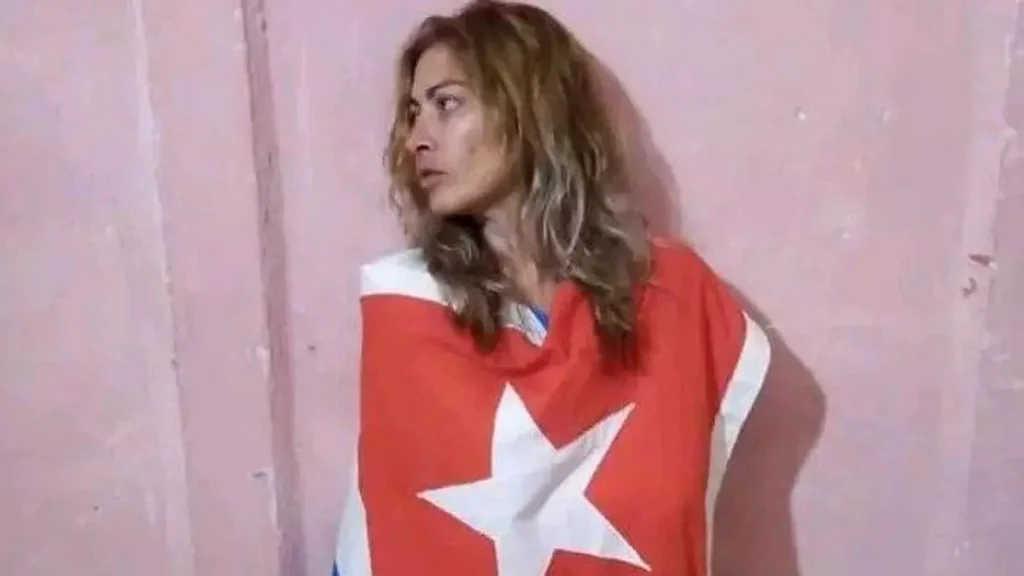
Her crime consisted of publishing photos of herself wrapped in the Cuban flag to demand the release of the artist Luis Manuel Otero Alcántara.
Aniette González was imprisoned in the Kilo 5 women’s prison in Camagüey for almost a year awaiting trial / Facebook
14ymedio, 8 December 2025 — Camagüeyan activist Aniette González García was released from prison on Saturday after serving her full three-year sentence for the crime of “insulting national symbols.” Her release was announced by journalist José Luis Tan Estrada at an event held in Mexico in support of María Corina Machado, Venezuelan opposition leader and Nobel Peace Prize laureate.
González García was arrested in March 2023 for posting photos on Facebook of herself wrapped in the Cuban flag in support of a campaign for the release of artist Luis Manuel Otero Alcántara, leader of the San Isidro Movement, who is also imprisoned for, among other things, the same crime as her. The activist was held in the Kilo 5 women’s prison in Camagüey for almost a year awaiting trial, until her sentence was handed down in February 2024.
In the ruling, she not only received a three-year prison sentence, but was also stripped of her right to vote. Furthermore, as a formality, she was barred from holding any positions in entities related to the Cuban economy and politics during her imprisonment, and will be considered a repeat offender before being granted any benefits or mitigating circumstances.
She will be considered a “repeat offender” before being granted any benefits or mitigating circumstances.
Following the conviction—the prosecution had originally sought up to four years in prison—various legal appeals were filed, all of which were rejected continue reading
by the court. Her family filed a petition for habeas corpus, an appeal, a motion to revoke the pretrial detention order, a motion to recuse the prosecutor, and an appeal of the verdict, but all were unsuccessful.
Following her release, several organizations celebrated the news and criticized the harshness of the authorities’ actions. “Her case exemplifies the criminalization of dissent and the use of the penal system to punish expressions protected by the right to freedom of thought and expression,” stated the Cuban Institute for Freedom of Expression and the Press (ICLEP), which also condemned “the arbitrary nature of her detention and the harassment she suffered in prison.”
The Cuban Observatory for Human Rights, based in Madrid, indicated that González’s case “remains a clear example of how the regime uses the penal system to punish peaceful expressions and repress any critical gesture,” and added that her release “does not erase the injustice committed nor the conditions in which she was detained, denounced even by international organizations.”
Her release “does not erase the injustice committed nor the conditions in which she was detained”
The irregularities in the process led the Inter-American Commission on Human Rights (IACHR) to address the case in May of last year, issuing precautionary measures in favor of the activist. In its resolution, the IACHR considered it “especially serious” that Aniette González lacked access to medical services “for the diagnosis of the bleeding she suffers,” and warned of the “serious and urgent situation, given that her rights to life, personal integrity, and health face a risk of irreparable harm.”
She also denounced the mistreatment she suffered at the hands of prison authorities and State Security, including insults, being confined in a cell “flooded with water, damp, with little light and ventilation,” preventing her from resting by taking away “the necessary elements for it,” controlling her clothing, giving her little food and in poor condition, or interrogating her in rooms “with low temperatures, at any time of day.”
According to the most recent report by Prisoners Defenders (PD), there are a total of 1,179 political prisoners on the island, 35 of whom are minors—the minimum age of criminal responsibility in Cuba is 16. Of these, 29 are serving sentences and six are being prosecuted under “precautionary measures without any judicial oversight.”
____________
COLLABORATE WITH OUR WORK: The 14ymedio team is committed to practicing serious journalism that reflects Cuba’s reality in all its depth. Thank you for joining us on this long journey. We invite you to continue supporting us by becoming a member of 14ymedio now. Together we can continue transforming journalism in Cuba.

 14ymedio, Madrid, December 13, 2025 — A group of Cuban organizations in Spain held a meeting in Madrid this Friday, entitled “Cuba a Pulso” (Cuba at Full Speed), with the aim of working together towards greater coordination. The exiles seek to strengthen their shared physical space and bolster their political influence in Europe, according to a press release sent to the 14ymedio newsroom.