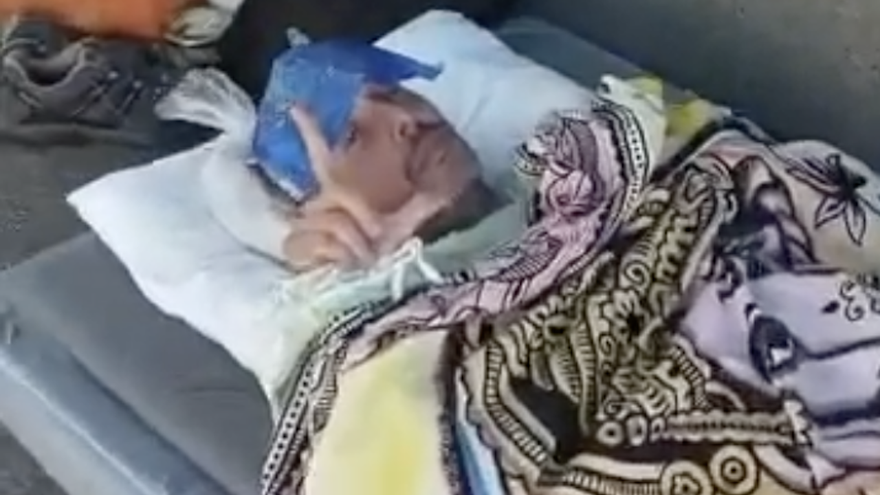
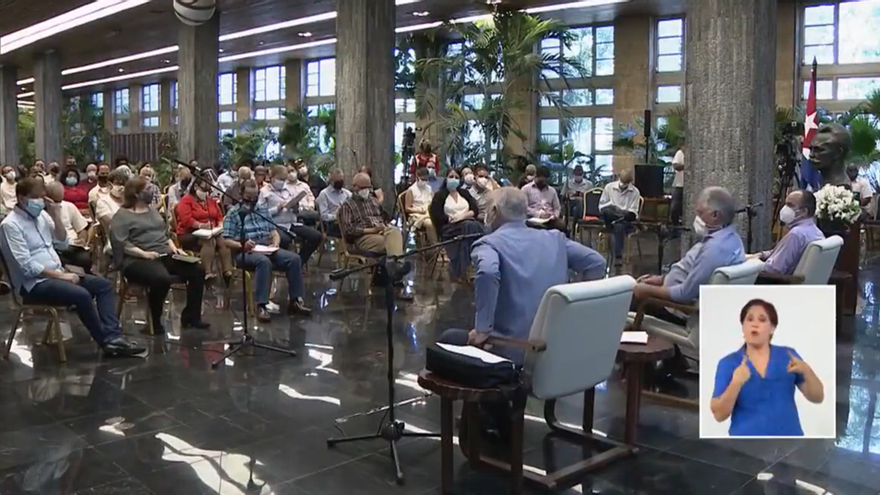
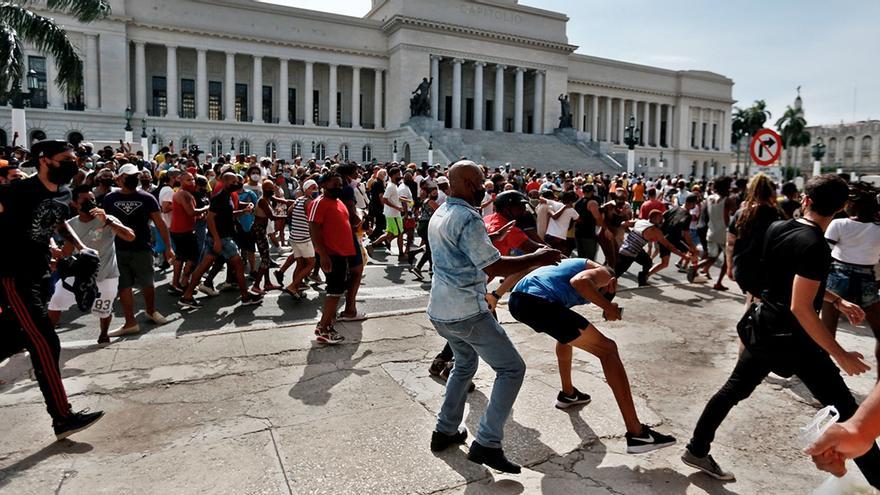
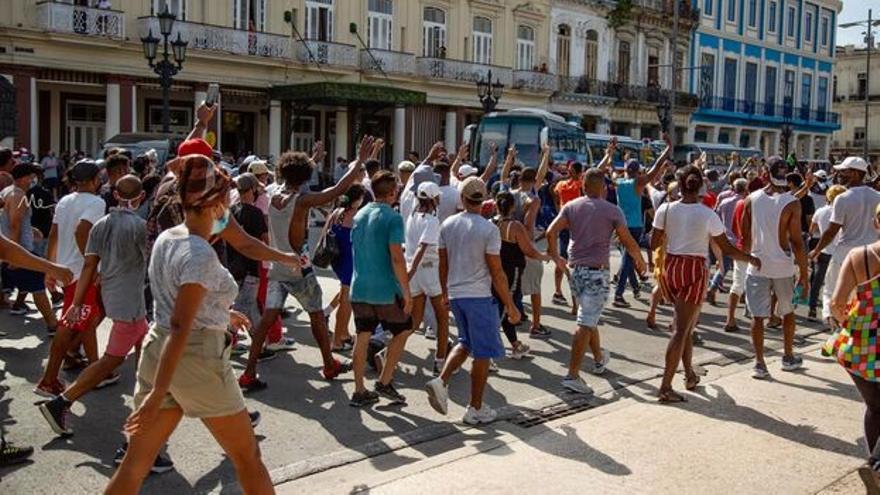
On Wednesday, a group of 250 migrants was gathered in an orchard in Eagle Pass (Texas) (Twitter/@BillFOXLA)
14ymedio, Havana, 13 July 2022 — Hundreds and hundreds of people in a line, from one side to the other of the Rio Grande, in an incessant flow like the waters that cross. The images, recorded on the river border of Piedras Negras (Mexico) with Eagle Pass (Texas) and shared this Monday by the American journalist Bill Melugin, illustrate the cold numbers.
According to the Fox News reporter, last week there were more than 13,000 illegal crossings in the same area: “That’s almost 2,000 a day.” A federal source told him that 2,258 illegal immigrants arrived on Wednesday. Matías, a source from the Mexican prosecutor’s office in Coahuila who prefers not to give his last name, told 14ymedio that between Sunday and Tuesday more than 8,000 people crossed the border strip of about 90 kilometers between Ciudad Acuña and Piedras Negras, among them, “several families”.
The official also says that the Northeast cartel has taken over the traffic of Cubans, Venezuelans and Nicaraguans in the place. “They have hawks – children, vendors, bartenders – who inform them about free points to cross migrants through the Rio Grande,” he details.
Two coyotes were seen in the images shared by Bill Melugin, revealing the way they operate: once the coyotes leave one group, they return to Mexican territory to guide another.
The arrival of Cubans in the US has reached unprecedented numbers during the Joe Biden Administration. Data offered by the Department of Customs and Border Protection show that in the last eight months a total of 140,602 Cubans have entered the United States by land, an number that already exceeds the Mariel Boatlift exodus of 1980, when 125,000 people reached the United States in seven months. continue reading
Matías knows that the undocumented immigrants who come in a caravan “reach their limits and some residents near Rio Grande support them free of charge so they can reach their American dream.”
Those who arrive by bus are “detected by the hawks, who notify the coyotes about the places where people are. Either under threat or extortion, but they end up agreeing to cross the river with these smugglers,” says Matías. “They charge them between 600 to 1,000 dollars to pass them and they leave them there.” This network also brings migrants from Tabasco and Yucatan.
The Northeast cartel – a split from the old Gulf cartel – is a bloodthirsty group that is not only dedicated to transporting drugs, but also to extortion, kidnapping, homicides, fuel theft, bank robbery and human trafficking.
The Cuban Francisco Torné Martínez is not part of the group filmed on Monday, but he could have been. He stepped on US territory this Wednesday. “They took names and divided the group of more than 200 people, the Peruvians and the Guatemalans were put on a bus to return them over the bridge,” he refers to this newspaper.
Torné was taken along with 22 other Cubans, 39 Venezuelans and 9 Nicaraguans to a church. “Texas is returning those from El Salvador, Honduras, Haiti and Guatemala, but this could change as a result of Texas Governor Greg Abbott intensifying his campaign,” says official Matías.
Translated by Andrea Libre
____________
COLLABORATE WITH OUR WORK: The 14ymedio team is committed to practicing serious journalism that reflects Cuba’s reality in all its depth. Thank you for joining us on this long journey. We invite you to continue supporting us by becoming a member of 14ymedio now. Together we can continue transforming journalism in Cuba.
By Carlos Manuel Álvarez, published in Univision News, 19 May 2016 Published in Malaletra, a Blog Made in Cuba, Regina Coyula, 11 July 2016
He looks like a god but is a heretic. He seems carved in stone, but is a nervous wreck. He looks like the first among men, but is just the last survivor.
Marina Tsvetaeva, the great Russian poet, said of Rilke: “He is not a symbol of our time, he is its counterweight. Wars, massacres, flesh lacerated in battles, and Rilke. Thanks to Rilke, our time will be forgiven.”
At eighty-two, Rafael Alcides is Cuba’s counterweight. Political courtesans, a nation eaten away by its own skepticism and cowardice, lives wasted in a useless march to nowhere, permeated by resentment and fear, and Alcides. Thanks to Alcides our country will be forgiven.
At age 82, in sacred communion with the world, equally reconciled with defeat and with light, Alcides is all he seems and is also all he is. A poet. He is someone who once wrote, “When a funeral procession of two lonely cars/ goes by and nobody cares, I quiver, I shudder, / I throb; I am afraid of being a man.”
***
He lives in a garage turned into an apartment — a cave, almost — on the corner of a quiet street in Havana’s Nuevo Vedado neighborhood. It is not the crumbling house of a tortured genius. It is not the lavish home of an acclaimed author. It is not the suffocating house of a bureaucrat. It is not the empty house of a suicide. It is a quintessential example of “mature homes, / where the act does not allow itself to be replaced by the word.”
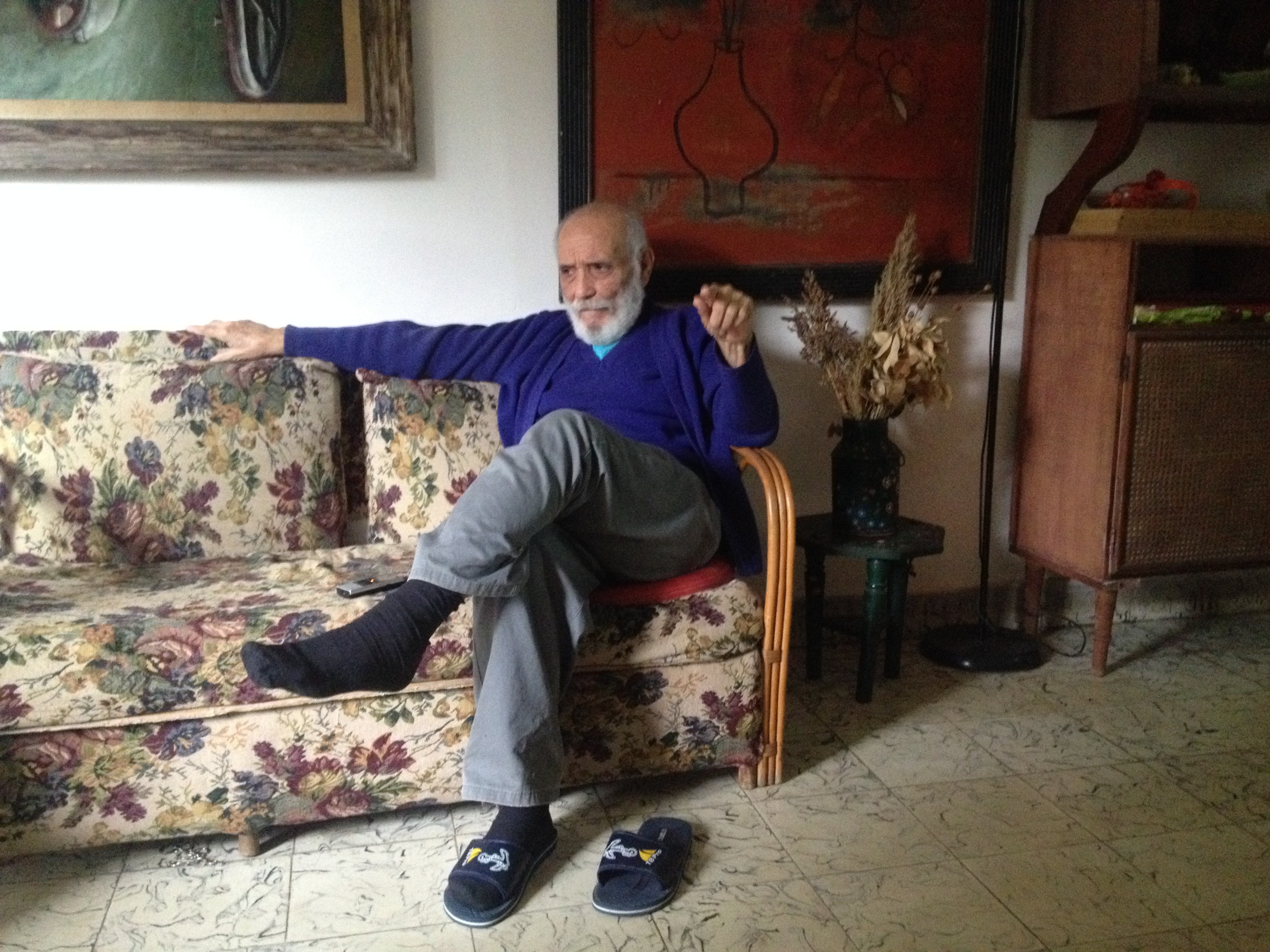
The volitional force that is Rafael Alcides inhabits an ideogram. The narrow sofa, almost at floor level; the cushions with patterns of tremulous flowers; the still life painted on the ceramic vases; the polished wood of armchairs; the wicker furniture; the wax candles; the sober paintings, with motifs ranging from the ordinary to the lugubrious; the dim lighting; the pusillanimous cold of Havana winters; the afternoon’s plasticity; the vague noise of apparently uninhabited spaces; and the inconstant barking of a lanky dog, with variegated eyes and floppy ears.
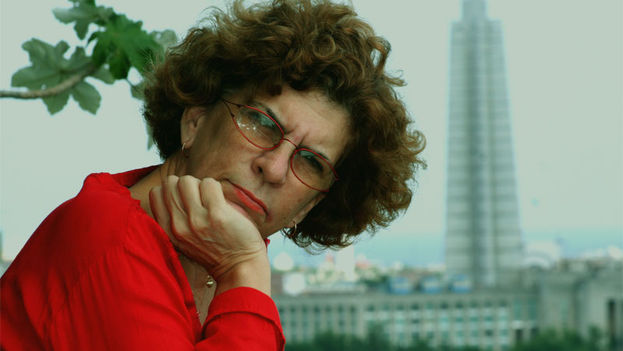
Regina Coyula, photo from her blog
Regina Coyula, his wife who is 23 years his junior, brews coffee in the kitchen, and from the back of the apartment, enveloped in this conversational aroma, Alcides emerges. A man who, in order to describe him, calls forth the exclamation that today — except when aimed at him — would sound ridiculous for anything else: “Oh!”
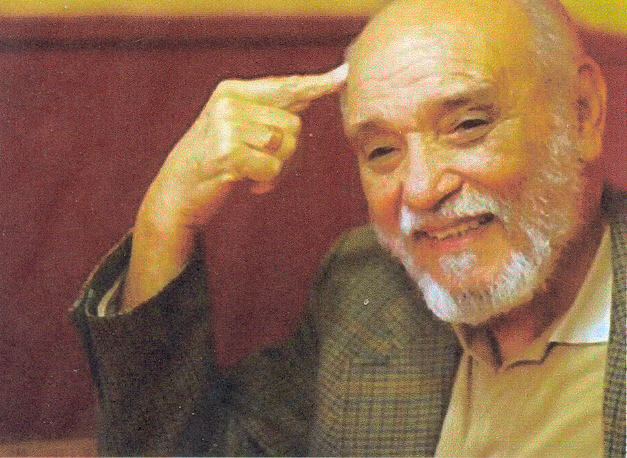
He sports grey heavy trousers, a navy blue sweatshirt, black socks and slippers. The white and generous beard, his elegant baldness, his coppery country skin, wrinkled forehead, and in the depths of his face, howling, the feverish black eyes.
He recites the verses of Rubén Darío:
“Margarita, the sea is beautiful / and the wind / brings the subtle essence of orange blossom!”
The grave and tremendous voice, combined with his scintillating gestures, produces a strange fascination.
“I feel / in my soul a skylark singing; / your accent…”
The hands seem to initiate a subtle dance, led by the vertiginous rhythm of the words. Long, aged fingers trace the words as if his mechanisms of expression were activated all at once and nothing within Alcides were disconnected. If he is going to say something, he says it with his whole being.
“Margarita, I am going to tell you / a story.”
His ears are filled with water, he can’t hear himself, and a few meters away everything is in shadows. Alcides has spent the last two months in bed, except on the days when he goes to the hospital so the doctors can check on him. Only thus he has reconnected with a city with which he wanted nothing further to do, consciously isolating himself from the final stages of its destruction.
“For more than 20 years now, Alcides’ life can be summed up in a linear kilometer. From the apartment to the farmers’ market and from the apartment to the bodega [ration store],” says Regina.
Last November he had surgery for colon cancer; the doctors found it had metastasized and they performed a colostomy. But he still hasn’t decided whether or not to undergo chemotherapy. It seems he would rather spend his last months peacefully, regardless of how many may be left, rather than drawing out the process amid vomiting and nausea.
What is striking about all this, however, is his renewed capacity to celebrate concrete details that others might consider minutiae. This is something that no cancer — whether it is political power or the actual disease – has been able to take away from him. Today, 19 January 2016, Alcides just finished reading with delight the recent criticism of his work by one of his fervent readers.
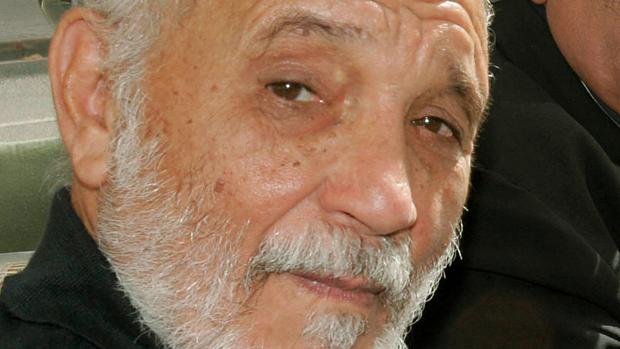
Rafael Alcides (EFE)
“I’m going to be a beautiful corpse,” he says, “remembered with love.”
But he is not dead yet. He is Cuba’s greatest living poet and very likely the most honest, the most unjustly silenced, the one who has paid the highest price for his nobility, and the one who has not been subverted by fashionable trends nor bought by politicians’ petty cash. continue reading
Intermittently published, he has received some quite unusual awards. In Cuban prisons, in the Eighties, the inmates exchanged cigarettes for his book, Agradecido como un perro [“Grateful as a dog”]. The only things a rafter would take with him across the Florida Straits were Alcides’s books wrapped in plastic so that the sea would not destroy them. Young people from the provinces would show up at his house after reading some book of his at some second-hand bookstore.
Alcides is not a poster boy for exile. He is not a plaintiff from the Five Grey Years. He did not become cynical, coarse, sarcastic, cautious, or violent, nor even less did he ever cave in. For some inexplicable reason, he cares less about his personal luck and more about the death of his country.
“If I lose my book, after many years of writing it, I am the one who loses. That is my own personal loss. But this is the loss of the people and it is a sacred thing, a tragedy: We have a patchwork of capitalism and socialism that means nothing. Look around for a damned vegetable. You won’t find it. Look at the prices. Is it the blockade’s [embargo’s] fault? Are you fucking kidding? You can’t be serious. What, the produce comes from London? The sweet potatoes come from Paris?
“No. Life goes on and it’s like a chess game. Each move changes the game. You cannot be rigid. This continues because Fidel and Raúl are in a duel with the United States. A shameless and mendacious duel; because Raúl says, ‘We can hold on for another 50 years’… yes, of course, you can hold on. But the people can’t hold on anymore. In no way am I proud of this situation. I feel like the worker who helped build the prison. I am one of those workers. But, if I reincarnated and were given the same circumstances, I would again join in that struggle and do everything that I did. I would sign up for that campaign. We thought we were going somewhere, even though it turned out that we didn’t arrive anywhere.”
— What about your literature?
“I don’t talk about my literature. My history is very simple. In the end, I have been an author of drafts. I have three or four meter-length of novels in my closet, and that’s where they’ll stay. Thirty years ago, when I moved to this house, I burned another meter and a half.”
— Doesn’t this trouble you?
“There was a time when it did trouble me, because it’s what I lived for and gave my life to. But later, you have much less anxiety. Why? Because there have been bigger losses. The biggest loss was losing the Revolution itself; it was the dream of many people like me. There was an opportunity, the opportunity existed, but that is a train that will not pass again.”
***
Previously, in an interview with the critic and writer Efraín Rodríguez Santana (Cuba Encuentro magazine, No. 36, spring 2005), Alcides had acknowledged that he burned his novels to pay off the mortgage on a future that was weighed down by so much draft material that he would never be able to finalize. In this sense, it can be said that the Revolution itself is the unfinished novel, allegedly complete, never to be finished, that its authors insist on continuing to write at the wrong time. Politicians are politicians precisely because the generosity of true poets is unknown to them.
***
“In Cuba, a Revolution was needed. What happens is that the Revolution soon ceased to be Revolution and became something else. Fidel began to do whatever he wanted, to lead wars around the world in which, on the other hand, he did not participate — unlike Alexander, Hannibal, and Napoleon, who did participate. Not even his children were there.”
— If we had to venture a year in which the Revolution ceases to be “Revolution”…
“Starting at the moment the new legal body is created. When it was established that blacks and whites were equal, that everyone had the same rights, and that the state was controlling the means of production…at that moment is when the Revolution ends. What takes its place is the natural contract between man and state and man and society, the social contract of all times, where the citizen produces, pays taxes, the state collects, distributes what it collects, builds schools, pays the salaries of officials, the army, the salary of Fidel and Raúl. That state is responsible for giving you a scholarship if you perform well, ensuring that you have a free education — which is essential — and hospitals, and doctors.
“The Revolution ended in 1965 or 66. But — what’s wrong with this picture? It’s that Fidel is very cunning, very intelligent, he is a genius, no doubt about it — he is sinister, and he retained the name, Revolución, that abstract entity. Why? Because that way you owe things to the Revolution. But since the Revolution has no face, it is not a figure, you need to identify it with someone. Your father was a garbage collector and you became a doctor or lawyer thanks to the Revolution, that is, thanks to Fidel Castro. You owe everything to Fidel Castro.
“No! No! Fidel Castro owes everything to you, everything he is, the glory and power he has, has been given to him by the people, by me as part of the people. I pay him the salary to manage and direct, I have trusted him. That story of ‘At your orders, Commander in Chief’… No, sir! The sovereign is me, it is not you, you must take off your hat to the people, who are the true sovereign, the one who puts the hat on your head and the one who can take it away. This [would be], of course, things rightly understood in a rule of law. Here, you can’t take away fuck. He’s the one who can take away from you, he can take your life.”
–Did you ever admire him?
“Yes, of course, I followed him, he was the chief.”
— Did you have affection for him?
“Affection is a strange word. Affection is one thing. Love is another. Respect, admire, feel a part of. Rather, I felt a part of it all. Also, you have to think of yourself as a big octopus, because you love people for many reasons. So, you’re a leader, you’re a boss, you represent an idea, and there are lots of friends of yours who have been friends of mine and have died — that is, we are all part of an ideal. Already, once I know you, we are united by all those affections of people who have loved you and whom you have loved, or supposedly have loved. We are part of a big family. It is no longer a problem of whether I love. You are simply part of me, and as I trust you and we are part of an enterprise, everything that is decided is correct.
“Fidel was also the man who was facilitating the country’s dream. For example, one of the great things he invents is literacy, which is very beautiful. Or distributing land to the peasants. Who wasn’t going to agree with that? Anyway, it was a very nice moment, really.
“Fidel could have become one of the Christs of human history, he was going down that road. People loved him, gave thanks to Fidel, ‘Fidel, my house is your house.’ All of this went on, things that would make you cry. And socialism seemed like the realization of man as a species, the political and cultural realization. Open hospitals for everyone. Although he didn’t create the hospitals, they were already there, and, well… the doctors left, because he harassed them. So that all the intelligence of the country would leave for good, and he could start over with people he had shaped from scratch and were in his debt.
“But, yes, it was beautiful. And we were making history, on the other hand. You don’t take money with you, but you do take glory. We were rebuilding the world. The great epoch.”
***
The life of Rafael Alcides is an excuse for nostalgia. If we continue with Rilke, it can be said that Alcides has been nothing more than the final verses of Duino’s Eighth Elegy: “Who has turned us upside down like this, so that, no matter what we do / we keep the attitude of one who is leaving?”
Everything – born on June 9, 1933 in a hamlet in Oriente province, “immense savannah with only ten or twelve houses” – begins, transpires, and ends this way: “I cannot stop being from Barrancas./ From Barrancas that today only exists in my dream.” We understand that fidelity to moral convictions is, then, a relatively comfortable and minor task for those who have known how to save that which is is most difficult: the integrity of their being.
Alcides is a pillar of memories, and time has finally forgiven him. Regina, his wife, describes him: “Another of the things that makes him extraordinary has to do with his appearance. When we started our relationship 24 years (!!) ago, my niece, with all the candor of ten years, wondered if he was Eliseo Diego. He wore then a venerable white beard and was unexpectedly balding. His contemporaries seemed like younger brothers. It turned out the joke was on them as he didn’t get any older while others lost their freshness, hair, pounds, physical and/or mental agility and for a long time the tables have been turned. That, despite a copious medical record very well concealed.”
He grew up in a clapboard house with a thatched roof and dirt floor. His first heroes were the heroes of Cuban Independence: Maceo, Gómez, Calixto García. Rafael and his brother Rubén were vying for the leading roles in their games, even coming to blows if necessary. Both always wanted to be Maceo, until Rafael convinced Rubén to assume the role of Ignacio Agramonte: young and beautiful.
“That was,” he said, “our childhood literature. And our cinema.” He already assumed Cuba as a vast fiction, the raw material with which his inventiveness would be dispatched.
He attended primary school in Bayamo, and in 1946, when about to finish high school at the Escuelas Pías de San Rafael y Manrique in Havana, he returned to Oriente – only to leave again. In Poema de amor por un joven distante [“Love poem by a far-away young man”] – dated 1989 – Alcides recreates as a protective father the archetypal arrival to Havana of excited young people of the province – that first, terrifying, Balzaquian clash with the city so many times evoked. But in reality, like Whitman, in the harmonious salutation to his fellow man, Alcides speaks to himself, and comforts and embraces the young man “solitary and lonely, the loneliest of men” — himself — on that day “longer than a century” of June 22, 1952.
In that decade, his baptism of fire was the struggle against the Batista dictatorship, clandestine activity, and membership in rebel groups of action and sabotage. There are moments, situations that haunt him, furies of youth that today he would not subscribe to, that he does not even mention. But they were violent years, tense, he in the prime of his age. What else could he do but offer himself to the fierce ritual of justice?
“Once we were at the university, the police came and started shooting. We threw ourselves to the ground and then, the next day, we saw that the bullets had hit a meter above our heads. But we came to know it the next day. With life, it happens to you exactly the same way.”
In the first years of the Revolution, Alcides was assistant to Manuel Fajardo Sotomayor (Commander of the Rebel Army), participated in the Literacy Campaign, assumed positions of a political cadre in the ORI (Integrated Revolutionary Organizations), and wrote two initiatory and forgettable poetry books: Himnos de Montaña [“Mountain Hymns] (1961) and Gitana [“Gypsy Woman”] (1962). In 1963 he published El caso de la señora [“The case of the lady”] in Unión magazine, a poem that caught the attention of Nicolás Guillén – his close friend – and stood out in the effervescent literary panorama of the moment.
Alcides assumed the conversational language that, first in an organic way – starting with his generation, the so-called “Generation of 1950”: Pablo Armando Fernández, Manuel Díaz Martínez, Roberto Fernández Retamar, Fayad Jamís, Heberto Padilla, etc. – and then later imperatively (due to stylistic fashion or expressive obedience with which to praise the socialist project) would come to rule the Cuban poetic discourse for a couple of decades.
At the same time, within the ICRT (Institute of Radio and Television), he wrote scripts and conducted En su lugar la poesía, a radio program on which several of the most important poets of Latin America were guests. In addition, he amassed narrative projects. In 1965 he delivered, with the tagline Brigada 2506 [the name of the exile group that carried out the abortive Bay of Pigs invasion in 1961], his novel Contracastro to the Casa de las Américas contest. Mario Vargas Llosa defended it tooth and nail, but such a title aroused resentment and, the prize being declared null, Alcides was awarded an honorable mention.
“The novel was not a counterrevolutionary novel — far from it. Maybe it was the doing of Haydee Santamaría (president of Casa de las Américas), a wonderful woman, very big, but for whom Fidel was untouchable, and the name must have seemed like a rumble, an elephant in a glassware shop. Later I learned that while on a trip to Vietnam [Fidel] asked for a copy so that he could read it, and decided that yes, they could publish it.”
But he was asked to change the title, and Alcides did not accept.
— Maybe that’s where your disappointment with the project begins.
“No, it’s not that. It was a very individual thing. We are still in January of ’65, a romantic year, and any individual could come up with anything.”
In 1967, La pata de palo [“The wooden leg”] appeared on the Letras Cubanas imprint, and the first poem, El agradecido [“The grateful one”] is enough: “My whole life has been a disaster/ that I do not regret./ The lack of childhood made me a man/ and love sustains me./ Prison, hunger, everything:/ all of that has been good for me :/ the stabs in the night/ and the unknown father./ And so from what I had/ is born this thing that I am: a very little thing, it is true,/ but huge, grateful as a dog”.
Since then, Alcides is a parable. Diaphanous, but deep. Assertive, but suggestive. The straight line of his actions, the clarity of his verses, end up creating an immensity.
He broke down the epic patiently. He sat at his kitchen table, took the Homeland, put it in the coffee grinding machine, and began to crush at times with the left, at times with the right, and so on. His colloquialism is ambidextrous. He equally claims the legitimacy of agitating himself as though a blind and universal god to whom everything is incumbent, as the possibility of composing, like the industrious potter, the exquisite daily piece.
“The wooden leg” found immediate homage in Guillén’s late exercises, such as En algún sitio de la primavera [“Somewhere in Spring”], and in Taberna y otros lugares [“Tavern and other places”], Roque Dalton’s main collection of poems. About Carta hallada en los bolsillos de un monje [“Letter found in the pockets of a monk”], one of the poems in the book, Virgilio Piñera said: “The reader who tries to find the ’trembling’ of St. John of the Cross, the ’imagery’ of Góngora, the frisson (goosebumps) of Baudelaire, the flares of Rimbaud or the ’silences’ of Mallarmé would understand nothing of this ’Carta’ [’Letter’] in which poetry is anything other than trembling, imagery, frisson, flares, and silences. And perhaps there is all that (…), but inserted into words that are not the words that the aforementioned poets used in their songs”.
In the braid (impossible to remove without destroying it) of History in capital letters and lyrical will that is the existence of Alcides, “The wooden leg” was followed by 1968, the Soviet tanks in Prague, the Cuban government’s approval of the invasion, and with it the pragmatic dagger of realpolitik destroying the brave illusions of the poet.
There would come the parametración imposed the literary and artistic field, the established and legislated censorship, the accelerated Stalinization of society, the most abusive methods of alleged ideological re-education, and the famous Padilla case – the author challenged for his “critical and anti-historical” literature, imprisoned under accusations of subversive activity, then pushed to publicly read a self-criticism in the purest of Soviet styles – and the Western intelligentsia’s immediate and majority divorce from the Revolution.
“We must understand the enormous cruelty that this meant, the wound it made in the field of culture. Everything went through a black hole. Someone moved the needle of the trains and diverted the route. The experience of the USSR began to be duplicated and the martiano program [the study of José Martí’s legacy] was betrayed: “a republic with all and for the good of all,” an economic program for small and medium-size business owners. This shows how that very human process, which seemed to be led by men, was carried out by So-and-Sos who wanted to look like divinities.”
In 1970, intent on publicizing his disenchantment, Alcides presented at the National Union of Writers and Artists (UNEAC) a notebook entitled The City of Mirrors, and was predictably rejected “as nihilistic, as improper of the New Man”.
Knowing that he would also be set apart, he decided to set himself apart. He would not visit UNEAC again. He would not submit books to any publisher. He would not attend any exhibition or cultural event. He would not be seen in cinemas, concerts, or public events. Thus began the longest inxilio [internal exile] of Cuban literature.
“The alternative would have been to plant bombs to destroy what I had helped build, and that I was never going to do.”
Alcides wrote radio scripts from his home and wrote prophetic verses in the most complete and conscious solitude. He subjected his soul to a disciplined military regime. He wrote: “The past and the future have already passed./ Everything we had we lost,/ and it was more than we could have./ We have this rumor. This / lot of sorrows that the wind spreads, / immemorial, without time./ This rumor / of what was / life before the future came.”
These were scary times and no one paid visits to anyone.
“César López and Pablo Armando saw each other more or less, from time to time. Manuel Díaz Martínez was stuck in a radio station without being able to put his name to his work, Heberto (Padilla) translated Maiakovski without being able to sign his work, Virgilio at that time also translated without being able to sign his work — everyone was very scattered. It was an offensive against intellectuals who had applauded the process, who had fought in Playa Girón [Bay of Pigs], who had slept rough, by the sea. People who loved the Revolution. These writers began to have ideas, to make critical literature, and they annoyed those who were already seated on the chair of Stalinism. That’s the whole story.
Later, many of the defenestrated intellectuals would be reinstated and would gladly accept the state’s perks. But not Alcides. An eminently sentimental — even melodramatic — poet, and with enough courage to write the fieriest confessions and walk the edge of any excess. But possessing, also, a cold lucidity. He believed that what the Revolution should expect from true revolutionaries was not faith anymore, but doubt: “A poem can be/ a machine of emotion/ or a machine of intelligence./ (Emotion passes).”
***
“Poetry is mixed with the story, with the novel, with everything. Poetry is given in fits and starts, it is like love. You have to write as you feel it. This is your chance, you will not be born again. That’s the secret. It doesn’t matter that others don’t see it. The creator risks his death, others risk their lives. Poets who today seem transcendent, tomorrow are forgotten. It happens with all authors. Poetry is the mystery, the gift that the word has to captivate. But it’s not a safe place. Today they can throw you kisses, give hugs, but tomorrow… There are so many poets out there. That’s why you have to take a chance. You don’t write for now, not for me, not for you, not for anyone. You are writing for your contemporaries — that is, the future. Sincerity. If it goes well, it goes well. If not, then no. Do not lie. Do not lie. He who lies will have his hand withered,” says Alcides, the noble conversationalist.
***
It is easy to trace the transcendent events in Alcides’ life, because they are all in his work, without disguise. He married Teresa – “Without solitude to deceive,/ today Teresa and I do not eat and we drink the poem/ made stew and made coffee that is how it feeds,/ and we laugh at how they are heated in a jar / or fried in a pan with butter / our next Complete Works” – and had with her the most famous of his four children: the painter Rubén Alcides.
When Teresa – several years divorced from Alcides – emigrated in the early 90s with the son they had together, Alcides composed Carta a Rubén, one of the most shocking elegies about the main trauma of the recent Cuban family: “But we, / we alone, / the sad, / the mournful ones / in what homeland are we now? (…) / The homeland, far from what you love? (…) / Where you live between walls and locks / it is also exile…”.
He sang, also, to the helpless flower (Canto para los dos) [“Song for the two of us”], to the tomb of his only general (En el entierro del hombre común) [“At the burial of the common man”], and even to the ministers, in a poem where he confesses: “Every time I hear about a friend / who is going to be made a minister, / someone erases a part of my life …” If we review the updated list of cultural commissars or retroactive sacred cows – a good part of the Generation of 1950 – we will see that power has been erasing Alcides more than should be erased from a man.
But in 1984 – years of a certain thaw already – “Agradecido como un perro [Grateful as a dog]”appeared, an indelible explosion. Reviews rained down and young and gallant readers, stunned, broke their fast with Alcides. In the title poem, the Revolution is mentioned. However, the poem does not wither, which is what usually happens, but the Revolution endures. The Revolution, after so many flat balladeers and grandstand impostors, finally owed survival to a dissident.
At the end of the eighties, believing that idle abstention made no sense, and driven by what he described as “the deceptive winds of Perestroika,” Alcides reconnected with the UNEAC and participated in meetings and congresses.
“My attitude had been that of someone who did not want to charge against what he had loved and continued loving, and for which he could still give his life because he had hopes that we would rectify it.”
Returning to the world, he found Regina, then an official of the Ministry of the Interior. She knew his poems inside out, and the gravitas, the manifest disinterest of Alcides in standing out, the silences interrupted only by his affable radio-announcer voice, ended up captivating her.
“I saw him for the first time at a wake and we didn’t speak, but I was very impressed by his concentrated expression, by himself, sitting in a Calzada y K [a Havana funeral home] armchair. Then we were introduced to each other at UNEAC and there was empathy, but no more. We met again through the complicity of a friend on 31 December 1988, and the rest, as they say, is history.”
In 1991, after the events of the “Letter of the Ten” [also called the Declaration of Cuban Intellectuals] – expulsion from the UNEAC, administrative sanctions, false accusations, and a shameful campaign to discredit a dozen intellectuals who dared to sign and disseminate what, according to Manuel Díaz Martínez himself, a signatory, was no more than a “list of moderate demands to the government” – Alcides concluded that everything would remain the same and so he again began to prefer his solitude to the company of colleagues whom he still loved but whom, in the best of cases, the pusillanimous silence turned into accomplices.
Around that time, Letras Cubanas released the forgotten notebook La ciudad de los espejos [“The city of mirrors”], but with a much more bitter title, which summarized the annoyances of Alcides: Nadie [“Nobody”]. It was his last book to be published by a Cuban publisher and he would never appear again in any public space. They once tried to recognize him with the National Prize for Literature and he rejected it.
As alternative avenues of expression opened up in Cuba, Alcides moved from silence to critical participation. He has held nothing back — not in interviews, not in articles, not in talks or events to which the political opposition invites him. During the last 23 years, his poetic work has only seen the light of day thanks to the Sevillian publisher Abelardo Linares, who one day knocked on his door and rescued him.
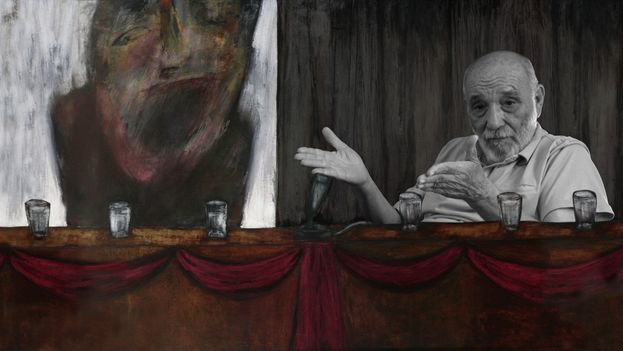
Screen shot of the documentary Nadie with Rafael Alcides.
***
On the occasion of his 80th birthday, Regina wrote: “Alcides is incapable of boarding a bus, a shared taxi (almendrón), or a called taxi (panataxi); he is incapable of walking even 200 yards to meet a celebrity. Instead, he is an extraordinary host, so warm and attentive, who immediately makes even new acquaintances feel comfortable.”
“In this time of ideological polarization, he keeps affection intact and that intense way of loving, be it for a high government official or a senior opposition leader in exile. He forgives (but does not forget, he has an excellent memory) some fool elevated? from bison poet to official who from his new position has allowed himself to treat him coldly. He still regrets the errata by omission of the dedication to Roberto Fernández Retamar in a poem from a book recently published in Colombia.”
A year later, some online media outlets published the following email, signed by Alcides:
“Havana 30 June 2014
Miguel Barnet, Poet
President, UNEAC
“Friend Miguel: In view of the fact that my books are no longer allowed to enter Cuba either through customs or by mail, which is the same as prohibiting me as an author, I resign from the UNEAC. You will also find in this envelope the Commemorative Medal of the 50th anniversary of the UNEAC which, as a founder, belongs to me. The rest of that mansion that was so mine in another time, are my memories, and these, being personal, will leave with me. Among those memories, that of the good friends found in the UNEAC of that time, treasures of my youth, what I have left of that great failed dream, figures whom I love even if they do not think like me and who love me, even if they do not dare to visit me. That is all, Miguel. Anticipating interpretations that would omit the text of this irrevocable resignation, I have gone ahead and made it public.”
Still, resentment is something he knows nothing about, and he fervently believes in God.
***
—Over time, you have gone further than any of your generation.
“No. I have advanced just like everyone else. I’m pretty sure we all think the same. In Cuba, there are only two dissidents: Fidel and Raul Castro. The rest of us agree that this does not work. What happens is that some dare to say it and others do not, because some are inside the game and others outside. Since I don’t need to take trips, nor do I accept trips, nor do I want a different house, nor do I aspire to be given a car, and I don’t even have a landline, I can say it.”
—But that’s going further.
“It is not.”
***
Manuel Díaz Martínez has said of him: “Rafael Alcides treasures still – they live on in his conduct and his writing – the rebellions and longings that were once the currencies of our already dismantled generation. It should not surprise us, then, that this Caribbean Ulysses continues to dream, in the grotto of Polyphemus, of reaching Ithaca. Across the Atlantic I discover him, a navigator of stubborn dignity, resisting the siren songs in a muddy sea of betrayals and surrenders.”
***
—Did you ever think about leaving Cuba?
“No, never. I am from here. Honestly, I wouldn’t know how to live outside of Cuba. But the problem is to continue fighting. It doesn’t matter if it’s here or there. That isn’t important. And I believe that those who fight for change, be it here or there, have the same right.”
—Do you feel alone at times?
“No, I don’t feel alone. I have many friends outside. But the friends from before no longer exist. They are a part of the before times. They don’t come here.”
—Do you still love them?
“Yes, I love them in the past. What has been, not even God can erase, and I respect it all. Now, those friends no longer visit me. If we run into each other, by chance, some of them hug me, others turn away. I have become invisible.”
—And how does that make you feel? Sad?
“Not even, not anymore. I realize that it can’t be otherwise. I realize that they are afraid. It makes me pity them (a little) because I know that they have not stopped loving me. Because I have not stopped loving them. I love them in the past, but I love them all the same. I greatly respect the choices of others, in every sense, but I also respect my right to disagree. If in the next government we will be as intolerant as we have been in this one, I’ll take this one, because I already know it more or less.”
—The radical position of the old exiles is not very convincing to you. “No, I don’t believe in radicalisms, radicalisms are stupid. We don’t realize it, but we have lived through a great tragedy. Today the word Patria — fatherland — doesn’t exist. We have drama. And literature — the novel, poetry — is made with drama, with pain. This is coming to an end. The time has come to start telling about it.”
The mothers of the 11J prisoners are not going to give up. (Facebook)
14ymedio, Havana, 12 July 2022 — “State Security visits us and harasses us, but we are going to continue asking for the freedom of our children.” The words of Migdalia Gutiérrez Padrón, mother of a 21-year-old young convicted because of the 11J protests [July 11, 2021] without even proof that he was there, explain why among more than 1,500 detainees in the anti-government demonstrations a year ago, there are barely only about twenty families who dare to raise their voices.
Warned and threatened, the mothers, wives, and sisters of the prisoners have become the weakest links for State Security, the easy target to ask for silence not to make things worse. But the political police did not count on the fact that links are also iron made. The political police lack the necessary expertise to understand that they would not be the first mothers in the world who fought for their children and managed, sooner or later, to bring genocides, traffickers and murderers to the dock.
Over several months, with the patience required to gain the trust of those who feel fear, the director of 14ymedio, Yoani Sánchez, was able to interview the mothers of some of the 11J prisoners and the wife of one of them, who also suffers the consequences of having a son now fatherless. continue reading
These women agreed to tell where their loved ones were that Sunday, when the demonstrations began, how their arrests and grotesque trials took place, the painful days in prison, and the frustrated hope of a useless appeal. Some affirm that their children did not even participate, others claim that they marched peacefully asking for freedom, others cannot believe that even if they had thrown a stone, they have been sentenced more harshly than murderers and rapists.
They have all suffered having to bring food and clothing to their children and seeing them locked up in unworthy conditions. And although they all know that their fight is almost against a wall, they do not plan to abandon it. María Luisa Fleitas, one of our interviewees and the mother of a young man sentenced to 21 years in prison, wrote: “A son in prison is a dead mother.” But they are alive enough to keep fighting.
COLLABORATE WITH OUR WORK: The 14ymedio team is committed to practicing serious journalism that reflects Cuba’s reality in all its depth. Thank you for joining us on this long journey. We invite you to continue supporting us by becoming a member of 14ymedio now. Together we can continue transforming journalism in Cuba.
Dimas Castellano, 7 July 2021 — The democratization of Cuba, a Western country laboring under a totalitarian government in the twenty-first century, is an urgent necessity. Cubans, who lack the space and freedom to participate as agents of that change, require international support. After 25 years of mutual relations, the European Union (EU) has shown the requisite conditions to satisfy that role as a partner.
The European Economic Community (EEC) was created in 1957 by Belgium, France, Italy, Luxemburg, the Netherlands, and West Germany. With the signing of the Maastricht Treaty after more than three decades in development, it added political ties to its economic relations and went on to be named the European Community (EC). At the summit meeting of the heads of state or governments of the member countries, it then became the EU.
In 1996, the EU, whose members maintained bilateral relations with Cuba, assumed a Common Position with the objective of “fostering a transition to democracy and respect for human rights and fundamental freedoms, as well as a sustainable recovery and an improvement of living standards for the Cuban people.”
A retrospective view of 25 years of relations with Cuba bears this out.
In 2002, Cuba sought to be incorporated into the Cotonou Agreement, a cooperation agreement between the EU and countries of Africa, the Caribbean, and the Pacific, in which the parties are obligated to respect human rights and fundamental liberties.
In 2008, while the majority of the 75 prisoners remained in jail, and the effects of the crisis were exacerbated by the destruction caused by hurricanes Gustav and Ike, the government decided to restart relations with the EU, which had been disrupted since 2003.
The chancellor, Felipe Pérez Roque, declared that the government of Cuba would make “clear gestures of recognition” of European policies if the EU did not vote in favor of the resolution on Cuba by the UN Human Rights Commission and added that by doing so “Cuba would sign the International Covenant on Economic, Social and Cultural Rights on the following day.” In other words, the signing of the covenant would not be predicated on a desire to improve the human rights situation in Cuba. Rather, it was political blackmail, which explains why the signature was never ratified. In the meantime, the chancellors of the EU countries revoked the 2003 sanctions and introduced a “renewed commitment” to the Common Position.
In 2010, Cuba denied entry to the Spanish MEP Luis Yáñez, and the political prisoner Orlando Zapata Tamayo died in a hunger strike. These incidents were condemned by the European Parliament. Deteriorating relations along with internal incidents led to a pledge to free all political prisoners involved in the case of the 75 activists.
In 2014, in response to the release of the political prisoners, the EU authorized the start of negotiations to establish the Political Dialogue and Cooperation Agreement with Cuba, signed in March 2016 in the presence of the High Representative of the Union for Foreign Affairs and Security Policy Federica Mogherini, and the Cuban chancellor Bruno Rodríguez.
From that moment to the first and second EU-Cuba Joint Council (in May 2018 and September 2019, respectively), there was no progress regarding human rights.
More recently, in June 2021, Cuba’s conduct received three forceful blows that indicate a possily decisive turn:
On the 10th of that month the European Parliament condemned the existence of political prisoners, the persecution and arbitrary detention of dissidents, and insisted that the Cuban authorities release all political prisoners and those who were arbitrarily detained for exercising the freedom of expression and assembly.
On the 20th, in its Annual Report on Human Rights and Democracy in the World, the EU recognized that in Cuba freedom of expression, association and assembly remain subject to important restrictions, and it affirmed that the government of Cuba is not inclined to support the recommendations of the EU member states.
On the 30th, the Lithuanian Parliament, the only country that had not ratified the Political Dialogue and Cooperation Agreement, upped the ante: It demanded “the unconditional release of political prisoners” and mentioned by name the persecutions of Tania Bruguera, Luis Manuel Otro Alcántara, Maykel Castillo, Denis Solís, Luis Robles and those held as a result of the protest on Obispo Street, among others, and thereupon declared that “it is not politically advisable to ratify the Agreement, effectively nullifying it.
These events have created an unforeseen scenario in Cuba-EU relations.
What lies behind these events was a dismantling of civil society after 1959, the suppression of the most basic civil and political rights, the elimination of private property on the means of production, and the monopoly of the party/state/government over politics, culture, education, and the media.
The current government of Cuba, essentially the same one that debuted in 1959, incurred responsibilities and interests it is prepared to defend. This explains the limited and contradictory nature of its reforms, and at the same time, it reflects its great weaknesses, disguised by impotent gestures and speeches. Within this complex scenario lies the importance of the EU as a partner toward democracy.
“The only thing that can save the Agreement is a public dialogue with civil society and the execution of the European Parliament’s resolution of last June 10th.”
One desirable and beneficial solution to achieve the agenda of the Political Dialogue and Cooperation Agreement would be to make at least five demands additional of Cuba:
Require concrete actions and not verbal agreements for help, as has occurred since the Common Position was adopted in 1996.
Freedom for all political prisoners, an end to arbitrary detentions, persecution and any other violations of rights and human dignity.
The addition of Cuba to the Covenant of Political and Civil Rights and the International Covenant on Economic, Social and Cultural Rights signed in 2008.
The coupling of Cuban law to the United Nations Charter as well as all international instruments of law.
The fomenting of spaces, mechanisms, exchanges, and cooperation with independent civil society in Cuba, establishing direct relations between associations of civil society of both parties without state control.
These minimal requirements, based on Cuba’s needs and on its relations with the EU for twenty-five years, should definitively constitute the lodestar for current and future relations for the good of Cuba, the Cuban people, and the EU.
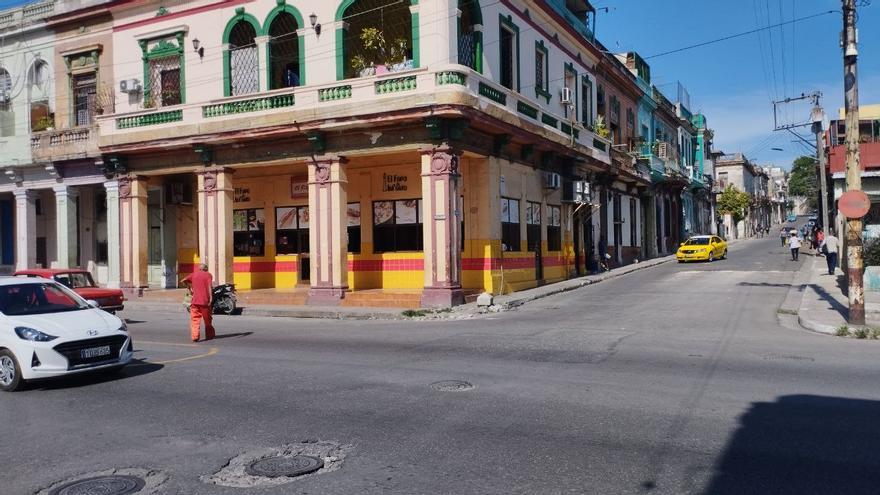
El Faro, one of the state stores that was completely empty this Monday. (14ymedio)
14ymedio, Juan Diego Rodríguez, Havana, 11 July 2022 — The harassment of independent activists and journalists since last week already foretold that this Monday, the one-year anniversary of the historic 11J demonstrations in Cuba, would be a day without disturbances. This is the case, at least in Havana, where numerous police officers, uniform and civilian, are deployed in the streets of the center. In their effort to maintain order, the authorities have even done what seemed impossible: they made the lines disappear.
“There’s nothing available in the neighborhood stores that always have lines in front, such as El Rápido, the Cupet de Infanta or Maisí. It seems that they’ve chosen to avoid the food lines today,” a neighbor of Central Havana tells this newspaper, surprised by the empty shops, the semi-deserted streets and the environment of surveillance.
In the Maisí store, located on Infanta Street, two other women commented that “there’s nothing for sale because, you know, today they don’t want people on the street.” Nor was there anything to buy at H. Upmann, on Zapata and Infanta, and Las Columnas, on Galiano.
At the doors, of course, there were individuals with an inquisitive attitude, who were clearly not there to buy, since nothing was offered. “Today there are more police than people on the street,” a boy murmured when he saw them. continue reading
The police operation was especially visible on Carlos III Street, which was full of officers. In the Plaza of the same name there was one business operating, with chicken and detergent for sale in pesos. On any other day, the line would have been massive; however, on Monday, there were only three people waiting.
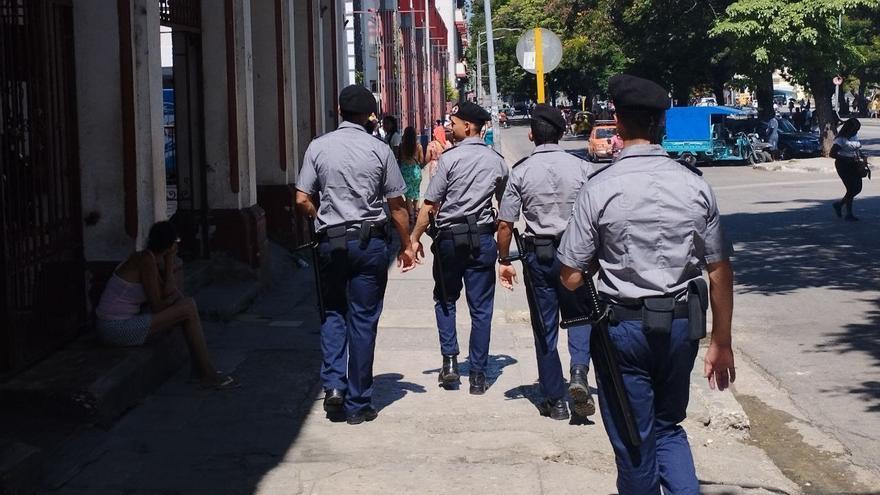
Uniformed and civilian agents guarded the streets of Central Havana. (14ymedio)
“Here, here’s the line, they replied to an old man who asked, surprised by the low number. “And why are there so few people?” he asked. “They’ve only allowed the bodegas (ration stores) to be open today,” they explained.
On the door, a sign announced the distribution of the bodegas for the People’s Council of Pueblo Nuevo, the only one that has been open from June 22, without any modification to the rules of last May 20. Since then, purchases have been restricted by municipality and “cycles,” a controversial measure not only to distribute scarce products but also to avoid turmoil in the lines.
“It’s a shame there isn’t even one place open, not even one line, in all of Havana. It’s incredible,” exclaimed a boy also from Central Havana who, in vain, was looking for a place where he could shop paying in national currency.
The strategic points of that neighborhood, one of the emblematic scenarios of last year’s 11J demonstrations, were full of officers on Monday. A woman summarized the situation when passing a group of four Black Berets [Special Forces] walking along Boulevard San Rafael: “Not even one fly is flying here today.”
Translated by Regina Anavy
____________
COLLABORATE WITH OUR WORK: The 14ymedio team is committed to practicing serious journalism that reflects Cuba’s reality in all its depth. Thank you for joining us on this long journey. We invite you to continue supporting us by becoming a member of 14ymedio now. Together we can continue transforming journalism in Cuba.
The biologist and Cuban activist Ariel Ruiz Urquiola, this Monday in front of the offices of the UN High Commissioner for Human Rights in Geneva.
EFE (via 14ymedio), Geneva, 11 July 2022 — On Monday, the Cuban biologist Ariel Ruiz Urquiola, an environmental and LGTBI activist, completed eight days on a hunger strike in front of the headquarters of the UN Office for Human Rights in Geneva, which he is demanding intervene to stop the harassment suffered by his family in Cuba.
“The only thing left for me is to ask the high commissioner (Michelle Bachelet) to adhere to the Universal Declaration of Human Rights, which has been violated against my sister [Omara Ruiz Urquiola] and me through medical torture and crimes against humanity,” the Cuban activist, resident in Switzerland since 2019, told EFE.
Ruiz Urquiola accuses the Cuban regime of having expelled him and his sister from the University of Havana for their political activism, of trying to confiscate the land they work, after not being able to dedicate themselves to teaching, and now of preventing his sister from returning to Cuba after traveling to the US to treat breast cancer.
In addition, the activist affirms that Cuban authorities inoculated him with the HIV virus in 2019, when he was on another hunger strike, and that they have given his sister placebo treatments on several occasions instead of the medicines she needs against her cancer. continue reading
“Now that my sister is prohibited from entering Cuba, my mother is left alone and they are going for her: they want to confiscate our farm,” said Ruiz Urquiola, who has been sleeping outdoors in a Geneva square since July 4, and assured that it will remain there “as long as the body lasts.”
“The Geneva medical services and the police have been very concerned about my health, but my choice is to continue,” he said, and blamed the UN Office for the medical consequences that the current strike, the fifth it has carried out in almost 20 years of activism.
The Cuban expert added that just one person in charge from the office headed by Bachelet has been interested in his health these days, for which he considered “disastrous” the response of an institution before which he had already done a shorter strike hunger in 2020.
Translated by Andrea Libre
____________
COLLABORATE WITH OUR WORK: The 14ymedio team is committed to practicing serious journalism that reflects Cuba’s reality in all its depth. Thank you for joining us on this long journey. We invite you to continue supporting us by becoming a member of 14ymedio now. Together we can continue transforming journalism in Cuba.
The regulation says that “freedom of the press constitutes a right of the people”, yes, but that this is exercised “according to the aims of the socialist society.” (Capture)
14ymedio, Havana, 12 July 2022 — On Tuesday, the Cuban government presented a preliminary draft of the Social Communication Law and opened, according to the official Granma newspaper, a “specialized consultation process” to support “the knowledge and study of the population regarding this norm.”
The 32nd version of the law was signed on April 15, but it was made public one day after the anniversary of the historic 11J (July 11th) protests throughout the island. Although the official press posits the law as an instrument to “regulate” the content in the press, already from its preliminary dispositions it makes its character clear: it says that “freedom of the press constitutes a right of the people,” yes, but that this is exercised “according to the aims of the socialist society.”
The text does not recognize any other type of ownership of the local media that is not state, as indicated in the 2019 Constitution.
At a press conference, Onelio Castillo Corderí, vice president of the Cuban Institute of Radio and Television (ICRT) and member of the document’s drafting commission, highlighted as the most important aspect of these consultations “being able to collect the opinion of the citizens, who constitute the core of all the communication processes that the standard describes.” continue reading
The document will go through a consultation starting this Tuesday that should end in September, commented the vice president of the state Union of Journalists of Cuba, Jorge Legañoa, without offering more details about the legislative path prior to its eventual approval. For the consultation an email address as been established an email, as well as “telephone numbers and other channels, through social networks, in many communication media, in organizations and institutions in the country,” Granma said.
The journalist, accompanied by two other press and social communication officials, stressed that the regulation covers the institutional, media and community spheres, and that it is the result of several months of investigation.
Legañoa described the preliminary project as “unprecedented, robust and as an opportunity to educate the public in matters of communication.”
The regulation announced this Monday, which contains 69 articles, includes a regulation that prohibits the use of content “to make propaganda in favor of war, of a foreign state hostile to the interests of the nation, terrorism, violence and the apology of hatred among Cubans, with the aim of destabilizing the socialist rule of law,” among others.
It also points out that the country’s social communication system has the purpose of “fostering consensus and national unity around the Homeland, the Revolution and the Communist Party of Cuba.”
It also recognizes the income generated by advertising as one of the ways for the economic management of the media, as long as it does not go against “the principles that govern” the “socialist society” of the Island.
There is no recognition of independent media critical of the government and operating in a legal vacuum.
Last May, Cuba approved its new Penal Code in which, among other things, it sanctions with one to three years in prison “whoever spreads false news” with the purpose of “disturbing international peace, or endangering the prestige or the credit of the Cuban State.”
____________
COLLABORATE WITH OUR WORK: The 14ymedio team is committed to practicing serious journalism that reflects Cuba’s reality in all its depth. Thank you for joining us on this long journey. We invite you to continue supporting us by becoming a member of 14ymedio now. Together we can continue transforming journalism in Cuba.
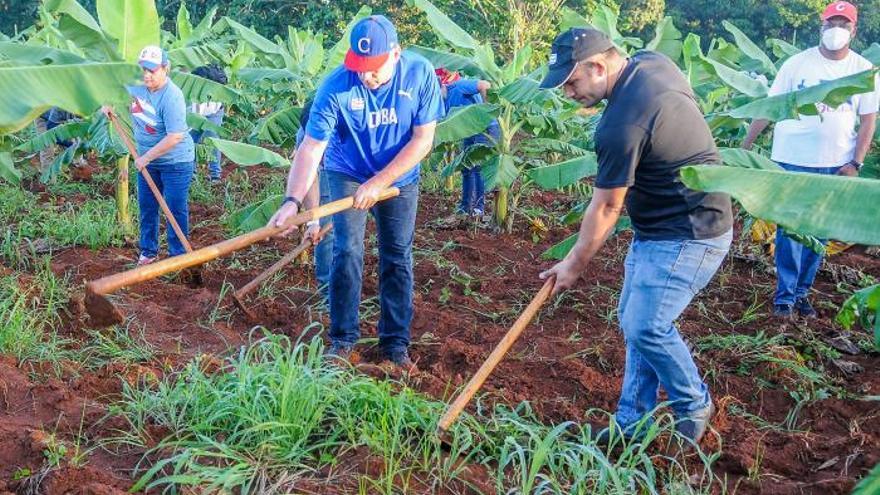
Miguel Díaz-Canel doing “voluntary work” this Sunday with young people on an agricultural farm. (@PresidenciaCuba)
14ymedio, Havana, 11 July 2022 — The official Cuban press has also made an 11J [July 11th] “special.” It is a series of opinion and analysis pieces, including an editorial, dated this Monday to talk about what it calls a “soft coup.” The roll-out began this Sunday, with a conference dedicated to young people, supporters of the Government. “We have full confidence in the Cuban youth, and we feel the shows of support every day in the fight against the media war and the active participation in the development of the country,” said Miguel Díaz-Canel.
The president, guataca [hoe] in hand, appeared at an agricultural farm in Bauta, Artemisa, to participate in “voluntary work” and talk about the demonstrations of a year ago. The demonstrators were, for the most part, young people, many of them today in prison, many others in exile, and the few that remain, warned so that today they do not think of repeating the feat.
“I want to remind you that it is true that (on July 11) we experienced unpleasant events, which we do not want to happen in our country. There were acts of vandalism, some with cruelty and with tremendous vulgarity and aggressiveness,” Diaz-Canel said.
However, the president celebrated that day that “the people took to the streets to defend the Revolution, the young people took to the streets to defend the Revolution, and in less than 24 hours, in much less than 24 hours, there were no more disturbances and the acts of vandalism and totally denigrating crimes against facilities, against people, had been extinguished.
Surprisingly, the leader decided to appropriate the spirit of 11J stating that “if there is something to celebrate this Monday, it is the victory of the Cuban people, of the Cuban Revolution, in the face of the attempts of those who wanted to turn (that) into a soft coup.” continue reading
The message plays in the editorial this Monday in the official newspaper Granma, entitled Un Girón en Julio*, although it contradicts a certain tone with Díaz-Canel. The president gave a long dissertation in Bauta on how love is always in the essence of Cubans and the Revolution loves love. Amid so much sweetness, he identified the J11 (July 11th) protesters and those who supported them with hate and evil. “Now, from the call they make, they are also calling for ruptures from positions of vandalism, from positions of events against citizen stability, against the stability of life in the country.”
In its editorial, the Cuban Communist Party’s newspaper, however, contemplates July 11 as one of the many battles that, according to the text, the Revolution has faced since its birth and against which it emerged victorious. “Because the dangers are true,” it says, “it is that the Cuban people have always been in the throes of combat. This was demonstrated on July 11, when they crushed that skirmish in a few hours,” it says, without being very clear if, finally, the prevailing belief is that the demonstrations were a serious coup attempt or an insignificant disturbance.
The newspaper also believes that there is an interest in “generating the false idea that material shortages and difficulties respond to inefficiency in the management of the revolutionary government, and to cover up its real cause: the inhumane economic siege of the United States.”
For its part, the official website Cubadebate opens full page with an analysis in which several specialists participate to address the “skirmish” or “soft coup.” In it, reference is made to how the complicated circumstances that Cuba was going through a year ago — and which now are far from having improved — were used to “intoxicate” and “thus generate citizen mobilization in the street.”
There is also space on the web for Reinaldo Rosado Roselló, responsible for logistics at the University of Informatics Sciences, who suffered a wound to the forehead on July 11 and has become a preferred witness of the ruling party, which uses him as a victim of “violent” protests.
There is no mention of Diubis Laurencio Tejeda, killed by a police shot. Nor to the hundreds of detainees, many of them sentenced to more than twenty years, nor to the combat order of Miguel Díaz-Canel to take to the streets to defend the system, with weapons if necessary.
*Translator’s note: Un Girón en julio — A Girón in July — references what the US calls the ’Bay of Pigs.’
____________
COLLABORATE WITH OUR WORK: The 14ymedio team is committed to practicing serious journalism that reflects Cuba’s reality in all its depth. Thank you for joining us on this long journey. We invite you to continue supporting us by becoming a member of 14ymedio now. Together we can continue transforming journalism in Cuba.
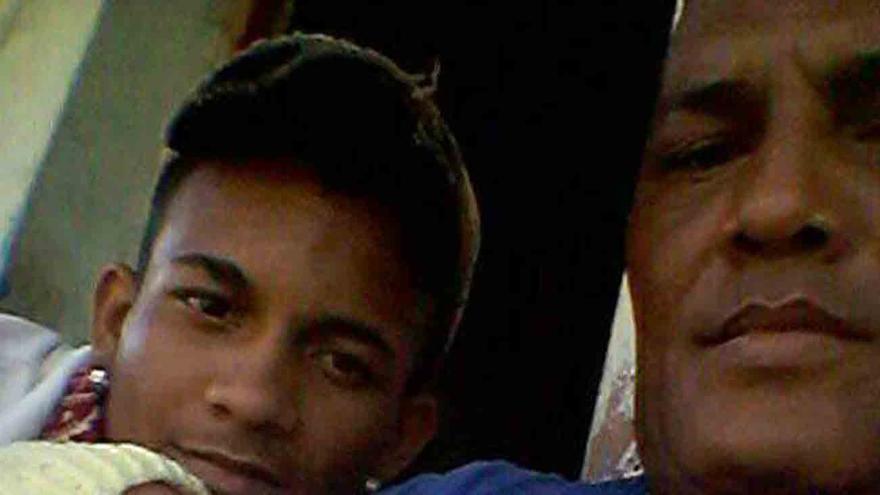
Zinédine Zidane Batista with his father Yosvany Batista, in a photo taken in May of last year. (Facebook/Yosvany Batista)
14ymedio, Yoani Sánchez, Havana, 12 July 2022 — When Zinédine Zidane Batista Álvarez was born, 17 years ago, his own father, Yosvany, wrote his name, that of the renowned French footballer, on a piece of paper, so that they would not make a mistake in the certification. “Then it turned out that he liked baseball more than football.”
Yosvany Batista, 43, speaks to 14ymedio with bitterness and without fear. He has been devastated since his son’s life was taken from him on July 1 in the El Condado neighborhood, in Santa Clara, where the family lives.
The images, which immediately spread through social networks, are brutal. The young man lies on the ground, handcuffed and with blood oozing from a gash in his thigh. A policeman approaches and kicks him in the abdomen. Then he fires a second shot into the chest, and the body stops moving.
Zidane had been experiencing an intense neighborhood conflict for months in which the authorities had hardly mediated, despite the complaints made by the family. His father is blunt: the uniformed men who should have protected him ended up killing him.
“That same morning, July 1, my son and I went to the 5th police station because we had a citation,” recalls Batista. The family was immersed in a dispute that had escalated in recent months, with occupants who broke into the house where the young man, his wife and his children had sneaked in some time before. “It is a house that has been empty for five years because the owner left for Spain and died there,” explains the man.
They spent two hours at the police station with the prosecutor who was handling the case. Upon returning, the man lay down for a while and his son played video games. “Around half past two in the afternoon we got the news that that other family, with whom we had already had many problems, had attacked the cousin of my son’s wife, who was in the La Latina store,” he says. continue reading
They immediately returned to the police station to report this new attack, but they were told that they could not do anything “against these people who entered the house one day when they took advantage of the fact that my son went to take one of the girls from his wife to the hospital, and after that they didn’t want to go out anymore.”
Faced with what he denounces as inaction by the authorities, he urged his son to resolve the conflict on his own. “I told the occupants to get out of the house and that this problem had to be resolved and we stopped in front of 217 Rodolfo Valderas Street, in El Condado,” he details ,with the Batista address.
“After about 20 minutes waiting for the other family,” he recalls, they started down the road in another direction, when, suddenly, “they hit us from behind. They threw stones at us and we also responded with stones. I received a flat blow with a machete and a stone on the forearm. When the police arrived, more or less an hour after the conflict began, everything was more of a verbal fight.”
Batista says that his son had a machete and he himself had a knife, and that he gave Zidane both weapons when he heard the sirens of the patrols, telling him to return to the house. And he insists: “The police did not try to calm the situation, but rather intensified the violence. When they arrived, they immediately went upstairs to beat me. My son was already leaving, seeing me on the floor he comes back.”
The policemen who pounced on Yosvany to hit him took the young Zidane out of sight. “I only heard him shout that no one was going to hit me and then I felt the shot. It was the second, because I didn’t hear the first one. I got the strength from I don’t know from where and got up, but I already saw him handcuffed on the ground and bleeding while they continued to beat him.”
Yosvany tried to help him, carrying him, but he couldn’t: “He was already almost dead.” The forensic report confirmed after one shot entered through the thigh and the other through the upper left area of the thorax. “They took him to the hospital because people started yelling at them to help him. His wife’s cousin was the one who put a tourniquet on his leg.”
“I started chasing the policeman who had shot him and he fired two shots at my feet. Luckily, none of them hit me.” At that moment, says Yosvany, his youngest son, 11 years old, crossed his mind, and that was what prevented him from killing the agent: “Now I would not be doing this interview, but in the cemetery.”
Batista believes that, since he was already wounded and could not flee, the second shot was not necessary. “When he was already on the ground, handcuffed, they shot him again. That’s the image you see in the video. They finish him off on the ground, without having any chance of defending himself. I saw the blood on his pants, but I I thought it was a small wound.”
Zidane Batista’s parents have been married for 19 years and have five grandchildren, they are pastors of the Apostolic and Prophetic Ministry. (Courtesy)
The man continues: “The second shot lodged in his lung and by the time he got to the hospital and they tried to revive him, he was already dead. My wife didn’t have the courage to dress the body when it was handed over to her for the funeral. Now we’ve been told that there is an investigation. I am going to make statements this week to see if we can prosecute the police officer who killed him.”
Zidane, recalls his father, was born on Calle Martí, in El Condado Norte. “He liked horses and he was a good son.” He loved animals and raised pigeons. Both Yosvany and his wife, who have been married for 19 years and have five grandchildren, are pastors of the Apostolic and Prophetic Ministry.
“When she and I met we had housing problems and we occupied an empty Medical Office, we lived there for almost ten years,” he details. “Later we moved to Camajuaní as shepherds. Zidane was asthmatic, also very intelligent, although he did not like school very much. He had a great memory for historical events.”
“When Zidane met his partner, she was already pregnant and he gave the baby girl his last name. He adored that girl,” he says. “They have told many lies about my son, but most of what they say about alleged crimes is false. He was detained because he witnessed the July 11, 2021 protests and they fined him 2,000 pesos for violating sanitary measures*.”
On the day of the historic demonstrations last year, Batista insists, Zidane “went to bathe in the river and then to get some yogurt for the girl. They stayed as spectators looking at the people who were protesting and for that he and his wife were fined. They arrested him, mistreated him, beat him up and only released him after seven days. From then on he had to go sign in at the fifth police station.”
Although the father insists that Zidane was surprised by the protests on the road, “I told the police that if he shouted something, at least he had the courage to express what he felt, because Cuban youth have no choice at all, no possibility of developing themselves. Parents spend a lot of work to be able to support them.”
The pain, now, is unbearable for him. He could not go to his son’s funeral because he was detained at the time after the fight. “I haven’t been able to go to the cemetery because I don’t have the courage to see his grave.”
*Translator’s note: “Violating sanitary measures” most likely means not wearing a facemask.
____________
COLLABORATE WITH OUR WORK: The 14ymedio team is committed to practicing serious journalism that reflects Cuba’s reality in all its depth. Thank you for joining us on this long journey. We invite you to continue supporting us by becoming a member of 14ymedio now. Together we can continue transforming journalism in Cuba.
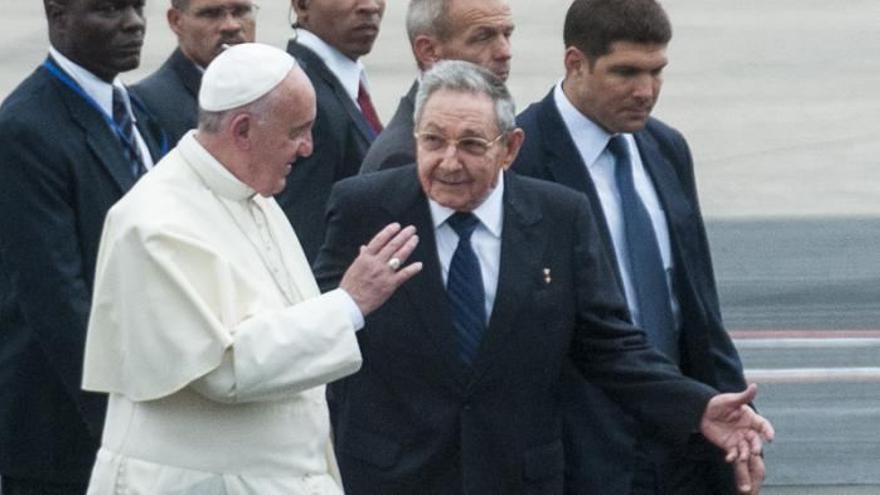
From left to right, Pope Francis, Raúl Castro and his grandson, Raúl Guillermo Rodríguez Castro, ’El Cangrejo’, son of the recently deceased Luis Alberto Rodríguez López-Calleja. (Granma)
14ymedio, Havana, 12 July 2022 — Pope Francis avoided referring to the protests of July 11, 2021 in Cuba this Monday, when the first anniversary of that historic day was celebrated. Journalists María Antonieta Collins, from Univisión, and Valentina Alazraki, from Televisa, specifically asked him about this in an interview. However, the pontiff did not want to mention the demonstrations and the current situation on the Island and diverted his response to the 2014 “thaw” between the US and the Island.
“I was happy,” he said, “when that small agreement with the United States was made, which President Obama wanted at the time and Raúl Castro accepted… It was a good step forward but it has stopped now,” the pontiff said, adding that he is aware of new “narratives” and “probing dialogues” to “shorten the distance” between Havana and Washington.
“I confess: I have a human relationship with Raúl Castro,” said the Pope, who said he felt, as expected, “very close to the Cuban bishops.”
“Cuba is a symbol. Cuba has a great history,” concluded the Pope, who in 2016 had described Havana as “the capital of unity,” during the signing of a controversial joint declaration between the Vatican and Patriarch Kirill of Moscow at the José Martí airport.
Pope Francis was one of the main actors in the restoration of diplomatic relations between the island and the United States. The late Cuban Cardinal Jaime Ortega described the Vatican mediation between Obama and Castro as a process characterized by “extreme discretion, secret conversations, quest for access to key personalities, hidden encounters, tenacious overcoming of obstacles.”
The Pope’s sympathies towards the Cuban Government have remained intact since those years. During the 11J protests, many expected an expression of condemnation of state violence and closeness to the people, but on that occasion he was no less evasive. continue reading
After a long silence, during the Angelus prayer on July 18, he listlessly mentioned the situation on the Island: “I ask the Lord to help you build an increasingly just and fraternal society in peace, dialogue and solidarity. I urge all Cubans to entrust themselves to the maternal protection of the Virgin Mary of Charity of El Cobre. She will accompany them on this journey.”
To this was added that, in October 2021, the Vatican authorities and the Italian Police prohibited a group of Cubans from demonstrating in Saint Peter’s Square, under the pretext that they could only enter as pilgrims and not to make political demands. The demonstrators recalled, in turn, that in 2008 several Italian citizens entered the same place, with a banner demanding the release of the five Cuban spies detained in the United States.
Collins and Alazraki also asked Francis how he felt about being accused of being a communist by different figures and the media. “I’m not worried. I see it as something outdated,” was his response.
“Certain media groups dedicate themselves to ideologizing our position. Sometimes they do not know how to distinguish what communism is from what Nazism, populism or popularism is. So with the communism thing, I say: this is outdated, those accusations are over,” he added.
The interview, which has already been applauded by the Cuban official press, also addressed the rumors about the pontiff’s resignation due to his health problems. “I don’t feel that the Lord is asking me,” he said, although he did not rule out that in the future he could leave the papal seat, which he has chaired for 9 years, if it became an “obstacle.”
____________
COLLABORATE WITH OUR WORK: The 14ymedio team is committed to practicing serious journalism that reflects Cuba’s reality in all its depth. Thank you for joining us on this long journey. We invite you to continue supporting us by becoming a member of 14ymedio now. Together we can continue transforming journalism in Cuba.
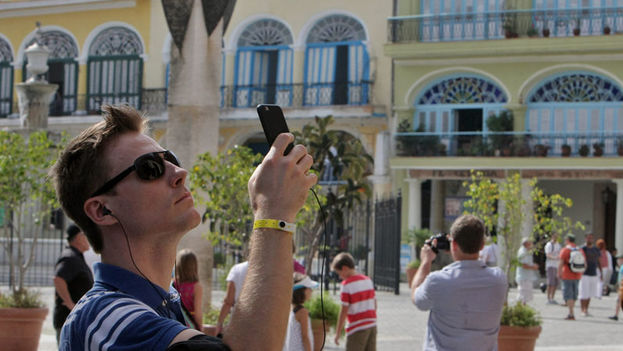
Several tourists take pictures in the Havana’s Plaza Vieja. (EFE)
14ymedio, Elías Amor Bravo, Economist, June 22, 2022 — Not to rain on your parade, but tourism in Cuba deserves a more respectful podium, and one more in tune with the economic and social reality of the island, new economic actors and the global environment. Cubadebate titled a report in the following manner, “Tourism is transitioning to a new era, a new traveler and an economic challenge,” referring to sessions at the XV International Journalism and Tourism Seminar, which was held recently in Havana, at the headquarters of the José Martí International Journalism Institute. This activity was organized by the Tourist Press Circle, UPEC, and the José Martí Institute, and highlights diverse issues related to tourism and the transformations in this sector due to the COVID-19 pandemic and the global economic crisis. I insist they should be more ambitious.
The underlying thesis of some participants who presented at the seminar is that, following the pandemic, the world will shift “toward a new tourism, a new traveler and toward a new era,” and also, “a rebirth rather than a recovery of tourism,” taking into consideration the very negative impact the pandemic has had on tourism which we hope to put behind us.
This vision seems relevant and coincides, in general, with that which we have put forth in this blog when analyzing why tourism in Cuba continues, in 2022, to be below the levels seen in 2019, the last normal year. Meanwhile, the Dominican Republic, Costa Rica, Cancún and even Honduras, are reporting more favorable estimates and are preparing to reach historic numbers of travelers and income this year.
Why is Cuba falling behind while others gain a competitive edge? A good question which has not been answered during the seminar. If communists would allow themselves to be advised, they’ve received the first kick in the nose, when they say we are facing a new tourism, a new traveler, and a new era. But not only has demand changed, which is true and will require directing financial resources to research the new market and identify its preferences and needs, but also Cuba has changed the supply and no one seems to have noticed that. A new network of private actors has emerged and are betting on offering all kinds of tourism in an efficient and competitive manner, adding value to the product. continue reading
But the communist leaders don’t give a damn. They’d need to recognize that the exploitative model of Cuban tourism (hotels owned by the state and Spanish management companies) have barely changed since Fidel Castro authorized tourism as an economic activity some time in the 1990s. They’ve been doing the same things for 30 years, and as was said in the seminar, everything has changed.
They spoke of the Caribbean, without a doubt one of global tourisms privileged zones, with an increased dependency on this activity, a surface of 300,000 square kilometers and a population of 52 million, similar to that of Italy. The Caribbean Sea is 2,763,800 square kilometers and as stated during the seminar, is divided into two large zones, an insular Caribbean reached by plane or ship and the other, continental, reached by train or road, which has allowed the Caribbean to maintain supply chains.
There are 30 tourist destinations in the Caribbean which compete for market share; the tourist who goes to Jamaica does not come to Cuba and one who goes to the Dominican Republic does not go to Jamaica or Cuba. In the insular Caribbean, known as the Antilles, a decline in tourism of more than 50% was reported, but it was not clarified that the decline varies notably among the different destinations. Cuba has experienced a decline of 75% but the Dominican Republic, for example, has surpassed pre-pandemic levels. It was reported that the Antilles contain 380,000 rooms in more than 2,000 ranked hotels. The region includes 51 international airports and 97 ports, 15 of which are equipped to berth cruise ships.
The Caribbean tourism supply expo did not serve to highlight that these destinations do not only compete amongst themselves, but for years the Caribbean as a region has competed with other areas of the planet, even far away regions such as East Asia, because air travel has allowed globalization of those destinations. We must begin to view the Caribbean as an integrated zone, and align tourism policies, or things will not go well.
To this point, someone in the seminar asked, “For what are all these hotels being built?” comparing the vertiginous pace at which the hotel supply was expanding, as in Cuba, with the decline in tourism. They justified themselves by saying that this is an international practice and that in Cuba, few are being built relative to the global scene. Which is not completely true, if you take into consideration the source of funding, which in Cuba is public. This requires neglecting other items and social needs. In contrast, at the international level hotels are built using private funds.
Another statement which did not align with reality is that the hotel sector actually belongs to the real estate sector and not tourism as such. This is only true when hotels belong to a proprietor who leases them, but in most cases, the hotel belongs to a chain that manages them and the property rights, valued in the accounts, is a very important factor in obtaining financing and the consolidation of budgets. This is not possible in Cuba since hotels are state property. What do they intend to do, convert the Cuban communist state into a lessor of hotels?
There is also a significant preoccupation with the buying and selling of islands and islets in the Caribbean to transform them into luxury destinations. It is said that this could create governance issues on the islands in the future, which any prospective analysis would conclude. However, this is an option to take into consideration, for which a potential market exists, willing to invest in this type of operation and it is inconvenient to lose the potential of these keys which exist in Cuba, which in many cases remain on the underutilized.
Then, betting that Cuba will consolidate in sun and sand tourism, with the sole aim of accounting for the 77,809 existing hotel rooms, does not seem appropriate, taking into consideration the trends of the tourism sector. Mature European destinations have been abandoning this model at a quick pace, and betting on quality and service, incorporating elements of value in tourism for the new traveler of the new era.
Contrary to what was said, the tourism sector in Cuba has little potency when faced with tourism’s challenges, motivated by its concentration: 44% of hotel rooms are five star, which influences the comparative price of travel packages, and 48% of lodgings belong to Grupo Gaviota, another 22% to Cubanacán, 18% to Gran Caribe and 12% to Islazul. On the other hand, about 50,000 rooms are managed by foreign hotel companies, mainly Meliá, Iberostar, BlueDiamond, Roc, Barceló, Blau, Kempinski, Accor, NH, Axel, Be Live and Sirenis. There was no reference made to private individuals who provide tourist accommodations in their homes or other properties, which in some urban destinations compete directly with hotels.
And what can be said of the marketing and tourism campaign with the “Única” [“Unique”] message presented at the seminar? Well, another failure. They reassured that the campaign aims to associate the destination of Cuba with the people, Cubans, “primary ambassadors of the attractions.” We caution against that message, which could raise expectations that cannot be confirmed later by tourists upon reaching the Island, with increasing misery and desperation; and this can have a devastating impact on the tourist. There is no doubt that Cubans are hospitable people, happy, supportive, but at this time, there must be a prudent glance at the social reality to see whether those patterns continue.
During the seminar they will also cover other topics, such as climate change and tourism, resilient tourism in Cuba, the impact of tourism on local development, the role of travel journalism, and with the Be Epic conference, there will be featured sessions dedicated to Meliá, Vive y Punto and Blue Diamond, the Canadian hotel group. We’ll see where this all ends up.
Translated by: Silvia Suárez
____________
COLLABORATE WITH OUR WORK: The 14ymedio team is committed to practicing serious journalism that reflects Cuba’s reality in all its depth. Thank you for joining us on this long journey. We invite you to continue supporting us by becoming a member of 14ymedio now. Together we can continue transforming journalism in Cuba.
Report Cover: A Year Without Justice. Cubalex, July 2022
Cubalex, 7 July 2022
The following report presents issues related to the impact and implications of the protests which occurred in Cuba on July 11th, 2021 (11J). We analyze elements such as the factors which provoked 11J and the reasons for the massive street protests.
As part of the observations of the state’s response, we describe the patterns of repression implemented along synchronic and diachronic axes, that is, throughout the country and over time. This is possible due to the systematic data on the arrests and the criminal and administrative proceedings from July to date, related to the public protests.
Finally, we offer recommendations on how the international community can help victims of repression in Cuba to obtain justice and reparations. Throughout this report, we apply an intersectional and gender lens to highlight the patterns of abuse faced by Cuban women, those of African descent and people from the LGBTQIA+ community as part of the state’s response from 11J to date.
We also highlight other vulnerable groups, such as minors, older adults, activists, journalists, human rights defenders and members of opposition parties and civic organizations.
While this report contains a balance sheet of what has occurred to date with regard to the state’s response to the July protests and other issues associated with them, it is part of a gradual and systematic process of documentation and analysis, which will not be final so long as the Cuban government continues, through any means possible, repressing the July protesters, their families, and civil society which support them.
As a result, the estimates presented and the patterns described will vary over time. At the time of this writing, we continue verifying information which will be incorporated into our public registries.
People demonstrate in front of the Cuban Capitol, in Havana, on July 11, 2021. (EFE/Ernesto Mastrascusa)
14ymedio, Havana, 11 July 2022 — That July 11, the 14ymedio reporters were in the streets of Havana and Santiago de Cuba, anonymously, like almost all Cubans who went out that day to demonstrate peacefully. They were unable to immediately transmit the photos and videos they had collected. That same day and for the next three, the state telecommunications monopoly Etecsa cut off telephones and the internet, in an attempt to prevent the example of San Antonio de los Baños from spreading to the rest of the country.
Etecsa did not succeed and it did not manage to prevent this newspaper from continuing to work. El Cafecito Informativo, the podcast that is published daily with the most important news of the day, did not miss a single one of those days. Through a small thread, the Editorial Office in Havana managed to send the information.
The next day, in La Güinera, a police officer killed a young man, Diubis Laurencio Tejeda, from behind, in a case that still has no clear explanations. The detainees, whose names were compiled little by little by Justice 11J, a group of women sponsored by the Cubalex legal organization, number 1,484 as of today, of which 701 are still in prison and 622 have been prosecuted.
The trials, this newspaper has also reported, were pantomimes and the sentences were excessive. Hundreds of Cubans – mostly young, some under 18, and poor – sentenced to prison terms as if they had raped or killed. Their crime: shouting “freedom,” “down with the dictatorship,” “Díaz-Canel singao [motherfucker],” “Patria y Vida” [Homeland and Life].
One year after the historic protests, 14ymedio pays tribute to them. First, offering its readers a special PDF that brings together the interviews conducted by our director, Yoani Sánchez, with several mothers of 11J detainees.
We also publish a first-person chronicle by Alejandro Mena Ortiz, one of our seasoned reporters who documented the demonstrations in Havana. A testimony from within the Island, from the heart of the protests.
But, outside of it, the hearts of thousands of Cubans in exile also beat, in suspense, between surprise and the hope of seeing, for the first time in 62 years, a people challenge the dictatorship. For this reason, we wanted to ask several of them, artists, writers and historians, what they make of 11J.
The conclusion is bittersweet. After the protests, the country is experiencing the greatest exodus in its history, repression has increased notably, several independent projects have ceased to function and the idea has settled in the minds of many Cubans that “if it wasn’t on 11J, then it can’t be.” However, the causes that brought thousands to the streets are still valid. The next outburst will be different.
____________
COLLABORATE WITH OUR WORK: The 14ymedio team is committed to practicing serious journalism that reflects Cuba’s reality in all its depth. Thank you for joining us on this long journey. We invite you to continue supporting us by becoming a member of 14ymedio now. Together we can continue transforming journalism in Cuba.
A group of demonstrators in Havana during the protests on July 11, 2021. (Marcos Evora)
14ymedio, Yoani Sánchez, Generation Y, Havana, 11 July 2022 — No one foresaw it, no analyst included it in their forecasts, and even the most optimistic had put aside, years ago, the possibility of a popular protest in Cuba. “People have gotten used to it,” “young people prefer to jump into the sea than to demonstrate in a plaza,” “their civic-mindedness has been amputated,” “they have become meek and docile,” were some of the phrases repeated to us from all sides, but the day of 11 July 2021 was enough to destroy all those diagnoses that made us seem like a people unable to raise our voices.
That Sunday morning, the spark did not even catch fire in the two largest cities in the country, but in the streets of San Antonio de los Baños, in the province of Artemisa, a community that until then we associated in our minds with the Ariguanabo River, a good-humored town with its international film school and long blackouts. The first images of the popular outrage reached us through Facebook and Twitter, but our own skepticism dampened the enthusiasm and many of us thought that it was just something momentary and small.
Then the demand spread through Palma Soriano in Santiago de Cuba, Cárdenas in Matanzas, different points of Havana and many other regions. What no one had predicted was happening. For many, that was one of the most important days of their lives, to the point that everyone on this Island remembers what we were doing when the demonstrations began. Like the day a child is born to us, a parent dies or a natural catastrophe occurs, 11J has left a mark on our lives.
And then came the repression pushed and propelled by Miguel Díaz-Canel and the “combat order” that he issued before the cameras of national television, a summons that could one day take him before a court to be tried for inciting violence and launching the military against unarmed people. Not only did we see the uniformed officers viciously beat young people and teenagers, but also the official press – which had initially been left without a script and did not know how to react to the people in the streets – begin to try to create a different story, one parallel to the reality.
In that narrative, dictated by the Plaza de la Revolución, the protests were small, violent, carried out by criminals, vandals and the marginalized. To impose this fiction they appealed to the monopoly of television, radio and printed newspapers, but the truth of 11J had already crept into the retinas of millions of people thanks to social networks and the independent press. In the images that came out of hundreds and thousands of mobile phones, we can see a citizenry that once again, after being gagged for decades, proves its civic voice. It was the day we swallowed our fear, chewed it for a long time and realized that we, the dissatisfied, greatly outnumbered the repressors.
After those bright hours, in which the protests showed their libertarian and massive character, the long night of repression arrived, and we continue under it now. But it is enough to remember that Sunday last summer to conclude that Cubans are no longer the same. We have shouted in the streets, we have chanted freedom and we have shown the world that we are neither cowards nor bowed down, just that a calculated dictatorship has prevented us from taking our places for a long time. The next outbreak will also be neither announced nor predictable, but it may be the last time the regime can crush the unrest and respond with punches, gunshots and trials. On 11J we also learned that fear changed sides.
____________
Editor’s Note: This text was originally published in DW in Spanish.
____________
COLLABORATE WITH OUR WORK: The 14ymedio team is committed to practicing serious journalism that reflects Cuba’s reality in all its depth. Thank you for joining us on this long journey. We invite you to continue supporting us by becoming a member of 14ymedio now. Together we can continue transforming journalism in Cuba.
Cuban opponent Guillermo Fariñas was arrested last Friday by State Security agents. (Capture)
14ymedio/EFE, Havana, 10 July 2022 — Guillermo Fariñas is “kidnapped by State Security officers,” Haisa Fariñas denounced on her social networks. According to Fariñas’ daughter, he is “in the Provincial Operations Unit of the State Security Directorate.”
The family already had contact with the dissident. “They only allowed my grandmother to enter the unit so that she could see him and bring him his medicine, food and toiletries,” Haisa explained. Fariñas was arrested by State Security agents last Friday in the province of Villa Clara, three days before the first anniversary of July 11.
Haisa Fariñas made it known on Friday that the political police patrol car with number 266 was watching her father’s house. Almost an hour later, she indicated that the agents of the unit were joined by those of patrol car number 250 to arrest Guillermo Fariñas. “He was arrested in his own home,” she noted. “His whereabouts are unknown, they did not want to give details of the reason for the arrest and where they transferred him.”
At the beginning of this month, Fariñas published an investigation carried out together with Mabel Hernández White, and the former Ladies in White Dayamí Villavicencio Hernández and Yaima Villavicencio Hernández, on police violence against Zinadine Zidan Batista Álvarezin the El Condado neighborhood of Santa Clara. The 17-year-old teenager, killed at the hands of the Police, the opposition revealed, participated in the protests on July 11, 2021 and after spending 23 days in detention, he was released and fined 3,000 pesos.
Guillermo Fariñas, winner of the Sakharov Prize for Freedom of Thought (2010) has been arrested and then released on several occasions, one of them in May, on his return to Havana from a tour of Europe and the US.
In one of those interrogations, he said that State Security threatened to charge him with rebellion or incitement to war, if he continued “issuing instructions” to incite another social outburst.
Fariñas is one of the best-known Cuban opponents, particularly for the numerous hunger strikes he has held in protest against the regime since the first in 1995.
The longest was in 2003 when he fasted for 14 months, and the 25th fast was in 2016, which lasted 54 days to ask the government to end the repression against dissidents.
The Government of Cuba, for its part, considers the dissidents “counterrevolutionaries” and “mercenaries” at the service of US interests and denies that it has political prisoners in its jails.
____________
COLLABORATE WITH OUR WORK: The 14ymedio team is committed to practicing serious journalism that reflects Cuba’s reality in all its depth. Thank you for joining us on this long journey. We invite you to continue supporting us by becoming a member of 14ymedio now. Together we can continue transforming journalism in Cuba.

 14ymedio, Havana, 13 July 2022 — Hundreds and hundreds of people in a line, from one side to the other of the Rio Grande, in an incessant flow like the waters that cross. The images, recorded on the river border of Piedras Negras (Mexico) with Eagle Pass (Texas) and shared this Monday by the American journalist Bill Melugin, illustrate the cold numbers.