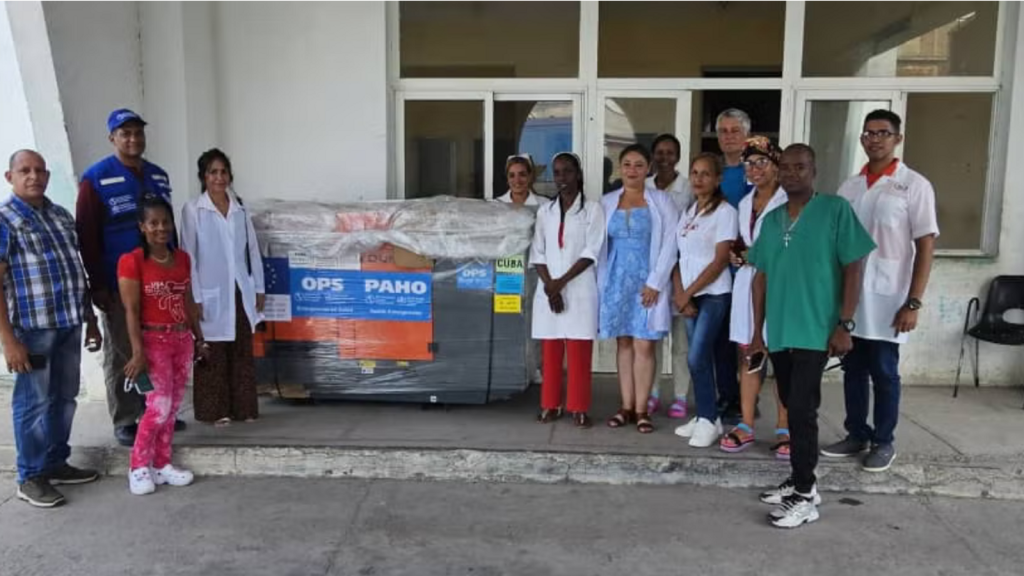
Havana and Santiago de Cuba each received 2,400 tonnes, with a delivery ceremony held in the capital.

 14ymedio, Madrid, 20 January 2026 — Up to 30,000 tonnes of rice will arrive in Cuba from China in the coming weeks, according to an announcement made by the official press on Monday, reporting the arrival of the first 2,400 tonnes in Havana and the same amount in Santiago de Cuba. The delivery in the capital was marked by a reception ceremony attended by authorities, including Deputy Prime Minister Óscar Pérez-Oliva Fraga and Chinese Ambassador Hua Xin.
“This assistance is another tangible sign of the solidarity that unites us. We are confident that, with the joint efforts of both countries, no difficulty will be able to hinder our path forward,” said the diplomat at the ceremony, held at the Ministry of Domestic Trade’s Loading and Unloading Centre.
“We deeply appreciate and are grateful for this assistance at a difficult time when levels of aggression are rising and the United States’ economic, commercial and financial blockade against the Cuban people is intensifying in an unprecedented manner,” said Pérez-Oliva.
“We deeply appreciate and are grateful for this assistance at a difficult time when levels of aggression are rising and the economic, commercial and financial blockade is intensifying in an unprecedented manner.”
In the provinces of Pinar del Río, Artemisa and Mayabeque, two pounds per person will be delivered, while in Havana it will be one continue reading
According to Hua Xin, the next shipment of 15,000 tonnes is already ready to set sail, and a quarter of the total – 9,600 tonnes – will be distributed in the middle of next month.
The donation is part of China’s Emergency Food Aid Project to Cuba, under which similar shipments have already been delivered. In 2024, China delivered just over 20,400 tonnes as part of the same programme, the first shipment of which – 408 tonnes – arrived in six flights due to the urgent nature of the situation on the island at the time. South Korea and, in particular, Vietnam are other countries that have made similar donations of grain.
However, this aid barely covers a fraction of the population’s needs, which traditionally consumed around 600,000 tonnes per year.
For this year, the authorities announced the planting of around 200,000 hectares, double the amount in 2025, but still far from the country’s needs. In 2024, Cuba harvested around 80,000 tonnes, 30% of what it produced six years earlier. Between 2012 and 2018, the island experienced growth in harvests, exceeding 300,000 tonnes.
The amount was still insufficient for the population, forcing the country to import as well. However, in 2024, almost 100% of the rice distributed through the ration card system had to be purchased.
However, in 2024, almost 100% of the rice distributed through the ration book had to be purchased.
Attempts to boost yields have so far proved unsuccessful, as can be seen by comparing the yields produced on land granted in usufruct to the Vietnamese company AgriVMA. While national production yields around two to 2.5 tonnes per hectare – compared to the five tonnes achieved in the past – the Asian company achieves 7.2 tonnes on its land in Pinar del Río.
Furthermore, according to data from the inter-state cooperation programme, yields of up to 9.14 tonnes per hectare have been reported for some of the varieties used in this joint project.
At the end of last year, Roberto Caballero, a member of the National Executive Committee of Agricultural and Forestry Technicians, sparked heated controversy when he commented on the television programme Cuadrando la Caja that the State was allocating resources beyond its means to the rice production programme, a crop that, in his opinion, is not suited to the soil and climate conditions of the island – just like potatoes. The technician proposed focusing efforts on products with a greater chance of success and stated that neither of these two crops was culturally national. “We are not Asian, this is not a Cuban habit,” he stressed, provoking endless criticism on social media.
Translated by GH
____________
COLLABORATE WITH OUR WORK: The 14ymedio team is committed to practicing serious journalism that reflects Cuba’s reality in all its depth. Thank you for joining us on this long journey. We invite you to continue supporting us by becoming a member of 14ymedio now. Together we can continue transforming journalism in Cuba.