Only a few service stations that take foreign currency are operating, where a liter of regular gas costs $1.10 and premium $1.30.
 14ymedio, Havana, Darío Hernández, January 26, 2026 – When gasoline was scarce in Havana, there were always people who knew where to find it. Fuel theft is a good business in Cuba, and the market had never failed. Until now. “Even the people who sell on the side, who almost always have it, don’t have any either,” says Pedro, a street-smart habanero who knows how to get around, but who now states bluntly: “Gasoline has disappeared.”
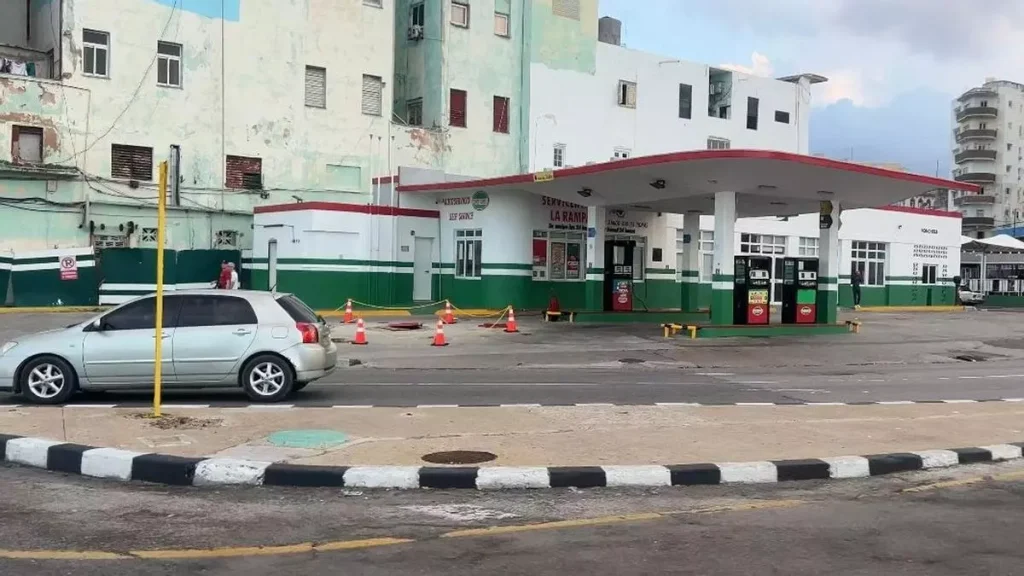
The service stations were once again empty this weekend, not only of gasoline, but also of would-be buyers, except for the most stubborn who refused to leave the line just in case something arrived. “Being here is pointless,” said a private transport operator waiting in line.
At one of the Cupet stations reserved for state vehicles, which receive fuel by allocation, they weren’t pumping either, and drivers were waiting for a tanker truck to arrive. When asked whether there was any way to resolver (work something out), one of them replied that it wasn’t possible because what they were being given wouldn’t even last two weeks. “If I sell you any, I’ll end up stranded.”
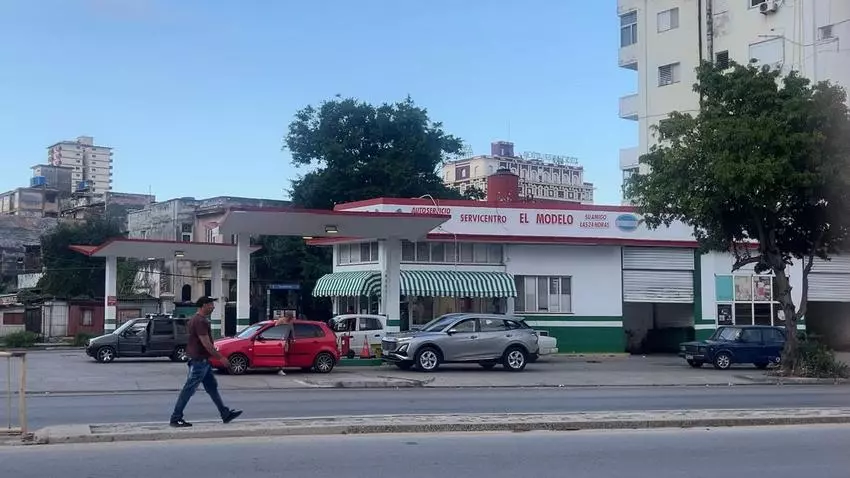
Walking past gas stations in the capital is bleak. The only one with customers waiting on Sunday was the Línea and E station in El Vedado, which sells fuel in dollars. Most of the cars were modern, and it was clear their owners were well-off. Since last year, when some service stations were dollarized in order to obtain hard currency amid the collapse of tourism, these had been the only places where supply was guaranteed. Now even that is not always enough, and prices don’t help either. A liter of regular gas costs $1.10 and premium $1.30, paid with prepaid cards or the Clásica card.
“The situation is extremely complicated,” Pedro insists. “A friend in Matanzas who owns a car told me that over there it’s the same. The only places selling are the service stations, in dollars, end of story, because there’s nothing on the street either. He says the dollar went up to 600 pesos, but then the gasoline disappeared, and there’s nowhere to find it.”
Suddenly, a man on a motorcycle shows up. He says he managed to buy fuel on the black market because he couldn’t find any at a service station, but before that he had to make another round through the informal market to buy dollars to pay for the gasoline.
Oil isn’t arriving, and the paths are narrowing. Everyone trembled again on Friday when the Reuters agency reported that the Mexican government is evaluating whether to maintain, reduce, or suspend its crude oil supply to the Island, amid fears of direct reprisals from the United States under the presidency of Donald Trump. Added to this were statements to Politico by sources familiar with an alleged White House plan to invoke the Helms-Burton Act in order to “impose a total blockade on oil imports carried out by Cuba.” “Energy is the key to killing the regime, and this will happen in 2026, with a 100% probability,” said one of the sources.
Gasoline is on the path to disappearing in Cuba, even on the black market. / 14ymedio
The reaction in Havana was immediate. The Deputy Minister of Foreign Affairs, Carlos Fernández de Cossío, spoke on Friday, denouncing a “brutal assault against a peaceful nation that poses no threat whatsoever to the United States.” He added that these measures are irrefutable proof that the economic hardships faced by the Cuban people are mainly caused and designed in Washington.
Carlos de Céspedes, Cuba’s ambassador to Colombia, has also weighed in. In an interview on Saturday with Qatari television network Al Jazeera, he accused the U.S. of “international piracy” and said it is imposing a “maritime siege” on the Island. “Cuba is facing U.S. threats more powerful than at any time in the 67 years since the Revolution,” he asserted.
The authorities, for their part, have continued without providing public data on the fuel shortage, not even on the fuel used for distributed generation, whose specific shortfall is not discussed. This Sunday, the Island experienced another day of blackouts: with a forecast peak demand of 3,130 megawatts (MW), available capacity was only 1,325, which pointed to a shortfall of 1,805 MW, equivalent to 60% of national consumption.
Although it is not known what portion is due to the lack of fuel, it was specified that only 450 MW corresponded to the deficit at thermoelectric plants.
If in Havana power outages already exceed 15 consecutive hours, what is happening in other provinces is truly staggering: 29 hours in Pinar del Río, 40 in Matanzas, and 48 in Cienfuegos, numbers that no longer surprise anyone. “Don’t add more misfortune to what we already have in that report that isn’t true,” a user pleaded with the Electric Utility. “Look for solutions for a people who are suffocating, who are agonizing. Don’t ask for resistance because there is none left. Be capable of moving your country forward and stop justifying the atrocities you commit with the blockade, because your standard of living isn’t affected.”
Translated by Regina Anavy
____________
COLLABORATE WITH OUR WORK: The 14ymedio team is committed to practicing serious journalism that reflects Cuba’s reality in all its depth. Thank you for joining us on this long journey. We invite you to continue supporting us by becoming a member of 14ymedio now. Together we can continue transforming journalism in Cuba.