
Cuba Announces Air China Flights for May, but the Airline Does Not Include Them in Its Program

The announcement did not specify the exact date the flights would restart nor the cost of the tickets / EFE

14ymedio bigger14ymedio, Havana, 9 April 2024 –The Cuban Aviation Corporation recently announced that Air China will resume its route to Havana this May, after having suspended its flights during the COVID-19 pandemic. However, despite the proximity of the date – the authorities did not specify an exact day – the airline does not include the route to the Cuban capital in its program for the coming months. The origin of the flights, which will land at José Martí International Airport in Havana, as well as their frequency, has not been announced by the authorities, who met with Air China representatives within the framework of the International Transport and Logistics Fair in Havana.

An article in the Chinese press in November 2023 mentions the restoration of the Beijing-Havana connection in 2024. If it is the same flight – a route that has not changed since its inauguration in 2015 with three weekly flights – it is likely to include a stopover in Montreal, Canada.

Both the Chinese and Cuban state press had already announced on other occasions the intention of both countries to resume the connection. At the beginning of 2023, the Tumei agency, based in Hong Kong and specialized in promoting destinations in the Caribbean, included Cuba among the 20 destinations that were authorized for travel after the pandemic. At that time, it was expected that commercial flights between the two countries would increase with the incorporation of Air China. continue reading

Increasing the arrival of Chinese travelers, coveted in many countries for being large consumers, has been one of the goals of the regime in recent years  

Tumei then declared that the Island was among its “priority” destinations, with preference among its customers. Also, in July 2023, 16 businessmen linked to the Chinese travel operator Huaxing International Travel visited Havana for 10 days with the aim of attracting foreign capital and Chinese tourists to the Island.

Increasing the arrival of Chinese travelers, coveted in many countries for being large consumers, has been one of the goals of the regime in recent years. Last December, Prime Minister Manuel Marrero revealed during his visit to China that Cuba will make adjustments to its tourist facilities to attract more customers in that country. The changes promised by the leader ranged from installing electric heaters in hotel rooms for hot water, including the Chinese language in the signage of the Island and the construction of a hotel “with Chinese characteristics.”

According to data from the National Bureau of Statistics and Information, 18,003 Chinese travelers arrived in Cuba in 2023, which translates into a growth of 215% compared to 2022, when 8,374 arrived.

The depression of the tourism sector on the Island, which has not managed to recover the number of travelers who arrived before the pandemic, has led the regime to look for alternatives in other markets. Russian tourism, with a recent boom – the Island expects to receive at least 200,000 travelers from that country this year – has been another of those chosen along with the Chinese. Both are favored by the political alliances between the governments of these countries with Havana, which promises perks in exchange for sending travelers.

During the Fair, the Cuban Ministry of Transport also signed an agreement with Álvaro Fernando Barba García, Uruguay’s ambassador to Cuba, for “the establishment of direct flights between Montevideo and Havana.”

Translated by Regina Anavy

____________

COLLABORATE WITH OUR WORKThe 14ymedio team is committed to practicing serious journalism that reflects Cuba’s reality in all its depth. Thank you for joining us on this long journey. We invite you to continue supporting us by becoming a member of 14ymedio now. Together we can continue transforming journalism in Cuba.

Public Health Contracts With a Private Company to Manage 15 Ambulances in Havana

The Mercedes-Benz subsidiary in Cuba will provide the vehicles and maintenance; the State, the doctors

The signature was captured this Thursday during the International Transport Fair held in Havana / Government of Havana

14ymedio bigger14ymedio, Havana, 5 April 2024 —   The Mercedes-Benz distributor in Cuba, MCV Comercial S.A., agreed on Thursday to an unprecedented collaboration with the Ministry of Public Health for the “experimental use” of 15 ambulances. The company – a mixed entity with links to Transport – expects that, as part of this public-private partnership, Health will complement” the vehicle service with a “crew of doctors.”

The announcement, very discreet, was made during the International Transport and Logistics Fair in Havana, and the government disseminated photos of the signing of the agreement, which took place under the watchful eye of the Minister of Transport, Eduardo Dávila. The MCV Comercial website celebrated the announcement and revealed that state-owned Taxi Cuba and Viazul will also collaborate in the project.

They will start from this initial experience in Havana, they allege, to “modify the way ambulances are managed” in Cuba   

The joint project represents the transfer to a business entity of a service that has been in the hands of Public Health. They will start from this initial experience in Havana, they allege, to “modify the way ambulances are managed” in Cuba. “As it is consolidated, it will be extended to other provinces,” they say. MCV will handle the “maintenance and driving of the vehicle,” and the staff will come from the hospitals in Havana.

The Cuban government spares no argument to praise the measure and notes that “this type of action is being promoted with the aim of making better use of what we have, improving management and making every investment last longer, with proper maintenance. Our people will get the resultng benefit.”

On the government website, several readers commented with irony. “That’s excellent,” said Carlos Luis Menéndez. “Maybe we don’t quite know what to do, but we should already be clear about what not to do!” The reader Otro Cubano Más mocked the signing and said that for the leaders, it is “better to ’innovate’ new mistakes.” continue reading

“And what do we owe this nonsense to? Will it make it easier to have a sales, post-warranty and maintenance-renewal contract for the service?” asked another reader about the alliance between MCV and Health. For others, the question is what type of entity the ambulance fleet will form: “Is it a mypyme (private company)?”

The image that Minister Dávila gave to international investors such as Mercedes-Benz and its branches in Cuba is that of a favorable panorama for the purchase and sale of vehicles and other businesses in the sector   

The Transport and Logistics Fair was held at the Pabexpo fairgrounds in the midst of the fuel crisis that plagues Cuba, which the authorities blame for all the ills of the country, in addition to the long blackouts throughout the national territory. Despite that, the image that Minister Dávila gave to international investors such as Mercedes-Benz and its branches in Cuba is that of a favorable panorama for the purchase and sale of vehicles and other businesses in the sector.

The display of the Mercedes-Benz group, based in Germany, was well stocked with state-of-the-art vehicles that very few on the Island could afford. The company’s slogan hangs on the cars: “The best or nothing.” Cubans know very well which of the two options they’ll have.

Translated by Regina Anavy
____________

COLLABORATE WITH OUR WORKThe 14ymedio team is committed to practicing serious journalism that reflects Cuba’s reality in all its depth. Thank you for joining us on this long journey. We invite you to continue supporting us by becoming a member of 14ymedio now. Together we can continue transforming journalism in Cuba.
State Premises at Night, Small Private ‘MIPYMEs’ the Next Morning

In Holguín, as in the majority of the Island, private businesses are rapidly replacing dilapidated State warehouses

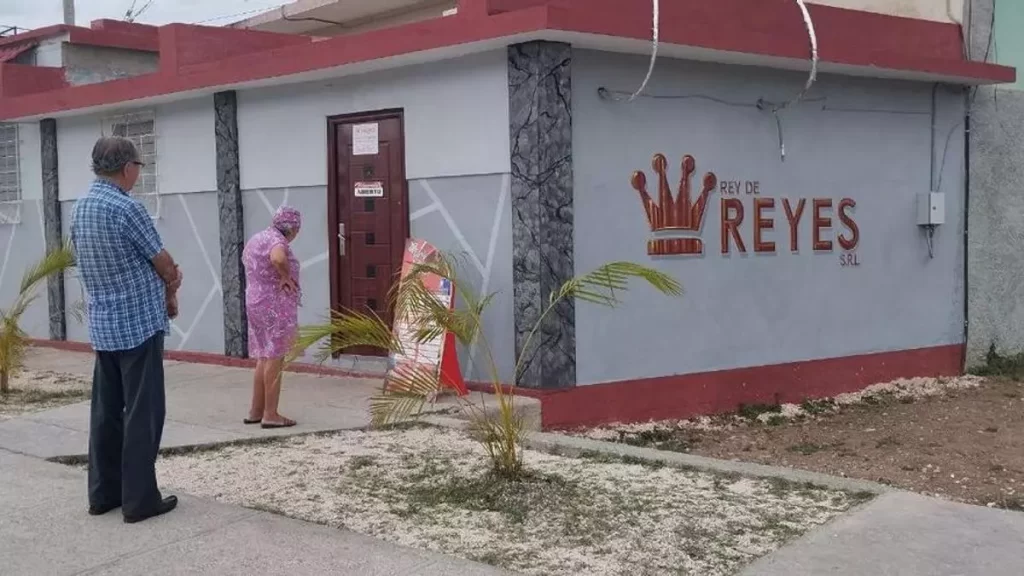
In another warehouse, which once was for the Holguín Beverage and Soft Drinks Company, the products of the Rey de Reyes mipyme* [MSME in English] are now exhibited. / 14ymedio
14ymedio bigger14ymedio, Miguel García, Holguín, 8 April 2024 — They go from being buildings with peeling facades to looking freshly painted, with bars on the windows and air conditioning inside. The process of leasing shops, offices and state warehouses to the mipymes* (MSMEs, or medium, small and micro-sized enterprises) in Holguín extends, as in Havana and other cities in Cuba, before the eyes of the residents of the city, who face the gradual privatization with expectations and doubts.

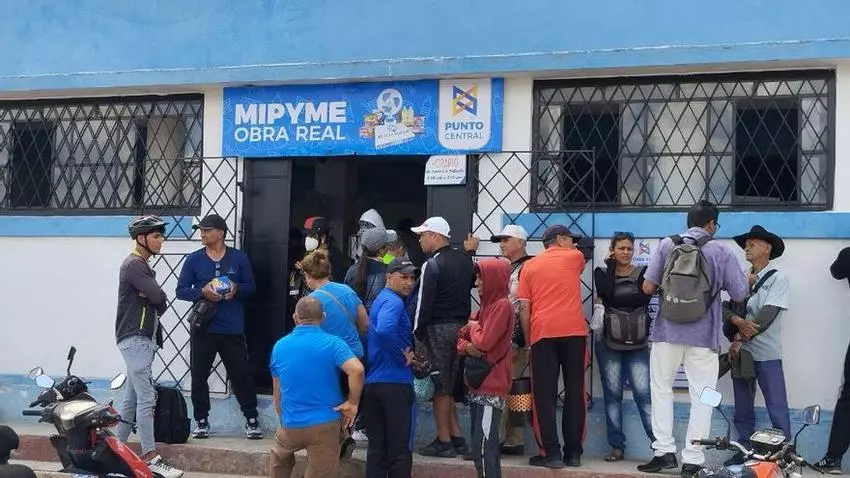
In front of the old vehicle workshop of the Comar Base Economic Unit, belonging to the Holguín Fisheries Company, this Friday morning a line of customers was waiting to enter. In the wide warehouse on Aricochea Street, between Maceo and Mártires, you can no longer hear the rattling of the faucets or perceive the smell of fat and fuel that characterized the place.

Now, after a capital remodeling, the Obra Real mipyme is there, with a wide assortment of food, toiletries and household items. In the line, some who arrive for the first time in front of the restored building are astonished. “I almost didn’t recognize it. I passed by here often, and it was covered in grease; it’s totally changed,” a man who was waiting to buy detergent told 14ymedio. continue reading

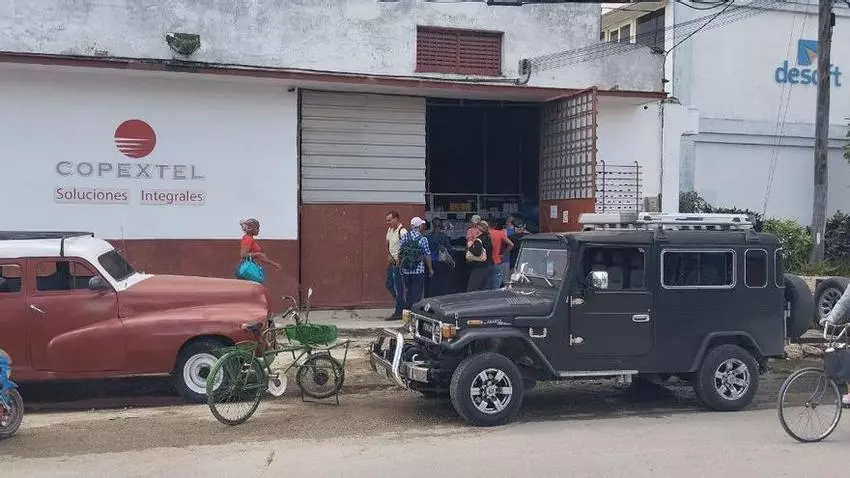
The warehouses of the Copextel company on the Central Highway, Holguín, have been leased to a mipyme / 14ymedio

Obra Real has four locations in the city of Holguin, and its catalog includes everything from packages of La Estrella brown sugar, imported from Panama, to fans that are recharged with small solar panels. “The prices are high, but right now I have to come here to buy flour because there is no bread in my bakery,” the man adds.

The bidding process for these private companies to rent a state premises continues to lack dissemination and transparency. “They told me that they are renting the space of the Copextel warehouse on the Carretera Central Calle Martí, in front of the Electric Company, but when I went to ask, they had already ’granted’ it to the owner of several motorcycle workshops,” an entrepreneur interested in the place who asked for anonymity tells this newspaper.

“In this city, when night falls, a space belongs to the State, and when you wake up the next day it’s now under the management of a mipyme but no one knows very well how,” he says. “The rumor is that donations must be made to hospitals and gifts to officials so that they put you on the list of beneficiaries.”

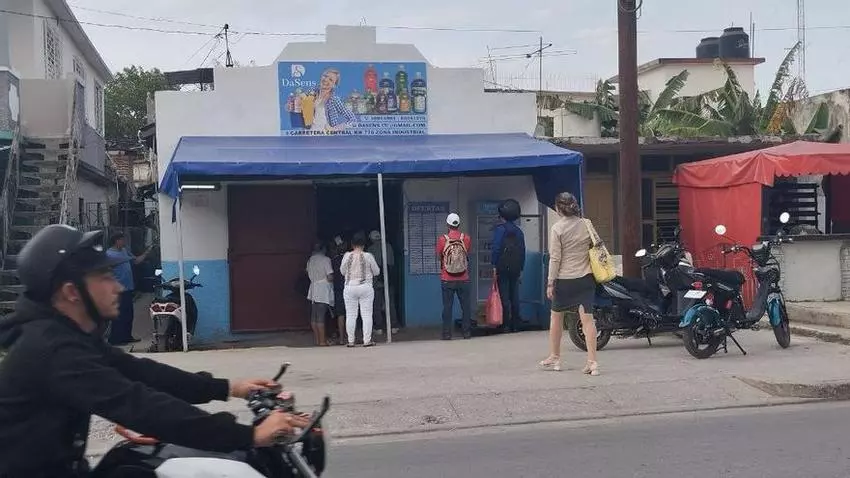
Another warehouse on Libertadores Avenue, where until a few years ago oxygen tanks were stored for patients who needed them, went from the hands of Public Health to the small private company DaSens, dedicated to the fabrication of cleaning and personal hygiene products. Now, with a blue awning at the entrance, it’s a rare day that there are not a dozen people waiting to enter.

Children’s colognes, hair dyes, household cleaners and dishwashers are part of the mipyme’s offers, most of them imported in bulk and packaged on the Island. At the entrance, the store has a sign of a smiling woman carrying a bag of newly purchased products. In the line of those waiting to enter, however, the faces do not seem as happy.

The place that belonged to the old bus terminal Santiago-Habana is now under private management / 14ymedio

“Before, these places were closed and not used. It’s good to give them to individuals so they can at least fix them up and sell something,” Lázara, a resident of Reparto Peralta, explains to this newspaper. “I’m here for a cologne for my grandson, but I don’t know whether I’m going to find it today because all the prices have gone up, and the mipymes take advantage of the fact that the state has almost nothing to sell.”

In another warehouse, which once belonged to the Company of Drinks and Soft Drinks of Holguín on the Central Highway at San Pablo Street, the products of the Rey de Reyes mipyme are now displayed. On one of its outside walls, a newly painted crown in red accompanies the name of the place. The detail does not go unnoticed by the buyers who arrive.

“We kings are going to have to be early to be able to buy anything, because you can come one day, you turn around, and the price has already increased by 50 or 100 pesos,” said a woman who carefully read the sign with the products and prices that is exhibited outside. “Of course, an employee of a mipyme might be rude, but they usually treat you better than the ones in the state stores.”

Among the “improvements” over the state shops, the woman says that “they have good refrigeration, and when you buy a chicken it’s hard as stone, not half thawed.” She adds that “the stores have air conditioning and refrigerators on display, and some have made large investments in signs and glass counters so you can really see the merchandise.”

However, the woman believes that they have also “copied some of the worst things from the state stores. They never give a discount even if the merchandise is about to expire. They use the formula of ’combos’ a lot to force you to buy products that do not interest you, because if you’re looking for a bottle of oil, then you have to include some instant drinks or a package of coffee.”

The building where oxygen tanks were stored for patients went from the hands of Public Health to the small private company DaSens / 14ymedio

The list goes on. The warehouse of the once-powerful Copextel, managed by the military and dedicated to computer products, has also been rented to a mipyme. Although on the facade it still says “integral solutions,” the inside points to more mundane merchandise. Boxes of chicken, packages of detergent and bags of rice now occupy the space that was once intended for computers, monitors and printers.

Despite the fact that its walls have not yet been painted, it’s just a matter of time before the current managers remodel the property and hang colorful posters outside. Once restored, people who pass by on the Central Highway will have no doubt. “Look, there’s another mypyme,” they will say, as is heard more and more in the neighborhoods of Holguín.

*Translator’s note: MIPYME = MIcro, PEequeña (small) Y (and) MEdium Enterprise

Translated by Regina Anavy

____________

COLLABORATE WITH OUR WORKThe 14ymedio team is committed to practicing serious journalism that reflects Cuba’s reality in all its depth. Thank you for joining us on this long journey. We invite you to continue supporting us by becoming a member of 14ymedio now. Together we can continue transforming journalism in Cuba.
The Rich Are Also Fleeing Cuba, Selling Their Properties at a Discount

Even some of the gigantic mansions in Siboney confiscated by the Revolution are for sale.

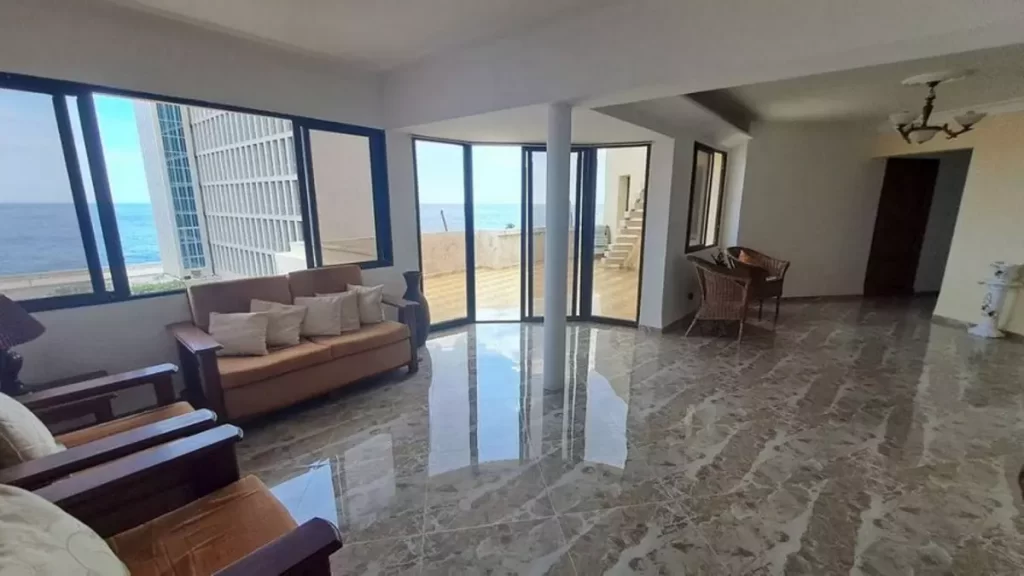
The island’s residential real estate market is saturated due to a mass exodus that is bleeding the country dry / Houses and Apartments for Sale in Havana

14ymedio bigger14ymedio, Natalia López Moya/Juan Diego Rodríguez, Havana, 3 April 2024 — Juan Carlos divides his time between Milan and Havana. The 52-year-old’s children, wife and parents all live in Italy but, for more than two years, he has been trying to sell an old mansion in Havana’s Vedado district which has caused him “more headaches than happiness.” Located a few yards from Línea Street, the house was a project that fulfilled a life-long dream that, as he puts it, “blossomed then failed.”

In the late 1990s, Juan Carlos received a scholarship to study art at an Italian university. When he left José Martí International Airport, he knew there was no going back and that he had to make a life for himself outside the island. “I had always lived with my parents and my sisters in a small apartment, so from a very young age my dream was to have my own home, one that was spacious, bright and had an area I could use as my studio.”

Ultimately, Juan Carlos married an Italian woman and, in 2014, began the process of repatriating to Cuba. He had lost his residency status after not visiting his country for several years. “There was a lot of excitement and several of my artist and designer friends were part of a wave of people getting Cuban identity cards again.”

One of the benefits of having Cuban residency is the ability to buy a house. “At the time, my wife and I were making good money. Her father had also died and left her a sizable inheritance so we decided to buy the place in Vedado. It was my life-long dream and I was finally able to make it come true.” continue reading

One of the benefits of having Cuban residency is the ability to buy a house. “It was my life-long dream and I was finally able to make it come true.”

One of the benefits of having Cuban residence is the ability to buy a house. “At the time, my wife and I were making good money. Her father had also died and left her a sizable inheritance so we decided to buy the place in Vedado. It was my life-long dream and I was finally able to make it come true.”

Juan Carlos reports that it cost almost as much to repair the house as it did to buy it. Other problems cropped up once constrution was underway: rusted beams, dampness in the walls, issues with the concrete. They even had to redo some of the column capitals. “They started coming apart as we were painting them.”

The process was long and costly. “I had to go to Cuba five times a year so, in addition to construction expenses, there was the cost of airline tickets. It seemed like the house was eating money. Every month we spent thousands of dollars to restore and maintain it. We had to hire two custodians to make sure our building materials weren’t stolen.”

Finally, in April 2022, six years after buying the house, the work was done.

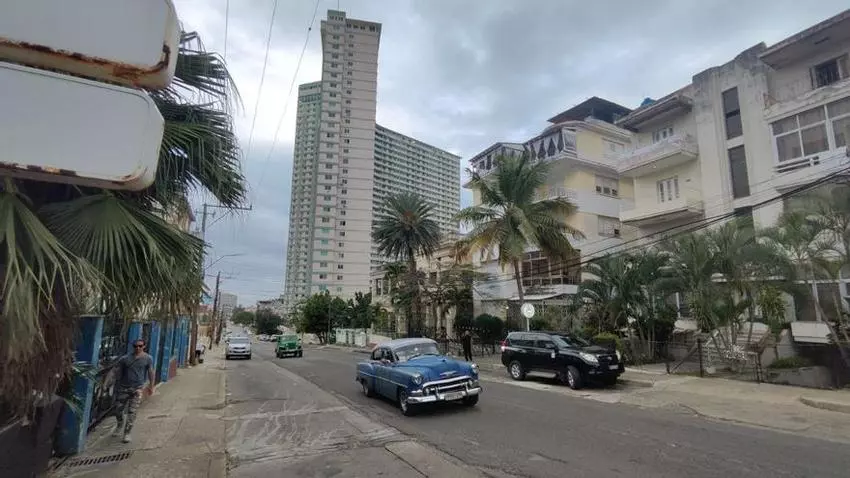
Apartments are also for sale in Havana’s legendary Focsa Building, one of the city’s most stylish when it was completed in 1956 / 14ymedio

Juan Carlos describes it as “a dream come true.” But, by then, he no longer wanted to own property in Cuba. “I had spent long periods in Havana and everything was deteriorating a lot. I thought about how to make some money out of it, maybe by renting it to a diplomat, or to an entrepreneur who wanted to open a restaurant. But I realized that doing that would have meant spending all my time keeping an eye on the place because [as the old saying goes] ’it’s the owner’s eye makes the horse fat.’”

In May of that same year, he decided to put the newly furnished home up for sale. The problem now, however, is that no one wants to buy it. “I have to list it with several real estate agencies and I’ve also dropped the price several times. I am currently asking $150,000 for everything but it’s been two years and, so far, there are no takers.” The island’s residential real estate market is saturated due to the mass exodus that is bleeding the country.

A quick look at local real estate listings says it all. A colonial-style house in Vibora Park that has been outfitted to operate as a nightclub, described as “a golden opportunity,” is on the market for $60,000, with 80% its contents included (“from wines to coffee makers,” the listing states). A 120-square-meter apartment in Vedado with seaside views is for sale at $80,000. A “recreation estate” with a four-bedroom house and a 1,450-square-meter extension is available for $50,000.

Though many of the listings do not indicate prices, there are lots of photos suggesting a high degree of luxury

Other listings suggest there has been some haggling going on. The asking price for penthouse in Vedado, covered in marble and with the ocean below — its elderly owner is also visible in the photos — has gone from $270,000 to $190,000.

Though many of the listings do not indicate prices, there are lots of photos suggesting a high degree of luxury, most of them taken after obviously expensive remodelings. One of them is a 1950s property in Nuevo Vedado with seven bedrooms, four bathrooms, a patio, terrace and jacuzzi. Then there is one of the spacious apartments in the Geralt Sisters Building, completed in 1958 with all the latest amenities of its era. Its exterior is now falling to pieces after years of neglect.

One of the problems when selling these houses is that anyone who dares set foot in the neighborhoods where they are located is scared away. This is the case with an apartment in San Lázaro. Advertised as a “luxury penthouse with ocean views in the heart of the city” in Central Havana, it is surrounded by ruined buildings and piles of garbage on every street corner.

Another quirk of the saturated real estate market is that now even the enormous mansions in Siboney, which were confiscated after Cuban Revolution by the regime’s leaders, are up for sale. The problem here is that, because they were nationalized after their original owners were exiled, they could be subject to future lawsuits.

Rita, a Cuban who works as a private residential real estate agent, explains the situation: “Before, these types of properties were handled with some discretion by an agency. Now, the owners are so desperate to sell that they post the listings themselves on Facebook for all to see.”

“I’m not going back to Cuba, which means I will lose my residency status once I have been out of the country for twenty-four months, but I don’t care anymore”

What owners like Juan Carlos want is to move their money out of Cuba. “It’s a large amount and I will have a lot of problems when the time comes. But everyone is in the same boat. They want hard currency and they want it to take overseas,” he says.

His plan is to wait a few months, then reduce the price. He does not plan on going back to Cuba once the property is sold. “I will lose my residency status once I have been out of the country for twenty-four months but I don’t care anymore,” he says.

“I thought my sons would grow up in this house, that Cuba would grow and move forward, but I was wrong. Between one thing and another, this venture has cost me and my wife more than a quarter million dollars,” says Juan Carlos, who has some mixed feelings about his house. “It’s very pretty. In Milan a house like this would have cost me a fortune but now no one wants to live in Cuba now.”

With its stained glass windows, long marble staircase, imported black granite in the kitchen, stately bathtubs and enormous mirrors in the living room, the mansion — like so many other Cuban properties whose owners once dreamed of living and growing old on the island — is still on the market, waiting for a buyer.

____________

COLLABORATE WITH OUR WORKThe 14ymedio team is committed to practicing serious journalism that reflects Cuba’s reality in all its depth. Thank you for joining us on this long journey. We invite you to continue supporting us by becoming a member of 14ymedio now. Together we can continue transforming journalism in Cuba.
‘When They Get a Supply, They Let Me Know and I Quickly Fill the Tank’

Manzanillo truck and bus drivers fight every day to get fuel

The implementation of the new fuel prices not only extinguished the circulation of state buses, but also complicated life for private transporters / 14ymedio

14ymedio bigger14ymedio, Juan Matos, Manzanillo, 24 March 2024 — It is five in the afternoon at the Manzanillo bus terminal stop, in the province of Granma, and people can’t take it anymore. The heat is around 33 degrees (91F) and the packages – almost everyone carries a basket or sack – will be the most difficult thing to get onto the truck that has just arrived. Slowly, with a white and green casing, and a strong stench of diesel, the vehicle parks and opens its hatch.

It charges 200 pesos for the trip of about 50 kilometers to Bayamo and shares the road with other private trucks – also green and heavy – that barely maintain the connection between Manzanillo and other nearby municipalities. The implementation of the new fuel prices not only extinguished the circulation of state buses, but also complicated life for private transporters

The other part of the wait begins once the passengers board the truck because until it fills to its maximum capacity the trip does not begin / 14ymedio

But he who invented the law, the saying goes, cheated. “I’m not worried that the diesel is unavailable,” one of the drivers on that vital route between the two large cities that are vying for prominence in that two-headed province tells 14ymedio. “I have my contacts in several service centers throughout the province. When they get a supply, they let me know and I quickly start filling the tank.” continue reading

The information costs, but it is worth it. “The money I lose later I will more than make up for, because the purchase is first-hand.” If he had to go to the informal market, a can of diesel would cost between 3,000 and 5,000 pesos, depending on the supplier, and a liter of gasoline would cost 600 pesos. “But there always is some,” the driver acknowledges.

In the absence of state buses, private transport trucks are the only option to get around / 14ymedio

The Manzanillo service centers enabled to sell in dollars have not imposed a limit on tourists, unlike what happens in some other provinces, such as Ciego de Ávila. There is an explanation: very few travelers pass through the province. The guajiros, who have also been affected by the change in the rules of the game, have to do whatever they can to get fuel. There is no special treatment for the farmers who have tractors and the oil they need is bought very expensively ’on the left’.

The worst part, however, remains for those who need to move from one town to another to work or study. The long faces at the stop say it all. Low-ranking soldiers, farmers, university students, workers in all kinds of companies or street vendors, the stress is repeated on each face. With a fanny pack on his shoulder, the driver – or an assistant – collects the tickets and starts the engine. To Bayamo –as the song says – but not by car

____________

COLLABORATE WITH OUR WORKThe 14ymedio team is committed to practicing serious journalism that reflects Cuba’s reality in all its depth. Thank you for joining us on this long journey. We invite you to continue supporting us by becoming a member of 14ymedio now. Together we can continue transforming journalism in Cuba.
A Member of the Clandestinos Group Receives Conditional Release After More Than Four Years in Prison

“My time in prison was very hard and unpleasant, among other things due to lack of medication,” explains Jorge Ernesto Pérez García

The Havana native’s health suffered during more than four years in prison / Courtesy

14ymedio bigger
14ymedio, 21 March 2024, Havana — This Friday, the Provincial Court of Havana granted conditional freedom to Jorge Ernesto Pérez García, a member of the Clandestinos group, arrested in January 2020 and sentenced to five years in prison for the crimes of “defamation of institutions and organizations and of the heroes and martyrs of a continuing character” and drug trafficking.

Pérez García, who was tried in the case against the group that threw red paint on pro-government propaganda posters and busts of José Martí, defines his time in prison as “atrocious.” The atrocities are “everywhere, not only in prison, but also in the violation of criminal prosecution rights and even in the Penal Code itself,” he explains in conversation with 14ymedio.

“I left prison on March 15 and my sentence ends on July 13,” the man, age 47 and a resident in the Altahabana neighborhood of the municipality of Boyeros, in Havana, told this newspaper.

“My time in prison was very hard and unpleasant, among other things due to lack of medication,” details Pérez García, who spent three years and four months in Combinado del Este where he was infected with Covid-19. The man denounces the difficulties in receiving medical care in Cuban prisons: “I do not speak only for myself, but on behalf of all prisoners in general.” continue reading

Now, he is trying to rebuild his life and, for the moment, he is still adapting to the new situation of having been able to return home to his family

After that time in the largest penitentiary center on the Island, Pérez García was transferred to an agricultural work camp, attached to the Combinado del Este, where he spent around eight months. A few days before receiving parole, he was taken to another forced labor camp known as Cetem, in the municipality of San Miguel del Padrón.

The Havana native’s health suffered during more than four years in prison. “I have tendonitis and my knees have become somewhat atrophied,” he explains to this newspaper. Now, he is trying to rebuild his life and, for the moment, he is still adapting to the new situation of having been able to return home to his family.

Pérez García’s mother, Mercedes García, maintained a long struggle with the authorities to ensure that her son received a change of precautionary measure and could finish his sentence outside of prison. In March 2021, the prisoner went on a hunger strike to demand his freedom, but he had to break the fast a few days later due to his poor health.

Pérez García was arrested on January 8, 2020, and on five occasions throughout that year, his lawyer requested a change of measure so that he could wait in freedom for the trial on the different charges, but in all cases this request was denied.

The other two members of Clandestinos convicted in the same case were Panter Rodríguez Baró and Yoel Prieto Tamayo, sentenced to 15 and 9 years in prison, respectively. These, according to the sentence, were the executors of the group’s activities while Jorge Ernesto Pérez was in charge of recording and taking photos of the actions and disseminating them.

____________

COLLABORATE WITH OUR WORKThe 14ymedio team is committed to practicing serious journalism that reflects Cuba’s reality in all its depth. Thank you for joining us on this long journey. We invite you to continue supporting us by becoming a member of 14ymedio now. Together we can continue transforming journalism in Cuba.
‘In Cuba, We Don’t Even Get a Good Eclipse’

Only one man watched the event, looking up and shading his eyes with a roll of paper

14ymedio bigger14ymedio, Juan Diego Rodríguez, 8 April 2024, Havana — The total solar eclipse that took place this Monday in North America and that was observed as partial in Cuba did not arouse much interest on the Island. In the peak hour of the phenomenon, shortly before three in the afternoon, the light dimmed, as in an old TV movie, and it came on again, but no one seemed to be aware of the sky.

The Institute of Geophysics and Astronomy (IGA) had warned of the security measures to watch the eclipse, which took place in the country between 1:40 and 4:05 pm. The coverage of the sun by the shadow of the Moon reached 43.9% in the area of the territory where it was observed with greater intensity, the Cape of San Antonio, in Pinar del Río, at 2:46 p.m.

The lines for buses and the tired looks were the same as always / 14ymedio

“If you have a small telescope or even a simple piece of cardboard with a tiny hole, you can project the image of the sun onto a white screen and observe the sun indirectly,” advised the IGA. Other recommendations were to protect your eyesight to avoid “serious and irreversible burns on the retina,” use appropriate “optical filters” (avoiding homemade gadgets, such as smoked glass, black nylon or x-rays) and not look directly at the sun.

Hardly anyone listened because they weren’t following the astronomical event. The lines for buses and the tired looks were the same as always. Only one man watched the event, looking up and shading his eyes with a roll of paper. Asked about the phenomenon, which she claimed to barely perceive, a woman said, resignedly: “It’s nothing; in Cuba we don’t even get a good eclipse.” Upon hearing this, another passer-by replied with a sneer: “It’s the fault of the [American] blockade.”

Translated by Regina Anavy

____________

COLLABORATE WITH OUR WORKThe 14ymedio team is committed to practicing serious journalism that reflects Cuba’s reality in all its depth. Thank you for joining us on this long journey. We invite you to continue supporting us by becoming a member of 14ymedio now. Together we can continue transforming journalism in Cuba.
Feminist Platforms Record the Murders of Two Elderly Women in Cuba

In addition to the violent death of Paulina Collazo Diago, also reported was that of María, 92 years old, at the hands of her son-in-law

Paulina Collazo Diago disappeared on February 27 and her body was found on March 14 in Los Arabos, Matanzas / Facebook/La Tijera

14ymedio bigger14ymedio, Havana, 21 March 2024 — The independent platforms Alas Tensas and Yo Sí Te Creo en Cuba reported this Thursday of the murders of two elderly women in recent days. One was that of Paulina Chiquitica Collazo Diago, which occurred in Los Arabos, Matanzas, “under extreme violence.” This included, they reported, her disappearance between February 27 and March 14, when her body was found.

In addition, they described the death of a 92-year-old woman, María, at the hands of her son-in-law in Lawton as a “family femicide.” This event took place in the Havana municipality of Diez de Octubre, on March 3, at the home where both lived.

Both cases are considered by the platforms to be femicides, although not by ’14ymedio’

Regarding the case of Samantha Heredia, recorded by 14ymedio as the 13th femicide so far this year on the Island, according to local sources, the platforms explain that “access to the police report is needed” and that her death, on March 3rd in Santiago de Cuba, was “under circumstances to be clarified.”

____________

COLLABORATE WITH OUR WORKThe 14ymedio team is committed to practicing serious journalism that reflects Cuba’s reality in all its depth. Thank you for joining us on this long journey. We invite you to continue supporting us by becoming a member of 14ymedio now. Together we can continue transforming journalism in Cuba.

Russian Oil Gives Oxygen to the Cuban Regime for ‘Speeding Up’ Food Distribution

The Russian oil improves the allocation of diesel by province, but “only satisfies about 50% of demand”

Coffee is one of the products that has been missing in the ration stores in recent months

14ymedio bigger14ymedio, Madrid, 8 April 2024 — The arrival of the NS Concord on March 29 in Matanzas with 90,000 tons of Russian oil – 697,000 barrels – has given Cuba a break, but it is never enough. “The allocation of diesel for the economy increased to 1,100 tons per province; however, this figure satisfies only 50% of demand. Meanwhile, gasoline production is moving at a good pace,” said the Minister of Energy and Mines, Vicente de la O Levy, this Sunday.

In a meeting he held with Prime Minister Manuel Marrero and local authorities to review the distribution of products in the libreta (ration book), among other things, the senior official said that during the next few days there will be an electricity deficit, due to the lack of 200 megawatts per day. The liquefied gas, however, is assured for April, May and part of June thanks to the “financial solutions” found, he said without giving further details.

The senior official stated that during the next few days there will be an electricity deficit, due to the lack of 200 megawatts per day. The liquefied gas, however, is assured for April, May and part of June   

The Russian fuel, the second shipment sent by Moscow to Havana after March 17, when 650,000 barrels of crude oil valued at about 50 million dollars arrived, will help, if the forecasts are met, to improve the transport of products for the basic basket. The population is very concerned about the chronic lack – together with the decrease in the number of products and their quality – of the food subsidized by the State. President Miguel Díaz-Canel admitted this last Thursday in his program From the Presidency, attributing the lack of funds for the products to the U.S. sanctions. continue reading

The situation of the last months of 2023 and early 2024, the leader promised, will improve this April and May. “We can confirm, without any doubt, that the basic products will be available until the month of June,” he said.

Distribution will be key but is complicated, according to the authorities, due to the catastrophic lack of fuel, which disrupts transport from the ports to the provinces. Díaz-Canel mentioned the nationally manufactured electric vans presented at the Havana International Transport Fair – held last week – that will help in provincial distribution, but they will not be a total solution, since they do not solve the interprovincial distribution, he said.

“We have to do everything we can to get food to the people. The search for alternative transportation is required, to give a ’hit’ to the distribution and make sure these products reach the families,” Marrero said this Sunday, adding that the work of the ports is also essential.

“We have to strengthen the work of the ports, the efficiency, the completion of the staff and also the discipline,” he added.

The meeting also involved Vladimir Regueiro Ale, Minister of Finance and Prices, who admitted that the shortage of inspectors at the provincial level helps to maintain “abusive prices.”

The meeting was also attended by Vladimir Regueiro Ale, Ministers of Finance and Prices, who admitted that the shortage of inspectors helps to maintain “abusive prices”

“That analysis must start with the territory, what else can we do to ensure stability in the work of the inspectors, to avoid corruption, so that this function is really exercised. How are we going to fight prices if there is no constant inspection of this important matter in compliance with what is established?” asked Marrero.

The Prime Minister insisted on interventionism and said that it is needed to control prices, taking into account the particularities of each municipality, and he emphasized the “importance of the cost and expenditure sheet of products and services as a decisive tool in agreeing on prices.”

The response of economist Pedro Monreal to this policy was not long in coming. “One of the main official economic tricks in Cuba maintains its primacy: the alleged centrality of ’cost sheets’ in the formation of prices, ignoring the supply-demand relationship and a realistic exchange rate.”

Translated by Regina Anavy

____________

COLLABORATE WITH OUR WORKThe 14ymedio team is committed to practicing serious journalism that reflects Cuba’s reality in all its depth. Thank you for joining us on this long journey. We invite you to continue supporting us by becoming a member of 14ymedio now. Together we can continue transforming journalism in Cuba.

Young Cuban Captured in Ukraine: ‘I Haven’t Killed Anyone, I Never Touched a Weapon, I Am Not a Mercenary’

14ymedio interviews a Cuban captured by Ukraine on the war front

The Cuban prisoner interviewed by this newspaper believes that he was detained in Donetsk, a city in eastern Ukraine occupied by Russia / EFE

14ymedio bigger14ymedio, Xavier Carbonell, Salamanca, 6 April 2024 — When Ukrainian troops captured Frank Darío Jarrosay Manfugás, a 35-year-old musician from Guantánamo, he had neither helmet nor weapons. It was night. He had left a bunker with a Russian soldier with the mission of moving a battery to another base. Trying to track down the Russian, who had abandoned him, the enemy surprised him.

Now he is imprisoned somewhere in Ukraine, but at least, he acknowledges, he is alive. Three months – from his trip to Russia last January to his capture in March – were enough to disrupt his life, which he tells 14ymedio in great detail. It is the first time that a prisoner of war from the Island speaks with a Cuban or Latin American media, an exclusive conversation that the Ukrainian authorities provided to this newspaper.

Jarrosay and his companions now await the outcome of the conflict, about which they avoid commenting. According to the Ukrainian Army, neither Havana nor Moscow “want to take them” or answer for them. “In my mind there is no guilt. I haven’t killed anyone. I never touched a gun. I am not a mercenary even if they consider me one,” Jarrosay states bluntly.

In Guantanamo, Jarrosay graduated as a Geography and Mathematics teacher, a profession he abandoned to dedicate himself to music. In Cuba he left his parents, his grandmother and a brother. It had cost him work and a lot of money to buy the cell phone on which, one day, he saw a publication that promised him a work trip to Russia. “For a Cuban, going to another country to work is more than an achievement. My goal was to help my family move forward,” he alleges. continue reading

According to the Ukrainian Army, neither Havana nor Moscow “want to take them” or answer for them

Jarrosay says he does not remember the name of the Facebook profile where he saw the ad, to which he responded by stating that he had “experience in carpentry and masonry.” He also cannot say whether a Cuban or foreign person wrote to him. “I gave them my phone number and they sent me a message on WhatsApp. There was a form and a request to send copies of my license and passport. The blanks: name, sex, age, illnesses and abilities. The document was in Spanish and promised a salary: more than 200,000 rubles per month – just over $2,000 – to be transferred to a bank account in Russia.

“Shortly afterwards they told me where I had to leave from: the Varadero airport.” He didn’t hesitate. He sold his phone to pay for the trip from Guantánamo to Matanzas by car. “There were five Cubans on the plane. “We didn’t confide in each other.” When he arrived in Moscow, he was met by a person who spoke Spanish and who had a copy of his passport.

He was immediately transferred to a military base in Rostov, one of the Russian cities on the war front against Ukraine – where the Wagner Group was briefly based during its uprising against the Kremlin in June 2023. Jarrosay describes the place as “a warehouse.” There were other Cubans there, although he refuses to say the estimated number. All of them, he insists, came from the Island and had arrived recently “deceived.”

Frank Darío Jarrosay Manfugás, during the interview given to this newspaper / 14ymedio

“They showed up with a contract in Russian,” he says, “nobody explained it to us. We signed a paper that we didn’t even know what it was about. “We were thinking about the work form that we had filled out in Cuba.” From Rostov he was transferred to a military base in a location he identifies as Donetsk, a city in eastern Ukraine occupied by Russia since 2014: another of the strategic points of the war. “There I met four other Cubans,” he says. “They were very scared. They didn’t know what they were coming for. They filled me in on things and told me what we were really in Russia for.”

He did not recognize soldiers of other nationalities, only Russians and those from the Island. The ages of his compatriots – who were “separated in a cubicle” – he estimated to be between 29 and 50 years old. The Russians communicated with them in a cumbersome way: with a translator on a cell phone. There were no interpreters.

They did not receive training in Rostov or Donetsk, although the Russian Army offered them uniforms and weapons, Jarrosay says. Like any Cuban, he had had to undergo mandatory military service in a unit of the Island’s Armed Forces. “I did not have military training because I was in the Youth Labor Army (EJT). “What we did was plant and harvest.” He did not even, he alleges, pass the preparation known as ’prior’.

In their attempt to get the Cubans to accept their weapons, the Russian officers limited their food

“The Cubans who were at the military base when I arrived were on strike. They didn’t agree with what was happening. Our stories were similar,” he explains. “When they gave us weapons we refused to take them. We hadn’t gone there for that. That’s why when the Ukrainian troops took me prisoner I had no weapons, no vest or helmet.”

He did not participate in any combat, he insists, and gives an argument with a shrug: “I don’t have any gunshot wounds.” In their attempt to get the Cubans to accept weapons, the Russian officers – says Jarrosay – limited their food. “One day they left us without breakfast, another without lunch. It was his punishment.” Breakfast, lunch and dinner consisted of a single food: “Soup.”

They were assigned, yes, minor missions. On March 4 – the day of his capture – Jarrosay and two other companions, escorted by two Russian recruits, were tasked with carrying some power banks or portable batteries to a bunker not far from their unit. “In the middle of the night, the Russian was ahead of me and suddenly left me behind. I was running. I saw shadows and then the Ukrainian troops captured me.”

“In the middle of the night, the Russian was ahead of me and suddenly left me behind. I was running”

The Ukrainian Army feeds him and has made him aware of his rights. He does not know if Havana or the Kremlin have been interested in his case, but the officers guarding him explain that they have refused to admit his repatriation.

Asked for his opinion on the war before traveling to Moscow, Jarrosay is clear: he had none. “In Cuba they only talk about the United States. About Ukraine I only knew what they said on the news: that Russia was going to start an armed conflict. They hide everything, they cover everything. But it’s never known about. This is how the press works in Cuba,” he argues. Now, however, he does not dare to take sides for one or the other. “Russia should not have attacked Ukraine, that is my opinion,” he limits himself to saying.

In Cuba, Jarrosay insists that he had nothing to do with politics. He did not participate in the protests of 11 July 2021 (’11J’) – “I didn’t get involved, I was at home” – even though he wanted to leave the country. “I don’t want to go back” and he hopes that some NGO will “rescue” him, since his government does not want to. Although he does not feel mistreated by the Ukrainian Army, he does not want to stay in the country when the conflict ends. If Kyiv proposed to rehabilitate him by having him help to repair the country, he would not accept

I would like the war to end, but then… if I stay here, there, if I’m dead… I wouldn’t know what to say”

“Before Russia, now Ukraine. It’s like ping-pong,” he says, bitter, “I want the war to end… but then… if I stay here, there, if I’m dead… I wouldn’t know what to say.”

“I wouldn’t even want to call Cuba,” says Jarrosay. He doesn’t know if they know his situation. If it were up to him, they wouldn’t know. His mother is sick and when talking about her, he becomes emotional. “These are things that happen,” he laments. To those – in Cuba or already in Russia – thinking of joining Vladimir Putin’s invasion of Ukraine, Jarrosay sends a message: to desist, despite the misery that the country is going through. “Do not be fooled. When you arrive it is something else.”

Now he doesn’t know what will happen to him. The war continues. After a few dizzying months with multiple dangers, he has come to understand the phrase that has become his mantra: “The future is uncertain.”

Related news: Ukraine places the number of Cuban mercenaries in the service of Russia between 400 and 3,000

____________

COLLABORATE WITH OUR WORKThe 14ymedio team is committed to practicing serious journalism that reflects Cuba’s reality in all its depth. Thank you for joining us on this long journey. We invite you to continue supporting us by becoming a member of 14ymedio now. Together we can continue transforming journalism in Cuba.

An ‘Experiment’ Allows the Santiago de Cuba Refinery To Process Heavy Crude

Hindered by the stampede of its workers and the lack of fuel, the plant didn’t function for several years / Sierra Maestra

14ymedio bigger14ymedio, Havana, 6 April 2024 — Paralyzed since 2021 and after a stampede by its employees, the Hermanos Díaz refinery in Santiago de Cuba has come out of its lethargy thanks to an unusual “adaptation.” Despite the fact that its facilities are designed to process light crude oil, the managers have decided that it will have to refine the heavy crude by diluting it until it becomes ’medium’. Interviewed by the official media Sierra Maestra, the engineer who designed the “innovation,” Víctor Manuel Díaz, did not give too many details about the process or explain how the “experiment” has been going since it began. The refinery uses a solvent – he didn’t give the name or origin – to dilute the crude oil.

“What is being done in the Hermanos Díaz has allowed, to the extent possible, the provision to the eastern provinces of hydrocarbon, gasoline, fuel for drilling wells, fuel oil for thermoelectric power plants and distributed generation, as well as the production of asphalt and the industrial processing of nickel,” Díaz stated.

The Santiago newspaper did not seem as interested in the plant’s technical process as in remarking on the fact that the refinery’s revival immediately stopped “the emigration of qualified personnel,” who were leaving for other Cupet positions, going to private companies or leaving the country. continue reading

The fact that the refinery was working again stopped “the emigration of qualified personnel”   

According to Díaz, the plant is now making money, allowing 700 workers to be paid, and several are earning up to 12,000 pesos “in the distribution of profits that are generated.” The managers enthusiastically congratulate themselves on their success, although they do not dare to predict how long the plant will be able to distribute fuel to both the eastern provinces and Camagüey under those conditions.

They clarify, of course, that the refinery has had 70 years of operation and almost no maintenance. The first floor – the most useful and also the most damaged of the Hermanos Díaz – continues to need a capital repair. The rest of the facilities present similar problems, despite the “aspirations and achievements” declared by the managers.

The urgency of processing less heavy crude oil, alluded to by the managers in Sierra Maestra, coincides with several pessimistic articles about the supply of light crude oil to Cuba. This March, Venezuela sent 34,000 barrels per day to the Island, but not of the best quality, which Caracas prefers to sell in the international market, according to Reuters.

Mexico, which sent two of its best crude oils to Cuba – the Isthmus and Olmeca variants – provided 1,970,000 barrels in the first months of the year. According to Jorge Piñón, a specialist at the University of Texas, Mexico has ceded its role of being Cuba’s energy “lifeguard” to Russia. Moscow sent a ship with 90,000 tons of oil to Havana, the second in March, to alleviate the fuel crisis, on which the Government blames all the country’s problems.

Havana could be experiencing this April “the end of the supply agreement between Mexico and Cuba  

Piñón believes that Havana could be experiencing this April “the end of the supply agreement between Mexico and Cuba, about which the details are unknown.”

One of the keys to the movement of the crude on the Island, says Piñón, is the flame coming from the smokestack of the Ñico López refinery in Havana. As of today – noted this Saturday by 14ymedio – it remains off, but when “the flame advises” the specialist alleges, it will mean that the Russian crude discharged in Matanzas by the ship NS Concord is now being processed. “It will take a few days,” he calculates.

Another ship, detected by maritime tracking applications, has set off alarms. This is the heavy cargo ship OK, which sailed from Istanbul on February 16 and arrived in Havana on March 30. “It is anchored next to the Turkish floating power plants,” says Piñón, alluding to the well-known patanas of the Karpowership company.

“The heavy cargo ships are semi-submersible,” he adds. “Using water as ballast to increase their draft (water depth) allows the deck to be submerged under the surface of the water. In this way, cargo can be placed on deck, and equipment of great weight or size can be transported.”

What is the OK carrying? It could be a new Turkish patana leased by the Government but not reported, perhaps destined to accompany or replace some of those that already exist, says Piñón.

On the other hand, the Island’s National Electric System is still hanging by a thread. The technical director of the Electric Union acknowledged that the investment that Cuba would need to repair its battered thermoelectric plants could amount to 10 billion dollars. The figure, Piñón and other specialists think, is not absurd.

Translated by Regina Anavy

____________

COLLABORATE WITH OUR WORKThe 14ymedio team is committed to practicing serious journalism that reflects Cuba’s reality in all its depth. Thank you for joining us on this long journey. We invite you to continue supporting us by becoming a member of 14ymedio now. Together we can continue transforming journalism in Cuba.

Russia Plans To Open a University in Cuba by the End of the Year

Cuban professors and students gathered with advisors from the Moscow state university Rosbiotech / Portal Cuba

14ymedio bigger14ymedio, Havana, 6 April 2024 — Russia, which already controls investments, companies and all kinds of businesses on the Island, will have its hand in another field: education. As reported this Friday by the Tass agency, the Kremlin plans to open a subsidiary of the Federal University of the South (SFU) at the end of the year, with the approval of the University of Havana and the Ministry of Higher Education. “The project is in the final stage. Changes are being prepared in the university statutes and all the documents to be sent to the Ministry of Education and Science of the Russian Federation,” Inna Shevchenko, rector of the SFU, told the state agency.

The Cuban SFU, which prides itself on being the first branch of a foreign university on the Island, will aim to prepare “Cubans for admission to Russian universities,” and includes “plans to implement their own master’s programs and additional vocational education,” said the rector without clarifying whether Cuba will also begin to send, as in the years of alliance between Cuba and the Soviet Union, young university students to study en masse in Russia.

The rector also explained that the subsidiary will adopt the programs of the preparatory faculty of the Russian headquarters  

The rector also explained that the subsidiary will adopt the programs of the preparatory faculty of the Russian headquarters and plans, for the 2025-2026 academic year, to have its first graduates in the master’s degree program in Pedagogical and Computer Education. continue reading

“Students will receive training for undergraduate, master’s, postgraduate and doctoral studies in Russian. Training will also be held in the technological, humanitarian, engineering and natural sciences fields,” says Tass.

The rector also emphasizes that the specializations could increase in the future if the Cuban side so requests. According to her, there has been interest in areas such as Earth Sciences, Electrical and Thermoelectric Engineering, Linguistics and Literary Studies.

The teaching of Russian is another of the purposes of the SFU, which will not only teach classes in that language but also some of its specializations.

The arrival of the SFU has as a precedent in the project “Maximum. Govorim po-russki” (“Maximum. We speak Russian”), funded by the Ministry of Education of Russia with the objective of “teaching Russian to foreign citizens residing abroad.” The teaching is free of charge according to communications to 14ymedio from the company Maximum Education, the promoter of the online program.

The next step was taken last October at the Meliá Cohiba hotel in Havana, where a hundred Cuban professors and students met with advisors from the Moscow state university Rosbiotech determined that Cubans learn to speak Russian “with quality.”

The teaching of Russian is another of the purposes of the SFU, which will not only teach classes in that language but also part of its specializations   

In four days of work, which began at the University of Havana and followed at the hotel, the Rosbiotech delegation, founded in Moscow in 1930, explained that the course would be funded by Rossotrudnichestvo, a federal collaboration agency supervised by the Russian Foreign Ministry. The goal is to “raise the qualification of Russian language teachers in Cuban universities,” said Anastasia Fedosina, director of the Rosbiotech Center for Engineering and Complementary Education, who promised that the project would soon be repeated in other provincial universities.

Cuba is also not new ground for the SFU, which in 2018 signed a cooperation agreement with the University of Computer Sciences (UCI) of the Island. At the same time, the Russian-Cuban Center for Research and Development of Computer Technologies and a Laboratory of Advanced Computer Technologies were inaugurated at the headquarters of the Russian university in Taganrog.

Translated by Regina Anavy

____________

COLLABORATE WITH OUR WORKThe 14ymedio team is committed to practicing serious journalism that reflects Cuba’s reality in all its depth. Thank you for joining us on this long journey. We invite you to continue supporting us by becoming a member of 14ymedio now. Together we can continue transforming journalism in Cuba.

Cubamax Signs an Agreement With Aerovaradero To Send Perishable Items to the Island

The business between Cubamax and Aerovaradero offers an opportunity for the regime to exploit the food and medicine shipping market / 14ymedio

14ymedio bigger14ymedio, Havana, 6 April 2024 — Cuba continues to sign contracts with foreign companies willing to inject foreign exchange and resources into different sectors of the economy. This Friday it was the turn of air cargo transport that, thanks to an agreement between the Cuban-American parcel company Cubamax and the state-owned Aerovaradero, that “will strengthen the transportation of cargo destined for Cuban families,” said the official press.

The business between the company of Cuban origin, which Cubadebate insists on calling American, offers an opportunity for the regime to exploit the market for shipments of food and medicines sent, for the most part, by Cuban emigrants to their relatives on the Island. In summary, clarifies Mayelin Gotera, general director of Aerovaradero, “the contract is part of the new services that this national entity will provide based on facilitating the arrival of perishable shipments, as was not the case before.” That is, an alliance to also hoard foreign exchange in that sector.

The contract is part of the new services that Aerovaradero will provide based on facilitating the arrival of perishable shipments

This is recognized by the directive itself, which emphasizes that with this agreement they will be able to increase income, and the satisfaction of the recipients will be increased because the cargo will arrive in optimal condition and in a short time.” continue reading

As for the operation of deliveries, “perishable shipments require cold rooms that Aerovaradero will provide to Cubamax through its facilities once the flights arrive in Cuba, and they will then be distributed by the vehicles of the private company Paloma,” explains Gotera. Shipments will only be made by air from Florida and will take between three and four days to reach the recipients, she adds.

Carlos Trujillo, the president of the Cuban-American company that operates mainly in South Florida, says that this alliance is frequently requested by his customers, which was achieved after negotiating the terms at this year’s International Tourism Fair.

Cubadebate also reviews the signing of another agreement between the Empresa Cubana de Aeropuertos y Servicios Aeroportuarios S.A and a Brazilian company in the same sector to “improve the conditions of the international airports of the archipelago and optimize their operations,” in addition to stimulating tourism between the two countries.

Cubamax was a source of controversy in 2021, when Alex Otaola accused its owners of having family ties to Miguel Díaz-Canel

As for Cubamax, the company was controversial in 2021, when the presenter of the Miami program Hola Ota-Ola, Alex Otaola, accused its owners of having family ties to Miguel Díaz-Canel.

The appearance of swastikas and writings on the walls of their premises calling them “Communists” forced the company to issue an official statement in which it denied any link with the regime and its president, in addition to dissociating itself from more serious accusations, such as having sent anti-riot material that the regime later used to suppress the protests of July 11 of that year.

“We want to clarify that there is no family link between the owners of Cubamax Travel and the president of Cuba, Miguel Díaz-Canel, nor does Cubamax receive direct or indirect orders from the Government of Cuba, as the YouTuber alleged in his program,” the statement said. Their contract with the state-owned Aerovaradero, however, leaves doubts about the true relationship between Cubamax and the Island’s regime.

Cubamax stands out for its cheaper prices and the wide range of products that customers can buy in its digital store

Among the numerous parcel shipping agencies to the Island, Cubamax stands out for its cheaper prices and the wide range of products that customers can buy in its digital store. With the facilities that the General Customs of the Republic has implemented since 2021 for the entry of food, medicines and toiletries, the Cuban-American company has expanded its options for the transfer of food, basic supplies and sanitary material.

The agency’s offices in Miami usually have lines of emigrants waiting to dispatch boxes to all Cuban provinces. Among the most demanded services is the sending of packages by sea of 22, 44, 70 and 100 pounds, which the sender packs themself, and which have a total cost of 44, 88, 139 and 179 dollars, respectively, which includes the customs tariff. Along with its advantageous rates, the company also offers the possibility of tracking the shipment, something that other companies do not offer.

Translated by Regina Anavy

____________

COLLABORATE WITH OUR WORKThe 14ymedio team is committed to practicing serious journalism that reflects Cuba’s reality in all its depth. Thank you for joining us on this long journey. We invite you to continue supporting us by becoming a member of 14ymedio now. Together we can continue transforming journalism in Cuba.

The Reconstruction of Cuba’s Matanzas Supertanker Base Accumulates Delays

The authorities pointed out that only two tanks of the four that originally existed will be built / Matanzas Fuel Marketer

14ymedio bigger14ymedio, Havana, 3 April 2024 —  The reconstruction of the fuel tanks at the Matanzas Supertanker Base is progressing at a slow pace. Four months after the deadline that the authorities set for the construction of the first tank, the images shared days ago by the Matanzas Fuel Marketer reveal that the structure of the tank is only half-built, and according to the official press, it is still undergoing “welding work.”

The delay has a high economic cost for the country. With no onshore storage, coastal tankers (smaller-scale ships that do not leave Cuban waters) must be used as substitutes to receive imported crude oil. This is what is happening now with the NS Concord, which arrived in Matanzas with 684,000 barrels of Russian oil.

An article published this Monday in Girón ignores some of the advances that have been made in the repair of the Base, destroyed in August 2022 by a serious fire that left 17 dead – several of them young people who were serving in fire brigade units – and 146 injured. “The welding work continues to mark the critical route in the construction of tank 88,” mainly in “the verticals, the assembly of the storage and the construction of the fire wall.” continue reading

“The welding work continues to mark the critical route in the construction of tank 88”   

The newspaper also emphasizes that the staff works to recover in the shortest possible time “the vitality of the strategic enclave, and to convert the terminal and the entire industrial area into a sufficiently robust economic sector, less vulnerable and with a more modern image.” It also added that instead of the original four tanks, only two will be built, which will allow a greater safe distance between the two, and they will have dams “prepared to comfortably retain all the fuel in the event of a spill.”

In January 2023, a report by the official newspaper Granma stressed that within four years the Base would recover its original capacity of 200,000 cubic meters, but mentioned the reconstruction of the four tanks, although with a smaller diameter, contrary to this week’s information.

However, it did clarify the “improvements” that the tanks would have, including the extension of the distance between one tank and another to 110 meters, almost four times more than previously, without mentioning that the proximity between the tanks was recognized by several experts as a possible aggravating factor of the accident.

Also on that occasion Granma pointed out that the tanks would have an underground electrical system, a concrete-lined earth dam, more powerful foam cannons and “a new position for firefighters in case of emergency, established at a greater distance from the tanks.”

In April 2023, at a Government meeting, Miguel Díaz-Canel asked for details about the progress of the “work, supported by a million-dollar investment that includes technological and urban construction.” He did not mention the origin of the money for the rehabilitation of the Base, whether it comes from the State or Venezuelan coffers. After the fire, Venezuela promised to help in the restoration of the deposits that had been built 10 years earlier with money from Caracas.

According to a statement by Nicolás Maduro after the fire, the Island could count on the “scientific, technical, engineering and workers’ support” of Venezuela   

According to a statement by Nicolás Maduro after the fire, the Island could count on the “scientific, technical, engineering and workers’ support” of Venezuela, and he ordered the Minister of Oil to contact the Cuban authorities. Venezuela’s state-owned oil company, Pdvsa, also participated in the extinguishing of the fire.

Rigel Rodríguez Cubells, director of Matanzas Fuel Marketing, explained to Díaz-Canel that, after completing the recovery work in the piping, firefighting and water supply systems, as well as in the maintenance workshops – not yet finished at that time – it could be “operated with greater safety in the facilities.”

The Minister of Energy and Mines, Vicente de la O Levy, also reported that weekly checks were carried out in the enclave to ensure the “investment.” The Matanzas authorities then promised the imminent delivery of 18 houses to the families of the 26 homes damaged during the fire.

Translated by Regina Anavy

____________

COLLABORATE WITH OUR WORKThe 14ymedio team is committed to practicing serious journalism that reflects Cuba’s reality in all its depth. Thank you for joining us on this long journey. We invite you to continue supporting us by becoming a member of 14ymedio now. Together we can continue transforming journalism in Cuba.

‘Every Country Except Cuba Has Evacuated Its Citizens From Haiti’

Several Cubans stranded in Haiti have recorded a video about their situation / Habana Roy/Facebook

14ymedio bigger14ymedio, Havana, 5 April 2024 — With a return plan promised two weeks ago by the Government and still not completed, Cubans stranded in Haiti since February no longer want to “wait calmly.” A video published on social networks by a representative of the group attempts to pressure the Island’s authorities to take more forceful measures for their rescue. “All countries have already brought their citizens out of here. We are the only ones who are left,” says the collective.

The Cubans, who claim to number more than 250, confess to being desperate about the violent situation in the country, which does not allow them to leave their rental houses, in which they initially intended to be no more than a week. They are left without money or food, and the Cuban Government has not taken any action in the matter.

“It’s true that the Haitians have helped us, but we no longer have money, and we must pay for food, water, electricity. We have even contracted debts. That’s why we ask the Government of Cuba and the people who watch this video to help us get out of here,” said one of the Cubans.

“French, German and other citizens of the world have already been evacuated by their embassies. Only we remain, and we ask both Cuba and the international community to help us get out, because the situation is becoming more and more difficult,” stressed another of the travelers. “Our lives are in danger here.”

Another post on social networks of a woman who claims to be stranded in Port-au-Prince, questions whether the Government is really concerned about extracting its citizens from Haiti. “Is the Government unaware that there are pregnant women, people with chronic conditions and children living in this situation? Don’t they know that Cubans have been attacked continue reading

here in these 41 days?” she asks. She reports that several relatives of those affected have gone to the Ministry of Foreign Affairs in recent days to ask for help and information.

“This is not to create a political problem, but with the aim of raising our voices and seeing, Mr. President (Miguel Díaz-Canel), if we, Cuban citizens who want to return to our homeland alive, are also among your priorities,” she adds.

On March 20, the Cuban Embassy in Haiti assured that it had a plan to evacuate the Cubans – mostly mules who travel to buy merchandise with a tourist visa – who were trapped in the middle of the crossfire between the armed gangs and the police, which has kept the country in chaos since February 29, even causing the closure of the Toussaint Louverture airport in Port-au-Prince.

“This is not to create a political problem, but with the aim of raising our voices and seeing, Mr. President, if we, Cuban citizens who want to return to our homeland alive, are also among your priorities”  

“The representative of Cubana de Aviación, a member of the Cuban state mission in Haiti, has established telephone and face-to-face contact with the 32 rental houses where most of the Cuban passengers of the flights canceled by the Sunrise Airways company are accommodated,” the diplomatic headquarters reported at the time.

Likewise, the statement assured that the Embassy was in contact with Barbara Joseph, a commercial specialist for Sunrise Airways, with which those affected traveled. “The flights will be made to two destinations: Camagüey and Santiago de Cuba. Passengers from other provinces will be transported by Transtur busses to their places of origin,” the note said.

Those were, however, the last clarifications received by the Cubans trapped in Port-au-Prince.

The situation for Cubans in Haiti took a critical turn in February, when a Sunrise Airways plane bound for Cuba was hit in a shooting. That day, for security reasons, air traffic was closed, preventing the return of the Cubans who were in the country. In addition to them, there are another 2,000 Cubans in Haiti “under different conditions,” including health workers on an official mission and diplomatic personnel, said Cuba’s Minister of Foreign Affairs, Bruno Rodríguez.

This same Thursday, the Government of Mexico announced the end of evacuation operations by sea of 34 of its nationals. The same thing happened this week with Peru and the Dominican Republic, and in previous days with many other countries that have even closed their diplomatic headquarters in Haiti. Only Cubans are still trapped on the island, waiting for a response from their government.

Translated by Regina Anavy

____________

COLLABORATE WITH OUR WORKThe 14ymedio team is committed to practicing serious journalism that reflects Cuba’s reality in all its depth. Thank you for joining us on this long journey. We invite you to continue supporting us by becoming a member of 14ymedio now. Together we can continue transforming journalism in Cuba.