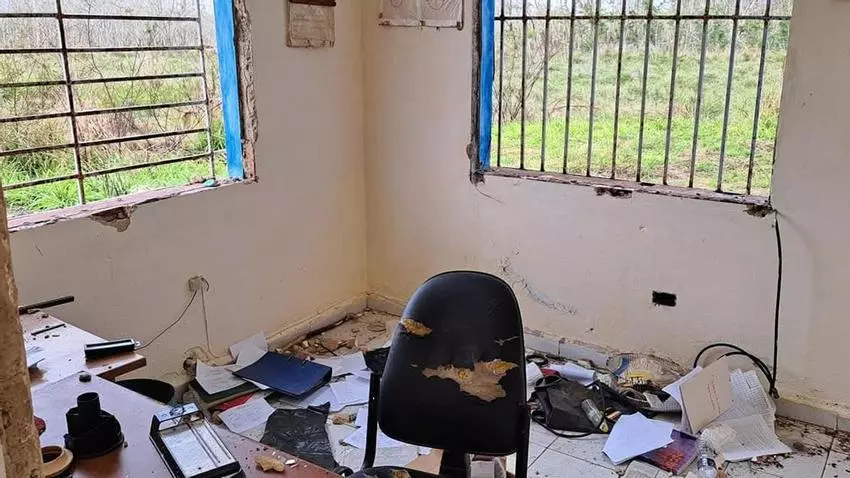
The organization is promoting a transition to renewable energy sources to reduce “dependence” on hydrocarbons.
The shortage is further taking over markets, which had already been undersupplied for several years. / 14ymedio
14ymedio / EFE, São Paulo, March 3, 2026 – The impact of the fuel crisis in Cuba is already being felt in its agricultural sector and the effect is “serious,” warned EFE in an interview with the regional representative of the United Nations Food and Agriculture Organization (FAO), René Orellana.
The head of the FAO for Latin America and the Caribbean stated that the lack of fuel, caused by actions taken by the government of the U.S. president Donald Trump, “is limiting” farmers’ use of machinery to carry out the harvest.
“Several crops are at risk of not being harvested properly,” he warned. As a consequence of this situation, Orellana said that the Island’s population “will not be able to access those foods.”
“Several crops are at risk of not being harvested properly.”
In this context, the FAO and other UN agencies are promoting a transition to renewable energy sources to reduce “dependence” on hydrocarbons, the agency official explained. continue reading
Among the options being promoted are the installation of new irrigation systems, as well as small-scale photovoltaic and hydroelectric plants.
“They are accessible energy sources that we must work on to support small family production,” Orellana said.
Since U.S. President Donald Trump imposed a blockade on oil shipments to Cuba, extreme fuel rationing measures have restricted the transport of agricultural products to markets.
Translated by Regina Anavy
______________________
COLLABORATE WITH OUR WORK: The 14ymedio team is committed to practicing serious journalism that reflects Cuba’s reality in all its depth. Thank you for joining us on this long journey. We invite you to continue supporting us by becoming a member of 14ymedio now. Together we can continue transforming journalism in Cuba.
Under another name, the regime offers the same recipes that have led the country to an unprecedented crisis.
Díaz-Canel at the Council of Ministers meeting to evaluate the economic program. / Revolution Studies
14ymedio, Havana, 3 March 2026 — The lessons of the past have not sunk in at the top of the Cuban power structure, which continues to stumble, time and again, over the same stone in its failed attempts to save “the economic and social model.” After the 2021 ‘Ordering Task‘, which plunged the country into misery, Miguel Díaz-Canel is now asking his ministers to focus “immediately on implementing the most urgent and necessary transformations,” this without touching the current socialist model.
The Associated Press (AP) echoed the Cuban president’s demand, and countless newspapers— including the Washington Post—have reprinted a story that, beyond the headline, contains nothing new: “to implement the urgent, most necessary transformations that must be made to the economic and social model.”
The president’s words generated widespread anticipation, not only within the US news agency, which emphasized the context in which they occurred—the oil embargo—but also among other sectors critical of the government, like the economist Pedro Monreal, based in Spain. However, Monreal was initially disappointed by the original information published in the State newspaper Granma. “What the press release describes doesn’t suggest that the government has a robust plan for transforming Cuba’s economic model. It would be necessary to go beyond the 10 aspects mentioned,” he said.
Hours later, the economist offered a harsher analysis. “The current economic model cannot be improved by replacing obsolete parts. The current model is exhausted, but it maintains an internal coherence that must be dismantled and replaced by another, also internally coherent, but discordant with the previous one,” he stated on his X account. Monreal pointed out that “the structural crisis expresses the nature of an economic impasse that cannot be overcome within the model” and that if the word reform is not to be used, it is at least imperative to call it “structural transformation.” continue reading
The current model is exhausted, but it maintains an internal coherence that must be dismantled and replaced by another, also internally coherent, but discordant with the previous one,” he stated on his X account.
In any case, the expert believes that the document called ‘Conceptualization,’ which defined “centralized socialist planning as a ‘central component’ of the model and ‘ownership by all the people’ as the basis of the economic system,” are “precisely two crucial aspects to modify in a structural reform.” Monreal believes it is imperative to involve all of society to reach an agreement on the necessary changes and accuses the government of perpetuating a “casting error” by “entrusting the transformations to the same team (…) that designed and implemented the programmatic folly of the ‘Reorganization,’ the ineffective patches that followed, and the bureaucratic contraption they call a ‘Government program.'”
What was discussed at the Council of Ministers was widely reported by the official press, making it clear that no changes have been announced. The mere list Díaz-Canel presented of these transformations demonstrates this: “They are fundamentally related to business autonomy, municipal autonomy, the resizing of the state apparatus, the government, and institutions; national food production, municipal budgets, the shift in the energy matrix, which includes not only renewable sources but also everything related to domestic crude oil; exports, linking them to the flexibilities approved for foreign direct investment; leveraging economic partnerships between the state and private sectors, especially at the municipal level; and promoting business with Cubans residing abroad,” he said. Each and every one of these was approved long ago.
The meeting focused on the role of municipalities and the importance of them taking control of decisions that were placed in their hands years ago. Prime Minister Manuel Marrero emphasized this idea, which is hardly original. For at least two years, the government has repeatedly invoked the concept of municipal decentralization, which, while potentially offering advantages—decisions being made locally and with a better understanding of each area’s needs—ultimately served more as a mechanism for diluting responsibility. Since mid-2024, for example, the approval of micro, small, and medium-sized enterprises (MSMEs) has been a municipal power, so Marrero’s words didn’t signify any real change.
“The municipalities have to manage foreign direct investment; municipalities have to manage their own closed schemes in foreign currency; municipalities have to manage economic partnerships between the state and non-state sectors; municipalities have to design and propose their local production systems; and they have to manage investments with Cubans residing abroad,” he said.
It is true that the approval of the decree on the Decentralization of Powers and Transfer of Resources to the Territories, at the end of December 2025, is recent. But in its resistance to relinquishing control, the Government reserved for itself “the final power to approve everything, as well as the ability to add further exclusions to decentralization, concentrating the power of veto and redefinition of the process at the central level,” as criticized, among others, by the official publication La Joven Cuba, which also acknowledged the lack of training and capacity in municipalities to suddenly make decisions. “Decree 140/2025 is more of a declaration of intent than a true decentralizing public policy,” it concluded.
What emerged from the Council of Ministers, as if it were the big thing, was the renaming of the “Government Program to correct distortions and revitalize the economy”, which will now be called the “Government Economic and Social Program for 2026”
The Council of Ministers announced, as if it were the big thing, the renaming of the “Government Program to Correct Distortions and Revitalize the Economy,” which will now be called the “Government Economic and Social Program for 2026.” However, the state of the economy remains largely unchanged. The Minister of Health, Joaquín Alonso Vázquez, stated that “generally, goods exports are falling short,” with the exception of honey, tobacco, lobster, rum, and pharmaceuticals. Sales of services are currently performing better, although the outlook is bleak. Tourism reached only 85% of projections, but February is expected to bring even worse conditions, following the cancellation of countless flights due to fuel shortages. Health sector exports are nearly at 100% of their targets, officials affirmed, although announcements of the suspension of agreements to contract out Cuban doctors for overseas missions are happening daily.
Regarding agricultural production, there is very bad news, all attributed to “the hostile US policy,” which means that despite the effort, “they still do not meet the demands of the population, they are insufficient and do not cover the deficits of imported food foreseen in the plan.”
The Minister of Energy and Mines, Vicente de la O Levy, also spoke about the energy transition – with no new developments, on that part. “Progress has been made, but concrete actions are needed in each of the provinces and municipalities to make them more energy sovereign,” he said.
There was no clear data on debts and defaults, although Marrero warned that the actions taken to address the debts are numerous but “insufficient,” leaving behind an unknown that no one wants to discuss. “The Council of Ministers reviewed the results of the Development and Business Program and Mariel Special Development Zone for the end of 2025, an important economic enclave for the nation which, despite the tense situation in Cuba, confirms its strategic value for attracting national and foreign investment.” No figures were presented to assess the current state of this free trade zone, which was expected to generate some $2.5 billion annually but had barely reached that amount in its first decade.
______________________
COLLABORATE WITH OUR WORK: The 14ymedio team is committed to practicing serious journalism that reflects Cuba’s reality in all its depth. Thank you for joining us on this long journey. We invite you to continue supporting us by becoming a member of 14ymedio now. Together we can continue transforming journalism in Cuba.
With a record deficit of 2,025 MW expected this Monday, the supply of photovoltaic energy is not reducing nighttime blackouts
Even some of the “chosen ones” haven’t been able to enjoy the privilege, because they can’t afford it. / UNE
14ymedio, Havana, March 2, 2026 — A new record for blackouts is expected this Monday in Cuba. The outage will again exceed 2,000 megawatts (MW), according to the report published by the National Electric Union (UNE), reaching 2,025 MW during peak hours. Given that only 1,185 MW will be available for a demand of 3,180 MW, this represents an unprecedented deficit of 64%.
In the midst of constant power outages, which exceed 20 hours a day in some parts of the Island, the National Union of Educators (UNE) has announced the sale of 800W solar panels for 75,000 pesos. The offer is only for “outstanding workers,” even though that price is more than 20 times the average salary of a state employee.
In a message posted on its official profile, the National Union of Educators (UNE) proudly announced the installation of an 800W photovoltaic module at the home of a retired Heroine of Labor (a 2003 recipient) in Artemisa. “The kit, priced at 75,200 pesos payable through various methods, includes six meters of cable and one connector; another connector and a double-edged blade will be purchased according to supply and demand,” the post detailed. Payment options included cash or card, as well as the possibility of “family support.”
The comments on the post reveal indignation laced with dark humor: “She won’t have enough time in her lifetime to pay for it.” Others point out that some of the “chosen ones” haven’t even been able to enjoy the privilege because they can’t afford it.
Even more outrageous is the advertisement from the Postal Service in Sancti Spíritus , which is selling solar kits to both individuals and businesses. According to a post on their social media, the most “basic” 5-kilowatt (kW) model costs 2,530,000 Cuban pesos, and the 12 kW model is nearly 4,895,000. Payment must be made entirely in Cuban pesos, either electronically or in cash. continue reading
State prices for these modules are three times higher than what can be purchased for similar systems on the informal market.
State prices for these modules are three times higher than what can be purchased for similar systems in the informal market, where, moreover, sales are not reserved for select groups within the population.
In Granma province, the program is already facing setbacks. An article in the official newspaperLa Demajagua reports panels installed without available batteries, equipment with technical limitations, and cases of breakdowns for which the customer is ultimately held responsible: some beneficiaries are forced to continue paying fees exceeding ten times their monthly salary due to the installation of systems that don’t work.
Meanwhile, the official newspaper Granma celebrates the installation of 5,000 2 kW photovoltaic systems donated by China to “protect what is essential.” According to Elena Maidelín Ortiz Fernández, the head of the project installing the donated modules, 2,671 of these systems were allocated to “vital centers in every municipality in the country.” The purpose, she noted, “is not total self-sufficiency,” but rather “to guarantee the energy survival of these centers, which in turn contributes to the vitality of the municipality and the province.” The National Union of Electricity Workers (UNE) proudly highlights these installations on its social media profile, prompting protests from users about the repeated power outages in their areas.
Because of system installations that don’t work, some beneficiaries have to continue paying fees that exceed ten times their monthly salary.
Ortiz Fernández also emphasizes that this benefit will reach rural areas that have never had electricity. “If you install a 2 kW system for these people there, allowing them to have a refrigerator, a fan, a television, their lives will be completely transformed, and we will prevent them from having to leave their communities.”
The deployment of solar panels is officially presented as part of the energy transition in the face of the crisis and deterioration of the national electricity system; but access to domestic systems depends on an impossible ability to pay in a context of extremely low wages and constant blackouts.
Furthermore, the installation of solar parks, announced with Chinese contracts for 92 projects across the island, will not solve the energy shortage either. The limited output of completed projects suggests that the energy these facilities provide to the island will remain insufficient and restricted to the hours of sunlight.
While the official press boasts about donations and “energy resilience,” millions of Cubans continue to suffer basic needs as a luxury that costs more than they will earn in years.
______________________
COLLABORATE WITH OUR WORK: The 14ymedio team is committed to practicing serious journalism that reflects Cuba’s reality in all its depth. Thank you for joining us on this long journey. We invite you to continue supporting us by becoming a member of 14ymedio now. Together we can continue transforming journalism in Cuba.
The print version of the Communist Party newspaper will be published only once a week
On Ayestarán Street, a closed and rusty newsstand has lost the stickers that advertised the magazines that were sold there a few years ago. / 14ymedio
14ymedio, Yoani Sánchez, Havana, 2 March 2026 — I leave my house and come across a woman placing food for a stray cat on a page of the Granma newspaper, a scene that will soon disappear in a country where the official organ of the Communist Party is now printed only once a week. With its few pages and triumphalist headlines, the Cuban regime’s main propaganda outlet is the latest victim of the energy crisis hitting the island. But its reduction, more than a loss of information, is a sign of the end of a model of indoctrination
I leave Rancho Boyeros Avenue behind and approach the Havana Printing Plant, one of the main printing facilities for periodicals in Cuba. Several windows are missing from the upper floor, and neglect seems to pervade a place that was once the heart of the country’s information policy. The facade is dirty here and there, and from inside, the sounds of the machines where paper and ink once combined to give shape to official statements, lengthy speeches, and calls to resistance are gone.
For a system that has based its control primarily on repression and propaganda, the current state of its official media represents a rapid loss of social influence. My curiosity leads me to walk around the building, and I don’t see a soul entering or leaving. The nearby institutional parking lot is filled with broken-down cars. Some vehicles have been sitting out in the open for years, never driven on the streets of Havana. The nearby headquarters of the newspaper Juventud Rebelde, which resembles a fish stall, also shows no signs of activity. continue reading
In a few months, the enthusiasm faded, the presses stopped, and the fuel to carry the dogma of the Central Workers’ Union of Cuba to every proletarian ran out.
The faded poster for Bohemia magazine catches my eye. The entrance is dark, and a nearby garbage dump has begun to encroach on the building’s access ramp. A fence in the vicinity has lost its color, and others have simply vanished, leaving only the metal scaffolding from which, until a few years ago, we were bombarded with slogans. I’m just a few meters from Revolution Square, where ideological propaganda should be more prevalent, but what I find are a few neglected and outdated posters.
At a nearby bus stop, across from the Ministry of Communications, a homeless man has improvised a place to sleep. He has some blankets and pages from the newspaper Trabajadores. I manage to read a few headlines printed on its pages. They are phrases that sound like they came from a distant land, where plans were made and victories were celebrated. But, in just a few months, the enthusiasm faded, the presses stopped, and the fuel to carry the dogma of the Cuban Workers’ Federation to every proletarian on the island ran out.
On Ayestarán Street, a closed and rusty newsstand has lost the stickers that once advertised the magazines sold there a few years ago. Further down the street, another newsstand has been handed over to a private vendor who, instead of official publications, offers small tubes of instant glue, colored pencils, and school supplies, all imported. Along the way, I don’t encounter a single newspaper vendor, a nearly extinct occupation in Havana.
A herbalist wraps a sprig of basil for me in a page of Tribuna de La Habana. The printed version of the official newspapers will also be missed in home repairs, where they were used to avoid getting paint on the floor, and in toilets throughout the country, where they replaced toilet paper. Now, with their reduction, what’s lost is not just a news source, but a practical resource for cleaning windows or picking up dog waste.
Provincial media outlets, with few exceptions, copy and paste the articles written in Havana.
A friend’s son is about to graduate with a degree in Journalism, but classes at his faculty have been suspended due to the power outage. The young man began his studies full of passion, eager to become a reporter, investigating stories, gathering testimonies, and compiling sources. Along the way, however, he lost hope of practicing his profession in Cuba and now only wants to obtain his diploma and emigrate. While waiting for in-person classes to resume, he writes for an independent newspaper that pays him in foreign currency.
The worst situation is that of the older journalists. In my neighborhood, a photographer for an official magazine complains that he’s no longer given gasoline to ride his motorcycle out to take photographs of events. Coverage on-the-ground is at a minimum in media that, until a few decades ago, enjoyed abundant resources and priority in receiving perks. Credentials to attend festivals, welcome cocktails at exhibitions, and even the occasional “little gift” upon completing a report on an industry with foreign investors were part of the profession’s allure. However, being a state reporter today brings more headaches than benefits.
My neighbor complains that his newsroom is empty. “The last few times I’ve been there, I’ve only seen the security guard,” he tells me. Provincial media outlets, with few exceptions, simply copy and paste the articles written in Havana. Some news headlines go days without updating, while others survive by rehashing posts from social media where a resident reports a water leak or thanks a bus driver for stopping at the bus stop. Instead of those powerful, tireless voices, publications controlled by the Cuban regime have become clumsy digital spreadsheets with hardly any well-known bylines, in-depth reports, or news.
Next to me in line for the elevator, a neighbor is looking at the front page of a Miami-based newspaper on her phone. The headline that catches her eye speaks of “economic collapse” in Cuba, and the photo shows the gaunt and sad face of an elderly man. Granma has not only lost the battle for print media, it was defeated long ago in its attempts to monopolize the Cuban audience. The elderly woman neither informs nor persuades, and from now on, she’s no longer of any use in Cuban bathrooms.
COLLABORATE WITH OUR WORK: The 14ymedio team is committed to practicing serious journalism that reflects Cuba’s reality in all its depth. Thank you for joining us on this long journey. We invite you to continue supporting us by becoming a member of 14ymedio now. Together we can continue transforming journalism in Cuba.
The good news for the United States and the world is that democratic institutions will outlive the current president.
Donald Trump, of course, in denouncing the Supreme Court’s decision, has been particularly rude to the two justices he appointed. / EFE
14ymedio, Federico Hernández Aguilar, San Salvador, 27 February 2026 — In April 2025, in this same opinion column, we shared our astonishment at the US president’s threat to impose barriers to free trade on much of the world. Calling it “inexplicable,” we warned that the “reasons” given by the White House to justify its tariff offensive were, in reality, mere excuses, because neither the logic of bravado as a tool of intimidation nor the hypothetical desire to lower interest rates on US debt through recession made sense. The potential benefits of these measures would not outweigh the risks involved.
The three outcomes we predicted came to pass exactly as predicted: increased bilateral trade responses; new alliances centered around development hubs alternative to the United States; and an inflationary wave that has devastated the stability of thousands of American households. Trump’s argument regarding supposed “trade balances” was untenable, aberrant, and illiberal. That is why its effects are hurting the president in the polls and creating unnecessary holes in his country’s image as a reliable partner.
Trump’s argument regarding supposed “trade balances” was untenable, aberrant, and anti-liberal.
However, the icing on the cake was still missing. Was the Supreme Court going to rule against Trump’s economic agenda, overturning his tariff strategy? Because the truth was that no president before him, at least in the last half-century, had gone so far in challenging judicial independence. Just last September, we recalled that the courts were flooded with executive orders and that, of twenty-one cases brought before the Supreme Court, only in three had the Court not ruled in favor of granting the president greater leeway at the expense of the lower court’s decisions.
While none of the above yet constituted a flagrant violation of the Constitution, it was clear that Trump was undermining the system. In his second term, therefore, only the bulwark of the rule of law could prevent him from abusing his power, in the manner of autocrats in South America or sub-Saharan Africa. continue reading
On February 20, finally, with a majority of six to three, the justices of the highest court did their job, reminding Donald Trump that the independence of the branches of government is a pillar of American democracy and that his executive powers cannot exceed the legal framework in which those powers originate.
At the end of his concurring opinion, Justice Neil Gorsuch, alluding to the need for Trump to abide by constitutional procedures, wrote: “Yes, legislating can be hard and take time. And, yes, it can be tempting to bypass Congress when some pressing problem arises. But the deliberative nature of the legislative process was the whole point of its design. Through that process, the Nation can tap the combined wisdom of the people’s elected representatives, not just that of one faction or man. There, deliberation tempers impulse, and compromise hammers disagreements into workable solutions. And because laws must earn such broad support to survive the legislative process, they tend to endure, allowing ordinary people to plan their lives in ways they cannot when the rules shift from day to day.”
Three justices whom the American press calls “conservatives”—John Roberts, Amy Coney Barrett, and Gorsuch—have offered the world proof of what makes the United States great: its institutional strength. And they did so, not out of animosity toward President Trump or a desire to give more power to Congress, but because they understand that posterity will judge them harshly for their decisions, decisions that must be grounded in the Constitution and the tradition of great liberal values.
Aside from sending a message to members of Congress (mostly Republicans) to understand and defend their legislative power, the Supreme Court was consistent in respecting the letter of the law.
Joining the majority of the Court’s justices, Justice Ketanji B. Jackson emphasized that U.S. legislative history provides clear evidence of what Congress intended when it enacted the International Emergency Economic Powers Act (IEEPA), on which Trump sought to base his tariff offensive. Jackson added, “Given that evidence, we need not speculate or, worse, step into Congress’s shoes and formulate our own views about what powers would be best to delegate to the President for use during an emergency.”
In other words, aside from sending a message to members of Congress (mostly Republicans) to understand and defend their legislative power, the Supreme Court was consistent in respecting the letter of the law and avoiding encroaching on the constitutional powers of the Capitol, which would have been a huge inconsistency.
Donald Trump, of course, in denouncing the Supreme Court’s decision, has been particularly rude to the two justices he appointed: Barrett and Gorsuch. As is typical of his rhetoric, he targets the reputations of those he cannot defeat with arguments. But his furious diatribe is also aimed at members of his own party in Congress, who will now have to provide the president with a legal recourse just months before they themselves are up for reelection in November.
Whatever happens, the good news for the United States and the world is that American democratic institutions will survive Donald Trump.
______________________
COLLABORATE WITH OUR WORK: The 14ymedio team is committed to practicing serious journalism that reflects Cuba’s reality in all its depth. Thank you for joining us on this long journey. We invite you to continue supporting us by becoming a member of 14ymedio now. Together we can continue transforming journalism in Cuba.
“We will arrive to embrace each other, to work together, to guarantee an unstoppable transition,” she said in a video.
Maria Corina Machado cannot, in principle, invoke the Amnesty Law. / Screenshot
14ymedio/ EFE, Caracas, 2 March 2026 — Venezuelan opposition leader María Corina Machado said Sunday that she will return to her country in “a few weeks” to consolidate a major national agreement among various sectors and prepare, she said, for a “new and gigantic” electoral victory.
“I will return to Venezuela in a few weeks. I want to do so, as do hundreds of thousands of Venezuelan exiles around the world,” the 2025 Nobel Peace Prize laureate said in a video posted on her social media. “We will arrive to embrace each other, to work together, to guarantee an orderly, sustainable, and unstoppable transition to democracy,” she added.
Machado indicated that there is a clear roadmap to follow, among them, strengthening the “unity of Venezuelans” that began with the opposition primaries of 2023 and continued with the commands, political and social organizations for the 2024 presidential elections, in which the electoral body – aligned with Chavismo – proclaimed the victory of Nicolás Maduro.
The opposition leader insisted that the victory in those elections belonged to the candidate of the majority opposition, Edmundo González Urrutia.
She also argued that it is necessary to finalize a major national agreement with political and social organizations and leaders to establish consensus to “achieve governability throughout this transition process and in democratic Venezuela.”
“First we had to defeat them spiritually, then politically, then electorally, and finally militarily. We said it was going to happen, and it did. On January 3, a legitimate president was not captured because Nicolás Maduro had already been defeated on July 28, 2024,” she adds. continue reading
Machado thanked the United States, its government, congressmen, judges and military personnel who “risked their lives for the freedom of Venezuela,” referring to the capture of Maduro and his wife, Cilia Flores, in an attack on Caracas and three other nearby regions on January 3.
“President Donald Trump, with vision and courage, brought Nicolás Maduro to justice before international law,” she noted.
The former congresswoman stated that the government led by Delcy Rodríguez wants to “buy time.” “The regime currently in power in Venezuela is the same. They are the ones who have tortured, persecuted, imprisoned, disappeared, murdered, expropriated, and lied,” she said. “But everything has changed, and now they have to follow instructions to move forward with dismantling the repression, recovering our country’s economy, and advancing toward the transition.”
On February 6, Machado said that there could be democratic elections in Venezuela in less than a year, according to an interview published with the digital media outlet Politico.
“Everything has changed, and now they have to follow instructions to move forward with dismantling the repression, the economic recovery of our country, and to advance towards the transition.”
“We believe that a real transition process with manual voting (…) the whole process could be completed in nine or ten months. But, well, that depends on when it starts,” said Machado, who left Venezuela in December for Norway to receive the Nobel Peace Prize, after spending almost a year in hiding.
The Amnesty Law, approved by the Venezuelan Parliament on February 19, has an article that excludes from the beneficiaries those who have been or may be prosecuted for “promoting, instigating, requesting, invoking, favoring, facilitating, financing or participating in armed or forceful actions against the people, sovereignty and territorial integrity of the Bolivarian Republic of Venezuela, by foreign States, corporations or persons.”
Chavismo accuses Machado, precisely, of having promoted the US military intervention, which would initially exclude her.
______________________
COLLABORATE WITH OUR WORK: The 14ymedio team is committed to practicing serious journalism that reflects Cuba’s reality in all its depth. Thank you for joining us on this long journey. We invite you to continue supporting us by becoming a member of 14ymedio now. Together we can continue transforming journalism in Cuba.
His bronze medal in Moscow 1980 marked a turning point for sport shooting in Cuba.
Roberto Castrillo García at the national sport shooting school. / Ecured
14ymedio, Havana, March 2, 2026 – Roberto Castrillo García, a historic figure in Cuban sport shooting and the Island’s first Olympic medalist in the skeet event, died on February 28, 2026, in Guanajay, his hometown, at the age of 85. His bronze medal at the 1980 Moscow Olympic Games remained for 24 years as the country’s only Olympic medal in sport shooting.
Born on June 30, 1941, in the same city where he passed away, then part of the former province of Havana, Castrillo began practicing shooting in the 1960s in Boyeros. Within a few years, he went from amateur to a continental benchmark.
His international career spanned more than fifteen years and five consecutive Pan American Games, from Winnipeg 1967 to Caracas 1983. In those competitions, he reached the podium every time, accumulating seven medals: one gold, four silver, and two bronze, in addition to nine medals at the Central American and Caribbean Games.
His crowning moment came at the 1980 Moscow Olympic Games. At age 39, Castrillo secured the bronze medal in a competition decided by the narrowest of margins. The medal remained the greatest international achievement for Cuban skeet until continue reading
Juan Miguel Rodríguez also won the bronze medal in Athens 2004.
His Olympic medal remained the greatest international achievement of Cuban skeet for 24 years.
His precision reached memorable marks: he broke 200 out of 200 targets in a preparatory competition in Mexico City, although the mark was not certified as a world record.
After retiring from competition, he worked as a coach and later as an international referee, participating in national and international events. He was recognized as a Glory of Cuban Sport.
The National Institute of Sports, Physical Education and Recreation (Inder) announced his passing and highlighted his career. Funeral services were held in Guanajay, where he lived, and he was buried that same afternoon.
Translated by Regina Anavy
______________________
COLLABORATE WITH OUR WORK: The 14ymedio team is committed to practicing serious journalism that reflects Cuba’s reality in all its depth. Thank you for joining us on this long journey. We invite you to continue supporting us by becoming a member of 14ymedio now. Together we can continue transforming journalism in Cuba.
The ‘Eugenia Gas’, docked in Puerto Jose, will carry the fuel used for cooking on the Island.
The tanker Eugenia Gas, flying the Liberian flag, is in the port of Jose. / Marine Traffic
14ymedio, Madrid, March 2, 2026 – After two months wandering around the Caribbean in its search for liquefied petroleum gas (LPG), used for cooking in Cuba, the tanker Eugenia Gas is finally loading at the Venezuelan port of Jose. The vessel, sailing under the flag of Belize, is part of Cuba’s coastal fleet and saw its attempt to obtain fuel in Kingston (Jamaica) thwarted three weeks ago.
“Until the bill of lading is made public, we will not know who the shipper, the consignee, and the carrier are that are requesting authorization for the resale of Venezuelan-origin oil for use in Cuba in compliance with the recent United States sanctions,” Jorge Piñón, an expert from the University of Texas, told 14ymedio.
After confirming that the ship is finally being loaded, the specialist laid out the three fundamental questions surrounding what will be the first shipment from the state-owned PDVSA since Nicolás Maduro’s capture by the United States.
The sale may have been carried out by the Venezuelan oil company, but it could also have been Vitol or Trafigura, the two major commodity trading firms that, according to the international press, obtained licenses to resell PDVSA crude and have already made exports to the United States and several European countries. continue reading
The sale may have been carried out by the Venezuelan oil company, but it could also have been Vitol or Trafigura, the two major commodity trading firms that, according to the international press, obtained licenses for resale.
They could also be the buyers and transporters, but Piñón does not rule out CubaMetales itself, although Washington’s sanctions do not contemplate the possibility of the fuel passing through the hands of the State.
Lastly, one fundamental question remains: how much did the LPG cost and who is paying for it? Barely a week after Maduro’s capture, U.S. President Donald Trump stated on his social network: “Cuba lived, for many years, off large quantities of oil and money from Venezuela. In exchange, Cuba provided ‘security services’ to the last two Venezuelan dictators. But no more! There will be no more oil or money for Cuba! Zero!”
At the end of January, he took another step: imposing tariffs on countries that delivered fuel to the Island. Although those levies were nullified by the Supreme Court’s decision, based on a rule the justices deemed inappropriate for that purpose, Washington still had mechanisms to sanction countries that insisted on helping Havana. The situation has not only forced the Cuban regime to adopt radical savings measures affecting the daily lives of Cubans, but it is also suffocating the private small and medium-sized enterprises that were beginning to gain ground on the Island.
“I have suppliers who tell me: ‘I’m going to lose 100 containers of chicken because it’s at the port, there’s no fuel to go pick it up, and it’s going to spoil,’” lamented Cuban-American businessman Hugo Cancio a few days ago. Just last week, the consulting firm Auge released two reports highlighting the scale of the crisis. In one, it concluded that 78% of 63 companies surveyed reported declines in sales since Trump threatened tariffs on oil supplies. In the other, even more stark, more than 96% of private businesses “face an impact ranging from severe to catastrophic due to the fuel shortage.”
The Trump Administration decided on a shift in recent days, according to some sources, because the idea is to make clear to the regime its dependence on White House decisions and that a cooperative understanding would be beneficial for everyone.
The Trump Administration decided on a shift in recent days, according to some sources, because the idea is to make clear to the regime its dependence on White House decisions and that a cooperative understanding would be beneficial for everyone. Thus, Washington authorized last week the sale of crude to the private sector, although for the moment it is in small quantities. This LPG shipment will be the first Venezuelan cargo to reach the Island since December 8, when the Neptune 6, part of the “ghost fleet,” arrived in Matanzas from Jose with about 598,000 barrels of Merey 16 crude.
Later, the Jasper, flying the flag of Cameroon and carrying 330,000 barrels of Russian crude, arrived on December 23. The United States did not place any obstacles to the arrival in Matanzas and Santiago de Cuba of this vessel, despite it being sanctioned by the European Union. Now, the route of the Sea Horse, flying the Hong Kong flag and supposedly loaded with about 200,000 barrels of Russian fuel for Cuba, remains in question. Moscow denied the information last week, although the tanker continues a slow westward course in the Atlantic and was located this Sunday about 1,463 nautical miles from Cuba’s northern coast, moving at a minimal speed of 0.8 knots.
The United States currently has several vessels available to try to stop a tanker of this type, including the Vincent Danz, John Patterson, Spencer, Richard Dixon, Stone, SAR 26227, and SAR 20313. All of these are less than 36 hours away from Cuba.
Translated by Regina Anavy
______________________
COLLABORATE WITH OUR WORK: The 14ymedio team is committed to practicing serious journalism that reflects Cuba’s reality in all its depth. Thank you for joining us on this long journey. We invite you to continue supporting us by becoming a member of 14ymedio now. Together we can continue transforming journalism in Cuba.
The opposition leader, who presented the Liberation Agreement project in Miami, spoke about a future transition in Cuba in an interview with the Spanish newspaper ‘El Mundo’.
The release agreement was signed this Monday in Miami. / @EmmaRincon
14ymedio, Madrid, 2 March 2026 — Part of the Cuban exile community in Miami gathered this Monday in the Varela Room of the Hermitage of Charity to learn about a new opposition alliance called the Liberation Agreement. The presentation was given by Orlando Gutiérrez Boronat, coordinator of the Cuban Resistance Assembly, and Rosa María Payá, who holds the same position within Pasos de Cambio [Steps for Change] (a platform of which Cuba Decides is a part).
Both have now joined forces in this proposal for “the release and consolidation of a comprehensive plan for the restoration of Democracy and the Rule of Law in Cuba, constituting a democratic alternative for Cubans and offering a viable framework for national reconstruction,” the organizers maintain.
Payá, a member of the Inter-American Commission on Human Rights and daughter of the late Orlando Payá, was interviewed earlier in the day by the Spanish newspaper El Mundo, to which she said, with hope, that this time she truly believes in imminent change in Cuba. “The Berlin Wall of our times can now be torn down,” she said.
Throughout the conversation, the opposition leader defends the role of organizations abroad as unifying forces that can help manage systemic change. She asserts that, over the past two years, her NGO has been working with six documents prepared by different platforms to develop a phased guide outlining the liberation, stabilization, transition, and ultimately, democratization of the country.
In addition, she said, there is another team dedicated exclusively to boosting economic recovery, which she considers urgent, though not as urgent as political change. And she is also working on the strategy of a team that can lead Cuba’s economic recovery. “If there’s one thing we Cubans understand very clearly, it is who is responsible for the misery continue reading
in Cuba, and that responsibility lies with the Castro family and the group of generals in power, who manage that power through an intelligence apparatus that is also a repressive apparatus. The worst of all the crises is the political crisis, which keeps hundreds of people in prison for political reasons, simply for speaking their minds or trying to survive,” she declared.
Payá believes the United States is the most relevant international actor in “helping the Cuban people” at this time, and she is also grateful to it for making the prospect of change more real today than it has been in the last 67 years. “Those in power have the weapons and are willing to use them against the unarmed people. Given this reality, international pressure is also necessary, and this pressure has changed qualitatively thanks to the actions of the U.S. government, both in weakening the network of support that came from authoritarianism to the Cuban regime, such as subsidies from Venezuela, and in imposing direct sanctions on Cuban repressors,” she emphasizes.
However, she also believes that “it is not the place of the US to define, nor do I think it is seeking to define or direct the Cuban people.” In that sense, Payá also responds to the possibility that the aforementioned talks between Washington and Havana will include a Cuban “Delcy,” something she considers practically a given, as is the certainty that these individuals—from within the regime—will have to be dealt with.
“Of course, it will have to work with the people who operate those existing structures to definitively transform them. That’s why the process has phases, and that’s why it’s called a transition. It’s not that there will be free elections in Cuba tomorrow, but we will have a timeline for them to take place once we can transform the state and guarantee the rights and freedoms necessary for the elections to happen,” she admits. However, she defers to speaking with the White House when asked if it is Raúl Guillermo Rodríguez Castro, Raúl Castro’s grandson, with whom U.S. Secretary of State Marco Rubio is dealing.
Payá stated in the interview that “system change in Cuba requires forcing a military group to submit to the sovereign will of the citizens.”
Payá stated in the interview that “system change in Cuba requires forcing the military to submit to the sovereign will of the people,” and that this process requires, precisely, that the people mobilize. She understands, however, that the regime continues to repress, as demonstrated by the detention of the El4tico influencers, and therefore urges the international community to strongly support a democratization process in Cuba.
“The fact that Cubans are physically disappearing from the island (since ’11J’ — the Island-wide protests of 11 July 2021 — almost two million have fled, mostly young people) is like the ultimate metaphor for communism and what that regime means, a regime that destroys the souls and bodies of human beings. This is very concrete, very literal, and devastating. That is why there is a sense of urgency: Cubans are so clear that the only way out of the crisis is to end the dictatorship,” she asserts.
The initiative presented this Monday was attended by members of various organizations who signed the agreement after the opening speeches. Just two weeks ago, Cubans from both inside and outside the island also signed the “Agreement for a Free Cuba,” an initiative promoted by civil organizations with one objective: to demand an end to the dictatorship and a transition to democracy.
That document urged, among other things, the creation of a group “tasked with laying the foundations for a process of truth, justice, memory, and reconciliation, which would coordinate the main aspects of the transitional period.” More than a hundred people, including economists, writers, and artists, signed the proposal.
______________________
COLLABORATE WITH OUR WORK: The 14ymedio team is committed to practicing serious journalism that reflects Cuba’s reality in all its depth. Thank you for joining us on this long journey. We invite you to continue supporting us by becoming a member of 14ymedio now. Together we can continue transforming journalism in Cuba.
In the case of Cuba’s provincial newspapers, they will stop circulating in print due to the energy crisis.
The Cuban Government’s pro-official newspapers, including Granma, will now be printed only once a week. / Granma/Ariel Cecilio Lemus
14ymedio/EFE, Havana, February 28, 2026 / The Cuban Government’s ‘officialist’ newspapers, including Granma, will now be printed only once a week, and the publication on paper of provincial state newspapers is being completely suspended due to the unprecedented energy crisis affecting the Island, a hard blow to the propaganda machinery of the Havana regime.
The state-run Cuban media themselves reported this Saturday on the decision, adopted by the Political Bureau of the Central Committee of the Communist Party of Cuba, which cited as justification “the tightening of the blockade by the United States Government.”
The announcement explains that the newspapers Granma, the official organ of the Communist Party, and Juventud Rebelde will be printed and distributed, in an eight-page format, only on Tuesdays, starting next week.
In addition, the regional newspapers, already limited in frequency, will “stop being printed” for the time being. Each of Cuba’s 14 provinces has its own state-run regional print publication.
The regional newspapers, already limited in frequency, will “stop being printed” for the time being.
The impact of the current crisis “on fuel availability” is the main argument authorities have put forward for this cutback. The shortage of oil not only affects the printing of newspapers but also their transportation to distribution centers and newsstands throughout the country.
Something similar has happened with several provincial radio stations that have had to go off the air or modify their programming due to the prolonged daily blackouts, which hinder and damage station equipment continue reading
and have made their operations unsustainable. Such is the case of Radio Sancti Spíritus and Radio Ángulo.
The situation in Cuba has deteriorated significantly in recent weeks following the capture of Nicolás Maduro by the United States Government and the threat of tariffs on countries that supply oil to the Havana regime. However, the energy crisis had been worsening even before that. President Miguel Díaz-Canel himself acknowledged on February 5 that the country had not received oil since December.
The starting point was already worrying, as the Island had been enduring six years of a severe economic crisis, with a cumulative loss of more than 15% of its gross domestic product and more than 20% of its population.
Currently, gas stations are practically out of fuel; hospitals are suspending basic treatments and operating at minimal capacity; public transportation has essentially disappeared; garbage is piling up in the streets due to a lack of fuel for trucks, and food prices are skyrocketing.
Translated by Regina Anavy
______________________
COLLABORATE WITH OUR WORK: The 14ymedio team is committed to practicing serious journalism that reflects Cuba’s reality in all its depth. Thank you for joining us on this long journey. We invite you to continue supporting us by becoming a member of 14ymedio now. Together we can continue transforming journalism in Cuba.
Special Troops vehicles carrying soldiers in bulletproof vests were traveling last night along the Vía Blanca.
Military exercises in Cuba have become more frequent since the capture of Nicolás Maduro in Caracas. / X / Gladys Martínez Verdecia
14ymedio, Havana, March 1, 2026 —The scene seemed straight out of a war movie, the kind shown on weekends, but it took place on the streets of Havana, on one of its busiest arteries. “Special Troops vehicles, with soldiers standing up, wearing their bulletproof vests,” a Havana resident who witnessed the convoy while driving along the Vía Blanca told this newspaper, shortly before 10 p.m. on Saturday.
“Pickup trucks and vans full of military personnel, patrol cars, and state vehicles were escorting a convoy of tractor-trailers with their contents covered,” he added. The column later turned onto the Carretera Central. “What caught my attention was the hour and that, despite being large, they were moving quietly, as if trying to go unnoticed.” In his view, they could have been transporting heavy weaponry to other provinces, although he cannot confirm it. Opacity is part of the landscape.
It was not the only sign. Shortly after dawn on Sunday, detonations were heard from the Playa area. “We’ve already felt some today,” said a resident of El Vedado. In a city that has gradually lost the noise of the classic American cars and where blackouts silence even the hum of fans, the sharp blast of a military exercise bursts in as a reminder that the country lives in a permanent state of alert.
Each statement is amplified by the Cuban propaganda apparatus as proof of an imminent threat.
Recent months have been a calendar of upheavals. The capture in Caracas of Nicolás Maduro during a U.S. operation that left at least 32 Cubans dead, as acknowledged by the Government itself, shook the official narrative. Havana portrayed the deceased as heroes and forcefully reactivated the doctrine of the “war of all the people.” Since then, military exercises have occurred with greater frequency and continue reading
visibility.
On February 18, another event heightened internal tension: a riot at Canaletas prison in Ciego de Ávila left several dead and numerous injured, according to relatives of the inmates. The regime confirmed “the incident” but avoided specifying the number of victims. Official silence once again opened the door to rumors.
On February 25, a new episode strained relations with the United States. A speedboat coming from Florida was intercepted near Cayo Falcones, in Villa Clara. The official version maintains that the occupants fired first and that the border guards’ response left four dead and six wounded among the expedition members. The authorities spoke of weapons, explosives, and infiltration plans. From Washington came partial confirmations and nuances, but the fact remains that four compatriots died in national waters at the hands of other Cubans, an event that reopens historical wounds.
In this context, Donald Trump’s rhetoric has added pressure to the scenario. The U.S. president has hardened his tone toward Havana and has even spoken of a possible “friendly takeover” of the Island. Each statement is amplified by the Cuban propaganda apparatus as proof of an imminent threat.
Will we be killed by enemy bombs or will we continue to be battered by shortages, disease, building collapses, and the lack of medicines?
On Friday, February 27, the country marked National Defense Day. In several municipalities, combat-readiness exercises were carried out, along with militia mobilizations and drills by the Production and Defense Brigades. President Miguel Díaz-Canel supervised maneuvers in the western part of the country, surrounded by olive-green uniforms and civilians training in shooting practice. The rhetoric insisted on the need to be ready to “confront and defeat” any aggression.
Images showed men and women learning to assemble and disassemble weapons, reviewing plans for a hypothetical external enemy. But outside the cameras, in bread lines and at bus stops, the conversation was different: are we really on the brink of an invasion, or are we witnessing a new chapter in the pedagogy of fear? Will enemy bombs kill us, or will we continue to be struck by shortages, disease, collapsing buildings, and the lack of medicines?
Thousands of miles away, the bombings in Iran, the death of Ayatollah Ali Khamenei, and the escalation in the Middle East complete the landscape of global uncertainty. Each external conflict is presented in Cuba as yet another piece on the chessboard threatening the Island. The tractor-trailers moving at night with their covered cargo become a metaphor for a country where what is essential remains hidden. The detonations echoing from the west are a reminder that the State is always ready for war, even though the most urgent battle continues to be against scarcity and disillusionment.
Translated by Regina Anavy
______________________
COLLABORATE WITH OUR WORK: The 14ymedio team is committed to practicing serious journalism that reflects Cuba’s reality in all its depth. Thank you for joining us on this long journey. We invite you to continue supporting us by becoming a member of 14ymedio now. Together we can continue transforming journalism in Cuba.
An Insmet employee calls José Rubiera a “parasite” and denounces the closure of at least 10 of the agency’s stations.
The historic Santiago de Las Vegas train station has been abandoned and is currently in ruins / Courtesy
14ymedio, 1 March 2026 — This week’s announcement of a United Nations-funded plan to “improve the quality and accuracy of weather forecasts” in Cuba coincided with the delivery to 14ymedio of a devastating testimony about “corruption and nepotism” affecting the Institute of Meteorology (Insmet). “Only those of us who work here know,” explains a young employee at the Casablanca station who asks not to be named.
Currently, half of the personnel remaining at Insmet are over 65 years old: “Rehired retirees who earn double for doing nothing,” the worker asserts. Among these rehired retirees, the renowned Dr. José Rubiera, 80, stands out. He “already forgets the names and years of hurricanes” and manages to earn a considerable amount of money through his YouTube channel and other private contracts.
It was not a committee of experts or a proficiency exam that put him there: it was by political order
“Even though he doesn’t need it, he has a contract with Insmet, like a parasite,” says the young man with heartfelt annoyance, adding that the people still believe that Rubiera is the best meteorologist in Cuba, simply because “he was the one who went out with every cyclone,” without taking into account that whoever put him there was not a commission of experts or a proficiency exam: “It was by political order, for being a deputy and a member of the PCC, like everything else that is done in Cuba.”
José Rubiera and Fidel Castro on an episode of the Round Table TV program. / Cubadebate
The same procedure was followed with Ailyn Justiz, the current head of the Center for Atmospheric Physics, who was assigned the position after the previous head was dismissed for expressing an “incorrect” political opinion on social media. “Ailyn, on the other hand, has the perfect profile: she is a member of the PCC and a deputy to the National Assembly of People’s Power, but she has very little knowledge of meteorology.”
The worker points to the unreliability of the data transmitted by Insmet staff, where there is widespread discontent due to appalling working conditions. “The observers stationed at the stations fabricate numbers to justify their salaries,” he explains. For example, some independent meteorologists have questioned the supposed zero-celsius degree record at Indio Hatuey, as the station’s measurements are inconsistent and there are numerous physical reasons to disprove the record.
The professionals have resigned due to discontent over their low salaries and the insecurity of the facilities, which have already suffered frequent break-ins. / Courtesy
However, this record will not be reviewed or refuted under any circumstances, since the Insmet officially recognized it and the news went viral worldwide. Should any questions arise that surface on social media, they would immediately be dismissed with the assurance that “everything is working perfectly.”
Of the 68 weather stations in the system, at least ten have closed due to a lack of professionals who have resigned in protest over their low salaries and the insecurity of the facilities, which have already suffered frequent assaults. continue reading
At least ten stations have closed due to lack of staff and resources. / Courtesy
Among the stations that have ceased operations is the one in Santiago de las Vegas. Although this facility has decades of history, it has been abandoned for over a year and is now in ruins. It is currently occupied by unknown individuals as an illegal dwelling, and its records have been lost. Other Insmet facilities that have suffered similar fates include the historic stations at Cabo de San Antonio, Güira de Melena, Colón, and Unión de Reyes. At the Tapaste station, only the station manager remains, and she only takes sporadic measurements.
Despite the organization’s precarious situation, none of its top officials have been singled out or sanctioned. While the sector continues to suffer from shortcomings and resource shortages, the directors are using the money for scientific tourism, denounces the Casablanca specialist.
“The three main people responsible for this (although not the only ones) are the general director, Celso Pazos Alberdi; the deputy director Yinelis Bermúdez – a specialist in censoring information – and Ailyn Justiz, who allows the whole disaster at the forecasting center and spends her life in PCC meetings,” the worker asserts.
While the sector continues to suffer from failures and resource shortages, executives are using the money to promote scientific tourism.
The poor state of the meteorological infrastructure is evident in the absence of station reports on the Insmet website itself. Among the persistent problems are various technical deficiencies: “They no longer conduct forecast assessments and have hired technicians with inflated templates to create ‘maps’ using Windows Paint, which is an embarrassment for a professional.”
To stop the loss of specialists, the Ministry of Science, Technology and Environment (CITMA) has decided to increase the salaries of workers at three of its centers, and especially at Insmet itself. Employees have been asked not to divulge the news of the raise, apparently to avoid complaints from professionals in other scientific fields who deserve the same treatment commensurate with their work, but who receive meager salaries.
“The increase, which will arrive in March, is around double the current amount –although that doesn’t mean it will be enough– and the goal is for the Insmet staff to stay, especially in Casablanca, since most of the professionals at that station have resigned to go and work at the airport, where they are paid between 12,000 and 20,000 pesos, plus incentives.”
______________________
COLLABORATE WITH OUR WORK: The 14ymedio team is committed to practicing serious journalism that reflects Cuba’s reality in all its depth. Thank you for joining us on this long journey. We invite you to continue supporting us by becoming a member of 14ymedio now. Together we can continue transforming journalism in Cuba.
The incident reignites criticisms of the deteriorating water system, as residents report weeks without water.
Children play in the floodwaters that have taken over the streets. / Image taken from social media.
14ymedio, Havana, March 1, 2026 / A failure in Havana’s hydraulic system has caused interruptions in the water supply in Guanabacoa and several areas of East Havana. The break has also caused a major flood at the intersection of Calzada de San Miguel and 1st Street, in the municipality of San Miguel del Padrón
The powerful water leak gushing from the road flooded the streets uncontrollably, even reaching nearby homes. Videos circulating on social media show children playing in the strong current, as if it were a river. The irony of seeing so much water flowing in a city suffering from chronic water shortages generated reactions of both astonishment and outrage.
According to the state-owned water company Aguas de La Habana, the break occurred around 4:00 pm this Saturday, affecting a 48-inch pipeline in the Nudo A Tanque María Cristina main. As a safety measure and to facilitate repair work, seven pumps at the El Gato Water Supply Plant have been shut down.
In the comments on the official post, several users reported that the water supply problem extends beyond this incident. Residents pointed to supply failures that have lasted for weeks in areas as diverse as continue reading
Old Havana, Alturas de La Lisa, Luyanó, Altahabana, Arroyo Arenas, Playa, and Cotorro.
Some users commented that the pipe was already damaged, but the authorities had not addressed the issue.
The incident highlights the fragility of the capital’s water infrastructure, which has suffered decades of deterioration without adequate repairs and faces a demand that exceeds the system’s actual capacity. In the news report published by the Havana government on its official profile, some users commented that the pipe was already damaged, but the authorities had not addressed the issue.
The indignation and skepticism of these reactions are framed within a situation where these supply system failures, as well as the persistent incidents in the electrical system, convert the basic into a constant challenge.
Havana Water Company announced that it will provide an update when repairs are completed and service is restored. In the meantime, residents of the affected areas will continue to experience interruptions. This lack of water supply adds to the current crisis and the scarcity that is suffocating an increasingly discontented population.
______________________
COLLABORATE WITH OUR WORK: The 14ymedio team is committed to practicing serious journalism that reflects Cuba’s reality in all its depth. Thank you for joining us on this long journey. We invite you to continue supporting us by becoming a member of 14ymedio now. Together we can continue transforming journalism in Cuba.
Nothing that depends on internet access is guaranteed on the Island
The phenomenon known as FOMO (fear of missing out) is causing people to climb water tanks to see if they can get a 4G signal. / 14ymedio
14ymedio, Yoani Sánchez, Havana, February 28, 2026 – I walk to the corner of the rooftop, raise my arm, and lean forward. A signal bar appears on my phone screen. All the accumulated messages begin to appear, and just as many struggle to come in. The only sound is the hum of a nearby generator in a ministry. The neighborhood falls silent in the blackout, heavier and denser than the peace of the graves.
Nothing that depends on internet access is guaranteed in Cuba. Local mobile apps, which until a few years ago organized food deliveries, passenger transport, or contact with construction workers, are useless most of the time. Only in the early morning hours does web browsing seem to loosen up somewhat and flow, but who would think of ordering a pizza at four in the morning? What’s the point of hiring a plumber shortly after midnight?
There are neighborhoods and then there are neighborhoods. A relative who lives in Vedado tells me I can go to her house anytime to check my email. Hers is a privileged zone. There are hardly any blackouts because it’s connected to a “hospital circuit” that ran out of fuel a while ago to power its generators and must maintain the lights in the surrounding houses, even when all of Havana is in darkness. I do the math: about a forty-minute walk there, another forty minutes to get back. Almost an hour and a half just to download my emails.
Sometimes I miss the days of telegrams. When the postman’s booming voice called out a name in the tenement where I lived, we all knew it was something brief, quick, and probably urgent. People wrote short sentences, without prepositions or compound verbs. Every word cost money, and you couldn’t waste it on embellishments. “Aunt dead, funeral tomorrow”; “Born, eight pounds”; “No wedding, groom left”; or “Send money for the wake.” That’s how we found out about the most important things.
But now, no. Now there are memes to watch, emails loaded with multi-megabyte images sent from all over the world, Valentine’s Day cards that take minutes to download, audio recordings a friend made on the Madrid metro, taking his time, forgetting that we envy the speed at which smoke signals travel. There are reels, heated debates to follow on Facebook, discussions where everyone wants to have the last word, and videos, with faces practically glued to the lens, filmed inside cars parked outside enormous shopping malls in Miami or Tampa.
Anxiety is growing. We’re not aware, nor could we be. The so-called FOMO (fear of missing out ) has people in this city climbing water tanks to see if they can get a 4G signal and those blessed Facebook posts will finally load on their phones. It was one thing when we didn’t know what we were missing, and quite another now, when the abysmal telecommunications service robs us of the internet users we’ve become, that we have constructed through years of social media presence. More than a deficiency, this is an amputation. continue reading
Infanta and San Lázaro Park in Central Havana is one of the few remaining Wi-Fi hotspots in Havana. / 14ymedio
An architect friend has arrived in Cuba after more than a decade living in Europe to bury her mother. Now she has to arrange for someone to care for her father, who has serious mobility issues and is almost 80 years old. But most of her contacts with possible candidates for the position, which she will pay in euros, are through mobile phones and WhatsApp. Having lost all experience dealing with Cuba’s slow internet speeds, my friend curses at her phone screen every time she dials and gets the recording that says “the number you are calling is switched off or out of coverage,” one of the many ways the state monopoly Etecsa masks its inefficiency.
The architect, who emigrated, has to finish and deliver a project she was asked to complete on the other side of the Atlantic. Her employers can’t seem to understand that, by boarding that plane to this island, she’s entered a kind of Faraday cage where communication is either unreliable or impossible. Her finished sketches are stuck in Havana, waiting for the longed-for bars of connectivity to appear on her phone. But my friend has lost the capacity to wait. She says that time is worthless here and that every minute that passes is money lost.
I can’t help her much. The Wi-Fi hotspot closest to our house no longer works. After the initial excitement surrounding these wireless parks, the arrival of mobile internet and the lack of maintenance have little by little shut them down. Mobile internet service began in December 2018, and we thought it was time to abandon the hard benches in public squares where the darkness and the threat of muggers forced us to keep one eye on the screen and the other constantly scanning our surroundings.
This Wednesday I visited several of those Wi-Fi hotspots. Some lost their antennas a while ago, and in others, the limited bandwidth has been absorbed by nearby residents who installed antennas that extend the wireless signal into their living rooms, collapsing the service for everyone else. However, the biggest problem now is getting the recharge cards that allow access to the Nauta portal with a username and password.
“Do you have Wi-Fi access cards?” I ask a telecommunications agent who, until recently, made a living selling mobile phone top-ups and other Etecsa services. “No, those haven’t been available for a while now, except that they’re selling them at some main offices,” he tells me. To offset the drop in sales, the man has set up a makeshift stand where he also sells soft drinks, beer, and cookies. If you can’t get online, at least have a drink and something to eat, seems to be the new motto of his tiny business.
At the Etecsa office on Obispo Street, they tell me they’ve run out of Wi-Fi cards. My relative from Vedado isn’t home so I can sit on her sofa and download my emails, so I decide to go back home. On the stairs, I run into my architect friend who is, quite literally, climbing the walls in despair. She hasn’t been able to check her LinkedIn account for over a week.
I go up to the rooftop. I put my phone in a corner and get to work in my little garden. An hour later, I hear a familiar sound. I’ve just received my first WhatsApp message of the day. Faraday, this time, I’ve beaten you.
______________________
COLLABORATE WITH OUR WORK: The 14ymedio team is committed to practicing serious journalism that reflects Cuba’s reality in all its depth. Thank you for joining us on this long journey. We invite you to continue supporting us by becoming a member of 14ymedio now. Together we can continue transforming journalism in Cuba.
The Island suffers a civil confrontation of nearly seven decades that today reaches its most tense moment
With Washington, the top leadership of the Communist Party has always been willing to dialogue, talk, “reach understandings.” / Screenshot (Raul Castro) / Cubadebate
14ymedio, Yunior García Aguilera, Madrid, 28 February 2026 — It is obvious that Washington and Havana are antagonists, but the real conflict is not between two countries, but between citizens of the same Island irreconcilably opposed to each other. The recent events in Cayo Falcones, where Ministry of the Interior authorities claim to have engaged in combat with other Cubans from Florida, demonstrate this once again.
Those who hold power in Cuba today came to it through arms. And for decades they have insinuated—when not openly stated—that this is also the only way to remove them. Cubans who dissent are not allowed to publicly express their discontent. Organizing protests is illegal, articulating politically outside the single party is forbidden, and the mere aspiration to participate in free and plural elections belongs to the realm of legal fantasy. All civic avenues are closed off, and then violence is invoked as a pretext.
With Washington, on the other hand, the top leadership of the Communist Party has always been willing to dialogue, talk, “reach understandings.” Against the Cuba that opposes Castroism, the repressive apparatus has been implacable, unleashing a virtual civil war from 1959 to the present. And in 67 years, there has never been a serious attempt at a truce.
Since the Revolution began to radicalize, the new power rushed into the arms of Moscow while its opponents sought the support of Washington. But the White House did not even want to involve its marines in the Bay of Pigs. And after the Missile Crisis, it committed to the USSR not to invade the Island. Even after the fall of the Berlin Wall, the United States preferred gradual economic pressure over resorting to military force to finish off the regime. continue reading
No one in the world would lift a finger in favor of the regime if it were too evident that the conflict is really against its own citizens.
The geographical argument, by the way, borders on the picturesque. For decades it has been repeated that the United States does not tolerate “a socialist state 90 miles from its coasts.” But geography is stubborn. The U.S. is closer to Russia than to Cuba. At the narrowest point of the Bering Strait, only 82 kilometers separate Alaska from Chukotka, while between Miami and Havana there are about 150 kilometers. So during the entire Cold War, Washington coexisted with the USSR literally on the other side of the polar fence.
U.S. conduct itself dismantles the thesis of an existential enemy. After the 1996 shoot-down of the Brothers to the Rescue planes—where U.S. citizens died—the response was not to mobilize aircraft carriers, but to tighten the embargo. Even now, everything points to the U.S. strategy continuing to be to pressure for negotiation, not military intervention.
The regime’s official narrative, however, insists that the essence of the problem is the historical dispute with the United States. It sounds epic, cinematic, and—above all—politically profitable, because that discourse attracts international solidarity and allows every internal disaster to be justified. No one in the world would lift a finger for the regime if it were too evident that the conflict is really against its own citizens.
The dictatorship has shown scandalous clumsiness against high-profile external threats—as happened on January 3 in Caracas— in contrast to the notable efficiency it displays when it comes to neutralizing and annihilating other Cubans. The bulk of the apparatus, from the Committees for the Defense of the Revolution to the political police and the army itself, is designed to monitor and discipline its own compatriots. In any serious strategy manual, that is called a structural internal conflict.
The leadership’s response to the largest civilian protests was never to call for national dialogue, but to give the “order to combat.”
In the early years of revolutionary power, the confrontation between Cubans reached levels of open violence. The mass executions of the 1960s set the tone for a policy that turned disagreement into a capital crime. The “Escambray cleanup” was, in essence, an irregular war within its own territory, where thousands of Cubans fought—and died—at the hands of other Cubans.
What is revealing is that, once the armed insurgency was exhausted, the State did not dismantle the logic of war. It simply changed the target. The same rhetoric of “terrorists” and “mercenaries” was recycled to confront peaceful opponents, independent journalists, and human rights activists. And the leadership’s response to the largest civilian protests—the July 11, 2021—was never to call for national dialogue, but to give the “order to combat.”
Currently, the climax of this historical confrontation responds less to Donald Trump’s return to the White House than to the presence of a politician of Cuban origin in a key position in the current Administration: Secretary of State Marco Rubio.
For the regime, Trump is a predictable figure in his tough rhetoric but also in his pragmatic negotiating style. Rubio, on the other hand, embodies the memory of anti-Castroism, the political capital of the diaspora, and above all, the ability to translate the Cuban conflict into the language of U.S. national security without intermediaries.
That is why the real conflict—Cuba versus Cuba—has now reached its most tense moment. And it occurs, moreover, when the Castroist model looks more exhausted than ever, incapable of convincing, of satisfying the basic needs of its population, or of finding an external ally truly committed to its survival. Is it possible to imagine a scenario in which Cubans resolve their differences through civic means? The challenge remains open.
Translated by GH
______________________
COLLABORATE WITH OUR WORK: The 14ymedio team is committed to practicing serious journalism that reflects Cuba’s reality in all its depth. Thank you for joining us on this long journey. We invite you to continue supporting us by becoming a member of 14ymedio now. Together we can continue transforming journalism in Cuba.

 14ymedio / EFE, São Paulo, March 3, 2026 – The impact of the fuel crisis in Cuba is already being felt in its agricultural sector and the effect is “serious,” warned EFE in an interview with the regional representative of the United Nations Food and Agriculture Organization (FAO), René Orellana.