20 Reasons to Doubt / Ernesto Morales Licea

My generation grew up listening to the litany. It wasn’t the only one. It was barely a new one. But I can attest to that: along with a motto I never understood “Pioneers for Communism, we shall be like Ché!”, my legs and my conscious grew up hearing that the country my grandparents had, without a Revolution, was far worse.

The country from the past they assembled in my childish brain never had color. Or better yet, it did: the color of blood. It was a barbarian country, with murderers as rulers and children bruised by pain.

It also had a lot of gray. The images from the past are always gray. Especially, if they were previously passed by an editing cubicle.

On the Island prior to 1959 Cubans did not know happiness. They did not heal illnesses; they did not know orgasms, or sunsets, or chocolate ice cream. They never danced deliriously, nor did they raise world trophies or academic titles.

If Cuban culture is a heritage of the revolution; if sports were never a people’s right; if doctors didn’t heal; if nightlife was nothing but crimes and punishments; if the only Cuban History that exists is the one that tells its wars and its hardships, my country owes its essence and reason for being to a process initiated on January, 1959.

That’s how I was taught. I, the diligent pioneer of Communism aspiring to be like Ché, learned it that way.

But somehow I also learned, by intuition or negligence, to suspect that imperfect past. A handful of books started to do its subversive work inside of me. The flyby information I retained as an antidote against a history that, just like the old saying goes, seemed very badly told.

Just like that, by chance or by destiny, I discovered that the past of my Island had a lot of blood and corruption. But it also had an undeniable splendor.

For example, I learned, that:

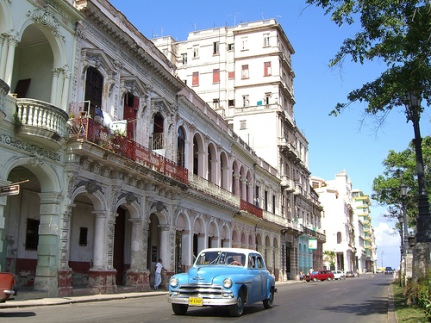
  1. The first Latin American nation and third in the world, after England and U.S.A, that had the miracle of the railroads was Cuba, in 1837.
  2. Furthermore, the first trolley that toured the streets of Latin America was in Havana, in 1900.
  3. In 1958, Cuba was the Latin American country with the highest automobile ownership rate. 160 thousand cars circled our streets, one for every 38 people.
  4. The first Latin American doctor to use ether as an anesthetic was the surgeon Vicente Antonio de Castro, on March 11, 1847. With that method he started the era of modern anesthesia for all of Latin America, right from this Caribbean Island.
  5. In the XIX century, the genius Carlos J. Finlay discovered the transmitting agent of yellow fever which decimated populations and instructed prevention and treatment. Had the Nobel Prize existed, this Cuban would’ve won it by far.
  6. In 1955, Cuba was the second country in Latin America where the fewest children died at birth. The rate was 33.4 for every one thousand newborns. For the resources at that period in time, it was a real feat.
  7. The U.N. recognized Cuba as the best country of Latin America in regards to the number of doctors per capita in 1957. We had one for every 957 people, a figure applauded by many developed nations at the time.
  8. In 1942, a Cuban became the first Latin American musical director to receive a nomination for an Oscar. His name: Ernesto Lecuona. Along with Kim Gannon, he was nominated for the statuette for his song “Always in my heart”, before any other Spanish-speaking musician.
  9. The first Latin American woman who sang at the exquisite Scala in Milan, was the Cuban singer Zoila Gálvez in 1946. Her Creole voice still resonates on the walls of that magnificent hall.
  10. And in 1950 another Cuban musician marked a world record not even matched by Elvis Presley or The Beatles. Dámaso Pérez Prado, with the piece called “Patricia” was on the American Hit Parade for 15 consecutive weeks.
  11. The first Cuban peso was stamped in 1915, and its value was identical to the dollar. On many occasions, up until 1959, it rose to surpass the value of an American dollar by a penny.
  12. Despite its small size, and that it only had a population of 6 million people, my country occupied the 29th position among the strongest economies in the world in 1958. I haven’t been able to find comparable data for today. I think only a sick keeper of statistics would dare to specify what position we are in now.
  13. In 1940, Cuba approved the most advanced of all Constitutions in the world at the time. It was the first in Latin America to recognize women’s vote, equal rights between sexes and races, and the right of women to work.
  14. In 1956 the U.N. recognized Cuba again, this time as the second country in Latin America with the lowest illiteracy rate (only 23.6%). At the time, countries like Spain, Venezuela, Brazil, Peru, Guatemala, and Dominican Republic had a 50% rate.
  15. In 1954, Cuba had one cow per person. It occupied the third place in Latin America (only outnumbered by Argentina and Uruguay) in the consumption of red meat per capita.
  16. In 1922 Cuba inaugurated the radio station PWX. It became the second nation in the world to do so, and the first nation in the world to broadcast a music concert and present radio news.
  17. Also, the first woman broadcaster in the world was a Cuban: Esther Perea de la Torre.
  18. And if we talk about television, we were the second country in the world to formally broadcast television. The biggest stars in all of America, who didn’t enjoy such progress in their countries, came to Havana to act before the Cuban cameras.
  19. The first Olympic Champion that Latin America had was a Cuban: the fencer Ramón Fonst, in 1900.
  20. The first Latin America who won a world chess championship was the Cuban Jose Raúl Capablanca, who, at the same time, was the first world chess champion born in an under-developed nation. This genius won every world tournament between 1921 and 1927.

So, to recontextualize a poem by León Felipe, I say I don’t know a lot of things, it’s true. I only tell what I have seen.

But when I learned how to read, how to listen to the elderly; when I learned to look behind the blank pages, to doubt the smiles of the powerful, and to think about my Homeland without that gray color many have hung on its past, I also think I started to doubt the colors of the present.

Translator: Angelica Betancourt

September 9, 2010

The Association of Ideas / Regina Coyula

One of the best things I’ve gotten out of my blog is a renewed interest in my surroundings and a bit beyond, and that’s come with a need for me to study up. First, all the mysteries of WordPress, my blog’s support platform, as well as, and still, a lot of reading about the Internet. I think this collaboration among advanced users to create such helpful programs for which you don’t have to pay is fantastic! Free software, the response of Internet users to the Microsoft monopoly (I don’t know about the other giants). And one thing led me to another: I’d like a government for my country like those online collaborations in which all interested parties improve the functionality of the programs, that marvel of transparency that is open source code. I’m tired of hearing so much, “no, you can’t”, “no, you shouldn’t”, “it’s not the right moment”… secrets, secrets, and more secrets, a mountain of secrets under which we’re entombed.

Translated by: Yoyi el Monaguillo

September 8, 2010

Goodbye, Granny / Miriam Celaya

Since I am not always home when the news comes on, and taking into account that information is an integral and offshoot component of one’s opinion, a few years ago I negotiated with a kind neighbor for the possibility of getting a secret subscription to the newspaper Granma. For a long time she has been friends with man who brings her the newspaper each morning. Cuban readers probably know that a clandestine subscription consists in coordinating with one of those retired old men who, in order to round out their meager pensions, agree to hoard the newspapers as they arrive at the newsstands, after having arranged with the official salesperson –the intermediary, who reserves a fixed number of papers each day- so that, for the modest monthly fee of 30 pesos (regular currency, of course) you can get one or another pastoral letter of the communist party which, with a different name and printing, repeat more or less the same thing.
Thus, the benefit is mutual: the newsstand vendor gets a little extra money by offering the reseller a newspaper, whose selling price is 20 cents, at 40 or 50 cents; the reseller, who often has a significant number of regular customers, gets a steady and modest profit without having to walk up and down the streets, in the rain or under the sun yelling: “Granma, Granma!” as happens with other unfortunate resellers; while we, those who have “subscriptions” are guaranteed to get, on a daily basis, a few printed pages that serve several purposes: sometimes they are useful to try to guess what are the other elders are up to (the ones in olive green, who do not have to sell newspapers to survive), the paper occasionally turns into material basis for critical analysis, to measure with any degree of accuracy the magnitude of our national disaster, or it’s useful for wrapping fish waste and other domestic detritus. It is an amusing paradox that, in this corrupt insular unreality, even Granma lends itself to shady business; the official organ of the single party feeds the list of contraband goods, possibly with the highest rate of incidence of crime, considering that some of us can afford to spend on the purchase of a daily newspaper, on the other hand, few times a year do we allow ourselves the excess of buying beef.

But today I have finally decided to quit. I’m sorry for the nice old man who has kept to his promise of bringing me my new Granma, on time and for such a long time, without missing a single day, except Sundays, when Granma is not published and I get, instead, Juventud Rebelde (Rebel Youth). I’m sorry, in addition, because I will have to adjust my agenda and to try to watch at least some of the airing of the news broadcasts, but, definitively, in recent times, Granma (Granny) has completed its metamorphosis and has managed to absolutely become a newspaper without any news, a hard copy of disinformation and delusions. Each edition competes successfully for being worse than the previous one. Now, as if it weren’t enough for an anemic newspaper to fill large areas with the usual messianic delusions full of dark omens, they have started to publish, in several pages, three times a week, the pile of more than 800 editorial pages that (they say) Mr. F. wrote, although the first edition remains gathering dust, waiting for buyers in more than one bookstore in the city.

The “Granny”, frankly, might be of great interest to psychiatrists, mediums, gurus and other specialists, but not to me. I won’t allow such a burden of negative energy. Thus, I give up the “privileges” of my illegal subscription and close down my last link with the persistent miasma of the past: I personally shut down the Granma. Farewell forever, Granny!

Translated by: Norma Whiting

September 6, 2010

Again, Yoani / Reinaldo Escobar

At the end of 2008 I published a text here titled “The Year of Yoani,” where I detailed the distinctions and achievements of the famous blogger up to that time. I realized, then, that nine was her lucky number and 2009 was also overwhelming, particularly with the mention in the Maria Moors Cabot prizes from Columbia University, and the successful interview with Barack Obama, among other achievements. Now, towards the end of 2010, as she celebrates her 35th birthday, two more laurels have arrived: one from the International Press Institute declaring her a World Press Freedom Hero, and the Prince Claus Award from the Netherlands.

I had the exceptional opportunity to be with her each time she learned of a new prize. She takes it always with surprise and modesty. Now, as she responds to the dozens of telephone interviews from some radio or television station, the journalists say they are confused because it is not clear which award she won on this occasion. Almost embarrassed she answers, “there are two awards,” adding, “forgive me.”

The real joy shows in her eyes when friends from around the world call to congratulate her. The thousands of commentators who come almost daily to her blog, Generation Y; the volunteers who translate her texts into 22 different languages; those who are calling from a pay phone and who, out of fear, can’t say their names. And others, those whom she helped to have their own blogs, or to connect to Twitter on a cellphone without Internet, or alumni of the Blogger Academy; and those to whom she never said “follow me,” but whom she armed with knowledge and courage so that they could find their own ways to empower themselves.

September 8, 2010

News From Yamil / Yamil Domínguez

From the translator:

As there have been no posts on this blog for quite a while, I have chosen to update it by copying recent posts on Twitter from Yamil’s family. Following are two “tweets” from today:

# Yamil Domínguez InjustNotoria

Ayer visitamos a Yamil, él se recupera notablemente, pero su streé aumenta cada día más.

Yesterday we visited Yamil, he is recuperating well, but his stress grows every day.

# Yamil Domínguez InjustNotoria

No tenemos ninguna noticia, ni ningún resultado. Estamos desesperados por tanta demora. Yamil tiene que ser LIBRE lo antes posible.

We have no news, nor any results. We are desperate due to so much delay. Yamil has to be FREE as soon as possible.

September 8, 2010

What Does Martí Have to Do with a Single Party? / Dimas Castellanos

un-solo-partido1The official Cuban press insists on justifying a single-party system. Some of the arguments are based on the fact that Martí created a single party, how lack of unity led to revolutionary failures, how the very existence of the nation depends on preserving unity, and how a multiparty system would be co-opted by imperialism. The last time these arguments were presented, they were published in the Tribuna de la Habana newspaper on Sunday, August 15, under the headline “What is the Role of the PCC in Maintaining Revolutionary Unity?”

To expose this mishmash of half truths and absurdities, I will quote six paragraphs written by José Martí containing the core ideas that led him to found the Cuban Revolutionary Party (PRC, by its Spanish acronym).

  1. In January of 1880, in New York, Martí presented a critical study on the mistakes of the Ten Year’s War which concluded with the Pact of Zanjón. In it he said: “Those who try to solve a problem can’t ignore any of its antecedents…”, and then proceeded to enumerate multiple causes, among them the negative consequences of the lack of unity.
  2. In July of 1882, in a letter to Máximo Gómez about past wars, he outlined the objectives of the Party thusly: “…My sole aspiration is that by forming a visible and tightly-knit body, bound by a shared solemn and judicious desire to give Cuba true and lasting liberty, all of those selfless and strong men will appear united, capable of repressing their impatience in the absence of a means to remedy all ills in Cuba with a probable victory in one quick, unanimous, and grandiose war…”
  3. In the Resolutions of November of 1891, considered to be the prologue of the PRC’s platform, he proposed: “The revolutionary organization should not be unaware of the practical necessities derived from the makeup and history of the country, nor should it actively work towards present or future control by any particular class; but rather towards the association, conforming to democratic methods, of all the living forces of the homeland; towards brotherhood and common action by Cubans residing abroad; towards the respect and aid of all the republics of the world, and towards the creation of a just and open republic… elevated with all and for the good of all.”
  4. In April of 1893, he stated: “That is the greatness of the Revolutionary Party: that in order to found a republic, it has begun with the republic. That is its strength: that by the labor of all, it confers rights to all. It is an idea, not a person, that must be introduced to Cuba.”
  5. In April of 1894, on the anniversary of the founding of the PRC, he said: “A people is not the will of one man alone, no matter how pure that will… A people is the composition of many wills, vile or pure, natural or grim, impeded by timidity or hastened by ignorance.”
  6. In the Montecristi Manifesto, signed jointly Máximo Gómez on March 25, 1895, before committing himself to the armed struggle, Martí proposes that war is not “the unhealthy triumph of one Cuban party over another, or even the humiliation of a mistaken group of Cubans; but rather it is the solemn demonstration of the will of a nation exasperated, as proven in the previous war, and disposed to hurl itself lightly into a conflict ending only in victory or burial.”

The contents of the six quoted paragraphs demonstrate: that there were multiple causes of the revolutionaries’ failures, not just the divisions among them; that the function of the Party consists of leading the war out of which the Republic should be founded, with true and lasting liberty; that the Party should not work towards the present or future predominance of any particular class; that its strength is rooted in that the labor of all, bestows rights upon all; that a people is not the will of a single man, no matter how pure his will, but rather the composition of many wills; and that the end of war does not signify the triumph of one Cuban side against another.

The PRC was founded as an intermediate link between planting the seed of the Homeland and molding the Republic, not to dominate and prohibit the existence of different parties after victory was achieved, not to annul popular participation, not to declare that the streets and university campuses belong to revolutionaries, not to imprison those who think differently, all of which demonstrate that Martí’s democratic and humanist ideas have been ignored and distorted to confer upon them an ill-fitting mantle: the genesis of the Cuban single-party system.

Additionally, it should be said that politics are founded on the fact that men are social and diverse beings. In that sense, parties, as the etymology of the word indicates, are a part of a whole that by its diverse and plural nature consists of other parts, wherein each represents the interests or tendencies of a sector of society. This reason explains why, when the ideas of independence were not represented among the existing parties, José Martí founded the PRC. Diego Vicente Tejera created the Cuban Socialist Party in 1899, because the interests of workers were not championed by the liberal and conservative parties. The Communist Association of Havana in 1923, the Communist Party in 1925, and the Orthodox Party in 1947 all arose for similar reasons: because the Authentic Party did not satisfy a segment of its constituency.

The single-party system is unnatural. The best proof of this is that, in order to establish a single-party system, totalitarian regimes must destroy all other political parties or subordinate them and their interests, allowing for the most perfect and complete model of totalitarian regime, and along with it, stagnation and failure. In Cuba, the existence of one sole party was the result of a reverse process initiated during the era of insurrectionist struggle in the Sierra Maestra mountain range that culminated in 1965 with the founding of the Communist Party as the sole political force, subsequently ratified into the Constitution; a process foreign to the ideas and work of José Martí.

From this, the necessary restoration of the right of assembly and decriminalization of political differences are inferred, so that Cubans can play the active and determinant role that they are entitled to in the destiny of the nation. The irreducible diversity and exhaustion of the current model have created the need for a multiparty system as the order of the day.

1 MARTÍ, JOSÉ. Selected Works in Three Volumes. VI, p.216

2 MARTÍ, JOSÉ. Selected Works in Three Volumes. VI, p.235

3 MARTÍ, JOSÉ. Resolutions Recorded by the Cuban Communities of Tampa and Key West in November of 1891. Selected Works in Three Volumes. VIII, p.23

4 MARTÍ, JOSÉ. Selected Works in Three Volumes. VIII, p.192

5 MARTÍ, JOSÉ. Selected Works in Three Volumes. VIII, p.359

6 MARTÍ, JOSÉ. Selected Works in Three Volumes. VIII, p.511

Translated by: Yoyi el Monaguillo

August 27, 2010

ALL ABOUT E / Orlando Luis Pardo Lazo

E

Orlando Luis Pardo Lazo

Her name is E. She’s twenty years old. She’s alive. She’s crazy. She’s desperate to do things, including, of course, the limitless freedom of her body. She’s sad. She’s very alone. She’s content in Cuba, at the reach of my hands and my writing. At the margin of everything, myself included. It’s impossible to not fall madly in love with such a little creature. E, exclusive vowel.

So thin. So angular. So dyed of an ancestral black. So scanty. A memorandum of death. So much desire compressed in a pair of decades. So orphaned. Such a vision when her smile at last bursts an explosion of pleasure. She smokes. Drinks. So post-Cuban, trapped in the shitty Little Havana of the thousand and one independent artistic groups that only dare to size up their own fear. Where would these lost angels hide if an explosion of hatred or perhaps a military re-concentration broke out right now in Cuba? They would commit suicide, certainly. Private beauty does not tolerate the mediocrity of the communal.

Hopefully E never gets killed. She’s at risk. She’s exposed. Museum of meows. She doesn’t stop. She gets involved. She’s expelled. They pedal over the minimal discharge of her backbone (her back is a cat’s back). She gets lost. Lunatic of the slums. She loses us. Not the faun’s labyrinth, but the nymph’s. She types formulas of circuits and impossible projects of books made with little pictures. She doesn’t sleep, accordingly. She doesn’t eat, except from other mouths. E is exceptionally spectacular.

I hope E reappears. That she resists. That she doesn’t become diluted in the familiar defect that this criminally conservative society has always been. I hope that she’s not deceived in her ingenuity of never telling lies. I hope that E lies. May she lie to us. May she manipulate us. May she mutate, but may she please survive the critical Cuba of the University during the times of Resurrection.

I hope to write more about E. All about E. Don’t envy me. Wait until I understand or extend myself better with E.

Translated by: Joanne Gomez

September 3, 2010

And Where is Pepito? / Rebeca Monzo

For those who don’t know him, Pepito is the mischievous and smart boy whom we make responsible for all those things we would like but don’t dare to express, either because of modesty or cowardice. He has an equivalent in Spain, where he is called Jaimito, and I imagine each country has its own.

Today as I was returning from taking food to Margarita, a little abandoned dog that some of us neighbors care for, I was observing the silence in which some people walk. With their body bent, as if carrying the load of their sorrows. It is possible that they may also do it in order to look down, because the sidewalks and streets are full of potholes and gaps. I thought then that, long ago, when you went for a walk in the neighborhood, there were several people who would call out to you and ask you to come closer, and would tell you, in a low voice, the most recent of Pepito’s stories. I have confirmed that for some years now, one doesn’t hear any talk of this spoiled child, and if someone mentions him, the story is too old by now.

On my planet, the political joke has always been the thermometer with which the social temperature is measured. Through it, all the situations and opinions about the government and its leaders have been recreated. So it is very striking that there are no new stories about Pepito. Could it be that he also left? Maybe on a raft, because I doubt very much that Immigration would have granted the famous exit permit to this emblematic boy,

Translated by: Espirituana

September 7, 2010

Pretending, a New Social Attitude / Rebeca Monzo

It is very regrettable, but there it is, quite the fashion.

Many years ago, when the inaptly named Special Period* started, I commented to my friends, in the get-togethers we used to have at my house: the worst thing about all this material decline is that it carries within itself the germ of moral decline.

Many years have gone by, and the inhabitants of my planet, increasingly accustomed to pretending in public, have by now assimilated it as something natural.

Scarcely a week ago, by pure coincidence, because it is not my custom, I turned on the TV at noon. They were showing a program where, at that moment, they were interviewing a Cuban actress who was very famous in the fifties, and later, without any explanation, disappeared from the TV screen. I am referring to Conchita Brando. An actress of very high caliber – singer, comedienne, dramatic actress, very good comic actress – in each of her many facets.

I was very happy to see her and at the same time it saddened me. At her eighty-seven years, she looked animated, jovial, but sad, like someone suddenly extracted from the darkest ostracism. She had been kept away from television, without any explanation, during more than a quarter century.

Many years ago, at the wedding of a mutual friend’s daughter, I spent the whole evening talking with Conchita, and she told me, as if complaining, that she could not understand why no one would call her for work, that she felt very well and was able to play roles appropriate for her age. She was still a very vital and beautiful woman.

On the TV program I mentioned, there were some interviews on the street, where they would ask passers-by about this actress. It was very painful for me to see how people would lie with impunity. Young people in their twenties, who I am sure never heard of her, and men and women whose faces reflected falsehood, would say shamelessly: we love to see her work, she is very good at any role she plays, etc.

I felt indignant. Far from being flattering to her, to me it was a mockery and a lack of respect to play these comments knowing that they were false. And I felt sorry for these people who, without any shame, are willing to pretend publicly.

*Translator’s note: The years after the collapse of the Soviet Union and the withdrawal of its economic support for Cuba, with its devastating effects on the economy, was baptized: “A Special Period in a Time of Peace.”

Translated by: Espirituana

September 6, 2010

Divine Providence / Rebeca Monzo

JJ, sending the news to his wife, Consuelito

Juan Juan Almeida surprised his friends when he told us he was going to initiate a hunger strike, as a final recourse to get them to let him leave. It hit all of us because there is nothing further from JJ’s personality: happy, jovial, optimistic and even has the sweet tooth of a little kid.

Those of us closest to him tried to dissuade him at every chance, but failed. It was his last resort. He had already lost everything, all he had left was his body and his own sovereignty over it, no one could interfere.

The first weeks of the strike, when he still had his strength, Juan Juan went out with signs demanding his civil rights, he always went alone and in silence. He was imprisoned, detained various times; but he never gave up. When he was too weak to stand up, he stopped going out to make his demands.

Then, the Catholic church intervened, and everything started to be redefined, and new hopes emerged. Juan Juan never lost faith.

Finally, just last week, the archdiocese contacted Juan Juan and from then on everything started to flow, moving at the speed of a tornado.

On Wednesday the 24th we took him to take care of several things: Archbishop, Immigration, Mexican Embassy. It all went really fast. We left him at his house very tired, but hopeful. That night he got the big news, they called to tell him he would be traveling the following day, heading to Mexico. Another friend took him to make the last minute arrangements, and finally, to the airport.

Juan Juan had no time to say goodbye to his friends, we know he felt this deeply, but to us it doesn’t matter, we were beaming with happiness for him. Finally he will go to take care of his illness, recover his health and his life, together with his wife and daughter, whom he hasn’t seen for seven years. This time the miracle is due to Divine providence.

August 27, 2010

The New Silk Road / Rebeca Monzo

This is not about Marco Polo. This is about a great 90-year-old woman. She lives in New Zealand, and is a great artist and wonderful person. She loves to share her art, so she travels long distances to demonstrate her creations and give free workshops.

Three years ago I had the honor of meeting her and the privilege of being her student.

According to what my friend who introduced us told me, she met Betty when she came to my planet as a tourist. Immediately, she empathized when my friend and a beautiful friendship resulted. From there the idea to return was born, but instead of returning as a tourist, she returned as a teacher. She assigned my friend the task of choosing a small group of friends who would be interested in learning her trade…I was one of the lucky chosen ones.

When the teacher arrived, with a lot of materials and white silk, the only thing she needed was a space. This is when our troubles began. We spoke with the authorities in our municipality and asked if they could provide a place for our workshops. When we explained what it involved and that it was completely free of charge, they accepted us.

The long-awaited day came and we went to the “House of Culture” carrying our materials and silk weaving panels with enthusiasm. Upon arriving to the location we were turned away because our teacher was foreign. Completely embarrassed, we called around to find someone who could help us. Finally, we found a dirty and practically abandoned location. We had to improvise tables and sit on boxes. Our teacher, who was 87-years-old (she celebrated her birthday while she was with us) adapted well without any complaints and introduced, with all the love that only a true teacher has, her beautiful world of silk.

Now, three years later, while travelling such great distances, she has returned to teach us the ins and outs of silk painting. This time we improvised our workshop in the garage of the building where I live. With her love and dedication she has marked a new silk road.

Translated by: Lita Q.

August 24, 2010

Flowers / Regina Coyula

In the history of the Cuban Revolution, there was a woman who had Fidel’s total confidence, the custodian of documents from the insurrection and the early years after the revolution took power. She did not want military ranks and, in spite of her power and influence, always stayed discreetly in the background. Upon her death in 1980, she became Celia Sánchez, the most autochthonous flower of the Revolution. And it has been thus until these last few days of August, when the 50th anniversary of the establishment of the Federation of Cuban Women was celebrated. For this reason, there has been much talk about Vilma Espín, its founder and president, who also had a résumé that started in her native Santiago with Frank País between 1955 and 1956, and who passed away last year. And Vilma, who had never been referred to by any designations, became the most universal flower of the Revolution.

Autochthonous is what is native to a country; universal, to state the obvious, refers to the whole universe. It’s impossible to forget that Celia was Fidel’s right hand and Vilma was Raúl’s wife, and to use the same designation, changing only one word, leaves Celia at a local, domestic level, whereas Vilma acquires an ecumenical connotation.

The desire to give an almost mythical aura to the Revolution’s historic figures reminds me of the old social pages that referred to the “highly-educated, beautiful and genteel señorita“, now transformed to the “insightful, fierce and loyal compañera“.

I thought of the paucity of ideas, so common in the media the government uses for its propaganda; and then I wondered if this might be the expression of a movement that aims to put itself on good terms with Raúl, given Fidel’s condition. In any case, there is no fixed time for the ridiculous.

Translated by: Espirituana

September 3, 2010