How Far Will They Go? / Katia Sonia

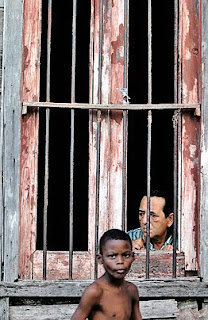
Photo published in the newspaper Juventud Rebelde (Rebel Youth).

In the newspaper Juventud Rebelde (Rebel Youth) which was published on September 7th, there was a printed article titled “Party in September” which was written by Margarita Barrio Sanchez.  The photo used for the article was taken “casually” by Raul Pupo at the primary school known as Nguyen Van Troi.  In it, one can see my two twin daughters, Samantha de la Caridad Medina Martin and Samyra de la Caridad Medina Martin, who both started second grade.

In general, the article makes reference to the Pedagogical School of Fulgencio Oroz Gomez, located within the normal school of educators, and the photo was taken as a presentation note for the school next door.  It would be true to state that the expression made by Jose Ramon Fernandez, the vice-president of the ministry council of the foundation of the pedagogical school, where he states, “We are sure that our teachers will not fail to represent the revolution, nor to the ideals of Fidel, Raul, and all of the hopes of our people”, is contradictory to his previous assertion, for the pedagogical schools had been terminated with the so-called “correction of errors” process.

On August 11th, a State Security official known as Pavel, told me that they had a functionary of the Department of Minors that would attend to my daughters due to my rebellious attitude.  I told some of my friends about this and about my fear that such a threat towards my daughters would become concrete during school hours.  My mother’s intuition did not fail me, for in an act of initiation during the school year in a school where the enrollment surpasses 300 students, my daughters made it to the front page of this “maximum” newspaper, noting that the essay does not have anything to do with that specific photo.  Due to all of this and more, I am warning the democratic world about my situation and the situation of my family, and I am holding the Castro government accountable for what could happen to my young 7-year-old daughters.

Translated by Raul G.

September 8, 2010

Agro, Another Efficiency That Doesn’t Arrive / Miriam Celaya


Notice of price cuts

My produce stand, located at the corner of Árbol Seco and Maloja in Central Havana, had a very promising sign a few days ago. It read as follows:

“Informing the population”
From the production results and the availability of agricultural products, price reductions were approved on all MAE small stands in the capital from September 3rd, 2010.

For the uninitiated, MAE means State Agricultural Market.

Following that, the sign enumerated significant per-pound price drops in plantains, cassava and sweet potato, as can be seen in the photo. However, as I approached the counter, I noticed that the establishment had only small, half-bruised avocados and some dregs of sweet potatoes. In response to my question, some customers there informed me that those would be the prices “when they had the produce”. Bottom line, there were none of the “discounted” items, although, days earlier and for several weeks, I know for a fact that there was an abundance of those three vegetables.

I’ve been to the little stand several times since then, without success. The news programs have reported the fabulous banana harvest, a large part of which is rotting in the fields for lack of transportation to take them to retail sites. The image of the food rotting on the ground contrasts against empty markets. More of the same. On the other hand, compared to the significant production of vegetables, there is a serious shortage of other popular high-demand products such as garlic, onion, pepper, fresh vegetables and pork, which demonstrates the continuing ineffectiveness of the structures and the inability to meet the needs of the population, among numerous other causes, because the scant official measures that stimulated agricultural production did not foresee the insufficiency of state transportation to make goods at point of sale effective.

For several days, plantains flooded the city. (Photo: Orlando Luis)

Week-end agricultural fairs are just a palliative to half-cover the popular demand, and are not stable in their offerings: just like they may offer a significant amount of products of acceptable quality for sale one week, they may offer significantly reduced varieties of produce of lesser quality the following week. In all cases, human crowds are inevitable.

Fear, on the part of the authorities, of private sector development in any of its variants, causes gaps in the markets and frustration of producers at the wasted effort. Excessive control is also a major obstacle that sabotages the natural flow between producers, the market, and consumers. It is not enough, then, to “change” an occasional piece of gear. The economy, exhausted, requires profound and effective changes. The government must release Cubans’ productive potential and their ability to work for themselves if it is really interested in reversing the crisis. Already they, the owners of power, have amassed their gains and it is known that they have put their sights on more lucrative and larger enterprises. How long will they hinder the progress of domestic business?

Translated by Norma Whiting

September 21, 2010

Nowhere, But Everywhere / Yoani Sánchez

It’s two in the afternoon at the Department of Immigration and Aliens (DIE) on 17th Street between J and K. Dozens of people are waiting for permission to leave the country, that authorization to travel that has been given the name “white card,” although it might better be called “the safe conduct,” “the freedom card,” or “the get out of prison order.” The walls are peeling and a notice to “be careful, danger of collapse” is posted next to a huge mansion in Vedado. Several women — who have forgotten how to smile and be pleasant — wear their military uniforms and warn the public that they must wait in an orderly fashion. Now and then they shout a name and the person called returns some minutes later with a jubilant face or a strained pout.

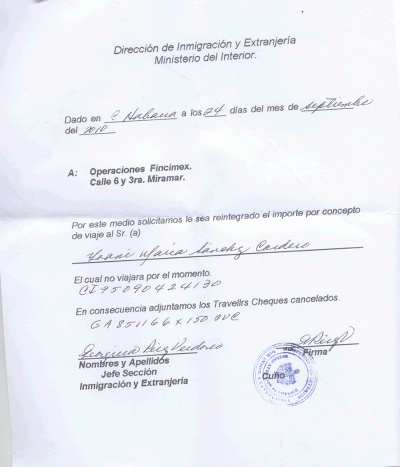
Finally they call me to tell me of the eighth denial of permission to travel in barely three years. Specialists in stripping us of what we could live, experiment, and know beyond our borders, the officials of the DIE tell me that I am not authorized to travel “for the time being.” With this brief “no” — delivered almost with delight — I lose the opportunity to be at the 60th anniversary of the International Press Institute, and at the presentation of the Internet for the Nobel Peace Prize in New York. A stamp on my file and I was obliged to speak by telephone in the activities of Torino European Youth Capital, and to communicate with the publisher Brûlé to launch Cuba Libre in Montreal without my presence. The absurd immigration has inserted itself between my eyes and the full shelves of the Frankfurt Book Fair, between my hands and the compilation of my texts which will see the light at the Nonfiction Literature Festival in Poland. I will not go to the Ferrara Journalism Fair nor to the presentation of the documentary in Jequié, Brazil, much less be able to participate in the Congress of Women Leading the Millennium based in Valencia, nor in Cuneo, during the City Writers event. My voice will not be hear at LASA, which sent me an official invitation, and I will have to enjoy from a distance the appearance of my book Management and Development of Contents With WordPress.

All this and more they have taken. However, they have left me — as if it were a punishment — along with the basic raw material from which my writings come, in contact with that reality which would not forgive me were I absent.

September 26, 2010

Stories of My Neighbors (II) / Ángel Santiesteban

Photo: Alejandro Azcuy

AFTER THE SPEECH of the new president. After the announcement of the end of all gratuities*, my neighbor, who for several consecutive years had been named the Vanguard Worker of his factory, decided to cease his incessant effort. Which, day-by-day, he brought to his workplace. He would not work more until they paid him a salary that would allow him to afford an annual vacation, even if only in the worst hotel in Cuba, not to be demanding because I am a revolutionary, he declared. He was accustomed to going, every summer, with his wife and daughters to a resort and enjoying a peaceful well-fed week. It was his stimulus. He sat down, as in the Arab proverb, in the doorway of his house, which couldn’t even be called a hut. His roofs sloped, the walls have lost their cladding and their bricks, exposed to the weather, reveal a few cracks that allow the neighbors to know, from the street, in what part of the house its inhabitants are. Thus, to be precise, starting from now, without the “socialist benefits,” we will be talking about a hovel, a shack.   And he sat down, he told them, in the doorway of his home. He would pick at the calluses on his hands, created over so many years, while waiting for death or a more bearable fate. It didn’t take long for the representatives from the House of the Combatants and the Secretary of the Party Nucleus to show up. Every good worker is a Communist, as they told him, but if you cease to honor the working class than you are no longer a member. On leaving they decided to confiscate his purple Party membership card.

Then the directors of the factory visited him and were surprised by the horribly shabby condition of his dwelling. My neighbor, at first, didn’t know what the hell they were talking about, when I explained, he responded with insults. The bosses let him know that since his absence, no one understood the old machinery which is now broken down most of the time. They couldn’t fulfill the orders of foreign clients and there were complaints. The delay in payments for the goods had gotten worse, and it was impossible for the factory to be profitable and, in consequence, goodbye to “socialist emulation.”

Patiently and painfully my neighbor explained to them that he had grown old without accomplishing anything. When I was a boy I started work with the American owners, it seemed unfair to me that the bosses went to New York on vacation, and their children, bad students, didn’t take advantage of having been born with money. But it’s also true that when I started working I soon bought this new house and my life changed.

After nineteen-fifty-nine, when I saw that the children of the owners and their henchmen wouldn’t be going on vacation on my effort, I gave myself to the revolutionary process. I was in the fight against the bandits, at the Bay of Pigs, Argelia, Angola, Nicaraguq, Ethiopia, and I forgot about me and my family. At the factory they gave me enough wages to survive and I never complained. When the Special Period came, then they gave me a little bag of goods. Later they stopped that and gave us ten chavitos — Cuban convertible pesos; after a little time they stopped that, too. Then I concentrated on earning the vacations to apologize to my family and make them shut up.

“Now what can I tell them?… I have no more justifications.”

Translator’s note: The Cuban regime calls the things it “gives” its citizens, in lieu of wages, “gratuities” — they include benefits ranging from lunch at one’s workplace to education. Many of these have been or are being eliminated.

September 25, 2010

El Dorado and the 21st Century Left / Claudia Cadelo

Photo: Leandro Feal, from the series “Trying to live with swing.”

My only certainty is that I am not a communist, the rest I’m not that sure about. I have trouble defining myself politically. It could be the result of having been born into a system different from the rest of the world — outside its definitions of right and left — into a system based on one man and above all, on his whims. I love listening to people when they explain their political positions to me (including the orthodox, of course), and it disappoints me not to be drawn to any. Beyond the rights and freedoms of man, there is no cause I feel committed to.

But one reads, is informed, and strives to understand the world, especially the ideologies that move it. Rather than get on a plane, the four hundred pages of a book — nearly destroyed by its great many readers — or a documentary on a flash memory, tell me the story of humanity beyond the sea. In general, I have decided to establish margins for a minimum comparison so as not to drive myself crazy. It is not very useful, from my point of view, to try to compare a democracy with a system of State capitalism, or a dictatorship with a developing country. I can compare the United States with Europe, Mexico with Argentina, Chile or Haiti; Cuba with the former countries of the Soviet Union, with Iran, with the Chile of Pinochet, the Spain of Franco, and even North Korea. Any other comparison, Cuba versus Uruguay for example, is tainted by a primary antagonism: Totalitarian Society versus the Rule of Law.

Thus, when a European unionist tries to convince me of “the achievements of the Cuban Revolution,” it makes me want to cry. First, because there are no unions in Cuba, at least not what would historically be known as a workers’ union, whose function is to enforce the rights of the worker versus the boss, the company or the State. It would be healthy to get to the root of the concept, to respect the meanings of nouns so as not to fall into ambiguity; as my friend Reinaldo Escobar says, “Bread means bread and dictatorship means dictatorship.”

On this point, the paths of the left, unfortunately, tend to greatly confuse me. So I find people who condemn all the dictatorships in the universe except for the one in my small country, and who are insulted when they hear Franco spoken of with respect, yet they venerate Fidel Castro. Others hate the western press for its sensationalism, but don’t criticize that a single party controls our newspapers.

There are those who are sure that the politics of the United States are interventionist and hegemonic, but they served as soldiers in Nicaragua, Angola and Ethiopia. There are even those who protest on the streets of New York against the war in Iraq with a three-by-three-foot poster of Ernesto Guevara. People, in short, who call the government of my country, “The Revolution.”

September 25, 2010

The Cuban Judicial Puzzle / Luis Felipe Rojas

photo/Luis Felipe Rojas

Using the defence of national sovereignty as a refuge, the secret police in Cuba are utilizing methods of repression against internal dissension that aren’t dictated by the courts, nor is their implementation in that fashion even considered in the Constitution or the Penal Code.

House arrest, detentions, and the ban on leaving or entering certain provinces are part of the low intensity repression that is practiced silently and to the beat of a policy of tyranny. With the offices of Attention to Citizen Grievances and military district attorneys at their feet, the so-called Seguridad del Estado (State Security) applies the tourniquet of improvised jurisprudence that squashes the weakest.

Ex-political prisoners like Abel López Pérez and Anderlay Guerra Blanco of Guantanamo, immediately upon their release, have been banned by Counterintelligence from leaving the first and second peripheries, respectively, of the city. Did a judge order this? Is it on their release forms? Is it a special regulation decreed only against social nonconformists? No one knows.

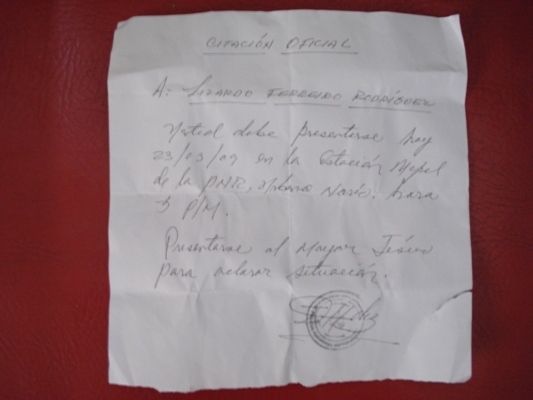
Two friends of mine, jurists of officialdom, who went to school with me back at the University of Oriente in Santiago de Cuba say yes, that it’s a violation, but “the powers acquiesce to manu militari“. I’ve asked many dissidents across the island up until now if they’ve ever been presented with an order of detention signed by a judge and they’ve said no. Never. The same goes for the issued extent of the official summons, which is applied verbally or on some little scrap of paper that won’t appear in any file. If the summoned refuses, then he or she is automatically detained, but his or her name will never appear in the police station’s registry as a detained person. To the eyes of the statistics that could serve as a report, that person was never there. That’s just how complicated the Cuban judicial system is.

The provincial-level military district attorneys receive the complaints against their colleagues with reluctance, and even more when they’re on behalf of peaceful dissidents. The offices of “Attention to The Populace” have a wretched mechanism for the receipt of the grievance, notice of investigation, and results thereof, that makes even the greatest optimist give up on the complaint process.

Before such judicial neglect, few dare to play that diabolical game of chess where the secret police fancies itself a supreme God in order to move white and black pieces alike on the same turn.

And that’s how checkmate is declared upon the Constitution.

Translated by: Yoyi el Monaguillo
September 10, 2010

Interference / Yoani Sánchez

The radio I got for my last birthday rests on a bookshelf, covered in dust. Because if I turn it on I can barely hear a thing. Not even the national broadcasts can be heard well in this area full of government ministries and the antennas they use to block the shortwave broadcasts that come into the country. I had the illusion I would be able to listen to Deutsche Welle to keep my German language alive, but instead of the hoped-for “Guten Tag” all that comes out of the speaker is a buzzing noise.

We live in the midst of a real war of radio frequencies on this Island. On one side we have the broadcasts of the station called Radio Martí — banned, but very popular among my compatriots, they are transmitted from the United States — and on the other side the buzzing they use to silence it. The radio receivers sold in the official stores have had the module that allows you to hear these transmissions removed, and the police are in the habit of searching the roofs for the devices that help to better capture these signals.

Meanwhile, inside their houses, people look for the place — it could be a corner, near a window, or stuck to the ceiling — where the radio manages to ignore the annoying beeping of the interference. It is common to see someone lying on the floor while they locate the exact point where local programming is overshadowed by what comes from abroad. It doesn’t matter what they’re sending from the other shore, whether it’s a boring musical program, the news in English, or a weather report from somewhere else in the world. What matters is that it is a balm for the ears, that it sounds different, that it is something other than that mix of slogans and prose without freedom that is transmitted daily on Cuban radio.

September 24, 2010

The Novel That Leonardo Padura Wrote for Me / Regina Coyula

Intro

Many years ago – I’m talking about the ’70s – I worked for the MININT (Ministry of the Interior), but my military unit’s official cover was MINFAR (Ministry of the Revolutionary Armed Forces), and therefore to all outward appearances I worked in the military. A minibus would pick me up in the morning and drop me off in the afternoon in Playa de Marianao, and next to the Mare Aperto pizzeria I’d get in line for the 79 and the 179 to return home. Since, for as long as I could remember, public transportation had been in a critical state, I’d steel myself with patience and a book for waiting. One afternoon while waiting in that line I was reading a biography of Trotsky, and I was approached by an officer (they hadn’t yet changed the ranks to the equivalents of those of our late sister [the USSR], so I’m talking about what was then a captain), and in a tone between authoritarian and condescending, he asked me how I could be reading that book. I had heard in my study-circles about this revisionist traitor and I wanted to know more. That’s the reason I gave the captain, who waited for my response with a penetrating stare. Through him I learned that Trotsky was forbidden reading for members of the Armed Forces; as far as I knew, this measure was not applied at the MININT. Some time later I got seriously scared while reading “China, The Other Communism”, when another officer (or maybe the same one, I don’t know) asked me the number of my military unit, concerned, no doubt, about the ideological purity of soldiers, there, where subordinates were so ill-informed of the Index. After that second incident I started making my own book covers.

There’s more.  Around that time and up until 1979, the buses passed 5th Avenue, and many times, from on board the bus, I’d become ecstatic on seeing the royal bearing of those Russian greyhounds being walked along the segment between 42nd and 70th Streets, along 5th Avenue’s wide central promenade, sometimes by a woman who undoubtedly walked the dogs as an obligation; sometimes by a tall man who could have walked right passed me unnoticed if it hadn’t been for the hounds.  It wasn’t until recently that I came to know that those dogs were Ix and Dax, the same ones in my novel, of the novel that Leonardo Padura wrote for me.

Love of Dogs

The Man Who Loved Dogs, like his earlier The Novel of My Life, is narrated in different time periods and with different characters that the narrator conjures with one common denominator: the love of dogs. The choice of historical figures couldn’t have been stronger: Trotsky, — a name spoken in whispers when talking about his writing and out loud when slandering him — seen in the novel as a man beaten but not defeated, who somewhat reminded me of Hemingway’s Santiago, the fisherman.

Mercader, the assassin, a man given unconditionally to the service of a cause, the plaything of an incomprehensible force, but one to which he submits, postponing (or nullifying) all doubts.  An awkward creature who must have left behind unfinished secret inspections, not as a super agent, but rather as a working goal for those who came after. Moscow trusts, but verifies… However, I ended up feeling sympathy for that solitary and undesirable man, quite a potent character; and even more potent, and for sale, his mother.  The mother, from a certain species that, since I don’t understand, I fear: those mothers who, far from protecting their children, expose them, with a peculiar sense of duty.  I’m thankful to the hand that wrote these splendid portraits for me.

The lives of these two men remind me, as only art can, how from such a premature date the Russian Revolution and the communist movement in general became contaminated by human miseries, and the revolutionary concept extends right up to us, falsified and degraded, shackled by immobility, complacency and the cult of personality.  We already know what the disillusion of reason can give rise to.

As if my unease wasn’t enough, light gets shed upon a chapter hitherto unknown to me about the relationship between the secret services of the Soviet Union and the Spanish Republic, one more infamous page which Cuba prefers to keep silent about, under the comfortable philosophy of avoiding the destruction of history.

The third character is Ivan: ahistorical, anti-hero, fearful, fainthearted.  Maybe it’s too many setbacks for just one man, but Ivan is an era, a generation, a country.  His personal story is the history of a collective failure.  He may seem excessive in his disgrace, but so real! With an economy of characters, the necessary brushstrokes are there for an unsuspecting reader, or a prospective reader, to glimpse the shadows of the Cuban Revolution.  Ivan started becoming intimate, familiar, until he became one with me.  I carry Ivan in my DNA.  In an intense symbiosis, Padura put into words all of my disenchantment, the feeling of having been swindled, the sensation of the loss of purity, that emptiness left by the confirmation that there is no Santa Claus.

The plot reaches a crescendo in the style of tragedies, the characters’ fates sealed, condemned to disaster, and doomed and called towards that disaster.

It had been years since I’d sped through a book with that eagerness that in my youth was motivated by (or obligated to) those best sellers, the first I’d known: Papillon, Chacal.  The book that now kept me sailing — and assailed me — I don’t know if I’d categorize it as a best seller, but it’s a book that all of us Cubans who straddle two centuries should read.

And it’s not a perfect book, the Cuban character’s story, the one that most impressed me due to its familiarity, even though to me it’s the least realized, left me with an uncontrollable anguish.  But when one dedicates even one’s sleeping hours to a book, to reach its end, the imperfections don’t matter.  I said it before: I read my book.  For that very reason I can’t avoid my disappointment with Padura when he deceives me with a line that’s only acceptable from Félix B. Caignet: “I felt as if I’d burst if I didn’t wring out once and for all the pus that had become a cyst in the seed of my fear.”  It’s a sentence imposed upon the character and unusual in a narrator who has become known for his clean prose, which he owes so much to his occupation as a journalist.

The edition, borrowed and returned with great heavy-heartedness, is from Tusquets.  I think Leonardo Pardura’s Spanish books have always been available in their Cuban edition.  With this novel, I don’t know, many readers over here are going to gaze over the tops of the pages and ask themselves if it was worth the pain, as did I, who couldn’t avoid, as in the classic tragedies, the catharsis, as these words I write become blurred to me.

Nuevo Vedado-Mantilla, summer of 2010

Translated by: Yoyi el Monaguillo

August 30, 2010

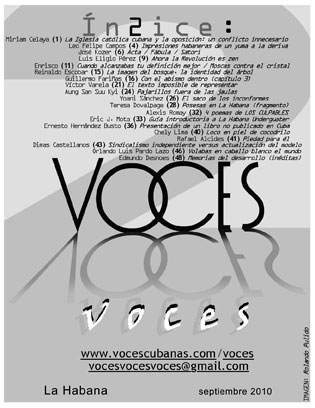
VOICES 2 IS NOW READY… / Orlando Luis Pardo Lazo

FLYING THE WORLD ON A WHITE HORSE

Orlando Luis Pardo Lazo

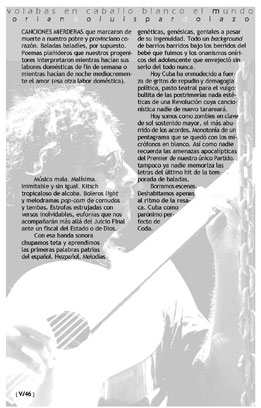
SHITTY SONGS that mark the death of our poor and provincial heart. Trivial ballads of course. Mournful poems that our progenitors interpreted while performing their domestic chores on the weekend or while making mediocre love at night (that other domestic chore).

Bad music. The worst. Inimitable and without equal. Tropical bedroom kitsch. Light boleros and popcorn melodramas of cuckolds and hard women. Stanzas crushed with unforgettable verses, harmonies that will accompany us beyond the Final Judgment before a State Prosecutor or God.

With that soundtrack we sucked on titties and learned the first native words of Spanish, español, ezpañol. Genetic melodies, ringtones, pleasant despite their ingenuity. All of the background of swept neighborhoods under the howls of the baby we were and the oneiric onanisms of the adolescent we aged into without ever being one.

Today Cuba has forcefully muted the cries of condemnation and political demagoguery, theatrical pasture for the masses: the racket of the non-aesthetic end of a Revolution whose little soundtrack no one will ever hum again.

Today we are like zombies in the key of G sharp major, the most boring of the chords. Monotony of a musical staff left with empty microphones. Just as no one remembers the apocalyptic threats of the Premier of our only Party, so no one remembers the lyrics of the latest hit of last season’s ballads.

We delete scenes. Vacate barely at the rhythm of the undertow. Cuba as a perfect paronym of Coda.

And then, when hope finally leaves like an endemic disease, when we know that we are alone in our generation, and that we will not do anything that will be worth the trouble of thinking, then, tired of beating our heads against the suicidal ghosts and the pragmatic functionaries which unknowingly we have become, when the brilliance of the day-to-day becomes a mist passing through our conceptual cataracts of people who stole the time they were called on to live, then, the softness of that music of our Mongolian childhoods is still waiting there, like a visa to save us, like a talisman against dictatorships, totalitarian or democratized, like a pillow on which to to lay one’s neck, to ask love’s forgiveness for how much we chattered in its name and for how little we practiced it.

The entire culture will only make sense, then, in two or three trashy phrases that will express better than any treatise what we were but we ignored. Wretched hendecasyllables of those who had no intention to escape, because among their noxious metaphors, in some of their thousand-and-one honeyed voices (better than the false intelligence of the poets of truth), the secret soul of the final phase of this so-called Cubanness, will resonate.

September 23, 2010

Evidence of the Shipwreck / Yoani Sánchez

Exclusive to the Huffington Post.

Two weeks ago, on a Monday, the State newspaper Granma published a note from the Cuban Workers Center (CTC), the only union allowed in the country. Some thought it would be one of those calls to “work with sacrifice,” or to support the path chosen by the leaders of the Revolution. But no. It was the dreaded news of massive layoffs that would soon throw the first half a million workers into the street; layoffs that are expected, within three years, to see one and a half million workers leave their State jobs. Overnight, the guarantee of full employment – one of the most publicized benefits of the Island’s socialism – has come to an end. And so, their own official propaganda apparatus announced our authorities’ worst nightmare: the day the system collapsed.

The drastic measure was justified as a part of what has been called “the perfection of the Cuban economic development model,” a euphemism intended to mask the growing application of market forces to the workings of the economy.

The panic extends to all sectors, except those traditionally short of labor: agriculture, construction and education. The government’s solution is to move laid off workers to options defined by “new forms of non-state labor relations”; translated, this means launching them into the competition of private or cooperative ventures.

As a palliative for the massive layoffs, Raul Castro’s cabinet plans to create room for private initiatives, expand the number of self-employed, and eliminate several of the absurd prohibitions which function as a straitjacket over the creativity of Cubans. Among the options that will be offered as an incentive to “be your own boss,” is one that will allow the unemployed to earn a living by renting rooms in their homes. It is easy to see, however, given the country’s excruciating housing shortage – where it’s common for three generations to share a tiny apartment – it is highly unlikely that many of these laid off workers will have spare rooms to rent. On the other hand, taxes for the permitted self-employment occupations will be extremely high, possibly reaching 45 percent of earnings.

It is also worth nothing that the herald of this bad news for the working class has been the workers’ own union, the CTC. Not only did it take on the role of justifying the layoffs, this organization wasted not a single word about the fate of the half a million union members it will lose: thousands of Cubans who will not have anyone to represent them before the State boss, which will now impose high taxes on the production of goods or services which they are expected to be engaged in going forward.

These measures, which represent a true shock therapy, are absolutely critical; if the current government leaders didn’t take them they would probably be among the first items on the agenda of those who will come to power after them. Contrary to how it was presented by the regime’s propagandists, the rocks against which the ship of the Revolution is crashing, with all its conquests on board, are not along the far shore where the sirens of capitalism sing, but here, in the illusion of Utopia, on this shore.

September 23, 2010

A New Path / Voices Behind The Bars / Pablo Pacheco

Painting: “Lighthouse” by Seamus Berkley

In no time, life could take a 360 degree turn. Just two months ago my fate was in limbo. I would frequently ask myself, “will I come out dead or alive from this living tomb of men?” I was serving a 20 year prison sentence, of which I had already completed 7 years and 4 months in 3 different maximum security prisons throughout various locations in Cuba. On one unforgettable morning, I heard the voice of Cardinal Jaime Ortega emanating from the phone in the office of the director of Canaleta Prison. The words he told me were very similar to those spoken by the archbishop of Havana to other prisoners of conscience who now live exiled thousands of miles from their homeland. This offer has been turned down by some of the other prisoners who still remain in captivity.

I don’t think anyone has the most minimal idea about how life outside of Cuba is until they get to experience it firsthand. It’s not easy, but my innate optimism is telling me that things will turn out alright. My time in the temporary Red Cross foster center for 2 months has been mixed with questions and stumbles. We now have a new path ahead of us; now my family has official residency in Spain, a work permit, and we are receiving much warmth from the people of Malaga. In a few minutes, I will go out in search of an apartment, enroll Jimmy in school, and try to find myself a job. The latter will probably be the most difficult part, because it is no secret that there are 4 million people unemployed, according to official statistics. Yet, my optimism is multiplying: I should continue onward, carrying the sadness of knowing that Cuba is physically absent from me, but always reassuring myself that she continues living on in my memory.

Pablo Pacheco

Translated by Raul G.

September 18, 2010

The Cuban Model Does Not Work / Voices Behind The Bars / Pablo Pacheco

(“Photo taken from blogforcuba.typepad.com”)

The recent declarations made by former Cuban president Fidel Castro to the journalist Jeffrey Goldberg have started an international media commotion. Within the island, however, the repercussions remained virtually unknown to the population because, save for a few exceptions within the power nomenclature and a minimal number of citizens who have the rare opportunity to inform themselves, barely anyone has heard the maximum leader acknowledge, 51 years after his ascent to power, that “the Cuban model does not work, not even for us”.

It is interesting but I don’t understand it. Why such a commotion over a fact that has already been confirmed? The peaceful Cuban opposition has been stating this for a very long time now, and just for saying that same phrase the authorities sent 75 dissidents to prison in March of 2003, many of whom are still imprisoned, and not to mention the long list of political prisoners and prisoners of conscience that have passed through Castro’s prisons during half a century of totalitarianism.

This whole egotistical show put on by the figure who is still the First Secretary of the Communist Party simply means that only he can speak without censorship. From my point of view, I don’t think that the “revolutionary leader” regrets his sins and that he is starting to ask for forgiveness. His love of power and his need to “represent” are now leading him, senile and all, to make many errors, which luckily for us, display his true personality.

Now, the Cuban government has started to try to adopt measures that distance it from its usual and traditional leftist politics. What will happen now with the “Cuban model”? It’s difficult to predict. Cuban civil society needs free space, and perhaps Fidel’s words can serve as a point of reference so people could start demanding their freedoms. The everyday citizens, who are worn out by ideology and tormented with vital problems, need a viable model that would once again grant them a dignified way of life and would allow them to join global society. They are in need of a country where screaming out what their conscience feels into the four winds is not a penal sin. Those who still live off of the State, hanging onto its every word, have just received a warning. In reality, it wouldn’t cost a thing to toss this “utopian” and archaic Cuban model into the trash can, changing it for a new system where we would all have the access to rights.

Pablo Pacheco
(This essay was written by Pablo Pacheco for the newspaper “La Epoca”)

Translated by Raul G.

September 18, 2010

A Certain Bolaño / Luis Felipe Rojas

It often happens to me with good books the same thing that happens with the best dreams: when they come to me, they are here to stay.

Ernesto, a friend of a couple of friends, came from the warm city of Barcelona and brought this gift to my hands. It’s called The Unknown University, it’s the complete poetry of a complete novelist, the Chilean Roberto Bolaño, the one who surprised us all with the novel The Savage Detectives when we were just waiting for the death of a genre that deteriorated during the nineties to the point of stagnating as of late.

What happens with simple poetry is that it becomes a compass to find the right words. Bolaño’s poetry is exactly that: Ariadne’s thread in the middle of his life. The peculiarity of these almost 500 pages lies in the lack of a visible effort on the part of the author to find himself. Bolaño had a predestined route which was prose, as much in his plentiful novels (almost ten) as in his numerous short stories, and at the same time as a silent yet very visible scaffolding was erected for the seekers of novelty in new literature, he let his thoughts and the search for that other identity which is the human language, fall in poetry.

Poetry served Bolaño to cross the bridge between what is public and what is intimate. Even though some of his poems slipped into magazines and anthologies, at the end of his life, afraid it would get lost in the way, he put together, edited and corrected every page of his whole work, sometimes in prose, sometimes in the most pristine verses one could find. Here it is now, at least for us, readers from these parts of the hemisphere where books arrive several years after publication, the complete works of poetry of Roberto Bolaño, compiled in just one volume by Anagrama in 2007 and which today starts its voyage through the hands, the offices, and the benches where the readers of this island sit, to taste that unknown university that may be life or poetry

Translated by: Xavier Noguer

September 22, 2010