DIRUBE’S DRAWINGS…? / Orlando Luis Pardo Lazo

A VISIT TO VISTA MAR

Orlando Luis Pardo Lazo

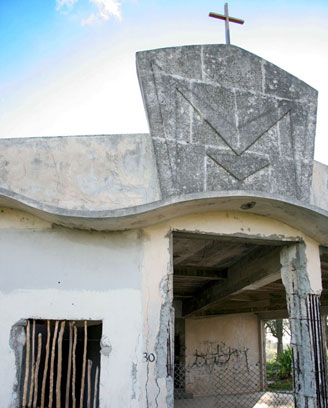
In a cultural magazine of the Catholic Church, I read the tiniest notice, published maybe a couple of months ago. It spoke of a chapel abandoned for many years and of a mural by Dirube that survived in its interior decor.

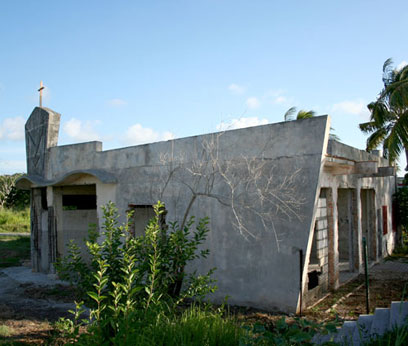
This past weekend I went up the Santa María del Mar hill, crossed a small, grassy park full of prisoners or crazies with gray uniforms (they performed labor-therapy), and I found the chapel at the end, with its cross raised towards the sky between a telecommunications tower and hard-currency hostel.

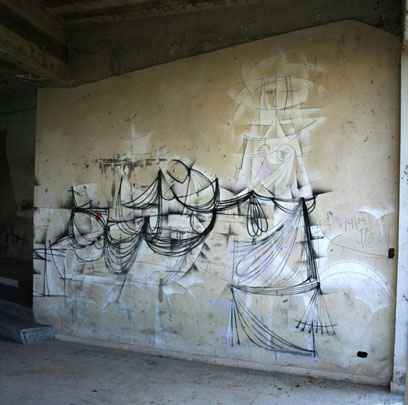
The place was beaten by neglect. Palsied fences, planks, bricks. A family inhabited a part of the building, as worse they could. And, in fact, I saw master strokes on the wall, adjacent to what may have been an altar.

It was a virgin. A Picasso virgin, chopped. Ruled, with baby God and little boat of charity with its three rafters included. Thin and thick lines, straight and curved, interwoven, illegible, perhaps a dystrophic flower, a goatish eye, everything holding glimmers of light that may well have been just remains of another painting that eventually faded.

There was an atrocious silence. A resonant vacuum perfect for Dirube, who was deaf from infancy, as well as unknown on the island during his biography. I put my ear to the mural. On the other side one could hear the voice-over bustle of a black Cuban family at the margins of a worldwide 21st century. It smelled of cockroaches and fresh cement.

I felt an inconsolable sadness. Fifty years ago, that division was being built to populate the future. People came and climbed these same hills and put their money to work as a function for creating an architecture of rupture against the patriotic Provincialism of our city concept.

Then they had to immediately flee from the overwhelming justice of the Revolution and they lost forever the epiphanic vision of a cyan sea. The vision that I now had for free, ignorant witness but susceptible to pain.

I took pictures. I breathed. I looked at the concave and claustrophobic line of Playas del Este. It was Saturday afternoon. It seemed to be the last weekend of the nation.

I do not know if, as he died in the nineties, Dirube remembered this mural. I don’t even know if he finished it or if I marveled at a mere sketch at the hands of a magician. Nonetheless, it was a miracle that his work still remained standing, fading without an audience in the face of ministerial indolence, waiting for me to pass serendipitously though here and kneel before the gods gone to pray.

I wanted to be humbled, sink before the splendor in ruins of a dead countryman, ask for forgiveness for so many kicks and coffins in exchange for nothing. I wanted to rebuild the imminent Cuba parting from a Dirube that may well have been a fake or by another painter (I do not trust the cultural magazines of any church).

Cuban culture is somewhat like that smudge, that scribbling of papers and walls, that despotic disregard against those who do not commune with the official faith, that masterpiece for nobody, that apocryphal elite that the people employ as latrine or guest house.

I left. I don’t know if I’ll return to the little chapel. Maybe I should organize a camping trip or hold a mass there in the name of all of you. That super modern temple, that the sloth of the religious institution did not know how to conserve, would be an excellent niche to begin repainting with the colors of change in Cuba.

Translated by: Joanne Gómez

September 21, 2010

Rolando Against the Impunity in Guantanamo / Luis Felipe Rojas

Photo/Luis Felipe Rojas

I’ve been avoiding writing this post for a few months. I was afraid I might not be objective enough, being close to Rolando Rodríguez Lobaina, to sound the alert to the world. Even so, my duty towards justice and truth is more important.

This young man, a computer engineer who graduated from Havana’s university system in the nineties, is being publicly hunted down by the political police, from the headquarters of the G2. His propensity to civil disobedience, his capacity to lead some thirty activists from every corner of eastern Cuba (Banes, San Germán, Contramaestre, Songo-La Maya, Baracoa, Manatí, Moa, Velazco, Antilla) and to take them to Camagüey where Orlando Zapata Tamayo agonized, proved his worth, but has made him a target. None of the more than a hundred transitory detentions of the last couple of years has been an accident.

The repressive system of my country doesn’t need any pretexts to jail anyone. They just apply the judicial puzzle. In the last few months Rolando suffered one attack after another, from the extreme-left web site Rebelión as much as from Military Counterintelligence high officials sent from Havana to eastern Cuba, on the pretext of “stopping subversion in eastern Cuba”. From his humble cabin in Baracoa to the many places where he has had to live, everywhere he’s been trying to avoid being arrested so that his peaceful activities won’t be disturbed. He’s been leading the highest profile public protests of the last 10 months in six eastern provinces, but his philosophy has always been “More united, being united is key”.

The decision by my country’s authorities to put a police poster in every town so that if he shows up he’s to be deported to Guantanamo, proves the absolute arbitrariness of the state towards its citizens. Even so Rolando doesn’t stop. Bravery and fearlessness are the flags he raises in order to gain liberty for Cuba. He directs the underground bulletin Porvenir and is a co-author of the collective blog Cuban Palenque. From Cuban Palenque he tries to draw attention to the use of torture and arbitrary acts of the state in the eastern part of the island. Punishments and convictions for trying to leave the country, social dangerousness and contempt for authority are the legal charges which are lodged against thousands of youths from eastern Cuba, and which Rolando has denounced on countless occasions. This enrages those who hold power. His last term in jail, 24 days, was a play to punish and frighten the latest generation of Cuban freedom fighters.

Meanwhile Rolando, an incurable rebel, starts the little engines of civil disobedience, a laxative the gorillas in military garb don’t swallow easily.

Translated by: Xavier Noguer

September 16, 2010

YOANI SANCHEZ IN VOICES 2 / Orlando Luis Pardo Lazo / Yoani Sánchez

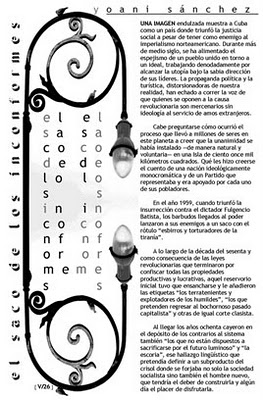
THE SACK OF THE DISSIDENTS

Yoani Sánchez

A sugar-coated image shows Cuba as a country where social justice triumphed, despite having North American imperialism as an enemy. For more than half a century, the country has fed the illusion of a people united in support of an ideal, working hard to develop a Utopia under the wise direction of its leaders. The political and tourist propaganda, distorting our reality, have put out the word that those who oppose the revolutionary cause are mercenaries without ideology, in the service of foreign masters.

One has to wonder how it happened, a process that led millions on this planet to believe that unanimity was installed, naturally and voluntarily, on an island of 111,000 square kilometers. What made them believe the story of a nation ideologically monochromatic and of a Party that represented and was supported by every single one of its inhabitants.

In 1959, when the insurrection against the dictator Fulgencio Batista triumphed, the bearded ones came to power, throwing their enemies into a sack labeled, “thugs and torturers of the tyranny.”

Throughout the decade of the sixties, and as a consequence of the revolutionary laws that ultimately confiscated all productive and lucrative property, that initial definition had to be expanded, adding the labels “the landowners and exploiters of the humble,” and “those who are trying to return to the shameless capitalist past,” and other similar class epitaphs.

Coming into the decade of the eighties, others who fell into the bin of those opposing the system, including “those who are not willing to sacrifice for a bright future,” and “the scum,” this linguistic discovery that tried to define a subproduct of the crucible that forged not only the socialist society but also the new man, who would have the duty to build, and one day to enjoy, the Utopia.

The labelers of opinion recognize no difference between those who opposed the early promises of social transformation, and those believers who ended up frustrated before its failure to come to pass. Because every promise has a deadline, especially if it is a political promise, and when the extensions proclaimed in the speeches expire, patience runs out and difficult-to-label positions appear in those eternally classified as citizens. So over several decades there have appeared in Cuba those who argue that things must be done another way, those who come to the conclusion that an entire nation was dragged into the realization of a mission impossible, many of whom would like to introduce some reforms, including those who would lie to change everything.

But there’s the sack with its insatiable open mouth, and the same hand throwing into it everyone who dares to confront the one possible “truth” monopolized by the powers-that-be. It doesn’t matter if it’s a Social Democrat or a Liberal, a Christian Democrat or an Environmentalist, a simply an independent non-conformist; if they don’t agree with the dictates of the only permitted party — the Communist Party — they are taken as opponents, mercenaries, traitors, in short, they are classified as agents in the pay of the imperialists.

Obstinately, many continue to look at the rosy little picture that shows a social justice process that tries to justify the intolerance that goes along with its achievements — already badly deteriorated — in health and education. They are those who cannot understand that the models used to delineate the triumphalist portrait of the Cuban system turn out very differently when they come down from the pedestal where they pose. Hospital patient and school student are not synonymous with the citizens of a republic. When a man and a woman, of flesh and blood, with their own aspirations and dreams, find themselves outside “the zone of benefits of the Revolution,” they discover they have no private space to build a family, nor wages commensurate with their work, nor any way to achieve a legal and decent prosperity.

When they also reflect on the paths within their power to change their situation, they fine only two: emigration or crime. If they come to meditate on how to change the situation of the country, they are overcome by panic at the threatening finger of the omnipresent State, the insults, the revolutionary intolerance that allows no criticism, no suggestions. Then they realize they’ve been thrown into the sack with the dissidents, where all that awaits them are stigmatization, exile, or the prison cell.

September 25, 2010

How Far Will They Go? / Katia Sonia

Photo published in the newspaper Juventud Rebelde (Rebel Youth).

In the newspaper Juventud Rebelde (Rebel Youth) which was published on September 7th, there was a printed article titled “Party in September” which was written by Margarita Barrio Sanchez.  The photo used for the article was taken “casually” by Raul Pupo at the primary school known as Nguyen Van Troi.  In it, one can see my two twin daughters, Samantha de la Caridad Medina Martin and Samyra de la Caridad Medina Martin, who both started second grade.

In general, the article makes reference to the Pedagogical School of Fulgencio Oroz Gomez, located within the normal school of educators, and the photo was taken as a presentation note for the school next door.  It would be true to state that the expression made by Jose Ramon Fernandez, the vice-president of the ministry council of the foundation of the pedagogical school, where he states, “We are sure that our teachers will not fail to represent the revolution, nor to the ideals of Fidel, Raul, and all of the hopes of our people”, is contradictory to his previous assertion, for the pedagogical schools had been terminated with the so-called “correction of errors” process.

On August 11th, a State Security official known as Pavel, told me that they had a functionary of the Department of Minors that would attend to my daughters due to my rebellious attitude.  I told some of my friends about this and about my fear that such a threat towards my daughters would become concrete during school hours.  My mother’s intuition did not fail me, for in an act of initiation during the school year in a school where the enrollment surpasses 300 students, my daughters made it to the front page of this “maximum” newspaper, noting that the essay does not have anything to do with that specific photo.  Due to all of this and more, I am warning the democratic world about my situation and the situation of my family, and I am holding the Castro government accountable for what could happen to my young 7-year-old daughters.

Translated by Raul G.

September 8, 2010

Agro, Another Efficiency That Doesn’t Arrive / Miriam Celaya


Notice of price cuts

My produce stand, located at the corner of Árbol Seco and Maloja in Central Havana, had a very promising sign a few days ago. It read as follows:

“Informing the population”
From the production results and the availability of agricultural products, price reductions were approved on all MAE small stands in the capital from September 3rd, 2010.

For the uninitiated, MAE means State Agricultural Market.

Following that, the sign enumerated significant per-pound price drops in plantains, cassava and sweet potato, as can be seen in the photo. However, as I approached the counter, I noticed that the establishment had only small, half-bruised avocados and some dregs of sweet potatoes. In response to my question, some customers there informed me that those would be the prices “when they had the produce”. Bottom line, there were none of the “discounted” items, although, days earlier and for several weeks, I know for a fact that there was an abundance of those three vegetables.

I’ve been to the little stand several times since then, without success. The news programs have reported the fabulous banana harvest, a large part of which is rotting in the fields for lack of transportation to take them to retail sites. The image of the food rotting on the ground contrasts against empty markets. More of the same. On the other hand, compared to the significant production of vegetables, there is a serious shortage of other popular high-demand products such as garlic, onion, pepper, fresh vegetables and pork, which demonstrates the continuing ineffectiveness of the structures and the inability to meet the needs of the population, among numerous other causes, because the scant official measures that stimulated agricultural production did not foresee the insufficiency of state transportation to make goods at point of sale effective.

For several days, plantains flooded the city. (Photo: Orlando Luis)
Week-end agricultural fairs are just a palliative to half-cover the popular demand, and are not stable in their offerings: just like they may offer a significant amount of products of acceptable quality for sale one week, they may offer significantly reduced varieties of produce of lesser quality the following week. In all cases, human crowds are inevitable.

Fear, on the part of the authorities, of private sector development in any of its variants, causes gaps in the markets and frustration of producers at the wasted effort. Excessive control is also a major obstacle that sabotages the natural flow between producers, the market, and consumers. It is not enough, then, to “change” an occasional piece of gear. The economy, exhausted, requires profound and effective changes. The government must release Cubans’ productive potential and their ability to work for themselves if it is really interested in reversing the crisis. Already they, the owners of power, have amassed their gains and it is known that they have put their sights on more lucrative and larger enterprises. How long will they hinder the progress of domestic business?

Translated by Norma Whiting

September 21, 2010

Nowhere, But Everywhere / Yoani Sánchez

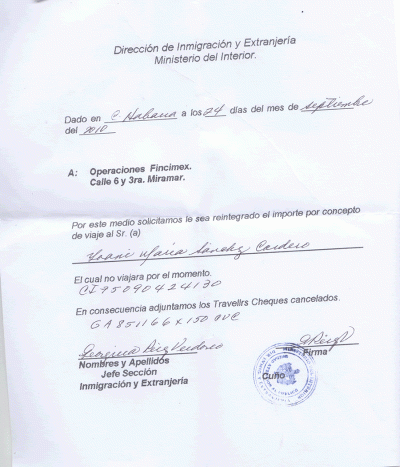
It’s two in the afternoon at the Department of Immigration and Aliens (DIE) on 17th Street between J and K. Dozens of people are waiting for permission to leave the country, that authorization to travel that has been given the name “white card,” although it might better be called “the safe conduct,” “the freedom card,” or “the get out of prison order.” The walls are peeling and a notice to “be careful, danger of collapse” is posted next to a huge mansion in Vedado. Several women — who have forgotten how to smile and be pleasant — wear their military uniforms and warn the public that they must wait in an orderly fashion. Now and then they shout a name and the person called returns some minutes later with a jubilant face or a strained pout.
Finally they call me to tell me of the eighth denial of permission to travel in barely three years. Specialists in stripping us of what we could live, experiment, and know beyond our borders, the officials of the DIE tell me that I am not authorized to travel “for the time being.” With this brief “no” — delivered almost with delight — I lose the opportunity to be at the 60th anniversary of the International Press Institute, and at the presentation of the Internet for the Nobel Peace Prize in New York. A stamp on my file and I was obliged to speak by telephone in the activities of Torino European Youth Capital, and to communicate with the publisher Brûlé to launch Cuba Libre in Montreal without my presence. The absurd immigration has inserted itself between my eyes and the full shelves of the Frankfurt Book Fair, between my hands and the compilation of my texts which will see the light at the Nonfiction Literature Festival in Poland. I will not go to the Ferrara Journalism Fair nor to the presentation of the documentary in Jequié, Brazil, much less be able to participate in the Congress of Women Leading the Millennium based in Valencia, nor in Cuneo, during the City Writers event. My voice will not be hear at LASA, which sent me an official invitation, and I will have to enjoy from a distance the appearance of my book Management and Development of Contents With WordPress.

All this and more they have taken. However, they have left me — as if it were a punishment — along with the basic raw material from which my writings come, in contact with that reality which would not forgive me were I absent.

September 26, 2010

Stories of My Neighbors (II) / Ángel Santiesteban

Photo: Alejandro Azcuy

AFTER THE SPEECH of the new president. After the announcement of the end of all gratuities*, my neighbor, who for several consecutive years had been named the Vanguard Worker of his factory, decided to cease his incessant effort. Which, day-by-day, he brought to his workplace. He would not work more until they paid him a salary that would allow him to afford an annual vacation, even if only in the worst hotel in Cuba, not to be demanding because I am a revolutionary, he declared. He was accustomed to going, every summer, with his wife and daughters to a resort and enjoying a peaceful well-fed week. It was his stimulus. He sat down, as in the Arab proverb, in the doorway of his house, which couldn’t even be called a hut. His roofs sloped, the walls have lost their cladding and their bricks, exposed to the weather, reveal a few cracks that allow the neighbors to know, from the street, in what part of the house its inhabitants are. Thus, to be precise, starting from now, without the “socialist benefits,” we will be talking about a hovel, a shack.   And he sat down, he told them, in the doorway of his home. He would pick at the calluses on his hands, created over so many years, while waiting for death or a more bearable fate. It didn’t take long for the representatives from the House of the Combatants and the Secretary of the Party Nucleus to show up. Every good worker is a Communist, as they told him, but if you cease to honor the working class than you are no longer a member. On leaving they decided to confiscate his purple Party membership card.

Then the directors of the factory visited him and were surprised by the horribly shabby condition of his dwelling. My neighbor, at first, didn’t know what the hell they were talking about, when I explained, he responded with insults. The bosses let him know that since his absence, no one understood the old machinery which is now broken down most of the time. They couldn’t fulfill the orders of foreign clients and there were complaints. The delay in payments for the goods had gotten worse, and it was impossible for the factory to be profitable and, in consequence, goodbye to “socialist emulation.”

Patiently and painfully my neighbor explained to them that he had grown old without accomplishing anything. When I was a boy I started work with the American owners, it seemed unfair to me that the bosses went to New York on vacation, and their children, bad students, didn’t take advantage of having been born with money. But it’s also true that when I started working I soon bought this new house and my life changed.

After nineteen-fifty-nine, when I saw that the children of the owners and their henchmen wouldn’t be going on vacation on my effort, I gave myself to the revolutionary process. I was in the fight against the bandits, at the Bay of Pigs, Argelia, Angola, Nicaraguq, Ethiopia, and I forgot about me and my family. At the factory they gave me enough wages to survive and I never complained. When the Special Period came, then they gave me a little bag of goods. Later they stopped that and gave us ten chavitos — Cuban convertible pesos; after a little time they stopped that, too. Then I concentrated on earning the vacations to apologize to my family and make them shut up.

“Now what can I tell them?… I have no more justifications.”

Translator’s note: The Cuban regime calls the things it “gives” its citizens, in lieu of wages, “gratuities” — they include benefits ranging from lunch at one’s workplace to education. Many of these have been or are being eliminated.

September 25, 2010

El Dorado and the 21st Century Left / Claudia Cadelo

Photo: Leandro Feal, from the series “Trying to live with swing.”

My only certainty is that I am not a communist, the rest I’m not that sure about. I have trouble defining myself politically. It could be the result of having been born into a system different from the rest of the world — outside its definitions of right and left — into a system based on one man and above all, on his whims. I love listening to people when they explain their political positions to me (including the orthodox, of course), and it disappoints me not to be drawn to any. Beyond the rights and freedoms of man, there is no cause I feel committed to.

But one reads, is informed, and strives to understand the world, especially the ideologies that move it. Rather than get on a plane, the four hundred pages of a book — nearly destroyed by its great many readers — or a documentary on a flash memory, tell me the story of humanity beyond the sea. In general, I have decided to establish margins for a minimum comparison so as not to drive myself crazy. It is not very useful, from my point of view, to try to compare a democracy with a system of State capitalism, or a dictatorship with a developing country. I can compare the United States with Europe, Mexico with Argentina, Chile or Haiti; Cuba with the former countries of the Soviet Union, with Iran, with the Chile of Pinochet, the Spain of Franco, and even North Korea. Any other comparison, Cuba versus Uruguay for example, is tainted by a primary antagonism: Totalitarian Society versus the Rule of Law.

Thus, when a European unionist tries to convince me of “the achievements of the Cuban Revolution,” it makes me want to cry. First, because there are no unions in Cuba, at least not what would historically be known as a workers’ union, whose function is to enforce the rights of the worker versus the boss, the company or the State. It would be healthy to get to the root of the concept, to respect the meanings of nouns so as not to fall into ambiguity; as my friend Reinaldo Escobar says, “Bread means bread and dictatorship means dictatorship.”

On this point, the paths of the left, unfortunately, tend to greatly confuse me. So I find people who condemn all the dictatorships in the universe except for the one in my small country, and who are insulted when they hear Franco spoken of with respect, yet they venerate Fidel Castro. Others hate the western press for its sensationalism, but don’t criticize that a single party controls our newspapers.

There are those who are sure that the politics of the United States are interventionist and hegemonic, but they served as soldiers in Nicaragua, Angola and Ethiopia. There are even those who protest on the streets of New York against the war in Iraq with a three-by-three-foot poster of Ernesto Guevara. People, in short, who call the government of my country, “The Revolution.”

September 25, 2010

The Cuban Judicial Puzzle / Luis Felipe Rojas

photo/Luis Felipe Rojas

Using the defence of national sovereignty as a refuge, the secret police in Cuba are utilizing methods of repression against internal dissension that aren’t dictated by the courts, nor is their implementation in that fashion even considered in the Constitution or the Penal Code.

House arrest, detentions, and the ban on leaving or entering certain provinces are part of the low intensity repression that is practiced silently and to the beat of a policy of tyranny. With the offices of Attention to Citizen Grievances and military district attorneys at their feet, the so-called Seguridad del Estado (State Security) applies the tourniquet of improvised jurisprudence that squashes the weakest.

Ex-political prisoners like Abel López Pérez and Anderlay Guerra Blanco of Guantanamo, immediately upon their release, have been banned by Counterintelligence from leaving the first and second peripheries, respectively, of the city. Did a judge order this? Is it on their release forms? Is it a special regulation decreed only against social nonconformists? No one knows.

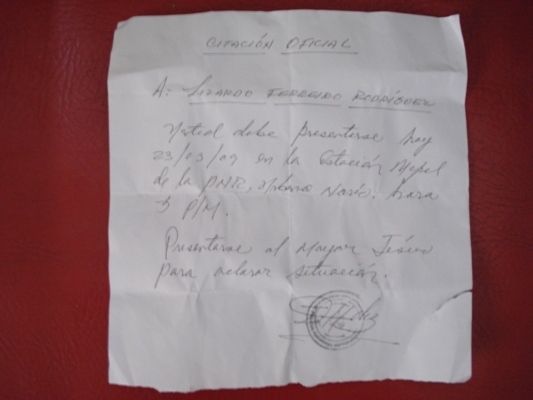
Two friends of mine, jurists of officialdom, who went to school with me back at the University of Oriente in Santiago de Cuba say yes, that it’s a violation, but “the powers acquiesce to manu militari“. I’ve asked many dissidents across the island up until now if they’ve ever been presented with an order of detention signed by a judge and they’ve said no. Never. The same goes for the issued extent of the official summons, which is applied verbally or on some little scrap of paper that won’t appear in any file. If the summoned refuses, then he or she is automatically detained, but his or her name will never appear in the police station’s registry as a detained person. To the eyes of the statistics that could serve as a report, that person was never there. That’s just how complicated the Cuban judicial system is.

The provincial-level military district attorneys receive the complaints against their colleagues with reluctance, and even more when they’re on behalf of peaceful dissidents. The offices of “Attention to The Populace” have a wretched mechanism for the receipt of the grievance, notice of investigation, and results thereof, that makes even the greatest optimist give up on the complaint process.

Before such judicial neglect, few dare to play that diabolical game of chess where the secret police fancies itself a supreme God in order to move white and black pieces alike on the same turn.

And that’s how checkmate is declared upon the Constitution.

Translated by: Yoyi el Monaguillo
September 10, 2010

Interference / Yoani Sánchez

The radio I got for my last birthday rests on a bookshelf, covered in dust. Because if I turn it on I can barely hear a thing. Not even the national broadcasts can be heard well in this area full of government ministries and the antennas they use to block the shortwave broadcasts that come into the country. I had the illusion I would be able to listen to Deutsche Welle to keep my German language alive, but instead of the hoped-for “Guten Tag” all that comes out of the speaker is a buzzing noise.

We live in the midst of a real war of radio frequencies on this Island. On one side we have the broadcasts of the station called Radio Martí — banned, but very popular among my compatriots, they are transmitted from the United States — and on the other side the buzzing they use to silence it. The radio receivers sold in the official stores have had the module that allows you to hear these transmissions removed, and the police are in the habit of searching the roofs for the devices that help to better capture these signals.

Meanwhile, inside their houses, people look for the place — it could be a corner, near a window, or stuck to the ceiling — where the radio manages to ignore the annoying beeping of the interference. It is common to see someone lying on the floor while they locate the exact point where local programming is overshadowed by what comes from abroad. It doesn’t matter what they’re sending from the other shore, whether it’s a boring musical program, the news in English, or a weather report from somewhere else in the world. What matters is that it is a balm for the ears, that it sounds different, that it is something other than that mix of slogans and prose without freedom that is transmitted daily on Cuban radio.

September 24, 2010