‘Escambray’ Justifies the Postponement of the National Series and the Elite Baseball League in Cuba

The authorities also announced the cancellation of the U23 Tournament due to lack of resources


The National Series will be postponed until September 2025 / ’Escambray’

14ymedio bigger14ymedio, Havana, October 25, 2024 — The official media of Sancti Spíritus, Escambray, justified this Friday the decision of the National Institute of Sports, Physical Education and Recreation (Inder) to postpone the two most important baseball competitions at the national level due to the crisis. As the newspaper explained, in the context of the “economic war” in which the Island lives, carrying out the III Elite League and the 64th National Series would be “counterproductive.”

Escambray recalled that, after the announcement on October 14 of the calendar change, many sports fans demanded that the Elite League – celebrated at the end of the year – be rescheduled for next March and the National Series for a year from now. For the media, however, the change of date is nothing extraordinary, because the events require “important logistics of all kinds that the country can’t manage today.”

In that sense, at least, the state newspaper went deeper into the causes to postpone the games than Inder, which did not dedicate a word to the deep economic crisis. “It is incoherent to carry out an event that has not yet shown its validity after resuming, at least not in a country that is debating how to share a drop of fuel between electricity generation and ambulances, that can’t guarantee rice and sugar in the family basket or the supplies to produce food, not to mention the medicine that is missing in the pharmacy,” Escambray said, referring to the Elite League. continue reading

The events require important logistics of all kinds, which the country cannot manage today

Given that scenario, the media adds, “baseball and any sporting event, even a cultural one, are not priorities.” In fact, he advises that this tournament be suspended until the country’s conditions allow it and makes an unfortunate comparison, by giving as an example the Olympic Games, which canceled three editions due to world wars – conflicts that, taken together, left about 85 million dead – and the case of Tokyo 2020, which was postponed a year due to the pandemic. “As far as I know, the Elite Baseball League doesn’t compare on any scale of importance to those events,” he says.

With the “few resources that the country has,” the article continues, the National Series could be developed, “which demands an even stronger logistical scaffolding and which is, in short, Cuba’s main sociocultural event.”

Postponing the date will have several consequences. One of them is the statistics, since there will not be a National Series until 2026. Therefore, there will be no winner in 2025. In addition, “it is too long a downtime for one of the few recreational reliefs in the nation,” explains Escambray, which estimates that it will mean at least five months without baseball on the Island.

There is no way to distract yourself or disconnect from the problems that the Cuban has day after day

In the comment section of the Cubadebate article about the Inder’s announcement, Cubans also made clear their discontent: “In all that time until March 2025, fans will not be able to enjoy the national pastime. There is no way to distract yourself or disconnect from the problems that the Cuban has day after day. Very bad decision, really,” says a user.

The negative announcements of the authorities about the sport did not end there. On October 15, during the preparation of the team of players to compete in the Premier 12 tournament, Juan Reynaldo Pérez, president of the Cuban Baseball and Softball Federation, reported that the National U23 Tournament was canceled because half the provinces “are not in a position to develop it.” The reason: the event depends on the local budget, and there are no funds.

“This is the second consecutive time that the U23 suspends its national championship for reasons of money. You can’t do something that contributes to the development of the youngest players in the country, but you do have to play a non-professional Elite League anyway in March, whose objectives are still very questionable,” criticized sports journalist Yasel Porto.

Last Wednesday, Porto also reported on the economic problems experienced by the Industriales of Havana team. According to him, the members have not received their salaries for more than two months. In his message, alluding to the authorities, the journalist added: “Let’s see if someone notices this and at least feels a little ashamed.”

Translated by Regina Anavy

____________

COLLABORATE WITH OUR WORKThe 14ymedio team is committed to practicing serious journalism that reflects Cuba’s reality in all its depth. Thank you for joining us on this long journey. We invite you to continue supporting us by becoming a member of 14ymedio now. Together we can continue transforming journalism in Cuba.

The Hiring of Cuban Doctors in Mexico Continues as Another 173 Arrive in Quintana Roo

Last June, five Cuban specialists joined the Mexican Chetumal oncology hospital in Quintana Roo / Diario de Quintana Roo

14ymedio bigger14ymedio, Mexico City, 25 October 2024 — Mexico announced this Thursday the arrival in Quintana Roo of another 173 Cuban doctors, who join the 36 already established in that state, to reinforce care in the health centers. Mexican authorities are waiting for another 30 doctors from the Island to distribute them in 13 hospitals in isolated communities and in 18 mobile units, where they will provide care on Saturdays and Sundays.

The Mexican government has been extremely cautious about the centers in which it places Cubans. As of September, the health authorities of Quintana Roo had registered a hematologist, an epidemiologist and three gastroenterologists from the Island, who in June 2023 joined the Chetumal oncology hospital. It is known that in 2022, another 31 specialists arrived, but their distribution was never revealed.

The state coordinator of Imss-Bienestar, Moisés Alejandro Toledo, announced last June that specialists sent to remote areas, including Cubans, will receive “a bonus independent of their salary.” Months ago, in April of this year, the director of the Mexican Institute of Social Security (Imss), Zoé Robledo, was more specific: the salaries for these positions are 50,000 pesos (2,732 dollars per month), in addition to an incentive of 10,000 pesos (545 dollars).

The newspaper Reforma also reported in early October that it cost Mexico 5,188 dollars a month to maintain each of the Cuban doctors. The figure includes the salary – 27,000 pesos (1,351 dollars) – and the costs that the Government must cover to pay for food, lodging and transportation of about 966 health workers. The 2,135 specialists who arrived in the country this year make a total of 3,101 doctors who will also benefit. continue reading

The state of Quintana Roo placed 173 Cuban specialists in rural hospitals / Video capture

The 3,277 dollars received in total by Cuban doctors is managed by Neuronic Mexicana, a subsidiary of Neuronic S.A Cuba, a company that, since 2018, has represented the products and services of the biotechnology and pharmaceutical industry of the Island, under its president Tania Guerra.

The management of the company has been questioned after the escape of several Cuban health workers, who have left their positions in Mexican centers – a total of 48 left between July 2022 and 2023. In practice, to cover their basic needs, doctors receive only “a stipend.”

Toledo said that a significant shortage of specialized nurses persists, confirming the weakening of the health system. The promise of former president López Obrador to create Imss-Bienestar, a free healthcare organization to replace the Seguro Popular and “have a better health system than Denmark,” is still far away.

“We have made a diagnosis of the infrastructure of our health centers and hospitals; maintenance by the state government has been carried out, and we are continuing with the work. We are improving the quality of care everywhere,” Toledo acknowledged.

Cuba has been favored by this program since the administration of López Obrador. Between 2022 and 2023, Mexico signed three agreements with the Island for which it paid 23,227,156 euros for 610 specialists.

The agreements were strengthened between the two countries despite the fact that several organizations, such as Prisoners Defenders, have criticized Mexico for promoting the hiring of Cuban professionals in “conditions of slavery.” The president of the organization, Javier Larrondo, has also said that there are “State Security agents” among the contingents of doctors who have arrived in Mexico.

Translated by Regina Anavy

____________

COLLABORATE WITH OUR WORKThe 14ymedio team is committed to practicing serious journalism that reflects Cuba’s reality in all its depth. Thank you for joining us on this long journey. We invite you to continue supporting us by becoming a member of 14ymedio now. Together we can continue transforming journalism in Cuba.

With No Time To Recover From Hurricane Oscar, Baracoa Cuba Suffers Floods Due to Heavy Rains

Local media reports the overflow of the Miel River and several landslides

The town of Cabacú, on the outskirts of Baracoa, is one of the most affected / Primada Visión

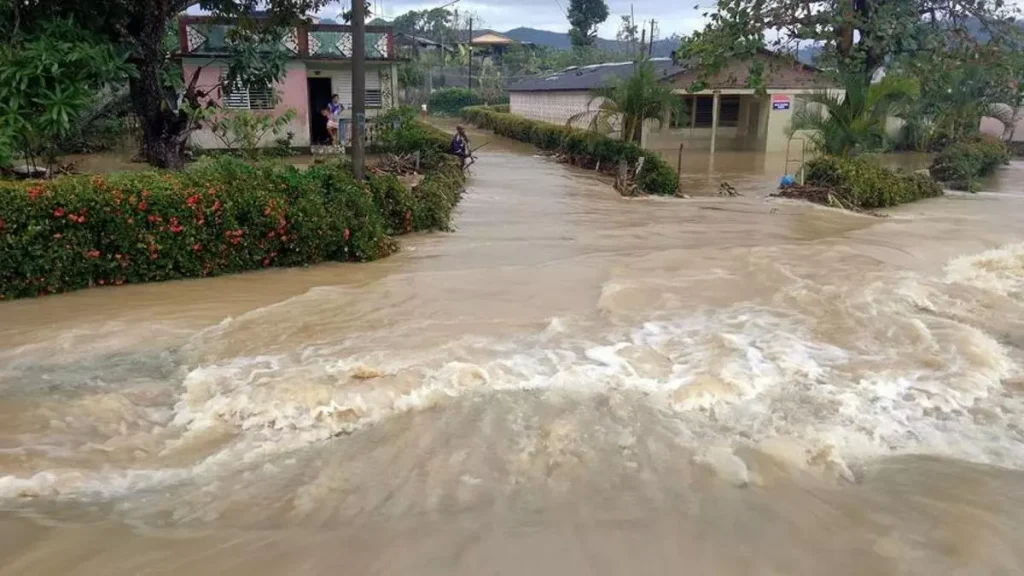
14ymedio bigger14ymedio, Havana, 25 October 2024 — Baracoa woke up again with floods this Friday, after being incommunicado since last Monday due to the passage of Hurricane Oscar. This time, the heavy rains that have ravaged the municipality of Guantánamo since dawn caused the overflow of the Miel River, whose waters reached several areas of the city and caused some landslides.

“Since two in the morning it’s been raining heavily here in Baracoa, and my street is flooded,” a resident told 14ymedio. “What Oscar didn’t do to us, this rain is doing. The water is about to enter the houses, and to top it off, an underground spring erupted on my patio, so we have water everywhere,” he complains. The man reports that, with the soil saturated by the rains left by Oscar, the slightest downpour wreaks havoc.

On Friday, Cuba’s Prime Minister, Manuel Marrero, reported on X that the authorities have begun to evacuate residents of Baracoa and Moa in the eastern province of Holguín. He stated that the Government has begun to mobilize after “the hard experience of the last few days.” “Landslides, floods and damage to homes are reported” in Baracoa, he added. The rainfall of the last few hours has also affected the municipality of Moa.

As reported this morning by the local television station, Primada Visión, the Jamal Weather Station reports intense rains from 1:00 in the morning. By 7:00 am, the cumulative rainfall was 128.8 millimeters (5.1 inches). The showers could last until Sunday. The rains are “related to the presence of an extended trough over the region, the transit of a tropical wave to the south of the territory, together with high values of humidity on the surface and a warm and humid flow from the southern region,” meteorologist Miriam Teresita Llanes told the media. continue reading


The television station also reports floods in the neighborhoods and towns of Cabacú – on the outskirts of the city and one of the most affected – La Playa, La Pasada, La Granjita, Reforma Urbana and areas near the Miel riverbed.

According to the Facebook post of Adalberto Moreira, a broadcaster on Radio Baracoa, in some areas of Cabacú, “landslides and floods” were reported.

“Very intense rains continue in Baracoa. Unusual floods in the city and river penetrations into homes are part of a critical panorama,” Primada Visión explained on social networks, where it showed images and videos sent by residents with entire streets flooded and houses with water up to the windows.

Not 48 hours had passed since Miguel Díaz-Canel left Guantánamo, where he visited San Antonio del Sur and promised that the Cubans of those areas were “neither alone nor abandoned.” But the people were again immersed in helplessness, and one resident reproached the leader to his face.

The tasks of the “recovery phase” announced on Thursday by the Civil Defense did not take effect either, and this Friday it was the residents themselves who tried, on their own, to unclog drains to facilitate the runoff.

Although reporting on the rains and sharing the images published by Primada Visión, the state media have not dedicated one line to reporting on the Government’s action plan to reduce damage in Baracoa.

After the passage of Hurricane Oscar, San Antonio del Sur, Imías and Baracoa were left incommunicado by the overflow of rivers and the destruction of several bridges that made it difficult for the authorities and rescuers to reach the municipalities. During those days there were seven deaths confirmed by official media, but large-scale floods and reports from families on social networks indicate that the number could be higher due to the dozens of people who are still missing.

The Minister of Transport, Eduardo Rodríguez Dávila, then reported the formation of a sinkhole that caused a road closure before Imías, leaving the population of Baracoa and Maisí isolated. In addition, in Macambo and La Farola, there were “big landslides” and damage to the San Antonio-Puriales road, whose bridge had one of its supports undermined.

As of Thursday, authorities accounted for at least 1,183 partial collapses and 1,048 partial roof collapses, in addition to 51 total house collapses. These numbers could grow if heavy rains continue in Baracoa.

Residents of Guantánamo province denounced the abandonment of the Government, which kept them uninformed due to the general blackouts on the Island. The news took two days to reach the devastated communities.

Translated by Regina Anavy

____________

COLLABORATE WITH OUR WORKThe 14ymedio team is committed to practicing serious journalism that reflects Cuba’s reality in all its depth. Thank you for joining us on this long journey. We invite you to continue supporting us by becoming a member of 14ymedio now. Together we can continue transforming journalism in Cuba.
In the Middle of a National Blackout, the Cuban Regime Hands Out Electric Motorbikes to Olympic Medallists

Cuban boxer Arlen Lopez was one of the medallists who received an electric motorbike. / Video Xinhua/Image Capture

14ymedio bigger14ymedio, Havana, 22 October 2024 — Vehículos Eléctricos del Caribe (Vedca), a Chinese-Cuban joint venture based in Havana, presented the medallists and coaches who took part in the Paris 2024 Olympic Games – and the Paralympics – with a batch of electric motorbikes. The reward for so much “sacrifice and abnegation” is ironic: it comes in the middle of a national blackout.

The president of the National Institute of Sports, Physical Education and Recreation (Inder), Osvaldo Vento, thanked China for the “gesture” and claimed that the motorbikes – which have been proving to be dangerous and unsuitable for the tropics for months – will help mitigate the transport crisis that affects athletes as much as other Cubans.

The information was reported by the Xinhua news agency, but the official press on the island did not report on the ceremony to accept the Chinese “gift”, which took place on 18 October. A video released by Xinhua shows that diplomatic personnel from the Asian giant – including the ambassador himself, Hua Xin – as well as Vedca executives and representatives of Inder took part in the ceremony.

Winner of bronze in Paris, boxer Arlen Lopez said he was “surprised” by his motorbike and welcomed Beijing’s “show of support” for Cuban sport. Vento, with rhetoric also in tune with the country’s electrical disconnection, assured that he accepts Chinese “support” at a “time when dreams and aspirations can be obscured by challenges”. He promised that, in future, athletes would be “provided with resources” that would allow them to “train more efficiently and focus on achieving new and important goals”. continue reading

For Hua Xin, the motorbikes represent the “historic ties of cooperation between the two nations” and he welcomed the fact that a group of Cuban coaches travelled to China to train Chinese boxers. It paid off: China won three gold medals and two silver medals in boxing, a sport which is one of the island’s specialities.

Also at the event were Yarisleidis Cirilo, bronze medallist in canoeing in Paris, and double Paralympic long jump champion Robiel Yankiel Sol. The athletes were given the keys to LT 4202A1 and LT 4202 motorbikes, priced between 1,200 and 1,600 dollars, according to the costs listed on Vedca’s Facebook profile.

Inder president Osvaldo Vento thanked China for the “gesture”. / Video Xinhua/Image Capture

A month after the Olympics ended, the Cuban medallists received cakes, syrup, rum, balloons and applause from the leaders and “the people”. The delegation had protagonists – Mijaín López, Erislandy Álvarez, Yusneylis Guzmán López, Luis Alberto Orta Sánchez, Gabriel Rosillo, Milaimys Marín, Yarisleidis Cirilo Duboys, Rafael Alba and Arlen López – whose gifts fell far short of what their emigrated colleagues received.

The shortages gave rise to regrettable episodes, such as the sale of the Samsung Galaxy Z Flip 6 mobile phone given to triple jumper Andy Hechavarría for his participation in Paris. He was asking $900 for the phone, which had logos referring to the event. After a few hours, the Holguín native claimed in a Facebook post that “a neighbour had hacked” into his account. “He put my photo and everything. That means that he got into my profile to steal photos of me and information, because, look, none of those publications appear on my current account,” he claimed.

For its part, Vedca was established in 2019 through an international economic partnership contract between the Chinese company Tianjin Dongxing and the Cuban company Minerva. According to the official media Cubadebate, it operates with a workforce of 60 workers, including engineers, technicians, sheet/metal workers, welders and electricians, who assemble nine models of motorbikes – including the three-wheeled LT4 203 – and two models of tricycles: the C-400 with a load capacity of 400 kilograms and the C-800A with a capacity of 800 kilograms.

According to the company’s sales promotion manager, Deans Daniel Rodriguez Arias, so far this year the company has earned $2,043,000 for its products. “By 2024, it should get to around six million. By 2025, we project a turnover of over eight million. Sales in shops abroad with delivery to Cuba, for example, should generate external revenues of more than one million dollars, which is also a contribution to the country,” he calculated.

Translated by GH

____________

COLLABORATE WITH OUR WORKThe 14ymedio team is committed to practicing serious journalism that reflects Cuba’s reality in all its depth. Thank you for joining us on this long journey. We invite you to continue supporting us by becoming a member of 14ymedio now. Together we can continue transforming journalism in Cuba.

La Plaza de Armas, Tourist Heart of Havana, Is Dying

Contributing to the square’s racy image was the proximity of El Templete – a foundational site of the city – from which name derived a joke, given the colloquial use of the verb “templar” / 14ymedio

14ymedio bigger14ymedio, Natalia López Moya, Havana, 24 October 2024 – Once upon a time there was a place that was pure noise. Legend has it that in Old Havana’s Plaza de Armas “you had to ask one foot’s permission to place the opposite foot down”. Luis Mario, who worked in the nearby restaurant La Mina when it was “overrun with business and the employees left every night with a wad of banknotes”, can’t believe what he sees now. Damp, blackened through lack of cleaning and empty of visitors, the square, which is also home to the Palacio de los Capitanes Generales, the Palacio del Segundo Cabo, the Santa Isabel Hotel and the Museo Nacional de Historial Natural, looked like a desert this Wednesday.

Damp, blackened through lack of cleaning and empty of visitors, the square looked like a desert this Wednesday / 14ymedio

Anyone familiar with the square since the 1990’s used to call this place – which once was brimming with sales activity – “books square”. While it’s true that there was an abundance of sleep-inducing editions of Che’s ’Bolivian Diary’ and Fidel Castro’s almost dissenting ’History Will Absolve Me’, in this same space you could also find – if you knew how to ask and could make it clear that you weren’t a State Security agent – a rare print copy of the demonised ’Out of the Game’ by Heberto Padilla, or that agonised mea culpa which Eliseo Alberto Diego titled ’Report Against Myself’.

You just needed to know where to look. Chroniclers say that no one left the square without what they were looking for. If it was love, there was always a wide choice to hand: a girl, a girl and a boy, a girl and a girl or a boy and a boy. Tourists were dazzled and surrendered themselves to this place. They gave in, loosened their wallet and put reason to sleep. More than a few would wake the next day without wallet, documents or even shoes. But now all of that sounds almost like just a past and happy piece of history. Where there was life, only dampness and emptiness remain.

Where there was life, only dampness and emptiness remain / 14ymedio

Contributing to the square’s racy image was the proximity of El Templete – a foundational site of the city – from which name derived a joke, given the colloquial use of the verb “templar” as synonymous with having sex. What serious city could have as the epicentre of its birth a synonym for a whorehouse? Only Havana, before they turned it into a militarized centre that disowned its nights of revelry, partying and carnival. From those enforced chastity belts that were imposed by the Cuban regime, this current sense of desolation has arrived.

Translated by Ricardo Recluso

____________

COLLABORATE WITH OUR WORKThe 14ymedio team is committed to practicing serious journalism that reflects Cuba’s reality in all its depth. Thank you for joining us on this long journey. We invite you to continue supporting us by becoming a member of 14ymedio now. Together we can continue transforming journalism in Cuba.

With Programmed ‘Alumbrones’ (Moments of Light) in Cuba, and Lines for Gas, Sancti Spíritus Returns to ‘Normalcy’

Most of the Cubans who crowd in front of the points of sale are elderly / 14ymedio

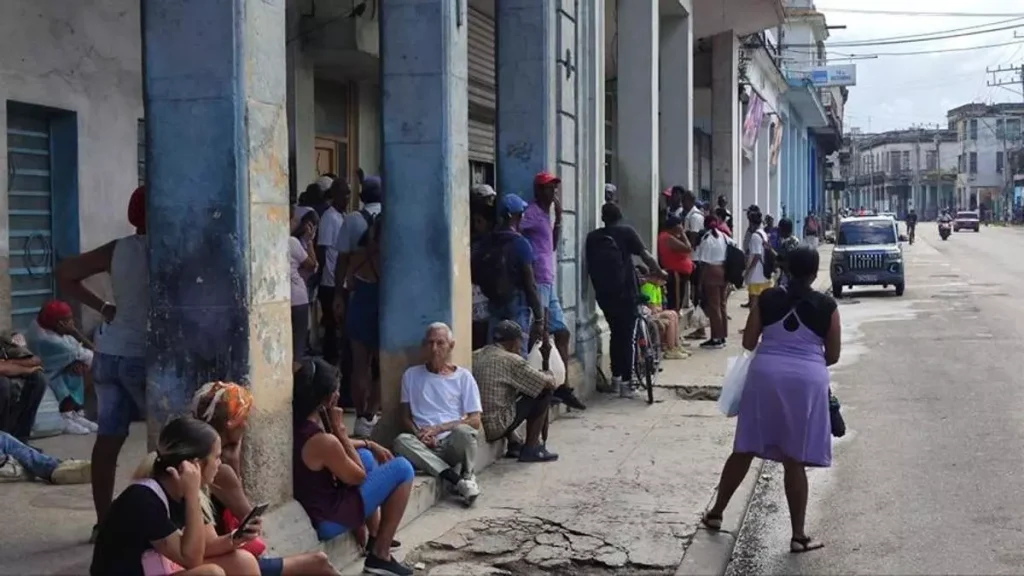
14ymedio bigger14ymedio, Mercedes García, Sancti Spíritus, 24 October 2024 — Nothing in the streets of Sancti Spíritus suggests that, as the state press states, life has returned to normal. The reconnection of the National Electric System (SEN) did not take the city out of the blackouts but merely returned it to the system of “rationed” cuts that it has been suffering for months. With the beginning of the school year scheduled for this coming Monday and the few services that have reopened, the streets remain almost empty. Only one place gives signs of life: the gas lines where Cubans gather daily to try to buy “a little something.”

“For days there has been the same crowd of people at the points of sale. The tickets for the application to buy are still suspended, and that forces people to go every day to check that they are on the list and look at what number they can get for a turn in line,” says Luis, a resident who, in recent days, has had to get up at the crack of dawn on several occasions to try to buy propane. “Yesterday I even fell asleep in line; that’s how tired I was.”

“The SEN was fixed, but here they continue to turn off the electricity in blocks as before. Therefore, those who do not have propane risk being left without cooking or heating water,” he explains. The places where charcoal is sold are also scarce, “although a bag has gone up to 2,000 pesos.”

The only option to eat when you don’t have electricity or propane, says Luis, are the places that sell broth. “Yesterday I went to the agricultural square and came across some broth being made on top of stones with a lot of sticks serving as firewood. One little glass was 32 pesos.”

In the Plaza de los Agros, broth was sold at 32 pesos / 14ymedio

Luis, therefore, has become one more of the hundreds of Cubans, mostly elderly, who crowd in front of points of sale for propane to try to get their name on the list of buyers. Carrying cylinders in wheelbarrows, on bicycles or in tow, Cubans settle on sidewalks or on the tanks themselves to wait long hours. The pose and age change, but the expression of helplessness on their faces is the same.

“I now managed to sign up, but I have about 1,000 people in front of me, and when the list reaches 1,500 it restarts. The lucky ones were the first to be able to add their names on Wednesday, because in the morning 100 cylinders came in, 15 of them authorized for state entities and five for the physically disabled. The remaining 80 were for the population,” Luis said, aware that the amount is insufficient.

“According to my calculations, from how the line has progressed so far, I should get the propane in about 20 days. I’m praying that it doesn’t end and they don’t stop bringing it,” says Luis, who knows that “the regime is limping along on its last legs.”

Just a few weeks ago, in early October, the Government managed to pay for the liquefied gas that is now being distributed on the Island. Before its arrival, the shortage kept many Cubans awake, and after the ship was able to dock, the distribution became “complex” due to bad weather caused by a cold front that arrived from the western provinces. “Cured of fright,” Luis knows that those situations, far from being exceptional, are quite frequent on the Island.

The provincial bus terminal this Wednesday afternoon was completely dark / 14ymedio

Like Sancti Spíritus, in other provinces there have also been long lines to buy the product. This is the case of Holguín, reported by this newspaper, where residents went to the points of sale in search of a means to cook during Hurricane Oscar’s passage. Many did not get to buy then, and the lines are still as long as at the beginning.

In the middle of the week, and with the alleged return to normalcy that the regime announced in its official media, no students or passers-by circulate in Sancti Spíritus. Only some employees that the Government described as “essential” continue to go to work.

The provincial bus terminal on Wednesday afternoon was completely dark with no service, and with the lack of fuel, hardly any vehicles circulated on the main roads. In his round-trip walks to the point of sale, Luis has found himself in a desolate city, “as if the hurricane had passed through here and not through the east.”

Translated by Regina Anavy

Translator’s note: ‘Alumbrón‘ is a coined Cuban word referring to the time when the light (electricity) is ON, that is the opposite of ‘apagones’ – blackouts. It comes from the verb ‘alumbrar’ which means to be bright or give off light.

____________

COLLABORATE WITH OUR WORKThe 14ymedio team is committed to practicing serious journalism that reflects Cuba’s reality in all its depth. Thank you for joining us on this long journey. We invite you to continue supporting us by becoming a member of 14ymedio now. Together we can continue transforming journalism in Cuba.

Requiem for Guantánamo

The easternmost province of Cuba is also the poorest, and the ideologues of the regime know that the greater the poverty, the greater the dependence

Cuban President Miguel Díaz-Canel arrived in the areas affected by Oscar with an army of escorts, but empty-handed / Cubadebate

14ymedio bigger14ymedio, Yunior García Aguilera, Madrid, October 24, 2024 — Thanks to the theater, I was lucky enough to tour almost the entire Cuban archipelago, from Pinar del Río to Santiago, including the Isle of Pines (now the Isle of Youth). However, I was left with a debt before I was expelled from Cuba: Guantánamo. Some of my works were presented on its stages, but the performance always coincided with a trip outside the country. That aphorism that reads “know Cuba first and abroad later” has never been taken very seriously by most Cubans who have the privilege of boarding planes. So when we are far away, we are crushed by the full weight of nostalgia. Guantánamo is my loose end, my little thorn, my pending account.

The easternmost province of Cuba is also the poorest. And the ideologues of the regime know that the greater the poverty, the greater the dependence. That is why no one rules out that planned misery is one of their strategies to maintain an obsolete, impoverishing and catastrophic model. In the “elections” of delegates of 2023, for example, Guantánamo was the province with the most validated votes (92.94%).

The regime prefers to concentrate the scarce resources it distributes on the most problematic areas, the least obedient, those where the spark of protest ignites more quickly. That’s why they tend to leave the territories that show greater loyalty alone. The poverty of Guantánamo is not only the result of a geographical fatalism. Its helplessness is directly proportional to the confidence that the bureaucrats feel in the political fidelity of the region. “You don’t waste bullets on won territory,” could be a new aphorism. But all that, perhaps, is about to change. continue reading

The regime prefers to concentrate the scarce resources it distributes on the most problematic areas, the least obedient

The hand-picked dictator arrived in the areas affected by Hurricane Oscar with an army of escorts, but empty-handed. He arrived with a lot of excuses, but without solutions; with a troop of cameramen, but without supplies. Cubadebate published this Thursday: “Neither alone nor abandoned, Cuba works as a function of you.” However, in all the images that circulate on social networks, the truth slaps the official headline in the face. People did not receive Díaz-Canel with applause. In their voices you could repeatedly hear a blunt phrase: You abandoned us.

We still don’t know, for sure, the size of the destruction. Hurricane Ian (2022), category 5, left five fatalities. Oscar, with category 1, has already claimed seven lives, although it is feared that the figure is higher. Not even the response to hurricanes, which once enjoyed prestige, can now boast of anything. The disaster is total.

Some Cubans have suggested turning the Guantánamo Naval Base into a city for free Cubans. Although the idea is Macondian* and unlikely, it would be interesting to transform that little piece of Cuba, occupied by the United States, into a kind of Caribbean Hong Kong. Imagine the moral impact that a free city could cause in the very mouth of the caiman. Imagine the contrast between both sides of the metal fence. Of course, this suggestion is no more than a fantasy. But since the regime has taken practically everything from us, don’t let them also take away our ability to imagine.

No one, not even the most bitter enemy of the regime, is happy about the tragedy that occurred

I’ve never been to Guantánamo, but I have a lot of friends there. I attest to the talent, intelligence, creativity, nobility and courage of the people I know. Our thoughts and prayers go out to them today. No one, not even the most bitter enemy of the regime, is happy about the tragedy that occurred. We all hurt for Guantánamo. In exile, many Cubans are already organizing to send aid, prioritizing the most affected areas. And we are aware that a bandaid does not solve the whole problem, but it serves, at least, one injured person. That’s not a small thing. Worse would be to stay with our arms crossed or limit ourselves to denunciation and catharsis.

Cuba is fed up with political speeches. Those of us who have focused on fighting for change should avoid reproducing the regime’s talkative model. Practicing politics is, above all, doing concrete things for the people. It should be more about doing and less about talking. It should be a practice, not just simple rhetoric. It’s true that it is extremely complicated to do it from the outside. It’s true that, with any aid, there is the trap of indirectly benefiting the regime. But that fear cannot cause us to abandon those who need help.

How to force a humanitarian intervention? How to achieve it despite the obstinacy and arrogance of a dying regime? Let’s not just stay in a corner singing La Guantanamera. Doing something today for Guantánamo is the best way to do it for the Cuba of our dreams.

*Translator’s note: Macondian is a term associated with the fictional Colombian town of Macondo, which is featured in Gabriel García Márquez’s novel ‘One Hundred Years of Solitude’

Translated by Regina Anavy

_______________

COLLABORATE WITH OUR WORKThe 14ymedio team is committed to practicing serious journalism that reflects Cuba’s reality in all its depth. Thank you for joining us on this long journey. We invite you to continue supporting us by becoming a member of 14ymedio now. Together we can continue transforming journalism in Cuba.

Cuba and 12 Other Countries Are Admitted to the BRICS Group As “Associate Members”

Venezuela, whose candidacy had been received with reluctance by Brazil, was not included

Central table of the BRICS summit in Kazan, Russia / EFE

14ymedio bigger14ymedio, Havana, October 24, 2024 — Cuba was admitted this Friday, along with 12 other countries, to the BRICS group, at a time of maximum devastation for the national economy in which the Island desperately seeks the bloc’s help. The announcement was made this Thursday during the XVI summit of the organization, in Kazan, Russia, according to the official media Cubadebate.

Together with the Island, the alliance – originally formed by Brazil, Russia, India, China and South Africa – also welcomed Algeria, Belarus, Bolivia, Indonesia, Kazakhstan, Malaysia, Nigeria, Thailand, Turkey, Uganda, Uzbekistan and Vietnam. Venezuela, however, was not accepted. Its inclusion had been met with reluctance on the part of Brazil.

Celso Amorim, the right-hand man of President Luiz Inácio Lula da Silva – who did not attend the conclave – asked to “go slowly” in including the group of emerging economies to the group. “I don’t defend the entry of Venezuela,” Amorim said before the summit. “It’s no use filling BRICS with countries; otherwise, a new G-77 will soon be created.” continue reading

Putin’s words reaffirmed that the members of the bloc will have the same support and that the group is open to all those who “share its values”

However, Putin’s words reaffirmed that the members of the bloc will have the same support and that the group is open to all those who “share its values.” To exemplify this, the president spoke of the war in Ukraine. He claimed that the West wanted to turn his country into “a satellite of raw material,” but stressed that, on the other hand, the BRICS partners respect the independence and traditions of Russia. Some, like Cuba, in a more than enthusiastic way and with full support.

In his message, the Russian president pointed out that the group does not create alternatives to the SWIFT system and highlighted that Russia uses its own financial messaging system and that several other Bric countries also use it.

Cuban President Miguel Díaz-Canel was unable to attend the summit. The energy situation on the Island, which since Friday suffered a blackout in most of its territory, and the passage of Hurricane Oscar through the eastern provinces, forced him to stay in the country. In his place was Foreign Minister Bruno Rodríguez, with the mission of doing everything possible to achieve the inclusion of Cuba in the bloc.

President Díaz-Canel said that Cuba’s goal was to find in the group a very favorable environment for Cuba

In a tweet about the summit, the president said that Cuba’s goal was to find in the group a “very favorable environment for Cuba,” “cooperation and collaboration,” “mutual benefit” and “the creation of an economic and commercial cooperation structure that does not use the dollar as its currency”; that is, a country linked to large economies, such as Russia or China.

As of now, the bloc temporarily led by Putin has become 45% of the world’s population and a third of the gross domestic product of the entire planet.

Translated by Regina Anavy

____________

COLLABORATE WITH OUR WORKThe 14ymedio team is committed to practicing serious journalism that reflects Cuba’s reality in all its depth. Thank you for joining us on this long journey. We invite you to continue supporting us by becoming a member of 14ymedio now. Together we can continue transforming journalism in Cuba.

Military Conscientious Objectors Call for the Creation of a Civic-Military Committee in Cuba

In a statement they remind the Revolutionary Armed Forces that “they owe their loyalty to the people, not to the oligarchy”

Members of the Revolutionary Armed Forces of the provinces of Holguín and Santiago de Cuba / Facebook

14ymedio bigger14ymedio, Havana, 23 October 2024 — Cuba is experiencing “a stage of existential danger.” In this situation, in the face of “the final collapse of the national energy system” and with the population living “fenced in by the lack of food, electricity and water,” the Military Conscientious Objectors group urged the creation of a civic-military committee with a group of citizens that synthesizes the main demands of the population, including the resignation of those who caused this crisis.

In a statement released on Tuesday, the group, founded in 2021 by former Cuban officers in exile, pointed out that this committee should implement the process of replacing the leadership in the Government with a provisional executive team, as well as the steps to be taken for the organization of free elections and the formation of a Constituent Assembly.

“Liberation from the totalitarian regime will allow the country to develop with the most modern technologies and, thus, finally incorporate Cuban society into the new era of information of the 21st century. Being miserable and oppressed is not living, but dying every day,” it added.

The total blackout suffered in the country in recent days, they say, is presented by the Government as an electricity supply crisis. It’s not

The pointed out that the moment the Island experiences today is “like that of the October Crisis” – referring to the 1962 missile crisis, provoked by the installation of Soviet nuclear missiles in Cuban territory – but this time, “courtesy of the current Cuban oligarchy.” The total blackout suffered in the country in recent days is presented by the Government as an electricity continue reading

supply crisis. “It’s not,” they say, and explain why: “When they say they’re repairing the power supply, they are actually trying to restore the regime that caused the already prolonged blackouts. But now not even that is possible. They did not invest in modernizing the thermoelectric plants, and today 10 billion dollars are needed to restore the energy system.”

The military in exile remarked that the population suffers not only from the lack of electricity and food, but also from the increase in various medical conditions, which cannot be faced due to the “lack of doctors, nurses and medicines.” Hence, the deaths multiply, and the authorities falsify the origin of the deaths, according to statistics, which, however, “are recorded in the cemeteries.”

Cubans experience different types of violence, such as social violence, not having services and basic economic rights, and political violence

The group added that Cubans experience different types of violence, such as social violence, not having services and basic economic rights for citizens, and political violence “when those who protest against this situation are repressed.” Those elements are “causing as many deaths as a civil war” in the country.

Therefore, they said, it is essential to remove “this parasitic class” from power to achieve the release of all political prisoners (1,113, according to the latest Prisoners Defenders count), as well as to put an end to exile and the lack of political, civil, economic and social freedoms and rights that has plunged the country into the most overwhelming misery.

In the face of the protests that have been experienced in the country in recent days as a result of the total blackout, the former military in exile remember the members of the Revolutionary Armed Forces who “owe their loyalty to the people, not to the oligarchy.”

Finally, in the text that culminates with the phrase “Homeland and life,”the military in exile recalled that rebellion is a constitutional right that is in force (Article 4) and a principle of democratic jurisprudence since the Universal Declaration of Human Rights, which also appeared in the Constitution of Cuba of 1940.

Translated by Regina Anavy

________________

COLLABORATE WITH OUR WORKThe 14ymedio team is committed to practicing serious journalism that reflects Cuba’s reality in all its depth. Thank you for joining us on this long journey. We invite you to continue supporting us by becoming a member of 14ymedio now. Together we can continue transforming journalism in Cuba.

Hurricane Oscar’s Devastation in Guantánamo Raises Fears in Cuba of More Victims

So far, the number remains at six deaths in San Antonio del Sur and one in Imías, but both places are incommunicado

View of the bridge from San Antonio del Sur to Imías, completely divided into two sections / Facebook

14ymedio bigger14ymedio, Madrid, 23 October 2024 — Hurricane Oscar left Cuba 24 hours ago, but anguish continues in San Antonio del Sur, Imías and, to a lesser extent, Baracoa, where almost all communication is cut off. The damage to the roads prevents access to the three populations of Guantana, and there is no telephone signal, so the concern of relatives and friends does not cease. The authorities have counted seven deaths so far, but the conviction is growing that there may be more visible in the photos and people who have not yet been located.

“Of the people who have gone to Imías, does anyone know anything about the community of Guajacal, which was not evacuated? I do not see Government photos uploaded from there,” said a user on Facebook. “From Yacabo,” “from San Ignacio…” doubts about the smaller communities of Imías accumulate, and the phone connection is scarce. “Part of Cajobabo has a signal and also internet. Let them send you news from there,” someone replied.

“Part of Cajobabo has a signal and also internet. Let them send you news from there”

Officially, the victims of San Antonio del Sur are Liz Anyi Elías Labañino, 5 years old; Iriannis Labañino Domínguez, 31; Francisco Columbié Matos, 92; Esmérido Noa Fiffe, 86; Antolino Áreas Domínguez, 83; and Alexander Savón Matos, 42. In addition, there is one deceased in Imías whose identity is still unknown.

Baracoa’s local television, Primada Visión, also reported the transfer by helicopter of a child in serious condition. There are many photographs of hospitals such as the Agostinho Neto and the pediatric Pedro Agustín Pérez with the injured who have been able to be rescued, but there are great difficulties in reaching the area. continue reading

According to the Minister of Transport, Eduardo Rodríguez Dávila, yesterday afternoon a huge sinkhole was detected on the road in front of the hospital in Acopio, which caused a road closure before Imías, leaving this population without access – in Baracoa and Maisí, for example. In addition, in Macambo and La Farola there were “big landslides” and damage to the San Antonio-Puriales road, whose bridge had one of its supports undermined.

“I got to San Antonio and couldn’t continue traveling. There are serious problems with the roads. We still don’t know all the damage,” reported Jesús Pérez Alonso, director of the Provincial Road Center.

Aerial view of homes in the flooded areas of Imías / Facebook

Early this Wednesday morning, Radio Guantánamo indicated that the work on the road to San Antonio and Imías continued, while in Baracoa and Maisí the situation was somewhat better. One person who was able to reach Imías, on Tuesday afternoon, was Yoel Pérez García, first secretary of the People’s Communist Party (PCC) in Guantánamo, who arrived on foot because of the impossibility of doing it any other way. His individual feat was taken advantage of by the ruling party, which extended the achievement to the past and present PCC. “Fidel Castro showed us the legacy that President Miguel Díaz-Canel Bermúdez continues,” praised Solvisión.

In a night appearance, Díaz-Canel admitted the seriousness of what is happening in Guantánamo: “The situation is very complex,” he said. So far, at least 1,183 total collapses and 1,048 partial roof collapses have been confirmed, in addition to 51 total house collapses.

The Army also began to arrive this Tuesday in helicopters, and 493 rescues have been carried out in flooded areas, according to the deputy director of the Operations Department of the National Civil Defense General Staff, Eduardo Cross. He added that 4,865 people are in evacuation centers and 443 in the homes of family and friends.

The population, however, considers that everything has been insufficient because the residents of the area were surprised by a change in the trajectory of the hurricane due to the lack of electricity and communications since Friday. “Those people were without electricity, like the whole country,” says a man in Havana. “On Sunday I was left without a way to charge my phone, but the last I saw from the NOAA (US National Hurricane Center), the hurricane was category 1 and entered closer to Holguín. On Monday when I had battery power again the hurricane had changed its route.”

Bridge that connects Maisí with Imías, also destroyed after the passage of Oscar / Facebook

The multitude of photographs showing destroyed and flooded roads reveal the impossibility of accessing the most affected localities at the moment, but there is a lot of indignation on social networks due to the lack of air equipment, which could have reduced the damage and, predictably, the deaths that are still unknown. “I wonder, is there only one helicopter in Cuba and can it take only one ride a day? Those of us who are mainly outside Imías and have families there are desperate,” a user from Guantánamo asked.

Others used nostalgia, not to charge against the regime, but against the current government: “Does anyone remember when Fidel almost lost his life in an amphibian in the middle of a hurricane? Of course, surely many. That’s why he was and will always be our only and undefeated leader. If Fidel existed, he would have already arrived with rescue forces in Imias. No one doubts it.”

Meanwhile, the electricity in these areas is still inadequate. Guantánamo is connected by microsystems, and the circuits are rotated as much as possible. A break in the optical fiber also prevents telephone and Internet communication, and telephone and electrical poles have fallen, which complicates other vital services.

Translated by Regina Anavy

____________

COLLABORATE WITH OUR WORKThe 14ymedio team is committed to practicing serious journalism that reflects Cuba’s reality in all its depth. Thank you for joining us on this long journey. We invite you to continue supporting us by becoming a member of 14ymedio now. Together we can continue transforming journalism in Cuba.

Lack of Communication With Family Abroad Is Another Traumatic Consequence of the Island-Wide Blackout in Cuba

Many emigrants have had to wait several days to reconnect with relatives on the Island

Etecsa doesn’t need hurricanes or energy debacles to disconnect Cubans from one shore to the other / Primade Vision

14ymedio bigger14ymedio, Juan Izquierdo, Havana, 23 October 2024 — The patience of Cubans runs out on par with the battery of their cell phones. For their relatives abroad, despair comes when an image, a voice and even messages vanish. That a person is no longer online means that he is submerged in the blackout, and that the silence will last until – indispensable to maintaining sanity at night – he can find a way to charge his phone. Jorge, a resident for four years in Mexico City, knows this well. His phone did not ring until, three days after the announcement of the “total disconnection,” his mother wrote him the first “Hello.” In Santiago de Cuba, she had not been able to find anywhere to connect her phone. In the rain, she managed to walk the four kilometers (2.5 miles) that separated her from her sister, for three-hour’s of light: an “alumbrón*.” There she bathed, prepared some food and dialed her son’s number.

“We could only talk for a few minutes,” Jorge reports. “The video froze, and we saw each other for a second.” If calling Cuba in normal times is cumbersome, – Etecsa does not need hurricanes or energy debacles to disconnect Cubans from one shore to the other – the blackout has made every attempt at communication a series of garbled and cut-off words.

In the short time that the dialogue lasted, Jorge heard from his mother about the first hours of the blackout. The soup she had that day was made on her wood stove. The first signs of decomposition had already begun to appear in some pork she had in the refrigerator, so she threw it in a pan and fried it. “That could last two days,” she told him. Then, we’ll see.” continue reading

In Madrid, it took Ana two days to learn that her grandmother – a robust and active woman, 74 years old – had suffered a stroke in Santa Clara

In Madrid, it took Ana two days to learn that her grandmother – a robust and active 74-year-old woman – had suffered a stroke in Santa Clara. “My dad found her passed out on the kitchen table,” she says. He had been surprised that his mother-in-law did not answer the phone and went to her house. With no signal on the phone and in the midst of a transport crisis that the blackout took to a critical point, Ana’s father managed to call an ambulance. Of course, it took a long time to arrive.

“I knew the whole story when my family found a way to call. I hadn’t had any news from them since the disconnection began, and I could barely understand the news when they gave it to me,” says Ana. For the girl, getting sick now in Cuba is like suffering a litany of calamities. Without supplies or electricity, with the doctors overwhelmed by personal and hospital situations, the message after the diagnosis was clear: “They did not give her more than 72 hours.”

For his part, Alfredo – who moved to Seville after the island-wide protests of 11 July 2021 (’11J’) – knew that his cousin, in Cienfuegos, had passed two patrol cars when he went out at night to walk with his girlfriend. According to the young man, the city was “militarized” with the blackout. The phone signal was minimal, and his cousin’s voice reached him intermittently.

“The last time I experienced something like this was during 11J,” Alfredo recalls. The tension in the streets was similar, and the crash of the internet – intentional at that time – made it difficult, as now, for the news of the situation to cross the borders of the country and reach relatives abroad. “My cousin told me that some were now demonstrating and banging on pots and pans, but such a “cacerolazo” can be like an episode of socialist Masterchef, with a wood stove in the middle of the street,” he says sarcastically.

Official journalists accustomed to leaving the country have tried to hide the situation and defend the regime

Official journalists accustomed to leaving the country, such as Yanetsy León from Camagüey, have tried to hide the situation and defend the regime against those who claim that blackouts are “romanticized” in Cuba. “We have spent months resisting blackouts, days without electricity and the weight of uncertainty,” claimed León, who has spent most of the year traveling in Europe.

He also invited Cubans to “take care of their emotional well-being” and ignore those who “from outside or other parts of the country” are emphasizing the seriousness of the national blackout. He admitted that there was a “disconnection” between the Cubans who left and those who still reside on the Island. But he wasn’t looking for culprits. “We are all struggling with our own forms of resistance,” he said, without a single request for accountability from the Government of Miguel Díaz-Canel.

*Translator’s note: “Alumbrón” is a word coined by Cubans that means “the time when the lights (electricity) come on” — that is the opposite of “blackout.” English has no equivalent.

Translated by Regina Anavy

____________

COLLABORATE WITH OUR WORKThe 14ymedio team is committed to practicing serious journalism that reflects Cuba’s reality in all its depth. Thank you for joining us on this long journey. We invite you to continue supporting us by becoming a member of 14ymedio now. Together we can continue transforming journalism in Cuba.

Cuba’s State Employees Are Given Orders to Address Any ‘Situation’ Arising from the Blackouts

Several employees in Cienfuegos disagree with these orders and fear an unstoppable reaction from the public

State employees have been ordered to warn police if things become tense due to recent blackouts. / 5deSeptiembre

14ymedio bigger14ymedio, Julio César Contreras, Cienfuegos, 21 October 2024 — As the hours-long blackouts take their toll on the people of Cienfuegos, state workers can be seen standing guard at offices and public institutions on Sunday. Boards of directors have been explicitly ordered to deal with any “situation” that might arise, specifically bu discouraging demonstrations by an exhausted citizenry after three days with hardly any electricity.

“The truth is that, if there were a protest, I wouldn’t know what to do because I too have a lot of complaints and am dissatisfied with everything that’s happening in this country,” said Humberto, a state employee who has chosen to obey orders despite any doubts he might have. “I don’t want to lose my job because it guarantees at least part of my family’s livelihood. I’m worried that this could all lead to violence that would be put down by force. Something like that would be very hard for people who are clearly tired,” he added, standing at the doorway of his workplace.

The 52-year-old Cienfuegos resident explains what his Sundays were like before he started his job and the daily challenges people like him faced beyond the lack of electricity. “Before coming here, I would go to the Pastorita buildings to look for rice so my children could eat. My wife was cooking with charcoal because we ran out of liquefied gas and we can’t afford to buy it on the open market. When they told me I should take this shift, I agreed, but I wonder what I’m defending,” he admits. continue reading

” When they told me I should take this shift, I agreed, but I wonder what I’m defending”

Mayra lives on Argüelles Street, where many companies and government offices are located. Unlike Humberto, she is not willing to participate in overnight guard duties at her workplace. “I understand that they’re afraid of what could happen but I didn’t create this crisis situation. Nor are the offices my property. If a protest does take place, I won’t do anything to stop it because [the protestors] would be defending many of the same positions that I have. I know that taking a stance like this could cost me dearly at work but I won’t do anything that goes against my principles,” she says.

Mayra explains that guard duty has been organized into 24-hour shifts. In order to prevent crowds of people from gathering, employees have been ordered to immediately contact the police if they notice anything suspicious. “I could never forgive myself for turning in innocent people. First, they would be beaten, then they would go to jail merely for openly expressing themselves. Of course, when the orders came down , there were many opportunists here who were happy to oblige, as though it were a heroic act. I’m not braver than anyone else but I have my dignity,” says Mayra. Though she declined to reveal exactly what she does professionally, she has said that her job has something to do with the provincial People’s Power Assembly.

Workers are being called upon to guard both open and closed spaces. For example, on the Paseo and El Prado soldiers and dozens of individuals from the Communist Party and other government agencies have been tasked with ensuring public order. Meanwhile, residents of the surrounding neighborhoods sit in doorways and on sidewalks trying to escape the heat, the mosquitoes and the hours of tension.

“This country is like a huge minefield that is about to explode”

“No one really knows how long it will take to restore power so I’m on call for awhile. Other employees here have offered to pay me 200 pesos per person to cover for them,” says a man standing behind a desk in his company’s reception area. “It’s true that I have to sacrifice myself day and night but I need the money to feed my mother, who is very sick. I hope that everything will be calm and that this situation will be resolved. What I really don’t want is confrontation between Cubans, much less unjust arrests like those on 11J*. I’m afraid this will get worse than it already is,” he admits.

Two police patrol cars parked in Martí Park provide a clue as to what their role would be in the event of a public demonstration. Though seemingly calm for now, the city is under heavy guard by people who, in many instances, have been threatened with sanctions and fear losing their jobs if they do not comply. “I know that the methods to convince those of us who refuse or who are undecided are harsh. There’s a lot of fear that anything could trigger an uncontrollable reaction by the public, who have been overwhelmed by all these difficulties for many years. This country is like a huge minefield that is about to explode,” concludes Mayra, putting her hands on her head.

*Translator’s note: 11 July 2021, when mass protests broke out across the island, which led to a government crackdown.

____________

COLLABORATE WITH OUR WORKThe 14ymedio team is committed to practicing serious journalism that reflects Cuba’s reality in all its depth. Thank you for joining us on this long journey. We invite you to continue supporting us by becoming a member of 14ymedio now. Together we can continue transforming journalism in Cuba.

Lights Come Back On in Havana but Some Blocks Still Don’t Have Power

The recovery process in the east is much slower and residents fear how Hurricane Oscar might affect that.

Luego de cuatro días sin luz, la cola ante los cajeros de la calle Toyo estaba más nutrida que nunca. / 14ymedio

14ymedio bigger14ymedio, Juan Diego Rodríguez, Havana, 21 October 2024 — “They all wear sweaters under their uniforms in case they’re ordered to out onto the street. This way they can take off their shirts, blend into the crowd and disappear.” Antonio has forbidden his son, who is doing his mandatory military service in Havana, to “beat people up” if his detachment is called upon to suppress street protests. He claims that many parents of other boys in his son’s unit have indicated they have done the same.

The man says that the the 19-year-old’s unit is located is “quiet” for now. “There are a lot of wealthy people living in grand houses in the area where they are deployed, all with electric generators and all the comforts,” he says, feeling powerless after another sleepless night.

His wife is more irritated by the general attitude she encounters on the streets. “You go out and everything is normal, as if nothing has happened. Everyone is partying! They’re happy because they’re going to get paid for not working, at least for as long as that this insanity lasts!” she says. “Nobody is bothered. Everyone is playing dominoes and having cookouts, laughing and drinking beer. The ones with the courage to protest don’t get support from their neighbors, who call them shit-eaters.”

Among the scattered slogans that people could be heard shouting, one stood out: “Down with the dictatorship”

However, around 9:00 PM Sunday night, residents in Central Habana banged pots and pans in protest. Among the scattered slogans that people continue reading

could be heard shouting, one in particular stood out: “Down with the dictatorship!” Despite the sporadic nature of the demonstrations, tensions in Cuba are rising. It is Monday and the country has now been without power for four consecutive days due to a nationwide blackout. Meanwhile, the regime is struggling to restore the power grid by creating electrical “islands.”

The human rights group Justicia 11J reported that there were at least twenty-eight protests on the island between Friday and Sunday night, twenty-one of them in Havana. Other provinces where demonstrations were reported were Holguín, Mayabeque, Santiago de Cuba, Sancti Spíritus, Artemisa and Villa Clara.

Strikingly, one of the protests took place in Manicaragua, a town in Villa Clara which was subjected to the so-called the Escambray cleanup operation. After the revolution, its insurgent population was forced to relocate to Pinar del Río and confined to captive villages, to be replaced by supporters of the regime. The grandchildren and great-grandchildren of those who had been “integrated” confronted police officers on Sunday in front of local government headquarters.

Justicia 11J issued a statement claiming it had received reports of authorities suppressing peaceful protests. It indicated, however, that it has no knowledge of people being detained or forcibly “disappeared” in relation to the events of the last three days. Nevertheless, they added that they cannot rule out the possibility due to an information blackout resulting from “the lack of electricity and internet connectivity.”

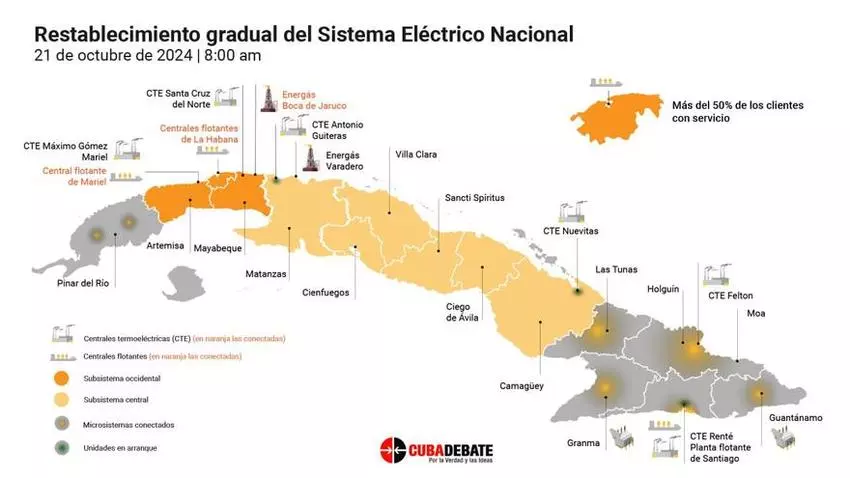
Map showing areas of the island where power was restored as of Monday morning. / Cubadebate

Meanwhile, Cubadebate continues to provide updates on the situation in a “breaking news” format that is unusual for state-run media. According to information released a few minutes before 3:00 PM, the Antonio Guiteras thermoelectric plant, whose unexpected shutdown was one of the reasons for Friday’s massive blackout, had “synchronized the microsystem.”

“A large number of units will start coming back online at 3:00 PM because we will be restarting Guitaras, which we will do slowly so as to avoid suddenly overloading the system,” said the minister of Energy and Mines, Vicente de la O Levy, in statements on national television. He did not specify whether the process would take hours or days.

With the power restored for who knows how long, Havana residents took to the streets on Monday hoping to buy food and run errands, which they have not been able to do since Friday. The Boulevard Café, located on the corner of San Rafael and Galiano streets in downtown Havana, was selling fried chicken legs for 50 pesos apiece, though the line to buy them was almost insurmountable.

Similarly, there was a comparable line in front of the ATMs on Toyo Street after four days without power. “There are blocks that have electricity and others that don’t,” said one customer waiting in line. She had just come from the bank on Galiano Street, which was closed because it did not have electricity.

The smell of meat that has gone unrefrigerated for hours is being carried by the wind to places far from its point of sale. Such is the case with the ground meat being sold at the Havana Literary Cultural Center for no less than 500 pesos a kilo. / 14ymedio

The smell of meat that has gone unrefrigerated for hours is being carried by the wind to places far from its point of sale. Such is the case with the ground meat being sold at the Havana Literary Cultural Center for no less than 500 pesos a kilo.

According to the electric company, more than 88% of Havana’s electricity has been restored. However, a cursory tour of the capital belies that number. The little grocery store on San Rafael Street in Central Havana was open despite having no electricity, with merchandise for sale at astronomical prices. Service on nearby Infanta was not fully restored either. In some other areas, and on Neptuno Street, power did seem to be back on but these were exceptions.

“No electricity, no water and drowning in garbage,” complained an elderly woman as she walked past a a pile of trash on the corner of Neptuno and Campanario streets. On the other hand, the lights in the Luyanó district came back on for about twelve hours. But just as the Guiteras facility was coming back online, they went out again at 3:00 PM.

“All the Energás facilities are ready, all synchronized except one, which allowed us to reboot Havana and the floating power stations in the bay,” said the minister

They were able, he said, “to keep going through the Havana substations all the way to Mariel” and start up a thermoelectric plant there.” This, in turn, “provided start-up power to facilities and floating power stations” so that “the Mariel site and the floating stations could go back online.” There are two floating power stations being leased from Turkey — one in Havana and one in Mariel — as well as another in Santiago de Cuba.

In the east, bringing Unit 5 at the thermoelectric plant in Nevitas back online will help restore power to that region. “Granma [province] is in a better situation because a small generating facility that serves more than 40% of its customers kept running,” he said.

However, he also warned that Hurricane Oscar — even if it does not pass directly over these provinces — could still bring with it winds that impact transmission lines. “The last thing we want is for the system to go down due to a line failure. We are restoring the system much more slowly; customers will not suddenly be brought back online,” he reiterated.

Without offering further details, the foreign minister indicated that Cuba “is in talks to finalize the receipt of this aid”

Though Oscar brought violent rain storms to Baracoa, it caused no significant damage” according to the assessment made by officials and confirmed by Eleazar Moreno Ricardo, networks director at the Cuban Electric Union (UNE). “Conditions are being created to revive the hospital back,” he added. There were, however, minor “impacts” in Maisí and Moa.

As for the rest of the communities in Guantánamo province, they have not been able to carry out damage assessments because it is still raining. To support the recovery of the electrical infrastructure after the storm, five contingents of linemen from Villa Clara, Ciego de Ávila, Camagüey, Granma and Santiago de Cuba are on their way to the eastern province.

What the authorities are not talking about is whether they are expecting fuel shipments. The tanker ship Prairie Tulip is expected to arrive in Moa on Wednesday. It could be transporting fuel from the refinery in Curacao, where Venezuela sends its oil to be processed. In Matanzas, they are still waiting for the oil tanker Ocean Mariner and the coastal vessels Ocean Integrity and María Cristina.

In a Sunday tweet, foreign minister Bruno Rodríguez expressed gratitude for “the efforts and immediate support offered by the governments of Venezuela, Mexico, Colombia, Russia and Barbados to deal with the current situation.” Without offering further details, he indicated that Cuba “is in talks to finalizer receipt of this aid.”

Officials announced there would be a new edition of the TV interview show “Roundtable” on Monday night. It will deal with the recovery process of the country’s electrical grid and the effects caused by Hurricane Oscar in eastern Cuba. The program was last broadcast just four days ago, on Thursday night, and featured an interview with prime minister Manuel Marrero. In that episode he stated, “[I can say] with all objectivity and transparency, we are not yet in a bottomless pit.” He was right. The next day, the entire island went dark.

____________

COLLABORATE WITH OUR WORKThe 14ymedio team is committed to practicing serious journalism that reflects Cuba’s reality in all its depth. Thank you for joining us on this long journey. We invite you to continue supporting us by becoming a member of 14ymedio now. Together we can continue transforming journalism in Cuba.

Six Young Baseball Players Flee Cuba in Just Three Days

Eric Valenzuela, Adrián Gómez, Cristian Rego, Eugenio Rodríguez, Osniel Castillo and Dayron Núñez are now in the Dominican Republic

Baseball players Eric Valenzuela and Adrián Gómez / Facebook

14ymedio bigger14ymedio/Swing Completo, Havana, October 22, 2024 — Baseball players Eric Valenzuela, Adrián Gómez, Cristian Rego, Eugenio Rodríguez, Osniel Castillo and Dayron Núñez are the most recent athletes who have fled Cuba. The escapes occurred between Sunday and Tuesday, according to reports by sports journalist Francys Romero. All of them are now in the Dominican Republic and will be presented to professional scouts from the MLB organizations.

Of the six, four are pitchers and average 90 mph throws. Despite their youth, every one has a previous tour of the local championships of various categories. Of them, Eric Valenzuela, the oldest of this group, had greater prominence in the National Series, in the ninth of Isla de la Juventud.

The 20-year-old player, who is 6’5″, played three classics in the country. In 33 matches he had 259 starts. He recorded three wins, nine defeats and an offensive average against him of .250.

Despite their youth, they all have had previous participation in the local championships of various categories

For his part, Adrián Gómez, 18, was one of the most outstanding prospects during trials carried out this year by the Cuban Baseball Federation for the most talented players. continue reading

Dayron Núñez is another pitcher with a lot of power in his throws. At only 19 years old, the player from Guantánamo also has experience in the National Series, where he won four games and lost six with the provincial team.

The youngest of the pitchers, Cristian Rego, barely 16 years old and 6’3″, has been one of the most coveted players by various seekers of new talent during the international tournaments in which he participated. In the U18 Pre-World Cup, last August in Panama, the player from Havana did not allow clean runs in 13.1 innings of work. In addition, although he records a speed that ranges between 87 and 90 mph, due to his physical qualities, he can potentially throw at more than 95 mph, according to Swing Completo.

To the list is added Eugenio Rodríguez, who has experience in the National Series with the Alazanes de Granma. In 2023 he had few opportunities on the offensive, since he only accumulated 29 official turns at bat, in which he hit six home runs, for an average of .207. However, at under 20 years old, he is seen as a medium-term prospect.

Finally, Osniel Castillo is a skilled runner and an excellent hitter, which placed him as first up at bat when he represented Cuba in international tournaments. During the U18 in August, he was the powerful hitter of the Cuban ninth.

Last week, another player who broke his link with the Island was the veteran Raúl González, who asked for asylum in the United States

Just last week, another player who broke his link with the Island was the veteran Raúl González, who asked for asylum in the United States after being excluded from the national team, next to compete in the Premier 12 tournament. The 37-year-old player is in the process of investigation by US immigration authorities, after entering through the northern border with Canada, where he played in the main league of that country with the Kitchener Panthers, under the auspices of the Cuban Baseball Federation.

Most of the athletes fleeing Cuba are baseball players. According to a count of the official weekly Trabajadores, in January 2022, at least 862 athletes had left the Island in a decade, of which 635 were baseball players. Today it is estimated that almost 1,100 athletes have fled the country in that period. To that figure we must add the dozens that have fled this year. In addition, since 2012, the exodus includes 2,344 coaches, 85 of whom worked at the highest level, according to the National Institute of Sport, Physical Education and Recreation.

Translated by Regina Anavy

____________

COLLABORATE WITH OUR WORKThe 14ymedio team is committed to practicing serious journalism that reflects Cuba’s reality in all its depth. Thank you for joining us on this long journey. We invite you to continue supporting us by becoming a member of 14ymedio now. Together we can continue transforming journalism in Cuba.

Salt Fields Destroyed, Crops Damaged and up to 6,000 Affected by Hurricane Oscar in Eastern Cuba

It is still impossible to give a total account of the damage because of isolated communities

It is estimated that there are some 4,000 families affected in the eastern provinces / Prensa Latina

14ymedio bigger14ymedio/EFE, Havana, October 22, 2024 — The northeastern end of Cuba is experiencing a dramatic situation one day after the passage of Hurricane Oscar, which left at least seven dead and much material damage. Baracoa, for example, remains incommunicado. According to the report on national television this Tuesday, the linemen mobilized from other provinces could not arrive: the La Farola viaduct is closed to the passage of vehicles due to landslides caused by the rains.

In the same report, they pointed out that the salt field of San Antonio del Sur, the most affected community, was totally damaged. In addition, 200 hectares of tomato plantations were lost. Throughout the territory, damage was reported in “almost 50% of the banana plantations,” and in the coffee plantations.

Early Tuesday, the official press reported that there are 6,000 people affected – about 4,000 “family nuclei” – mainly by the floods, which have caused river overflows and sea penetrations in low coastal areas.

In the last 48 hours, the province has recorded accumulated rain of more than two feet in some points, according to data from the Institute of Meteorology. continue reading

Oscar entered Cuba as a category 1 hurricane (out of 5) on the Saffir-Simpson scale on Sunday afternoon and spent just over 24 hours on the Island, accompanied by strong winds, intense rains and high tides. It made land near Baracoa at 6:10 pm on Sunday and left Cuban territory in the vicinity of Gibara around 7:20 pm on Monday.

Civil Defense decided on Tuesday to declare the return to “normality” in the eastern provinces of Santiago de Cuba, Granma, Holguín and Las Tunas, but in Guantánamo classes will continue to be suspended at least until Thursday.

Oscar is the fifteenth hurricane of the current season in the Atlantic

Oscar is the fifteenth hurricane of the current season in the Atlantic and the first to touch land in Cuba. The meteorological services of the United States and Cuba warned months ago that this hurricane season in the Atlantic, which runs from June 1 to November 30, was going to be especially active.

The last time a big hurricane hit Cuba was in 2022, when Ian caused a collapse of the power grid similar to the one that Cuba has experienced in recent days.

Translated by Regina Anavy

____________

COLLABORATE WITH OUR WORKThe 14ymedio team is committed to practicing serious journalism that reflects Cuba’s reality in all its depth. Thank you for joining us on this long journey. We invite you to continue supporting us by becoming a member of 14ymedio now. Together we can continue transforming journalism in Cuba.