A crowd was waiting outside the mansion in Vedado with a statue of Abraham Lincoln in the garden. The language school opened its doors to new registrations and in the days that followed tested the attitudes of those interested. Everyone waited nervously, thinking that they would be evaluated on a pronunciation here… a mastery of vocabulary there. To our surprise, the main questions weren’t about language, but rather alluded to politics. By mid-morning a young woman who had been rejected warned us, “They’re asking the name of the first secretary of the Cuban Communist Party (PCC) in Havana.” We stood there mouths agape, who would know that?
A few decades ago the leaders of the so-called “political and mass organizations” were figures known throughout the country. Whether through their excessive presence in the official media, long tenure in their jobs, or simply because of personality, their faces were easily identifiable, even to kids in elementary school. We relentlessly heard talk of the secretary of the Young Communist Union, saw on every newscast who was leading the PCC in a province, or overdosed on declarations from some president of the Federation of University Students. There they were, clearly recognizable. Some even came to have nicknames, along with numerous jokes about their quirks and inefficiencies.
This morning on national television they mentioned Carlos Rafael Miranda, national coordinator for the Committees for the Defense of the Revolution (CDR). And it started me thinking about how blurred these positions have come to be, posts that before seemed to have so much power to decide the fate of so many. People now unknown leading institutions that every day fall deeper into indifference, are more forgotten. Leaders whose led can no longer remember their exact names and surnames. Figures who came too late to stand in the flashes of the camera, to be included in the analyses of the Cubanologists, or — at least — to be the targets of some joke. Mere shadows of a system where charisma is increasingly scarce.
Dr. Oscar Elias Biscet was arrested this morning near his home in the Lawton neighborhood, according to his wife Elsa Morejon’s Twitter account. Cubanet called the home of the opposition leader and was surprised when Biscet answered. He had been released.
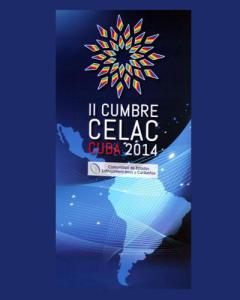
Biscet told us that early in the morning two security officials came to his house and warned him not to go out into the street during the preparation for the CELAC summit, that is, from now until the presidents invited to the summit leave the Island. The meeting of the 33 Latin American and Caribbean countries is scheduled for 28-29 January.
The opponent protested that he was not going to abide by that dictatorial measure. And he would go where he had to go. Half an hour later they grabbed him in the street.
He was walking four blocks from his home when a civilian car stopped and two individuals identifying themselves as State Security got out. One of them asked Biscet for all his documents, keeping them. And told him he had to accompany them. That is, they took him into custody.
They drive about two blocks to what looked like a workplace. There one of the officials — according to Biscet — called his superiors on the phone to ask them what to do with the detainee. Evidently they told him to let him go. They returned to the car and took him back to his house. Repeating the warning that he was not to go out into the street or he would be arrested.
Oscar Elias Biscet told us that the headquarters of the Union for Cuba, on 100th Street near Fortuna, is surrounded by forces of the regime. No one can come closer than two blocks .
Last November, the Cuban government was prevented Elias Biscet leaving the country, after he was invited by President Barack Obama to the White House ceremony for the award of the Presidential Medal of Freedom in Washington. His wife, the activist Elsa Morejon, attended the celebration. On that occasion she visited Cubanet.
For a Cuban reporter, in addition to mastering the narrative techniques of modern journalism, it’s good to have in hand Oriana Fallaci’s book. To read the chronicles of Gay Tallese or Rosa Montero. These days, seems essential to own a laptop, tablet, and a digital recorder and camera.
But, please, keep in mind you are engaging in journalism in an autocratic country, where according to its laws the professions of spy and unauthorized reporter are almost synonymous.
Yes, we must learn to use 21st century tools, Twitter, Facebook, Linkedin, but in Cuba it’s ore useful to have a network of friendships located in different strata who can give you first hand information.
Not being able to confront the information, or verify it through other sources, we have to have confidence in our intuition. We’re always going to lack a specific date, or a concrete figure that could round out the note.
Not having access to official statistics, it’s impossible to contrast the news and look for other points of view to balance the story. In my experience, after working as an independent journalist for 18 years, on the island we have to throw in the trash certain rules established like canons of the profession.
Let me give an example. If we try to have a hooker tell you about her life, it’s advisable not to show her a microphone or camera. Or she’s not going to tell you a story. Then the most sordid stories flow. continue reading
Not being able to record, take notes, or take photos, a good memory is fundamental. When an interviewee quotes outside the law, what is important is to get across the essence of their opinions.
To do journalism inside Havana’s marginal world comes with its risks. One journalist note can bring down a police operation on a guy who sells drugs or a girl who sells herself. So you have to be very careful to camouflage the identity, place of residence or where there person usually operates.
I’ll tell you an anecdote. In the past year, Diario de las Americas published a story of mine about transvestite prostitutes. Every night they sit in a doorway on 10 de Octubre avenue. After I published the work, the police discretely evacuated the place.
These unadorned stories carry a risk in Cuba: any person mentioned could be arrested and end up behind bars.
An old butcher told me about a common method among the DTI (Technical Investigations Department) officials when they detain someone, to avoid a conflict, is to say they got the information from an article by an independent journalist.
Although at times the publication of a story helps the affected. In December, as a result of strong downpours assaulting Havana, a neighbor, living in a destroyed room in a tenement, told me he’d been asking for decent housing for his family for 20 years.
“After you mentioned my case, the authorities talked to me. They told me that if I stopped offering statement, they could resolve my problem,” the neighbor said.
On Friday, 10 January, the independent journalist León Padrón Azcuy published on Cubanet a report about the private restaurant Starbien, owned by José Raúl Colomé, son of Abelardo Colomé Ibarra, Army General and Minister of the Interior.
On Monday the 13th, Colomé Jr. visited the journalist at his home. He told him he was very annoyed with what was reflected in the article and promised to take charge of the matter personally. On 15 January Cubanet revealed that the minister’s son’s restaurant had been entered on Spain’s Merchant Register as Starbien Investment SL.
When you do journalism outside the State, you have to be well-informed and can’t try to wield the “journalistic stick” or compete against the international news agencies stationed in the country.
A journalist, according to Kapuscinski (Poland 1931-2007), above all must be a good person. To do good reporting work and, in the case of Cuba, to describe this reality hidden by the regime with objectivity.
Iván García
Photo: All the independent journalists who live in Havana, at least once a week go to the Esquina de Tejas, by foot, bus or taxi; this is where four of the most important streets of the capital meet: Monte, Infanta and the Calzadas del Cerro and Diez de Octubre. Taken from Primavera Digital.
That house had a protective fence bristling with iron spikes, and the one next door had a huge gate and double locks. On the doors of certain offices signs warn, “Authorized Personnel Only,” and around the Council of State the armed guards are stationed every ten yards. Protecting themselves from others, avoiding contact, keeping strangers out, are the objectives of these physical and legal parapets. They are just like what the masterful Ryszard Kapuscinski described in his article, “Chairman Mao’s One Hundred Flowers,” during his trip to China.
In this vivid and sharp text, the Polish journalist brings us the human mania to construct obstacles to separate us from the different. The perfect example is that serpent of bricks, stones and various materials that snakes across the geography of the great Asian giant. All to defend itself — or isolate itself — from those who were left on the other side of the wall. In the Cuban case, it has been simpler, because the sea distances us from the rest of the planet. A strip of salt water that has marvelously served the political discourse of a “people under siege” and “the enemy” on the other shore. All out of fear, out of pure fear of diversity.
Kapuscinski reflected on the human and material costs of the construction–real or discursive–of walls. An exercise we could try in our own country. How much has isolation cost us? How many resources have been spent on trenches, tunnels for war, aggressive diplomatic campaigns, indoctrination in schools to foment the idea of a foreign enemy? How many lives have been destroyed, diminished or terminated because of these walls erected for the benefit of a few? “The wall serves not only to defend oneself… it allows one to control what happens within it,” reads Travels with Herodotus, and it’s painful that sixty years later it continues to be a reality in so many places.
The official media recently reported on the situation in Thailand where the authorities have declared a state of siege, prohibited meetings, established censorship and eliminated several citizen rights. Without the slightest shame, the announcers on Cuban Television News declared themselves shocked by these horrors.
Right now in Cuba, on the eve of the celebration of the Second CELAC Summit, no official institution has decreed any type of special situation, however they have unleashed a wave of arrests and threats against all those who try to gather between the 28th and 29th of January, which are the days the great event will take place.
With complete certainty, the Cuban delegation will happily show its guests a peaceful country where no one protests about anything, even though there is no decree of a state of siege or anything like it.
The truth is, it’s not necessary to take any kind of extraordinary measures. Here there is a permanent Thailand (as that country is now), and if the leaders attending the Summit support fighting against poverty they will admire the Cuban example where not a single beggar will be seen (they’ve all been relocated), nor will they encounter any prostitutes or pickpockets.
I dare say they can be sure that they won’t even see a teenager wearing the school uniform incorrectly, because here we have all been warned… be careful of what you say in the bread line, don’t even dare sneer at a police officer, nor sell anything on the black market. If you suffer from gas, hold it in, knowing that any alteration to the public order could be extremely suspicious.
“Reagan wears a skirt, we wear pants, we have a commandant whose balls roar!”(Revolutionary slogan made famous by Felipe Pérez Roque)
Sunday, January 19, 2014 | Miriam Celaya
Havana wakes up early, and before 8:00 am and there is a swarm of voices and movement. Old cars and buses rattle around the city, people crowd at bus stops and at the curb, the new day of survival sizzles. Just one block from Carlos III, a main avenue, dozens of teenagers huddle around the “Protest of Baraguá” middle school staving off morning classes as much as possible. Regardless of gender, lively, haughty, irreverent, almost all speak loudly, gesticulating and shouting from one group to another, from one sidewalk to another.
A neatly dressed and beautifully groomed student stands on her toes while she places her hands on either side of her mouth, like a megaphone:
“Dayáááán … Dayáááán ! Hey, you, don’t pretend you can’t hear me…I’m talking to you, what the f… is it with you?!”
The kid in question, half a block away, turns to the girl and laughs:
“Hey, Carla, what’s the problem? Did you catch the hash? Now you can’t stop itching and I gotta go and “scratch” it?”
“Oh, honey, you wish! You aren’t man enough for that!”
The brief dialogue is accompanied by exaggerated, lewd gestures.
Dayán approaches and they greet each other with a friendly kiss and much fondling. They join an adjacent group of classmates chattering among themselves. Every once in a while, strong words fly, like the morning sparrows in nearby trees. I look carefully at the big picture. Greetings among these young people can be a spank on the bottom, a kiss, or an expletive straight from a tavern of pirates, with an ease borne of habit. continue reading
I approach the group and identify myself as a reporter. I want to ask them some quick and simple questions before they have to go through the school gates. I make it clear to them that I will not need their names, that I will not record their answers and that I will not take their pictures if they don’t want me to do so. Some move away a little, just in case, but stay in close range, as if to hear everything. None wanted to be photographed.
Where did you learn to express yourself like that? Do your parents allow that at home and your teachers at school? Have you been brought up in a violent family environment? What is your interpretation of rudeness or cursing? How would you define the language you use? Is your vocabulary found in any of your Literature or Spanish Language books?
After some hesitation, it’s Dayán himself who breaks the ice.
“It’s OK, nuttin’, auntie, it’s normal. Everyone speaks this way and everyone knows what those words mean. At home, you have to be careful, because parents get upset if you swear a lot, but they do it just like nuttin’. Teachers rarely butt in. There is nothing wrong with that. Look, at home, there is no violence like that. I have never been hit. OK, so maybe I got smacked when I was younger and did something bad, but ‘normal’ like everybody else”.
Then others jostle to talk and offer their opinions, interrupting each other. All agree that what is happening is that in “my era” they did not talk this way because they were behind the times and there was less freedom, but “that was before”. Cursing is now “normal” (let’s say very advanced). It is true that our vocabulary is not found in books, but books are one thing and real life is another. The same is true of TV, for example. I dig a bit more and discover that not a single one of them has ever read a novel. They don’t even know about poetry. To sum it up, vulgarity is not so vulgar for them, and foul-mouthed expletives are the norm.
The school bell warns that morning classes are about to begin, and the kids push each other as they go in, laughing, having fun. I am obviously “over the hill”, kind of a brief anachronism for that day. Some, very few, say goodbye to me before turning their backs and walking away.
But just as not all young people are vulgar, the vulgar are not all young. The epidemic of rudeness that has become endemic is not a generational thing, but a systemic phenomenon.
In the afternoon, I go to a nearby avenue and skirt the lateral passageway of the Carlos III Market, by Árbol Seco Street, where taxi drivers hang out to gossip daily between fares. They drink espresso or refreshments for their parched throats. Every once in a while, profanities sprinkle the talks, especially in the friendly, loud discussions about national baseball series or car prices, whose sales were recently allowed by the State. Adolescence is far behind them; many have some gray hair to comb, others have even lost their grays.
I ask the area’s septuagenarian parking attendant if the regulars always use such foul language or if it is only in the thrill of the moment. “That is normal here. They always curse, even in the presence of women and children. There is no respect, and if you say something to them, it gets worse, so it’s better if you keep quiet”. I make it clear to him that I will not say anything to them.
Indeed, if I tried to complain to all those who express themselves using profanity, my whole day would be spent doing so, and would have gotten smacked more than once. In Cuba today, correcting someone’s manners and language is considered unjustifiable prudery: aserismo* prevails . But how and when did it all begin?
¡Asere, ¿qué bolá?!
Hey,you, wassup?
While it’s true that there have always been people who are vulgar and people without manners, only lately has rudeness invaded Cuban society, so much so that it is impossible to avoid. Contrary to the official discourse that advocates for education and culture of this society, vulgarity as a particular form of violence seems to be here to stay. From using the most foul language to the very masculine impudence to urinate in public and in broad daylight, our daily lives are becoming ever more aggressive.
If we were to explain the history of the empire of vulgarity on the Island using some of the prosaic words that have been incorporated into everyday speech at different times in these 55 years from vulgar egalitarianism imposed as state policy, probably only a Cuban brought up in this environment could understand something of the lexicon. Perhaps the story could be summarized as follows, and readers will forgive me, as I only intend to illustrate:
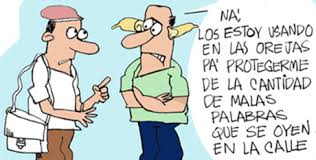
I just put them in my ears to protect myself from all the bad words you hear in the streets.
At first it was a guy who stormed a barracks with a group of ecobios, although when he left he was on fire when the shooting began. It became pretty bad and lacking in cold, and the ones who went to prison were better off. But, since they were such crazy dicks, at the end, they and the other cuties who joined them along the way took the bunch here, by their balls, gave Batista, who was a weirdo, a good poison, and that is how this dark affair began since here everyone is the same salsa, so whoever has an itch should scratch it, and if not….tump tu tum tump tum, bolá. Politeness and sentimentality ended, and shake it so it goes off* which one is it?
The spread of foul language and loss of good manners is already a feature of the Cuban society of the times, to the point that the general-president himself, Castro II, has publicly expressed alarm at such vulgarity. Social vulgarity, that sort of bastard child that the regime now refuses to recognize as its own, has passed out of the masses and reached the sacred threshold of its parents. And it scares them. What if one day such uncontrolled crudeness becomes violence against the throne?
Diligent criers, meanwhile, have responded immediately to the master’s whistle. Language, Did Good Manners Take a Trip? is an article where the official journalist Maria Elena Balán Sainz, after lamenting about the rudeness of speech and manners currently governing Cuba, especially among the young, delves into an analysis of the origin of the Spanish spoken in the Island and its lexical relationship with other countries in the region, on the evolutionary theory of language, its importance in human communication and care, about which she insists that, “Although it seemingly may fall on deaf ears, we cannot stop the battle for the proper use of our language, although there are marked tendencies in recent times toward popular slang language, occasionally with vulgar ingredients”.
Even she could not escape the clichés that in Cuba each issue becomes a “battle” and where all “official strategy” gets shipwrecked in sterile campaigns, though we can recognize the good intentions of her article. However, her article seems to imply that the vulgarity and crudeness emerged suddenly and spontaneously among us without cause or reason, as naturally as if it were fungi on animal feces in a pasture. Balán Sainz does not mention, even once, the coarse rusticity of revolutionary slogans, swearing in repudiation rallies, vulgarity in assaulting and beating by those who think as indicated by the olive-green creed, or rudeness stimulated and wrapped from power to try to nullify those morally different.
Those waters brought this mud …
Now, using my own words for the review, I’d say that, at first, it was the violence of a social revolution that came to power by force, which expropriated, expelled, sowed exclusions, for political reasons, of religious faith or sexual preferences, which imposed egalitarianism, condemned traditions, separated children from their parents’ home in order to indoctrinate them, fractured families, condemned prosperity, kidnapped rights, stifled the creative capacities and independence of individuals, standardized poverty, pushed an infinite migration that plagues and cripples us. I cannot imagine greater vulgarity.
Now, when Cuba looks like a scorched land, her economy ruined and her values misplaced among old slogans and constant disappointments, the regime is perturbed by the rudeness and poverty of speech, which move along proportionally with the system’s general crisis.
But Balán Sainz is somewhat right when she reminds us that our lexicon is a reflection of our social reality. Lowly, vulgar and violent language belongs in an impoverished country, where each day we can feel more and more the frustration, the precariousness of survival and the tendency for violence. It is part of the anthropological damage, so masterfully defined by Dagoberto Valdés.
Are there solutions? Of course, but they will not be spontaneous. Only the end of the rude Castro dictatorship could mark the beginning of the end of aserismo in Cuba.
*Kimba Pa’ que Suene : a raunchy Reggaeton (Latin Reggae) glorifying masturbation. Such music is currently outlawed by the government of Cuba.
A friend called me yesterday. He was nervous. All around his house the police were engaged in an intense “cleansing.” The reason for such concern was that this retiree with no pension has an illegal satellite antenna with which he provides TV service to several families. So, when the forces of order get strict, my friend has to cut the cables, hide the dish and give up the service fees he earns for several days. A real economic disaster for him. Whenever he hears about an international summit, a meeting with invited foreigners, or some dignitary visiting from another country, he starts to fear for his business. He knows that each of these events corresponds to a police raid carried out with zeal and intransigence.
When Pope Benedict XVI visited the Island, hundreds of beggars, prostitutes and dissidents were “taken out of circulation.” The phone company, Cubacel, also did its part, cutting service to 500 users across the country. Now, the second Summit of the Community of Latin American and Caribbean States (CELAC) is coming our way, to be held in January in Havana. Already truckloads of flowerpots have appeared, with plants that will be watered only for the two weeks they are located along the main avenues. In some central streets scaffolding is rising, with housepainters who are coloring over the cracked and blackened walls. They are also retouching the traffic signals along the route where the guests will pass, and even the old chipped billboards are being replaced by others.
The clandestine and officially “unpresentable” Havana has been warned that it must be quiet, very quiet. The beggars are being held until the Summit is over, the pimps warned to maintain control over their girls and boys, while members of the political police visit the homes of the opposition. The illegal market is also being held in check. “Calm down, let’s have a little calm,” the police repeat in a threatening tone, without ever leaving written notification. So my friend started this morning. He is disconnecting his equipment and called me again to assure me that on the 28th and 29th he won’t even think of putting a foot in the street. “Not at all! I have no desire to sleep in a dungeon,” he told me, before hanging up the phone and locking away his antenna.
(http://www.miscelaneasdecuba.net) – On the afternoon of 15 January, Dr. Francisco Leblanc Amate passed away. He was a founding member of the executive committee of the CUTC (United Council of Cuban Workers) where he acted as legal counselor on the BAJIL (Bureau of Independent Labor Legal Advice) and the ISECI (Cuban Institute of Independent Unions).
His strong professionalism characterized his work as a labor lawyer for independent unions. Many remember his decades of collaboration and participation in seminars and conferences on union workers, which he shared with provincial delegates and activists in the Council along with well-aimed opinions in articles on these and other topics related to law and the labor situation, whether state-run or not, in modern-day Cuba.
His family has received heartfelt condolences from his colleagues in Cuban independent unions, who remember Dr. Leblanc for his unprecedented honesty, courtesy, and wealth of knowledge.
I write to you, once more, to ask you, if it is possible, to make an appeal to the leaders and delegations of the member countries of the Community of Latin American and Caribbean States which will hold its Summit in Havana on the 28-29 January, and which the Castro dictatorship, as has been its custom for 55 years, will use, having chosen as the most important topics the region’s hunger and poverty, to add to its false fame as humanists concerned with social dramas, while doing nothing more than consolidating the repression and the violation of human rights on the island against those who dare to speak out against it.
This 2nd Summit of Community of Latin American and Caribbean States (CELAC) to be held in Cuban will be another opportunity for the brutal dynastic dictatorship of the Castros, so that, along with its recent designation as “guarantor of Human Rights” on the United Nations Human Rights Council, continues tormenting its people, preying especially on the most humble, including women and children.
Ángel Santiesteban Prats is one of the hundred political prisoners who dared confront the tyranny. And only his national and international recognition as a writer, makes him a visible prisoner. And nor has the expenditure of resources on hiding the harassment from the repressive agents of which he is a victim for more than a month and which has its objective punishing him so to avoid his leaving prison on a pass during the days leading up to the Summit. It is easy to imagine how much greater is the cruelty and brutality against the “invisible” prisoners.
The world turns its back on the Cuban people. Commercial interests are more powerful than human reasons. And meanwhile the dictatorship has undermined every effort of union to achieve the only end everyone yearns for: Freedom and Democracy.
The Cuban people are alone and isolated. Only you, Holy Father, in your infinite love, mercy and wisdom, could appeal to the leaders of the governments that, once again, legitimate with their presence in Havana, the longest and bloodiest dictatorship on the continent, to demand that the dictator put an end to his crimes against his own people.
With all my affection and gratitude,
(The Editor)
Note: This letter was sent to His Holiness Francisco via fax on the morning of 14 January 2014.
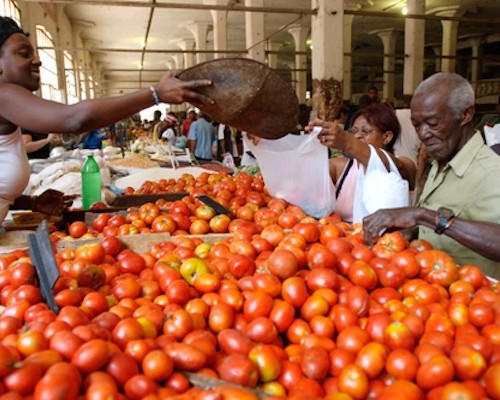
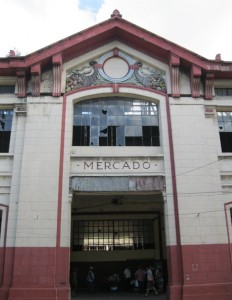
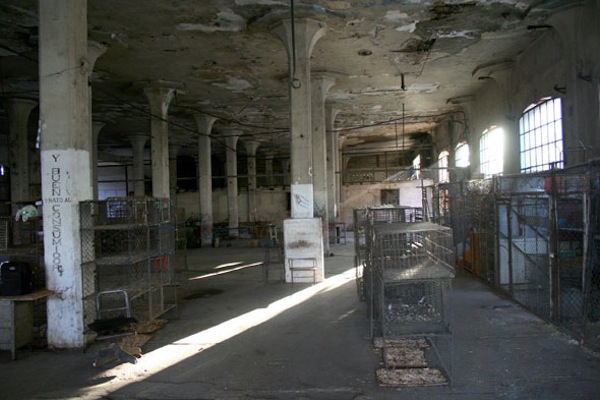
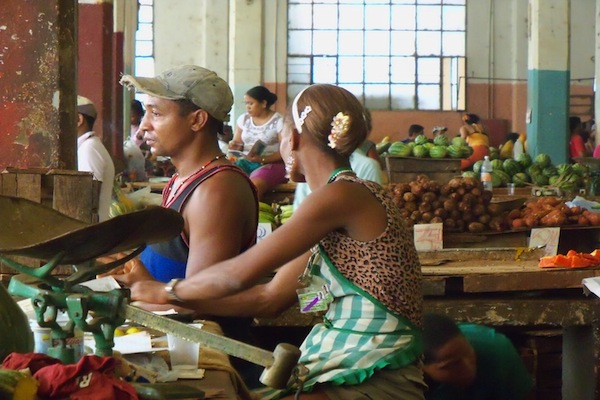
HAVANA, Cuba – The Cuatro Caminos (Four Roads) Market, one of the most important of Havana, and pioneer of the system of supply and demand for agricultural products, will close its doors on 2 February. They already met with the employees and told them the site will undergo “repairs” and that they will be relocated to other farmers markets.
Consumers will see one of the few markets displaying a “true range” of products disappear. And, with one less market, the possibility of a decline in the prices paid by the population for fruits, meats, vegetables and meat products becomes more remote.
The official press insists that the problems of Cuban agriculture are transportation and marketing. They repeat that products do not reach the bodegas because there are so many intermediaries between the producer and the consumer. They believe that the reasons that sweet potatoes, yucca and malanga do not reach Cubans’ tables are paperwork, truckers, and vendors.
Certainly the most inefficient of these intermediaries is the state-owned Supply Company, a bureaucratic monster that has never had enough means of transport nor containers to collect the crops, nor has it correctly set prices for purchasing from farmers, but the Supply Company doesn’t deserves all the blame. continue reading
Failed measures
Recent measures to simplify the links between farmers and consumers have revealed that if the peasant cooperatives themselves carried their goods to the sellers themselves, it would neither widen the assortment of products, nor lower prices.
Under Decree 318 — in force since last December in Havana, Artemisa and Mayabeque provinces — 433 large and small markets were leased by Credit and Service Cooperatives (CCS) and Agricultural Production (CPA). As part of the lease, the cooperatives themselves transport the products to the small markets, and they themselves set the prices for sales to the population.
A recent article in the Granma newspaper (Friday, 17 January) revealed the dissatisfaction of consumers with high commodity prices and shortages at many small markets due to the inability of cooperatives to supply them .
To understand the situation of other ways of managing farmers markets, we headed to El Arroya, a small market located near Jesus del Monte avenue in the municipality of Central Havana.
The upstairs of Cuatro Caminos is already closed
This market is managed as a non-agricultural cooperative. Its employees must buy the products they sell, they assume the site’s administrative costs, and ultimately profits divided among all. But it happens that the main suppliers of this market are several CPAs and CCSs. And according to some of its employees-partners, the supply of these cooperatives is unstable, and the production quality is not always the best.
The other option available to them to stock their stands is to go to the wholesale markets like El Trigo (The Cornfield). But right now, there is no means of transport for it. The day of our visit, all we found at El Arroyo was a few withered pineapples and bananas barely glanced at by the few people who passed by.
From market to museum
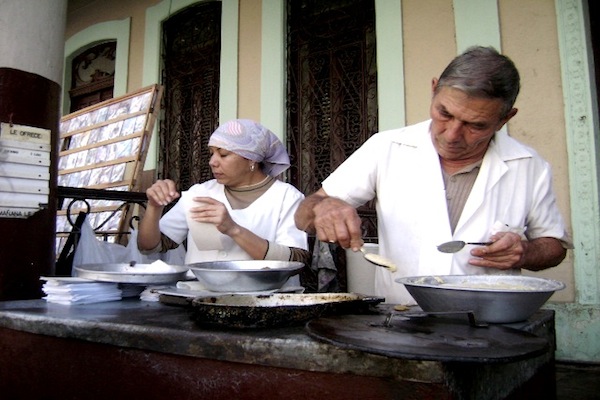
Returning to the legendary Cuatro Caminos Market, one of the few where an ordinary Havanan could — very happily — find fresh malanga to make fritters, and even soursop to make smoothies… It is rumored that the Office of the City Historian, led by Eusebio Leal, has been interested in this site that covers an entire block.
It’s said that the Historian is thinking of constructing a complex of buildings there that, besides another farmers market, will include a museum. For now, consumers will say goodbye to their malanga fritters and, with one less market, the possibility of lowered prices for fruits, roots, vegetables and meat products is even more remote.
For lower prices its necessary to increase competition among the various actors of this network: farmers, truckers, traders. And with the closure of the Cuatro Caminos Market, the most important farmers market in Havana, there won’t be much to hope for.
At first glance, the Community of Latin American and Caribbean States (CELAC) is a laudable mechanism for consultation and integration of the nations located south of the Rio Grande. When it was founded in Caracas in December of 2011, under the leadership of Hugo Chavez, it was thought that it would foster unity among the 33 Latin American countries without the presence of the United States and Canada.
That unifying spirit that transcends the diversity of our region, is what the Cuban government is trying to bring to the Second Summit of the organization, which will be held in Havana on January 28-29. The hosts of this event, like the rest of the continent’s Chavista militant leftists on the continent, yearn for a united Latin American in the ideological environment of 21st Century Socialism, conducive to economic integration within — in the style of ALBA and Mercosur — which favor commercial relations of complementarity rather than competition, and that reject the so-called “neoliberal politics,” and above all that conceive the rivalry with the north through the compass of its foreign policy.
More precisely, the attitudes towards trade, economic integration, and the view of the United States, are some elements of diversity that could bury the consensus. Because a negligible portion of Latin Americans believe in the benefits of economic liberalism, competition, and openness to foreign capital. Also, they contemplate the United States and the European Union as suitable partners with whom to sign free trade agreements. continue reading
So it is not wrong to say that Latin America is divided into two halves: the integration of the left, represented by ALBA and Mercosur, and moreover the Pacific Alliance, which includes Mexico, Colombia, Peru and Chile, all committed to accessing economic growth and development in the context of the market and free trade.
If we examine the internals of each of these integrationist systems, we get an idea of their real potential. The weakest undoubtedly is the Bolivarian Alliance for the Peoples of the Americas (ALBA). Its existence depends solely on petrodollars from the Chavistas in Venezuela. That is, should Nicolás Maduro and his minions exit Miraflores Palace, the rest of the nations of ALBA would be left like shipwrecks in the ocean.
Mercosur, for its part — not taking into account the strong economies such as Brazil and Argentina — has cracks in its operation. Asymmetries between the small economies Uruguay and Paraguay and the two aforementioned are often spoken of. In addition, at the political level, the Paraguayan institutions have sometimes been out of tune in an environment marked by the leftist affiliations of the other countries involved.
The Pacific Alliance, with advantages
Thus, despite the followers of Castro and Chavez, the Pacific Alliance is now the most powerful integration mechanism seen in Latin America. Its four members, Chile, Columbia, Mexico and Peru, if they operated as one country, would be the sixth largest economy in the world in terms of Gross Domestic Product (GDP) per capita. They also account for 55% of the exports of the Latin American subcontinent.
At the same time, there have been many advances with regard to the free movement of people, as visa requirements have been eliminated for the travel of citizens within the alliance. On the diplomatic and consular side, this integration has enabled the opening of common embassies and consulates, allowing them to provide more effective services to the citizens of the Alliance. For example, the Declaration of Cali — the city where the 7th Summit was held in 2013 — led to an embassy shared by the four countries in Ghana, and an agreement between Colombia and Peru to share their embassy in Vietnam. And the Pacific Alliance is expanding: conditions have already been created for Costa Rica , Panama and Guatemala pass to become members.
Of course an integrationist effort such as the Pacific Alliance has unleashed the wrath of the Latin American far left. In the most recent meeting of the Forum of Sao Paulo, the Alliance was described as “an interventionist approach, opportunistic and anti leftist to attack the sovereignty of Latin American nations.”
The president of Bolivia, Evo Morales, has come to define it as “a geopolitical scheme of the United States to oppose the progressive and leftist governments of Brazil, Argentina, Uruguay, Bolivia, Venezuela y Ecuador.”
So when the Havana Summit insists on fighting hunger and poverty, regardless of the apparent consensus, it is likely that each of the halves think of a different way to accomplish the charge. And while ALBA supporters and some of the Mercosur supporters need their leaders to remain in power forever, the Pacific Alliance recommends alternating in public office, a key element for the rule of law.
Diario de Cuba, 22 January 2014, Orlando Freire Santana
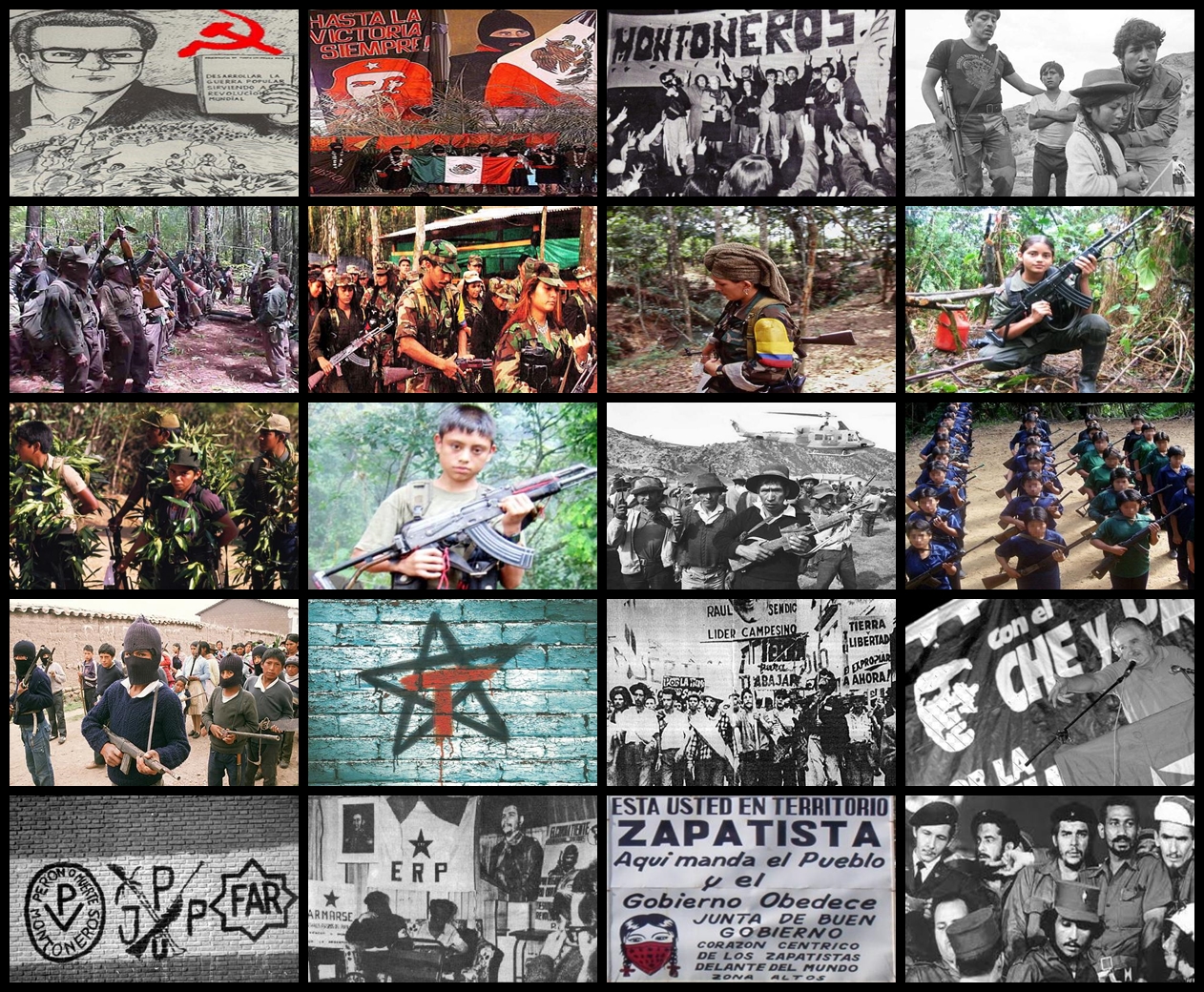
If we calculate the victims and the economic losses caused by the creation of guerrillas in the world, starting with the coming to power of Fidel Castro, particularly in Latin American, how many deaths would they be guilty of over the more than half century that some conflicts have endured like the one in Columbia, which still continues? How much have the economies lost in those countries? However, you have to hear the Cuban government presenting itself as victims to understand the shamelessness of the State that has always been their flag.
That our people have lost their children is entirely the fault of Fidel Castro. That the Cuban economy is a zero, is the fault of his inefficiency. Starting from 1959 in the last century we are one of the people with the highest emigration per capita, it’s the fault of the dictator, sinking us into misery and despair. continue reading
In recent years they have make an inventory of what has been lost because of the U.S. economic embargo (with the intention of justifying their own inefficiency), which according to them is more than a billion dollars. With this we couldn’t even begin to pay all the damage that has been caused to other countries, with regards to liquidity, because on the moral and human site it’s priceless; without quantifying the damage to Cuban society, its families and the economic side, which will have to be suffered for many years to recover, at least what was achieved in 1959.
The Cuban people have learned to listen to the “complaints and apologies” of the government while remaining silent. They know they have to choice, that things could get worse it they thought, calculated, and not match those numbers and causes of totalitarianism that has a particular mathematics and logic. At least it can’t be denied that they have learned if not which side lives better, at least which side doesn’t live worse.
The infamy is that we don’t know whether to laugh or cry when we see the commissioners cynically defending the debacle of a government that has systematically drowned us for half a century. On the TV screen I see them speaking at the UN or in Geneva, and try to guess if they’ve convinced themselves of what they are saying. In any event, they exaggerate so much in order to hide the visible, that it’s impossible to believe them.
we can’t forget that even Nazism had its defenders, and the dictators in the Americas do as well. There will always be the satrap interested in the power on offer. And of course, there will always be the dignity of those who risk their lives to confront them.
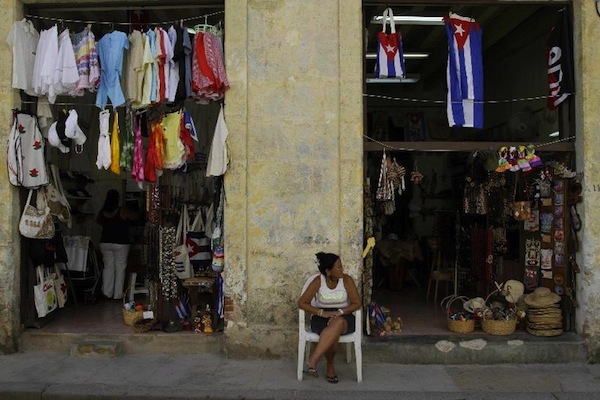
HAVANA, Cuba – The echoes of the unfair audits of the Declarations of Personal Income haven’t even faded yet, nor have the prohibitions of the marketing of imported household objects and clothing, and government action again threatened to overshadow the horizon of self-employment.
An extraordinary issue of the Official Gazette of the Republic of Cuba just appeared, containing Decree Law 315. The document, among other things, describes several of the offences that the self-employed could commit in the exercise of their work, among them the marketing of goods or services not contemplated in the descriptions of their respective occupations.
For some weeks now, as a preview of the Decree Law, the Ministry of Labor’s municipal authorities have been visiting the self-employed to ratify what they can and can’t do in the context of their occupations. These meetings always end with the signing of a document by the person visited; a signature that attests that the person has been warned about what could happen to them if they depart from what is established. continue reading
Many think it’s the classic “closing the barn door after the horse bolted,” and so avoid situations like those presented by activities now presented. Without denying this hypothesis, others point to the government’s intention to put roadblocks in the way of the prosperity of the self-employed beyond the expected standards. Something similar to the barriers they apply — through progressive taxes — to discourage the hiring of more than five employees.
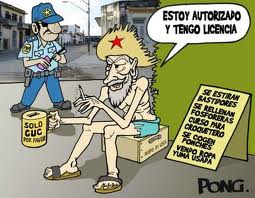
With the idea of delving into this topic, we decided to go to the meeting of two self-employed workers who see their opportunities limited by the dispositions of Decree Law 315. One of them Giraldo, is a builder, who raises walls brick by brick, who designs buildings’ water systems, or gives the final touches to a home’s electrical system. However, his self-employment license classifies him only as mason. Therefore, when they visit him they insist that he’s licensed as a mason and not as a plumber, carpenter or electrician.
Every one of these occupants has its specific license, and of course Giraldo, who must pay taxes as a mason every month, even if he has no work, can’t apply for three or four licenses. This forced specialization, according to Giraldo, could close the doors to certain contracts.
I’m authorized, I have a license
Fernando, for his part, is licensed to teach English. But because he is an expert guitar player, and because some of his students are also interested in learning this musical instrument, he could teach both simultaneously. But the authorities clarified to him that he couldn’t do it while in possession of a single license. In his case there’s the additional problem that the activity “Teacher of music and other arts,” is not taxed by the simplified rules like Language Teacher, but under another that imposes higher taxes, as well as requires the dreaded Affidavit at the end of the fiscal period.
This is, in short, new evidence that, rather than a strategic option of development, the flexibilization of self-employed work, and the remainder of the Raulist changes, are simply tactical maneuvers that seek to adjust Castroism to the current circumstances.
 A crowd was waiting outside the mansion in Vedado with a statue of Abraham Lincoln in the garden. The language school opened its doors to new registrations and in the days that followed tested the attitudes of those interested. Everyone waited nervously, thinking that they would be evaluated on a pronunciation here… a mastery of vocabulary there. To our surprise, the main questions weren’t about language, but rather alluded to politics. By mid-morning a young woman who had been rejected warned us, “They’re asking the name of the first secretary of the Cuban Communist Party (PCC) in Havana.” We stood there mouths agape, who would know that?