Community of Latin America and Caribbean States / Rafael León Rodríguez

Image from http://www.adelante.cu/

The Second CELAC Summit ended in Havana this January 29th with more pain for Cuban protestors and the population than glories for the anti-democratic authorities, despite the praise received by the hosts of the for the most part satisfied and grateful visitors from Latin America and the Caribbean.

A few leaders from the hemisphere saved the dignity of democracy and in their speeches valued the human rights of all and for all. But the highest note hit in this regard was that of the Secretary General of the United Nations, his excellency Mr. Ban Ki-moon, during a press conference, in which he pointed out some details of his conversations with the patriarchs of the island. In these, he said, he referred to the ratification of the United Nations Covenants on civil and political and economic, social and cultural rights by the Cuban government, who already signed them in 2008, and invited them to advance the theme of human rights in general.

The estimable presidents, prime ministers and Heads of Delegations at the meeting forgot, apparently, that on 11 September 2001, in Lima, Peru, the representatives of their governments in those moments, signed the Inter-American Democratic Charter, which in its Article 3 states:

“There are essential elements of representative democracy, among others, with respect to human rights and fundamental freedoms; the access to power and its exercise and its exercise within the rule of law; the celebration of regular, free, fair elections, based on universal and secrete suffrage as an expression of the sovereignty of the people; the plural regime of political parties and organizations; and the separation and independence of the public powers.”

It is not a coincidence that the Cuban regime is the only one among the 33 that make up CELAC that doesn’t recognize the political opposition in Cuba; discriminated against those who disagree with its authoritarian practices; arbitrarily detains peaceful opponents; violates the rights of assembly and peaceful association, among many others and maintains a real totalitarian power over society. The members of CELAC call this permissibility “unity in diversity” to save the consequent ignominy.

Another intelligent and interesting figure used in the statements and in the founding texts of CELAC, to justify the status quo of some undemocratic regime participants is that of “non-interference,” which on occasion converts, somehow “respectful of the sovereignty of others” into complicity with totalitarian states. Thus, in the Proclamation of Latin America and the Caribbean as a Zone of Peace, in point 3 it points out:

“The commitment of the States of the region in strict compliance with their obligation not to intervene, directly or indirectly, in the internal affairs any other state and observe the principles of national sovereignty, equal rights and self-determination of peoples. “

Some sectors of Cuban civil society wanted to conduct a meeting where citizens of different political viewpoints would analyze the founding documents of  CELAC. This has not been possible, to date, because of the action of the political police. If the authorities of the island, as would be logical, issued the Declaration of Havana in full, so that it could become known by Cuban citizens, then we, the opponents, would have one more document to discuss and on which to rule democratically. Let no one doubt it.

1 February 2014

Impossible Zone of Peace / Rene Gomez Manzano

Represión-en-Cuba-a-disidencia-política_EFE-300x200
Repression of a political dissident in Cuba. Source: EFE

HAVANA, Cuba – In the last several hours the Castro propaganda campaign has come to a climax on the occasion of the Second Summit of the Community of Latin American and Caribbean States, which will be held in Havana between today and tomorrow. Of course this focus is justified if we consider the swaddling this event implies for the totalitarian regime in Havana.

Meanwhile, the independent press informs us about the intense reservation exercised by the Castro government against all of society. Even beggars and pimps have been affected by the delirium of the conclave. Many of them are warned that, during the great event, they should abstain from exercising their ancient craft.

On a slightly more serious note, it should be remembered that several documents have been agreed to within the CELAC framework. In one of them, dating from just a year ago, it reiterates that this Community is based on, among other things, “the protection and promotion of all human rights, the rule of law at the national and international level and democracy.” Can anyone believe these beautiful words are compatible with the regime imposed in Cuba by the Castro brothers?

Of course not. But the totalitarians usually get by with ease. We have the experience of the clauses about freedoms and pluralism adopted years ago by the Ibero-American Summit in Viña del Mar. With to what was agreed to there, the Havana authorities commented: The documents signed by Cuba we interpret according to our own conception of democracy. And problem solved!

The fact of the matter lies in that the governments of our cultural environment, who for the most part respect Human Rights internally, don’t allow among their members a regime that systematically violates them like that of Havana, but they even selected it to preside and host its meetings, as is happening now with the CELAC Summit in Havana. Its fig leaf is the supposed “uniqueness of Cuba.”

In the interim, Cuban authorities do a disservice to those democratic states. We hope the world press and the internal press of those countries report on the fierce repression unleashed in the Great Antille; in this case, the respective governments confront certain difficulties. Serves them right! For having tried to patronize the only totalitarian regime in the West.

At the same time, in the context of the Summit, Castro spokespeople have recalled the words spoken by General-President Raul Castro in South Africa: “Dialog and cooperation are the way to solve differences and the civilized coexistence of those who think differently.” Events show that this is proclaimed (and applied) in relations between states, not between the totalitarian regime and its subjects.

Meanwhile, Deputy Foreign Minister Abelardo Moreno, told the newspaper Granma a supposed new important aspect of the Havana Summit: “We believe that another contribution is the proclamation of Latin America and the Caribbean as a Zone of Peace. This is a proposal that we hope will be adopted during the 2nd Summit by its 33 member countries.”

That’s the way it is! And I thought that CELAC had already solved this in the Declaration of Santiago, agreed on in Chile a year ago! Its Point 14 establishes: “We commit that the climate of peace that prevails in Latin America and the Caribbean be strengthened throughout our region and consolidated in a Zone of Peace, and which differences among nations are resolved in a peaceful way through dialog and negotiation or other forms of solution, and fully consistent with International Law.”

Meanwhile, Foreign Minister Bruno Rodríguez Parrilla, at a press conference, affirmed that in Cuban there is no need to hold a summit of the peoples, as is generally held in other latitudes on similar occasions. For him this is because, according to what he said, the delegations meeting in Havana represent the governments as well as the masses.

The minister didn’t say what principles of Bolshevik alchemy apply now to make this happen. Surprisingly, such a thing doesn’t happen when these meetings are held in other sites, where, in the opinion of the radical left, it is necessary that in parallel to the official meetings, there is a Summit of the peoples.

Cubanet, 28 January 2014, René Gómez Manzano

The Latest Gamble / Fernando Damaso

Taking advantage of the presence of foreign journalists, politicians, investors and numerous visitors on the occasion of the Second Summit of the Community of Latin American and Caribbean States, in the days leading up to it and even during the summit itself, the Cuban government has deployed a massive publicity campaign, using all the available media, about the so-called “achievements” of its socialism, particularly in healthcare and education, as a means of trying to attract foreign investment in the Mariel Special Development Zone, through continuous messages, interviews and statements, assessing their multiple advantages. Ironically, this port that was used in 1980 as an exodus point for 123,000 Cubans, is now offered by the same authorities to welcome foreign capital, tax-haven included.

The result of a collaboration between Brazil and Cuba — with the first providing capital and the latter direction the construction — the Mariel Special Development Zone is betting on the displacement in the region of super-vessels, once the expansion project gets underway in the Panama Canal, and the need for deep water ports, modern port facilities, as well as the location of manufacturing plants within the port properties, with special tax treatments.

Undoubtedly, the Brazilian investment is more for “the day after” than for the present, with the objective of assuring an important economic presence in the Cuba of the future. The current statements are only a part of the “third world stage setting” so fashionably right now, where it’s the style to resuscitate the heroes of independence, in order to serve as “moral guarantors” for the politicians.

Another element to take into account is that its importance will only materialize of the United States eliminates the sanctions currently imposed on Cuba, including the so-called “blockade.” Without this it would be very difficult to attract super-vessels to this Cuban port, and even more so the foreign investments in manufacturing plants, whose products could not be sold in the United States. And so it’s easy to understand: this is a gamble with a great deal of uncertainty.

If we add to this the possibility that the next president of the United States will not be a Democrat but rather a Republican, do to the loss of acceptance among the citizenry of the current leader because he has failed to fulfill many of his campaign promises, the panorama becomes even more complex.

In any event, the gamble is already made and here, fortunately, there is no stepping back, because the capital is Brazilian and also has its interests. It only remains to pray, cross one’s fingers and hope it comes to pass, because for Cuba, discarding for now the false illusion of finding oil, it’s the only potential economic effort that can help us overcome the crisis in the near future, as long as the benefits reach down to ordinary Cubans and don’t remain solely at the heights of power and those who surround it.

31 January 2014

No One Wants to Talk About CELAC / Lilianne Ruiz

Police on the Malecon -- Havana -- internet
Police on the Malecon — Havana — internet

HAVANA, Cuba — The morning of the 28th, there were fewer people on the street than any other Tuesday.  Also it was notable that the flow of cars on a street as central as 23rd, in El Vedado, had diminished.

Who can find out what is in the heart of the Cuban people, subjected to political propaganda 24 hours a day?

The Malecon, almost deserted.  Two twenty-somethings talk about the Summit of Latin American and Caribbean States (CELAC) as an opportunity for Latin American integration. They speak of the collective, not of the individual. They said that it is about “an opportunity to show the world how much we have tried to rectify some things.”

A man of 40 complains that beer is missing and he associates it with the international event.

Going down O street, another man of 30 laments that the host only tries to fix how Cuba presents itself and accepts that there is another invisible part in permanent crisis. He is not aware of the alternative Forum that the opposition was going to hold that same day.

No one agrees to say his name.

Also on O street, between 15th and 17th, there is an artisan fair, selling the same things as always: pieces of wooden sculpture, costume jewelry of nickel and bone, stamps with the Cuban flag, berets and t-shirts printed with the Korda photo of Che Guevara. But no seller wants to talk to me of his expectations with respect to CELAC. Only one customer, a native, says that he hopes the economic situation will improve.

Leaving the fair, a lady signals me to look some meters away at a man dressed in plainclothes who does not move from the corner. She explains to me that he is part of the State Security force that watches over the CELAC Summit. Every once in a while the man gets out a radio transmitter-receiver and speaks; he seems to be reporting what is happening around him. For a minute I think that I am going to meet with Manuel Cuesta Morua in the dungeons of the Fifth Police Station.

Young women, dressed in the olive-green uniform of the Ministry of the Interior and orange vests, appear on some corners, alternating with the uniformed officers of the PNR (People’s Revolutionary Police). These latter are not too remarkable because they are a daily presence in the streets, patrolling.

A system that requires individuals to deny themselves to be able to survive, in a society that punishes non-conformists, is being irrigated with the impunity that it is granted by 33 regional heads of State, the secretary general of the UN, Ban Ki-Moon, and the Organization of American States, Jose Miguel Insulza, silent about the indefensible situation in which the Cuban people live in matters of civil and political, economic, social and cultural rights.

The internal opposition had conceived of Democratic Forum II in International Relations and Human Rights, as an event parallel to the CELAC summit, a Forum that yours truly should attend. The political police incarcerated the leaders and organizers, and in that way the project was dismantled.

According to information offered by the Cuban Commission of National Human Rights and Reconciliation (CCDDRN), more than 200 arrests have been reported in the last days, some in the nature of house arrest and others in police jail cells, throughout the whole Island.  In all the cases it is about arbitrary detentions to restrain free movement or to impede the activists from meeting.

If they insist on selling again the idea of socialism as a panacea for eradicating poverty, Cubans from the Island have something more to show the world: not only the devastated country, police control, State violence, but also our souls which have been still more poor — practically incapable of understanding and defending themselves — after 55 years without the desired liberty.

Cubanet, January 29, 2014, Lilianne Ruiz

Translated by mlk.

The Cuban System Isn’t That Absurd / Angel Santiesteban

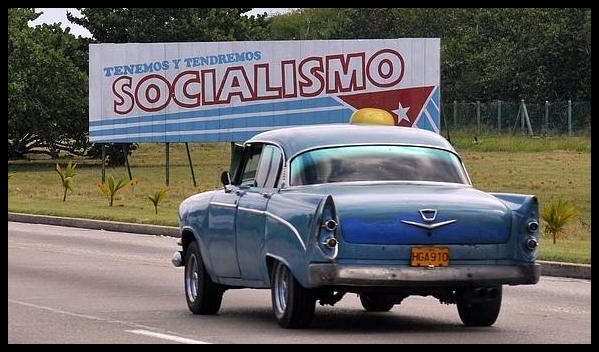
Slogan on billboard is “We’re doing fine.”

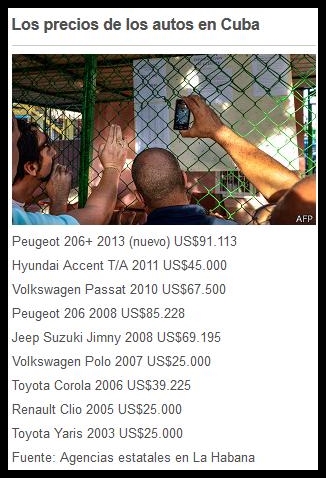
There are few times in a nation’s history when the inhabitants of a country agree unanimously. Now with the prices of cars for sale, one of those scant opportunities has occurred.

Many have drawn upon Kafka, Cortázar, and Virgilio Piñera, but I guarantee that this is even further removed from reality.

The first question Cubans ask is if the person who has enough money to waste on a car would be able to go in person to the sales agency, since they know that they would be captured there. If no one, with the highest salary possible, can save this money, then it necessarily means this is black-market money from some lucrative business, like drug trafficking. You would have to come to the conclusion that the cars are a special offer for these traffickers, and an offer of paradise for prosecutors, the most unequal in the hemisphere.

We have and will have socialism

Cuba is a plaza for criminals, prohibited for honest Cubans.

Ángel Santiesteban Prats

Lawton Prison Settlement. January 2014

Translated by Regina Anavy

29 January 2014

Raul’s Reforms Turn us Into Lice / Jose Hugo Fernandez

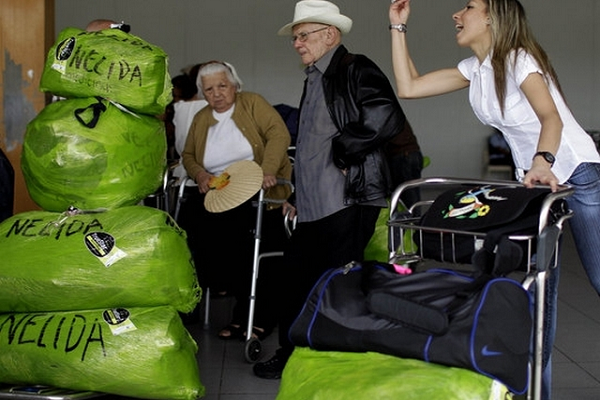
Cuban-Americans arrive at Havana; photo taken from the internet

HAVANA, Cuba — The announcement of new email and internet navigation services that directives of ETECSA — the state (and only) telephone company in Cuba — have just made public confirms the regime’s tendency to design each measure of its “progressive reforms” having always as their objective the Cubans of the diaspora.  In recent times not even a single economic liberalization has been produced that is not based on the money of Cuban emigres, and the success of which does not depend entirely on them.

The circumstance is paradoxical: those whom our bosses obliged to flee from the country have become not only one of the main sources of economic sustenance for its power, but also the cornerstone of a new political strategy with which they today try to clean up their image before the world.

Any barely awake observer could take the fact as a key in order to understand the failure of the Revolution. And not only that. Also to corroborate the outrageous nature of the so-called Raulist reforms, delineated in order to manipulate international opinion, while they exhibit scorn and disrespect towards Cubans, whether they live on or outside of the Island. continue reading

Should we then reject the measure?  Each with his skin makes drums.  I approve it, in spite of the regrets. And in agreement with the first reactions that I have observed in my surroundings, it seems that there are many in my case.

That leads to another paradox: in the same way in which our bosses adapted the people to depend almost absolutely on their guardianship, today, now that the systemic crisis keeps them from continuing to adopt us as foolish children, they pass the hot potato to emigration. “But, look, only in respect to economic dependency, without making any allowances in the political field, and counting a priori on those who here or there are going to come along for the changes without changes that they (the political elite) are planning.”

A friend, with whom I conversed about the matter, commented in jest that the best thing that President Obama could do right now to support our aspirations for democracy and progress is to sign an exceptional decree giving salary increases for all Cubans who live in the United States.

It is a joke that also contains a paradox, and a very serious one. Thanks to that delusional decree signed by Obama, emigrants and exiles could continue being the support of the Raulist “progress” which, sooner rather than later, will turn against the regime itself, because each step, however minimal and mediocre it may be, opens a gap through which people from here look, explore and know the real world, something that without a doubt will end up changing their expectations.

That, it is clear, should not keep us from visualizing a last paradox, or two, the saddest:

1) It’s unfreakingbelievable that after confronting the drama that emigration or exile implies, those on the other side have to break their backs in order to supply even the minimum necessary for the relatives who remain here.  2) It shakes this metamorphosis that they have imposed on Cubans on the island: we’ve been transformed from from measly parasites of the State to useless parasites of our loved ones.

We now know that the Cubans of the future will not be like Che, but will we be able to avoid in time becoming like lice, after having permitted parasitism to become a trait of our national identity?

Cubanet, 29 January 2014, Jose Hugo Fernandez

Translated by mlk

Farewell To Revolutionary Sport / Angel Santiesteban

Life gives us the opportunity to use it at the whim of our possibilities of talent, for personal gain. In life we engage in a search for what we can be as good professionals, if it makes us happy to do it, and in doing so we discover that we add glory to the society around us, and we make our family proud. This is the perfect formula to feel fulfilled, amen, if we are also well-remunerated.

The outstanding sportsman, Lázaro Rivas, ¨Illustrious son of de San Nicolás de Bari,” could feel like that (except for feeling well-remunerated). He gained the world title in his weight class, in Greco-Roman wrestling, among other awards. He brought glory to his town and to Cuba, until his official retirement in 2011.

In recent days he disappeared physically as a consequence of a brawl with another sportsman. His family members came to say goodbye to his body, as did two trainers and some friends. The corresponding sports officials were not present, nor was the government. That was, in sum, the gesture of gratitude that the State awarded him for his efforts.

The precarious infrastructure on which sportsmen count is no secret to anyone, above all those at the bottom layer, to accomplish their feats. Your would have to appreciate more their human capacities and persistence to achieve such rewards, a great part of those being at the top and refusing opportunities in professional sports where they could earn large sums of cash, the only thing that would guarantee them economic sustenance after the official retirement pension given by the Cuban authorities.

I was witness to seeing the legendary boxer, Teofilo Stevenson, roaming the city to find ingredients for a sancocho (a type of soup), that some shops kept for him, to feed the pigs that he raised in the swimming pool of his house. He also participated in the familiar theater of pleasing foreigners who visited him and were itching to pose for a photo with their idol, after coming to an agreement to pay 100 euros, to put on the table some bottle of good whiskey, and in the best of cases, moreover, invite him to a restaurant, to obtain this souvenir.

The also distinguished fighter, Félix Savón, has had to accept this manner of survival. Visitors leave with his photo and a gesture, or a stench of knowing that their admired gladiators live off handouts. I got to know a Czech who visited them. Many ballplayers live off public charity; they eat and drink at the expense of their fan club.

Thanks to the opening of the State, above all in baseball, those older players with fewer performances are permitted to go to small clubs that can pay for them in some way, either as athletes or as trainers, so they can live of their savings, some years without destitution.

Among them are the pitcher Lazo, today contracted by a club in Mexico, and before that Victor Mesa in Japan. At least the most distinguished athletes have that opportunity of survival. The others, those whose names have been erased from the collective memory, today are ghosts lost in society, sons whom no one wants. That’s the destiny that revolutionary sports assures.

We would say that a large part of the most talented have made the most difficult decision: to abandon their country and their families, without knowing when they will return. A sad fate for Cuban sportsmen.

Ángel Santiesteban-Prats

Lawton Prison settlement. January 2014

Translated by: Shane J. Cassidy and Regina Anavy

10 January 2014

CELAC Summit in Havana: The Regime is Cashing In / Ivan Garcia

E4CABC98-3159-402E-9759-7B8430EF074F_mw1024_n_s-620x330Under a warm sun and unusually cool breeze, a worker puts the final touches on the exterior of PABEXPO, an exposition and meeting center of 60,000 square yards, located in the Siboney neighborhood, to the west of Havana.

There, from Saturday the 25th to Tuesday the 29th of January, experts, foreign ministers and presidents will meet at the 2nd Summit of the Community of Latin American and Caribbean States (CELAC).

The tourist group Cubatur S.A., obviously, is the most favored. Two weeks ago, in a document from the Minister of Foreign Relations loaded to the internet as a PDF, offers detailed information.

It consists of 116 pages and is titled Operations Manual for the 2nd CELAC Summit. The Cuban Organizing Committee offered free housing to every Head of State, one of the Foreign Ministers and another to the Head of the Delegation to the Meeting of National Coordinators.

Six other rooms, guaranteed at the same hotel and floor established for each attending country, will be paid by the delegations requesting them. The prices range between 170 and 340 CUC per night, in the case of doubles, and include transportation from and to the airport, breakfast, internet, and personalized assistance. If they want rooms superior to the standard, the price will be higher. [Ed. note: The CUC, Cuban Convertible Peso, is pegged one-to-one to the U.S. dollar but exchange fees increase its cost to about $1.10.]

Six hotels have been selected for the invited VIPs. Three five-star hotels (Hotel Nacional, Meliá Cohiba and Meliá Habana) and three four-star superior (Hotel Quinta Avenida, Occidental Miramar and Panorama).

Some 2,500 to 3,000 foreign reporters are expected to return. At their disposal there will be twelve hotels with room prices ranging from 90 to 400 CUC a night.

Cubatur also will make bank renting cars or other types of tourist transport. For three to six days an economy car will cost 51 CUC a day, a premium model 181 CUC and a van 185 CUC. continue reading

The organizers are offering six vehicles to each delegation. The foreign press and other participants will have to pay “an adequate collective transport.”

ETECSA, the only Cuban telecommunications company, will also have its harvest. Calls within the island cost 0.35 CUC. To the United States or another Latin American country, 1.60 CUC (to Venezuela is 1.40), and 1.80 CUC a minute to the rest of the world.

To install a fixed telephone line, ETECSA will charge 100 CUC, plus the price of the calls. The cost of renting links to navigate the internet depends on the speed. If it is 64 Kbps, the participants will have to pay 150 CUC for the installation plus 7 CUC a day.

For the fastest connection, at 2,048 Kbps, the installation price rises to 200 CUC and the daily cost of service is 186 CUC.

In addition, ETECSA will charge one convertible peso for every sheet received by fax, while an hour of access from PABEXPO will cost 4.50 CUC, the same price we Cubans pay when we go to a state internet room.

The media who intend to use a satellite phone will have to pay a 1,000 CUC license fee, and if they want satellite Internet the figure doubles. The current regulations in Cuba establish that it is mandatory to obtain a credential to work temporarily as a journalist in the country at a cost of 100 CUC, with the exception of the Presidential Press, which will receive credentials from the Organizing Committee.

The Cuban Institute of Radio and Television (ICRT) will charge 200 CUC for an hour of editing, including the editor, and the same fee for an hour of using a transmission position. According to a source from ICRT, the multinational Telesur, financed with Venezuelan and Ecuadorian capital and Cuban advice, is exempt from these payments. And, in addition, it will also have privileged locations in the conference rooms.

A consulting economist estimated that the CELAC SUMMIT, in barely a week, fattened the coffers of the regime with between 180 and 220 million dollars. Not bad for some finances in the red.

25 January 2014

Traitors to the Thinking of Marti / Angel Santiesteban

If José Martí warned that “capitalism is the superior phase of slavery,” how can those who belong to the Communist Party, beginning with Fidel Castro, call themselves followers of Martí? It’s no secret that when the Comandante of the bearded ones came to power he said on several occasions, in Cuba and in the United States, that the Revolution was not communist, that this possibility was a campaign to discredit them.

Caption on video: “I’ve said very clearly that we are not communists.”

Videos exist where he denies he’s communist. And from night to morning, he declares the Marxist character of this social movement that catapulted him to power in the nation. I always wonder how great the despair of Cubans was that they forgave him and followed all his nonsense. Of course many glimpsed what would come and so resigned, like Comandante Huber Matos, Eloy Gutiérrez Menoyo, William Morgan, among others who were disillusioned that after putting their lives on the line, they understood they had been betrayed by personal ambition. continue reading

Fidel Castro never put the people before his insatiable appetite for power. All the social power that at first he obtained was to mask his image of a dictator. Above all because then, economically, we didn’t depend on our own attempts, on the skill of investments, but we did have the teat of the Soviet Union and the rest of the socialist camp to satisfy his insanity and his plans for conquering the rest of the world.

If those countries didn’t exist who shared “ideology,” his mandate to govern wouldn’t have lasted more than five years, precisely by the great defect of not knowing how to listen to his specialists, to those who were suddenly removed if they didn’t agree with his dreams and his inconsistent, baseless mega-plans that always ended in failure.

Knowing this defect, his “collaborators” became adulators who lied in order to continue receiving the benefits of power. In spite of everything, he has been a brilliant manipulator who knows where to get resources for staying in power, now making his brother, Raúl, head of state.

At the end of this cursed cycle, the only thing that assures us is that José Martí is renewing himself, that his prophecies acquire more timeliness, and that for many years the Cuban people have been slaves, surviving in order to continue breathing, always scared of being whipped by the officials for any criticism or demand for improvement. We are a people basically seeking refuge in being run-away slaves, dispersed throughout the hemisphere.

Let’s hope that this 21st century will be prosperous for the Cuban nation and reunite its families, and that we will be capable of achieving a free and democratic society that assures and balances the needs of its people.

Ángel Santiesteban-Prats

Lawton Prison Settlement. January 2014

Translated by Regina Anavy

25 January 2014

We’re at the Summit! / Eliecer Avila

Outside the government press, how Cubans experience the CELAC Summit.

As often happens with more or less important events that take place in Cuba, all of the radio, TV and written press is focused for days on the preparations undertaken to guarantee the success of the 2nd CELAC Summit.

According to the images shown, it’s clear that there have been important investments in preparing locations, the purchase of equipment and all the paraphernalia demanded by the protocols for the occasion.

Meanwhile, on the streets, the corners of the neighborhoods, and inside their homes, just about every Cuban speaks of nothing but CELAC. Which is logical. No one sees in this merely political instrument any kind of practical benefit for daily life.

Similar news coverage filled the screens and the presses didn’t do much to convey to us the daily sessions of the of the World Festival of Youth and Students in Quito-2013. The event left the country with tens of thousands of dollars spent and zero real gain in any area of daily interest.

Now, the press, or the government, announces with special emphasis another meeting where integrationist and anti-imperialist — or more to the point, anti-American — speeches will be delivered, leaving another million dollar bill for Cuba and nothing concrete for Cubans.

If we calculate how many kilometers of highway could be built, or how many buildings could be repaired, or how many buses could be bought with what is spent on the interminable list of international events that the government sponsors every year, and we can imagine how much we might advance of the State’s priority wasn’t, exclusively, politics.

However, interventions, at least rhetorically, have their attractions. They will speak of “brother countries and peoples,” but in practice none of our “brothers” will stop asking us for visas, letters of invitation and exceptional guarantees that make it ever more difficult to complete the paperwork to be able to visit them.

We are very special brothers, however, Venezuelans and Cubans. The rulers just say we share 99% of our genetics, but at the level of the people — with the exception of those who join official missions and travel to the country for this work — we carry ourselves like the most distant strangers. Anyone would think that a decade earlier with the fervor around bilateral relations, today we would have something that seems like a treaty of free movement of citizens, by which a Cuban family could decide to spend a week traveling in any Venezuelan state or vice versa.

This could be extended to Bolivia, Ecuador, Argentina or Brazil. In fact, among the South American countries there are mechanisms that favor mobility, employment, trade, regional tourism, communications, etc… But Cuba, or rather the people of Cuba, continue to be isolated and absent in these concrete and palpable realities; although from within our oyster, we are surrounded by a sea of “defensive” barriers, and we continue to pretend to be the most normal country in the world.

Outside of summits and rare brotherhoods, the issues that in reality concern us beat more strongly than ever; issues that the national press, concerned about official communications, not speaking or doing it in an imperceptible way: the grotesque mockery represented by the issue of car sales, the state crusade against the sel-employed, the ever more

The list is long, but the patience of a people who accept a government with a political agenda totally divorced from the their most pressing needs and aspirations seems even longer.

Diario de Cuba, 27 January 2014, Eliécer Ávila

CELAC, A Meeting with Absolute Power / Anddy Sierra Alvarez

This time Cuba is the president of a young organization with ideas of uniting Latin America and the Caribbean. In its second summit, held in Havana, the government leaders faced a question: Will Latin America and the Caribbean be a unified movement, similar to the Soviet Union?

One of the visible purposed those countries have is to distance themselves from capitalism and latch on to the example of a government that will go down in history as the most manipulative and lying government in the history of humanity, “that’s saying a lot, but it’s the reality.”

To avoid at all costs exporting any benefits that don’t belong to the government, declaring that it is a resource invested in the people, but it’s true purpose is to enrich itself with greater eternal power.

There will be a lot of dialog and agreements undertaken at the meeting, everything always rose-colored by the state mass media, no disagreements will come to light that could concern the followers and trumpeters of the Castro “promise.” So far the only thing he’s accomplished is keeping his beard as symbol of having accomplished nothing in Cuba.

27 January 2014

Queen-Brand Pots, Chinese Refrigerators and the Little Gas Cylinder / Gladys Linares

Hornilla-casera-de-carbón_foto-cortesía-de-la-autora-300x200HAVANA, Cuba, January, www.cubanet.org — With the change of domestic appliances in the so-called energy revolution devised by Fidel Castro, there began for us a series of problems that each day gets worse.

We were warned to exchange old Russian refrigerators and air conditioners, or American ones from the pre-“revolutionary” era, for Chinese equipment supposedly of lower energy consumption, payable through a bank credit that people are paying off still today.

During that period they also sold, in certain locations, fans, water heaters, electric stoves, rice and multipurpose cookers (the so-called Queen brand pots), at the same time that electric rates were increased.  The gas sale cycle for these families was extended to six months for each 20 pound drum (the so-called “little balls”) “just in case some day the electricity flow is interrupted,” which happens quite frequently.

Due to their poor quality, these pieces of equipment quickly broke, and the shortage of replacement parts has obliged Cuban families to adopt different alternatives in order to be able to cook.  Some do it with charcoal; others buy a gas cylinder on the black market. continue reading

Such is the case of Erlinda, who has prepared a little charcoal stove although she complains that sometimes it is difficult to get one; with much difficulty it can be bought on the black market.  She says that now she knows the cause of its scarcity: according to what she read in the Granma newspaper of January 14, charcoal is an export item.

Refill hose for cylinders  -- photo courtesy of the author
Refill hose for cylinders — photo courtesy of the author

For some, the quota of gas is not sufficient, but they don’t have the money to buy a cylinder on the black market, so they try to get a “shot” (the residue) from a neighbor or friend, almost always emptying one drum to another with the appropriate hose, a dangerous operation that has caused more than one explosive accident costing lives and homes.

A while back, one afternoon, Raudel, a gas courier, tried to help a neighbor in this procedure, and although he did the maneuver in the doorway, someone who was passing at that moment lit a cigarette and everyone ended up in the burn room of the Calixto Garcia hospital.

When Raul Castro, in his speech on December 13, 2012, announced that he was increasing the production of petroleum and gas, a rumor began to circulate that its sale would be freed from the rationing system.  But what no one expected is that in order to consume gas by the pound he would have to enter into a contract with the State to rent, for 500 pesos, an empty cylinder, and only with this could he then get it filled for a price of 130 pesos.

During the eighth legislature of Parliament, the deputies Attention to Services Commission voiced the difficulties presented by the electric domestic appliances and recognized that more than 80% were in disuse.

Near Barrio Obrero, gas transport -- photo courtesy of the author
Near Barrio Obrero, gas transport — photo courtesy of the author

As a “solution” to this problem, the State widened access to the bank credits in CUC, applying the prevailing exchange rate (25 Cuban pesos for 1 Cuban Convertible Peso, or CUC) so that those affected might buy their appliances again and undertake more debt, although they also have the “option” of buying the unrationed gas through contract with the State.

On learning the news, a friend exclaimed:  “I don’t know why they are surprised, if this bloodsucking Government takes a step, or makes a change, or applies a measure, it’s only to suck our blood!”

Cubanet, January 29, 2014, Gladys Linares.

Translated by mlk.