Concerned in Villa Clara About What Is Happening in Venezuela / Alex Reinaldo Perez

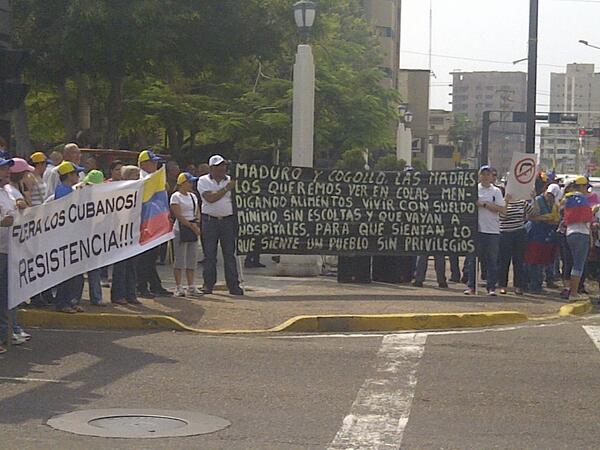
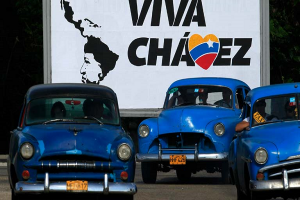
Calles-de-La-Habana-muestran-estrechas-relaciones-entre-los-gobiernos-de-Cuba-y-Venezuela_www.rtve_.es_-300x200SANTA CLARA, Cuba – The demonstrations by students and opponents of President Nicolas Maduro in Venezuela are the news of the moment.

Countless media worldwide are focused on the events. The web is full of videos, images, writing. We Cubans are not unexposed to this; although we only see and hear what the censored media broadcasts.  Remember, we don’t even have free access to the Internet.

While the media on the island catalogs the events as “an intended coup against Nicolas Maduro planned from abroad,” thousands of Cuban families are desperate, fearing for their family members who are in Venezuela. According to official figures, 30,000 Cubans are working in this country.

For the relatives of the Cubans “on a mission” in Venezuela, it’s nerve wracking. They think the national TV reports of Cubans carrying on with their usual activities are false.  “Venezuela is burning,” is the phrase that runs from mouth to mouth in this province.

Concern among the population is striking. People know that the fall of Maduro and Chavismo could strongly affect the daily lives of Cubans.

Loreto del Sol Pérez remembers that during the so-called “Special Period” in the 1990s, high-ranking officials weren’t affected: they monopolized the food supply, fuel, basic necessities, and became the black market suppliers.

Mrs. Omara Diaz says that if the Special Period returns, she won’t be taken by surprise. To the extent her pension reaches, she will buy a few candles for the blackouts. She also commented that she’s looking for the oven her son concocted during the Special Period for cooking with sawdust.

Rafael Villavicencio, retired from the Interior Ministry, said that the events in Venezuela are caused by the government of the United States of America. He added that they were “mercenary actions to prevent the integration of Latin American countries, where Venezuela plays a super important role.”

Meanwhile, Mario Ruano, a retired professor of Marxism and History  concluded that the “coup attempt” is a response by Barack Obama to the “successful” summit of the Community of Latin American and Caribbean States (CELAC), recently held in Havana.

According to the dissident Guillermo del Sol Pérez, Venezuelans taking to street in demonstrations have the view that Maduro wants to implement the regime of the Castro brothers in the land of Simon Bolivar.

The truth is that Venezuela is currently uncertain territory. Cubans are on the lookout for what happens there. When things calm down most of us, ordinary Cubans, still won’t know what’s going on.

Some are asking God not to let Nicolas Maduro cede the reins of Venezuela because they imagine what awaits us if that happens.

Simply that, for elemental survival.

Cubanet, 21 February 2014, Alex Reinaldo Perez

From the Pen of Bradbury, Čapek, Hurtado and Chaviano / Yoani Sanchez

Loving Planet

Among the most precious possessions of my childhood was a collection of science fiction books. Those pages filled long hours of my life, allowing me to know other worlds and to escape — at will — the flat reality. My sister liked the tales of far off planets, space ships and extraterrestrial civilizations. I preferred the possible fantasies, that left me with the feeling that at any moment something could happen: Time travel, genetics-manipulating scientists and creatures rescued from yesterday were my favorites.

From the pens of Karel Čapek, Isaac Asimov, Daína Chaviano, Stanislaw Lem and Oscar Hurtado, my adolescence was a time enlivened with robots, humanoids, fairies, flying saucers, and remote galaxies. Several compilations of the genre had been published in those years, in editions with yellowed pages and cramped typography. On our bookshelf there was a place of honor for The Martian Chronicles, Quick Freeze and The Call of Cthulhu, the great stories of Ray Bradbury and the novel The Space Merchants. Those books for us were like doors to another dimension.

The 23rd Havana International Bookf Fair has brought a selection of science fiction authors. On the Cuban side José Miguel Sánchez (Yoss) stands out, while the foreign author of greatest note is the Russian Serguei Lukianenko. Absent, however, are the great titles of the last decade in a genre that keeps evolving and attracting readers. The reason for such a failure is the lack of many local publishers’ economic capacity to buy the copyrights from foreign writers. There is also a certain underestimation of the genre, which has failed to find a place in the annual plans of what is printed and promoted.

20 February 2014

Details of Insularity / Angel Santiesteban

Historically, we Cubans have been separated politically, and although diversity is healthy for free thought and democracy, we have been marked by the extreme of what we wish to attain and defended it at all costs.

José Martí never was understood by those upper military leaders who accompanied him, and his death, in a certain way, was caused by them. Before, Carlos Manuel de Céspedes also had his political enemies inside the mambisa rebels, until he was removed as the President of the Republic in Arms, and replaced with Salvador Cisneros Betancourt; then they left him alone and without protection in San Lorenzo, and there is a version of someone confessing at some moment that it was a betrayal of the high command of the insurrection.

Political struggle has been a constant in Cuban history; inequality existed even within the same parties. The day that we learn to listen and understand one another will be the day we have the force to change our society. But first we have to start with ourselves, an unfinished subject for all Cubans. Until then, unity is till a pending issue, and the freedom of Cuba is compromised.

Ángel Santiesteban-Prats

Lawton Prison Settlement, February 2014

Please follow the link to sign the petition to have the dissident Angel Santiesteban declared a prisoner of conscience by Amnesty International.

Translated by Regina Anavy

From the Banana Fair to the Un-Fair / Yoani Sanchez

Banner para papeleta Feria del libroWhen the days are cloudy Havana Bay takes on a strange, gray tint. When viewed from the Fortress of San Carlos de la Cabaña, the city looks like a faded postcard. Yesterday morning the public opening of the International Book Fair perfectly coincided with a winter’s day. So the colorful posters announcing the titles and the authors to be honored flapped in a chill February breeze. A brisk reading many appreciated.

Among the main attractions of this Fair is the site itself. The esplanade of a colonial military fort and its rounded galleries gives a vintage touch to the literary event. Parents take take the opportunity to bring their children to frolic among the old cannons and the walls of stone. The gastronomic offerings, the sale of handicrafts, and other associated choices, come to play a bigger role than the books.

This twenty-third edition of the fair confirms the deteriorating trend in Cuban publishing. Although the official media announced two million copies and some 400 invited guests, the decline of our main cultural event is obvious. The reasons for this loss of brightness range from the purely commercial to the ideological. Such that the Fair, approaching its quarter century, is aging and urgently in need of a reevaluation.

A celebration of books and reading where too much is missing. The long list of what is censored for political considerations, among which are numerous Cuban exiles. Missing names like Guillermo Cabrera Infante, Reinaldo Arenas, Jesus Jesús Díaz, Daína Chaviano or Abilio Estévez. The silence also extends to writers of other nationalities like the Nobel laureate Mario Vargas Llosa. Ideology still stands as the main criterion when sending out invitations.

The limited economic capacity to acquire copyrights from living international figures still writing impoverishes our publishing. There is a marked tendency to publish the classics over and over, which clearly are must-reads, but shouldn’t constitute the only option. Many shelves in this Book Fair seem to come from the end of the 19th century and the beginning of the 20th, rather than from today.

The scarcity of contemporary titles is especially dramatic in the children’s options. Every year the youngest readers can choose only local authors, or names such as Emilio Salgari, Jules Verne and the Brothers Grimm. The greatest hits of the fantastic literature for children and teens in the last decades, have not been present on the national circuit. Harry Potter was never issued by a Cuban publisher.

A book fair should be a site to make contacts, close deals, get to know new authors who will be published later. This function of serving as a meeting point doesn’t exist at the Havana Book Fair. It lost, or never had, the character of a showcase not only for an audience that wants to buy or browse, but for  entrepreneurs , directors or cultural promoters of the publishing world.

How many agreements are closed during the two weeks of the event? What is the total amount of contracts signed? The day we know the answers to those questions we will be able to see on the Fair’s heart monitor whether it’s a straight line and a beep that confirms it’s over.

Ideology also influences the selection of the guest country, whose offerings in recent years have been turned into more of a showcase for the ruling party than a literary exposition. On this occasion the announced highlight of the Fair was the presentation of the book “From Banana Republic to Non-Republic,” written by Ecuador’s president Rafael Correa. The cancellation of the South American dignitary’s trip “for work-related reasons,” was not properly announce. The Fair was already in a free fall since its opening, where off-the-cuff speeches tried to cover the absence of the missing president.

Still, the fairgrounds have been filled and will continue to be filled in the coming days. People will buy thousands of books and stand in long lines to get the most attractive titles. Because the number of visitors doesn’t reflect the quality of the fair, but rather the publishing wilderness that surrounds us the rest of the year. Parents will watch their kids play between the walls of what was once a prison and also the scene of summary executions. The Havana that presents itself from La Cabaña in this gray winter is a strange and beautiful sight.

The Un-Fair has begun.

15 February 2014, from Yoani’s “Cuba Libre” blog in El Pais newspaper

An Old Method / Fernando Damaso

Photo Peter Deel

In relation to the ongoing tense situation in Venezuela, the Cuban government and its Government Organisations unceasingly make declarations of support and solidarity with the government and the people of that country, bundling them up together, as if those who are protesting and joining in demonstrations are not a part of that people. It is worth remembering that in the last elections, 5,300,000 voters endorsed the official candidate and 5,000,000 the opposition candidate.

What’s more, our official communication media only show one side of the coin; the Chavista*. The opposition demonstrations, as numerous as the government ones, are hidden. This distorts the reality of a country in crisis, and creates confusion.

It’s an old method which the Cuban authorities don’t stop repeating: in the old Czechoslovakia, they supported the Soviet invaders and the Treaty of Warsaw, in Poland, the Communist coup d’etat, in the old USSR those who opposed Gorbachev, in Iraq against Saddam, in Libya against Gaddafi and now in Syria against Assad and the pro-Soviet government in the Ukraine.

The opposition, without any kind of distinction, are referred to as mercenaries, employees of the Western powers, antisocials, delinquents, etc. It’s a cracked record, which we always hear in Cuba. For many years the Cuban government has only known how to ally itself with similar governments and to support the worst causes: the reactionary and anti-democratic.

Now, with Venezuela, you have to be able to read between the lines and find the censored pictures, in order that what might happen does not catch us by surprise, as happened when the notorious Berlin Wall fell and pulled European socialism down with it.

An old song goes: God creates them and the devil brings them together. Sometimes it isn’t necessary for the devil to unite them: they do it all by themselves.

*Translator’s note: Chavista refers to supporters of the late Hugo Chavez and his party, which remains in power.

Translated by GH

18 February 2014

With the Port of Mariel, Cuba Reassesses its Geographical Position / Miriam Leiva

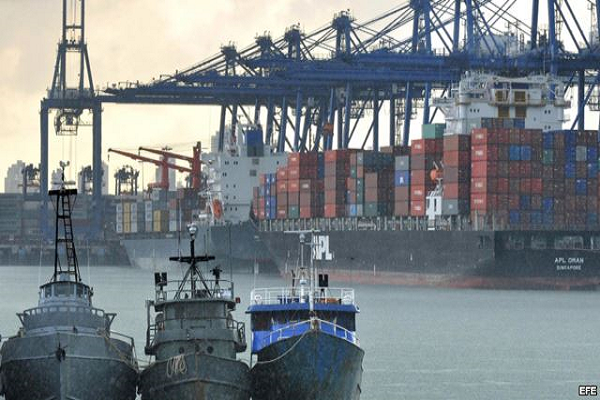
Mariel Port, Cuba

HAVANA, Cuba, 31 January 2014, www.cubanet.org – The position of the Port of Mariel has revalued the geographical importance of Cuba, lost with the end of the Cold War. The soldiers who for 46 years were the support of the government, when they began to direct everything in mid-2006 they found a country undercapitalized, productively and humanly.

General Raul Castro has moved the troops towards economic ends to confront the disaster that can not be overcome, despite his straitjacketed reforms that don’t encourage hard work and creativity to supply imports and increase exports.

As his travels through the friendly countries failed to achieve a financial injection for core investments and the replacement for the possible reduction or loss of petrodollars from Venezuela, he seems to have taken advantage of the changes in the 21st century, to preserve the fifty-year revolution, the “unity in diversity” of CELAC, beyond militant ALBA.

The transit of senior officers of the Armed Forces to create civilian businesses in innovative sectors began in the late 1980s and, especially, with the debacle of the “Special Period in Peacetime” and the loss of subsidies from the Soviet Union and other countries of real socialism.

In the early ’90s, Fidel Castro authorized the company Gaviota to engage in tourism, the TRDs or stores for the recovery of hard currency, and Raul Castro sought the implementation of the successful business system in the Revolutionary Armed Forces, but passing into the civilian sector without the conditions of organizational control military did not give the same results. From here much of the current entrepreneurs emerged.

The Port of Mariel is the only great monument built by the Revolution and will remain as a legacy of Raul Castro. Companies of the Ministry of the Armed Forces appear to have met the schedule and built a quality container terminal, inaugurated by the president and his Brazilian counterpart Dilma Rousseff last January 27.

Upon completion of all the works, perhaps it will join the seven wonders of Cuban engineering, like the Albear aqueduct, from the nineteenth century, still in use. Furthermore, the Special Development Zone boosts the national economy. A stark contrast to the legacy of destruction across the country, critically wrought over previous decades.

Undoubtedly, President Jose Inacio Lula da Silva and his successor, Mrs. Rousseff, calculated well the positioning in an economically asphyxiated Cuba. The Brazilians arrived in a big way to “help confront the northern neighbor,” to open American trade and tourism. The companies of the competitive Yankees advance with the best technology in the world.

Of course, it also entered the current priority calculations: Super Post-Panamax vessels, the Panama Canal expansion. In the Cuban press reports it was noted that the top leaders of the works are executives of the Brazilian company Odebrecht — the principal in the project — and Raul Castro said the administration of the container terminal will be in charge of one of the largest port operators in the world. Lamentable guarantee that inexperienced Cubans will not hard the adequate functioning.

As a prelude to the opening, the advantages of foreign investment in the Mariel Special Development Zone have been divulged. Russian, Chinese, German, British, French, Italian and Brazilian companies of course are mentioned as interested. The approach of the Mexican president could follow the same course. However, investors need guarantees that the old law doesn’t offer. Hence a new version has been promised.

As the project only benefits those who desire to hide their problems and arbitrariness, a greatly cultivated style in Cuba for decades, the presence of more European Union countries and the United States could be advantageous to the competence of the best economic opportunities, most advanced technologies, training, sources of jobs and less dependence.

Cubanet, 31 January 2014,

Free Enterprise Without Freedom / Orlando Luis Pardo Lazo

FREE ENTERPRISE WITHOUT FREEDOM

Orlando Luis Pardo Lazo

“Invest in Castro, it does not matter: Castroism will condemn you. . .”

Cuban exile mogul, Alfonso Fanjul, has traveled to Cuba several times between 2012 and 2013.  Recently, he has declared that there’s a “soft spot in his heart” and that he has an “open mind” towards the prospect of investing his fortune in the Island. Given the “right circumstances”, and “legal grounds”, and on the basis of an “appropriate framework.”

That’s only one example, of course, but it is far from being the only one among millionaires in the Cuban exile. And it wasn’t long before this caused a media outrage, including at the highest levels of American politics. Republican Senator from Florida, Marco Rubio, said he was “surprised and disappointed” with Fanjul’s change in perspectives, a person who for decades supported many initiatives that were forthrightly anti-Castro.

The key question at the current historical juncture would be the following: Do human rights violations in Cuba even remotely concern the economic interests (whether foreigners or Cuban exiles) that loom over the island?  First of all, Havana’s government doesn’t even allow Cubans living on the island to invest or associate peacefully in their own country. According to foreign interests, it seems we don’t even deserve it. We’ve already waited half of century a despotism, we might as well wait out one hundred years of impunity.

European politicians take advantage of the circumstance to start asking for the same. Let’s give our support to Castro, and let Castro deal with the Cubans.

And just like that, they aim to place themselves on the best possible terms with the dictatorship, with the idea of eventually “democratizing” it through gradual blows of solvency.  They bet on the miserliness of the Chinese model based upon Raúl Castro’s stagnant reforms, supposedly with the idea of not upsetting the Moribunds-in-Chief, and avoiding radical tendencies that could end up turning the Island into a Caribbean North Korea.  Ha!


But this is a false argument, the demagoguery of the Castro lobby complicated with donations to the presidential campaign every four years. In practice, Cuba has already shown the voracity of the markets of Beijing, as well as the criminal despotism of Pyongyang. Perhaps through this justification these tycoons expiate their totalitarian guilt of ending up talking about profits with former Castro supporters and former Castro enemies, indistinguishable from each other in the face of post-Castroism.

What’s surprising is that the international entrepreneurs insist on not acknowledging that  in Cuba their investments will be more than insecure. Unless they’re all moles of State Security since the beginning of the Revolution, or they had been lured/blackmailed by it (like the Catholic Cardinal). In fact, more than a few investors have ended up being accused of corruption and had all their assets confiscated. In the best case, they were deported to their country of origin without indemnity rights. In the worst, they’re still in prison (without trial), or dead just like the mafia that was left behind by the thug Max Marambio in his stampede-like get-away.

Amassing wealth through the humiliation of others is a feudal formula. Above and beyond the rule of law, decency is the source of all legitimacy.

John Stuart Mill’s phrase is well-known: “One’s own freedom ends where the freedom of the others begin”. In the case of the foreign business dealings with the Castro regime, that quote can very well be re-inscribed as followed: “One’s own freedom ends right where the freedom of others is ended.”

 Translated by W. Cosme

10 February 2014

The Self-Employed: Unemployed or Illegal / Odelin Alfonso Torna

HAVANA, Cuba — January offers to close its curtains with 100 empty stands in the country’s markets, self-employed who hope for job relocation, government fines  shielded in absurd justifications and the promise of a wholesale market that does not arrive.

While the print and television press emphasize new regulations for the private sector in 2014, the so-called “small businessmen” line up in municipal offices of the Tax Administration (ONAT) in order to turn in their licenses.

Rosa Maria, resident of Washington Street and Bejucal in the Havana township of Arroyo Naranjo, is one of those who delivered her license recently.  As a seller of ice cream and slushes, Rosa received innumerable visits from inspectors:

“The last fines were 50 and 500 pesos (2 and 20 dollars at current exchange), both from Public Health.  The 50 was because of my long nails and the 500 because there was dust on the counter of the cafeteria; now I’m tired!” she exclaimed.

La Cuevita Market before its closure

According to the Ministry of Work and Social Security, at the close of February 2013, 450,000 individuals worked for themselves.  An official economist, Ariel Terrero Font, said on television that judging by growth in the first months, it would not be possible to reach “half a million self-employed workers” by the close of that same year.

Nevertheless, after the prohibition on the sale of imported clothes and hardware items bought on the retail market, the body of licenses awarded by the ONAT for private work, say food vendors, cabbies (we call them “boatmen”), clothing and hardware sellers, decreased sharply.

The tsunami that passed through Havana

Hundreds of tarps lie empty in the capital’s markets.  It is said unofficially that at a national level, a mid-range of 62,000 individuals have frozen or turned in their licenses.

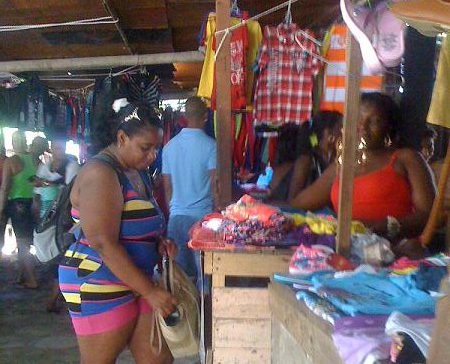
In the Electrico neighborhood market, located at Camilo Cienfuegos and Calzada de Managua, Arroyo Naranjo township, 17 stands have closed since the beginning of January and only two operate with the sale of pirated CDs and handicrafts.  The market located on Porvenir Avenue, between San Gregorio and Georgia, in the same township, closed totally: more than 70 stands offered clothes and imported shoes, including four cafeterias that used to serve the self-employed.

Self-employed market after closure by authorities

In one of the best attended markets of Arroyo Naranjo, sandwiched between Atlanta and Diez de Octubre, 43 stands have remained empty since January 6. The occupied stands, a total of 32, offer tailored clothes, handmade shoes, and costume jewelry.  In Central Havana, another of the leading markets in supply and demand, located at Angeles and Reina, barely keeps 3 or 4 stands active out of approximately 60 mini-kiosks.

Nevertheless, while in the main the extermination of taxpayers is visible, others give the impression of recovery. That is the case at the Virgen del Camino Market, situated on San Miguel and B Street, San Miguel del Padron township. This market, which reopened at the beginning of January, has 55 abandoned sales stands and 63 in service, above all with the sale of shoes and leather items.  This township is characterized for being the greatest producer of handmade shoes.

For Natividad Jimenez, a specialist in physical planning for the National Tax Administration Office (ONAT) in the capital township of Arroyo Naranjo, the taxpayers who used to sell imported clothes were never unemployed because some have accepted relocation and others have not.

“No place has been closed. They (the sellers) were alerted since last year, nothing has been done outside of the law. Many of the sellers from La Cuevita (Havana’s most prolific market) were illegal, that’s why they haven’t done anything, they haven’t complained and they have remained quiet,” Natividad pointed out.

Unemployment:  A secret tax?

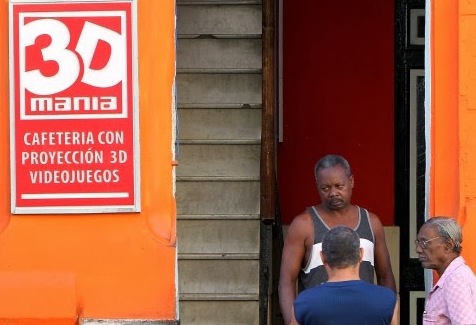
Three-D theaters were the first required to close

At the close of 2011, the Office of National Statistics (ONE) published its last report about the numbers of taxpayers enrolled at the ONAT, a total of 391 thousand self-employed workers.  Nevertheless, statistics published in the official press reflect, until that date, a mid-range of 444,109 individuals registered with the ONAT.

Given the growing number of taxpayers cancelled in the ONAT, the municipal and provincial offices close ranks when it comes time to offer information.

The black market as a solution

Maybe the ONAT, charged with receiving the liquidation of taxes for private workers who seek cancellation, does not register in its data base the number of licenses turned in?

Judging by the official statistics, since December 2011 to date, only 54,000 Cubans have sought a license in the offices of ONAT. This tells us that the private sector remains at the bottom of the sewer, in spite of the grandiloquent displays of “transparency and timely information.”

Cubanet, January 30, 2014, 

Translated by mlk.

At a Turtle’s Pace / Yoani Sanchez

Focus on a fixed point and you’ll see that we are, in fact, advancing. Graphic humor from Santana

Everything moves clumsily, heavily. Even the sun seems to take longer than normal up there. The clock knows nothing of precision and the minute hand is stuck. Making an appointment with the exactitude of three-fifteen or twenty-to-eleven is the pure pedantry of those in a hurry. Time is dense, like guava jam with too much sugar.

“If you hurry your problems double,” the clerk warns the customer anxious to get home early. The man sweats, drums his fingers, while she cuts her really long fingernails before even hitting a key on the cash register. The line behind him also looks at him with scorn, “Another one who thinks he’s in a big hurry,” says an annoyed lady.

We live in a country where diligence has come to be interpreted as rudeness and being on time as a petulant quirk. An Island in slow motion, where you have to ask permission from one arm to move the other. A long crocodile that yawns and yawns as it lolls in the Caribbean waters.

Someone who manages to complete two activities in one day might feel fortunate. It’s common not to be able to find ways to do even one. There’s a hitch at every step, a sign that says, “Today we’re closed for fumigation,” “We don’t serve the public on Friday,” or Raul’s phrase, “Without hurry but without pause.” Delay, postpone, suspend, cancel… the verbs most conjugated when you face any procedure or paperwork.

The turtle’s pace is everywhere. From the bureaucratic offices and the bus stops to the recreation and service centers. But the big winner of the award for having “the blood of a turnip” is the government itself: Three years after the fiber optic cable was connected between Cuba and Venezuela it is still impossible to contract for a home Internet connection.

Two decades of the dual monetary system and they still haven’t published a schedule for the elimination of this economic schizophrenia. Fifty-four years of single-party government and there is no sign of a day when we will have the right to free association. Half a century of government blunders and mistakes and they haven’t even begun to hint at an apology.

At this rate, one day they’ll re-baptize the Island “Never Never Land,” a place where clocks and calendars are banned.

18 February 2014

GUSANO (Worm) – A Video from Estado de SATS

If the video doesn’t appear try this link.

If you don’t see the subtitles — start the video and then, on the bottom right, there will be a little “CC” box. Click there and ENGLISH will appear and the subtitles will show up. If an ad appears on the screen, close it and the subtitles will move to the bottom of the screen.

Site manager’s note: This video was translated and subtitled by the most amazing group of young people in the world… their names are on the final credits… our thanks to them are IMMEASURABLE and UNPAYABLE… but some day… in a free Cuba… sitting on the wall of the Malecon… we’ll celebrate together what you helped to bring about.

Community Network Journalists Arrested and Beaten / Martha Beatriz Roque Cabello

And so the violence starts

Juliet Michelena Díaz, José Antonio Sieres Ramallo and Billy Joe Landa Linares, were stopped on San José between Belascoaín and Manrique, talking with me, on the balcony, which they’ve dubbed “The Ferns,” an allusion to the Cuban telenovela, when Patrol Car No 767 appeared to arrest them. They wanted to take the two men and leave the woman. She opposed it.

In this patrol they took Yuleidis López González and Juan Carlos Diaz Fonseca

At that moment, officials from State Security officers and two women in uniform with the rank of Major arrived. They jumped on Billy Joe and Juliet. At first they beat him by squeezing his testicles, and injected something in his left arm, near the shoulder.

When he was released, he had to be transferred to the Poze Bernardo polyclinic of San Miguel del Padrón, where he was supplied oxygen. He didn’t want to go to the hospital to avoid being subjected to the political police.

Juliet was dragged by the two officers and a third woman dressed in civilian clothes. They gave low a low blow and hit her in the mouth when she screamed. The public intervened, saying, “Don’t hit her, she’s a woman,” “Don’t be abusers.” Only one woman shouted “Viva Fidel,” and “Down with the worms,” but it didn’t have any resonance. Also arrested wereYuleidis López González and Juan Carlos Diaz Fonseca, who were driven out to Guanabacoa and abandoned there.

One of the cooperators with the political police

Barbara Fernandez Barrera and Misael Aguilar Hernández, arrested in San Antonio de los Baños, were taken to an unknown place, and had to walk 3 kilometers alone until a truck picked them up and took them to Quivicán in the province of Mayabeque.

In front of my balcony those cooperating with the police hid behind a column so we couldn’t take their picture, but we did.

Wherever the people are concentrated, the regime acts repressively. They can not allow the street to heat up from the “Balcony of the Ferns.”

Cubanet, 13 February 2104, Martha Beatriz Roque Cabello

Batteries Disappear from Power Substations / Moises Leonardo Rodriguez

Subestación-Alta-Tensión_www.escambray.cu_-300x200Artemisa, Cuba –  The theft of batteries at five electrical substations in Artemisa province, at the risk of the thieves’ lives, was acknowledged by the weekly paper El Artemiseño, the official Communist Party organ in the province.

The batteries stolen in 2013 were from circuit breakers, called NULEC, in substations at Mariel, San Antonio de los Baños, Caimito and Artemisa, according to the report of the journalist Yailín Alicia Chacón, in the 11-17 February edition of the paper.

These batteries are for electric bicycles, musical equipment, and as back-ups (Uninterruptible Power Supplies) for personal computers, which are all very expensive in the State market. For example, the cost of an electric bike battery is 2,875 Cuban pesos (about $120 USD), and they only last about two years.

The director general of the provincial Power Company, Martín de la Concepción Cordero, acknowledged that, “There is still no solution for such outrages and unscrupulous attitudes of people who enter our facilities to take these batteries.”

This new type of theft is added to the theft of the aluminum cross beams of the high tension towers, traffic signs, railroad ties and others that endanger the lives of the perpetrators of the crime and/or third parties after their execution.

Cubanet, 17 February 2014, Moises Leonardo Rodriguez

corrientemartiana2004@gmail.com