“Although No One Wants to Say It Out Loud, Child Labor Exists in Las Tunas”

‘Periódico 26’ claims that cases in the province are few and that there is no “crisis.”
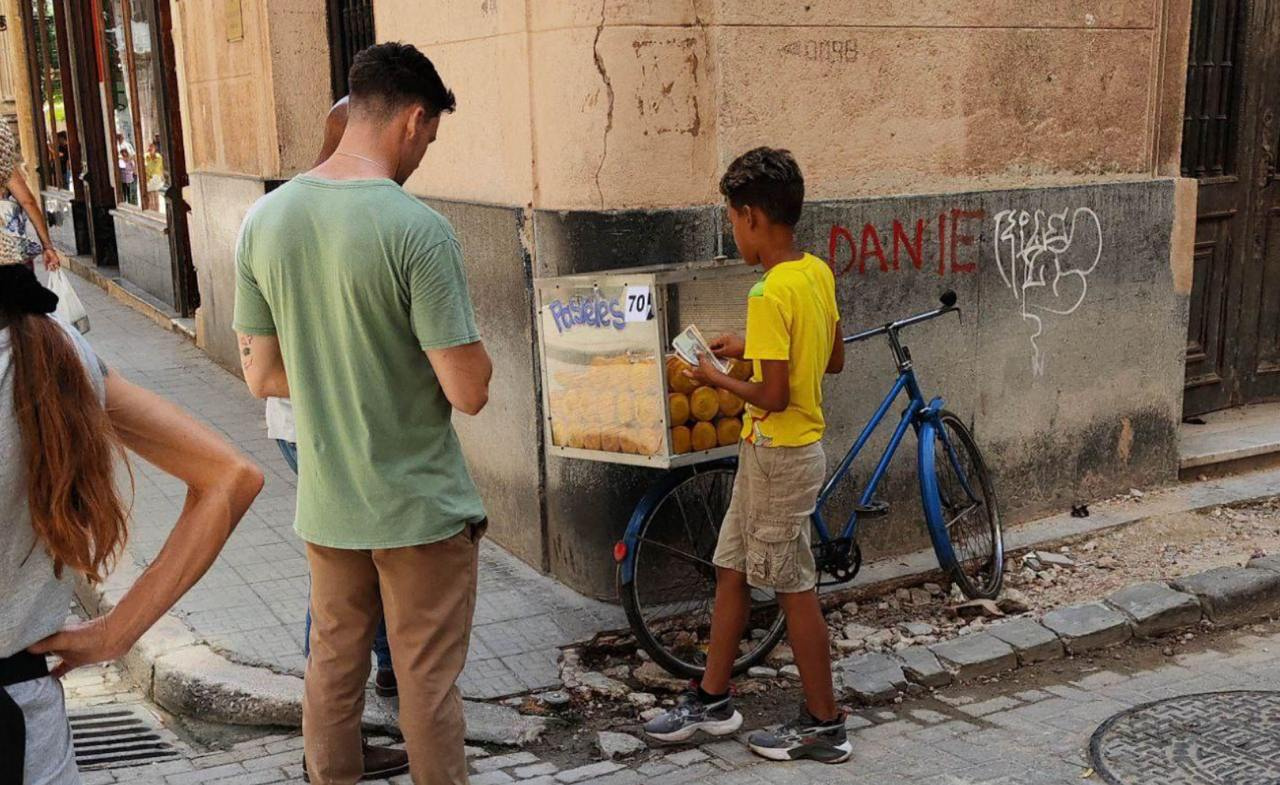

File photo of a boy selling candy on Obispo Street in Havana. / 14ymedio

14ymedio bigger 14ymedio, Havana, 11 April 2025 — Sharply, but cautiously, Periódico 26 admits: “Although one might not want to say it out loud, child labor exists in Las Tunas.” The statement is part of a lengthy report, published this Friday in the Communist Party newspaper in that province, in which complicit parents and exploited children appear, and in which there is only one “hero”: the authorities.

“Addressing this issue doesn’t mean there’s a crisis in Las Tunas,” the newspaper insists from the outset, but the testimonies it gathers show a different reality. The article begins with the story of Pablo, a 16-year-old boy who works as a coal miner, even though the law sets the starting age at 17.

In his case, the problem isn’t the months separating him from legality, but the fact that “he learned the trade from the moment he opened his eyes.” Now, it’s “the main source of income that puts the food on the table” in his house.

His story is one of the most common. Families, driven by poverty, allow and sometimes encourage children to take up a job that can contribute to the family economy, even without knowing they are committing a crime, explains Daisy Torres Álvarez, chief prosecutor of the Family Protection Department.

Not all cases, however, are so “innocent.” “It’s shocking and outrageous that behind the little boy who sells bread in the neighborhood is a 35-year-old mother, physically and mentally fit, who lives off the ’invention’ because she can’t find a job and prefers to ’starve to death’ rather than work for the state,” the newspaper criticizes. continue reading

The presence of teenagers on the streets selling everything from food to electronics has raised some alarm.

In recent years, the presence of teenagers on the streets selling everything from food to electronics has raised a certain amount of alarm, the authorities acknowledge. “It’s good for children to be hardworking and diligent from an early age, but be careful. A few days ago, I came across a little boy on the street selling tamarinds with his mother. That’s child labor,” warns Juan Miguel Barrios, deputy director general of education in the province.

In any case, although poverty reigns supreme on the island, authorities maintain that families are primarily responsible for caring for their children.

“Some parents have allowed themselves to be dragged down by the shortcomings and complexities, but there’s no need to drop out of school or have children with work obligations,” the judge argues. In their favor, she adds, parents have the support of the State, which guarantees financial assistance for families in similar situations. However, even Periódico 26 is aware of the Cuban government’s limits and offers a caveat: “We know, it’s not an amount that will make all hardship disappear, but it does alleviate it.”

The authorities claim to have everything under control and have found a solution for each case, even if it’s often not ideal: “There were some teenagers who didn’t go to school because they had to help their families with the farm, and we met with the parents, agreed on days and times, and they returned to classes. Everyone wins.”

For readers who found the article on Facebook, the situation doesn’t seem as ideal as the media outlet claims. “And the children in Havana begging for money at traffic lights. There’s one every day at the 124th St. in Marianao. The children in Old Havana begging tourists for money. Oh, and if they check the girls who are prostitutes. It’s horrible. How far will we go? They’ve had to grow up too fast,” laments one internet user at the bottom of the post.

The authorities claim to have everything under control and to have found a solution for each case, although it is often not ideal.

Others took their criticism further: “ Periódico 26, better that you say that as a society we’re swimming in shit. So I ask myself, what kind of financial aid is supposedly being provided? How can you talk about the education system when classes often aren’t even held due to a lack of teachers?”

This is not the first time the official press has discussed child labor on the island. In June 2024, Sierra Maestra published a note acknowledging its existence and attributing it to the “complexity of the country’s economic context.”

Before the government’s attention, independent media had already focused on the problem, which is often disguised as “housework” and minor responsibilities that children are given at the social and family levels, even though they are not appropriate for their age.

Barely a month after the Sierra Maestra report, 14ymedio reported on the appearance of children begging for food or alms in the doorways of restaurants and stores in Havana and Holguín. A look at these cases, or any of those reported by Periódico 2 , reveals the connection between children forced into the labor market and a country where poverty is rampant.

____________

COLLABORATE WITH OUR WORK: The 14ymedio team is committed to practicing serious journalism that reflects Cuba’s reality in all its depth. Thank you for joining us on this long journey. We invite you to continue supporting us by becoming a member of 14ymedio now. Together we can continue transforming journalism in Cuba.

Former Miami Mayor Tomás Regalado Affirms that Radio Martí is Still ‘Indispensable to the Cuban People’

The former mayor of Miami is confident the station can continue broadcasting, despite a “restructuring.”

For Regalado, the future of Radio Martí is linked to strengthening its journalistic content and its presence on digital platforms. / EFE

14ymedio biggerEFE (via 14ymedio) Ivonne Malaver, Miami, 8 April 2025 — Former Miami Mayor Tomás Regalado asserted that Radio Martí continues to fulfill its original purpose of promoting freedom in Cuba, and rejected criticism that its existence responds solely to the interests of Cuban exiles in the United States.

In an interview with EFE, Regalado emphasized that Radio Martí will not disappear as a result of the cuts imposed by President Donald Trump, considering that stations like this one are essential to promoting press freedom globally.

“I think there will be a restructuring, but it will remain up in the air. I think the United States realizes it needs to have a voice, that they can’t speak for it,” he explained. Regalado, who also served as director of the Office of Broadcasting to Cuba (OCB)—responsible for operating and supervising media outlets targeting Cuban audiences—affirmed that Radio Martí continues to fulfill its original purpose. continue reading

Regalado insists that Radio Martí continues to fulfill its initial purpose.

“Radio Martín was created in the 1980s, at the request of the Cuban exile community, by President Ronald Reagan and the then-Congress. It was said to be the instrument to bring the truth to the Cuban people,” recalled Regalado, 77, who was born in Havana and served as mayor of Miami from 2009 to 2017. “It has always served to guide, inform, and entertain the Cuban people,” he added.

Regalado said that during his tenure at the OCB, during the first Trump administration (2017-2021), he commissioned a survey from the U.S. Embassy in Havana that confirmed the station’s high audience level in Cuba, especially in rural areas.

“That’s why the regime has acted with such rage” and has demanded its closure as a condition for improving relations with the United States, said the now Miami-Dade County property appraiser.

In the face of the criticism that Radio Martí only responds to Cuban exiles, Regalado emphasized that although he has politically supported the station, the priority has always been to give a voice to the opposition within Cuba.

He recalled that at one point they had more than 100 dissidents participating weekly. “In fact, the participation of leaders from the Cuban exile was minimal because they understood that the priority was for the Cuban people to speak to the world,” he added.

He also refuted the perception that the station doesn’t connect with younger generations. He noted that during his administration, they incorporated popular musical content banned by the regime and broadcast Major League Baseball games, which had a huge impact because baseball remains a national passion in Cuba, he stated. The criticisms, he said, are a misguided narrative, promoted largely by the Cuban regime itself.

The criticisms, he said, are a misguided narrative, promoted largely by the Cuban regime itself.

Asked about a possible closure, Regalado stated that “Radio Martí will not cease broadcasting” because Congress and the State Department, led by Cuban-American Secretary of State Marco Rubio, are aware of its importance. He admitted he was concerned when employees were recently sent home, but recalled that in less than a week and a half, they were called back, the transmitters were reactivated, and regular programming was back on the air.

The former mayor of Miami ignored the fact that the workforce has been severely depleted, with only about 50 federal employees returning, while contractors—at least 20 of them— have had their contracts terminated, including technicians .

For Regalado, the future of Radio Martí is linked to strengthening its journalistic content and its presence on digital platforms. It’s not about criticizing governments, but rather telling the truth and letting the people judge, he explained.

He also highlighted the station’s growth on social media, where it generates “millions of views,” especially at key moments like the July 2021 protests in Cuba.

Regalado considers his greatest achievement as director to be rekindling enthusiasm for the station among younger generations with modern history programs. They shared visual content about Cuba’s past on social media, and that, he said, fascinated many young people who were unaware of that past.

“There were young Cubans who didn’t know that Cuba was the first country in Latin America, after the United States, to have television,” he said.

The former director believes that, despite the technological and political transformations in the US, Radio Martí must continue its mission because “it is essential for many people, millions in Cuba, to be informed.”

____________

COLLABORATE WITH OUR WORK: The 14ymedio team is committed to practicing serious journalism that reflects Cuba’s reality in all its depth. Thank you for joining us on this long journey. We invite you to continue supporting us by becoming a member of 14ymedio now. Together we can continue transforming journalism in Cuba.

Cuban Singer ‘Ovi’ is Willing to Pay $5 Million for Residency in the US

Ovidio Crespo dropped out of university and the island in 2017

“If Donald Trump wants to deport me, I’ll buy him a Gold Card,” said Cuban singer ’Ovi’. / Instagram

14ymedio bigger14ymedio, Havana, 11 April 2025 — “If Donald Trump wants to deport me, I’ll buy him a Gold Card.” This was the message Cuban singer Ovidio Crespo, known as Ovi, posted on Instagram to avoid deportation from the United States. This is the alternative the U.S. government launched last February: the ability to obtain residency in exchange for an investment of $5 million.

Although Ovi doesn’t have a deportation order, he does have a criminal record. According to the Laken Riley Act, the singer’s criminal record would be an aggravating factor for his deportation from the country. Last September, Ovidio Crespo was arrested in Miami. He was charged with possession of illegal substances, carrying a revolver, and armed assault. He was released after posting $8,000 bail. On that occasion, his lawyers prevented the singer’s deportation.

Crespo also has a history of other offenses. In March 2022, he was arrested for domestic violence. He was released after posting $1,500 bail. Four months earlier, in December 2021, he was arrested after getting into a fight with fellow countryman, reggaeton artist Manny La Figura, outside a jewelry store in Miami.

Ovi arrived in the United States in 2017 after a 25-day journey. / Instagram

The alternative proposed by Trump generated controversy. “The proposal has the form and flavor of a golden passport program,” reported Fortune. The same edition emphasized that in Europe, “some countries have continue reading

successfully used this system to sell the rights and benefits of EU citizenship.” However, it warned that it runs the risk of “accepting payments with minimal scrutiny, exposing oneself to the risks of corruption and money laundering.”

An Al Jazeera investigation revealed that an investment of more than €2,000,000 ($2,266,693) in Cyprus secured EU citizenship for at least 30 people with pending criminal charges or convictions, as well as 40 politically exposed persons. Faced with the evidence, Cyprus canceled the program in 2020 and Bulgaria did so in 2022.

Ovi, who dropped out of the University of Medical Sciences in Havana, left the island in 2017. The singer began his journey through Ecuador and after 25 days arrived in the US and began his dream of making music. Two years after his arrival, he became a household name for his musical performance with Adriel Favela and Yendi on the song “Cuando me ve.”

The Rancho Humilde record label boosted his career and with the songs Se me dio, Bailen and Pacas verdes he has achieved a place as an exponent of the so-called corridos tumbados, reggaeton and Latin trap.
____________

COLLABORATE WITH OUR WORK: The 14ymedio team is committed to practicing serious journalism that reflects Cuba’s reality in all its depth. Thank you for joining us on this long journey. We invite you to continue supporting us by becoming a member of 14ymedio now. Together we can continue transforming journalism in Cuba.

Fernando Dámaso, the Blogger Who Left the Cuban Army After Ochoa’s Execution, Dies in Havana

Author of the blog ‘Mermelada’, he was an expert in republican history and a contributor to the independent press.

In several interviews, Dámaso pinned Cuba’s future on the tension between dogmatists and pragmatists. / Facebook/Fernando Dámaso

14ymedio bigger14ymedio, Havana, 11 April 2025 — Born in 1938, a Sagittarius, a former Piarist student, a former military officer of the regime, and a writer passionate about Cuba, literature, sports, and cinema: this was the calling card of Fernando Dámaso, once one of the most active authors on Cuban topics on the Internet. He died at 8:00 a.m. this Friday at the age of 87, in Havana.

His wife, Rebeca Monzó, confirmed the death of the man who was also, for a time, a contributor to 14ymedio and Diario de Cuba. Familiar with the inner workings of the Army, he rose to become a colonel in the Armed Forces under the command of General Ulises Rosales del Toro, one of the men who held the reins of Cuban troops in Africa.

After the execution of Arnaldo Ochoa and three others implicated in the notorious Case 1 in 1989, Dámaso resigned from the Communist Party and the Armed Forces. His protest cost him dearly. He was not only sanctioned, but also subjected to a ban on the pretext—applied to all high-ranking Cuban military personnel who deserted —that he might reveal secrets to the “enemy.”

By then, Dámaso had accumulated several military “missions” in Africa on his service record, a period in his life about which he preferred to remain discreet. continue reading

Dámaso had accumulated several military “missions” in Africa on his service record, a period in his life about which he preferred to remain discreet. 

In Mermelada, his blog – active until 2020 – Dámaso addressed a myriad of topics, from the politics of both sides to the history of the island. From that space, he repeatedly criticized the regime, always with calm arguments and expressed ironically, especially in the form of comments on the official press. [Selections from Mermelada in English are here.]

He also published Mapa perdido de La Habana (Lost Map of Havana) with Hypermedia Ediciones, which compiled some of his historical and cultural texts, exploring the character of the capital through the origins of its emblematic streets and corners. He was an expert on culture and politics during the Republic, chronicling its “buried history.”

In several interviews, Dámaso pinned Cuba’s future on the tension between dogmatists and pragmatists, two extremes of the nomenklatura who, he believed, would enter into a definitive confrontation when the so-called historic generation, beginning with Fidel Castro, was dead and buried. He lived to see that Castro’s death did little to shake the foundations of a dictatorship that made “continuity” its watchword.

When questioned by media outlets around the world, he invited caution and urged against underestimating the military-based structure on which the leader had built his dominance over Cubans. Change would not be “imminent, not even close,” he predicted back in 2017, at least as long as Raúl Castro continued to dictate the country’s course from his retirement.

Regarding the possibility of change, he did venture at least that it would be carried out by “someone who will emerge from the process, someone no one knows today.”

Translator’s note: This is the first personal note I have added to a post on this project. From the beginning of my translating, Fernando and Rebeca’s voices were among my most treasured; cogent, gentle and calm.  How I wish I had met them. Perhaps in some yet unimagined future I can still meet Rebeca. Safe travels my friends. May my work here continue to honor you and your lives.

The Expulsion of Writer Ángel Santiesteban Opens a New Crisis in Cuban Masonry

The case documents show the high level of politicization in the accusations.

Santiesteban has been on the front line of criticism about the infiltration of State Security in Masonry / Facebook/Ángel Santiesteban

14ymedio bigger14ymedio, Juan Izquierdo, Havana, 10 April 2025 — A number of crimes against Freemasonry appear in the indictment of Ángel Santiesteban Prats before the Supreme Court of Masonic Justice. Writer, opponent, screenwriter and high-ranking Freemason, Santiesteban has been one of the most critical voices against the Regime and its historic infiltration into the brotherhood, a stance that places him back in the center of the storm.

After a period of suspension and a criminal session held on 20 March, the 58-year-old writer has just been expelled from the Grand Lodge. For the decision to be effective it must be approved by the High Masonic Chamber, something that Santiesteban – in a telephone conversation with this newspaper – hopes will not happen.

“Betrayal of the fraternity,” “violation of the dogmas,””contempt for the Grand Lodge,” “insulting a Freemason in a manner of contempt, disrepute and discredit,” “abuse of confidence”: the list goes on. The victim, the document claims, is the current Grand Master of the Cuban Masons, Maykel Filema, whom Santiesteban described to the independent press as “handpicked” by his predecessor.

“I said that Filema had been ’handpicked’ by Mario Urquía Carreño. He says it is a contemptuous way of treating the Grandmaster”

“I said that Filema had been “handpicked” by Mario Urquía Carreño. He says it is a contemptuous way of treating the Grand Master,” says Santiesteban. On the Island, the expression is also used to characterize Miguel Díaz-Canel, “handpicked” by Raul Castro, which gives it a particularly offensive connotation.

Filema was appointed by Urquía Carreño, the man who almost destroyed Cuban Freemasonry in 2024. After a year of tension and interventions by State Security, the unpopular Grand Master left office, putting Filema in continue reading

charge. Filema’s brief tenure has been equally unpopular and has been characterized by an apparent docility to the government.

Santiesteban has been on the front line of the criticism against Filema. He assures 14ymedio that the Grand Master does nothing but repeat the authoritarian attitudes of his predecessor, and that this led to a schism between the two grand instances of Cuban Freemasonry: the Grand Lodge and the Supreme Council of Degree 33, where both Santiesteban and José Ramón Viñas, a person of great interest for counterintelligence, hold managerial positions.

The present Masonic situation of Santiesteban is unusual: he is expelled from the so-called symbolic degrees – the hierarchy that includes Entered Apprentice, Fellowcraft and Master Mason – but not from degrees 4 to 33, the highest rank.

A reading of the case documents, provided by Santiesteban to this newspaper, gives the measure of the high level of politicization in the accusations. The indictment mentions a meeting between the writer, along with his partner, freelance journalist Camila Acosta, and the US Embassy’s Business Manager in Cuba, Mike Hammer, last January. The document alleges that this meeting was Santiesteban’s pretext for not going to one of the oral hearings in order to defend himself against the accusations of the Grand Lodge.

Also, the Grand Lodge is not pleased that Santiesteban presents himself as a “masonic leader” to 14ymedio, Cubanet and Diario de Cuba, and serves as an occasional source for these media on the situation of the brotherhood. Santiesteban’s defense had argued before the Supreme Court that all opinions expressed in these media outlets were personal and motivated by the best of intentions. It was in vain.

Last year, both the Ministry of Justice and State Security took an interest in the conflict

Santiesteban’s case threatens to open a new episode of crisis in Cuban Freemasonry. Last year, both the Ministry of Justice and State Security were interested in the internal conflict of the order and knew how to exploit the schism between the Grand Lodge and the Supreme Council.

Santiesteban’s defense argued that the writer had every right, as a high-ranking official and member of Masonry, to be alert to the harassment and infiltration of counterintelligence and to denounce it, if necessary, in the profane sphere, as the Masons who do not belong to the brotherhood call it.

Meanwhile, the government has done nothing but strengthen its institutional dominance and surround Freemasonry, not just symbolically. Last January, a document signed by the Cuban prime minister, Manuel Marrero, reaffirmed the State’s ownership of several floors of the building of the Grand Lodge of Cuba, located on Carlos III Avenue in Havana.

The floors, confiscated by Fidel Castro in 1961 and now in the possession of the State telecommunications company Etecsa, are a strategic point to control the Masons: at all times, thanks to employees and officials, the communications and surveillance monopoly knows who enters and leaves the Grand Lodge, and with what intentions.

Translated by Regina Anavy

____________

COLLABORATE WITH OUR WORK: The 14ymedio team is committed to practicing serious journalism that reflects Cuba’s reality in all its depth. Thank you for joining us on this long journey. We invite you to continue supporting us by becoming a member of 14ymedio now. Together we can continue transforming journalism in Cuba.

Rosa María Payá, Trump’s candidate for the IACHR: ‘I Want To Be Closer to the Voices of the Victims’

“The only instance of accountability my family has received is precisely the Commission’s report,” she said in an interview with EFE.

Rosa María Payá, during the interview with EFE on Wednesday, at the OAS headquarters in Washington / EFE/Octavio Guzmán

14ymedio biggerEFE (via 14ymedio), Eduard Ribas and Admetlla, Washington, 11 April 2025 — The United States candidate for the Inter-American Commission on Human Rights (IACHR), Rosa María Payá, daughter of Cuban dissident Oswaldo Payá, proposes to improve the functioning of the body based on her own experience as a victim of human rights violations.

“I’ve been a victim. I have seen my family suffer and die, my compatriots and friends live in anxiety just because they do not have basic rights,” says the 36-year-old activist.

Payá brought to the IACHR the case of her father’s death in a suspicious car accident in 2012 in Cuba, for which the agency held the Cuban state responsible after ten years of trial. continue reading

“I have seen my family suffer and die, my compatriots and friends live in anxiety just because they don’t have basic rights”

“The only instance of accountability that my family has obtained is precisely the Commission’s report,” she says. ” I want the same and something better for every citizen of the Americas who has seen their rights repressed,” says Payá, who adds that she has been able to know first-hand both the successes and failures of the Commission.

Rosa María Payá was nominated by the Trump administration as a member of the IACHR and received the assignment from Secretary of State Marco Rubio, who is of Cuban origin.

Founder of the initiative Cuba Decide, which advocates for the democratization of the Island, Payá says that she has spent her “adult life dedicated to the defense of human rights” and has worked with civil society organizations from Canada to Chile.

That experience, she says, has allowed her to clearly identify the challenges faced by victims as well as the limits of the current system.

Payá says that the IACHR can and should be more accessible, faster and more relevant for the victims

She says that the IACHR can and should be more accessible, faster and more relevant for the victims. It is an autonomous body of the Organization of American States (OAS), responsible for ensuring the protection of human rights in the Americas.

“I think that I can contribute a lot to the work of the commission by bringing those voices, the voices of defenders and victims, closer to the commission,” she says.

Payá identifies four countries with particularly serious human rights crises in the region: Haiti, Cuba, Venezuela and Nicaragua.

Although the latter three countries do not participate in the inter-American system, Payá emphasizes that the IACHR retains jurisdiction over their cases and that the Commission must continue to make these violations visible through its recommendations.

On the situation in her native Cuba, she denounces the serious energy, health and food crisis, “while the Cuban military keeps millions of euros in foreign banks.”

As a Cuban and an American citizen, she cannot participate in the decisions of the Commission on the U.S. and Cuba

As a Cuban and an American citizen, she cannot participate in the decisions of the Commission on the U.S. and Cuba but says that she will “of course” continue to fight for the “recovery of democracy” on the Island.

“I think it is clear that the way out of the crisis is through the dictatorship’s exit, and the member states should support this direction,” she says .

Questioned about the tightening of Trump’s migration policies and the sending of migrants, accused of being criminals, to the mega prison of El Salvador, Payá replies that each member state is sovereign in defining its own rules.

However, she maintains that the IACHR’s role is to ensure respect for human rights in all contexts.

“I am also a migrant in this country (the U.S.), and my role in the Commission will be to ensure that the human rights of migrants are respected,” she affirms.

The OAS General Assembly in Antigua and Barbuda will elect the three vacant IACHR seats from among seven candidates submitted by member states.

Translated by Regina Anavy

____________

COLLABORATE WITH OUR WORK: The 14ymedio team is committed to practicing serious journalism that reflects Cuba’s reality in all its depth. Thank you for joining us on this long journey. We invite you to continue supporting us by becoming a member of 14ymedio now. Together we can continue transforming journalism in Cuba.

This Year Will Be As Bad as the Last One for the ‘Family Basket’ in Cuba

The Minister of Domestic Trade pleads for foreign investment to save a failing economy.

As of July 2024, only pregnant women can receive eggs / 14ymedio

14ymedio bigger14ymedio, Havana, 4 April 2025 — For a long time, Cubans have not seen complete orders arriving without delay in the bodegas (ration stores), with no missing pounds or for only a part of the families. This was acknowledged in an interview with the State newspaper Granma by the Minister of Internal Trade, Betsy Díaz Velázquez, who explained that during 2024, the standard basket “decreased compared to the previous year.”

The minister did not provide specific data but admitted that “deliveries of resources from national production such as liquid milk were not made due to a collection deficit – which forced an adjustment of per capita to half a liter – for sugar, coffee, eggs, beef and salt. Eggs were distributed bimonthly in the first half of 2024, and from July only deliveries to pregnant women’s diets were achieved.”

In general, the official described last year as “extremely complex,” and this one, she added, “has started off equally challenging” with “serious damage to the standard family basket.” But she washed her hands of the situation. According to her, alleviating the lack of supply in Internal Trade requires titanic tasks in the context of the Cuban crisis, such as “increasing national production.” continue reading

The official described last year as “extremely complex,” and this one, she added, “has started off equally challenging.”

For the moment, her portfolio has only managed to “diversify the offers in the sector’s bodegas and centers, although nothing replaces what so regularly arrived every month to the bodegas.”

The official praised the collaboration of the private sector in a context where the State has its hands tied. However, she defended Resolution 56 of her ministry, which , since the end of 2024 limits wholesale trade for private companies and businessmen. While the former have until September to liquidate the goods they send to the wholesaler, the latter have been completely banned from activity since April.

Only production enterprises, whether private or non-agricultural cooperatives, will be able to sell wholesale as long as they market their own products and are subordinated to State-owned enterprises.

Asked whether the measure could become a “brake on the supply chain for the population,” Díaz said that Cuba will ensure that the rule works. However, she referred at all times to the private sector as a “complement” to the State enterprise system and stressed its utilitarian function: “Local storage capacities, equipment and other means are available in all territories but not exploited or underutilized, and they can be made available to non-State economic actors.”

“In all territories, local storage capacities, equipment and other means are available that are not being exploited”

The minister is speaking about the recent State custom of handing over equipment and facilities in precarious condition to individual entrepreneurs so that they are responsible for rescuing them and putting them to use.

Foreign investment, the only thing that could save the Island’s broken economy, was another of the issues that the official defined as priorities. Domestic Trade has approved eight foreign investment deals: an international economic partnership contract, five unnamed joint ventures and two wholly foreign-owned enterprises. Of these, five already operate in the wholesale market, and in 2024 they exceeded $20 million in sales.

“Foreign investment in the Domestic Trade system is intended to establish wholesale procurement markets that provide services to the State and non-State sector,” she said, adding that the priority is domestic industry.

Beyond the temporary lifeline represented, to some extent, by foreign capital, Díaz did not mention any concrete plan to stimulate food production and solve the supply problems that, in Granma’s words, “have already lasted longer than desired.”

Translated by Regina Anavy

____________

COLLABORATE WITH OUR WORK: The 14ymedio team is committed to practicing serious journalism that reflects Cuba’s reality in all its depth. Thank you for joining us on this long journey. We invite you to continue supporting us by becoming a member of 14ymedio now. Together we can continue transforming journalism in Cuba.

Exiled by the Regime, the ‘Flag Man’ Continues Fighting for Cuba From the US

The image of Daniel Llorente, running in the 2017 May Day parade in Havana with the flag of the “empire,” went around the world.

Daniel Llorente, the “flag man,” in front of his home in Tampa, Florida. / Courtesy/14ymedio

14ymedio bigger14ymedio, Havana, 10 April 2025 — “The work I’m doing is remodeling houses, making sporadic repairs, electrical work, plumbing, anything that breaks down.” The words of Daniel Llorente Miranda, the “man with the flag,” sent to 14ymedio via audio message, make it clear that he continues to lead a precarious life in the United States, where he arrived almost four years ago, following a long journey after being exiled from Cuba.

Llorente talks about his jobs with good spirits, and assures that since he has residency, he has no worries about Donald Trump’s tightening immigration policies, but clarifies that his way of earning a living is never fixed: “It’s not a daily occurrence; three jobs may open up in a week, two may open up, or none at all.”

He acknowledges that the best-paying jobs are permanent, but it’s not so easy to get one for someone his age who, moreover, doesn’t speak English. However, the main reason he has avoided stable employment is that he doesn’t want anything to stop him from continuing his activism for freedom on the island. “On occasion, I’ve had to go to Miami to participate in actions. About four weeks ago, I participated in a protest at the Florida Capitol. And if I’m tied to a company, I wouldn’t be able to move freely and fulfill the purpose for which I came to this country,” he explains. “Even if people don’t believe it, I remain committed to the issue of Cuba.”

Three years ago, upon learning that Llorente was homeless, Buran offered him free accommodation. Now the Cuban is returning the favor.

From time to time, he makes the news in the local press, and for the better. A few days ago, an article in the Tampa Bay Times recounted, for example, his story of solidarity with Ralph Buran, the American veteran with whom he shares a house.

Three years ago, upon learning that Llorente was homeless, Buran offered him free accommodation. Now it’s the Cuban who’s returning the favor. The two men, who don’t speak the same language or come from the same culture, have embraced their friendship as a new banner. “I’m still in Tampa, in the same house mentioned in the article. The American and I still live together,” he told this newspaper, while insisting that his main goal is to continue his political activity in exile.

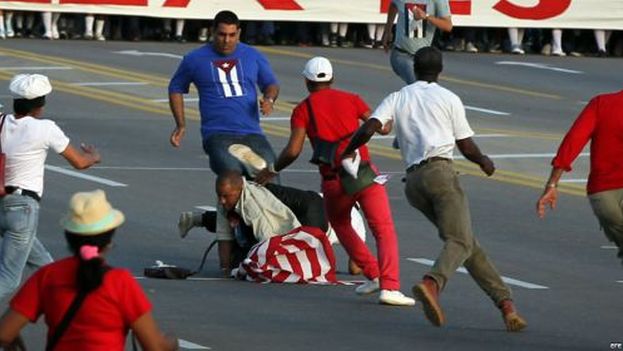
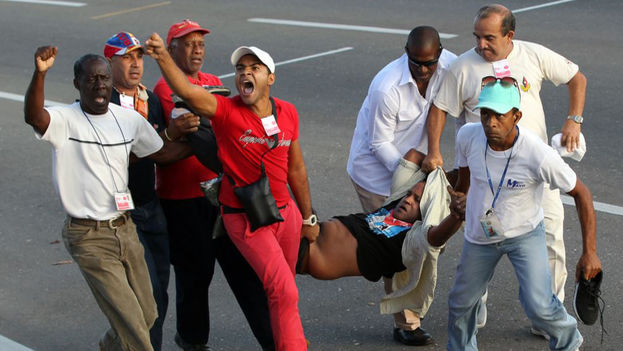
Llorente was tackled during the May Day march when he broke into the parade with the American flag. (Screen Capture)

“Everyone knows I didn’t come because I wanted to leave Cuba, but because they kicked me out,” he recalls. The image of Daniel Llorente sneaking into the May Day parade in Havana, 2017, carrying an American flag, went viral around the world. He would be exiled a year later, but not before spending time in a psychiatric hospital, in an attempt to justify his imprisonment.

Cuban opponent Daniel Llorente breached the security cordon and unfurled a US flag in front of the grandstand. (EFE)

The time from then until he reached U.S. soil with his son, Eliezer, in June 2021 was an odyssey, including a protest outside the Cuban Embassy in Guyana . Afterward, the “American dream” consisted of night after night of sleeping in a car.

Despite all the difficulties, nothing can deter him from his plan: to fight for Cuba’s freedom. “That’s my main purpose, that’s my life plan, and I have faith that I’ll win with these thoughts I have.”

He warns that he plans to soon carry out a public protest against the situation in Cuba. “I’ll tell you, you’ll find out,” he explains, and listening to him, it’s hard not to remember him running across the esplanade of Havana’s Revolution Square before the astonished eyes of security guards, the generals in their olive-green suits, and the foreign press.

____________

COLLABORATE WITH OUR WORK: The 14ymedio team is committed to practicing serious journalism that reflects Cuba’s reality in all its depth. Thank you for joining us on this long journey. We invite you to continue supporting us by becoming a member of 14ymedio now. Together we can continue transforming journalism in Cuba.

A ‘Marielito’ Is Released After One Week in a US Migration Processing Center

Another Cuban, Eduardo Núñez González, has requested his deportation to Spain.

Cuban José Francisco García Rodríguez spent a week at the processing center in Pine Prairie, Louisiana / News15

14ymedio bigger14ymedio, Havana, 10 April 2025 — U.S. Immigration and Customs Control (ICE) is keeping the futures of José Francisco García Rodríguez and Eduardo Núñez González in limbo. Although the former was released after a week at the processing center in Pine Prairie, Louisiana, he has to check in periodically with the immigration office in the future. The second, a Spanish national, has requested deportation to Madrid because he “cannot stand the festering conditions” of the detention center in New Mexico where he is currently being held.

García Rodríguez, 73, arrived in the United States during the Mariel exodus in 1980, when more than 125,000 Cubans left by sea in what came to be known as the Mariel Boatlift. He accepted that he made mistakes in the early years of his arrival in the country but paid for them by serving time.

The US government is implementing the Laken Riley Act, signed by President Donald Trump at the beginning of his second term, to detain and deport irregular migrants who are accused but not yet convicted of crimes such as robbery or assault. continue reading

“However, in this specific case, that did not happen because the individual was from Cuba,” lawyer Tala Voosoghi told local television channel KATC 3. According to the lawyer, the “marielito” has refugee status and therefore “cannot be deported to his country of origin.” Hence, this migrant “finds himself in a kind of limbo.”

duardo Núñez González suffers from chronic bronchitis without medical care in the detention center in New Mexico / Telemundo51

Voosoghi explained that when they are arrested “many times, after completing their sentence, as in this case, they are released and receive a supervision order, which means that they have to report to ICE periodically, and while they continue doing so, they generally stay here indefinitely.”

The release of García Rodríguez is just the beginning;”there’s a lot to be solved,” said his stepson, Tyler García.

Christian Cooper Riggs, his stepdaughter, said, “Our country has a delicate immigration path ahead. I believe that we can protect our borders by analyzing individual cases. It is not a political issue, but one of humanity.”

Meanwhile, Eduardo Núñez González, the Cuban-Spaniard who was arrested by the FBI on March 20 while taking out the garbage, is being held in the detention center of Torrance County, in New Mexico, which has been denounced by the American Civil Liberties Union (ACLU) because of the conditions in which migrants are kept.

Vilma Pérez Delgado told the Nuevo Herald that her husband “remains permanently immobilized in the center, with a chain around his waist. They also keep him isolated, without visits, and he suffers from chronic bronchitis without medical attention.”

The conditions under which he is held led the family to consider deportation to Spain. The Cuban has received an electronic tablet to carry out his request. Catholic Legal Services’ managing lawyer in Miami, Rebeca Sánchez-Roig, told the same media that for this to happen, an official order from an immigration judge is required.

Translated by Regina Anavy

____________

COLLABORATE WITH OUR WORK: The 14ymedio team is committed to practicing serious journalism that reflects Cuba’s reality in all its depth. Thank you for joining us on this long journey. We invite you to continue supporting us by becoming a member of 14ymedio now. Together we can continue transforming journalism in Cuba.
A ‘14ymedio’ Reporter Is in Prison in Cuba for Investigating Drug Trafficking at a Matanzas School

Arrested and interrogated by State Security at the end of January, Yadiel Hernández is being held in Combinado del Sur prison.

One of the last photos from Matanzas sent to ’14ymedio’ by Yadiel Hernández / 14ymedio

14ymedio bigger14ymedio, Havana, April 10, 2025 — The Facebook profile of Yadiel Hernández Hernández, known as Kakashi, only returns this message to visitors: “no posts available.” The contents of the account have been deleted following the arrest, on January 24, of the young man who, at the time of his arrest, was investigating for 14ymedio the drug trafficking at the pre-university school in the city of Matanzas.

Kakashi, a 33-year-old designer, graduate in theological studies and freelance reporter, is being held at the Combinado del Sur prison, where overcrowding and allegations of abuse against inmates are constant. He arrived at that prison after being arrested almost three months ago and spending several weeks under interrogation by State Security. Hernández is now charged with the alleged crime of “propaganda against the constitutional order.”

Under the current Penal Code, offenses against the constitutional order include penalties such as deprivation of liberty, life imprisonment and even the death penalty, for those who take up arms to change the Constitution or impede the functioning of the authorities. Kakashi, on the other hand, was only investigating the spread of the drug scourge among teenagers, a journalistic work that would help save lives.

All attempts by this newspaper to contact the family of Hernández have been unsuccessful 

At the end of January, communication between our editorial staff and Hernández was cut off. At first, the silence was blamed on the long electrical cuts that hit the Island during those days and also caused frequent internet connection failures. However, a few weeks later, a source close to Kakashi’s family confirmed his arrest. “They arrested him and took him away.” continue reading

All attempts by this newspaper to contact Hernández’s family, to get details of his current situation and the date of his trial, have been unsuccessful. Within the Combinado del Sur, Hernández’s possibilities of communicating with the outside world are limited, and at this time the independent journalist has not been able to contact legal advisory organizations or press media.

“He was detained for several days in Versalles [headquarters of the State Security operations center in Matanzas],” the source says. ” He was taken away after the incident that occurred with an alleged gas leak in the pre-university,” he adds, referring to an accident at the José Luis Dubrocq High School. There was at first a strong smell, and several students experienced nausea and discomfort, with some even having to be hospitalized.

Although the official version of the incident blamed a student who sprayed pepper spray on a teacher’s motorcycle and caused the substance to be inhaled, the incident fueled rumors about drug use in the pre-university and the sale of such substances inside the school. “The police questioned people who could report what had really happened, and that same January 24th, they took away Kakashi, who had been investigating the trafficking network for a long time.

All indications are that the best way to help him at this time is to post about what happened

After learning these details, this newspaper has weighed whether a public complaint could make matters worse or help to make the case more visible. Finally, after hearing the opinions of several friends of Hernández, everything indicates that the best way to help him at this time is to publish what happened, so that his case reaches the international organizations that ensure the protection of journalists and freedom of the press.

“He has always been a person who is very critical about everything he sees that is bad, someone with a lot of civic conscience,” points out one friend of Kakashi’s, who fears that “he will stay in prison for many years, because they will make him pay for his attitude, his rebellion and his ability to uncover a whole plot that is affecting the young people, almost children, of this pre-university and other parts of the city of Matanzas.”

Repression against independent reporters has been a constant in recent decades in Cuba, but it intensified following the Island-wide popular protests of 11 July 2021, when the independent media reported on the scale and desire for political change that marked the demonstrations. The new Cuban Social Communication Law, which came into force on October 4, has been a turning point in the censorship. Journalists working outside the official media report an increase in threats and pressures.

Another collaborator of ’14ymedio,’ José Gabriel Barrenechea, has been in prison for five months

In addition to this legislation, both the Penal Code and Decree Law 370 create a gag on the press. The Law of Social Communication only recognizes media linked to the government and marginalizes all independent platforms, many of them also blocked on national servers. The arrest of reporters, confiscation of their technological devices and prison sentences are also part of the repressive scheme against the free flow of information.

Another collaborator of 14ymedio, José Gabriel Barrenechea, has been in prison for five months awaiting trial for participating in the protests on November 8 at Encrucijada, Villa Clara. A few weeks ago, the journalist sent a strong message: “No one can ask me to feel positive about a political system, institutions and leadership that are ultimately responsible for this hell my life has been reduced to,” he told the independent newspaper CubaNet from the La Pendiente prison.

The Committee to Protect Journalists, the Inter-American Press Association, Article 19, Reporters Without Borders, Human Rights Watch and other human rights organizations have repeatedly warned of the use of the law to limit freedom of expression and access to information in Cuba.

Translated by Regina Anavy

____________

COLLABORATE WITH OUR WORK: The 14ymedio team is committed to practicing serious journalism that reflects Cuba’s reality in all its depth. Thank you for joining us on this long journey. We invite you to continue supporting us by becoming a member of 14ymedio now. Together we can continue transforming journalism in Cuba.
Exemplary Trial for a Horse Thief With ‘Maladjusted’ Behavior in Guantanamo

Guilty of the crime of theft, he was a 34-year-old man with “disorderly civic behavior.”

Crimes related to livestock “are increasing in the territory,” admits the official press / 14ymedio

14ymedio bigger14ymedio, Havana, April 9, 2025 — The adjective “exemplary” now forms an integral part of the vocabulary of the official press about the trials of rustlers in Cuba: all judicial trials in Granma province and others have their moral. So it happened with the thief of two horses in San Antonio del Sur who was sentenced to three years in prison in Guantánamo, whose case received national circulation this Wednesday.

The accused, guilty of theft, was a 34-year-old man with “disruptive civic behavior,” who entered a paddock in the town of Playa Sabanalamar. He cut a wire fence, entered the farm where the two horses were tied up, mounted one and guided the other with a rope.

The police captured him as he rode towards the Caujerí Valley, a rural area characterized by poverty, in the community of El Oro. By that time, the owner of the horses had given notice to the authorities, who, in a display of speed uncommon in these robberies, intercepted him.

Chased by the agents, the thief spurred on the horses and tried to flee “in a high-speed race”

Cubadebate narrates the scene as if it were a western movie. Chased by the agents, the thief spurred on the horses and tried to flee “in a high-speed race.” He carelessly threw a backpack on the ground, whose contents were the tools of his trade: a rope, “with thin, plastic cord,” a pointed knife and a wallet with money and his identity documents. continue reading

Identity card in hand, the agents had no trouble finding the thief’s address. They went to his house and arrested him there. They found that he was a “suspect in the commission of criminal acts against property” related to other livestock thefts -although he had no criminal record – and had “close links with persons of inappropriate conduct,” which could be a suggestion, used by the official press on other occasions, that he belongs to a gang of rustlers.

Another comment raises suspicions about his mental state, since Cubadebate emphasizes that the thief was “physically and mentally fit,” and that he only performed “occasional work on his father’s farm.” It is reported that several articles were finally confiscated from him.

This time, the description of the exemplary trial did not include the identity of the accused, a practice that was already common on Facebook profiles related to the Ministry of the Interior, and which used to be published by the official press itself, especially when it came to corrupt local cadres.

This time, the description of the exemplary trial did not include the identity of the accused

One last piece of information provided by the media is significant: the witnesses at the trial appeared to be other thieves, “who are under the control” of the authorities. However it is not clear whether they had a direct relationship with the accused, if they were accomplices or if they simply contributed to the exemplary character of the trial.

Crimes related to livestock “are increasing in the territory,” the report admits. Theft, illegal slaughter, failure of owners to declare the births and deaths of their animals as required by law, and administrative traps of all kinds characterize the livestock sector of the Island, whose control has become – with little success so far – a matter of State.

Last February, after ten months of inspections and surveillance, the Ministry of Agriculture revealed that there are 2,914,009 cows left in the country, an alarming figure that gives the measure of the country’s livestock debacle.

The “survivors” were counted during a “high control exercise” that mobilized hundreds of police and inspectors throughout the year, and which was not successful because of the reticence and obstacles placed in the way by some ranchers. Left to their own devices, after having repeatedly denounced the police’s inaction and the increase in violence by the rustlers, it was the ranchers themselves who had to stand guard and take action against the danger, often with a machete in hand, in the absence of firearms.

The picture has changed little or not at all since then, and exemplary trials are now the strategy that the State seems to be pursuing in this and other areas, such as energy or corporate corruption, to discourage criminals in an increasingly hungry country.

Translated by Regina Anavy

____________

COLLABORATE WITH OUR WORK: The 14ymedio team is committed to practicing serious journalism that reflects Cuba’s reality in all its depth. Thank you for joining us on this long journey. We invite you to continue supporting us by becoming a member of 14ymedio now. Together we can continue transforming journalism in Cuba.

Inaugurated by Putin’s Envoy, the First Russian University Opens in Cuba

The Southern Federal University plans to prepare Cubans for university studies in Russia.

Russian delegation at the inauguration in Havana. / News from Rostov-on-Don

14ymedio bigger14ymedio, Havana, 8 April 2025 — Russian Deputy Prime Minister Dmitry Chernyshenko’s visit to the island has yielded more benefits for Cuba than for its visitor in terms of investment and aid. However, in at least one area, Russia appears to have gained ground. Last Friday, a branch of the Southern Federal University (SFU) was finally inaugurated in Havana to train Cubans and prepare them for “admission to Russian universities.”

The venue was established with the approval of the University of Havana, which, according to Russian press reports, provided facilities to the SFU free of charge. “We proudly announce an important step in educational cooperation between Cuba and Russia,” the official announced on social media, with a message full of praise for Vladimir Putin’s “distinguished” envoy.

SFU, whose location has not been revealed by authorities, is the first foreign university that the regime—which nationalized and monopolized education since 1961—has allowed to establish itself on the island. It’s unclear what benefits Cuba will gain from the Kremlin’s expansion in education, but Cuban students will undoubtedly take advantage of the connection. continue reading

The inauguration comes several months late, as the original plan was to have the first graduating class by next summer.

According to SFU, which will officially begin classes next September, its programs aim not only to educate Cuban citizens but also prepare them for admission to Russian universities. However, the inauguration comes several months late, as the original plan was to have the first graduating class by next summer.

“At first, the department will operate as a preparatory faculty. Cubans will be offered additional vocational training programs in Russian. Local residents will be prepared for admission to Russian universities. In addition, the branch will organize Russian language courses and programs in various areas of study. In the future, SFU plans to make it possible for students to begin receiving higher education there,” the Russian press reports.

With a banner in Russian featuring the faces of Vladimir Putin and Miguel Díaz-Canel in the background, Chernyshenko celebrated the opening of the site, calling it a testament to the ties between the two countries. SFU President Marina Borovskay echoed the sentiment, adding that she traveled to the event with a “large delegation” from the university.

“The University of Havana is our long-standing friend and trusted partner. We are already successfully completing a number of joint research and training projects and exchanging experiences. Last year, Cuban students and university staff visited SFU, where they not only learned about the university but also received training, gathered information for their research projects, and met colleagues with whom they joined forces to continue their research,” the director explained.

Glazov State Pedagogical University has capitalized on the momentum and signed a memorandum of cooperation with its counterpart in Havana this week.

Another Russian university, Glazov State Pedagogical University, has capitalized on SFU’s momentum and signed a memorandum of cooperation with its counterpart in Havana this week. According to Russian media, the goal is also to create Russian language learning programs for Cubans, in addition to dual-degree programs.

“During the business visit, together with our Cuban colleagues, we outlined new areas of joint work, such as dual-degree programs, the development of a new educational and methodological complex on Russian as a foreign language for Spanish-speaking audiences, and the introduction of Russian in schools. We are pleased to be at the forefront of developing Russian-Cuban relations,” said Rector Yanina Chigovskaya-Nazarova.

She also emphasized that Cuba is not her only focus: “Our university has been supporting the study of Russian in Latin America for three years, and thanks to this work, we see how the linguistic landscape of the region is changing.” The director noted that there are eight Russian language study centers in Cuba, “created with the support of the Russian Ministry of Education and Science and the My History Foundation,” from which nearly 1,000 students graduated last year.

It has been unclear, since it was practiced in the Soviet Union, how Moscow benefits from training Cubans. Indoctrination in the values ​​defended by the Kremlin didn’t take root much before 1989; and nothing indicates that now, more than three decades later, the island is more receptive to Putin’s Russia.

____________

COLLABORATE WITH OUR WORK: The 14ymedio team is committed to practicing serious journalism that reflects Cuba’s reality in all its depth. Thank you for joining us on this long journey. We invite you to continue supporting us by becoming a member of 14ymedio now. Together we can continue transforming journalism in Cuba.

Díaz-Canel Accuses the US of Having “Staged 11J With a Massive Media Operation on Social Media.”

  • Chinese solar farms will end “daytime” blackouts.
  • The money from medical missions has often been used to pay for fuel ships.
  • The key question was missing: Why did the government invest hundreds of millions in hotels for tourism instead of public health?
Miguel Díaz-Canel during the interview with José Manzaneda, Carlos González Penalva, Javier Couso and Pascual Serrano. / Alejandro Azcuy

14ymedio bigger14ymedio, Madrid, 9 April 2025 — “In a few months, during the day, we shouldn’t have any blackouts, because with the photovoltaic source, we’ll be able to survive.” The commitment made by Miguel Díaz-Canel in an interview broadcast this Tuesday with four Spanish journalists will be verifiable in the very short term. The president is once again taking a risk on a sensitive issue for Cubans, who have already seen the same promise vanish twice in 2022.

In May of that year, the president stated that the electricity deficit would improve in June, and only weeks later he assured that “a series of repairs and maintenance” should lead “to stability in the coming months.” Far from improving, the situation has only worsened, but Díaz-Canel continues to stick to his word, knowing that he owes nothing to the electorate.

In the interview, organized jointly by several pro-government channels—Cubainformación, Venezuela News, Televisión Cubana, Ideas Multimedios, and the Cuban Presidency—the president had the opportunity to speak at length about several topics, among which the most pressing question was precisely this one: the blackout. “People complain that we don’t ask these questions, but we’re here to do it,” said one of the journalists, as if by doing so he would put the president on the ropes instead of giving him the opportunity to talk about one of his favorite topics. continue reading

“People complain that we don’t ask those questions, but we’re here to do it,” said one of the journalists.

Díaz-Canel lavishly repeated the entire argument offered just two weeks ago by his Minister of Energy and Mines, Vicente de la O Levy, in a four-part interview published by the State newspaper Granma. He summarized Cuba’s energy matrix, composed essentially of aging, poorly maintained thermoelectric plants and distributed generation that requires enormous quantities of imported diesel and fuel oil.

“We need more than $500 million a year,” he said, just for repairs to the thermoelectric plants, while imported fuel can require $1.5 to $2 billion. The lack of foreign currency has complicated repairs, the purchase of components, and oil stockpiles, leading to an accumulation of problems that, in turn, impedes economic growth and, once again, leads to a lack of capacity for improvement in that system. No one present asked him why hundreds of millions of dollars were allocated to the tourism sector instead.

Díaz-Canel then began the optimistic segment. He spoke about electricity generation through renewable energy, the progressive but accelerated introduction of Chinese solar parks, thermal and distributed energy repairs, domestic panels, and how this will allow for “a better time” next year. He also thanked friendly countries for their collaboration, although he did not provide details on how the agreements and business plans were made. “I can’t explain them clearly so they don’t persecute us, so they don’t attack us, but we have found solutions and alternatives,” he concluded.

The president stated that he had planned to increase pressure on the government since Marco Rubio—”very involved with the anti-Cuban mafia in Miami”—and Mauricio Claver-Carone, both of whom are inclined to put an end to remittance transfers, took office.

“The pretext is that this is handled by an organization that, as they claim, is in the hands of the Cuban military, which is also a lie,” he said, despite the links found between the money transfer management company in Cuba, Orbit SA, and the Gaesa conglomerate, run by the Cuban military. According to Díaz-Canel, the money is received by families and “the State can receive a portion of that income for the services provided or for the ways in which it is consumed or spent,” but this happens in every country without any consequences, he reflected. In his opinion, he said, this demonstrates the intention to economically suffocate and “to bring down the Revolution.”

“The State may receive a portion of these revenues for the services provided or for the ways in which they are consumed or spent,” but this occurs in all countries without any consequences.

It is the same thing, he insisted, that happens with the sanctions targeting medical missions. The president maintained that Cuba often doesn’t receive money in exchange for sending international brigades of health professionals and, on the contrary, covers the costs. But other times, through agreements, it does receive money.

“And what is that money invested in? It’s not to enrich anyone. It’s invested in the healthcare system. And many times, when we’ve been in crisis situations, we haven’t even been able to put it into the healthcare system, and we’ve had to use it to pay for fuel ships, to pay for food ships that have been held up in our ports,” he claimed.

According to Díaz-Canel, the US is bothered by this example, since, while they intervene in other countries through sending military personnel, “Cuba goes with an army of white coats.” He wonders why the US is irritated that this cooperation brings Cuba money with which to “improve the living conditions” of the people. Beyond this, the president conveyed an unusual message of recognition not only to those who leave, who receive constant praise, but also to those who stay, “who then take on the work of their colleagues so that others can raise the name of Cuban health.”

Much of the conversation revolved around the communications battle. Díaz-Canel found time, in response to questions from the four sympathetic journalists, to address the suspension of US government aid to independent media outlets, as well as the situation at Radio and Television Martí — which operate from the United States — about which he even admitted that “the intelligence and creativity of our people” has created “technological conditions that have prevented TV Martí and Radio Martí from reaching out.”

On this point, the president agreed more than ever with the Trump administration—”they have exposed themselves” and “the American people should one day be held accountable for how part of their budget contributions were spent,” he said, among other things—although he stopped distancing himself. “Marco Rubio encourages and supports the policy of counterrevolutionary means against Cuba. Therefore, he will search and lobby to find that money,” he affirmed.

The great crusade is currently taking place, he noted, on social media, where the regime has multiplied its presence since a very specific date. “They set us up on 11 July (2021) [known as ’11J’] with a huge media operation calling for action on social media. At that time, we were hardly on social media. Therefore, we also draw from that experience,” he said. Díaz-Canel then described the new channels created to disseminate the regime’s version of events and the young people trained to fight the battle. “We have accepted the challenge: we are going to fight on social media and we are going to fight to win,” he declared.

“We have accepted the challenge: we are going to fight on social media and we are going to fight to win,” he declared.

The foreign policy part of the conversation included several reflections on relations with the European Union, with which it said it has a space—thanks to the Political Dialogue and Cooperation Agreement—for debate and discussion, including on issues where they disagree, but also for joint projects. These occur primarily in the areas of food development, education, science, sports, and culture, he said. However, he noted that “there are groups that sometimes respond to personal interests, to the interests of a certain ideology, that are very interested in breaking the agreement” and promote those interests in the European institutions or the parliaments of its member states.

The president also mentioned Cuba’s entry into the BRICS as an associate country and heaped praise on an organization in which, he noted, no one is superior. The island will contribute projects, he said, in the fields in which it has the most experience: biotechnology, education, and pharmaceuticals. He also highlighted the essential support from China and Russia, countries whose cooperation with Cuba has commonalities but also differences, he said, although it all came down to the fact that there is more contact with Beijing at the party level because both countries are governed by communism, while with Moscow—whose strong institutional relationship with Havana, he also praised—the business presence was more emphasized.

“Thank you, President Díaz-Canel. We felt comfortable asking questions freely and without restrictions,” one of the interviewers concluded. “And next time I’ll ask you a few questions,” the president concluded with a laugh. And it was clear that the most comfortable person in the room was him.
____________

COLLABORATE WITH OUR WORK: The 14ymedio team is committed to practicing serious journalism that reflects Cuba’s reality in all its depth. Thank you for joining us on this long journey. We invite you to continue supporting us by becoming a member of 14ymedio now. Together we can continue transforming journalism in Cuba.

Growing Persecution Against the ‘Street Fighters’ on Calle 13 in Holguín, Cuba

The order to combat Cuba’s largest black market was given by Prime Minister Manuel Marrero.

Police operation on Calle 13, Holguín, last March / Facebook / Holguín in photos

14ymedio bigger14ymedio, Miguel García, Holguin, April 7, 2025 — Unlike Atrévete-te-te, that famous song [see also] that celebrated informality to the rhythm of cumbia and reggaeton and that got so many people dancing 20 years ago, the “street fighters” of Calle 13″ in the Holguín neighborhood of Sanfeld live in permanent fear of an offensive against them by the local authorities.

“The only people left on Calle 13 are those who have licenses,” Armando tells 14ymedio, after the police operation on March 25 closed access to the popular market. “Behind Las Baleares, where many had set up stalls, it has slowed down somewhat. You can walk there now, but today I went by and saw an influx of people and stalls. There are people with tables and products, watching out for inspectors. The legal sellers were moved to areas near the parking lot of Estadio Calixto García, but they were joined by the illegal ones.”

A week ago, March 24 to 29, the Second National Exercise in Preventing and Combating Crime was completed. Not only did the usual inspectors take part in that operation but also teams of the Communist Party of Cuba, the Union of Young Communists, the Ministry of the Interior, officials of the provincial government, auditors, mass organizations, jurists, the National Association of Economists and even fifth-year students in accounting. The contradiction is that, in their daily realities, many of them are forced to walk down Calle 13 to buy a deodorant or a bottle of cooking oil. They did so before the “exercise” and will continue to do so. continue reading

Police stationed on the corners closed off market access last Tuesday and began a thorough inspection of every stall

Police stationed on the corners closed off market access last Tuesday and began a thorough inspection of every stall. In addition to the suspension of sales that day, the uniformed officers, accompanied by a large group of inspectors, “confiscated goods, imposed fines and collected more than one,” says a local newspaper. During the next 48 hours, sellers pretended to respect the prices of some products, but gradually the widespread deception returned to its untamable normality.

The combat order comes from above. Prime Minister Manuel Marrero Cruz defined the “prevention and reduction of crime, corruption, illegalities and social indiscipline” as the eighth priority goal for 2025. Considering that these were the same goals for 2024 and that they were not met, they have decided to repeat them and redouble their efforts. Díaz-Canel even proposes “public trials, to create a legal awareness in the population.”

Colonel Derbis Camejo, second head of the Ministry of Interior in the eastern province, said at the summary meeting of the exercise that the focus was also on Calle 8 of the Sanfield neighborhood and around the bus terminal of Las Baleares. The offensive included fines and confiscations, although they only mention that they have succeeded in increasing the number of complaints, without being accompanied by an equal level of clarification.

As long as the formal market is unable to meet consumer demands, the informal market will flourish

For his part, Joel Queipo Ruiz, first secretary of the Communist Party in Holguín, claims a “decrease in crime in most types of priority attention compared to the previous year, carried out in December,” but he does not provide any data to support his claim. Queipo insists on earning merit as a continuator of the “Operation Rastrillo” promoted by Díaz-Canel when he held office in the province.

The oldest residents of Holguín will remember that famous Calle Rio, where you could buy “even a helicopter.” But now it is Calle 13 that has become famous beyond its natural Holguin clientele. Some youtubers have published images calling it “the biggest black market in Cuba.” One of the videos uploaded to the networks has 72,000 views and almost 300 comments from the Dominican Republic, Chile and El Salvador.

Armando comments that the star product is cooking oil. “A few days ago it started to run out terribly. The little bit they sold in the MSMEs, 900 milliliters, people took away in boxes. One man took 100 boxes of twelve bottles each, or 1,200 bottles of oil. When he arrived home there was a line waiting, and he sold out on the same day. A liter of oil in the street is between 1,500 and 1,600 pesos.”

Whatever Marrero Cruz and Díaz-Canel say, the business has very old rules. As long as the formal market is unable to meet consumer demands, the informal market will flourish. The onslaught on Calle 13 will only spread the overflow to other streets. The street vendors and irregulars “shake off sweat as if they were windshield wipers,” move from doorways, expand, stay “alive” in case they see an inspector disguised as a customer approaching and shout “water” before the unexpected visit of some police. When other street fighters conquer a new street, the rumor spreads through the city, and the tables, cots and vendors’ cries of practically everything imaginable begin to multiply.

Translated by Regina Anavy

____________

COLLABORATE WITH OUR WORK: The 14ymedio team is committed to practicing serious journalism that reflects Cuba’s reality in all its depth. Thank you for joining us on this long journey. We invite you to continue supporting us by becoming a member of 14ymedio now. Together we can continue transforming journalism in Cuba.

Trump’s Tariffs Also Affect the Cuban Informal Market

Uncertainty and fear of rising prices are growing among Cuban mules traveling to Panama.

Candonga at 100 and Boyeros, one of the markets in Havana where they sell products ’made in China’ / 14ymedio

14ymedio bigger14ymedio, Natalia López Moya, Havana, 8 April 2025 — The earthquake of tariffs announced by Donald Trump, which this Monday sank the stock markets and caused an uncertainty unprecedented since the Second World War, is also felt in Cuba. Although because of US sanctions Cuba is not on the list of countries affected by tariffs, the fear of price increases and shortages in the informal market keeps businesses and buyers in suspense.

Magda, a 56-year-old woman from Havana who became a Spanish citizen a decade ago, learned of the announcements made by the US president last Wednesday while having lunch at a small inn in the Colón Free Zone in Panama. “I still do not know how it will affect my business, but I have already had calls from several contacts who had agreed to make deliveries, to tell me that I had to wait.”

Magda, who imports clothing and footwear from Panama, is among thousands of Cubans who travel to Panama every year to buy products that they will then sell on the Island. continue reading

“I buy sportswear, tennis shoes, hair accessories, caps, sunglasses, backpacks – everything for sale that can enter Cuba with no trouble”

“I buy sportswear, tennis shoes, hair accessories, caps, sunglasses, backpacks – everything on offer that can enter Cuba with no trouble,” the woman tells 14ymedio. “As I have been doing this for many years I now have my contacts and agreements with Panamanian and Chinese business people who know what I am looking for. They give me a price for the quantities that I need and are people I trust.”

“Every year I come to Panama up to five times,” she says. ” I have learned some phrases in Chinese because there are areas where the intermediaries speak neither Spanish nor English.” Her previous trip, at the end of last January, coincided with Trump’s declarations showing his intentions for the US to take over the management of the Canal, with five main ports, two of them managed by China.

Finally, after multiple pressures, the Hong Kong giant CK Hutchison sold its ports to the American fund BlackRock, a transaction that is in progress and which has badly hurt Beijing and has “enraged” the Chinese president, Xi Jinping, who considers that the operation will go “against the interests” of the nation. But beyond the government palaces, chancelleries and stock exchanges, doubt has already settled among the traders who feed the Cuban mules in that country.

“The first thing I noticed is that many do not want to close deals in the medium term because you do not know how prices will be tomorrow”

About 3% of world trade passes through the Panama Canal. Its main customer is the United States, which accounts for two-thirds of the tonnage crossing it, followed by China and Japan. “This is the best country to come to buy because it has a lot of variety, prices are very good and plane tickets are not so expensive, but if everything starts going up they won’t give me the accounts.”

“The first thing I noticed is that many do not want to conclude agreements in the medium term because we do not know how prices will be tomorrow,” says Magda. “Some products have gone up, such as hearing aids, smart watches and accessories from China that sell very well in Cuba. Before they were cheaper, but we still don’t know if everything will go up, and we must wait for the waters to calm down.”

Any increase, however, will end up being paid by the client. ” I have my regular clientele, who ask me by catalogue also or that their family pays for the products from the United States and I make the delivery in Havana. I have already told them that I can not guarantee I will maintain current prices,” she explains to this newspaper. ’There are those who have already told me that they will stop shopping because food and basic products have gone up a lot in Florida, and they can no longer pay for clothes and shoes for their relatives.”

Others have started their business with goods that come directly from the United States, even though they are also from the far-off continent of Asia. ” I have women’s dresses, girls’ dresses and men’s sportswear,” says El Pury in its catalog, updated up to three times a day, which is disseminated through a WhatsApp group with more than 3,000 subscribers. “It’s all Shein and Temu, nothing else,” he writes accompanied by colorful emojis.

“I lost some money because, although I explained to the customers that they had to be patient, many withdrew their order due to the delay”

El Pury is part of a growing group of Cuban traders who bring goods to the Island that their contacts in the United States buy through fast-fashion giants like Temu and Shein. The mechanism is simple: “the client chooses what he wants in the application, passes me the code of what he selected, gives a part of the money in advance, or, if he is very trustworthy, he does not have to pay anything before, and I tell my sister in Miami to buy it online.”

When they have a certain amount of products selected on demand by the buyers, the woman sends the goods through mules, takes them herself on a personal trip or uses one of the parcel agencies to Cuba that have multiplied in recent years in southern Florida. “I don’t sell only clothes but also home accessories, appliances and lots of makeup.”

El Pury’s business is now in the middle of a tariff war between Washington and Beijing. Among the highest taxes imposed by Trump are those applied to goods from China and that reach tariffs of up to 25% on technological products, machinery and textiles, among others. The tone of confrontation has risen in recent hours, and China has warned that it will “fight to the end” if the US imposes additional tariffs of 50%.

The result of this confrontation began to be noticed in February when Temu and Shein, the two largest Chinese e-commerce platforms operating in the US, started to raise prices. Digital stores also removed some products from their websites, and delivery times were extended. ” I lost some money because, although I explained to the customers that they had to be patient, many people withdrew their order because of the delay,” the businessman acknowledges.

“The truth is that we don’t even know what’s going to happen. Not even Trump himself knows what’s going to happen”

“Before all this I could guarantee that from the time the customer placed the order until he had the product in hand would be only 25 to 30 days, but now that has changed, and I have to tell them that it can take up to 45 days,” she says. “I can’t even guarantee that those deadlines will be met. A few days ago my sister was waiting for a purchase of more than ten items she had bought on Temu to send me. Every time I checked the application the day of delivery was revised: one week became three.”

Despite the economic crisis on the Island, fast fashion has carved out an increasingly large place in the wardrobe of Cubans. In the middle of the ruins, the mountains of rubbish and the sewer waters, it is frequent to see people dressed in new clothes and shoes, mostly Chinese copies of famous brands. The years of austerity and uniformity imposed by the rationed market for industrial products seem to have led to a great appetite to dress well according to world trends.

Cuban sites that promote themselves as intermediaries of Shein have also proliferated a lot in recent years. Some promote their services as a way to “buy easily” from Cuba and even allow payment in national currency. They have the option of express shipment of the goods from the US to the Island or the possibility to pay less because the package is sent by boat and takes longer.

An employee at one of these digital stores has told 14ymedio, anonymously, that they are having many inquiries from customers who fear that the goods already purchased will not reach their hands. “We are trying not to panic and tell them that everything will continue as before but the truth is that even we ourselves do not know what will happen. Even Trump doesn’t know what’s going to happen.”

Translated by Regina Anavy

____________

COLLABORATE WITH OUR WORK: The 14ymedio team is committed to practicing serious journalism that reflects Cuba’s reality in all its depth. Thank you for joining us on this long journey. We invite you to continue supporting us by becoming a member of 14ymedio now. Together we can continue transforming journalism in Cuba.