Newly arrived in the US, the artist reconstructed a broken Virgin Mary statue he brought from the island and stated that Maykel ‘Osorbo’ would be in Miami “very soon” as well.
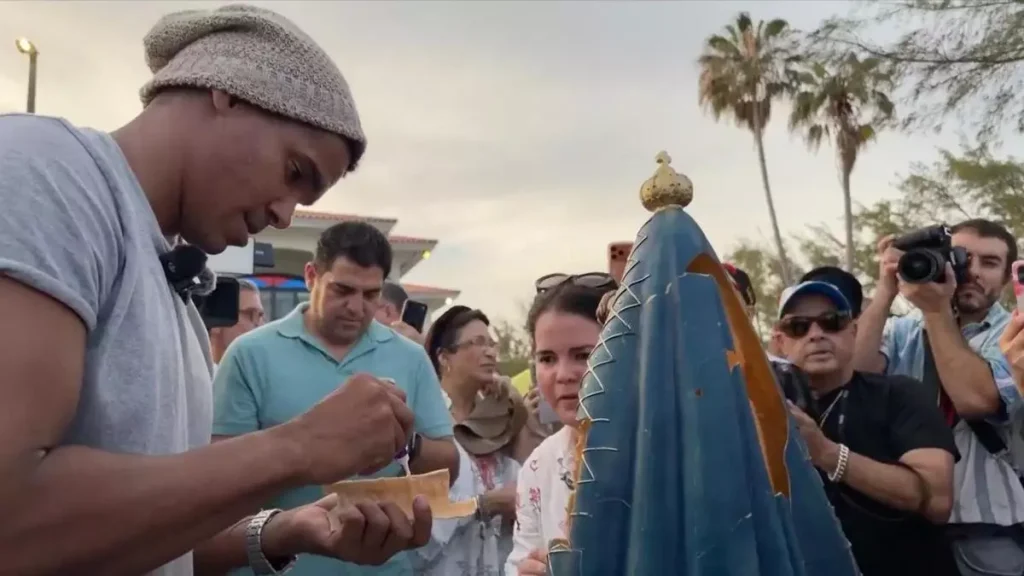
 14ymedio, Madrid, July 19, 2026 — Just an hour after landing in Miami, USA, Cuban artist and former political prisoner Luis Manuel Otero Alcántara transformed his first act of freedom into a “spiritual and political” performance. At the Hermitage of Our Lady of Charity of El Cobre, before dozens of members of the exile community, journalists, and activists, he led an event to collectively reconstruct a broken image of Our Lady of Charity that he had brought from Cuba and presented as a metaphor for the “wounds” of the island, the exile community, and himself.
Faced with a barrage of questions from the press, Otero Alcántara repeatedly emphasized the same point: “What I want is to work. I’m here to work: every minute I waste is another minute of the dictatorship.”
Before beginning, he thanked the exile community for their support and dedicated a few words to the political prisoners who remain on the island, especially the rapper Maykel Osorbo Castillo Pérez, also a member of the San Isidro Movement. Regarding the musician, he stated that he would be in Miami “soon.” According to his contacts at the U.S. Embassy, the artist could arrive in that country “in less than a month,” although he clarified that he couldn’t guarantee it. “Maykel is a survivor and a fighter, and if I survived, he’ll be alright, as far as possible.”
Regarding ‘Osorbo’, he stated that he would also be in Miami “very soon.” According to his contacts at the US Embassy, the artist could arrive in that country “in less than a month.”
While applying glue to the fragments of the image, Otero Alcántara answered journalists’ questions. The artist reiterated that he will continue using art as a tool for political transformation: “There is a type of art that has the power to change things: a song changed things, a performance changed things,” he said, alluding to Patria y Vida and his own artistic actions on the island. But he insists that commitment is necessary, that art must be more than “a painting on the wall.” “I put my skin on the line, and I’m here to continue putting my skin on the line.”
He also sent a message to those who remain in Cuba. “We must continue fighting for freedoms, because it is possible.” Otero Alcántara maintained that “we must know what we are fighting for. We didn’t leave for chicken, for oil, or anything like that. We left demanding freedom, and freedom will bring all of that.”
The activist also claimed to have spoken with US Embassy officials about the situation of Cuban political prisoners. “They are putting pressure on,” he said, though he insisted that “to get them all out, the dictatorship must
be overthrown,” because “as long as the dictatorship exists, there will be political prisoners.”
“We need to know what we’re fighting for. We’re not out here for chicken, oil, or anything like that. We’re out here demanding freedom, and freedom will bring all of that.”
When asked about his time in prison, he said he felt “mentally healthier” thanks, in part, he said, to the international pressure exerted during those years. He explained that prison authorities allowed him to paint because they knew that this activity “kept him alive,” and he expressed his confidence in having been able to smuggle most of the artwork he created in prison out of the country.
He also announced that he is preparing a public exhibition of the more than 4,000 paintings he created during his imprisonment and managed to bring with him. He plans to hold an event where, as he unpacks them, he will talk about how he conceived them. “I’m going to keep making art; I have a lot of ideas in my head. All the works I’m bringing are about the feeling of confinement.”
Regarding the reconstruction of the Virgin of Charity statue, Otero Alcántara explained that it represents a meeting point for Cubans, transcending political or personal differences. “We are all broken,” he stated, alluding to families separated by exile and the consequences of repression. “The Virgin doesn’t restore herself. She is the culmination of all our collective energy.” He also maintained that spirituality is a space where “straight people, gay people, white people, black people, government supporters, dictators, State Security, opposition members, Mambises, and we, the artists,” all converge.
Otero Alcántara asserts that commitment is essential, that art must be more than just “a painting on the wall.” “I put my heart and soul on the line, and I’m here to continue putting my heart and soul on the line.”
While the performance was underway and many friends approached to embrace Otero Alcántara and celebrate his freedom, slogans such as “Patria y Vida” [Homeland and Life], “Down with the dictatorship,” and “Long live free Cuba!” were chanted. In addition, those present sang the Cuban national anthem.
The arrival of Luis Manuel Otero Alcántara in the United States generated immediate reactions both within and outside the Cuban exile community. U.S. Secretary of State Marco Rubio welcomed him with a statement declaring: “Luis Manuel Otero Alcántara faced years of repression and inhumane conditions under the Castro regime. His courage in appearing with the Cuban flag during ‘Patria y Vida,’ the anthem of freedom, inspired millions. It is a privilege to welcome him to the United States as a hero of the Cuban cause.” Rubio also called for the release of rapper Maykel Osorbo and the rest of the Cuban political prisoners, and reiterated the need for free elections on the island.
Republican Congressman Mario Díaz-Balart, for his part, maintained that Otero Alcántara and other opposition members “risked everything for the freedom of the Cuban people,” and reiterated his support for those who remain imprisoned for political reasons.
______________________
COLLABORATE WITH OUR WORK: The 14ymedio team is committed to practicing serious journalism that reflects Cuba’s reality in all its depth. Thank you for joining us on this long journey. We invite you to continue supporting us by becoming a member of 14ymedio now. Together we can continue transforming journalism in Cuba.