In Guanabacoa They Remember With Nostalgia La Cotorra, the Company That Distributed Water Throughout Cuba

The springs of Loma de la Cruz are in good condition, but no one exploits them anymore


The abandonment of La Cotorra reflects a loss of identity and collective memory / 14ymedio

14ymedio bigger14ymedio, José Lassa, Havana, 6 January 2024 — “It was the water that we drank in my house, and a fleet of trucks delivered 20-liter glass bottles at home,” Ramón sighs at the ruins of La Cotorra, one of the most emblematic companies of pre-revolutionary Cuba. Uncovered roofs, cracked walls, chipped paint and weeds growing wildly among rusted iron are all that remain now of the factory, located at the entrance of Guanabacoa (Havana), on Corral Falso Avenue.

“We bought water from the trucks that distributed it,” Ramón continues. “At home they put it in some metal containers where you could swing the bottle forward to extract the water. We were regular customers of La Cotorra and we never lacked water. The same truckers had you change the empty for the full, carrying it on their backs in a very characteristic way, and they took the water everywhere. It cost 20 cents.”
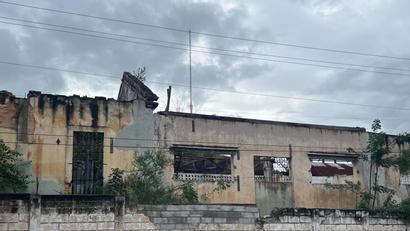
Uncovered roofs, cracked walls, chipped paint and weeds growing wildly among the rusted iron is all that is left now of the factory / 14ymedio

The man’s nostalgia is evident; he knew the factory when the Soviet subsidy still kept it active. La Cotorra, however, knew better times. Its foundation dates back to the early nineteenth century, when the Galician immigrant Claudio Conde Cid – who began in 1905 to transport water from the Isle of Pines to Havana – acquired in 1915 the land in the Loma de la Cruz, known for its springs, including the famous Chorrito del Cura.

Those first years were dedicated by the company to bringing water to the capital under the La Vida brand, but it soon began a much larger continue reading

deployment aimed at exploiting local resources. In 1920, the company completed the construction of an industrial complex that included purification, packaging and distribution facilities, along with gardens and halls that became popular spaces for social events.

The company became one of the great economic centers in the area, not only because of the water it distributed, but also because of the employment and social activities it generated. In the 1940s it had 42 distribution trucks and 69 branches throughout the country, and produced about 20 million bottles in 1959.
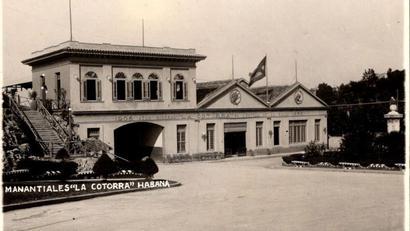
The company became one of the great economic centers in the area, not only because of the water it distributed, but also because of the employment and social activities it generated / Archive

After nationalization in the 1960s, the company was converted into the Administrative Unit that controlled water and soft drinks. Several local brands were unified, and the name was changed to José Ramón Reyes Moro, in honor of a soldier from Guanajuato who fell at Playa Girón. In that decade and the next, there were still years of splendor for the company, as Julián, a neighbor of the Habana Nueva neighborhood, points out.

“Although I was born in 1968, the service still existed. In my grandmother’s house it was the water we drank. Over the years, the bottles were used to make rice wine that my great-grandmother loved,” he recalls. Little by little, like so many facilities on the Island, the money stopped flowing and the deterioration became increasingly pronounced.

In 1986, the official newspaper Granma itself reflected on the deterioration of the industrial facilities. The lack of maintenance and the precarious conditions of the infrastructure, which included defective boilers and obsolete filters, began to diminish production.

During the Special Period, the social halls and the playground disappeared, becoming offices and warehouses. The springs of the Loma de la Cruz, once an inexhaustible source of pure water, stopped being exploited due to the proliferation of houses, which made the neighbors think that the water was contaminated. The plant was dedicated solely to marketing water from the El Gato aqueduct, and, in 1997, the management became part of the Beverages and Soft Drinks Company of the City of Havana.

However, an expert in the field, Laureano Orbera, points out that, despite the widespread deterioration, the springs of the Loma de la Cruz are in good condition. In a study conducted in 2005, Orbera and a team discovered twenty virgin wells with a constant flow of one liter per second and adequate mineralization. Despite the constructions that have invaded the Hill of the Cross, the deep water remains intact, although its medicinal and valuable waters remain inaccessible due to the lack of adequate infrastructure for its exploitation.

Today, the factory operates as a parking lot. Collapsed, it remains closed, with access to its interior forbidden. The image is very different from the memories of Monica, who went to visit it as a child with her school.
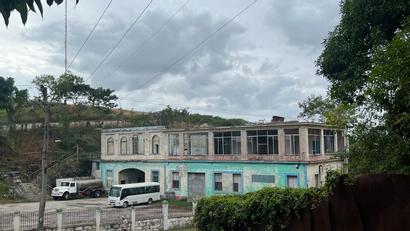
Today, the factory operates as a parking lot. Collapsed, it remains closed, with access to its interior forbidden / 14ymedio

“There was a sculpture of a parrot in the center of the gardens resting on a concrete slab that covered a large well or pond of crystal clear water with blue rock walls. There was a large park where the trucks that distributed the water were parked. At the top of the factory were the offices and a large hall where activities, meetings, birthdays, dances, etc. were held. Now it is a garden, playground and gastronomic center, but the restoration has been horrible.”

The deterioration is not only physical. The abandonment of La Cotorra reflects a loss of identity and collective memory. The history of this emblematic water company is in ruins, and with it, the future of a heritage that was once vital for Guanabacoa.

Translated by Regina Anavy

____________

COLLABORATE WITH OUR WORKThe 14ymedio team is committed to practicing serious journalism that reflects Cuba’s reality in all its depth. Thank you for joining us on this long journey. We invite you to continue supporting us by becoming a member of 14ymedio now. Together we can continue transforming journalism in Cuba.

The Garbage on El Chacón Beach Has Ruined the Fame That Hemingway Gave to Cojímar

In its time, El Chacón was one of the most beautiful places on the coast of Havana / 14ymedio

14ymedio bigger14ymedio, José Lassa, Havana, 5 January 2025 — “Take care of your people. Your garbage pollutes.” The sign on a small wall on the beach of Cojímar – known as El Chacón – east of Havana, becomes a bad joke when the visitor looks out at the coast: a long landfill, with several strata, between the weeds and the sea.

Cojímar is still the town of Santiago, Hemingway’s battered fisherman in The Old Man and the Sea. But to the poverty of the town, which was already a humble but very lively community in the 1950s, are now added entire months of waste accumulation. Almost a year ago, when a reporter from 14ymedio toured Cojímar and Alamar, El Chacón was already submerged in the garbage, dragged from the bay and the river of the area.

“The beach was a place where families and tourists came to enjoy themselves. Sometimes I feel helpless when I see how everything has deteriorated,” says Ana María González, owner of a small coffee shop in the area. The woman remembers the times when the beach was full of laughter and children. “On weekends I prepared lunch, and we went to the beach to spend the day. It was a close and cheap option, and my children had a great time.”

“Take care of your town. Your garbage pollutes,” says a sign on a small wall on the beach / 14ymedio

At the time, El Chacón was one of the most beautiful places on the capital’s coast. At the end of the coastal curve is the 17th century “castillito” that was the last bastion against French pirates and English invaders. The old tower gave charm to the place, in whose waters sailed the yacht Pilar, of the American Nobel Prizewinner (1954), in search of Nazi submarines that – it was thought at the time – loaded fuel in some Cuban key. continue reading

Now, however, “the fall in tourism has made the authorities prioritize other areas,” laments Miguel Ángel Rodríguez, a veteran fisherman from Cojímar. “We used to have tourists buying fresh fish right here. Now, they don’t even want to get close.”

Some insist on setting a date for the decline of El Chacón: 2017, the year of Hurricane Irma, which devastated the northern coast of Havana. However, it’s the tide and the river current that have, over time, returned to the area’s inhabitants everything they have thrown in the water.

No one wants – or can – walk along the beach anymore. Not to mention swimming in its waters. You can barely see a path of sand below the carpet of waste: it shows that, in spite of themselves, many residents of Cojímar must cross the beach.

You can barely see a path of sand between the carpet of waste. It shows that, in spite of themselves, many residents must cross the beach / 14ymedio

The complaints that frequently appear in the Havana press have been worthless. Reinier Torres Cruz, a resident of Cojímar and president of the Alto Voltaje motorcycle club, led a beach cleaning in 2019. His description of the landscape, published in Trabajadores, already presaged the current situation.

“The river brings the largest amount of garbage to the beach,” Torres explained. “It is dragged from Regla and Guanabacoa, and, as if that were not enough, there are industries that also dump their waste in the river. That’s why it takes so much work to keep our bay clean.”

In August 2024, the Regional Office of Culture for Latin America and the Caribbean, in collaboration with UNESCO, carried out cleaning work. They collected as many as 150 bags of garbage.

On December 15, the restored Golfito de Alamar – currently leased to a private company – organized another garbage collection with private businesses in the area. “It’s a collective effort, but we need more support and education on conservation,” one of the volunteers told this newspaper at the time. “People don’t understand that every little gesture counts.”

Complaints about the precarious state of El Chacón have even reached social networks / 14ymedio

Complaints about the precarious state of El Chacón have even reached social networks, where neighbors publish photos of the garbage that the sea deposits on the sand. “We can’t go on like this,” an Internet user living in the area recently commented. “I have lived here all my life and have never seen anything so sad. The beach is part of our history and is now disappearing.”

The little beach continues to attract Cojímar’s garbage. The fact that the place is no longer among the sites of tourist interest has condemned it to permanent neglect by the authorities. Defeated in its war against the landfill, like Hemingway’s old fisherman, El Chacón appears to be very unlucky.

Translated by Regina Anavy

____________

COLLABORATE WITH OUR WORKThe 14ymedio team is committed to practicing serious journalism that reflects Cuba’s reality in all its depth. Thank you for joining us on this long journey. We invite you to continue supporting us by becoming a member of 14ymedio now. Together we can continue transforming journalism in Cuba.

Olympic Champion Jordan Díaz Wants To Take His Family out of Cuba and Bring Them to Spain

The Paris 2024 triple jump gold medalist has bought a house in Spain to live in with his family from Cuba

Jordan Díaz, Cuban, with two of his medals won as a Spanish athlete / Instagram/Jordan Díaz

14ymedio bigger14ymedio, Havana, 5 January 2025 — The family of the Olympic gold medalist in triple jump, the Cuban Jordan Díaz, is in the process of leaving the Island. The naturalized Spanish athlete gave the news in an interview offered to the newspaper El País: “I want to bring them, so I have bought a house for them to come.”

Díaz, who deserted from the Cuban national team in 2021 to seek a “better future” for himself and his family, said that his parents supported his decision at all times. “When my parents gave me their blessing, they told me, ’you have to go, you have to leave if you want to be great’.”

The athlete recalled: “It’s not a matter of one day saying I’m going to leave and nothing happens. You have to really think about it, see the consequences it can bring you, think about friendships, all the life you have led here, your family.” continue reading

Díaz’s career has been on the rise since he arrived in Spain. He trains with Iván Pedroso, the former Cuban champion who has won medals for his training work in Venezuela and Spain. After winning the gold at the Olympic Games in Paris 2024, the triple-jumper beat Spain’s absolute record on four occasions and placed it at 17.87 meters, achieved in the local Championship held in Nerja.

Triple-jumper Jordan Díaz during his participation in the Olympic Games in Paris 2024 / Instagram/Jordan Díaz

Before the Olympics, he was crowned in the 2024 European Athletics Championship with a jump of 18.18 meters, the third best jump in history and a record for Spain. “I didn’t have more than 18 in mind; I think it’s an incredible score,” he told the same newspaper.

For his achievements on the track he was awarded the ICON Award. “It’s a great prize. All recognition is good and all prizes are important for an athlete, because you see how in the end the work you are doing is rewarded,” he said.

Díaz focuses his goals for this year on completing the triple crown with the World Athletics Championships, which will be held in 2025 in Japan. He has dedicated part of his training to perfecting his technique, which has also helped him overcome the fibrosis he suffers as a result of poorly healed injuries and the tendonitis he had in Cuba.

“Cuba’s method is not to do many sprints but to work more on the jump. That’s why I had a lot of power there, I did taller jumps to gain distance, but when you approach with more speed and lower the jump angle, you pull further forward. That’s what Iván has changed for me, and thus we have obtained better results. That’s why I need to be physically well,” said the medalist.

Translated by Regina Anavy

____________

COLLABORATE WITH OUR WORKThe 14ymedio team is committed to practicing serious journalism that reflects Cuba’s reality in all its depth. Thank you for joining us on this long journey. We invite you to continue supporting us by becoming a member of 14ymedio now. Together we can continue transforming journalism in Cuba.

The Prensa Latina Correspondent in New York Abandons Her Post and Stays in the United States

The agency has experienced several casualties in recent years and lacks staff

Borrego graduated from the Marta Abreu Central University of Las Villas / LinkedIn/Elizabeth Borrego

14ymedio bigger14ymedio, Havana, 4 January 2025 — Prensa Latina lost one of its key correspondents this week. Elizabeth Borrego Rodríguez, head of the official Cuban news agency at UN headquarters in New York, informed Prensa Latina that she was leaving her position to stay in the United States, after more than a year of reporting for the organization, reported El Vigía de Cuba.

The resignation of the 31-year-old journalist after little time in the position affects Prensa Latina, which increasingly resorts to younger collaborators, who, like Borrego, do not seem to last. “She had only been on the job at United Nations headquarters for a little over a year. She called Prensa Latina in Havana to say that she was not returning,” an employee of the agency confirmed to Cubanet.

Before arriving in New York, Borrego was a correspondent in Venezuela, from where she sent articles validating the actions of the Caracas regime, an ally of Havana, which were then reproduced in the provincial press of the Island. The Cuban government has stationed several of its most notable propagandists in Caracas, such as Pedro Jorge Velázquez, known as El Necio [The Fool].

Born in Sancti Spíritus and graduated from the Marta Abreu Central University of Las Villas with a thesis about Noticiero Estelar [another official news source], Borrego is the daughter of Juan Antonio Borrego Díaz, who continue reading

died in 2021. He was the director for almost 24 years of Escambray, the newspaper of the Communist Party in Sancti Spíritus. In addition, he was a correspondent for the State newspaper Granma for 30 years and a collaborator of Cubadebate, where his articles appeared frequently. After his death, the Journalistic Innovation Award that bears his name was created.

After his death, the Journalistic Innovation Award that bears his name was created

From the UN, Borrego diligently performed her work, which consisted mainly of criticizing the economic “blockade” of the United States, asking that Cuba be removed from the list of countries sponsoring terrorism and applauding the pleas of the foreign minister, Bruno Rodríguez Parrilla. “Unilateral coercive sanctions prevent enjoyment of the rights to food, education, health and development [of Cubans],” she wrote in her last article, published by Prensa Latina on December 10.

Occasionally, she also worked on other topics, such as a report dedicated to Latin American women that she published in 2024, or the recent deliveries of UN donations to those affected by hurricanes Oscar and Rafael on the Island. “Borrego did her job very well. She is a good journalist, but, like every young person, she dreams of having children and leading a dignified life, and that is impossible here,” explained a source close to El Vigía de Cuba.

He also said that Prensa Latina has a lack of journalists: “The blow is hard, because more and more young journalists are leaving, the most talented, some with important positions or in wonderful places, without us being able to do anything at all to avoid it.”

However, he says that the reactions within the agency do not always support the decision of the young reporter, and some believe that her departure is a “treason” to the agency that entrusted her with an important position.

Inside the agency, some believe that her departure is “treason”

According to Cubanet, with a source in Havana, the agency tries to keep the UN correspondent active with the support of Washington correspondent Daisy Francis Texidor, of “very discreet professionalism as she showed in Mexico, but an old collaborator of Cuban intelligence.”

He also adds that Francis “was closely linked to the environment of Los Cinco,” – The Five – in reference to the spies in the service of the Cuban government that Washington arrested in 1998. He also recalled the departure in recent years of two other important correspondents of Prensa Latina: Néstor Marín, in London, and Miguel Lozano, in Madrid.

On December 30, the arrival at Miami International Airport of sports commentator Sergio Ortega and his family, who emigrated definitively to the United States and plan to settle in southern Florida, was also in the news. The journalist is the son of Manolo Ortega, who was a “personal friend” and official presenter of Fidel Castro in political events.

Translated by Regina Anavy

____________

COLLABORATE WITH OUR WORKThe 14ymedio team is committed to practicing serious journalism that reflects Cuba’s reality in all its depth. Thank you for joining us on this long journey. We invite you to continue supporting us by becoming a member of 14ymedio now. Together we can continue transforming journalism in Cuba.

A ‘Coyote’ Abandons 25 Cubans in an Area of Mexico Controlled by Narcos

The Mexican Border Police transferred the Cuban migrants to the Immigrant Prosecutor’s Office /FGE of Chiapas

14ymedio bigger14ymedio, Mexico City, 3 January 2024 — A coyote abandoned 25 Cubans on Thursday in the trailer of a cargo truck on a road in the Ignacio Zaragoza ejido, in the municipality of Suchiate, Chiapas, bordering Guatemala. The migrants were rescued by state police, who after a medical check-up, handed them over to the Immigrant Prosecutor’s Office to determine their status.

These Cubans, among whom are several women and minors, asked to communicate with 14ymedio, but the authorities denied it, arguing that “the investigation could be hindered.” The minors were taken to a shelter of the National System for the Integral Development of Families (DIF) in Tapachula.

From Tecún Umán, in Guatemala, to Suchiate and Tapachula, in Mexico, the authorities carry out tours to combat irregular entries. However, they have not been able to eradicate the networks of coyotes in the service of criminal groups.

Of an average of 1,200 migrants who illegally enter Mexico daily through the Guatemalan border, at least 50% are being kidnapped by “cartels in the municipality of Suchiate,” denounced priests from the San Andrés Apóstol parish and the Pastoral Coordination of Migrants in Guatemala. continue reading

The Chiapas State Prosecutor’s Office is investigating a network of coyotes in the state / FGE of Chiapas

Father Percy Cervera of Guatemalan Pastoral confirmed the increase of “migrants of 56 nationalities” in the last quarter of 2024 who seek to reach the United States. They have become a vulnerable group that is “prey to criminals, authorities, transporters and many people who take advantage of their situation,” he said.

For his part, the priest of the parish of San Andrés Apóstol de Ciudad Hidalgo, Heyman Vásquez Medina, warned Diario del Sur in August last year of the presence of coyotes under the control of factions of the Sinaloa Cartel and the Jalisco New Generation Cartel. They “arrive in vans wearing balaclavas and with weapons. They intercept the migrants and take them to farms, where they keep them for days until their relatives pay the sums they demand,” he said.

The Associated Press agency documented the kidnapping of migrants in Suchiate last November. Before crossing the river that separates Guatemala from Mexico, they are detained by human traffickers. Heyman Vázquez, parish priest in Ciudad Hidalgo – a town near the border – said in the same interview that the cartels dominate both sides of the border. “They are the ones who say who passes and who doesn’t.”

The migrants are grouped and taken to a farm known as “the chicken coop” or “la gallera.” There they demand 100 dollars for transit duty, and those who pay are marked and released. Those who cannot cover the fee remain in place, but the sum is increased by the food they receive. “When they can’t pay with money, they pay with their bodies, especially women, adolescents and homosexual men,” Enrique Vidal Olascoaga, general director of the Fray Matías de Córdova Human Rights Center in Tapachula, told the same agency.

Translated by Regina Anavy

____________

COLLABORATE WITH OUR WORKThe 14ymedio team is committed to practicing serious journalism that reflects Cuba’s reality in all its depth. Thank you for joining us on this long journey. We invite you to continue supporting us by becoming a member of 14ymedio now. Together we can continue transforming journalism in Cuba.

In 2024 Oil Shipments From Venezuela to Cuba Fell by Almost Half

Although Venezuelan fuel exports increased by 10%, donations to the Island fell from 56,000 barrels per day to 32,000

The ship ’Alicia’, one of the tankers that usually bring oil from Venezuela

14ymedio bigger14ymedio, Madrid, 3 January 2025 — Fuel shipments from Caracas to the Island fell by more than 42% in 2024. The data, published by Reuters, is even more striking if we take into account that Caracas increased its oil exports in the same period by 10.5%, and its crude oil production by 17%, from the 780,000 barrels per day (bpd) of the first 11 months of 2023 to the 914,000 bpd of the same period last year.

“While Venezuela struggled with frequent refinery cuts last year, exports of crude oil and fuel to its political ally Cuba, which has been facing a severe energy crisis, fell to about 32,000 bpd from 56,000 bpd the previous year,” the British agency reported.

On the other hand, total exports decreased to 756,000 bpd in December, compared to a maximum of 974,000 bpd in November, because, explains Reuters, “one of the four Pdvsa crude upgraders had operational problems.”

The annual increase in exports took place despite the political instability in Venezuela, because partners of the Venezuelan state-owned PDVSA who have licenses granted by Washington took more shipments. Reuters alluded to the results of the presidential elections last July, whose triumph was attributed to Nicolás Maduro. This result has been questioned internationally and gave rise to demonstrations with hundreds of arrests. continue reading

Pdvsa and its joint ventures exported 772,000 barrels per day last year, the highest figure since 2019

These individual licenses, in force since the beginning of 2023, are the main element that caused Venezuelan fuel exports to the United States to skyrocket exponentially, by 64%, to about 222,000 bpd last year. The numbers make the United States the second largest export market for Caracas, behind China, which took 351,000 bpd, 18% less than the previous year.

On average, the British agency indicates, Pdvsa and its joint ventures exported 772,000 barrels per day last year, the highest figure since 2019, when Washington, under the presidency of Donald Trump, imposed energy sanctions for the first time.

Much of last year’s export profits, Reuters highlights, come from the American oil company Chevron. In addition, shipments to Europe tripled in 2024, up to about 75,000 bpd, thanks to the authorization of the US to European producers such as the Italian Eni, the Spanish Repsol and the French Maurel et Prom.

These gains, Reuters also estimates, “could be in danger” in the face of Trump’s imminent arrival at the White House for the second time. The president-elect and his team appointed for the State Department, headed by Cuban-American Marco Rubio, have already announced more pressure on the Maduro regime.

For the specialist, in any case, 2025 will be an “extremely difficult” year for the Island

The reinstatement of sanctions against Caracas by the next US president would, however, be beneficial for Cuba and Mexico, in the opinion of Jorge Piñón, a Cuban analyst at the University of Texas in Austin.

In an interview with the Spanish agency EFE published this Thursday, the specialist, a 14ymedio source for information on energy, indicated that Pdvsa, in fact, has given priority to companies such as Chevron and Repsol and has left Cuba “at the end of the line.” He pointed out the minimum shipment from Caracas to the Island, 23,000 barrels per day, compared to the 2023 average of 55,000 bpd.

Given this scenario, Piñón also commented that Mexico has displaced Caracas as the main sender of fuel to Havana, which is a problem for President Claudia Sheinbaum with Trump’s arrival in power on January 20.

“The United States and Mexico have a very close relationship in energy matters. That is not something that can be closed or turned off overnight,” the expert told EFE, pointing out that it is a card that Trump can play, as well as for the Pemex refinery in Texas. “Ninety percent of the natural gas that the United States exports through pipelines goes to Mexico, which represents 65% of Mexico’s natural gas consumption.”

“If Marco Rubio and Trump say: ’Fine, we are going to go back to the sanctions again,’” Piñón declared. It would benefit Cuba and Mexico, because the oil Venezuela sends to the US would go to Cuba instead, and on the other hand, Mexico would not have to send crude to Cuba, for that matter, and would not be exposed to possible sanctions from Washington.

For the specialist, in any case, 2025 will be an “extremely difficult” year for the Island, which has just ended 2024 with three total collapses of the National Electric System (SEN).

Based on official data from 2022, Piñón told EFE that Cuba has a daily deficit of about 80,000 barrels of liquid fuel. He calculates, based on international shipments from Venezuela and above all from Mexico, that the demand in 2024 was reduced by 20,000 barrels per day.

Translated by Regina Anavy

____________

COLLABORATE WITH OUR WORKThe 14ymedio team is committed to practicing serious journalism that reflects Cuba’s reality in all its depth. Thank you for joining us on this long journey. We invite you to continue supporting us by becoming a member of 14ymedio now. Together we can continue transforming journalism in Cuba.

After Hurricane Rafael, All the Resources of the Cuban State Were Put at the Service of the Mariel Special Development Zone

With more than 10,000 workers in its facilities, the Zone is the most important economic enclave in Cuba / Canal Caribe

14ymedio bigger14ymedio, Havana, 4 January 2025 — The Mariel Special Development Zone (ZEDM) in Artemisa recovered in record time after the passage of Hurricane Rafael in November. Construction materials of military origin arrived; fuel was allocated in the midst of a supply crisis, and there was direct supervision of the regime’s main plan, headed by President Miguel Díaz-Canel.

The impact of the hurricane was considerable: 29 of the 49 businesses based in Mariel suffered damage. “Catastrophic” was the adjective used by its managers to describe the panorama in an extensive report on Cuban Television. However, neither the blackout nor the crisis in which the country was immersed during those days was an obstacle to sending all possible resources to the ZEDM.

Ana Igarza, director of the Free Zone, said that before 36 hours had passed, reconstruction activities had already resumed. Electricity for the entire area was restored in less than three days, thanks to a legion of workers from the Electric Union who arrived the day after the hurricane.

Electricity for the entire area was restored in less than three days, thanks to a legion of workers from the Electric Union

The Army also intervened from the first moment. The governor of Artemisa, Ricardo Concepción, said that the Cuban military sent him more than 40,000 fiber cement tiles manufactured in entities of the Military Industry Company. “Today all municipalities now have materials,” he said. The role continue reading

of the Western Army in Mariel’s record reparation has been “determining,” Concepción admitted.

The foreign companies that operate in the ZEDM, according to Televisión Cubana, are “godparents” for Mariel’s schools, and financed their recovery. For the governor, the visits of Díaz-Canel and Ramiro Valdés also had a military character: both were wearing olive green uniforms.

Most of the report deals with the opinions of foreign managers in the ZEDM, especially those who suffered the most damage. This is the case of Brascuba Cigarrillos, whose director, the Brazilian Gustavo Leite Machado, said that his factories had lost 50% of the roofing. The chimneys, machines and power plants were damaged by the rain. “The water fell directly on the machines, and the parts rusted. A dismantling and cleaning process was necessary,” said Robinson Tamayo, Cuban director of Brascuba.

Most of the report deals with the opinions of foreign executives in the ZEDM

Maylin Carmente, director of administration of the Mexican Richmeat, said that the blackouts affected the production of processed meat “considerably.” The plant, like that of Brascuba, suffered structural damage.

About 25% of the roof of the company Nescor – which produces crackers, coffee and similar products – was cut down by the hurricane. “It was quite difficult to see a factory like Nescor in that condition,” said its director, Jorge Rivas. Although he claims to have enough raw materials to continue working, he predicts that 2025 will be a hard year for the company.

Suchel, another of the famous tenants of the Zone, had damage to its drying tower, ceiling and walls. The hurricane prevented the launch of several lines of detergent, which the company expected to sell this year.

Thai Binh Green, a disposable diaper and paper factory that built an extensive photovoltaic park in Mariel, was badly damaged by the hurricane. They need “more than a million dollars to rebuild the park,” said its director. The shipments of solar panels promised by China as the “definitive solution” to the Cuban energy crisis arrived a few days later.

With more than 10,000 workers in its facilities, the Free Zone is the most important economic enclave in Cuba. The Government spends about 300 million dollars a year maintaining its structure, according to Ecured. Its area is 213 square kilometers and has four large Chinese cranes. Not willing to lose its most important economic bet, the Cuban Government has a motto for the ZEDM, according to Igarza: “There is no pause.” And, unlike what happens in the rest of the country, there was a lot of hurry.

Translated by Regina Anavy

____________

COLLABORATE WITH OUR WORKThe 14ymedio team is committed to practicing serious journalism that reflects Cuba’s reality in all its depth. Thank you for joining us on this long journey. We invite you to continue supporting us by becoming a member of 14ymedio now. Together we can continue transforming journalism in Cuba.

Faced With a Disastrous Planting Season, Sancti Spíritus Tobacco Growers Lower Their Expectations for the Harvest

To improve last year’s results, planting had begun “early in October,” but it was in vain

Sancti Spíritus tobacco growers expect to harvest about 1,520 tons of the leaf / ‘Escambray’

14ymedio bigger 14ymedio, Havana, January 2, 2025 — After a depressing year for tobacco production in Sancti Spíritus and facing another one that doesn’t offer great promise, tobacco growers have carried out a “readjustment” of their expectations. They promise the State, according to the province’s Escambray newspaper, to harvest about 1,520 tons of the leaf, 1,000 less than the target set in August, when it was hoped to reach 2,596 tons.

The number reported this week is still just an estimate that reflects not the reality – treacherous when it comes to Cuban agriculture – but the best possible scenario.

The original plan, according to Clemente Hernández Rojas, director of the State’s Acopio y Beneficio de Tabaco Company in the province, was to plant 2,000 hectares of tobacco “sol en palo” (in the sun), and 260 of “tapado,” (shaded by a mosquito net), the two variants* that are grown in Sancti Spíritus. Due to the lack of “some inputs,” he said, only 62% of the plan could be carried out.

To improve last year’s results, planting had begun “early in October.” It was in vain. Hernández claimed that the “inclement weather,” especially the rains that hit the territory that month and the following, delayed the planting.

However, the problems were seen coming from August, when the growers, with optimal conditions to start planting and over a third of the land destined to plant tobacco for export, counted only on one variety that contributes the most income to the state coffers.

According to Escambray, the end of the year “became demanding for the growers, who sought to increase the pace of planting to conclude 2024 with more than 850 hectares covered.” The State executed an old trick and extended the campaign until the first days of January. “We must finish before the 20th of this month,” Hernández explained.

To this list of difficulties is added the energy situation in the country, which does not seem to abate this year. Many growers who use an irrigation system powered by electricity have been affected. With the usual triumphalism, the leader assured that “the farmers are recovering, looking continue reading

for alternatives, making sacrifices, and it is expected that this plan will be fulfilled in Sancti Spíritus.”

Escambray reported that the omens “are favorable” for growers. From an agricultural point of view, “the tobacco plantations look healthy, with leaves of very good quality.” The media added that “there is a favorable climate for tobacco” and that there have been no intense attacks of disease, although “yes, there are some plagues, but they have what they need to fight them.”

The difficulties faced by growers for the profitability of the product contrast with what the tobacco of the Island represents anywhere in the world: a symbol of luxury. Despite this and the large resources that the industry collects annually (721 million dollars in 2024 alone), only the minimum is reinvested to keep the business afloat.

The numbers that are glimpsed in the province, the second largest production territory in the country, follow the same route as last March, when the plan was barely fulfilled at 49%. One of the consequences of low production was that only one sixth of the tobacco harvested in Sancti Spíritus met the quality parameters necessary for export.

Then, according to the official press, the main causes of the debacle were the lack of fuel to carry out the planting and the fact that “many producers did not plant because the crop is not profitable.”

Despite the fall of the tobacco industry, which every year reports more- diminished and lower-quality productions, attributed to the passage of Hurricane Ian in 2022, Habanos S.A. continues to obtain increasingly higher profits.

In March of last year, the Cigar Festival, held annually in Havana, raised 19.3 million dollars from the sale of eight humidors alone – six were traditionally sold. The Government claims to invest this record amount in Public Health, despite all the evidence pointing to another pocket.

*Translator’s note: “Sol en palo” is used mainly for cigar wrappers; “tapado”
is protected from insects and direct sunlight and used as cigar filler and for cigarettes.

Translated by Regina Anavy

____________

COLLABORATE WITH OUR WORKThe 14ymedio team is committed to practicing serious journalism that reflects Cuba’s reality in all its depth. Thank you for joining us on this long journey. We invite you to continue supporting us by becoming a member of 14ymedio now. Together we can continue transforming journalism in Cuba.

The Independent Yorubas Dare To Foresee Dismissals ‘At the Highest Levels’ in Cuba

“The attachment to the past does not let us see present solutions, nor future plans,” warns the Miguel Febles Padrón Commission

The Miguel Febles Padrón Commission meets at its headquarters at 1509 Diez de Octubre Avenue, in Havana

14ymedio bigger14ymedio, Juan Izquierdo, Havana, 3 January 2025 — Two predictions for 2025 – both political and social – stand out in the Letter of the Year prepared by the Cuban independent Yorubas this Thursday. The first, that there will be dismissals “at the highest levels”; the second, that crimes related to children and infant mortality will increase.

The Miguel Febles Padrón Commission, which meets at its headquarters on Avenida de Diez de Octubre 1509, in Havana, offered its Letter one day after the official Yoruba Cultural Association published its own. Both religious institutions, with similar prestige and seniority, are – after a brief period of union a few years ago – in full schism. The reason: the Government’s preference for the Association, which is totally loyal to it and whose Letter even mimics the official press.

More critical in other times, Miguel Febles has gradually lowered the tone of its “Events of social interest” and its “Recommendations” – the two sections that usually contain warnings against bad government and descriptions of the Cuban crisis.

More critical in other times, Miguel Febles has gradually lowered the tone of its “Events of social interest” and its “Recommendations”

The letter published this Thursday predicts that in 2025 – under the protection of two ominous orishas, Odua and Yewa, respectively incarnations of the divine king and death – there will be a drop in the birth rate and an increase in the abandonment of children. In addition, it foresees continue reading

no loss of jobs and says that violence will continue to rise in the country.

Coinciding with the Association, which asked this Wednesday to “eliminate the agglomeration of garbage and outbreaks that facilitate the proliferation of epidemic diseases,” Miguel Febles demands a total “sanitation” of the cities.

The Letter, which many exiled Cubans consider legitimate – because their babalawos have not been pressured by the Party when writing it – indicates that it will be a year of “new wars.” Other fragments, which could be interpreted as critical allusions to the Cuban leadership, are: “Do not repeat procedures that have turned out to be obsolete” and “The attachment to the past does not let us see present solutions, nor future plans.”

The election of the governing deities of the year also has a certain political connotation. Odua, a divinized ancient Yoruba king, is credited with the unification of several African kingdoms. Therefore, it is the orisha that grants authority to the rulers, without whose approval every mandate is doomed to failure.

Odua is the ’orisha’ that grants authority to the rulers, without whose approval every mandate is doomed to failure

Yewa, on the other hand, is a goddess of cemeteries and destiny. For the Yorubas, she is the one who “governs existence” and provides at a symbolic level – for believers – a powerful counterpoint to the power of Odua. In the message offered by the Letter, power and death go irretrievably together.

This Wednesday, the message of the Yoruba Association also had, against all odds, a certain critical flavor. They predicted a year of “sadness and melancholy” and “vandalism and crime,” two attributes of Cuban society so obvious that you don’t need fortune tellers to see them coming. The symbol that summarized the year – protected by Changó, according to this group – is the “common grave.”

“Measures must be taken for the intensification of criminal acts,” they asked, in addition to “analyzing well the economic investments and their consequences.” Like Miguel Febles, they urged paying more attention to adolescents and young people, and to “take care of and respect marital and family integrity.”

For its part, in Miami, the Kola Ifá Ocha Commission also published a preview of its Letter. For the exiled Santeros, the reign of 2025 will not be in the hands of Changó or Odua, but of Oggún – the orisha blacksmith and rival of Santa Barbara – and by Oyá, associated with the Virgen de la Candelaria, who in Yoruba mythology abandons Oggún for Changó.

Despite the variety of predictions, the Kola Ifá Ocha, the Yoruba Association and the Miguel Febles all have the same aspiration: to send a message urbi et orbi, “for Cuba and the world,” which is still the charter of behavior for hundreds of Cubans, no matter where they are.

Translated by Regina Anavy

________________

COLLABORATE WITH OUR WORKThe 14ymedio team is committed to practicing serious journalism that reflects Cuba’s reality in all its depth. Thank you for joining us on this long journey. We invite you to continue supporting us by becoming a member of 14ymedio now. Together we can continue transforming journalism in Cuba.

Cuban Faces 2024 – Eduardo Rodríguez Dávila, the ‘Facebook Minister’

The bad situation in his sector has made Dávila a frequent bearer of bad news

The minister even responds to some scoldings, like when a user questioned the new transport laws / Facebook

14ymedio bigger14ymedio, Havana, 29 December 2024 — He is very active on Facebook. His daily quota varies from two to three posts, although sometimes, due to the situation, he can respond to four to five messages on his page. That interaction has given the head of Transport, Eduardo Rodríguez Dávila, a popularity that his colleagues in the Council of Ministers of Cuba lack.

Born in Villa Clara, the bad situation of his sector has made him a frequent bearer of bad news, since the problems on the Island in terms of transport never end. The shortage of fuel and vehicles, many of them “in the bones,” which exceed their useful life by years, are part of the information shared daily by the man known as the “Facebook Minister.”

After the total blackout that hit the Island at the end of October, he reported that the “contingency of the electrical system” – the usual euphemism with which the official press insists on qualifying the massive energy debacle – was disastrous for mobility throughout the country. continue reading

The informative work of Rodríguez Dávila is recognized by the majority of users, who repeatedly point out his “sense of belonging”

In his message he broke down the disaster that corresponds to his sector. He said that there was a lack of “tires, batteries, spare parts and tools, grease, oil and special liquids for the sustainability of the fleets” and that only a little more than half of the fuel planned for the first eight months of the year would be available.

However, the official got away with it, as with most of his posts. Although the announced measures are criticized, Rodríguez Dávila himself is recognized for providing information by most users, who repeatedly point out his “sense of belonging.”

The minister even responds to some scoldings, such as when a user questioned the new transport laws: “Regrettably, the conciliation and final adjustments of the rules with all the agencies and entities that participate have taken a little longer than expected.”

In one of his posts, on December 3, he said that he has felt “great pressure in the face of difficult circumstances” in his position. Hours later, it had been shared 53 times, with 128 comments and 703 reactions, almost all positive.

Translated by Regina Anavy

____________

COLLABORATE WITH OUR WORKThe 14ymedio team is committed to practicing serious journalism that reflects Cuba’s reality in all its depth. Thank you for joining us on this long journey. We invite you to continue supporting us by becoming a member of 14ymedio now. Together we can continue transforming journalism in Cuba.

Cuban Faces 2024: Omara Portuondo, 94 Years Old and Postponing Retirement

“Each person decides how he wants to live and die too,” the artist said

Portuondo was born in 1930 and remains one of the great references of Cuban music abroad /EFE

14ymedio bigger14ymedio, Havana, December 30, 2024 — Omara Portuondo has long been taking two fundamental things to her concerts: a doctor who monitors her health and a chair from which she offers her songs. It’s also been a long time since the followers of the 94-year-old artist predicted her departure from music, and last October the news finally arrived.

After an episode of disorientation on a stage in Barcelona, Ariel Jiménez, son and agent of the diva of the Buena Vista Social Club, announced her retirement. However, exactly a month later, another statement by Portuondo left the public perplexed: “I am not retiring from music.”

Before the stumble at the Palau de la Música in Barcelona, Portuondo’s active career was already generating controversy among her followers, but the episode of “fatigue” that caused the artist to stop singing Lágrimas negras was the straw that broke the camel’s back.

The audience, who paid up to 75 euros for a ticket, shouted “exploiters” and “let her rest” to the organizers, to which Ethiel Failde, director of the homonymous orchestra that accompanies her on stage, replied that the screams showed a lack of respect. “She herself asked to sing,” he said, and recalled that “Omara has always said that she wanted to die on stage.” continue reading

The audience, who paid up to 75 euros for a ticket, shouted “exploiters” and “let her rest” to the organizers

The justifications of the Portuondo team came shortly after, when Jiménez alluded to a “definitive retirement.” “By medical recommendation, the possibility that she continue to sing, rehearse and record, contributes favorably to her mental health, although at a moderate pace and always according to her physical condition. For this, periodic examinations are carried out, and her indicators are monitored,” he said at the time.

That same enthusiasm, Jiménez defended, was what led the family to organize together with the Cuza Agency and the Failde Orchestra, a tribute to the legendary Buena Vista Social Club group. “She would appear to interpret a few songs, from her condition as an exceptional protagonist of that project and in the same way she did with the original group,” said her son. There would be four concerts outside Cuba, two of which had already ended, in Gran Canaria and Colombia.

However, a statement from Portuondo weeks later explained that, although long and live concerts were now out of her reach – “I get tired, and it’s natural at my age” – she would continue to make recordings and “other activities” that her health allows.

A statement from Portuondo weeks later explained that she would continue making recordings

Also known as the Bride of Filin* she added: “As long as I have strength and people who want to listen to me, I will continue to sing. Because as I always tell you: music is in me, heaven, earth, sea and sun, joy and reason.”

Portuondo was born in 1930 and continues to be one of the great references of Cuban music abroad, but her career, especially on the Island – where she stopped singing years ago – was not free of stumbles either. Her loyalty to the regime and, in 2003, her initials on the letter that supported the shooting of the young people who hijacked the Regla ferry to escape to the United States, cost her the animosity of many followers.

However, if Omara Portuondo has made something clear, it is that she has always lived according to her own rules. “With respect for all the people who sincerely appreciate me, each person decides how they want to live and die too.”

* A style of singing resembling a jazz ballad, championed by Portuondo.

Translated by Regina Anavy

____________

COLLABORATE WITH OUR WORKThe 14ymedio team is committed to practicing serious journalism that reflects Cuba’s reality in all its depth. Thank you for joining us on this long journey. We invite you to continue supporting us by becoming a member of 14ymedio now. Together we can continue transforming journalism in Cuba.

The Birth Rate in Cienfuegos Fell by More Than 25 Percent in 2024

There are 24,000 Cuban doctors on “international missions” and 32,000 who emigrated from the Island this year

Cuban authorities are concerned about the low birth rate, but they put it into perspective in public / Flickr/Sanutri

14ymedio bigger14ymedio, Madrid, 30 December 2024 — This year 703 fewer children were born in Cienfuegos than last year, the provincial newspaper 5 de Septiembre published this Sunday in a very short report. It expresses concern about the province’s low birth rate, which is among the worst in the country.

The data are confusing, however, since the media points out that in 2024 2,127 cienfuegueros arrived in the world, but the demographic yearbook indicates that in 2023 there were 2,895, a difference of 768. In any case, taking the gross numbers for granted, the drop in births is 26.5%, well above the average that was offered for the Island with the data of the first semester.

In the middle of the year, in the ordinary session held by Parliament in July, Catherine Chibás Pérez, national head of the Maternal and Child Program (Pami) indicated that in the first six months of 2024, 34,648 live births were recorded throughout the country, 19% less than in the same period of the previous year. On that date, there were 8,157 fewer births in Cuba than in the same period of 2023.

“For 2025, work is already underway to increase birth rates and thus achieve the replacement that society needs”

“For 2025, work is already underway to increase birth rates and thus achieve the replacement that Cuban society needs, which is noticeable in the demographics of difficult times in the face of the phenomenon of emigration,” says the newspaper, without specifying what measures are expected to stimulate the birth rate in the midst of a galloping economic crisis and with the massive emigration of people of childbearing age. continue reading

The information appears on the same day that the Latin American edition of the leftist American magazine Jacobin publishes an interview with Carlos Fernández de Cossío, Cuban Deputy Minister of Foreign Affairs, in which he openly talks about the problem posed by the lethal combination of the Island’s demographics.

“Cuba resembles European countries in terms of social development. Advances in education, professional opportunities for women and women’s rights in general have an impact on the reduction of fertility rates,” the senior official said in response to a question about the decrease in young adults in Cuba.

“However, we have practically no immigration and emigration is relatively high,” he says. Labelling this ‘relative’ is surprising, when the Island has lost 18% of its population in the last two years according to official data. In the United States alone, in the last fiscal year, from October 1, 2023 to September 30, 217,615 Cubans arrived. The US Customs and Border Protection Office counts 860,000 Cuban migrants who entered in the last four years.  To this must be added thousands of migrants to other countries, mainly Spain.

“Does this put the continuity of the social security network in imminent danger?” asks the interviewer. To this, Fernández de Cossío responds bluntly: “It puts it in danger, yes. I wouldn’t say that it leaves it on the verge of collapse, but it puts it in tension.” Next, the deputy minister strives to argue that many of those who appear as emigrants are not really emigrants, but temporarily reside outside Cuba. “Some go and work part-time in the United States or other countries and return,” he says.

The official rejects the argument, raised by the journalist, of whether the Island is more like other Latin American countries due to its high emigration

In addition, the official rejects the argument, raised by the journalist, of whether the Island is already more like other Latin American countries due to its high emigration – although Cuba has been expelling population for 60 years – and affirms that this happens because the United States stimulates the exodus with its legislation.

In the interview, Fernández de Cossío also provides official data for the doctors who are abroad. He defends them abundantly for their solidarity, because – he maintains – they only receive compensation “in the case of economies greater or better than the Cuban one.” “If any institution in the world provided vital services,” he says, “an administrative expense of, let’s say, 30% would be needed to cover the services. But when the Cuban government does it, it is called ‘slavery’.”

He places the number of doctors on “international missions” at 24,000, doctors needed on the Island, where the Maternal and Child Care Program (Pami) has been suffering for years from the lack of professionals. To them should be added the 32,000 doctors that, according to the National Bureau of Statistics and Information, Cuba has lost this year. The 5 de Septiembre report speaks of an improvement in the data of recent years, for example in the low birth weight index of 6.3%, where there were 30 cases fewer than in 2023.

Last week, the Minister of Health, José Ángel Portal Miranda, announced the improvement of the infant mortality data, which stood at 7 per thousand for all of Cuba, excluding the data by provinces, where recent abysmal differences are seen. In 2023, the rate had already improved slightly compared to the pandemic years, which led to catastrophic data.

Last year the rate was 7.1 deaths per thousand live births, compared to 7.5 per thousand in 2022 and 7.6 in 2021. However, in 2018 there were barely 3.9 per thousand, so the indicator, while good in relation to the surrounding countries, has worsened significantly. Although the pandemic aggravated the situation, in the case of Cuba there are key elements, as experts have highlighted: the lack of professionals due to the exodus – both abroad and to the private sector – and the disinvestment in the Pami, which for decades had enviable figures for a Latin American country.

Translated by Regina Anavy

____________

COLLABORATE WITH OUR WORKThe 14ymedio team is committed to practicing serious journalism that reflects Cuba’s reality in all its depth. Thank you for joining us on this long journey. We invite you to continue supporting us by becoming a member of 14ymedio now. Together we can continue transforming journalism in Cuba.

Cuban Faces 2024: Martha Beatriz Roque, the Woman Most-Hated by the Cuban Regime

 The tireless opponent will turn 80 on May 16, and she has dedicated more than 35 of those years to the fight for democracy

Roque has been working for years to constantly support the families of political prisoners. / EFE/Ernesto Mastrascusa

14ymedio bigger14ymedio, Havana, December 28, 2024 — The cell phone of former political prisoner Martha Beatriz Roque doesn’t stop ringing. People call from the most remote prisons, from the most humble homes and from countless radio stations in exile. Her wisdom, deep knowledge of Cuba and wide network of contacts within the Island have made her an essential reference to understand the Cuban dissent that still resides within national borders.

The tireless opposition leader will turn 80 on May 16, and she has dedicated more than 35 years to the struggle for democracy in Cuba from within the Island. This year she was one of the 12 winners of the 2024 Women of Courage International Award.

The award is given by the United States Government to recognize the work of women worldwide who “have demonstrated exceptional courage, strength and leadership in defending peace, justice and human rights.” Roque could not collect the prize in Washington because she is not allowed to leave the country.

The only woman in the group of 75 opponents arrested by the Fidel Castro regime during the Black Spring of 2003, the opponent told foreign media that this international award is the first she has received of this magnitude. “For me, it is as if all the dissidents received it.” continue reading

“The people of Cuba have no food, no medicine, no transportation, no water, no electricity, nothing”

About her condition of being regulated [forbidden to travel] and not being able to attend the ceremony, she told 14ymedio that the regime preferred “an empty chair” to listening to what she had to say, and added: “The hatred they have for me is terrible.”

As the doyenne of the Cuban opposition, for years Roque has carried out a work of constant support to the families of political prisoners. Mothers desperate about their children in Cuban prisons and activists seeking help have passed through her house, with their health affected after years of opposition. Her solidarity and perseverance have earned her a special place among those most affected by repression and harassment.

Regarding the current situation on the Island, she recently told The Associated Press that she is “pessimistic.” “The people of Cuba have no food, no medicine, no transportation, no water, no electricity, nothing. And the dictatorship is still there,” she explained.

Given this scenario, “what people are looking for is to leave.” “The current opposition does not suffer prison; it goes to the United States before anything happens,” she said. However, Roque thinks “firmly” that the solution of the Cuban people is “within the country, just as other countries have come to solve their dictator problem.”

Roque signed in 1997, together with Félix Bonne Carcassés, René Gómez Manzano and Vladimiro Roca, the document La patria es de todos ’The homeland belongs to everyone’

Roque signed in 1997, together with Félix Bonne Carcassés, René Gómez Manzano and Vladimiro Roca, the document La patria es de todos, which criticized the management of the Castro regime and called for an opening. The so-called Group of Four was given sentences of between three and five years in prison for the alleged crimes of “actions against the national security of the Cuban State” and “sedition.”

Amnesty International considered Roque and her three companions prisoners of conscience. She was released in May 2000 and three years later received a 20-year prison sentence after being arrested during the Black Spring. Then, the former professor at the University of Havana obtained an extra-penal release for health reasons.

Translated by Regina Anavy

____________

COLLABORATE WITH OUR WORKThe 14ymedio team is committed to practicing serious journalism that reflects Cuba’s reality in all its depth. Thank you for joining us on this long journey. We invite you to continue supporting us by becoming a member of 14ymedio now. Together we can continue transforming journalism in Cuba.

‘The Government Must Understand That Only We Can Provide Food to the People’

Faced with the new restrictive measures, many Cienfuegos merchants have closed their businesses

The caution of private entrepreneurs is noticeable even on their product boards / 14ymedio

14ymedio bigger14ymedio, Julio César Contreras, Cienfuegos, 31 December 2024 — The before and after that marks the arrival of a new year raises a universal question: what will 2025 bring? Cienfuegos, immersed in a deep crisis like so many places in Cuba, is no exception. Doubts are greater among entrepreneurs, a sector that in recent months has changed from initial euphoria to fear of the new official measures that regulate wholesale trade.

On Dolores road, in stores with wide portals on both sides, the caution of private business owners is noticeable even on their product boards. Where before there was a long list of sweets, soft drinks, alcoholic beverages and all kinds of imported food, now you can barely find anything.

Norberto avoids making predictions for the new year. “They have shaken up the board,” he explains to 14ymedio about the new regulations that force micro, small and medium-sized enterprises (MSMEs) to sell wholesale with the mediation of the State and the explicit prohibition of doing so for self-employed workers. His small private store was fed, precisely, by a private business that imported large volumes from Mexico.

“In our establishment, the stable sale of oil, chicken, picadillo and other products highly demanded by our customers was guaranteed,” Norberto points out. This end of the year, however, in fridges and on shelves, the frozen chicken drumsticks have disappeared, along with the wide variety of beans that until recently were offered and the decreased options for pasta and tomato sauce. continue reading

Entrepreneurs avoid making predictions for 2025 and are careful with the products they exhibit / 14ymedio

Norberto’s store is a distillate of the effort of several generations of his family. The large family estate, on the outskirts of the city, was for decades the productive epicenter of his grandparents and parents. But a few years ago, when the purchase and sale of houses and land was finally allowed, his relatives decided to finish planting the farm with crops, fruit trees and add a pigsty. The resulting money went to a house on the Dolores road and a small grocery store.

Now, the Cienfuegos man has many questions about the future of his business: “Will state-owned companies be able to maintain a permanent assortment of the merchandise we need? Will there be new measures with more restrictions and prohibitions? Will they include more products on the list of capped prices that they now impose on us?” His doubts are not exaggerated, because since he opened the doors of his store less than two years ago “there has been only bad news.”

However, Norberto is not going to give up for the moment. “Our MSME will renew the license, but we are also preparing in case we finally have to close,” he admits. “The problem is that you can’t have it both ways: either I stay open or I close. There comes a time when you have to choose.”

Gonzalo is one of many entrepreneurs who, this Christmas, instead of garlands and red hats, has dressed in the costume of uncertainty. In a space on San Carlos Street, near Martí Park, the owner of another shop repeats similar questions. “I bought directly from a private person in Punta Gorda, but they are already liquidating the products they have left because they don’t want to do business with the Government. Who am I going to buy from in January?” he asks.

Many merchants maintain the illusion that “something will happen” that forces the authorities to implement greater economic openness

At the moment, he is not considering liquidating his business. Hope is the last thing that is lost when there is so much money at stake. Many merchants maintain the illusion that “something will happen” that will force the Cuban authorities to implement greater economic openness and eliminate the restrictive measures recently adopted. “We can see that it will be very difficult next year, and it is possible that this will make the Government understand that only we can provide food to the people.”

For Gonzalo, there is an inversely proportional relationship between what happens in the stores of the rationed market and the role that private shops are playing. “To the same extent that the supply of rationing is smaller and more unstable, MSMEs have been growing in offers and variety, and we also have places that make you want to enter – beautiful, well-decorated with good attention to the customer. Buying right now at a state ration store is depressing.”

The entrepreneur, however, recognizes that many Cubans cannot pay the high prices of the MSMEs: a liter of vegetable oil, 800 pesos this last week of December in Cienfuegos; a pound of chicken around 310, and a 500-gram package of spaghetti for 300 pesos. For retirees and state employees who do not receive remittances from abroad or have any informal sources of money, the private shops are prohibitive.

“We do not set prices on a whim. Our business has many expenses to cover, and the lack of fuel has made the transfer of goods, the payment of employees and the investment to turn the main room and the door of the house into a pleasant little shop are expenses that prevent us from selling cheaper.” Christmas offers and year-end sales are not the order of the day because the bills keep coming.

Christmas offers and year-end sales are not the order of the day because the bills keep coming. /

Other merchants got ahead of events. Liuba, 48 years old, sensed what was coming. Resident in the Junco Sur neighborhood, the businesswoman liquidated her small business earlier this year, a tiny store where customers could find everything from sweet cookies, malts and beer to packages of minced turkey, a food very helpful for those who cannot pay for other animal proteins. “I knew all this was coming because I have a relative who works in the Ministry of Foreign Trade and he warned me of what was being cooked up.”

Liuba didn’t lose too much money. “I finished selling the merchandise I had in stock and told the owner of the house, who was renting me the space, that I was no longer going to continue and handed over my license.” Now, Liuba offers some products through WhatsApp groups. “We have food combos that are paid for from abroad by Zelle. My husband, my eldest son and I deliver them to your home.” The new modality, absolutely informal, has given her a break: “I got rid of the inspectors, the prices and the maintenance of the premises.” Now, I put together the packages by buying goods from agricultural producers and other MSMEs. “I sell less, but I’m calmer.”

On the wide road of Dolores, the offer boards have very few products at the end of the year, but the new official restrictions have not affected the combos that Liuba has prepared for Christmas. “If next year they remove all these absurd laws, I will reopen my little grocery store,” she says, but for the moment she prefers to stay “under the radar” and sell outside the law.

Translated by Regina Anavy

See here for one report on average incomes in Cuba for 2024.

____________

COLLABORATE WITH OUR WORKThe 14ymedio team is committed to practicing serious journalism that reflects Cuba’s reality in all its depth. Thank you for joining us on this long journey. We invite you to continue supporting us by becoming a member of 14ymedio now. Together we can continue transforming journalism in Cuba.

Cuba Closes 2024 With Fewer Femicides but More Children Orphaned for This Reason

The number of femicides on the Island exceeds the 47 recorded in Spain.

Of the femicides in Cuba in 2024, according to this newspaper’s count, eight were recorded in November / EFE

14ymedio bigger14ymedio/EFE, Havana, 31 December 2024 — Machista violence in Cuba claimed the lives of 54 women this year (the 14ymedio database counts 52 verified cases; the number is lower because two cases are not considered femicides). However, despite the fact that the number was lower than in 2023 (85), the number of orphans increased significantly: a total of 62 (21 more than in 2023).

Of the femicides in Cuba in 2024, according to this newspaper’s count, eight were recorded in November, the month this year with the most crimes of this kind, leaving behind October, when seven were counted. Of the total, 41 were committed by the partner or ex-partner of the victims.

The number of femicides on the Island exceeds those recorded in Spain, with a population that is five times greater. Hours before the end of 2024, the Spanish authorities confirmed the murder of a woman, adding up to 47 sexist crimes, and the murder of 9 girls and boys in vicarious crimes committed by their mothers’ abusers.

Of the femicides in Cuba in 2024, according to the count of this newspaper, matched by EFE, eight were recorded in November, the month with the most sexist crimes in the year

As happened the previous year, most of the femicides on the Island, based on the records of Alas Tensas and Yo Sí Te Creo, were committed by current partners (25) and former boyfriends (20).

The average age for victims rose to 36 years – there was a 90-year-old – from an average of 35 in 2023.

The victims include two teenagers – 15 and 16 years old – both in Santiago de Cuba, because of the injuries inflicted, one of them by her ex-partner and the other by her boyfriend, who killed her on the street, a space that has been the scene of several of these events. continue reading

At least five of the femicides were by men with a history of violence against women, and one of them was in pre-trial detention for acts of that nature. In addition, there is the death of a trans woman and another of a man for gender reasons (he was murdered along with the woman).

A protest in Spain against femicide; the country closes 2024 with 47 sexist crimes, a figure lower than that of the Island / EFE

The provinces with the most significant indices – in correspondence with their population – were Santiago de Cuba (11), followed by Havana (8) and Holguín (6).

Cuba closed the first semester with 28 machista crimes verified by independent feminists, 43% fewer than for a similar period in 2023. This drop can be attributed mainly to the difficulties in confirming cases due to the fear of reporting by relatives and because most activists operate anonymously or from outside the Island.

As an example, Alas Tensas has cited six cases that are pending confirmation because they need to access the police investigation. In addition, there is a general lack of public information.

Their report indicates that at least two out of three victims of such violence in Cuba were under 40 years old, and in more than half the cases they had dependent minors. In 46% of these cases, the alleged aggressors were their partners, and in 42% they were ex-partners.

According to the references documented in those reports, 2023 remains the worst year for femicides in Cuba since the independent registrations began. There were a total of 85 fatalities, compared to 36 in 2022 and 36 in 2021.

In the Criminal Code of Cuba, femicide is not classified as a specific crime, and the terms ’femicide’ or ’machista crime’ are not used in the official media

The independent groups mentioned have insisted on the importance of the Government of Cuba declaring a “state of emergency for gender violence,” and they demand the promulgation of a comprehensive law against sexist violence on the Island.

In the Criminal Code of Cuba, femicide is not classified as a specific crime, and the terms “femicide” or “machista crime” are not used in the official media.

The Government confirmed last August that the courts identified a total of 110 women over 15 years of age murdered by their partners or ex-partners in trials held in 2023.

President Miguel Díaz-Canel declared “zero tolerance” against such violence, and although information about femicides is not frequent in the state media, in recent months reports and articles have appeared about this problem, and its dimension has been recognized.

At the end of last July, the Government of Cuba approved a national system of “registration, attention, follow-up and monitoring” of machista violence in the country and announced the launch of the “No More” campaign, focused on the prevention and response to aggression against women, with the participation of official organizations, the Italian association Cospe, and the Martin Luther King Christian Center, among other groups.

Translated by Regina Anavy

____________

COLLABORATE WITH OUR WORKThe 14ymedio team is committed to practicing serious journalism that reflects Cuba’s reality in all its depth. Thank you for joining us on this long journey. We invite you to continue supporting us by becoming a member of 14ymedio now. Together we can continue transforming journalism in Cuba.