The springs of Loma de la Cruz are in good condition, but no one exploits them anymore

 14ymedio, José Lassa, Havana, 6 January 2024 — “It was the water that we drank in my house, and a fleet of trucks delivered 20-liter glass bottles at home,” Ramón sighs at the ruins of La Cotorra, one of the most emblematic companies of pre-revolutionary Cuba. Uncovered roofs, cracked walls, chipped paint and weeds growing wildly among rusted iron are all that remain now of the factory, located at the entrance of Guanabacoa (Havana), on Corral Falso Avenue.
“We bought water from the trucks that distributed it,” Ramón continues. “At home they put it in some metal containers where you could swing the bottle forward to extract the water. We were regular customers of La Cotorra and we never lacked water. The same truckers had you change the empty for the full, carrying it on their backs in a very characteristic way, and they took the water everywhere. It cost 20 cents.”
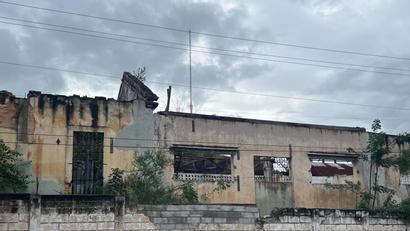
The man’s nostalgia is evident; he knew the factory when the Soviet subsidy still kept it active. La Cotorra, however, knew better times. Its foundation dates back to the early nineteenth century, when the Galician immigrant Claudio Conde Cid – who began in 1905 to transport water from the Isle of Pines to Havana – acquired in 1915 the land in the Loma de la Cruz, known for its springs, including the famous Chorrito del Cura.
Those first years were dedicated by the company to bringing water to the capital under the La Vida brand, but it soon began a much larger deployment aimed at exploiting local resources. In 1920, the company completed the construction of an industrial complex that included purification, packaging and distribution facilities, along with gardens and halls that became popular spaces for social events.
The company became one of the great economic centers in the area, not only because of the water it distributed, but also because of the employment and social activities it generated. In the 1940s it had 42 distribution trucks and 69 branches throughout the country, and produced about 20 million bottles in 1959.
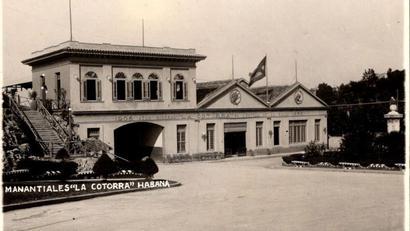
After nationalization in the 1960s, the company was converted into the Administrative Unit that controlled water and soft drinks. Several local brands were unified, and the name was changed to José Ramón Reyes Moro, in honor of a soldier from Guanajuato who fell at Playa Girón. In that decade and the next, there were still years of splendor for the company, as Julián, a neighbor of the Habana Nueva neighborhood, points out.
“Although I was born in 1968, the service still existed. In my grandmother’s house it was the water we drank. Over the years, the bottles were used to make rice wine that my great-grandmother loved,” he recalls. Little by little, like so many facilities on the Island, the money stopped flowing and the deterioration became increasingly pronounced.
In 1986, the official newspaper Granma itself reflected on the deterioration of the industrial facilities. The lack of maintenance and the precarious conditions of the infrastructure, which included defective boilers and obsolete filters, began to diminish production.
During the Special Period, the social halls and the playground disappeared, becoming offices and warehouses. The springs of the Loma de la Cruz, once an inexhaustible source of pure water, stopped being exploited due to the proliferation of houses, which made the neighbors think that the water was contaminated. The plant was dedicated solely to marketing water from the El Gato aqueduct, and, in 1997, the management became part of the Beverages and Soft Drinks Company of the City of Havana.
However, an expert in the field, Laureano Orbera, points out that, despite the widespread deterioration, the springs of the Loma de la Cruz are in good condition. In a study conducted in 2005, Orbera and a team discovered twenty virgin wells with a constant flow of one liter per second and adequate mineralization. Despite the constructions that have invaded the Hill of the Cross, the deep water remains intact, although its medicinal and valuable waters remain inaccessible due to the lack of adequate infrastructure for its exploitation.
Today, the factory operates as a parking lot. Collapsed, it remains closed, with access to its interior forbidden. The image is very different from the memories of Monica, who went to visit it as a child with her school.
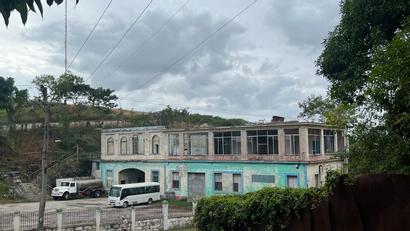
“There was a sculpture of a parrot in the center of the gardens resting on a concrete slab that covered a large well or pond of crystal clear water with blue rock walls. There was a large park where the trucks that distributed the water were parked. At the top of the factory were the offices and a large hall where activities, meetings, birthdays, dances, etc. were held. Now it is a garden, playground and gastronomic center, but the restoration has been horrible.”
The deterioration is not only physical. The abandonment of La Cotorra reflects a loss of identity and collective memory. The history of this emblematic water company is in ruins, and with it, the future of a heritage that was once vital for Guanabacoa.
Translated by Regina Anavy
____________
COLLABORATE WITH OUR WORK: The 14ymedio team is committed to practicing serious journalism that reflects Cuba’s reality in all its depth. Thank you for joining us on this long journey. We invite you to continue supporting us by becoming a member of 14ymedio now. Together we can continue transforming journalism in Cuba.