Salaries for Doctors on the Island Will Increase / Cubanet, Roberto Jesus Quinones

cubanet square logoCubanet, Roberto Jesus Quinones, Guantanamo, 16 February 2015 — A rumor is keeping  the medical sector in Guantanamo euphoric, and it provokes immediate outbursts of joy in hospital corridors, in homes and in every place the supposedly good news is known. No one knows the origin of the rumor nor its hidden intent.

According to those who are in charge of spreading it, very soon the government will increase the salary for doctors. And, as happens with every rumor, there are always those who know everything about it and affirm that the new increase will be put into force to try to contain the exodus of physicians abroad by way of continue reading

 a 30-day exit permit, a type of safe conduct that helps them flee.

These experts assure that the new increase will raise physicians’ salaries to 5,000 pesos per month (200 dollars), an astronomical pay in Cuba, but that they’ll only receive it if they agree to sign a document saying they will remain in the country for five or ten years without asking for the exit permit.

However, a few days after the rumor appeared, the voices of others begin to be heard. They speak clearly, affirming that not even with this increase, which would place the doctors in the vanguard of the Castro Communist labor aristocracy — now made up of Party and governmental bureaucracy along with the sportsmen of high performance and the high officials of the armed forces and the Ministry of the Interior — would they be able to contain the massive exodus of these professionals abroad. Above all to Ecuador, a country that doesn’t request visas and where there already exists a developing but prosperous Cuban medical community that has taken care of communicating to its colleagues on the Island the high lifestyle that is rapidly achieved in the land of Eloy Alfaro.

Because 5,000 Cuban pesos are around 200 dollars, a sum very inferior to what any Cuban doctor could earn abroad.

Between the well-being within reach and the promises of a prosperous and sustainable socialism, which no one knows when it will arrive nor if also there is another rumor or a new feverish chimera of the Cuban leaders, you don’t have to rack your brains to decide. Stupid people are more scarce every day, and the ideological teque* has been in intensive care for some time.

I don’t know what the government will do to stop this flight of doctors, which has a direct effect on one of its most trumpeted social accomplishments — currently in a very precarious state, among other things because of the lack of specialists — and on the export of health services, which is perhaps, together with tourism, the most lucrative activity of the Cuban economy at this time.

In case the rumor becomes a certainty, let’s see what happens with the other professionals, because the flight of qualified personnel is not limited to the medical sector. Pandora’s Box is open, and the government doesn’t give any signs that will let us believe it is possible to close it and, above all, to convince us.

*Translator’s note: “Teque” is literally a spinning top, and is used in Cuba to mean old, worn out, political harangues.

Translated by Regina Anavy

Cuban Irresponsibility Causes Shortage of Medications in Venezuela / Juan Juan Almeida

The medication crisis that was anticipated in Venezuela is a storm that scared people even before it began. Not only because the inventories of the Ministry of Peoples’ Power for the Health of Venezuela, a governmental organization of national jurisdiction, are practically exhausted, but also because some of the medications handled by the Cuban medical mission came into the country without the consistent rigor of matching them to a corresponding medical registry.

It’s repugnant to read how a country’s problems are met with messianic discourse and disgusting to hear how continue reading

some of the upper-echelon Venezuelan health officials justify the bad management, assuring people that the scarcity of medications is due to laboratory workers taking vacations, and the chains of distribution being altered because of an “economic war,” and that as a result of “enemy” propaganda there was alarm, which caused people to buy in 15 days what they usually buy over 2 months.

The Cuban and Venezuelan governments some time ago crossed the line of respect for human dignity, and for that reason, although I’m not giving the written numbers, I’m copying part of the report issued by the Analysis Group for Medications of the Cuban Medical Mission in Venezuela, received via email in the Ministry of Public Health in Cuba.

In this dossier there is evidence of unquestionable irresponsibility that crosses the criminal line, and a deficit of medications that the Biofarmacuba company hasn’t procured and won’t procure for delivery on the agreed-on dates in order to fulfill the recent yearly plan.

According to the report, there’s a mountain of medications lacking for the 2015 plan that Biocubafarma won’t be able to provide. I list some of them here:

1. Ampicillin 125 mg/5 ml p/susp x 60 ml: Out of stock in the warehouses.

2. Local anesthesia (cartridge of 1.8 cc: Out of stock. Pending (Dentistry).

3. Atropine 0.5 mg amp x 1 ml: Not in solution, controlled, without medical registration in Venezuela. (CDI, Surgery).

4. Atenolol 0.5 mg amp: In facilities. Pending arrival in Cuba of discontinued imported product.

5. Carbamazepine 200 mg x 90 tab: Not in solution because it is a controlled product. Imported. Not on medical registry in Venezuela (Peoples’ Medical Consult).

6. Cefalexina 500 mg x 10 cap: Pending production.

7. Ciprofloxacin 200 mg/100 ml BBO: Pending export (General Use).

8. Clorhidrato de tramadol 100 mg amp: Pending import permit.

9. Chlorpromazine 25 mg amp x 1 ml: Not in solution. Controlled product. Imported without medical registration in Venezuela.

10. Diclofenac sodium: 1 mg/ml col x 5 ml (Voltaren): Not in solution. Inventory expired (Eye Clinics).

11. Digoxina 0.25 mg x 20 tab: Out of stock. Pending removal from port.

12. Elitrol 1 x 5 ml fco: Out of stock. Pending arrival in Cuba of imported discontinued product.

13. Ergometrine 0.2 mg x 1 mil: Not in solution. Controlled and imported without medical registration in Venezuela.

14. Glibenclamide 5 mg x 10 tab: Out of stock in warehouses.

15. Hydralazine 20 mg amp x 1 mil: Out of stock in warehouses.

16. Hydrocortisone 100 mg bbo: Out of stock in warehouses.

17. Actrapid Insulin 100 u bbo x 10 ml. Out of stock.

18. Human Insulin 100 NPH bbo x 10 ml: Out of stock.

19. Isoprenaline 0.2 mg amp: Out of stock. Pending removal from port (High Technology Centers-CAT).

20. Meropenem 1G BBO: Unavailable for 22 weeks (Therapy and hospitalization).

21. Salicure-Test 50 det x 100 ml. (Clinical reagent).

22. Ureterovesical probe No. 18 x 20: Out of stock.

23. Coombs serum: Out of stock.

24. P Tubes/Pentra Complete Hematology packet x 400: Distributed one part of what was received because of their expiration dates. 

25. Thiamine 100 mg bbo: Not yet in solution due to technological problems (CDI).

26. Timolol Missing for 20 weeks. Reported by 12 states. Affected by material in the container.

27. Thiopental 500 mg bbo: Missing for 6 weeks. Affected by raw material.

28. Vitamin A and D2 drops x 15 mil: Not in solution, inventory expired (Peoples’ Medical Consult).

29. Vitamin C drops fco x 15 ml: Not in solution, inventory expired (Peoples’ Medical Consult).

This is enough without boring you to show that – as my grandmother, who didn’t have good sight but knew how to see – would say: It’s much easier to catch a liar than a cripple.

Translated by Regina Anavy

2 February 2015

“United States or Die” Demand Cubans in Veracruz / Luis Felipe Rojas

Photo taken by Universo Increible (Incredible Universe)

Rafael Alejandro Hernández Real, who says he was an agent of State Security in Cuba — infiltrated into the Eastern Democratic Alliance — in September 2014 chained himself in the Plaza Bolivar of Bogota, Colombia, and now is on a hunger strike, demanding that he be allowed to go to the United States, according to a report from Universo Increible.

“Ten young Cuban emigrants have declared a hunger and drink strike in the immigration station at Acayucán, in the state of Veracruz, in order to avoid being deported to Cuba. Right now there are seven men and three women. The group of strikers has been increasing before the official denials and threats of being returned to the island,” reports the news source.

Hernández Real made himself known in 2008 when, together with Eliecer Ávila and other students at the University of Information Sciences in Havana, they questioned the then-president of the Peoples’ Power National Assembly. Ricardo Alarcón. On that occasion Ávila and Hernández Real called for the freedom to leave the country, to visit historic sites of the world like “Che Guevara’s tomb in Bolivia,” and they questioned the supposed unanimity of the general voting that takes place in Cuba.

Translated by Regina Anavy

6 February 2015

Reflections from Companero Juan Juan / Juan Juan Almeida

1421794998_base-naval

As the debate continues, visitors come and go. It’s normal and forms part of the process of re-establishing relations between the United States and Cuba. Also in this exchange, in a not-too-distant future, the American government will return to its Cuban counterpart the territory occupied by the naval base at Guantanamo. And to reciprocate, the government of the island will accept that finally the imperial eagle will return to its original nest continue reading

at the top of the two columns that, together with the canons, human figures and chains, compose the monument to the victims of the Maine explosion.

I feel that both these things will happen, and I’m not making up scenarios in order to encourage a debate.

Time has shown us that, although the present economic environment is still challenging since there could be negative surprises, as far as the political structure goes, the Caribbean has been and is one of the most stable zones on the planet. So that keeping a military installation of such size in the heart of a place where there are no international conflicts, not even of low intensity, represents an excessive waste of time and an important squandering of money.

The Guantanamo Naval Base was established in 1898, when the United States military occupied the island after defeating Spain in what many of us know as the Hispano-Cuban-American War. Later, with the signature of the first president of the Republic of Cuba, Don Tomas Estrada Palma, on February 23, 1903, the U.S. obtained that much-discussed perpetual lease. It emerged as an historic anomaly and today makes no sense. Neither military, strategic, or regional.

1421794999_maine

For its part, the monument to the Maine was constructed in 1926, and in 1961 the man who “reflected” on it* ordered the imperial eagle taken down from the pedestal, because its figure was warping the new marketing image of the revolutionary government.

But given present circumstances and the indefinite absence of the insufferable “reflector,” the eagle means nothing more than the piece needed to complete the sculpture. I would dare say that because of the strange culture of rejection that we islanders have for everything that daily surrounds us, out of the two million Cubans who now live in Havana, not even 100 of them have bothered to read the inscription at the foot of the monument.

The return of the territory occupied by the naval base in the municipality of Caimanera in Oriente will be welcome, as will be the return of the image of the raptor to its environment on the Malecon.

Both events will be historic, but of no value. Since nothing about this presses the principle of democracy for a country that requests change and transformation, from the interior of a tempest hidden below a sea of apparent calm.

As that Cuban virtuoso said, known for being the king of the tambor** players and for the charming way he told a joke: “The agendas of governments are divorced from the people; politics get done in the street. The others react with the same naivety as an inexperienced mother.”

Translator’s notes:

*Fidel Castro’s column in Granma newspaper is called “Reflections of Fidel

**African drum

Translated by Regina Anavy

Cuba: The fight against Ebola is the new theater of war / Juan Juan Almeida

Every interesting story has light and dark parts, epic actions, and a protagonist who inspires. The rest consists of weaving reasons and emotions together by way of origami.

The Cuban government knows very well how to put into practice its habitual juggling act in order to locate itself opportunely at the center of all news flashes. Cuban doctors have been sent to fight the Ebola epidemic in West Africa, and by taking advantage of this, the government feeds the false image of having no self-interest in this new theater of war, where everything is tested, even human sacrifice.

We could see that during the recently-concluded Summit of the Bolivarian Alliance for the Peoples of Our America Trade Treaty of the Peoples (ALBA-TCP) the moment of emotion was at the meeting of the heads of state, delegations, and invited personalities with the Cuban collaborators from the medical brigades, who that same night, October 21, left for Liberia and Conakry, Guinea.

Hail, Caesar; those who are about to die salute you. They know that if they become contagious they can’t come back to the country until they are cured or die. A hard but wise decision, because the island is not prepared to receive the sick without activating the usual chain of errors that, as we already know and even have suffered, facilitated the epidemic proliferation of conjunctivitis, cholera, chikungunya, dengue fever, and a long list of contagious etceteras.

The photo of the Summit is beautiful, but the Summit didn’t provide much. A declaration with 23 points of agreement and little money. Cheap politicking. The illness continues unabated. According to data offered by Mr. Bruce Aylward, the Assistant-Director General of the World Health Organization, the situation is alarming. They have confirmed cases of infected people in seven countries, and it’s estimated that by the beginning of this coming December, if things continue as is, the number of people infected with Ebola could reach 5,000 to 10,000 cases weekly.

It’s clear that the Cuban government wants to pursue more than just aiding and combating the mortal virus. With this new crusade, in addition to confronting an emergency, it will receive a spurt of dollars to spend excessively without needing to justify it. The government is developing a strategy to favorably influence the UN vote on human rights and the American embargo. A key point.

It’s clearly persuasive. There is no greater veneration in the human condition than for the action of saving lives — even more captivating when the effort means risking your own.

We can criticize them or see from the computer how General Raul Castro and his buddies are gaining space in Realpolitik (practical interests and concrete actions). The other option would be to equal or, even better, to surpass them. To silence, with real actions, the humanitarian chatter of the Cuban revolution, its hapless friends of ALBA, and its cousins in the TCP.

But for that we would have to be ready not only to  help the needy but also to define who we are and what exiled Cubans can do. To act together with international organizations who work in the center of the crisis. To buy medical and hygienic supplies, protective uniforms, stretchers, gloves, disinfectants, and instruments for the centers that treat the sick. It’s not difficult.

Certainly we can continue believing that we create a homeland on the Internet, or we can grab the limelight away from the revolutionary government. But that, paraphrasing the title of the bolero, is for you to decide.

Translated by Regina Anavy

27 October 2014

Blatant Lies / Angel Santiesteban

During the days in which Ángel Santiesteban-Prats’ whereabouts were unknown, and with fears absolutely based on the illegal transfers that he experienced before, we filed a complaint with the United Nations Working Group on Forced or Involuntary Disappearances, so they would put it before the Regime in Havana to clarify his whereabouts.

Translation of letter from the High Commissioner’s Office of the United Nations Human Rights Commission:

Dear Mrs. Tabakman,

I have the honor of addressing you in the name of the Working Group on Forced or Involuntary Disappearances with respect to the case of Mr. Ángel Lazaro Santiesteban Prats (case no. 10005155).

In this respect I would like to inform you that the communication sent to the Government of Cuba on July 30, 2014, due to an administrative error, did not include the phrase “Marti TV (Miami, United States)” in place of “Cuban communication media.”

Furthermore, I want you to know that this correction of the case does not affect the decision taken by the Working Group during its 104th session, such as was communicated to you in its letter of September 30, 2014.

I would like to inform you that the Working Group will celebrate its 105th session between March 2-6, 2015, in the City of Buenos Aires, Argentina.

Sincerely yours,

Ariel Dulitzky, President-Presenter

They acted with the dedication and speed that an emergency requires, and, of course, the Castro dictatorship did not. They only responded to the Group’s requirement when it gave them the demand; that is, when Ángel already had been located by journalists from 14Ymedio. Thanks to them we knew where he was, although they couldn’t meet with him. The Regime had put him in the border military prison where he presently is. continue reading

I want to point out not only the fact that the Regime responded to the presenter for the Working Group, but they also took advantage of the occasion to lie blatantly and use against the “source” complainant the same strategies they use to falsely accuse and imprison the opposition. All thieves believe that others are like them.
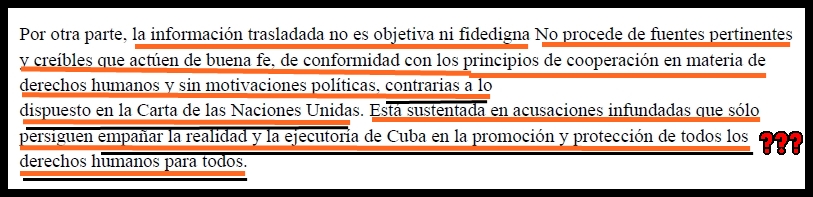
Translation of document from Cuban government:

On the other hand, the facts transcribed are not reliable. They don’t come from pertinent and credible sources that act in good faith, in accord with the principles of cooperation in the matter of human rights and without political motivation, contrary to what is set forth in the United Nations Charter. They are supported by unfounded accusations that are only intended to tarnish the reality of Cuba’s record in the promotion and protection of all human rights for everyone.

They exploited an involuntary omission in the group’s communication to the Cuban government to try to disqualify the complaint and the complainants. Now they have just communicated and corrected the omission – again – in order to continue supporting their lies, but they will preserve the same pathetic silence that they have with respect to the whole case.

I am transcribing here the response from the Regime (the complete document is attached in a link in this post):

Session: 104

Government Item

Date: September 4, 2014

The Government of Cuba reported that:

“The allegations about a supposed transfer of the citizen Ángel Lázaro Santiesteban Prats,

from the place where he was fulfilling a punishment of deprivation of liberty to a ’military base.’

“After investigation, it was demonstrated that:

“1. At 7:00 a.m. on July 21, 2014, Santiesteban Prats tried to escape from the center where he was held as a prisoner (with open living). Immediately complaint 38563/14 was filed in the station of the National Revolutionary Police of Municipio Diez de Octubre, for the crime of Escape of Prisoners or Detainees.

“2. At 1:05 a.m. on July 27, 2014, Santiesteban Prats was detained and transferred to the Territorial Department of Criminal Investigation and Operations, where he remains. He enjoys good health and receives all the benefits established in the Cuban penitentiary system.

“3. Santiesteban Prats himself admitted that he fled from the detention center with the goal of leaving the country in an irregular and covert manner, with support from the exterior, and to thereby avoid having to continue serving his sentence.

“On the other hand, the facts transcribed are not reliable. They don’t come from pertinent and credible sources that act in good faith, in accord with the principles of cooperation in the matter of human rights and without political motivation, contrary to what is set forth in the United Nations Charter. They are supported by unfounded accusations that are only intended to tarnish the reality of Cuba’s record in the promotion and protection of all human rights for everyone.

“In that sense, it is false that his presumed disappearance was related to ’declarations of a person associated with him in Cuban communication media in the days previous to July 20, 2014.’

“Nor for his activities as a writer and blogger was Santiesteban Prats sentenced to five years in prison for having committed common crimes, as regulated in the present Cuban Penal Code.

“He was accused by his wife, Kenla Liley Rodriguez Guzmán, in August 2009, of the crimes of Harm, Home Invasion, Injuries, Threats, Rape, and Robbery with Force. After investigation, the Prosecutor presented the case before the Provincial Court of Havana for the crimes of Injuries and Home Invasion.

“From that time they knew of his intentions to flee the country in an irregular and covert manner, incited by his sister who lives in the exterior, to evade his sentence. He finally tried, unsuccessfully, in July of this year, as already has been explained.”

Ángel Santiesteban, without even knowing of the existence of the complaint or this document, has already given an answer to that nonsense in the message that was sent explaining what motivated him to leave the Lawton prison settlement and saying that he would give himself up several days later. The only certainty in everything the dictatorship alleges is that he recognized that he abandoned the prison voluntarily, taking advantage of the movement of the prisoners who left for work in the morning.

The first lie, which falls of its own weight, is that “he receives all the benefits established in the Cuban penitentiary system.” Exactly because he DOESN’T receive them is the reason he left on his own to recover them (the 15 days of pass that corresponded to the last 10 months, which they arbitrarily denied him). He wasn’t “detained” on July 27 like they allege. He gave himself up, telling the official who received him that they still owed him 10 days of pass.

“On the other hand, the facts transcribed are not reliable. They don’t come from pertinent and credible sources that act in good faith, in accord with the principles of cooperation in the matter of human rights and without political motivation, contrary to what is set forth in the United Nations Charter. They are supported by unfounded accusations that are only intended to tarnish the reality of Cuba’s record in the promotion and protection of all human rights for everyone.”

Such a declaration merits nothing more than remembering that we are facing a dictatorship where neither law nor justice exists, in which they only administer rewards and punishments according to whether one is obsequious or opposed. The cynicism of those who work for the Regime is such that they have the nerve to mention the United Nations Charter and human rights. Does Mr. Dictator finally want to ratify the pacts of the U.N.? The biggest violator of all human rights on the continent makes believe that the complaint “continues tarnishing reality and the executive of Cuba in the promotion and protection of all human rights for everyone.” Ask him about all the executions, assassinations, tortures, imprisonments, and those who have been banished and forced into exile who have endured the said promotion and protection for 55 years.

Then they relied on the before-mentioned omission to lie again: “(…) It’s false that his presumed disappearance was related to ’declarations of a person associated with him in the Cuban communication media in the days previous to July 20, 2014.’ Now it’s already been explained to them that it was a matter of an omission, clarifying that it referred to the declaration of Angel’s son in a television program from Miami. How do they explain that they had prepared a transfer for Angel and that he complained only five days after his son said on Television Marti how he had been manipulated by his mother and the political police to lie and prejudice the case against his father? Wasn’t there a relationship with the said complaints? Are they trying to delegitimize the rumor that he denounced his imminent transfer on July 20 when on August 13 they incarcerated him where he said they would? The Regime knows perfectly well that there was an involuntary omission in the report, and they knew that it referred to the declarations of Angel’s son on Television Marti, who said that the political police were permanently spying on him, so that the Human Rights Commission granted cautionary measures for him also.

Ángel Santiesteban is the only “common” prisoner to whom the dictatorship has offered – on numerous occasions since he was incarcerated – freedom and banishment in exchange for renouncing his political position, documenting it in a video. Every time he has refused outright and denounced this in his blog. Even so, they continue stubbornly trying to convince him. So that “From this time they knew about his intentions to abandon the country in an irregular and covert manner (…)” is no more than another cock-and-bull story like the ones they habitually resort to in order to justify the unjustifiable: the lack of freedoms, guarantees, and protections for the citizen victims of the island prison.

Ángel never asked that they free him; he only requested a review of the trial with ALL the guarantees of due process that they denied him when they took him to prison. If they would proceed to carry out the review, he would be absolved, because the accusations aretotally false. That’s the reason they delay the review with the stupidest excuses, because they only pretend to penalize him by keeping him locked up: “Nor for his activities as a writer and blogger was Santiesteban Prats sentenced to five years in prison for having committed common crimes, as regulated in the present Cuban Penal Code.”

The accuser is named Kenia Diley Rodríguez Guzmán; only by reading how they refer to her in the response do we have proof of the “care” they put into fabricating causes of action, the accusations and the accusers. It doesn’t ever matter to them who has lied; the only thing that matters is that their lies serve the interests of the dictatorship: “He was accused by his wife, Kenla Liley Rodriguez Guzmánin August 2009, for the crimes of Harm, Home Invasion, Injuries, Threats, Rape, and Robbery with Force. After investigation, the Prosecutor presented the case before the Provincial Court of Havana for the crimes of Injuries and Home Invasion.”

I remember again that as there wasn’t any proof that would incriminate him, they condemned him after a report from a lieutenant, a handwriting expert, who alleged that “from the size and inclination of his handwriting, he’s guilty.”

In the end, there is little to add that is not already known.

The Editor

Translated by Regina Anavy

20 October 2014

Angel Santiesteban’s New Dossier

The mechanism of annulment is cleanly bureaucratic: You can’t hire an attorney without having completed the dossier. The prosecution prepares its case in the dungeons.

Lilianne Ruiz

Havana, Cuba.  In the doorways of Avenue Acosta, in the neighborhood of La Vibora, some faded beings sell aluminum scouring pads, Band-Aids and little boxes of matches. A few meters away, crossing Calzada de Diez de Octubre – formerly Jesus del Monte – is the former police station of Acosta and Diez de Octubre, which now advertises itself, by a lighted sign, as a Territorial Unit of Criminal Investigation and Operations of the Ministry of the Interior. The latest news about the writer, Angel Santiesteban, places him in the cells of that sinister place.

Another writer, the Czech Milan Kundera, victim in his time of the same procedures, pointed out that our only immortality exists in the archives of the political police. In this city of changed names, where poetry is a military choir, where the violation of human rights is called anti-imperialism and there is thoughtless defense of socialism, and where some nameless beings without a voice sell scouring pads in order to eat, I think about my friend who is experiencing the same awful misfortune.

Except for Daniela Santiesteban, his 18-year-old daughter, sufficiently bewildered and frightened to not want to speak with the independent press or the dissident friends of her father, no one else has seen him nor can corroborate that he hasn’t been maltreated, or that he really tried to escape from prison, as the authorities say.

The Territorial Unit building has checkpoint surveillance. It seems to be the entrance where the detainees are taken to the dungeons, which are in the basement. Those who have left that prison say that below there are around 70 cells. And that’s where they look for confessions in all the cases. It doesn’t matter if they don’t know the first thing about the crimes that the official presents to them. The dossier can be false. It takes time to complete, so that in order to obtain the auto-inculpation, the false confession, no attorney can be present. continue reading

This is the beginning of total domination: The detainees can’t count on having the right to an attorney from the beginning of the charging process. The mechanism of annulment is simply bureaucratic; you can’t hire a lawyer without having a dossier and the case number. The trial is prepared underground.

It’s in these cells where you can be interrogated at any time, where no family member can have access unless he’s also a prisoner and where even your diet has been thoroughly studied with the goal of crushing your feeling of having rights. It’s there that your dossier would be assembled and the charge against you enumerated in the most total incommunication. Hannah Arendt already said it, when in 1961 she formulated the expression “banality of evil” as a phenomenon that is characteristic of every dictatorship: The first essential step on the path that leads to total domination consists of suppressing the juridical person in Man.

There’s another front entrance to the building. Going up the stairs you arrive at a reception area that is garishly green, with a sepulchral silence. Ornamental plants, always the same: miserable malanga vines. Portraits of Castro and other allegorical figures of July 26 provide ambience, so you don’t have any doubt that you’re in Hell. In this mournful place, the guard refuses to answer my questions about the situation of the detainee. He says that only his family can see him, and that he is accused of “detainee evasion”. “I’m not giving you any more information”, he concludes. The expression “detainee evasion” appears to be nonsense. It’s not clear what the accusation is. Neither does he answer when I ask his name and military rank, in spite of the fact that I told him, before he asked me for my identity card, who I am and what I do.

I know Angel. Before being taken to prison he had time to leave the island, but that’s not his intention. His awareness of not being guilty of the crime that the political police fabricated in collusion with his ex-wife, Kenia Diley Rodriguez, who had already made threats that she was going to destroy him, made him believe until the last moment that it wasn’t possible that the authorities would go so far in the consummation of evil.

On one of those afternoons when we talked about this, he told me how at the beginning of the whole process, neither he nor the people who would serve as witnesses, making him believe that they would stand by him when his accuser, Diley Rodriguez, told her story, thought it possible that a case would be opened against him. But he armed himself with a dossier with the case number. Later, his lawyers told him that it was impossible that a trial would take place, because that would not be logical. And there was a trial. And the sentence? It was announced to him previously during a detention, by a minion of the political police named Camilo – famous for his sadism – with the exact number of years to which he was condemned. Five.

So that this isn’t the first dossier prepared against Angel Santiesteban.

Interview with Marti News

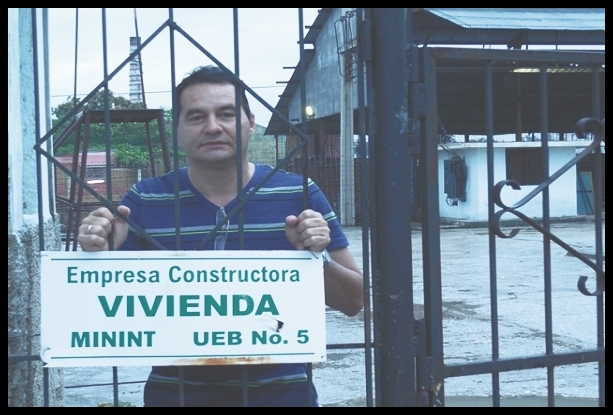
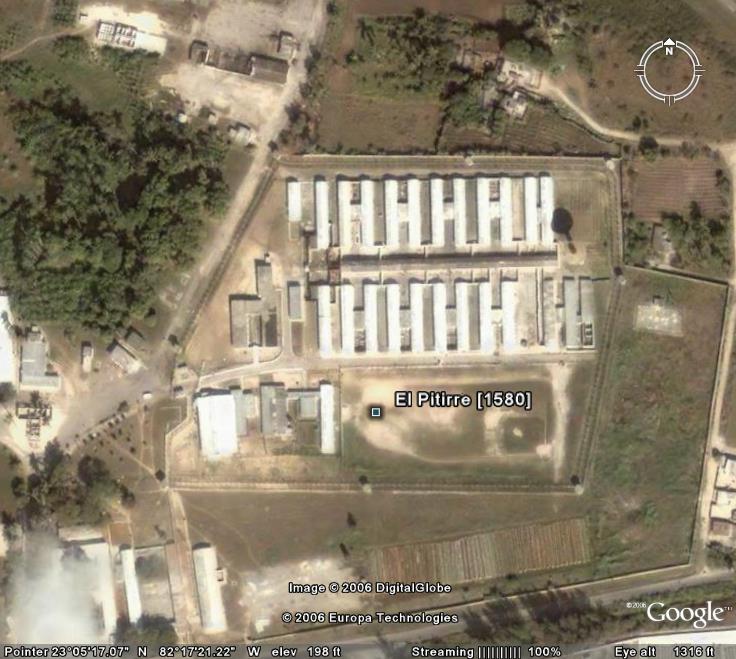
The Lawton military settlement, which presents itself as the Ministry of Interior Housing Construction Company, was the last place Santiesteban was seen. So I went there to follow up. The prisoners, through a fence, repeated to me the authorities’ version, but no one could tell me that they really saw him being transferred from the prison. They only affirmed what the authorities said.

A friend of the writer named Reinaldo Gantes Hidalgo was “visited” by State Security, in a move that can be part of the new judicial fabrication, to ask him if he knew where Santiesteban was. Another person, who asked me not to reveal his identity for fear of reprisals, was detained for a week, accused of complicity without any evidence, but he hadn’t seen Santiesteban either. And it’s clear that State Security wouldn’t spare itself some arbitrary detention with which it could propagate the version that matches their perverted goals.

Gantes Hidalgo told me that after the visit of the son of Colome Ibarra, the present Minister of the Interior, to the military settlement of the regime prison, in his position as the head of the MININT Housing Construction Company, and after the escape of a boatman, an inmate who managed to get to Miami, three guards kept watch on Santiesteban at all times, even when he went to the bathroom. All of which was again inconsistent with the official version.

If there’s a relationship between this visit and the increase in vigilance, we can only deduce this from the question that Colome Jr. asked him. With much sarcasm he questioned him about the woman who called the Directorate-General of Jails and Prisons to denounce Santiesteban for the possession of a laptop and a cell phone hidden inside the prison, and about a supposed plan to escape. From there they also started the records. With these notices it’s not very probable that Santiesteban would have improvised an escape from an island where there are police guarding almost every corner, and boats patrolling 24 hours a day thanks to Venezuelan oil.

All this points to a set-up. After which his son, Eduardo Santiesteban, 17 years old, conceded an interview to Karen Caballero, a journalist from Marti News, where he denounced the manipulation of State Security in the trial against his father. And so he began to demolish the first dossier. Let’s remember that during the trial, they used, as pretend proof, his declaration that Angel didn’t accompany him home in order to claim, in a rare sophisticated use of ubiquity, that he found him at home with his mother, Kenia Diley. As if by being absent from one place he would be fatefully in another.

So that the prosecutor’s maliciousness, added to the fact that trials aren’t independent, had the result of an unjust sentence based on ridiculous reasoning, twists and lack of proof.

Until Angel Santesteban commnicates his version, we can’t believe the authorities, who are dependent on a government of which it can be said that not only do they lie, but they also hardly ever tell the truth.

Published by Cubanet.

Have Amnesty International declare the dissident Cuban, Angel Santiesteban, a prisoner of conscience. Follow the link to sign the petition.

 Translated by Regina Anavy

18 August 2014

Amidst Rumors and Disinformation, Angel Santiesteban Continues Missing

{*Translator’s Note: Angel disappeared from prison on July 21, 2014. As of today he has not been heard from for 29 days.}

Five days* have passed now since the disappearance of the writer Angel Santiesteban in Havana, barely hours after he wrote a post from Lawton prison,  in which he announced to the world that there were strong rumors that the Regime’s prison authorities would transfer him to a higher security prison.

After his disappearance from said prison last July 21, without the Cuban authorities informing family members of anything, another rumor started circulating: supposedly, Angel Santiesteban had escaped. In a telephone call that the writer’s son, Eduardo Angel Santiesteban, made to the prison, worried at not knowing anything about his father, a minor official confirmed the rumor. “I don’t know if they did it to scare me, to make me more nervous than I am,” said the 16-year-old, on the Columbian television program, Night, Channel NTN24. In conversations with family and friends he has said that he feels this lie by the regime’s prison officials is a bad sign. continue reading

Maria de los Angeles Santiesteban Prats said the same thing, from Miami: “The telephone harassment I’m suffering since my brother disappeared in Cuba, and other information we have obtained and that can’t now be revealed in order to protect some people on the island and in exile, make me think that this is another maneuver of the dictatorship: Spreading this rumor about my brother’s escape serves only to deflect attention from something big they are doing to him and that they don’t want known.” In a conversation with the NeoClub Press agency, she affirmed that “They are blackmailing me; last night, for example, I received an anonymous call coming from Japan. They call me and tell me that it’s better that I shut up, that I’m going to end up losing.”

A simple analysis of the facts preceding Santiesteban’s disappearance is enough to confirm the family’s suspicions.

After many months without responding to the Request for Review of the judgment against Angel, undertaken by the defense attorney last year, the Cuban judicial authorities (as they have now demonstrated in this case, manipulated by the Cuban political police) received a hard blow which totally undid the judicial farce they prepared to condemn the lauded Cuban writer to five years for a supposed crime of domestic violence. One of the principal prosecution witnesses, the writer’s own son, Eduardo Angel Santiesteban, granted an interview to Television Marti, in which he explained that being a minor he was forced and manipulated by his mother – Kenia Diley Rodriguez – at the urging of Castro’s State Security, forcing him through psychologists and other specialists, to declare against his father.

In this interview, and in a later one on the television program Colombia Night, he confessed that he never saw anything like what his mother said Angel did, and that the political police took advantage of “amorous” problems between his parents, inciting Kenia Diley Rodriguez to collaborate in a plot to punish Angel’s dissident stance and the international denunciations that he made in his blog, The Children Nobody Wanted. This evidence, which exposed the dirty strategy of State Security, makes it logical to think that the regime would want to punish the writer and his family with this disappearance. It’s not an isolated fact, since every Cuban dissident who has been incarcerated can tell similar stories.

Another detail that casts doubt about the rumor of flight is the same post the writer sent from prison, hours before his disappearance, in which he made known that one of the possible reasons of his transfer was the fact that two high government officials, condemned for corruption, would be sent to Lawton prison, where he was located. Logic imposes itself: It was necessary to transfer Angel to avoid his making contact with these officials and thereby getting first-hand information about the corruption in high spheres of the island’s government.

A third event to take into account would be the constant threats that Angel received in the last months to stop writing denunciations in his blog. In spite of these threats, in spite of the fact that he had to hide in order to write and look for different ways of eluding the vigilance to get his writing out of prison, they didn’t manage to shut him up; so that, in communication with his friends and family, he had shown his suspicion that they would transfer him to a higher security prison (thereby violating the established legal procedure for cases with his sanction), if only to avoid his continued denunciation of the most sinister face of a dictatorship that pretends to show itself to the world as a truly human system.

Finally, as Angel Santiesteban’s international prestige has grown, the repressive forces of the regime have become more rabid and impotent. Its murderous blindness doesn’t permit them to digest the fact that important intellectual and international human rights institutions have their eyes on the writer, unjustly imprisoned on the island; that this world recognition has allowed him to receive the Jovenaje 2014 award, which is granted every year for the work and life of an important Cuban intellectual, and that Reporters Without Borders has included him on the list of the world’s 100 Information Heroes.

“Something big has happened and they are hiding it,” said Maria de los Angeles, Angel’s sister, in several interviews these last days. “I demand that they show my brother alive and well, because he never has had the intention of escaping.”

We have mentioned it many times but it’s good to remember it again: The little time he has been in prison, Angel was visited by agents of State Security to offer him his freedom in exchange for abandoning his antagonistic position and testifying about this compromise in a video. After roundly refusing, they told him he should look for a friendly embassy to arrange his deportation, something Angel also roundly refused. It’s also good to remember again how many times they threatened him with death, in prison or before.

Obviously they don’t make such proposals to a simple “home invader”; if anyone knows something about home invasions it’s the regime; it’s a daily practice with which they try to intimidate the valiant and peaceful opposition. And they know about maltreating women, which we can add to everything the world knows and consents to with its complicit silence. The Castro regime takes the prize for its duplicitous discourse, now charging Mariela Castro to “sell” the image of an open government that respects gender diversity. It’s enough to see the brutal images of aggression against the Ladies in White, to know their testimonies, along with that of other dissident women and LGBT activists who don’t conform to the designs of the dictatorship, to know how much falsity there is in that Castrista discourse.

Angel has spent five days* in an unknown location, and WE DEMAND HIS IMMEDIATE APPEARANCE IN PERFECT CONDITION. We demand that finally justice be done, and that after the Revision of the judgment, with all its procedural guarantees, he be freed because HE IS INNOCENT.

RAUL CASTRO is absolutely responsible for what can happen to Angel, and WE WARN THAT THERE ARE NO POSSIBLE ACCIDENTS to justify what they can do. The international community is witness to all this horror happening to Angel, and NOW THERE IS NO PLACE FOR IMPUNITY. The same goes for his minor son, EDUARDO ANGEL SANTIESTEBAN RODRIGUEZ.

The Editor

Maria de los Angeles Santiesteban, in the name of the whole family

Amir Valle

Lilo Vilaplana

Translated by Regina Anavy, August 18, 2014

26 July 2014

Angel Santiesteban and the Path of the Fugitive

By Armando Añel, July 30, 2014

The confused news that comes from Havana indicates that either Angel Santiesteban ran away from the prison-settlement where he was unjustly imprisoned or the political police have launched a fabrication to condemn him to a longer term of imprisonment and keep him isolated.

In any case, we must wait for specific statements from the novelist and blogger. Today we know that his children saw him in prison but they couldn’t speak freely with him: a member of State Security was with them the whole minuscule time they were with their father.

I don’t believe it, but if Santiesteban effectively took the decision to flee — in spite of the fact that, as his sister Maria de los Angeles Santiesteban said, at another time he could have remained in the exterior without major inconvenience and he didn’t do so — I congratulate him.

Begging pardon from friends and colleagues who disagree, one never should surrender to a delinquent regime. In Cuba no procedural guarantee exists, and we all know the degree of superlative helplessness that the citizenry suffers. A product that the Castro regime has exported to countries like Venezuela, where the case of Leopoldo Lopez shows that these gestures of chivalry are counterproductive in societies hijacked by the State.

I chatted with Idabell Rosales for a moment. Santiesteban never should go into prison voluntarily. Not only because of the rigged trial that he suffered previously and that made his sentence absolutely unjust, but also because in countries like Cuba all the gear of social coexistence, of daily structure, is flawed in advance and twists the logic of personal relations.

During these last months, in the face of the campaign for his freedom, he saw with clarity the degree of vilification by the Cuban intellectual class not only on the Island or among the pro-Castro creators, but also in the exterior and in a part of the media-oriented dissidence that he says “laments” his detention but travels half the world without advocating for his freedom.

To live in Cuba is to surrender to a darkly surrealist reality, and to yield to the jailers of the country as he did in 2013, seemed to me and seems to me to be doubly absurd. Fugitives don’t hand themselves over. But I respect, scrupulously, the author of The Summer God Slept and those who defend that type of attitude, brave like very few. It appears that God continues to sleep. Although, as Carlos Alberto Montaner said, we also know that He will wake up.

Published in NeoClub Press.

Have Amnesty International declare the dissident Cuban Angel Santiesteban a prisoner of conscience. Follow the link to sign the petition.

Translated by Regina Anavy

Completely dismantled, the farce against Angel Santiesteban continues in an unknown location

Angel continues being held in an unknown location, transferred illegally and without being able to communicate to his family, a few days after his son, Eduardo Angel Santiesteban Rodriguez, told the truth about what happened when he was only a child. He now is a 16-year-old adolescent.

Forced and manipulated by his mother — Kenia Diley Rodriguez — and Castro’s State Security, he has told now that the objective was to harm his father and declare against him. He said that he never saw anything of what his mother said Angel had done to her, and that everything is a plot in order to punish Angel for his dissidence, and that his mother, for motives of “love,” collaborated with the Regime to lie.

It’s important to clarify that the ex-partner was the one who abandoned Angel and the two-and-a half-year-old boy, a little before she started to make up false accusations against him.

She abandoned him after deceiving him with a lover who had made promises to her that later he didn’t keep, and she, disenchanted with that lover, decided to try to win him back, something she couldn’t do, because he had already formed a stable partnership with a very well-known and beautiful Cuban actress. Kenia, disgusted and jealous, formed a new partnership with an agent of the political police, and from that moment the false accusations rained down. continue reading

Here I present a letter that Kenia Diley Rodriguez wrote to a girlfriend explaining all this; the letter, like many more other proofs of Angel’s innocence, is found in the court file, which has been available in complete form in this same blog for almost two years.

Let’s demand Angel’s immediate appearance, and let’s make Raul Castro responsible for Angel’s life and integrity, as well as that of his son, Eduardo Angel.

The Editor

Note:

1-”Ch” is “Chino” (“Chinese man”), a colloquial name that Angel Santiesteban’s family calls him.

2-”Micho” is the name of Kenia Rodriguez’ ex-lover, with whom she cheated on Angel with while they were a couple and for whom she abandoned him, leaving him the boy. When “M” (“Micho”) disappointed her by not giving her what he promised, she tried to go back with Angel.

Have Amnesty International declare the Cuban dissident Angel Santiesteban a prisoner of conscience. To sign the petition, follow the link.

Translated by Regina Anavy

24 July 2014

S.O.S. Imminent Transfer: Am I more dangerous than the murderers? / Angel Santiesteban

In the most total secrecy, State Security is preparing my transfer to a military unit of border guards.

In the last few days, a rumor started that now has become plausible, inasmuch as the prison authorities are waiting for my transfer in order to bring me to a Minister or a Vice-Minister of Construction who keeps convicts for “diversion of resources,” and in no way can they clash with me, fearing that I will get information from them and later divulge it in my blog.

After a prisoner escaped and managed to reach Miami, State Security ordered that the surveillance on me be strengthened, so they set up a 24-hour command post and kept every movement that I make inside the settlement under supervision.

A few minutes ago, they just ordered a welding of some bars to secure the place where they’re taking me, and the bars have to be placed in the frontier-guard unit before morning.

Evidently, they will keep me more guarded and isolated there. Another chapter begins in this journey of injustice, for my dangerous crime of thinking differently.

I reaffirm that I am stronger than the first day of imprisonment. It’s an honor that they commit these extremes against me — for exercising the craft of thinking and expressing my opposition to the dictatorial regime that has suppressed our country for more than a half-century — while they accept murderers, drug traffickers and rapists, whom they barely harass or watch, like they do in my case.

Long live Cuba, and let it be free.

Ángel Santiesteban-Prats

Lawton Prison Settlement, July 2014.

Follow the link to sign the petition to have Amnesty International declare Angel Santestieban-Prats a prisoner of conscience.

Translated by Regina Anavy

21 July 2014

Are Anguish, Bitterness and Loneliness Only Names of Havana Streets? / Angel Santiesteban

A voyage to the end of all things.

By Antonio Correa Iglesias, June 6, 2014

Angustia (Anguish), Amargura (Bitterness) and Soledad (Loneliness) are not only names of Havana streets. They also are discovered feelings that seize and condition that which we call Cuba, the infinite island, which Abilion Estevez and Virgilio Pinera call the fate of being cursed, a portion of earth that floats in the sea, a sea that is the beginning and end of everything, where weightlessness and drifting are forms of keeping afloat.

But the island is also longing and folly, desire and debauchery, hatred for those who have made Cuba a prison of 111,111 square kilometers, as Reinaldo Arenas reminds us in his Leprosorio. The island and its agony accompany us each morning when we prepare coffee, a coffee which reminds us where we came from, and by those smoky silhouettes of a woman we remembered the amazing knitting grandmother who  helped the homesick and the spoiled greet the dawn. How Cuba hurts, and hurts much more when we find in a literary exercise a daily reality like that which Angel Santiesteban Prats describes for us in a clear and visceral voice. continue reading

The Summer When God Slept (Neo Club Editions), by Santiesteban Prats, isn’t just one more novel that adds to the already extensive and archetypical denomination of “Cuban literature,” from which many — including the author himself — have been excluded.

The Summer When God Slept coexists in a very special place, once it encounters an unexploitable reality not only from the sociological and political order, but also the esthetic and experiential. A reality that by its “everydayness” passes to being assisted history — many times loaded with “comicality” — but that the author handles with the rigor that he always brings rigged to the traumatic act.

That’s to say that Angel Santiesteban’s novel isn’t only a stark x-ray picture of the Cuban context: It’s above all a blog where hidden desires and frustrations, longings and deceptions exist, trying to expunge the feeling of guilt that gravitates — consciously or unconsciously — over our heads.

The voyage is the driving thread of the narration, a voyage like going and returning, like a Nietzchean return, with an eternal return of the same, an endless spiral like those hallucinations that wake us up in the somersault of dawn and tighten our chests.

The voyage that Angel Santiesteban proposes results in a crossing marked by the curse of incertitude, a voyage like a traumatic passage associated with death, a voyage without the guarantee of a destination. A voyage in which death waits patiently and heteromorphically, cross-dressed in hallucinations, decomposition and the deterioration of the human being.

The decision to escape — the foundation of the voyage — the conviction to leave, a transcendental and definitive action of life, is the plot-line of the novel. However, this voyage drags with itself calamities and dangers narrated as extraordinary experiences, once the characters in the novel embody others who have met death on the trip. The desperation of the traveler brings them to grasp themselves “with their fingers, their fingernails …until they bite the wood, the wind or even my own skin….” Yes, it’s precise.

The author manages to construct the drama of the text, and the exercise is of such magnitude that the reader feels himself teletransported; you are no longer only the one who reads; you appear with them, you are one of them, and like an argonaut (that’s to say, like a hero), you search for the Golden Fleece — in our case, Liberty.

Because the sensation of fleeing has to be earned, the voyage is a process of tearing into shreds your awareness of what you leave and where you are going, although you know nothing of your final destination. The sensation is of abandoning weight like a ballast, like a stone infinitely weighing on your shoulders, since what you leave is who you are. So the sensation of abandon in the characters of the novel confuses itself with the coldness of the night, which always reminds you of death.

Because the flight comes associated with the anguish of saying goodbye, a goodbye that is in the voice that resonates in the depths of your being, the doom of a delirious echo that torments. Because the goodbye is accompanied by a sensation of eternity that weighs down and clouds the consciousness of whoever – mumbling his lyrics — knows that he has no guarantee of return.

So the dream of fleeing the island — a laboratory island of politics, a laboratory where the consequences of the experiment and the human cost aren’t registered (the cost in terms of a future isn’t considered in the statistics) — begins to be a reminiscence until it’s converted, as the author says, into a virus, a virus that has inoculated a whole society and that corrodes, in a slow but at the same time delicate and emphatic form, every portion of you, dawning one day, confused by the continuous evaporation of desires and illusions — now that all the illusions have died, like the song about the Matamoros* — and some other unknown end.

Antonio Correa and Carlos Alberto Montaner during the presentation of the book (photo by Ulises Regueiro).

In The Summer When God Slept, nostalgia for the past is a recurring theme, fictional, never political; however, the longing for the past not only invalidates the present for us but also makes the future impossible. For the characters in the novel, to be anchored in the past safeguards the possibility of existence, a life that no longer belongs to them because it lacks a fate, once it’s marked by the calamities and sufferings of a people.

Neo Club Press

*”Matamoras Banks” is a song by Bruce Springsteen about an illegal immigrant who drowns while crossing the Rio Grande River.

Translated by Regina Anavy

20 June 2014

The Tribal Unity of the Dissenters / Angel Santiesteban

I want to mention the appearance of laziness inside the Cuban opposition, because — in my opinion — this is what most corrodes our political force and does the lamentable work of the common enemy.

And I’m not even referring to those who must be sprinkled among us doing the terrible and cowardly work of the satraps, but also to that partitioning of ideas and movements, where each one thinks he’s better and more important, and that his work will be most recognized.

I have listened to those who talk about themselves and their work, and — even recognizing their merits — later I have seen how they end up lowering themselves, diminishing themselves as human beings. They leave much to be desired from those feelings that — I take for granted — all fighters for human rights should have.

Comprehension and respect are important to co-exist with others and above all, you know what, not thinking you’re better than anyone else… Just as there are a lot of people who don’t like me… it makes sense to assume that I can’t like a ton of imbeciles… no?

Sometimes, the daring of confronting a regime isn’t sufficient when we ignore common sense and let them impose that mechanism educated in misery that they have imposed on us since birth. continue reading

We will always fail when we show that we are isolated tribes, those on the Island as well as those in exile, and on that subject, the Patriotic Union of Cuba (UNPACU) has taken a laudable step, uniting people in the whole national territory; today, together with the Ladies in White, it’s one of the most constant and effective coalitions against the dictatorship.

To attack each other, to envy and criticize any initiative, work, and recognition of others, and to not support and make known the sacrifice of others, turns us away from that dialogue with the regime that — in some moment — we will have to have by sitting down at the table of political negotiations for a better and democratic Cuba.

When we understand and assume that all of us are no more than grains of sand dissolved on that beautiful beach of our dreams, then we will understand that only if we remain joined and united will we be capable of constructing the wall that can support the calamities that totalitarianism still strikes us with and makes us suffer.

A political conscience, a soul like José Martí, and a respective dose of humility will be the only formula that makes us visible and respectable before the Regime of the Castro dynasty. Otherwise, let’s prepare to continue with the tyranny for half a century more.

We pray to God that He grants us the wisdom to form a national conscience that summons us to political unity, while we maintain and respect individual paths and objectives to accomplish the CHANGE that we all yearn for.

Angel Santiesteban-Prats

Lawton prison settlement. May 2014.

Please follow the link and sign the petition to have Amnesty International declare the Cuban dissident Angel Santiesteban a prisoner of conscience.

Translated by Regina Anavy

30 June 2014

Response to my Blog Readers / Angel Santiesteban

Messages come to my blog mail, some elegant with congratulations for “my upright position” before the dictatorship; others, interested in my health, like this one that I answer in which they ask questions because they don’t understand why I’m in prison, then recognize that sometimes there are contradictions. And of course, this happens so much that I thought I needed to answer. With the most possible brevity, I’ll try to answer many questions in one single answer: this post.

Everything that is sanctioned in Cuba with a maximum sentence of five years is recognized as a “minimum severity” conviction. There are three types of sentences: “maximum”, “medium” and “minimal severity”. As my punishment was for five years, according to the present laws for prisoners condemned for “minimal severity”, they had to place me in a settlement.

The prisoners of “prioritized” character (meaning the most dangerous, condemned for murder, trafficking of people or drugs, economic crimes, rape, pederasty, etc.) are always sent to prisons. continue reading

But those like myself with a sentence of “minimum security” and furthermore, with a first offense, are transferred to a camp or a settlement, which is the same thing but with the difference that the second group contains fewer inmates. For example, if in a camp you can have little more than 100 prisoners, in the settlements (like the one I am in, in Lawton) they can only crowd together around some 20 inmates.

When they transferred me on April 9, 2013, from the camp of La Lima to Prison 15-80, the truth was that they were trying to hide me from that group of international journalists, and for that reason, unjustly, they changed my penitentiary regimen from minimum severity to medium severity. They held me there until August 2, the date when they brought me to this place: a settlement.

Once you are in the camp you are confined for the first three months. As indicated in the penal code, the prisoner has a right to a pass of 72 hours every 70 days. In the camp of La Lima, they transferred me at two months, one month before what could have been my first pass.

After arriving at the present Lawton settlement, they gave me a pass at the beginning of October. But in that release, according to the dictate of my principles, I met with the dissidents Antonio Rodiles and Jose Daniel Ferrer, among others, and I suppose that this was the reason, a fair decision, that they took away my pass authorizations, although it’s another one of their flagrant violations.

But they are so many and they have continued for so long, that it’s not worth the bother to complain, and up to this date, they have denied me a pass on five occasions.

Since the last year, exactly on July 4, 2013, the Petition for Review of my case was presented to the Minister of Justice. There they archived said petition for six months. Later they communicated that they did it for lack of a paper that the lawyer did not send.

She returned again to present the Review, and after some months, they answered that the court did not find similarity between the number of case 444/12 and my name. My lawyer returned to meet with the corresponding officials and showed them the papers that corroborated that there was no mistake, and then they recognized it.

All the times that I called this department, they assured me that they were doing what they could, and in their tone of voice, I didn’t suspect pressure on the part of State Security.

But once they told me, almost one year later, that they found the file in their offices; finally now the tone was abrupt and not friendly, and the experience that I had (forcibly), of recognizing when someone is afraid or pressured, made me intuit that this tone signaled the subsequent proceeding with my case.

Knowing their methods, I dare say that now the political police reported to this department and exposed the rules of the game. This is nothing new: It’s always been them, the omnipresent and omnipotent State Security.

First, they were the ones who decided to start the accusations against me. Later, they imposed a bond on me. After that, they sanctioned me through a manipulated trial, and, finally, they sent me to prison as a punishment for thinking differently. Now they are busy trying to detain me.

I don’t expect justice from that review. They, the judges, prosecutors and the rest of the officials who are busy imposing the law, do not govern themselves, just as no other institution of the country is auto-governing.

It’s not for pleasure that we live in a totalitarian regime. I only have accepted doing all these negotiations using the existing official channels to demonstrate clearly that I live in an inhuman and all-powerful system, which mocks the legal and judicial norms established internationally in order to truly defend the integrity of citizens.

I hope that the people who are interested in me feel that I have answered their questions. However, I take the time to insist, always, that the intentions of concern be honest. Thank you very much.

Ángel Santiesteban-Prats

Lawton prison settlement, June 2014.

Please sign the petition to have Amnesty International declare the dissident Cuban Angel Santiesteban a prisoner of conscience.

Translated by Regina Anavy

28 June 2014

The New Man in Cuba in Search of Anabolic Steroids / Juan Juan Almeida

You don’t need to be an expert critic, clairvoyant sociologist or a wise politician to understand that when you grow up in a totalitarian and absolutist country like Cuba, flooded with numerous afflictions, it’s normal to feel small.

Thus, because of the great restrictions on individual freedom, the meager access to modernity and a determined idleness, every day more young Cubans, trapped in the wrong time of an epoch that doesn’t move on, however much it’s announced, and doesn’t arrive, evade reality by finding refuge in sex, drugs, alcohol, emigration, robbing, lying and in a new sickness that, although it’s not recognized as such by the international medical community, is now all the craze.

The consumption of anabolic steroids has grown into an epidemic, especially among adolescents and young people, who want to improve their physical and esthetic qualities. They also are sure they will lose body fat, which is in vogue. continue reading

In large measure, the creators of the problem are the media of communication. Cinema, television, literature, magazines, trying to sell a gallant beau, aren’t aware of what happens later. Prosecuting them now leads nowhere; what’s worrisome is the increase in young people cared for in the emergency rooms of Cuban hospitals, affected by severe liver and multiorgan failure, brought on by the consumption of anabolics, because the desire to look good, even as a form of social nonconformity, draws them to spend money for these substances that exaggerate their musculature.

Primobolan, Proviron, Winstrol, Parabolan, Anadrol – young people talk about the brand names and doses without having the remotest idea of the secondary effects.

The Cuban government knows about this, has the information, even has referred to the subject in extensive editorials that sound less convincing than Mariela Castro’s curriculum; but understanding that it’s a matter of an invisible hurricane, they prefer to practice their habitual sedentary politics of explaining and not acting. As if Poseidon, the Greek god of the sea, couldn’t stop a tsunami.

The Minister of Public Health, with total shamelessness, assures that the market for this type of substance is controlled; but it’s certain that young people can obtain it without much work in pharmacies, hospitals, sports schools and connections in the black market. But the principal providers of this “destructive spring” are some Cuban functionaries with the medical mission in Venezuela, who through a dark back-route and in complicity with officials of General Customs of the Republic of Cuba, send and let pass the product into the national territory by treating it as regulated but lawful trade.

The “Trafficking and holding of toxic drugs and other similar substances” is well-represented in Chapter V (Crimes against public health) of the Cuban penal code; but its sanction is poor, and by association, the business is easier, more profitable, less prosecuted than trafficking in cocaine, and it guarantees an equal number of dependent clients, creating a host of young people trapped between the weights and this addiction, scientifically called muscular distrophy or vigorexia, which obliges them to fall into the constant nightmare of raising their self-esteem. My aunt always repeated, “Mijo, don’t let yourself be fooled; there are no roses without thorns.”

Translated by Regina Anavy

2 June 2014