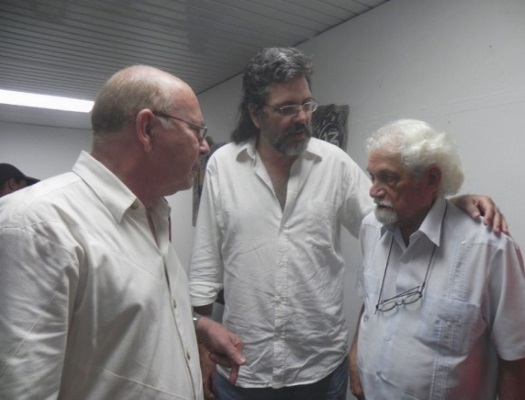
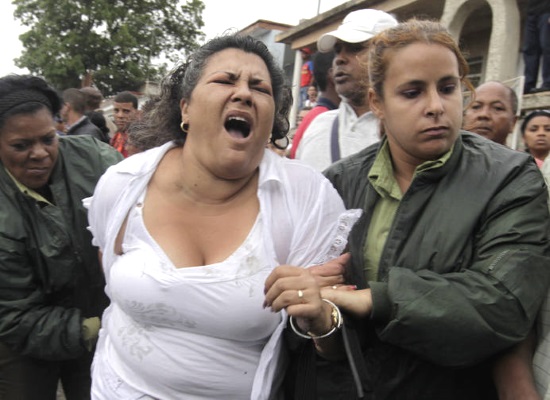
Ultimatum from the political police to musician Goki Aguila, participant in the peaceful marches of the Ladies in White.
Cubanet.org, Camilo Ernesto Olivera Peidro, Havana, 6 August 2015 – Tuesday, August 4, Gorki Aguila, leader of the punk band Porno for Ricardo, was visited at his home by an official from the PNR Sector (Revolutionary National Police). She tried, without success, to get Aguila to accept a badly drafted and irregular summons.
After that visit, on Wednesday at about midday, Gorki heard a knock on his apartment door. On opening, he found two police officers who were bringing orders to arrest him:
“I barely had time to make a couple of calls,” says the musician and host of the offline radio program Gear Shift. “Then, while I was being taken to the patrol car, I asked the agents the reason for the arrest. They did not know how to answer me.” continue reading
The patrol car took the route towards the well known Fifth Station in Playa township.
Kafka, in STASI version, according to State Security
“On arriving and being taken to the jail, I insisted that they explain why I was there. Then, the guard in charge of that area found out and told me: ‘You are here for an interview with CI (Counter-Intelligence).’ The other guards looked at me as if I were the most sought after criminal in Cuba. They said: ‘If CI summoned you, it is because they have something heavy against you.’ No one wanted to accept that I could be a prisoner just for thinking or acting politically differently.”
After more than two hours, Gorki was taken to an office inside the station itself. There he had a meeting with an officer from State Security who did not identify himself. This one, in a hectoring tone, threatened the musician:
“The agent told me: ‘If you go this next Sunday to the Ladies in White, you will never leave this country again. Those who have invited you to play in the United States are going to have to get you on a raft. I am personally going to make sure you are not able to leave from the airport.’”
Gorki thinks that “these officers are sick with impunity. They really believe that this system is going to last forever. Their bosses make them think that. We are all buried in a blend of the films ‘The Lives of Others’ and Kafka’s story ‘The Process,’” added the musician.
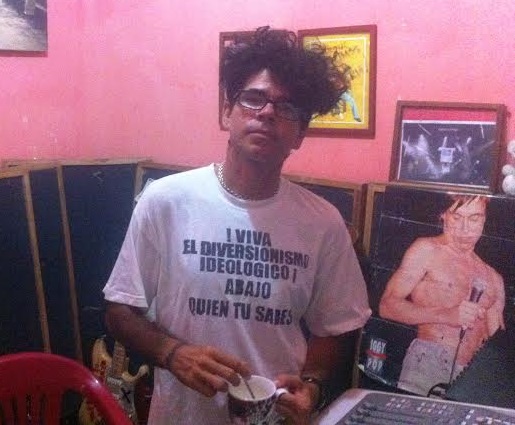
Gorki in his studio. (Photo by author)
Porno Para Ricardo, the Ladies in White, Kerry and the Pope
The band Porno Para Ricardo is scheduled to travel to the US to join a tour. On prior occasions, the group’s musicians were held on the island by express order of Cuban security. Gorki has had to travel via Mexico and turn to session musicians hired by the sponsors in order to be able to perform.
“There are two important visits coming up which have these repressors very nervous. One of these is the American Secretary of State John Kerry. The other is Pope Francis in September. I don’t doubt that they are gearing up for a flash wave of repression. They will do it, as soon as they have the American flag waving at the embassy across from the Malecon,” he says.
At the beginning of July, Gorki Aguila debuted his theme entitled “Ladies in White” in Gandhi Park, near the Santa Rita Church. He did it surrounded by the respect and emotion of these brave women and the activist members of the Forum for Rights and Freedoms. A little latter, everyone marched in defiance of repression. They have continued to do so. They will do it again next Sunday.
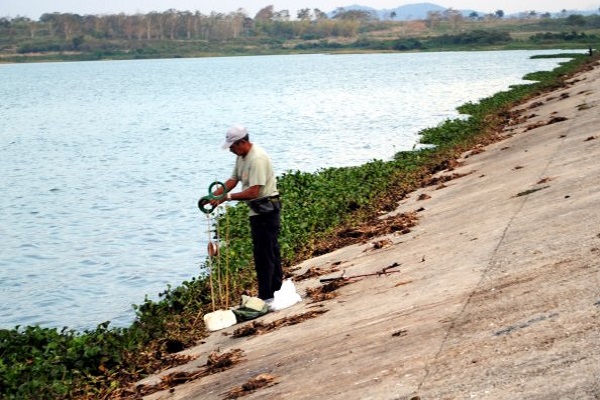
In spite of the contamination of Cuban bays, health authorities do not prevent fishing and bathing (photo by the author)
Cubanet.org, Ernesto Perez Chang, Havana, 28 July 2015 – Between the years 2004 and 2007, 65 children from the Los Sitios neighborhood in Central Havana, 7 to 10 years of age, underwent testing in order to determine their degree of lead poisoning. The research, conducted by a team of researchers from the Cuban National Institute of Health, Epidemiology and Microbiology (INHEM), found that 46.2% of the children exceeded the acceptable levels for adults according to the World Health Organization (10.0 mg/dl) and that 67.7% already were demonstrating learning difficulties associated with poisoning from this heavy metal.
According to the scientists, who recommended extending the investigation to other areas of the capital, the group of those affected presented with “diminished reading abilities, more limited vocabulary, poor reasoning, very slow reactions and poor psychomotor coordination.” Also, concern about the long term consequences was raised due to lead exposure being associated not only with reduction in academic performance but with changes in hearing, behavior, low self esteem, suicide attempts, depressive syndromes, aggression, and even mental retardation or death. continue reading
Perhaps because the research involved some “taboo topics” in the official public debate like childhood, health and the poor living conditions of Cubans, the results were not repeated in national press outlets, even though they were published in issue number 47(2) of 2009 of the Cuban Magazine of Health and Epidemiology [found at http://scielo.sld.cu; most of the studies mentioned here are available on the internet], and years before, in 2003, the INHEM magazine itself had brought to light a study1 by several of its researchers about lead levels also in children in the Central Havana township, perhaps one of the most affected by the poor health-sanitation conditions and by its location in a highly contaminated area.
Works like the foregoing join a list of investigations developed by Cuban scientists who belong to official institutions which signal the catastrophic effects of the island’s ineffective environmental policy, especially because of the link they observe with direct damage to human health.
Official Sources Note the Problem
In early 2015, the first issue of the digital magazine Science on Your PC, corresponding to January-March, published the extract from a dissertation2 by a group of researchers from the University of the East in Santiago, Cuba, about the low risk-perception and disinformation on the part of the residents of fishing communities about heavy metal contamination in the waters of the bay and surrounding areas.
According to the study, even though the Santiago Bay ecosystem is highly contaminated, there exists no government strategy to curb the negative effects of the heavy metals on the health of the residents of the city. Similarly, the inhabitants and even the fishing cooperative workers receive no information about the toxicity of the waters and the foods that they extract from them.
Santiago is, after the bay of Havana, the most poisoned on the island, and several sources discharge contamination into it such as the Antonio Maceo Thermoelectric Center, the November 30 Forming Company Electroplating Plant, the Celia Sanchez Textile Company, the repair workshops of the Electric Company and the Polygraphic. All use the principal rivers and their tributaries to discharge wastes without any effective filtration.
Despite this, according to the research, in the area “everyone claims that they have never been kept from fishing (…) This prohibition on fishing has been imposed only in the event of an outbreak of diarrheal illnesses and, of course, in the case of a closed season as with shrimp. (…) None of those interviewed from the fishing grounds knows about the heavy metals; they have not even heard this term.”
People from other regions of the country, also visibly affected by pollution, demonstrate equal ignorance about the phenomenon. The government’s policies of concealment in most cases are due to economic strategies, as deduced by those investigations that link cancer levels to the degree of contamination of the waters in mining or highly industrialized areas.
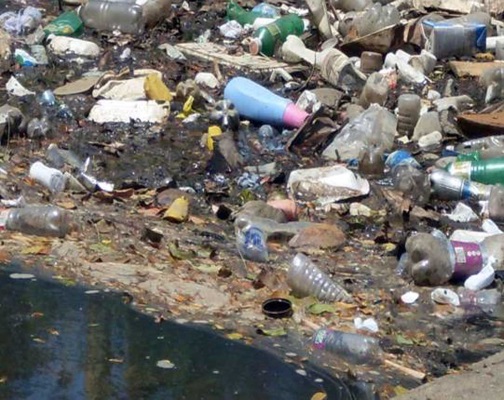
Dump next to a water source (photo by the author)
In the research report “Cleaner Production Strategy for the INPUD Galvanic Factory” (2006)3, the authors, belonging to the Central University of Las Villas, recognize that the main factor that impeded the design of a filtration system for heavy metals and toxic residues in the galvanic factory of the National Industry Producing Domestic Appliances (INPUD) was the impossibility of developing means of environmental protection because these raised the costs of production, a luxury that the Cuban economy could not afford, much less in the middle of the program called “Energetic Revolution” promoted by Fidel Castro, where he required them to commit to producing 350,000 pressure cookers benefitting the “Battle of Ideas.”
According to the researchers, at that time, “the treatment at the end of the pipe [filtration of pollution discharged into rivers and reservoirs] was improving the contamination problem but not reducing the costs [of production],” in a factory that employed Czech technology from 1964, “with very deteriorated technology and obvious obsolescence.”
In 2001, the factory had put into operation a wastewater treatment plant, but at the same time, it encountered construction problems because of which chrome and nickel wastes continued to be discharged directly into a small stream and from this to the Arroyo Grande dam, belonging to the Rio Sagua watershed with an area of more than 2,000 km².
This discharge into the groundwaters of the region could be related to the high levels of cancer that was reported by the province of Villa Clara where the highest incidence of cases on the island is recorded, according to statistics from the Cuban Ministry of Public Health itself.
In that regard, a report entitled “Contribution to Environmental Management in the Context of Urban Agricultural Production in the City of Santa Clara,” carried out between January and February of 2009 by a group of authors from the Provincial Meteorological Center and the Agricultural Research Center of the Central University of Las Villas, found high concentrations of lead, cadmium, nickel and other harmful substances in the soils and waters of several urban agriculture production systems in the city of Santa Clara. On comparing them to the standard established by Cuban regulation NC-493, from 2006, it was observed that “in organic gardens the concentrations of heavy metals were greater (…) with possible risk in some cases for human health.”
Similar studies, but focused on the petroleum areas of Boca de Jaruco in Santa Cruz del Norte and in a town near a goldmine on the Island of Youth, show that one of the fundamental reasons that the investigations are not disseminated and that urgent measures are not taken is the government’s economic interests.
In 2003, the magazine Earth and Space Sciences [Vol. 4, pp. 27-33], published the study “Arsenic and Heavy Metals in the Waters in the Area of Delita, Island of Youth, Cuba,” by a group of scientists from the Geophysical and Astronomical Institute and from the National Hydraulic Resources Institute.”
The text speaks of “a reduction in the maximum permissible limit for arsenic in drinking water,” which had unleashed the onset of chronic illnesses like cancer in people who had ingested drinking water with lethal concentrations of arsenic for long periods.
Populations from Batey de la Mina and from the Delita goldmine in the southeast of the Island of Youth, were and are exposed to arsenic concentrations higher than the detectable limit. In the Manantial La Mina station alone were recorded values that exceed the Cuban regulation of 50 mg/L-1 as well as the World Health Organization guideline of 10 mg/L-1.
The “Benign” Purpose of the Studies
In spite of these alarming measurements, according to what the investigators themselves expressed, all the clinical studies that have been carried out in the area by governmental agencies interested in the territory’s tourist development were for the express purpose of demonstrating the “therapeutic benefits of Delita’s waters and sludges” and not to connect the appearance and behavior of diverse illnesses with the ingestion and external use of arsenical waters.
Students from Central Havana demonstrated high blood-lead levels due to exposure to polluted sources like the Havana Bay (photo by the author)
The group of Cuban researchers is aware of the toxic impact on residents’ health in the so-called “special township” that, in recent years, has demonstrated a rising trend in mortality rates from cerebro-vascular diseases, notably exceeding other regions of the country: “The clinic where the residents of Batey de la Mina, the Argelia Victoria People’s Council No. 6, are treated, has shown a marked increase in the years 1994, 1996 and 1999.”
“If one considers,” continues the final report of the study, “the transit time of the underground waters from Delita, which is 13 years (…) and subtract those years from the date of the first increase in deaths from this cause (1994), the resulting date is 1981, which marks the beginning of the decade in which the most important exploration studies were carried out in the mine, as well as the drainage and direct dumping of the underground waters on the surface (1982), showing some possible relationship between these events. (…) Furthermore, although there exists no detailed study by clinics and areas that indicate the behavior of those dead from malignant tumors, this condition constitutes the main cause of death in adults as well as of premature death in the township, also with an upward trend in the last decade. Lung cancer (…) has shown a startling increase between the years 2000 and 2001 for the whole township.”
According to other researchers, Delita’s reservoir area is regarded as a uranium mining prospect, a considerable concentration of this element having been identified in a sample from the deep part.
The thousands of facts offered in the studies carried out by state scientific institutions themselves exceed the limits of these pages, and at the same time, contradict many aspects of the Cuban government’s official discourse that speaks of health programs and educational strategies but persists in ignoring a true environmental catastrophe that threatens to transform into another nightmare that new chapter of the Cuban revolution that has been referred to as “prosperous and sustainable socialism.”
References
1Aguilar Valdés, J. et al., “Niveles de plomo en sangre y factores asociados, en niños del municipio de Centro Habana”, Revista Cubana de Higiene y Epidemiología, 2003; 41(1).
2 Rodríguez Heredia, Dunia et al., “Educación ambiental vs. baja percepción acerca de la contaminación por metales pesados en comunidades costeras”, Ciencia en su PC, 2015, enero-marzo, 1, 13-28. Centro de Estudios Multidisciplinarios de Zonas Costeras (CEMZOC), Universidad de Oriente, Santiago de Cuba.
3 Cachaldora Francisco, Isidro Javier et al., “Estrategia de producción más limpia para el taller galvánico de INPUD”, Universidad Central “Marta Abreu” de Las Villas (2006).
High levels of lead and other metals harmful to health have been detected in reservoirs intended for human use
Cubanet.org, Ernesto Perez Chang, Havana, 23 July 2015 – Although they have not been properly disclosed, in spite of their great importance, numerous studies carried out repeatedly by teams of Cuban scientists have raised the alarm about the critical state of Cuba’s main aquifers.
The detection of high levels of lead and other heavy metals harmful to human health in lakes and reservoirs intended for human use and for work related to agriculture and fisheries suggest that this could be one of the main causes for the increase among the Cuban population of cancer and other illnesses related to prolonged exposure to toxic substances.
The Ejercito Rebelde dam receives wastes from the nearby Antillana de Acero (photo from the internet)
While the phenomenon afflicts all the country’s provinces, Havana is the region most affected because, first, it is surrounded by several landfills capable of leaking highly toxic elements into underground waters that feed sources destined to supply the capital; and, second, most industries do not comply with international norms for the treatment of wastes and the filtering of harmful gas emissions, and they even discharge wastes directly into river basins like the Almendares, which crosses the capital and whose waters are used on farmlands. continue reading
A study published in 2013 conducted by a team of specialists from the Laboratory of Environmental Analysis, part of Cuba’s Higher Institute of Applied Technologies and Sciences, reported the levels of highly toxic substances in the soils of and produce grown on 17 farms dedicated to urban agriculture, all located within two kilometers of the 100th Street landfill to the west of the capital.
According to the research, the soil of half the farms exceeded the ranges at which heavy metals, like lead, are usually found in Cuban agricultural soils, while a high percentage exceeded levels considered toxic according to some international standards. Similarly, 12.5 per cent of the vegetable samples collected exceeded the maximum permissible limits of this contaminant in foods intended for human consumption established by Cuban regulation NC 493 of 2006.
One of the areas that most worries those who are familiar with this phenomenon, about which nothing is said in the official press outlets, is the Ejercito Rebelde dam, built in 1976 south of the capital and considered one of the largest stores of “potable water” in the western region.
Surrounded by highly polluting industries like the steelmaker Antillana de Acero and giant dumps like Cotorro, the lake has been singled out by several scientific groups as a danger to human health since analyses of its sediments as well as of its flora and fauna have revealed lethal concentrations of heavy metals and other harmful substances.
In spite of the released warnings – almost always by digital academic publications of limited circulation – state fishing cooperatives that sell their products in the capital’s markets continue to operate there, while the regional authorities do very little to prevent the area’s inhabitants from coming to fish, swim or wash cars at the banks of the reservoir.
The oil stains and countless accumulations of rubbish that surround the dam speak for themselves of the government’s lack of control and the ignorance of the people about the danger to which they are exposed.
A scientific study from 2005 had already detected high levels of lead, zinc, cadmium and copper in the so-called “Almendares-Vento” basin as well as at the Ejercito Rebelde dam.
In its report, the team of analysts from Cuba’s Higher Institute of Applied Technologies and Sciences explained that such levels of contamination were due, in large measure, “to inadequate hygienic-sanitary coverage and industrialization without regard to protective measures for the environment.”
In order to have an idea of how terrible it could be now as well as in the future just for Havana, the Almendares-Vento watershed (which also includes the Ejercito Rebelde dam), provides almost half of all the potable water that the city’s populace consumes and a good part of its food. The heavy metals are extremely toxic even in relatively low concentrations, they are not biodegradable, and, to the contrary, they accumulate through the food chain.
To understand the gravity of the situation – both because of the discharged contaminants in our waters and the authorities’ willingness to conceal or disinterest in the matter – it suffices to refer to the body of research that, although carried out by Cuban institutions and experts, almost exclusively circulates outside of the island in foreign digital scientific media, while domestic publications keep their distance from what already constitutes a real silent tragedy.
The appalling hygiene and sanitation conditions of the capital influence the contamination levels (photo by the author)
Tables and info-graphics from several studies of the aquifers of Havana and the San Juan and Cobre rivers in Santiago de Cuba, among others, show the accumulation levels of heavy metals comparable to heavily industrialized areas of Europe. Chemical contaminants have also been found in species captured in the Guancanayabo Gulf and at the Hanabanilla dam in Villa Clara. Investigations by the Metallurgical Mining Institute of Holguin also have detected elevated concentrations of sulfates, nickel, chromium, manganese and iron in the groundwater of Moa.
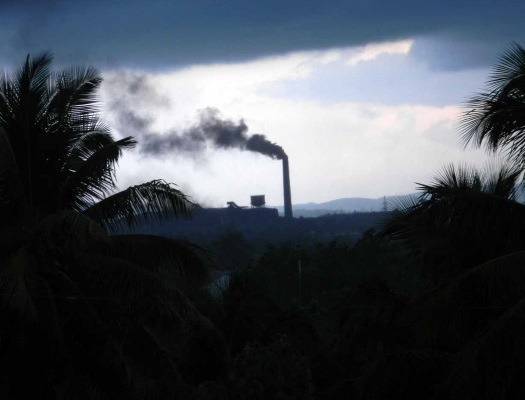
Antillana de Acero and other industries near the dam do not comply with environmental regulations (photo by the author)Graph from one of the studies showing levels of contamination in Havana’s waterOil stains line the Ejercito Rebelde dam in Havana (photo by the author)Small dumps skirt the dam (photo by the author)Drivers wash trucks and cars in the reservoir (photo by the author)
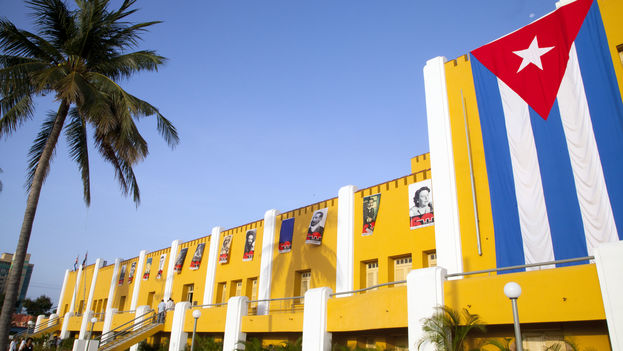
The Moncada Barracks. An attack on the barracks on 26 July, 62 years ago, was the opening move of the Revolution
A pandemic of freedom floods our senses.
Juan Carlos Cremata
14ymedio, Pedro Campos and other authors, Havana, 25 July 2015 – It will soon be 62 years since a group of young men headed by Fidel Castro attacked the Moncada Barracks in Santiago de Cuba, an event that catapulted that figure to the foreground of national politics and definitively buried the possibility of a peaceful and political outcome to the situation created by Fulgencio Batista’s coup a year before.
The armed struggle prevailed and managed to oust the tyrant from power. But the violent way in which it was achieved marked until today the political fate of Cuba. The Encampment triumphed again over the Republic.
That same character who organized and led that assault and who then headed a rebel military movement capitalized on the popular triumph of the 1959 Revolution, made and supported by the great majority of the Cuban people in order to restore the democratic system. continue reading
The small group close to Fidel and Raul Castro leads, now for more than half a century, an authoritarian Government that never re-established democratic institutions, structured on the basis of the “dictatorship of the proletariat,” according to the principles of Stalinism, which has nothing to do with Marx or with the founders of socialism.
All very well done to keep the little group in power. All very badly done according to the interests of the people and workers.
Injustice today still openly and violently represses different thought, prevents a few women [the Ladies in White] from marching with flowers on an avenue seeking liberty for political prisoners, imposes on the nation its own Communist Party and political economy that they decide and negotiate with the US Government, behind the backs of the Cuban people, an effort to save their monopolistic State capitalism with an alliance with the foreign capital that could lead to the virtual economic and geo-political annexation by the neighbor to the north.
The failure of monopolistic State capitalism imposed on Cuba in the name of socialism, the Revolution and the working class is more than evident in many of its main results:
1-Destroying the country’s economy. 2- Impoverishing workers and Cubans in general. 3- Covering the word socialism in mud. 4-Dividing and scattering the Cuban family. 5-Discouraging the Cuban people from working. 6-Distorting national history and de-nationalizing the Cuban nationality. 7-Retarding for almost half a century revolutionary progress in Latin America with its encouragement of violence.
The constant violation of the civil and political rights of the Cuban people is found today in the most recent absurd attacks by the bureaucratic system against artists of great national and international prestige such as Tania Bruguera and Juan Carlos Cremata
Another recognized achievement is international solidarity, which has been the work of the Cuban people, but some part would have to be celebrated, another part discussed and much re-evaluated as counterproductive and even reprehensible. Education and health in reach of all, with all its deficiencies and limitations, are the little improvement that it has achieved, but both were conceived for the skilled and continuous exploitation of salaried statism.
That is the concrete thing we have today. What happened before 1959 is ancient history for new generations, who are brought up in absolutism around the power established and recognized in an obsolete Constitution, copied from the former USSR, a constitution that the Government itself violates every day.
The constant violation of the civil and political rights of the Cuban people is found today in the most recent absurd attacks by the bureaucratic system against artists of great national and international prestige such as Tania Bruguera and Juan Carlos Cremata, attacks which constitute offenses against the whole national culture and prove that the
Encampment does not back down in its outrage against the Republic.
If different expressions of art and national culture cannot be freely demonstrated, if they cannot creatively represent our contemporary national reality, then the old slogan “Within the Revolution everything, outside the Revolution nothing” has been turned into: The ‘Revolution’ is no longer ‘everything,’ rather it is ‘nothing.’
A nation is its culture and if it is not respected, it is nothing more than a group of empty symbols.
The most sacred thing that a human being has, what permits him to live, to be fulfilled and to build a family, is his work, his creative capacity, his physical and intellectual aptitudes, which are materially translated into remuneration for his efforts and results.
The right to payment for work is perhaps the most important right, which permits in turn the realization of other rights.
And the supposedly socialist State is violating that right since it appropriated and nationalized all the factories, lands, big, medium and small businesses, theaters, cinemas, parks, beaches, cultural and social centers, dance halls, etc., and converted everyone, even artists, into salaried employees of the State. Today they receive miserable salaries and pensions, the same as 50 years ago but devalued 50 times.
That desecration of the value of work, the main basis for any economy, has destroyed the productive forces of the nation, especially the most important, the human workforce, which has been demoralized and corrupted by the high level of exploitation to which it is subjected with extremely low wages. How can they ask people to be productive, to take care of the means of production and to feel master of them?
If they do not respect the workforce, art or the citizens’ civil or political rights, what mess are we facing?
We already told the General [Raul Castro] that it was time to close the Encampment and to open the Republic. But like all our messages to power, this one did not reach receptive ears either. It was ignored.
Do the current rulers really believe they can ignore with impunity the demands of other revolutionaries and citizens with different thinking? Do they believe that I gained this by shooting and by shooting they will have to take it from me? Why were those shots fired? To gain access to power eternally and return to the people trampled dignity and sovereignty? To keep themselves in power by means of violence? Do some still believe that it is preferable to sink the Island in the sea than to lose their power and privilege?
From the democratic left the government has been warned many times: if they continue forgetting the original contents that gave life to this process and continue to violate the rights of Cubans, the unchanneled discontent could overflow.
They go so slowly that they are becoming paralyzed. Everything has its limits. Patience, too.
Today repressive actions against the peaceful opposition do not stop not even with the approach of the pope’s visit. If anything, they increase in number and intensity in an effort to stop the inevitable progress of the democratization demanded by almost all of Cuban society, parts of which are equally inside and outside of Cuba, the worker, the fledgling entrepreneur, the student and the soldier, the communist, the indifferent and the dissident. We are all parts.
I recently demanded an end to the spiral of violence, which is the fault of the repressor State. The opposition no longer places bombs or makes attacks. It assumed the path of peaceful confrontation. The world today is different than that of the Cold War. Not realizing these changes and continuing with violence is good for no one.
As some opponents demand: Judge for yourself the repression’s direct actors.
From the democratic left it has been warned many times: if they continue forgetting the original contents that gave life to this proc overflow.
If they do not want people protesting in the streets or wherever or however they can, they must do things right: stop the repression, free the political prisoners, permit freedom of expression, association, election and economic activities. Start a dialogue with everyone. Move towards a new democratic Constitution, a State of law and a new electoral law.
We do not demand that you surrender or submit, but that you permit the democratization of Cuban society
Set reasonable internet prices. Eliminate obstacles to self-employment, cooperativism and state trading monopolies. Deliver state enterprises to the collective management of the workers. And free yourselves from so much blame.
Without peace, democracy and freedom, there will be no development or any socialism.
This is, once more, a plea from the political forces that emerged from the revolutionary process itself. From people who devoted the best years of their lives to fighting for the socialism in which they believed and who today see their poor families torn apart and their children and grandchildren risking their lives at sea or in the jungles searching for well being. Bringing people to desperation is the worst politics. Prevent violence from growing and spreading.
We do not demand that you surrender or submit, but that you permit the democratization of Cuban society or let others do what you espoused and were incapable of doing: achieving the complete happiness of all the Cuban people.
Do that last service for the Revolution that you began and that long ago you should have put into the hand of the sovereign people, and then no one will bother you. In any case, you would pass into history as those who righted the stray path.
Let the people decide, restore to them their sovereignty. Because of that and for that they supported the Revolution that you lead 62 years ago. Don’t provoke another one.
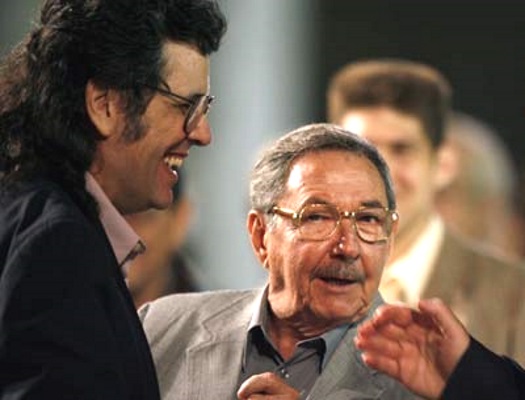
Miguel Barnet and Abel Prieto may be exempt, but what will happen to others like Pablo Armando Fernandez? (photo taken from the Internet)
Now that the slogan is economic profitability, what will happen to all the mediocre but loyal intellectuals?
Cubanet.org, Ernesto Perez Chang, Havana, 20 July 2015 – In that “without haste but without pause”* race to impose a new economic model that might alleviate the ravages of Fidel Castro’s despotism, in Cuba some are wondering if the changes will positively or negatively affect the forms of cultural management to which a majority of writers and artists have been accustomed.
I am referring to the model that has permitted many of them to live, sometimes well, sometimes not, but “without breaking a sweat,” meaning publishing books that no one reads and that will never be sold; receiving prizes and distinctions for a lifetime of submissive work; manipulating competitions; plundering travel allowances or missions to Venezuela; haggling over, in the offices of the Culture Ministry, frequent departures to fairs and events abroad; being the official lapdog who paves the way to court, and turning himself into a character that is half rogue and half leftist intellectual who says he has renounced international success due to his “revolutionary commitment.”
Many questions arise now that all those who have lived off of – and even thrived from – the “profitability” of those false loyalties are on a leaky boat in the middle of a stormy sea. continue reading
However, the need that absolutely everything on the island be economically profitable has placed writers as well as the government at a crossroads, breaking an old loyalty pact in which political power ensured the feeding of the ego of that other party, bothersome, who mastered words, all in exchange for complicity.
Under that convention, real writers fled, joined the internal resistance or adapted to the circumstances while, out of the mediocrity there were born hordes of producers of texts without conflicts that only would have served as a backdrop to that illusory cultural conformity environment, of a gilded world, that seems to exist only in bookstores and book fairs.
But now, when the deal has been broken and entrepreneurial profitability is sought, will Cuban writers continue publishing according to that “quota system” established by the island’s publishers and magazines under which the single fact of being a member of the Union of Cuban Writers and Artists, UNEAC, or feigning political obedience ensures that you remain in the publishing plans at least once a year?
What even will be the fate of UNEAC or the Cuban Book Institute? Will their true roles as thought “managers” be revealed?
What even will be UNEAC’s fate! (photo courtesy of the author)
What will happen to the thousands of mediocre but faithful “intellectuals” whom the government will have to ignore if it does not want to continue maintaining a no longer useful claque, especially in an era when the touch screen of a tablet or a cell phone is more attractive than a rough paper surface in black and white?
The new official discourse, no longer based on the egalitarianism of Karl Marx’s Communist Manifesto but on the life raft that are Marino Murillo’s “Economic Guidelines,” is repetitive with respect to the total elimination of gratuities and quite insistent on the rapid transformation of state-subsidized entities into businesses forced to be profitable in order to be able to continue existing.
However, everything works as a trap. Statutes governing self employment do not allow the creation of publishing cooperatives or those initiatives that encourage a cultural environment alternative to that other one controlled, supervised, censored by the Communist Party and State Security.
Writers, if they want to be profitable, that is, if they want to avoid starving to death, will be obliged, much more than before, to write what they are asked to write, to adhere to the margins of tolerance, to feign greater fidelity or, on the other hand, to try their luck abroad or, simply, to change jobs to something much more promising in the Port of Mariel Special Development Zone. After all, the “general president” has already said it; the first thing is the economy while the term “culture,” in the official discourse, has gotten divorced from utopia in order to marry trade. “Economic culture,” “market culture,” “entrepreneurial culture” are the seasonal pairings.
“We writers are screwed,” say several friends who accept the uncertainty of the times. Managing to enter the international publishing market is a true feat for any writer, Cuban or not. The negligible likelihood of something like that happening increases fear, and analyzing the few opportunities for survival without sacrificing the writing trade, the only path to choose is to continue with the pact of silence as long as the storm lasts.
That fear of being on the outside and on their own can only partly explain why, in contrast with musicians and filmmakers, Cuban writers avoid disobedience and feign living outside of politics; however, they are naïve to ignore that now their former role as vassals is not useful in a world where money has completely displaced the word. Now, clearly, the government is not prepared to invest money and time in breeding what it has always seen as a caste of spongers and would-be traitors.
Although always committed to not publishing writers opposed to the Revolution or works that could unleash the demons among the mob, publishers and other Cuban cultural institutions, which until yesterday functioned under an impression of art for art’s sake where the official resolution of “art for socialist ideology” was disguised, now have been forced to redesign their profiles and undertake the race for survival, an eventuality that suits the government perfectly and that will serve to sweep away all the poets and narrators who offer nothing substantial to the building of that rare socialism financed with capital from the Empire.
That rare socialism financed with capital from the Empire! (photo courtesy of the author)
The total elimination of state subsidies, the reduction in publishing plans, the cutbacks in author copyright payments, the massive layoffs from publishers, the assumption of business strategies that take them further from their foundational principles and that transform the editorial element, that is to say, the true reason for a business to exist, into a secondary matter, has been a true earthquake for those who trusted that, for culture, any future time would have to be better.
Now it means speaking and writing less and working more, is what the Cuban government says, which also has replaced its traditional “fleet” of literati for a torrent of ideologues capable of providing to the people that “Revolutionary” literature indispensable for pretending that nothing falls apart: military officers with too much free time and turned into historians, State Security agents turned novelists and poets, historians feeding the revolutionary epic, children of Raul and Fidel occupying the printers with their manias and cravings, all the Book Fairs revolving around them, while the writers attend the end of times, their own extinctions, with the calmness of cattle led to slaughter, just for fear of breaking the silence.
*Translator’s note: Words from a 2014 speech by Raul Castro to the National Assembly about “updating the Cuban economic model.”
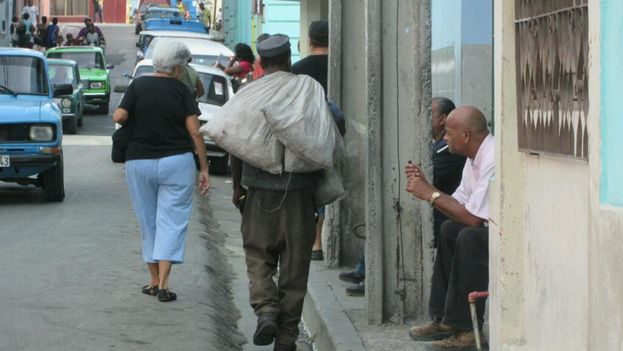
Raw material collectors have been warned “not to appear” until the festivities have concluded (Yosmani Mayeta)
14ymedio, Yosmany Mayeta Labrada, Santiago, 23 July 2015 – The builders hurry to give the last touches to building projects, and the communal brigades obsessively clean the streets. A few days before the celebration of its fifth centennial, the city of Santiago is bustling. The imminent arrival of the delegations to the ceremony for the Assault on the Moncada Barracks has also caused the local authorities to gather up the many vagrants of the historic center.
The psychiatric institutions of the city have established monitoring services for the areas surrounding Cespedes Park in order to proceed with the detention of the mentally ill and homeless or those who beg near the tourist destinations. “Everything must be clean,” explains one of the members of a medical brigade that handles such tasks.
For those who reside in the city of Santiago it is evident that something is missing from the landscape of the so-called “golden kilometer” where the first houses, established in 1515, and the Holy Basilica are located. Absent are those figures, often scrawny and in dirty clothes, who stretch out their hands or display a prescription so that the passersby will give them “some help to live.” continue reading
The cathedral entrance is one of the busiest places for those displaced people who, with a figure of Saint Lazarus, a candle and a little plate, spend the days waiting for parishioners to throw them some coins. Now they are not even seen, due to having been confined in hospital wards until the more than 4,000 guests of the festivities leave.
Regina Lobaina, a nurse at the Gustavo Machin Psychiatric Hospital, confirms to 14ymedio the hospitalization of the vagabonds and explains that although “many have family and receive aid from provincial social assistance, poor living conditions force them to beg on the more affluent streets.”
However, not only the destitute have been removed from the “family portrait” that is being prepared for the city’s anniversary. Those who gather raw materials in the vicinity of downtown have been warned “not to appear” until the week concludes. Bernardo, retired from the Ministry of the Interior, is one of them. He picks up cans in parks, bars and public places because his pension is not enough, but recently they have “knocked down his business,” he explains.
The facilities of the Train Terminal have also been “cleaned” of indigents. Lourdes often takes shelter there, but recently has searched for another roof under which to spend the night “until all this is over.” Her house was destroyed by Hurricane Sandy in October 2012, and she says she has slept in all kinds of places, including the provincial Party headquarters. “My children are in the Shelter for Homeless Children because I cannot have them with me,” she adds.
Lourdes says she “has been lucky” because at least she has not been confined. “I prefer the street even though it is hard because a hospital room is worse,” she asserts while she gathers her belongings in a bag that years ago lost its handles and zipper. Bernardo, Lourdes and the other indigents are superfluous to the showcase of the fifth centennial of Santiago de Cuba which is preparing to be shown off to journalists and authorities.
Presentation of the HRF about the death of Oswaldo Payá. (@RosaMariaPaya)
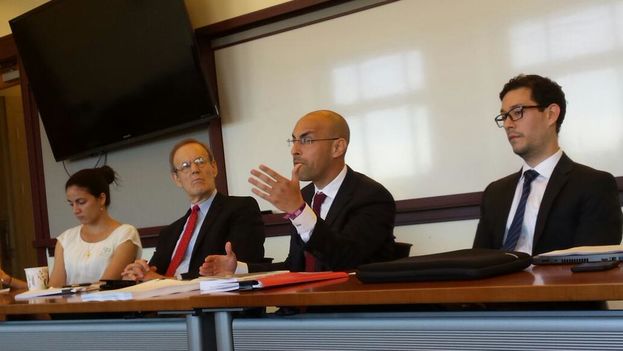
14ymedio, Havana, 22 July 2015 – The human rights defense organization Human Rights Foundation (HRF) thinks that the Cuban government has “direct responsibility” in the deaths of dissidents Oswaldo Payá and Harold Cepero, according to the conclusion of an 88-page report presented this Wednesday at the University of Georgetown (Washington), on the third anniversary of the death of the opponents.
“The accident (…) is the result of an automobile incident deliberately caused by agents of the State,” assert the authors of the report, lawyers Javier El-Hage and Roberto C. Gonzalez, both of HRF. According to the lawyers, there was “intention to assassinate Oswaldo Payá and the passengers who were travelling with him.” The authors of the report also think there was the intention of “causing them serious bodily injury” or that the event “was carried out with negligence and/or extreme indifference – and an unjustified high risk – for the life of the activist.”
The foundation highlights the “errors” and the “contradictions” of the official investigation into the events of 22 July 2012, documenting numerous violations, such as a faulty autopsy of the “most prominent pro-democracy activist in Latin America in the last 25 years,” according to the president of the HRF, Thor Halvorssen.
The report maintains that the evidence, deliberately overlooked by the official investigation, suggests that it was not a traffic accident and implicates the government in the crash between the vehicles.
The organization believes that the Spaniard Angel Carromero, who was driving the car in which Payá was travelling and who is now on probation in his country, was ”obliged” to confess himself to be responsible, and that Cuban Justice paid no attention to the complaints of the dissident’s relatives, excluding them from the trials. Carromero himself, who was then a leader of the youth branch of Spain’s Popular Party (PP), has asserted on several occasions that the accident was an “attack” orchestrated by the Island’s regime. Those responsible for the report insist that Carromero had no access to a lawyer for weeks and that, later, he was forced to be represented by lawyers with close ties to the Government.
“The State of Cuba is responsible internationally for having violated Angel Carromero’s right to an effective legal defense,” says the report, since the authorities refused his defense access to the case file and the opportunity to present new evidence.
“Cuba is not a democratic State in which individual rights are respected or in which there exists independence among the powers of the State,” warns the report, which labels trials that involve dissidents as “a mere formality” in which “all the actors (prosecutor, judge and defense attorney) direct their work towards legitimizing the Government’s decision and not towards the search for the historical truth of events and the punishment of the responsible parties.” The investigation and the later trial in the death of Payá and Cepero were not exceptions, having been carried out in a “context of complete authoritarianism.”
Cuban authorities also did not permit the family of the deceased to speak with the two survivors of the crash (Angel Carromero and the Swede Jens Aron Modig), and three years after the event, they have still not communicated the result of the autopsy. The dissident’s relatives received the clothes that he was wearing the day of the incident already washed which kept them from opting for an independent examination.
“Havana’s authorities believed that it was necessary to destroy my father,” said the daughter of the opponent, Rosa Maria Payá, present at the University of Georgetown. “This report will be an important tool against the impunity of those authorities,” she added. According to the activist, the document “is the end of the first part” of her efforts, and the process to clarify what happened to her father “is only beginning” with “the analysis of the evidence” in the hands of the family.
“We plan to use this report as a tool in front of all the international bodies,” said Payá, who calls on Cuban authorities to release her father’s and Cepero’s autopsy reports.
The authors of the report accuse Havana of having violated the Universal Declaration of Human Rights as well as the American Declaration of the Rights and Duties of Man.
The preference of trying political opponents for common crimes is not new. Thus is prevented the sullying of the regime’s image while giving cover to those who assert that in Cuba there are no political prisoners.
Cubanet.org, Augusto Cesar San Martin, Havana, 10 July 2015 – The preference of trying the Cuban government’s political opponents for common crimes is not new.
Attorney Julio Alfredo Ferrer Tamayo, head of the Cuban Law Association (AJC) is in jail in Valle Grande awaiting a new trial and suspended from practice for four years. The lawyer faces a new criminal charge just when his six-month sentence for contempt was ending.
Such charge was imposed on Ferrer during his defense of his wife Marienys Pavo Anate. He demanded a mistrial on her behalf because of breaches of duty by public officials. continue reading
In his lawsuit against the judges, delivered in the Civil and Administrative Courtroom of the same Court, the lawyer from the AJC charged the process against his wife with being a “colossal fraud, with a worthless, corrupt and illegal vote,” as recorded in the judgment.
As a result of such incident, the farce against him ended up revealing itself when the judge from the Criminal Division of the Plaza of the Revolution Court considered “severe” the prosecutor’s request for seven months in jail for Contempt and lowered it to six months.
Lawyer Idilio Hernandez Herrera, legal representative for Ferrer, told Cubanet that the malice is proven by the first sanction, replacing the fine with jail as corrective discipline.
“To refer to my client they used words like corruption, documented falsities highly repudiated by society…irreverent and unethical lawyer. Which is to say the judges can use inappropriate language and prejudge the verdict,” said the defense lawyer.
“They are ordinary prisoners, not political”
The real ‘crime’ of the AJC lawyer is having used the administrative and procedural resources of Cuban law in order to demand the right of association.
The process summoned before the Provincial and Supreme Courts Maria Esther Reus, head of the Ministry of Justice (MINJUS), who delegated to the director of MINJUS Associations to declare in a trial why the AJC is not legally approved.
The next criminal process that Julio Alfredo Ferrer faces aims to eliminate any political or anti-governmental position that his conduct may describe.
He is accused of Falsification of Public Documents during the purchase of his home more than 10 years ago. Even when the notary who conducted the process testified in the oral trial to Ferrer’s innocence, the prosecutor petitioned for three years’ incarceration.
His representative Hernandez Herrera is convinced that the new accusation is a plan that intends to search at all costs for a civil violation so that he will be punished for ordinary crimes [i.e. not political ones].
“After they punish him for an ordinary crime, his defense becomes more difficult in international organizations for Human Rights, the Latin-American Court of Justice and the European Commission that have to do with lawyers,” explains Hernandez.
“This has been a political operative game by State Security with other factors very well organized in order to neutralize any kind of campaign for the freedom of my client,” he adds.
What is certain is that the government will keep the lawyer Julio Alfredo Ferrer Tamayo in jail without sullying the regime’s image and apparently will give cover to those who assert that in Cuba there are no political prisoners.
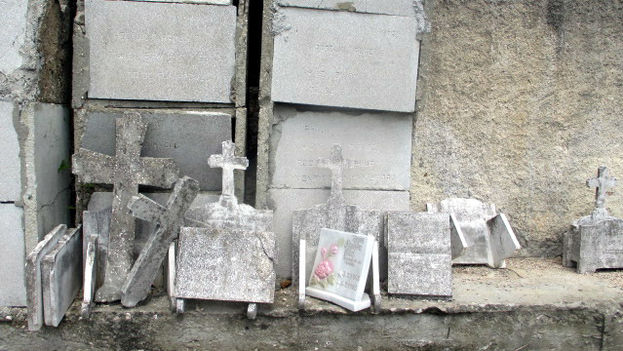
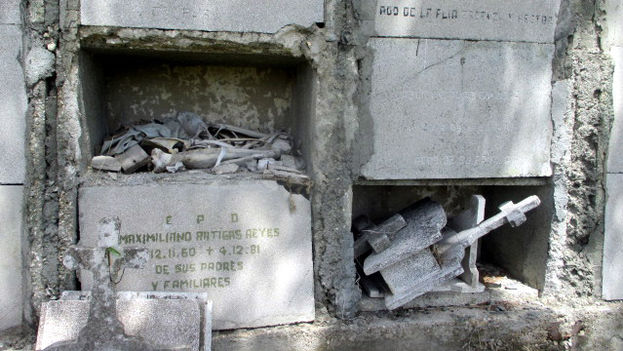
Broken tombstones in the Mayabe cemetery, Holguin. (14ymedio)
14ymedio, Orlando Palma and Fernando Donate, Holguin, 11 July 2015 – Broken tombstones, open graves, dilapidated tombs, and, here and there, scavengers that devour shallowly buried remains. This is no scene from a horror movie but images from a video that exposes the serious situation in the Mayabe Cemetery in Holguin.
Released by the Patriotic Union of Cuba (UNPACU) in 2014, the film was produced by journalists Nairovis Zaldivar, Yainiel Diamela Escofet and Rosaida Check, and has been distributed through the illegal “weekly packet” that circulates widely in the province without any official media picking up the story.
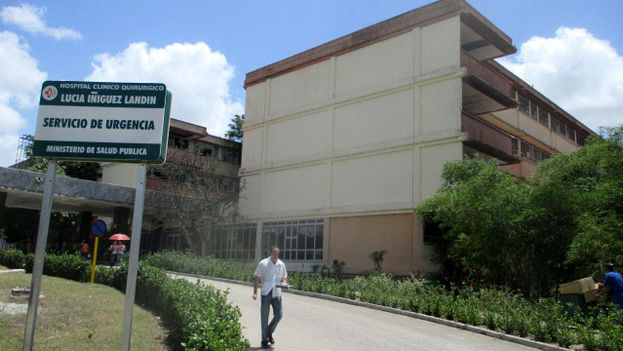
Almost a year later, the problem has not been solved; it was caused because the Vladimir Ilich Lenin University General Hospital, the Lucia Iniguez Landin Surgical Teaching Clinic and the Provincial Military Hospital bury their wastes in the place, since their crematoriums are not functioning. Criticism of the mismanagement of biological wastes has been heard at various levels but local authorities have not taken action in the matter.
In the investigative work the errors committed by the medical institutions depositing the remains from surgeries, abortions, amputations and tests, without proper precautions, are laid bare. For months, those who have visited the grave of a relative in the cemetery have been overwhelmed by carrion birds and other animals that helped themselves to the hospital wastes barely covered by a little dirt. continue reading
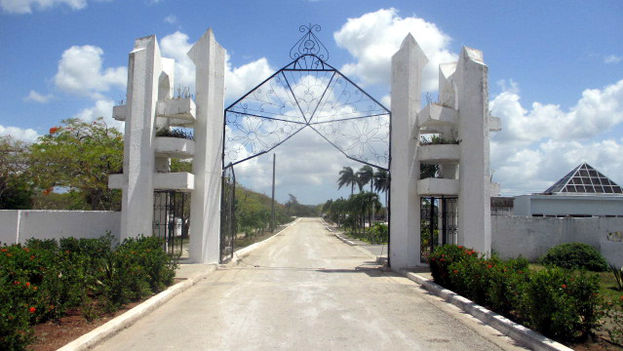
Gate to the Mayabe, Holguin, graveyard, one of the biggest on the island. (14ymedio)
Located six kilometers from the city, the Holguin cemetery has some 500,000 square meters and is one of the biggest in the country. Although there are no homes nearby, at midday the bad odor is unbearable, especially in the area at the back of the site where the three medical centers dump their wastes.
On the Cuban Medicine Blog, Doctor Eloy A. Gonzalez calls attention to the fact that “the management of hospital wastes, above all biological materials, is a problem of the highest priority for health systems and the organizations and institutions charged with management and disposal of the same.”
The doctor points out that “you cannot walk around in cemeteries throwing away biological wastes, barely buried where soon stray dogs and carrion birds notice the anatomical parts that come from a hospital. Are there no incinerators in hospitals in Cuba?” he asks. His text circulates through the email of various health professional with accounts on the Infomed service.
Specialists consulted by this daily agree that a first step to solving the problem would be to diminish as much as possible the biological wastes that the hospitals generate. Once reduced, their collection, transport and disposal must be rigorously controlled. Failure to fulfill the measures associated with the treatment of these wastes can present a serious health risk.
With the scandal uncovered by the UNPACU video, now the wastes are buried more deeply, although still without regard to the measures required for their handling. The regular edition of the February 15, 1999, Official Gazette governs the responsibility of “the heads of the entities that are in charge of installations and release areas whose operations generate dangerous biological wastes.”
Here and there are seen exposed remains in the neglected niches of Mayabe. (14ymedio)
Under Cuban law, wastes that may contain “biological agents, organisms and fragments of agents or organisms with genetic information, that represent a real or potential danger for human health and the environment in general” must be removed in a way that “guarantees the protection of the environment and in particular the population and workers.”
On questioning about the topic at the Vladimir Ilich Lenin University General Hospital, the employees shy away from responding about the conditions in which the wastes from the health center end up at the Holguin graveyard. Only one employee from the laboratory area, who preferred anonymity, submits: “We have problems with resources, for example with the correct bags and containers for placing the samples that we process.”
When they will repair the crematorium is a question that finds no answer in the management of the health center and much less in its administration. Nevertheless, the epidemiological risk from the wastes is not the only cause for worry for those Holguin residents who visit the cemetery. The use of an area laden with funereal connotations as a biological dumping ground bothers many, too.
Lucia Iniguez Landin Surgical Hospital Clinic, one of those denounced for burying biological wastes in the Holguin cemetery. (14ymedio)
Lucia, 72 years of age, often visits the family mausoleum which is located a few meters from the place where the hospitals bury their wastes. “It is a lack of respect that they do this because this is a sacred place for the dead to rest in peace,” this lady complains, and although she has not seen the journalistic report, she asserts: “I realized that something was going on when I arrived and this was full of miserable buzzards.”
The main complaint, however, lies in the fact that such a sensitive matter that involves ethical and epidemiological issues has still not been dealt with by the province’s official media. “It seems that they are waiting for something grave to happen, for someone to get sick or to protest because of this disrespect, before they put it in the press,” says Lucia.
DiariodeCuba.org, Miami, 10 July 2015 – The increase in the number of Cubans who ae arriving undocumented in the United States due to the announcement of the re-establishment of diplomatic relations with Cuba is so great that Florida’s social services cannot cope; they have crashed and have a waiting list of almost two months, reports the Spanish newspaper El Mundo.
This situation slows the settlement of these people in other states, the receipt of work permits and emergency monetary help. Those recently arrived fear that the renewal of diplomatic relations at the ambassadorial level will put an end to exceptional immigration laws favoring Cubans.
According to figures from Immigration Services, since the October 1st beginning of the fiscal year, almost 19,000 Cubans have entered the country either by sea or across the Mexican border, a figure equivalent to the total arrivals of the previous year. Two thirds of those arrived since the announcement of the thaw. continue reading
The newspaper relates the case of the Cuban Antonio Mora, 27 years of age, who arrived in Miami after entering the country at Laredo, Texas, a border crossing with Nuevo Laredo in Mexico. He was interviewed, and he presented his case as a Cuban refugee and was admitted in to the country easily.
He immediately moved to south Florida, but he has no relatives there, and he has been homeless. The young man survives in the open in a shopping center parking lot in the city of Doral in the Miami metropolitan area together with three other fellow countrymen.
“We came without money or family. In Cuba it is said that the United States’ government gives asylum to Cubans. Meanwhile, we have to be outdoors,” he emphasizes with a certain despair.
Catholic social service organizations say that they are overwhelmed. “Many are coming. We operate on state programs and private contributions,” say sources consulted by the media.
“But with the crisis, contributions have fallen and funds are exhausted. We don’t have the capacity to process so many people,” explains Amaldo Vicente, one of the volunteers from Catholic Charities, the most important Florida home for refugees, without greater detail because he is not authorized to comment on the issue.
14ymedio, Havana, 7 July 2015 – Through the month of June, at least 563 arbitrary arrests of regime opponents in Cuba were recorded according to the report published this Tuesday by the Cuban Commission on National Human Rights and Reconciliation (CCDHRN). In spite of a slight decrease in the number compared to previous months, the total continues to be one of the highest in the hemisphere.
The organization also counted 26 physical attacks and 16 cases of harassment; however, it recorded no acts of repudiation nor vandalism against homes of dissidents.
The report mentions the case of Lazaro Yuri Valle Roca, an independent journalist arbitrarily detained last June 3, interrogated by State Security and transported dozens of miles from Havana. After forcing him to kneel looking at the ground, the agents put the barrel of a pistol against his neck, which the CCDHRN classifies as an unofficial mock execution.
A usual scene in Reparto Electrico, whether Holy Week or not
Cubanet.org, Ernesto Perez Chang, Havana, 1 July 2015 – A daughter killed her mother, dismembered her with the help of her boyfriend and then reported her missing in order to be able to inherit her humble apartment in a slum where they both lived. It may seem the plot of a horror movie but it is a real story that barely a year ago shook the community of Reparto Electrico.
It was not the first time I heard such chilling news as that; but more than the blood relationship between the victim and the murderer, the motive of the killer was what accentuated the absurdity, the insanity, especially when in the streets, while the crime was being talked about, equally disturbing stories emerged about family conflicts related to the difficulties in wrangling a place to live.
Before and after that bloody episode, I learned of other similar scenarios, and, according to Orlando Asdrubal, a lawyer who has followed several cases in the Arroyo Naranjo township, the bloody events within families are increasing, all related to housing property rights. continue reading
Although they do not always yield fatal outcomes, this kind of litigation accounts for almost half the cases heard in the courts: “Brother against brother, children against parents, and always it is because of a room, to inherit a shack, a little piece of land, four pesos. Too much violence, that is what poverty brings when there is hopelessness and desperation. That is one of the main attractions of the Cuban courts. Four cases out of ten have to do with housing,” says Orlando.
Amado Ibanez, resident of Centro Habana, illustrates for us with dozens of anecdotes how increasingly frequent are the bloody events related to housing and involving family members who have shared the same space for years: “Right here, on this street, every day there is a brawl and they have nothing to do with gangs or drugs or machismo, those are less frequent. The majority are because of one brother who wants to bounce another from the house or a child who wants to divide a room that is his father’s or uncle’s, and all that is sometimes with machetes.”
Violent events like these to which Amado refers are those that everyone hears about because they are frightening. However, there exist others that go unnoticed due to their everyday nature, more so in the current political-economic environment in which old people are classified as a social burden, an obstacle to development, although, paradoxically, that subliminal rhetoric comes from the discourse of our ruling elders.
Through the testimony one can hear on the street, from the mouths of neighbors, friends and work colleagues, one can sense that in Cuba many old people, whose only heritable property is the humble family home, die as victims of what could be considered “stealth killings,” most of the time at the hands of their own offspring.
Recently while riding on a bus, I could hear the conversation of two women. One was telling the other about how turbulent it was to share the home with her elderly father who suffered very advanced diabetes and episodes of senile dementia.
When one detailed the things that she did or left undone in order to hasten the death of the sick man (she left him alone at night, fed him a bad diet and even stopped administering his medicine to him), the other fearlessly advised her about the steps she should take to declare him incompetent, admit him to a health institution and inherit the property that was simply a small apartment with only one room. The gruesome plan was discussed aloud as if it had to do with an inoffensive plan to exterminate cockroaches.
On a more personal level, I have known neighbors who have died in the cruelest abandonment by their families without any governmental institution bothering to investigate in depth what happened and without any legal mechanism for reporting these cases in which one senses that, behind the supposed negligence, there are hidden true instances of premeditated murder.
A doctor from a clinic in Reparto Electrico, whose identity we withhold, says that in recent years instances of old or sick people dying because of the apathy of their relatives have increased and that, due to the lack of interest demonstrated by the institutions who should attend to this phenomenon, it is very difficult to prevent these tragedies.
“There is no way of knowing if the relative is acting out of ignorance or if the lack of attention is on purpose. I always am inclined to the latter. If, as a relative, you take responsibility for a sick person, you must do things just as the doctor indicates, but in the end you cannot complain about them for anything because neither the hospitals nor the nursing homes are capable of offering better attention. (…) I have had several cases where it is evident that there has been a murder. But how can I prove it? And not only that, how do I know that the police will pay attention to me?
“And worse, I am asking for them to come and stab me four times in the back for something that I cannot prove outright. (…) I have had many experiences but I don’t need to be a doctor to live them daily. For example, in the same building where I live. A neighbor, not very old, was partially paralyzed after a stroke so that she could not walk. With some physical therapy sessions and some more or less good care the woman was up, but her daughter did nothing. She had her thrown in bed and did not worry about feeding her. She died after a few months.
“I live here, and I know that every day there were fights about the apartment, I know that they left the woman to die, that they saw the opportunity to resolve the matter that way, finally, no one investigates. (…) For the government it is one less old person and another housing problem solved.”
The difficulties of getting housing in Cuba are not comparable to any other reality and it has been creating quite complex phenomena where official corruption, astronomic sale prices or political conditions for getting an assignment for a place to live are practically not problems in comparison with the tragedies that have occurred within families or with the loss of moral values and the degradation of human feelings to monstrous levels.
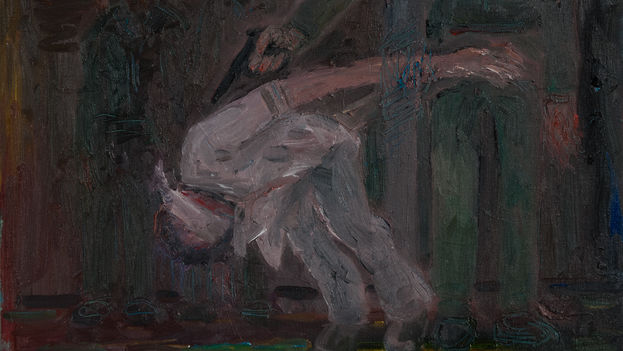
Juan Abreu: ‘1959. Fall from Grace,’ fragment (oil on canvas, 38 x 46 cm)
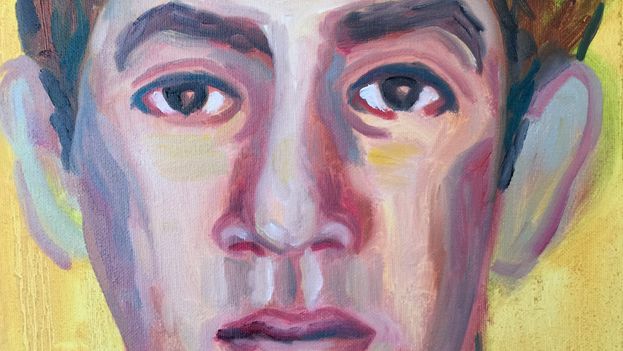
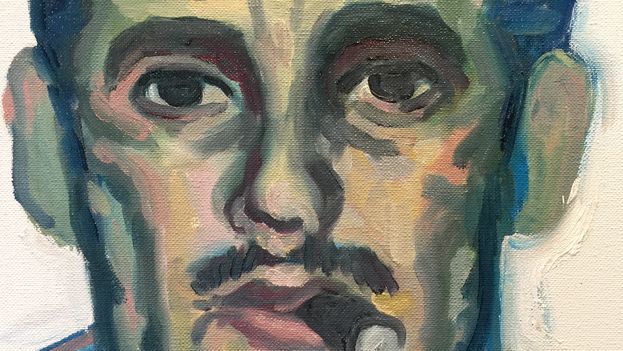
14ymedio, Yaiza Santos, Mexico, 27 June 2015 – Painter and writer Juan Abreu (b. Havana, 1952) has taken on the inordinate task of painting, one by one, all those executed by the Castro regime. The work in progress is entitled 1959 but encompasses 2003, the year in which Lorenzo Capello, Barbaro Sevilla and Jorge Martinez were sentenced to death in a summary trial, accused of “acts of terrorism” after trying to reroute a passenger ferry to escape to the United States. They were the last executed by the Cuban government. “Let it be known,” says Abreu.
The project emerged, he says, recently, by chance: “I was doing some paintings that had to do with the firing squads in Cuba, because I was struck by the character, the loner that they are going to kill. I had seen some paintings by Marlene Dumas of Palestinians and then I approached the subject. When I started researching, suddenly the faces of all these people began to appear. I began to look at the faces and read, and suddenly I realized that I was going to have to paint this. Not only as a kind of pictorial adventure, which it is, because of the quantity of portraits and the complexity of the genre, but also because it seems to me that I have a certain moral responsibility.” continue reading
Juan Abreu: ‘1959. Carlos Baez’ (born in 1937, shot in 1965), fragment (oil on canvas, 27 x 35 cm)
Of the executions in Cuba, he continues, “It is an untold story. Not only untold, but also they have tried to hide it, and when they have spoken of it, the effort has always been to discredit the protagonists, branded as outlaws or murderers. These accusations lack any kind of historical evidence. They were people who rebelled, the same as Fidel Castro rebelled against Batista, they rebelled against Fidel Castro.”
The death penalty, explains Abreu, was not contemplated in the 1940 Constitution which the Revolution originally claimed it would restore: “They [the Castro regime] imposed it. The trials completely lacked any kind of safeguard. Sometimes even the lawyer spoke worse of the condemned than the prosecutor did. They were Soviet-style trials: you already knew you were guilty as soon as they caught you; you knew that they were going to kill you or put you in jail for thirty years.”
In order to gather as much information as possible, he contacted some of the few people who have devoted themselves to the topic in the United States, like Maria Werlau, from the Cuba Archive, or Luis Gonzales Infante, a former political prisoner who sent Abreu his book Rostros/Faces, where he compiles names and photos of those dead by execution, from hunger strike or in combat during the El Escambray uprising, those seven years that historians like Rafael Rojas consider a civil war and that Fidel Castro called a “fight against bandits.”
Other documents he has found easily on the Internet, like videos from the period and photographs from the free press that still existed in Cuba when the Revolution triumphed. Hence, the executions of Enrique Despaigne, doubled over by two shots at the edge of a ditch, or Cornelio Rojas, whose hat flew together with his brains against the execution wall. Abreu confesses that what impacted him most was “the gruesomeness and cruelty” of some of the cases.
Like that of Antonio Chao Flores, who at 16 years of age fought against Batista – the magazine Bohemia had him on its cover as a hero of the Revolution – and at 18 years of age he fought against Castro, and was required to drag himself from his cell in the La Cabana fortress to the execution wall without the leg he had lost in combat because the guard took his crutches from him. “It is from the savagery of the system’s punishment mechanism that one feels fury that all this that has happened has been forgotten. If I was Chilean or Argentinean, this would immediately demand attention.”
Abreu says that the project is becoming gigantic and that he cannot stop. For now, he has painted some twenty of the 6,000 total that he estimates were executed in Cuba in that almost half-century. Via a Youtube video [see below] he seeks photographs from all who may be aware of any victim.
No one has answered him from Cuba – “There, to have a relative who was a prisoner or who had been shot, was anathema, because of the amount of false propaganda against them” – but people have answered him from the United States. For example, one sent him the photograph of her neighbor in Cuba, whom she knew from childhood, who used to greet her kindly and whom she eventually learned was made a prisoner and executed. It was when media control was complete, and an absolute silence, when propaganda was not served, covered these kinds of cases.
“The death penalty in Cuba has always been used as a means of social threat. When they ask me, “But why has the regime lasted so long?” I answer: It has lasted for many reasons, but among them because it is a system that kills. You know that they will kill you. And there is no safeguard: There is no judge or lawyer who can defend you, and if they decide that you have to be killed, they will kill you. And if you do anything against the system, they will kill you. Death is a very effective deterrent.”
Juan Abreu: ‘1959. Man Alone,’ fragment (oil on canvas, 35 x 27 cm, collection of Carles Enrich)
Forged by the generation of his friends Reinaldo Arenas and Rene Ariza, Abreu says that “kind of strange fury” that he feels about Cuba has not abandoned him since he left the Island with the Mariel Boatlift, and that after so many years, he has decided to stop fighting it. “Towards Reinaldo (Arenas), for example, it seemed to me a great betrayal. In our last conversation, two or three days before he killed himself, we were talking about that precisely, and he told me, ‘Up to the last minute. Our war with those people is to the last breath of life.’ It surprised me a little why he was saying that to me, but of course, he already had his plans. Maybe I like lost causes, but I will continue infuriated.”
By way of poetic revenge, he hopes that his project 1959 – which he calls “completely insane” – ends up one day in a museum. “Because a hundred years from now, when no one remembers who Fidel Castro was, these paintings will be here and people will say, ‘And what about these, so pretty?’ And that, truthfully, is very comforting.”
Cubanet.org, Victor Manuel Dominguez, Havana, 24 June 2015 – Abel Prieto rides again. Not as the author of two little novels whose names I cannot remember. Nor as the ex-president of a union of writers and authors more sold to the powers-that-be than self-help books at the Havana book fair, or reproductions of “Still Life with the Leader” at an art exposition committed to who knows what.
Never ever as that ex-minister of culture, with long hair and little sense, who declared that poets like Raul Rivera could be jailed, but they would not show up shot in the head at the edge of some ditch. Now, such a sad political figure, he rides as the cultural adviser to the Cuban president.
Other “Kultural Pajes”
As the Spanish writer Arturo Perez Reverte said in his article “Kultural Pajes” from the book With Intent to Offend, “The more illiterate the politicians are – in Spain those two words almost always are synonymous – the more they like to appear in the cultural pages of the newspapers.” continue reading
It happens here in Cuba, too. The difference is that here the lines fuse, and writers and artists are declared politicians by decree and illiterate by submission. Our politician-intellectuals also write or “sing” to the authorities, who sign a document to send innocents to the execution wall.
Therefore, Abel Prieto’s words to the Spanish daily El Pais are not strange although they are cynical: “The idea that we live in a regime that controls everything that the citizen consumes is a lie, an untenable caricature in this interconnected world.”
Saying that in a nation where the citizens are only interconnected, against their will, to registration offices, personnel files, surveillance centers, State Security and Interior Ministry monitoring and control departments or crime laboratories is a bluff.
The assertion that Cubans are at a high level of international connectedness would be pathetic, if it were not insulting, when we have not yet even overcome the barrier between the produce market and the stove, and they censor films, prohibit books, and pursue and seize antennas across the length and breadth of the country.
The Dark Object of Desire
According to Abel Prieto in El Pais, “We are not going to prohibit things. Prohibition makes the forbidden fruit attractive, the dark object of desire.” We had and have enough experience. From the prohibitions on listening to the Beatles or writing to a relative abroad to access to the internet.
Apparently among the secret guidelines issued by the Communist Party to its cadres in order to mend the nation is the obligatory reading of the poem Man’s Statutes by the Brazilian Thiago de Melo which in one of its verses he says: “Prohibiting is prohibited.” In Cuba only outwardly?
The reality is that Abel contradicts himself. While on one hand he assures that we are not going to prohibit, on the other he says that “we are never going to allow the market to dictate our cultural policy,” when everything is sold, from Lennon’s spectacles and Che’s beret to the sheet music of the National Anthem.
The strategic shield against cultural penetration designed by Abel (under the guidance of Cain: the State) is that it works against banality and frivolity so that people learn to differentiate, apparently, among the “exquisite” passages by Baby Lores about Fidel and the subversive themes of the Cuban rappers Los Aldeanos* (The Villagers).
Which is to say that, disguised as a demand for quality, absolute control of what citizens consume continues. They will not prohibit them, they will only give them the option, for the good of their cultural appreciation level, of seeing or hearing what the Cuban Minister of Culture, assisted by the Minister of the Interior, schedules.
Among Abel’s proposals against banality and frivolity is a “weekly packet” that includes films like The Maltese Falcon and Gandhi, the new Latin-American cinema, Kenneth Branagh’s Hamlet, and a symphonic cocktail by Silvio Rodriguez with the Small Daylight Serenade, that delusional song about “I live in a free country/which can only be free…”
Also to be enjoyed are films by Woody Allen and other offerings that combine “things with cultural density and entertainment material” far from racism and violence, as if in the films about mambises – Cuba’s independence fighters of the wars of independence — the guerrillas and international soldiers fight with cakes, and meringue is spilled instead of blood.
The dark desire for total control by the State is intact. Beyond the linguistic juggling that government spokesmen perform within and outside of Cuba. And without denying a minimal (fortuitous) breach in what is consumed, we still are very far from choosing freely what we desire.
When Abel wonders, in his interview with El Pais, “What are we going to do with Don Quixote?” perhaps Marino Murillo and the company answer him: Send him to run an agricultural cooperative, assisted by Sancho and Rocinante. Or, even better, have him manage the little restaurant La Dulcinea on Trinket Island.
About the Author
Victor Manuel Dominguez is an independent journalist. He lives in Central Havana.
The regime has dedicated itself to sugarcoating the pill for organizations like the UN, UNESCO and UNICEF
Cubanet.org, Jose Hugo Fernandez, Havana, 23 June 2015 – Recently, during a conference at the University of Puerto Rico, I was astonished to hear how a teacher cited Cuba as such an example of Human Development for the Caribbean region and the whole continent. No political deliberation was evident in her statements. She simply appealed to statistics and reports by international institutions, apparently trusting completely in the reputation of the issuer, and without reference to other more vital sources for comparison. The thing is that it made me feel ashamed somehow of representing my country under circumstances in which perhaps I should have felt proud.
The cynical compromise, well structured and promptly placed in orbit, can become a historical fact. Machiavelli had it right, more than five centuries ago, so how much better will our chiefs, his gifted students, have learned it, even if they act much more savagely. continue reading
After shredding almost all basis for Human Development on our little island, this regime has dedicated itself, with cold and careful patience, to sugarcoating the pill for prestigious organizations like the UN, UNESCO and UNICEF (and, through them, the international academic sphere, particularly that of the European Union), in order to round off the massacre, making the civilized world believe that its dictatorship – ingrown and even wild in more than one respect – represents a revolutionary project of humanistic and emancipating character.
It will fall to historians and sociologists or anthropologists and maybe to the psychiatrists of the future to explain how, by what devices of insane policy or under what kind of deception, they managed to win the upper hand. But what is certain is that last year Cuba occupied 44th place among the world’s countries with the best Human Development indices, and it is among the best in the Caribbean. One does not know whether to laugh or to cry in the face of that piece of information, but so it appears in the most serious records, those which inevitably serve as reference as much for the naïve and dandruff-covered “experts” as for the clever accomplices.
Although it is more, it should be pointed out that, as conceived by the UN itself, the Human Development of each nation is measured, above all, by the chance the bulk of its inhabitants live a life that meets their expectations and that permits them to develop all their potential as human beings.
And so we have a country where the only dream of the young is to flee, even risking life, in search of material and spiritual growth. Or where old people constitute a burden that no one can tackle and that, therefore, moves no one, including the State. Or where citizens are excluded, harassed, jailed for their political ideas. Or where work has lost its function as the sustenance for family existence and the essence of national progress… That country now ranks as a paradigm of Human Development.
A couple of years ago, the vice minister of foreign relations for Cuba, Abelardo Moreno, blatantly lied in testimony before the Universal Periodic Review (EPU) of the United Nations Human Rights Council that his government has recognized in its laws the indivisibility and interdependence of all human, political, social and economic rights.
He also said, just like that, that the decrepit dictatorship that he was representing had submitted to the EPU “without discrimination, without double standards and without selectivity.”
The strange thing, I insist, is not that he would say it but that there and everywhere he was believed without it occurring to anyone to undertake onsite and in depth verification which, as we know, is fundamental for the most basic scientific conclusions.
In the end, it is not my purpose to bore my dear readers with more small talk about the same thing. So it is that I merely set forth some other parameters that are used as a guide for measuring the Human Development of a country:
Respect for human rights. A solid economy based on cutting edge technology to make it work. Civil society and autonomous and empowered democratic institutions. Equality between people, regardless of any prejudice. End of discrimination on the basis of sex, race, ethnic, class or religious origin. Freedom of thought and of expression. Elimination of fear of threats to personal security, arbitrary detention and other violent acts for political reasons. Elimination of misery. Freedom to develop and fully achieve the potential of each individual. Elimination of injustice and violations of the law by the state. Opportunities and guarantees of decent work without exploitation.
Those who take the trouble of weighing these parameters, they will tell me now if Cuba practices only one of them to sustain its Human Development trick. As for the rest, as Jesus Christ would say, he who wants to understand does understand.
About the Author
Jose Hugo Fernandez is the author of, among other works, the novels The Clan of the Suicides, The Crimes of Aurika, The Butterflies Don’t Flutter on Saturdays and The Parabola of Belen with the Pastors, as well as two books of stories, The Island of the Black Blackbirds and I Who Was the Streetcar of Desire, and the book of articles Silhouette Against the Wall. He lives in Havana where he has worked as an independent journalist since 1993.
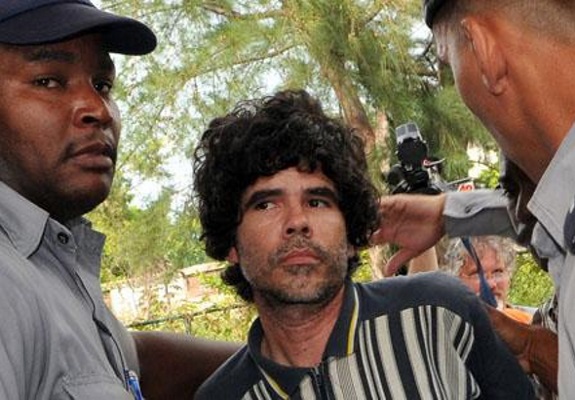
 Cubanet.org, Camilo Ernesto Olivera Peidro, Havana, 6 August 2015 – Tuesday, August 4, Gorki Aguila, leader of the punk band Porno for Ricardo, was visited at his home by an official from the PNR Sector (Revolutionary National Police). She tried, without success, to get Aguila to accept a badly drafted and irregular summons.