Domestic Tourism, the Faces of Deceit / Cubanet, Ernesto Perez Chang

Cuban guests can only observe foreigners enjoy yachting trips.  They are prohibited from this activity (photo by the author)
Cuban guests can only observe foreigners enjoy yachting trips. They are prohibited from this activity (photo by the author)

cubanet square logoCubanet.org, Ernesto Perez Chang, Havana, 16 June 2015 — To judge by the avalanche of television programs that in recent weeks have been dedicated to so-called “domestic tourism,” in Cuba all families have adequate income to become a major market for the island’s hotel groups and resorts.

Several Round Tables with the participation of ministers, vice-ministers, and company heads, all tied to the tourism sector, plus extensive reports on the Cuban Television National News detail the offers for this summer, present promotional campaigns in hotels and shopping centers and exhort the “Cuban family” to make reservations as soon as possible due to high demand.

The propagandistic marathon gives the sense that the economies within our homes are booming and that this country, replete with multitudes living below the poverty line, only exists in “enemy propaganda.” continue reading

As anyone can find out if he wants to, within those same tourist centers “open to everyone,” it is difficult to find guests from our own backyard. Nevertheless, at the doors of the hotels one can collect statements from people who not even in their dreams are permitted the fantasy of “vacationing” on equal terms with foreigners.

Although many may seem to be indigent or to owe their poverty to a slight entrepreneurial spirit, talking with any of those vendors and hustlers who abound in the streets of Cuba can reveal to us that it is those same men and women, workers and professionals, who once believed in that perennial “sacrifice for the future” demanded by those same government officials who today, when speaking of vacations and complete availability in the midst of the daily miseries, inoculate them with a sense of personal failure.

Manolo, a street vendor with whom we spoke on a corner of Paseo del Prado tells us: “I worked my whole life, I was at the sugar harvest when needed, I was in all the mobilizations and I was in the vanguard for many years, and I have nothing. (…) My pension does not cover my needs, like almost everyone. How am I going to plan a vacation? Only one time, in 1983, could I go to a house on the beach in Guanabo, a week, and now I don’t even remember why it was. Vacations are for the rich, and in this country almost everyone is poor, so I don’t know what they’re talking about on television. Well, there they say anything. My son tells me that if I want to consume everything they talk about on the television, I have to put a basket underneath it, because they only exist on the news.”

Manolo’s experience is similar to that of thousands, maybe millions, of Cubans. Collecting testimony about the matter is not hard, and this makes it much more dramatic.

German, another old retiree who sells plastic bags in the streets of Old Havana, could give the impression that he wasted his time when young and that he did not exert himself to achieve greater welfare in his old age; however, like any decent Cuban he believed in work as the only source of prosperity and currently he feels cheated. Vacation in one of the tourist facilities promoted as a vacation destination by the government itself is a true luxury: “What do I do then? It is better not to even think of those things. (…) I never pay attention to what they say on television. They have their country and we, ours,” German tells me.

In cahoots with the journalists who lend themselves to hiding the true reality in a country where the word “vacation” has become empty of all meaning, government officials have the audacity to speak of “affordable prices,” of “overbooking” and “high demand” in a scenario where the entire year’s salary from an honest professional’s job is not high enough to even provide the enjoyment of one day in hotel in Cayo Coco or Varadero, two of the destinations that, according to the official press and the highest tourism authorities in Cuba, “are among the most in demand by the domestic tourist for the coming months of July and August, a time when Cubans comprise 45 percent of those vacationing.” The statistics from MINTUR, contrasted with Cubans’ hard day-to-day reality, are offensive.

A brief visit to any of the internet pages where businesses like Cubanacan or Islazul promote their summer products, aimed at the “domestic market,” show how “cheap” the offers can be even for those same official reporters who barely receive more than 20 dollars for their work.

A basic room in a low or medium level hotel costs, for only one person, between 25 and 70 dollars per night, without counting that the so-called “domestic tourist” does not receive the same treatment as a foreign visitor so that there exist payment and service options totally closed to Cubans. For example, outings on yachts or any motor boat are off limits for even the few Cubans with enough purchasing power (and who, of course, are not relatives of high military officers or leaders); so are those vacation packages that include underwater fishing or big game hunting in preserves devoted only to the country’s upper echelons.

Doctors and health specialists who return from missions abroad where they are paid in dollars, people who live on considerable remittances from relatives in exile, prostitutes, smugglers and corrupt leaders make up that mass of citizens favored by the changes in the policy of access to tourist facilities. A minority that the Cuban government insists on turning into the best face of that capitalist-socialism and into a shield in order to hide the accumulation of lies that constitutes that old populist discourse that, in current circumstances, no longer is suitable but that constituted that sad and skinny losing horse called the “Cuban Revolution” on which they obliged us to bet in a race they always knew was lost.

Click here for the author page for Ernesto Perez Chang

Translated by MLK
Professionals of ‘Snitching’ / Cubanet, Camilo Ernesto Olivera

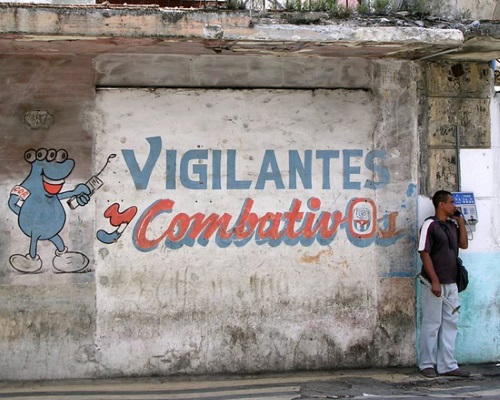
"Combative vigilants." Sign about the CDR (photo from the internet)
“Combative vigilants.” Sign about the CDR (photo from the internet)

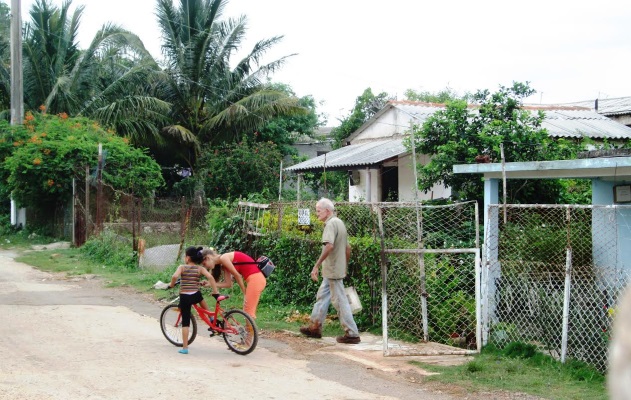
cubanet square logoCubanet.org, Camilo Ernesto Olivera Peidro, 18 June 2015 – An old man is going out of his house in the little village named Henequen Viejo, near the Port of Mariel. Everyone there knows him as Alfonso. In reality, his name is Idelfonso Estevez. At first glance he seems like an old man like so many others.

However, the village’s inhabitants and his closest family members fear and hate him. Alfonso is not surrounded by the protective affection of his fellow man. The local members of the Ministry of the Interior (MININT) take care of him. He is one of their most notorious “snitches.”

His story began years ago. He belonged to a group known as the “Guarapitos”: Alfonso, Jesus, El Viola, Camilo and Titico Borrego. They formed a group of auxiliaries in service to MININT at the beginning of the 1970’s. They dedicated themselves to watching everyone in Henequen Viejo. They gave away those who opposed the regime or anyone who annoyed them. They turned the area into a stronghold of terror. continue reading

When the property seizures began in the early months of 1959, the “Guarapitos” proposed ravaging a farm named La Francesa belonging to Pedro “Pepin” Carbonell and his family. The “Guarapitos” arrived and confiscated the largest cattle and slaughtered them for their consumption. No one could touch them. It was futile to try to denounce them to the authorities. They were protected by being efficient tools of Revolutionary terror.

Later other individuals joined the group with the same vocation of informing. Among them were Faustino Sanchez, Lucas Cabrera Lugo (Tatico) and Benito Mirabal.

Benito Mirabal and the Fisherman

They nicknamed Benito Mariabal “Moustache.” For years, he was one of the most prominent snitching characters in the region. He denounced people trying to leave the country and also reported street vendors. He was sent by State Security officers to watch, day and night, those named as dissidents.

In the last years of his life a rare disease attacked his legs. The doctors diagnosed it as gaseous gangrene, and they had to amputate them.

While Benito was hospitalized, the fisherman residing in the area, friends of his family, brought good and fresh fish for his nourishment. Several of them used to and do make their living from what they catch at sea.

Sometime after having recovered, Moustache Mirabal asked one of his grandsons to take him, in his wheelchair, to the nearest guard post. Once there, he denounced those same fishermen who had fed him. He accused them of illegal fishing. Several of the fishermen lost their licenses, had their boats confiscated or were fined.

Idelfonso Estevez (Alfonso), active snitch.  Henequen Mariel (photo courtesy of the author)
Idelfonso Estevez (Alfonso), active snitch. Henequen Mariel (photo courtesy of the author)

Alfonso is capable of snitching even on his mother if she were resurrected

Certainly Idelfonso Estevez may seem like just another old man when he goes out of his house. But right now he is known as the “greatest trumpet” (biggest informer) in Henequen Viejo.

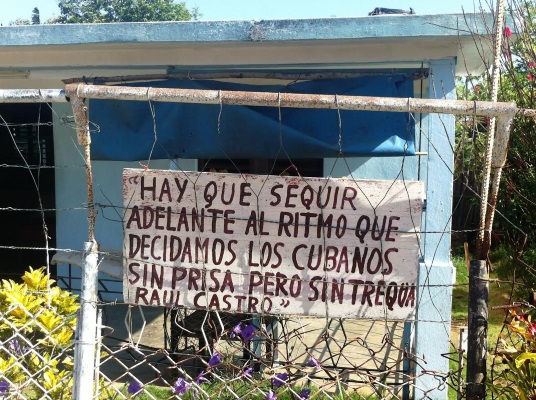
So that no one may doubt his unlimited commitment to the regime, he has placed on the fence around his house several pro-government signs. One of them alludes to a sentence of Raul Castro and the other advertises the “process” (sic) for strengthening the Committee in Defense of the Revolution (CDR).

"We must advance at the pace we Cubans decide, without haste but without pause." Signs on the yard fence at the house of Idelfonso Estevez (photo by the author)
“We must advance at the pace we Cubans decide, without haste but without pause.” Signs on the yard fence at the house of Idelfonso Estevez (photo by the author)

A family source who asked to remain anonymous told us that during the Special Period, this man’s refrigerator was all eaten away with salt residue, and he needed it fixed. A nephew, who did this kind of work informally, restored it for him at no charge. Two blocks away lived Ricardo, brother of Idelfonso. He had a little chain saw with which he did carpenter work. Neighbors commissioned broomsticks, knife handles, and things of that sort.

Two weeks later there appeared in the area two inspectors. They came checking on who had private jobs without being licensed and paying taxes. They went to see Idelfonso, and he, without thinking twice, denounced his nephew and his brother. Idelfonso, “The Guarapitos” and all the guys that are like him, would “snitch” even on his mother if she were resurrected, he said.

For more about the author click the link below.

Camilo Ernesto Olivera Peidro

Translated by MLK
Che Guevara, the Commercial Fetish / 14ymedio, Hector Dario Reyes

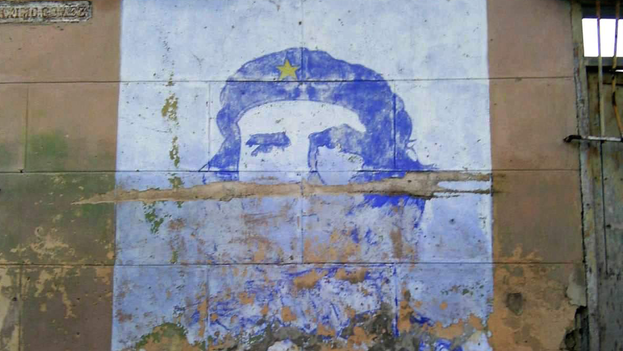
The murals with the Argentinean’s face cannot escape the wear and tear of a reality that little resembles what he planned
The murals with the Argentinean’s face cannot escape the wear and tear of a reality that little resembles what he planned (Silvia Corbelle/14ymedio)

14ymedio bigger14ymedio, Hector Dario Reyes, Santa Clara, 15 June 2015 – “He was a man surrounded by good photographers,” is how a clever self-employed tour guide describes Ernesto Guevara to his clients in the streets of Santa Clara. The man lives by showing the face of the Argentine and telling of his hyperbolic exploits. This Sunday he has had good profits, taking advantage of the 87th anniversary of the birth of one who long ago stopped being a hero and turned into a fetish.

With the passage of the years, the plundering of the guerrilla’s image and the commercialization of his likeness have been imposed on this island. “Santa Clara, the city of Marta and of Che,” says the motto of the provincial capital, although Guevara was not born here. The Villa Clara capital tries to extract a return from the cheesiest ornaments with his name, and the whole tourist network is fed with some bit of his story.

Canek Sanchez Guevara, recently deceased musician and writer and grandson of the Cuban revolutionary commander, hated the t-shirts and pictures of his grandfather. “There is one that unifies his face with that of Christ that is really degrading,” he told his friends. continue reading

Since his death in 1967 and when the Havana photographer Korda gave his mage to an Italian publicist, international trade has encouraged a Che-rebel pseudo-fashion. Although t-shirts with his face abound in stores all over the world, it is in Cuba where that image of beret and jacket has profited most. As with other excesses so characteristic of our idiosyncrasy, in this also we overdid it.

“Here in this city can be found almost all the ways of remembering him that would have annoyed him.”

In Santa Clara there is even a Mate House, home of a historian who collects those traditional Argentinean accessories used for drinking the beverage extracted from the herb of the same name. “I began with the first mates, and when I had many, I placed them decoratively, then I put the image of Che Guevara on the door,” says the man who made a killing from then on. “My objective is to collect them and for people to come to see the display and drink the mate,” is how he explains his publicity strategy.

“Cuba commercializes Che,” says an alert tourist. From berets to bad songs, allegorical t-shirts, bags, bad oil paintings and ashtrays where tobacco is put out right in that face with the majestic gaze. Everyone wants to take advantage of the Argentine. From government institutions and artists to prostitutes or old men who exchange three peso bills with his image for one convertible peso. Che Guevara has become a bargaining chip.

“Santa Clara bases its tourism on the remains of the guerrilla,” the tour guide says ironically. “Here in this city can be found almost all the ways of remembering him that would have annoyed him.”

Another of his grandchildren organizes, in his name, motorcycle tours of the Island on nothing less than Harley-Davidsons. “In memory of the trip through Latin America on the Ponderosa,” he explains to interested clients. Although everyone knows that he made that historic journey “on a Norton 500,” wryly reminds a mechanic who has his garage a few meters from the sculpture complex where official propaganda asserts that the remains of the politico together with 29 of his companions are found.

In Santa Clara his image swarms in the Artex premises like a provincially manufactured product. “The myth is not sold, it is collected with the image,” says a local, tired of stumbling over that gaze everywhere.

Billboards and walls show phrases and drawings that sometimes do not match his face or were not even uttered by him

Opposite the monument to the armored train, a kiosk overflowing with t-shirts, berets, and postcards. A kilometer further, another statue of the guerrilla stands across from the headquarters of the Provincial Party Committee. They receive many foreigners there, who frequently place flower bouquets at the feet of the statue, “because the guidebook says so,” says a Canadian with the look of one who blindly follows to the letter everything that those travel books say.

Another line of exploitation, less profitable but equally petty, is the use of Guevara’s image for ideological purposes. Billboards and walls show phrases and drawings that sometimes do not match his face or were not even uttered by him, but the purpose is to show that his myth and his ideology are believed in.

Che is not only used in the revolutionary exhibition plan, but also to hide some things. Like in the Santa Clara mausoleum, where a giant fence across from the monument prevents foreigners from seeing the marginality of the neighborhood that surrounds Revolution Plaza. His eyes are directed there from the main sculpture; so that, as a popular saying recites, “In Santa Clara, Che watches the poor.”

Translated by MLK

Beef, Only for the Privileged / Cubanet, Roberto Jesús Quiñones Haces

La-Ternera-2-Foto
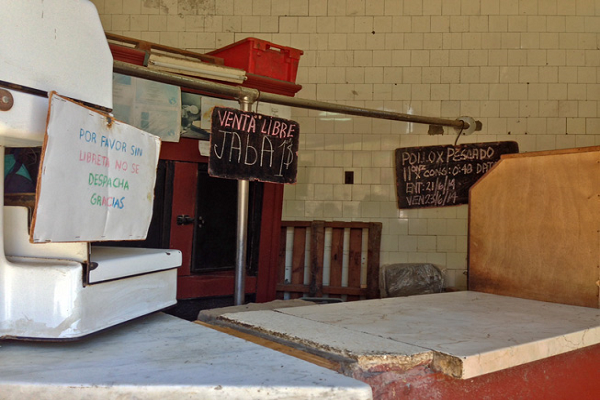
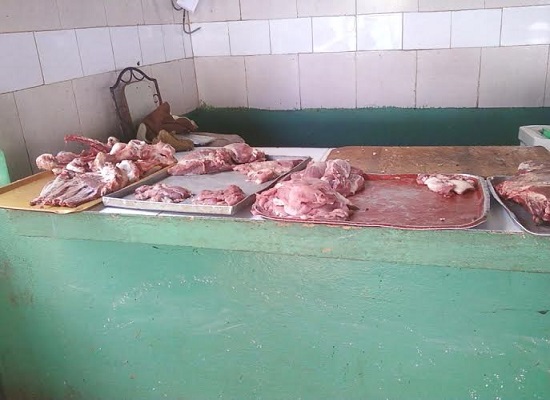
Cuban butcher shop (photo from the internet)

cubanet square logoCubanet.org, Roberto Jesus Quinones Haces, Guantanamo, 12 June 2015 – Among the list of prohibitions imposed on Cubans from 1959 until today is freely fishing, having a boat and wandering around the island or giving our children an education in non-state schools, among others. Until recently it was forbidden to stay in a hotel, sell cars acquired after 1959, sell housing, leave the country without permission from the government, possess foreign currency and buy in stores for tourists and foreign technicians.

Another unusual prohibition that we Cubans have is that the slaughter of large livestock and the consumption of their meat is penalized with harsh jail sentences. For more than 25 years eating a beefsteak has become the dream of the great majority of Cubans. Here, the only ones who can are the leaders, tourists and those with the money to buy it in the currency stores, or those with enough bravery – and also the contacts – to buy it illegally. Not even in the most distinguished restaurant does there appear the longed-for filet. continue reading

A purely Cuban – and revolutionary! – ban

The crime of Theft and Illegal Slaughter of Large Livestock is perhaps unique in the history of international jurisprudence. It had its precedent in the 1962 Law 1018 which last March turned 53 years old and by which cattle owners are obliged to sell their meat exclusively to the state, prohibiting them from consuming it.

In his book, “In Kind Crimes,” Dr. Jose A. Grillo Longoria asserted that before 1959 a great percentage of Cubans could not consume beef and that this law would guarantee that all residents of the country could eat it regularly. For such reason, the distinguished professor of Criminal Law warranted that the state’s efforts to increase the production of milk and beef would be useless if it benignly repressed those who slaughtered those animals irresponsibly or because of a desire for profit.

When he wrote that he knew, because of his age, that in Cuba there had always been milk and meat, even in the worst droughts. From living one could realize that this incomprehensible decision has been the main reason that the Cuban cattle population has decreased continuously from 1962 to today.

Today the number of Cubans, including children, who cannot drink a simple glass of milk as well as those who have not tasted a little piece of beef in years, is much higher. It would prove that the cruel sanctions that he defended have not managed to stop the commission of a crime invented by the bearded ones, the implementation of which has caused thousands of Cubans to rough it in jails, sentenced to thirty and even more than fifty years for having butchered a head of cattle.

The Guantanamo slaughterhouse is militarized

Unable to kill their own cattle, to eat its meat in restaurants, or to acquire it in currency stores due to its high prices, the great majority of Cubans have to go to the black market, supplied by butchers and slaughterhouse workers, in order to be able to eat a steak. In the wholesale network a kilogram costs 10 CUC, more than 50% of the average monthly salary.

carnicero-1
Archive photo

According to a source whose identity we withhold since he works in the Guantanamo Slaughterhouse, the manager there is Mr. Gustavo Osorio, a retired colonel of the Armed Services, who believes himself still to be in a military camp based on the methods he uses against his workers.

As members of his team he has named Lioel Cantillo Pelegrin, an ex-police officer who is chief of the slaughter area and Feliberto Espinola, another ex-police officer who occupies the job of Maintenance Chief.

As if that were not enough, Major Liranza, member of the economic police, continually visits the slaughterhouse and together with those mentioned above, carries out suppressive checks of the work stations without these being part of his job. As a result of these actions, worker Manuel Reyes Calderin was surprised last week with 10 pounds of meat in his clothes, which cost him two days locked in a prison cell, the loss of his job and a pending trial.

A steak, which together with some fried plantains and a serving of beans and rice cost some 25 cents before 1959, now joins the long list of scarcities in Cuban homes. Add to that also that risking the great pleasure can involve a solid blow of many years confinement.

And like everything that happens in Cuba, the fault is not with our leaders but with others. In this case it’s the cow’s fault because they do not want to fatten up, increase their offspring or give us milk. Oh, and I forgot it, also the embargo’s fault!

Roberto Jesús Quiñones Haces

Translated by MLK

Cane Cutters Complain about Their Working Conditions / 14ymedio, Fernando Donate Ochoa

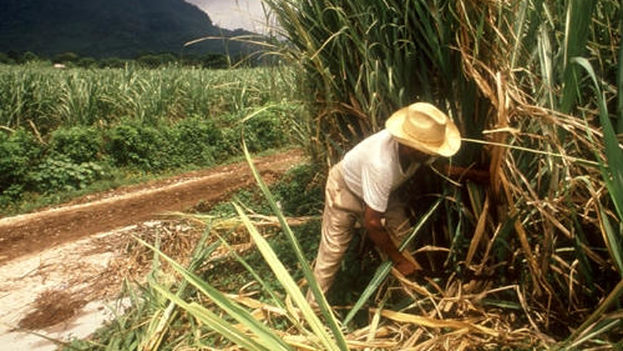
Cane cutting in Cuba (Conexion Cubana)

14ymedio bigger14ymedio, Fernando Donate Ochoa, Holguin, 31 May 2015 – The recently concluded sugar harvest failed to fulfill production forecasts. Analysts have struggled to explain the reasons for the repeated failure and have spoken of incomplete or ineffective repairs and poor organization, but none have mentioned the social factor.

Workers involved in cutting cane in Holguin complained of the abandonment to which they were subjected and multiple violations of their labor rights during the harvest that just ended.

Members of the Basic Economic Unit from the Loynaz Hechavarria center from the Cueto municipality say they worked more than 16 hours a day beginning at five in the morning during the four months of the harvest. continue reading

Heriberto Cuenca Tamayo, operator of a cane combine, told 14ymedio that his brigade had been victim of labor law violations and they were the group that suffered most: in spite of intense heat during these months, they had no cold water for lack of ice. Nor did they receive the promised work clothes, and they ate what they could manage on their own since they were not even provided coffee.

He mentioned that the enterprise is still in default on the incentive pay in convertible currency that is due the members of the team under the labor contract. He also lamented the lack of technical assistance that would have helped with the combine breakdowns during the cane cutting. They are only paid as operators, but they also had to act as mechanics, work for which they are not qualified.

“We were on our own when the machines broke, and in order to continue working we had to personally manage the parts and the repair,” Cuenca Tamayo told this daily.

Together with his companions, he said he felt unprotected. The bosses only speak of obligations, order, discipline and demands. “When they say to do more with less, it seems that they are thinking of more effort and worse conditions, more duties and fewer rights.”

“Neither the Constitution nor any other Cuban law legally establishes the right to strike, but nor did the union solve our problems in spite of raising them on several occasions,” said this cane worker.

For his part, Mario Gonzalez, harvest boss for the Azucarera Company, said that Holguin failed to meet the sugar production plan by not reaching the projected figure of 207,801 tons, lacking almost 4,000 tons to achieve the goal. In this harvest the province milled with only five of the ten sugar refineries it has had since 2002.

The official explained that among the causes that led to the failure are the breakdowns of the combines, the refinery stoppages for lack of cane caused by the late arrival of squads to the cutting fronts, and others of an organizational nature. “There was enough cane in the fields, but it was not known how to get it to the centers,” asserted Mario Gonzalez on a local radio program.

Translated by MLK

Mariel, the Past and Present of an Exodus / Cubanet, Camilo Ernesto Olivera

Fishing school, El Mosquito camp in 1980, seen from the point of view of the River Homonimo (photo by the author)

“They left through here and will never return,” recited a sign on the wall of the power plant. Nevertheless, those who “left” became the support of those who stayed. Today many share the Miami exile with those who said goodbye to them by throwing eggs or rocks

cubanet square logoCubanet.org, Camilo Ernesto Olivera Peidro, Havana, 28 May 2015 – In the town of Boca del Mariel there is a small beach preferred by the locals. Next to it are the facilities of the former bulk sugar terminal. A little further beyond operates the Maximo Gomez power plant.

One Sunday in mid-April 1980 the beach-goers saw four boats flying the flag of the United States enter. They observed how they were directed toward the area of the neighboring pier. At that time the presence of armed Cuban officials became apparent. Later it was learned that there, in a sugar storage warehouse, was the temporary headquarters of the captaincy.

In the days following, the presence of boats and yachts from the north increased. The people from the town of La Boca as well as Mariel were taken militarily by army troops and police personnel. continue reading

Fifteen years earlier the Cuban government had equipped the port of Mariel, located 20 miles to the west of Havana, as an embarkation point for a migratory bridge leading through Boca de Camarioca in Matanzas. Between April and October of 1980, 125,000 Cubans left for Florida, in what came to be known in the United States as the Mariel Boat Lift.

The way of the cross of the Marielitos

The Cuban government announced that all who wanted to do so could leave. But, as a condition, they had to apply for permanent dismissal from their places of work or education. With this safe-conduct pass, many who had taken refuge in the Peruvian embassy went out. They were victims of fascist acts of repudiation in favor of the regime.

Many Cubans carried out diverse actions in order to visit relatives who were waiting for them in that port. Men, women and children arrived there with visible signs of the humiliation suffered at their places of origin.

But something as bad or worse awaited them at the last stop.

At the corner of the Wakamba pizzeria, the mobs armed with sticks and iron bars lurked, cheered on by local government officials. Those who arrived were hunted down and beaten with a vengeance. Then the police “intervened.”

Little beach near the mouth of the port, town of Boca del Mariel (photo by the author)

Those attacked were taken to the Border Guard Unit known as El Mosquito, located at the mouth of the river of the same name four kilometers from Mariel. They were confined there for days or weeks. The conditions in the barracks were inhumane. They mixed the families with criminals or prisoners taken from penitentiaries, sent to this checkpoint to then be deported. The place was guarded by armed military personnel and trained dogs.

On the trip back, the buses took a route to Mariel crossing the bridge. At the end of this, the authorities posted children brought from the schools of Baracoa and Henequen. The teachers passed out eggs and rocks for the students to throw at those in the vehicles.

Currently, on this site, where so many Cubans suffered, is a school that teaches fishing.

The threshold of freedom

The pier of the Camaronera Flota (today the Astilleros Astimar Company) was the last step in the way of the cross. Those who were leaving were concentrated there on two boats next to the pier, at that time, empty and half finished. They waited to be called from a list. Then on boarding they passed through another control.

As a condition of being able to take their relatives, those who came with the boats had to permit themselves to let their decks be stuffed with other people of various kinds. There were those who chose refuge for their families in the cabins.

When the boats pulled away from the coast, the last image, from afar, was of the columns of smoke coming from the chimneys of the Mariel power plant.

Entry point of the former Mosquito Camp, currently a fishing school (photo by the author)

On a stretch of the perimeter wall of that plant, there was for many years a sign that said: “Through here they left and they will never return.”

The sign disappeared during the nineties. That was when the crisis increased. Those who “left” turned into the support for those who stayed.

Today those who left in 1980 share exile in Miami with many who said goodbye with eggs or rocks and later fled in the raft stampede of 1994.

The dictatorship that made them abandon the country still governs with an iron fist poorly disguised with a fine silk glove.

Pizzaria Wakamba in Mariel where the trip ended on Route 218 from Miramar (photo by the author)
Warehouse where the registry of the Port Captaincy was located during the Mariel exodus (photo by the author)
Muro-de-la-refineria-Maximo-Gomezen-este-tramo-existio-este-cartel-Por-aqui-salieron-y-jamas-volveran-Foto-Camilo-Ernesto-Olivera-722x505
Section of the Maximo Gomez refinery wall where the sign existed (photo by the author)

About the author

camilo-ernesto-olivera.thumbnailCamilo Ernesto Olivera Peidro – City of Havana (September 14, 1970) – Screenwriter and Researcher – He has participated in theorist events in almost all the rock festivals that have taken place in Cuba from 2001 to the present – Workshop for screenwriting, production and staging of musical events (UNEAC, CARICATO) 2004 Graduate of television script and drama course (ICRT Teletransmisora training department) 2006 collaborator on Cuban non-official publications concerning the rock genre like “El Punto G,” “Insanedrac,” “Ilusion.” Since December 2007, he has been part of the Cuban Rock Agency where he works as a cultural promoter and member of the editorial board of the magazine “Rock del Patio” (in process). His texts are published in “La Corchea” (ICM), websites AHS, maximrock.com, cubametal.com, esquife.cu, Cubaencuentro, Voces, Cubanet and Diario de Cuba.

Translator: MLK

State Inefficiency, Convenient Business / Cubanet, Ernesto Perez Chang

Selling yields no benefits (photo by the author)

cubanet square logoCubanet.org, Ernesto Perez Chang, Havana, 22 May 2015 — Attestations about poor or non-existent attention in Cuban state businesses are so abundant that few pay attention to them. In order to offer a response to the indignant, the island’s official press searches for causes of such abuse not in the inefficiency of the state enterprise but in other absurd factors like poor education or lack of professionalism, which do not reveal the corrupt essence of a system that, in spite of the proof of its uselessness, will be kept in place by government will, as is expressed in the Guidelines of the Sixth Congress of the Communist Party.

Why do we receive better treatment in a private restaurant or cafeteria? Why do customer demands bother the clerk and managers of a state eatery and why do they not improve the quality of their offerings? Why do they hide behind any justification in order to remain closed or to reduce their public service hours to the minimum?

According to Vladimir Rodriguez, owner of a busy little restaurant in downtown Vedado, the problem is in the objectives of each:

“As the owner of my business I seek to attract more customers, to offer more variety. I listen to the opinions of the people, the suggestions, I serve them like they were kings because it winds up as earnings. In a state restaurant the earnings do not come from the clients’ consumption and satisfaction but in that quite miserable thing that happens in the warehouse, in the sale to the black market of everything that arrives to be produced and sold to the customers, who turn into a nuisance. What little gets to the table is only to justify the work in case an inspector comes, but the clerks as well as the manager live on the black market. continue reading

“That is something everyone knows. (…) I worked for years in restaurants in Havana, even in luxury hotels in Varadero, and what I saw in the kitchens is nasty. (…) Rice that customers leave on their plates went back in the casseroles, a bit of meat, salads, the olives, everything that people leave on the plates is served again. That is way of dealing with leftovers. That’s why I left and opened my own business. I would not be caught dead in a State restaurant; God only knows what they are serving you.”

For Iraida, a clerk in a private cafeteria in Arroyo Naranjo, the matter is more complicated: “It is a secret to no one that in the stores as well as in all the state enterprises the people do not work, they are going, as they say, to struggle, that is to say, to steal. And the worst is that the government knows it and “plays the silly goat” [pretends not to know]. (…) Why? Because it is convenient for them. If they attack the black market the people will rebel because everyone lives off that, even them. There, yes, the revolution is over. They promised to create a wholesale market for the self-employed and even now we continue in the same way, buying on the black market because there is nothing in the stores or if there is, it is hidden in the warehouses, so that you have to buy from a warehouseman, who has a fix with the manager, and so forth and so on. There you realize that the government is involved in that mess (…) if it does not benefit with money, at least it does by leaving it to the people ‘to struggle’ so that they see the ‘blessings of socialism.’ In troubled waters, fishermen gain.”

Marta Li, owner of a café in Vedado, illustrates for us with her own examples what she considers the superiority of private enterprise. “In a State café no one worries about serving the customer well because it does not end up as earnings. They sell or not, the salary is the same for the manager as well as for the sales clerk. They care about what is left from a liter of oil and the chicken, to resell the cheese and the spaghetti; they are not sold because no one would buy them. I, on the other hand, have to constantly create sales strategies; my objective is that nothing is left, not in the pots or in the freezers, to sell everything because what I have paid is quite a lot. (…) Since I am close to the university, I make offers to the students who present their student ID, I discount the price. Sometimes for someone who buys more than one pizza or for a repeat customer I give them a free drink. People come because they know that they will receive good attention. It is not about lowering prices but giving good service.”

Customers do not matter; what’s good is what happens in the warehouse (photo by the author)

A former civil servant of a business enterprise in Havana, who wishes to remain anonymous because she is currently the owner of a restaurant, tells us of her experiences in a state business:

“Satisfying the customer is the last of the priorities [of a state enterprise]. Whatever it may be. They all work in order to steal everything that can be stolen and in the least time possible. One enters with good intentions and ends up coming to terms with the corruption because there is no other path. (…) The socialist economy has neither feet nor head. When I studied [economics] at the university the professors themselves said that there is no way to explain the Cuban economy. And when you try to apply any model you realize that they all fail. (…) It is not that you propose to steal, it’s that you have to do it because everyone is out for himself. It didn’t matter to me or to any of the workers in all the stores where I worked, which were more than twenty; it didn’t matter if the wages were low or not, not even the bonus, the salary was a formality, the true earnings are not even on the counter as many think. Where the money comes from (…) is not the counter. And be careful with making yourself the conscious one [honest] because you wind up blaming yourself for everything.”

Will they be able someday to prove the efficiency of the socialist state enterprise, as Cuban leaders claim, based on a couple of suspicious exceptions? According to the recent statements by Miguel Diaz-Canel, this “demonstrative work” is one of the main undertakings of “the country’s leadership with the Cuban people.” As if half a century of failures that we Cubans currently suffer did not matter, the government pushes to prolong an economic experiment behind which is hidden a vast fabric of corruption.

Against that piece of nonsense, for years it has been very common to hear on the street a phrase that sums up the inefficiency of state enterprises: “The government pretends to pay us, and we pretend to work.”

Outside the businesses, in the doorways, people resell products on the black market, in view of everyone (photo by the author).
Iniciativas-a-favor-del-cliente.-Una-paladar-privada-en-el-Vedado.-Foto-P.-Chang-722x505
Initiatives in support of the customer. A private restaurant in El Vedado (photo by author)
This snack bar gives students 5% off (photo by author)
Satisfying the customer is the objective of private business. There are more menu items than in State companies. This snack bar gives students 5% off (photo by author)
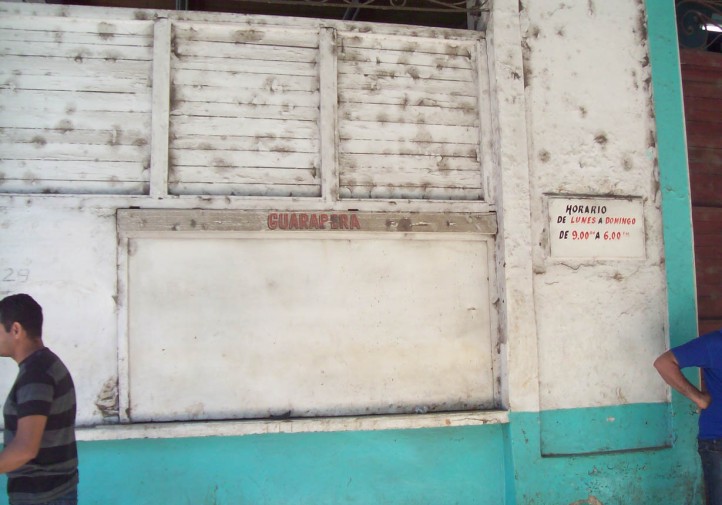
Guarapera-estatal-cerrada-en-horario-laboral.-Foto-P.-Chang-722x505
A State business closed during working hours (Photo by author)

About the Author
448.thumbnailErnest Perez Chang (El Cerro, Havana, 15 June 1971). Writer, graduate in philology from the University of Havana. He studied Galician Language and Culture in the University of Santiago de Compostela. He has published the novels: Your Eyes Are in front of Nothing (2006) and Alicia under Her Own Shadow (2012). At the end of 2014, the publisher Silueta, in Miami, will publish his most recent novel: Food. He is also the author of books of stories: Last Photos of Mama Nude (2000); Sade’s Ghosts (2002); Stories of Silk (2003); Variations for the Preliterate (2007), The Art of Dying Alone (2011) and One Hundred Deadly Stories (2014). His narrative work has been recognized with prizes: David de Cuento of the Cuban Gazette twice, 1998 and 2008; Julio Cortazar Latin American Story prize on its first call in 2002; National Critics Prize in 2007; Alejo Carpentier Story Prize in 2011, among others. He has worked as editor for numerous Cuban cultural institutions like the House of the Americas (1997-2008), Art and Literature Publisher, the Center for Research and Development of Cuban Music. He was Chief Editor for the magazine Union (2008-11).

Translated by MLK

They Murdered My Son in the Streets of Camaguey / 14ymedio, Pedro Armando Junco

Mandy Junco killed last Saturday in Camaguey.  (Pedro Junco, Fury of the Winds blog)
Mandy Junco killed last Saturday in Camaguey. (Pedro Junco, Fury of the Winds blog)

14ymedio bigger14ymedio, Pedro Armando Junco, Camaguey, 22 May 2015 – Pedro Armando Junco Torres, alias “Mandy,” 28 years of age, was stabbed to death in Camaguey in the early morning of Saturday, May 16, a day before the beginning of the rock festival Sounds of the City. Mandy would have participated in it as guitarist and leader of the band Strike Back. His father, writer Pedro Junco, Thursday posted on his blog, The Fury of the Winds, this open letter in which he asks for “true justice.”

They Murdered my Son on the Streets of Camaguey

By Pedro Armando Junco

It is very difficult for me to write. All you mothers and fathers who read these lines, put yourselves in my place. Just for a minute think that it was your son who was stabbed to death in the street at the hands of four killers who did not even know him, who did not even do it to steal from him or to settle accounts. They think that the motivation was to kill, the pleasure of killing. Put yourself there for only one minute and then assimilate what you have felt in your hearts. That is what I am enduring and will endure until the end of my existence. continue reading

I write in order to thank so many people who, in and out of the country, have been at my side recently: the cruelest moments that I have suffered in my long existence. I also do it for so many friends who have not yet heard the news.

Saturday May 16, between 2:40 and 3:00 in the morning, my 28-year-old son: young, beautiful, intelligent, good, was surprised by a foursome of sadistic killers who, for no other purpose than to stab, riddled him with blows and knife wounds. The pathologists found 46 contusions on the body of my beloved Mandy. He was a joyful rocker, always smiling. He had no enemies. He was adored by the most beautiful young women in the city. He was returning from a rock festival, in which he was supposed to participate as a guitarist with his group the following night. Minutes before his murder he spoke with friends about his projects, about the successes he had already achieved and hoped to surpass with each new day, since he was already a professional musician.

I want to put in writing what I feel at this moment. As I said yesterday to a priest, I am angry with God. And I ask him: Lord Almighty, where were you then that you permitted such an injustice? Perhaps you were sleeping so that you did not run to his aid? What debts did we owe you? I believe in you, God Almighty, because you are evident to me, but I doubt your kindness and your justice.

To those who govern my country and dictate the laws; to the members of the courts that say they do justice: how long must one wait before terrifying events like this one receive exemplary punishments? The perpetrators of bloody events go to jails like they were on scholarships, and inside they are trained like graduates, they enjoy monthly visits with their women, they enjoy regular furloughs, and at half their sentence, if they have behaved well, they are granted “conditional” liberty, which many take advantage of to kill with impunity, because now in Cuba the death penalty is not used.

The city of Camaguey is electrified by this event. My son was the third victim of the gang which, that morning, carried out the crime spree. Cases like this emerge almost daily on our streets; but the press, muzzled, is not empowered to disseminate them. And to hide the truth is the most sordid way to lie.

The dismay that overwhelms me will not leave me for as long as I exist. But from now on I will fight with all my strength so that the streets of our city will be truly safe for our young people, whose parents today, horrified, corral them at home. Today it is my turn. Tomorrow the victim might be your child.

Let us demand true justice. Exemplary punishment.

I have been a zealous defender of the right to life. But if the use of the maximum penalty is necessary to save innocent people, then use it.

Translated by MLK

Deportees in Their Own Country / Cubanet, Reinaldo Cosano

In Cuba, if you do not have permission to reside in Havana, they deport you to your province of origin (internet photo)

Cuban Apartheid, suffered by families who abandoned their homes and went to Havana in search of a new life

cubanet square logoCubanet.org, Reinaldo Emilio Cosano Alen, Havana, 15 May 2015 – Rodolfo Castro, from Santiago de Cuba, met with three other young men detained at the Guanabo police station east of Havana. Driven to the Central Train Terminal in a patrol car – so that they could not escape – they were put on the train and deported to their provinces, following imposition of a fine of a thousand Cuban pesos – some 50 dollars – each. So says Osmany Matos, of Guanabo, arrested for a traffic offense who witnessed the incident.

The “Palestinians” (as they ironically call those who come from the eastern provinces) Yordanis Reina, Maikel Cabellero and Edilberto Ledesma, from the rural area El Parnaso; and Amaury Sera, from the Manati township, all in the Las Tunas province, explained to Graciela Orues Mena, independent trade unionist: continue reading

We went to work at Guira de Melena in Mayabeque province, because here either we don’t work or they pay a pittance, always hired by a farmer. One afternoon we were walking through the city with work clothes covered in red dirt, when two police officers asked us for identification. We were arrested and deported for the crime of ‘being illegal.’ They put us on the train with the warning that if we came back we would wind up in the courts. They didn’t let us collect our pay for the time we worked or change clothes or get our belongings. We spent so many hours hungry on the train, without money. An abuse.”

The Crime? Not having a registered address in Havana.

Independent lawyer Rene Lopez Benitez, resident of Arroyo Arenas in Havana, explains: “The Law Decree 217 of April 22, 1997, Internal Migratory Regulations for the City of Havana and its Contraventions, better known as the Internal Immigration Law, tries to control immigration to Havana (also to the capitals of the western provinces). They justify its application because of the dire housing situation, difficulty getting work, public transportation crisis, the supply of water, drainage, electricity, domestic fuel, sanitation, the low level of quality in the provision of other services, which put great pressure on the capital’s infrastructure. The Decree arranges for the eradication of illegal persons and settlements in Havana and the other provincial capitals with work of the Interior Ministry and the National Housing Institute. They have carried out thousands of deportations, forced evictions. Appeals to the Government and the Communist Party for legal protection are a waste of time. The evictions seriously undermine the integrity of entire families, including children and elderly people, who had achieved labor, social and personal stability.”

Slums surround the country’s western cities. There are onslaughts of demolitions “in the name of urban order and discipline in the charge of the Institute of Physical Planning, whose director is the Division General Samuel Rodiles, which intends to eradicate the slum areas that have emerged in the face of the government’s construction paralysis. Now – with the failure of the state initiative – they are trying to increase housing construction through their own efforts and a policy of bank credits and subsidies,” adds Lopez.

Graciela-Orúes
Graciela Orúes (photo by author)

Acts of rebellion across the island against the evictions have managed to paralyze some removals and building collapses.

Resolution 267 of Internal Immigration is at odds with recent laws related to self-employment and Housing. Says Lopez:

“On October 7 of 2010 the Minister of Employment and Social Security issued Resolution 32-2010 arranging for the Regulation of the Practice of Self-Employment by which the restrictions of Law Decree 217 – among other reasons because of lack of work – do not have justification. Many go to the capital to work for themselves in the most varied trades to provide services in construction, plumbing, house cleaning, child care, health care, agriculture, trade, agricultural supplies, farming. Also the essential requirement of proving legality in housing in order to get a license to work is facilitated through Law Decree 288 from the October 28, 2011, Modifications to Law 65, General Law of Housing, in reference to the conveyance of property by buying and selling, inheritance and gift; and it supports the leasing of dwellings, rooms and spaces. All of which, in fact, would annul the restrictions of migration to the capital and decrease the record ‘floating population’ of almost half a million, according to the Housing and Population Census of September 2012.”

The most important thing would be to eliminate, above all, the inhumane deportation. People and even whole families abandoned their homes in order to work, study and try to move forward, but then they were deported like pariahs.

The Internal Immigration Law denies Article 13, Paragraph 1 of the Universal Declaration of Human Rights (1948): “All people have the right to freely move and to choose their place of residence within the borders of a nation.”

The construction industry, prosperous until 1958, was in rapid decline thereafter. Internal deportation for political reasons was used by the colonial Spanish government in the 19th century. Carlos Manuel de Cespedes (1819-1874), Founding Father, was banished to Contramaestre, near Bayamo, his hometown.

About the Author

cosano.thumbnailReinaldo Emilio Cosano, Havana, May 1943, graduate in Philology from the University of Havana. He worked as a teacher the last 20 years of his career. He was removed teaching for lack of “political suitability,” as recorded in the minutes of his final dismissal. He was a member of the Cuban Committee for Human Rights and participated in the Cuban Democratic Coalition. He has written for more than ten years for CubaNet, through the Sindical Press agency, with email address of cosanoalen@yahoo.com

Translated by MLK

Fidel Castro’s “Hardships” in Prison / Cubanet, Roberto Jesus Quinones

Fidel Castro’s mug shot (photo from the internet)

“We sleep with the lights off, we have no roll calls or formations all day, we get up whenever (…) Plenty of water, electric lights, food, clean clothes and all for free”

cubanet square logoCubanet.org, Roberto Jesus Quinones Haces, Guantanamo, 15 May 2015 – This May 15 marks the 60th anniversary of the release of the Moncadistas. The attack on the Moncada barracks is characterized by many as a terrorist act. Beyond the adjectives, always debatable, those who have been charged with praising the rebellious generation and denigrating the army officers of the time say nothing about the soldiers killed that Carnival dawn. Nineteen officers fell, but their names do not count for the official historians.

What would happen today if a group of Cubans, tired of political discrimination and abuses, were to attack a military unit? Would they receive sanctions as benign as those applied to the Moncadistas? Would they be allowed to meet in jail and be separated from the regular prisoners? Would they be granted amnesty? continue reading

The “cruel” prison of the Moncadistas

In the articles that the figureheads of Castro Communism have written about the event, it is emphasized how “cruel” the prison was for the Moncadistas during the year and nine months that they were held. It is embarrassing to read that in comparison with what many opponents of the regime later had to — and still — suffer.

In the book “The Fertile Prison,” published in 1980, historian Mario Mencia says that Melba Hernandez and Haydee Santamaria were sentenced to seven months for their participation in that event, a surprising sentence compared to the sentences currently meted out to the brave women who dare to raise their voices against the regime. Suffice it to say that recently Sonia Garro spent more than a year in jail awaiting trial.

Arriving at the women’s jail at Guanajay, Melba and Haydee were not only allowed to make phone calls to inform their families, but they were fixed up with accommodations consisting of a bedroom, kitchen, bathroom and dining room; they were permitted to receive all kinds of books, visits by family and friends, and they were always separated from the ordinary prisoners. I must add that before 1959 only three women were sentenced for political reasons, all during the Batista dictatorship, an insignificant number if we compare it to what happened after 1959.

The 27 Moncadistas were sent to the Model Prison on the Island of Pines and separated from the common prisoners, something that Castro-communism has never done with political prisoners. Mr. Mencia says that jail was a hell because it had 460 cells for 930 prisoners and only three showers and two toilets per 25 men. I would like, if he is still alive, for Mr. Mencia to see the 2C outpost of the Guantanamo prison where I was a prisoner between 1999 and 2003, a place built for 90 men and that at that time came to house up to three hundred, many of them sleeping on the floor with only two holes for defecating and two showers. Or he should see the sealed cells where political prisoners are kept. Would Mr. Mencia write about that?

The Moncadistas – according to Mencia – were allowed to have an electric stove, a library with more than 600 books, to read even after the 10 pm roll call, to play ping pong and volleyball and to form an ideological academy in which they debated all kinds of subjects without intervention by the prison authorities. Fidel Castro had at his disposal a Silvestone brand radio. Sixty years later, no Cuban political prisoner enjoys such benefits.

On page 76 of the book there appears a letter by Fidel dated April 4, 1954, where he wrote: “I am going to dinner: spaghetti with squid, Italian chocolates for dessert, fresh brewed coffee and then an H. Upman 4 [cigar]. Don’t you envy me? They take care of me, they take care of me a little among everyone… They take no notice, I am always fighting so that they do not send anything. When I take the sun in the morning in shorts and feel the sea air, it seems that I am on a beach, then a little restaurant here. They are going to make me believe that I am on vacation. What would Karl Marx say about such revolutionaries?”

The permissiveness of the authorities so encouraged the prisoners that their families bought them a refrigerator.

In another letter from August 1954, page 149, the despot in the making wrote: “Cleaning is for the prison staff, we sleep with the lights off, we do not have roll call or formations all day, we get up whenever; I did not ask for these improvements, of course. Abundant water, electric lights, food, clean clothes, and it’s all free.”

The Supposed Isolation

The supposed isolation of the Moncadistas is another falsehood because the book records that on July 8, 1954, Bohemia published an interview with Fidel Castro with the title “The Political Prisoners on the Isle of Pines.”

The prisoners’ mothers formed the group “Cuban Mothers,” which would become the Committee of Pro-Amnesty Relatives of Political Prisoners. They were never beaten for fighting for their relatives’ freedom, much less arrested or slandered as the most worthy Ladies in White are today by the government.

On March 25 of 1955 Bohemia magazine published a document by the Moncadistas addressed to the Cuban people, and on several occasions they were visited by high officials of the regime. Castro-Communism has never permitted that liberty to its opponents.

The lessons of a political mistake

The mistake by the politicians of that era was to believe that if they granted amnesty to the Moncadistas, they would renounce the violent vocation that the letters written by Fidel Castro from his comfortable prison clearly announced.

The dictatorship disguised as Revolution, which that young man of supposed ideals imposed on us, is now 56 years old. He and his brother learned the lesson very well. Hopefully some day the Cuban people will learn that the best leader of a country is respect for institutions and, consequently, will create the needed mechanisms so that we never again suffer another dictatorship.

About the Author

jesus-quinones-haces.thumbnailRoberto Jesus Quinones Haces was born in the city of Cienfuegos September 20, 1957. He is a law graduate. In 1999 he was unjustly and illegally sentenced to eight years incarceration and since then has been prohibited from practicing as a lawyer. He has published poetry collections “The Flight of the Deer” (1995, Editorial Oriente), “Written from Jail” (2001, Ediciones Vitral), “The Folds of Dawn,” (2008, Editorial Oriente), and “The Water of Life” (2008, Editorial El Mar y La Montana). He received the Vitral Grand Prize in Poetry in 2001 with his book “Written from Jail” as well as Mention and Special Recognition from the Nosside International Juried Competition in Poetry in 2006 and 2008, respectively. His poems appear in the 1994 UNEAC Anthology, in the 2006 Nosside Competition Anthology and in the selection of ten-line stanzas “This Jail of Pure Air” published by Waldo Gonzalez in 2009.

Translated by MLK


Making a Living From Trash / 14ymedio, Victor Ariel Gonzalez

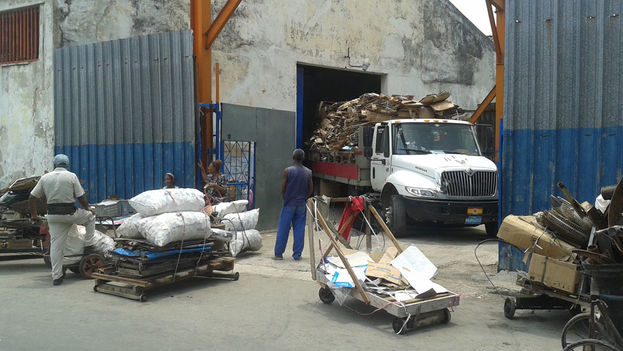
Collection point (14ymedio)

14ymedio bigger14ymedio, Victor Ariel Gonzalez, Havana, 1 May 2015 – They appear silently, without anyone taking notice, a little after dawn.  They will not hide again until nightfall, when they return home or camp out in some corner of the city to count their profits.  They used to be called “divers,” not without a certain disdain; now, the activity is gaining organization as well as workers.  Without the collectors of raw materials, Havana would be an even dirtier city.

Jesus is one of them.  Dragging a mountain of cardboard pieces on his cart, he goes to a buying house with the merchandise acquired today.  For each kilo they pay one peso and 20 cents, but sometimes he gets other material – pieces of aluminum or bronze – and they pay him more.  “It all depends on knowing how to search,” he says.

At Benjumeda and Retiro Streets in Central Havana is one of the warehouses where the collectors go to patiently wait their turn in line.  Each one carries the merchandise however he can, whether in a street sweeper cart or a trailer hitched to a car, a luxury, this latter one, uncommon in the business.  In Cuba, gathering rubbish is a job like any other, because it barely provides enough for survival. continue reading

Around the recycling industry there has been created a whole network of private workers who play various roles.  The “buying houses” can be individuals, like the one at Belascoain and Santo Tomas Streets, next to another state collection warehouse.  The difference between the two may be, for example, that in the private ones they also buy the imported beer bottles that no other site accepts.

With the unveiling of the private sector came the legalization of this kind of job.  The trash collectors must pay around 30 pesos a month for their license, in addition to social security.  Their tax system does not include the obligation to present a sworn statement, explains Jesus while he waits for another truck.  The one that was there has just left completely full.

But there are also workers who operate without authorization, as an extra job.  They see trash in the street, pick it up and discreetly put it in a little bag.  “Are you going to throw that out, sir?”  they ask when a neighbor approaches the containers at the corner of his house with a box of empty bottles.

The illegals must always be careful about the police, but the legal ones also are harassed sometimes, above all if their presence coincides with an important event in the city and it is not “proper” for them to be in the streets, wandering and ragged, because they “mar” the environment.

The official media estimate that 430,000 tons of trash is recycled each year, which means a savings of 212 million dollars for the national economy.  Sixty-four percent of the collection – which includes a first cleaning, sorting and transporting of material to the collection point – is achieved thanks to the army of individuals who roam the streets.  They see an empty can, they pick up an empty can.

Prices for trash (14ymedio)

Those in line at Benjumeda think that figure falls short, and they accuse the State of barely employing a few trucks and waiting, while they bring everything.  “We must really account for 80 to 90% of the total gathered,” estimates the driver of a Fiat who pulls a small trailer loaded with pieces of stainless steel and who clarifies that he does not regularly devote himself to recycling.

“In the Carlos III [shopping center] they do it, but I don’t know anywhere else like this,” says a young man referring to the small raw materials warehouse located next to the crowded store.  Some more warehouses exist, but not many.  Big Havana stores have one or another hidden space dedicated to accumulating the boxes, now empty and disassembled, awaiting transport.

“Those in charge of doing it don’t pick up the trash on time,” according to a recent television report.  The official report said that “in most cases there is no control over the contracts, there is a lack of stringent performance among the involved parties, there is slowness to approve cancellations of resources and equipment, and they do not fulfill delivery plans.”

“Big enterprises have to deal with their own rubbish and finance the process with their own resources,” the report specified.  Thus, the private sector demonstrates a management capacity superior to that of the State, working on a smaller scale.

The deficiencies, therefore, exist at an institutional level.  In Cuba the infrastructure for the treatment of trash is insufficient.  Dumps are lacking – those that exist still do not use any system for sorting wastes – and transportation is scarce.  Also, there is a lack of industrial interest and of exportation of re-useable material.

All these conditions mean that there is not an effective collection system, and trash accumulates on the corners.  Fires are frequent, and the micro-dumps constitute a serious sanitation problem, which is aggravated in the poorer neighborhoods, where service is even worse than in the downtown and tourists areas.

Although these problems have been recognized by the authorities, no measure has been announced to address trash collection via a coherent state policy.

Meanwhile, it is possible to see gatherers working at dawn, after each important event that attracts the public and generates a lot of trash.  Without a contract, without security for the dangerous circumstances or other conditions of their work.  That is how it works, the silent army that lives from the trash of others.

Translated by MLK
No More Blackouts? / Cubanet, Gladys Linares

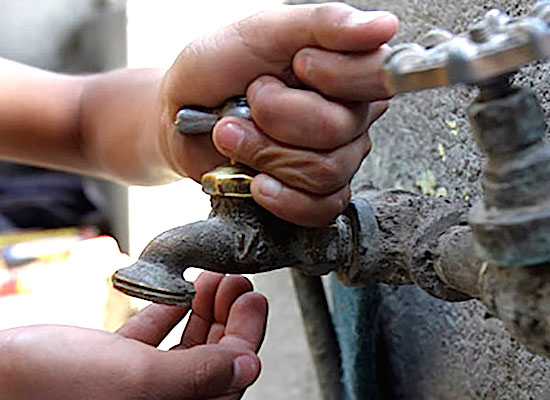
The blackouts occur very frequently “at the time of the water,” in those 4 or 5 hours on alternate days that the liquid arrives at our houses

“If water and electricity have the same owner, why do they turn off my power when I need it most?”

cubanet square logoCubanet.org, Gladys Linares, Havana, 28 April 2015 – The word “blackout” was eliminated by the Electric Company.  Nevertheless, blackouts continue, managed, disguised, masked with terms like free channel, breakdown, maintenance, pole change, broken cables, etc., causing a thousand and one miseries among the population.

For Andres, a self-employed man who sells pizzas, spaghetti and smoothies in Lawton, the blackouts, he says, have turned into a nightmare.  He says that  recently he cannot sell a smoothie because the fruit pulp was spoiled in a blackout, and as his oven is electric, when the lights go out he cannot make pizzas, either. continue reading

Several times a week the same hell confronts those who are obligated to cook with electricity; without it there is no food.  There are those who solve the problem with a cylinder of gas (almost always bought on the black market because few have the 500 pesos necessary for getting a contract for the unrationed gas canisters).

The Island stopped in time

The first electric plant was established in Cuba in 1889 (in Cardenas), only seven years after New York’s first electric plant was inaugurated.  For the republic’s half century, few complained about blackouts.  But after 1959, the Cuban electric system did not escape the disaster, and as in so many spheres of our calamitous economy, it was at the point of collapse.

In the Tribune of Havana newspaper of August 15, 2010, the program’s chief engineer, Pedro Felipe de las Casas, declared that he had carried out 75 percent of the necessary improvements in order to offer a high quality service to the capital’s clients, and among those works he mentioned were: rush changes, increased transformer capacity, improvements in street lighting – though not in the outlying neighborhoods – and to conclude he said, “So far 3,109 low voltage areas have been eliminated which stands out as one of the results most noticed by the people.”

Tendido-eléctrico-y-árboles-sin-podar-en-la-Calzada-de-Porvenir-Lawton
Power lines and untrimmed trees in Calzada de Porvenir, Lawton

In spite of the government’s triumphant propaganda about energy efficiency, frequent fluctuations in voltage continue which damage appliances, and in the neighborhoods we spend long hours without electricity.

The pruning of trees that damage lines that hang from poles is only carried out in a marathon manner in the face of an imminent cyclone. The branches are another of the frequent cause of electric service interruption or of accidents. On Friday, April 10 in the suburb of Abel Santamaria, a 12-year old boy climbed a tree to knock down mangoes and was electrocuted by a line that passed through the branches.

The lights go out when the water arrives

The blackout happens very frequently at the “water time,” that is to say, in those 4 or 5 hours in which on alternate days the vital liquid arrives at our houses.  When this happens, you can hear the curses of the neighbors who had washing machines going (although many have to wash by hand).  Worse occurs in the case of multi-family buildings or other multi-story houses: without electricity the motors don’t start, and without motors to run the pumps, the water does not get to them.

For these reasons, more than a few are outraged, and some wonder: if in 48 hours we only have water for 5 hours, maybe 6, generally 4 hours, if it is true that they turn off the electricity to make repairs, if the water and the electricity are from the same owner: Why do they have to take my power when I need it most?  Is it that you cannot make the repair in the other 40 hours?

On one of these days that corresponded to the arrival of the water, an affected neighbor, who asked me not to mention her name, called 18888 and asked the operator how long was the blackout was going to be.  She countered her: “In Cuba there are no blackouts.”

On another occasion another neighbor called to find out, and they told him that a pole at 16th and Conception (Lawton) had caught fire.  To verify it, he went out for a spin on his bicycle in the area but did not manage to find the supposed incident.

Julia Cecilia Ramos, an old lady who receives a monthly pension of 240 pesos (less than US$10), was due her payment on March 26.  She arrived at the CADECA closest to her house, and the store was closed for lack of electricity.  She continued to the bank, and there found the same situation. The old woman told me that she decided to return to her house, “because the blackouts in Cuba, although they no longer exist, they last hours.”

Caption:  Blackouts and water shortages go hand in hand in the daily tribulations of Havana

About the author

gladys-linares.thumbnailGladys Linares.  Cienfuegos, 1942.  School teacher.  She worked as a geography teacher and a principal in different schools for 32 years.  She joined the Human Rights Movement at the end of 1990 through the Women’s Humanitarian Front organization.  She actively participated in the Cuban Council and the Varela Project.  Her chronicles reflect the daily life of the people.

Translated by MLK

The Internet: A Space for Diversity and Freedom of Expression / Cubanet, Ernesto Perez Chang

Young people are indifferent to politics.  Cell phones, video games and television series are their priorities (photo by the author)
Young people are indifferent to politics. Cell phones, video games and television series are their priorities (photo by the author)

We have to wonder how much the Cuban government invests in restricting this essential information tool in our time, blocking it and even minimizing the “harmful effects” of its free and generalized use

cubanet square logoCubanet.org, Ernesto Perez Chang, Havana, 24 April 2015 – Faced with the problem of the limits on access to the internet in Cuba, one would have to wonder not how much the Cuban government invests in expanding the reach of this information tool, essential in our time, but how high the costs will rise in order to restrict it, block it and even to minimize the “harmful effects” of its free and generalized use.

It is known that every state enterprise, institute and agency has an information department charged with not only managing the internet but monitoring the navigation of every user, censoring it and reporting any “suspicious maneuver.”  The specialists do not work of their own will but must carry out to the letter the rigorous instructions provided by the national Information Security team strongly tied to the Ministry of the Interior. continue reading

A great portion of State resources are tied up in the strict control of information and in filtering the communications of absolutely every email account that is hosted on Cuban servers or that uses them, according to a worker for the network Infomed, who prefers to remain anonymous.  According to this person, who makes a living from offering email service on the black market, all messages that pass through the server are rigorously investigated.  Through specialized programs, customers are studied, words and key names are marked, elements are deleted as a routine practice.

A review of ads on the Revolico.com classified ads page reveals immediately how exhaustively internet connections and email accounts are monitored.  Almost all who seek services from clandestine providers advise that they will only employ them for “family” or “serious” purposes.  Although they sell on the black market, the vendors of hours of connection forbid doing “problematic” searches or sending content “contrary to the Revolution.”  Thus, any opponent in Cuba finds it very difficult to make a deal for the purchase of an internet or email account with an international outlet.  The computer experts who take risks with such clients are very few, and when they do it, they double their prices due to the danger they may run.

Disguised censorship

On the threshold of a new millennium, the creation in Cuba of the University of Computer Sciences (UCI) and the increase in software development centers were not linked to a willingness to update our knowledge in those new areas of the scientific universe but as a defensive strategy in the face of the “penetration of information,” the most feared of all the ghosts in a totalitarian environment.

Nevertheless, all the projects of cyber defense have become a double-edged sword due to the fact that a work of computer censorship so huge and in a country sunk in misery must mobilize thousands of people to whom access must be given to that which will have to be prohibited, and these will use their “power” not to exercise it fully but in order to find the cracks in the system that will permit them to personally profit.

Although the University of Computer Sciences is the study center most monitored and controlled by the Cuban government, as much there as in any of the  country’s other computer departments, there are many students and specialists who live not on their stipends and salaries but by clandestinely providing services related to the internet.  Those who review all the speeches by Fidel Castro where he addressed the topic of the internet will be able to recognize his insistence, if not to say his desperation, to create a cyber shield in order to hide the world and continue his disinformation maneuvers.

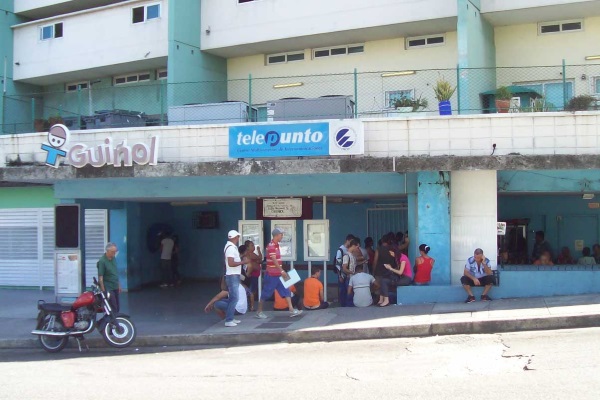
ETESCA Telepunto office.  Long lines to access email and internet service (Photo by the author)

Much software and many applications created in official Cuban institutions are aimed at control of the web and its accessibility.  The so-called “initiatives” to carry information to all the people in Cuba are intended not to share free connectivity with all citizens or to end privileges but to create “monitored diversification” of the Cuban internet and sites with the .cu domain that function as substitutes for the true Worldwide Web, where the topic of “Cuba” is approached only from the regime’s perspective.

To diversify the Cuban platforms for blogs, continuing the history of censorship from the first, loyalty to the system will continue to be demanded along with abstention from free expression of opinion; it is known that the sites classified as tied to the official press, more than providing a service, are trying to displace the uncontrollable Revolico.com; the Cuban encyclopedias, out of date and ideological, badly imitate Wikipedia.  These are some of the “sterile” products that the government intends to fight the “dangerous internet.”

When I hear Cuban leaders put forth with such insistence the idea of “responsible use of information and the internet,” I feel that they are putting a patch over the immense information abyss that censorship will generate.  Undoubtedly, not being able to dominate the monster, they will continue generating laws much more absurd than the current ones in order to punish freedoms, so it will be as if someone said to me:  “They will allow all Cubans to set in front of a computer, but they will be prohibited from turning it on.”

It is surprising the number of computer students, particularly at the mid-levels, who do not know what it is to navigate the internet.  Some do not even have a computer at home.  In Cuban universities it is a real ordeal, both for students and professors, to get permission to freely access the internet.

Youth pass by worn out speeches

It is no longer news to assert that the great majority of Cuban youth shy away from political speeches, from commitments of loyalty to a regime and to its social model.  Television, radio, press, newsreels, round tables and all those devices of manipulation of the masses that between the 60’s and the 90’s were effective for the regime, now are distant worlds for the new generations who have learned, due to the bitter experiences of their parents, to nullify that which they find “bothersome” and to search for alternatives of escape, as much physical as spiritual.

Several young people confess to having absolutely no interest in anything related to the revolution and its leaders.  Many admit to never having read the newspaper Granma or having seen the newscast or the Round Table.  There are even those who have never heard or read a speech by Fidel Castro, much less by Raul, in spite of it being required study in all Cuban schools.

Demand by Connect Cuba on a Havana Street (photo by the author)

A young neighbor, a high school student, has told me:  “I’d like you to see the people in my school when the principal gets into those political talks. Everyone puts on headphones and it’s over. The same with the classroom. No one is interested in any of that. When they require work about Fidel or any of that trash, I tell my dad to do it or I pay the teacher but I am not wasting my time.  To make us read Granma, sometimes they ask us to talk about some news item but people invent anything about the Pope or the doctors in Venezuela or some gossip that came out on the dish and with that it’s dead.  In the end, on the television they always say the same thing, and the teacher doesn’t waste his time on that either.”

Nevertheless, with each passing year technology will be developing new means for information to reach everyone, and at the same time, get away from the domination of a few. In spite of knowing that they are fighting a losing battle, the Cuban leaders keep investing resources just to make the imminent collapse much slower. Mobile telephones, the internet, and the so-called “packet of the week” (international television programming and other content prohibited in Cuba that people transmit by digital media) have achieved in a few years what the regime’s opponents have not been able to manage in more than half a century.

The internet is delivering the coup de grace to the dictatorship and the most interesting thing about that is that it has not done it with political speeches or programs of action but by providing a space for diversity and freedom of expression, the most feared enemies.

448.thumbnailAbout the author

Ernesto Perez Chang (El Cerro, Havana, 15 June 1971).  Writer, graduate in philology from the University of Havana.  He studied Galician Language and Culture in the University of Santiago de Compostela.  He has published the novels:  Your Eyes Are in Front of Nothing (2006) and Alicia Under Her Own Shadow (2012).  At the end of 2014, the publisher Silueta, in Miami, will publish his most recent novel:  Food.  He is also the author of books of stories:  Last Photos of Mama Nude (2000); Sade’s Ghosts (2002); Stories of Silk (2003); Variations for the Preliterate (2007), The Art of Dying Alone (2011) and One Hundred Deadly Stories (2014).  His narrative work has been recognized with prizes:  David de Cuento of the Cuban Gazette twice, 1998 and 2008; Julio Cortazar Latin American Story prize on its first call in 2002; National Critics Prize in 2007; Alejo Carpentier Story Prize in 2011, among others.  He has worked as editor for numerous Cuban cultural institutions like the House of the Americas (1997-2008), Art and Literature Publisher, the Center for Research and Development of Cuban Music.  He was Chief Editor for the magazine Union (2008-11).

Translated by MLK
Corruption and its Three Enormous Harms / 14ymedio, Carlos Alberto Montaner

Protest against corruption in Spain (Flickr/CC)
Protest against corruption in Spain: “They don’t govern, they steal!” (Flickr/CC)

14ymedio bigger14ymedio, Carlos Alberto Montaner, 25 April 2015 – Mexico and corruption are two words that always go hand in glove, or as the Columbians mischievously say, “grab each other’s peepees.”

Corruption in Venezuela is greater, and that of Argentina is not far behind, according to Transparency International, but to judge by what is happening in Chile, Brazil and Cuba, it seems to be a bad Latin American epidemic.  The continent, with few exceptions, is a pigsty.

In any case, the Mexican government wants to end corruption. It was about time. Is that possible? When did it start? They tell you, laughing, as soon as you set foot in the country.

The Spanish conquistadors tortured Cuauhtemoc, the Aztec chieftain, to make him reveal where he hid the gold: continue reading

“Tell me, you damned Indian, where the gold is,” screamed the torturer, through the interpreter, while he burned the hands and feet of the warrior prince.

“I’ve told you forty times that it is buried 50 steps from the pyramid, under the palm tree,” screamed Cuauhtemoc, writhing in pain.

“He says he does not know, and that if he did know, he would never tell you,” translated the interpreter, secretly rubbing his hands together.

It all started there. Right at the beginning. The confusion between public and private is in Latin America’s DNA and in that of three quarters of the planet. They gave Hernan Cortez a tribute of 20,000 Indians as a reward for the conquest of Mexico. Then they took them away, and the fierce captain ended up in Europe, poor and angry, unable to forget the scorching odor of burned flesh.

Some cynics and pragmatists – sometimes they are the same – maintain that corruption is a form of wealth redistribution and income growth, designed to stabilize society through a web of interests and complicities.

I do not believe it. The harms that unpunished corruption causes are usually devastating. Let’s look at just three from an infinitely greater list.

First, it rots the essential premise of the Rule of Law, making a lie of the principle that everyone is subject to the authority of the law. If the politician or the civil servant steals with impunity, or receives bribes for granting favors, why is the common citizen going to pay taxes?  What stops him from lying or cheating?

The law establishes that it is a crime to sell cocaine and also to seize public property.  Why not sell cocaine if others embezzle the national treasury with impunity?  Why not rob a bank?  What moral difference is there between stealing from everyone or stealing from a business or an individual person?

Second, it distorts and inflates the whole economic process.  The market economy is based on free competition.  It presumes that goods and services compete on price and quality.  It is the end buyer who decides which businesses succeed or fail.  When a politician or an official favors one business in exchange for a commission, this unholy operation forces the consumer to select an inferior and more expensive option, given that the cost of corruption is added to the prices.

Moreover, corruption eliminates incentives to innovate and improve the quality of the offer, while it notably reduces productivity, which is the foundation for growth.  Why be more productive and lower prices if we have a captive market?  Why design a new and better car if the customer is obliged to buy the usual one?  Sometimes the businesses themselves distort the market by agreeing among themselves to raise prices.  This is another serious form of corruption.

Third, it destroys the ideal meritocratic structure to which all healthy societies should aspire.  It weakens the passion to study and curbs the entrepreneurial impulse. In corrupt societies personal connections prevail.  “He who has godparents gets baptized.”  That is the general order.  Ties are more important than effort to compete in an open and free market.  What sense does it make to burn the midnight oil studying when, in order to enrich yourself, it suffices to pass an envelope under the table of a corrupt official?  Why sweat and toil in the effort to create a successful business if to achieve economic success a combination of personal relations and lack of scruples suffices?

There is no doubt: corruption kills the political and economic system and moral values.  Ask the Spaniards who today walk that dark and uncertain road. Of course corruption is a tendency present in our species. That is known, but it is not a good excuse. Either we fight it and defeat it or it devours us. It is that simple.

Translated by MLK

Cuba Increases Control over Its Doctors / Cubanet, Roberto Jesus Quinones

cuban doctorsThe government is trying, among other measures, to curb hiring of its professionals by foreign clinics

cubanet square logoCubanet, Roberto Jesus Quinones Haces, Guantanamo, 20 April 2015 — The exodus of Cuban health professional does not stop, and the Ministry of Public Health (MINSAP) apparently has decided to act to counter a phenomenon that is damaging domestic medical services but much more the country’s income.

A document attributed to the senior management of MINSAP, adopted in a meeting held in mid-March of this year, has been making the rounds in the e-mail of health professionals in which the sector’s new policy is expressed. This event was confirmed to CubaNet by an official from the Provincial Management of Public Health in Guantanamo, whose identity we do not reveal for obvious reasons. continue reading

The document has 18 instructions. The first three are focused on the re-organization of services and the re-location of professionals as a result of the staff review carried out last year.

The other 15 are directed to curbing the exodus of health professionals through private contracts or other avenues and steering the application of the measures in each case.

The document

One of the most controversial, instruction number 4, establishes that Cuban doctors in Angola must be relieved, but without increasing the collaboration with that country, until its authorities stop handing down measures that discourage the hiring of Cuban professional in private clinics or institutions.

Another measure, number 5, directs the withdrawal of the passport, in the airport itself, of professionals who later return from the completion of a mission.

Measures 6, 7 and 8 aim to get the private clinics of other countries to hire Cuban doctors through MINSAP, an agency that claims the right to review the professional’s individual contract, obviously so that the doctors pay the corresponding tax to the Cuban government and in no way receive all the money that is due them from the agreed upon wage.

Measure number 10 requires concluding the process of cancelling the diplomas of the 211 professionals who left service without authorization, and number 11 directs MINSAP’s vice-minister of International Relations to carry out a study of the existing rules in the International Labor Organization (ILO), the World Health Organization (WHO) and the Pan-American Health Organization (PAHO), as it relates to the migration of the sector’s professionals.

Punishing the “undisciplined”

Rule 12 considers it a serious breach for a health professional to not return to Cuba upon fulfillment of his mission abroad without good cause verified by MINSAP, and it requires final separation from the profession by those who engage in said conduct, with the subsequent withdrawal of the degree.

Meanwhile, Rule 13 orders the creation of records of disqualification for those professionals who violate the established procedures for leaving the country. If any of them repents and returns, Rule 14 directs that they cannot be re-located in their previous workplace but in an inferior status.

Another cage for the army of white coats

Rules 16 and 17 of the document are intended to promote meetings with ambassadors of the countries where Cuban health professionals travel, largely for the purpose of discouraging their being recruited to remain and practice in that country.

The heads of Cuban medical teams and ambassadors have received that same instruction. Besides interfering in the internal affairs of other countries, this shows one of the thus-far-discouraged facets of Cuban medical collaboration, which is none other than exerting pressure over the countries receiving these types of services to make them faithful to the regime’s policy, which is clearly established in instruction number 4 with respect to Angola.

Finally, number 18 establishes a monthly coordination between MINSAP and the Department of Identification, Migration and Foreign Affairs of the Interior Ministry so that it will report to MINSAP on the doctors who leave the country as well as those who have begun proceedings for that purpose, in order to take appropriate measures.

Being a health professional in Cuba, a doubtful advantage

The above measures show the doubtful advantage of being a health professional in Cuba, although the same could be said with respect to other professionals.

Determined to provide the country with qualified personnel, the government never concerned itself with steadily encouraging the efforts of the professionals themselves. That explains their massive exodus to foreign countries and other better paying jobs with the consequential social loss.

At the dawn of the 21st Century, renowned Cuban professionals have been subjected to a financial exploitation that not even the fiercest capitalist would have dared to impose. Paid miserable wages, many times they sign unfair contracts that the government offers for them to work abroad because it is the only chance they have of improving their housing or getting housing, or acquiring a car or having some savings for their retirement.

In doing so, at a sometimes irreversible familial cost, they damage their freedom and self-esteem in service to a government for which they are only a source of income that allows it to continue dominating the people.

About the Author

jesus-quinones-haces.thumbnail (2)Roberto Jesús Quiñones Haces was born in the city of Cienfuegos September 20, 1957. He is a law graduate. In 1999 he was unjustly and illegally sentenced to eight years incarceration and since then has been prohibited from practicing as a lawyer. He has published poetry collections “The Flight of the Deer” (1995, Editorial Oriente), “Written from Jail” (2001, Ediciones Vitral), “The Folds of Dawn,” (2008, Editorial Oriente), and “The Water of Life” (2008, Editorial El Mar y La Montana). He received the Vitral Grand Prize in Poetry in 2001 with his book “Written from Jail” as well as Mention and Special Recognition from the Nosside International Juried Competition in Poetry in 2006 and 2008, respectively. His poems appear in the 1994 UNEAC Anthology, in the 2006 Nosside Competition Anthology and in the selection of ten-line stanzas “This Jail of Pure Air” published by Waldo Gonzalez in 2009.

Translated by MLK