Customs, Another Point Against It / 14ymedio, Victor Ariel Gonzalez

Inside the suitcase of a traveler from Miami (14ymedio)

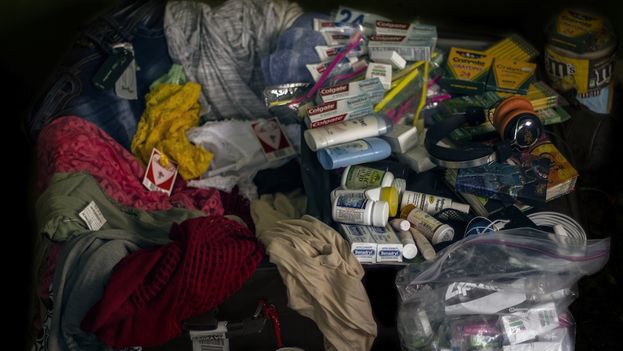
14ymedio, VÍCTOR ARIEL GONZÁLEZ, Havana. 24 November 2014 — From food to motorcycles, stuffed into plastic water tanks, Cubans use the most improbable ways to introduce products into their country. But it has nothing to do with drugs or weaponry, but basic necessities intended as much to satisfy consumer demand as to supply a retail market that the state – so far – is incapable of supplying.

In one of the usual reports by national television where they intend to lecture the audience, an official reporter recently stressed that “Customs has confiscated several containers with articles that are not classified as household goods because among them are clothes, footwear, toiletry articles and foods. Also home construction or repair materials, fixtures and all kinds of spare parts, water tanks full of miscellaneous items, a central air conditioning unit compressor and internal combustion engines, new and disassembled, in order to trick customs control.”

“Household goods” is one of the classifications that General Customs of the Republic (AGR) employs for products that Cubans bring to the Island when they return from a trip or that they send here in packages.

The reason for the irregularities described by the press, according to an AGR official named Yudesis Alfonso, lies in the fact that “one of the fundamental advantages for individuals is that household goods are exempt from payment of Customs duties. And it is regrettable that there are people who use this operation to try to introduce merchandise into the country without declaring it to Customs as legislative decree 162 of 1996 specifies in article 6.”

In the words of Jorge Alberto, a Cuban with a Spanish passport who for months served as a mule for the importation of small volumes of merchandise in exchange for 150 CUC per trip, “What is really regrettable is that we have to bring hidden things in because the stores are bare.” When the government intensified the administrative measures about what it considers “commercial importation,” in addition to prohibiting the sale of clothes and footwear, Jorge Alberto was left without work, and what he will do now is finally emigrate from Cuba.

AGR is part of a strict system of state control that hinders the development of private businesses in Cuba where there exists no wholesale market for many self-employed activities. For this institution it is quite an achievement to display for the cameras cases such as the one that one of its officials, Aniuska Navarro, describes: “Within this white tank was an internal combustion motor, separated into pieces. This tank had to be broken up in order for us to be able to gain access to the pieces of the motor.”

The television report concludes that “Customs … is in a constant fight against the illegalities,” in a country whose domestic economy survives thanks to the black market.

The regulation of “household goods” exception is legally regulated by resolution 43/1998 by the Ministry of Finances and Prices and resolution 122/2009 by the AGR, but “on occasions” citizens have been found “importing into the country great volumes of merchandise which show a marked commercial character” as well as “the intention to import articles belonging to third parties who should use a different Customs regulation, which involves paying tariffs in convertible pesos.”

Which is to say that besides confiscation of the articles – whose subsequent fate is unknown – the offenders are criminally prosecuted for tax evasion, “being accused just as they should be to the competent agencies: the Ministry of the Interior and the system of justice.”

Among those affected, a group that includes businesses as much as consumers, opinions like those of Jorge Alberto abound. “The customs taxes that are so high are the essential reason that we commit these crimes. They don’t let us raise our heads.”

Translated by MLK

American Agency Will Operate Direct Flights Between New York and Havana / 14ymedio

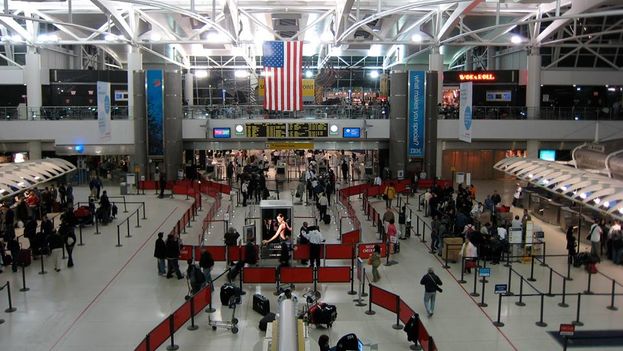
New York’s J. F. Kennedy Airport.(Cuba Travel Services Facebook page)

14YMEDIO, Havana/November 21, 2014 — The American agency Cuba Travel Services announced last Thursday that it will operate a direct flight between New York’s J.F. Kennedy Airport and Havana. It is envisioned that the trips will occur daily in the afternoon, although company workers have not been able to confirm either the departure days or the frequency of the flights.

Cuba Travel Services has not provided information about the date the service will begin, but it has announced that the price for a round trip ticket on the inaugural flight will start at $849.

The company organizes travel to popular destinations like Cienfuegos, Camaguey, Santa Clara, Holguin and Santiago de Cuba, with flights operated by Sun Country Airlines.

The Turbo News site explained this afternoon that “in the spirit of the recent New York Times editorial published October 11, 2014, entitled ‘Time to End the Cuban Embargo,’ the agency Cuba Travel Services chose to provide an important cultural and social link between the two cities.”

The agency maintains that the expansion of its offering will permit travelers who leave from New York to save as compared with the current options on the market, avoiding the delays of connections and the cost of additional fares for stops in Miami, Fort Lauderdale or Tampa.

The company, which organizes daily flights between the US and Cuba, asked for permission to operate flights also from Newark Liberty International Airport, but that request was rejected.

The US government suspended direct air links with the Island at the beginning of the 1970’s and resumed them in 1999 with a flight between New York and Havana. After a slight opening by President Bill Clinton, Barack Obama also opted to soften restrictions on travel by Cuban Americans visiting the Island; now they can travel every year instead of every three and stay as long as they like.

In 2012 the Cuban government suspended landing rights on the Island for two airlines from Miami, Airline Brokers and C&T Charters, explaining the reason for the decision “as over capacity of seats and other operational issues,” although the travel agency operators revealed suspected payment defaults with Cuban authorities. Airline Brokers operated weekly flights to Havana and Cienfuegos from Miami and Fort Lauderdale, while C&T Charters traveled to Havana and Camaguey from Miami, New York and Chicago.

Translated by MLK

The Cultural Trick: “I’ll trade you a center fielder for an exiled essayist” / Luis Felipe Rojas

Photo:  Luis Felipe Rojas

About the awarding of the Critic’s Prize (in Cuba) to the Cuban essayist Roberto Gonzalez Echevarria.  The scholar won it with a book published by Capiro Editions, from Santa Clara.

We have gone back 200 years, the epoch of the barter:

“I’ll trade you a central fielder for an exiled essayist,” said Mandamas.

“Let me think about it,” responded Queentrentodos…  Why don’t you take a salsa doctor? That way you’ll kill two birds with one stone: You send him to combat ebola and complete the artistic Assembly of the Cuban medical Brigade in Africa.

Translated by mlk.

24 September 2014

(Site manager’s note: This post was translated quite a while ago but somehow got stuck here as a ‘draft’ — sorry for the delay!)

Shadow Market / 14ymedio, Lilianne Ruiz

Vendors at a bus stop in Havana (14ymedio)]

Street vendors are the last card in a clandestine business deck whose purpose is pure survival.

14ymedio, LILIANNE RUIZ, Havana, 20 November 2014 — In the shadow of the doorways on Galleno Street in Havana, a young man shows several pairs of sunglasses that he has encased in a piece of polystyrene foam, popularly known as polyfoam. The improvised showcase is kept in a travel bag that can easily be moved. At his side, a girl announces in a low voice: “Colgate toothpaste, deodorant, cologne.”

Suddenly the young man grabs the polystyrene containing the spectacles, as if he were really dealing with a suitcase, and both walk away, their step and pulse accelerating. They disappear within a hallway. They wait. Fifteen minutes later they come out and place themselves again in a stretch of the same street. For the moment, they have managed to cheat the inspectors and the police.

They sell their wares clandestinely in order to survive. They risk being detained by the police, who confiscate their products and impose fines for “hoarding.” The fines can reach 3,000 pesos. Frequently they incur debts because they get the merchandise from a “wholesale” supplier to earn, at maximum, 1 to 3 CUC.

On many occasions it is the Cuban stewardesses or other workers or state officials with the privilege of going abroad and buying in any supermarket, together with the “mules,” each day more hounded, who manage to get through customs controls some batch of basic necessities. The street vendors are the last card in that business deck. “We live daily on what we manage to make. It is not enough to save. If you live for food you can’t buy clothes and if you live for clothes you can’t eat,” they contend.

She has a bachelor’s degree in nursing, and her identity card places her at some address in Ciego de Avila province. That is why she cannot get hired as a nurse in the capital: “I think that from Pinar del Rio to Guantanamo is Cuba. But as I was not born here (in Havana), I have no address here, I cannot work. I am illegal in my country.” But she does not complain: “The salaries are so low that I would have to leave my job as a nights-and-weekend nurse and sell in the street if I want to buy myself, for example, a pair of shoes.”

For his part, he has a tailor’s license and is authorized to sell homemade clothes. “The licenses mean nothing in this country. To sell ready-made clothes, they ask for a ton of papers to know where you bought the thread, the cloth and even the buttons. The government always wins and we do nothing but lose. They charge you taxes to sell what the licenses authorize but also they are charging you taxes for the prices that they fix for raw materials. That’s why we have to buy and sell on the black market,” he explains. The earnings for selling homemade ready-made clothes are minimal.

In January of this year the government prohibited the sale of imported clothes or any imported article. So that after paying for the tailor’s license and the familiar taxes, he comes out to sell eyeglasses, ready to run from the authorities. “I get these glasses at five CUC for two, sometimes three CUC. I did not steal them from anyone. And if the police come, they take them from me. They have already confiscated from me about three times.” In spite of the persecution, he has a powerful reason to continue going out to sell: “If I lie down to sleep, we die of hunger at home.”

Both youngsters report that there are days when they sell nothing. “The whole day on foot from 8:30 in the morning to 6 in the afternoon, running from here to there: if not the inspector, then the police, or the surveillance cameras.”

According to them, there are cameras installed on the corners. Thus they suffer the enormous disadvantage of not being able to see who is watching them. The girl indicates a column: “That wall covers the camera that is at the corner and that is why we stop here. We already have them figured, because if not they order to search for you because of the camera. For example, they order to search for the one who has the black blouse, which can be me.” In this atmosphere of tension and fear of being discovered, this subsistence economy unfolds.

The government harasses the mobile vendors while it woos the big companies of global capitalism. Cuba does not look attractive for those who undertake the economic path of mere survival. Not even legally. That’s why so many young people want to leave the island.

Translated by MLK

Four Cubans Among the 50 Most Influential Latin-American Intellectuals of 2014 / 14ymedio

14YMEDIO, Havana/November 19, 2014

The Spanish political magazine Esglobal has included four Cubans in its list of 50 most influential Latin American intellectuals of 2014 published this Wednesday: historian and essayist Rafael Rojas, economist Carmelo Mesa-Lago, professor emeritus at the University of Pittsburgh, blogger and manager of 14ymedio Yoani Sanchez, and the writer Leonardo Padura.

The ranking, developed in collaboration with the Latin-American Faculty of Social Sciences (FLASCO), has as its objective “highlighting the enormous talent and variety of viewpoints that are generated in Spanish and Portuguese, as languages capable of offering alternatives to the hegemonic English in the contemporary world’s dissemination.

To select the intellectuals, the magazine used some basic criteria, like choosing living and active people who perform at least part of their work in Spanish or Portuguese with influence in the Latin-American or international setting.

Among the other intellectuals chosen by Esglobal are Chilean writer Isabel Allende, Pope Francis, Mexican economist Jorge Castaneda, Spanish sociologist Manuel Castells, Mexican activist and journalist Javier Sicilia and Nobel Prize for Literature winner Mario Vargas Llosa.

Translated by MLK

Raul Castro’s Migratory Reform Falters / 14ymedio, Eliecer Avila

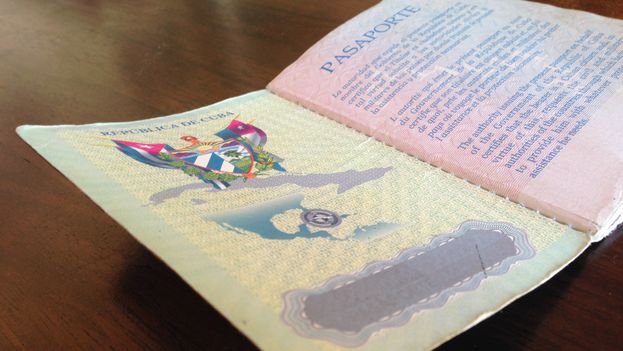
Cuban passport (CC)
Cuban passport (CC)

14ymedio, ELIECER AVILA, Las Tunas/November 15, 2014 — Officials, opposition and public opinion in general have recognized as positive the implementation of the Migratory Reform (covering emigration and travel) promoted by the Cuban government at the beginning of 2013.

In spite of the fact that the trips for many dissidents continue to be marked by abuse, delays and confiscations by Cuban customs authorities, the truth is that until now, only people subject to some kind of legal process, whether invented or not, have been prevented from travelling.

But this may be starting to change. Signs of a sudden regression, in regards to the new rules, come to us from the eastern part of the country.

Two officials, the Major “Oliver” and the Lieutenant Colonel “Vilma,” from State Security Management and Immigration and Alien Status Management (DIE), respectively, have communicated categorically to young Hanner Echavarria Licea that “it has been decided that you are not going to travel.”

To that end, today they retain his certified criminal record document, which the Peruvian embassy demands, so that he cannot participate in the conference “Civic Conscience and Citizen Participation” which will take place in Lima.

The youth, a teaching graduate, self-employed and son of a retired official of the FAR, is a serious and educated young man who enjoys high standing in his community. Precisely the kind of person that State Security cannot bear to see fighting for profound change in Cuba.

Echavarria Licea joined the political movement SOMOS+ and was elected by its members to be its leader in Las Tunas. This seems to be the reason for the current reprisal of not letting him leave the country.

His case could be palpable evidence that even today, someone without prior criminal history or any legal entanglement whatsoever, may be prevented from exercising his right to leave the country. Which would mean the end of the more or less serious application of the Migratory Reform.

Translated by MLK

Some Seven Thousand Cows ‘Disappear” in Villa Clara Province / 14ymedio, Orlando Palma

Cows in Cuba (CC)
Cows in Cuba (CC)

14ymedio, Orlando Palma, Villa Clara, 15 November 2014 – Around 7,000 head of beef cattle were presumed disappeared in the space of a year during a count carried out in ten cattle ranches in the province of Villa Clara, according to a report by the newspaper Juventud Rebelde.

The inspection, carried out by the province’s Department of Livestock Registration and revealed by the official newspaper, was carried out in a group of agricultural production cooperatives where 51 animals were found missing, whereas the State sector counted around 6,900 “not found,” which means the loss of practically the total inventory of these ranches.

Among the explanations the ranchers offered their inspectors are: deaths that could not be reported for lack of a veterinarian to issue the relevant certificate; statistical errors; and – not ruling out! – the possibility that the disappeared cows were victims of theft and illegal slaughter.

To add a touch of science fiction to the matter, as if it had to do with some kind of abduction carried out by extra-terrestrials, the possibility was mentioned that some of the vanished cattle might reappear, maybe because it will be less dangerous to get them from their hiding places without much explanation than to face up and confess where the innocent animals were kept.

Most of the missing heads of cattle were from the townships of Manicaragua, Encrucijada and Sagua La Grande.

Translator’s note: Cows in Cuba belong to the State and it is against the law to kill and eat them. This post from Miguel Iturria Medina — Is Killing a Cow Worse Than Murder — discusses the relative penalties for murder of a human being versus slaughter of a cow. This post from Yoani Sanchez — Male Heifers and Cow Suicide — discusses a creative ways to get around the law.

Translated by MLK

Exodus, “Modernization,” Solutions and Demands from Democratic Socialism / 14ymedio, Pedro Campos

We democratic socialists have made many proposals for overcoming “State socialism.” We are ignored in spite of our disposition towards dialogue. The past is not the solution for the present, nor for the future.

14ymedio, PEDRO CAMPOS, 4 November 2014 — It is no secret to anyone that in the last year, Cuba has experienced a considerable increase in departures abroad, particularly to the United States, by all possible avenues and, unfortunately, by the most dangerous, in improvised vessels through the Florida Straits and cross-country through Central America, crossing Mexico to arrive at the northern border. Some time ago the topic was broached by the independent and international press. In Cuba…silence.

The problem is, and it must be said loud and clear: The Raulist “modernization,” which offered hope and an interlude of awaiting better times, is not producing the economic, political or social results that it at first awoke among a good number of Cubans. And that is the fundamental cause that is provoking this exodus that threatens to become massive.

Raul Castro’s government itself, without clearly saying it, has recognized it with the announcement of that meager 0.6% growth in the first six months and with the measures taken in the last meeting of the Council of Ministers.

Cuban economists here in Cuba, including some who qualify as official, have publicly manifested their dissatisfaction with the limits and obstacles of the “modernization” measures. This is not about blaming or attacking anyone in particular. But any government, in any part of the world, is responsible for taking necessary measures to guarantee the well-being and contentment of its people.

This silent exodus requires all of us who are interested in the good of the Cuban people to think of solutions, throwing aside all prejudice, mottos, or slogans like that of “without rest but without hurry,” in order to try to find and apply quick, practical and effective solutions.

The Cuban government again blames the imperialist blockade for all ills. But it does nothing even to support the anti-embargo campaign that the New York Times is leading.

The practical measures that it takes do not wind up freeing productive forces, as Raul Castro himself has called for, and they maintain all kinds of obstacles against self-employed work, against the expansion of small business, and especially against autonomous cooperatives, without which post-capitalist society, socialism, is an illusion. continue reading

The State, by various bureaucratic mechanisms, keeps monopolizing internal trade and increasingly restricts the least chance for citizens to import small-scale consumer media that the state-military monopoly TRD* stores are incapable of offering.

Even though opposition politics and thought are peaceful and inoffensive, their repression continues.

The internet continues to be inaccessible for the great majority of the population, unaware of its importance and meaning for the broad development of individual and collective abilities, for the market between different sectors and areas of production, for culture and scientific-technical growth.

The supposed decentralization of state enterprises has been nothing more than a simulation with the creation of the Superior Organization of Entrepreneurial Leadership (OSDE), an intermediate link subordinate to the ministers who neutralize the announced entrepreneurial autonomy and, instead of reducing bureaucracy, increase it.

On the other hand, there is not a single movement in the modernization that points to the direct participation of workers in ownership, leadership, management or profits in the businesses that the State considers most important and productive.

Nevertheless, it organizes “cooperatives” in unprofitable state service workshops that are in crisis, with a series of conditions and dependencies that seem more devoted to demonstrating the failure of cooperative business forms than searching for socialist solutions.

What is the consequence? The entrepreneurs, young technical and professional workers who in some way hope to see positive results from the “modernization,” do not see in practice any real rectification of the statist, bureaucratic, and centralized course and, simply tired, they have decided to undertake the adventure of exile.

Raul said that the mindset had to change. And that is absolutely true. But it is also true that a true process of rectification may be hard to carry out by the same ones who for half a century have been working and living with the mentality that has to change.

That philosophy that continues in force is seen every day in the Party press, where the statements of high leaders continue blaming workers and low-level bureaucrats for the country’s serious problems and low productivity, when we all know that the only thing responsible is that salaried, centralized and bureaucratized state model that pretends to change without changing essentially anything.

If Raul does not want to pass into history as a failed follower of willfully traditional policies, he himself will have to produce a change in his mentality, open himself to new times, forget the worn out “Marxist/Leninist” theories of a single-party leader of a dictatorship of the proletariat and of non-democratic centralism, and end up achieving true changes guided by democratization and socialization of politics and the economy.

This demand does not come from Miami, from the traditional opposition to socialist ideas or from any organization financed by “the enemy.” It comes from the last deprived step of the pyramid—“the low man on the totem pole”—with barely a crust of bread on the table, by the right of having sacrificed and delivered the best years of our lives to a revolutionary process into which we poured the great majority of our hopes.

We do it from that generation that today, courting 60 or 70 years of age, has to invent for itself a means of living because the miserable pensions do not cover food for a week; the generation that did not hesitate to step to the front when called upon for Girón (the Bay of Pigs), El Escambray, the Literacy Campaign or the Militias or when they asked us for the unconditional delivery of thousands of hours of voluntary work in the cane, coffee and tobacco fields.

We do it from the right given us for having completed international missions in which life left us, not occasionally but almost daily, for years and on the enemy field.

How to come out from this?

We democratic socialists from Cuba and all over the world have written quite a lot about how to overcome the model of “State socialism” which masks a monopolistic State capitalism. They have never wanted to hear us, or our proposals have been applied in a skewed and incoherent manner although we have always been open to dialogue. But some cheesy bureaucrats have labeled us even as enemies and agents of imperialism.

For ourselves, old now, many sick, veterans of uncounted battles, we ask for nothing; but we do demand with all the strength of our voices, semi-muffled by the years and by intolerance, that they finally taking practical steps, effective for getting the Cuban people out of this situation, so that our children and grandchildren do not have to keep risking their lives in the waters of the Caribbean or crossing Central American borders and so that we do not have to repent on our death beds for having served causes that have turned out to be ignoble.

We also know that there is more time than life and that the past is not the solution for the present but for the future.

For a society of free workers.

*Translator’s note: The State-run stores selling only in hard currency are called “TRDs” – an acronym for the phrase: Currency Collection Stores. In other words, they are designed to ‘collect’ the income some Cubans receive from remittances sent by their family and friends abroad, by selling products otherwise unavailable at hugely inflated prices.

Translated by MLK
Cuban-Spaniards Demand Their Rights to Social Security / 14ymedio, Ferran Nunez

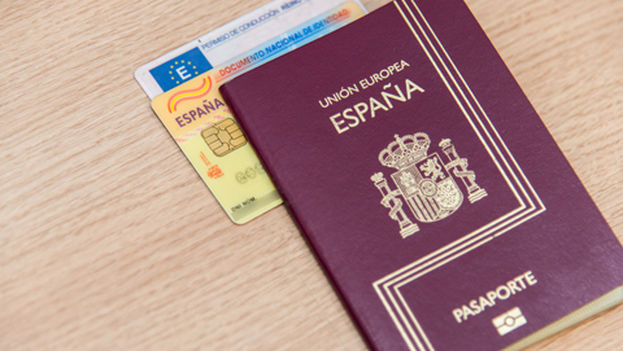
Spanish passport (CC)

14ymedio, Ferrán Nuñez, Paris, 7 November 2014 — It was the month of November 2007. A group of seven Latin American countries led by Spain decided to sign a historic agreement that never came to be, so far, a mere bureaucratic anecdote. In effect, the Multilateral Spanish American Convention on Social Security offered a legal solution to the Hispano-American workers who moved to a Spain then in the middle of a real estate boom. Similarly, it dealt with former refugees from Chile, Uruguay and other states who, after a life of work in Europe and once democracy was re-established in their countries of origin, wanted to return home with their acquired retirement rights.

Naturally, this movement of workers is part of the wider trend of globalization which, as we know, accelerated the displacement of workers from the poorest regions to richer ones, thus creating an ever greater interdependence among countries. Specifically, among Hispanic nations where there is “a common cultural, economic and social framework,” this agreement is intended to become an instrument to coordinate the disparate national laws so that migrating workers and their families, in the always possible case of return, “could enjoy the benefits generated by their work in their host countries.” In this way, the agreement has facilitated the return to their country of origin of many workers hit by the current financial crisis.

The Cuban Case

The Spanish Law of Historical Memory permitted the children and grandchildren of Spaniards to claim the nationality of their ancestors. The current global crisis that the island is experiencing has caused many descendants of those Spaniards, among whom are included the children of Fidel Castro himself, to welcome the benefits of this law in order to be able to emigrate. According to the latest official consulate data, half a million applications were made, of which 190 thousand have been accepted and 100 thousand are pending. In the end Cuba will have the greatest colony of Spaniards of all the Americas.

Thus, many fellow countrymen, looking for a better future, have managed to install themselves on the Spanish peninsula and in other countries. Spain, through its seventeen administrative authorities, is devoting considerable resources to organizing the return of these families. However, the arrival of new Spaniards to the peninsular territory may be traumatic since there exist no agreements between Madrid and Havana for recognizing the retirements, among other deficiencies, as pointed out by lawyer Pedro Luis Sanudo from his blog DobleR, where he advises waiting for “better times” to try the return adventure.

Based on these realities, an affected group above age 50, residents in Spain, headed by the returnee Cuban-Spaniard Alvaro Miralles, has gathered signatures (ten thousand) on the platform Change.org. The object of his demand is simple: Cuba’s inclusion in the Multilateral Spanish American Convention on Social Security. He intends to send this petition to the King and to the Foreign Relations Ministers of Spain and Cuba during the next Spanish American Summit which takes place in December in the Mexican state of Veracruz.

For Miralles it is not only a problem of basic justice and equity among all Hispano-American countries. The protection of Cubans abroad should be a priority, and he concludes his petition saying: “Cuba has just received great support in the heart of the United Nations for the lifting of the economic embargo of Cuba; we believe this is a good opportunity to also lift another embargo that exists between Spain and Cuba as regards social security.” The next visit of the Spanish Chancellor to Havana, announced for next November 24, could be the best occasion to complete this agreement.

——-

Ferrán Nuñez has published the book “Historia de Cuba y de España para tontos” (The History of Cuba and Spain for Idiots).

Translated by MLK

Orphans of the Wall / 14ymedio, Bernard de la Grange

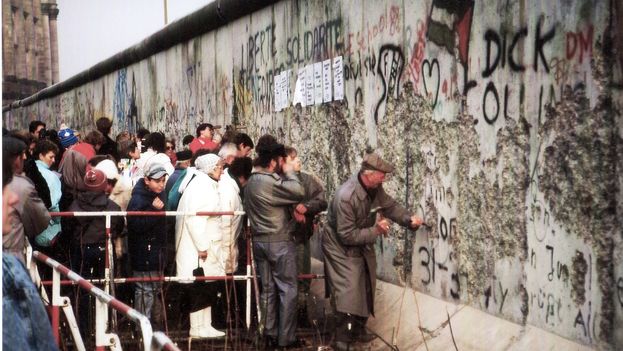
alemanes-emprenden-muro-BerlA-n-CC_CYMIMA20141108_0067_16
Germans tackle the Berlin Wall, 1989 (CC)

14ymedio, Bertrand de la Grange, Madrid/November 8, 2014 — Prensa Latina devoted only ten lines to news that stunned the world. Below a detached title – “The GDR Announces the Opening of its Borders” – the Cuban agency related on November 9, 1989, that the German Democratic Republic had just made an administrative “ruling” by which “citizens will be able to take private trips without the need to explain their reasons.” The word “wall” did not appear in the teletype. Such moderation reflected the prevailing confusion in Havana.

The transcendental event that western media celebrated was a catastrophe for the allies of the Soviet Union in the Americas. Cuba and Sandinista Nicaragua were in mourning. The guerillas still active in the region, above all the Salvadoran FMLN, the Guatemalan URNG, and to a lesser extent the Colombian FARC, saw their logistical and diplomatic space reduced with the weakening of the communist bloc.

Mikhail Gorbachev’s trip to Cuba, some months before, had made evident the gulf that separated the Soviet president from the then Maximum Leader who held tight to ideological orthodoxy as a detractor of the Perestroika economic reforms, which were seen by Havana as an imitation of capitalism. “We have seen sad things in other socialist countries, very sad things,” Fidel Castro would later say in reference to the changes that took place two years after the collapse of the USSR, with its devastating consequences for the Cuban economy, totally dependent on subsidies from Moscow. continue reading

The events of November 9 also alarmed the Sandinista leaders in Nicaragua. They did not expect it, in spite of – or perhaps because of – their close relationship with the Stasi, the intelligence apparatus of the GDR, which along with Cubans managed the security of the nine leaders of the revolution. A year before, the Stasi had played a key role in Operation Berta in order to change by force of arms the Nicaraguan currency in a desperate effort to stop an inflation of 36,000%, which the government managed to reduce to 2,000% in 1989.

When the news arrived from Berlin, Nicaragua was immersed in a very tense electoral campaign. At the request of the White House, Gorbachev had convinced the Sandinista government to advance the elections scheduled for the end of the year to February 25, 1990. This was about looking for a political exit to the war between the Sandinista forces, supported by Havana, and an essentially peasant rebellion, the Contras, sustained by Washington. Managua was then an important piece on the regional geo-political board, and the US feared that El Salvador would be the next chip to fall.

The Sandinista National Liberation Front (FSLN) hoped to achieve with those elections democratic legitimacy to convince the international community of the need to disarm the Contras under the supervision of the United Nations. Opposing, the National Opposition Union (UNO) a coalition of 14 parties from the whole political spectrum, seemed to have not the least chance of winning. Its candidate, Violeta Barrios, widow of Joaquin Chamorro, assassinated during the Somoza dictatorship, was a housewife without political experience. Instead, the FSLN counted on the overwhelming machinery of the State to impose its candidate, Daniel Ortega, who had spent a decade in power.

La Prensa, property of the Chamorro family, dedicated extensive coverage to the Berlin event, including an editorial entitled, “Fall of the Wall, a Miracle of History.” Antonio Lacayo, son-in-law and close adviser to the UNO candidate, saw the opportunity that was presented to them. “We knew immediately that that historic event would have very favorable repercussions for us in the campaign against the Sandinistas,” he says in a book, The Difficult Nicaraguan Transition, published in 2005. “We said that if the Germans were capable of throwing off forty years of dictatorship, we could throw off ours of ten years…”

He was not wrong. Contrary to the surveys, the international press and the diplomats, who predicted a comfortable victory for Daniel Ortega, Violeta de Chamorro won with almost 55% of the vote.

“The electoral defeat of the Sandinistas was our Berlin Wall, we were convinced we were going to win,” Joaquin Villalobos would later say. Villalobos was one of the leaders of the Salvadoran guerrilla group, the Farabundo Marti Front for National Liberation, which had its rearguard in Managua. Instead, the events of November 1989 in Germany did not affect them “morally,” and they decided to continue with their plans to launch an unprecedented military offensive against the capital, San Salvador, and the country’s principal cities.

The political times of Central America did not match up with those of Eastern Europe. The Salvadoran guerrillas saw their survival endangered in the face of pressures from the United States on Gorbachev to stop the deliveries of Soviet arms through Cuba and Nicaragua. The FMLN dreamed of winning power by means of weapons, although their more realistic commanders settled for achieving a greater control of terrain in preparation for a negotiation.

While the Cold War was dying out and the citizens of East Germany were celebrating their new freedom, the leaders of the FMLN hurried the final details of “Operation To the Top” in safe houses placed at their disposal by the Sandinista government. November 11, a little before eight at night, Radio Venceremos, the emissary of the Salvadoran guerrillas, received the message from Joaquin Villalobos: “We are on the march. From here to there, there is no retreat,” he said from Managua. The offensive was beginning.

The Soviets were furious at feeling tricked by their Sandinista allies who had committed to cutting off logistical help to the FMLN. The minister of Foreign Affairs, Eduard Shevardnadze, one of Gorbachev’s closest associates, had traveled to Nicaragua the month before to announce Moscow’s decision to collaborate with the peace plan for Central America, launched two years before with international support.

Close to 4,000 Salvadorans died in the two weeks of combat, between guerrilla fighters, soldiers and the civil population. Was anything achieved? According to writer David Escobar Galindo, ex-negotiator for the government, “The offensive of November 11, 1989, opened the possibility for peace by demonstrating that war could not be decided militarily.” Terror had reached an equilibrium. Both sides would sign the peace in 1992 and, a distant consequence of the fall of the Wall, the FMLN would come to power by the ballot box in 2009.

Editor’s note: This text has been previously published in the daily El Pais. We reproduce it with permission of the author.

Bertrand de la Grange was a correspondent for Le Monde in Central America when the Wall fell.

Translated by MLK

Defections by Cuban Doctors in Venezuela Double / 14ymedio

Cuban doctors before leaving on a “mission” (EFE)

14ymedio, Havana, 10 November 2014 — Some 700 Cuban health professionals defected from Venezuela between September 2013 and September 2014, according to data published Sunday in Caracas by the daily El Universal. The majority went to the United States and reported the deterioration of their work conditions.

This figure doubles the number from the same period a year earlier, when some 300 professionals left their missions, according to information from Solidarity Without Borders (SSF), an organization with headquarters in Miami that helps Cuban health professionals looking for a better future.

“The worsening of conditions in Venezuela is causing an increase in defections. The lack of safety, low pay, worker exploitation and control over private life continue to be the big reasons,” said Doctor Julio Cesar Alfonso, president of the organization, to El Universal. continue reading

Alfonso explains that the most significant increase was registered after the death of President Hugo Chavez. Among other reasons that impel doctors to escape, according to the organization’s president, are the devaluation of the bolivar, an average salary of 100 dollars at the official exchange rate and few prospects for professional development.

The phenomenon is not limited to Venezuela and, according to Solidarity Without Borders, some 1,100 Cuban professionals abandoned their missions abroad between September 2013 and 2014.

Translated by MLK

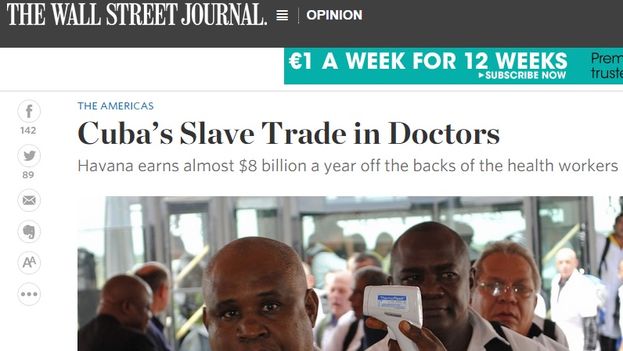
Cuban Doctors Are Enslaved Says ‘The Wall Street Journal’ / 14ymedio

The Column ‘Cuba’s Slave Trade in Doctors’ in ‘The Wall Street Journal’

14ymedio, Havana, 10 November 2014 — In an article published Sunday, the Wall Street Journal lashes out against the “doctor diplomacy” carried out by the Island by sending health personnel abroad. The newspaper compares the system with the “slave trade” in spite of international praise.

Columnist Mary Anastasia O’Grady, however, asserts that the doctors who travel to poor countries “are not a gift from Cuba,” since the Island earns some 8 billion dollars annually at the expense of the workers through the payments it receives from the host country – as in the case of Venezuela – or other countries who send funds to the World Health Organization. O’Grady reminds readers that the medical personnel do not receive their remuneration directly and that this money goes to the coffers of the state which only dedicates a small part to the salaries. continue reading

“It is the perfect crime: By sending its subjects abroad to help poor people, the regime gains from the global community the image of a disinterested contributor even though it exploits the workers and enriches itself at their expense,” writes the columnist. “This is a great business which, if were not carried out by Marxists gangsters, surely would offend journalists. Instead, they swallow it.”

O’Grady insists that “human trafficking is nothing new for Havana, nor is it limited to the medical profession.” Refusing to participate in a mission can mean the loss of employment—as Cuban Doctor Antonio Guedes reported from Madrid to the German international television chain DW—or have consequences for children’s university admission.

In 2008, some workers reported to the United States Justice Department the hard work conditions and the salary of three cents per hour they received during a mission to Curacao where they went to work in exchange for Cuba’s debt to Curacao Drydock Company. The relatives of the claimants, according to the report by the United States newspaper The Christian Science Monitor, “lost jobs and access to education and suffered harassment by gangs.”

The columnist emphasizes that sending medical personnel abroad is causing a shortage of doctors in Cuba, in spite of the delicate epidemiological situation the Island is experiencing, affected by outbreaks of dengue fever and cholera.

Translated by MLK

Education on the Market / 14ymedio, Orlando Palma

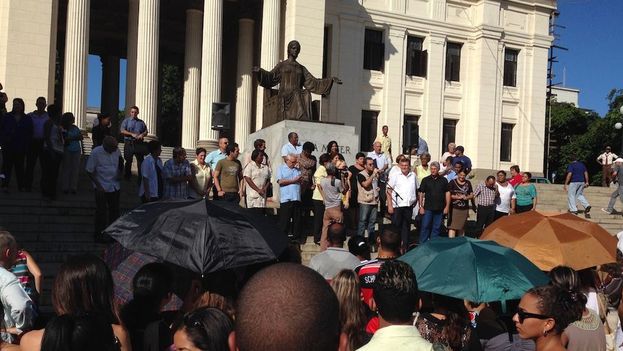
Start of the school year at the University of Havana, one of the education centers that would offer export of education services

14ymedio, Orlando Palma, Havana/November 8, 2014 — Although missing from the opportunities portfolio, “the exportation of academic services” may be a considerable field for obtaining foreign currency given the presence of more than two thousand Cuban helpers in some 14 countries, according to what Doctor Aida Terrero Lafita, director of International Relations for the Ministry of Education, set forth in a press conference.

Although the amount that this would represent for the country was not made public, the official emphasized that among those programs most in demand abroad are a literacy teaching program known as Yes, I Can, and another called Teach Your Child, intended for early childhood, and those that focus on special education.

Dr. Terrero specified that on the African continent there is a growing trend of seeking Cuban collaboration in technical and professional education, especially as related to jobs in the fields of electricity, construction and agronomy. continue reading

The branch of the Ministry of Education charged with exporting academic services includes a team of 26 specialists occupied with carrying out the process for selecting the teachers who will offer services abroad.

There are many educators who aspire to carry out one of these missions, now lacking the epic and caring character of other times and marked today by the economic needs of the country and the hardships that these professionals experience. In spite of receiving a fraction of what the State raises in payment for their services, many of them consider the missions in other countries an opportunity to improve economically and acquire consumer goods.

Public Health personnel have been doing something similar and, according to unofficial figures, close to 50,000 people from that sector currently lend service abroad. They are mainly in Venezuela, Brazil, Nicaragua, and Bolivia, also in Argentina, Ecuador, Haiti, Guatemala, Panama and many other countries.

Translated by MLK

Between the Renovated and the Pathetic / 14ymedio, Eliecer Avila

News from Cuban television, with Rafael Serrano at the front

14ymedio, Eliecer Avila, Havana/November 5, 2014 — In recent months, an attempt to renovate the look of Television National News has been noted. They have changed the set, adding colors and trying to infuse dynamism and spontaneity into the reading.

It is clear that the directors of that news program have been inspired by the style of TeleSur, their only “competitor,” which combines the visual quality of the big television companies with its spokesman mission for the governments of Cuba and Venezuela. In order to carry out their political influence and consolidation of power, TeleSur has created a broad platform of opinion.

Faced with the effectiveness of TeleSur, the “cable” news programs and the packets, the directors of National News have no option but to put on a little makeup or they won’t even watch themselves. Nevertheless, we see how the newscasters fail to adapt to the new format: They feign dialogue, and it comes out wooden; they try to be spontaneous, but fear of making a mistake makes them rigid and stuttering; they want to give the impression of analysis but they wind up reading the raw, pre-conceived note.

They do not have a single journalist who really knows what he speaks of or can form intelligent questions or comments about events. Let’s see about today: They talked about the plenary session of Popular Power in Havana, where Esteban Lazo called for taking measures; about a national meeting of Protestant churches, where its president asserted that “in other places, no, but here we live in a society of dialogue;” and finally, about the president of the European Parliament who leaves his post when “the terrible social situation that exists in Europe” worsens following austerity policies.

With that news, lacking all objectivity, disconnected from reality and useless for any member of the public, they will never be credible even if they dress the newscasters in Halloween style or give Rafael Serrano an Afro.

Translated by MLK

A Management Success: The Butcher Shops without Flies / 14ymedio, Victor Ariel Gonzalez

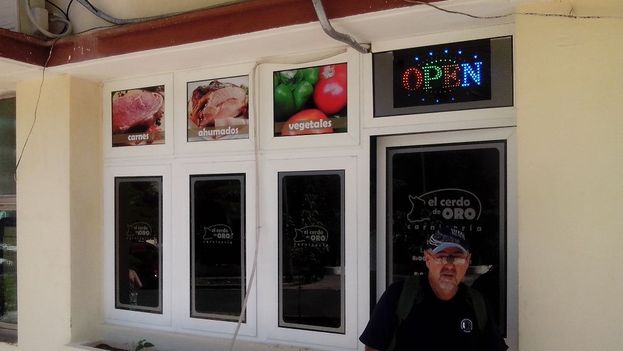
A client leaves The Golden Pig (14ymedio)

14ymedio, Victor Ariel Gonzalez, Havana / 6 November 2014 — It’s ten in the morning, and the Golden Pig is packed with customers. On entering, one detects the intense odor of smoked meat mixed with the aroma of ripe guavas. Two salesmen work behind the counter, and a third places fruits in their boxes.

They almost have no time to assist the journalist who is interested in knowing how they have managed to start this business. This is not just any market; there are electronic scales, vertical refrigerators, air conditioning and — most surprising – the cleanliness and organization are infinitely superior to those of the typical farmers’ markets of Havana, those built hurriedly under zinc plates where flies swarm and mud has stained everything.

Here it is different. This is a small shop inside a building at the corner of Linea and 10 in Vedado. They threw cement on the floor and oiled it, installed dark windows and put an attractive label over the glass. “We took two months to prepare this,” says one of the workers when he can finally answer some questions. “You already saw that it is full,” the man continues. “In December I imagine that we are going to even need a doorman!” Success has come to them quickly since they have only been open a few weeks.

The Golden Pig functions as a cooperative. On one of the walls, over the counter, hangs the license that the State grants for this form of private activity that is gaining momentum and opening new businesses at several locations in the city.

So, for example, there is also El Barrio market, close to the embassy of the Czech Republic. It is easy to pass by if you are not familiar with it because, seen from outside, the closed garage does not have much paint for being a business. Inside, the presentation of products is even more attractive than the previous place. They possess a big refrigerated counter with all the offers in view, already packaged and with labels printed in Cuban pesos. They have a shiny machine for making slices at the customer’s request and an area in back where they prepare the packages. There are not those so disagreeable odors that one usually smells in the state butcher shops that sell in CUC (hard currency).

There are not those so disagreeable odors that one usually smells in the state butcher shops that sell in CUC

In El Barrio a saleslady explains how a business of this type can be pulled off. The required license is “retail seller of agricultural products” and is sought in the municipal offices of the Ministry of Work and Social Security. “It took us five months to take the necessary steps for the permit, but the advantage of this activity is that we do not need a health certificate like our suppliers,” she says before assisting another recently-arrived customer.

“Although we have to pay a lot in taxes, we manage to profit,” says a staff member at the Golden Pig. The prices on the boards are well above what the pocketbook of the common man can pay, although similar to those found elsewhere. “Our advantage is that we have made a different presentation, and people like that,” say the workers of the other store.

Mind you, it will never be possible to find beef in any of these businesses. Not even cow’s milk or its derivatives. The yogurt they offer in one of these butcher shops, where they sell several types of foods, is made with goat’s milk. Neither are they permitted to trade in imported products.

In spite of the administrative tethers and the enormous limitations that the government places on the offer of products, private initiative little by little paves the way in this economy that insists on calling itself “socialist” and “planned.” Nevertheless, the paltry purchasing power of the population means few Cubans can give themselves the luxury of entertaining their families with a pork leg – a month’s average salary – and some mouthwatering fresh lettuce leaves wrapped in clear plastic.

Translated by MLK