
The Three Options of a Cuban: Obedience, Escape or Rebellion

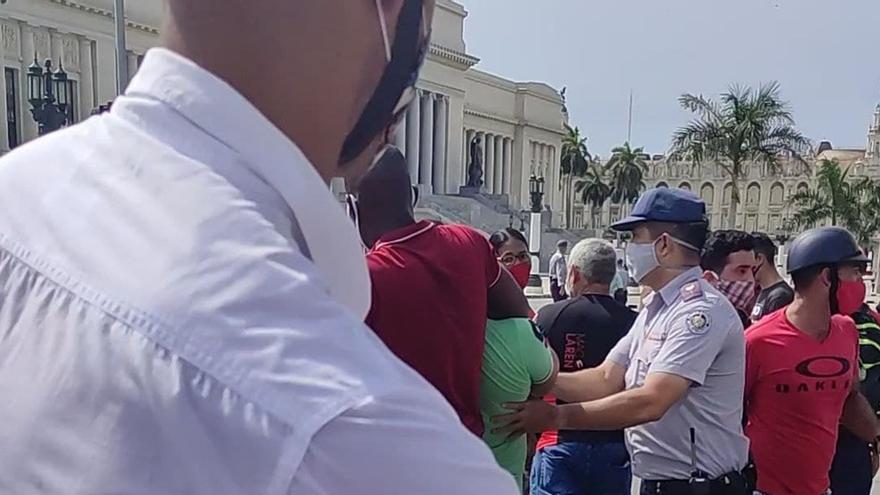
On July 11th, 2021 thousands of Cubans at various points throughout the Island participated in the largest act of rebellion in the history of the country. (14ymedio)

14ymedio bigger14ymedio, Reinaldo Escobar, Havana, January 29th, 2022 — To say it poorly and quickly, for a Cuban who lives on the island subject to the current dictatorship, only three options remain: obedience, escape, or rebellion.

Obedience

Obedience can be taken on consciously, accepted for fear of the consequences of rebelling, or mimicked to create a space for escape.

Those who consciously accept it are the ones who possess a militancy based on their convictions. They act as soldiers, convinced that “the boss’s orders embody a mandate of the Homeland,” believing that those who occupy those very high positions are enlightened bearers of a solid political foundation and grantors of all the elements necessary to make the decisions; elements which can not always be divulged because discretion is a weapon of war and the enemy must not know everything.

Those who obey out of fear have come to the conviction that any rebellion is useless because it would be mercilessly quashed, whereas they view the crumbs offered to them as an advantage. Their low self-esteem leads them to believe (with or without reason) that they would not be capable of surviving or prospering in the competitive society to which they could escape.

The mimics are difficult to identify, because they can far exceed the displays of enthusiasm and “revolutionary fervor” of those who are genuinely convinced. You see them at the reaffirmation marches waving little flags and smiling for the cameras; applauding, praising, raising their hands to approve whatever is proposed, and, if necessary, wielding a club to confront opponents. Until their visa is approved and they gather enough money for a ticket.

The price of obedience is the surrender of oneself. The prize, the peace of not ending up in jail, and the security of counting on the assigned quota of misery.

Escape

It is difficult to calculate the exact number of Cubans who have chosen this option. To know it would require adding those who already have a continue reading

residency, even citizenship in another point on the planet; those who live outside the country but return to “punch the card” before the 24 months required by law for them not to be considered emigrants, and sadly, those who rest at the bottom of the sea in the cemetery in the Florida Straits.

The decision to emigrate is not as dramatic today as it was in the half-century during which the concept of “definite departure” was in force, although black lists still exist to deny entry to those who are “inconvenient” or to sanction for several years those who are considered “deserters.”

“Traitors will not return here,” pounded the hymn of the National Revolutionary Militias in 1960, when everyone who “abandoned the country” was considered an enemy. Two decades later, in the midst of the Mariel stampede, they were described as scum. “We don’t want them, we don’t need them,” argued the commander.

When it was discovered that money could flow from abroad, the discourse changed in an attempt to depoliticize emigration. The so-called “economic motives” as a reason for escaping were used similarly by authorities to portray a normal country and by some emigrants who didn’t want “to look for problems.”

There have been many forms of escape: risking one’s life at sea or in the jungle; asking family members to legally sponsor loved ones who remained on the Island; staying behind while on an official mission, a cultural event, sports competition; requesting humanitarian refuge. The thing is to leave.

The price paid for this option is being uprooted, referring to metaphorical cultural, spiritual, familial roots which ground an individual to a place. The prize, if one arrives, are the fruits: the tangible fruits obtained through one’s own efforts.

Rebellion

When a person respects himself, he is not in a position to obey that which is unacceptable to him. That is the case of children who confront the absurd imposition of authoritarian parents; women who break up with their abusive husbands; a worker who encourages a strike to force the employer to increase salaries or improve work conditions, and the citizen unsatisfied with his/her government.

In countries not governed by a dictatorship, citizens are not forced to escape their country because they have, through their vote at the polls, a civilized alternative to change things. Furthermore, they have the right to rebel, expressed in the sacred right to take to the streets and protest, appealing to a degree of violence that, from the ethical point of view, is acceptable if they do not manage to be heard by peaceful means.

Rebellion has a history in Cuba. But there is no space to tell the story the whole world knows. The latest dictatorship in our history (hopefully the last) is also the longest-serving and the one that has produced the most victims.

Rebels in the mountains, armed explorers, terrorists, conspirators of all kinds were active in the 1960s. The options of peaceful resistance appeared later, defenders of human rights, political party organizers, civil society activists, independent journalists. Rebels, all of them.

On July 11th, 2021, thousands of Cubans at various points throughout the Island participated in the largest act of rebellion in the history of the country. Not against the colony, nor against the dictatorships of Gerardo Machado or Fulgencio Batista, did this many people take to the streets on a single day to protest, to demand freedom and rights.

They were the ones who refused to continue obeying, the ones who wanted to change the country, not to change countries.

The price of rebellion during the last 63 years has been high: executions, long prison sentences, attacks on your reputation, prohibitions on leaving the country, the impossibility of practicing your profession. The prize is reduced, for the moment, to the satisfaction of knowing that you are doing what is correct.

Translated by: Silvia Suárez

____________

COLLABORATE WITH OUR WORK: The 14ymedio team is committed to practicing serious journalism that reflects Cuba’s reality in all its depth. Thank you for joining us on this long journey. We invite you to continue supporting us by becoming a member of 14ymedio now. Together we can continue transforming journalism in Cuba.

A Call for Governments that Host Cuban Workers to ‘Say No to Forced Labor’

In addition to the situation of doctors and health workers, they also denounced that of teachers, cruise ship staff, architects, engineers, and even artists. (Facebook)

14ymedio bigger14ymedio, Madrid, January 26, 2022 — Not only are doctors and health workers affected by the harsh work regimen of the so-called international ’missions’, but so are thousands of other professionals such as teachers, cruise ship workers, architects, engineers, and even artists.

During a videoconference, organizations presented the third addendum to the claim of abuses committed by the Cuban regime during the international sale of services, initially submitted in 2019 to the International Criminal Court and the United Nations.

As the liberal Member of the European Parliament (MEP) and event co-organizer, Dita Charanzová, said, the report includes “the testimony of Cuban professionals outside of Cuba who have been subjected to grave injustices, persecution, slavery, threats, violence, harassment, family separation.”

With that, they aim to show how a total of 1,111 professionals from different sectors were “used by the regime as propaganda to show solidarity with other countries,” when, noted the Czech MEP, “this does not reflect the real intentions of the Cuban Government.” The original 2019 claim, with 110 witness statements, was expanded one year later to include 622 statements.

For Charanzová, “governments that receive these services from Cuba should be firm and demand changes,” and “say no to slavery and forced labor.” continue reading

The MEP also mentioned that the European Union will soon submit legislation on sustainable corporate governance and, in that context, will request “consideration for the situation of Cuban workers on international missions.”

Furthermore, she insisted that the Political Dialogue and Cooperation Agreement EU-Cuba, signed in 2016, “is not working,” for which reason she insists it be suspended and sanctions applied, within the EU’s legal framework, against the Cubans responsible for violations of human rights. The MEP also criticized the High Representative of the EU for Foreign Affairs, Josep Borrell, who in her judgment, “has not put any pressure on the (Cuban) regime to comply with the Agreement.”

The Cuban Government’s international missions are designed for professionals to work in other countries. Although the initiative is usually associated with contingents of doctors, for decades it has placed more than 400,000 professionals in 164 countries; musicians, cruise ship workers, engineers, athletes, and professors also participate, very notoriously, for example in the case of Venezuela.

In a survey of 894 anonymous informants, completed by three NGOs, 75% confirmed that they did not participate in the missions voluntarily and 13% alleged coercion. Eighty-seven percent reported that economic factors influenced their decision and 66% confessed wanting to escape the situation they faced with the lack of alternatives on the Island.

The report also provides documentary evidence of the so-called eight-year law, which prohibits entry into Cuba during this period of time for professionals who abandon their mission early or do not return to complete it.

These organizations have obtained, among other documents, a consular certificate that declares one a “deserter” and another which ratifies the denial of entry of a Cuban citizen into his own country.

There are two payment models for missions, the report explains. In the first, the worker is paid by Cuba, and receives between 9% and 25% of what Cuba charges the host country. According to these NGOs, the Cuban government pays professionals an average of $525 a month, while charging, on average, more than $3,500 per person, pocketing 85% of their salary.

In the second model, a state-owned staffing agency, which functions as an intermediary, takes a commission on the salary, normally between 75% and 90% of the base salary. The NGOs present documents with regard to this, for example, a worker for the Italian-Swiss cruise ship company, MSC, receives a salary of 408 euros a month, of which 326.40 euros are garnished, leaving the worker with 81.60 euros for a month’s labor.

This specific company is also named in the report as one of the beneficiaries of the system. In this manner, it has employed thousands of Cuban workers with an average monthly salary of $727 per month (640 euros), which includes the portion controlled by Cuba and an undeclared portion. This sum is much lower than the minimum wage established in Europe, especially for jobs with a 77-hour workweek without days off.

The document also points to the Pan American Health Organization (PAHO), which retained 5% of the salaries of 8,400 Cuban doctors who, every year for six years, worked in the Mais Médicos [More Doctors] program in Brazil. In 2018 alone PAHO obtained $128 million through this mechanism.

The report also shows how the sale of professional services, which are referred to as Cuba’s international missions, is the largest source of hard currency for the country, greater than remittances and tourism, since at least 2005.

Shortly after the report was published, without referencing it, the Cuban Minister of Foreign Affairs, Bruno Rodríguez, criticized the United States on Wednesday for associating the international missions with human trafficking. “The false accusations of the U.S. Secretary of State which links Cuba with human trafficking seeks to tarnish the solidarity efforts of Cuban medical cooperation, which saves lives and the merits of which are unquestionably recognized by the international community,” tweeted the Minister of Foreign Affairs, one day after Blinken accused the governments of Cuban, China, North Korea and Russia of participating in human trafficking.

Translated by: Silvia Suárez

____________

COLLABORATE WITH OUR WORK: The 14ymedio team is committed to practicing serious journalism that reflects Cuba’s reality in all its depth. Thank you for joining us on this long journey. We invite you to continue supporting us by becoming a member of 14ymedio now. Together we can continue transforming journalism in Cuba.
Cuban State Security Evicts Journalist Yadiris Fuentes from Her Home

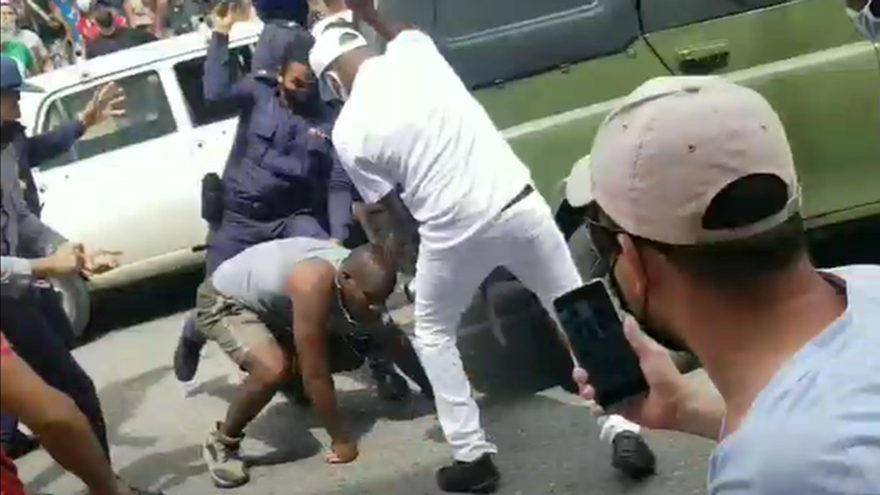
Yadiris Fuentes is a reporter for ADN Cuba. (Julio Llopiz-Casal)

14ymedio bigger14ymedio, Luz Escobar, Havana, 22 January 2021 — Serious threats from Cuban State Security are forcing independent journalist Yadiris Fuentes to, in a few days, move out of the home she’s lived in since June 2021. The owner of the home was warned by political police that if he did not evict her, he could face a fine or even lose his property, which is an illegal rental.

As Fuentes told 14ymedio, she will only be able to remain in the home until February 5th, the last day through which her rent is pre-paid. “Since the state of siege we all had around November (stemming from the announcement made by Archipiélago) they had not bothered me anymore, they had not called me nor seen me,” she explained.

“On Monday, January 17th I was not home, but Manuel called my cell phone, the agent who ’takes care of me’,” says Fuentes, who for years lived in Cienfuegos although she is originally from Pinar del Río. The official told her he wanted to see her in two days, last Wednesday, in the afternoon. “Summon me, if you want to see me, summon me,” she replied.

The ADN Cuba reporter let the Security agent know that she refused to respond to verbal summons and to date, she has not received an official document to appear before the authorities; thus, she believes the objective of the political police “was to intimidate and that, perhaps, to them, the rental thing is enough” harassment. continue reading

“The day after that call, my landlord informed me that State Security went to see him and told him that, ’either he evicts me, or they would fine him 15,000 pesos’ and that they could confiscate his house. Obviously, I will not subject anyone to live under that pressure and I said if that is how it is, I’d leave on February 5th,” she declared.

Fuentes assures us that these pressures to leave her without a place to live will not divert her from her profession, “This won’t influence anything I do as a journalist but while I concentrate on where to live, obviously I cannot work in the same way and they know that and I believe that is part of the method.”

The reporter stated that this type of pressure has been seen before and that her case “is not extraordinary nor unique… It is a technique they’ve already used a lot, especially against women, as if they view us as weaker and more susceptible to pressure.” Among the independent reporters who have suffered this type of pressure so they’d lose their rentals is Camila Acosta, a contributor to the online news portal CubaNet.

Faced with this dilemma, she says, “A friend always appears,” who can take her in for a few days while she finds a place to live, but she insists that she will try “not exploit these avenues” because she does not like “to be bothering anyone nor subjecting them to the pressure from State Security.”

“Right now, finding a rental is super difficult. There was a time when Havana was the easiest place to find one because there were several channels for finding them but right now, for example on Revolico, the online platform for buyers and sellers, there are very few options. Most of the ads are for people looking for rentals,” she says.

According to her experience, looking for options these days, she’s noticed that prices “have increased a lot” and that right now “everything is above 7,000 or 9,000 pesos,” (between 280 and 360 dollars, according to the official exchange rate), and when she communicates with the owners, they inform her that they are already taken.

The independent reporter is aware that what she is experiencing “is a cyclical story,” and that wherever she lives they can, once again, pressure her landlords, even if the rental is legal.

This scene has served as motivation for a group of independent Cuban female journalists to launch the Casa Palanca campaign, with the goal of fundraising to acquire a property. With the initiative, shared on Verkami, the activists and reporters want to create a network “of linkages, protection, and emotional and psychological support.”

Translated by: Silvia Suárez

____________

COLLABORATE WITH OUR WORK: The 14ymedio team is committed to practicing serious journalism that reflects Cuba’s reality in all its depth. Thank you for joining us on this long journey. We invite you to continue supporting us by becoming a member of 14ymedio now. Together we can continue transforming journalism in Cuba.
Five Cuban Political Prisoners from July 11th are on a Hunger Strike

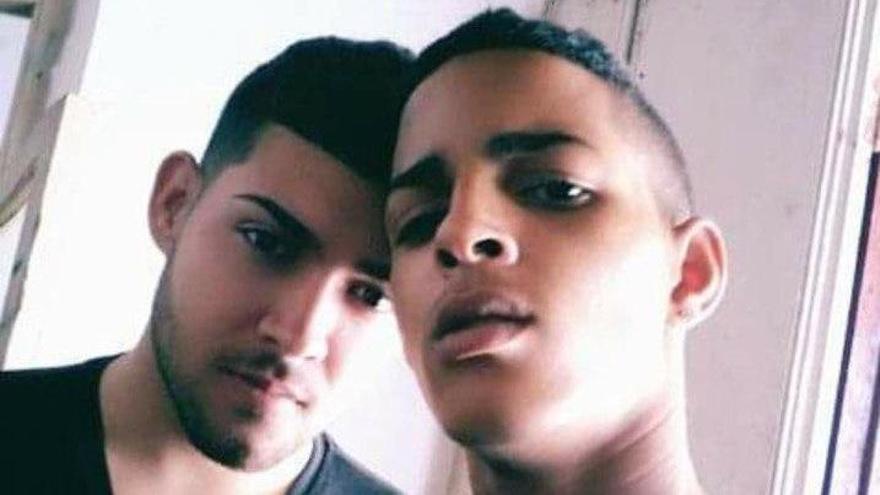
A protester on July 11, 2021, is beaten by agents of the police in Havana. (Capture)

14ymedio bigger14ymedio, Havana, January 21, 2022–Five political prisoners, of those detained for the popular protests on July 11th (11J), are on a hunger strike. Luis Manuel Otero Alcántara, William Manuel Leyva Pupo, Yosnavy Rosell García, Cruz García Domínguez, and Chadrían Vila Sequin are refusing to ingest food, demanding their immediate release, reported Justicia 11J on Friday.

On its Facebook page, Justicia 11J provided updated details about the upcoming trials of 39 J11 protesters, which will take place between January 24th and the 28th. Among the crimes for which they are accused are “sedition, sabotage, public disorder, contempt, assault, and sexual insult,” it states.

The platform [Justicia 11J] denounces that in the trials to date, “we have identified the same patterns: police operations at the tribunals where the trials are held behind closed doors.” A cordon [blocking access to the court], which “constitutes a violation of the right to due process, and an assault on transparency of the judicial proceedings.”

“The authorities only allow one family member per defendant to be present at the trial,” explains Justicia 11J. Activists call upon the prosecutors and judges to guarantee, “justice for the more than one thousand people who ended up arbitrarily detained and who are being subjected to torture, cruel, inhumane and degrading treatment for exercising their right to protest.” continue reading

In order to restore the rights of those arrested that day, Justicia 11J proposes dropping “the charges for which there is no evidence,” dismissing “the cases against protesters which have yet to be charged,” and acquitting those who have been tried, “but who have not yet been sentenced.”

“In the cases of those who have been convicted, but not yet sentenced, promote ex oficio appeals and declare the protesters absolved,” adds the document. “Promote ex officio revision of the proceedings,” and “initiate an investigation against agents of the Ministry of the Interior and the Revolutionary Armed Forces who used excessive force,” were the other recommendations.

The platform [Justicia 11J] reiterates its demand that the Island permit entry to “international organizations such as Amnesty International and the Inter-American Commission on Human Rights, so they may inspect the state of detention centers across the country.” They also joined the #UEenCubaMiraLasPrisiones [European Union in Cuba Look at the Prisons] campaign, targeting European diplomats in Cuba.

With a demand that foreign press credentialed in Cuba be present at the trials, Justicia 11J completed its report on Friday. The document is accompanied by a list, by province, of the trial dates and the names of protesters who will be tried, their age, and the sentences sought by the prosecutor’s office:

January 24th and 25th, prosecutor Idania Miranda Ferrer, People’s Municipal Tribunal of Jovellanos, Matanzas:

1. Félix Navarro Rodríguez (68), 15 years

2. Saily Navarro Álvarez (35), 11 years

3. Daymelin Abreu Rodríguez (20), 7 years

4. Odrey Rodríguez Lanz (30), 11 years

5. Adrián Echegoyen Espiñeira (25), 7 years

6. Cristian Carlos Contreras Matos (24), 16 years

7. Yoandy Ripoll Smith (32), 16 years

8. Yanelys Rosabal Milanés (36), 9 years

9. Mildrey Mederos Soca (44), 9 years

January 24th, 25th and 26th, prosecutor José Mayo González, Municipal Tribunal of Diez de Octubre, Havana (sedition):

10. Carlos Alberto Hernández Pérez (23), 26 years

11. Elian Seguí Cruz (21), 21 years

12. Mackyanis Román Rodríguez (23), 25 years

13. Juan Piloto Ferro (58), 21 years

14. Alejaime Lambert Reyes (22), 26 years

15. Lázaro Daniel Cremé Bueno (21), 21 years

16. Arielvis Rill Baró (30), 25 years

17. Amaury Fernández Martínez (33), 21 years

18. Rolier Salazar González (36), 21 years

19. Luis Miguel Oña Jiménez (23), 21 years

20. Yaquelin Castillo García (49), 20 years

21. José Luis Castillo De La Torre (56), 25 years

22. Andrius López Fragosa (29), 25 years

23. Liliana Oropesa Ferrer (20), 19 years

24. Dayan Jesús Ramírez Rondón (23), 25 years

25. Osvaldo Lugo Pita (34), 21 years

26. Wilfredo Limonta Mesa (20), 21 years

27. Yurema Ramos Abad (25), 25 years

28. Eris Diógenes Mejías Vinent (21), 25 years

29. Juan Walberto Verdecia Rodríguez (48), 25 years

30. Germán Barrenechea Echevarría (24), 25 years January 25th and 26th, prosecutor Yerandy Calzadilla Dávalos, Municipal  Tribunal of Quivicán, Mayabeque:

31. Jorge Martín Perdomo (38), 10 years

32. Nadir Martín Perdomo (37), 8 years

January 26th, prosecutor Daylet Fuentes Morales, Municipal Tribunal of San José de las Lajas, Mayabeque:

33. Angel Miguel Martín Caro (50), 12 years

34. Jorge Luis Reynoso Barrios (21), 6 years

35. Omar Valenciano Donatien (25), 6 years

36. Raul Xavier Díaz Pérez (17), 5 years

37. Alain Yamil Sánchez Baluja (21), 7 years

38. Livan Viel de la Peña (19), 7 years

39. Abel González Lescay (23), 7 years

Justicia 11J also explained that of “the 1,379 people arrested in connection with the protests on July 11th, at least 727 remain in detention centers, 71 of them are women and 15 are minors younger than 18 years of age.

Of the 613 people who have been released, many are awaiting trial and were either released on bail as a precautionary measure or are under house arrest.

“A total of 158 people are being tried or have been tried for sedition and 40, for sabotage. Of the 93 people arrested in connection with the Civic Day for Change, on November 15th, nine remain in detention.

Unedited images of the protests on July 11, 2021, in Havana.

Translated by: Silvia Suárez

____________

COLLABORATE WITH OUR WORK: The 14ymedio team is committed to practicing serious journalism that reflects Cuba’s reality in all its depth. Thank you for joining us on this long journey. We invite you to continue supporting us by becoming a member of 14ymedio now. Together we can continue transforming journalism in Cuba.
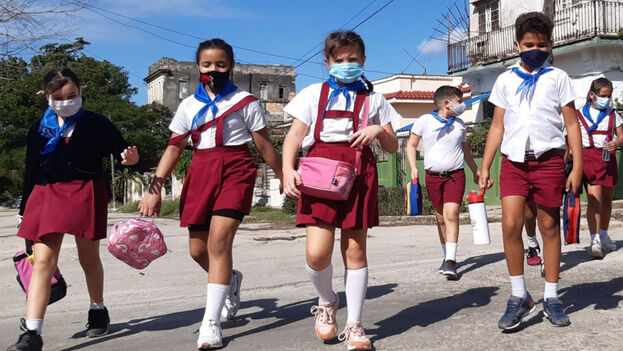
Cuba: The Mother of a Young Man Sentenced to 5 Years in Prison Denies it Was for Throwing a Rock at a Store

“He did not go out on July 11th, but he live-streamed from the house, which they considered contempt because he addressed the president in a very bad way while he spoke on television,” said Pérez Colón’s mother. (Facebook)

14ymedio bigger14ymedio, Havana, January 20th, 2022 — The five-year prison sentence, which the Provincial Tribunal of Sancti Spíritus announced against Leodán Pérez Colón was for “associating to commit a crime” and two counts of “contempt”; none of the charges were for throwing a rock at a store, explained his mother, Elizabeth Colón Peña, who attended the trial at the end of December, speaking to 14ymedio.

“He did not go out on July 11th, but he live-streamed from the house, which they considered contempt because he addressed the president in a very bad way while he spoke on television,” explained the woman. The video, or a segment of it, was used by state-run television to discredit those arrested for the protests.

Another contempt charge and the charge of associating to commit a crime were also imposed upon the young man around July 16th, when they arrested him, says Colón Peña, who has not received a copy of the sentence.

Néstor Estévez, an activist from Sancti Spíritus, who currently lives in the United States, insisted on Wednesday during a live-stream on social media that “throwing the rock through the window” never happened, and he took responsibility for sharing it, “when it all started, everything was based on testimonials and talk.”

During the live-stream he also emphasized that Leodán Pérez is not “a person we can point to as someone who threw a rock through the window of an MLC [hard currency] store.” continue reading

“The official record of what occurred in Sancti Spíritus says that some young men were arrested for throwing rocks at a store and we later learned that they were other people,” he declared.

Wednesday this newspaper reported on the Provincial Tribunal’s decision, which sentenced Leodán Pérez Colón to five years deprivation of liberty, Yoanderley Quesada to two years, and Yoel Castillo to 1 year and 8 months.

The note mentioned that the three young men were tried on December 27th and their sentences were expected on January 13th, but it was postponed by a week, denounced Colón Peña. Furthermore, Leodán Pérez’s mother believes the delay is punishment and torture for the family members. Her son was the only one who was in pre-trial detention, whereas the other two defendants, now convicted, had been out while they awaited trial.

Pérez Colón was arrested on July 16th at his home on Independance Street, between Tirso Marín and Frank País. The young man was with several companions, who were also arrested, and who according to Néstor Estévez, behaved improperly during the trial “trying to implicate their friends to save themselves.”

According to his family members, Pérez Colón was accused because of those two Facebook live-streams asking Miguel Díaz-Canel to resign so his country could “prosper,” although the authorities considered it contempt, associating to commit a crime and acts against State Security.

Yoanderly Quesada, who considers himself a brother to Pérez Colón, was accused, in turn, of “conspiring to reactivate the protests,” while Yoel Castro is the only case not registered on the lists of those arrested for J11.

According to Estévez, of the 42 arrested in the province, only one went out to protest, Luis Mario Niedas Hernández, who was convicted in October and sentenced to three years in prison, half of what the prosecutor was seeking for “contempt, propagating the epidemic and instigating a crime.”

Alexander Fábregas, the fifth one sentenced in Sancti Spíritus since the summertime protests, was taken out of his home and tried nine days later; he was sentenced to 9 months deprivation of liberty.

Translated by: Silvia Suárez

____________

COLLABORATE WITH OUR WORK: The 14ymedio team is committed to practicing serious journalism that reflects Cuba’s reality in all its depth. Thank you for joining us on this long journey. We invite you to continue supporting us by becoming a member of 14ymedio now. Together we can continue transforming journalism in Cuba.

The Myth of Cuba’s Education System

When UNESCO speaks of the high level of education in Cuba, it refers to it as “free,”,. but that does not mean the Cuban system educates its new generations well. (14ymedio)

14ymedio bigger14ymedio, Rolando Gallardo, Quito, 16 January 2022–Determining the quality of the education system in Cuba is a task filled with pitfalls and endless assumptions as it is impossible to access verifiable macro data. So much secrecy incites even more suspicion.

In the Latin American and Caribbean region, we know that the countries with the best educational outcomes are Chile — paradoxically, a window into reviled neoliberalism — followed by Uruguay, Costa Rica and Mexico, according to the list created by PISA testing (Program for International Student Assessment), which measures the application of acquired knowledge in daily life after the completion of mandatory education. Cuba does not appear in the data, for one simple reason: it does not participate in the measurement.

In 2013, the tough nucleus of “21st-century socialism”, Cuba, Bolivia, and Venezuela, refused to participate in these evaluations. For the governments of these countries, education was considered a strength of the social processes they developed and they preferred their “achievements” not to be questioned.

Without access to government information and refusing to provide data to international organizations, one must ask from where the idea came that Cuba is the point of reference for the best education system in the region. continue reading

The United Nations itself is responsible for presenting the Cuban system as the paradigm, but if one reads between the lines, the indicators highlighted by UNICEF are not reliable evidence of the quality of education.

When UNESCO speaks of the high level of education in Cuba it refers to it as free, but the absence of a cost does not mean the Cuban system educates its new generations well.

While in Latin American countries textbooks are updated, on average, every five years, in the case of Cuban textbooks, from physics to Spanish and literature, these were last updated between 1989 and 1990, with the objective of eliminating Soviet propaganda and strengthening the unique social nature of the Cuban revolution.

Indoctrination in textbooks from preschool through the last year of high school is the only thing that has not varied in Cuba in the last three decades. This can be corroborated by reviewing the Cuban Ministry of Education’s books which have been digitized.

When a rigorous measure of poverty is applied to Latin American education systems and the real impact of the lack of family resources has on the quality of education is understood, one forgets that Cuba transitioned from ranking as the 23rd economy globally, in 1958, to compete with Haiti on poverty indicators since the 1990s when the USSR collapsed.

Cuban civil society estimates that 51% of the population currently lives in poverty and rural and suburban areas are in extreme poverty. The minimum monthly salary is 19 USD, according to the real value of this hard currency on the black market. The annual income per capita for Cubans is 300 USD, similar to the Democratic Republic of Congo.

In a country where the average family income is so low and access to protein has been difficult since 1990, what can be said about the nutrition students need to face classes in the morning and complete their homework in the afternoon.

Despite the palpable reality in classrooms, UNICEF and the UN Food and Agriculture Organization (FAO) accept, without questioning, uncorroborated data from the Cuban government about “nonexistent child undernutrition” in Cuba. These types of approaches generate more questions about the role international organizations play in the country.

The starting monthly salary for Cuban teachers is 4,825 pesos (70 USD). To support themselves in the midst of runaway inflation, teachers take on extra work as tutors, for which they charge 100 pesos per session (less than 1.50 USD). Receiving tutoring is not an option for all students, the family’s ability to pay determines who has a greater chance to achieve the best test scores and subsequently secure a university spot in their desired career field. Evidence that the “free” system for all is just a cover for the surreptitious social Darwinism of the system.

The idea we have in Latin America of an average quality education includes the use of the internet and information technologies. In Cuba, this vision is limited to learning the parts of a computer and mediocre use of Microsoft’s Office package. Social access to the internet was approved in the country in 2013 and its use as a resource for research and classwork is a dream which still has not arrived, in accordance with the state policy of maintaining a traditionalist system of education.

The layout of classrooms, the forms of organization, the methodologies, and the promotion of innovation are static and eminently theoretical; in practice, the changes in the last 40 years are barely perceptible. Among the transformations that require a meritorious mention is the implementation of inclusive education policies, which integrated special needs students who formerly were destined for special schools. The first students to be integrated with average students were children and adolescents from reform schools, where they were marginalized as juvenile delinquents until 2003, when they were assigned to regular schools.

Despite these changes, teacher training has had to deal with massive desertion, constant migratory crises, and demotivation as a result of the lack of financial incentives and the declining social recognition of teachers, who are viewed as the spokesmen and spokeswomen of a totalitarian regime and responsible for decades of indoctrination.

Faced with this crisis, in 2000 Fidel Castro opened Emerging Teacher Training Schools, which as their name suggests, train teachers in an accelerated manner. At first, teachers were expected be ready to go to the classroom in six months, later it was after a year. This fix reduced the prominence of university education for teachers and spread the learning weaknesses of these adolescents-turned-teachers.

The dictator’s direct intervention in public education policies resulted in the systematic destruction of the management structure in schools. It reached the point of assuming that a secondary school teacher could teach physics, mathematics, literature, chemistry, and art under the assumption that if “Aristotle could teach his disciples several sciences, integrated general teachers (PGI) could as well.” In the end, the PGI were unable to offer a deep knowledge in anything, though they were required to talk about everything.

Twenty years after the “Emergent Training” disaster, 70% of the teachers in the country at all levels of Cuba’s education system are the result of poor training. When we pay attention to academic training and teaching practices, that should be an indicator when determining the quality of the education provided in Cuba.

Putting these data in the context of the Cuban reality, we should reconsider whether its education model should be the paradigm for Latin America. How many of us would be willing to guarantee free education accessible to all at the expense of our individual liberties? How many parents would choose an ideological education with explicit indoctrination? How many teachers would prefer an education model that is static, traditionalist, in addition to being the lowest paid in the western hemisphere? Some stories are poorly told.

Translated by: Silvia Suárez

____________

COLLABORATE WITH OUR WORK: The 14ymedio team is committed to practicing serious journalism that reflects Cuba’s reality in all its depth. Thank you for joining us on this long journey. We invite you to continue supporting us by becoming a member of 14ymedio now. Together we can continue transforming journalism in Cuba.

Three Cuban Activists are Detained in Havana for Denouncing July 11th Trials

Activists Carolina Barrero, Daniel Triana, and Arian Cruz were detained at the entrance to the People’s Supreme Court in Old Havana. (Collage)

14ymedio bigger14ymedio, Havana, 17 January 2022 — Three new trials of July 11th (11J) protesters in Cuba are being held this week. According to a report from Justicia 11J they will take place for 45 defendants in Mayabeque and in Havana.

Due to a lack of information from Cuban authorities, civil society organizations and family members of the prisoners continue to provide information about the 11J trial proceedings.

Activists Carolina Barrero, Daniel Triana and Arian Cruz, who arrived at the entrance to the People’s Supreme Court on Obrapía and Aguiar in Old Havana, “to protest” the trials and in solidarity with families of the detained, were themselves arrested on Monday morning.

Inside the patrol car, the young people repeated this verse from the poem by José Martí, Pour Out Your Sorrows, My Heart:

Oh poem, they speak of a God
A host where the dead must go
Oh poem, we’ll be saved together
Or felled by a single blow!

Furthermore, they yelled slogans such as: “justice for the people,” “freedom for political prisoners,” “end extreme cruelty,” and “down with the empire of fear.” continue reading

The prisoner facing the longest sentence, 27 years, is Elieser Gordin Rojas, who will be prosecuted in the trial that begins on Monday and will end on Friday in the Municipal Tribunal of Diez de Octubre, in the capital.

There, they will also try two 17-year-old minors: Nelson Nestor Rivero Garzón and Emiyoslán Román Rodríguez, for whom prosecutor Mabel Palacios Aties — recently included on the  Foundation for Human Rights in Cuba’s list of oppressors — seeks 15 years in jail.

During the trials last week in Havana and Holguín, “in response of to pressure from civil society,” wrote Justicia 11J, “the sedition charges were dropped and the sentences sought by the prosecutor were reduced for 12 minors younger than 19 years old.”

“It is not yet clear which charge would be imposed in its place, and therefore, whether the maximum penalties would still be applied,” continued the statement from the group, linked to the NGO legal platform Cubalex, which is unaware of whether these measures “would also apply to those younger than 19 years of age who were tried in December in Havana, and who are still awaiting sentencing.”

Ten prisoners in Holguín against whom the prosecutor upheld its request for very high penalties initiated a hunger strike after their trial ended Friday.

Prosecutors are also seeking 20 years in prison for sedition during trials this week in Havana for no fewer than 19 defendants: Roberto Ferrer Gener, Santiago Vázquez León, Yosney Emilio Román Rodríguez, Carlos Luis Águila Socarrás, Frandy González León, Adonay López López, Harold Michel Mena Nuviola, Jaime Alcide Firdó Rodríguez, Alejandro Becquer Arias, Amaury Leyva Prieto, Julián Yasmany Díaz Mena, Raudel Saborin González, Juan Carlos Morales Herrera, Eduardo Álvarez Rigal and Yasiel Arnaldo Córdova Rodríguez.

In the capital, Yeinier Ibáñez Boude, for whom prosecutors are seeking 18 years, will also be tried, along with Frank Daniel Roy Sotolongo, Yassell Guerra Campos, Marcos Antonio Alfonso Breto and Yensy Jorge Machado González, who face 15 year sentences.

Another 22 protesters will be prosecuted in San José de las Lajas, Mayabeque, 15 of them between Monday and Wednesday and the rest on Friday.

For the first group, prosecutor Ariagne Pérez Pérez seeks between one year of forced labor with internment (in the case of defendant Sergio Enseñat Valladares) and up to 14 years in prison (in the case of Vladimir Castillo Llanes). In addition to them, Jorge Yenier Ortiz Aguilera, Rogelio Lázaro Domínguez Pérez, Manuel Velázquez Licea, Alien Molina Castell, Humberto Monrabals Camps, Arturo Valentín Riverón, Enmanuel Robles Pérez, Yusmely Moreno González, Danger Acosta Justi, Yaroski Amat Salabarria, Jesús Pérez Quintero, Emelina Pendás Rodríguez and Mailene Noguera Santiesteban.

The defendants who will be tried on Friday are María Cristina Garrido Rodríguez, Angélica Garrido Rodríguez, Alexis Pedro Acosta Hernández, Giorbis Pardo del Toro, Osmany Hernández Rodríguez, Yanet Sánchez Cocho and Patricia Lázara Acosta Sánchez, for whom prosecutor Ruth Reina Rodríguez seeks between 6 and 18 years in prison.

In its most recent report, Justicia 11J denounced the conditions in which those jailed for the massive peaceful protest on that Sunday in July are being held. “We denounce the appalling health conditions in Cuban detention centers,” warned the organizations, “and we raise the alarm about the ill-treatment, which the prisoners continue to denounce.”

As an example, the group shared a letter, dated July 17th, written from prison by Mailene Noguera Santiesteban, who is facing up to a six year sentence in San José de las Lajas; it details the violence with which she was detained, “dragged on the floor” between blows.

“They dragged me and would yell “pig, louse, where are the clothes and money the Americans send you, look how you’re dressed,” she said. “I was almost naked, as they entered my house in the middle of the night and upon taking me and my husband [Manuel Velázquez Licea] left my 8 year old son completely alone.”

Justicia 11J logged a total of 1,377 people arrested for the July protests, of which 727 remain in jail, including 70 women and 15 minors. At least 361 have been tried in “either summary or ordinary trials”.

The first mention of these trials by the state-run media appeared on Monday, for the purpose of launching the new judicial year. “In the same way, it is our responsibility to judge those who, acting as peons in the subversive attack and the destabilization attempts by enemies of the Revolution, they committed acts of vandalism, violent aggression against authorities and officials, and other serious crimes,” mentioned the People’s Supreme Court president, Rubén Remigio Ferrio, according to the state newspaper Granma.

This is the same judge who this past July spoke much more conciliatory words, “Diverse political opinions, including those of a political nature that differ from the prevailing politics in the country, do not constitute a crime, thinking differently, questioning what is being done, that in and of itself does not constitute a crime. Furthermore, protesting, far from constituting a crime, constitutes the people’s constitutional right.”

Nonetheless, for a long time, Remigio Fierro has been considered a hard-line partisan and, for this reason, has been included on FDHC’s list of Cuban oppressors since May 2019.

Translated by: Silvia Suárez

____________

COLLABORATE WITH OUR WORK: The 14ymedio team is committed to practicing serious journalism that reflects Cuba’s reality in all its depth. Thank you for joining us on this long journey. We invite you to continue supporting us by becoming a member of 14ymedio now. Together we can continue transforming journalism in Cuba.
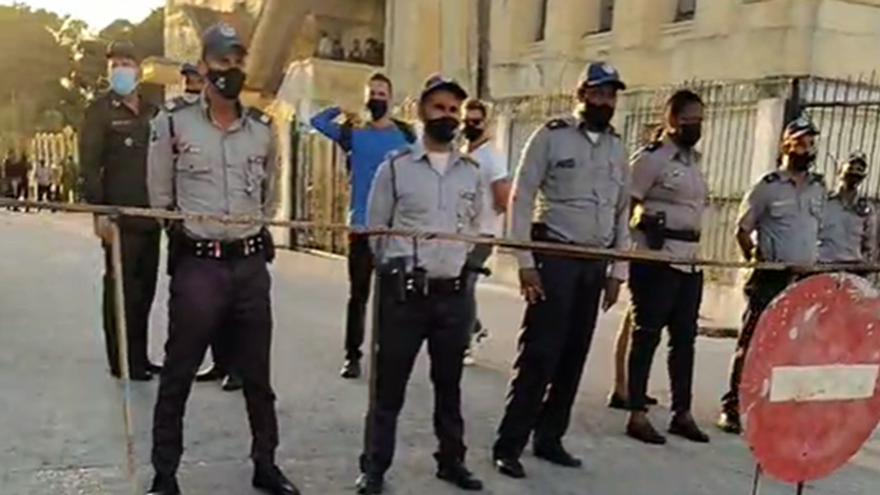
Ten July 11th Prisoners in Holguin, Cuba Begin Hunger Strike Protesting the Sentences Sought by the Prosecutor

Police deployed outside the tribunal in Santa Clara where, this week,  July 11th (11J) protesters were tried.

14ymedio bigger14ymedio, Luz Escobar, Havana, 15 January 2022 — Ten prisoners in Holguín, for whom the prosecutor maintained its request for very high sentences went on a hunger strike following their trial for the July 11th  (11J) protests. This was reported by Dr. Alejandro Raúl Pupo Casas on his social media, alerted by the mother of one of the defendants, William Manuel Leyva Pupo, a relative of the doctor.

For this 20-year-old, the prosecutor sought 18 years, and the same for Reymundo Fernandez Rodríguez, Jorge Luis Martínez García, Marcos Antonio Pintueles Marrero and Yoel Ricardo Sánchez Borjas.

The same source warned that the prisoners’ families will join their protest, although she did not name the other prisoners who were on hunger strike.

The sentences will be officially handed down on February 11, according to messages shared on Facebook by family members of the accused, and they all take for granted that the judges will bend to the prosecutors’ requests, as is usually the case in political trials. continue reading

Three other trials for 11J also ended on Friday in Santa Clara, Havana, and Mayabeque.

In this city, the news agency Efe reports that according to family members of the prisoners, a trial was held without the families’ prior knowledge.

For now, we know that in Holguín is where they requested the harshest sentences for July 11th protesters accused of “sedition”. Prosecutor Fernando Valentín Sera Planas–included on the Foundation for Human Rights in Cuba’s list of oppressors along with dozens of his colleagues–sought 30 years in prison for Miguel Cabrera Rojas, Yosvany Rosell García Caso, José Ramón Solano Randiche and Iván Colón Suárez for the crime of sedition; 28 years for Maikel Rodríguez del Campo and Mario Josué Prieto Ricardo; 25 for Cruz García Domínguez, Miguel Enrique Girón Velázquez and Yasmany Crespo Hernández, and 22 for Yoirdan Revolta Leyva.

The only woman facing such high penalties in Holguín is Jessica Lisbeth Torres Calvo, for whom they are seeking 27 years, the same as her current age.

We are also aware of four minors tried for the same crime–Yeral Michel Palacios Román, Ernesto Abelardo Martínez Pérez, Ayan Idalberto Jover Cardosa and Keyla Roxana Mulet Calderón–the original request of 15 years was reduced to between five and seven years.

During the last day of the trials, State Security stepped up its harassment of the prisoners’ friends and family who have publicly protested.

In Santa Clara, where 16 protesters were tried, activist Saily González was detained for several hours, as were family members of Andy García Lorenzo, arrested in the morning, they were heading to the tribunal, as they did every day since the start of the trial on Monday.

According to sources close to Saily González, her arrest occurred when she was headed to present a writ of habeas corpus on behalf of García Lorenzo’s familyAll of their phones were confiscated and they were each assessed a fine of 3,000 pesos. “She was very agitated, crying, they took her phone, the hard drive on which she had the habeas corpus document, her earphones. Now neither she nor Andy García’s family has a way to communicate,” reported activist Víctor Arias, whom González visited following her release at 7 pm sharp.

Arias also confirmed that Andy García’s sister, Roxana, and her partner Jonathan López were released, but he alerted that his father, Pedro López, “left the interrogation and there is still no news from him.”

Andy García’s family has been one of the most active in denouncing the irregularities of the trials in which, they assure, the prosecution’s witnesses lie. According to Tayri Lorenzo, the young man’s mother, in the courtroom in Santa Clara one of them said that State Security negotiated a fine for him in exchange for his testimony to implicate the accused.

They are not the only ones suffering harassment by the political police. Yudinela Castro, the mother of Rowland Castillo, a 17-year-old accused of “sedition” and for whom the prosecutor seeks 23 years of deprivation of liberty for participating in the 11J protests in Havana, told 14ymedio that State Security has been pressuring her not to denounce her son’s situation.

“Yesterday I received a summons, I was not at home but they called my phone and left it under my door. It was around midnight,” she said. She was so bothered to see that paper as she arrived home, that she ripped it up.

The civilian agents who identified themselves as Ignacio and Elías, she continued, always tell her they are going to accuse her of “contempt or sedition” for what she posts on social media and the declarations she has made to the press. “They tell me I am associated with terrorists and counterrevolutionaries.”

Castillo, incarcerated in Occidente’s Juvenile Prison in El Guatao, is from Mantilla and the Sunday of the protests, he was arrested on the corner of Toyo in the municipality of Diez de Octubre, one of the epicenters of the protests and a place where a patrol car was overturned.

Translated by: Silvia Suárez

____________

COLLABORATE WITH OUR WORK: The 14ymedio team is committed to practicing serious journalism that reflects Cuba’s reality in all its depth. Thank you for joining us on this long journey. We invite you to continue supporting us by becoming a member of 14ymedio now. Together we can continue transforming journalism in Cuba.
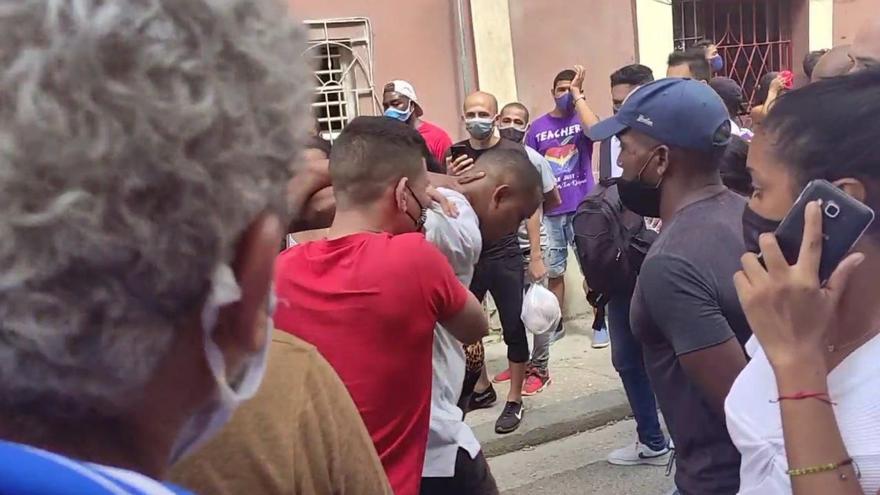
‘Prosecution Witnesses Lie,’ Warned Family Members of Those on Trial in Santa Clara for the July 11th Protests in Cuba

The trials of July 11th (11J) protesters in Santa Clara continued on Wednesday. (Screen capture)

14ymedio bigger14ymedio, Havana, 12 January 2022 — The fabrication of evidence and manipulation of witnesses have marked the last hours of the trials taking place in Cuba for the July 11th protesters. The oral arguments against the protesters taking place in the city of Santa Clara remain the center of attention for family members, human rights organizations, and the independent press.

Among the denunciations of family members, which emerged on Wednesday, one witness said that State Security negotiated with him and would impose only a fine in exchange for his testimony accusing those arrested in that city during the massive protests that took place six months ago.

Tayri Lorenzo, the mother of political prisoner Andy García Lorenzo, one of those on trial this week, told Saily González on Facebook from outside the Provincial Tribunal of Villa Clara, that prosecution witnesses “were lying” and “slandered” the defendants.

Only a few family members of the protesters have been able to attend the trials and, as a result, the accounts of what occurs inside the tribunals can only be reconstructed in a fragmented way, according to the few relatives who have been able to access the courtroom.

García’s mother assured us on Wednesday that they took one prisoner to the tribunal so he could testify and he “said he gave his first statement [against the protesters] because he was coerced by State Security and negotiated his release and [they ensured] he would be set free with a fine of 1,000 pesos if he implicated someone else.” continue reading

She confirmed what she heard from the prisoner himself: “There were many witnesses to what I am saying. With regard to that, the prosecutor was left without any arguments. The judge speaks very softly, we realize that everything is written,” ahead of time.

She also said that during the trial they are “emphasizing” that the protesters yelled phrases such as “down with the revolution,” “patria y vida [homeland and life]“, “Díaz-Canel singao [motherfucker],” “dickhead police” and other defiant slogans.

On the other hand, García’s mother reproaches that other demands made by protesters were not mentioned: “That the people were demanding food, that the people are hungry, the need for food, that the people do not want repression, they want freedom. They did not emphasize that, only their offenses.”

Regarding her son’s case, Lorenzo confirmed that the official who led the young man’s proceedings, Yadian Cárdenas, told the family that “Andy was not involved in violent acts at any moment,” but did not provide details about those moments.

However, the prisoner’s sister, Roxana García Lorenzo, was able to attend Wednesday’s trial and she told the family that the official himself “testified against Andy saying that he was always inciting violence, which is a lie. There is not a single video of this. The attorneys requested permission to show the videos, but they say that due to technical issues they are not available. We have all the videos and none shows Andy hitting, on the contrary, he was always avoiding violence,” said the young woman.

During the interview with Saily González, Roxana García Lorenzo denounced that at one of the police stations where she was held for hours along with her boyfriend in October, they were shown videos where her brother defended the agents who were there to preserve order, asking other protesters not to assault them and advocating for a peaceful protest.

At that moment, says the young woman, she asked to copy the videos but the request was denied by police and they justified it by saying that only defense attorneys had access to the evidence. However, “[García’s] attorney did not have access to the videos,” to prepare his defense, she denounced on Wednesday.

She also mentioned the official, Yadian Cárdenas, who during the trial told her that García was “assaulting and offending the police and inciting violence” the entire time. He also said the young man was “the leader” of the protests but “leading a protest is not a crime, but they do treat it as a crime. . .The prosecutor is bringing witnesses who work for them,” she said.

In Santa Clara, in addition to García, 15 more young people are on trial for crimes of public disorder, contempt, and assault. Wednesday the strong police perimeter continued around the Provincial Tribunal of Villa Clara, reinforced by special brigade agents and the State Security. Trials were also being held for 11J protesters in three other cities throughout the country.

https://www.facebook.com/100009282412974/videos/1266223720537987/

Translated by: Silvia Suárez

____________

COLLABORATE WITH OUR WORK: The 14ymedio team is committed to practicing serious journalism that reflects Cuba’s reality in all its depth. Thank you for joining us on this long journey. We invite you to continue supporting us by becoming a member of 14ymedio now. Together we can continue transforming journalism in Cuba.
Prosecutors in Holguin, Cuba Drop Sedition Charges Against Four Minors who Participated in July 11th Protests

Caption: In contrast to the reduced charges for the minors, harsh penalties await the adults accused of sedition for the peaceful protests of July 11th (11J). (14ymedio)

14ymedio bigger14ymedio, Havana, 14 January 2022 –The initial results of the clamor, both within and outside of Cuba, against the long sentences sought for the July 11th protesters were seen on Friday. The prosecutor’s office in Holguín, Cuba, dropped sedition charges against minors.

One of the defendant’s sisters, who prefers not to give her name, confirmed it to 14ymedio. “My brother is not a minor and attorneys requested that the sedition charges against all of those accused be dropped.”

The four minors, younger than 18 years of age, who were facing sentences of 15 years in prison in Holguín are: Yeral Michel Palacios Román, Ernesto Abelardo Martínez Pérez and Ayan Idalberto Jover Cardosa — all 17 years old — and 16-year-Keyla Roxana Mulet Calderón. Sentences for them would be reduced, they said, without specifying their sources, to five years in some cases and seven years in others.

The Miami-based Cuban Democratic Directory (DDC) had demanded that democratic governments and foreign investors take “decisive steps” in response to the trials of minors for 11J.

Similarly, in a statement published on Friday, it had demanded that human rights organizations denounce, “the serious violations occurring in Cuba against children.” continue reading

The DDC reported, using data from Justicia 11J, that “at least 45 minors were arrested in July when the people led a civic uprising which resulted in more than 1,355 arrests.” Of the minors who were detained, 29 were freed, some on bond, and “14 are in political prison.”

In contrast to the reduced charges for minors, harsh penalties may await the adults. In Holguín, prosecutor Fernando Valentín Sera Planas, who along with another colleague was recently added to the Foundation for Human Rights in Cuba’s list of oppressors, sought 30 years in jail for Miguel Cabrera Rojas, Yosvany Rosell García Caso, José Ramón Solano Randiche and Iván Colón Suárez for the crime of sedition.

This crime, with which 121 protesters are being charged, according to data collected by Justicia 11J, is described in Article 100 of the Cuban Penal Code for those who “tumultuously and in concert, expressed or tactical, use violence, disturb the social order, elections or referendums, or impede the execution of any sentence, legal order or other measure dictated by the Government, or by a civil or military authority exercising their respective functions, or refuse to follow them, or make demands, or resist fulfilling their duties.”

The severity of the sentences contrasts with those received in the past for others who “disturb the order” and “use violence.” For example, the brothers, Fidel and Raúl Castro, who for their 1953 assault on the Moncada barracks, were sentenced to 15 and 13 years in prison, respectively but only served 22 months, after which they were absolved by dictator Fulgencio Batista, or Frank País, who was absolved in 1957.

Another difference: contrary to those revolutionaries whose actions resulted in deaths, 11J protestors did not produce any victims, so the “violence” they used remains to be seen during the trials, which various organizations have denounced for their lack of due process.

In addition, not only in other countries but within the Island itself, penalties this harsh are reserved for serious crimes such as murder, aggravated rape or terrorism.

Meanwhile, the official press is completely silent with regard to these trials. Justicia 11J denounced that “none of the Cuban authorities’ propaganda channels have reported until now on the ordinary trials of at least 223 protesters.”

Translated by: Silvia Suárez

____________

COLLABORATE WITH OUR WORK: The 14ymedio team is committed to practicing serious journalism that reflects Cuba’s reality in all its depth. Thank you for joining us on this long journey. We invite you to continue supporting us by becoming a member of 14ymedio now. Together we can continue transforming journalism in Cuba.
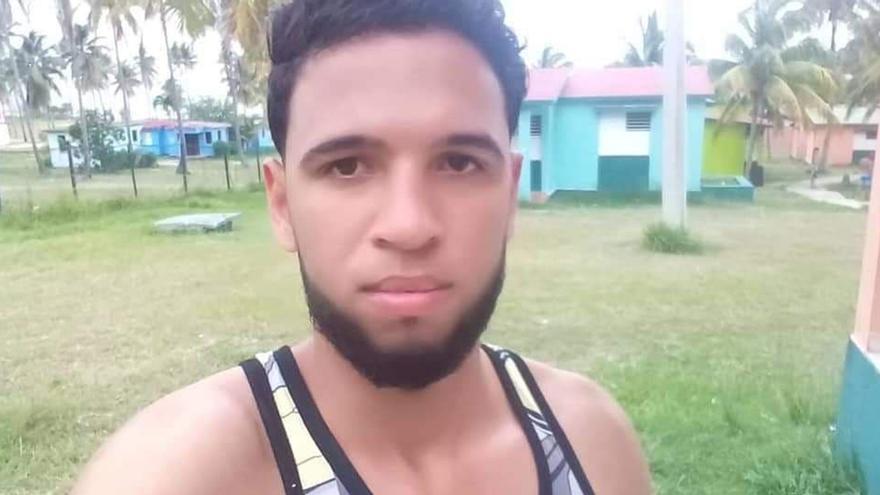
Donating Cell Phone Minutes, a Simple Way to Support Change in Cuba

Wright and Miralles, partners in life, not just in art, told Efe that the purpose of this project is to support the social protest and help people on the Island. (EFE/Wright/Miralles)

14ymedio biggerEFE (via 14ymedio), Miami, 11 January 2022 — Cuban-American artists Antonia Wright and Rubén Miralles have volunteered to support a plan that will keep members of the Cuban opposition connected so they may coordinate amongst themselves and inform on events on the Island through something as simple as donations to pay for cell phone minutes.

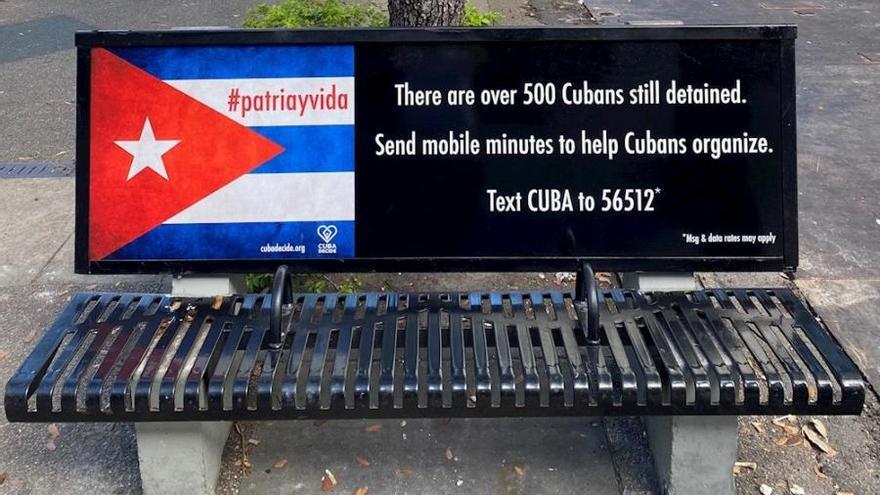
Wright and Miralles, known for their art in public spaces, have transformed two benches at strategically located bus stops in Miami-Dade county with text that alludes to political prisoners on the Island, which number more than 500 after the July 11th protests, and Patria y Vida” [Homeland and Life], the anthem of those demanding political change in Cuba.

In addition, those benches, one located in the center of Miami and another in Hialeah, a city where the majority of the population is Cuban, urge people to send a text message with the word “Cuba” to 56512, through which donations of any amount can be made to “recharge” mobile phones of people on the Island.

“There are still more than 500 Cubans detained. Send mobile minutes to help Cubans organize,” the bench reads, along with the number to be texted, a Cuban flag and “#patriayvida.” continue reading

Wright and Miralles, who are partners in life, not just in art, told Efe that the purpose of this project is to support the social protest and help people on the Island.

Donations will be distributed by Cuba Decide, which defends the right of Cubans to decide which political system they want, because, according to the artists, they can ensure these funds “directly reach those who need them,” without Cuban government intervention.

Rosa María Payá, Cuba Decide’s leader, told Efe that being connected amongst themselves and with the world is fundamental for opposition members and activists on the Island.

“When Cubans are connected, mobilization is much more effective,” emphasized Payá, to signal the important role cell phones played on July 11th, the largest protests on the Island since 1959.

It is also important so they can make known the results of repression unleashed by the Government since then, the situation of political prisoners, and the trials to which those that participated in the protests are subjected, she added.

Cuba Decide has launched a campaign targeting Cuban-American artists and small business owners to volunteer and raise funds to help the cause of freedom in Cuba.

“We appreciate all the friends for their help in elevating the voices of those who have no voice, supporting our movement until we achieve freedom and democracy in Cuba,” adds Cuba Decide on its Instagram account.

Translated by: Silvia Suárez

____________

COLLABORATE WITH OUR WORK: The 14ymedio team is committed to practicing serious journalism that reflects Cuba’s reality in all its depth. Thank you for joining us on this long journey. We invite you to continue supporting us by becoming a member of 14ymedio now. Together we can continue transforming journalism in Cuba.
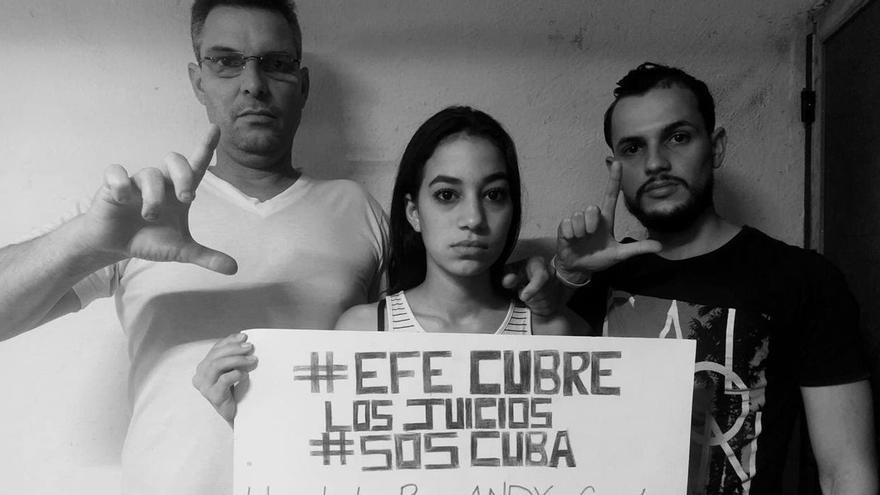
July 11th Protesters in Artemisa, Cuba Receive Sentences of Up to 12 Years in Prison

Eddy Gutiérrez Alonso was sentenced to 8 years in jail. (14ymedio)

14ymedio bigger14ymedio, Natalia López Moya, Havana, 9 January 2022 — For the crimes of public disorder, contempt, assault, and insulting national symbols, 13 protesters who participated in the peaceful protests on July 11th (11J) in the municipality of Artemisa, were sentenced on Friday; sentences ranged from 4 years of ’limited liberty’ to 12 years in prison.

The trial was held at the end of November in the courtroom of the People’s Provincial Tribunal of Artemisa, the province where the first popular protests occurred, in the municipality of San Antonio de los Baños. During the trial, family members denounced the fabrication of crimes and the use of false witnesses, used by the prosecutor to seek longer sentences.

Luis Giraldo Martínez Sierra (27 years old) received the longest sentence, 12 years in prison, followed by Yeremin Salcine Jane (31 years old), with a 10-year sentence. Victor Alejandro Painceira Rodríguez (26 years old) was sentenced to 7 years and José Alberto Pio Torres (28 years old), Iván Hernández Troya (25 years old) and Yoslen Domínguez Víctores (33 years old) were all sentenced to 6 years.

Javier González Fernández (34 years old) and Alexander Díaz Rodríguez (41 years old) will have to spend 4 and 5 years in prison, respectively, while Eduard Bryan Luperon Vega (21 years old) and Yurien Rodríguez Ramos (42 years old) were sentenced to 4 years of forced labor without internment.

For his part, Yoselin Hernández Rodríguez (39 years old) faces a sentence of 5 years of ’limited liberty’, while Leandro David Morales Ricondo (23 years old) faces a 4-year sentence of the same. continue reading

In the case of young Eddy Gutiérrez Alonso (24 years old), the sentence was 8 years behind bars. “I was crying all night. For going out to protest he must spend 8 years in prison,” his girlfriend, Rachel, became indignant during the conversation on Friday, after learning of the tribunal’s decision. “I’m very depressed with all of this, I still have not processed the sentence.”

The document which describes the sentences, to which we had access, was issued on December 27, 2021, but the political prisoner’s family members and defense attorneys received it on Friday. It is signed by the judges of the Municipal Tribunal of Artemisa, Yurisander Diéguez Méndez, Ernesto Amaro Hernández and Leonel Llerena Díaz. Furthermore, it should be stated that all of those tried were given joint penalties for various crimes.

Of all those accused, it is said that “they walked in the middle of the public road, obstructing all traffic,” on several municipal streets in Artemisa. As they walked, “they raised and agitated their hands, so people would follow them,” while also “screaming ’police dickheads’, ’police motherfuckers’, and Díaz-Canel motherfucker’,” this last phrase directed at President Miguel Díaz-Canel Bermúdez, “which exacerbated the spirits of those present and contributed to other people joining.”

Among the accusations against Luis Giraldo Martínez Sierra, the tribunal said it took into consideration his decision to “snatch from a government official” a Cuban flag, “which deserves respect for all it represents and the implicit honor it carries and in lashing out against the said symbol, demonstrated total irreverence.” The “facts” are described as “severe” because he also “decided to snatch the national symbol from the hands of a woman, physically smaller than him, shows a level of aggression on the part of the accused.”

With regard to Yeremin Salcine Jane, the judges considered “his active role in citizen disorder,” that he “uttered demeaning phrases against government officials,” in addition to “assaulting agents who were there to fulfill a mission, for which he hit and intimidated one truck driver so drivers would abandon their attempt to drive on, acts which resulted in marked violence and aggression in the public roadway.”

Of Eddy Gutiérrez Alonso, they stated that “in addition to disturbing the peace and offending government officials, he assaulted agents who were trying to contain the crowd’s illegitimate advance, for which he hit, threw a jar and intimidated the driver,” of a military truck, “so he would be unable to continue driving.”

Regarding the truck, the document also mentions the vehicle is a HOWO, “olive green, with ’PNR’ on its front doors, referring to the National Revolutionary Police, and belongs to the Military Unit 5274 Brigade of Prevention Troops of the Revolutionary Armed Forces of Havana.”

Some of the accused, “lay on the ground to prevent the truck from advancing,” described the sentencing document. “Later, they stood in front” of the vehicle and “with their hands, lashed out against the vehicle and its occupants, striking the front of the vehicle, Eddy joined in, forcefully striking the passenger side door of the car several times with a closed fist and damaging it.”

The document continues, while the truck was turning a corner onto another street, Eddy “grabbed a plastic bottle from the floor and threw it into the cab,” in the direction of the driver, “without injuring him.”

In another part of the country, Matanzas province, another trial resulted in six-year jail sentences for Tania Echevarría, Leylandis Puentes Vargas, and Franciso Rangel Manzana for protesting on 11J in the municipality of Colón, reported Radio Televisión Martí this Saturday.

Manzano and Puentes, members of the Pedro Luis Boitel Party for Democracy, have been in prison since July 11th.

The families of the 13 people sentenced in Artemisa, as well as those of the opponents in Colón, have said they will appeal the sentences imposed on the political prisoners.

Translated by: Silvia Suárez

____________

COLLABORATE WITH OUR WORK: The 14ymedio team is committed to practicing serious journalism that reflects Cuba’s reality in all its depth. Thank you for joining us on this long journey. We invite you to continue supporting us by becoming a member of 14ymedio now. Together we can continue transforming journalism in Cuba.
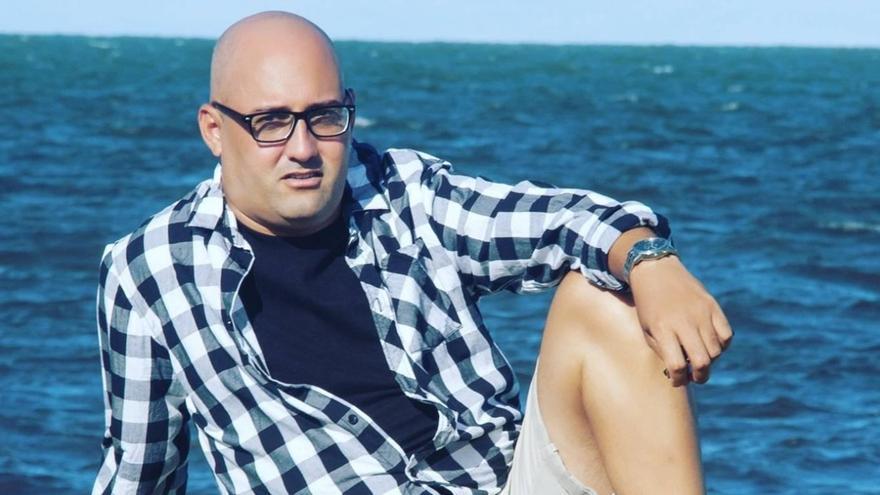
Family Members of Those Arrested on July 11 in Cuba Plea with EFE to Cover Their Trials

Family members of political prisoner Andy García joined the #EFECubreLosJuicios [EFECovertheTrials] campaign. (Facebook)
14ymedio bigger14ymedio, Luz Escobar, Havana, 7 January 2022 — The Cuban activist and businesswoman Saily González Velázquez, along with others such as Salomé García Bacallao, and family members of those detained on July 11th (11J), have started a social media campaign for the Spanish news agency, EFE, to cover the prisoners’ trials.

“There is still time for foreign press credentialed in Cuba to cover the trials of political prisoners. Several family members and activists have already joined the campaign [with the hashtags] #EFECubreLosJuicios [EFECovertheTrials] and #SOSCuba. Let’s support them,” said González on Twitter from Santa Clara, where she works in the private sector.

For her part, García Bacallao, emphasized that “from January 11th through the 14th four children will be tried in Holguín for the political crime of sedition,” and until now, the Spanish agency “has not covered a single ordinary trial of more than 200 July 11th protesters.”

Activists and citizens on the Island have joined the initiative on social media using the hashtag #EFECubreLosJuicios as a way to demand the agency inform on the legal proceedings, during which some have received sentences that exceed 20 years in jail. continue reading

González explained to us that she shared the idea with a WhatsApp group that brings together family members of those detained on July 11th and civil society actors. “Every once in a while initiatives to support political prisoners are presented there and it occurred to me to launch this campaign to raise the visibility of the situation, since we already know we have no other way to help them because, in Cuba, the legal tools that would allow us to help them do not exist.”

Furthermore, she says the campaign is based “on the responsibility that EFE has, as an international press agency credentialed in Cuba, to cover these trials,” and because it is often “picked up by other European media.”

Over twenty family members have joined the initiative, says González. “We hope more will join because the important thing is to pressure EFE to respond, if not, to make it clear that the agency is being complicit with the dictatorship and to show the lack of mechanisms available to Cuban civil society and family members of political prisoners to achieve justice.”

Jonathan López Alonso, a relative of political prisoner Andy García Lorenzo, said that what they intend to accomplish with this campaign is “for these communications channels which are credentialed in Cuba and do not do their job, to do it.” This young man’s trial will take place on January 10th and he is accused of public disorder, contempt, and assault.

“They hardly cover any of what the opposition and civil society do in Cuba. EFE covered what happened with Yunior García Aguilera in November when his home was under siege, but it is unjust that they covered that and not this. Why don’t they also do this with the trials, which is so important when they seek sentences of up to 25 years?” denounced López.

Bárbara Farrat Guillén, mother of 17-year-old Jonathan Torres, who has been in prison since August 13th awaiting trial for his participation in the 11J protests, also joined the campaigned, as did activists Daniela Rojo, Camila Rodríguez, and Leonardo Fernández Otaño. The latter, on his messages of support, also makes demands of other international press agencies such as AP, Reuters, AFP or television station CNN.

Although support for the initiative is growing, activist Saily González regrets that family members “still have not decided whether to speak publicly,” and they resist “using the few mechanisms we have to exercise our rights or at least try to,” because in her opinion it is something civil society “would love to” support.

“Family members are not accustomed to using the available mechanisms, almost no citizen here in Cuba is; first of all, they don’t know what they are, they do not perceive themselves as citizens with rights. While they decide, we will continue occupying our own social media, because the streets may belong to the revolutionaries, but social media belongs to us,” she confirmed.

Last November, Cuban authorities rescinded the press credentials of EFE journalists in Cuba, in the lead up to the so-called “illegal” Civic March for Change. Later, some of the credentials were reinstated; however, according to the agency, its delegation in Havana is depleted and it needs its entire team to return to work.

Since then, EFE warned its subscribers that the decision of the Cuban authorities in the last several months “have decimated the delegation’s team,” in Havana where currently, “only two journalists can continue working.”

Translated by: Silvia Suárez

____________

COLLABORATE WITH OUR WORK: The 14ymedio team is committed to practicing serious journalism that reflects Cuba’s reality in all its depth. Thank you for joining us on this long journey. We invite you to continue supporting us by becoming a member of 14ymedio now. Together we can continue transforming journalism in Cuba.
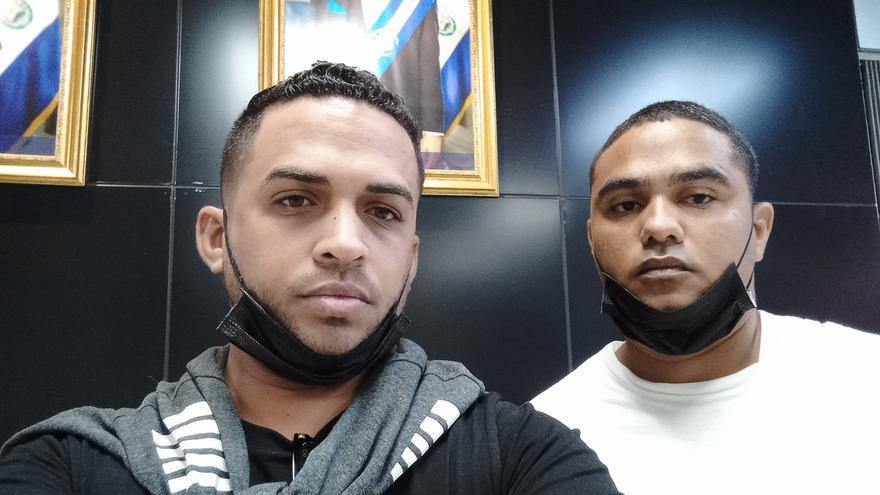
Threatened by State Security, Cuban Journalist Orelvys Cabrera Traveled to Russia

Independent Journalist Orelvys Cabrera. (Facebook)

14ymedio bigger14ymedio, Lorey Saman, Mexico, January 3rd, 2022–Independent reporter, Orelvys Cabrera Sotolongo had to abandon Cuba “due to pressure from State Security.” The journalist, a resident of Matanzas and one of those detained during the protests on July 11th, confirmed on Monday to 14ymedio that he traveled to Russia along with his partner on December 19th.

“I was the last journalist to be released from prison after July 11 (11J). They were extreme with me, they held me prisoner for 37 days,” said Cabrera, who insists that the regime’s repression increased after October when he launched a podcast, La Gusanera, a project developed along with CubaNet, an independent media outlet where he is a reporter.

With regard to his arrest on 11J, he said he was reporting on the events of the social uprising when State Security “kidnapped him.” The political police “had been following me for a while, they knew who I was.”

As soon as they saw him at the protest, he says, they “sent a patrol car” and they loaded him in it. “I say it is a kidnapping because I was forced to disappear for ten days, until one point when they allowed me a phone call because my partner denounced on Mega TV that I had disappeared and my whereabouts were unknown,” said Cabrera, who has been practicing independent journalism since 2018.

After more than a month in jail the terms of his pre-trial detention changed to house arrest and only a few weeks later continue reading

he was fined for the propagation of the epidemic and public disorder.

Since then, the political police warned him they had opened a case file to incarcerate him and they’d add several criminal charges. He also received death threats from people on the street who appeared “common,” he said. “The last was a Black man with a knife in his pants. He raised his t-shirt and told me, ’This revolution was made with the blade of a machete and, if necessary, we will preserve it with the blade of a machete.’ When he did that, I told myself they could assassinate me.”

State Security communicated that he would be processed in court for “ideological corruption of minors,” due to a video he made “talking about the trains in Cuba” where “a minor gave a testimonial.”

“The truth is, I didn’t know that crime existed, but it is included in a file they had opened on me.” In reality, this crime is not mentioned in the Cuban Penal Code, which only mentions “corruption of minors”.

Furthermore, he was warned that he’d be accused of “usurpation of duties” [practicing  a profession without a license] for not having his journalist credential and that he’d be added to the list of “regulated” people who cannot exit the country. They also invalidated his degree in Social Communications.

During one of the interrogations they spoke without filter: “You have become a very potent opponent and we need to put the brakes on that, the easy way or the hard way.”

Regarding his exit from the country, Cabrera maintains, “This step we took is very difficult, it is difficult to abandon your land knowing you will not return to see it nor will you be able to return to your family. I do not view it as cowardice.”

“Repression in Cuba has increased a lot and there are many independent journalists who are almost at the prison doors, there are many activists being pressured and I believe that I feel more useful outside than inside [the country] because I realized that my voice bothers them, my discourse bothers them,” he explained.

Cabrera appealed for the support of any international organization or American politician who could help him exit Russia, “a homophobic society,” he said. “A homosexual couple in this country could be at risk and more so because the tentacles of the Cuban dictatorship could reach here and they could even kill us and the crime would go unpunished.”

“We need to leave as soon as possible before we lose the tourist status we now have,” he explained. “When we lose this condition, it will be more difficult to exit legally, it would need to be through a border and right now, the closest one is Serbia,” where the crossing, he recognized, “would be very difficult.”

In the last year and more frequently after July 11th, the Cuban regime has reverted to its historical tactics: forcing every voice that rises up against it to exit the Island. Several protestors, opponents and artists have had to abandon the country for fear of being incarcerated, as has occurred in other decades.

Among the most notable are artist Hamlet Lavastida and poet Katherine Bisquet, after negotiating with State Security, which hopes to remove from the country some political prisoners, such as activist Luis Manuel Otero Alcántara, rapper Maykel Castillo Osorbo and independent reporter Estaban Rodríguez.

Translated by: Silvia Suárez

____________

COLLABORATE WITH OUR WORK: The 14ymedio team is committed to practicing serious journalism that reflects Cuba’s reality in all its depth. Thank you for joining us on this long journey. We invite you to continue supporting us by becoming a member of 14ymedio now. Together we can continue transforming journalism in Cuba.

The Last of Those Arrested on Obispo Street, Esteban Rodriguez, Exits Cuba ‘Fleeing Terror’

Esteban Rodríguez and Héctor Luis Valdés Cocho at the airport in El Salvador. (Facebook)

14ymedio bigger14ymedio, Havana, 5 January 2022 — Journalist Esteban Rodríguez, detained in Combinado del Este prison until Tuesday for participating in the protest on Obispo street is in El Salvador with his colleague Héctor Luis Valdés Cocho after Nicaragua refused them entry. Both are reporters for the Cuban independent daily, ADN, and members of the San Isidro Movement.

Tuesday night, 14ymedio learned of the release of Inti Soto and Ángel Cuza, the only activists that remained in jail with Rodríguez for protesting on April 30th, and attempted to contact Valdés Cocho for information about the last of the detainees, who apparently remained awaiting release; however, his cellular phone was off.

Very early this morning, Valdés Cocho published a post on Facebook recounting how both were forced to “take the decision to abandon our country, destined for Nicaragua,” although he adds that his intention was to remain there only for a few days to end up in the same place as many Cubans “fleeing the terror perpetuated by a totalitarian system.”

However, according to his statement, the route included continue reading

a layover in the Tocumen airport (Panama), from there they were to fly to El Salvador before continuing on to Managua. It was at that point, upon their arrival in the San Salvador airport, that they were called through the loudspeakers and informed that Nicaragua, governed by an associate of the Cuban regime, Daniel Ortega, rejected them.

“They never provided an explanation, much less a possible solution to this problem that emerged. Stranded in San Salvador, in migratory limbo and without considering a return to our country due to the imminent threat of arrest [CHECK: I’m never how to process that word “procesarnos”]  if we did,” said Valdés Cocho.

According to the reporter, Rodríguez was taken to the Havana airport straight from prison, with sores on his feet from the shackles, in the early morning hours on Wednesday. He assured that he was also driven to the same terminal where both were told they were being expelled and could never return to Cuba.

“Here we are; without any solutions, without money, without food and imploring the Salvadorean Government or any democratic country; to offer assistance,” he writes.

According to his account, they had not received a response from the immigration authorities of El Salvador, nor to the asylum application they submitted.

Esteban Rodríguez has spent the last eight months in prison, since April 30, 2021, when he attempted, along with other protesters, to approach the house where artist Luis Manuel Otero Alcántara was on a hunger strike.  When police tried to impede their passage, the group initiated a sit-in to protest what they considered a limitation of their freedom of movement, but they were arrested.

Of the six activists who were sent to prison for those acts, Mary Karla Ares was released in May and Thais Mailén Franco Benítez and Yuisan Cancio in September.

With Tuesday’s release of Inti Soto and Ángel Cuza, only Rodríguez remained in the Combinado del Este prison where he said he was subjected to torture, isolation in punishment cells under sub-human conditions.

Rodríguez also participated in the Facebook live stream, where he denounced not being able to say goodbye to his family. “They were eight months under a tremendous hell, I always thought that the next time I’d live stream it would be from my Havana, in my Cuba, with the people from my neighborhood. Not in this way, having to exit my country, simply because I fear for my life.”

Translated by: Silvia Suárez

____________

COLLABORATE WITH OUR WORK: The 14ymedio team is committed to practicing serious journalism that reflects Cuba’s reality in all its depth. Thank you for joining us on this long journey. We invite you to continue supporting us by becoming a member of 14ymedio now. Together we can continue transforming journalism in Cuba.